
Article

Prompt Choreographies: Dialogues Between Humans and Generative AI in Architecture

by
Martin Uhrík
1,
José Carlos López Cervantes
2,
Cintya Eva Sánchez Morales
2,
Roman Hajtmanek
1,*,
Jakub Demčák
1 and
Alexander Kupko
1
1
Institute of Ecological and Experimental Architecture, Faculty of Architecture and Design, Slovak University of Technology in Bratislava, 812 45 Bratislava, Slovakia
2
Department of Graphic Expression in Architecture and Engineering, School of Architecture, University of Granada, 18071 Granada, Spain
*
Author to whom correspondence should be addressed.
Architecture 2026, 6(1), 46; https://doi.org/10.3390/architecture6010046
Submission received: 15 December 2025 / Revised: 9 February 2026 / Accepted: 7 March 2026 / Published: 11 March 2026
(This article belongs to the Special Issue Architecture in the Digital Age)

Abstract

Generative artificial intelligence is increasingly embedded in architectural practice and education, yet its role often remains confined to image production or optimization tasks. This study situates generative AI within a broader design ecology. It examines how structured human–AI interaction can support environmentally oriented architectural thinking in design education. The article presents an international design workshop as a research setting in which architecture students engaged with AI through a multi-agent workflow. This workflow combined large language models, diffusion-based image generation, 2D–3D translation tools, parametric modeling, and clay-based 3D printing. Central to the methodology is the concept of prompt choreographies. These are deliberate dialogs between human and AI agents, based on a language of prompts and AI-generated outcomes. Through this process, the design concept moves toward a final architectural proposal. The workshop addressed complex ecological challenges emerging from interactions among Earth’s spheres. These were conceived as environmental interfaces defined by behavioral continuity rather than typological form. Using qualitative, design-based evaluation criteria focused on environmental, spatial, and material aspects, the study identifies recurring patterns of human–AI collaboration. The findings indicate that generative AI supports architectural ideation most effectively when embedded in structured workflows that emphasize curatorial decision-making and reduce generative overproduction. While limited to a workshop-based educational context, the research offers transferable methodological insights for architectural pedagogy and conceptual practice. It proposes a process-oriented framework for designing with generative AI and outlines an emerging form of architectural literacy and multi-agent collaboration that warrants further empirical validation.

Graphical Abstract

1. Introduction

Over the past decade, computational paradigms in architecture have shifted dramatically. Artificial Intelligence (AI), once a distant technological prospect, is now embedded in the very software tools architects use daily, quietly but profoundly transforming the nature of design. While the early 2000s were defined by parametric design systems and the 2010s saw the rise in digital fabrication, particularly 3D printing, the 2020s are being shaped by AI. As Campo and Leach note, AI is the first genuinely native design technology of the 21st century, and it is revolutionizing architectural culture [1].
Within current discourse, two contrasting but complementary trajectories of AI application can be observed. The first centers on analytical AI [2], where machine learning is employed as a problem-solving engine. This stream addresses quantifiable, tame challenges in architecture—optimizing floor plans for spatial efficiency, reducing material waste, forecasting energy performance [3], or minimizing construction timelines. Here, the architect’s role is to define measurable objectives, with AI serving as an accelerator in achieving them.
The second trajectory leans toward the more intangible aspects of architectural practice—creativity, spatial intuition, and atmospheric sensibility. This is the realm of generative AI [2], where the goal is not merely to optimize what already exists but to imagine what could exist. Generative systems, from image synthesis to text-to-3D, explore formal, material, and experiential possibilities that resist quantification. In this mode, AI operates less like a calculator and more like a speculative tool, expanding the terrain of design ideas rather than narrowing it to a single optimal outcome.
Generative AI has moved rapidly from being a novelty—producing concept art and speculative visualizations—to becoming an integral part of design studios. Beyond ideation, AI now automates architectural production, from generating floor plans to evaluating programmatic and spatial requirements [4,5]. The technology is also facilitating clearer communication between clients and architects by producing highly specific imagery and scenarios early in the design process [6]. Crucially, recent developments are closing the gap between 2D and 3D workflows. AI tools now allow designers to transform flat images into spatially coherent models, with increasing control over geometry, detail, and scale [7,8]. These capabilities are evolving rapidly, reshaping both how we work and what we imagine to be possible.
Within the current international body of research on generative AI, considerable attention has been devoted to the technical use of individual tools, prompt sequencing, and the selection of generated outputs. These aspects are often examined in isolation. By contrast, less attention has been paid to their structured comparison and systematic evaluation within collaborative human–AI design processes based on shared criteria.
This article approaches AI as an integral component of conceptual architectural design education. The focus is on the theoretical framing, systematic observation, and evaluation of applying AI within collaborative design processes oriented toward environmentally friendly architecture. By engaging AI across multiple stages of the conceptual design pipeline, the study investigates how human–AI interaction can support ideation, interpretation, and early-stage spatial articulation.
To examine these questions in practice, an international student workshop was conducted at the University of Innsbruck. The workshop functioned as a laboratory for implementing AI in architectural education, enabling mixed student groups to experiment with multi-agentic workflows. Attention was given to documenting patterns of human–AI interaction and evaluating the architectural outcomes produced through these methods, with prompt choreography serving as a central operative mechanism.
Prompt choreography is the deliberate dialog between human and AI agents, based on a language of prompts and AI-generated outcomes. Through this dialog, the design concept moves in a repeating loop of abstraction, interpretation, synthesis, and refinement. This loop iteratively guides the process toward the final design. Rather than a single instruction, it operates as a structured design process in which each prompt reshapes the relationship between latent space and architectural intention.
The workshop focused on ecological and climate-change challenges that are diffuse, hard to delimit, and technically demanding. Rather than discrete objects to classify typologically, these problems present themselves as couplings at sphere borders (e.g., cryosphere × technosphere; cryosphere × lithosphere × technosphere), theoretically derived from the texts in Log60: The Sixth Sphere [9]. For such contexts, the workshop adopted a topological, coherence-first framing rather than typological sorting. Here, identity is treated as a continuity of behaviors and boundary conditions, rather than as membership in a canonical family. The workshop outcomes are therefore framed as environmental interfaces. An environmental interface is a multi-layer climatic, material, and informational membrane operating at the borders of Earth’s spheres, where physical, biological, and computational systems exchange energy, matter, and data. Its identity is defined not by typology but by behavioral invariants—flows, latencies, porosities, and human accessibility—through which the planet becomes governable, legible, and responsive.
The empirical contribution of this study lies in a qualitative, design-based analysis of human–AI interaction patterns across multiple student teams and their relationship to the qualities of the outcomes. This analysis provides the foundation for the core research question and two sub-questions explored in this article:
  • How do human–AI interaction patterns shape design outcomes within multi-agentic, AI-assisted architectural design processes?
    What is the potential of AI-driven design pipelines to generate environmental interfaces that effectively integrate natural systems with technological layers?
    To what extent do AI-generated architectural designs remain purely speculative, and how feasible is their translation into structurally, environmentally, and materially viable solutions?
The paper combines theoretical reflection, design-based empirical observation, and comparative evaluation to examine these questions.
In the following sections, we situate this work within the broader discourse on AI in architecture. These sections outline the methods and tools used in the workshop and present the outcomes as case studies and exploratory provocations. Rather than making definitive claims, the article suggests a broader understanding of AI in architecture. AI is not a replacement for human creativity but a tool that may support more iterative and interconnected design processes.

2. Theoretical Background

2.1. Beyond Imitation: The Extended Role of AI in the Design Pipeline

Often reduced to the role of a concept art and sketch generator, generative AI has been framed as an “automatization of imitation”, recalling historicist copying. Yet imitation has always played a role in architectural culture. What matters methodologically is not imitation itself but how it is transformed into actionable design intent. Unlike historicist reproduction, generative AI does not replicate forms literally. It learns distributions from large-scale datasets and produces statistical recombinations. The novelty of these outputs emerges through interpolation, recomposition, and selection effects rather than direct copying [2,10,11,12]. While training sets are selected externally, foundation-model pipelines inherit structural risks related to data provenance, scale, and bias [12]. Despite this, authorial intention is not erased. Rather, it is re-situated through prompting, iteration, curation, and translation. This is consistent with accounts of distributed authorship and socio-technical action in design and human–computer interaction [13,14,15]. In this paper, agency is therefore treated as a workflow property, emerging through sequences of decisions and transformations rather than as a single-author act.
Beyond sketch generation, AI’s potential extends into an integrated design pipeline that reshapes both ideation and material translation. This shift sits within longer genealogies of computational and interactive design imaginaries in architecture. In these, computation is framed as an active partner in design reasoning rather than a neutral drafting tool [16,17,18,19]. In contemporary practice, large language models can support early-stage concept development through textual exploration and prompt-based reasoning [20,21,22,23]. Visual generators translate design constraints into imagery that mediates intention. Such workflows amplify the iterative character of design, aligning with accounts in which problems and solutions co-evolve through cycles of reframing and critique rather than linear optimization [24,25,26,27]. Later, 2D-to-3D translation tools and diffusion-based approaches extend this sequence by enabling generated imagery to evolve into 3D hypotheses that require architectural control through remodeling, structuring, and prototyping [7,8]. Accordingly, this paper treats AI outputs as intermediate design material. They are useful insofar as they can be curated, reconstructed, and made operable within architectural workflows. At the same time, critical AI scholarship foregrounds intellectual property, dataset provenance, representational bias, and uneven distributions of harms and benefits in data-driven systems. This highlights the need for methodological transparency and bounded claims when describing “literacy” or broader impacts [28,29,30,31].
This framing motivates the paper’s empirical focus on multi-agent workflows. In these, design intent is consolidated through prompt choreographies and translation steps (selection, remodeling, prototyping) rather than through single-shot image generation. The workshop evidence discussed later is therefore read as an instance of workflow agency. It shows how teams reduced overproduction into coherent mechanisms, stabilized decisions across media, and translated speculative imagery into controllable geometry and materially constrained prototypes.

2.2. Diffusion, Latent Space, and Why Design Should Aim for Coherence (Not Typology)

2.2.1. What Diffusion Models Actually Do

Diffusion models do not render scenes the way a ray tracer does. They denoise. Starting from noise, they iteratively move a sample toward regions of the latent distribution that satisfy textual and visual constraints [32,33,34]. This process is optimized for statistical coherence, not for canonical object-ness. In practice, prompts and image conditions act as fields of attractors. The model searches for mutual consistencies among cues and reconciles them through successive denoising steps [32]. What emerges first is not a “type,” but a coherent relation—a proto-behavior—around which various shapes can stabilize.
The design consequence is to treat outputs as proto-topologies—relational templates awaiting environmental, material, and civic determination—rather than as finished forms. The useful question becomes: which relations are being made coherent (exchange, delay, porosity, telemetry, care), and how can they be stabilized as an interface.
Broader planetary framings (e.g., the “sixth sphere”) are referenced only to contextualize why these briefs are posed as cross-sphere boundary problems. The analytic emphasis remains diffusion-aware and coherence-first [9].

2.2.2. Ambiguity-to-Rule Prompting (Without Typological Targets)

Instead of prompting for a façade or a recognized building type, a coherence-first strategy composes constraint sets that the model must reconcile. For instance, couplings such as cryosphere × technosphere, or combinations such as melt-delay with evaporative cooling, porous joints with reversible assembly. The aim is not a stylistic image but a resolvable coherence. It is a relation that can be named, checked for consistency across iterations, and translated into architectural control. Once such coherence appears, it is not taken as a final proposal. It then becomes a provisional hypothesis that must be reduced, interpreted, and converted into explicit rules and modeling decisions within the pipeline (see Section 3). This step is where architectural authorship becomes legible. The designer decides what to keep, what to discard, and how to externalize intent as constraints that can survive translation across media.
In practice, this translation is guided by behavioral attributes treated as design handles. Teams specify the kind of exchange (e.g., convective, radiative, capillary), delay or retention targets, porosity gradients, material reversibility, and civic access. This ensures that intent can be carried across media. Authorship shifts from naming a type to articulating thresholds and relations that remain legible through iteration and reconstruction. The same mechanism can then be expressed through images, sectional logic, editable geometry, and prototype constraints.
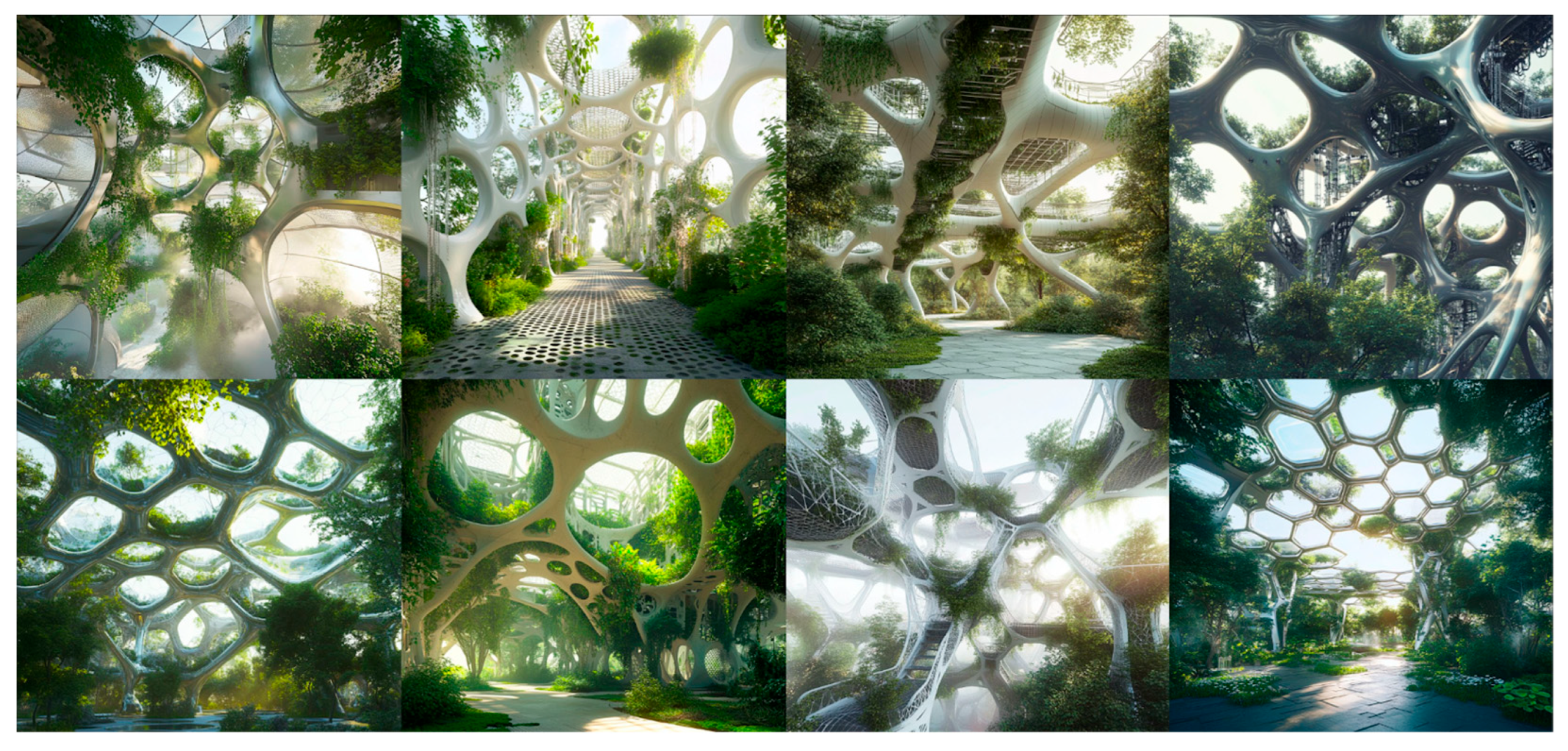
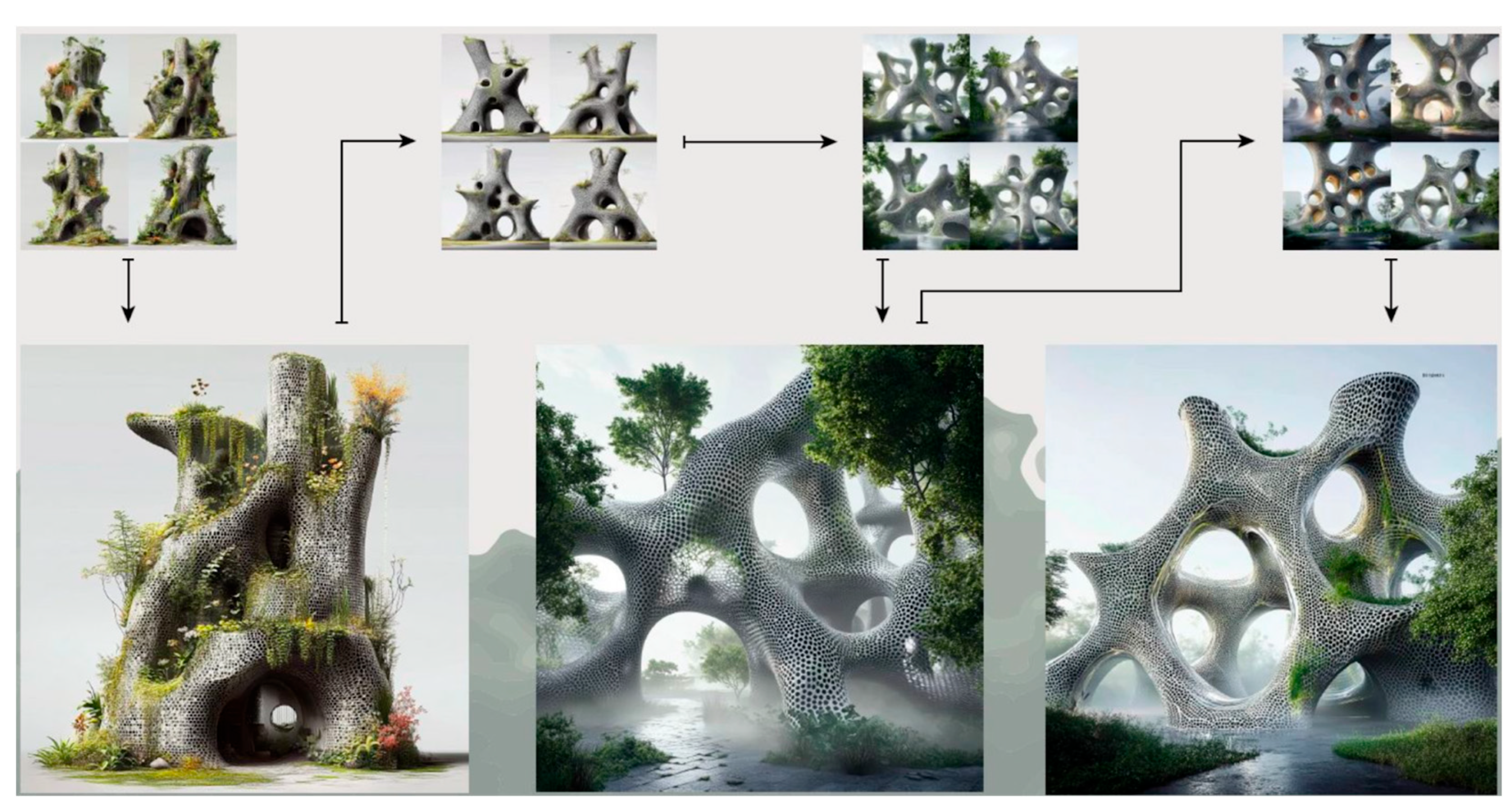
This process also clarifies why the paper treats the design artifact as an environmental interface rather than an object. The interface framing emphasizes coupled behaviors across energetic, material, informational, and civic dimensions. It also helps align representation with mechanism. Drawings, sections, and prototypes are read for how clearly they externalize where exchange occurs. They are also examined for how delays or gradients are produced and what forms of access, maintenance, or stewardship are implied (Figure 1). Here, the “interface stack” functions as a descriptive scaffold rather than a validated performance model. It supports consistent articulation of intent and provides a shared vocabulary for critique across teams.
Coherence-first prompting is inseparable from translation because diffusion outputs frequently resist classical CAD ontologies, such as NURBS patches and watertight polygonal solids. This resistance makes direct downstream use difficult [7,8]. Accordingly, the workflow relies on translation steps—selection, remodeling, and selective prototyping—to convert latent coherence into controllable geometry and plausible prototypes (see Section 3). Within these steps, prompts supply architectural semantics that point to behaviors rather than typologies. This ensures that intent remains legible as it moves from images to editable geometry and materially constrained prototypes.
The typology–topology distinction is not introduced here as a tested comparison. It is used later as a brief interpretive lens to clarify why the workshop briefs and evaluation criteria emphasize behavioral coherence and continuity under translation rather than typological resemblance.

3. Methods of AI Creativity

The workshop provided a central setting to observe creative practices and study interactions between participants and AI agents. Its aim was to identify methodologies emphasizing feasible rather than fantastical design. Participants were trained in the topic, condensed into two core principles of architectural design, previously framed as the problem of typology and topology.
A key perspective for connecting AI procedures with design is the role of the author. In the modernist model, the architect occupies the highest instance, governing the process. The system is strictly hierarchical—both in terms of a clearly structured decision-making sequence and in the logic of data reduction and typological organization. Despite multiple interpretative paths, these ultimately converge into a single correct solution. There is a clear line of reduction from the abstract multiplicity of possible interpretations towards one concrete answer.
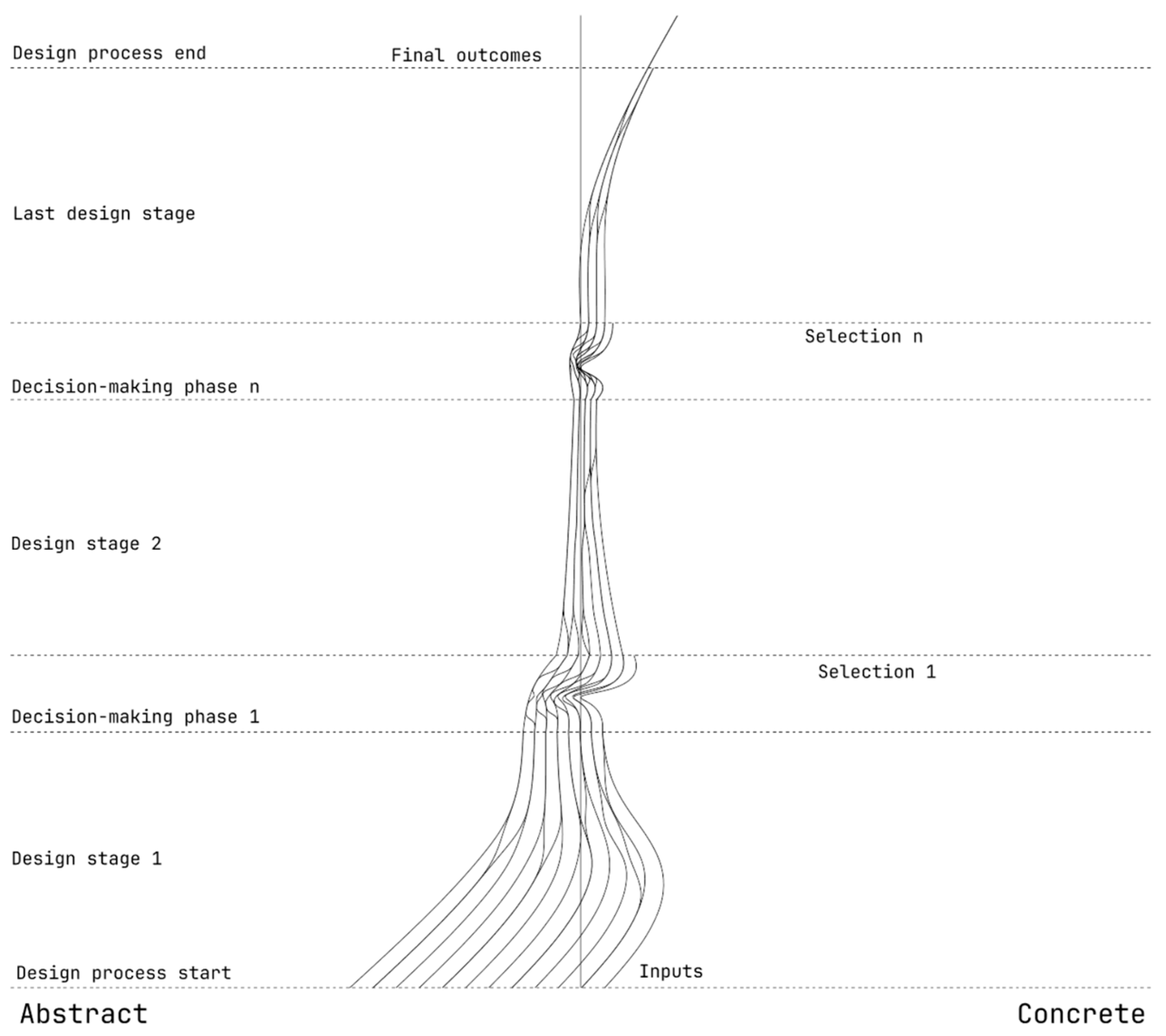
In the postmodern diagrammatic process, the author constructs an environment—the diagram—within which recursive actions synthesize design outcomes. Reduction proceeds from abstract data to the concrete through repeated loops searching for optimal solutions. The reduction in possible solutions unfolds from abstract data toward the concrete. This loop repeats: abstract data become concrete, and the reductive process continually searches for the optimal solution. The author organizes diagrams, procedures, and data, evaluating outputs through performative criteria. The logic of diagrammatic practice allows the system to expand with ease. In the 1990s, computational design techniques were naturally incorporated into diagrammatic workflows.
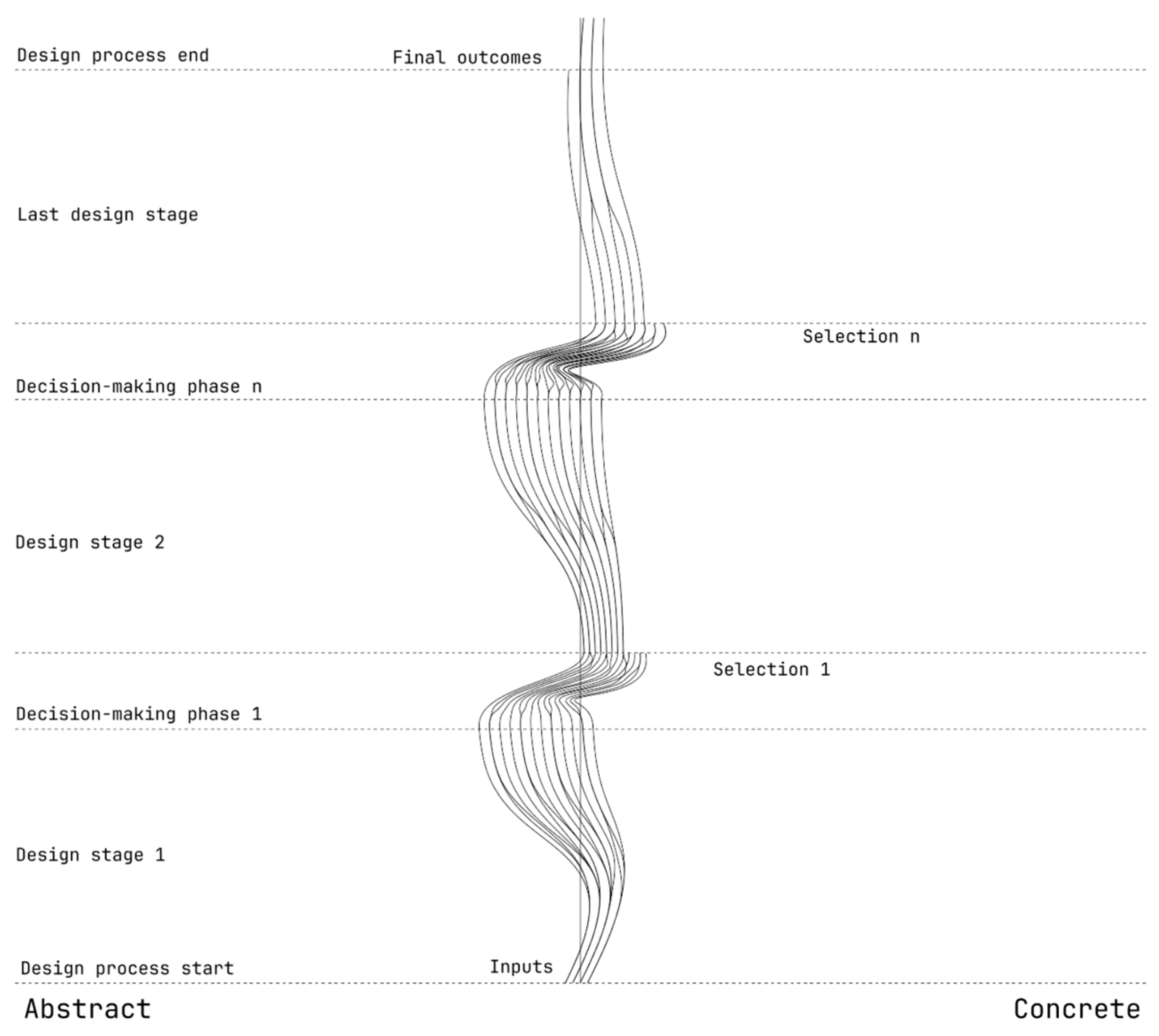
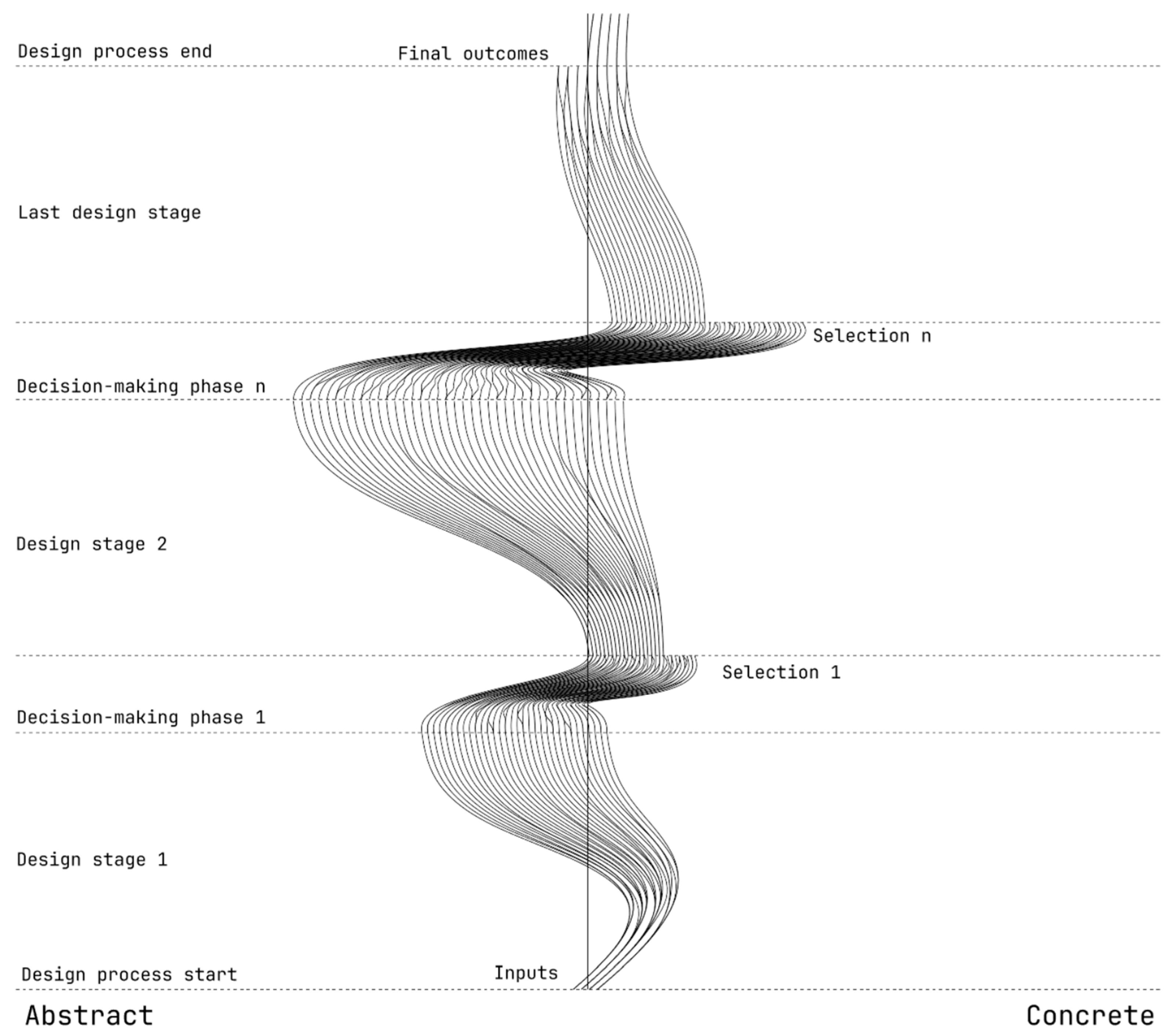
A shared denominator of both creative methodologies is the reduction in potential interpretations. This allows for the articulation of qualitatively stronger solutions and stabilizes the design into a concrete dispositif (see Figure 2 and Figure 3).

3.1. Agentic Design Environment

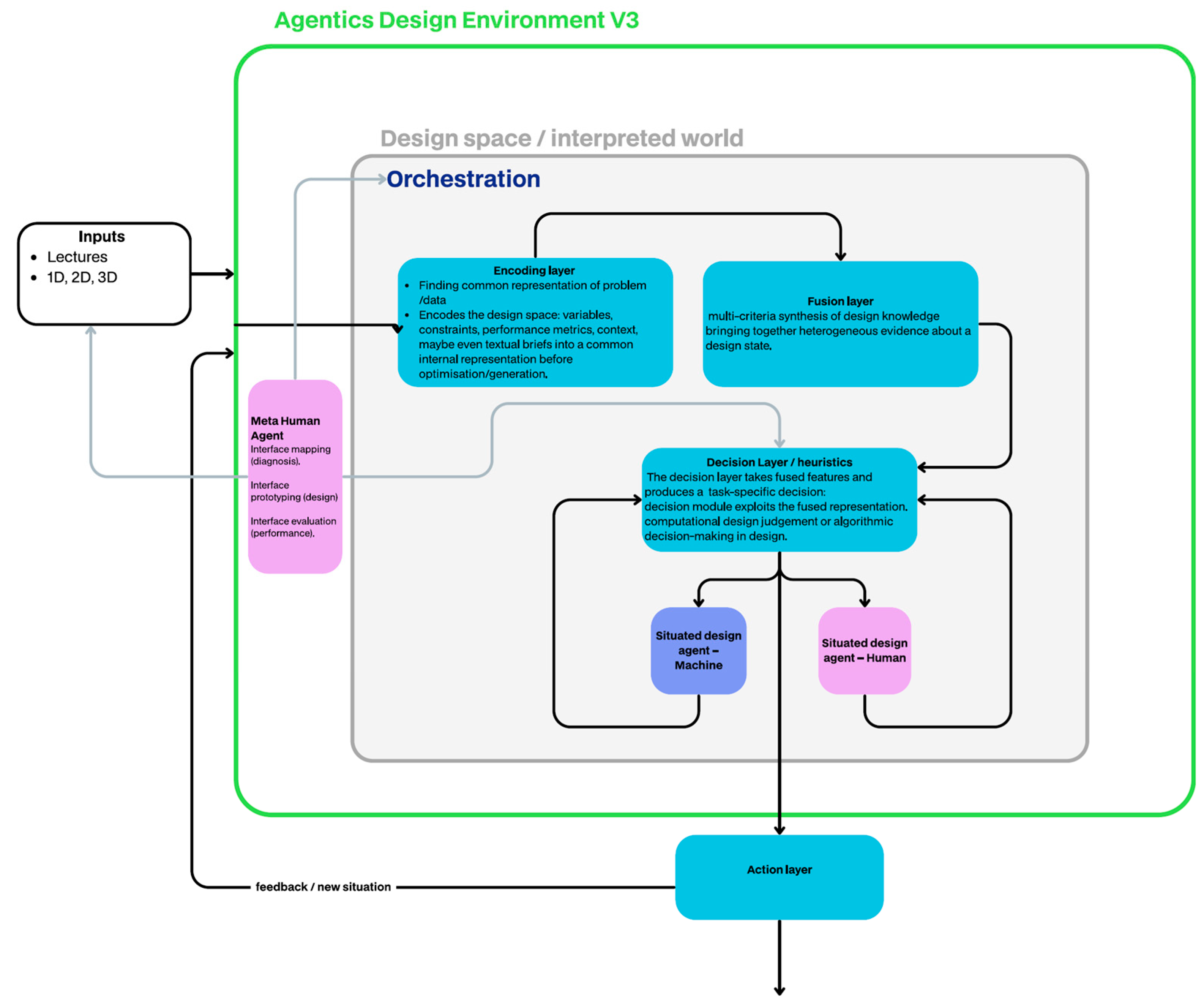
The environment developed during the workshop is called the Agentic Design Environment. The core of agent-based design was defined in the text “A Computational Framework for Concept Formation for a Situated Design Agent” by Gero and Haruyuki Fujii. A design agent possesses sensors, perceptors, and conceptors that interact with external and internal environments to construct situations [35]. A crucial aspect of this concept is that it does not distinguish between human and non-human agents. The second conceptual pillar stems from contemporary AI discourse: “A multi-agent system comprises multiple autonomous, interacting computational entities, known as agents, situated within a shared environment. These agents collaborate, coordinate, or sometimes even compete to achieve individual or collective goals” [36]. Our interpretation examines the shift in creativity toward the more formalized structures of designing AI systems.
The Agentic Design Environment describes a transition from viewing digital tools as passive instruments supporting the designer’s work to recognizing them as semi-autonomous participants in design processes. AI systems, parametric scripts, optimization algorithms, simulations, and fabrication procedures appear as a population of interconnected agents acting within a shared design ecology. Rather than a linear pipeline progressing from the abstract to the concrete, design becomes a distributed negotiation. In this process, human and non-human actors iteratively test and revise possible futures of the emerging project.
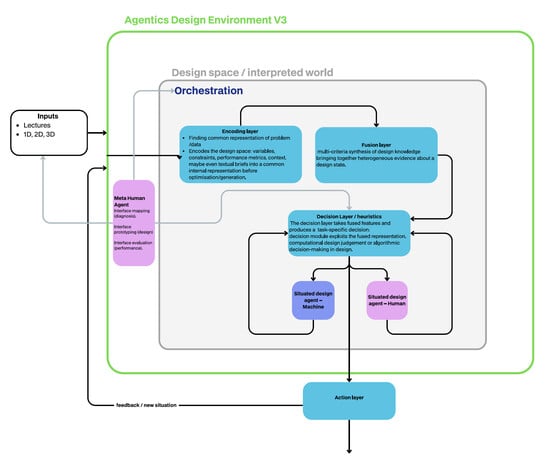
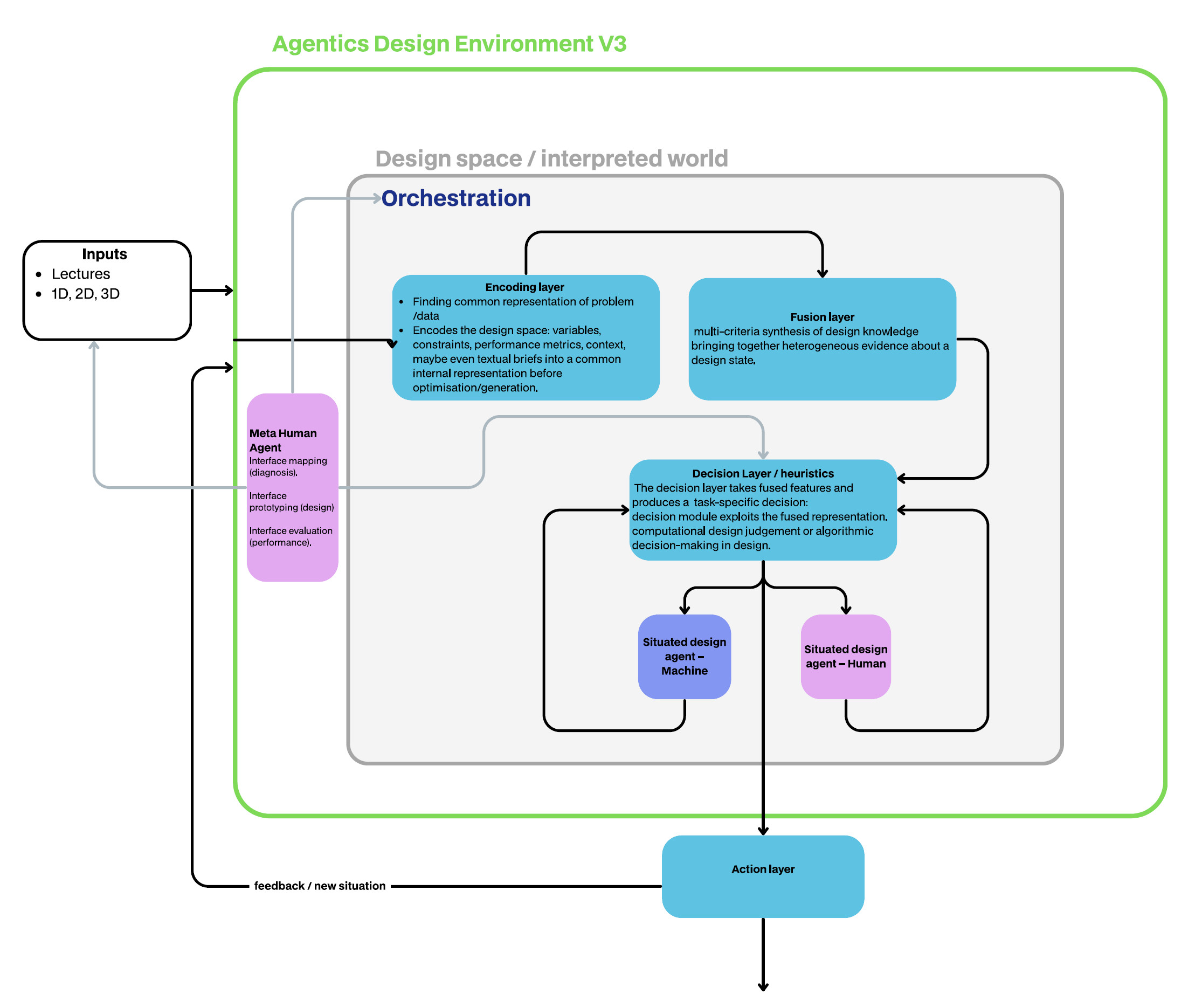
The structure of this environment is captured in a diagram (Figure 4), inspired by organizational diagrams of agentic workflows in Microsoft research [37] and by widely adopted descriptions of multimodal data fusion and multimodal agents. We therefore structure the system into five stages: Input, Encoding, Fusion, Decision, and Actions. Multi-agent systems do not possess a single universal workflow; their organization depends on diverse technologies and continually evolving processes and terminology. The selection of concepts and their relationships is thus not meant to be generalizable but reflects the concrete reality of our work during the workshop.

3.2. Layered Pipeline

The environment is structured differently from conventional design environments. The key parameter altering the organization of creation is the absence of reduction in the degree of interpretation at intermediate stages through abstraction. A fundamental characteristic of AI workflows is their overproduction of concrete configurations. From a human perspective, this yields an ungraspable proliferation of seemingly infinite permutations, often producing image-based simulacra.
The process begins classically, with input data of various kinds, as described earlier. These data enter the Agentic Design Environment, which encompasses all processes and informational flows.
The Encoding Layer processes heterogeneous material and recasts it into a shared design space. At this stage, the project becomes computationally legible. Briefs, sketches, and site readings are translated into parameterization and performance targets that subsequent agents can manipulate.
The Fusion Layer synthesizes design knowledge into a provisional representation that foregrounds conflicts and trade-offs and produces a problem-definition representation.
On the basis of this fused representation, a Decision Module—algorithmic, human, or hybrid—selects the next move. It may accept or reject variants, adjust parameters, or open a new branch in the design space and delegate activities to agents.

3.3. Agents

In our interpretation of the Agentic Design Environment, the human designer remains central, but no longer as a solitary author who governs every step. Instead, the designer oscillates between two roles:
  • The Meta-Agent, who sets up the system, defines rules, constraints, and evaluative procedures, curates emergent patterns, and integrates partial results into broader programs, narratives, and architectural languages.
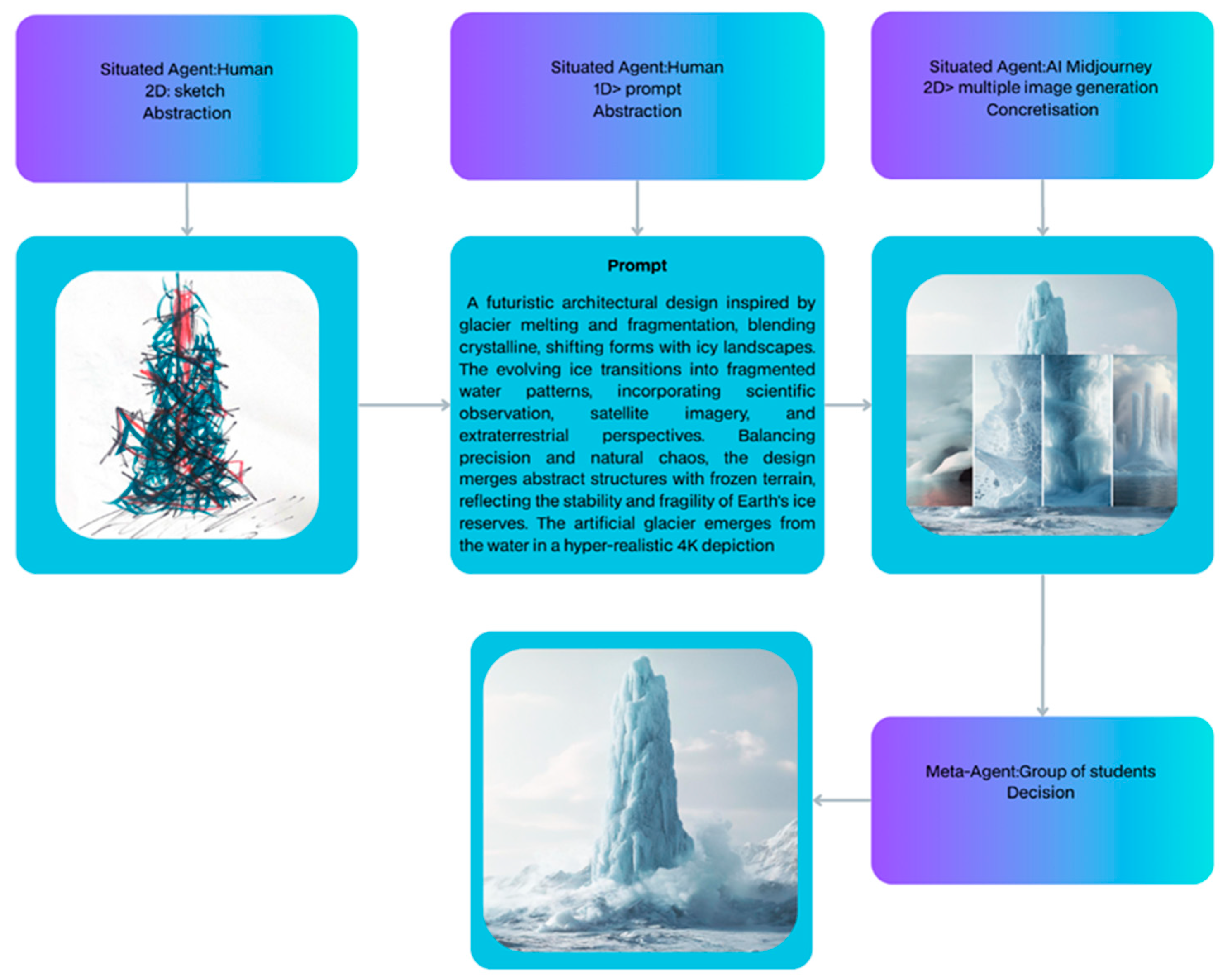
  • The Situated Agent, who participates in the ecology by sketching, prompting, annotating, selecting options, and engaging in dialogic exchanges with AI systems. The process often resembles “gaming” the environment: designers test prompts, parameters, and workflows to explore the latent capacities of the system (see Figure 5).
This dual positioning has significant implications. Every design move potentially reshapes the environment that conditions future moves. Moreover, both roles—meta-agent and situated agent—may be partially delegated to AI systems. A hybrid creative structure thus emerges, combining intuitive design and decision-making processes typical of humans with the computational and generative power of artificial intelligence. The orchestration performed by the meta-agent establishes communication flows between the design environment and the design space.

3.4. Multi-Agentic Design Process

AI workflows are determined by two fundamental processes. The first is a reversal of the relationship between the abstract and the concrete. Principles of design without AI proceed through gradual concretization. Each stage of the design process limits the number of new scenarios and narrows the field of interpretation. In an agentic environment, abstraction and concretization become cyclical rather than linear. The boundary between concept and detail, or between representation and operation, becomes porous.
A typical feature of generative AI is the overproduction of reality. Image outputs overflow with hyperrealist details. Textual analyses are saturated with excessive word descriptions and examples. These systems generate simulated realities that Carpo refers to as imitation [2]. The result is, in essence, an infinite proliferation of new interpretations circulating through the design process. From the perspective of achieving the task—producing a meaningful architectural output according to a brief—this overproduction of simulated realities becomes undesirable.
The work during the workshop demonstrated that the primary function of human participants, in their role as meta-agents, was to eliminate overproduction of interpretations. The first process within the decision layer became the reduction in AI-generated material to a corpus that satisfies defined criteria. The second significant process, appearing across multiple layers and guiding orchestration, was prompting.
A prompt is a textual command. Text may be understood as a one-dimensional entity that is always abstract and must be interpreted by every agent. On one side, it acts as a force enabling abstraction, filtration, and ultimately interpretation. It is a reductive procedure, a programmatic condensation and redefinition into abstraction, which allows ideas to escape the dictation of hyperreality. On the other hand, the prompt is a concrete instruction directing processes within the multi-agentic system. The abstract nature of natural language in our multi-agentic environment enables creativity, both at the level of meta-agents and at the level of situated agents. The orchestration diagram continually undergoes narrative updates that maintain the system on its trajectory toward fulfilling its task, an architectural response to the question emerging from the texts of the Six Spheres [9]. This iterative dialog of agents in abstract language abstracts and interprets the design concept in the Encoding Layer, synthesizes it in the Fusion Layer, and refines it in the Decision Layer (Figure 4). We call this process prompt choreography, as it drives the design concept toward a final outcome. This part of the Agentic Design Environment is central to the research because it is where creativity emerges and hidden patterns of the multi-agentic design process can be observed. A diagram illustrating the flow of concrete and abstract representations in the Multi-Agentic AI design process is shown in Figure 6.
The stack of the Agentic Design Environment is thus not only an operational model of interfaces. It is also an epistemic framework for architectural design practice that structures how design agents perceive and create.

3.5. Examining of Multi-Agentic Design Process in the Workshop

The workshop explored the multi-agentic design process for creating topological, environmentally responsive architecture—an environmental interface. Each team was assigned a task to create an environmental interface between the Technosphere and one sphere from Log60 [9] (Atmosphere, Hydrosphere, Biosphere, Cryosphere, Lithosphere). Students worked in teams of 5–6 members as human agents, together with AI agents including ChatGPT, MidJourney, Krea, Meshy, and 3D modeling tools such as Rhino and Maya. Together, they formed a multi-agent environment where human intuition, design judgment, and collaborative decision-making interacted continuously with autonomous computational creativity.
The examination of the multi-agentic design process was organized through a set of explicitly defined, layered workflows that specified how human and AI agents interacted. Because multi-agent systems do not follow a single universal workflow, these sequences were intentionally open. This allowed each team to produce slightly different variants through their own decisions. Each workflow was defined as a sequence of tools and agents—such as ChatGPT research followed by MidJourney generation—but this sequence could be repeated through prompt choreography as many times as needed, cycling through abstraction, interpretation, synthesis, and refinement. For this reason, the workflows were treated as loops or iterations rather than linear pipelines. The initial loops connected ChatGPT for 1D research and environmental concept formation to MidJourney for 2D generation, with Krea and other tools used for 2D editing, collaging, and refinement. In the middle iterative loops, refined 2D outputs were transferred to MeshyAI for 3D generation, then remodeled, merged, and adjusted in Maya and Rhino. In the final loops, Maya and Rhino were used to prepare geometries for clay 3D printing, while an optional return loop sent drawings and sections back to MidJourney for articulation of architectural details. Table 1 summarizes the phase-structured, multi-agent design loops used across teams, indicating the main objective of each phase, the tools and AI agents involved, the prompt type, the expected output, and the corresponding human decision.
The multi-agentic design process was examined by observing how human and AI agents collaborated across different phases, allowing recurring patterns of interaction, delegation, and decision-making to be identified. In parallel, the final outcomes were evaluated not as conventional architectural projects but as environmental interfaces operating across Earth spheres. The assessment applied a set of qualitative criteria: clear coupling between Earth spheres; environmental behavior defining identity over form; topological continuity, including survival under geometric transformation; humans embedded in the system; legible environmental processes; materiality actively regulating environmental exchange; and sensors and computation technologies enabling adaptive planetary response. Additional criteria addressed the quality of production outcomes (visuals and ideas), the clarity of design intent and use of AI capabilities, whether the outcome was a specific solution or a cloud of many non-concrete outcomes, and the structural and ecological feasibility of the physical model.
Clear coupling between Earth spheres assesses how clearly the project articulates and spatially locates interactions between two or more Earth spheres (e.g., cryosphere–hydrosphere), showing where and how exchanges occur and what role architecture plays in mediating them.
Environmental behavior defines identity over form evaluates whether the project’s identity is driven by environmental behaviors (exchange, delay, porosity, regulation) rather than by a fixed formal language or esthetic outcome.
Topological continuity survives geometric transformation measures whether the core spatial and behavioral logic remains coherent under geometric changes, meaning the design preserves relational structure (flows, gradients, interfaces) even as form is iterated or transformed.
Humans embedded in the system assesses how explicitly human presence, agency, and use are integrated into the environmental system—through access, maintenance, stewardship, operation, or participation—rather than treated as an external afterthought.
Legible environmental processes evaluates how readable the environmental mechanisms are in the proposal (e.g., airflow, condensation, filtration, thermal lag), so that a viewer can understand “what happens” and “where” without heavy explanation.
Materiality actively regulates environmental exchange assesses whether material choices and material logics (porosity, thickness, hygroscopicity, thermal mass, surface texture) actively control environmental exchange rather than merely representing an idea visually.
Sensors and computation technology enable adaptive planetary response. These measures whether sensing, data, and computation are meaningfully integrated to monitor conditions and adapt behavior. Integration involves feedback loops, thresholds, and responsive actuation, not merely generic “smart” features.
Quality of production outcomes (visuals, ideas) evaluates the overall quality and coherence of the produced outputs. This includes clarity of visuals, strength of the concept, and how convincingly the representations communicate the proposal.
Clarity of design intent and use of AI capabilities assesses how clearly the project’s intent is stated. It also evaluates how effectively AI tools are used (prompting, variation, translation to 3D, iteration) in a way that supports the design rather than producing arbitrary imagery.
One solution vs. cloud of non-concrete outcomes evaluates whether the workflow balances exploration and convergence. It assesses whether meaningful variants are generated while ultimately stabilizing one coherent, actionable direction rather than remaining in a vague cloud of possibilities.
Physical model—Structural feasibility assesses whether the physical prototype demonstrates structural plausibility (continuity, load paths, stability, printability/constructability) and whether the material test supports the claimed structural logic.
Physical model—Ecological feasibility evaluates whether the prototype supports the proposed ecological function (habitat potential, water retention/filtration, thermal performance, surface behavior) and whether environmental claims are credible at the tested scale.
To reduce interpretative drift, each criterion was operationalized through observable indicators discussed among evaluators before scoring. All projects were scored independently on a 0–5 scale by the six tutors during the finals of the workshop, with 5 representing the strongest manifestation of a given criterion. Rather than claiming objective measurement, the scoring was used to enable structured comparison between projects and to reveal correlations between process patterns and design qualities. Because the workflows and criteria are explicitly defined and reproducible, repeating the experiment allows comparable comparative analysis, even if individual outcomes differ.

4. Results: Workshop Case Studies

The workshop brought together 36 students from the University of Innsbruck, University of Granada, Academy of Arts Architecture and Design in Prague, and Slovak University of Technology in Bratislava. They were organized into seven mixed groups combining students from all participating universities. Working through the predefined cycles of prompting, collaging, and 3D translation, the groups revealed a range of architectural outcomes. They also revealed recurring cross-group patterns of collaboration, curation, and decision-making in human–AI workflows.
Across the groups, the workflow followed a shared loop: research and framing of an environmental theme, rapid visual exploration, selection, and gradual conversion into buildable form. Early iterations produced wide and sometimes contradictory directions. Progress depended on curating outputs—selecting, editing, recombining, and re-testing until a coherent direction emerged. Selected proposals were then translated into 3D geometry and refined through conventional modeling. Material thinking entered through analysis of porosity, layering, and texture, which informed fabrication tests and revisions.
What differed between groups was mainly where they gained control: some tightened the project through repeated visual iterations and collage-based correction, while others shifted toward more rule-based generation, manual remodeling, and scripted adjustments to steer form and circulation. Accordingly, the results are presented as brief case snapshots (Section 4.1, Section 4.2, Section 4.3, Section 4.4, Section 4.5, Section 4.6 and Section 4.7) followed by a cross-group synthesis of recurring interaction patterns (Section 4.8).

4.1. Group 1: Cryosphere

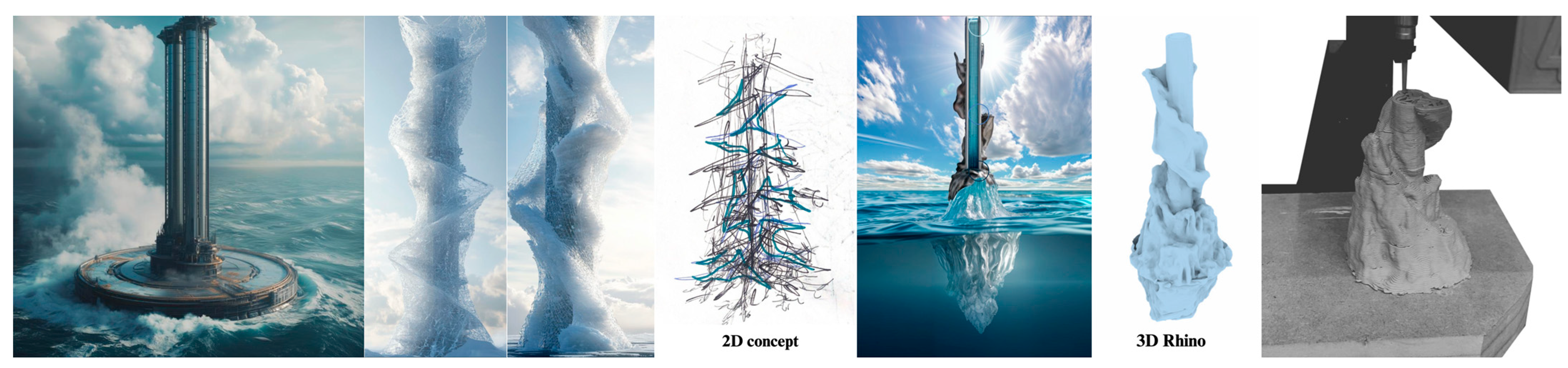
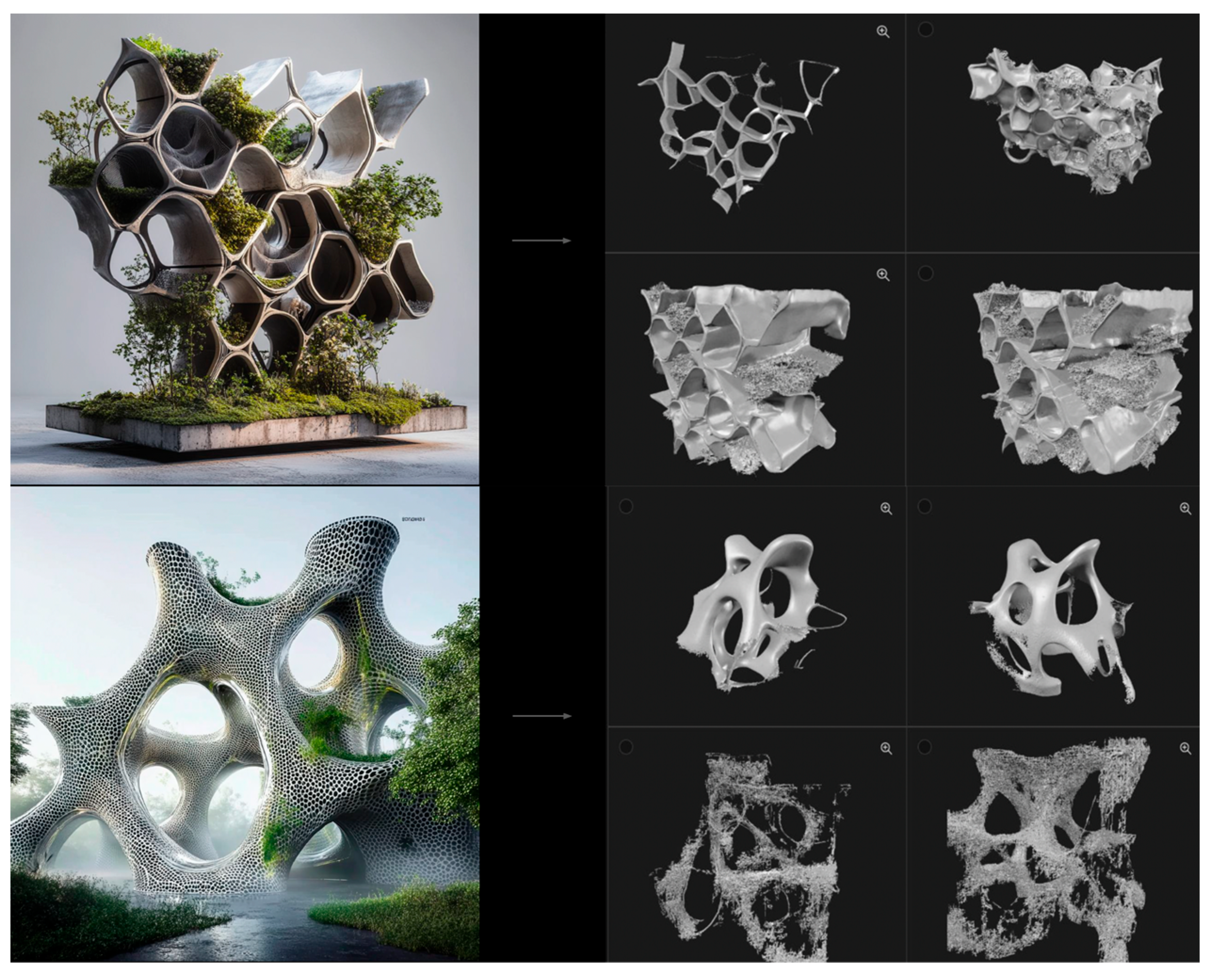
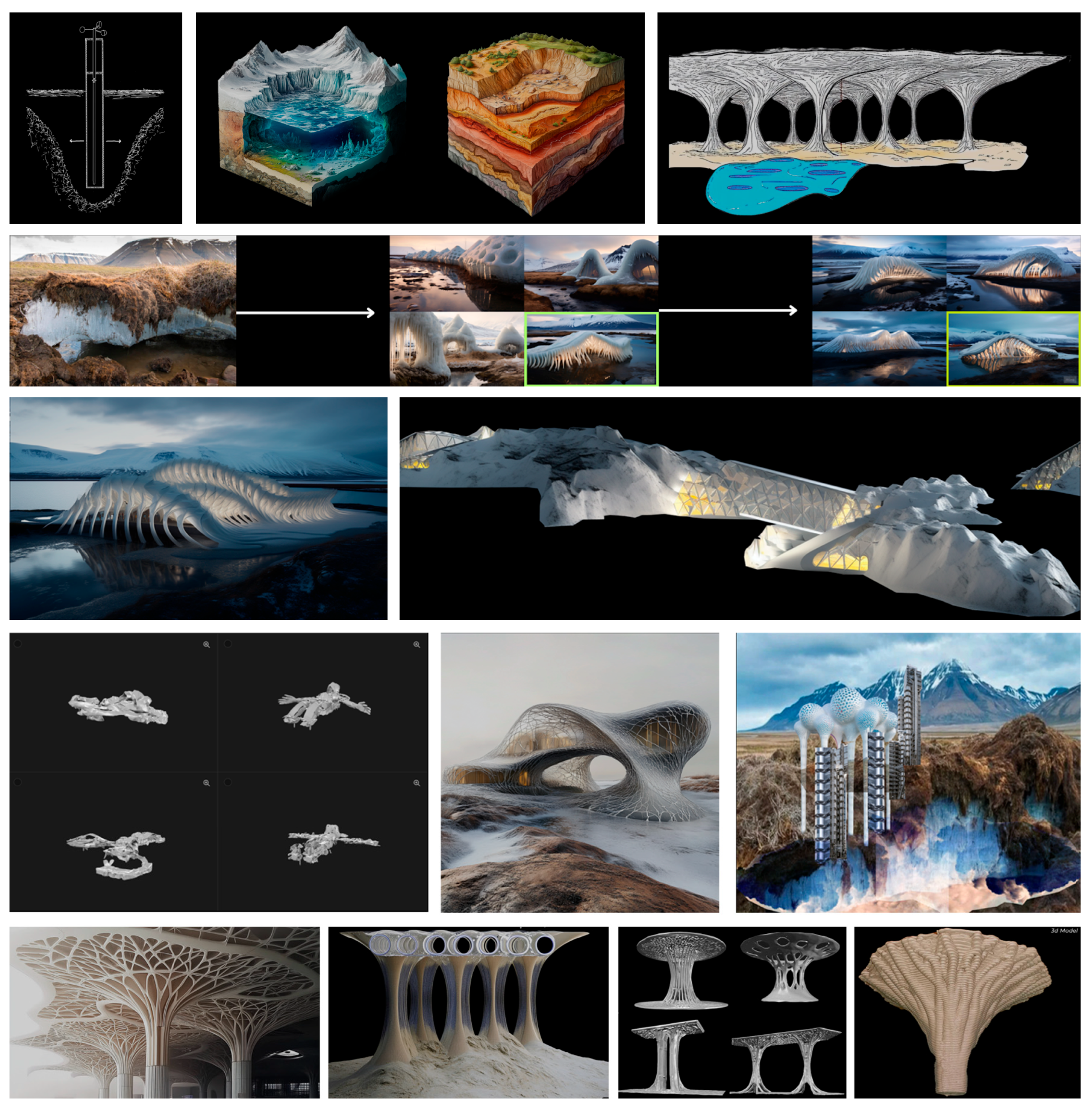
Group 1 used a large language model (ChatGPT) for initial research and to define a main concept focused on glacier loss and its downstream ecological and hydrological consequences. They linked this problem to the idea of artificial glaciers, inspired by Sonam Wangchuk’s Ice Stupas in Ladakh, which store winter water as ice and release it gradually during dry seasons. Building on this, the students proposed “CryoEarth,” a speculative vision of artificial glaciers used at a global scale. With this conceptual base, the group created a series of prompts (see Appendix A.1) and started visualizing their ideas in MidJourney. Through repeated prompting, image-editing and collage steps, and re-insertion of modified images back into MidJourney, they converged on a consistent visual direction. This workflow combined AI generation with manual collage and correction, allowing them to bring clear authorship into the process (see Figure 7).
Their final images were translated into a 3D model using MeshyAI. The model was further adjusted and detailed in Rhinoceros and finally prepared for digital fabrication through clay 3D printing. The outcome demonstrates an image-to-geometry-to-prototype workflow in which AI outputs were treated as intermediate material rather than final proposals.

4.2. Group 2: Lithosphere

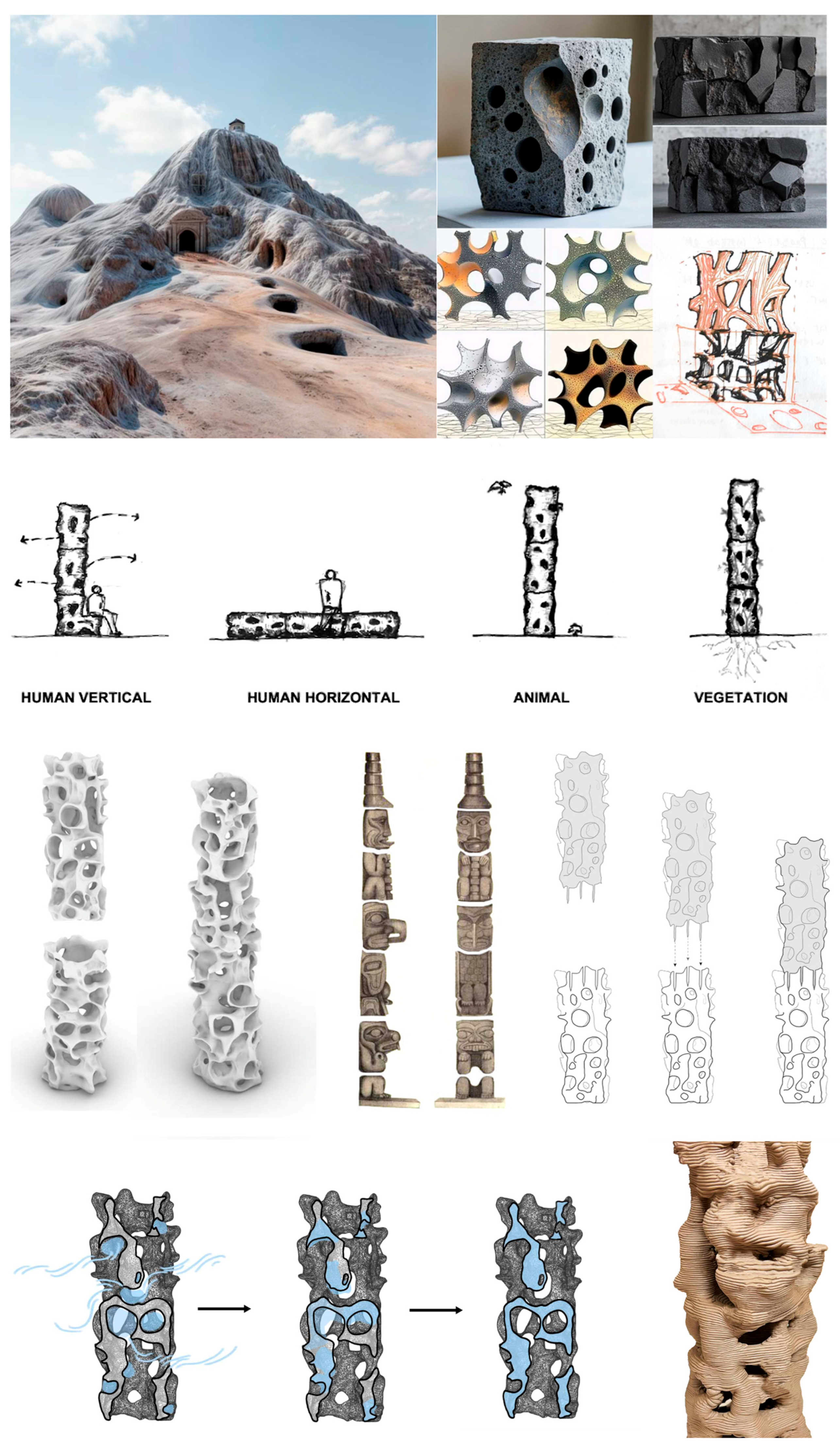
The group explored lithospheric processes—erosion, sedimentation, and porosity—as generative models for architectural form. Early prompting cycles fluctuated between overly literal cave reproductions and abstract biomorphic masses. The breakthrough came with prompts describing human vertical/horizontal occupation, animal traces, and vegetation patterns. These produced hybrid lithic morphologies balanced between geological and architectural logic (see Appendix A.2).
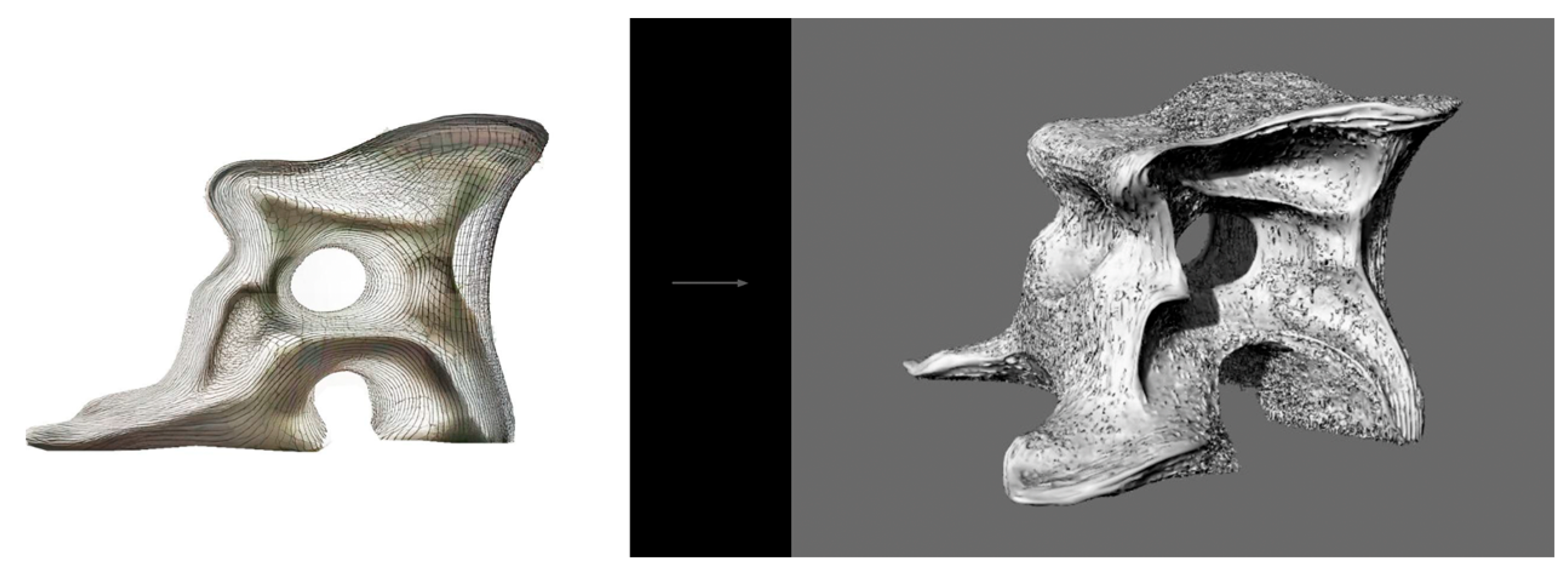
Meshy was used to extract workable geometries from selected images. Rhino refinements created continuous cavities, differentiated wall thicknesses, and stable sedimentary-like structures. Texture sampling informed porosity distribution and printability. The final clay prototype captured the eroded, stratified quality of the AI images while introducing material coherence (see Figure 8).

4.3. Group 3: Biosphere

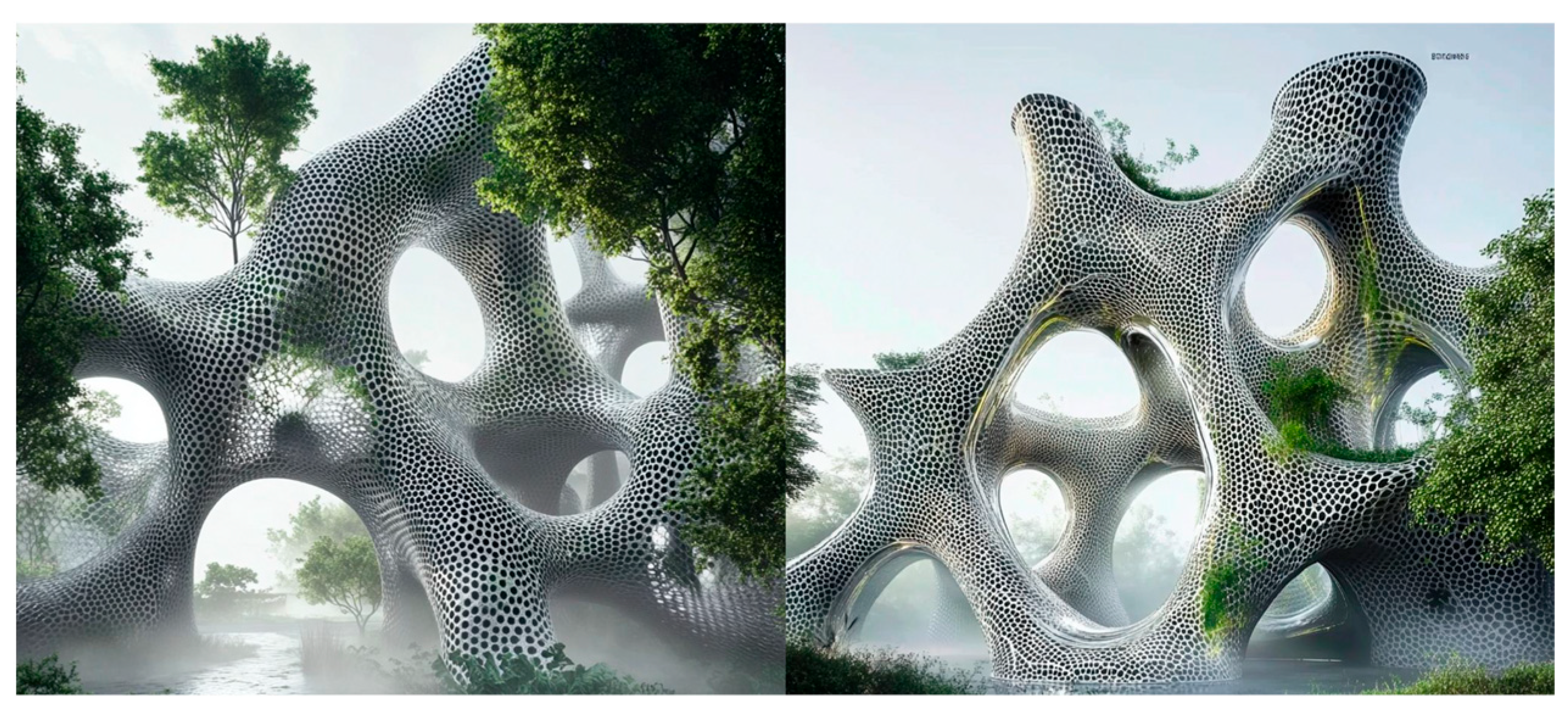
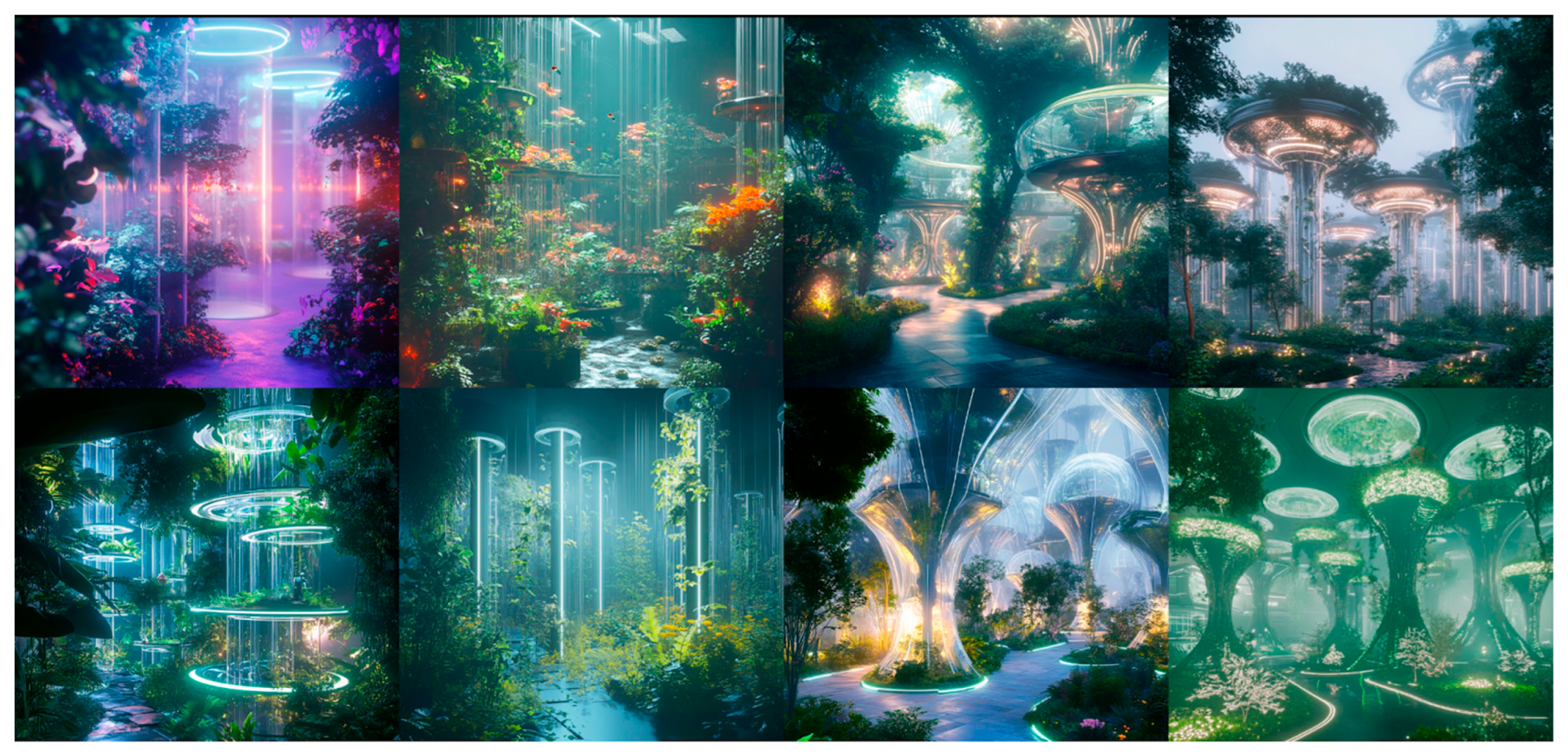
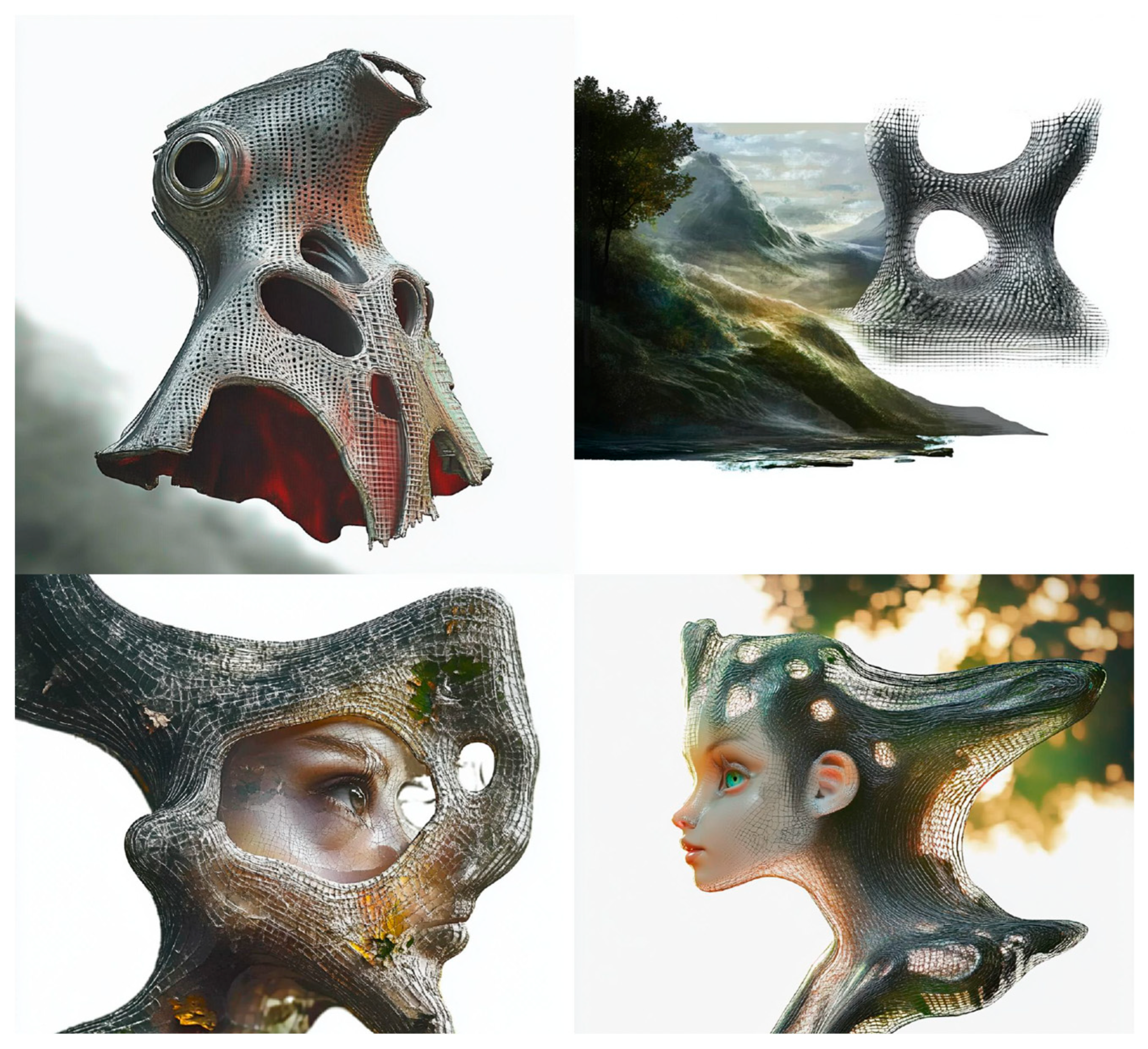
Group 3 pursued two parallel interpretations of a shared theme, resulting in two distinct but related solutions presented within a joint framework. The group’s research centered on future botanical systems conceived as hybrid techno-ecologies. These were explored through the lens of a “botanical garden of the future” and envisioned within underused urban spaces. Early prompting experiments explored bioluminescence, coral-like growth patterns, microbial membranes, and exposed irrigation infrastructures. Prompts emphasizing visible technical systems produced more coherent organic–mechanical syntheses (see Appendix A.3). The team iterated through form-finding and 3D model generation, testing porosity, branching logic, and spatial density (see Figure 9 and Figure 10).
As the project progressed, the students translated their initial abstract orchestrations into more concrete spatial structures through collage and prompting. Their work evolved toward a porous, pavilion-like structure (gyroid-inspired) coupled with vegetation (see Figure 11). The process also produced a “hallucination” phase in which outputs drifted toward character/object-like forms. Curatorial filtering and constraint-setting were then required to return to inhabitable, scalable structures (see Figure 12).
The selected outcomes represent one of the group’s final designs—the first point at which they were able to align their multi-agentic design spectrum around a shared proposal. From there, they began generating 3D models from selected 2D images and subjected these outputs to a curatorial selection process (see Figure 13 and Figure 14).
The split emerged precisely at this orchestration stage. Part of the students, as meta-human agents in the multi-agentic spectrum considered the MeshyAI result sufficiently resolved and accepted it as the project’s 3D direction. The other part chose to keep working with massing and material articulation, seeking greater control over geometry and transformation logic. This shifted the workflow from image-driven selection toward rule-based, parametric authorship.
The group that adopted the MeshyAI output after minor refinements translated it into a clay prototype via 3D printing (see Figure 15).
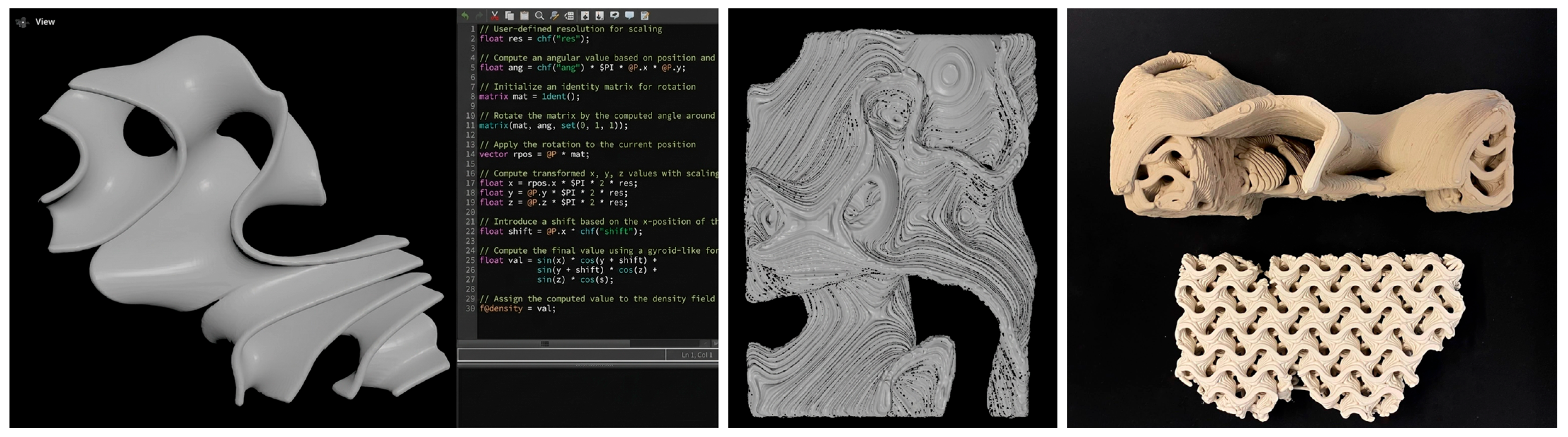
Another part of the group shifted toward editing and refining model segments to add surface details and texture with ChatGPT and Python (version 3.13) scripting in Houdini. After these refinements, they adapted the model for 3D clay printing (see Figure 16).

4.4. Group 4: Cryoreefs

Group 4 framed the Cryosphere topic through a large language model (ChatGPT) to explore polar ice loss and potential architectural responses. Drawing conceptually from Log 60 [9] and supplementing these insights with LLM-generated information, the group formulated an initial conceptual framework. Early prompts (see Appendix A.4.1) focused on abstract formal studies and the definition of an Encoding and Fusion layer, iteratively refined through re-prompting to produce their first visual outputs in MidJourney (see Figure 17).
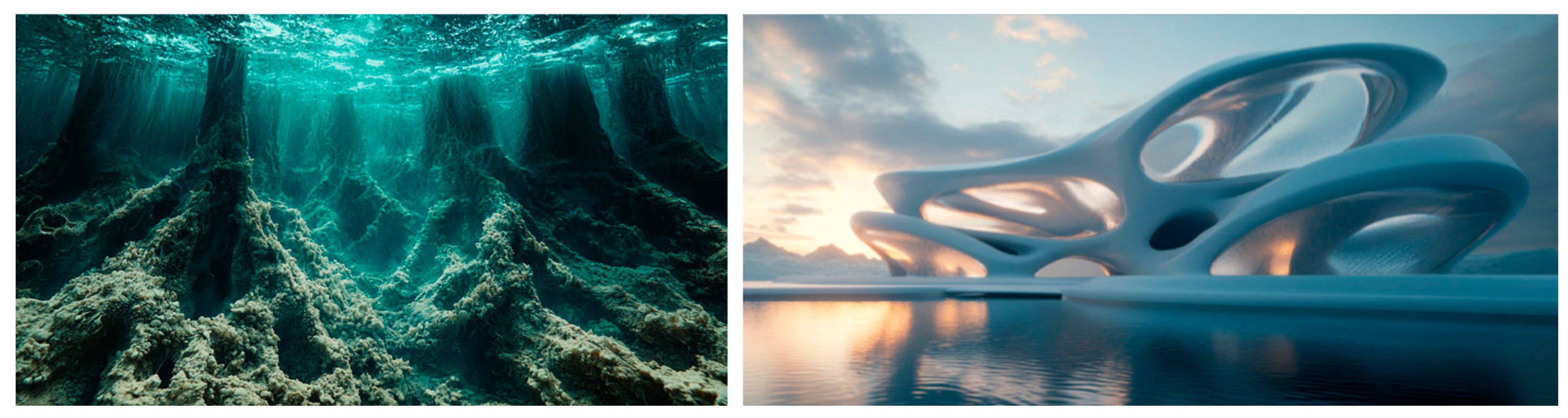
Following this initial phase of orchestration, the group converged on a set of thematic references. Agents generated concrete configurations—ice crystals, stalactite/stalagmite formations, and wind-driven geomorphologies—as outputs of the Decision layer. Iterative blending, shared imagery, and group discussion (meta-human decision input) consolidated these into a working direction. Students developed the concept of a growing porous structure emerging underwater, surmounted by a fluid, wind-responsive geometry at the water’s surface. The upper structure was envisioned as a system for capturing wind and facilitating cooling processes within the submerged porous components.
The next iteration deepened design-space orchestration. The students generated and curated numerous image variations to build an expanded visual library. Through continuous blending, variation, and evaluation, the group established a coherent visual and conceptual design language. Collaging selected images in Photoshop supported spatial control and articulation of the emerging proposal. The stage process oscillates between agentic production of concreteness and meta-agent human prompting to enforce abstraction and limit interpretations.
After defining this preliminary concept, the group strategically divided their workflow to increase efficiency and advance the project along multiple complementary trajectories. This resulted in two parallel paths of development. One part of the group continued to investigate 2D image blends, refining environmental atmospheres and structural intentions (see Figure 18), while the other part transitioned into 3D modeling. Prompt examples are recorded in Appendix A.4.2.
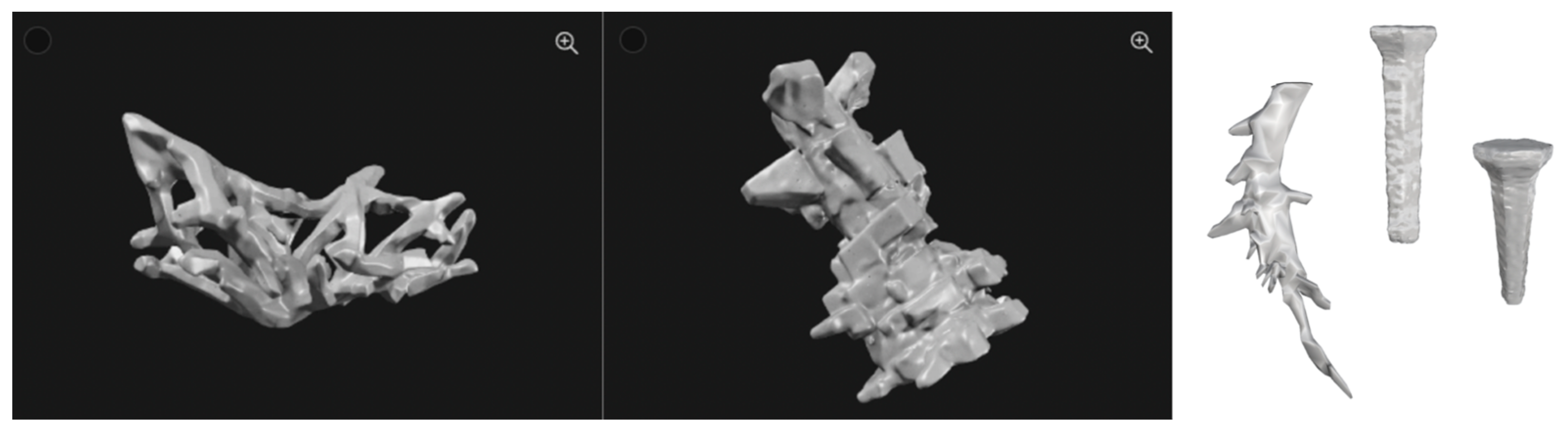
Using MeshyAI, the 3D team translated key 2D studies into volumetric geometries. These were subsequently merged, scaled, and edited in Rhinoceros, including the use of Boolean operations to test early spatial configurations. The team analyzed pore density and erosion-like textures in the underwater porous zone. A brief stalactite-inspired parametric growth study was tested and later abandoned as misaligned with the project’s trajectory (see Figure 19).
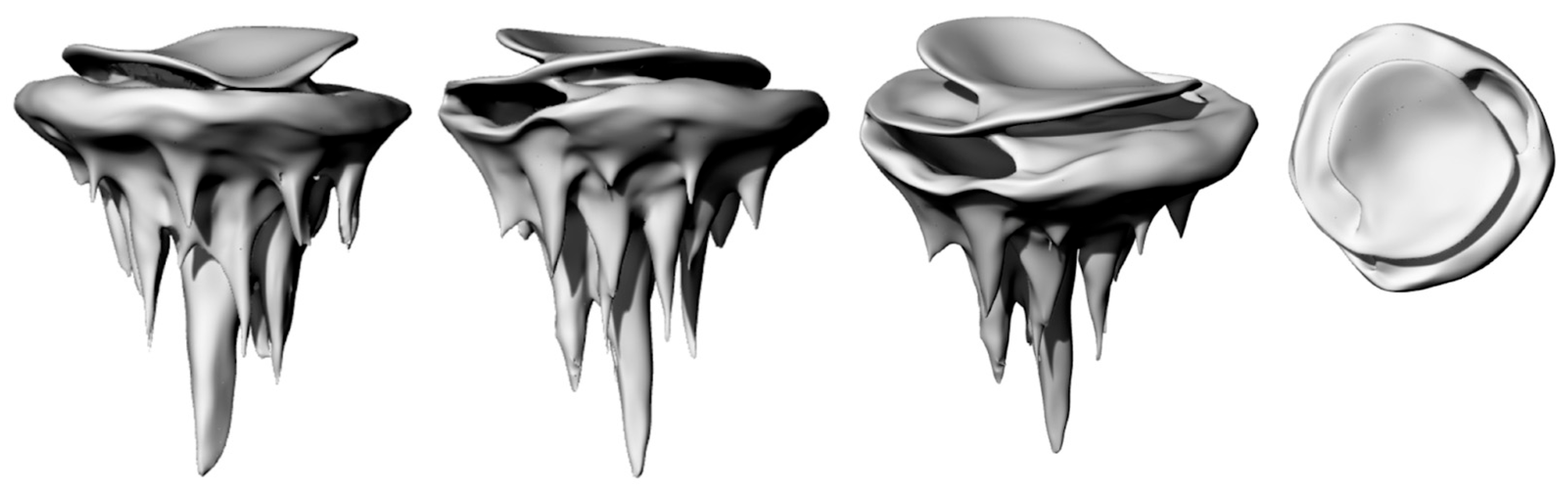
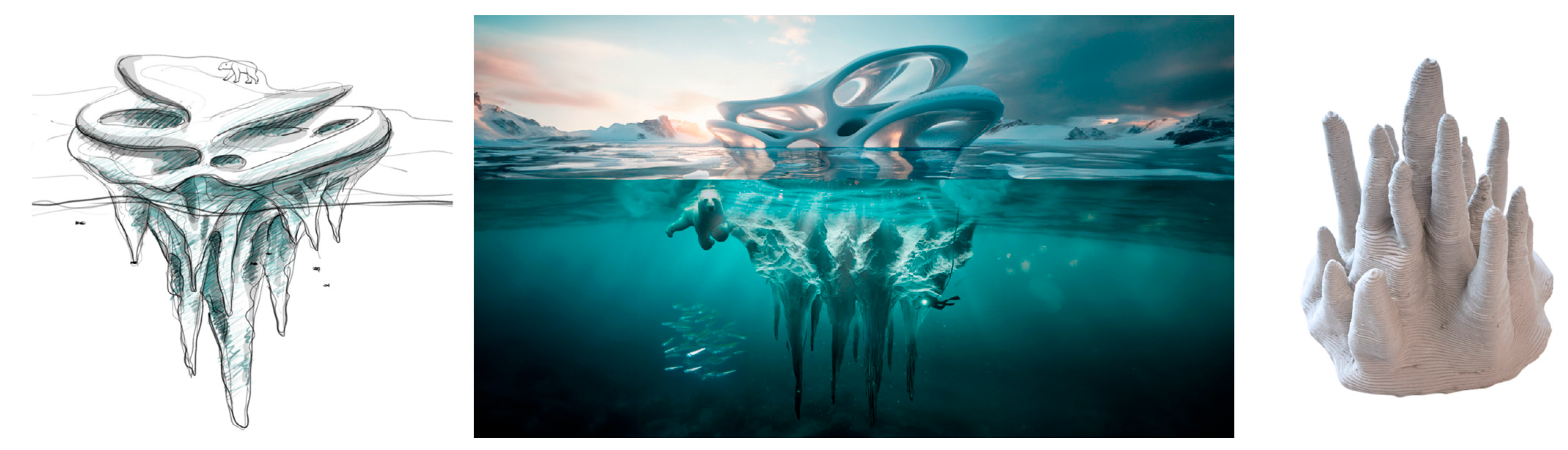
Returning to their earlier models, the students began shrink-wrapping various 3D geometries from MeshyAI and refining them using SubD tools in Rhinoceros. Through iterative manipulation and collective evaluation, they gradually arrived at a cohesive final form that aligned with the conceptual ambitions of the group (see Figure 20).
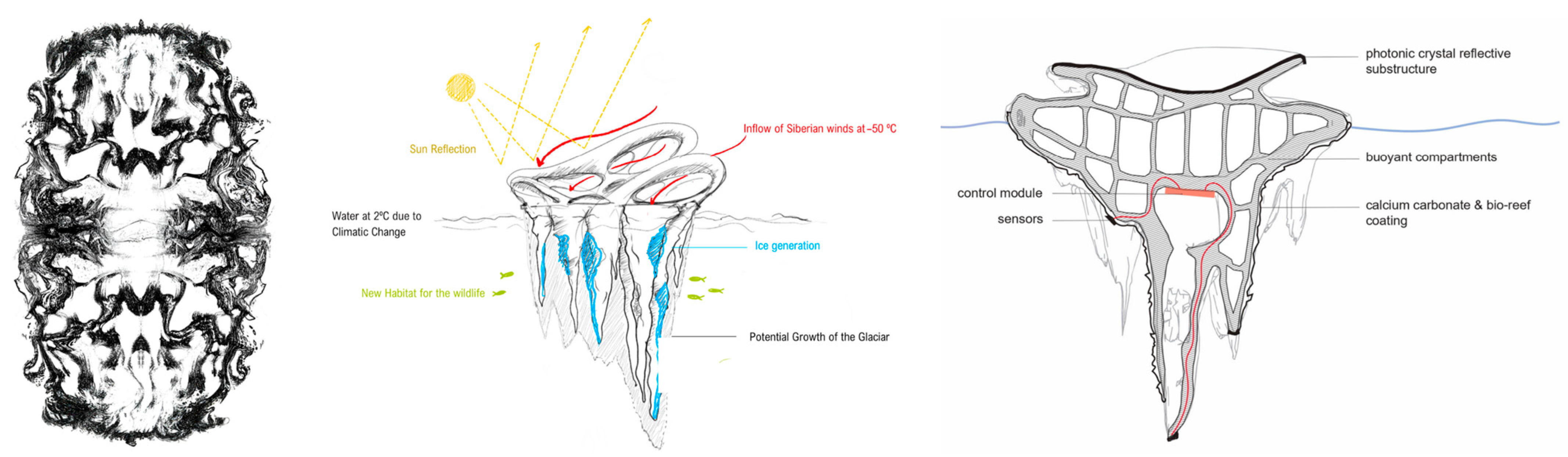
Through the systematic merging of AI-generated models, the group developed early spatial prototypes that informed the articulation of the final architectural concept. The project was defined as a composite system comprising a porous, stalactite-inspired structure beneath the water’s surface and a fluid, wind-responsive form above the waterline that channels airflow to support cooling within the submerged volume.
To refine this dual structure, the team analyzed generated textures to define material behavior in the underwater and above-water components. Feasibility and structural logic typical of water-situated architectures were then integrated. This process resulted in a multi-layered system combining thermal shielding, wind-driven cooling, environmental sensing, and habitat restoration (see Figure 21).
As the design research advanced, the students continued developing both their visual and spatial representations of the project. They produced 2D visualizations by compositing MidJourney outputs in Photoshop and refining them through KreaAI for higher detail and atmospheric coherence. In parallel, the evolving 3D model was prepared as a physical prototype suitable for clay 3D printing, allowing the conceptual system to be tested and evaluated through material form (see Figure 22).

4.5. Group 5: Hydrosphere

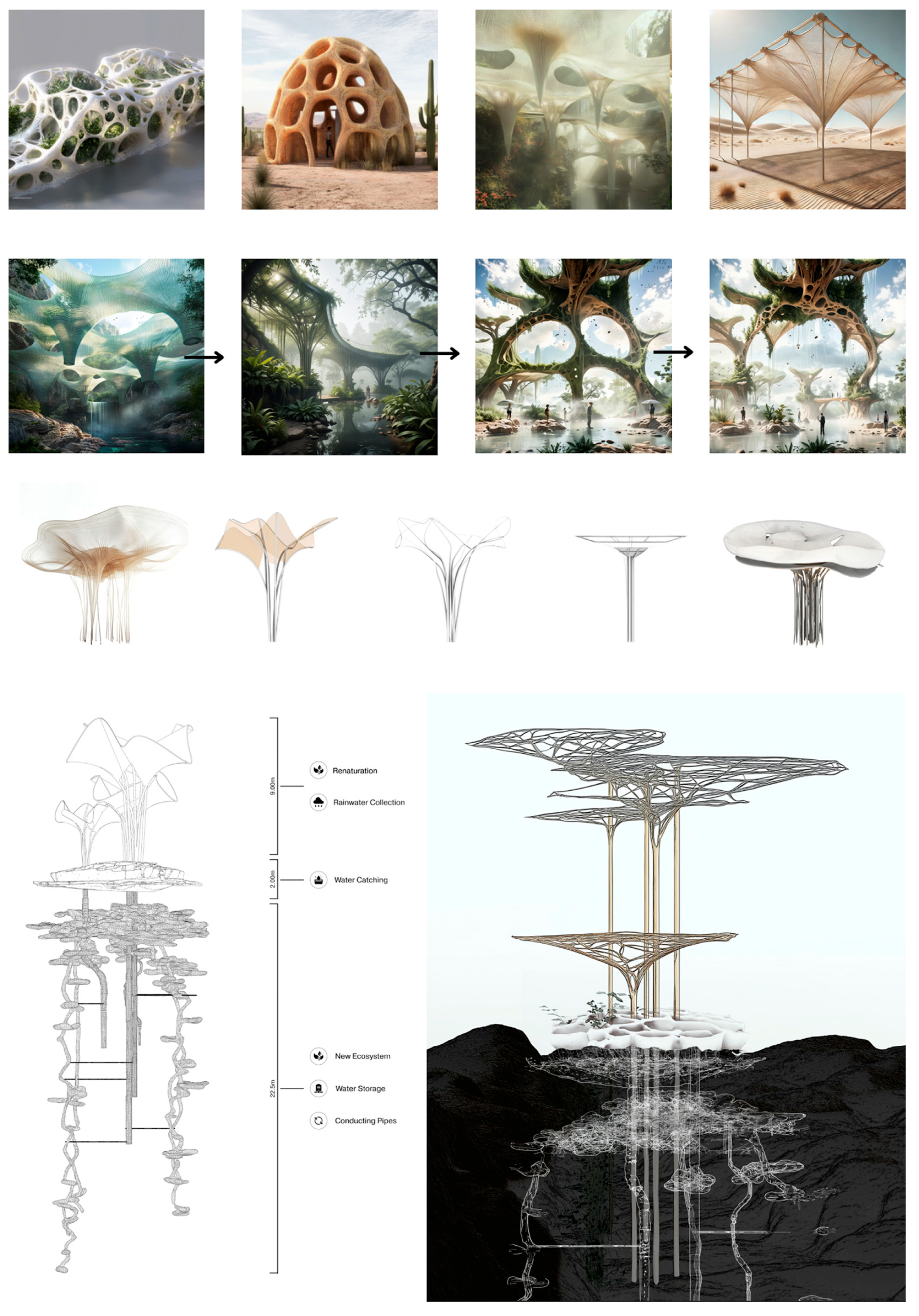
Group 5 structured the project around three interconnected landscapes—condensation, precipitation, and infiltration. These emerged from distinct AI prompt families involving fog nets, cactus ribs, beetle-shell condensation, and mycelium–clay composites (see Appendix A.5). Meshy and Rhino enabled the translation of speculative forms into water pathways, subterranean reservoirs and capillary systems (see Figure 23). Clay printing tested membrane thickness, porosity and structural branching. The final proposal forms a biodegradable, self-regulating hydrological interface.

4.6. Group 6: Cryosphere

Group 6 addressed permafrost thaw through wind-driven cooling devices. The prompting strategy cycled through kinetic tendrils, porous exoskeletons, hollow shells, and methane-filtering networks. Meshy-to-Rhino iterations reorganized speculative forms into airflow channels and cooling cavities. Clay printing validated structural continuity and aerodynamic behavior. CryoWind emerges as a conceptual mitigation device for permafrost stabilization (see Figure 24).

4.7. Group 7: Atmosphere

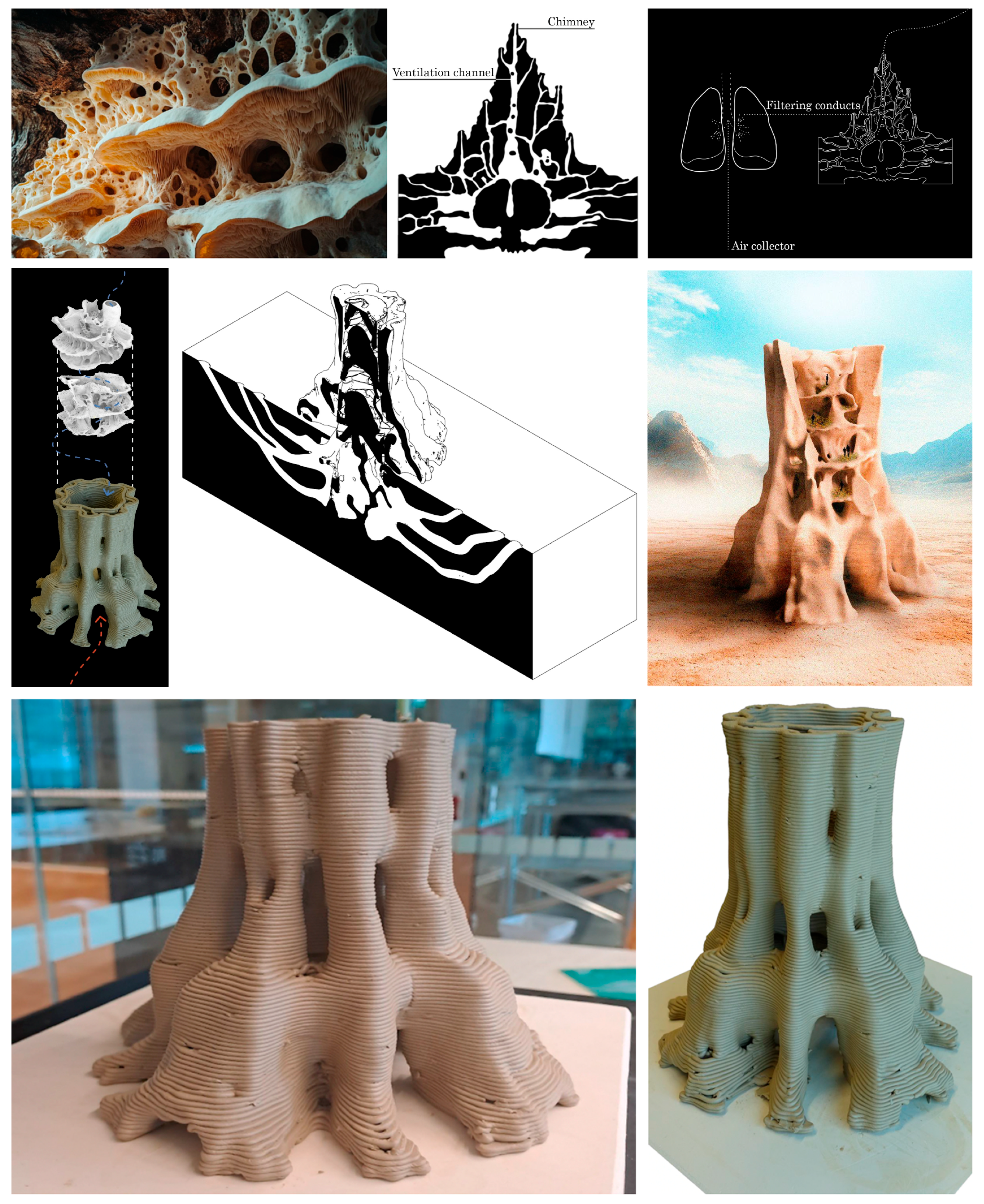
Group 7 explored the atmosphere as a metabolic layer. Prompt iterations examined airflow, CO2 capture and thermal gradients (see Appendix A.7). Meshy generated volumetric scaffolds, later reorganized in Rhino into an interior filter network and a chimney-like exterior. Clay printing validated airflow channels and differentiated thicknesses. The final object operates as a CO2-filtering organism responsive to atmospheric flows (see Figure 25).

4.8. Human–AI Interaction Patterns

To evaluate human–AI workflow patterns across student teams, it is necessary to define a shared structural baseline that allows heterogeneous processes to be compared without reducing them to tool-specific descriptions. In this study, the analysis therefore adopts an agentic design pipeline derived from the workshop’s design environment model and composed of the following phases: Input and Briefing, Orchestration, Encoding, Fusion/Synthesis, Decision and Heuristics, Situated Co-Design (Human–Machine), Action/Execution, and Feedback and Reframing (see Figure 4). Read as a pipeline rather than a prescriptive method, this structure functions as an analytic scaffold for comparing how intent, constraints, and generative material were stabilized through decisions and translations across media.
Building on the agentic design pipeline, the workshop outputs can be evaluated as recurring human–AI workflow patterns rather than as isolated projects. We documented how groups distributed tasks, interpreted outputs, and validated decisions over time and then compared these behaviors across teams. On this basis, we identified four recurring behavioral patterns that function as dominant modes of coordination, validation, and translation within the multi-agent design process. These patterns offer insight into how groups adopted and adapted the workflow, and how decisions were made and sustained at the human meta-agent level. We defined these four behavioral pattern clusters: Conceptual Drifting, Translating, Splitting Agencies and Curatorial Assembling.
Conceptual Drifting: This behavior tends to dominate during orchestration and early synthesis (see Figure 4, Orchestration), generating many plausible directions without stabilizing a shared design intent or clear decision heuristics. Validation is often driven by the availability and esthetic persuasiveness of AI outputs, which encourages frequent conceptual shifts and limits progress toward execution (see Figure 4, Action layer).
Translating: This behavioral pattern treats generative outputs primarily as raw material and focuses on converting images or 3D-generated forms into controllable geometry through manual remodeling, refinement, and iterative feedback (see Figure 4, Action layer). Authorship becomes most visible in the translation and resolution stages, where consistency, scale, and constructive logic are established beyond the initial AI proposal.
Splitting Agencies: We recognized this behavioral pattern when agency is intentionally divided to improve efficiency, allowing different outcomes to develop in parallel. One part of the group continues with 2D generated material—building collages, plans, and visualizations—while the other develops 3D forms through generation and refinement and prepares the model for clay printing.
Curatorial Assembling: This behavioral pattern focuses on selection, sequencing, and editing. It shows the commitment of human meta-agents to keep a clear design intent across multiple orchestration loops: AI produces many options, while intent remains legible in what is selected.
Across the workshop, these behavioral patterns did not appear as isolated or stable “types” of groups. Instead, each project moved through a hybrid behavioral workflow in which different patterns surfaced at different moments of the pipeline and sometimes overlapped within the same phase. In this sense, the patterns should be read as dominant tendencies within a project’s trajectory rather than as fixed classifications. These tendencies are illustrated below through figure-referenced cases.
Group 6 illustrates Conceptual Drifting through extended orchestration before consolidation (see Figure 24). The group generated many plausible variants but did not stabilize a shared design intent and curatorial selection criteria early on. As a result, their formal language kept shifting, moving from more high-tech expressions toward increasingly fluid geometries. This also limited their move into the action layer, where curatorial choices and execution would normally consolidate the work. After several days of conceptual uncertainty, they eventually committed to a direction and began to adopt elements of Curatorial Assembling and Translating.
Group 5 exemplifies Translating by remodeling generated geometry into controllable form (see Figure 23). A key move was shifting from AI-derived suggestions to reconstructed geometry that could be evaluated, adjusted, and carried forward into execution. This made authorship most visible in the translation and resolution stages.
Group 4 exemplifies Splitting Agencies through parallel 2D refinement and 3D translation (see Figure 20, Figure 21 and Figure 22). After early orchestration and establishing a shared visual library, the workflow separated into complementary tracks, enabling simultaneous development of representational intent and geometric/prototype control. This division supported earlier convergence without reducing the exploration of variants.
Group 7 was among the highest-performing teams and foregrounded Curatorial Assembling by repeatedly selecting and refining within a stable direction (see Figure 25). Rather than oscillating between alternatives, the workflow used AI outputs as a candidate pool while maintaining continuity in the core mechanism and formal logic. Orchestration loops strengthened an already defined design line rather than restarting it.

5. Discussion

5.1. Criteria for Decision-Making and Evaluation Framework

This discussion adopts the workshop rubric and scoring procedure described in Section 3.5 to interpret how projects consolidated design intent under conditions of generative overproduction. The criteria are not treated as standardized performance metrics but as a consistent, workshop-based lens supporting feedback, redirection, and convergence across projects.
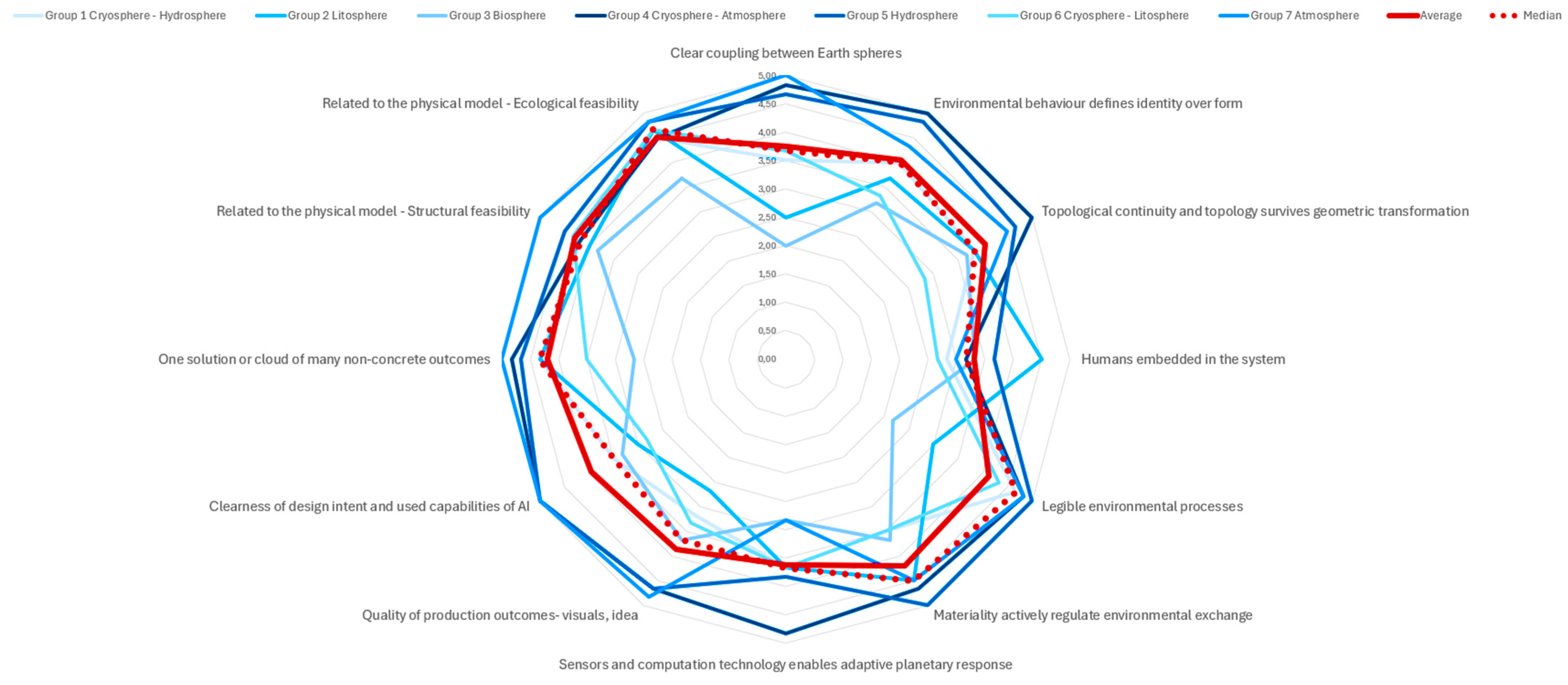
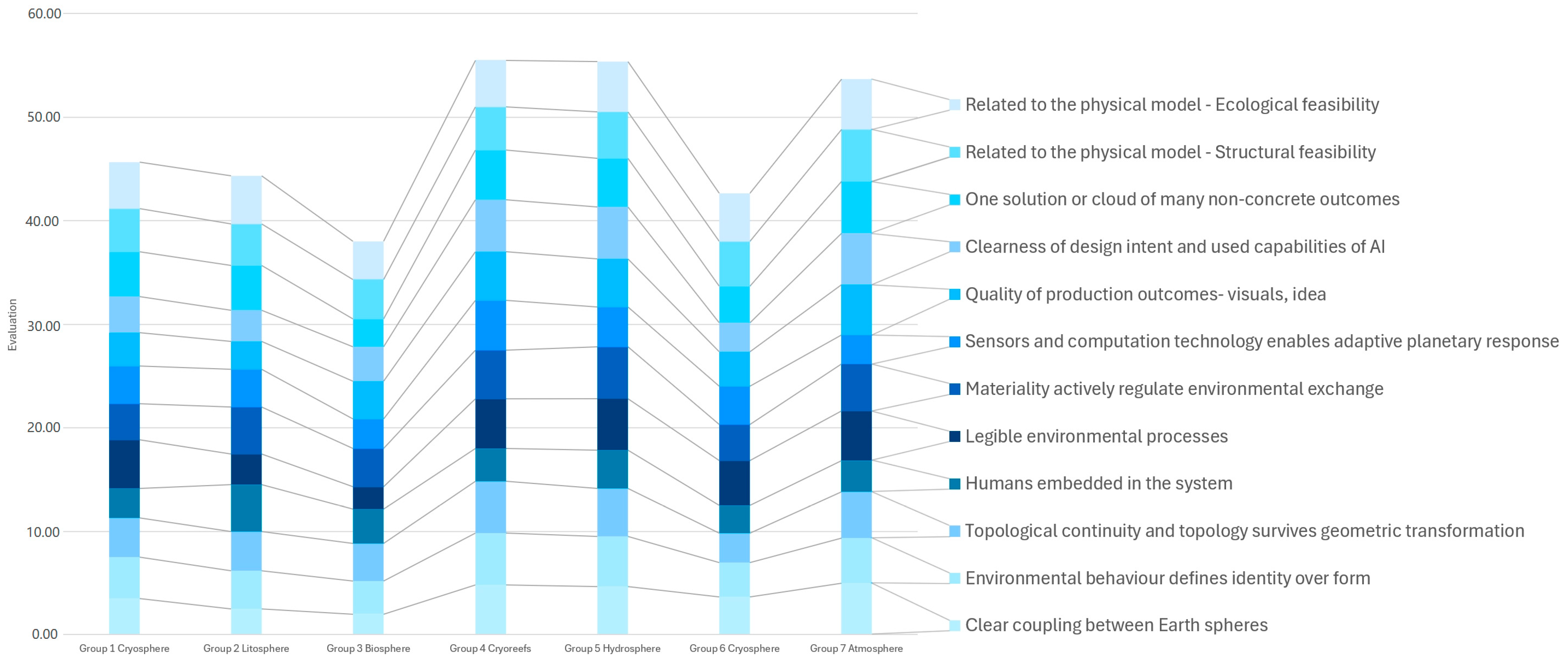
As a brief interpretive lens, the typology–topology distinction clarifies why the workshop briefs and rubric emphasize behavioral coherence and continuity under translation rather than typological resemblance: diffusion-led generation often stabilizes relations under constraint reconciliation (e.g., exchange, delay/retention, porosity, reversibility, stewardship), while architectural work consists of translating those relations into editable geometry and prototype plausibility. Table 2 and Table 3 summarize this interpretive lens and the corresponding observable cues used during feedback and scoring. Tutor scores were aggregated as group means (Table 4), which provide the numerical basis for the comparative diagrams in Figure 26 and Figure 27 and the synthesis in Section 5.2.

5.2. Cross-Group Synthesis Guided by the Evaluation Criteria

Building on the aggregated scores (Table 4) and the comparative diagrams (Figure 26 and Figure 27), the following synthesis distinguishes high-, mid-, and lower-performing groups and summarizes cross-group patterns. The highest overall group averages were Groups 4, 5, and 7 (high tier), Groups 1, 2, and 6 (mid-tier), with Group 3 as a lower outlier (Table 4). This spread suggests that generative capacity alone does not determine outcome quality; rather, outcomes vary according to how effectively each team reduced overproduction into a coherent and testable direction.
Across criteria (averaged across groups), the strongest dimensions were prototype-oriented feasibility and convergence: Groups 4, 5, and 7 (high tier), Groups 1, 2, and 6 (mid-tier), with Group 3 as a lower outlier (Table 4). In contrast, the weakest cohort-level dimensions were Humans embedded in the system and Computation enabling adaptive planetary response, indicating that most teams prioritized environmental coupling and prototype plausibility over explicit human participation and robust sensing/feedback logics.
A criterion-by-group reading further clarifies differentiated strengths and weaknesses:
High-performing teams coupled environmental reasoning with disciplined consolidation: Group 4 was consistently strong in behavior-over-form, continuity, and intent/method clarity; Group 5 excelled in process legibility and material regulation; and Group 7 combined clear coupling and convergence with comparatively weaker computation/adaptation (Table 4; Figure 26 and Figure 27). Mid-tier teams achieved plausibility at prototype scale but were less consistent in stabilizing intent across iterations (e.g., conceptual drifting, continuity breaks, or partial system integration). Group 3 struggled most with coupling clarity, process legibility, and convergence, indicating difficulty in stabilizing one coherent outcome under overproduction.
This synthesis makes visible the full range of outcomes and identifies recurring weaknesses that persist across multiple groups rather than relying solely on selected exemplars.

5.3. Linking Decision-Making Patterns to Evaluation Outcomes

As described in the Results, the workshop revealed recurrent patterns of decision-making in AI-assisted multi-agentic workflows (conceptual drifting, translating, splitting agencies, and curatorial assembling). These patterns are interpreted through the evaluation outcomes. Read alongside Figure 26 and Figure 27, the results suggest that higher-performing projects tend to consolidate design intent earlier and reduce generative overproduction more consistently, enabling clearer convergence toward one coherent proposal. In these projects, a meaningful splitting of agencies further supported this consolidation. Where pattern translation was observed, the groups’ work exhibited high process legibility, reinforced by a clearly articulated environmental interface logic. Lower-performing projects, by contrast, more often remained in delayed convergence, wider divergence, or collisions in internal validation—conditions that correlate with diffuse outcomes and reduced legibility.
This reading is not presented as a causal claim or as a deterministic mapping between any single pattern and success. Rather, it supports a bounded interpretation consistent with the workshop framework: when overproduction is coupled with explicit decision criteria and a convergent decision process, proposals more often become legible as environmental interfaces and more plausible at prototype scale; when reduction and convergence remain weak, outputs tend to remain diffuse and less explicit in their coupling logic.

5.4. Between Fantasy and Feasibility

Across the examined case studies, generative AI repeatedly produced imagery that exceeded conventional architectural expectations, often operating across cryospheric, atmospheric, lithospheric, and hydrological registers. This excess is interpreted here as an effect of statistical exploration—consistent with Carpo’s account of the “automatization of imitation” shifting from reproduction toward recombinatory search [2]—rather than as a flaw to be eliminated. In the workshop, generated images rarely functioned as final architectural proposals; instead, they served as abundant speculative material that required interpretation, reduction, and translation to become architecturally legible.
Feasibility was not assessed as validated structural or environmental performance. It was approached as the capacity of a proposal to remain coherent when translated from images into controllable geometry and then into a materially constrained prototype, in line with the definition of environmental interfaces established earlier (Section 2.2). Once translated through Meshy, Rhino, and clay-based prototyping, projects were forced to externalize mechanisms—porosity, channels, gradients, thickness modulation—and to clarify where and how environmental exchange was intended to occur. This shift from visually persuasive imagery to constrained modeling and prototyping did not “prove” feasibility, but it made constraints and inconsistencies visible and allowed teams to refine or discard directions accordingly.
In this sense, feasibility emerged as an after-effect of iterative translation and material grounding: clay printing acted as a reality check at prototype scale, highlighting where continuity, printability, and the proposed environmental mechanisms could be maintained under constraint and where proposals remained underdetermined beyond the image stage.

5.5. Educational Reflections: Lazy Minds or an Emerging Literacy?

The educational question of whether generative AI encourages uncritical reliance (“passive uptake”) or supports emerging forms of AI/prompt literacy has been increasingly discussed in recent empirical work on AI in education and design practice [38,39,40,41,42]. While some studies raise concerns about overreliance and fixation in ideation under generative assistance [39,40], other work suggests that structured prompting, iteration, and explicit critique can foster more reflective engagement [41,42].
Importantly, the workshop described in this study does not provide a measured educational assessment (no control group, no pre/post testing, and no cognitive instrumentation). For this reason, the following remarks are offered as interpretive reflections grounded in workshop observations rather than validated learning outcomes.
Read alongside the evaluation outcomes (Figure 26 and Figure 27), the strongest indicator of an “active” mode of engagement is not the sheer production of variants but the ability to converge: higher-performing groups (notably Groups 4, 5, and 7) combined clearer intent/method articulation with more consistent convergence toward one coherent proposal. In these teams, prompting operated less as isolated inputs and more as structured sequences of decisions (prompt choreographies) that repeatedly justified selection against the decision criteria (Section 3.5), and this pattern coincides with more consistent convergence under overproduction.
By contrast, lower-performing outcomes—most clearly the Group 3 outlier—cluster around delayed convergence and diffuse solution clouds, where generative variation widened the space of possibilities faster than teams could reduce it into a legible environmental mechanism. In these situations, the workflow risks reverting to a more passive mode of engagement: not because students “do less work,” but because decision-making becomes under-specified and evaluative control weakens, making it harder to translate imagery into coherent environmental interface propositions.
Across the cohort, two comparatively weaker criteria are also pedagogically revealing: “Humans embedded in the system” and “Computation enabling adaptive response.” Even when teams achieved prototype plausibility and material regulation, integrating human operation and feedback-loop thinking remained underdeveloped. Future work should test these educational interpretations through comparative study designs (e.g., AI vs. non-AI cohorts and pre/post assessment), explicitly distinguishing workshop-grounded observations from measured learning outcomes.

5.6. AI as an Agent in Co-Evolving Design Ecologies

Within the workflow presented in this paper, AI does not function as an autonomous author or as a deterministic optimizer. It operates as one agent among several within the Agentic Design Environment, accelerating cycles of variation and requiring human meta-agent oversight to consolidate design intent through selection, translation, and iterative refinement. In this sense, prompt choreographies describe not isolated prompts but structured sequences of human–AI exchange that keep the process aligned with environmental aims and material constraints.
Rather than repeating the case narratives, the discussion reads the Results comparatively. Higher-performing projects tend to show earlier intent consolidation and clearer convergence, while weaker projects correlate with delayed convergence and more diffuse outcomes. This supports a bounded interpretation of agency as distributed and negotiated across tools, representations, and team decision-making, as described in Section 4.

5.7. Value of the AI Designs

While the workshop resulted in physically manifest architectural objects—clay prototypes, environmentally oriented forms, and computational models—their value does not reside in their completeness as buildings. Rather, their significance lies in their ability to function as environmental design hypotheses, where topology, behavior, and matter intersect. This interpretation aligns with the shift described in Section 2.2: architecture understood not as object production but as the design of multi-scalar couplings between energy, matter, and information.
A further insight emerging from the workshop concerns the relationship between authorship and value. AI-generated outputs tend to be undervalued when designers engage with them passively, perceiving them as “orphaned” forms lacking intentional authorship. However, once participants intervened actively—steering the generative process through successive reinterpretations, reorganizing prompt choreographies, and critically translating outputs across abstraction and material constraints—the perceived value of the AI designs increased significantly. In this context, authorship does not disappear but is reconfigured: the designer acts neither as a passive recipient nor merely as a curator but as an active agent who operates from within the generative process. Sustained investment of time, judgment, and conceptual decision-making transforms outcomes into co-produced architectural propositions, narrowing the psychological gap between “my design” and “AI’s design.”
AI-generated forms hold conceptual value because they expand the speculative and environmental design space. As del Campo’s notion of “latent tectonics” suggests [43], generative models expose hidden continuities in data that human designers can reinterpret as structural or atmospheric logic. Several workshop prototypes—cooling chimneys, condensation surfaces, and porous lithic membranes—demonstrate how AI can reveal unfamiliar tectonic potentials when critically evaluated rather than accepted wholesale.
Representationally, AI accelerates the production of intermediate images, neither abstract nor fully resolved, which enable rapid feedback loops between intention and performance. These “middle forms” echo ideas in evolutionary and agent-based modeling, where morphology emerges through iteration, adaptation, and feedback. Here, images serve as catalysts for environmental reasoning rather than as end-stage representations.
Finally, the material–tectonic translation to clay printing provided a crucial reality check, revealing which AI-derived geometries exhibited structural continuity, printability, and behavioral coherence. These tests parallel Fang’s work on sectional sampling [8] and Li & Xu’s 2D-to-3D frameworks [7], showing how AI integrates into fabrication workflows not as a replacement for craft but as a new layer of computational material intuition.
The value of the AI designs therefore lies in their ability to reframe architectural production around interfaces, environmental behaviors, and topological conditions rather than around typology or program.

5.8. Negatives of Generative AI

A main ethical concern is the uncertain provenance of training datasets used by many generative models, alongside contested questions of authorship, attribution, and representational bias in AI-augmented pipelines. In the workshop context, authorship was treated as co-produced across students and tutors, and the workflow was documented transparently as part of the research setting. This does not resolve broader legal or ethical questions, but it makes them explicit as boundary conditions of AI-augmented design pedagogy.
Another concern is the potential loss of an individual’s personal style or formal language when working with generative AI, which introduces its own esthetic and compositional tendencies. In the workshop, this risk was mitigated through an iterative process of generation, critical evaluation, and curatorship of AI outputs, allowing participants to articulate their design intent and develop an authorial formal language through selection and manual editing of the generated results.
A related, practical issue is that generated 3D models are often difficult to use directly in architectural workflows: they may be visually convincing but lack editability, semantic structure, or reliable geometric control [44]. As a result, several teams chose to remodel the AI-generated geometry rather than simply “clean” it, treating the output as a reference that must be translated into workable, deliverable form.
The workshop also exposed failure modes such as hallucination (Figure 12) and collisions in decision-making typical of multi-agentic systems. Generative AI model selection dynamics can begin to define what outcomes are visible when replacing an image generator for vibe coding with an LLM (Figure 15 and Figure 16), and when design intent is unclear, the AI tends to widen outcomes rather than stabilize them—reinforcing the need for explicit criteria, reduction, and convergence.

5.9. Limitations

This study is grounded in a single workshop and reports a qualitative, expert-based evaluation of design outcomes. The scoring matrix supports comparative interpretation across groups but does not constitute a standardized performance assessment. No control group (AI vs. non-AI) was used, and no pre/post educational measures were collected; therefore, claims about learning or cognitive impact remain observational. Likewise, structural and ecological feasibility are discussed at the level of prototype plausibility and representational coherence, not validated simulation or full-scale performance.

6. Conclusions

This paper frames AI-assisted architectural design as a multi-agentic workflow operating under generative overproduction, where the central design problem shifts from producing options to stabilizing intent through reduction and convergence. Generative systems do not function as autonomous authors or performance optimizers; instead, they accelerated variation cycles that required teams to articulate constraints, evaluate consequences, and translate outputs into coherent environmental interface propositions through modeling and prototyping.
The manuscript’s contribution is methodological. Its originality lies in articulating a transferable approach for managing generative overproduction through prompt choreographies and explicit decision criteria (Section 3.5), moving beyond a workshop narrative of tool use. The proposed Agentic Design Environment describes how agency is redistributed across roles, representations, and translation steps, and how coherence is maintained—or lost—within that process.
The evaluation supports a comparative reading across groups: higher-performing projects combine clearer intent articulation, stronger convergence, and more legible environmental mechanisms supported by prototype plausibility, while weaker performance clusters around delayed convergence and diffuse outcomes. Across the cohort, prototype-based feasibility and convergence scored relatively high, whereas “humans embedded in the system” and “computation enabling adaptive response” remained comparatively weaker, indicating recurring gaps in operational integration and feedback-loop thinking.
Pedagogically, the workshop suggests a redistribution of effort toward judgment, sequencing, and critical interpretation when students work through prompt choreographies and decision criteria; however, educational claims remain observational rather than measured outcomes.
This study reports a single workshop and qualitative expert evaluation; no control group or pre/post educational measures were implemented, and feasibility is discussed at the level of prototype plausibility rather than validated performance. Future research should test transferability across cohorts, contrast AI-augmented and non-AI workflows, and refine how environmental behaviors are specified and assessed at prototype scale. Ethical constraints—particularly uncertain dataset provenance—remain a boundary condition that warrants explicit attention.
Overall, the work positions AI-augmented architecture not as image production but as a method for decision-making under generative abundance. In this framing, environmental reasoning, translation to geometry, and prototype constraints convert speculative variation into coherent architectural propositions.

Author Contributions

Conceptualization, M.U., J.C.L.C., C.E.S.M., R.H.; methodology, M.U., J.C.L.C., C.E.S.M., R.H.; software, M.U., J.C.L.C., R.H., J.D., A.K.; validation, M.U., J.C.L.C., C.E.S.M., R.H.; formal analysis, M.U., J.C.L.C., C.E.S.M., R.H.; investigation, M.U., J.C.L.C., C.E.S.M., R.H., J.D.,A.K.; resources, J.D.,A.K.; data curation, J.D.; writing—original draft preparation, M.U., J.C.L.C., C.E.S.M., R.H., J.D.; writing—review and editing, M.U., J.C.L.C., C.E.S.M., R.H.; visualization, M.U., J.C.L.C., R.H., J.D.; supervision, M.U.; project administration, J.C.L.C., R.H.; funding acquisition, R.H.; All authors have read and agreed to the published version of the manuscript.

Funding

This work was supported by the RESEARCH AGENCY Výskumná agentúra Plynárenská 7/A 821 09 Bratislava, grant number ESG 23-05-02-B UrbanGraphica [“Procesovanie a vizualizácia dát na viacdimenzionálnom modeli mesta.”/“Data processing and visualization on multidimensional model of the city.”] Financed by the European Union—NextGenerationEU.

Institutional Review Board Statement

The study was conducted in accordance with the principles of the Declaration of Helsinki (2013 revision). According to Slovak national legislation and institutional guidelines, formal approval from an ethics committee was not required for this type of non-interventional educational research involving adult participants (see Slovak Code of Research Integrity and Ethics, 2024, VAIA; Act No. 172/2005 Z. z. on the Organization of State Support for Research and Development).

Informed Consent Statement

Verbal informed consent was obtained from the participants. Verbal consent was obtained rather than written because the study was non-interventional and involved adult students in an educational workshop, consistent with acceptable practices for ethnographic and observational research. Participants were informed about the purpose of the study, that their participation was voluntary, and that their contributions could be used anonymously for research and publication purposes.

Data Availability Statement

The original contributions presented in this study are included in the article. Further inquiries can be directed to the corresponding author.

Acknowledgments

Many thanks to all students who participated in the workshop. During the preparation of this manuscript, the authors used LLM ChatGPT, 5.1. to improve the readability and language of the manuscript. The image generator MidJourney, V7 was used for the purpose of illustrating the coherence of the AI-generated images in Figure 1. The figures in Section 4, Results: Workshop Case Studies, were AI-generated during the workshop and are part of the research. The authors have reviewed and edited all outputs and take full responsibility for the content of this publication.

Conflicts of Interest

The authors declare no conflicts of interest. The funders had no role in the design of the study; in the collection, analyses, or interpretation of data; in the writing of the manuscript; or in the decision to publish the results.

Appendix A

Appendix A.1. Example Prompts of Group 1: Cryosphere

A 1.5 km tall floating industrial tower on the open ocean, formed by two fused metal cylinders—one for pumping seawater, the other for cooling air. Reinforced steel with bolts, seams, and frost sits on a circular buoyant platform with pontoons and ballast tanks. Surrounded by mist, rough waves, and storm clouds, it feels cold, futuristic, and imposing.
A futuristic architectural form inspired by glacier melting and fragmentation, combining crystalline shapes with icy landscapes. Ice transitions into fractured water patterns, drawing from scientific observation and satellite-like viewpoints. Merging precision with natural chaos, the structure reflects both the stability and fragility of Earth’s ice. An artificial glacier rises from the water in a hyper-realistic 4K depiction.

Appendix A.2. Example Prompts of Group 2: Lithosphere

An ultrarealistic and close view of a volcano with an entrance to a museum with windows and man-made holes and different entrance --iw 2 --no lava
An organic form, with a textured surface featuring numerous holes. High resolution.
A tall ceramic sculpture with intricate, organic textures and perforations, resembling coral or a honeycomb. Its dark gray to light brown tones add depth against a white background.

Appendix A.3. Example Prompts of Group 3: Biosphere

A futuristic artificial botanical garden where nature and technology seamlessly intertwine. A towering, porous structure with an intricate honeycomb-like exoskeleton serves as the foundation, its large organic openings allowing trees and vibrant greenery to grow outward. The bioengineered walls merge with transparent irrigation veins, pulsing with nutrient-rich water that sustains the lush ecosystem. Bioluminescent flora glow softly, casting ethereal light across mist-filled pathways. Floating mist gardens hover between the perforated surfaces, while kinetic flower structures respond to human movement. The breathable microbial walls, creating a cyber-organic sanctuary. The atmosphere is a blend of soft neon lighting, a dreamlike mist, and hyper-detailed textures--cinematic, ultra-realistic, biophilic, and surreal yet grounded in reality. Hyper-detailed, 8K resolution, cinematic lighting, soft ambient glow, intricate textures, cyberpunk nature esthetic --v 6.1)
Prompt count: 147
Word count: 6174
Generated images count: 578

Appendix A.4. Example Prompts of Group 4: Cryoreefs

Overall prompt count: 128
Overall word count: 4486
Overall generated images count: 461

Appendix A.4.1. Initial Stage Prompts

Futuristic architectural concept inspired by the cryosphere, depicting a visionary structure gracefully emerging from an icy, glacial landscape. Seamlessly integrated organic, fluid shapes mimic the natural flows of ice and snow, featuring translucent facades and crystalline textures. Biomimetic, sustainable design showcases adaptive insulation and ethereal lighting, creating a dreamlike, softly glowing atmosphere. Minimalist yet futuristic esthetics influenced by Arctic and Antarctic ecosystems. Hyper-realistic rendering, 8K resolution, ultra-detailed textures, cinematic lighting, atmospheric fog, gentle blue–white palette --ar 16:9 --v 6.1 --q 2 --s 500)
An abstract visualization of Earth’s cryosphere as interconnected, translucent icy spheres and crystalline fragments suspended in a delicate equilibrium, evoking concepts of climate fragility, temporal transformation, and planetary balance. Shimmering textures and subtle gradients of frosted blues and whites interweave beneath a veil of ethereal polar light, symbolizing dynamic interactions and interdependencies. Conceptual, atmospheric, visually poetic, intricate details, minimalistic style, surreal esthetic --ar 16:9 --v 6.1 --q 2 --s 600)
Word count used in prompts in this phase of design process: 3606
Count of generated images in this stage of process: 192

Appendix A.4.2. Later Stage Prompts

form study, biomimicry, glaciers, stalagmites in the water, cooling water, root texture
futuristic massing concept inspired by the cryosphere, depicting a visionary structure gracefully emerging from an icy, glacial landscape, fluid shapes mimic the natural flows of ice and snow, 8K resolution, ultra-detailed textures, cinematic lighting, atmospheric fog, gentle blue–white palette --ar 16:9 --q 2 --v 6.1 --s 500
Word count used in prompts in this phase of design process: 880
Count of generated images in this stage of process: 108
Number of models generated: 45 models from 8 generated images.

Appendix A.5. Example Prompts of Group 5: Hydrosphere

Generate a conceptual visualization of a self-regulating, biodegradable entity in dynamic equilibrium with the biosphere and hydrosphere. Inspired by Gaia devices, it should recycle materials, sustain biodiversity, and mediate between Earth’s systems. The form draws from hydrological and biogeochemical cycles—porous membranes, root-like networks, or buoyant lattices that absorb, store, and redistribute water. It acts as a metabolic node with photosynthetic surfaces, mineral circulation, and microclimate modulation. Materiality is ephemeral and cyclical, decomposing back into the environment. Visualize it across diverse contexts—rainforest, desert, coral reefs, or the critical zone—highlighting its adaptive, evolving, ecosystem-like behavior. The scene should evoke moisture flow, capillary veins, root structures, and microbial symbiosis, blurring the boundary between organism and environment.

Appendix A.6. Example Prompts of Group 6: Cryosphere

Futuristic arctic architecture designed to capture methane from permafrost, kinetic bio-structures, adaptive porous facades, organic fluid forms, hollow aerogel membranes, dynamic breathing exoskeleton, atmospheric gas filtration vents, bioluminescent energy absorption, soft glowing ice, ultra-detailed generative parametric design, high-tech environmental adaptation, AI-driven material intelligence, intricate network of methane-capturing tendrils, photoreactive lattice structures, futuristic carbon sequestration system, visible methane fiber networks, experimental nanomaterial surfaces --ar 16:9 --v 5.2 --chaos 20

Appendix A.7. Example Prompts of Group 7: Atmosphere

Structure that lets the air pass through sea shell geometry
Highly detailed porous earth structure shaped by air flow, natural erosion forming layered cavities and honeycomb-like voids, sedimentary rock with organic textures, wind-carved limestone, biomorphic porosity, soft diffused light, macro photography, ultra-realistic, high detail, earthy tones, cinematic depth of field --ar 3:2 --v 6

References

  1. del Campo, M.; Leach, N. Can Machines Hallucinate Architecture? AI as Design Method. Archit. Des. 2022, 92, 6–13. [Google Scholar] [CrossRef]
  2. Carpo, M. Generative AI, Imitation, Style, and the Eternal Return of Precedent. John Hejduk Soundings Lecture, Harvard Graduate School of Design, Cambridge, MA, USA, 28 March 2024; Available online: https://www.gsd.harvard.edu/event/mario-carpo-generative-ai-imitation-style-and-the-eternal-return-of-precedent/ (accessed on 15 December 2025).
  3. Hajtmanek, R.; Uhrik, M.; Hain, V.; Kupko, A. Digital twin of Bratislava city for estimation of sustainable energy production and utilization. In Proceedings of the 24th International Multidisciplinary Scientific GeoConference SGEM 2024, Albena, Bulgaria, 1 November 2024; STEF92 Technology: Sofia, Bulgaria, 2024; pp. 357–364. [Google Scholar] [CrossRef]
  4. Zeng, P.; Yin, J.; Gao, Y.; Li, J.; Jin, Z.; Lu, S. Comprehensive and Dedicated Metrics for Evaluating AI-Generated Residential Floor Plans. Buildings 2025, 15, 1674. [Google Scholar] [CrossRef]
  5. Chaillou, S. AI + Architecture|Towards a New Approach. Master’s Thesis, Harvard University Graduate School of Design, Cambridge, MA, USA, 2019. Available online: https://www.academia.edu/39599650/AI_Architecture_Towards_a_New_Approach (accessed on 15 August 2025).
  6. Bagasi, O.; Nawari, N.O.; Alsaffar, A. BIM and AI in Early Design Stage: Advancing Architect–Client Communication. Buildings 2025, 15, 1977. [Google Scholar] [CrossRef]
  7. Li, Y.; Xu, W. A Deep Learning-Based Framework for Intelligent Modeling: From Architectural Sketch to 3D Model. Front. Archit. Res. 2025, 14, 1567–1584. [Google Scholar] [CrossRef]
  8. Fang, Z.L.; Li, X.; Sun, M.; Tian, R. Sectional Sampling. In Proceedings of the ACADIA 2024: Designing Change [Volume 2: Proceedings of the 44th Annual Conference for the Association for Computer Aided Design in Architecture (ACADIA) ISBN 979-8-9891764-8-9]. Calgary. 11–16 November 2024; Nahmad-Vazquez, A., Johnson, J., Taron, J., Rhee, J., Hapton, D., Eds.; Association for Computer Aided Design in Architecture: Calgary, AB, Canada, 2024; pp. 623–634. [Google Scholar]
  9. Pope, A.; Utting, B. (Eds.) Log 60: The Sixth Sphere; Anyone Corporation: New York, NY, USA, 2024. [Google Scholar]
  10. Carpo, M. The Second Digital Turn: Design Beyond Intelligence; First; The MIT Press: Cambridge, MA, USA, 2017. [Google Scholar]
  11. Bommasani, R.; Hudson, D.A.; Adeli, E.; Altman, R.; Arora, S.; von Arx, S.; Bernstein, M.S.; Bohg, J.; Bosselut, A.; Brunskill, E.; et al. On the Opportunities and Risks of Foundation Models. arXiv 2022, arXiv:2108.07258. [Google Scholar] [CrossRef]
  12. Bender, E.M.; Gebru, T.; McMillan-Major, A.; Shmitchell, S. On the Dangers of Stochastic Parrots: Can Language Models Be Too Big? In Proceedings of the 2021 ACM Conference on Fairness, Accountability, and Transparency, 1 March 2021; Association for Computing Machinery: New York, NY, USA, 2021; pp. 610–623. [Google Scholar] [CrossRef]
  13. Suchman, L.A. Human-Machine Reconfigurations: Plans and Situated Actions; Cambridge University Press: Cambridge, UK, 2007. [Google Scholar]
  14. Latour, B. Reassembling the Social: An Introduction to Actor-Network-Theory; Oxford University Press: Oxford, UK, 2005. [Google Scholar]
  15. Amershi, S.; Weld, D.; Vorvoreanu, M.; Fourney, A.; Nushi, B.; Collisson, P.; Suh, J.; Iqbal, S.; Bennett, P.N.; Inkpen, K.; et al. Guidelines for Human-AI Interaction. In Proceedings of the 2019 CHI Conference on Human Factors in Computing Systems; Association for Computing Machinery: New York, NY, USA, 2019; pp. 1–13. [Google Scholar] [CrossRef]
  16. Schön, D.A. The Reflective Practitioner: How Professionals Think in Action; Routledge: London, UK, 2017. [Google Scholar]
  17. Lawson, B. How Designers Think: The Design Process Demystified; Routledge: London, UK, 2006. [Google Scholar]
  18. Dorst, K.; Cross, N. Creativity in the Design Process: Co-Evolution of Problem–Solution. Des. Stud. 2001, 22, 425–437. [Google Scholar] [CrossRef]
  19. Negroponte, N. The Architecture Machine: Toward a More Human Environment; MIT Press: Cambridge, MA, USA, 1973. [Google Scholar]
  20. Rietschel, M.; Guo, F.; Steinfeld, K. Mediating Modes of Thought: LLM’s for Design Scripting. arXiv 2024, arXiv:2411.14485. [Google Scholar] [CrossRef]
  21. Chen, J.; Wang, D.; Shao, Z.; Zhang, X.; Ruan, M.; Li, H.; Li, J. Using Artificial Intelligence to Generate Master-Quality Architectural Designs from Text Descriptions. Buildings 2023, 13, 2285. [Google Scholar] [CrossRef]
  22. Shi, M.; Seo, J.; Cha, S.H.; Xiao, B.; Chi, H.-L. Generative AI-Powered Architectural Exterior Conceptual Design Based on the Design Intent. J. Comput. Des. Eng. 2024, 11, 125–142. [Google Scholar] [CrossRef]
  23. Postle, B.; Salingaros, N.A. LLM and Pattern Language Synthesis: A Hybrid Tool for Human-Centered Architectural Design. Buildings 2025, 15, 2400. [Google Scholar] [CrossRef]
  24. Crawford, K. Atlas of AI: Power, Politics, and the Planetary Costs of Artificial Intelligence; Yale University Press: New Haven, CT, USA, 2022. [Google Scholar]
  25. Benjamin, R. Race After Technology: Abolitionist Tools for the New Jim Code; Wiley: Hoboken, NJ, USA, 2019. [Google Scholar]
  26. Noble, S.U. Algorithms of Oppression: How Search Engines Reinforce Racism; NYU Press: New York, NY, USA, 2018. [Google Scholar]
  27. Ho, J.; Jain, A.; Abbeel, P. Denoising Diffusion Probabilistic Models. In Proceedings of the Advances in Neural Information Processing Systems; Curran Associates, Inc.: Red Hook, NY, USA, 2020; Volume 33, pp. 6840–6851. [Google Scholar]
  28. Manovich, L.; Arielli, E. Artificial Aesthetics: Generative AI, Art and Visual Media. 2024. Available online: https://manovich.net/index.php/projects/artificial-aesthetics (accessed on 15 December 2025).
  29. Jobin, A.; Ienca, M.; Vayena, E. Artificial Intelligence: The Global Landscape of Ethics Guidelines. Nat. Mach. Intell. 2019, 1, 389–399. [Google Scholar] [CrossRef]
  30. Mitchell, M.; Wu, S.; Zaldivar, A.; Barnes, P.; Vasserman, L.; Hutchinson, B.; Spitzer, E.; Raji, I.D.; Gebru, T. Model Cards for Model Reporting. In Proceedings of the Conference on Fairness, Accountability, and Transparency (FAT* 2019), 29 January 2019; ACM: Atlanta, GA, USA, 2019; pp. 220–229. [Google Scholar] [CrossRef]
  31. Buolamwini, J.; Gebru, T. Gender Shades: Intersectional Accuracy Disparities in Commercial Gender Classification. In Proceedings of the Machine Learning Research, Cambridge, MA, USA, 21 January 2018; PMLR: London, UK, 2018; Volume 81, pp. 77–91. Available online: https://proceedings.mlr.press/v81/buolamwini18a.html (accessed on 10 December 2025).
  32. Rombach, R.; Blattmann, A.; Lorenz, D.; Esser, P.; Ommer, B. High-Resolution Image Synthesis with Latent Diffusion Models. arXiv 2022, arXiv:2112.10752. [Google Scholar] [CrossRef]
  33. Nichol, A.; Dhariwal, P. Improved Denoising Diffusion Probabilistic Models. arXiv 2021, arXiv:2102.09672. [Google Scholar] [CrossRef]
  34. Dhariwal, P.; Nichol, A. Diffusion Models Beat GANs on Image Synthesis. In Proceedings of the Advances in Neural Information Processing Systems; Curran Associates, Inc.: Red Hook, NY, USA, 2021; Volume 34, pp. 8780–8794. [Google Scholar]
  35. Gero, J.S.; Fujii, H. A Computational Framework for Concept Formation for a Situated Design Agent. Knowl.-Based Syst. 2000, 13, 361–368. [Google Scholar] [CrossRef]
  36. What Is a Multi-Agent System in AI? Available online: https://cloud.google.com/discover/what-is-a-multi-agent-system (accessed on 3 December 2025).
  37. Kittel, C.; Siemens, C. AI Agent Orchestration Patterns—Azure Architecture Center. Available online: https://learn.microsoft.com/en-us/azure/architecture/ai-ml/guide/ai-agent-design-patterns (accessed on 20 November 2025).
  38. Kosmyna, N.; Hauptmann, E.; Yuan, Y.T.; Situ, J.; Liao, X.-H.; Beresnitzky, A.V.; Braunstein, I.; Maes, P. Your Brain on ChatGPT: Accumulation of Cognitive Debt When Using an AI Assistant for Essay Writing Task. arXiv 2025, arXiv:2506.08872. [Google Scholar] [CrossRef]
  39. Wadinambiarachchi, S.; Kelly, R.M.; Pareek, S.; Zhou, Q.; Velloso, E. The Effects of Generative AI on Design Fixation and Divergent Thinking. In Proceedings of the CHI Conference on Human Factors in Computing Systems, Honolulu, HI, USA, 11 May 2024; Association for Computing Machinery: New York, NY, USA, 2024; pp. 1–18. [Google Scholar] [CrossRef]
  40. Wardono, P.; Aulia, A.N.; Fahmi, H.; Williem, W.; Hastuti, R.P. Effects of AI Image Generator Application on Student Cognitive Load in Design Studies. IT Soc. 2025, 9, 1–7. [Google Scholar] [CrossRef]
  41. Rodriguez, J.D.S.; Joyce, S.C.; Julfendi. Using Customized GPT to Develop Prompting Proficiency in Architectural AI-Generated Images. arXiv 2025, arXiv:2504.13948. [Google Scholar] [CrossRef]
  42. El Moussaoui, M. Future Illiteracies—Architectural Epistemology and Artificial Intelligence. Architecture 2025, 5, 53. [Google Scholar] [CrossRef]
  43. del Campo, M.; Manninger, S. Strange, But Familiar Enough: The Design Ecology of Neural Architecture. Archit. Des. 2022, 92, 38–45. [Google Scholar] [CrossRef]
  44. Yiannoudes, S. Shaping Architecture with Generative Artificial Intelligence: Deep Learning Models in Architectural Design Workflow. Architecture 2025, 5, 94. [Google Scholar] [CrossRef]
Figure 1. Arctic Twilight Lattice Structure. The four-layer interface stack—energetic, material, informational, civic—fixes these behaviors in design space and provides a framework for evaluation. Source: authors.
Architecture 06 00046 g001
Figure 2. The modern architectural workflow starts from many abstract inputs and inspirations. These inputs are transformed during the design process into a small number of representations, which lead to one final, concrete outcome. Each decision-making phase translates representations into abstract language and selects concrete solutions from them.
Architecture 06 00046 g002
Figure 3. The diagrammatic design workflow involves more variations in representations oscillating between concrete and abstract. These representations are transformed during the design process into families of outcomes (variants).
Architecture 06 00046 g003
Figure 4. Diagram of Agentic Design Environment.
Architecture 06 00046 g004
Figure 5. Situated agents and their inputs to design. The decision-making Meta-Agent is group of students.
Architecture 06 00046 g005
Figure 6. The Multi-Agentic AI design process multiplies input data, leading to the overproduction of concrete representations. During the design stages, these representations are translated into abstract language—prompts. Every decision-making phase also translates all representations into abstract language and selects concrete solutions from them. The design process ends with clusters of final outcomes.
Architecture 06 00046 g006
Figure 7. Examples of group outcomes and orchestration results. Source: authors and students.
Architecture 06 00046 g007
Figure 8. Examples of group outcomes and orchestration results. Source: authors and students.
Architecture 06 00046 g008
Figure 9. Example of initial orchestration results on artificial gardens. Source: authors and students.
Architecture 06 00046 g009
Figure 10. Iterative AI-generated visualizations of a gyroid-inspired porous pavilion embedded in an urban botanical landscape. Source: authors and students.
Architecture 06 00046 g010
Figure 11. Workflow diagram of iterative prompt-based form exploration and curatorial selection, leading from initial massing variants to refined, porous pavilion visualizations. Source: authors and students.
Architecture 06 00046 g011
Figure 12. Hallucinated cross-domain outputs during prompting of architectural concepts for artificial gardens moved toward character- and object-like forms, illustrating the need for curatorial filtering and constraint-setting. Source: authors and students.
Architecture 06 00046 g012
Figure 13. Group selection of the final outcome from the orchestration. Source: authors and students.
Architecture 06 00046 g013
Figure 14. Examples of 2D-to-3D generated forms. Source: authors and students.
Architecture 06 00046 g014
Figure 15. Example of the final generated model from one part of the group. Source: authors and students.
Architecture 06 00046 g015
Figure 16. Script-driven form generation and fabrication tests (3D clay-printed segment of the model). Source: authors and students.
Architecture 06 00046 g016
Figure 17. Result of the curatorial selection during the initial orchestration process. Source: authors and students.
Architecture 06 00046 g017
Figure 18. Selected generated images for the preliminary concept. Source: authors and students.
Architecture 06 00046 g018
Figure 19. Examples of 3D models and prototypes generated, scripted, or remodeled during this phase. Source: authors and students.
Architecture 06 00046 g019
Figure 20. Elevations of final edited model emphasizing connection of stalactite-like form and wind-formed inspired structures on top. Source: authors and students.
Architecture 06 00046 g020
Figure 21. Material, structural, and program concept development. Texture analysis for the porous underwater form. Source: authors and students.
Architecture 06 00046 g021
Figure 22. Conceptual visualization of the final project outcome, alongside a 3D clay-printed segment of the model. Source: authors and students.
Architecture 06 00046 g022
Figure 23. Examples of group outcomes and orchestration results. Source: authors and students.
Architecture 06 00046 g023
Figure 24. Examples of group outcomes and orchestration results. Source: authors and students.
Architecture 06 00046 g024
Figure 25. Examples of group outcomes and orchestration results. Source: authors and students.
Architecture 06 00046 g025
Figure 26. Comparative diagram of groups’ outcomes evaluated per evaluation criterion. Source: authors.
Architecture 06 00046 g026
Figure 27. Comparative diagram of group outcomes illustrating evaluations by project and by evaluation criterion on a 0–5 scale, together with the aggregated score for each project.
Architecture 06 00046 g027
Table 1. Summary of iterative multi-agentic design loops: tools and AI agents, prompt types, outputs, and human decisions.
Loops-PhasesAimTools and AI AgentsPrompt TypeOutputHuman Decision
1. Research and sphere couplingDefine the sphere-border brief and environmental mechanismChatGPTResearch prompts; concept-framing promptsThematic brief; keywords; mechanism hypothesesSelect coupling; define constraints; assign roles
2. 2D generationElicit a resolvable coherence (behavioral relation)MidJourneyConstraint bundles (behaviors, materials, thresholds); “no-type” promptsLarge image set (overproduction)Cull outputs; identify recurring invariants; reject literal/typological drifts
3. 2D refinementStabilize intent through variation and correctionMidJourney + KreaImage-to-image; targeted variations; collaging image-editing and collage stepsCurated image families; edited composites; selected directionDefine selection rules; converge toward one direction
4. 2D→3D translationConvert selected imagery into workable geometryMeshyAIImage-to-3D reconstruction requestsFirst-pass 3D mesh modelDecide what is usable; accept/reject topology; rebuild or cleanup
5. Remodeling and rule articulationMake geometry controllable and coherentMaya + RhinoRule-based remodeling (continuity, thickness, joints, gradients)Editable model; sections; rule setResolve continuity; enforce constraints; negotiate feasibility vs. intent
6. Print preparationPrepare geometry for physical prototypingMaya + RhinoPrint preparation for clay 3D printingPrint-ready geometryDecide adjustments for printability
7. Physical prototypingExternalize mechanisms under material constraintsClay 3D printing + manual finishingClay prototypeIdentify inconsistencies; iterate geometry accordingly
8. Optional return loopArticulate architectural details for communicationMidJourneyDrawings as inputs; detail promptsDetail images/narrative visualsAlign representation with mechanism and rubric
Table 2. Typology–topology as an interpretive lens used to frame the workshop briefs and evaluation criteria (conceptual comparison; not empirically tested in this study).
DimensionTypology-First (Object Families)Coherence-First, Diffusion-Aware (Interface Behaviors)
Unit of designDiscrete object; membership in a type (house, museum, pavilion).Environmental interface; coupled behaviors across layers (energetic, material, informational, civic).
Primary question“What type is it?” (precedent/morphology).“What coherences must be maintained?” (exchange pathways, delay/retention, porosity, stewardship).
Generative handleCanonical forms, proportions, compositional rules.Behavioral attributes (exchange, delay/retention, porosity, telemetry/care) articulated as qualitative constraints.
Prompting strategyName the building/type; specify style cues.Constraint sets that force reconciliation across briefs (e.g., melt-delay with evaporative cooling; porous joints with reversible assembly).
Computation / representationTemplate tweaking; library components; object re-use.Rule articulation and translation steps; diffusion outputs treated as proto-topologies to be stabilized through remodeling and selective prototyping.
Geometry basisNURBS patches; watertight polygonal solids; envelope-first.Interface-first assemblies; porous/graded/logical fields expressed as controllable geometry through translation (not as direct CAD import).
Evaluation approach (workshop-applied)Code compliance, area/program fits, precedent alignment.Qualitative indicators: legibility of exchange mechanisms; continuity under translation (image → editable geometry → prototype); prototype plausibility; maintainability/stewardship; and alignment with the decision criteria in Section 3.5.
Validation practicesDrawing sets; precedent checks; checklist conformance.Remodeling and selective prototyping for plausibility checks (e.g., printability/constructability, structural continuity, and legibility of the proposed mechanism), without claiming measured performance.
Scope and scaleSingle object; site-bounded resolution.Cross-sphere boundary problems (e.g., cryosphere × technosphere; lithosphere × technosphere) treated as coupled systems across scales.
Risk / failure modeStylization; type-casting; silhouette fixation.Incoherent behaviors; under-specified rules; image-led choices that fail to stabilize an operable mechanism through translation.
Educational emphasis (contextual, not measured)Cataloging and reproduction of types; form mastery.Prompt literacy, rule articulation, and behavioral reading as workflow capacities; educational effects are discussed as interpretive reflections (Section 5.5), not measured outcomes.
Typical deliverablesPlans/sections; object renders; type diagrams.Interface maps (four-layer stack), rule sheets, and prototypes that support the legibility of the environmental mechanism.
When appropriateStable programs; strong typological precedents; limited environmental coupling.Coupled ecological briefs and design under uncertainty, where coherence and continuity across translation are prioritized over typological resemblance.
Table 3. Operationalization of decision criteria (recognition cues, workshop evidence, and design consequences).
Decision CriterionHow It Is Recognized/Assessed (Observable Indicators)Evidence in Workshop (Typical Manifestations)Design Consequence
Clear coupling between Earth spheresCoupling is spatially located; exchange pathways are explicitInterface zones defined; “where/how exchanges occur” is readableReduces thematic drift; strengthens mechanism legibility
Environmental behavior defines identity over formIdentity described by exchanges/thresholds rather than silhouetteNarrative + sections explain exchange/delay/porosity/regulationShifts iteration from style to mechanism tuning
Topological continuity survives geometric transformationRelational logic persists across iterations and translationsSame flow/gradient logic after 2D → 3D → prototypeSupports convergence; prevents “new image = new concept”
Humans embedded in the systemHuman access, maintenance, stewardship or operation is explicitAccess/maintenance paths; operation scenarios; civic roleTurns interface into operational system, not object
Legible environmental processesProcesses are readable without heavy explanationDiagrams/sections show airflow/condensation/filtration/thermal lagIncreases communicability and evaluative clarity
Materiality actively regulates environmental exchangeMaterial logic controls exchange (porosity, thickness, mass, surface)Thickness gradients; porous joints; layered assembliesLinks form to environmental function and fabrication logic
Sensors and computation enable adaptive planetary responseMeaningful sensing + response rules (feedback loops, thresholds)Sensor placement logic; responsive behavior describedMoves from static interface to adaptive system framing
Quality of production outcomes (visuals, idea)Overall coherence and clarity of visuals/modelsConsistent visual language; readable drawings/modelsImproves interpretability; strengthens comparison
Clearness of design intent and use of AI capabilitiesIntent is explicit; tool use is deliberate and sequencedDocumented prompt choreographies; clear selection logicConverts overproduction into controlled exploration
One solution vs. cloud of non-concrete outcomesExploration + operational convergence (not vague multiplicity)Variants close into one actionable directionPrevents endless divergence; enables prototype commitment
Physical model—Structural feasibilityContinuity, stability, printability/constructability is plausibleStable printed elements; coherent connections/thicknessForces geometric simplification and rule clarification
Physical model—Ecological feasibilityPrototype supports ecological claims at tested scaleRetention surfaces, channels, habitat/thermal logicCouples mechanism claims to materially grounded evidence
Table 4. Comparison of projects based on evaluation criteria, including mean and median values per criterion and overall average scores per project.
Evaluation CriteriaGroup 1Group 2Group 3Group 4Group 5Group 6Group 7AverageMedian
Clear coupling between Earth spheres3.502.502.004.834.673.675.003.743.67
Environmental behavior defines identity over form4.003.673.175.004.833.334.334.054.00
Topological continuity and topology survive geometric transformation3.833.833.675.004.672.834.504.053.83
Humans embedded in the system2.834.503.333.173.672.673.003.313.17
Legible environmental processes4.673.002.174.835.004.334.834.124.67
Materiality actively regulate environmental exchange3.504.503.674.675.003.504.504.194.50
Sensors and computation technology enables adaptive planetary response3.673.672.834.833.833.672.833.623.67
Quality of production outcomes- visuals, idea3.172.673.674.674.673.334.833.863.67
Clearness of design intent and used capabilities of AI3.503.003.335.005.002.835.003.953.50
One solution or cloud of many non-concrete outcomes4.334.332.674.834.673.505.004.194.33
Related to the physical model—Structural feasibility4.174.003.834.174.504.335.004.294.17
Related to the physical model—Ecological feasibility4.504.673.674.504.834.674.834.524.67
Average by group3.813.693.174.634.613.564.47
Disclaimer/Publisher’s Note: The statements, opinions and data contained in all publications are solely those of the individual author(s) and contributor(s) and not of MDPI and/or the editor(s). MDPI and/or the editor(s) disclaim responsibility for any injury to people or property resulting from any ideas, methods, instructions or products referred to in the content.