1. Introduction
Disasters have occurred in various forms throughout human history and have left deep impacts on societies. Most of the natural disasters that occur around the world every year are related to earthquakes. Earthquakes are among the most common natural disasters and have devastating consequences. In Türkiye, a significant portion of the natural disasters that occur every year are related to earthquakes. In this country, which is geographically located in an active earthquake zone, disaster management strategies are of great importance. For example, the 1999 Marmara Earthquake was recorded as one of the most devastating earthquakes in Türkiye’s history and such events necessitated the revision of disaster management policies [
1]. However, the earthquakes, especially the one centered in Kahramanmaraş on 6 February 2023, once again demonstrated how prepared Türkiye should be in disaster management [
2].
In the context of disaster management strategies, the concept of temporary shelter assumes particular significance. As one of the most basic needs of disaster victims, the need for shelter is of vital importance both physically and psychologically. Temporary shelter units not only meet the immediate needs of disaster victims but also contribute to the reconstruction of their social and economic lives. In this context, the importance of temporary shelter is demonstrated by various studies at both national and international levels. The provision of temporary shelter is of critical importance in the process of normalizing social life in the post-disaster period [
3]. The development of strategies for the adaptation of earthquake-resistant buildings as temporary shelters is of great importance in two key areas. Firstly, it allows for the utilization of the physical potential of the building during an emergency. Secondly, it enables a rapid response to the psychological and environmental needs of disaster victims. Despite the extensive utilization of public buildings as emergency shelters, there is a paucity of research that systematically compares architectural programs through explicit adaptability criteria to guide transformation decisions. This study aims to address this gap by developing a program-based, strategy-oriented comparative framework focused on indoor sports facilities. The objective of this study is to provide a comprehensive analysis of the process of adapting spaces with diverse functions within indoor sports facilities to meet temporary accommodation needs. Consequently, the approach adopted is not to design architectural-scale arrangements in a specific sports facility and provide a design proposal.
Research on the effectiveness and feasibility of post-disaster shelter solutions [
4,
5] is laying the groundwork for the potential of different public spaces. Legal regulations proposing the use of schools, markets, places of worship, and sports facilities for temporary shelter purposes open up the discussion on functional transformation. The integration of the architectural program of the building into the temporary shelter program is a problem that must be solved. A plethora of studies in the field of literature have hitherto examined which criteria schools [
6], religious buildings [
7] and sports facilities [
8,
9] can be selected and converted. However, this study addresses which key concepts and strategies can be used to adapt a selected public building. The scope of the research has been defined as indoor sports facilities due to their wide-open spaces and areas that allow for reuse, such as wet areas.
The research seeks to answer the questions: “What criteria should be considered in determining the adaptability of sports facilities for temporary shelter purposes post-earthquake?” and “In the context of these identified criteria, what temporary shelter needs can the spaces within a sports facility address?”. The study differs from other studies because it focuses on architectural–scale transformations in the use of public buildings after disasters.
2. Materials and Methods
This study employs a qualitative, criteria-based comparative research design to examine the potential adaptability of indoor sports facilities for use as post-disaster temporary shelters. The unit of analysis is defined as the functional program, examined in two distinct but comparable contexts: (a) indoor sports facilities and (b) post-disaster temporary shelter environments. This approach allows us to move beyond situation-specific conditions by focusing on design programs and functional requirements rather than evaluating buildings in isolation.
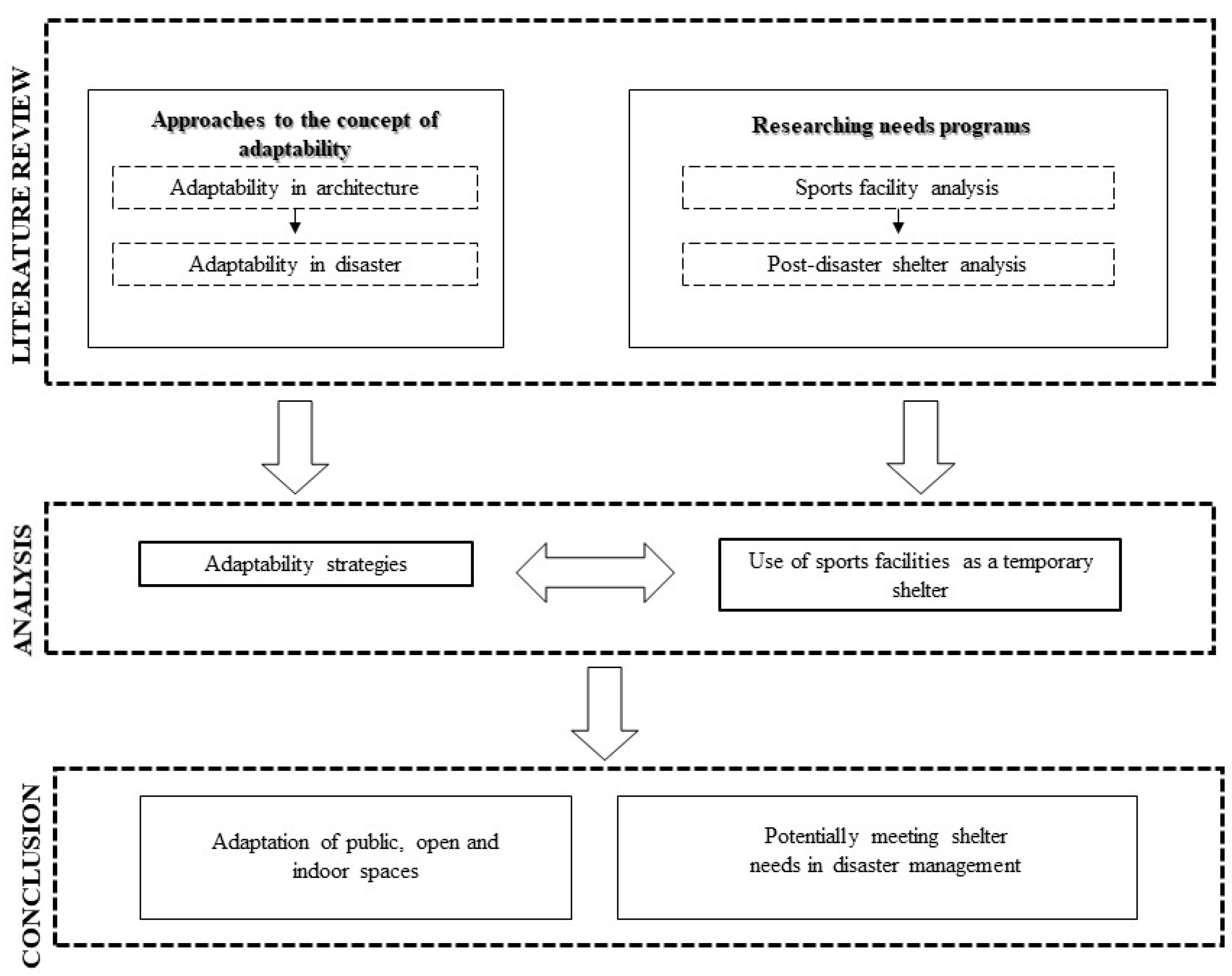
The research process of the study consists of three main stages. These stages are presented in
Figure 1. First, stage adaptability strategies are identified and operationally defined through a focused review of the architectural adaptability and changeability literature, complemented by operational and spatial strategy. These strategies constitute the evaluation criteria of the study. In addition, functional requirement programs are compiled separately for indoor sports facilities and temporary shelter settings. This stage is defined as the literature review. The literature review primarily focused on studies that could provide specific fundamental concepts related to adaptability. This approach aimed to create a synthesis table by summarizing the concepts obtained from the literature and to enable space–function mapping based on these concepts. It was thought that the use of fundamental concepts would provide a more descriptive narrative when describing the transformation process from one spatial requirement to another. In the second stage, which is the analysis phase, the programatic components of both contexts are systematically mapped to the identified adaptability strategies using a rule-based matching procedure. In the final stage, based on this mapping, design decision categories—including reuse, reconfiguration, expansion, and the introduction of add-on components—are derived as feasible transformation pathways.
To enable systematic comparison, both programs were translated into functional categories. Sports facilities were classified under four primary groups—user spaces, personnel spaces, service areas, and sports activity zones—while shelter programs were organized into open, semi-open, and enclosed spaces, supplemented by service areas. Each category was then assessed against the eleven adaptability strategies using explicit and decision rules. Direct reuse was assigned when an existing function could satisfy shelter requirements with minimal intervention. Transformability-related strategies (e.g., versatility and adjustability) were applied when needs could be met through internal reconfiguration, such as partitioning, furnishing changes, or circulation adjustments. Scalability and expandability were considered where meeting shelter demands required increased capacity or spatial extension toward adjacent outdoor areas. Finally, portability, dismountability, and modularity-related strategies were used when temporary or detachable components were necessary to achieve the intended function.
This structured, criteria-driven approach enables a consistent evaluation of adaptability across both programs and supports the derivation of generalized design insights applicable to post-disaster reuse scenarios. To enhance analytical rigor, all functional mappings were conducted using the same predefined criteria set and decision rules. The use of programatic categories rather than building-specific cases improves transferability, while the explicit documentation of matching logic supports future studies.
In this study, adaptability strategies are addressed not as a graded or weighted evaluation system, but as binary operational tools that define the necessary conditions for a specific spatial–functional transformation to occur. In other words, each strategy is considered a transformation mechanism that enables a given sports facility space to meet temporary shelter functions. Within this approach, a space–function match is deemed possible only when the relevant adaptability strategy is activated; if the strategy is not activated, the match is not considered valid. Accordingly, the strategies are used as decision components that determine not the degree to which a transformation occurs, but whether it can occur at all. At the same time, adaptability strategies are not treated as mutually exclusive categories, but as complementary tools representing different dimensions of spatial transformation. Therefore, meeting the requirements of temporary shelter within a given space may necessitate the simultaneous activation of multiple strategies. This approach conceptualizes adaptability as a multi-layered spatial transformation process rather than as a set of singular and hierarchical interventions.
Furthermore, the study deliberately excludes validation, weighting, or scoring processes based on expert judgment. The primary rationale for this decision is that the aim of the research is to develop a rule-based, transparent, and reproducible matching framework that can be applied across different architectural studies, rather than to assess the correctness of specific spatial transformation decisions. The decision-making process is thus implemented through strategy definitions derived from literature and pre-defined matching rules. The principle of interpretive consistency is not ensured by individual expert judgments; rather, it is ensured by methodological clarity, coherence, and reproducibility.
2.1. Background
The literature review is structured to progressively narrow the concept of adaptability from a broad architectural perspective toward a disaster-sensitive and function-oriented interpretation relevant to temporary sheltering. This section positions “adaptability” as the analytical bridge between post-disaster shelter needs and the latent capacities of existing sports buildings. By consolidating key definitions, evaluation criteria, and strategy sets from the literature, the paper establishes a consistent framework that will be used to compare (i) sports facility requirement programs and (ii) temporary shelter requirement programs, and to justify transformation decisions in the results section.
2.1.1. Different Approaches to the Concept of Adaptability
Adaptability is broadly defined as a system property that is amenable to change in order to adapt to the changing context of use and stakeholder demands [
10]. Lelieveld et al. [
11] examine adaptability in terms of autonomy and discusses it in six stages: flexible, active, dynamic, interactive, intelligent and artificial intelligence. The concept of adaptability is defined as the ability to adapt to environmental changes. In the context of architecture, adaptability can be explained as the ability to adapt to user demands, environmental effects, the requirements of time and current technologies [
12].
2.1.2. Adaptability in Architecture
Schmidt III et al. [
13] discuss adaptability in terms of being accessible to different users at different times, having an open plan that can be divided and created with a flexible design approach, being able to interact quickly with the use of kinetic systems against environmental changes, and being used for purposes suitable for transforming structural features and functions. From this point, a general definition of adaptability is created as “the capacity of a building to effectively meet the changing demands of its context, thereby maximizing its value over its lifetime”. There are also approaches that consider adaptability as the adaptation of a space to the use of people with disabilities or the adaptation of a space designed for people with disabilities to the use of people without disabilities, or as a combination of flexibility and sustainability. The concept of sustainability at this point refers to maintaining a certain level of indoor comfort suitable for different user types. It is the ability to continue providing service according to changing users throughout the building’s lifetime [
4,
14,
15]. Kronenburg [
16], on the other hand, considers adaptability within flexible architecture, exemplified by a house that can adapt to the needs of expanding families and the number of rooms can be increased or decreased [
17].
Arge [
18] states that there are three approaches to architectural adaptability. In the first approach, it is emphasized that the building should have a multifunctional use by referring to the capacity of the building to adapt to the changing function and needs of the users. In the second approach, the physical characteristics of space are changed in order to adapt to changing functions and needs. However, since this change was previously planned with a flexible design approach, the interventions are also small-scale. In the third approach, adaptation to the changing situation is at the forefront with the effect of macro-scale applications in the building. Options such as the construction of an additional building or the division of the existing building can be evaluated.
Based on the fact that a building with high adaptability potential should have a high transformation speed, it is stated that the use of dismountable materials is one of the main components of adaptability. The entire construction and demolition process should be manageable and architectural details should be designed within the scope of adaptability. In this way, the transformation speed of the buildings and thus their adaptability potential increases [
19]. Sinclair et al. [
20] discuss the adaptability potential of a building in relation to minimum destruction, cost, waste and maximum robustness, variability and efficiency. The sustainable quality of adaptable buildings is strengthened by reducing waste and cost and planning for their transformation.
The “layering approach” to assessing adaptability is based on the idea that building components have different life cycles. By extending Brand’s layer theory, building components are divided into nine elements (facade, space organization, furnishing, floor, wall, ceiling, installation, structure, technology) under the subheadings of surfaces, spatial features, components and modules, technical features [
12,
13,
14,
15,
16,
17,
18,
19,
20,
21].
At the stage of measuring adaptability, it is seen that strategies, tools and procedures are needed to guide and improve the design. The development of a practice that involves stakeholders in the design and production of adaptive buildings will facilitate the achievement of sustainability. Recognizing adaptability as an important part of the architectural design process is a solution to planning-related problems in this field [
22]. The strategies of adaptive design approaches are discussed under six headings by Manewa et al. [
23,
24]:
Under the heading of adaptability, the functional change capacity of the building with changes in furnishing elements with the help of modular systems is addressed.
The versatility strategy covers the capacity to change the interior spaces of the building. Through the use of modular cells and interchangeable planes, it focuses on services appropriate to the current needs of the building.
The retrofitability strategy emphasizes the capacity to change the building’s components. It emphasizes the building’s components that can be dismantled, disassembled, moved and folded.
The concept of transformability emphasizes the capacity of the building to be adapted in processes where it has different functions.
The scalability strategy includes macro-scale adjustments, such as the capacity to change the size of the building.
Portability refers to the ability of a building or its components to be moved.
Özler and Güçyeter [
25], in their study of adaptability-related strategies in the literature, found that flexibility, expandability, dismountability, mobility, overcapacity, transformability, reuse, independence, modularity and re-equipment are the most frequently used concepts.
It is important to note that the concept of “adaptability” is subject to diverse interpretations. Consequently, there is a plethora of evaluation criteria and implementation strategies in existence (see
Table 1). Despite the fact that the notion of adaptability is addressed in the extant literature under a variety of terms by a range of authors, it is evident that these concepts largely correspond to similar forms of spatial and functional interventions. Within the scope of this study, the adaptability strategies employed were identified through a comparative evaluation of the approaches that have been prominent in architectural literature under the headings of adaptability, flexibility, transformability, and changeability. Concepts that recur across studies such as Manewa et al. [
23], Arge [
18], Kronenburg [
16], Sinclair et al. [
20], and Özler and Güçyeter [
25], and that have clearly defined spatial implications, were consolidated, and a total of 11 adaptability strategies were addressed within the scope of the research. Accordingly, the identified strategies were derived through a literature review and aimed to establish a spatial evaluation framework within the context of post-disaster use. By reviewing definitions, evaluation criteria, and strategies of adaptability from various sources, key concepts used in three different contexts were identified. Data related to each context were synthesized through an integrative approach, leading to comprehensive definitions, evaluation criteria, and strategies of adaptability. Based on these findings, an assessment framework was systematically developed and presented in detail. The proposed framework clarifies how the identified adaptability strategies correspond to specific spatial concepts and intervention types within the context of sports facilities. In this way, the spatial transformation potential required for adapting sports facilities to post-disaster temporary shelter use is articulated at both conceptual and operational levels.
2.1.3. Disaster-Sensitive Adaptability
In the aftermath of a disaster, families encountering challenges with regard to their shelter may remain in temporary accommodation for a period of time, until such time as they are able to move into their renovated or newly constructed permanent dwellings. During this period, the living environment must be modified and adapted to meet the needs of the patient. An adaptive design approach is imperative for evicted families to access living spaces that they can adapt with minimal effort [
26].
It is seen that public open and closed spaces are not given enough importance in the planning of temporary and permanent new settlements after disasters. However, it is thought that public spaces can affect psychological recovery as they are considered as social cohesion spaces [
27]. Therefore, adaptive design of public spaces for effective use after a disaster is considered necessary for the benefit of the individual and society.
2.1.4. Sports Facilities and Disaster-Sensitive Adaptability
Architectural design products are programed and designed to serve a specific purpose, it is also important that they are flexible, adaptable, changeable and transformable to adapt to changing living conditions in a world where epidemics, migration and natural disasters occur [
28,
29].
Indoor sports centers can also be considered among adaptive flexible design products, which are also defined as “being able to adapt to differentiating, changing conditions” [
30]. The architectural program gains importance in buildings designed for adaptive use. The flexible nature of spatial organization ensures that it has the potential to adapt to different functions [
31]. However, not only physical requirements but also the psychological needs of the user, aesthetic values and second or more events that may develop instantaneously should be taken into consideration during the design phase of the building [
32]. Considering the ratio of indoor and outdoor areas of sports complexes, it is seen that they have a high ratio in terms of spatial volume in the city. Therefore, the adaptable nature of the architectural programs of indoor sports complexes gives these spaces the potential to be used for different functions [
32]. At this point of the study, it is important to clarify and reveal the architectural program of indoor sports complexes.
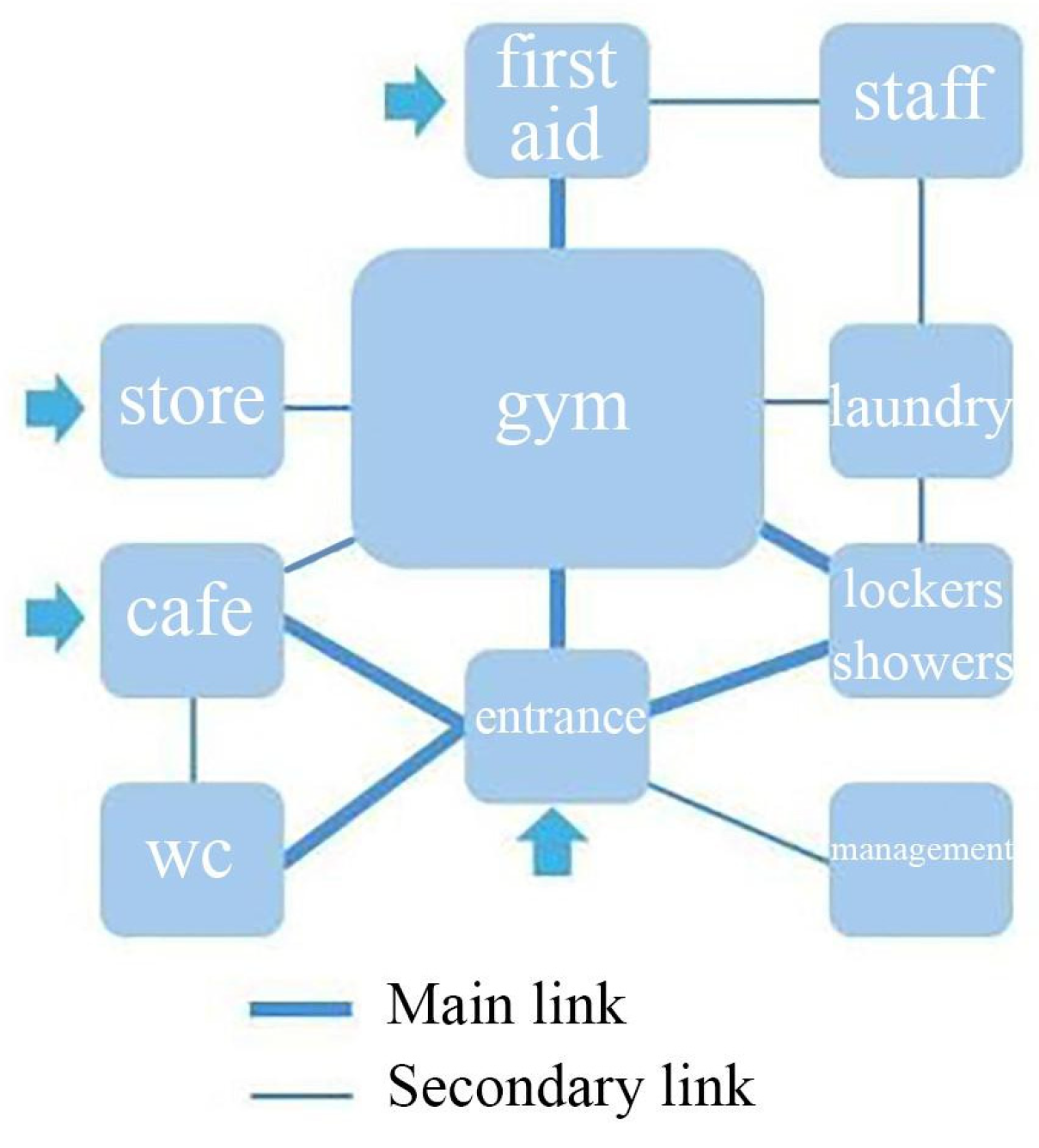
John and Campell [
33] defined the circulation network diagram for indoor sports complexes in their studies as service areas distributed from the entrance hall, sports area connected to the entrance hall, spectator area, storage areas and personnel areas (
Figure 2).
Here, in addition to the shower, toilet and storage areas for indoor sports hall users, there are rest areas and wet areas for the use of administrative units and personnel, first aid room and laundry rooms, and it is recommended that there are two or three service entrances for restaurants, storage and emergency entrances and exits in addition to the main entrance.
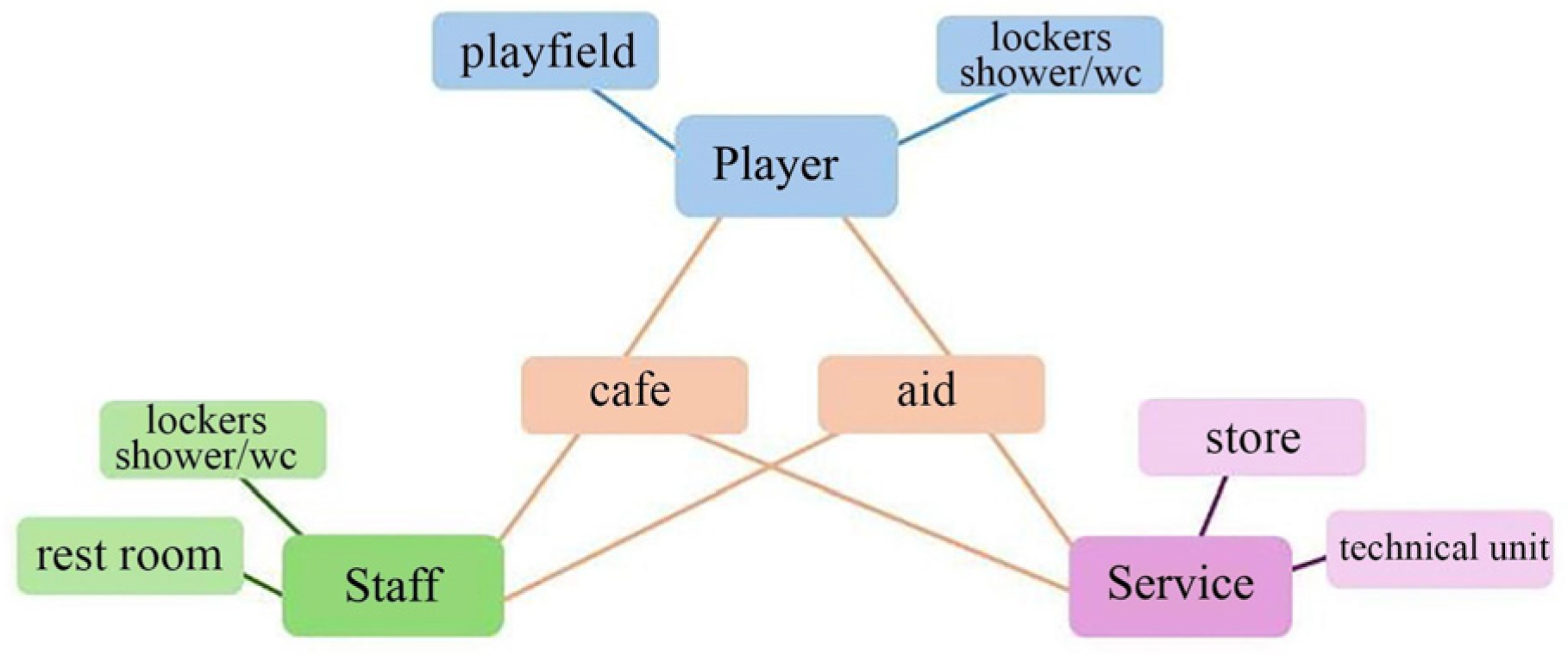
In another study prepared on the spatial organization of sports facilities, it was stated that there are entrance, administrative unit, playground (basketball and volleyball courts), user locker room-shower, toilet, staff locker room-shower, toilet, material storage, first aid room, spectator area and technical service functions in the spatial organization [
34]. Therefore, the spatial program of sports facilities can be examined under three categories as user-personnel-service (
Figure 3).
Çelik [
34] stated that the indoor sports hall project, which he designed and whose tender was made by the Ministry of National Education of the Republic of Türkiye, should be applicable in different climate, economic and geographical conditions and offer adaptable spaces. In the Minimum Design Standards Guide for Educational Buildings prepared by the Ministry of National Education, it is stated that the design program for independent indoor sports halls within the educational building campus should include an athlete entrance and foyer, spectator entrance-foyer, cafe, gym, tribune, indoor physical education hall, athlete locker/shower toilet, referee room, storage, first aid and technical units, and it is stated that it should have a facade that can be opened to open sports areas and should be associated with open sports areas. In addition, the height of the hall should not be less than 7.5 m [
35]. The functions that should be included in the structure are defined and explained in detail in the relevant guide that provides design standards (
Table 2).
In the Türkiye Disaster Risk Reduction Plan prepared by AFAD [
36], it is stated that sports facilities should be accessible and suitable for temporary shelter, like other public spaces. Sports facilities have different space requirements depending on the sports activities they operate in, and this necessitates the transformation of spaces with different functions in the post-disaster process. The example of the Kocaeli Olympic Ice Sports Facility being used as a morgue in the Marmara Earthquake in 1999 shows the importance of adaptable sports facility applications in meeting needs other than shelter [
37]. Post-disaster shelters in Japan include parks, green areas, schools, sports fields and other public halls. Among these public spaces, sports fields play an important role as they provided shelter for more than 200,000 disaster victims in the Modern Japanese Kanto earthquake and the Kobe earthquake [
38]. Flexibility and transformation, which are considered two subheadings of adaptability, have become fundamental concepts for post-pandemic architecture and urbanism. Especially after the COVID-19 outbreak in 2019, the transformation of sports facilities into temporary shelters and health spaces has been frequently preferred. Sports facilities have a great advantage in accommodating patients, as the partition elements within the buildings can be relatively easily assembled and disassembled after they have served their purpose. The use of existing toilets and showers also shows that the potential for adaptability is high. In a study conducted on two indoor sports facilities in Serbia in 2023, the physical characteristics and systems of the sports halls were found to meet the special requirements for the temporary accommodation and treatment of patients in the event of a disaster [
39]. Montejano-Castillo and Moreno-Villanueva [
40] who touched on the idea that urban open spaces can be considered as a second city outside of normal situations, consider it important to classify public spaces according to their functions in the post-disaster process. It is emphasized that public spaces have great potential in making the city a disaster-resistant structure.
Gebel et al. [
32] in their study examining the post-disaster adaptability potential of sports facilities, made an evaluation based on five criteria: size/transformability, location/accessibility, security, service areas, and psychological factors. It was determined that the transformation of indoor areas of sports facilities into service areas was easily achieved, and that accommodation in outdoor sports facilities had positive effects on the psychological state of individuals. It was stated that the proximity of sports facilities to residential areas was advantageous for individuals to maintain similar social relations before the disaster.
Concepts related to disaster-sensitive adaptability and previously established adaptability evaluation criteria are integrated in
Table 3. Recommended structural interventions for adaptability applications are outlined under the heading “Synthesis”. An adaptability strategy concept has been defined for each application to enhance clarity within the scope of sports facilities.
2.1.5. Post-Disaster Temporary Shelter
The existence of temporary shelter units is important in disaster management in meeting the need for shelter after a disaster [
41]. The minimum standards of temporary shelter can be examined in two main tabs as design and implementation. In the main design criterion, the profile of the disaster victim plays a role in shaping the temporary shelter design. According to this criterion, it is possible to examine the user from two perspectives as family and individual (1–2). The family criterion includes families of 4–6 people, individuals who need shelter as parents, the elderly and the disabled. The individual criterion includes students studying in the city, disaster experts and guest researchers who come to the region after the earthquake. Considering these possibilities, decisions are made according to the user profile in the design and implementation of shelter units and an efficient shelter process is created.
The design process of temporary shelter units is examined under three different headings: open space, closed space and semi-open space. The title “Open space” includes common gathering and socializing areas for disaster victims and green areas and specialized garden areas for the psychosocial recovery of disaster victims [
42,
43]. The title “Closed Space” of the shelter unit design includes the basic sections that should be in a living space. These are wet area, living area, sleeping area, food preparation and cooking area and storage area [
44,
45]. The shelter interior closed area design is made by considering the relevant sub-units. The last stage of the design process of the units is semi-open areas. In addition to closed shelter units, these areas can be balconies, storage and living areas shaped according to the cultural lifestyle of disaster victims. It is important that the material to be selected in the design and implementation of temporary shelter has certain characteristics. For example, the fact that the material preferred during the construction phase is the local building material of the region provides convenience to the relevant personnel in terms of supply and application to the region where the disaster occurs. In this process, the application of shelter units provides an efficient process management in terms of the time it saves [
46]. In addition, the storability of the material provides the opportunity to store it in the storage areas determined before the disaster. After the disaster, the material can be disassembled and re-stored when the shelter need is met [
47]. In addition to the material properties, it is recommended that the panels and carriers forming the shelter units should be resistant to sound and heat comfort [
48,
49]. This situation supports thermal comfort and contributes to family privacy [
50]. In the standard design decisions of temporary shelter units, the climatic conditions where the disaster occurs directly affect the comfort conditions of the disaster victims [
51]. In this context, the thermal comfort values of the closed area to be preferred must provide the physical conditions with the use of air-permeable materials [
52].
The construction of temporary shelter units in the disaster-affected region is frequently seen in the literature. This approach is met by meeting the need for shelter in the land to which disaster victims feel emotionally attached [
53]. In the selection of temporary shelter locations, the fact that disaster victims will reside in the region for a long time is taken into account [
43]. In this context, one of the main objectives is to ensure that the life routine that continued before the disaster continues in the temporary shelter area. The location of the shelter within the region and its accessibility play an active role in easily carrying out work, education, health and social activities [
54]. The accessibility of shelter units to each other and to the outside region provides a livable environment for different user types [
43]. The planning of pedestrian, disabled and vehicle paths, public transportation services and emergency services are evaluated within this scope . On the other hand, infrastructure works, which are one of the technical requirements, are important in the design and implementation of temporary shelter [
50].
For many people, the adaptation process of homes—where daily activities, habits, and time are most intensely spent—prioritizes ensuring functionality. However, a function-focused approach tends to relegate individual demands related to cultural structures to the background. Within the scope of this study, adaptation based on basic spatial requirements is considered in the initial stage after a disaster. However, there is a need to plan living spaces that incorporate local life and cultural codes, even if they are temporary shelters. Due to organizational deficiencies, the temporary shelter process may be prolonged; therefore, local authorities need to consider arrangements that are compatible with the cultural structure and can meet the expectations of women and children. Although the adaptability practices proposed in the article cover sports facilities, it is anticipated that the relationship established between structural requirements and adaptability strategies can also be used in the adaptability of other public buildings. For the proposed adaptations related to interior spaces at the spatial scale, climatic conditions are not factors affecting the design. The use of open spaces is restricted under adverse climatic conditions. However, since the main functions related to the accommodation function take place indoors, adverse climatic conditions are considered tolerable for the proposed adaptability applications.
3. Results
In the process of adapting sports complexes for temporary shelter purposes, the adaptability strategies mentioned in the introduction were taken into consideration, and these strategies were used when deciding how to transform the functions. The design criteria for temporary shelters were addressed under two overarching headings: “open space” and “closed space”. The spatial requirements program for the sports complex was addressed under four main headings: “service”, “personnel”, “sports” and “user spaces”. It is evident that adaptability strategies have been instrumental in addressing the prevailing needs of the program, thereby ensuring the provision of adequate temporary shelter in the aftermath of the disaster.
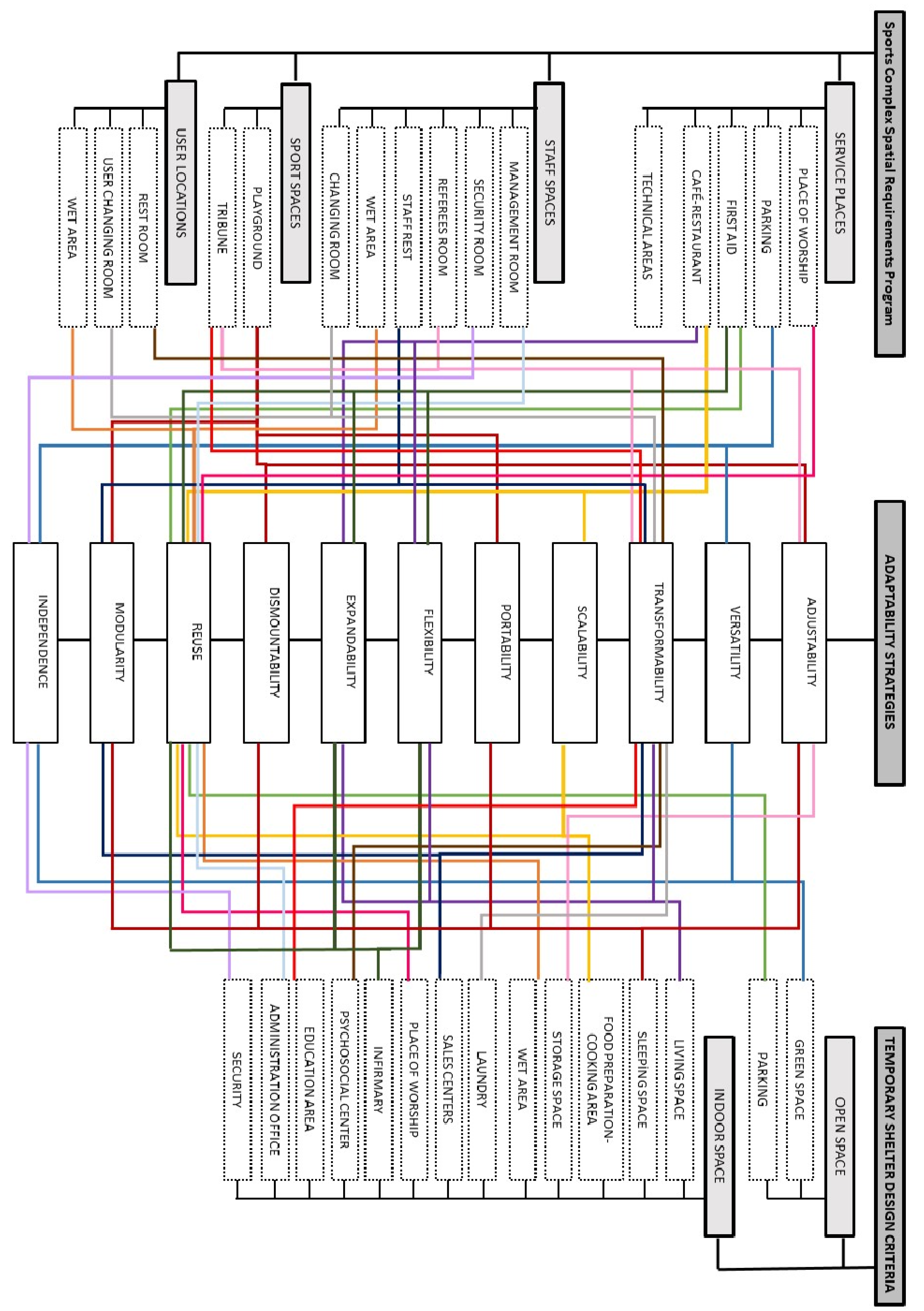
Figure 4 presents an analytical framework that establishes the relationship between the spatial requirement program of sports complexes and post-disaster temporary shelter design criteria through eleven adaptability strategies. Rather than depicting a direct functional transfer, the figure illustrates how different spatial components can be reprogramed through specific adaptability strategies. The diagram is composed of three layers. The left section represents the spatial program of the sports complex, the right section represents temporary shelter requirements, and the central section represents the adaptability strategies that enable transformation between these two programs. The colored connections indicate that a space can fulfill shelter functions only when the corresponding strategy is activated. The most prominent finding highlighted in the figure is that transformation decisions are largely structured around the strategies of transformability and reuse. This indicates that, in the use of sports complexes for post-disaster sheltering, interventions requiring spatial reconfiguration and capacity enhancement are more decisive than direct reuse. When the adaptability strategies are examined in detail, within the scope of the first strategy, adjustability, it is envisaged that the Sleeping Area, which is one of the temporary shelter sub-criteria, will be met with the playground in the needs program of the sports venue. The same strategy was matched with the referee room and tribune area in the sports complex and the “storage area” function in the temporary shelter. Another strategy, versatility, is used in adapting the parking area in sports complexes as a green area. The results demonstrate that adaptability strategies function not as isolated design tools but as combinatory mechanisms that enable layered transformation decisions across different spatial scales.
By using the transformability strategy, education area needs are transformed from the tribune areas within the sports venue. It is envisaged that the psychosocial space need will be met by transforming the rest room and the laundry need will be met by user changing rooms. The scalability strategy was used in the adaptation of the cafe-restaurant area in the sports complex for the need for food preparation and cooking. In addition, to provide a sleeping area, portability and dismountability strategies were preferred in the adaptation of the playground space. In the need for an infirmary area, it was thought that the first aid room and the horizontal circulation line connected to this area could be used and the flexibility strategy was used here. In this adaptation, the expandability strategy also comes into play in order to increase the service area by opening the space to the outside. It was thought that if the spatial capacity is sufficient in the common criteria of the sports complex and temporary shelter, the functions could be directly transferred and the reuse strategy could be used at this point. The reuse and independence strategy was used in the adaptation of the first aid room as an infirmary and the other service spaces (administrative units, wet areas, parking lot, food preparation areas, places of worship and security areas, etc.) by continuing their functions. The modularity strategy was used in the adaptation of the playground to the sleeping area, and the staff rest areas to the sales centers. All adaptation decisions are shown in
Figure 4.
An examination of the findings indicates that the adaptability strategies most frequently employed in the conversion of sports facilities for post-disaster temporary shelter functions are transformability and reuse. These strategies play a critical role particularly in the reprograming of large-scale, high-volume, and multifunctional spaces—such as playing fields, spectator stands, and lounge areas—that serve diverse user profiles. According to the analysis results, the transformations requiring the highest level of intervention occur when the primary sports spaces of these facilities (especially playing fields) are converted into shelter functions—such as sleeping areas and enclosed living spaces—that demand privacy, comfort, and long-term use. The study reveals that the limits of adaptability become particularly evident in situations where spatial capacity, technical infrastructure, and user comfort requirements cannot be met simultaneously. Moreover, although sports facilities are large-volume and highly accessible structures, they present inherent limitations in long-term shelter scenarios in terms of privacy, thermal comfort, acoustics, and the provision of individual living spaces.
4. Conclusions
Disasters expose not only the physical vulnerability of the built environment but also the limitations of post-disaster sheltering approaches that rely predominantly on newly constructed, temporary structures. In this context, the adaptive reuse of existing public buildings emerges as a critical yet underexplored strategy for enhancing post-disaster response capacity. This study has examined sports facilities as a representative public building type with significant latent potential to accommodate post-disaster temporary shelter functions through programatic adaptability.
The findings demonstrate that sports facilities possess a high degree of spatial and functional compatibility with post-disaster shelter requirements. By employing eleven adaptability strategies, the study shows that fifteen distinct shelter-related functions can be accommodated through varying degrees of transformation, ranging from direct reuse to reconfiguration, expansion, and the incorporation of temporary modular components. This confirms that adaptability operates not as a singular design attribute but as a layered and combinatory mechanism that enables differentiated transformation decisions across spatial scales. Rather than focusing on individual building cases, the study adopts a program-based analytical approach, allowing for the evaluation of adaptability at specific architectural forms. This methodological choice strengthens the transferability of the findings and enables the framework to be applied to other public building typologies, such as educational, religious, or cultural facilities. The rule-based matching of functional programs minimizes subjective interpretation and provides a basis for comparing spatial capacities under post-disaster conditions. The aim is to provide support regarding the preferred methods and criteria rather than creating a model design for adaptable sports facilities. It is expected that the connection made between the spatial constraints and the adaption solutions that were successful will also apply to other public buildings. Thus, an effort has been undertaken to create a framework for decision-making about uses of adaptability in public buildings.
4.1. Limitations
The findings of this study reveal a significant potential for the adaptive reuse of sports facilities for post-disaster temporary sheltering; however, these findings should be interpreted within the context of certain structural, administrative, and contextual limitations. First, the preservation of the structural integrity of sports facilities after a disaster constitutes a fundamental prerequisite for the feasibility of the proposed transformations; in public buildings that have sustained severe damage or exhibit compromised structural safety, the direct application of this framework may not be possible. Second, the organizational capacity and decision-making processes of local authorities and relevant institutions play a decisive role in the post-disaster use of public facilities; these governance-related issues fall outside the scope of the present study. Moreover, as the duration of shelter use in sports facilities increases, limitations related to privacy, thermal comfort, acoustic performance and individual living space requirements become more pronounced, thereby revealing the boundaries of spatial adaptability. In addition, context-specific factors—such as social dynamics, the diversity of user profiles, and climatic conditions—directly influence the effectiveness of adaptability strategies and were therefore not addressed within this study. Taken together, these limitations indicate that context-sensitive and multi-actor evaluations should support the proposed framework.
4.2. Practical/Managerial Implications
From a disaster management perspective, the study underscores the importance of integrating adaptability considerations into pre-disaster planning and architectural programing. The experience of the 6 February 2023 Kahramanmaraş earthquakes once again revealed the necessity of utilizing enclosed and semi-enclosed public spaces, particularly under adverse climatic conditions. In this regard, sports facilities represent not only emergency shelter options but also environments capable of supporting psychosocial recovery, continuity of daily routines, and social interaction during prolonged displacement periods. Beyond its immediate application to temporary sheltering, the proposed framework contributes a broader methodological reference for evaluating the adaptive reuse potential of public buildings under conditions of uncertainty, rapid functional change, and resource constraints. By linking architectural adaptability strategies with disaster-sensitive spatial requirements, the study offers a structured decision-support tool for architects, planners, and policymakers seeking to enhance flexibility through the effective reuse of existing building stock.
4.3. Future Research Directions
Future research may expand this framework by incorporating quantitative performance indicators, user-based evaluations, or scenario-based simulations to assess adaptability under different disaster types and durations. Additionally, comparative studies across diverse cultural and climatic contexts can further refine the adaptability strategies and support the development of context-sensitive design guidelines for disaster-resilient public architecture. In addition to this framework, future studies may comparatively analyze the effects of different adaptability strategies by incorporating quantitative methods—such as multi-criteria decision-making approaches—alongside qualitative, context-based matching processes. Furthermore, adapting the program-based evaluation approach developed specifically for sports facilities to other public building typologies, including educational, cultural, and religious buildings, would allow for testing the transferability and generalizability of the proposed framework. Finally, in order to address the challenges associated with long-term sheltering identified among the limitations of this study, future research may more comprehensively examine the time-dependent spatial performance of adaptability strategies, as well as their impacts on user comfort and privacy.