Article

Perception of Spatiality in Residential Interiors: An Analysis of the Visual Experience of Space in Motion


by
Đorđe Alfirević
1,*,
Slobodan Marković
2,
Sanja Simonović Alfirević
3 and
Tanja Njegić
3
1
Faculty of Contemporary Arts, University Business Academy in Novi Sad, 11000 Belgrade, Serbia
2
Laboratory for Experimental Psychology, Faculty of Philosophy, University of Belgrade, 11000 Belgrade, Serbia
3
Institute of Architecture and Urban & Spatial Planning of Serbia, 11000 Belgrade, Serbia
*
Author to whom correspondence should be addressed.
Architecture 2026, 6(1), 36; https://doi.org/10.3390/architecture6010036
Submission received: 31 January 2026 / Revised: 27 February 2026 / Accepted: 28 February 2026 / Published: 3 March 2026

Abstract

This paper investigates the relationship between the typological organisation of residential interiors and the subjective experience of spatiality, formed through sequential, visually mediated movement. It examines whether perceived spatiality derives primarily from the mental integration of the dwelling as a whole through circular movement, or from immediately accessible visual relationships such as visual accessibility and perceptual depth. An experimental study was conducted in which participants with and without professional education in architecture and interior design evaluated four typologically distinct residential interior models (circular circulation, enfilade, branched structure, and open plan), presented through standardized screen-based animated walkthrough simulations designed to replicate continuous spatial movement under controlled visual conditions. Subjective evaluations were collected using eight bipolar semantic scales. Analysis of variance showed that typological structure had a statistically significant effect on all analysed dimensions of spatiality, while professional expertise did not produce significant differences. The results support the hypothesis that perceived spatiality is predominantly shaped by immediate visual accessibility and perceptual depth rather than by circular spatial connections requiring sequential cognitive integration. The findings clarify key perceptual mechanisms of spatiality and underscore the distinction between spatial flow as a structural property and spatiality as a perceptual category, with implications for residential design and further research.

1. Introduction

1.1. Spatiality

In contemporary housing, driven by global population growth and the need for more rational use of resources, tendencies toward sustainability, the miniaturisation of dwelling units, and the introduction of alternative models of shared living, such as co-living and cohousing, have become increasingly prevalent [1,2].
The reduction of residential floor area, in conjunction with changes in lifestyles, necessitates a re-examination not only of spatial functionality but also of the ways in which space is experienced. In this context, spatial perception becomes one of the key components of housing quality, as the subjective sense of openness, orientation, and comfort often exceeds the significance of the objective physical characteristics of the interior. The perceptual experience of space, shaped by visual, spatial, and cognitive factors, becomes particularly important under conditions of limited dimensions [3].
Understanding space therefore extends beyond its material structure and encompasses the manner in which it is perceived, used, and interpreted through users’ everyday movement and occupancy.
The terms space and spatiality are used across multiple disciplines. In general, space denotes an unlimited, dimensionally defined continuum within which objects and events are positioned; in architecture, it refers to a portion of that continuum shaped by functional and aesthetic criteria [4,5,6,7]. Spatiality, by contrast, denotes the perceived quality of space from a specific standpoint; unlike spaciousness, which refers to physical size, it also includes openness, formal clarity, expressiveness, and the degree of spatial definition [8].
Although space is commonly described through measurable parameters such as floor area, height, or number of rooms, dwelling experience is largely perceptual: small interiors may appear spacious due to lighting, clear visual axes, and connectivity, while larger ones may feel cramped if organisation and visual legibility are weak.
Spatial perception is formed not only statically but also in motion: as one moves through an interior, space is experienced as a sequence of interconnected scenes [9,10,11,12,13]. This indicates that spatial experience may diverge from physical dimensions and should be understood as an experiential rather than purely physical category [14], whereby spatiality concerns how space is perceived as open, fluid, legible, or congested.
As a perceptual category, spatiality emerges from relations between light, form, proportions, movement, and spatial connectivity, shaping comfort, orientation, and functional clarity within interiors.
Since spatiality is experienced through movement and sequential spatial unfolding, it is necessary to examine how different forms of spatial organisation influence users’ subjective experience [15,16,17].

1.2. Review of Previous Research

Spatiality has been discussed across disciplines, from philosophy and geography to sociology, architecture, and psychology, with authors examining what spatiality is, how it is formed, and what impressions it produces [18,19,20,21,22,23,24,25,26,27,28]. The following overview emphasises philosophical, psychological, and architectural interpretations, as these frame spatiality through existence, action, and movement.
Heidegger links spatiality (Räumlichkeit) to being-in-the-world, arguing that it is not equivalent to geometric space but defines a subjective domain of presence [29]. Merleau-Ponty similarly treats spatiality as irreducible to coordinates or sensory data, describing it as a ‘spatiality of situation’ inseparable from the event in which it emerges [30].
Foucault describes a shift from temporal to spatial orientation in modernity, conceptualised through heterotopias as ‘other places’ that reflect and contest normalised spaces [31]. Harvey proposes a tripartite model of space (absolute, relative, relational) to conceptualise spatiality within social processes [32].
Soja argues that space both reflects and actively shapes social relations, including inequality [33]. Perec emphasises the sensory basis of space, through which depth and enclosure are attributed to experience [34].
Within psychological discourse, Martin Farrell argues that spatiality is not an independently existing category but rather emerges in direct relation to the way it is experienced; that is, it does not exist outside experience but is constituted by it [20]. Along similar lines, a study by Stephanie Liddicoat indicates that the spatiality of therapeutic interiors, as experienced by individuals who self-harm, does not represent a purely individual perception, but is formed through collectively shared patterns encompassing visual attention, emotional responses, and modes of attentional focus. These findings have direct implications for the design of therapeutic spaces that support healing and emotional stabilisation [35].
From a different research perspective, Gunnar Karlsson analyses how individuals who are blind from birth form concepts of space, concluding that their spatial experience comprises three modes of understanding: tactile “pictorial experience”, conceptual thinking, and abstract knowledge. According to him, the most concrete and richest form of spatiality is grounded in a bodily, holistic, and emotionally inflected experience [36]. By contrast, David Melling introduces the concept of experiential space, which he describes as a set of activities and interactions—the space in which one looks, listens, walks, and communicates is not a single, stable whole, but a dynamic “action space” that changes depending on the type of activity [37].
Freshwater treats spatiality as a relational concept that enables multiple meanings generated through interaction with space [38]. Tally emphasises narrative as a means of mapping real and imagined spaces, relevant to the subjective experience of spatiality [39].
Bokharaei and Nasar show that perceived spatiality depends not only on physical attributes (size, lighting, windows, furniture) but also on prior spatial exposure, making it a relative and dynamic impression formed through movement [16].
In acoustic research, spatiality is operationalised through measures such as lateral energy fraction and interaural cross-correlation, although these indicators fluctuate with minor positional changes, raising methodological concerns in assessing spatial experience [40]. Griesinger further links perceived spatiality and auditory envelopment to interaural time and intensity differences and to the presence of multiple sound sources [41].
Ozdemir shows that rooms with open and natural window views are perceived as more spacious and pleasant, highlighting the role of visual connection with the exterior in spatial perception [42]. Stamps demonstrates that perceived spatiality depends on factors such as area, illumination, boundary permeability, and wall height, so that spaciousness may increase without physical enlargement; form, depth, porosity, and movement possibilities significantly shape impressions of openness, and both static and dynamic media can reliably measure spatiality when properly designed [43,44,45,46,47].
A growing body of research employs virtual environments, digital walkthroughs, and immersive simulations to investigate spatial perception under controlled conditions [48,49,50,51]. These methods enable simulated movement while maintaining control over visual parameters and have proven effective in examining responses to spatial configuration.
Von Castell, Oberfeld, and Hecht show that furnishing alters perceived dimensions and spaciousness in physical models, though not equivalently in virtual environments, indicating the influence of representational media on spatial impressions [52]. Wang, Lu, Ohno, and Gu demonstrate that wall texture significantly affects perceived spatiality, with material properties more influential in smaller rooms and associative meanings more decisive in larger spaces [53].
Within the field of architecture, Bernard Tschumi conceives space not as an abstract or geometric construct, but as an experience that emerges through bodily movement and sensory perception. In his view, spatiality is not a predefined category, but an experiential dimension that manifests itself through the movement of the body in space [54]. By contrast, Myungshig Kim introduces a broader understanding of architectural spatiality, arguing that it does not remain confined within building forms, but extends towards urban and territorial space. In this context, the interior is no longer understood solely as an enclosed architectural space, but as a concept that enables value-based spatial formation within the domains of urbanism and landscape architecture [55].
From the perspective of virtual environment design, Denis de Groot emphasises that spatiality in digital space, namely its size and organisation, has a more direct impact on user creativity than the mere application of VR technology itself. This position underscores the importance of carefully designing virtual environments as spaces in which experience is constituted [56]. Focusing on residential architecture, Đorđe Alfirević and Sanja Simonović Alfirević point out that spatiality can be achieved not only through physical dimensions, but also through organisational and perceptual strategies. According to them, space may be experienced as dynamic and layered through openness towards the surroundings, flexibility of layout, or the application of optical illusions [57]. In further elaboration of their arguments, the same authors emphasise that the quality of spatiality is not based exclusively on the physical dimensions of space, but on the manner in which it is shaped and experienced. Through various design strategies, such as flexible organisation, spatial openness towards the environment, or the use of optical illusions, it is possible to create an ambience that does not reveal all of its qualities at first glance but instead invites movement and exploration. Even when physical transformations are not feasible, perceptual intervention may contribute to a higher degree of spatial comfort [3].
From the standpoint of architectural aesthetics, Apollo Spiliotis analyses, in his dissertation, the ways in which interior spatiality can be shaped through illusionistic techniques. He examines historical and contemporary examples of architectural illusionism as methods that influence how users perceive spatial boundaries and depth [58]. Finally, David Dernie points out that the experience of space through colour is not exclusively visual, but is formed as an interactive effect between visual, symbolic, and contextual meanings. According to him, colour in the interior possesses a fluid spatial character that continuously changes in relation to the environment and user experience [59]. According to Al-Zamil, spatiality is not the result of physical dimensions, but of visual perception shaped by design elements such as form, volume, light, and colour, whose integration determines the impression of openness, connectedness, and spaciousness of the interior [60]. According to the findings of Ünlü, Edgü, Şalgamcioğlu, and Canakcioglu, perceived spatiality in interior environments depends significantly on physical aspects such as volumetric visibility, natural lighting, and the visual infinity index, while the sense of openness is further enhanced when the space is familiar to users [61].
Although virtual and mediated simulations are widely used to assess perceptual responses to environmental variables [62,63], typological patterns of residential spatial organisation have rarely been examined as independent variables in such experimental settings.
Despite extensive interdisciplinary discussion of spatiality, a clear gap remains in residential architecture regarding the analysis of specific dwelling organisations and their impact on users’ spatial experience. Empirical studies addressing subjective experience in residential interiors are comparatively scarce, indicating the need for research grounded in direct perception and movement that clarifies how spatial organisation shapes openness, connectedness, and comfort in contemporary housing.
While numerous studies address the influence of physical spatial parameters on perceived spatiality, none have specifically examined typological patterns of residential organisation in relation to subjective experience during visually mediated movement. This gap motivates the present study, which interprets architectural solutions through movement, experience, and perception as central factors in spatial formation.

1.3. Research Aim and Hypotheses

The aim of this paper is to examine how visually mediated movement through a residential interior, as employed in experimental and virtual environment research [17,64], influences the subjective experience of spatiality, through a comparison of different types of spatial organisation, including open-plan layouts, branched spatial structures, as well as interiors organised according to the principles of circular circulation and enfilade. In this context, the main research question is formulated as follows: based on which perceptual mechanisms do users evaluate the spatiality of a residential interior during visually mediated movement through space?
Building on existing theoretical considerations and empirical findings, the research is structured around two competing hypotheses concerning the mechanisms underlying the formation of the experience of spatiality. The hypotheses are derived from two distinct theoretical approaches to spatial experience: the first is based on the cognitive integration of space through movement and the mental representation of the whole, while the second interprets spatiality as the result of predominantly perceptual, immediately visually accessible spatial relationships.
The first hypothesis is based on the assumption that perceived spatiality relies predominantly on the experience of the dwelling as a whole, which cannot be comprehended from a single static position, but is instead formed through continuous and circular movement.
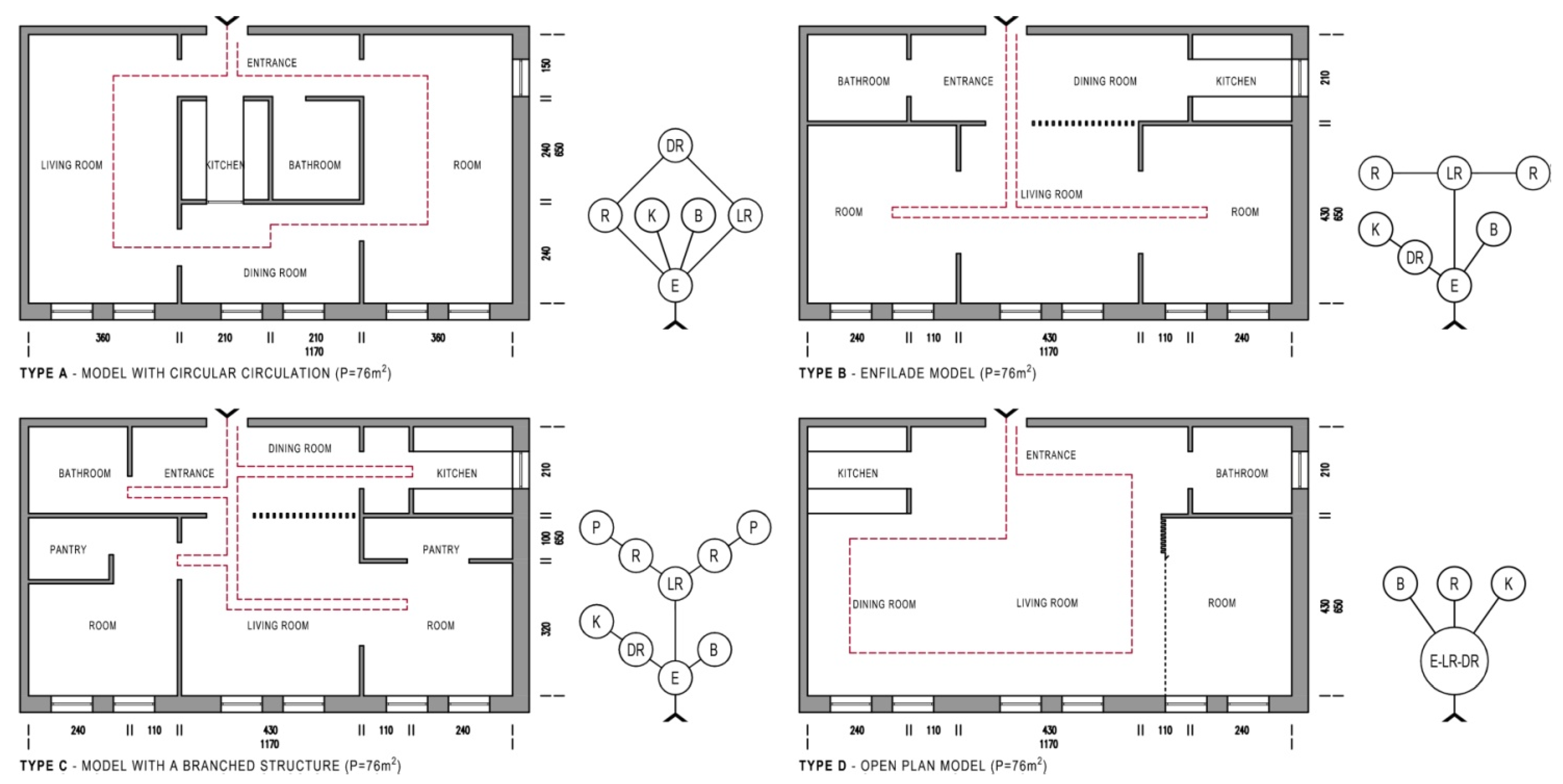
According to this hypothesis, interiors that enable spatial circulation without retracing the same path, namely, dwellings with circular circulation (see Figure 1, interior A), will be perceived as more spatial, due to the impossibility of grasping the dwelling as a whole from a single viewpoint and the necessity of its gradual comprehension through movement. In this study, “circular circulation” is defined as cyclical movement through multiple rooms, with the possibility of returning to the starting point without the necessity of following the same route, whereby the dwelling as a whole is progressively revealed through a sequential spatial experience. This type of organisation encourages the mental integration of space into a coherent whole and may contribute to a sense of spatial continuity and connectedness [65]. Discontinuous movement, by contrast, is characteristic of typological organisations in which spatial circulation is limited or conditioned by the need to return along the same path, such as dwellings with an enfilade, with a branched spatial structure, or with an open plan [66] (see Figure 1, interiors B–D). In such structures, movement is often predictable and segmented, and the dwelling as a whole is less frequently perceived as an integrated spatial system, which may result in a weaker sense of spatial connectedness and lower evaluations of spatiality.
The second hypothesis assumes that the assessment of spatiality is primarily based on immediately perceivable spatial relationships, namely the degree of visual accessibility and perceptual depth that an interior provides at a given moment. In this case, spatial configurations that connect multiple rooms into a single visual field, creating a pronounced sense of depth and visual continuity, will be evaluated as more spatial, regardless of the possibility of circular movement through the overall structure.
Perceptual depth refers to the visual reach and spatial layering that can be perceived from a limited number of positions, arising from the connection of multiple spatial segments into a continuous visual whole. Interiors with pronounced perceptual depth allow the simultaneous perception of distant parts of the space, thereby generating a strong immediate impression of spatial breadth and inclusiveness, even in the absence of circular movement. According to this hypothesis, an apartment organised as an enfilade and an apartment with an open plan (see Figure 1, interiors B and D) provide greater visual accessibility and more pronounced perceptual depth, and will therefore be experienced as more spatial, whereas perception in an apartment with a circular circulation and, in particular, in an apartment with a branched structure (see Figure 1, interiors A and C) will depend to a greater extent on movement and the sequential perception of individual spatial segments.

2. Materials and Methods

The aim of this study is to examine the influence of different types of spatial organisation of residential interiors on the subjective experience of spatiality, based on visually mediated movement through space. The research is designed as an experimental study in which participants assess spatial characteristics of interiors presented in the form of animated sequences.

2.1. Participant Sample

The study included 115 participants with different levels of expertise. The expert group consisted of 60 participants with educational backgrounds in architecture or interior design, while the non-expert (lay) group comprised 55 participants without educational experience in these fields (47 men, 68 women; mean age 37.15).

2.2. Set of Visual Stimuli

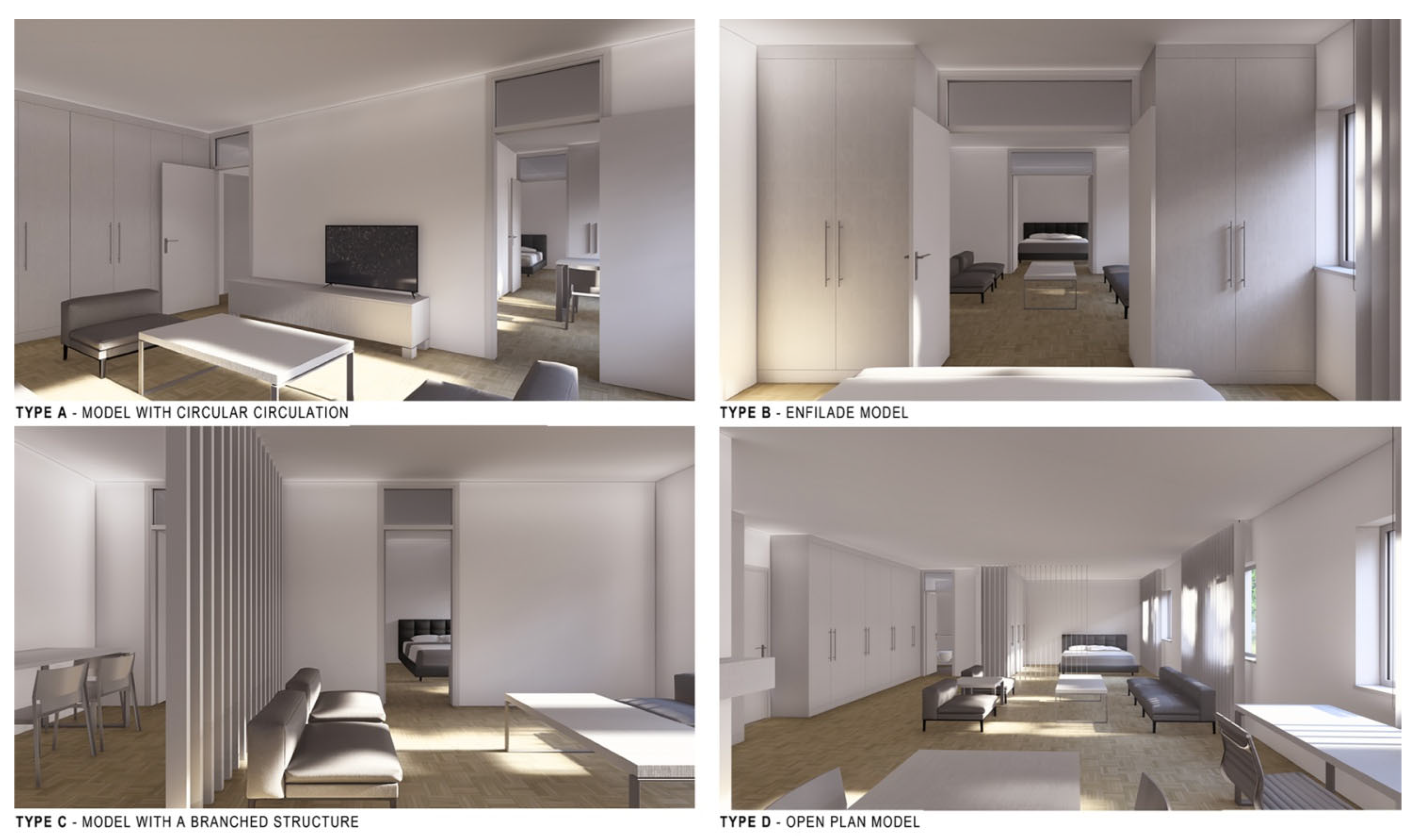
For the purposes of the study, four animations were prepared, representing different typologies of residential spatial organisation: (1) Type A—apartment with a circular circulation; (2) Type B—apartment organised as an enfilade; (3) Type C—apartment with a branched structure; and (4) Type D—apartment with an open plan (Figure 2).
All apartment examples were designed to have approximately the same floor area (P = 76 m2), within a narrowly defined range, in order to minimize the influence of physical size on the subjective perception of spaciousness. This approach made it possible to observe the effects of typological organization in isolation from the factor of area.
Each animation lasts one minute and represents simulated movement through the interior. The animations were designed to reproduce a realistic trajectory of movement through space, without pauses at positions that would allow the entire spatial structure to be perceived within a single frame. In addition, movement paths were standardized to avoid differences in the perceived length of circulation. The interiors were furnished in a minimalist manner, with uniform materialization and furniture tonality, in order to eliminate visual distractions such as color or contrast. The purpose of this level of visual control was to maximally isolate the influence of spatial organization on the perception of spaciousness.
The floor plans of all apartment models were drafted in Autodesk AutoCAD (version 2025), where the corresponding 3D models were also developed. Material definition and animated walkthrough sequences were produced in Lumion. The observer’s camera height was set at 160 cm above finished floor level, corresponding to the average eye level of a standing adult. The field of view (FOV) was fixed at 60°, approximating the clear central field of human vision, and the virtual camera was configured to a 35 mm focal length.
Movement paths differed in spatial configuration according to the typological structure, but their total lengths were kept identical across all animations in order to control for differences in exposure duration. Movement speed varied slightly due to camera rotations required by different path geometries; however, overall animation duration was standardised to one minute for each case. These minor variations were limited to brief local adjustments during directional changes and did not alter the total exposure time or the sequence of spatial segments presented in each animation. The duration of visual access to individual zones remained comparable across typologies. Consequently, slight differences in instantaneous movement speed are not expected to have systematically influenced the perceptual evaluation of spatiality.
All apartment types were derived from an identical base plan, with the same entrance position and identical façade openings. Only the internal partition configuration was modified to generate the four typological variants analysed in the study. Window positions remained constant in all models. Lighting conditions were simulated as natural daylight within Lumion in order to maintain comparable illumination across all layouts.

2.3. Criteria for the Selection of Typological Apartment Models

The selection of four typologically distinct apartment models was carried out with the aim of investigating perceptual differences in the experience of spaciousness as a function of interior circulation organization. All four models encompass approximately the same total floor area in order to eliminate the influence of size as a physical parameter and to focus the analysis exclusively on the effects of spatial logic. The typologies were chosen to represent different concepts of movement and spatial connectivity:
  • Type A—Model with circular circulation—This model is characterized by a spatial organization that enables continuous and looped movement through multiple rooms without the need to return along the same path. The spaces are interconnected into a closed circulation loop, generating a pronounced sense of spatial continuity, dynamism, and fluidity. Such a structure encourages an experience of openness and perceptual expansion of the interior, as users can explore the space freely without encountering dead ends or rigid barriers [67].
  • Type B—Enfilade model—This model is defined by a linear and axial organization in which rooms are connected sequentially along a clearly defined visual and physical axis. Movement is rectilinear and predictable, with each room accessed through the preceding one in the sequence. This spatial logic produces a sense of directionality and hierarchical order but may limit flexibility and contribute to a perception of enclosure when transitions are strictly sequential [68].
  • Type C—Model with a branched structure—This model is characterized by a spatial organization in which multiple paths extend from the entrance zone toward different parts of the apartment, without a central axis or circular circulation. Spaces are interconnected through a network of shorter and longer movement paths, resulting in a fragmented and partially unpredictable movement pattern. While such an organization allows access to different zones from multiple directions, it may also lead to a reduced sense of overall spatial coherence and lower legibility in the holistic experience of the interior [66].
  • Type D—Open-plan model—This model is characterized by an open and non-fragmented spatial structure in which functional zones (such as the living area, dining space, and kitchen) are integrated into a single continuous space without internal partition walls. The layout allows free and flexible movement with a high degree of visual connectivity between different activities. Such an organization promotes perceptions of spaciousness, transparency, and spatial elasticity, but in some cases may reduce the sense of intimacy and clear definition of individual zones [67].
Each model represents a distinct organizational logic, enabling a comparative analysis of how spatial form and layout influence perceived spaciousness. All interiors were designed to maintain functional completeness (living area, kitchen, bathroom, sleeping zone), with consistent use of identical materials, tonal ranges, and levels of modeling detail, in order to avoid visual bias in perceptual evaluation.
The typological models were not derived from specific case studies but were analytically constructed based on established typological principles in residential spatial organisation identified in architectural theory and housing research. Each model represents a controlled variation of internal partition logic applied to an identical base layout. This strategy ensured that differences in perceived spatiality could be attributed primarily to internal spatial configuration rather than to changes in overall size, entrance position, or façade openings.

2.4. Procedure

Participants completed the experiment online. The experiment was conducted online in order to enable controlled exposure to identical animated sequences under standardised viewing conditions. All participants viewed the animations on desktop computers with a standard 16:9 screen ratio. While minor variations in physical screen size and resolution could not be entirely eliminated in an online setting, the use of desktop displays with a standard 16:9 ratio reduced variability compared to mobile devices. Although exact control over individual viewing distance was not feasible in an online setting, each participant evaluated all four spatial typologies under identical personal viewing conditions. Since spatial structure was analysed as a within-subject factor, any variation in screen characteristics or viewing distance would have affected all evaluated typologies equally for a given participant. Consequently, such variability does not compromise the internal validity of the comparative analysis, although it may limit strict environmental standardisation.
The use of animated video representation was selected as a controlled and reproducible method of simulating spatial movement, consistent with established approaches in perceptual research employing mediated walkthrough representations. The study was conducted anonymously, with all participants identified only by a code. After entering basic demographic information (gender: male, female, non-binary; expertise: with or without formal education in architecture or interior design; age, expressed in years), participants observed animated “walk-throughs” of four apartment interiors. Four versions of the questionnaire were created, corresponding to four participant groups. All groups viewed the same interior models, but with systematic variation of two factors: the type of furniture used in the apartment and the direction of animated movement through the interior (leftward or rightward). After viewing each animation, participants completed a short questionnaire consisting of a set of bipolar scales designed to measure different dimensions of the subjective experience of spaciousness: perceived openness, connectivity, orientation, spatial depth, and spatial complexity. During the conceptualization phase, these perceptual dimensions were defined through bipolar semantic pairs representing opposite poles of the same construct. In the final version of the questionnaire, each dimension was operationalized as a single five-point continuous scale anchored by these opposing terms (e.g., ‘closed’–‘open’). Participants therefore indicated their position along one bipolar continuum rather than evaluating two independent unipolar attributes. This format preserves the conceptual bipolarity of the constructs while allowing interval-based statistical analysis.

2.5. Selection of Scales and Bipolar Pairs for the Assessment of Spaciousness

The development of the instrument for evaluating the perception of spaciousness was based on a review of existing literature in the fields of architecture, psychology, and cognitive sciences, with additional reliance on previous studies addressing the visual and perceptual experience of space. Approaches from interior design and ergonomics concerned with user experience in enclosed spaces were also taken into account.
The initial assumption in forming the scales was that the experience of spaciousness can be expressed through a set of perceptual dimensions that respondents intuitively recognize in visual material. For this purpose, bipolar scales were designed, based on the principle of the semantic differential. Each pair of terms was positioned at the poles of a continuum ranging from 1 to 5, where 1 denotes one extreme and 5 the opposite extreme.
The final set of scales was established on the basis of several thematic categories identified as representative of spatial experience:
  • Enclosed—open (This pair directly reflects the basic perceptual dimension of spaciousness, that is, the impression of visual accessibility and openness of space. It does not refer exclusively to the physical absence of partitions, but also to the subjective sense of communication between different spatial zones.)
  • Cramped—spacious (This pair measures an integrative subjective impression of spatial size, independent of actual floor area. The assessment of spaciousness encompasses the combined effect of spatial organization, visibility, and the possibility of movement through the interior.)
  • Poorly legible—legible (This pair refers to the degree of visual legibility of space, that is, the extent to which a user can perceive the spatial structure, relationships between zones, and spatial depth from one or multiple positions.)
  • Disconnected—connected (This pair describes the perception of structural integrity of space and the degree to which different spatial units are perceptually and functionally linked. A higher level of connectedness often contributes to a more pronounced sense of spatial cohesion.)
  • Difficult to navigate—easy to navigate (This pair examines the cognitive legibility of space, that is, how easily a user can understand the spatial logic, orient themselves, and anticipate subsequent paths of movement through the interior.)
  • Obstructed—passable (This pair relates to the perceived possibility of movement through space, both physical and visual. A space perceived as passable allows unobstructed movement and continuity of spatial flow.)
  • Simple—complex (This pair encompasses the perception of visual and structural complexity of space. Spaciousness often emerges as a result of more complex yet legible spatial–functional relationships, while both excessive simplicity and excessive fragmentation may diminish the quality of spatial experience.)
  • Does not encourage movement—encourages movement (This pair measures the extent to which a space motivates the user to move, explore, and visually follow spatial sequences, which represents an important aspect of the experience of spaciousness in interiors perceived in motion.)
The selection of specific terms within the bipolar pairs was finalized after pilot analyses of several earlier studies and internal evaluation by experts in architecture, design, and psychology. Particular attention was given to the formulation of terms so that they would be intuitively understandable and applicable also to participants without professional terminological background.

2.6. Statistical Analysis

Statistical analysis was conducted using analysis of variance (ANOVA) with one repeated-measures factor (type of spatial organisation: four levels) and one between-subjects factor (expertise: experts vs. non-experts). ANOVA was selected as an appropriate method for comparing mean differences across multiple related conditions and participant groups.
For each of the eight perceptual scales, F-values, degrees of freedom, p-values, and partial eta-squared (η2) were calculated. The F statistic represents the ratio of variance between groups (e.g., interior types) to variance within groups (e.g., respondents), while the p-value indicates the statistical significance of this ratio. Partial eta-squared was used as a measure of effect size, estimating the proportion of variance explained by the independent variables.

3. Results

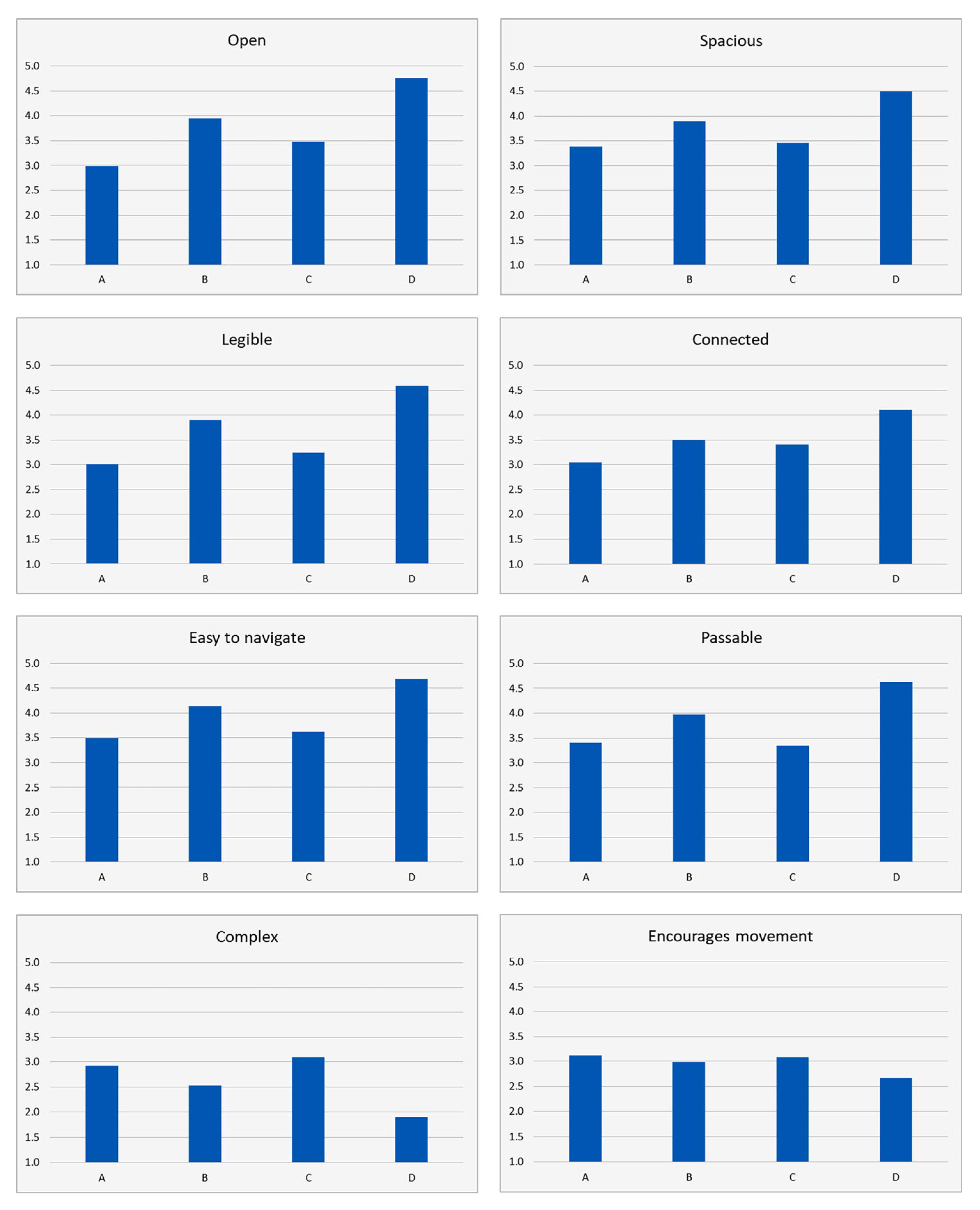
The results of the study are based on an analysis of variance (ANOVA) examining the effects of two factors: residential spatial structure (within-subject factor: four types of spatial organization) and participant expertise (between-subject factor: architects and interior designers versus participants without formal education in these fields) on interior evaluations across eight bipolar scales of subjective spatial experience. Figure 3 presents a graphical overview of the mean ratings of the four interiors across the eight scales, while Table 1 reports the F coefficients, degrees of freedom (df), significance levels (p), and effect sizes (partial eta squared, η2).

3.1. Effects of Spatial Structure

The results indicate that the spatial structure factor had a statistically significant effect on all eight examined dimensions of perceptual experience, with differences observed in effect strength across individual scales.
The most pronounced effects of spatial structure were recorded on the closed–open scale (F(3, 114) = 97.252, p < 0.001, η2 = 0.462), the cramped–spacious scale (F(3, 114) = 50.919, p < 0.001, η2 = 0.311), and the poorly legible–legible scale (F(3, 114) = 85.145, p < 0.001, η2 = 0.430). These results indicate a strong influence of spatial organization on the basic subjective impression of openness, size, and visual legibility of space. High effect size values suggest that differences among typological models account for a substantial portion of variance in participants’ evaluations. Post hoc comparisons (Bonferroni correction, p < 0.05) reveal a similar pattern of differences across these scales, following the order D > B > C = A: Interior D was rated as the most open, most spacious, and most legible, followed by Interior B, while Interiors C and A were evaluated as more closed, more cramped, and less legible, with no significant differences between the latter two (see the bar relationships in Figure 3).
Significant effects of spatial structure were also observed on the disconnected–connected scale (F(3, 114) = 24.605, p < 0.001, η2 = 0.179), indicating that the mode of spatial organization substantially affects visual comprehensibility and the perceived structural connectedness of space. Post hoc analyses (Bonferroni correction, p < 0.05) show that differences on this scale follow the order D > B = C > A: Interior D was rated as the most connected, followed by Interiors B and C, while Interior A was perceived as the least connected (see Figure 3).
For scales related to orientation and movement through space, statistically significant effects of spatial structure were likewise recorded. Specifically, the difficult to navigate–easy to navigate scale yielded a significant effect (F(3, 114) = 40.909, p < 0.001, η2 = 0.266), while one of the strongest effects of spatial structure was found on the blocked–passable scale (F(3, 114) = 61.069, p < 0.001, η2 = 0.351). Post hoc analyses (Bonferroni correction, p < 0.05) indicate a similar pattern of differences on these scales, following the order D > B > C = A: Interior D was evaluated as the easiest to navigate and most passable, followed by Interior B, whereas Interiors C and A were rated as the most difficult to navigate and the most blocked, with no significant differences between them (see Figure 3).
Regarding the assessment of visual complexity, the spatial structure factor had a significant effect on the simple–complex scale (F(3, 114) = 37.376, p < 0.001, η2 = 0.248). Post hoc analyses (Bonferroni correction, p < 0.05) indicate that differences on this scale follow the order D < B < C = A: Interior D was evaluated as the simplest, followed by Interior B, while Interiors C and A were rated as the most complex, with no significant differences between them (see Figure 3).
Finally, the weakest, yet still statistically significant, effect of spatial structure was recorded on the does not encourage movement–encourages movement scale (F(3, 114) = 4.257, p = 0.006, η2 = 0.036), indicating a moderate influence of typological organization on this aspect of spatial experience. Post hoc analyses (Bonferroni correction, p < 0.05) show that differences on this scale follow the order D < C = B = A: Interior D was evaluated as the least inspiring in terms of movement, while Interiors C, B, and A were rated as moderately inspiring, with no significant differences among these three (see Figure 3).

3.2. Effects of Participants’ Expertise

In contrast to spatial structure, the expertise factor did not show a statistically significant effect on any of the eight examined scales. Across all analyses, p-values were above the threshold of statistical significance, and effect sizes were negligible (η2 ranging from 0.000 to 0.014). This indicates that evaluations of subjective spatial experience did not differ systematically between participants with professional education in architecture and interior design and those without such educational backgrounds.

3.3. Summary of Results

Overall, the results clearly indicate that the typological structure of the residential interior has a dominant and consistent influence on the subjective experience of space, independent of the participants’ professional background. Spatial organizations significantly differentiate evaluations of openness, spaciousness, legibility, connectedness, ease of orientation, passability, complexity, and encouragement of movement, while the effects of expertise do not emerge as a relevant factor within the analyzed perceptual dimensions.

4. Discussion

The results of the study enable an examination of the relationship between different types of spatial organization of residential interiors and the subjective experience of spatiality in light of existing theoretical assumptions. The research was based on two competing hypotheses: the first positing that perceived spatiality relies predominantly on the global spatial structure, which is mentally constructed through continuous and circular movement; and the second suggesting that the assessment of spatiality is primarily grounded in immediately perceivable spatial relations, namely visual accessibility and perceptual depth. The obtained findings provide clearer empirical support for the second hypothesis. Interiors characterized by greater visual accessibility and higher perceptual depth, specifically, the apartment with an enfilade arrangement and, in particular, the open-plan apartment, were systematically evaluated as more open, more spacious, and more legible compared to the other types [43,56,57].
This pattern of results indicates that participants assessed spatiality primarily on the basis of the immediately available spatial image, that is, the visual scope of the space from a limited number of viewpoints, rather than on the mental reconstruction of the overall spatial structure achieved through continuous movement. In this sense, visual accessibility, continuity of visual fields, and the possibility of perceiving multiple spatial segments within a single visual frame proved to be stronger determinants of spatiality assessment than structural characteristics that are fully revealed only through movement [16,43,47].
In contrast to the open-plan apartment and the apartment with an enfilade, residential interior models with a circular connection do not allow the perception of the spatial whole from a single point or along a dominant visual axis. In these cases, spatial boundaries remain perceptually indeterminate and are revealed gradually, through successive spatial sequences [5,14,15,24,50]. In theoretical discussions, this very characteristic is associated with an enhanced sense of spatial breadth and depth, as it requires active cognitive integration of space through movement. However, the obtained results suggest that in the case of the apartment with a circular connection, under conditions of assessment based on visual representations and temporally limited exposure to the stimulus, this mechanism remains less strongly activated, thereby reducing its influence on the subjective evaluation of spatiality.
Particularly indicative is the finding that spatially more expansive structures were simultaneously evaluated as simpler. This pattern points to a possible inverse relationship between perceived complexity and spatiality [3,44,46], whereby the apartment with a branched structure and the apartment with a circular connection were assessed as more complex, but not as more spacious. In other words, spaces characterized by high visual accessibility and clear spatial flows may be perceived as simpler precisely because they enable rapid and relatively unambiguous cognitive organization of space, without the need for additional mental reconstruction of its structure [8,27,53,69].
It is therefore possible that participants formed their assessments on the basis of successive local visual impressions, related to individual spatial segments or sequences, rather than through the integration of the apartment’s global spatial structure [23,36,39]. Such a mode of assessment is consistent with the second research hypothesis, according to which perceived spatiality arises from immediately apprehensible spatial relations, rather than from a potential spatial whole that is revealed exclusively through movement. This effect may be further amplified under experimental conditions in which actual movement through space is absent and the spatial experience is mediated by visual representations.
The absence of differences between participants with professional training and lay participants represents one of the more unexpected findings of the study. It was anticipated that experts, owing to a more developed capacity for mental representation and interpretation of spatial structure, would be more likely to recognize and value the potentials of circular connections and sequential spatial revelation in shaping the experience of the apartment as a whole [70]. This expectation was grounded in the assumption that the assessment of spatiality could be based on cognitive integration of the overall spatial configuration, rather than exclusively on immediately visible relations. However, the results indicate that, under conditions of visually mediated assessment and limited exposure time, evaluations of spatiality are predominantly guided by directly perceptible factors, regardless of professional expertise. This finding suggests that the potential for experiencing the apartment as an integrated whole is more strongly activated in situations involving actual movement and prolonged occupancy, whereas in experimental settings different patterns of perceptual processing prevail.
In this context, the lack of differences between professionally trained participants and laypersons further confirms that the assessments were based on general perceptual and cognitive mechanisms rather than on professionally conditioned interpretative strategies [42,43,52]. Spatial legibility, visual accessibility, and perceptual depth emerged as universal factors in the formation of spatiality experience, independent of the participants’ level of expertise.
Finally, the obtained findings should be considered in light of certain limitations of the study. First, the assessments were based on visually mediated video stimuli presented online, which cannot fully reproduce the multisensory, embodied, and proprioceptive dimensions of actual movement through physical space [43,56,71]. Although this format ensured experimental control and standardisation of exposure across participants, it inevitably reduced kinaesthetic and immersive aspects of spatial experience. Consequently, the influence of mechanisms relying on sequential spatial revelation is likely underestimated. In addition, the subjective nature of the assessments and the limited number of typological variants may affect the generalizability of the results. Despite these constraints, the study provides relevant insights into the perceptual foundations of spatiality and opens avenues for further research that would incorporate dynamic modes of representation and direct experiential engagement with spatial movement.

5. Conclusions

This study aimed to examine how different typological organizations of residential interiors influence the subjective experience of spatiality, observed through visually guided movement and evaluated using bipolar semantic scales. The obtained results indicate that spatial structure represents the dominant factor in shaping perceptual assessments, while participants’ expertise did not emerge as a relevant variable across any of the analyzed dimensions.
The key finding of the study supports the second hypothesis and refutes the first. Contrary to the assumptions of the first hypothesis, that perceived spatiality primarily relies on a global mental representation formed through circular movement, the apartment with a circular connection was not perceived as more spacious. Instead, the results favor the second hypothesis, demonstrating that assessments of spatiality are predominantly based on immediately visible space. Interiors characterized by greater visual openness, continuity of visual fields, and pronounced perceptual depth (the enfilade apartment and, in particular, the open-plan apartment) were systematically evaluated as more open, spacious, legible, and passable. This suggests that, under conditions of visually mediated assessment, priority is given to spatial configurations that allow immediate apprehension of a large portion of space from a limited number of positions.
The finding that more spacious structures are simultaneously perceived as simpler further indicates a strong relationship between spatiality and spatial legibility. In this context, complexity does not appear as a result of the richness of spatial relations, but rather as a consequence of their reduced cognitive accessibility. Spatial organizations that enable clear orientation, continuity of movement, and visual connectivity between functional zones facilitate the formation of a stable mental representation of space, which is directly reflected in more positive assessments of spatiality.
From the perspective of design practice, the results have several important implications. First, they highlight the significance of visual openness and spatial continuity in the design of smaller residential units, where physical floor area represents a limiting factor. Strategies such as the open-plan apartment and the enfilade apartment can enhance the experience of spatiality without increasing actual surface area. The findings are also relevant for interior interventions, where relatively modest changes in spatial organization may have a disproportionately large effect on users’ subjective experience. Finally, the results are pertinent to the digital presentation of architectural spaces, indicating that the mode of visual representation and the structure of movement through a virtual model can substantially shape spatial perception.
With regard to future research, the findings open several directions for further investigation. One key direction involves the application of immersive technologies, such as virtual reality, which would allow for a more realistic experience of movement and sequential spatial revelation. Additionally, the inclusion of physical models and experimental setups involving actual movement through space could contribute to a more precise understanding of the relationship between spatial structure and perceptual experience. Expanding the sample of participants, as well as introducing a larger number of typological variants, would enable testing the stability of the observed patterns and their broader generalizability.
Overall, the study confirms that the experience of spatiality in residential interiors is primarily shaped by visual accessibility, legibility, and spatial continuity, rather than exclusively by more complex topological characteristics of circular and branched spatial structures, which are fully revealed only through movement. In this way, a clear link is established between perceptual mechanisms and design decisions, positioning spatiality as a relevant and operational concept in contemporary architectural practice and research.
Future research should therefore aim to incorporate immersive and interactive modes of representation, such as virtual reality environments or experimental settings involving actual bodily movement through space. Such approaches would allow examination of kinaesthetic and multisensory dimensions of spatial experience that cannot be fully captured through screen-based representation.
Additionally, expanding the range of typological variants and including a larger and more diverse participant sample would enable testing the robustness and generalisability of the observed perceptual patterns. Further investigation could also explore the interaction between spatial configuration and other environmental variables, such as materiality, colour, and lighting dynamics.

Supplementary Materials

The following supporting information can be downloaded at: https://www.mdpi.com/article/10.3390/architecture6010036/s1, Animation S1: Simulation of Interior Type A with circular circulation; Animation S2: Simulation of Interior Type B with an enfilade; Animation S3: Simulation of Interior Type C with a branched spatial structure; Animation S4: Simulation of Interior Type D with an open plan.

Author Contributions

Conceptualization, Đ.A. and S.M.; methodology, Đ.A. and S.M.; software, S.S.A.; validation, Đ.A., S.M. and S.S.A.; formal analysis, Đ.A.; investigation, S.M. and Đ.A.; resources, S.S.A. and T.N.; data curation, S.M.; writing—original draft preparation, Đ.A. and S.M.; writing—review and editing, Đ.A., S.M. and S.S.A.; visualization, S.S.A. and T.N.; supervision, Đ.A. and S.M.; project administration, S.S.A.; funding acquisition, S.S.A. All authors have read and agreed to the published version of the manuscript.

Funding

The research presented in this paper was funded by the Ministry of Science, Technological Development and Innovation of the Republic of Serbia (No. 451-03-33/2026-03/200006).

Institutional Review Board Statement

The study was conducted in accordance with the Declaration of Helsinki and approved by the Institutional Review Board of the Department of Psychology, Faculty of Philosophy, University of Belgrade, Serbia (Protocol No. 2025-49; date of approval: 1 September 2025).

Informed Consent Statement

Informed consent was obtained from all subjects involved in the study.

Data Availability Statement

The original contributions presented in the study are included in the article, further inquiries can be directed to the corresponding author.

Acknowledgments

We would like to express our gratitude to the colleagues, friends, and students who participated in the survey and whose involvement, as well as their sincere and detailed responses, significantly contributed to the value of this paper. Moreover, we confirm that an AI-based language tool (ChatGPT (version 5), developed by OpenAI) was used exclusively for the translation of the final version of the manuscript from Serbian into English and for minor language polishing. The AI tool was not used for generating scientific content, formulating research questions, designing the methodology, analyzing data, interpreting results, or drawing conclusions. All scientific content, arguments, interpretations, and conclusions presented in the manuscript remain the sole responsibility of the authors, who have carefully reviewed and approved the final English version.

Conflicts of Interest

The authors declare no conflicts of interest.

References

  1. Geffner, T. Towards a Smaller Housing Paradigm: A Literature Review of Accessory Dwelling Units and Micro Apartments. Bachelor’s Thesis, Portland State University, Portland, OR, USA, 2018. [Google Scholar]
  2. Kholid, M.F.; Zaharin, P.M.B. Micro Housing: Typological Study and Implementation in Malaysia. Environ. Behav. Proc. J. 2019, 4, 265–278. [Google Scholar] [CrossRef]
  3. Alfirević, Đ.; Simonović Alfirević, S. Design Principles for Achieving Interior Spatiality. In Proceedings of the 1st International Conference “SmartArt—Art and Science Applied: From Inspiration to Interaction”; University of Arts in Belgrade, Faculty of Applied Arts: Belgrade, Serbia, 2020; pp. 140–150. [Google Scholar]
  4. Jammer, M. Concepts of Space: The History of Theories of Space in Physics; Harvard University Press: Cambridge, MA, USA, 1954. [Google Scholar]
  5. Rasmussen, S.E. Experiencing Architecture; MIT Press: Cambridge, MA, USA, 1964. [Google Scholar]
  6. Gould, J. The Existence of Absolute Space. Ohio J. Sci. 1962, 62, 101–104. [Google Scholar]
  7. Asplund, E.G. Our Architectural Conception of Space. Archit. Res. Q. 2000, 4, 151–160. [Google Scholar] [CrossRef]
  8. Ching, F. Architecture—Form, Space and Order, 3rd ed.; John Wiley & Sons Inc.: Hoboken, NJ, USA, 2007. [Google Scholar]
  9. Vroman, L.; Lagrange, T. Movement and Experiences in Constructed Spaces: A Description of Spatial Experiences, Based on Movement. In Proceedings of the 9th International Conference on Design and Emotion; Ediciones Uniandes: Bogotá, Colombia, 2014; pp. 429–434. [Google Scholar]
  10. Kuliga, S.F.; Thrash, T.; Dalton, R.C.; Hölscher, C. Virtual reality as an empirical research tool—Exploring user experience in a real building and a corresponding virtual model. Comput. Environ. Urban Syst. 2015, 54, 363–375. [Google Scholar] [CrossRef]
  11. Paes, D.; Arantes, E.; Irizarry, J. Immersive Environment for Improving the Understanding of Architectural 3D Models: Comparing User Spatial Perception between Immersive and Traditional Virtual Reality Systems. Autom. Constr. 2017, 84, 292–303. [Google Scholar] [CrossRef]
  12. Heydarian, A.; Carneiro, J.P.; Gerber, D.; Becerik-Gerber, B.; Hayes, T.; Wood, W. Immersive virtual environments versus physical built environments: A benchmarking study for building design and user-built environment explorations. Autom. Constr. 2015, 54, 116–126. [Google Scholar] [CrossRef]
  13. Vilar, E.; Rebelo, F.; Noriega, P. Indoor Human Wayfinding Performance Using Vertical and Horizontal Signage in Virtual Reality. Hum. Factors Ergon. Manuf. Serv. Ind. 2012, 24, 601–615. [Google Scholar] [CrossRef]
  14. Voigt, K.; Roy, V. Editorial: Spatial Dimensions of Moving Experience. Dimens. J. Archit. Knowl. 2021, 1, 7–10. [Google Scholar] [CrossRef]
  15. Ahmadi, M. The Experience of Movement in the Built Form and Space: A Framework for Movement Evaluation in Architecture. Cogent Arts Humanit. 2019, 6, 1588090. [Google Scholar] [CrossRef]
  16. Bokharaei, S.; Nasar, J.L. Perceived Spaciousness and Preference in Sequential Experience. Hum. Factors 2016, 58, 1069–1081. [Google Scholar] [CrossRef]
  17. Tural, A.; Tural, E. Exploring sense of spaciousness in interior settings: Screen-based assessments with eye tracking, and virtual reality evaluations. Front. Psychol. 2024, 15, 1473520. [Google Scholar] [CrossRef] [PubMed]
  18. Acre, F. Spatial Quality Assessment for Energy-Efficiency Renovation of Dwellings. Ph.D. Thesis, Norwegian University of Science and Technology, Trondheim, Norway, 2017. [Google Scholar]
  19. Erkelens, C. Perspective Space as a Model for Distance and Size Perception. i-Perception 2017, 8, 2041669517735541. [Google Scholar] [CrossRef] [PubMed]
  20. Farrell, M. Historical and Philosophical Foundations of Psychology; Cambridge University Press: Cambridge, UK, 2014. [Google Scholar]
  21. Čanak, M. Otvoren ili zatvoren stan. Arhit. I Urban. 2013, 38, 66–77. [Google Scholar]
  22. Merriman, P.; Jones, M.; Olsson, G.; Sheppard, E.; Thrift, N.; Tuan, Y. Space and Spatiality in Theory. Dialogues Hum. Geogr. 2012, 2, 3–22. [Google Scholar] [CrossRef]
  23. Wang, Y. Formal Descriptions of Cognitive Processes of Perceptions on Spatiality, Time, and Motion. Int. J. Cogn. Inform. Nat. Intell. 2009, 3, 84–98. [Google Scholar] [CrossRef]
  24. Hertzberger, H. Space and the Architect: Lessons in Architecture 2; 010 Publishers: Rotterdam, The Netherlands, 2000. [Google Scholar]
  25. Van de Ven, C. Space in Architecture: The Evolution of a New Idea in the Theory and History of the Modern Movements; Van Gorcum: Assen, The Netherlands; Maastricht, The Netherlands, 1987. [Google Scholar]
  26. Ie Lie, K. An Analysis of the Formal Qualities of Space in Architecture. Master’s Thesis, Massachusetts Institute of Technology, Cambridge, MA, USA, 1985. [Google Scholar]
  27. Rapoport, A. The Study of Spatial Quality. J. Aesthetic Educ. 1970, 4, 81–95. [Google Scholar] [CrossRef]
  28. Laird, J. Mental Spaciousness. Monist 1921, 31, 161–181. [Google Scholar] [CrossRef]
  29. Heidegger, M. The Concept of Time: The First Draft of Being and Time; A&C Black: London, UK, 2011. [Google Scholar]
  30. Merleau-Ponty, M. Phenomenology of Perception; Routledge: London, UK, 2002. [Google Scholar]
  31. Foucault, M.; Miskowiec, J. Of Other Spaces. Diacritics 1986, 16, 22–27. [Google Scholar] [CrossRef]
  32. Harvey, D. Social Justice and the City; Johns Hopkins University Press: Baltimore, MD, USA, 1973. [Google Scholar]
  33. Soja, E. Seeking Spatial Justice; University of Minnesota Press: Minneapolis, MN, USA, 2010. [Google Scholar]
  34. Perec, G. Vrste Prostora; Meandar: Zagreb, Croatia, 2005. [Google Scholar]
  35. Liddicoat, S. Perceptions of Spatiality: Supramodal Meanings and Metaphors in Therapeutic Environments. Interiority 2018, 1, 91–111. [Google Scholar] [CrossRef]
  36. Karlsson, G. The Experience of Spatiality for Congenitally Blind People: A Phenomenological-Psychological Study. Hum. Stud. 1996, 19, 303–330. [Google Scholar] [CrossRef]
  37. Melling, D. Forms of Experienced Spatiality. J. Br. Soc. Phenomenol. 1982, 13, 277–285. [Google Scholar] [CrossRef]
  38. Freshwater, D. The Poetics of Space: Researching the Concept of Spatiality Through Relationality. Psychodyn. Pract. 2005, 11, 177–187. [Google Scholar] [CrossRef]
  39. Tally, R., Jr. Spatiality; Routledge: London, UK, 2012. [Google Scholar] [CrossRef]
  40. de Vries, D.; Hulsebos, E.M.; Baan, J. Spatial Fluctuations in Measures for Spaciousness. J. Acoust. Soc. Am. 2001, 110, 947–954. [Google Scholar] [CrossRef]
  41. Griesinger, D. Objective Measures of Spaciousness and Envelopment. In Proceedings of the AES 16th International Conference on Spatial Sound Reproduction; Audio Engineering Society: Rovaniemi, Finland, 1999. [Google Scholar]
  42. Ozdemir, A. The Effect of Window Views’ Openness and Naturalness on the Perception of Rooms’ Spaciousness and Brightness: A Visual Preference Study. Sci. Res. Essays 2010, 5, 2275–2287. [Google Scholar]
  43. Stamps, A.E. Evaluating Spaciousness in Static and Dynamic Media. Des. Stud. 2007, 28, 535–557. [Google Scholar] [CrossRef]
  44. Stamps, A.E. On Shape and Spaciousness. Environ. Behav. 2009, 41, 526–548. [Google Scholar] [CrossRef]
  45. Stamps, A.E. Effects of Permeability on Perceived Enclosure and Spaciousness. Environ. Behav. 2010, 42, 864–886. [Google Scholar] [CrossRef]
  46. Stamps, A.E. Effects of Area, Height, Elongation, and Color on Perceived Spaciousness. Environ. Behav. 2011, 43, 252–273. [Google Scholar] [CrossRef]
  47. Stamps, A.E. Effects of Multiple Boundaries on Perceived Spaciousness and Enclosure. Environ. Behav. 2013, 45, 851–875. [Google Scholar] [CrossRef]
  48. Azarby, S.; Rice, A. Spatial Perception Imperatives in Virtual Environments: Understanding the Impacts of View Usage Patterns on Spatial Design Decisions in Virtual Reality Systems. Buildings 2023, 13, 160. [Google Scholar] [CrossRef]
  49. Kalantari, S.; Mostafavi, A.; Xu, T.B.; Lee, A.S.; Qi, Y. Comparing spatial navigation in a virtual environment vs. an identical real environment across the adult lifespan. Comput. Hum. Behav. 2024, 157, 108210. [Google Scholar] [CrossRef]
  50. Cho, J.Y.; Suh, J. Spatial Ability Performance in Interior Design and Architecture: Comparison of Static and Virtual Reality Modes. Buildings 2023, 13, 3128. [Google Scholar] [CrossRef]
  51. Tuker, C.; Tong, T. Comparing Field Trips, VR Experiences and Video Representations on Spatial Layout Learning in Complex Buildings. arXiv 2021, arXiv:2105.01968. [Google Scholar] [CrossRef]
  52. Von Castell, C.; Oberfeld, D.; Hecht, H. The Effect of Furnishing on Perceived Spatial Dimensions and Spaciousness of Interior Space. PLoS ONE 2014, 9, e113267. [Google Scholar] [CrossRef]
  53. Wang, C.; Lu, W.; Ohno, R.; Gu, Z. Effect of Wall Texture on Perceptual Spaciousness of Indoor Space. Int. J. Environ. Res. Public Health. 2020, 17, 4177. [Google Scholar] [CrossRef] [PubMed]
  54. Tschumi, B. Architecture and Disjunction; MIT Press: Cambridge, MA, USA, 1996. [Google Scholar]
  55. Kim, M. A Theoretical Study on the Extended Spatiality of Architecture—Focused on the Conceptual Development & Recognition of Architectural Space Since Modern Architecture. J. Archit. Inst. Korea 2021, 37, 145–152. [Google Scholar] [CrossRef]
  56. de Groot, D. Spatiality, Virtual Reality, and Creativity: The Effects of Room Size and Environments on Divergent Thinking. Bachelor’s Thesis, Tilburg University, Tilburg, The Netherlands, 2017. [Google Scholar]
  57. Alfirević, Đ.; Simonović Alfirević, S. Design Principles for Achieving Spatiality in Living Space. Arhit. I Urban. 2019, 48, 37–53. [Google Scholar] [CrossRef]
  58. Spiliotis, A. Illusionism in Architecture: Anamorphosis Trompe l’Oeil and Other Illusionary Techniques from the Italian Renaissance to Today. Ph.D. Thesis, University of Manchester, Manchester, UK, 2008. [Google Scholar]
  59. Dernie, D. Notes on the Spatiality of Colour. In Cultural, Theoretical, and Innovative Approaches to Contemporary Interior Design; Crespi, L., Ed.; Information Science Reference: Hershey, PA, USA, 2020. [Google Scholar]
  60. Al-Zamil, F.A. The Impact of Design Elements on the Perception of Spaciousness in Interior Design. Int. Des. J. 2017, 7, 177–187. Available online: https://www.faa-design.com/files/7/22/7-2-zamil.pdf (accessed on 31 January 2026). [CrossRef][Green Version]
  61. Ünlü, A.; Edgü, E.; Şalgamcioğlu, M.E.; Canakcioglu, N.G. Exploring Perceived Openness and Spaciousness: The Effects of Semantic and Physical Aspects. Archit. Sci. Rev. 2022, 65, 162–174. [Google Scholar] [CrossRef]
  62. Kim, D.; Kim, S.; Shin, J.; Yoon, B.; Kim, J.; Lee, J.; Woo, W. The Effects of Spatial Configuration on Relative Translation Gain Thresholds in Redirected Walking. arXiv 2022, arXiv:2206.05522. [Google Scholar] [CrossRef]
  63. Zejnilovic, E.; Husukić, E.; Licina, D. Perception and evaluation of interior space: Experimental study on color and pattern. Int. Des. Art J. 2023, 5, 13–30. Available online: https://www.idajournal.com/index.php/ida/article/view/188/73 (accessed on 31 January 2026).
  64. Ruddle, R.A.; Lessels, S. The benefits of using a walking interface to navigate virtual environments. ACM Trans. Comput. Hum. Interact. (TOCHI) 2009, 16, 1–18. [Google Scholar] [CrossRef]
  65. Suhail, D.H.; Al-Ghabban, B. Movement Flow in Interior Design. J. Lang. Linguist. Stud. 2022, 18, 141–159. [Google Scholar]
  66. Leupen, B. Polyvalence, a Concept for the Sustainable Dwelling. Nord. J. Archit. Res. 2006, 19, 23–31. [Google Scholar]
  67. Alfirević, Đ.; Simonović Alfirević, S. Principles of Residential Space Configuration; Special Editions No. 95; Institute of Architecture and Urban & Spatial Planning of Serbia, Faculty of Architecture, University of Belgrade: Belgrade, Serbia, 2024. [Google Scholar]
  68. Pardo Llorente, M. The Removal of the Corridor in Housing. Bachelor’s Thesis, Universitat Politècnica de Catalunya, Barcelona, Spain, 2023. [Google Scholar]
  69. Marković, S.; Alfirević, Đ.; Simonović Alfirević, S.; Nikolić, S. Principles for Achieving Legibility in Residential Spaces. Buildings 2025, 15, 1243. [Google Scholar] [CrossRef]
  70. Connors, M.; Campitelli, G. Expertise and the Representation of Space. Front. Psychol. 2014, 5, 270. [Google Scholar] [CrossRef]
  71. Aarseth, E. Allegories of Space—The Question of Spatiality in Computer Games. Cybertext Yearb. 2000, 2001, 152–171. [Google Scholar]
Figure 1. Floor plans of the analyzed apartment models (red lines indicate movement paths): Type A—apartment with circular circulation (See Animation S1); Type B—apartment with an enfilade (See Animation S2); Type C—apartment with a branched spatial structure (See Animation S3); and Type D—apartment with an open plan (See Animation S4). (Source: authors’ archive).
Architecture 06 00036 g001
Figure 2. Visualization of movement through the analyzed apartment models (frames from the animations): Type A—apartment with circular circulation (See Animation S1); Type B—apartment with an enfilade (See Animation S2); Type C—apartment with a branched spatial structure (See Animation S3); and Type D—apartment with an open plan (See Animation S4). (Source: authors’ archive).
Architecture 06 00036 g002
Figure 3. Average ratings on eight scales are shown. A, B, C, and D labels indicate interiors of different structures (see Figure 1).
Architecture 06 00036 g003
Table 1. Results of the analysis of variance of the interior ratings on 8 scales. The effects of two factors are presented: Structure (four types of interior structure) and Expertise (Architects/interior designers and laymen). Measures of F coefficient, number of degrees of freedom (df), significance (p), and effect size (partial eta squared, η2) are given.
Fdfpη2 Fdfpη2
Open Spacious
Structure97.2523, 1140.0010.462Structure50.9193, 1140.0010.311
Expertise0.7731, 114n.s.0.007Expertise1.5991, 114n.s.0.014
Legible Connected
Structure85.1453, 1140.0010.430Structure24.6053, 1140.0010.179
Expertise1.6001, 114n.s.0.014Expertise0.3181, 114n.s.0.003
Easy to navigate Passable
Structure40.9093, 1140.0010.266Structure61.0693, 1140.0010.351
Expertise0.3181, 114n.s.0.003Expertise0.1281, 114n.s.0.001
Complex Encourages movement
Structure37.3763, 1140.0010.248Structure4.2573, 1140.0060.036
Expertise0.0001, 114n.s.0.000Expertise0.0251, 114n.s.0.000
The abbreviation “n.s.” means “not significant”, that is, it is “not statistically significant”.
Disclaimer/Publisher’s Note: The statements, opinions and data contained in all publications are solely those of the individual author(s) and contributor(s) and not of MDPI and/or the editor(s). MDPI and/or the editor(s) disclaim responsibility for any injury to people or property resulting from any ideas, methods, instructions or products referred to in the content.