


Abstract
This study examines balconies in contemporary Parisian housing (2007–2020) as façade-threshold systems that shape architectural expression and offer qualitative environmental mediation potentials and socio-spatial capacities. The research combines (i) a selective bibliographic synthesis used to construct the analytical domains and criteria, (ii) field observation and photographic documentation, and (iii) graphical–morphological analysis of 33 housing projects. The corpus is organised into three balcony systems (individual, continuous/filant, and combined), and seven recurrent subtypes (symmetrical, asymmetrical, box-shaped, double-height, uniform continuous, variable continuous, and hybrid). Results show how variations in projection, depth, enclosure, and façade integration structure façade rhythm and threshold conditions, and suggest differentiated shading, exposure, and ventilation opportunities consistent with established passive-design principles. Environmental statements are therefore presented as inferential interpretations grounded in observable morphology, not as measured performance outcomes; no thermal simulations or post-occupancy measurements are undertaken. The contribution is a reproducible typological classification and comparative evaluation matrix that can guide future quantitative verification and support climate-responsive housing design under dense regulatory contexts.
1. Introduction
Across contemporary urban housing, balconies have re-emerged as critical architectural devices that redefine the boundary between interior domestic life and the external environment [1,2,3]. In Paris—one of Europe’s densest and most architecturally regulated urban contexts—balconies are not merely decorative projections or inherited typologies; they have become strategic extensions that negotiate climatic pressures [4,5,6,7], spatial scarcity [6], and the expressive identity of the façade [8]. The triple role of balconies as social areas and environmental controllers, and visual indicators of residential spaces, makes them the focal point for discussions about sustainable housing design that focuses on human needs. The architectural field needs more research about balconies because these structures appear in most buildings and serve various functional purposes [9,10,11].
Classic interpretations, such as Pingusson’s notion of external extensions as “fourth spaces,” [12] frame balconies as liminal thresholds mediating interior comfort and outdoor exposure [13]. However, contemporary Parisian housing (2007–2020) indicates a far more complex reality: balcony morphologies—including individual, continuous (filant), and hybrid systems—now operate as environmental infrastructures embedded within architectural form [14]. The building’s balconies serve three main purposes: regulating solar radiation and protecting against climate change, providing ventilation opportunities, and creating spaces that affect how people live and how the city appears to others [15]. In this study, these purposes are treated as intended roles that are examined through morphological description and qualitative interpretation rather than through measured performance testing.
Although balconies are ubiquitous globally, Paris (2007–2020) constitutes a particularly informative “laboratory” because balcony design during this period was shaped simultaneously by (i) high-density housing production, (ii) evolving regulatory constraints affecting façade articulation and exterior private space, and (iii) architectural experimentation within a mature urban fabric. The contribution of this case study is therefore not to claim universality of Parisian outcomes, but to provide a transferable method of typological description and comparative evaluation that can be applied to other metropolitan contexts. Transferability is approached at the level of the analytical framework (domains, criteria, and workflow), while acknowledging that specific typological prevalence and design rationales remain dependent on local climate, culture, housing markets, and regulation.
Despite this growing importance, scholarship remains divided. Formal and typological studies tend to treat balconies primarily as aesthetic instruments [3], while environmental research isolates their thermal effects within technical evaluations [16]. This fragmentation produces a significant blind spot: the absence of a holistic, comparative framework that links balcony typology to its architectural expression, passive environmental behaviour, and social use in real built contexts. The Parisian housing production of the past two decades—shaped by regulatory shifts (RT2005–RT2012) [17,18], intensified density [19], and the demand for outdoor space—provides an unparalleled laboratory to address this gap. Yet no systematic research has capitalised on this opportunity.
To address this gap with an appropriate methodological scope, this article makes three concrete contributions. First, it documents and classifies balcony morphologies in a defined corpus of 33 contemporary Parisian housing projects (2007–2020) using a transparent typological procedure. Second, it translates dispersed theoretical insights into a reproducible analytical matrix (Table 3) that operationalises three domains—architectural expression, environmental mediation potential, and socio-functional interface—through observable criteria applicable across cases. Third, to support clarity and replicability, the manuscript provides (i) a complete case list with assigned balcony systems/subtypes and (ii) descriptive distribution statistics of systems and subtypes (Table 2), enabling readers to understand the corpus composition at a glance.
This study argues that balconies in contemporary Parisian housing can be analysed as hybrid threshold systems whose morphology (projection, depth, enclosure, and façade integration) is systematically related to architectural expression, environmental mediation potential, and socio-functional interface. The originality of the work lies not in claiming entirely new balcony forms—many of which are discussed in the literature—but in proposing an integrative and reproducible analytical framework that consolidates dispersed insights into a single comparative matrix (Table 3) and applies it consistently to 33 housing projects produced during a period of regulatory and morphological transition (2007–2020). The research questions are therefore: (1) How do balcony systems shape façade expression and architectural identity? (2) What environmental mediation potentials are suggested by recurrent morphological variables? (3) How do these systems support differentiated privacy, use, and threshold conditions under contemporary regulatory constraints? The novelty of the study lies in the integrative and reproducible framework that links typology to a transparent evaluation matrix and applies it consistently to a defined corpus, rather than in claiming entirely new balcony forms or performance validation.
The manuscript is structured as follows: Section 2 synthesises the relevant typological and threshold-space literature and defines the conceptual gap. Section 3 details the qualitative research design, the corpus selection, and the operationalisation of criteria (Table 3). Section 4 reports the typological results, including descriptive distributions and comparative synthesis. Section 5 discusses interpretive implications, trade-offs, and transferability limits. Section 6 concludes with a concise summary of qualitative insights and the quantifiable descriptive outputs derived from the corpus.
The scope of the paper is intentionally qualitative and typological: it documents balcony morphologies and interprets their environmental mediation potentials and socio-spatial roles from observable form and use cues. The study does not test whether Parisian regulations “worked” in a causal or performance-verified sense; instead, it examines how balcony forms and façade-threshold strategies are configured in a regulatory transition period and how these strategies can be comparatively interpreted through a replicable matrix. This argument carries broader contemporary relevance. As cities face rising summer temperatures and growing demand for usable semi-outdoor domestic space, balconies are increasingly discussed as potential spatial devices that may support shading, exposure management, and adaptive use—depending on geometry, orientation, enclosure and user operation. In Paris, where space constraints and regulatory demands are intense, balcony morphology provides an informative context to observe how contemporary housing configures façade-threshold strategies. Accordingly, the study’s value is to clarify typological logics and generate testable hypotheses, rather than to claim verified environmental outcomes.
2. Reframing the Balcony: From Typological Form to Environmental and Social Performance
The architectural theory positions balconies as multifunctional elements that serve as design components and environmental connectors, and social interaction platforms [10,20]. Their evolution and contemporary significance extend far beyond conventional typological descriptions [10,21]. The morpho-ecological tradition views balconies as environmental extensions of building walls, which interact with environmental forces and distribute spatial energy across building facades [22,23]. Rather than static projections, they form part of what Hensel describes as “morpho-ecologies”—spatial configurations in which form, climate, material behaviour, and human occupation co-produce architectural effects [24]. Historically, their liminal status was anticipated by Pingusson’s description of external extensions as “fourth spaces,” but their twenty-first century transformation in Parisian housing repositions them as active, adaptive interfaces embedded within the building’s environmental and social metabolism [25,26].
Viewed morphogenetically, balconies contribute to the differentiation and thickening of the façade, generating gradients of enclosure, depth, porosity, and articulation that exceed the interior–exterior binary [26,27]. Their symmetrical, asymmetrical, box-shaped, double-height, continuous, and hybrid variations produce distinct spatial and environmental conditions, functioning less as discrete objects than as nodes within a relational field. The architectural performance of field conditions according to Stan Allen emerges from systems of variation that spread across a space instead of depending on individual formal elements [28,29]. The modern city of Paris includes balcony fields, which create façade ecologies through their layered design structure that controls population density and environmental elements and functions as a location marker.
Studies about environmental science show that the balcony functions as a natural climate management system, which regulates sunlight entry and air circulation and protects the area from weather changes in the region [9,30]. Depth, projection, and enclosure operate as performative parameters that shape thermal gradients along the façade. Environmental building research indicates that balcony geometry (e.g., depth, projection, and degrees of enclosure) can influence façade exposure, daylight access, and ventilation opportunities, and can affect indoor environmental conditions in some contexts. However, these relationships depend on orientation, local wind regimes, opening operation, and the interaction with the wider façade system. In this study, environmental points are therefore treated as morphology-based inferences (i.e., plausibility of shading continuity, exposure control, or ventilation opportunity suggested by observable form) interpreted through passive-design principles, not as measured or simulated performance outcomes [31].
The socio-material perspective views balconies as active areas that link human bodies to physical structures, plants and natural elements to form connected systems [32]. People use these small areas to control their environment and connect with others, grow plants, and perform their daily routines, which turns the balcony into their personal environmental connection [33]. The socio-material perspective supports this perspective because it indicates how people use their daily activities with objects and environmental elements to construct spaces that influence their spatial experiences and environmental conditions [34]. The limited availability of private outdoor areas in Paris makes balconies essential for residents to achieve well-being and express their identity while gaining control over their personal space, which proves that their performance requires more than technical or formal assessment [10].
Despite their conceptual and functional richness, balconies remain undertheorized within architectural research. Existing scholarship tends to fragment analysis into either aesthetic-formal interpretations or isolated technical studies of thermal effects [35]. The two architectural fields show balconies as separate systems that connect physical structures to environmental elements and social activities. Moreover, despite the extensive production of Parisian housing between 2007 and 2020—marked by regulatory transitions, environmental pressures, and façade experimentation—no systematic, comparative framework examines how balcony typologies operate within this evolving architectural ecology [36].
While literature explicitly addressing Parisian balconies is limited, extensive scholarship examines balconies and porches as threshold spaces that extend domestic life and mediate environmental conditions, particularly in warm and equatorial climates where shading, ventilation, and outdoor living are central to comfort strategies. Within this broader body of work, porches and balconies are frequently treated as comparable spatial devices: both operate as semi-outdoor interfaces that structure privacy gradients, support seasonal inhabitation, and alter the public perception of the dwelling through façade expression.
This study draws on these insights to inform the interpretive criteria used in Table 3—especially those related to enclosure, depth, openness, shading potential, and appropriation—while recognising that Paris differs climatically and culturally from equatorial contexts. The objective is therefore not to transpose climatic performance claims from other regions to Paris, but to use established threshold-space theory to support a careful morphology-based interpretation of balcony roles in a dense European metropolis.
On this basis, the present study operationalises balcony analysis through three integrated domains—architectural expression, environmental mediation potential, and socio-functional interface—so that insights from diverse climate and typological literature can be translated into observable variables and applied consistently to the 33 Parisian cases.
This review highlights three persistent gaps: the typological gap, wherein balcony types are treated generically without comparative performance analysis; the morpho-climatic gap, where formal variations are rarely studied in relation to environmental behaviour; and the contextual gap, due to the absence of empirical studies within the Parisian housing context. Together, these gaps underscore the need for an integrated, morpho-ecological and socio-material interpretation of balcony design—the orientation adopted in this study. Building on these gaps, the literature was synthesised into an operational- analytical structure. Specifically, recurrent concepts from balcony morphology, passive environmental mediation, and socio-spatial threshold studies were translated into three domains and a set of observable criteria consolidated in Table 3. This synthesis constitutes the first analytical layer of the study and directly informs the coding procedure and typological comparison applied to the 33 cases.
The bibliographic synthesis is presented as a distinct analytical layer rather than a dispersed background. Sources were selected to cover three strands relevant to balcony interpretation: (i) typology/morphology and façade-threshold theory, (ii) passive environmental mediation principles related to depth, shading and enclosure, and (iii) socio-material use of semi-outdoor domestic spaces. The synthesis output is reported in Table 3, which (a) lists the thematic strands, (b) summarises the recurrent concepts extracted from each strand, and (c) shows how these concepts were translated into the three analytical domains and the observable criteria consolidated. This structured synthesis clarifies the scope and the derivation logic of the codebook used for coding and cross-case comparison.
3. Methodology
3.1. Research Design: An Observational and Morphological Architectural Approach
The research design of this study uses qualitative architectural methods, which combine direct observation with graphical documentation and morphological analysis [37]. The research investigates how modern Parisian residential balconies function as complete architectural systems that unite building design with environmental factors and social elements to create both exterior building arrangements and actual interior spaces. Rejecting interview-based and simulation-driven approaches, the research instead privileges empirical observation and rigorous morphological reading of built form [38,39]. This decision reflects the hypothesis that balconies express their climatic and spatial performance primarily through their material configuration, depth, geometry, and façade integration, all of which are directly observable in the built environment.
The methodological framework combines three analytical layers that are explicitly operationalised in the Results section: (1) a selective bibliographic synthesis used to define the analytical domains and evaluation criteria; (2) systematic field observation and photographic documentation to record balcony configurations and inhabitation cues; and (3) graphical–morphological analysis of drawings and built evidence to classify balcony systems and enable cross-case comparison. Environmental statements in this study are treated as qualitative, morphology-based interpretations supported by passive-design literature (e.g., shading/exposure logics associated with depth and enclosure), rather than as verified performance outcomes.
The bibliographic synthesis does not function as general background only; it produces two concrete outputs applied throughout the study: (i) the three analytical domains (architectural expression, environmental mediation potential, and socio-functional interface), and (ii) the observable evaluation criteria consolidated in Table 3. These criteria were stabilised through iterative reading and pilot application to a subset of cases before being applied systematically across the corpus.
3.2. Case Study Selection: Sampling Contemporary Parisian Housing (2007–2020)
The empirical corpus comprises 33 contemporary Parisian housing projects constructed between 2007 and 2020, derived from an initial database of 134 projects. The period corresponds to a decisive moment in French architectural production marked by evolving energy regulations (RT2005 → RT2012), intensifying ecological concerns, and significant experimentation with balcony morphology in large-scale urban development zones. The sample is purposive rather than random, prioritising projects with clear balcony intentionality and sufficient documentation for graphical–morphological extraction. This approach strengthens internal analytical consistency for typological comparison, but it limits statistical generalisability even within the Parisian context. The study, therefore, claims analytical transferability of the framework and criteria, not representativeness of typology frequencies across all housing built in Paris during the period.
Regulatory context as interpretive layer (not outcome testing) is discussed here. Because the manuscript references regulatory changes during 2007–2020 as a contextual driver, the study treats regulation as an interpretive layer used to situate design choices, not as an experimental variable whose effectiveness is tested. A brief regulatory timeline was compiled from publicly available planning and housing policy documents and used to contextualise the corpus and to describe the period as a transition phase. However, the study does not quantify whether regulations achieved intended environmental outcomes; instead, it examines how balcony morphologies and façade strategies appear to respond to dense urban constraints and design guidance during this period.
Case selection followed four criteria: temporal relevance within the regulatory transition; geographic concentration in Paris and the Île-de-France region, particularly within ZAC developments such as Clichy-Batignolles, Masséna-Bruneseau, and Tolbiac-Chevaleret; typological clarity, ensuring that balconies form an intentional and architecturally expressive component (individual, continuous/filant, or hybrid); and documentation availability, including access to on-site observation, architectural drawings, and construction details. Together, these projects provide a coherent corpus to interpret balcony morphology and façade-threshold strategies and to compare environmental mediation cues and socio-spatial interface conditions through a consistent, qualitative codebook.
3.3. Data Collection: Observation, Documentation, and Graphical Extraction
The research team conducted on-site observations and photographic surveys to document balcony configurations, materials, depth, enclosure conditions, shading devices, and indications of everyday use (e.g., furniture, planting, screens, openness/closure). Architectural plans, sections, elevations, and detail drawings were collected from public architectural databases and online archives, competition dossiers, publications, and—where available—design offices. These materials were used to extract observable morphological variables (e.g., projection type, depth category, enclosure gradient, façade integration) and to cross-check built form against archival representation. The study does not claim measured thermal performance; it documents form and use conditions that support qualitative environmental interpretation.
3.4. Data Analysis: Thematic, Graphical, and Morphological Interpretation
Data analysis followed a transparent sequence that connects directly to the structure of the Results and Discussion. First, all cases were coded using a codebook organised into three domains aligned with Table 3: (1) architectural expression (form, rhythm, materiality, façade integration), (2) environmental mediation potential (orientation context, shading condition, depth/projection, enclosure, ventilation opportunity), and (3) socio-functional interface (privacy gradients, adaptability, inhabitation cues). This coding ensured that observations were recorded within predefined analytical categories, enabling consistent comparison across the corpus.
Second, graphical–morphological analysis translated drawings and photographs into comparable descriptors (projection geometry, depth classes, enclosure gradients, structural alignment, and the presence/absence of shading devices). Each project was summarised in an analytical sheet that records the key morphological attributes and their coded interpretation across the three domains. These sheets form the evidentiary basis for the typological classification presented in Section 4 and for the comparative patterns discussed in Section 5. References to environmental logic, therefore, indicate form–effect plausibility grounded in morphology and literature, not measured performance.
Third, triangulation and cross-case comparison were used to strengthen analytical reliability. Triangulation consisted of cross-checking on-site observations with photographic documentation and architectural drawings to ensure consistency between built form, recorded use cues, and archival representation. Cross-case comparison was conducted by grouping cases by balcony system/subtype and identifying recurring morphological strategies as well as ambiguous or contrasting cases. This procedure helps ensure that reported patterns emerge from repeated coding decisions across multiple projects rather than from isolated examples.
The methodology inevitably entails certain limitations. The research lacks thermal simulation capabilities, which prevents accurate energy performance evaluation, and user-driven adaptation assessment remains limited because no post-occupancy studies exist. The Parisian case study has limited ability to generalise because it exists under specific regulatory frameworks, climate conditions and cultural settings. Nonetheless, the observational and morphological rigour of the method yields a detailed and contextually grounded understanding of balcony typologies and their environmental, spatial, and architectural roles, offering insights directly relevant to the design of climate-responsive housing.
3.5. Reliability, Reflexivity, and Reproducibility
Given the qualitative and interpretive nature of architectural morphological research, the study includes explicit measures to enhance transparency and reduce interpretive bias. First, the analysis is anchored in a predefined codebook aligned with Table 3, which translates theoretical concepts into observable variables (e.g., projection type, depth class, enclosure gradient, façade integration, and inhabitation cues). Second, each case is documented through a standardised analytical sheet compiling drawings, photographic evidence, and coded attributes across the three domains, creating an auditable “analysis trail” from evidence to typological assignment. Third, triangulation is used systematically by cross-checking on-site observations with published drawings and photographic documentation to limit single-source interpretation.
Environmental statements are treated as morphology-based inference rather than verified outcomes: the analysis identifies form–effect plausibility (e.g., deeper projections plausibly increasing shading continuity; enclosure plausibly affecting exposure and wind protection) and interprets these relationships through established passive-design scholarship. As a result, the framework supports comparability and reproducibility of classification and reasoning, while explicitly avoiding claims of measured thermal comfort, quantified ventilation rates, or verified user behaviour.
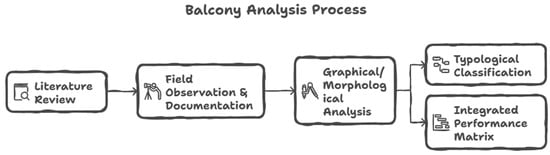
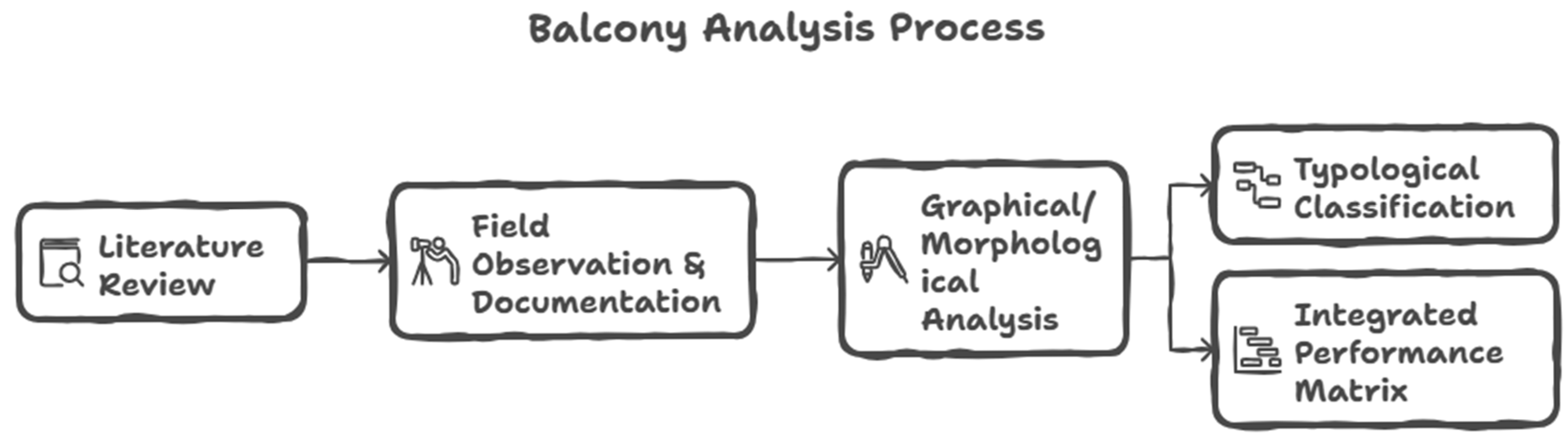
In summary, the study proceeds in three phases: (1) a selective bibliographic synthesis that produces the analytical domains and evaluation criteria (Table 3); (2) field observation and documentation to record balcony form and inhabitation cues; and (3) graphical–morphological analysis to classify balcony systems and enable cross-case comparison. Table 1 and Figure 1 summarise the workflow and the outputs generated at each step. The methodology is therefore designed to deliver a rigorous qualitative typology and comparative interpretation, not to validate environmental performance through simulations or monitoring. Cross-case comparison, therefore, considers both typological similarity/difference and broad periodisation within 2007–2020, without asserting causal links between regulation and performance outcomes. For full transparency and reproducibility, reporting each of the 33 projects with year and location.
Table 1.
Methodological phases and corresponding analytical procedures.
Figure 1.
Workflow of the balcony analysis process.
4. Result and Analysis
The results present a typological and comparative synthesis of balcony systems in contemporary Parisian housing (2007–2020), structured according to the analytical domains and criteria defined in Table 3. The corpus is organised into three principal systems—individual balconies, continuous (filant) balconies, and combined systems—each representing a distinct approach to façade articulation and threshold formation. The findings show how balcony morphology contributes to architectural identity and suggest differentiated environmental mediation potentials and socio-functional capacities. All environmental statements are presented as qualitative and inferential, grounded in observable form and supported by passive-design literature, rather than as confirmed performance outcomes. To reflect the transition-period context (2007–2020), the typological synthesis is also reported with reference to project timing within the corpus. This does not establish regulatory effectiveness; rather, it provides a descriptive lens to observe whether particular balcony systems cluster in sub-periods of housing production.
Interpretive status of environmental findings is discussed here. The results should be read as a comparative typological synthesis, not as causal validation of environmental performance. Environmental and thermal implications are derived from repeated morphological patterns across the corpus and interpreted through documented passive-design principles; they therefore indicate correlation between form and presumed environmental mediation potential, rather than measured performance outcomes or causal effects. Where the text refers to ventilation, shading, or comfort, these are discussed as plausible implications grounded in morphology, not as monitored or simulated results.
Across the 33 projects (n = 33), the distribution of balcony systems is as follows: individual systems [n = 14; 42.4%], continuous/filant systems [n = 11; 33.3%], and combined systems [n = 8; 24.2%]. At the subtype level, the seven subtypes occur with the following frequencies: symmetrical [n = 6; 18.2%], asymmetrical [n = 5; 15.2%], box-shaped [n = 5; 15.2%], double-height [n = 4; 12.1%], uniform continuous [n = 5; 15.2%], variable continuous [n = 5; 15.2%], and hybrid [n = 3; 9.1%]. These values quantify the documented corpus only and do not claim statistical representativeness for all Paris housing built during 2007–2020. Across the coded domains, cross-case comparison indicates that more continuous balcony configurations are generally associated with façade regularity and consistent threshold conditions, while more variable or enclosed configurations tend to coincide with differentiated privacy/exposure gradients and stronger perceived shelter, albeit with potential trade-offs in openness and daylight access depending on exposure conditions. Triangulation is reflected in the consistency of these observations across drawings, photographs, and on-site reading of the built façade. See Table 2.
Table 2.
Balcony typologies and representative case studies in Parisian housing.
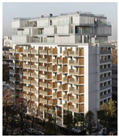
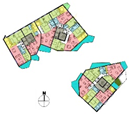
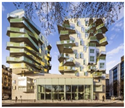
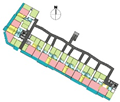
The results show that different formal strategies exist to define the visual and compositional identity of building envelopes when studied through architectural expression. The individual balcony typology consists of four main subtypes, which include symmetrical and asymmetrical designs and box-shaped and double-height configurations that create separate spatial and aesthetic outcomes. Symmetrical balconies, exemplified by Naud & Poux’s ZAC Paul Bourget (2019), establish a rhythmic and ordered composition, reinforcing façade regularity and visual coherence. In contrast, asymmetrical forms, as in Bernard Buhler’s ZAC Paris Rive Gauche (2017), disrupt this order through irregular projections, varied orientations, and diverse materials, creating a dynamic architectural rhythm. Box-shaped balconies, such as those realised by Hamonic & Masson (Rue d’Aubervilliers, 2015), contribute volumetric depth and material layering, while double-height configurations, as observed in Ingrid Taillandier & Fresh’s ZAC Clichy-Batignolles (2016), express vertical openness and spatial generosity. The continuous (filant) balconies reveal a contrasting logic: the uniform form reinforces façade unity through repetitive horizontal bands, while the variable form introduces alternating projections that enrich façade plasticity. Finally, combined systems—as seen in Jacques Moussafir & Nicolas Hugoo’s Chapelle International (2019)—indicate a hybrid architectural language balancing unity and differentiation, showing how typological synthesis can respond to complex design and environmental conditions.
In terms of environmental mediation potential, the analysis indicates that balcony morphology is associated with different shading conditions, degrees of exposure, and opportunities for ventilation and daylight modulation. Across the cases, three recurrent variables—orientation context, depth/projection, and enclosure—consistently structure how balconies may operate as climatic buffers or exposure devices. For example, more continuous and uniform configurations tend to produce consistent façade shading patterns, while variable and asymmetrical configurations generate differentiated exposure conditions. Box-shaped balconies frequently provide higher enclosure and protection from wind/glare but may reduce openness, while double-height configurations increase vertical openness and may enhance daylight access. These findings should be read as morphology-based interpretations supported by passive-design literature rather than measured microclimatic outcomes. The analysis of socio-functional aspects, supported by observation and graphical documentation, suggests that balcony configurations influence privacy gradients, patterns of use, and perceived threshold conditions. More symmetrical and continuous systems often reinforce collective façade coherence and comparable spatial conditions across units, while variable and box-shaped configurations enable differentiated privacy/exposure and flexible appropriation. Double-height systems may increase perceived openness and vertical connection, potentially affecting how residents inhabit these thresholds. These interpretations rely on documented form and inhabitation cues and are not presented as verified behavioural or comfort outcomes. See Table 3.
Derivation of Table 3 criteria and parameters are discussed here. The criteria in Table 3 were derived through a three-step process designed to convert theoretical concepts into observable variables. First, a selective bibliographic synthesis identified recurring balcony attributes discussed across typological, passive-design, and threshold-space literature (e.g., projection logic, depth as buffer, enclosure gradients, façade integration, privacy/use cues). Second, these candidate attributes were pilot tested on an initial subset of cases to verify that they were (i) observable in drawings/photographs and (ii) sufficiently discriminative across projects. Third, the final set of criteria was stabilised into a Table 3 matrix and used as a codebook for systematic case-by-case coding. Accordingly, Table 3 represents a structured interpretive device enabling cross-case comparison; it does not report measured environmental performance.
Table 3.
Multidimensional analysis of balcony typologies: architectural, environmental, social, and morphological criteria. (criteria are operational variables derived from literature synthesis and pilot coding; they support qualitative comparison and morphology-based inference and are not equivalent to simulated or monitored performance indicators).
5. Discussion and Implications
5.1. Architectural–Environmental Integration
The discussion suggests that balconies in contemporary Parisian housing operate as hybrid interfaces where façade composition and environmental reasoning are frequently co-present. Morphological variables such as depth, projection, enclosure, transparency, and material articulation shape the conditions under which shading, daylight modulation, and ventilation opportunities may occur. Many configurations appear consistent with passive-design intentions (e.g., deeper projections associated with higher solar exposure; enclosure gradients balancing privacy and daylight), but the study does not measure the magnitude of these effects. Accordingly, balconies are interpreted here as potential environmental mediators embedded in the façade, rather than as proven environmental systems. This synthesis illustrates a broader disciplinary shift toward performative expression, where architectural form is generated through climatic intelligence rather than decorative intention. The framework shows a flexible building envelope system that adjusts to environmental factors to establish a connection between sunlight exposure, air movement, heat management and architectural design elements. The research suggests modern ecological and performative design principles, which indicate that sustainable building designs result from the interactive relationship between environmental conditions and architectural design choices. The Parisian housing balconies indicate how architectural design requires environmental conditions to achieve complete harmony between architectural form and climate adaptation.
5.2. Typological Performance and Adaptive Morphology
Comparative evaluation reveals that balcony typologies contribute differently to environmental modulation and formal articulation. Symmetrical balconies emphasise façade rhythm and uniform shading patterns, creating predictable environmental performance, while asymmetrical configurations introduce spatial variation and localised solar adaptation through differentiated projection depths. The box-like design of balconies creates enclosed spaces, which creates more enclosed threshold conditions that may increase shading continuity and perceived shelter, while also introducing trade-offs such as reduced openness and potentially reduced daylight access (context-dependent). The double-height balconies design creates vertical openness, which enables natural ventilation and daylight entry while producing expansive areas that make spaces appear deeper.
Continuous (filant) balconies function as horizontal environmental buffers, unifying the façade and generating large-scale shading surfaces that moderate solar gain. The design of hybrid systems unites discrete balcony elements with horizontal bands to create a single façade which provides both privacy, environmental continuity and personal identity. The design of balconies shows adaptive characteristics because architectural choices depend on building orientation, environmental needs, regulatory standards and user requirements. Rather than proposing a universal typology, the results highlight an adaptive grammar of balcony forms, each capable of performing distinct roles within different spatial and climatic contexts.
Analytical balance and boundary conditions are discussed here. While several balcony systems appear consistent with passive-design intentions, the corpus also includes cases where morphological strategies may generate trade-offs or ambiguous outcomes. For instance, deeper or more enclosed balcony configurations can plausibly enhance shading and privacy while potentially reducing daylight access or openness; conversely, highly open or double-height configurations may increase daylight and perceived spaciousness while offering less consistent shading continuity depending on orientation and façade exposure. These boundary conditions highlight that the framework identifies comparative potentials and trade-offs rather than universally “better” solutions, reinforcing the need for future quantitative verification (simulation/monitoring) and post-occupancy assessment.
5.3. Human Experience, Use, and Microclimatic Agency
Field observations additionally reveal that balconies function as lived microclimatic spaces influenced by the daily practices of their users. Residents take an active role in regulating comfort by adjusting shading devices, modifying operable elements, incorporating plants, and rearranging furniture. These actions align with adaptive comfort theory, as individuals can manage their surroundings through natural methods rather than relying on mechanical systems. Through these activities, balconies transform into dynamic areas of thermal and sensory adjustment, enabling residents to navigate shade, airflow, privacy, and sunlight in accordance with their evolving needs.
In addition to their role within environmental agencies, balconies significantly augment domestic life through a myriad of social and experiential functions. They function as semi-private realms conducive to relaxation, horticulture, professional endeavours, and informal social engagement, thereby enhancing psychological well-being and cultivating emotional connections to the home. Their ability to expand indoor spaces into urban areas creates better views and city visibility and stronger sensory experiences with the surrounding environment. The experiential aspects indicate that balconies function as social-material habitats that enable people to experience comfort and pleasure while maintaining their identity and everyday comfort. The design of balconies determines how well buildings perform environmentally while creating better domestic experiences.
5.4. Regulatory and Theoretical Implications
The Parisian cases suggest that the period’s regulatory and design guidance context (e.g., RT2005/RT2012) may have contributed to balcony depth/enclosure experimentation; however, this study does not test regulatory effectiveness or causal impacts and treats regulation as contextual background rather than an explanatory variable. Rather than imposing limitations on architectural expression, these regulatory frameworks have encouraged innovative experimentation with stratified façades, varied depths, and precisely calibrated material transparency. Balconies emerged as pivotal interfaces for harmonising adherence to regulations with creative inquiry, positing that performance-based policies may function as generative design instruments rather than mere restrictive constraints.
The research establishes balconies as connectors between architectural design, environmental control and social interactions, which most architectural studies keep distinct. The research combines these three architectural components into one analytical framework, which eliminates the conventional separation between architectural design and functional requirements and residential spaces. The research shows balconies function as morpho-climatic infrastructure, which combines spatial intelligence with environmental logic and experiential value. This integrated perspective carries implications for architectural education, which must foreground the intersection of morphology and climate; for practice, which benefits from early typological evaluation; and for policy, which can leverage balcony design to enhance urban microclimates and resident well-being.
5.5. Recommendations for Sustainable Balcony Design
Based on the findings, several recommendations can support architects, educators, and policymakers in advancing more sustainable and environmentally responsive balcony design:
Design Recommendations:
Integrate climatic reasoning from the earliest design stages, using simple sun-path and shading analyses to calibrate depth, projection, and enclosure according to orientation.
Prioritise adaptive morphology, selecting balcony typologies (symmetrical, asymmetrical, box-shaped, continuous, hybrid) based on microclimatic needs rather than formal preference.
The design should use material transparency and layering as strategic elements to achieve privacy and shading, and daylighting through perforated panels, partial enclosures and operable elements.
Environmental and Performance Recommendations:
Regard balconies as inherently passive environmental systems that possess the capacity to mitigate overheating, enhance natural ventilation, and establish stable microclimates in the absence of mechanical interventions.
Optimise thermal-bridge reduction through structural decoupling or insulated attachment systems, preventing energy losses common in projecting elements.
Social and Experiential Recommendations:
Facilitate user autonomy by enabling inhabitants to customise shading, plant life, or enclosure parameters to optimise their comfort levels.
Encourage multi-functionality, ensuring balcony dimensions and materials support diverse activities such as relaxation, gardening, and informal work.
Policy and Education Recommendations:
Adopt performance-based regulations that incentivize environmental adaptation rather than imposing prescriptive geometric limits.
Integrate balcony-based climatic thinking into architectural curricula, emphasising morphological analysis and environmental responsiveness.
These recommendations reinforce the role of balconies as essential infrastructures of sustainability, climate adaptation, and urban well-being in contemporary housing.
6. Conclusions
This study examined balcony typologies in contemporary Parisian housing (2007–2020) as façade-threshold systems integrating architectural expression, environmental mediation potential, and socio-spatial interface conditions. Using field observation, graphical documentation, and comparative morphological analysis of 33 projects, the paper developed a reproducible typological classification and a transparent evaluation matrix (Table 3) that links observable balcony attributes (projection, depth, enclosure, and façade integration) to interpretive domains.
The findings indicate recurring relationships between balcony form and plausible environmental/socio-spatial implications—such as differentiated shading continuity, exposure control, ventilation opportunity, privacy gradients, and inhabitation flexibility—without claiming measured thermal comfort or verified behavioural outcomes. Accordingly, the contribution is best understood as theoretical–exploratory and framework-building: it offers a structured method to compare balcony morphologies and to formulate testable hypotheses for future simulation-based, monitored, or post-occupancy research.
The research makes a theoretical contribution by introducing a three-part framework that connects architectural expression, environmental performance, and social-experiential use. This framework frames balconies as socio-material and morpho-ecological interfaces that collaboratively shape façade identity and environmental behaviour, thereby questioning traditional distinctions between aesthetics, climatic function, and lived experience. It advances the understanding of sustainability as a spatial and morphological condition embedded in everyday residential architecture.
The empirical results provide architects with a typological and morphological framework for the identification and adjustment of balcony designs in accordance with climatic orientation, façade strategy, and user anticipations. Furthermore, they assist educators in the incorporation of environmental rationale within design pedagogy and encourage policymakers to acknowledge balconies as essential components of microclimatic regulation, wellbeing, and urban vitality.
Transferability beyond Paris should be understood at the level of method rather than outcome. The proposed domains, criteria, and workflow can be adapted to other metropolitan contexts, but the relative prevalence of typologies and the magnitude of environmental effects will vary with climate, cultural norms of outdoor living, construction practices, and regulatory regimes.
The constraints of the study encompass the lack of quantitative thermal simulations, the absence of post-occupancy assessments, and an emphasis on the specific climatic and regulatory framework of Paris. Subsequent investigations ought to incorporate numerical modelling, inter-climatic comparisons, and occupant-centric studies to substantiate and enhance the proposed conceptual framework. In summary, the study proposes that balconies—when analysed as spatially thickened façade thresholds—can be systematically classified and comparatively interpreted as potential mediators of environmental and socio-spatial conditions; future work should quantify these potentials across climates, regulations, and occupant practices.
Author Contributions
Conceptualization, L.H.; Methodology, L.H., Y.G., and E.N.; Software, E.N.; Validation, E.N.; Data curation, L.H.; Formal analysis, L.H.; Investigation, L.H.; Resources, L.H.; Writing—original draft, E.N.; Writing—review & editing, E.N. and Y.G.; Visualization, L.H.; Supervision, L.H.; Project administration, E.N. All authors approved the final version to be published and agrees to be accountable for all aspects of the work, in accordance with ICMJE authorship criteria. All authors have read and agreed to the published version of the manuscript.
Funding
This research was supported by Prince Sultan University, and the Article Processing Charges (APC) were funded by Prince Sultan University.
Institutional Review Board Statement
Not applicable.
Informed Consent Statement
Not applicable.
Data Availability Statement
No new data were created or analyzed in this study.
Conflicts of Interest
The authors declare no conflicts of interest.
Correction Statement
This article has been republished with a minor correction to the Funding statement. This change does not affect the scientific content of the article.
References
- Friedman, A. Choice, Adaptability and Circularity in Housing; Cambridge Scholars Publishing: Newcastle upon Tyne, UK, 2024. [Google Scholar]
- Zaera-Polo, A.; Anderson, J. The Ecologies of the Building Envelope: A Material History and Theory of Architectural Surfaces; Actar D, Inc.: New York, NY, USA, 2021. [Google Scholar]
- Moussavi, F. The Function of Style; Actar D, Inc.: New York, NY, USA, 2021. [Google Scholar]
- Haynes, D. A Brief History of Paris: How the World’s Most Beautiful City Was Built on Blood, Brilliance, and Bold Ideas. In Dominic Haynes History; Everand: San Francisco, CA, USA, 2025. [Google Scholar]
- Malaquin, P. From Fairy Modernity to Fear Obsolescence the Adaptive Future of Meta-Metropolitan Touristic Coastal Cities Study Case of la Grande Motte, France. Ph.D. Thesis, Università degli Studi di Genova, Genoa, Italy, 2025. [Google Scholar]
- Smektała, M.; Baborska-Narożny, M. Adding Balconies to Historical Tenements–Local Approaches to the Retention of Heritage Value in Poland, Germany, and Denmark. Hist. Environ. Policy Pract. 2024, 15, 141–169. [Google Scholar] [CrossRef] [Scilit]
- Litsardaki, M.L. Balco(n)vid-19: The Use and the Importance of Balconies Before and During the COVID-19 Pandemic. Master’s Thesis, KTH Royal Institute of Technology, Stockholm, Sweden, 2021. [Google Scholar]
- Jabłońska, J.; Telesińska, M.; Adamska, A.; Gronostajska, J. The architectural typology of contemporary façades for public buildings in the European context. Arts 2022, 11, 11. [Google Scholar] [CrossRef] [Scilit]
- Ribeiro, C.; Ramos, N.M.; Flores-Colen, I. A review of balcony impacts on the indoor environmental quality of dwellings. Sustainability 2020, 12, 6453. [Google Scholar] [CrossRef] [Scilit]
- Peters, T.; Masoudinejad, S. Balconies as adaptable spaces in apartment housing. Build. Cities 2022, 3, 265–278. [Google Scholar] [CrossRef] [Scilit]
- Smektała, M.; Baborska-Narożny, M. The use of apartment balconies: Context, design and social norms. Build. Cities 2022, 3, 134–152. [Google Scholar] [CrossRef] [Scilit]
- Pingusson, G.H. (1953) ‘Renouveler le Logement’, Esprit (1940–), (207/208). pp. 539–549. Available online: http://www.jstor.org/stable/24253509 (accessed on 23 February 2026).
- Aronis, C. Architectural liminality: The communicative ethics of balconies and other urban passages. Cult. Stud. 2022, 36, 475–501. [Google Scholar] [CrossRef] [Scilit]
- Cohen, J.-L. France: Modern Architectures in History; Reaktion Books: London, UK, 2014. [Google Scholar]
- Huovila, P. Buildings and Climate Change: Status, Challenges, and Opportunities; United Nations Environment Programme: Nairobi, Kenya, 2007. [Google Scholar]
- Buyle, M.; Braet, J.; Audenaert, A. Life cycle assessment in the construction sector: A review. Renew. Sustain. Energy Rev. 2013, 26, 379–388. [Google Scholar] [CrossRef] [Scilit]
- Daly, I. Housing Policy and Urban Development in France. Ph.D. Thesis, Université Paris-Saclay, Orsay, France, 2024. [Google Scholar]
- Pollard, J. The political conditions of the rise of real-estate developers in French housing policies. Environ. Plan. C Politics Space 2023, 41, 274–291. [Google Scholar]
- Kostourou, F. Housing growth: Impacts on density, space consumption and urban morphology. Build. Cities 2021, 2, 55–78. [Google Scholar] [CrossRef] [Scilit]
- Shamseldin, A. Adaptation opportunities for balconies to achieve continuity of their environmental functions. Alex. Eng. J. 2023, 67, 287–299. [Google Scholar] [CrossRef] [Scilit]
- Kelbaugh, D. Typology—An architecture of limits. Archit. Theory Rev. 1996, 1, 33–52. [Google Scholar] [CrossRef] [Scilit]
- Palazzo, E. Bridging urban morphology and urban ecology: A framework to identify morpho-ecological periods and patterns in the urban ecosystem. J. Urban Ecol. 2022, 8, juac007. [Google Scholar] [CrossRef] [Scilit]
- Karagkouni, C.; Fatah gen Schieck, A.; Tsigkari, M.; Chronis, A. Performance-driven facades: Analysis of natural cross-ventilation in an indoor environment with Fast Fluid Dynamics and apertures optimization based on a genetic algorithm. Simulation 2014, 90, 978–990. [Google Scholar] [CrossRef] [Scilit]
- Hensel, M.; Menges, A. Designing Morpho-Ecologies: Versatility and Vicissitude of Heterogeneous Space. Archit. Des. 2008, 78, 102–111. [Google Scholar] [CrossRef] [Scilit]
- Yaari, M. Rethinking the French City: Architecture, Dwelling, and Display After 1968; Brill: Leiden, The Netherlands, 2008. [Google Scholar]
- French, H. Adaptable Housing: Accommodating Change. Ph.D. Thesis, University of Brighton, Brighton, UK, 2016. [Google Scholar]
- Kousidi, S. Space-Containing Façades: Mediating Environmental, Social, and Urban Dynamics in Collective Housing Design. Architecture 2025, 5, 12. [Google Scholar] [CrossRef] [Scilit]
- Allen, S. Practice: Architecture, Technique and Representation; Routledge: Oxfordshire, UK, 2012. [Google Scholar]
- Allen, S. Field conditions (1997). In The Digital Turn in Architecture 1992–2012; John Wiley & Sons Ltd.: Hoboken, NJ, USA, 2013; pp. 62–79. [Google Scholar]
- Izadyar, N.; Miller, W.; Rismanchi, B.; Garcia-Hansen, V. A numerical investigation of balcony geometry impact on single-sided natural ventilation and thermal comfort. Build. Environ. 2020, 177, 106847. [Google Scholar] [CrossRef] [Scilit]
- Rinaldi, B.M.; Tan, P.Y. Urban Landscapes in High-Density Cities: Parks, Streetscapes, Ecosystems; Birkhäuser: Basel, Switzerland, 2019. [Google Scholar]
- Ghannam, F. Reciprocal spaces: The socio-material life of balconies in urban Egypt. City Soc. 2023, 35, 156–166. [Google Scholar] [CrossRef] [Scilit]
- Fodor, E. Better not bigger: How to take control of urban growth and improve your community. Hum. Ecol. Rev. 1999, 6, 127. [Google Scholar]
- Chang, W.-W.; Giaccardi, E.; Chen, L.-L.; Liang, R.-H. (Eds.) “Interview with Things”: A First-thing Perspective to Understand the Scooter’s Everyday Socio-material Network in Taiwan. In Proceedings of the 2017 Conference on Designing Interactive Systems; Association for Computing Machinery: New York, NY, USA, 2017. [Google Scholar]
- Ribeiro, C.; Flores-Colen, I.; Valentim Lopes, N.; Ramos, N.M. The balconies as an archetype of well-being: A critical literature review. Archnet-IJAR Int. J. Archit. Res. 2024, 19, 970–989. [Google Scholar] [CrossRef] [Scilit]
- Ciplet, D.; Roberts, J.T. Climate change and the transition to neoliberal environmental governance. Glob. Environ. Change 2017, 46, 148–156. [Google Scholar] [CrossRef] [Scilit]
- Groat, L.N.; Wang, D. Architectural Research Methods; John Wiley & Sons: Hoboken, NJ, USA, 2013. [Google Scholar]
- Scheer, B.C. The epistemology of urban morphology. Urban Morphol. 2016, 20, 5–17. [Google Scholar] [CrossRef] [Scilit]
- Scheer, B.C. Urban morphology as a research method. In Planning Knowledge and Research; Routledge: Oxfordshire, UK, 2017; pp. 167–181. [Google Scholar]





Disclaimer/Publisher’s Note: The statements, opinions and data contained in all publications are solely those of the individual author(s) and contributor(s) and not of MDPI and/or the editor(s). MDPI and/or the editor(s) disclaim responsibility for any injury to people or property resulting from any ideas, methods, instructions or products referred to in the content. |
© 2026 by the authors. Licensee MDPI, Basel, Switzerland. This article is an open access article distributed under the terms and conditions of the Creative Commons Attribution (CC BY) license.