
Systematic Review

Navigating Green Building Policies and Incentives: A PRISMA Systematic Review of Trends, Mechanisms, Barriers, and Strategies

by
Titi Sari Nurul Rachmawati
1,*,
Mustika Sari
1,
Daniel Darma Widjaja
2 and
Walter Timo de Vries
3
1
Department of Civil and Environmental Engineering, Faculty of Engineering, Universitas Indonesia, Depok 16424, West Java, Indonesia
2
Department of Architectural Engineering, Kyung Hee University, Yongin-si 17104, Republic of Korea
3
Department of Aerospace and Geodesy, School of Engineering and Design, Technical University of Munich (TUM), Arcisstrasse 21, 80333 München, Germany
*
Author to whom correspondence should be addressed.
Architecture 2026, 6(1), 33; https://doi.org/10.3390/architecture6010033
Submission received: 3 January 2026 / Revised: 22 February 2026 / Accepted: 22 February 2026 / Published: 25 February 2026
(This article belongs to the Special Issue Advances in Green Buildings)

Abstract

Green building incentives constitute a policy instrument for mitigating economic, technical, and behavioral barriers to the adoption of green buildings, yet existing studies remain fragmented across incentive types, stakeholders, and building life cycle stage. A coherent synthesis that explains how incentive strategies evolve and interact across these dimensions is still missing. This study addresses that gap through a systematic literature review guided by the PRISMA 2020 protocol. A total of 69 peer-reviewed journal articles published between 2016 and 2025 were identified from Scopus and analyzed using thematic synthesis. The review maps temporal trends, incentive typologies, stakeholder roles, and implementation challenges across different regional and market contexts. The findings indicate that incentive effectiveness depends on alignment between life cycle stage, market maturity, and stakeholder capacity, rather than on any single policy instrument. Financial incentives remain critical in early market phases, while non-financial and regulatory instruments gain prominence as markets mature. The synthesis also demonstrates how evolutionary game theory has been increasingly applied to analyse dynamic incentive and penalty strategies under bounded rationality, offering a structured lens for adaptive policy design. By integrating life cycle perspectives, stakeholder interactions, and game theoretical insights, this study advances current understanding of these incentive designs. The results provide a foundation for more adaptive and context-sensitive incentive frameworks and identify clear directions for future empirical and comparative policy research.

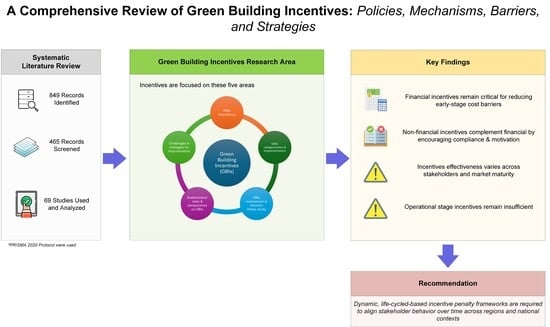
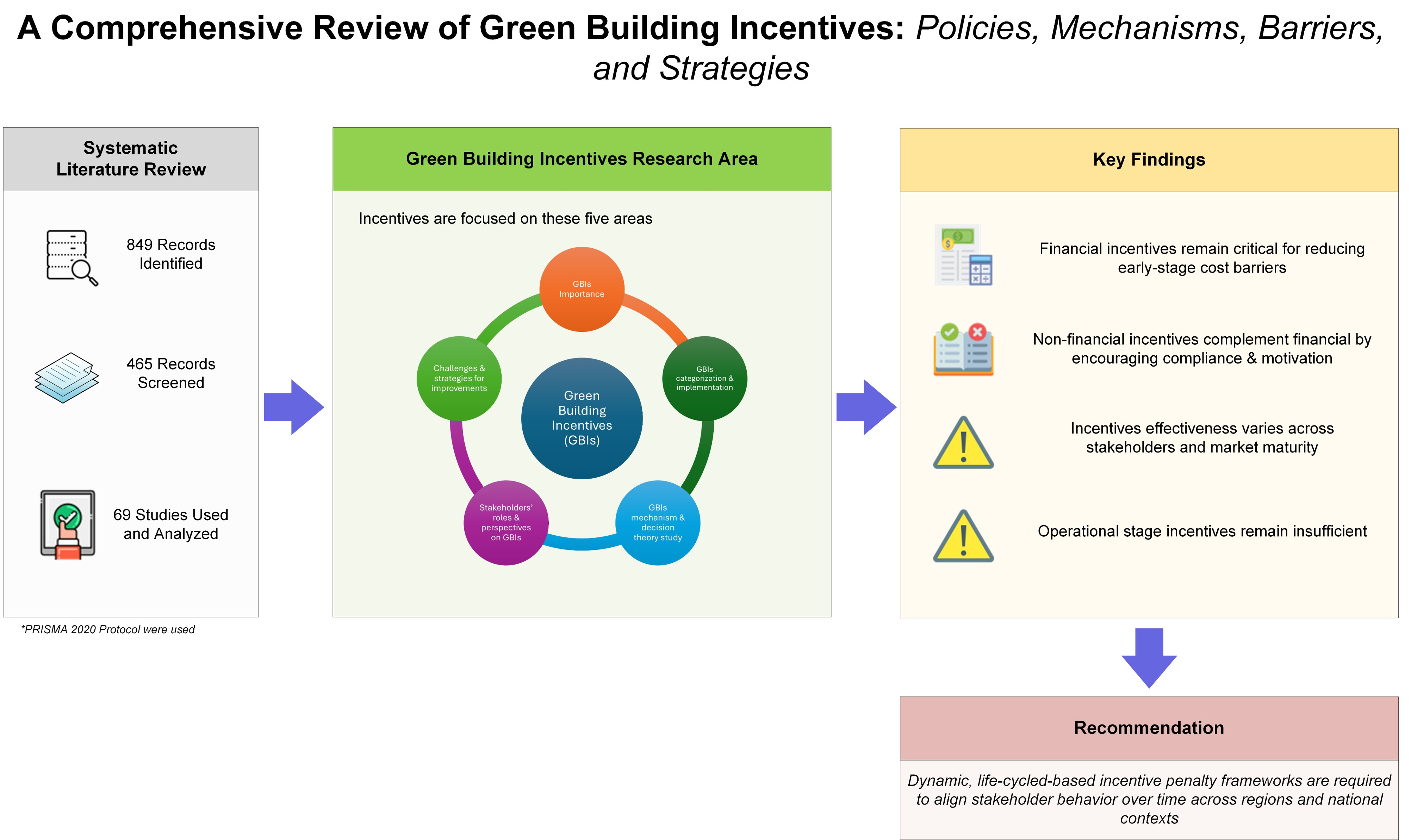
Graphical Abstract

1. Introduction

The construction industry plays a pivotal role in national economy by fulfilling infrastructure and housing needs. However, its environmental impact is substantial, with 75% of global waste generated by the sector [1]. In 2013, buildings accounted for 30% of global energy consumption and 25% of total CO2 emissions. A recent study revealed that these figures increased to 34% and 37% within nine years [2]. Greenhouse gases emitted by the sector predominantly consist of 79.4% CO2, 11.5% CH4, 6.2% N2O, and 3% fluorinated gases, according to the U.S. Environmental Protection Agency [3]. These figures underscore the urgent need for effective strategies to mitigate environmental impacts, encompassing energy efficiency, renewable energy integration, low-carbon materials and construction methods, and behavioral and operational measures as part of comprehensive green building practices.
Green buildings have emerged as a key response to these challenges by improving resource efficiency, reducing emissions, and enhancing occupant well-being. Green buildings are designed, constructed, and operated to improve resource efficiency, support economic growth, enhance durability, and provide comfort while minimizing environmental degradation [4,5]. These buildings optimize energy and water use, reduce waste, and enhance indoor environmental quality [6]. The development of green building practices can be traced back to the 1970s energy crisis, which emphasized energy efficiency and renewable energy integration. These ideas were later institutionalized through sustainability-driven regulations and certification systems, beginning with BREEAM in the United Kingdom in 1990 and followed by LEED in the United States in 1998 [7]. Since then, these standards set benchmarks for sustainable design and shaped regulatory frameworks that encourage compliance through financial and non-financial incentives.
Despite advantages of green buildings, several barriers prevent widespread adoption, such as high initial costs, long payback periods, knowledge gaps, and limited incentives [8,9]. These challenges are commonly grouped into cost- and risk-related, knowledge- and information-related, and social- and cognitive-related barriers [10]. Among these, financial barriers are particularly dominant, as green building design, technologies, materials, and certification processes often require premium costs [11]. Split incentives complicate adoption, especially when developers or owners bear the costs while tenants benefit from lower utility expenses [12].
To address these barriers, governments and policymakers have increasingly introduced incentive mechanisms by providing financial support and regulatory benefits [13]. Incentives fall into two main categories: internal and external [14]. Internal incentives originate within an organization or building, independent of external support, which include operational cost savings, improved occupant comfort, and enhanced property value [14,15]. External incentives, provided by governments or other entities, require meeting predefined criteria [14]. They are further classified into financial and non-financial incentives. Financial incentives provide direct financial benefits, such as tax reductions, subsidies, or grants. Non-financial incentives offer regulatory relief, technical assistance, or development bonuses, such as gross-floor-area concessions [16,17]. Together, these measures reduce the financial burden of green buildings and support emission reduction efforts [18].
A growing body of literature has examined green building incentive mechanisms from different perspectives. Olubunmi et al. [14] developed a comprehensive classification framework that distinguishes between internal and external incentives. Rana et al. [19] examined financial incentives for green buildings in Canada, Shazmin et al. [20] concentrated on property tax assessment schemes, while Liberalesso et al. [21] investigated policies that promote green roof and wall technologies. Although these studies provide valuable insights, their scope remains fragmented. Existing reviews often concentrate on single incentive types, specific policy tools, or limited geographic contexts, and many do not reflect recent policy developments. Moreover, no study has provided a comprehensive, multidimensional analysis that integrates temporal trends, incentive typologies, stakeholder roles, and policy effectiveness across different regions. This fragmented understanding prevents policymakers from formulating effective incentive programs.
Accordingly, this study aims to synthesize recent research on these incentives by explicitly integrating incentive typologies, stakeholder roles, and building life cycle considerations within a single analytical framework. The review focuses on identifying how different incentive instruments operate across market contexts and stages of development, how stakeholder interactions influence incentive effectiveness, and how policy mechanisms evolve over time. By consolidating these dimensions, this study seeks to clarify patterns, tensions, and strategic implications that remain fragmented in existing reviews.
To operationalize these objectives, this study examines green building incentive literature published over the last decade (2016–2025). This period reflects significant policy shifts, particularly after the Paris Agreement in 2015, which strengthened global commitments toward sustainable building practices. During this time, governments and financial institutions have introduced new green financing models, regulatory frameworks, and incentive programs. Focusing on this period enables a timely assessment of how incentive mechanisms have evolved in response to changing policy priorities, market maturity, and stakeholder engagement. The analysis provides an updated evidence base to support policy design and scholarly inquiry related to green building adoption. The research questions that directed this study are:
  • What temporal trends characterize green building incentives between 2016 and 2025?
  • What typologies and implementation mechanisms of green building incentives are identified across different regional and market contexts?
  • What roles do stakeholders play in the design and implementation of these incentives?
  • What challenges are encountered, and what strategies are proposed to address them?
This paper is organized as follows. Section 1 presents the problem definition, reviews related studies, and identifies the research gaps and objectives. Section 2, Section 3 and Section 4 present the materials and methods, the results, and the thematic synthesis of the literature, respectively. Finally, Section 5 provides the conclusions.

2. Research Methodology

This study complied with the PRISMA 2020 guidelines developed by Page et al. [22] to conduct systematic literature review. PRISMA 2020 guidelines provided a clear and structured framework for identifying, screening, and selecting relevant publications [22]. PRISMA flow diagram outlines the sequential process of identification, selection, and inclusion of studies, ensuring the development of a focused and reliable dataset. This study employs a narrative synthesis to consolidate findings from the selected literature by systematically examining green building incentives, including policies, mechanisms, barriers, and strategies. The review process followed a predefined protocol covering database selection, search strategy, eligibility criteria, and data synthesis procedures to enhance transparency and replicability.

2.1. Identification

Within the PRISMA 2020 framework, the identification stage involves compiling all potentially relevant records from databases and other sources prior to screening. In this study, relevant papers were sourced from Scopus as one of the major databases. Scopus was chosen because Scopus provides a broad index of peer-reviewed journal articles. Web of Science was not included due to limited full-text accessibility for a significant number of records relevant to this study. The Boolean search applied in Scopus was: (“green building” OR “sustainable building”) AND (“incentives” OR “policy incentives”), restricted to title, abstract, and keywords.
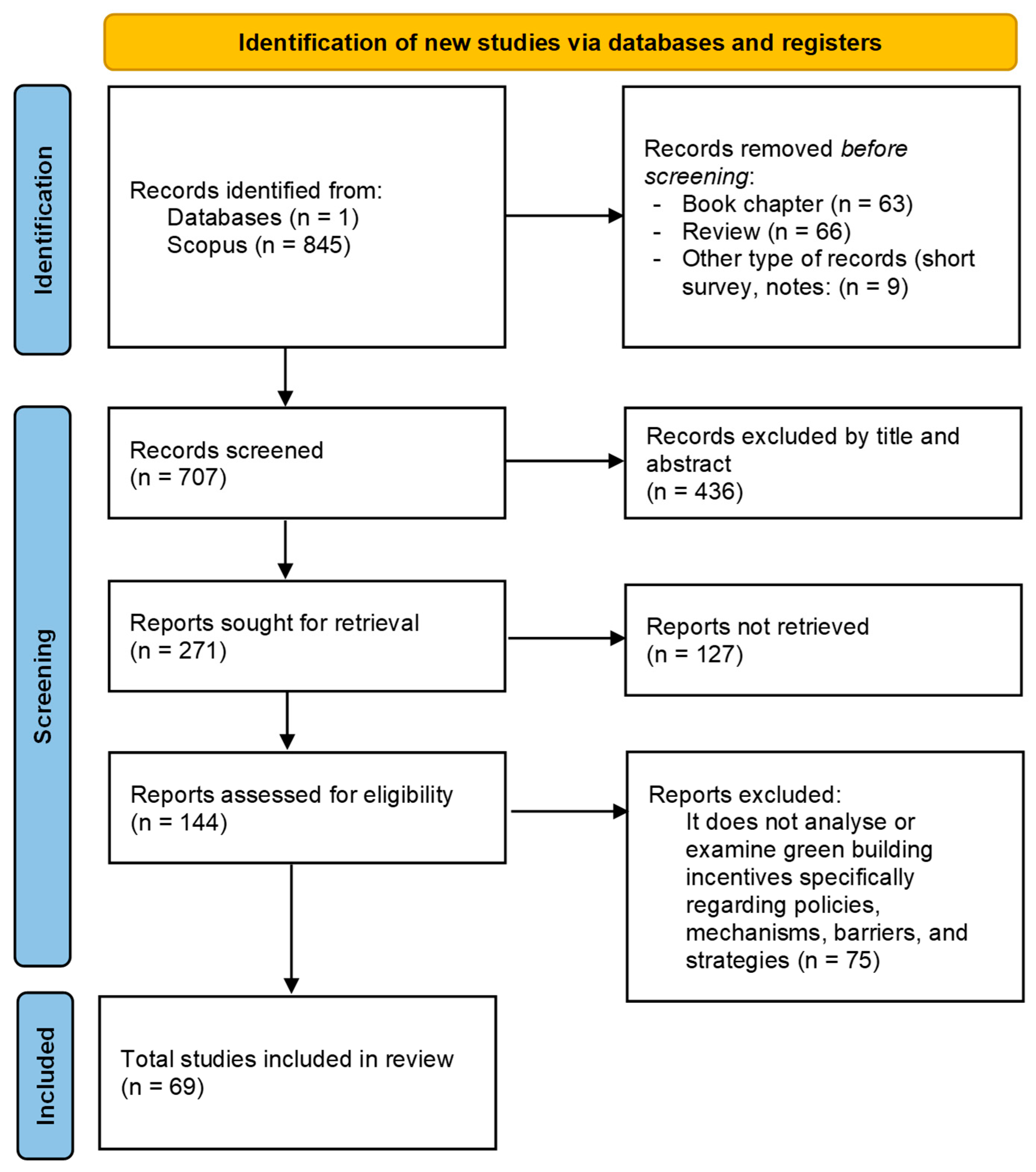
During the identification stage, records were gathered based on specific criteria: (1) the use of predefined keywords, (2) publication time spanning 2016–2025 period, and (3) restriction to English-language publications. An aggregate of 845 records was retrieved from the database searches and imported into Endnote for organization. The primary literature search was conducted between January and December 2025; consequently, any studies published or indexed after this period were excluded to maintain a static dataset for analysis.

2.2. Records Removed Before Screening

In accordance with PRISMA 2020, records were cleaned prior to screening to remove duplicates and those failing to meet administrative criteria. This study included only journal articles and conference papers. Accordingly, other types of publications, such as book chapters, review papers, short surveys, and notes, were excluded. As a result, 138 records were removed, leaving 707 records for further screening.

2.3. Screening

In PRISMA 2020, the screening stage entails assessing record titles and abstracts to determine their relevance to the inclusion criteria, with irrelevant records excluded. In this study, records retained after initial cleaning were screened based on their titles and abstracts, to include records focusing on the implementation of green building incentives, including policies, mechanisms, barriers, and strategies. Following this step, 436 records were deemed ineligible, leaving 271 records for a more detailed analysis. To minimize the risk of bias during the screening process, the screening process was carried out by four people from this stage through to the final selection. Each person independently and manually assessed the records without the use of automation tools. Any discrepancies in judgments were resolved through discussion until consensus was achieved. This approach was performed to maintain objectivity and consistency in selection and evaluation process.

2.4. Report Sought for Retrieval

According to PRISMA 2020, records that pass the screening stage should undergo full-text retrieval to enable a thorough eligibility assessment. This step involves evaluating each study based on its complete content. In this study, all articles that met the title and abstract criteria were designated as reports sought for retrieval, and full-text articles were obtained to proceed to the eligibility stage.

2.5. Report Not Retrieved

In PRISMA 2020, the reports not retrieved stage refers to records for which full-text access was attempted but could not be obtained due to technical or access constraints. In this study, 127 records whose full texts were unavailable through Scopus, ScienceDirect, Emerald, or institutional sources were classified as reports not retrieved and excluded from the eligibility assessment. As a result, 144 records remained for full-text quality assessment.

2.6. Eligibility

A quality assessment process was applied to the 144 full-text articles to ensure methodological rigor. Studies were evaluated based on methodological transparency defined as: (1) a clearly described research design, (2) a well-defined analytical scope or sample, and (3) sufficient explanation of data sources, analytical procedures, and interpretation of results. This final step led to 69 records forming the core dataset of this systematic literature review, as listed in Appendix A.

2.7. Included (Total Studies Included)

The final stage in PRISMA 2020 is included, which refers to the total number of studies ultimately incorporated into the systematic synthesis. In this study, 69 articles that passed the full-text eligibility assessment were compiled for further analysis. Data extraction followed a structured coding process. Each article was reviewed to identify incentive types, stakeholder roles, policy instruments, implementation contexts, and analytical perspectives.
Figure 1 presents a clear and concise flow diagram and describes the study selection process in accordance with the PRISMA 2020 guidelines proposed by Page et al. [22] on green building incentives.

3. Results

3.1. Trend Analysis

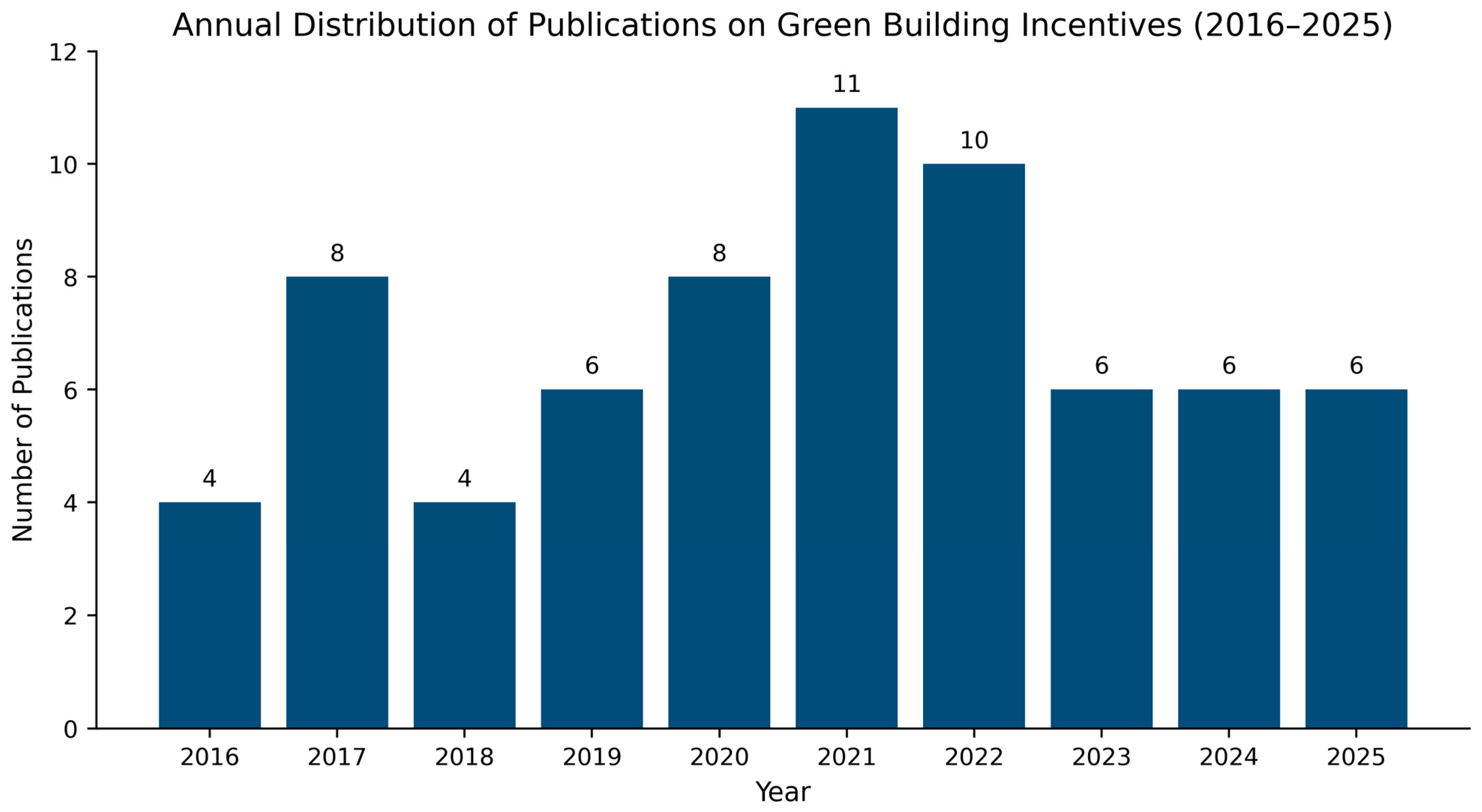
Figure 2 illustrates the publication trends on green building incentives from 2016–2025. Overall, the number of studies shows a generally upward trajectory from 2016 to 2022, indicating growing scholarly attention to this topic. Publications increased steadily, reaching a peak of 11 studies in 2021, followed by a slightly lower but still high output of 10 studies in 2022. After this peak period, research output declined to 6 publications in 2023 and remained stable at 6 publications in both 2024 and 2025. The fluctuations may be linked to changes in policy interest, funding availability, and shifting research priorities. A more consistent research effort remains necessary to advance knowledge in this field.
To provide a deeper critical analysis, the results in Figure 2 are categorized into two distinct periods: the Pre-Peak Era (2016–2020) and the Post-Peak Era (2021–2025). This division is justified by the global shift in economic and environmental policy following the COVID-19 pandemic. The Pre-Peak period represents an initial foundation stage where research largely focused on aligning green building incentives with the then-newly established Paris Agreement in 2015 [23].
Conversely, the peak in 2021–2022 reflects a critical convergence of the COP26 Glasgow Climate Pact and the launch of huge fiscal stimulus programs, notably NextGenerationEU [24] and US Inflation Reduction Act (IRA) [25]. During this time, these stimuli heavily incentivized sustainable construction to drive economic growth which transitioning the narrative from voluntary green goals to mandatory, well-funded incentive structures, which simultaneously redirecting research toward the intersection of energy efficiency and indoor health. The decline observed in 2023 to 2025 may reflect a transitional phase in which scholarly attention shifted from examining policy design and intent toward assessing implementation challenges.

3.2. Country Analysis

Table 1 presents the distribution of the 69 reviewed publications according to the first author’s country of affiliation. China contributes the largest share, with 29 publications, indicating a strong and sustained research interest in green building incentive policies. The United States follows with 8 publications, while Malaysia accounts for 4 studies. Australia, Hong Kong, and Singapore each contribute three publications, reflecting comparable levels of research activity across these contexts. Five countries—Canada, Ghana, Indonesia, Iran, and the Netherlands—each contribute two studies, while the remaining nine countries are represented by a single publication each.
While a limited number of countries dominate the research output, contributions from multiple countries indicate a growing global interest in these incentives. China’s dominant position is indicative of its focus on sustainability policies and government-led incentive programs. The Chinese government’s ‘Dual Carbon’ goals (peaking by 2030 and achieving neutrality by 2060) have institutionalized green building as a national priority, necessitating extensive research into the efficacy of government-led subsidies and incentives within a rapidly urbanizing economy.
The United States represents a different paradigm, where research typically analyses market-driven mechanisms and federal tax credits, such as those expanded under the Inflation Reduction Act. Notably, the inclusion of countries from the Global South, including Malaysia, Singapore, Ghana, and Indonesia, demonstrates that these incentives are no longer the exclusive domain of developed economies. In these regions, research is increasingly focused on adapting incentive policies to local economic constraints and diverse climatic contexts, signaling an expanding global landscape for sustainable policy implementation.

3.3. Journal Allocation Analysis

Of the 69 reviewed publications, 59 were published in peer-reviewed journals. Table 2 presents the distribution of these journal articles across different publication outlets and disciplinary domains. Sustainability (Switzerland) published the highest number of studies, with 8 articles, followed by the Journal of Cleaner Production with 5 articles. Renewable and Sustainable Energy Reviews and Building and Environment each contributed 4 articles, followed by Engineering, Construction and Architectural Management with 3 articles. Energies and Environmental Science and Pollution Research each published 2 articles. The remaining 31 articles were distributed across a wide range of other journals.
The concentration of articles in Sustainability and the Journal of Cleaner Production highlights the transdisciplinary nature of green building incentives. This concentration reflects that the complexities of incentive mechanisms are not easily contained within a single specialized discipline, but rather require an intertwine of environmental science, public policy, and construction management. In addition, the fact that the remaining articles are spread across a diverse array of journals emphasizes the importance of incentive research. It suggests that while the core discourse is centered on sustainability and production, the impact of these incentives is delved through multiple lenses: engineering, economics, and management lenses.

3.4. Co-Occurrence Keywords Analysis

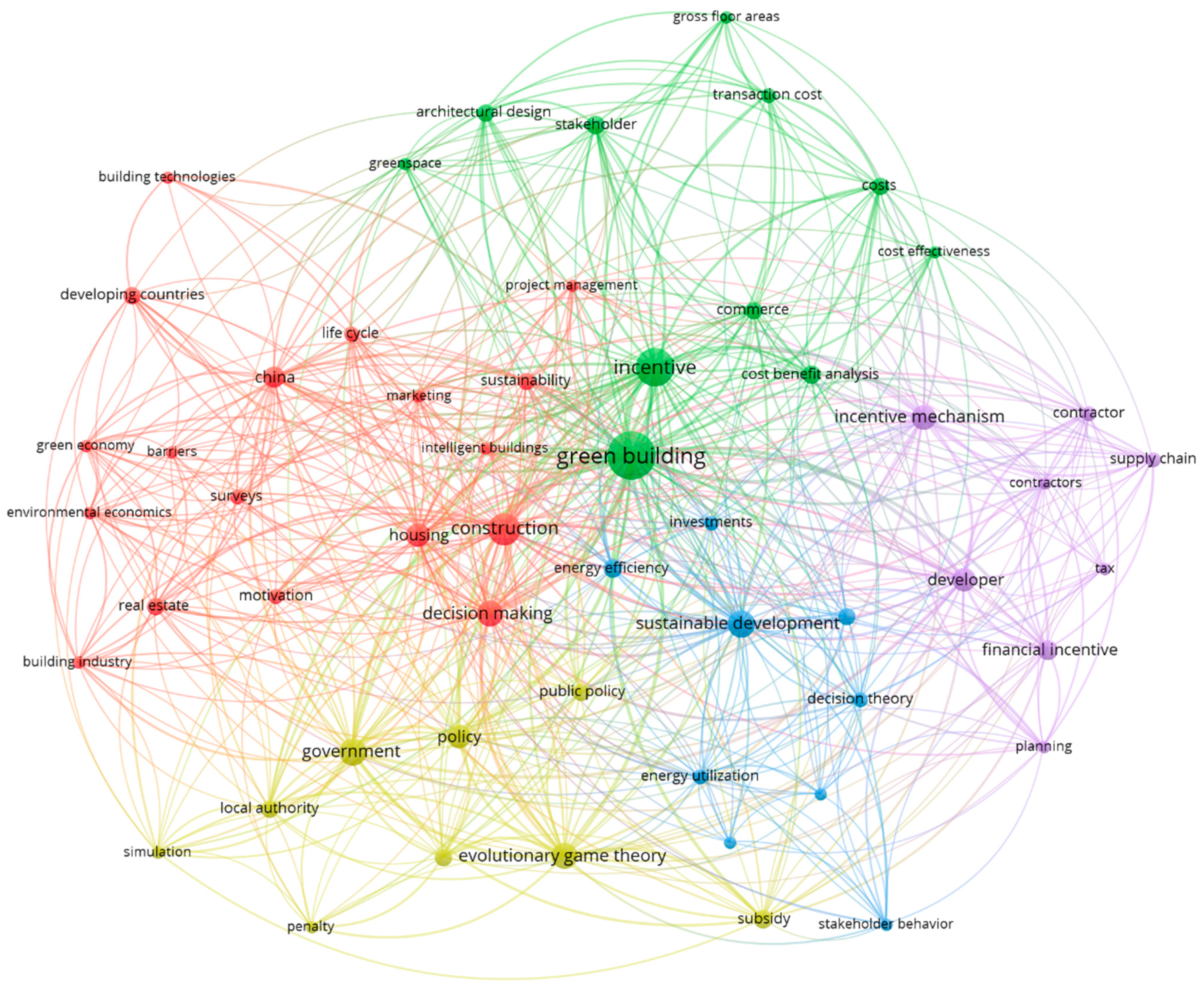
The co-occurrence network of keywords provides insight into thematic connections across the reviewed publications. In this network, each keyword appears as a node, and links between nodes represent relationships between them. Larger nodes indicate higher keyword frequency, while stronger links reflect greater co-occurrence.
The analysis was conducted using VOSviewer (version 1.6.20), with the “all keywords” and “full counting” options applied to ensure comprehensive representation. After manual standardization of similar terms, a minimum occurrence threshold of 3 was applied, resulting in a final dataset of 55 keywords.
Figure 3 illustrates the co-occurrence network generated from the 69 publications reviewed during the inclusion stage of the PRISMA protocol. Green building and incentives appear at the core of the network, with total link strengths of 210 and 134, respectively. The network analysis reveals five thematic clusters that categorize research on green building incentives: decision-making in developing incentive mechanisms (yellow cluster), financial incentives (purple cluster), non-financial incentives (green cluster), sustainable construction and economic integration (red cluster), and sustainable development (blue cluster).
The yellow cluster focuses on the process of designing and optimizing incentive mechanisms, with evolutionary game theory frequently applied as the primary framework. Studies in this cluster examine how incentives influence stakeholder decisions in green building adoption. The application of evolutionary game theory provides a structured approach to balancing financial benefits among developers, governments, and occupants.
The purple cluster explores the role of financial incentives in promoting sustainable construction. This cluster includes keywords such as “incentive mechanism”, “developer”, “financial incentive”, and “supply chain”. Studies in this area analyze the impact of subsidies, tax credits, and grants on green building implementation. Financial incentives reduce the economic burden on developers and encourage wider participation in green construction projects. By lowering upfront costs, these mechanisms increase the adoption of sustainable building practices.
The green cluster highlights non-financial incentives that encourage developers to invest in green buildings. Keywords such as “gross floor area”, “green spaces”, and “cost–benefit analysis” appear in this cluster. Structural incentives, including additional gross floor area allowances, provide developers with regulatory advantages when adopting sustainable building practices. The inclusion of green spaces suggests an increasing emphasis on the environmental and social benefits of green buildings. Meanwhile, cost–benefit analysis reflects a focus on evaluating the long-term value of non-financial incentives.
The red cluster examines the intersection of sustainability, construction, and economic considerations. Keywords such as “construction,” “sustainability,” “real estate,” “green economy,” and “environmental economics” demonstrate the integration of green building incentives into market-driven frameworks. This cluster also includes regional studies on sustainable construction in urban development, with “China” emerging as a central node in the network.
The blue cluster explores the relationship between sustainable development and energy-efficient practices. Keywords such as energy efficiency, energy utilization, and sustainable development emphasize the role of incentive programs in reducing energy consumption and improving resource efficiency. This cluster highlights the broader environmental benefits of green buildings, particularly in urban sustainability efforts.

4. Thematic Synthesis of the Literature

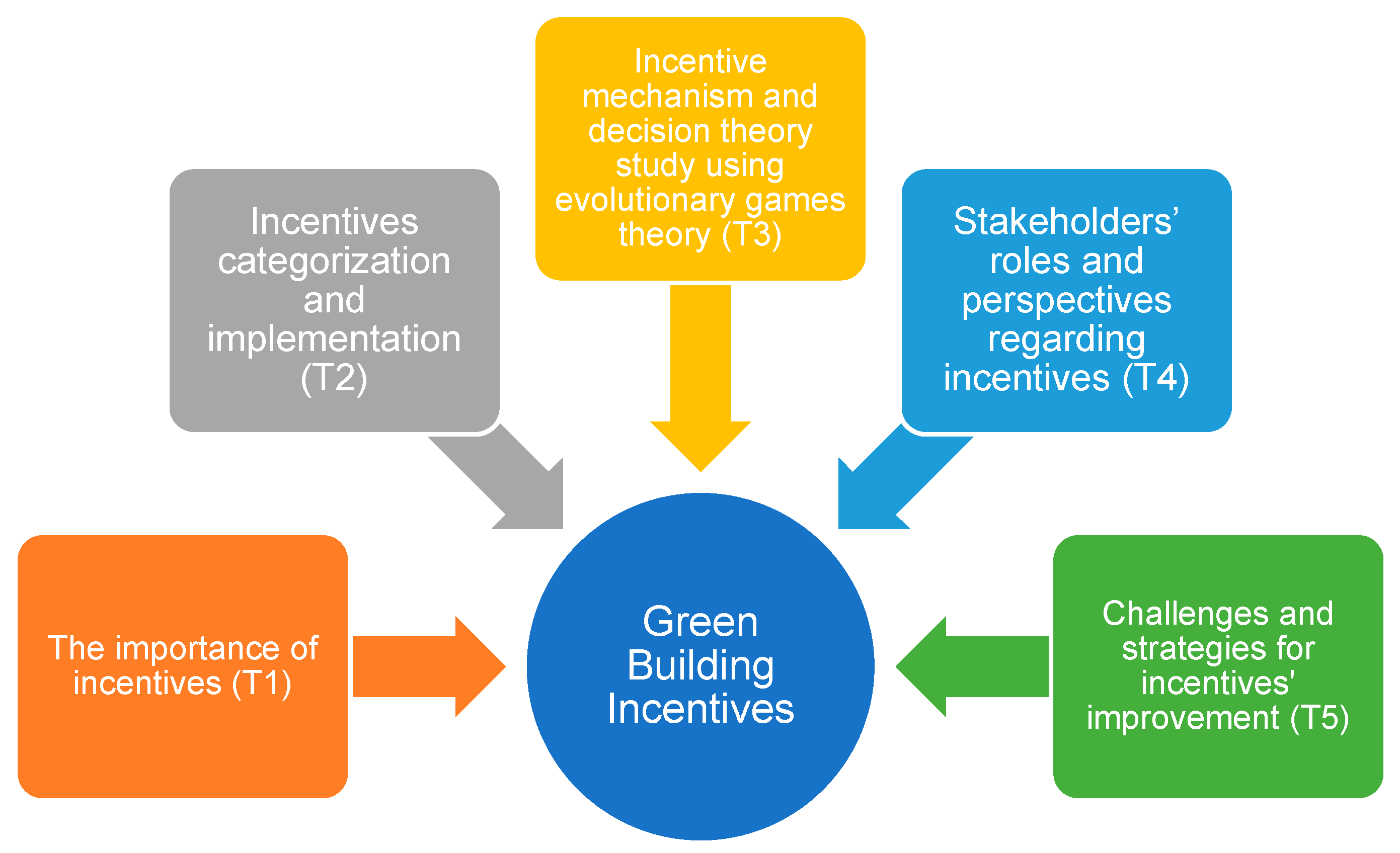
The following section explores five key research areas related to incentives in the construction industry. It discusses the importance of incentives and their categorization into financial and non-financial types, alongside their implementation in green construction, green retrofitting, and green technologies. The section also examines incentive mechanisms and decision-making processes through the lens of evolutionary game theory. Furthermore, it examines the responsibilities and viewpoints of stakeholders about the incentives, along with the obstacles encountered and the techniques suggested for enhancing the effectiveness of these incentives (see Figure 4).

4.1. The Importance of Incentives

The construction sectors encounter numerous environmental challenges, including energy inefficiency, resource depletion, and carbon emissions. This sector is known for its significant contribution to global greenhouse gas emissions and resource use. Consequently, transforming how it is conducted to be more sustainable is urgently required. Furthermore, these challenges are heightened by rapid urbanization and rising infrastructure demands that further pressure natural resources.
For the past few years, green building has been widely recognized as a solution that can address these challenges, as it provides a pathway to reduced energy consumption, improved resource efficiency, and enhanced occupant well-being. Green buildings involve practices that balance environmental, economic, and social sustainability. For example, energy-efficient technologies, renewable materials, and improved waste management contribute to environmental benefits and long-term cost savings. However, despite these renowned advantages, the wide adoption of green building practices is still being obstructed by various barriers [26]. Across the literature, there is broad agreement that the environmental and operational benefits of green buildings are well established, yet their diffusion remains limited due to persistent economic and institutional constraints.
Several significant barriers that discourage the adoption of green building practices comprise high initial costs [27], conflicting stakeholder interests, and long payback periods [28]. Therefore, strategic solutions that reduce financial pressures, raise awareness, and align stakeholder goals are required to overcome these barriers. Recently, green building incentives have been seen as one of the potential approaches that can be applied to address these barriers [22,29]. These incentives support stakeholders in embracing sustainable construction practices while helping reduce their economic burdens. In addition, they play a role in promoting long-term financial feasibility and encouraging a sustainable development attitude among various stakeholders [10]. For instance, Malaysia’s tax incentives demonstrate how policy-driven financial mechanisms can drive the adoption of green building practices [30]. While high initial costs indicate an immediate financial barrier, long payback periods are also a challenge that deters stakeholders from adopting green building practices. Hence, this subsection explores the importance of incentives and discusses how they can help address the challenges faced by green building practices.
Green buildings’ high initial costs are largely caused by the need for advanced materials [27], energy-efficient technologies [31], and certifications [32], which often exceed those of conventional buildings. There is strong consensus across these studies that upfront cost premiums remain the most significant deterrent to adoption, although the magnitude of the premium varies by regional market conditions and regulatory environments. This financial burden discourages developers and property owners, particularly those with limited capital [10].
Several incentive mechanisms can help reduce the cost burden on developers, such as tax exemptions, grants, rebates, and reduced permit fees. For example, implementing tax incentives in California, United States, lightens financial pressures through several mechanisms, such as tax credits, deductions, and exemptions, by which green construction can be more economically viable [33,34]. Similarly, Kentucky offers limited grants as a gesture to promote certification, in addition to some innovative policy measures and incentives. These include property tax reassessment moratoriums, green funds, parking incentives, electric bill discounts, and green roof mandates, such as those in Malaysia [30]. Furthermore, from the study of Hopkins et al. [35] on LEED-certified buildings, incentives and grants significantly lower the upfront green premium, where a 17% reduction can be obtained in the initial costs. In Canada, utility rebates that target energy-efficient appliances have reduced procurement costs for developers, which further encourages green building adoption [34]. Combining these measures with annual energy savings in green buildings can enhance financial feasibility over the building’s life cycle by offsetting the initial investment with long-term operational savings.
Even though green buildings could deliver operational savings over time through reduced energy and water consumption, the long payback periods in green buildings often discourage developers from adopting this practice. The prolonged durations to reach the desired Rate of Return occur because the benefits of green buildings are mainly obtained in the post-construction phase [11]. It becomes an issue for developers who have limited direct incentives to prioritize sustainability as their focus, which tends to focus on short-term investment profitability [36]. Across studies, there is agreement that payback duration remains a decisive factor in investment decisions, although disagreement persists regarding the acceptable length of payback periods across different market contexts.
Mechanisms such as low-interest loans, grants, and tax benefits help improve market confidence and provide developers with the financial support needed to balance initial costs while waiting for operational savings to accrue. For example, programs offering low-interest loans for energy-efficient technologies in California have enabled developers to shorten the payback period by spreading the financial burden over time [33]. Similarly, in Iran, introducing low-interest loans with extended repayment terms has proven effective in reducing financial barriers for developers [31]. Furthermore, performance-based incentives align with long-term energy efficiency goals by tying rewards to energy savings [28]. These measures provide immediate financial support for developers to see tangible returns earlier in the project lifecycle; hence, confidence in sustainable construction practices can also be built. The literature converges on the value of these mechanisms in mitigating financial risk yet diverges on their scalability and fiscal sustainability when applied at national levels.
Another significant barrier to green building adoption is split incentives, where developers bear the upfront costs of developing sustainable features while occupants benefit from long-term reduced utility bills and improved living conditions. This misalignment hinders developers from investing in green practices, as they cannot directly capitalize on operational savings [15]. Green building incentives address this challenge through mechanisms like property tax abatements, utility rebates, and green leases [37]. Property tax reductions tied to the green certifications reduce financial burdens on developers [33,36]. On the other hand, utility-based programs, such as subsidies for energy-efficient systems, can provide immediate financial relief and long-term savings for occupants. Most studies agree that split incentives require targeted policy responses, although disagreement exists regarding whether market-based solutions or regulatory interventions offer more durable outcomes.
Another innovative solution is using green leases that align interests by sharing costs and benefits [38]. Green leases specify how the savings from energy-efficient systems are distributed; therefore, developers can recover some of their investments through increased rent or cost-sharing mechanisms. Additionally, accelerated permit processes and density bonuses offer operational advantages that compensate developers for higher initial costs. These incentives encourage collaboration among stakeholders on sustainability efforts.
The lack of awareness of the stakeholders, including developers, property owners, tenants, and policymakers, is also a significant barrier to adopting green building practices. Many stakeholders are still unfamiliar with green buildings’ benefits, such as long-term cost savings, improved occupant health, and reduced environmental impact. Additionally, limited access to information on green building technologies and financial incentives further hinders adoption [32,37]. This lack of awareness creates uncertainty about the value of investing in green buildings.
However, green building incentives have the potential to address this barrier by combining financial support with education and collaboration initiatives. Additionally, programs that link certifications with tax credits or grants showcase the benefits of green building, which can boost public awareness as well as attract environmentally conscious buyers and tenants [34]. Furthermore, educational campaigns and government-sponsored training workshops funded by incentives can improve the technical expertise of the stakeholders so that the perception that adopting green practices is complex can be reduced [32,37]. Incentives can also fund collaborative platforms and industry forums to facilitate information sharing; stakeholders can exchange best practices and success stories among themselves [37,38]. Utility rebates for energy-efficient equipment and demonstration projects provide tangible examples of the financial and environmental benefits of green building so that confidence in green building practices can be boosted [34]. Moreover, targeted incentives, such as low-interest loans and subsidies, focused on underserved groups like small developers can reduce entry barriers and promote knowledge-sharing initiatives [37,38]. Incentives provided for demonstration programs, such as the green-certified pilot projects in Canada, offer practical illustrations of green building advantages, further improving stakeholder trust and engagement [34]. Across studies, there is strong agreement that incentives serve not only as financial instruments but also as signaling mechanisms that shape perceptions, reduce uncertainty, and legitimize sustainable construction practices.

4.2. Categorization and Implementation of Green Building Incentives

Existing research highlights variations in terminology when classifying incentives. According to Olubunmi et al. [14], green building incentives are categorized into external and internal categories. On the other hand, Hashim et al. [39] classified incentives into three types: financial, fiscal, and structural. Similarly, Simpeh [40] classified them as “economic incentives” and “reward schemes and technical support.” Although these frameworks differ in terminology and structure, there is broad agreement across studies that incentives can be grouped around three core functions: motivating voluntary adoption, reducing financial burden, and facilitating implementation through regulatory or procedural support. The observed variation largely reflects differences in national policy systems and regulatory maturity rather than conceptual inconsistency. Table 3 consolidates these classifications and illustrates their substantive overlap.

4.2.1. Financial Incentives

According to Basten et al. [47], the government should develop both financial and non-financial incentives to address the challenges associated with green building initiatives. Brotman [29] highlighted that the significant upfront costs of green construction are primarily driven by the adoption of green technologies. Consequently, financial incentives are typically designed to reduce or offset these initial costs, commonly called green premium costs, making the payback period, return on investment, or net present value more appealing to developers. Similarly, Hopkins [35] emphasized that grants and incentives are crucial in lowering the upfront green premiums and improving the financial viability of green building projects throughout their entire lifecycle.
Financial incentives can be provided through loans, grants, or subsidies, building approval fee waivers, reductions, rebates, and property tax exemptions [14]. In Canada, these incentives are classified into taxes, loans, grants, and rebates, with rebates being the most widely used and accessible across all provinces. Furthermore, Canada offers customized incentives targeting these specific end-user groups: low-income individuals, Indigenous communities, landlords, and tenants, as well as three categories of buildings: heritage, non-profit, and energy-rated structures [19]. In contrast, South Africa emphasizes rebates, discounts, and incentive payments for energy efficiency measures and using environmentally friendly materials as essential fiscal incentives [40].
The first type of fiscal incentive includes property tax reductions or exemptions. These tax incentives provide financial benefits such as credits, reductions, or exemptions awarded when buildings meet specific energy targets or implement energy improvements. Shazmin et al. [20] introduced two models of such incentives: the property tax assessment exemption model and the reduction model. Under the property tax exemption model, property owners are granted tax waivers or exemptions for green upgrades or additions, which often increase property value. For instance, Bulgaria offers a full 100% real estate tax exemption for incorporating renewable energy technologies into green building construction [20].
Meanwhile, under the property tax reduction model, property owners may face slightly higher taxes due to the increased value of their environmentally friendly buildings. However, the annual energy savings achieved through green building features, such as enhanced energy efficiency or better insulation, often compensate for these additional costs. For instance, in Cluj-Napoca, Romania, a 50% tax rate is offered, lowering it from 0.5% to 0.25% for buildings certified under one of three green certification systems: LEED, BREEAM, and DGNB [48]. Similarly, property tax reductions are available in the United States for commercial buildings that comply with specific energy efficiency standards [49].
Beyond property tax-based incentives, financial mechanisms such as investment tax credits (ITCs) are promising. Brotman [50] demonstrated that ITCs, when combined with lending programs, positively impact spending on new non-residential commercial construction. However, while these benefits effectively support affordable system upgrades, they are typically insufficient to fund comprehensive energy retrofits for entire buildings. To promote energy retrofits in existing buildings, it is essential to maintain low interest rates and a manageable debt–service coverage ratio.
Other type of fiscal incentive are grants and subsidies, which governments or institutions provide help to offset the additional costs associated with adopting green technologies, such as solar panels or water management systems. For instance, Canada’s EcoEnergy Retrofitting Incentive program provides grants to homeowners and businesses retrofitting older buildings to enhance energy efficiency. The grant amount is determined based on the costs incurred during the retrofitting process [51]. In addition to grants and subsidies, waivers for building approval and service fees represent another significant type of fiscal incentive. For instance, the city of Cerritos in California offers a maximum waiver of $1000 for building fees. The waiver is tiered based on the level of LEED certification attained: 40% for LEED Certified, 60% for LEED Silver, 80% for LEED Gold, and a full 100% waiver for LEED Platinum buildings [52].
Across the reviewed studies, there is strong agreement that financial incentives are the primary instrument for addressing high initial costs and improving short-term project feasibility. Authors consistently report that grants, rebates, tax exemptions, and preferential loans reduce green premiums and improve investment attractiveness [29,35,47]. However, disagreement emerges regarding their long-term effectiveness. While Hopkins et al. [35] and Basten et al. [47] emphasize lifecycle financial viability through incentives, Brotman [50] and Shazmin et al. [20] note that fiscal measures alone are insufficient for deep retrofits or sustained market transformation without complementary regulatory or financing mechanisms. This divergence suggests that financial incentives are widely accepted as necessary but not universally regarded as sufficient for long-term green building adoption.

4.2.2. Non-Financial Incentives

While financial incentives directly address cost-related barriers, non-financial incentives provide other alternatives by shaping institutional practices and regulatory certainty, which often makes them preferable to governments. Non-financial incentives include the gross floor area (GFA) concession scheme [45,53,54,55,56], technical assistance, expedited permitting, marketing assistance, and regulatory relief [17]. These incentives, such as expedited permitting or technical assistance, help owners save time by mitigating risks and process issues. This is particularly valuable in project delivery, where time is crucial, especially for preparing projects for marketing or occupancy. Reducing project timelines directly translates into cost savings for owners [46]. Additionally, non-financial incentives are flexible and can be tailored to local contexts [17]. Governments often prefer offering non-financial incentives as they do not involve direct financial expenditure [46].
This literature review reveals that the most frequently discussed non-financial incentive is the GFA concession scheme, while there is limited focus on other incentives such as expedited permitting, marketing assistance, or regulatory relief. Although terminological variations exist across regions, they generally serve the same purposes as the GFA concession scheme, with alternative terms such as the GFA incentive scheme, density bonus (DB), and floor area ratio (FAR) bonus [45]. The terms DB and FAR bonus are commonly used in North America, Japan, France, and other countries [57], whereas Hong Kong prefers the term GFA concession scheme, and Singapore adopts the GFA incentive scheme. The GFA concession scheme is a popular incentive as it offers indirect compensation to developers by permitting additional floor areas without requiring government expenditure to promote green buildings [45]. This incentive is particularly beneficial in high-rise, high-density cities with costly land and property markets, like Hong Kong and Singapore, where extra saleable GFA translates to greater profits for developers. In such high-rent areas, a density bonus can be a powerful motivator for developers [58]. Meanwhile, a density bonus refers to the FAR, which is calculated by dividing the total floor area of a building by the size of the land designated for its physical development [59]. In India, several states have introduced incentives such as an additional FAR of 5–15% for buildings that obtain green building certification [60].
Several countries adopting the GFA concession scheme include Hong Kong and Singapore. Singapore and Hong Kong introduced the GFA concession scheme in 2009 and 2011, respectively, with notable differences in their implementation. In Hong Kong, GFA concessions are granted only if the green features outlined in the sustainable building design guidelines meet the minimum standards of BEAM Plus certification. On the other hand, in Singapore, only projects achieving Green Mark Goldplus certification or higher are eligible for the GFA bonus, encouraging developers to strive for higher tiers of Green Mark certification [45]. Malaysia, a neighboring country of Singapore, is advised to place greater emphasis on implementing non-financial incentives, such as GFA concession schemes, expedited permits, and technical support [39].
Implementing the GFA concession imposes additional stakeholder responsibilities, resulting in increased transaction costs (TCs). These TCs encompass various expenses, including search, approval, validation, negotiation, certification, monitoring, verification, transfer, enforcement, and contracting costs associated with implementing green building practices. Yau et al. [61] highlighted that TCs often arise during negotiations and coordination between the government and the owner team (owners, architects, and engineers) and even among co-owners of multi-owned residential buildings. These costs can undermine the effectiveness of the incentive scheme and reduce stakeholders’ willingness to participate in the voluntary GFA concession scheme or green building initiatives [45]. Understanding these hidden TCs is crucial for assessing the costs and benefits of green buildings and evaluating policy effectiveness [53]. The current research findings suggest that to mitigate the impact of high transaction costs, which hinder collective action, governments should institutionalize additional subsidies to encourage co-owners of large-scale housing developments to engage in eco-certification and retrofit projects [61]. Nevertheless, Fan et al. [62] stated that the effectiveness of the GFA Concession Scheme is well justified, as the 10% GFA concession successfully attracts developers to enter the GB market despite incurring additional transaction and actual costs.
Battisti and Campo [55] emphasized that the GFA scheme can be applied to both new and existing buildings’ renovation. The allocation of GFA should correspond to the level of green building certification achieved. Developers are more likely to prefer the GB levels with lower TCs when the actual costs and benefits are comparable. It is also important to assess who bears the burden of these TCs. Typically, the costs are shared among developers, engineers, and architects; however, only developers directly benefit from the GFA concession scheme. This highlights the need for a mechanism to acknowledge and reward the contributions of engineers and architects to such projects [54]. Another key aspect of the GFA scheme is its permanence as an incentive. Local governments should carefully calibrate the scheme to attract developers to provide public amenities without allowing it to become an excessive benefit or “giveaway” for developers [56].
The literature demonstrates broad consensus that non-financial incentives play a critical supporting role by reducing procedural delays, regulatory uncertainty, and development risk [17,46]. Studies consistently identify GFA-based incentives as the most influential non-financial mechanism, particularly in dense urban markets [45,55,58]. However, disagreement arises concerning their efficiency and equity. While Fan et al. [62] and Battisti and Campo [55] argue that GFA concessions successfully attract developers despite additional transaction costs, Yau et al. [61] highlight that such costs may discourage participation, especially in multi-owner developments. These contrasting findings indicate that the effectiveness of non-financial incentives depends strongly on institutional capacity, certification requirements, and the distribution of transaction costs among stakeholders.

4.3. Incentive Mechanism Using Evolutionary Games Theory

This literature review synthesized studies that applied evolutionary game theory to investigate the incentive mechanism of green building. Green building incentives involve various stakeholders, including governments, consumers, developers, contractors, and suppliers, each operating under bounded rationality and heterogeneous preferences. These stakeholders often have differing perspectives and preferences regarding incentive strategies. To address these complexities, evolutionary game theory has been widely employed to design mechanisms that efficiently allocate incentives from providers to beneficiaries. This approach is well-suited for such analysis as it offers a versatile framework capable of modeling interactions within bounded rationality, facilitating a structured examination of complex stakeholder dynamics [63]. Through simulations, stakeholders’ behavioral trajectories and stable strategy combinations can be identified, providing valuable insights into the long-term effectiveness of incentive mechanisms rather than short-term optimality.

4.3.1. Incentive Strategies Within the Developer–Contractor Relationship

Some studies [64,65,66,67] investigated incentive strategies within the developer–contractor relationship. The studies revealed that green premium costs and risk allocation constitute the primary barriers to achieving higher levels of green building certification. Contractors are generally more sensitive to the additional costs associated with sustainable construction practices, which discourages voluntary adoption of higher certification standards and, in turn, limits developers’ ability to maximize project value.
Across these studies, incentive mechanisms that redistribute green premium risks, such as bonus incentives and cost-sharing contracts, are shown to outperform pricing-based strategies alone. Bonus incentive mechanisms enable developers to motivate contractors to pursue higher certification levels, thereby improving overall project value and allowing developers to optimize selling prices [64,65]. However, when technological uncertainty and innovation costs are high, cost-sharing arrangements prove more effective. In particular, reference pricing strategies within a green building supply chain involving developers and contractors can improve consumers’ perceived value and willingness to pay premium prices [66]. Furthermore, sharing a portion of contractors’ green premium costs leads to higher innovation levels, improved contractor profitability, and more stable cooperative outcomes within the supply chain [67].
These findings suggest that effective incentive design in developer–contractor relationships should prioritize risk-sharing mechanisms over purely outcome-based rewards, especially in projects requiring significant green technology innovation. Incentives that align cost responsibility with long-term value creation are more likely to sustain cooperative behavior under bounded rationality.
The reviewed studies consistently agree that green premium costs and risk allocation constitute the central friction in developer–contractor relationships [64,65,66,67]. There is broad consensus that incentive mechanisms based solely on pricing or penalties are less effective than schemes incorporating risk sharing or bonus rewards. However, disagreement arises regarding the dominant mechanism. While some studies emphasize bonus-based incentives as sufficient to motivate higher certification levels [64,65], others argue that cost-sharing contracts outperform bonuses under high technological uncertainty and innovation intensity [66,67]. These contrasting findings indicate that the relative effectiveness of incentive instruments depends on project complexity, innovation risk, and the maturity of green construction technologies.

4.3.2. Government-Led Incentive Mechanisms and Policy Portfolios

Several studies [68,69,70,71,72,73,74,75,76,77,78,79,80,81,82,83] examine incentive mechanisms led by government actors, highlighting the central role of public policy in shaping green building markets. A key insight emerging from this body of literature is that single-instrument subsidy policies are generally insufficient to induce stable green building adoption. Instead, policy effectiveness depends on the strategic combination of incentives, penalties, and regulatory supervision.
Existing research demonstrates that subsidies significantly influence developers’ and consumers’ decision-making, particularly in markets where green buildings command price premiums [68,69]. Providing subsidies to both developers and consumers simultaneously has been shown to maximize developer profits while enhancing overall social welfare [70]. However, subsidies to developers and homebuyers/tenants have to be designed while considering private information, such as effort levels and cost [71,72] as evolutionary simulations consistently reveal that excessive reliance on subsidies can lead to opportunistic behavior and policy inefficiency if not supported by enforcement mechanisms [69].
Consequently, the majority of the reviewed studies integrate both incentives and disincentives into their analytical frameworks [73,74,75,76,77,78,79,80,81,82,83]. Zhang and Wu [73] concluded that moderate financial subsidies, infrequent inspections, and high pollution taxes are the most effective for promoting green housing development. Meanwhile, some studies stated that dynamic rewards/subsidies and penalties approach is the best strategy to encourage green building construction [74,75,76,77,78,79]. In particular, Cao et al. [80] demonstrated that a combination of subsidy policy, the preferential policy for green housing, and the restriction policy for common housing effectively promotes the diffusion of green housing. Gao et al. [81] concluded that government supervision and penalties positively influence outcomes, while well-structured financial subsidies are highly effective in encouraging green building development. Nevertheless, information asymmetrically generated by the multi-level governance structure among the central government, local governments, and developers warrants careful attention to ensure the proper allocation of rewards and penalties [82].
Furthermore, governments should reasonably adjust the subsidy amounts and enhance penalty mechanisms by considering the lifecycle-based perspective of green building [83]. In early-stage green building markets, light incentives and limited penalties are recommended to reduce resistance and encourage initial participation [84]. During the growth phase, stronger incentives and penalties are necessary to accelerate adoption and stabilize cooperative behaviour among stakeholders. In mature markets, however, excessive subsidies may distort competition and reduce efficiency. At this stage, regulatory supervision becomes more important than financial support, with incentives gradually transitioning toward compliance monitoring and quality assurance. This lifecycle-based perspective provides a theoretical foundation for adaptive and phased incentive policies, aligning policy intensity with market conditions and stakeholder learning processes.
A clear point of agreement across government-focused studies is that single-instrument subsidy policies are inadequate for sustaining green building adoption [68,69,70,71,72,73,74,75,76,77,78,79,80,81,82,83]. Most studies support policy portfolios combining subsidies, penalties, and regulatory supervision. Nevertheless, there is notable disagreement regarding policy intensity and sequencing. Some studies advocate strong penalties and moderate subsidies as optimal [73,80], while others highlight the risk of excessive enforcement causing resistance or strategic evasion in early-stage markets [74,75,76,77,78,79,84]. These differences reflect contrasting assumptions about market maturity, enforcement capacity, and information asymmetry across governance levels. The literature shows consensus that supply chain coordination remains underexplored in green building incentive research. While Jianchang [85] demonstrates that cost-sharing arrangements between suppliers and retailers can stabilize low-carbon investment, the absence of comparable studies prevents broader generalization. This lack of empirical and modeling diversity contrasts sharply with the extensive focus on government–developer and developer–contractor interactions, indicating a clear imbalance in scholarly attention rather than disagreement in findings.

4.3.3. Incentives from Supply Chain Perspectives

While most studies focus on developers and contractors, limited attention has been given to incentive mechanisms within broader green building supply chains. Jianchang [85] represents the only study investigating the cost-sharing mechanism between suppliers and retailers in green buildings. In detail, the study built a green and low-carbon supply chain model comprising an upstream supplier and a downstream retailer. In this model, the supplier invests in low-carbon technology and green quality, while the retailer, as the dominant entity in the supply chain, has the option to share the corresponding costs with the supplier. This finding highlights an important research gap and suggests that future incentive strategies should extend beyond government, developer, and contractor centered frameworks to encompass green building practice in the supply chain coordination. The literature shows consensus that supply chain coordination remains underexplored in green building incentive research. While Jianchang [85] demonstrates that cost-sharing arrangements between suppliers and retailers can stabilize low-carbon investment, the absence of comparable studies prevents broader generalization. This lack of empirical and modeling diversity contrasts sharply with the extensive focus on government–developer and developer–contractor interactions, indicating a clear imbalance in scholarly attention rather than disagreement in findings.

4.3.4. Synthesis and Strategic Implications

Based on the synthesis of findings presented above, several recurring patterns emerge across the reviewed studies employing evolutionary game theory, particularly regarding stakeholder interactions, incentive responsiveness, and adaptive behavior over time. The reviewed literature consistently shows that the incentive mechanisms and penalties must be dynamic, stakeholder-specific, aligned with market maturity, and considering the lifecycle-based perspective. Accordingly, evolutionary game theory provides not only explanatory insights into stakeholder behavior but also underscores the value of evolutionary game theory as a decision-support framework for stakeholders to formulate incentive mechanisms and penalties.

4.4. Stakeholders Roles and Perspectives

The success of green building project incentives relies heavily on the roles and behaviors of stakeholders. Broadly, stakeholders are categorized into government entities, real estate developers or owners, buyers or end-users (also referred to as tenants or occupants), consumers, and contractors. Within the incentive mechanisms for green building projects, the government provides incentives, while the other stakeholders act as beneficiaries. Effective collaboration among these parties is essential to maximize the benefits of the incentives. A study on implementing Green Building Rating Systems in Bahrain’s real estate sector highlights developers, government entities, and end-users as key stakeholders [86].
The government plays a pivotal role in green building incentives by shaping policy frameworks and designing effective incentive mechanisms to foster sustainable construction practices. The government needs to establish a robust quality assurance system that monitors the entire lifecycle of low-carbon housing, ensuring the success and credibility of green building initiatives [87]. Strategic measures should be implemented to encourage developers to participate in the green building market and create an environment conducive to sustainable development. Once a critical mass of developers has adopted green building practices, the government can gradually phase out or scale back incentive measures, allowing the market to sustain itself [88]. Moreover, as Koski and Lee [89] highlighted, government commitment to green building projects, particularly through constructing their own facilities, can be a powerful influence on private sector engagement. Local governments, in particular, demonstrate the strongest impact on private decision-making by showcasing tangible examples of green building outcomes, fostering trust and market growth for sustainable architects, suppliers, and construction professionals.
Consumers, including homebuyers, tenants, and end users, play a pivotal role in driving the adoption of green building practices through their purchasing decisions and preferences. Financial incentives significantly influence consumer behavior by enhancing perceived control over the high upfront costs of green buildings [90]. While many buyers recognize the long-term benefits of green homes, including energy efficiency and environmental contributions, the perceived “high cost” of sustainable practices remains a barrier [91]. To address this, governments and policymakers are encouraged to diversify financial incentives, such as offering low-interest loans, reduced down payments, and flexible payment schemes, to appeal to a broader demographic of buyers, regardless of their financial backgrounds [91].
Studies in Korea reveal that consumers are increasingly willing to pay a premium for energy-efficient homes, particularly when they offer long-term savings on housing expenses and clear environmental benefits [92]. In China, however, governmental incentives have been identified as the most influential factor driving green housing purchase intention, followed by consumer attitudes toward green practices [93]. In Japan, the Tokyo Zero Emission Point program raised its rebate limit from JPY 26,000 to JPY 80,000 in October 2024 to promote the adoption of energy-efficient products more effectively [94]. Similarly, Seoul’s Building Retrofit Project supports energy-saving upgrades in residential buildings through long-term, low-interest loans of KRW 2–15 million [95]. These programs highlight the critical role of targeted economic and policy incentives in encouraging greater consumer participation and accelerating the transition toward sustainable housing practices.
Contractors play a pivotal role in implementing green construction practices yet often suffer significant economic challenges. Chi et al. [96] emphasize that green practices, such as waste management, impose substantial financial burdens, necessitating the provision of economic incentives to ensure sustained implementation. Project managers as representatives of contractors, who oversee green construction projects, face unique challenges related to “split incentives” between clients and themselves, which can affect job satisfaction. These challenges include navigating unclear project requirements, adapting to specified green technologies, and sourcing materials often available only from international suppliers [97]. To address these issues, clients should provide clear project specifications.
Designers, suppliers, engineers, and architects play a central role in green innovation, yet they are often over-reliant on governmental incentives to drive their participation in green building projects [98]. This dependency underscores the importance of establishing mechanisms that recognize and reward their contributions to these sustainable initiatives.

4.5. Challenges and Strategies for Incentive Improvements

4.5.1. Challenges

One of the major challenges in providing green building incentives is the government’s tendency as the incentive provider to prioritize non-financial incentives, such as policies that allow for increases in gross floor area. This preference often stems from the government’s reluctance to allocate additional budgetary resources, as budgetary matters are typically sensitive issues in public policy. This situation is evident, where non-financial incentives including gross-floor area, floor area ratio, and density bonus are widely practiced and applied.
Another major challenge identified is the split incentive issue. The split incentive challenge is a significant barrier to the effective implementation of incentives. This issue arises from misaligned financial interests between stakeholders, particularly landlords and tenants, as well as landlords and facilities managers. These incentive gaps, often exacerbated by information asymmetries, lead to a “double principal-agent problem” that complicates decision-making in green building projects [99]. A study analyzing the behaviors of building owners and occupiers during the initial phases of green retrofit projects highlights similar challenges. In scenarios involving owner-occupied, single-occupied, and multi-occupied buildings, both owners and occupiers demonstrate reluctance to undertake green retrofits, though for different reasons. Key factors include the split incentives between owners and occupiers, the complexity of coordinating such efforts, and uncertainties surrounding green retrofits. Addressing these issues is critical for policymakers, who must design strategies that align the interests of all parties and consider the distinct needs associated with various occupancy types.

4.5.2. Strategies

Existing studies reveal several challenges in designing and implementing green building incentives to balance effectiveness, equity, and sustainability. First, Kong and He [100] highlight the differential impacts of supply and demand-sided policies on technological innovation, with supply-sided measures such as infrastructure fee reductions and priority awards being more effective drivers of innovation. This underscores the need for governments to prioritize impactful policies that promote advancement in green technology. However, incentive structures like the net lease system in eco-labeled green buildings [101] pose equity challenges by transferring operational costs to tenants. While these structures provide financial benefits to owners and capitalize on the green premium, they result in higher overall housing costs for tenants, undermining the affordability of green housing. Conversely, the financial viability of green affordable housing (GAH) is evident in cases where energy efficiency savings offset or surpass additional construction costs [102]. This demonstrates the potential for GAH as a sustainable and economically feasible solution with global applicability. Furthermore, emerging markets illustrate how a strategic mix of fiscal and non-fiscal incentives (government incentives), green financing options, and developer education can drive profitability and market transformation for green housing [103]. Despite these opportunities, there are significant inequities in incentive distribution, as direct subsidy schemes often favor high-income groups [104]. This calls for policies like green taxation to ensure socially fair and environmentally effective incentive systems. Finally, research [105] emphasizes the importance of a well-structured combination of technical, financial, and legal incentives for maximizing policy impact. Using tools like fuzzy inference models, policymakers can fine-tune incentive contributions to optimize outcomes for green building adoption. Together, these findings highlight the complexities in designing green building incentives that drive innovation and adoption and address equity, affordability, and sustainability challenges.
Based on the study’s findings and the authors’ expertise, the implementation strategies should focus on the following key aspects:
Effective implementation strategies for green building initiatives must be tailored to each region’s unique context and potential. The findings emphasize that no single policy instrument can act as a universal solution for achieving carbon mitigation goals, as the effectiveness of such instruments depends significantly on regional and contextual factors [106]. Governments must adopt multifaceted roles as educators, mentors, and regulators to foster an environment conducive to green building adoption. Strategies such as fast-track zoning, bonus density allowances, expertise sharing, supplier collaboration, tax deferments, and mixed-use zoning are robust measures that empower city officials to lead market transformations while encouraging developers to undertake green projects [107].
The design and provision of incentives should also account for the capabilities of all involved stakeholders, including governments. Mature approaches to incentives, such as combining fiscal and non-fiscal incentives, are critical to optimizing outcomes. Furthermore, governments must set an example for private entities by ensuring streamlined procedures, regulatory certainty, and a strong commitment to providing incentives, building trust and motivating private entities to embrace green practices [8].
Collaboration among stakeholders is equally vital. Coordinated efforts among policymakers, financial institutions, technical experts, and developers can create synergies that address barriers and unlock opportunities for green building development. For example, city governments can establish policies and incentives; banks can develop innovative financing solutions to alleviate cash flow constraints on developers, and engineers, utility leaders, and real estate developers can work together to define and measure key performance indicators. This collaborative framework ensures that policies and incentives are effective and result in measurable and impactful changes [107].

5. Conclusions

This study used a systematic literature review guided by the PRISMA 2020 protocol to investigate current trends and future directions of green building incentives. The findings confirm that green building incentives are most effective when designed to balance stakeholder interests and reduce financial and behavioral barriers. Financial incentives, such as subsidies and tax credits, remain critical for alleviating developers’ cost burdens, particularly in the early stages of market development. Meanwhile, non-financial incentives, such as gross floor area concessions and regulatory privileges, provide complementary value by encouraging compliance and innovation without direct fiscal expenditure. Together, these incentive types form a diversified policy toolkit capable of supporting green building diffusion across different market contexts.
Green building incentives should be complemented by effective penalty mechanisms to enhance their overall effectiveness. Incentive and penalty structures need to be dynamic, stakeholder-specific, aligned with market maturity, and designed from a lifecycle-based perspective. This highlights that the policy challenge is not the selection of individual instruments but the strategic coordination and timing of incentives and penalties across market development stages.
Evolutionary game theory can support this process as a decision-support tool by modelling adaptive stakeholder behaviours and identifying stable incentive–penalty strategies over time. Its application provides insight into how incentive mechanisms can evolve as stakeholders learn and respond to policy signals, strengthening the link between theoretical design and long-term policy effectiveness.
From a practical perspective, these findings suggest that policymakers should prioritize adaptive incentive portfolios rather than static subsidy schemes and calibrate incentive intensity according to market maturity and stakeholder responses. For researchers, the results indicate a need to shift from descriptive assessments toward empirical evaluation of implemented incentive schemes and comparative analysis across governance contexts.
While this study provides valuable insights, it is not without limitations. Current literature remains heavily theoretical and lacks post-implementation analysis; furthermore, research is often concentrated on developed economies. Consequently, future research should shift toward ex-post evaluations of policy performance and the development of context-specific frameworks for the Global South. Furthermore, exploring the integration of digital technologies for performance-based rewards and optimizing the incentive–penalty balance will be critical for achieving a resilient and equitable global transition to a sustainable built environment. In addition, future research should also focus on conducting comparative analyses across regions or national contexts to identify adaptable and transferable strategies.

Author Contributions

Conceptualization, T.S.N.R. and D.D.W.; methodology, T.S.N.R. and D.D.W.; validation, M.S.; formal analysis, D.D.W. and T.S.N.R.; investigation, D.D.W. and T.S.N.R.; resources, D.D.W. and T.S.N.R.; data curation, M.S. and W.T.d.V.; writing—original draft preparation, D.D.W. and T.S.N.R.; writing—review and editing, T.S.N.R. and M.S., and W.T.d.V.; supervision, T.S.N.R. and W.T.d.V.; project administration, T.S.N.R.; funding acquisition, T.S.N.R., M.S., and W.T.d.V. All authors have read and agreed to the published version of the manuscript.

Funding

This research was funded by the Directorate of Research and Development, Universitas Indonesia, under Hibah PUTI Q2 2025–2026 (Grant No: PKS-391/UN2.RST/HKP.05.00/2025).

Data Availability Statement

Data sharing is applicable upon reasonable request.

Acknowledgments

During the preparation of this manuscript/study, the authors used ChatGPT-5.2 for the purposes of paraphrasing the paragraphs. The authors have reviewed and edited the output and take full responsibility for the content of this publication.

Conflicts of Interest

The authors declare no conflicts of interest.

Abbreviations

The following abbreviations are used in this manuscript:
DBDensity bonus
FARFloor area ratio
GAHGreen affordable housing
GFAGross floor area
TCsTransaction costs

Appendix A

Table A1. List of 69 Reviewed Publications.
NoAuthorsYear of PublicationJournal TitlePublication TypeFirst Author Country AffiliationThemes
1Prasetyawan et al.2023Journal of the Civil Engineering ForumArticleIndonesiaT1
2Chegut et al.2019Journal of Environmental Economics and ManagementArticleUnited StatesT1
3Darko and Chan2017Sustainable DevelopmentArticleHong KongT1
4Gan et al.2022Technology in SocietyArticleChinaT1
5Agyekum et al.2022International Journal of Construction ManagementArticleGhanaT1
6Mohamed Ghazali et al.2017MATEC Web of ConferencesConference paperMalaysiaT1
7Gohari et al.2024Clean Technologies and Environmental PolicyArticleIranT1
8Schwartz and Krarti2022EnergiesArticleUnited StatesT1
9Arabshahi et al.2017CSCE-CRC International Construction Specialty ConferenceConference paperUnited StatesT1
10Komurlu et al.2024Sustainability (Switzerland) ArticleTurkeyT1
11Wong et al.2016Journal of Cleaner ProductionArticleHong KongT1
12Dong et al.2020Sustainability (Switzerland)ArticleChinaT1
13Oluibunmi et al.2016Renewable and Sustainable Energy ReviewsArticleAustraliaT2
14Rana et al.2021Renewable and Sustainable Energy ReviewsArticleCanadaT2
15Shazmin et al.2017EnergyArticleMalaysiaT2
16Liberalesso et al.2020Land Use PolicyArticlePortugalT2
17Hopkins2017World Sustainability SeriesBook chapterUnited StatesT1, T2
18Hashim et al.2016International Journal of Engineering and TechnologyArticleMalaysiaT2
19Simpeh and Smallwood2024Open House InternationalArticleGhanaT2
20Kempa and Moslener2017Economics of Energy & Environmental PolicyArticleGermanyT2
21Curtin et al.2017Renewable and Sustainable Energy ReviewsArticleIrelandT2
22Qian et al.2016Building Research and InformationArticleNetherlandsT2
23Basten et al.2018Journal of Design and Built EnvironmentArticleIndonesiaT2
24Brotman2017Journal of Corporate Real EstateArticleUnited StatesT2
25Fan et al.2018Energy PolicyArticleChinaT2
26Fan and Wu2020Building and EnvironmentArticleSingaporeT2
27Battisti and Campo2021LandArticleItalyT2
28Homsy and Kang2023Journal of the American Planning AssociationArticleUnited StatesT2
29Yau et al.2021EnergiesArticleHong KongT2
30Fan et al.2018Sustainability (Switzerland)ArticleChinaT2
31Jiang et al.2019IOP Conference Series: Earth and Environmental ScienceConference paperChinaT3
32Jiang and Wu2019IOP Conference Series: Earth and Environmental ScienceConference paperChinaT3
34Jiang et al.2020IOP Conference Series: Materials Science and EngineeringConference paperChinaT3
35Qian et al.2023Energy and EnvironmentArticleChinaT3
36Fan and Hui2020Building and EnvironmentArticleSingaporeT3
37He and Chen2021Renewable and Sustainable Energy ReviewsArticleChinaT3
38Si et al.2025Sustainability (Switzerland)ArticleChinaT3
39Chen and Li2021International Journal of Production ResearchArticleChinaT3
40Fan and Li2025Engineering, Construction and Architectural ManagementArticleChinaT3
41Zhang and Wu2019IOP Conference Series: Earth and Environmental ScienceConference paperChinaT3
42Yang et al.2019Journal of Cleaner ProductionArticleChinaT3
43Meng et al.2021Environmental Science and Pollution ResearchArticleChinaT3
44Lu et al.2025Energy and BuildingsArticleChinaT3
45Su and Zhang2025BuildingsArticleChinaT3
46Wang and Zhu2025Scientific RecordsArticleChinaT3
47Liu et al.2022Building and EnvironmentArticleChinaT3
48Cao et al.2022International Journal of Environmental Research and Public HealthArticleChinaT3
49Gao et al.2022Sustainability (Switzerland)ArticleChinaT3
50Hu et al.2025Building and EnvironmentArticleChinaT3
51Li et al.2022Sustainability (Switzerland)ArticleChinaT3
52Ai et al.2024Journal of Cleaner ProductionArticleChinaT3
53Jianchang et al.2022Proceedings of the 34th Chinese Control and Decision Conference, CCDC 2022Conference paperChinaT3
54Abdulrahim et al.2024Studies in Systems, Decision and ControlBook chapterBahrainT4
55Yang et al.2021IOP Conference Series: Earth and Environmental ScienceConference paperChinaT4
56Al Mamun et al.2023Environmental Science and Pollution ResearchArticleMalaysiaT4
57Durdyev et al.2022Engineering, Construction and Architectural ManagementArticleNew ZealandT4
58Choi et al.2023Sustainable Cities and SocietyArticleSouth KoreaT4
59Zhang et al.2018Sustainability (Switzerland)ArticleChinaT4
60Hwang et al.2020Engineering, Construction and Architectural ManagementArticleSingaporeT4
61Fu et al.2020Journal of Cleaner ProductionArticleChinaT4
62Rameezdeen et al.2019FacilitiesFinalAustraliaT5
63Kong and He2021Journal of Cleaner ProductionArticleChinaT5
64Gabe et al.2020Journal of Property Investment and FinanceArticleUnited StatesT5
65MacAskill et al.2021Housing StudiesArticleAustraliaT5
66Rusmir Musić2021Enterprise Development and MicrofinanceArticleUnited StatesT5
67Fernández et al.2024Journal of Housing and the Built EnvironmentArticleNetherlandsT5
68Tajaddini et al.2023International Journal of Construction ManagementArticleIranT5
69Saka et al.2021Environmental and Sustainability IndicatorsArticleNigeriaT5

References

  1. Lasvaux, S.; Habert, G.; Peuportier, B.; Chevalier, J. Comparison of Generic and Product-Specific Life Cycle Assessment Databases: Application to Construction Materials Used in Building LCA Studies. Int. J. Life Cycle Assess. 2015, 20, 1473–1490. [Google Scholar] [CrossRef]
  2. UN Environment Programme, Global Status Report for Buildings and Construction. Available online: https://wedocs.unep.org/bitstream/handle/20.500.11822/45095/global_status_report_buildings_construction_2023.pdf?sequence=3&isAllowed=y (accessed on 21 December 2025).
  3. United States Environmental Protection Agency. Overview of Greenhouse Gases. Available online: https://www.epa.gov/ghgemissions/overview-greenhouse-gases (accessed on 21 December 2025).
  4. United States Environmental Protection Agency. Green Building: Basic Information. Available online: https://archive.epa.gov/greenbuilding/web/html/about.html (accessed on 21 December 2025).
  5. Green Building Council South Africa. What Is a Green Building. Available online: https://www.gbcsa.org.za/what-is-a-green-building/ (accessed on 21 December 2025).
  6. United States Environmental Protection Agency. Green Building: Background, Tools and Resources. Available online: https://www.epa.gov/smartgrowth/green-building (accessed on 21 December 2025).
  7. Pacific Northwest National Laboratory. Green Buildings. Available online: https://www.pnnl.gov/explainer-articles/green-buildings (accessed on 21 December 2025).
  8. Berawi, M.A.; Basten, V.; Latief, Y.; Crévits, I. Green Building Incentive Model during Design Recognition to Ensure the Reliability of Green Building Operation and Maintenance Achievement. IOP Conf. Ser. Earth Environ. Sci. 2020, 426, 012020. [Google Scholar] [CrossRef]
  9. Karamoozian, M.; Zhang, H. Obstacles to Green Building Accreditation during Operating Phases: Identifying Challenges and Solutions for Sustainable Development. J. Asian Archit. Build. Eng. 2025, 24, 350–366. [Google Scholar] [CrossRef]
  10. Prasetyawan, S.; Machfudiyanto, R.A.; Rachmawati, T.S.N. Incentives and Barriers to Green Building Implementation: The Case of Jakarta. J. Civ. Eng. Forum 2023, 9, 287–302. [Google Scholar] [CrossRef]
  11. Chegut, A.; Eichholtz, P.; Kok, N. The Price of Innovation: An Analysis of the Marginal Cost of Green Buildings. J. Environ. Econ. Manag. 2019, 98, 102248. [Google Scholar] [CrossRef]
  12. Wimala, M.; Akmalah, E.; Sururi, M.R. Breaking through the Barriers to Green Building Movement in Indonesia: Insights from Building Occupants. Energy Procedia 2016, 100, 469–474. [Google Scholar] [CrossRef]
  13. DuBose, J.R.; Bosch, S.J.; Pearce, A.R. Analysis of State-Wide Green Building Policies. J. Green Build. 2007, 2, 161–177. [Google Scholar] [CrossRef]
  14. Olubunmi, O.A.; Xia, P.B.; Skitmore, M. Green Building Incentives: A Review. Renew. Sustain. Energy Rev. 2016, 59, 1611–1621. [Google Scholar] [CrossRef]
  15. Ashuri, B.; Durmus-Pedini, A. An overview of the benefits and risk factors of going green in existing buildings. Int. J. Facil. Manag. 2010. Available online: https://www.semanticscholar.org/paper/An-Overview-of-the-Benefits-and-Risk-Factors-of-in-Ashuri-Durmus-pedini/273d50d209fb7fbea32139528f1b396037ed0c23 (accessed on 21 December 2025).
  16. Cotten, M.N. The wisdom of LEED’s role in green building mandates. Cornell Real Estate Rev. 2012, 10, 6. Available online: https://ecommons.cornell.edu/server/api/core/bitstreams/d272302f-7d1d-4bd9-a041-d59b0c6b4c00/content (accessed on 21 December 2025).
  17. Choi, C. Removing Market Barriers to Green Development: Principles and Action Projects to Promote Widespread Adoption of Green Development Practices. J. Sustain. Real Estate 2009, 1, 107–138. [Google Scholar] [CrossRef]
  18. Ahmed, N.; Abdel-Hamid, M.; Abd El-Razik, M.M.; El-Dash, K.M. Impact of Sustainable Design in the Construction Sector on Climate Change. Ain Shams Eng. J. 2021, 12, 1375–1383. [Google Scholar] [CrossRef]
  19. Rana, A.; Sadiq, R.; Alam, M.S.; Karunathilake, H.; Hewage, K. Evaluation of Financial Incentives for Green Buildings in Canadian Landscape. Renew. Sustain. Energy Rev. 2021, 135, 110199. [Google Scholar] [CrossRef]
  20. Shazmin, S.A.A.; Sipan, I.; Sapri, M. Property Tax Assessment Incentives for Green Building: A Review. Renew. Sustain. Energy Rev. 2016, 60, 536–548. [Google Scholar] [CrossRef]
  21. Liberalesso, T.; Oliveira Cruz, C.; Matos Silva, C.; Manso, M. Green Infrastructure and Public Policies: An International Review of Green Roofs and Green Walls Incentives. Land Use Policy 2020, 96, 104693. [Google Scholar] [CrossRef]
  22. Page, M.J.; McKenzie, J.E.; Bossuyt, P.M.; Boutron, I.; Hoffmann, T.C.; Mulrow, C.D.; Shamseer, L.; Tetzlaff, J.M.; Akl, E.A.; Brennan, S.E.; et al. The PRISMA 2020 Statement: An Updated Guideline for Reporting Systematic Reviews. BMJ 2021, 372, n71. [Google Scholar] [CrossRef]
  23. The Paris Agreement. Available online: https://unfccc.int/process-and-meetings/the-paris-agreement (accessed on 3 February 2026).
  24. NextGenerationEU. Available online: https://next-generation-eu.europa.eu/index_en (accessed on 3 February 2026).
  25. Inflation Reduction Act: Buildings Provisions. Available online: https://www.usgbc.org/resources/inflation-reduction-act-buildings-provisions (accessed on 3 February 2026).
  26. Darko, A.; Chan, A.P.C. Review of Barriers to Green Building Adoption. Sustain. Dev. 2017, 25, 167–179. [Google Scholar] [CrossRef]
  27. Gan, X.; Liu, L.; Wen, T.; Webber, R. Modelling Interrelationships between Barriers to Adopting Green Building Technologies in China’s Rural Housing via Grey-DEMATEL. Technol. Soc. 2022, 70, 102042. [Google Scholar] [CrossRef]
  28. Agyekum, K.; Opoku, A.; Oppon, A.J.; Opoku, D.-G.J. Obstacles to Green Building Project Financing: An Empirical Study in Ghana. Int. J. Constr. Manag. 2022, 22, 2922–2930. [Google Scholar] [CrossRef]
  29. Ann Brotman, B. Green Office Construction: A Discounted After-Tax Cash Flow Analysis. J. Prop. Invest. Financ. 2014, 32, 474–484. [Google Scholar] [CrossRef]
  30. Mohamed Ghazali, F.E.; Zakaria, R.; Aminudin, E.; Yong Siang, L.; Alqaifi, G.; Abas, D.N.; Abidin, N.I.; Shamsuddin, S.M. The Priority Importance of Economic Motivation Factors Against Risks for Green Building Development in Malaysia. MATEC Web Conf. 2017, 138, 02011. [Google Scholar] [CrossRef]
  31. Gohari, A.; Gohari, A.; Ahmad, A.B.; Mokhtar, K.; Oloruntobi, O.; Johari, N.H.; Darwin, N.B. Multi-Criteria Analysis of Barriers to the Use of Green Building Technologies in Residential Buildings: A Case Study of Mashhad, Iran. Clean Technol. Environ. Policy 2024, 27, 1183–1204. [Google Scholar] [CrossRef]
  32. Schwartz, E.K.; Krarti, M. Review of Adoption Status of Sustainable Energy Technologies in the US Residential Building Sector. Energies 2022, 15, 2027. [Google Scholar] [CrossRef]
  33. Arabshahi, A.; Akhavian, R.; Gaedicke, C. Barriers and Incentives for Affordable Multi-Family Green Building Construction in California. In Proceedings of the 6th CSCE/CRC International Construction Specialty Conference, Vancouver, BC, Canada, 31 May–3 June 2017; pp. 291–300. [Google Scholar]
  34. Komurlu, R.; Kalkan Ceceloglu, D.; Arditi, D. Exploring the Barriers to Managing Green Building Construction Projects and Proposed Solutions. Sustainability 2024, 16, 5374. [Google Scholar] [CrossRef]
  35. Hopkins, E.A. The Importance of Incentives and Grants for Green Buildings. In Handbook of Theory and Practice of Sustainable Development in Higher Education; Leal Filho, W., Azeiteiro, U.M., Alves, F., Molthan-Hill, P., Eds.; World Sustainability Series; Springer International Publishing: Cham, Switzerland, 2017; pp. 429–439. ISBN 978-3-319-47876-0. [Google Scholar]
  36. Gündeş, S.; Yildirim, Ş.U. The Use of Incentives in Fostering Green Buildings. METU JFA 2015, 32, 45–59. [Google Scholar] [CrossRef]
  37. Wong, J.K.W.; Chan, J.K.S.; Wadu, M.J. Facilitating Effective Green Procurement in Construction Projects: An Empirical Study of the Enablers. J. Clean. Prod. 2016, 135, 859–871. [Google Scholar] [CrossRef]
  38. Dong, J.; Zuo, J.; Luo, J. Development of a Management Framework for Applying Green Roof Policy in Urban China: A Preliminary Study. Sustainability 2020, 12, 10364. [Google Scholar] [CrossRef]
  39. Hashim, S.B.; Zakaria, I.B.; Ahzahar, N.; Yasin, M.F.; Azis, A.H. Implementation of Green Building Incentives for Construction Key Players in Malaysia. Int. J. Eng. Technol. 2016, 8, 1039–1044. [Google Scholar]
  40. Simpeh, E.K.; Smallwood, J.J. Incentive Mechanism for Promoting the Uptake of Green Building in South Africa. Open House Int. 2024, 49, 340–357. [Google Scholar] [CrossRef]
  41. Kempa, K.; Moslener, U. Climate Policy with the Chequebook—An Economic Analysis of Climate Investment Support. EEEP 2017, 6, 111–130. [Google Scholar] [CrossRef]
  42. Curtin, J.; McInerney, C.; Gallachóir, B.Ó. Financial Incentives to Mobilise Local Citizens as Investors in Low-Carbon Technologies: A Systematic Literature Review. Renew. Sustain. Energy Rev. 2017, 75, 534–547. [Google Scholar] [CrossRef]
  43. Yang, J.; Xu, C. Rethinking Incentive Policy for Building Energy Efficiency. Adv. Mater. Res. 2011, 374–377, 195–198. [Google Scholar] [CrossRef]
  44. Fletcher, L.K. Green Construction Costs and Benefits: Is National Regulation Warranted? Nat. Resour. Environ. 2009, 24, 18. [Google Scholar]
  45. Qian, Q.K.; Fan, K.; Chan, E.H.W. Regulatory Incentives for Green Buildings: Gross Floor Area Concessions. Build. Res. Inf. 2016, 44, 675–693. [Google Scholar] [CrossRef]
  46. Perkins, M.A.; McDonagh, J. New Zealand Local Government Initiatives and Incentives for Sustainable Design in Commercial Buildings. In 19th Annual European Real Estate Society Conference; ERES: Edinburgh, Scotland, 2012; Volume 2012. [Google Scholar]
  47. Basten, V.; Berawi, M.A.; Latief, Y.; Crévits, I. Building Incentive Structure in the Context of Green Building Implementation: From the Local Government Perspective. J. Des. Built Environ. 2018, 18, 37–45. [Google Scholar] [CrossRef]
  48. Yang, X. Measuring the Effect of Environmental Certification on Residential Property Values-Evidence from the Green Condominium in Portland, US. Ph.D. Dissertation and Master Thesis, Portland State University, Portland, OR, USA, 2013. [Google Scholar]
  49. Energy Star. Tax Deductions for Commercial Buildings. Available online: https://www.energystar.gov/about/federal_tax_credits/tax_credits_commercial_buildings (accessed on 15 December 2025).
  50. Brotman, B.A. The Impact of Corporate Tax Policy on Sustainable Retrofits. J. Corp. Real Estate 2017, 19, 53–63. [Google Scholar] [CrossRef]
  51. International Energy Agency. ecoENERGY Retrofit—Homes. Available online: https://www.iea.org/policies/2259-ecoenergy-retrofit-homes (accessed on 15 December 2025).
  52. City of Cerritos. Green Building Rebates and Incentives. Available online: https://www.cerritos.gov/city-government/sustainability/green-building-rebates-and-incentives/ (accessed on 15 December 2025).
  53. Fan, K.; Chan, E.H.W.; Qian, Q.K. Transaction Costs (TCs) in Green Building (GB) Incentive Schemes: Gross Floor Area (GFA) Concession Scheme in Hong Kong. Energy Policy 2018, 119, 563–573. [Google Scholar] [CrossRef]
  54. Fan, K.; Wu, Z. Incentive Mechanism Design for Promoting High-Level Green Buildings. Build. Environ. 2020, 184, 107230. [Google Scholar] [CrossRef]
  55. Battisti, F.; Campo, O. The Assessment of Density Bonus in Building Renovation Interventions. The Case of the City of Florence in Italy. Land 2021, 10, 1391. [Google Scholar] [CrossRef]
  56. Homsy, G.C.; Kang, K.E. Zoning Incentives: Exploring a Market-Based Land Use Planning Tool. J. Am. Plan. Assoc. 2023, 89, 61–71. [Google Scholar] [CrossRef]
  57. Paetz, M.M.D.; Pinto-Delas, K. From Red Lights to Green Lights: Town Planning Incentives for Green Building. In Proceedings of the Talking and Walking Sustainability International Conference, Auckland, New Zealand, 20–23 February 2007. [Google Scholar]
  58. Küçükmehmetoğlu, M.; Büyükgöz, A. Consensus Building via Cooperative Game Theory in the Process of Urban Redevelopment. In Proceedings of the 53rd Congress of the European Regional Science Association: “Regional Integration: Europe, the Mediterranean and the World Economy”, Palermo, Italy, 27–31 August 2013. [Google Scholar]
  59. Pippin, A.M. Survey of Local Government Green Building Incentive Programs for Private Development. In Land Use Clinic; University of Georgia: Athens, GA, USA, 2009. [Google Scholar]
  60. Firstgreen. Green Building Incentives In terms of Extra FAR in Various States. Available online: https://firstgreen.co/green-building-incentives-in-terms-of-extra-far-in-various-states/ (accessed on 15 December 2025).
  61. Yau, Y.; Hou, H.; Yip, K.C.; Qian, Q.K. Transaction Cost and Agency Perspectives on Eco-Certification of Existing Buildings: A Study of Hong Kong. Energies 2021, 14, 6375. [Google Scholar] [CrossRef]
  62. Fan, K.; Chan, E.H.W.; Chau, C.K. Costs and Benefits of Implementing Green Building Economic Incentives: Case Study of a Gross Floor Area Concession Scheme in Hong Kong. Sustainability 2018, 10, 2814. [Google Scholar] [CrossRef]
  63. Venkatesh, M.; Reddy, B. Realistic Agent-Based Simulation of Evolutionary Game Theory. TechRxiv 2024. [Google Scholar] [CrossRef]
  64. Jiang, W.; Huang, X.; Zhou, Y. Pricing and Incentive Strategy for Green Building Supply Chain with Incentive Mechanism. IOP Conf. Ser. Earth Environ. Sci. 2019, 304, 032111. [Google Scholar] [CrossRef]
  65. Jiang, W.; Wu, L. Green Building Incentive Approach: The Developer Perspective. IOP Conf. Ser. Earth Environ. Sci. 2019, 237, 052052. [Google Scholar] [CrossRef]
  66. Jiang, W.; Huang, X.; Liu, M. Pricing and Incentive Mechanism for Green Building Supply Chain with Reference Price. IOP Conf. Ser. Mater. Sci. Eng. 2020, 780, 062033. [Google Scholar] [CrossRef]
  67. Qian, Y.; Yu, X.; Chen, X.; Song, M. A Model and Simulation Study of Developers’ Multicontract Incentives for Contractors’ Green Technology Innovation Decisions Considering Marketing Efforts and Innovation Capability. Energy Environ. 2023, 36, 2665–2687. [Google Scholar] [CrossRef]
  68. Fan, K.; Hui, E.C.M. Evolutionary Game Theory Analysis for Understanding the Decision-Making Mechanisms of Governments and Developers on Green Building Incentives. Build. Environ. 2020, 179, 106972. [Google Scholar] [CrossRef]
  69. He, L.; Chen, L. The Incentive Effects of Different Government Subsidy Policies on Green Buildings. Renew. Sustain. Energy Rev. 2021, 135, 110123. [Google Scholar] [CrossRef]
  70. Si, Y.; Yang, Y.; Shao, Z. Green Building Design and Sustainable Development Optimization Strategy Based on Evolutionary Game Theory Model. Sustainability 2025, 17, 2649. [Google Scholar] [CrossRef]
  71. Chen, W.; Li, L. Incentive Contracts for Green Building Production with Asymmetric Information. Int. J. Prod. Res. 2021, 59, 1860–1874. [Google Scholar] [CrossRef]
  72. Fan, C.; Li, X. Exploring Effective Incentive Policies for Sustainable Development of Green Buildings in China: Based on Evolutionary Game Theory and Numerical Simulation Analysis. Eng. Constr. Archit. Manag. 2025, 32, 3326–3348. [Google Scholar] [CrossRef]
  73. Zhang, L.; Wu, S. Evolutionary Game Analysis of Government Incentive Mechanism for Green Buildings. IOP Conf. Ser. Earth Environ. Sci. 2019, 267, 052050. [Google Scholar] [CrossRef]
  74. Yang, X.; Zhang, J.; Shen, G.Q.; Yan, Y. Incentives for Green Retrofits: An Evolutionary Game Analysis on Public-Private-Partnership Reconstruction of Buildings. J. Clean. Prod. 2019, 232, 1076–1092. [Google Scholar] [CrossRef]
  75. Meng, Q.; Liu, Y.; Li, Z.; Wu, C. Dynamic Reward and Penalty Strategies of Green Building Construction Incentive: An Evolutionary Game Theory-Based Analysis. Environ. Sci. Pollut. Res. 2021, 28, 44902–44915. [Google Scholar] [CrossRef] [PubMed]
  76. Lu, X.; Yang, C.; Ma, W.; Yang, H. Evolutionary Game Analysis on Governments and Developers’ Behavioral Strategies: Impact of Dynamic Incentives for Green Building. Energy Build. 2025, 336, 115631. [Google Scholar] [CrossRef]
  77. Su, Y.; Zhang, Z. Evolutionary Game Analysis on the Promotion of Green Buildings in China Under the “Dual Carbon” Goals: A Multi-Stakeholder Perspective. Buildings 2025, 15, 1392. [Google Scholar] [CrossRef]
  78. Wang, S.; Zhu, D. Strategies for Promoting Green Buildings: Integrating Evolutionary Game and SEIR Models. Sci. Rep. 2025, 15, 558. [Google Scholar] [CrossRef]
  79. Liu, Y.; Zuo, J.; Pan, M.; Ge, Q.; Chang, R.; Feng, X.; Fu, Y.; Dong, N. The Incentive Mechanism and Decision-Making Behavior in the Green Building Supply Market: A Tripartite Evolutionary Game Analysis. Build. Environ. 2022, 214, 108903. [Google Scholar] [CrossRef]
  80. Cao, X.; Zhao, T.; Xing, Z. How Do Government Policies Promote Green Housing Diffusion in China? A Complex Network Game Context. Int. J. Environ. Res. Public Health 2022, 19, 2238. [Google Scholar] [CrossRef]
  81. Gao, Y.; Jia, R.; Yao, Y.; Xu, J. Evolutionary Game Theory and the Simulation of Green Building Development Based on Dynamic Government Subsidies. Sustainability 2022, 14, 7294. [Google Scholar] [CrossRef]
  82. Hu, Q.; Xiong, F.; Shen, G.Q.; Liu, R.; Xue, J.; Wu, H.; Zhou, X. Incentive Mechanism Design for Promoting High-Quality Green Buildings in China’s Multi-Level Governance System. Build. Environ. 2025, 269, 112358. [Google Scholar] [CrossRef]
  83. Li, X.; Wang, C.; Kassem, M.A.; Liu, Y.; Ali, K.N. Study on Green Building Promotion Incentive Strategy Based on Evolutionary Game between Government and Construction Unit. Sustainability 2022, 14, 10155. [Google Scholar] [CrossRef]
  84. Ai, X.; Meng, Q.; Chong, H.-Y.; Li, Z.; Hao, T. How Can the Policy Combination Promote the Development of Green Buildings? ---Analysis Based on Stage Perspective. J. Clean. Prod. 2024, 450, 141887. [Google Scholar] [CrossRef]
  85. Jianchang, F.; Shuangshuang, C.; Yuan, Q. The Research on Incentive Strategies in Green and Low Carbon Supply Chains. In Proceedings of the 2022 34th Chinese Control and Decision Conference (CCDC), Hefei, China, 15 August 2022; pp. 3605–3609. [Google Scholar]
  86. Abdulrahim, H.M.; Ateeq, A.; Al-Khalifa, F.A.; Alzoraiki, M.; Milhem, M.; Almeer, S. Exploring the Implementation Efforts and Contributions of Green Building Rating Systems (GBRS) Among Stakeholders in Bahrain’s Real Estate Sector: A Qualitative Study. In The AI Revolution: Driving Business Innovation and Research; Awwad, B., Ed.; Studies in Systems, Decision and Control; Springer Nature: Cham, Switzerland, 2024; Volume 524, pp. 559–563. ISBN 978-3-031-54378-4. [Google Scholar]
  87. Yang, L.; Du, P.; Liao, H.; Zhang, H. Stakeholder Behavior Analysis of Low-Carbon Housing Promotion. IOP Conf. Ser. Earth Environ. Sci. 2021, 821, 012012. [Google Scholar] [CrossRef]
  88. Xie, X.; Liu, Y.; Hou, J. Promoting the Sustainable Building Market: An Evolution Analysis and System Dynamics Simulation on Behaviors of Real Estate Developers and Government. J. Ind. Eng. Manag. 2014, 7, 491–505. [Google Scholar] [CrossRef][Green Version]
  89. Koski, C.; Lee, T. Policy by Doing: Formulation and Adoption of Policy through Government Leadership. Policy Stud. J. 2014, 42, 30–54. [Google Scholar] [CrossRef]
  90. Al Mamun, A.; Rahman, M.K.; Masud, M.M.; Mohiuddin, M. Willingness to Pay Premium Prices for Green Buildings: Evidence from an Emerging Economy. Environ. Sci. Pollut. Res. 2023, 30, 78718–78734. [Google Scholar] [CrossRef]
  91. Durdyev, S.; Mohandes, S.R.; Mahdiyar, A.; Ismail, S. What Drives Clients to Purchase Green Building?: The Cybernetic Fuzzy Analytic Hierarchy Process Approach. Eng. Constr. Archit. Manag. 2022, 29, 4015–4039. [Google Scholar] [CrossRef]
  92. Choi, J.; Kee, D.; Lee, J.; Kim, J.J. Understanding Heterogeneous Consumer Preferences for Residential Zero-Energy Buildings (ZEBs) in South Korea: A Latent Class Approach. Sustain. Cities Soc. 2023, 97, 104747. [Google Scholar] [CrossRef]
  93. Zhang, L.; Chen, L.; Wu, Z.; Zhang, S.; Song, H. Investigating Young Consumers’ Purchasing Intention of Green Housing in China. Sustainability 2018, 10, 1044. [Google Scholar] [CrossRef]
  94. World Economic Forum. How Public-Private Partnerships Are Creating More Energy-Efficient Appliances in Japan. Available online: https://www.weforum.org/stories/2024/10/how-public-private-partnerships-are-creating-more-energy-efficient-appliances-in-japan/ (accessed on 15 December 2024).
  95. Seoul Housing & Communities Corporation. Seoul Housing. Available online: https://www.seoulhousing.kr/ (accessed on 15 December 2024).
  96. Chi, B.; Lu, W.; Ye, M.; Bao, Z.; Zhang, X. Construction Waste Minimization in Green Building: A Comparative Analysis of LEED-NC 2009 Certified Projects in the US and China. J. Clean. Prod. 2020, 256, 120749. [Google Scholar] [CrossRef]
  97. Hwang, B.-G.; Zhao, X.; Lim, J. Job Satisfaction of Project Managers in Green Construction Projects: Influencing Factors and Improvement Strategies. Eng. Constr. Archit. Manag. 2019, 27, 205–226. [Google Scholar] [CrossRef]
  98. Fu, Y.; Dong, N.; Ge, Q.; Xiong, F.; Gong, C. Driving-Paths of Green Buildings Industry (GBI) from Stakeholders’ Green Behavior Based on the Network Analysis. J. Clean. Prod. 2020, 273, 122883. [Google Scholar] [CrossRef]
  99. Rameezdeen, R.; Zuo, J.; Ochoa Paniagua, J.; Wood, A.; Do, P. Ensuring Environmental Performance in Green Leases: The Role of Facilities Managers. Facilities 2019, 37, 527–549. [Google Scholar] [CrossRef]
  100. Kong, F.; He, L. Impacts of Supply-Sided and Demand-Sided Policies on Innovation in Green Building Technologies: A Case Study of China. J. Clean. Prod. 2021, 294, 126279. [Google Scholar] [CrossRef]
  101. Gabe, J.; Robinson, S.; Sanderford, A.; Simons, R.A. Lease Structures and Occupancy Costs in Eco-Labelled Buildings. J. Prop. Invest. Financ. 2019, 38, 31–46. [Google Scholar] [CrossRef]
  102. MacAskill, S.; Stewart, R.A.; Roca, E.; Liu, B.; Sahin, O. Green Building, Split-Incentives and Affordable Rental Housing Policy. Hous. Stud. 2021, 36, 23–45. [Google Scholar] [CrossRef]
  103. Rusmir Musić, R.M. Building the Business Case for Green Affordable Housing. Enterp. Dev. Microfinance 2021, 32, 179–192. [Google Scholar] [CrossRef]
  104. Fernández, A.; Haffner, M.; Elsinga, M. Subsidies or Green Taxes? Evaluating the Distributional Effects of Housing Renovation Policies among Dutch Households. J. Hous. Built Environ. 2024, 39, 1161–1188. [Google Scholar] [CrossRef]
  105. Tajaddini, A.; Pirooznezhad, L.; Ravanshadnia, M.; Coley, D. Fuzzy Inference Decision Model to Quantify the Effectiveness of Incentives on Delivering Green Buildings. Int. J. Constr. Manag. 2024, 24, 1599–1616. [Google Scholar] [CrossRef]
  106. Saka, N.; Olanipekun, A.O.; Omotayo, T. Reward and Compensation Incentives for Enhancing Green Building Construction. Environ. Sustain. Indic. 2021, 11, 100138. [Google Scholar] [CrossRef]
  107. Voland, N.; Saad, M.M.; Eicker, U. Public Policy and Incentives for Socially Responsible New Business Models in Market-Driven Real Estate to Build Green Projects. Sustainability 2022, 14, 7071. [Google Scholar] [CrossRef]
Figure 1. Flow diagram of the systematic literature review using the PRISMA 2020 protocol on green building incentives.
Architecture 06 00033 g001
Figure 2. Annual distribution of publications related to green building incentive from 2016–2025.
Architecture 06 00033 g002
Figure 3. Co-occurrence network of green building incentives based on all keywords.
Architecture 06 00033 g003
Figure 4. Green building incentives’ research area.
Architecture 06 00033 g004
Table 1. Number of published articles by country.
CountryNumber of ArticlesRemarks
China29-
United States8-
Malaysia4-
Australia, Hong Kong, Singapore9Two countries presenting three articles each
Canada, Ghana, Indonesia, Iran, and Netherlands10Five countries presenting two articles each
Bahrain, Germany, Ireland, Italy, New Zealand, Nigeria, Portugal, South Korea, and Turkey9Nine countries presenting one articles each
Total69
Table 2. Number of published articles by journal.
Journal TitleNumber of Papers
Sustainability (Switzerland)8
Journal of Cleaner Production5
Renewable and Sustainable Energy Reviews4
Building and Environment4
Engineering, Construction and Architectural Management3
Energies2
Environmental Science and Pollution Research2
Others31
Total59
Table 3. Incentives for green buildings.
TypesDescriptionRef.
A. Internal Incentives
Human well-beingGreen buildings enhance human well-being by providing a healthy environment and improving employee productivity.[14]
Market demandGreen buildings attract higher market demand and a greater willingness to pay from users than conventional buildings.[14]
Awards and certificationGreen buildings recognized through awards and green certification can increase the reputation and sales price.[14]
AltruisticOwners implement green buildings driven by pro-environmental beliefs based on inner motivation to contribute to energy efficiency, reduce carbon emissions, and educate the public about sustainable practices.[14]
B. Financial Incentives
LoansLoans are given at a lower interest rate and are longer than commercial loans.[41]
GrantsGrants are monetary incentives with simple procedures and are not required to be paid back.[42]
Tax incentivesTax incentives can be positive incentives (reduction, rebates, or exemption) to encourage sustainable practices or negative (carbon tax) for unsustainable practices.[43]
Building approval fee waiversFee waivers of building approval are given to buildings designed as green buildings.[44]
C. Structural/Non-Financial Incentives
GFA concession schemeThe GFA concession scheme provides additional floor area without requiring government expenditure.[45]
Technical assistanceThe government provides assistance from green building experts to support the planning of green building projects.[46]
Expedited permittingThe government provides expedited permitting, streamlining the process from design proposals to the commencement of project delivery.[46]
Disclaimer/Publisher’s Note: The statements, opinions and data contained in all publications are solely those of the individual author(s) and contributor(s) and not of MDPI and/or the editor(s). MDPI and/or the editor(s) disclaim responsibility for any injury to people or property resulting from any ideas, methods, instructions or products referred to in the content.