
Assessment of Criteria for Residential Buildings’ Insolation: A Comparative Review of European Standards

Abstract
1. Introduction
1.1. Sunlight Exposure and Compliance with Hygiene and Technical Standards in Housing
1.2. Historical Overview of Sunlight Exposure Criteria for Residential Buildings
1.3. Sunlight Exposure in Modern Architecture
2. Sunlight Exposure Criteria for Residential Buildings in Croatia
3. Method
- a comparative analysis of current standards in European countries (including Croatia) and
- an assessment of planning, urban and architectural design criteria framework that ensures insolation in residential spaces and thereby enhances the overall quality of housing.
4. Sunlight Exposure Criteria for Residential Buildings in Europe
5. Results
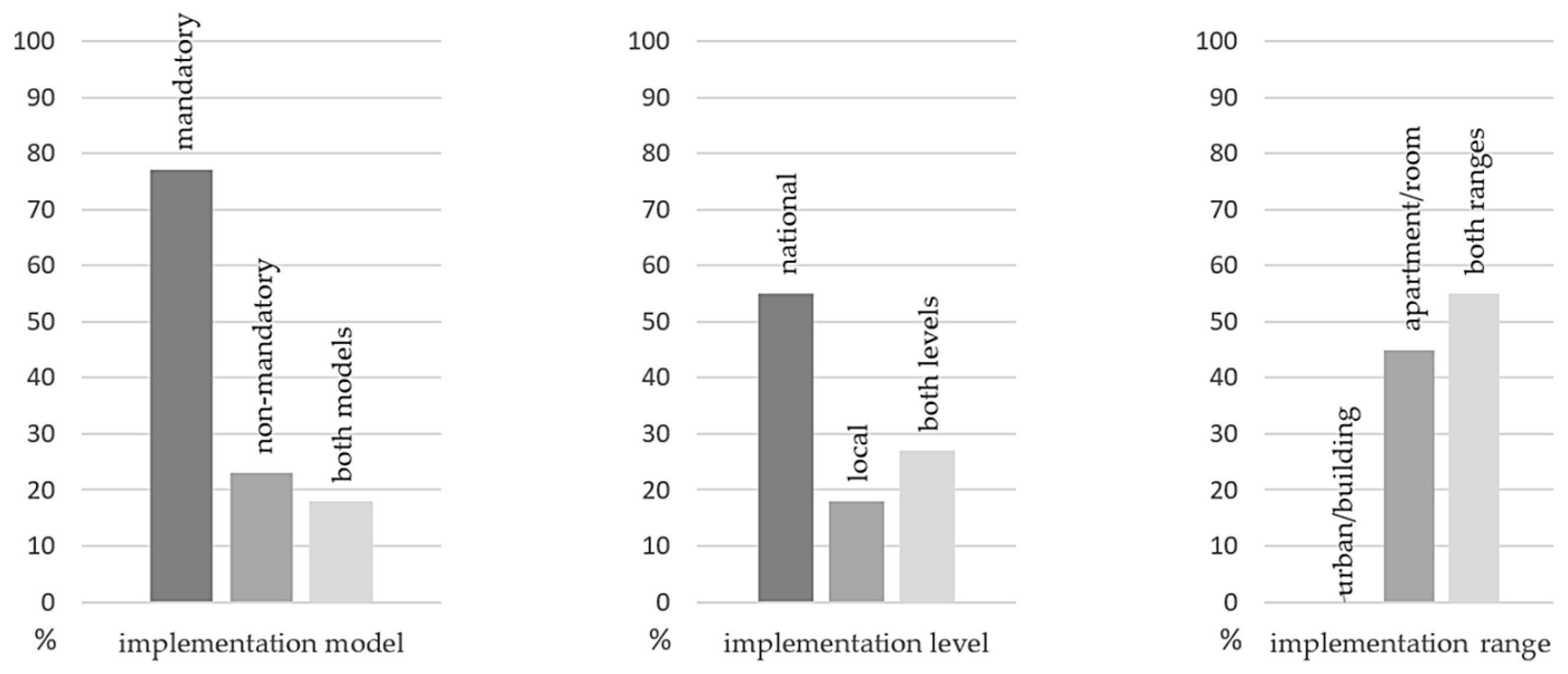
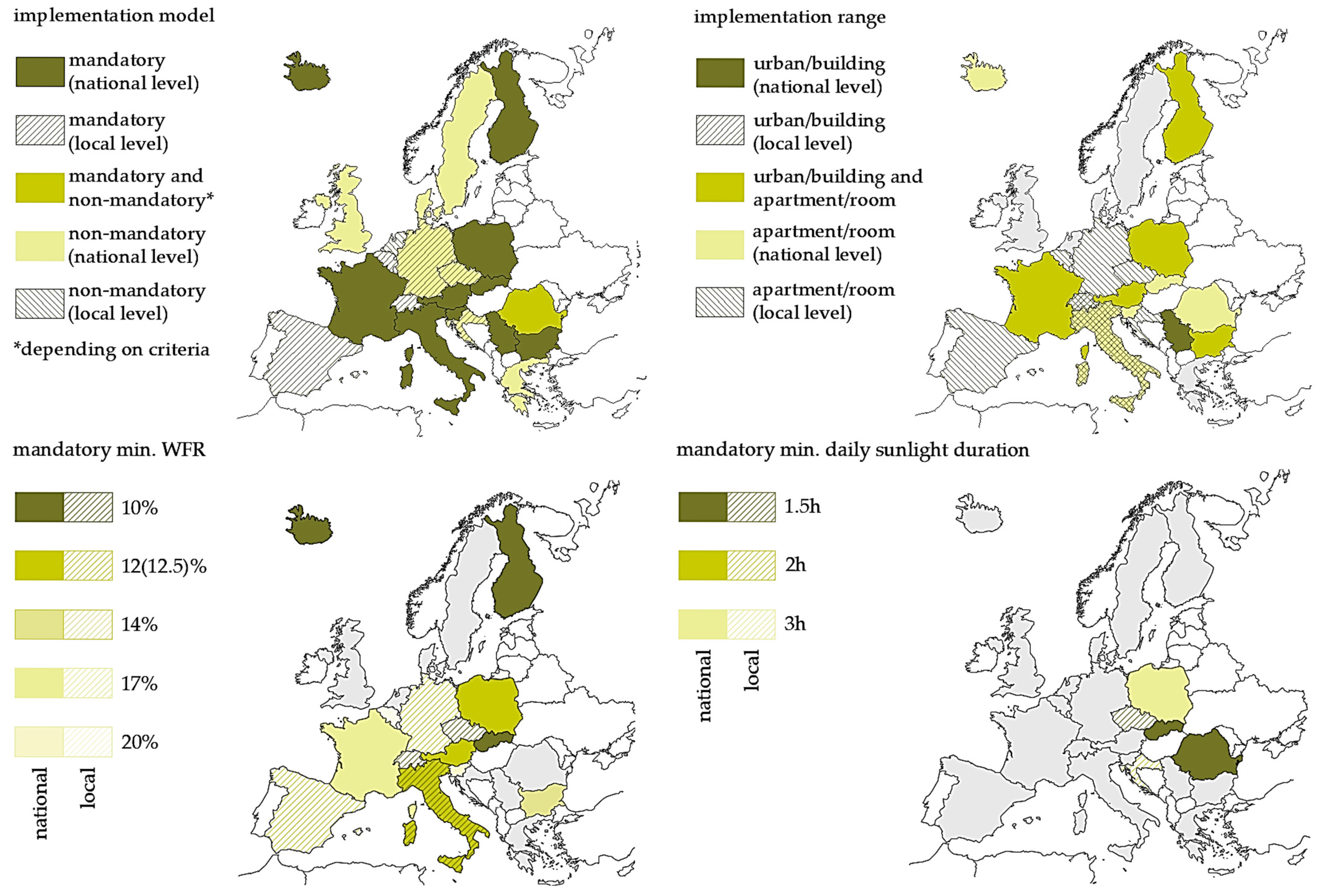
- implementation model (mandatory or non-mandatory),
- implementation level (national or local),
- implementation range (urban/building or apartment/room),
- criterion type and value.
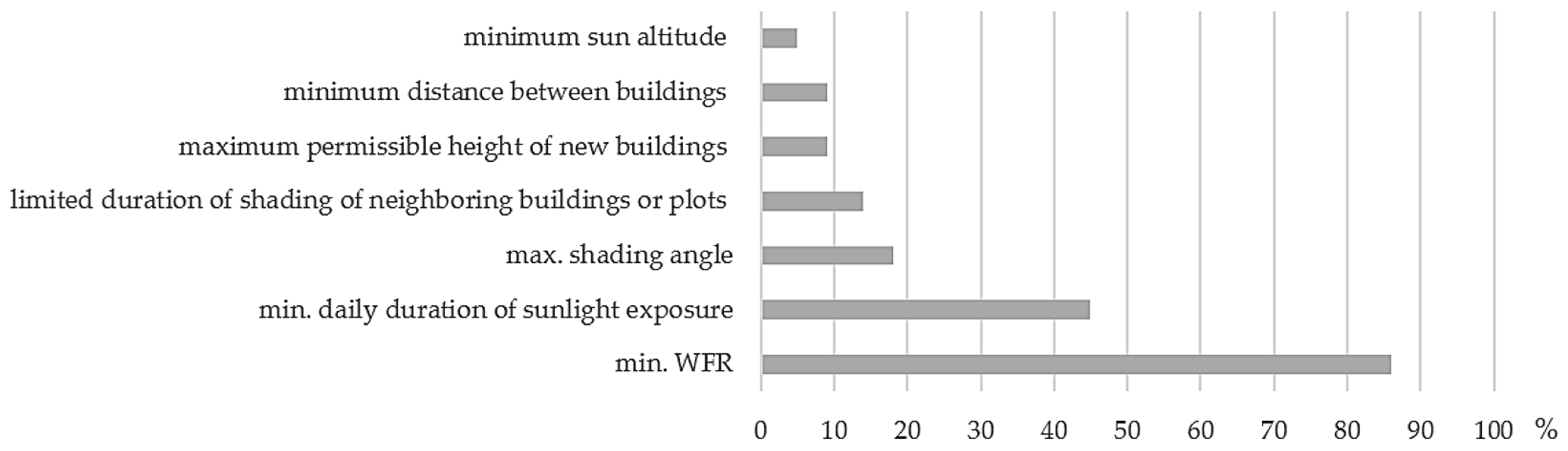
- minimum WFR (or minimum window dimensions),
- minimum daily duration of sunlight exposure,
- minimum sun altitude (considered when assessing building sunlight exposure),
- four criteria related to the shading impact factor of surrounding buildings (maximum permissible height of new buildings, minimum distance between buildings, maximum shading angle, limited duration of shading of neighbouring buildings or plots).
- urban/building (minimum sun altitude, and criteria covered by the shading impact of surrounding buildings: maximum shading angle, limited shading of neighbouring buildings or plots, minimum distance between buildings, maximum height of buildings)
- apartment/room (minimum daily sunlight exposure of habitable spaces and minimum WFR).
- the specific date or period of the year during which the value applies,
- the specific part of the day during which the value applies,
- the level of population or built density in the area where the value applies,
- the number of living spaces in an apartment to which the value applies,
- the share of floor area of habitable room(s) to which the value applies.
6. Discussion
6.1. Study Limitations
6.2. Future Research Directions
7. Conclusions
- there are no obligatory national insolation standards,
- obligatory insolation standards are prescribed just locally (Zagreb),
- the only national-level standard is non-mandatory (HRN EN 17037:2022),
- just apartment/room insolation criteria are detected,
- detected insolation criteria are min. WFR (14%) and sun protection (both mandatory, but just for buildings included in the Socially Subsidized Housing Program), and min. sunlight duration (2 h, mandatory just in Zagreb).
- the implementation of insolation standards is mostly mandatory (77%),
- implementation mostly refers to national (country) level (55%),
- the combined implementation of urban/building and apartment/room insolation criteria is most common (55%), followed by implementation of only apartment/room insolation criteria (45%),
- the most common insolation criterion types are min. WFR (86%) and min. sunlight duration (45%), both referring to apartment/room criteria,
- insolation criteria values differ from 10 to 20% for min. WFR, and from 1 to 4 h for min. sunlight duration.
Author Contributions
Funding
Institutional Review Board Statement
Informed Consent Statement
Data Availability Statement
Acknowledgments
Conflicts of Interest
Abbreviations
| BC | before Christ |
| cro. | Croatian |
| DUSI | cro. Društveno usmjerena stambena izgradnja (eng. Socially Directed Housing Construction) |
| eng. | English |
| fr. | French |
| h | hours |
| JUS | Yugoslav standard |
| max. | maximum |
| min. | minimum |
| WFR | window (glazed) area-to-floor area ratio |
References
- Hasanagić, S.; Jakobović, Z. Insolacija u Arhitekturi. In Tehnička Enciklopedija; Požar, H., Ed.; Leksikografski Zavod Miroslav Krleža: Zagreb, Croatia, 1979; Volume 6, pp. 488–494. [Google Scholar]
- Kongebro, S. Design with Knowledge—New Research in Sustainable Building; Henning Larsen Architects: Copenhagen, Denmark, 2012; p. 101. [Google Scholar]
- Darula, S.; Christoffersen, J.; Malikova, M. Sunlight and insolation of building interiors. Energy Procedia 2015, 78, 1245–1250. [Google Scholar] [CrossRef]
- HRN EN 17037:2022 en; Dnevno Svjetlo u Zgradama, Bulletin for Normative Documents 1/22. Croatian Standards Institute: Zagreb, Croatia, 2022.
- Ne’eman, E. Visual aspects of sunlight in buildings. Light. Res. Technol. 1974, 6, 159–164. [Google Scholar] [CrossRef]
- Littlefair, P. Daylight, Sunlight and Solar Gain in the Urban Environment. Sol. Energy 2001, 70, 177–185. [Google Scholar] [CrossRef]
- Hraška, J. Approaches, Methods and Tools of Rights of Access to Sunlight Around the World. Slovak J. Civ. Eng. 2019, 27, 45–52. [Google Scholar] [CrossRef]
- Lee, E.S.; Szybinska Matusiak, B.; Geisler-Moroder, D.; Selkowitz, S.E.; Heschong, L. Advocating for view and daylight in buildings: Next steps. Energy Build. 2022, 265, 112079. [Google Scholar] [CrossRef]
- Šprah, N.; Košir, M. Daylight Provision Requirements According to EN 17037 as a Restriction for Sustainable Urban Planning of Residential Developments. Sustainability 2020, 12, 315. [Google Scholar] [CrossRef]
- Schittich, C.; Staib, G.; Balkow, D.; Schuler, M.; Sobek, W. Glass Construction Manual, 2nd ed.; Institut für Internationale Architektur-Dokumentation GmbH & Co. KG: Munich, Germany, 2007; pp. 75–79, 120. [Google Scholar]
- Dervishaj, A.; Gudmundsson, K. Sunlight Autonomy for Buildings: A New Methodology for Evaluating Sunlight Performance in Urban and Architectural Design. Leukos 2024, 21, 34–64. [Google Scholar] [CrossRef]
- Brasche, S.; Bischof, W. Daily time spent indoors in German homes—Baseline data for the assessment of indoor exposure of German occupants. Int. J. Hyg. Environ. Health 2005, 208, 247–253. [Google Scholar] [CrossRef] [PubMed]
- Schweizer, C.; Edwards, R.D.; Bayer-Oglesby, L.; Gauderman, W.J.; Ilacqua, V.; Juhani Jantunen, M.; Lai, H.K.; Nieuwenhuijsen, M.; Künzli, N. Indoor time–microenvironment–activity patterns in seven regions of Europe. J. Expo. Sci. Environ. Epidemiol. 2007, 17, 170–181. [Google Scholar] [CrossRef] [PubMed]
- Friederici, A.; Wand, B. Daylight and Well-Being. In Lighting Design—Principles, Implementation, Case Studies; Kollmann, N., Schulz, C., Eds.; Institut für internationale Architektur-Dokumentation GmbH & Co. KG: Munich, Germany, 2006; pp. 8–11. [Google Scholar]
- Mardaljevic, J. The implementation of natural lighting for human health from a planning perspective. Light. Res. Technol. 2021, 53, 489–513. [Google Scholar] [CrossRef]
- Wirz-Justice, A.; Skene, D.J.; Münch, M. The relevance of daylight for humans. Biochem. Pharmacol. 2021, 191, 114304. [Google Scholar] [CrossRef] [PubMed]
- Korlaet, L. Prostorni Razvoj Stana u Zagrebu 1975–2005 u Okvirima Programa Društveno Poticane Stanogradnje. Doctoral Thesis, University of Zagreb, Faculty of Architecture, Zagreb, Croatia, 2015. [Google Scholar]
- Gilbertson, W.E.; Mood, E.W. Housing, the residential environment, and health—A re-evaluation. Am. J. Public. Health Nations Health 1964, 54, 2009–2013. [Google Scholar] [CrossRef] [PubMed]
- Krieger, J.; Higgins, D.L. Housing and Health: Time Again for Public Health Action. Am. J. Public Health 2002, 92, 758–768. [Google Scholar] [CrossRef] [PubMed]
- Vezilić Strmo, N. Model Procjene Održivosti Postojećih Stambenih Zgrada—Na Primjeru Višestambene Izgradnje u Zagrebu od 1945 do 1975. Godine. Doctoral Thesis, University of Zagreb, Faculty of Architecture, Zagreb, Croatia, 2012. [Google Scholar]
- Herczeg, M.; McKinnon, D.; Milios, L.; Bakas, I.; Klaassens, E.; Svatikova, K.; Widerberg, O. Resource Efficiency in the Building Sector: Final Report; ECORYS Nederland. BV: Rotterdam, The Netherlands, 2014; p. 8. [Google Scholar]
- Goromosov, M.S. Fiziološka Osnova Zdravstvenih Normi za Stanove; Teodorović, B., Translator; Savez arhitekata Hrvatske: Zagreb, Croatia, 1970; pp. 51–52, 54–55. [Google Scholar]
- Knežević, G.; Kordiš, I. Stambene i Javne Zgrade; Tehnička Knjiga: Zagreb, Croatia, 1972; p. 86. [Google Scholar]
- Hobday, R.A. Sunlight Therapy and Solar Architecture. Med. Hist. 1997, 42, 455–472. [Google Scholar] [CrossRef] [PubMed]
- Kolarić-Kišur, H. Stambene zgrade. In Higijena Građevnih Objekata: Priručnik za Higijensku i Sanitarno-Tehničku Ocjenu Građevnih Objekata; Medicinska Knjiga: Belgrade, Serbia; Zagreb, Croatia, 1949; pp. 61–106. [Google Scholar]
- Biondić, L. Uvod u Projektiranje Stambenih Zgrada; Golden Marketing-Tehnička Knjiga, Arhitektonski Fakultet: Zagreb, Croatia, 2011; p. 90. [Google Scholar]
- Bašić, S. Urbanistički Standardi Planiranja Novih Stambenih Naselja. Doctoral Thesis, University of Zagreb, Faculty of Architecture, Zagreb, Croatia, 2013. [Google Scholar]
- Pollio, V.M. Deset Knjiga o Arhitekturi; Lopac, M., Translator; Svjetlost: Sarajevo, Bosnia and Herzegovina, 1990; pp. 18, 124, 129–130. [Google Scholar]
- Montavon, M. Optimisation of Urban Form by the Evaluation of the Solar Potential. Doctoral Thesis, École Polytechnique Fédérale de Lausanne, Lausanne, Switzerland, 2010. [Google Scholar]
- Bursa, P.E. A Historical Perspective on the Impact of the Infectious Disease Outbreaks on Architectural and Urban Changes. J. Civ. Eng. Urban. 2022, 12, 27–35. [Google Scholar] [CrossRef]
- Overy, P. Light, Air and Openness; Thames & Hudson: London, UK, 2007; pp. 99, 118–120. [Google Scholar]
- Le Corbusier. Atinska Povelja; Udovički, D., Translator; Klub Mladih Arhitekata: Belgrade, Serbia, 1972; p. 47. [Google Scholar]
- Senjak, I. Arhitektonski i Urbanistički Čimbenici Kvalitete Višestambene Izgradnje—Na Primjeru Zagreba u Razdoblju od 1991 do 2016 Godine. Doctoral Thesis, University of Zagreb, Faculty of Architecture, Zagreb, Croatia, 2020. [Google Scholar]
- Udružena Samoupravna Interesna Zajednica Stanovanja i Komunalnih Djelatnosti Grada Zagreba. Standard Stana, Zgrade i Naselja u Društveno Usmjerenoj Stambenoj Izgradnji—Knjiga 1 i 2; Udružena Samoupravna Interesna Zajednica Stanovanja i Komunalnih Djelatnosti Grada Zagreba: Zagreb, Croatia, 1983. [Google Scholar]
- Croatian Ministry of Physical Planning; Construction and State Assets. Zakon o Gradnji; Official Gazette 153/13, 20/17, 39/19, 125/19, 145/24; Croatian Ministry of Physical Planning, Construction and State Assets: Zagreb, Croatia; Available online: https://narodne-novine.nn.hr/clanci/sluzbeni/2013_12_153_3221.html (accessed on 1 February 2026).
- Croatian Ministry of Environmental Protection; Physical Planning and Construction. Pravilnik Minimalnih Tehničkih Uvjeta za Projektiranje i Gradnju Stanova iz Programa Društveno Poticane Stanogradnje; Official Gazette: Zagreb, Croatia, 2004; Available online: https://narodne-novine.nn.hr/clanci/sluzbeni/2004_07_106_2064.html (accessed on 1 February 2026).
- The City of Zagreb. Odluka o Izmjenama i Dopunama Odluke o Donošenju Generalnoga Urbanističkog Plana Grada Zagreba; Official Gazette of the City of Zagreb: Zagreb, Croatia, 2013. [Google Scholar]
- Yugoslav Standard JUS U.C9.100; Daylight and Electric Lighting of Rooms in Buildings. Official Gazette FNRJ: Belgrade, Yugoslavia, 1962.
- Krasić, S.; Pejić, P.; Mitković, P. Važnost dnevne svjetlosti pri projektiranju i izgradnji zgrada. Građevinar 2013, 65, 833–840. [Google Scholar] [CrossRef]
- French Ministry of Ecological Transition. Réglementation Environnementale. 2020. Available online: https://www.ecologie.gouv.fr/politiques-publiques/reglementation-environnementale-re2020 (accessed on 20 October 2025).
- Urban Planning Regulations of the General Urban Development Plan of Madrid. Available online: https://transparencia.madrid.es/UnidadesDescentralizadas/UDCUrbanismo/PGOUM/CompendioNNUU/Compendio_2025_septiembre/COMPENDIO_MPG_NNUU_24_09_2025.pdf (accessed on 2 February 2026).
- Austrian Institute of Construction Engineering. Richtlinien des Österreichischen Instituts für Bautechnik OIB-RL 3: Hygiene, Gesundheit, Umweltschutz; Austrian Institute of Construction Engineering: Vienna, Austria, 2019; Available online: https://www.oib.or.at/wp-content/uploads/oib-rl-3-hygiene-gesundheit-und-umweltschutz-2019.pdf (accessed on 1 February 2026).
- Icelandic Ministry of the Environment, Energy and Climate. Reglugerð um (4.) Breytingu á Byggingarreglugerð, nr. 112/2012. 2016. Available online: https://island.is/reglugerdir/nr/0360-2016 (accessed on 20 October 2025).
- Zierke, P. Buildings and their Location—Polish Technical Conditions 2018 (Part III—Buildings and Rooms). Available online: https://www.researchgate.net/publication/337338881_Buildings_and_their_Location_-_Polish_Technical_Conditions_2018_-_Part_III_Buildings_and_Rooms (accessed on 20 October 2025).
- Bulgarian Ministry of Regional Development and Public Work. Spatial Planning Act. 2001. Available online: https://www.registryagency.bg/media/filer_public/2023/08/01/zakon_za_ustroistvo_na_teritoriiata.pdf (accessed on 20 October 2025).
- Bulgarian Ministry of Regional Development and Public Work. Order No. 7 of December 22, 2003 for Rules and Norms for the Organization of Separate Types of Territory and Organizational Zone. Available online: https://sofia.obshtini.bg/doc/23658/0 (accessed on 20 October 2025).
- Romanian Ministry of Public Works, Transport and Housing Order. Normativ Privind Proiectarea Clădirilor de Locuinţe NP 057/02. Available online: https://migs.ro/wp-content/uploads/2021/12/NP-057-2002-Normativ-privind-proiectarea-cla%CC%86dirilor-de-locuint%CC%A6e.pdf (accessed on 20 October 2025).
- Romanian Ministry of Health. Ordin nr. 119 din 4 Februarie 2014 Pentru Aprobarea Normelor de Igienă și Sănătate Publică Privind Mediul de Viață al Populației. Available online: https://legislatie.just.ro/Public/DetaliiDocument/155650 (accessed on 20 October 2025).
- Technical Chamber of Greece. Τ.O.Τ.Ε.Ε. 20701-7/2021 Artificial and Natural Lighting of Buildings; Technical Chamber of Greece: Athens, Greece, 2021; Available online: https://web.tee.gr/wp-content/uploads/TOTEE-20701-7-2021.pdf (accessed on 20 October 2025).
- ČSN 73 4301; Obytné Budovy. Czech Office for Standards, Metrology and Testing: Prague, Czech Republic, 2004. Available online: https://www.technicke-normy-csn.cz/csn-73-4301-734301-223541.html (accessed on 20 October 2025).
- BS EN 17037:2018+A1:2021; Daylight in Buildings 2022. British Standards Institution: London, UK. Available online: https://knowledge.bsigroup.com/products/daylight-in-buildings-2 (accessed on 20 October 2025).
- Polish Ministry of Infrastructure. Rozporządzenie Ministra Infrastruktury z Dnia 12 Kwietnia 2002 r. w Sprawie Warunków Technicznych, Jakim Powinny Odpowiadać Budynki i Ich Usytuowanie. Available online: https://isap.sejm.gov.pl/isap.nsf/DocDetails.xsp?id=wdu20020750690 (accessed on 20 October 2025).
- Zonneveld, L.; de Groot, E.H. Daglichttoetreding en Bezonning in de Woonomgevmg; 2005-BBE-R036; Dutch Ministry of Housing, Spatial Planning and the Environment: Delft, The Netherlands, 2005; Available online: https://publications.tno.nl/publication/34627572/M4makC/2005-BBE-R0036.pdf (accessed on 20 October 2025).
- Ministarstvo Građevinarstva; Saobraćaja i Infrastrukture Republike Srbije. Pravilnik o Opštim Pravilima za Parcelaciju, Regulaciju i Izgradnju. 2015. Available online: https://www.paragraf.rs/propisi/pravilnik_o_opstim_pravilima_za_parcelaciju_regulaciju_i_izgradnju.html (accessed on 20 October 2025).
- Greater London Authority. Housing Supplementary Planning Guidance. 2017. Available online: https://www.london.gov.uk/sites/default/files/housing_spg_revised.pdf (accessed on 20 October 2025).
- Brussels Regional Urbanism Regulation: Decree of 21 November 2006. Available online: https://urban.brussels/doc/RRU_Reglementaire.pdf?utm_ (accessed on 1 February 2026).
- Kunkel, S.; Kontonasiou, E.; Arcipowska, A.; Mariottini, F.; Atanasiu, B. Indoor Air Quality, Thermal Comfort and Daylight: Analysis of Residential Building Regulations in Eight EU Member States; Buildings Performance Institute Europe (BPIE): Brussels, Belgium, 2015; pp. 70–78. [Google Scholar]
- Austrian Institute of Construction Engineering. Harmonization of Building Regulations. Available online: https://www.oib.or.at/en/our-core-tasks/harmonization-of-building-regulations/ (accessed on 1 February 2026).
- Vienna Building Code. Available online: https://www.ris.bka.gv.at/GeltendeFassung.wxe?Abfrage=LrW&Gesetzesnummer=20000006&utm_ (accessed on 1 February 2026).
- Prague Building Regulations. Available online: https://iprpraha.cz/uploads/assets/dokumenty/psp/en/psp_en.pdf (accessed on 1 February 2026).
- Finnish Decree of the Ministry of the Environment on Residential, Accommodation and Work Premises. Available online: https://www.finlex.fi/api/media/statute/41060/mainPdf/main.pdf?timestamp=2018-02-06T00%3A00%3A00.000Z (accessed on 1 February 2026).
- Berlin Building Code. Available online: https://gesetze.berlin.de/bsbe/document/jlr-BauOBE2005rahmen (accessed on 1 February 2026).
- Milan Building Code. Available online: https://www2.comune.milano.it/documents/20126/200621210/Regolamento%2BEdilizio%2B2016.pdf/ef520144-6ac6-d3c2-c51e-99c6232fa962?t=1551192584474&utm_ (accessed on 2 February 2026).
- STN 73 4301; Dwellings Buildings. Slovak Office of Standards, Metrology and Testing: Bratislava, Slovakia, 2021.
- Swedish National Board of Housing. Building and Planning’s Building Regulations, BBR. Available online: https://www.boverket.se/globalassets/publikationer/dokument/2020/konsoliderad-bbr-2011-6-tom-2020-4.pdf (accessed on 2 February 2026).
- Canton of Zurich, Building Department, Planning and Building Act (PBG). Available online: https://www.notes.zh.ch/appl/zhlex_r.nsf/WebView/3B9E9F2232301FF3C1258D2A00290112/$File/700.1_7.9.75_131.pdf (accessed on 2 February 2026).
- DIN 5034-1:2011-07; Daylight in Interiors—Part 1: General Requirements. German Institute for Standardization: Berlin, Germany, 2011.
- Worldometer, Based on United Nations Population Estimates. Available online: https://www.worldometers.info/hr/svjetsko-stanovnistvo/europa-stanovnistvo/?utm_source (accessed on 6 February 2026).
- Hraška, J.; Čurpek, J. The practical implications of the EN 17037 minimum target daylight factor for building design and urban daylight in several European countries. Heliyon 2024, 10, e23297. [Google Scholar] [CrossRef] [PubMed]



| Year | Guideline/Regulation Name | Criteria | Value | |
|---|---|---|---|---|
| 2004 | Regulation of Min. Tech. Req. for the Design and Construction of Apartments from the Socially Subsidized Housing Program | min. glazed WFR * | glazed surface area min. 1/7 of the respective room floor area; glazed surfaces up to 0.50 m above the finished floor level are not considered | |
| sun protection | mandatory | |||
| 2013 | 2007 General Urban Plan for the City of Zagreb, Amendments | min. sunlight exposure of new apartments | min. 2 h of sunlight exposure per day during the summer solstice for each apartment | |
| 2022 | HRN EN 17037:2019 Daylight in Buildings updated in 2021 and 2022 ** | min. sunlight exposure (1 February to 21 March) | min. one habitable space of apartment | |
| minimum medium high | 1.5 h 3.0 h 4.0 h | |||
| Country | Guideline/Regulation Name | Sunlight Exposure Recommendation/Requirement |
|---|---|---|
| mandatory implementation | ||
| Austria | Richtlinien OIB-RL 3: Hygiene, Gesundheit, Umweltschutz, 2023 | min. WFR 12% |
| shading/obstruction angle 45° | ||
| Vienna Building Code 2012 | defined max. height of new buildings | |
| Belgium | Brussels Decree of 21 November 2006 | min. WFR 20% |
| Bulgaria | Law on Territorial Planning, 2001; Ordinance No. 7 of 2003 on rules and regulations | min. distance between buildings equals the building height |
| min. WFR 14% | ||
| Croatia | Socially Subsidized Housing Program | min. WFR 14% * |
| Zagreb General Urban Plan | min. 2 h of sunlight daily on summer solstice (each apartment) | |
| Czech Republic | Prague Building Regulations | min. 1/3 of the total floor area of all habitable rooms in each apartment must receive direct sunlight |
| min. WFR 10% | ||
| Finland | Decree on housing, accommodation and work premises 127/2018 | min. WFR 10% |
| shading/obstruction angle 45° | ||
| France | Réglementation environnementale RE2020 | min. WFR 17% ** |
| at distance > 1 m from the facade: in at least one main room, the occupant has a view of the exterior allowing them to see both the horizon and the sky | ||
| Germany | Berlin Building Code | min. WFR 12.5% |
| Iceland | Amendment 360/2016 Regulation on the (4th) Amend. to the Build. Reg., 112/2012 | min. WFR 10% |
| Italy | Ministerial Decree of Health, 1975 | min. WFR 12.5% |
| Build. reg. of the mun. of Milan, 2016 | shading/obstruction angle of 60° | |
| min. WFR 10% (12.5% in specific cases) | ||
| Poland | Reg. No. 690/2002 of the Ministry of Infrastructure on the technical requirements to be met by buildings and their placement | min. 3 h of sunlight between 7:00 and 17:00 on equinox, for at least one room min. 1.5 h for town apartments (not applicable for one-bedroom apartments) |
| shading/obstruction angle 60° | ||
| min. WFR 12.5% | ||
| Romania | Order of the Minister of Health no. 119/2014 | min. 1.5 h of sunlight on 21 December for living units in the building and in neighbouring dwellings, as proven by the sun study if the distance between neighbouring buildings is less than or equal to the height of the highest building |
| Serbia | Rulebook on General Rules for Parcelation, Regulation and Construction, 2015 | building must not block direct sunlight to another building for more than half of the duration of direct sunlight exposure |
| Slovakia | Reg. No. 532/2002 of the Min. of Env. of the Slovak Republic; Standard: STN 73 4301: Dwel. buildings | min. 1.5 h of sunlight (21 March to 22 September) |
| min. WFR 10% | ||
| Slovenia | Rules on Min. Tech. Req. for the Construction of Apart. Buildings and Apartments, 2011 | min. WFR 20% |
| Spain | Urban Planning Regulations of the General Urban Development Plan of Madrid | min. WFR 12% |
| Switzerland | Canton of Zurich, Building Department, Planning and Building Act (PBG) *** | no north-facing orientation (NW–NE) |
| min. WFR 10% | ||
| high buildings must not cause significant shading in residential zones | ||
| non-mandatory implementation | ||
| Croatia | HRN EN 17037 | min. 1.5 h of sunlight for one habitable space of apartment from 1 February to 21 March |
| Czech Republic | Standard ČSN 73 4301:2004 | min. 1.5 h of sunlight on 1 March and 21 June or balance of sunlight duration in the period from 10 February to 21 March is min. 1.5 h daily (new and existing buildings) |
| min. window dimension ≥ 90 cm (for roof windows ≥ 70 cm) | ||
| min. solar altitude 5° | ||
| Denmark | Bygningsreglementet 2018 (BR18) | min. WFR 10% |
| Germany | 2007 Urban planning—assessing the impact of the planned construction on daylighting of adjacent rooms; Standard: DIN 5034-1: 2011-7 | min. one room in the apartment: min. 4 h on 21 March; 1 h possible insolation on 17 January (additional winter criterion) |
| min. 2 h of daylight per day for 250 days in a year | ||
| min. distance between buildings is twice the building height | ||
| Greece | TOTEE 20701-7:2021 | min. 1 h of sunlight on 21 February |
| Netherlands | ‘TNO standard’ in some big cities | min. 2 h of daily sunlight (19 February to 21 October) min. 3 h of daily sunlight (21 January to 22 November) |
| min. WFR 10% | ||
| Romania | Normative regarding the design of housing buildings NP 057-02 | min. 2 h for at least one of the living units, on 21 February or 21 October |
| Sweden | Boverket Building Regulation BBR | min. WFR 10% |
| U.K. | London housing supp. plan. guid. 2016 **** | sunlight exposure of min. 1 habitable room for part of the day |
| BS 8206-2:2008; BS EN 17037; Site layout planning for daylight and sunlight: a guide to good practice (BR209), 2022; The “45-Degree Rule” in urban planning approval; | min. 1.5 h of sunlight exposure on the assessment date | |
| if a new building causes the daylight duration of adjacent buildings to be lower than this standard and less than 80% of that before development, it is an obstruction to daylight | ||
| min. WFR 20% | ||
| min. 25% of probable annual sunlight h, min. 5% of probable sunlight from 21 September to 21 March | ||
| Criteria | Criteria Value | Town or Country | |
|---|---|---|---|
| apartment/room criteria | |||
| minimum WFR | 10% | Prague, Finland, Iceland, Milan, Slovakia, Zurich, Denmark, Dutch bigger cities, Sweden | |
| 12% | Austria, Madrid | ||
| 12.5% | Berlin, Italy, Poland | ||
| 14% | Bulgaria, Croatia * | ||
| 17% | France | ||
| 20% | Brussels, Slovenia, U.K. | ||
| min. window dimension | ≥ 90 cm (for roof windows ≥ 70 cm) | Czech Republic | |
| minimum daily duration of sunlight exposure | 1 h | on 17 January for min. one room in the apartment | Germany |
| on 21 February | Greece | ||
| 1.5 h | 1 February to 21 March, for one habitable space of apartment | Croatia | |
| on 1 March and 21 June or balance of sunlight duration in the period from 10 February to 21 March (new and existing buildings); min. 1/3 of the total floor area of all habitable rooms in each apartment must receive direct sunlight | Czech Republic Prague | ||
| on 21 December, if the distance between neighbouring buildings is ≤ height of the highest building | Romania | ||
| 21 March to 22 September | Slovakia | ||
| town apartments (not applicable for one-bedroom apartments) | Poland | ||
| on the assessment date | U.K. | ||
| 2 h | during the summer solstice for each apartment | Zagreb | |
| 19 February to 21 October | Dutch bigger cities | ||
| daylight per day for 250 days in a year | Germany | ||
| on 21 February or 21 October, for at least one of the living units | Romania | ||
| 3 h | 21 January to 22 November | Dutch bigger cities | |
| between 7:00 and 17:00 on equinox, at least one room (not applicable for apartments in central town area) | Poland | ||
| 4 h | min. one room in the apartment on 21 March | Germany | |
| - | min. one habitable room for part of the day; min. 25% of probable annual sunlight h, min. 5% of probable sunlight from 21 September to 21 March | London U.K. | |
| no north-facing orientation (NW–NE) | Zurich | ||
| urban/building criteria | |||
| maximum shading angle | 45° | Austria, Finland | |
| 60° | Milan, Poland | ||
| limited shading of neighbouring buildings or plots | building must not block direct sunlight to another building for more than half of the duration of direct sunlight exposure | Serbia | |
| high buildings must not cause significant shading in residential zones | Zürich | ||
| if a new building causes the daylight duration of adjacent buildings to be lower than this standard and less than 80% of that before development, it is an obstruction to daylight | U.K. | ||
| minimum distance between buildings ** | equals the building height | Bulgaria | |
| usually twice the building height | Germany | ||
| maximum height of buildings ** | defined in terms of insolation | Vienna | |
| at distance > 1m from the facade: in at least one main room, the occupant has a view of the exterior allowing them to see both the horizon and the sky | France | ||
| minimum sun altitude *** | 5° | Czech Republic | |
Disclaimer/Publisher’s Note: The statements, opinions and data contained in all publications are solely those of the individual author(s) and contributor(s) and not of MDPI and/or the editor(s). MDPI and/or the editor(s) disclaim responsibility for any injury to people or property resulting from any ideas, methods, instructions or products referred to in the content. |
© 2026 by the authors. Licensee MDPI, Basel, Switzerland. This article is an open access article distributed under the terms and conditions of the Creative Commons Attribution (CC BY) license.
Share and Cite
Ostojić, S.; Veršić, Z.; Mrinjek Kliska, N. Assessment of Criteria for Residential Buildings’ Insolation: A Comparative Review of European Standards. Architecture 2026, 6, 34. https://doi.org/10.3390/architecture6010034
Ostojić S, Veršić Z, Mrinjek Kliska N. Assessment of Criteria for Residential Buildings’ Insolation: A Comparative Review of European Standards. Architecture. 2026; 6(1):34. https://doi.org/10.3390/architecture6010034
Chicago/Turabian StyleOstojić, Stanka, Zoran Veršić, and Neda Mrinjek Kliska. 2026. "Assessment of Criteria for Residential Buildings’ Insolation: A Comparative Review of European Standards" Architecture 6, no. 1: 34. https://doi.org/10.3390/architecture6010034
APA StyleOstojić, S., Veršić, Z., & Mrinjek Kliska, N. (2026). Assessment of Criteria for Residential Buildings’ Insolation: A Comparative Review of European Standards. Architecture, 6(1), 34. https://doi.org/10.3390/architecture6010034