1. Introduction
The preservation, creative adaptation, and active transmission of intangible cultural heritage represent a dynamic frontier in contemporary ethnomusicology and creative arts education [
1,
2,
3]. In Northeastern Thailand, widely recognized as the Isan region, traditional folk music (Dontree Peun Baan) has long served as a vital socio-cultural medium, binding communities together and reflecting localized worldviews, spiritual beliefs, and historical narratives. The structural core of this cultural ecosystem is deeply rooted in Heetsipsong [
4,
5]—the twelve traditional monthly merit-making cycles that govern communal activities and religious rituals throughout the year [
6,
7,
8]. Each traditional merit-making event possesses a highly distinct spiritual purpose, communal atmosphere, and native sonic landscape [
9,
10]. Within this framework, regional music does not merely function as passive entertainment; it operates as an essential ritualistic vehicle that validates communal rites, communicates with ancestral spirits (Phi Taen), and preserves the collective consciousness of the Isan populace [
11,
12].
Historically, traditional Isan folk music has relied entirely on oral tradition (Mukhapatha), a method where musical repertoires, performance techniques, and modal structures are transmitted across generations without standardized notation, formalized acoustic score systems, or large-scale institutional frameworks [
13,
14]. This reliance on unwritten transmission implies that the survival of regional idioms is bound strictly to the memory and longevity of master musicians. Furthermore, while indigenous instruments exhibit vibrant, rich acoustic timbres, their physical construction and performance practices were originally optimized for outdoor, village-scale gatherings characterized by highly heterophonic textures and unmetered, improvisational structures [
15,
16,
17,
18]. In the modern landscape of rapid urbanization, demographic shifts, and globalized educational standards, relying solely on oral methods poses vulnerabilities regarding structural continuity, pedagogical documentation, and international dissemination [
19,
20]. Without a systematic method for preserving and analyzing these musical syntaxes, the subtle nuances of local microtonality and structural variations remain vulnerable to cultural erasure [
21,
22].
To bridge the gap between regional folk heritage and formalized music education, the concept of the “Isan Orchestra” was established as an innovative, creative methodology. The Isan Orchestra is structurally defined as a large-scale, homogeneous contemporary ensemble consisting exclusively of 40 traditional Isan folk instruments [
23,
24]. Rather than adopting a hybrid or syncretic approach that blends or juxtaposes Western orchestral instruments with folk elements, this ensemble achieves a multi-voiced symphonic dimension solely by expanding, replicating, and physically scaling native instruments. The entire apparatus is organized and directed via Western symphonic concepts, standardized staff notation, and rigorous orchestration techniques [
25,
26]. The ensemble functions as a calculated synthesis, utilizing Western theoretical structures such as contrapuntal voice-leading and frequency partitioning to systemize regional modal parameters, elevate the administrative scalability of folk music performance, and broaden the expressive vocabulary of Thai cultural heritage [
27,
28,
29,
30].
Therefore, the objective of this entry is to systemize the compositional concepts, architectural instrumentation grids, and structural orchestration frameworks developed for the Isan Orchestra. By focusing on the structural transformation of traditional folk motifs into an integrated symphonic format, this article establishes a standardized reference model for cross-cultural art music. It delineates how a 40-piece folk instrument grid can be organized to achieve acoustic balance, structural clarity, and symphonic depth, ensuring the sustainable and creative transmission of Southeast Asian musical traditions in the twenty-first century.
2. Theoretical Principles and Compositional Framework
The compositional language of the Isan Orchestra is governed by an innovative synthesis that applies Western tonal architecture, thematic development, and contrapuntal voice-leading to traditional, orally transmitted Isan modal frameworks (Lai) [
31,
32]. This methodology bypasses the conventional practice of superficial juxtaposition, in which folk melodies are merely layered over standard Western triads, and instead prioritizes organic assimilation [
33,
34]. Composers extract original melodic phrases, idiomatic ornamentation, and core motifs (Musical Motifs) from historical folk tunes associated with regional ceremonies. These raw materials are subsequently deployed as the structural seeds for symphonic development, allowing short ethnic motifs to generate expansive thematic transformations, imitations, and multi-movement variations without losing their native core syntax [
35,
36,
37].
The systematic integration of traditional Isan instruments into a Western orchestral framework inevitably raises critical ethnomusicological questions regarding microtonality and cultural colonization. Traditional Isan music inherently relies on nuanced microtonal intervals that escape Western equal temperament. Rather than erasing these vital inflections, the Isan Orchestra utilizes Western symphonic architecture strictly as an “administrative framework” for large-scale synchronization. The native microtones are intentionally safeguarded through the physical acoustic preservation of the instruments themselves, such as the natural pitch generation of Khaen reeds and organic Phin pitch bends combined with the maintenance of traditional performance idioms and stylistic micro-ornamentations. Furthermore, this structural synthesis should be understood as a decolonial, self-determined act of appropriation rather than assimilation. The primary objective is not to transplant Isan music into the privileged cultural space traditionally occupied by Western classical music, nor is it to measure the value of indigenous art through Eurocentric criteria. Rather, the Isan Orchestra strategically appropriates Western symphonic traits as functional tools to construct new, highly complex, and hybrid forms of contemporary musicality. By keeping traditional Thai folk music frameworks, organic microtonalities, and regional performance syntaxes firmly at the absolute center, this synthesis empowers indigenous actors to project their living heritage onto global academic and artistic stages on their own self-determined terms.
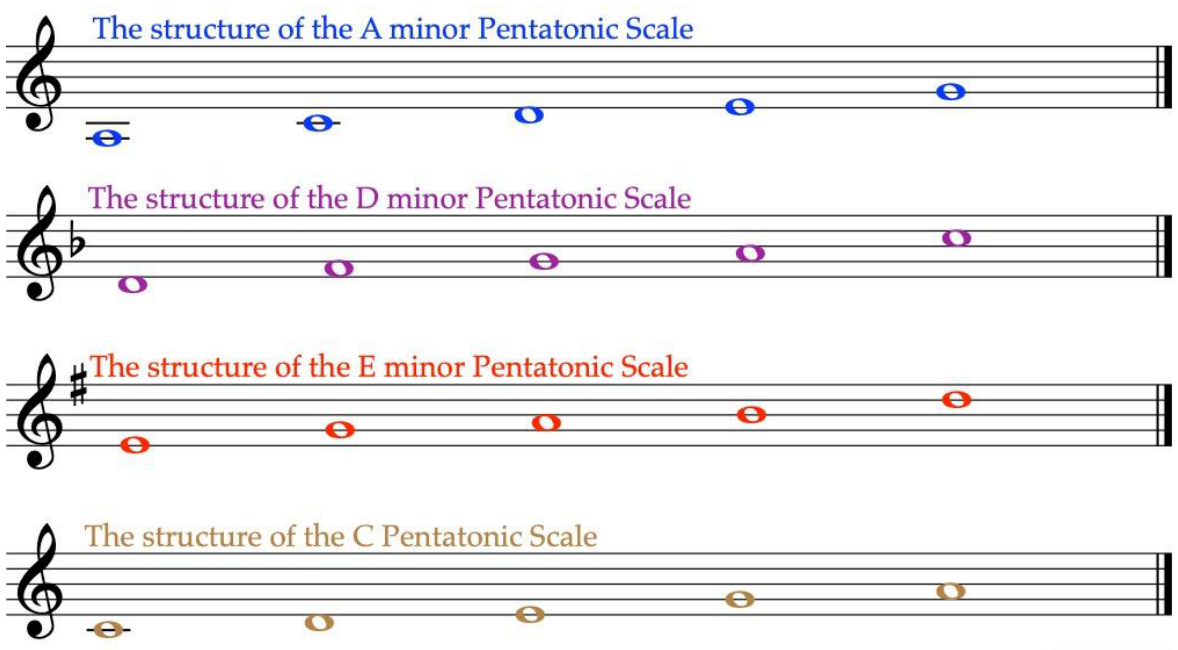
To establish structural stability within a large-scale symphonic environment, the musical language of the ensemble relies on two foundational native modal systems, which are systematically mapped onto the Western twelve-tone equal temperament system for orchestral organization:
2.1. The Lai Yai System
This mode acoustically corresponds to the Western A Aeolian (Natural Minor) or A Minor Pentatonic scale (A–C–D–E–G). Possessing a deeply solemn, reverent, and introspective emotional quality, Lai Yai pitch materials are ideal for movements capturing the spiritual gravity of monastic reflection, ancestral remembrance, and animistic supplication. Within the orchestral texture, these motifs are often assigned to sustained reeds and low bowed strings to reinforce a hallowed acoustic resonance [
38,
39,
40].
2.2. The Lai Noi System
This mode acoustically aligns with the Western D Dorian or D Minor Pentatonic scale (D–F–G–A–C). Characterized by an energetic, bright, and highly expressive atmosphere, Lai Noi motifs are drawn from lively communal celebrations and seasonal agriculture. These materials are heavily integrated into high-tempo movements to evoke festive vitality, driven by virtuosic syncopations in the plucked lutes and high aerophones [
38,
39,
40].
To maintain absolute cultural authenticity and tonal integrity, the compositions deliberately avoid standard Western functional cadences such as dominant-to-tonic progressions that would structurally distort the regional modal identity and introduce unwanted Eurocentric harmonic biases. Instead, the orchestral framework adapts and scales up the traditional “Drone” and “Ostinato” textures native to Khaen mouth organ performance [
41,
42,
43]. While a dedicated section of multi-voiced Khaens and bowed Saws sustains static, open-fifth drone structures (e.g., A–E or D–A) to establish a thick, highly resonant harmonic canvas, the Phin and Whode sections engage in complex polyphonic counterpoint, heterophonic imitation, and sudden unison structural statements. This systemic redistribution allows the 40-piece ensemble to achieve dramatic symphonic weight, horizontal complexity, and grand dynamic swells while remaining entirely faithful to the traditional modal syntax of Northeastern Thailand. The exact pitch parameters and horizontal intervallic relations across these primary regional modes are systematically documented in staff notation (see
Figure 1).
3. The 40-Piece Instrumentation Grid and Register Chart
The structural foundation of the Isan Orchestra relies on a meticulous orchestration scheme that maps 40 traditional Isan instruments into functional sections mirroring the multi-voiced hierarchy of a Western classical orchestra. Rather than assigning identical unison passages across all players, the collective ensemble partition divides these 40 instruments using 13 distinct traditional types. These are systematized into four operational domains based on acoustic taxonomy, frequency ranges, and mechanical voice-leading capacities:
3.1. The Plucked String Section (Acoustic Lutes)
This harmonic core is driven by a layered configuration of standard Phins and Phin Basses. To replicate the spatial depth and contrapuntal independent motion of Western violin sections, the standard Phin sub-group is segmented into specialized soprano and alto ranges. This registration shift is engineered through carefully calculated body dimensions and calibrated string gauges. Complementing this high-register motion, the Phin Bass establishes a percussive, low-register rhythmic matrix, anchoring the lower pitch boundaries of the plucked string choir.
3.2. The Bowed String Section (Acoustic Fiddles)
Comprising an integrated multi-voiced apparatus from the regional Saw family, this section is subdivided into four distinct textural roles: Saw 1, Saw 2, Saw 3, and Saw 4. This division facilitates intricate four-part linear distributions. Acoustically, the section delivers a rich, hollowing spatial echo and highly sustained legato lines. This sustained capability functions similarly to Western orchestral cellos and double basses, providing an essential timbral glue that fills the frequency gap between percussive attacks and wind articulations.
3.3. The Aerophone Section (Free-Reed and Woodwinds)
This multi-tonal wind division is commanded by the Whode (circular panpipe) and Khaen (free-reed mouth organ) networks, supported by modern chromatic adaptations: the Tenor Universal Khaen and Bass Universal Khaen. Standard Khaens operate as dominant horizontal polyphonic drivers. Concurrently, the Tenor and Bass Universal Khaens circumvent the natural diatonic boundaries of standard folk configurations by infusing complete chromatic flexibility and deep, fundamental low frequencies, functioning effectively as a dense harmonic pad. At the absolute zenith of the acoustic spectrum, the Whode choir navigates virtuosic ornaments and piercing upper-register flourishes, comparable to Western symphonic piccolos and flutes.
3.4. The Percussion Section (Idiophones and Membranophones)
Centered on multiple Wood Pong Lang and Steel Pong Lang log xylophones, this section provides rapid, interlocking percussive lines and foundational melodic ostinatos. The underlying rhythmic engine is reinforced by an expansive native suite, including the Long Drum (including heavy ceremonial Phen Drums), multi-sized Bass Drums (calibrated across small, middle, and large sizes to isolate specific downbeats), targeted ritualistic Bells (Small, Middle, and Big), and the Ching (finger cymbals acting as the absolute temporal metronome).
To structurally coordinate their multi-voiced integration, the physical tessituras and core acoustic limitations of all 13 traditional instrument types are systematized within a standard framework (see
Figure 2).
4. Architectural Seating Layout and Stage Configurations
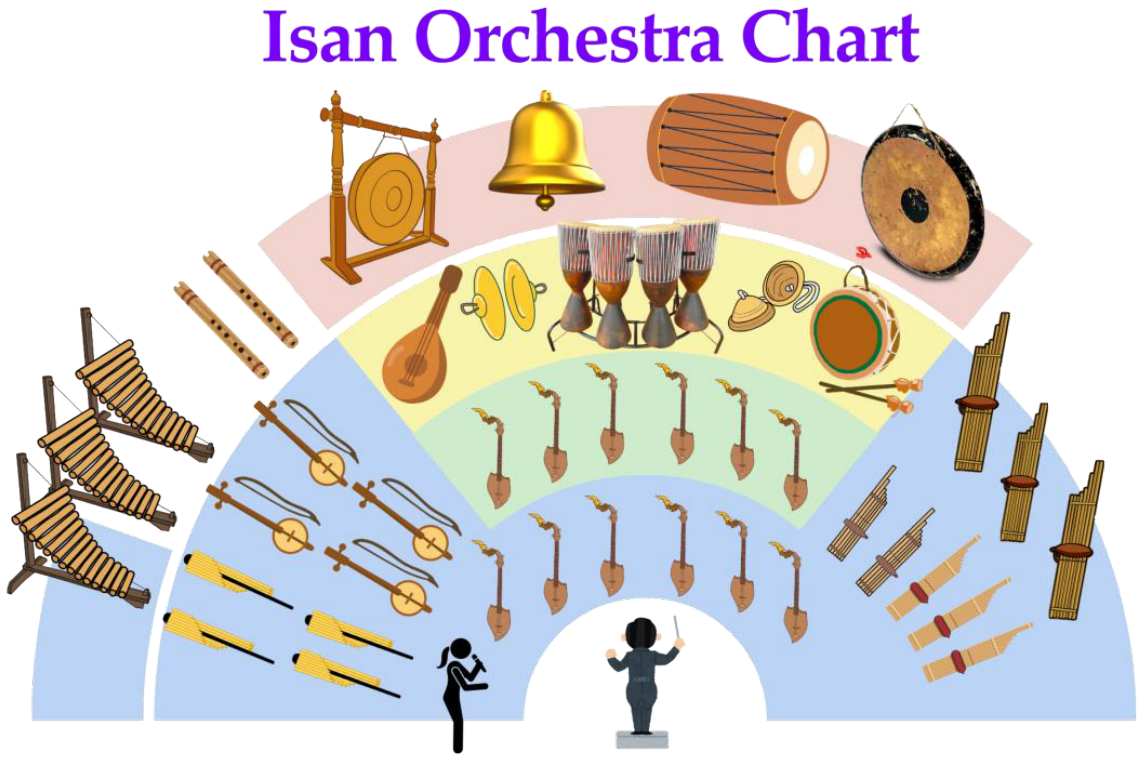
The spatial organization of a large-scale homogeneous folk ensemble requires careful acoustic engineering to compensate for the absence of high-decibel Western brass and heavy symphonic string sections. Traditional Isan instruments, primarily constructed from natural organic materials such as bamboo, hardwood, and regional animal skins, possess distinct localized projection angles and delicate dynamic thresholds. Without a strategic physical deployment, the ensemble is highly susceptible to frequency masking, a phenomenon where louder, percussive transients overpower the sustained, lower-decibel acoustic details of plucked and bowed strings. To prevent this sonic degradation and maximize natural structural resonance, the 40 instruments are systematically arranged in a compact, acoustically optimized semicircle radiating outward from the conductor’s podium.
The resulting physical architecture establishes a multi-layered acoustic grid designed to balance transients and optimize frequency dissemination across the sound stage:
4.1. The Downstage Foreground (Front Row)
Positioned directly adjacent to the conductor’s podium to achieve immediate transient articulation, transient response, and spatial clarity. This primary zone isolates the high-register aerophones (Whode) and the lead multi-voiced plucked string lutes (Phin). Their proximity to the audience ensures that intricate syncopated picking patterns and rapid melodic ornamentation are projected clearly without being masked by heavy rhythmic structures.
4.2. The Midstage Core (Middle Rows)
Flanking the center and filling the intermediate spatial field are the multi-phonic Khaen players and the bowed Saw family. The Khaens generate an omnidirectional chordal cushion that acts as a dense harmonic backdrop, while the Saws project sustained, lyrical countermelodies. This collective mid-tier positioning creates a crucial timbral bridge that seamlessly glues the high-frequency treble lines to the foundational bass structures.
4.3. The Upstage Perimeter (Rear Rows)
Anchoring the absolute rear boundary of the ensemble are the heavy, high-decibel idiophones and large-scale membranophones, specifically the Wood and Steel Pong Lang structures, alongside the Long Drums and multi-sized Bass Drums. By segregating these massive percussive elements to the back perimeter, their heavy acoustic impact is softened by physical distance. This allows them to project a powerful rhythmic frame and deep low frequencies without bleeding into or overpowering the delicate acoustic nuances of the front string and wind sections.
The engineering of this dynamic equilibrium relies on a calculated directional template that dictates the physical alignment of players on the sound stage (see
Figure 3).
5. Structural Orchestration and Song Architecture
The overarching structural design of the compositions for the Isan Orchestra shifts away from standard folk medleys into a grand multi-movement programmatic suite. Rather than relying on abstract impressionism, the suite structures its musical forms, tempo variations, and instrumental focus around the mature, established emotional contexts and functional requirements of the traditional cycles.
The arrangement and structural orchestration within this 40-piece framework follow a rigorous three-tier systemized approach to voice-leading and texture building:
5.1. Motific Extraction and Thematic Development
The composition initiates with the absolute preservation of the core melodic identity. The composer isolates the primary thematic motif from an original folk melody. For instance, in movements that represent festive vigor, a high-register Whode or lead Phin introduces the motif in an unaccompanied, rubato fashion, mimicking the historical oral delivery. This motif is then subjected to Western classical development techniques, including melodic inversion, rhythmic augmentation, and phrase fragmentation across the distinct instrumental choirs.
5.2. Contrapuntal Layering, Unison, and Dialogue
To create orchestral weight and contrast without Western brass or strings, the orchestration heavily utilizes alternating textures of Unison and Polyphony:
Unison Passages: To achieve maximum thematic strength and structural punctuation, particularly during climactic sections or transitional bridges, the orchestration merges the entire Whode, Phin, and Pong Lang sections to execute the primary melody in absolute unison. This creates a powerful, piercing acoustic mass that cuts through the percussive field.
Contrapuntal Dialogue: Movements are frequently structured as a complex dialogic counterpoint between disparate instrument families. The aerophone section (Khaen and Whode) often engages in call-and-response dynamics with the string section (Phin and Saw), where a complex contrapuntal line introduced by the plucked strings is immediately answered, inverted, or imitated by the free-reed choir.
5.3. Instrumental Improvisation and Functional Accompaniment
A unique compositional parameter of the Isan Orchestra is the integration of controlled Improvisation (Khita Patiphan) within a rigid Western score framework. In specific developmental sections, a solo instrument such as a master Whode player is granted structural freedom to improvise virtuosic runs, rapid glissandos, and regional ornamentation styles.
To support this solo line without causing sonic chaos, the remaining instruments in the 40-piece grid transition into a highly systematized accompaniment texture. The bowed strings (Saws) establish a dense, sustained harmonic pad using open-fifth drone chords sustaining a massive tremolo (e.g., a sustained C Major or A Minor pad), while the regional percussion suite (Ching, Bells, and Bass Drums) provides a steady, dynamically attenuated rhythmic template, ensuring the soloist maintains absolute clarity and expressive prominence. The real-time execution of these multi-voiced orchestration layers and complex call-and-response dynamics can be meticulously examined in the complete academic master scores (
Supplementary File S1) and is aurally demonstrated in the high-fidelity live audio capture (
Supplementary File S2).
6. Practical Applications, Social Impacts, and Pedagogical Recommendations
The successful establishment and systemic modeling of the 40-piece Isan Orchestra yield significant practical benefits and actionable recommendations across three major institutional dimensions:
6.1. Reframing Regional Cultural Presentation and Transmission
By using regional heritage as its programmatic core, the music serves as a living bridge between historical traditions and contemporary society. While this study focuses primarily on structural orchestration rather than a sociological field survey, the aesthetic implications of the ensemble remain highly relevant. When performed during regional festivals, the orchestra provides a modernized yet deeply authentic presentation of folk culture that resonates across generational lines. It offers contemporary youth demographics a renewed sense of cultural pride and ownership, reinforcing the visibility of regional artistic assets and safeguarding regional identity against the homogenizing effects of globalization.
6.2. Pedagogical Infrastructure and Educational Recommendations
From an educational standpoint, it is highly recommended that music researchers, academic faculties, and curriculum designers actively incorporate Western music notation, formal score arrangement, and theoretical frameworks into the study of traditional folk music. This recommendation arises from pragmatic and pedagogical necessity in modern institutional settings rather than from an ideological shift. While traditional oral transmission (Mukhapatha) remains an irreplaceable lineage for master-disciple training on individual instruments, it presents distinct structural limitations when organizing large-scale ensembles (40+ players) within modern university degree programs. Standardized staff notation serves as an efficient graphic blueprint, democratizing student access and enabling participants from diverse musical backgrounds to quickly comprehend complex contrapuntal layering and orchestral balances. Beyond literacy, this large-scale ensemble framework offers profound collective pedagogical affordances for music students. Through active participation, students develop advanced socio-auditory skills by learning to listen to one another critically within a multi-voiced grid, collaboratively deciding on microtonal ornaments, and engaging in collective, real-time pitch adjustments to resolve the acoustic variations inherent in organic traditional instruments. This process bridges strict notation reading and spontaneous traditional improvisation, cultivating a sophisticated musicianship that balances structural discipline with native flexibility. Utilizing this 40-piece framework in practical ensemble training allows students to develop advanced technical proficiency, notation literacy, and a sophisticated understanding of non-Western modal counterpoint. This methodology effectively transforms orally transmitted regional knowledge into a highly structured, internationally accessible pedagogical resource without compromising the core traditional idioms.
6.3. Institutional Support and Creative Enterprise
To ensure the long-term sustainability and preservation of this cultural capital, educational administrators, university executives, and government policymakers must prioritize and support ongoing research and diverse dissemination channels. Funding should be directed toward establishing specialized institutional ensembles modeled after the 40-piece grid and developing accessible digital repositories. This extensive, multidimensional realization process—capturing the exact synchronization of physical stage arrangements, multi-phonic texture shifts, and the conductor’s physical navigation of the hybrid notation—is fully preserved for public and academic dissemination via the high-definition video documentation (
Supplementary File S3). Additionally, supporting regional instrument makers (Phin, Khaen, Whode) stimulates the local creative economy and elevates folk instrument craftsmanship to meet international symphonic performance standards.
Currently, the Isan Orchestra functions as an active research and performance hub at the College of Music, Mahasarakham University. Future development pathways focus on expanding the instrumentation parameters to archive rare or endangered regional instruments, ensuring that this vibrant heritage continues to evolve dynamically while maintaining its core socio-cultural foundations.
7. Conclusions
This entry has systematized the compositional concepts, theoretical principles, and instrumentation frameworks developed for the Isan Orchestra in Thailand. By organizing a large-scale, homogeneous ensemble consisting exclusively of 40 traditional Northeastern Thai folk instruments and directing them via Western orchestral architecture and contrapuntal methodologies, the framework successfully establishes a reliable reference model for contemporary cross-cultural art music.
The structural orchestration and song architecture demonstrate that traditional melodic motifs and raw cultural materials can be objectively transformed into complex symphonic structures without sacrificing their authentic spiritual or sonic identity. By providing a robust methodology for large-scale synchronization, this entry illustrates how Western musical frameworks can be strategically appropriated as a universal communication medium to document and elevate regional performance traditions. Ultimately, the Isan Orchestra model provides a sustainable, efficient methodology for documenting, expanding, and transmitting Southeast Asian folk traditions, ensuring their survival and academic relevance for future generations.
Supplementary Materials
The following supporting information can be downloaded at:
https://www.mdpi.com/article/10.3390/encyclopedia6070154/s1. File S1: Isan orchestra native master scores (PDF) (comprehensive multi-voiced conductor’s full scores and master arrangements mapped onto Western staff notation, detailing the structural orchestration framework and modal contrapuntal grids). File S2: Isan orchestra audio demonstration (MP3) (high-fidelity live audio capture showcasing the dynamic blending, multi-tonal realization, controlled improvisation sections, and acoustic equilibrium of the 40-piece folk ensemble performing the programmatic suite). File S3: Live concert realization and conducting video (MP4) (full-length high-definition video documentation capturing the live stage realization of the Isan Orchestra, detailing the physical instrument seating configurations, real-time dynamic balancing, multi-phonic texture shifts, and the conductor’s physical execution of the hybrid score).
Author Contributions
Conceptualization, S.C. and A.P.; methodology, A.P., A.K. and W.S. (Weerayut Seekhunlio); validation, S.C., W.S. (Warakorn Seeyo) and N.W.; formal analysis, S.C., A.P., A.K. and W.S. (Warakorn Seeyo); investigation, S.C., A.P., A.K., W.S. (Warakorn Seeyo), W.S. (Weerayut Seekhunlio) and N.W.; resources, S.C. and N.W.; data curation, A.K., W.S. (Warakorn Seeyo) and W.S. (Weerayut Seekhunlio); writing—original draft preparation, S.C. and A.P.; writing—review and editing, S.C., A.P. and N.W.; visualization, A.P., A.K. and W.S. (Warakorn Seeyo); supervision, S.C.; project administration, S.C. and A.P.; funding acquisition, S.C. All authors have read and agreed to the published version of the manuscript.
Funding
The research project was funded by the National Research Council of Thailand (NRCT) under Grant Number N33A660209. This research publication was financially supported by Mahasarakham University.
Institutional Review Board Statement
The study was conducted in accordance with the Declaration of Helsinki and approved by the Ethics Committee for Research Involving Human Subjects, Mahasarakham University, Thailand (Approval Number: 233-275/2024, Review Method: Exemption Review, Date of Approval: 18 April 2024). This article represents a specific component of the comprehensive findings derived from the primary approved research project titled “The composition for Isan Orchestra of the Isan Heetsipsong-traditions”.
Informed Consent Statement
Written informed consent was waived because the study was classified under the Institutional Review Board’s exemption review, as it involved artistic research, creative composition, and ethnomusicological documentation that posed no physical, psychological, or social risks to participants. Verbal informed consent was obtained from the participants. Verbal consent was obtained instead of written consent because it was officially waived in accordance with the exemption review and decision of the Institutional Review Board (IRB) of Mahasarakham University.
Data Availability Statement
Acknowledgments
The authors wish to express their profound gratitude to the local Isan folk musicians, cultural experts, and traditional instrument craftsmen across the Northeastern region of Thailand for generously sharing their invaluable oral traditions, technical expertise, and historic musical repertoires. Special thanks are also extended to the administrative executives, academic faculty, and student musicians at the College of Music, Mahasarakham University, whose dedication and creative performance data made the live concert realizations of the Isan Orchestra programmatic suite possible.
Conflicts of Interest
The authors declare no conflicts of interest.
References
- Howard, K. Music as Intangible Cultural Heritage: Policy, Ideology, and Practice in the Preservation of East Asian Traditions; Routledge: London, UK, 2016. [Google Scholar] [CrossRef] [Scilit]
- Jiang, M. The Optimization of Curriculum System for Music Education Professionals in the Inheritance and Transmission of Intangible Cultural Heritage Music. Pac. Int. J. 2025, 8, 139–146. [Google Scholar] [CrossRef] [Scilit]
- Pietroni, E. Multisensory Museums, Hybrid Realities, Narration, and Technological Innovation: A Discussion Around New Perspectives in Experience Design and Sense of Authenticity. Heritage 2025, 8, 130. [Google Scholar] [CrossRef] [Scilit]
- Phimprajun, R.; Pengsri, T.; Choatchamrat, S.; Chuangprakhon, S. Guidelines for the Development of Silp-Isan Klong Yao Band Performance Style. J. Educ. Issues 2022, 8, 278. [Google Scholar] [CrossRef] [Scilit]
- Wannapaiboon, P.; Chantachon, S.; Wanlu, S. Domestic Violence: A Synthesis of Causes and Solutions Using Traditional Isan Knowledge. Int. J. Interdiscip. Soc. Community Stud. 2015, 10, 69–77. [Google Scholar] [CrossRef] [Scilit]
- Chuangprakhon, S.; Seekhunlio, W.; Seeyo, W.; Santaveesuk, P.; Chen, Q. Crafting Isan long drums through the wood-segment merging technique. Bioresources 2026, 21, 4029–4044. [Google Scholar] [CrossRef] [Scilit]
- Gohain, S. Monastic Visibility: Monasteries, Tourism, and Outreach in the Buddhist Himalayas. Contemp. Buddhism 2025, 25, 78–101. [Google Scholar] [CrossRef] [Scilit]
- Homhuan, W.; Sensai, P. The Significance of Percussion Instruments in Isan Thai Folk Music within the Context of Music Education and Learning. J. Educ. Learn. 2024, 13, 180. [Google Scholar] [CrossRef] [Scilit]
- Deo, A. Oral Traditional Music in Digital Networks: Questions of Commons, Property, and Belonging in India. J. Pop. Music Stud. 2025, 37, 90–111. [Google Scholar] [CrossRef] [Scilit]
- Julakarn, S.; Nachaisin, D.; Julakarn, P. Folkloric perspectives of spiritual essence (hwạỵ) in Northeastern Thailand. Discov. Glob. Soc. 2025, 3, 31. [Google Scholar] [CrossRef] [Scilit]
- Mukhsiynova, M.; Kassimova, Z.; Kaspakova, G.; Abeltayeva, J.; Umirzakova, G. Innovations in traditional vocal techniques: The integration of historical performance and contemporary stage practices. Música Hodie 2026, 26, 1–37. [Google Scholar] [CrossRef] [Scilit]
- Silva, J. Entertaining Lisbon: Music, Theater, and Modern Life in the Late 19th Century; Oxford University Press: Oxford, UK, 2016. [Google Scholar] [CrossRef] [Scilit]
- Garrido, S.; Davidson, J.W. Music, Nostalgia and Memory; Springer International Publishing: Cham, Switzerland, 2019. [Google Scholar] [CrossRef] [Scilit]
- Qureshi, R.B. Master Musicians of India: Hereditary Sarangi Players Speak; Routledge: London, UK, 2016. [Google Scholar] [CrossRef] [Scilit]
- Agolli, I.; Hasmeta, A. Vulnerabilities of Education for Children’s Quality Access; Springer: Berlin/Heidelberg, Germany, 2025; pp. 115–126. [Google Scholar] [CrossRef] [Scilit]
- Hopkin, B.; Tewari, S. Sound Inventions: Selected Articles from Experimental Musical Instruments; Focal Press: London, UK, 2021. [Google Scholar] [CrossRef] [Scilit]
- Ryan, R. Kernels of discovery: Original musical instruments and acoustic sound designs. Perfect Beat 2016, 17, 25–51. [Google Scholar] [CrossRef] [Scilit]
- Opesemowo, T.R. Intergenerational transmission of feminist indigenous knowledge in Nigeria: A study of cultural continuity and change. J. Pedagog. Sociol. Psychol. 2025, 7, 85–99. [Google Scholar] [CrossRef] [Scilit]
- Barratt-Peacock, R.; Herbst, J.-P. The effects of ensemble singing on heaviness in metal music: Revisiting a systematic approach. Metal. Music Stud. 2025, 11, 65–89. [Google Scholar] [CrossRef] [Scilit]
- Guo, X. Exploration of Ethnic Music Characteristics and Values from the Perspective of Diverse Music History; King’s College London: London, UK, 2024; pp. 444–451. [Google Scholar] [CrossRef] [Scilit] [PubMed]
- Huang, J.; Huang, J. The integration of Chinese traditional instruments in contemporary symphony ensembles. Música Hodie 2025, 25, 1–44. [Google Scholar] [CrossRef] [Scilit]
- Schott, G.R. The Language of Music: Minority Languages in Popular Music; Routledge: London, UK, 2025. [Google Scholar] [CrossRef] [Scilit]
- Costa, J.A.; Cruz, A.I.; Mota, G. Between adoption and adaptation: Unveiling the complexity of the Orquestra Geração. Res. Stud. Music Educ. 2019, 41, 293–309. [Google Scholar] [CrossRef] [Scilit]
- Kennan, K.; Grantham, D. The Technique of Orchestration; Routledge: New York, NY, USA, 2024. [Google Scholar] [CrossRef] [Scilit]
- Peilun, H.; Panya-in, T.; Teerachat, T. Ottorino Respighi Vocal Music Techniques Performing Manual for Undergraduate Level at Ningbo University, the People’s Republic of China. High. Educ. Stud. 2025, 15, 169. [Google Scholar] [CrossRef] [Scilit]
- Zuber, B. ‘Nulli sua forma manebat’: Wolfgang Rihm’s Orchestral Pieces Verwandlung 1 and 6. Contemp. Music Rev. 2017, 36, 311–333. [Google Scholar] [CrossRef] [Scilit]
- Osborn, B. Rock Harmony Reconsidered: Tonal, Modal and Contrapuntal Voice-Leading Systems in Radiohead. Music Anal. 2017, 36, 59–93. [Google Scholar] [CrossRef] [Scilit]
- Sun, Z. Musical Style of Composer Chu Wanghua: The Role of Traditional Compositional Components of Chinese Folk Music in ‘Yellow River’ Piano Concerto. Rev. Música Hodie 2022, 22, e7339. [Google Scholar] [CrossRef] [Scilit]
- Suwanpakdee, S.; Jitduangprem, P. Participatory creative music in multicultural contexts: A case study of youth engagement and community development in Thailand’s Southern border provinces. Res. Stud. Music. Educ. 2025, 1–16. [Google Scholar] [CrossRef] [Scilit]
- Wen, Y. The Experiment Technique Innovation of Tone System in Shanxi Contemporary Orchestral Work. In Proceedings of the 2024 6th International Conference on Literature, Art and Human Development (ICLAHD 2024), Xi’an, China, 18–20 October 2024; pp. 109–121. [Google Scholar] [CrossRef] [Scilit] [PubMed]
- Martin, A.R.; Mihalka, M. (Eds.) Music Around the World: A Global Encyclopedia [3 Volumes]; ABC-CLIO, LLC: New York, NY, USA, 2020. [Google Scholar] [CrossRef] [Scilit]
- Büdenbender, N.; Kreutz, G. Familiarity of Western melodies: An exploratory approach to influences of national culture, genre and musical expertise. Music. Sci. 2016, 20, 173–192. [Google Scholar] [CrossRef] [Scilit]
- Cheng, M.; Pang, B.; Zeng, X.; Xu, W.; Chang, Y. Integration of the Traditions of Folk-Instrumental Art into the Works of Chinese Composers of the 20th and 21st Centuries. Rupkatha J. Interdiscip. Stud. Humanit. 2022, 14, 1–17. [Google Scholar] [CrossRef] [Scilit]
- Juhász, Z. Revealing Footprints of Ancient Sources in Recent Eurasian and American Folk Music Cultures Using PCA of the Culture-Dependent Moment Vectors of Shared Melody Types. Music Sci. 2024, 7. [Google Scholar] [CrossRef] [Scilit]
- Heister, H.-W. The Principle of Variation: Similarities, Differences, Development. In Music and Fuzzy Logic: The Dialectics of Idea and Realizations in the Artwork Process; Springer: Berlin/Heidelberg, Germany, 2021; pp. 549–657. [Google Scholar] [CrossRef] [Scilit]
- Shadle, D.W. Orchestrating the Nation: The Nineteenth-Century American Symphonic Enterprise; Oxford University Press: Oxford, UK, 2015. [Google Scholar] [CrossRef] [Scilit]
- Toledo, D.M. Music and Leadership: The Nature and Role of Aesthetics in Orchestrating Successful Organizations; Routledge: New York, NY, USA, 2025. [Google Scholar] [CrossRef] [Scilit]
- Akarawat, C.; Hirunrux, S. Isan Suite: The creation of songs based on Isan folk melodies for the Symphonic band. J. Fine Arts Res. Appl. Arts 2021, 8, 184–205. [Google Scholar]
- Poowaniy, D.; Nesusin, S. Concept and Process of Creating Northeastern Folk Music. J. Fine Appl. Arts Khon Kaen Univ. 2020, 12, 127–144. [Google Scholar]
- Pongsaporn, U.; Nesusin, S. The Technical Creative Playing Khaen Mouth Organ Styls Lai Yai. J. Fine Appl. Arts Khon Kaen Univ. 2020, 12, 145–163. [Google Scholar]
- Knyt, E.E. Song of the Spirit Dance’ and Native American Songs: Teaching About Appropriation in Late Nineteenth-and Early Twentieth-Century Symphonic Compositions. In Navigating Stylistic Boundaries in the Music History Classroom; Routledge: New York, NY, USA, 2024; pp. 62–84. [Google Scholar] [CrossRef] [Scilit]
- Park, L. Inside Out: Integrating Creative Practices into the Orchestra Classroom. Music Educ. J. 2019, 105, 54–59. [Google Scholar] [CrossRef] [Scilit]
- Son, M. Negating Nationalist Frameworks: Aesthetics of Unsuk Chin’s Musical Individualism in Twenty-First-Century East Asian Composition. Asian Music 2022, 53, 127–152. [Google Scholar] [CrossRef] [Scilit]
| Disclaimer/Publisher’s Note: The statements, opinions and data contained in all publications are solely those of the individual author(s) and contributor(s) and not of MDPI and/or the editor(s). MDPI and/or the editor(s) disclaim responsibility for any injury to people or property resulting from any ideas, methods, instructions or products referred to in the content. |




 ,
,