Review

Multicultural Education in Teacher Preparation as an Integrative Framework: Culturally Responsive, Critical, and Democratic Approaches


School of Teacher Education, College of Education, University of Wyoming, 1000 E. University Ave, Laramie, WY 82071, USA
Encyclopedia 2026, 6(7), 153; https://doi.org/10.3390/encyclopedia6070153

Submission received: 19 March 2026 / Revised: 30 June 2026 / Accepted: 3 July 2026 / Published: 9 July 2026
(This article belongs to the Section Social Sciences)

Abstract

Multicultural education remains a foundational yet contested area of teacher preparation in increasingly diverse, unequal, and politically polarized educational contexts. This conceptual review examines multicultural education through culturally responsive, critical, and democratic approaches by synthesizing foundational scholarship and recent research published between 2023 and 2026. Although these traditions have been widely examined, they are often treated as separate perspectives, limiting the development of a coherent framework for teacher preparation across diverse educational settings. Guided by the question of how multicultural education is conceptualized, enacted, and sustained within teacher preparation programs, the review argues that multicultural education is most effective when embedded throughout curriculum, assessment, clinical practice, and program design rather than confined to stand-alone diversity courses. The synthesis demonstrates that implementation remains predominantly fragmented or additive, acknowledging diversity without systematically advancing equity. To address this limitation, the article proposes an integrative conceptual framework organized around three complementary pedagogical orientations—culturally responsive, critical, and democratic—operationalized through reflective practice, curriculum transformation, community and contextual engagement, and pedagogical translation. The framework further incorporates contemporary scholarship on intercultural education, culturally sustaining pedagogy, democratic citizenship, Indigenous education, and decolonizing perspectives, extending existing conceptualizations of multicultural teacher preparation. The review concludes by identifying persistent challenges related to institutionalization, faculty capacity, policy contexts, and assessment while outlining directions for future research and program development across diverse national and sociocultural contexts. By integrating recent scholarship within a unified conceptual framework, the article offers teacher educators, researchers, and policymakers a comprehensive model for designing coherent, equity-oriented teacher preparation programs.

1. Introduction

Multicultural education has remained one of the most influential and enduring frameworks for rethinking teacher preparation in culturally, linguistically, racially, and socially diverse societies. Initially advanced through scholarship on equity, representation, prejudice reduction, and curriculum reform, the field has expanded over several decades to include questions of power, identity, belonging, language, citizenship, decolonization, and the public purposes of schooling [1,2,3]. This expansion reflects a broader shift from viewing diversity as a demographic characteristic to understanding it as deeply intertwined with systems of power, knowledge production, and social inequality.
In contemporary teacher preparation, multicultural education is increasingly understood not only as a matter of inclusion but also as a means of preparing teachers to respond to structural inequality, cultural complexity, contested knowledge, and the challenges facing democratic societies. Recent scholarship further emphasizes that culturally responsive teaching, intercultural competence, democratic citizenship, and inclusive pedagogies are central to preparing teachers capable of working effectively in increasingly pluralistic classrooms and globally interconnected educational environments [4,5,6,7,8]. Despite these advances, a growing body of research indicates that multicultural education continues to be implemented in limited and additive ways, often confined to isolated coursework rather than integrated throughout teacher education programs [9,10]. This gap between the conceptual aspirations of multicultural education and its programmatic implementation remains one of the field’s most significant challenges.
Although multicultural education has maintained a longstanding presence within teacher education, its interpretation and implementation remain uneven across institutions. In some programs, it is treated as a stand-alone course or diversity requirement that is disconnected from methods courses, assessment, and clinical experiences. In others, it serves as a program-wide orientation that shapes how future teachers interpret curriculum, engage with communities, design instruction, and understand their ethical and professional responsibilities. These differences reflect not only variations in program design but also broader institutional, historical, and political contexts, including standardized accountability systems, Eurocentric curricular traditions, and resistance to equity-oriented reforms [11,12].
At the same time, recent scholarship demonstrates that teacher education is being reshaped by increasing cultural diversity, migration, democratic challenges, decolonizing movements, and calls for equity-oriented educational reform. These developments have expanded the conceptual landscape of multicultural education beyond traditional concerns with representation and inclusion to encompass culturally responsive pedagogy, democratic participation, intercultural learning, anti-racist education, and epistemic justice [4,5,6,7,8]. However, these rapidly evolving perspectives have largely developed in parallel rather than through an integrated conceptual framework capable of informing coherent teacher preparation.
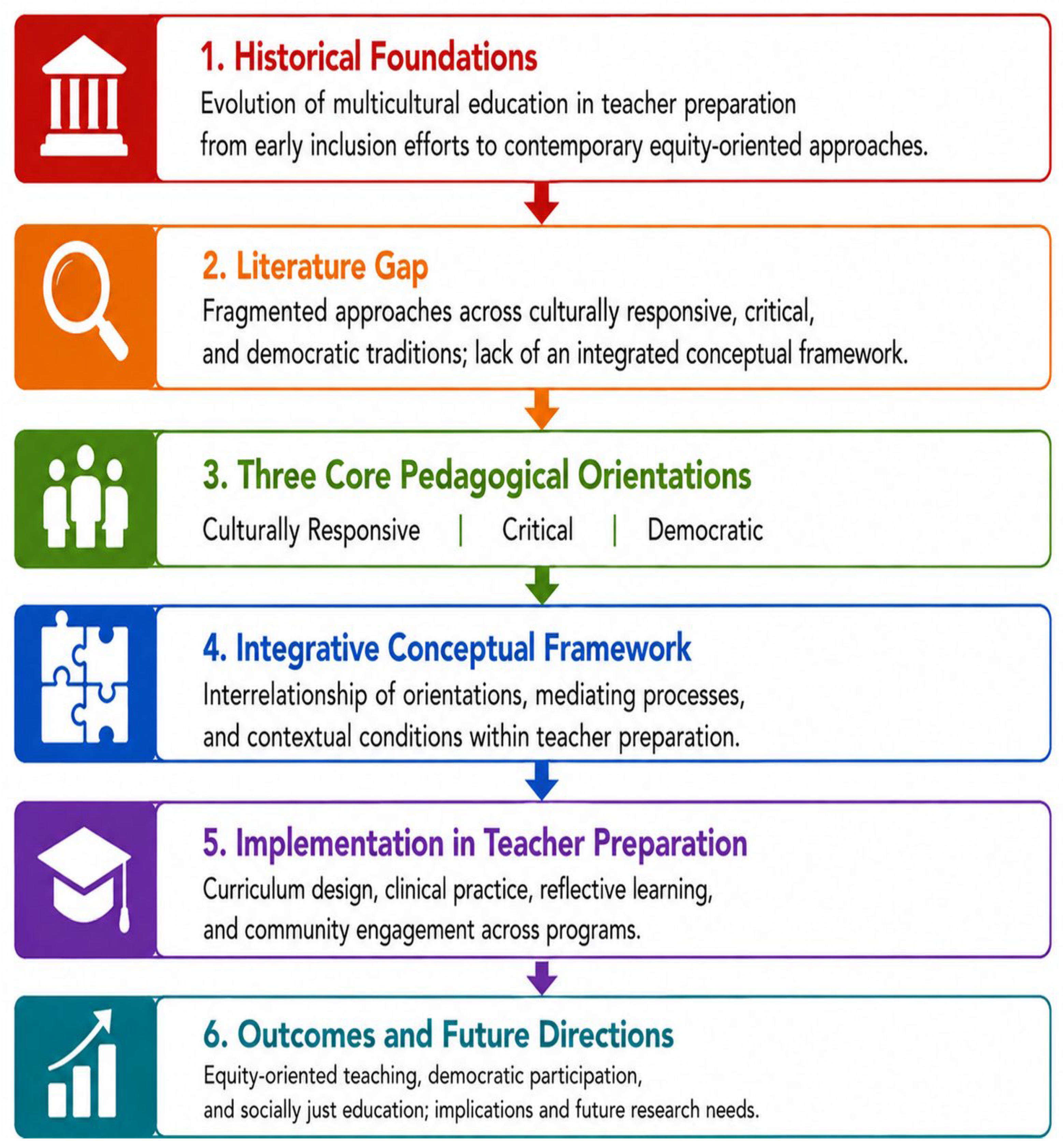
This fragmentation reveals an important gap in the literature. Existing reviews and conceptual discussions frequently examine culturally responsive pedagogy, critical pedagogy, democratic education, intercultural education, or decolonizing approaches independently. While these studies have made important theoretical contributions, relatively few have synthesized these complementary traditions into a single conceptual framework that explains how they collectively contribute to preparing teachers for culturally, linguistically, socially, and politically diverse educational settings. Consequently, teacher educators continue to lack a comprehensive framework that connects these perspectives while demonstrating how they can be enacted across curriculum, clinical practice, assessment, and professional learning. Figure 1 provides an overview of the review and illustrates the organization of the conceptual framework.
The need for such a synthesis has become increasingly urgent. Recent studies published between 2023 and 2026 consistently argue that teacher preparation programs must move beyond additive models of diversity toward integrated approaches that cultivate culturally responsive practice, democratic engagement, critical inquiry, and intercultural competence simultaneously. Yet the literature remains dispersed across multiple theoretical traditions, limiting its accessibility and practical application for teacher educators and program designers [4,5,6,7,8].
The present review examines multicultural education in teacher preparation through three interrelated traditions that have become particularly influential in contemporary scholarship and practice: culturally responsive, critical, and democratic approaches. Rather than viewing these traditions as separate or competing perspectives, this review conceptualizes them as overlapping yet analytically distinct orientations that collectively shape what teacher candidates should know, value, and be able to do in diverse educational settings.
Culturally responsive approaches emphasize relational pedagogy, cultural competence, and the affirmation of learners’ identities and community knowledge [13,14]. Critical approaches foreground issues of power, ideology, the hidden curriculum, and the need to interrogate dominant and deficit-oriented assumptions embedded within schooling. Democratic approaches connect multicultural education to civic dialogue, pluralism, participation, and justice-oriented teaching in diverse societies. Although each of these traditions has been widely studied, they are frequently examined independently, limiting opportunities for conceptual integration and comprehensive program design. This review addresses that limitation by examining their intersections, complementarities, and productive tensions.
Rather than presenting new empirical findings, this article synthesizes existing scholarship to provide a concise yet analytically grounded overview of multicultural education in teacher preparation. Particular attention is given to the historical development of the field, its conceptual foundations, major pedagogical approaches, global and comparative perspectives, and persistent implementation challenges. Methodologically, the review adopts an integrative approach that enables the inclusion of theoretical, empirical, and review-based scholarship to produce a comprehensive synthesis of current knowledge [15]. The review also incorporates illustrative examples from recent teacher education research—including studies of intercultural competence, culturally responsive teaching, Indigenous education, democratic citizenship education, and culturally responsive teacher leadership—to demonstrate how multicultural education continues to evolve in response to changing social, political, and educational contexts.
The central argument advanced in this review is that multicultural education is most meaningful when it is positioned as a foundational and integrative orientation across teacher preparation rather than as an additive or symbolic component of teacher education. This argument is supported by evidence demonstrating that fragmented or superficial approaches are insufficient for preparing teachers to navigate the complexities of contemporary classrooms, particularly those characterized by diversity, inequality, and political contestation. To advance this argument, the review introduces a conceptual framework organized around culturally responsive, critical, and democratic approaches and examines the processes through which these orientations become pedagogically meaningful [16].
This article contributes to the literature in three important ways. First, it synthesizes foundational and contemporary scholarship published across multiple traditions into a single integrative conceptual framework. Second, it demonstrates how culturally responsive, critical, and democratic pedagogies function as complementary rather than competing orientations within teacher preparation. Third, it extends recent scholarship by offering an analytically coherent model that can guide curriculum design, teacher preparation, and future research in multicultural education. In doing so, the review responds directly to recent calls for more integrated, equity-oriented, and contextually responsive approaches to teacher education.
To address this gap in the literature, this review argues that multicultural teacher preparation requires an explicitly integrative framework that connects culturally responsive, critical, and democratic pedagogies rather than treating them as separate or competing traditions. Although each approach has been examined extensively in its own right, the literature continues to reveal fragmentation in how teacher education programs conceptualize equity, power, culture, and civic engagement. Accordingly, this review advances a conceptual synthesis that bridges these traditions while incorporating recent developments in intercultural, democratic, and decolonizing education. Culturally responsive pedagogy addresses the disconnect between students’ cultural identities and classroom practices; critical pedagogy examines structural inequities, power relations, and dominant systems of knowledge; and democratic pedagogy emphasizes dialogue, participation, ethical responsibility, and civic agency within pluralistic societies. Together, these complementary perspectives provide a more comprehensive framework for preparing teachers to work effectively in increasingly diverse, unequal, and politically contested educational contexts.

1.1. Conceptual and Theoretical Framework

The conceptual framework guiding this review is organized into three interconnected components: (1) foundational theoretical perspectives, (2) contemporary extensions, and (3) analytical implications. Drawing on these perspectives, this review advances an integrative conceptual framework that synthesizes culturally responsive, critical, and democratic approaches to multicultural teacher preparation. Rather than presenting these orientations as discrete or sequential, the framework conceptualizes them as mutually reinforcing dimensions that collectively shape how teacher candidates understand identity, power, culture, knowledge, equity, and democratic participation. This integrative perspective responds directly to a persistent gap in the literature, where these traditions have frequently been examined independently despite addressing complementary dimensions of teacher preparation.
The growing body of literature further supports the need for conceptual integration. Studies published during the past several years increasingly emphasize culturally responsive pedagogy, democratic citizenship, intercultural competence, inclusive leadership, and decolonizing teacher education as interconnected rather than isolated educational priorities [4,5,6,7,8]. However, these perspectives are often discussed within separate scholarly conversations, limiting opportunities to develop coherent models capable of guiding teacher education program design. This review addresses that limitation by bringing these complementary traditions together within a single analytical framework.
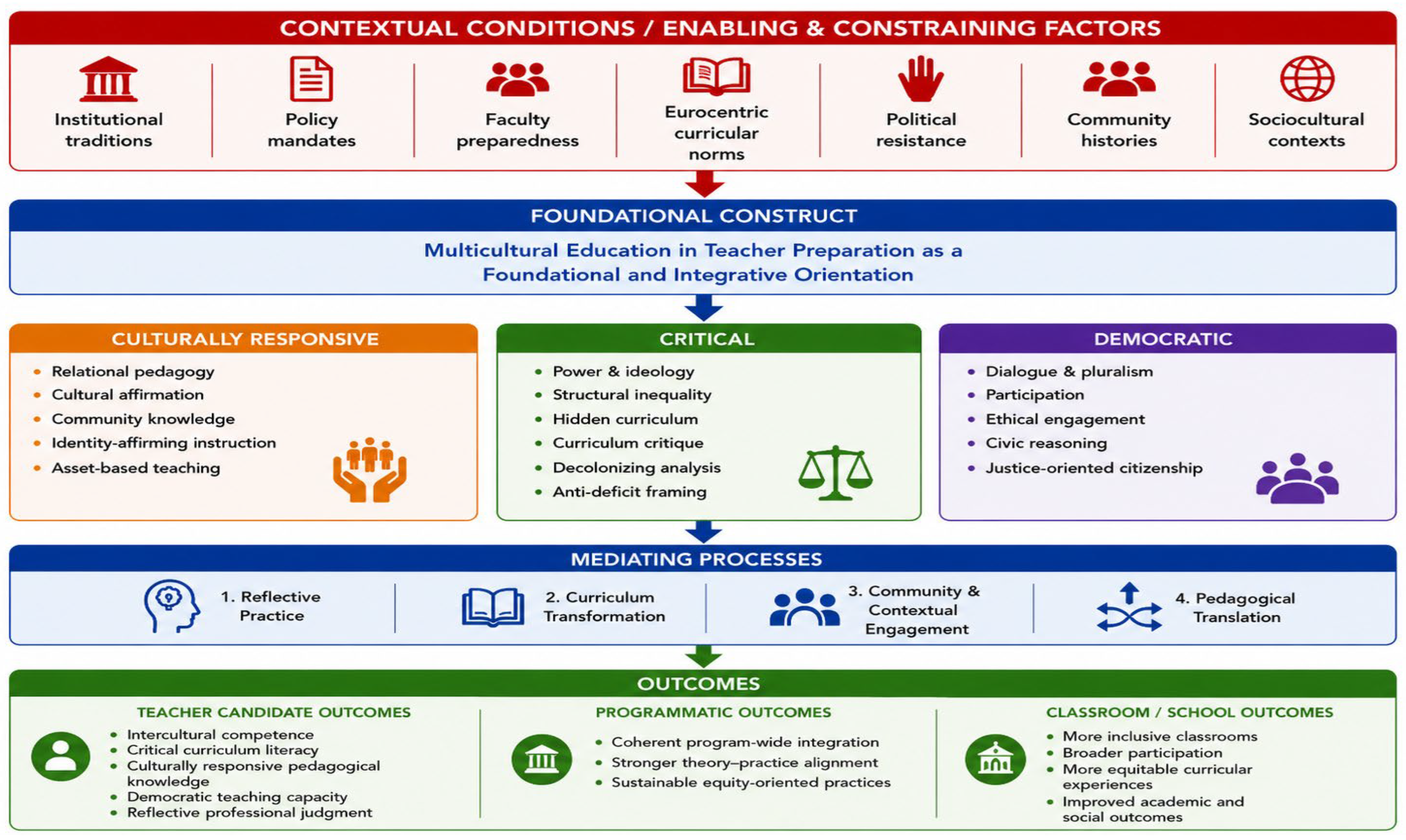
The framework further illustrates how these orientations are enacted through reflective practice, curriculum transformation, community and contextual engagement, pedagogical translation, and critical professional reflection. These mediating processes operate within broader institutional, cultural, and policy contexts that either enable or constrain the implementation of multicultural education. Consequently, the framework provides both a conceptual and practical lens for examining multicultural teacher preparation across diverse educational settings.
Unlike previous conceptualizations that primarily emphasize one pedagogical tradition, the proposed framework demonstrates that culturally responsive, critical, and democratic pedagogies are complementary because each addresses a distinct dimension of teacher preparation. Culturally responsive pedagogy focuses on culturally meaningful teaching and learning; critical pedagogy foregrounds power, inequality, and social transformation; and democratic education emphasizes participation, dialogue, and civic responsibility. Together, these orientations provide a more comprehensive understanding of teacher preparation than any single perspective alone.
Figure 2 represents an integrative conceptual framework illustrating the relationships among culturally responsive, critical, and democratic approaches within multicultural teacher preparation.

1.1.1. Foundational Theoretical Perspectives

Three major theoretical traditions underpin multicultural teacher preparation, each contributing distinct yet complementary insights into teaching and learning within culturally diverse educational contexts.
Culturally Responsive Pedagogy
Culturally responsive pedagogy emphasizes recognizing and valuing students’ cultural backgrounds as assets that enrich teaching and learning. It promotes the development of cultural competence, meaningful relationships, and instructional practices that build upon students’ lived experiences [2,13]. Within teacher preparation, this perspective encourages future teachers to critically examine their own cultural identities, assumptions, and biases while developing instructional approaches that affirm linguistic, cultural, and community knowledge.
Latest scholarship extends culturally responsive pedagogy by emphasizing culturally sustaining, inclusive, and context-responsive approaches that prepare teachers to support increasingly multilingual, multicultural, and globally connected classrooms [4,5]. These developments reinforce the importance of moving beyond superficial cultural recognition toward pedagogical practices that sustain students’ identities while promoting educational equity.
Critical Pedagogy
Critical pedagogy focuses on examining power, ideology, inequality, and knowledge production within educational systems [14,15,16,17]. Drawing on Freire’s work, it encourages teachers to question dominant knowledge systems while recognizing how educational practices can either reproduce or challenge systemic inequities. Within teacher preparation, this perspective cultivates sociopolitical consciousness and prepares future educators to address issues of justice, equity, and oppression through reflective and transformative practice.
Contemporary scholarship further demonstrate that critical pedagogy continues to inform anti-racist education, decolonizing pedagogies, and equity-oriented curriculum reform. These perspectives broaden critical pedagogy by emphasizing epistemic justice, representation, and the inclusion of historically marginalized knowledge systems within teacher education [6,7].
Democratic Education
Democratic education emphasizes the role of schooling in fostering participation, dialogue, civic engagement, and ethical responsibility. It highlights the importance of creating inclusive learning environments in which diverse perspectives are respected and students are prepared to participate thoughtfully within democratic societies [1,7,8,18]. Within teacher preparation, democratic education develops candidates’ capacity to facilitate dialogue, deliberate controversial issues, and promote inclusive civic participation.
A growing body of scholarship argues that democratic education has become increasingly important in response to political polarization, misinformation, globalization, and growing cultural diversity. Consequently, democratic teacher education now extends beyond civic knowledge to include intercultural dialogue, critical listening, collaborative problem-solving, and ethical engagement across difference [4,8].
Collectively, these traditions address three complementary dimensions of multicultural teacher preparation: how teachers engage cultural diversity (culturally responsive), interrogate structural inequities (critical), and foster democratic participation (democratic). Rather than functioning independently, these dimensions intersect continuously within authentic teaching practice, providing a more comprehensive theoretical foundation for preparing teachers to navigate increasingly diverse educational environments.

1.1.2. Contemporary Extensions: Global and Decolonizing Perspectives

In recent decades, multicultural education has been enriched through global, intercultural, and decolonizing perspectives. Globalization has expanded multicultural education beyond national contexts by emphasizing intercultural competence, global citizenship, and the capacity to engage effectively across cultural boundaries [4,5,6,7,8,19]. Consequently, teacher preparation programs are increasingly expected to prepare educators capable of navigating both local educational realities and globally interconnected societies.
Decolonizing perspectives further extend multicultural education by challenging dominant epistemologies and centering Indigenous, community-based, and historically marginalized knowledge systems [7,19,20]. These perspectives emphasize epistemic diversity while encouraging educators to critically examine whose knowledge is recognized, legitimized, and privileged within educational institutions.
Recent studies further demonstrates that intercultural education, democratic citizenship education, culturally responsive leadership, and equity-oriented teacher preparation increasingly converge around common commitments to inclusion, justice, participation, and educational transformation [4,5,6,7,8]. These developments reinforce the need for integrative conceptual frameworks capable of connecting these overlapping scholarly traditions.

1.1.3. Analytical Implications

The proposed framework informs the analysis presented throughout this review in four important ways.
  • It conceptualizes multicultural education as a multidimensional and integrative framework rather than a single pedagogical approach.
  • It examines culturally responsive, critical, and democratic traditions as mutually informing orientations whose collective application strengthens teacher preparation.
  • It interprets tensions among these traditions as productive analytical spaces that promote reflection, innovation, and professional learning rather than as theoretical contradictions.
  • It situates the implementation of multicultural education within broader institutional, political, historical, and sociocultural contexts, recognizing that meaningful educational change depends upon both pedagogical practice and systemic support.
Overall, this framework provides the conceptual foundation for the remainder of the review. It enables the subsequent analysis to move beyond describing individual pedagogical traditions toward examining how their integration strengthens multicultural teacher preparation, addresses persistent implementation challenges, and advances future scholarship [4,5,6,7,8,15,16].

2. Materials and Methods

This study employed an integrative literature review to examine the conceptual development, theoretical foundations, and contemporary applications of multicultural education in teacher preparation. An integrative review was selected because it allows for the synthesis of diverse forms of scholarship—including theoretical papers, empirical studies, conceptual articles, and review literature—to generate new perspectives and conceptual understandings rather than to aggregate empirical findings alone [21]. This methodological approach is particularly appropriate for examining broad educational concepts that have evolved across multiple theoretical traditions and disciplinary contexts. Unlike systematic reviews that primarily evaluate empirical evidence using narrowly defined inclusion criteria, integrative reviews seek to develop comprehensive conceptual syntheses by bringing together diverse bodies of literature. Accordingly, this review focuses on identifying major theoretical developments, recurring themes, areas of convergence and divergence, and emerging directions within multicultural teacher preparation. The thematic synthesis and conceptual analysis were conducted through iterative reading, manual coding, and interpretive analysis of the selected literature. Because this study is a conceptual integrative literature review, no specialized software was used for literature screening, qualitative coding, statistical analysis, or data processing.

2.1. Search Strategy

A comprehensive literature search was conducted using JSTOR, Web of Science, ERIC, and Google Scholar to ensure broad coverage of multidisciplinary scholarship related to multicultural teacher preparation. These databases were selected because they index leading peer-reviewed journals in education, teacher education, curriculum studies, multicultural education, and educational policy.
The search strategy combined key terms associated with the conceptual focus of the review, including “multicultural education,” “teacher preparation,” “teacher education,” “culturally responsive pedagogy,” “culturally relevant pedagogy,” “critical pedagogy,” “democratic education,” “intercultural education,” “inclusive education,” “social justice education,” and “decolonizing education.” Boolean operators (AND, OR) were used to refine search combinations and improve retrieval accuracy. The literature search prioritized scholarship published between 2023 and 2026 to ensure that the review reflected current theoretical and empirical developments in the field. These recent publications were examined alongside seminal works to capture both the historical evolution of multicultural education and emerging conceptual developments related to culturally responsive pedagogy, democratic citizenship, intercultural education, decolonizing teacher education, and equity-oriented practice.

2.2. Selection Criteria

Studies were selected using purposive inclusion criteria designed to ensure both conceptual relevance and scholarly quality. First, only peer-reviewed journal articles, scholarly books, and influential conceptual reviews were included. Second, studies were required to focus explicitly on teacher preparation, including both pre-service and in-service teacher education. Third, selected publications needed to address one or more of the major conceptual orientations examined in this review, including culturally responsive pedagogy, critical pedagogy, democratic education, intercultural education, social justice education, or decolonizing approaches to teacher preparation.
Although the review emphasizes literature published between 2005 and 2026, foundational scholarship was retained where necessary to establish the historical and theoretical foundations of multicultural education. This approach ensured an appropriate balance between seminal contributions and recent developments that have shaped contemporary scholarship.

2.3. Data Analysis

The literature was analyzed using an iterative thematic synthesis. Following repeated readings of the selected publications, studies were coded according to recurring concepts, theoretical perspectives, pedagogical orientations, and implementation challenges. Similar concepts were subsequently grouped into broader analytical themes that informed the conceptual framework presented in this review.
The analysis proceeded in four stages.
  • Identification of major theoretical traditions within multicultural teacher preparation.
  • Comparison of culturally responsive, critical, democratic, intercultural, and decolonizing perspectives to identify conceptual convergence and divergence.
  • Examination of recurring implementation challenges reported across teacher education contexts, including curriculum integration, faculty preparedness, institutional support, and policy constraints.
  • Development of an integrative conceptual framework synthesizing these complementary traditions into a coherent model for multicultural teacher preparation.
Rather than evaluating intervention effectiveness, the purpose of the analysis was to identify conceptual patterns, theoretical relationships, and emerging directions that advance understanding of multicultural education as an integrative framework for teacher preparation. This analytical process supports the central contribution of the review by demonstrating how culturally responsive, critical, and democratic pedagogies can be understood as complementary dimensions of teacher education rather than isolated pedagogical traditions.

3. Results

The thematic synthesis identified three interrelated conceptual dimensions that collectively define multicultural teacher preparation: (1) culturally responsive and relational teaching, (2) structural and critical analysis, and (3) democratic and civic engagement. Rather than representing separate pedagogical traditions, the findings indicate that these dimensions function as complementary orientations that together provide a more comprehensive foundation for preparing teachers to work effectively in increasingly diverse educational settings. Across the literature, however, these dimensions are frequently implemented independently, contributing to fragmented approaches to multicultural teacher education.

Culturally Responsive and Relational Dimension

The first theme emerging from the literature emphasizes the importance of culturally responsive and relational approaches to teaching and learning. Across the studies reviewed, culturally responsive pedagogy is consistently identified as the foundation for recognizing students’ cultural, linguistic, and community knowledge as educational assets rather than deficits [2,13,22,23]. Teacher preparation programs that intentionally incorporate culturally responsive practices encourage candidates to develop cultural competence, build meaningful relationships with students and families, and design instruction that reflects learners’ diverse experiences.
Recent scholarship further demonstrates that culturally responsive pedagogy has evolved beyond the recognition of cultural diversity toward culturally sustaining, asset-based, and inclusive educational practices [4,5]. These approaches emphasize not only affirming students’ identities but also sustaining their languages, cultures, and community knowledge while fostering equitable participation within classrooms.
The thematic synthesis further revealed that effective culturally responsive teacher preparation extends beyond instructional strategies [24,25]. Successful programs consistently integrate opportunities for teacher candidates to engage in reflective practice, community-based learning, and critical examination of their own cultural assumptions. These experiences enable future teachers to connect theoretical understandings of diversity with authentic classroom practice.
Despite broad agreement regarding the value of culturally responsive pedagogy, the literature also reveals persistent implementation challenges. Many teacher education programs continue to approach multicultural education through isolated diversity courses or short-term instructional modules rather than embedding culturally responsive principles across methods courses, clinical experiences, and assessment practices [9,10,26]. Consequently, teacher candidates often experience multicultural education as an additional curricular requirement rather than as a foundational orientation guiding professional practice.
The synthesis also identified structural and critical analysis and democratic and civic engagement as complementary dimensions of multicultural teacher preparation (see Figure 2). Although these themes are not presented separately here, the literature consistently indicates that culturally responsive practice is strengthened when accompanied by critical examination of educational inequities and opportunities for democratic participation, reinforcing a coherent and integrated approach to teacher preparation.
The findings therefore suggest that culturally responsive pedagogy is most effective when it functions as an organizing principle throughout teacher preparation rather than as a discrete instructional approach [27]. Such integration strengthens teacher candidates’ ability to recognize students’ cultural assets, develop equitable instructional practices, and establish meaningful partnerships with diverse communities.
Key Finding—The synthesis indicates that culturally responsive pedagogy provides the relational foundation for multicultural teacher preparation. Its greatest impact is achieved when integrated with critical attention to educational inequities and democratic engagement, and systematically embedded throughout teacher education programs rather than confined to individual courses or instructional activities.

4. Discussion

The literature reviewed and synthesized in this article suggests that multicultural education in teacher preparation remains both indispensable and unfinished. Its enduring significance reflects the continuing need for teacher education that meaningfully addresses diversity, equity, and justice. At the same time, its unfinished nature reflects the reality that the educational challenges it seeks to address—including structural inequality, cultural marginalization, democratic exclusion, epistemic injustice, and contested curriculum—remain deeply embedded within educational systems and continue to evolve alongside broader social, political, technological, and educational transformations. Recent scholarship further suggests that increasing cultural diversity, migration, political polarization, and calls for educational equity have intensified the need for teacher preparation models that are simultaneously culturally responsive, critically informed, and democratically oriented [4,5,6,7,8].
Importantly, the evidence synthesized in this review extends beyond describing these challenges by demonstrating that they are not merely persistent but structurally embedded within educational systems shaped by historical, political, and sociocultural inequities [22,26]. This broader perspective situates multicultural education within the wider institutional and policy environments that influence curriculum, teaching, and teacher preparation rather than treating it solely as a pedagogical concern. Consequently, meaningful reform requires not only changes in instructional practice but also institutional commitment to equity-oriented teacher education.
One of the clearest conclusions emerging from this review is that multicultural education is most effective when it is integrated across teacher preparation programs rather than confined to isolated coursework. Teacher candidates need repeated opportunities to encounter, analyze, practice, and reflect on culturally responsive, critical, and democratic teaching across methods courses, field experiences, assessments, and professional reflection. Developing multicultural competence therefore involves far more than acquiring theoretical knowledge; it requires cultivating the professional judgment, reflective capacity, and ethical responsibility necessary to navigate educational contexts characterized by complexity, contested knowledge, and unequal power relations. This conclusion aligns with broader scholarship demonstrating that additive or fragmented approaches are insufficient because they fail to disrupt dominant curricular, pedagogical, and institutional norms [1,9]. Instead, program-wide integration promotes coherence among theory, practice, clinical experiences, and professional identity development, thereby addressing one of the principal limitations identified throughout the literature.
A central contribution of this review is its demonstration that culturally responsive, critical, and democratic pedagogies are best understood as complementary rather than competing traditions. Although these approaches have frequently been examined independently, the thematic synthesis revealed that each addresses a distinct yet interconnected dimension of teacher preparation. Culturally responsive pedagogy emphasizes identity, relationships, and cultural competence; critical pedagogy foregrounds power, ideology, and structural inequality; and democratic education focuses on dialogue, participation, ethical reasoning, and civic engagement. Integrating these perspectives provides a more comprehensive conceptual foundation for preparing teachers to respond effectively to increasingly diverse and politically complex educational contexts. In this respect, the proposed model addresses a significant gap in the literature by synthesizing theoretical traditions that have often developed in parallel rather than through an integrated analytical approach.
A third conclusion concerns the importance of context. Multicultural education cannot be meaningfully theorized or enacted as a universal model applicable across all educational settings. Indigenous communities, rural schools, urban districts, postcolonial contexts, immigrant-serving classrooms, multilingual programs, and politically polarized environments each shape what culturally responsive, critical, and democratic teaching requires. Accordingly, effective multicultural teacher preparation must remain contextually responsive while maintaining its commitment to equity, inclusion, and democratic participation [28]. Comparative and international scholarship further demonstrates that culturally responsive teacher education is strengthened when local knowledge systems are engaged through reciprocal rather than universal approaches across diverse educational systems [29,30,31]. Recent studies similarly emphasize the importance of culturally responsive leadership, intercultural dialogue, and decolonizing approaches that recognize multiple ways of knowing and challenge Eurocentric assumptions that continue to shape teacher education [5,6,7,8,32].
The review also highlights important implications for teacher education policy and practice. Studies further suggest that teacher candidates benefit from structured opportunities to develop culturally responsive, critical, and anti-biased pedagogical practices through coursework, reflective activities, critical analysis of instructional materials, and community engagement [29,30,31,33,34,35,36]. Rather than positioning multicultural education as an isolated course or program requirement, teacher preparation programs should embed these perspectives throughout curriculum design, clinical experiences, candidate assessment, and faculty development [30]. Such integration is likely to strengthen coherence across teacher education programs while better preparing graduates to teach within increasingly diverse educational communities. The literature also indicates that institutional support, faculty preparedness, and sustained community partnerships are essential for successful implementation.
Finally, an important limitation within the existing literature concerns the relative scarcity of empirical evidence regarding long-term program implementation and classroom enactment. While conceptual frameworks have expanded considerably, empirical evidence regarding long-term program implementation and classroom enactment remains comparatively limited. Much of the literature continues to emphasize conceptual and theoretical development, whereas relatively fewer studies examine how multicultural teacher preparation influences instructional practice, teacher decision-making, student learning, and educational outcomes over time. Future research should therefore prioritize longitudinal, comparative, and practice-based investigations that examine how culturally responsive, critical, and democratic pedagogies are implemented, adapted, and sustained across diverse educational contexts. Such work would strengthen the empirical foundation of multicultural teacher education while further refining the integrative model proposed in this review.
Overall, this review advances the field by moving beyond isolated conceptual discussions toward an integrative model that synthesizes culturally responsive, critical, and democratic approaches within a single analytical perspective. By connecting foundational scholarship with emerging developments in intercultural, decolonizing, and equity-oriented teacher education, the article offers a contemporary guide for future scholarship, teacher education program design, and educational policy.

5. Conclusions

Multicultural education in teacher preparation remains an essential and evolving framework for preparing educators to teach within increasingly diverse, unequal, and democratically contested educational contexts. As this review has demonstrated, the field has evolved from early concerns with inclusion, representation, and prejudice reduction into a multidimensional and theoretically robust body of scholarship encompassing culturally responsive pedagogy, critical curriculum transformation, democratic participation, intercultural competence, anti-racist education, and decolonizing educational practice. This evolution reflects not only changing understandings of diversity but also growing recognition that teacher preparation must address the complex relationships among culture, power, knowledge, identity, and democratic participation within contemporary schools.
A central contribution of this review is the development of an integrative conceptual framework that synthesizes culturally responsive, critical, and democratic pedagogies into a coherent model for multicultural teacher preparation. Although these traditions have often been examined independently, the findings demonstrate that they are mutually reinforcing and collectively provide a stronger theoretical and practical foundation than any single perspective alone. By explicitly integrating these complementary orientations, this review addresses a significant gap in the literature while responding to recent calls for more coherent, equity-oriented, and contextually responsive teacher education [4,5,6,7,8].
This review further demonstrates that multicultural education should be understood not as an isolated course or program requirement but as a foundational orientation embedded throughout teacher preparation. The proposed framework illustrates how multicultural education can be organized through three interrelated pedagogical orientations—culturally responsive, critical, and democratic—and enacted through reflective practice, curriculum transformation, community and contextual engagement, and pedagogical translation [37]. Embedding these orientations across coursework, clinical practice, candidate assessment, and faculty development strengthens coherence between theory and practice while supporting the preparation of reflective [38], equity-oriented educators.
Several future directions emerge from this review. First, teacher education programs require stronger models for program-wide implementation that intentionally connect coursework, clinical experiences, assessment, and professional learning. Second, greater attention should be devoted to faculty development because successful implementation depends upon teacher educators who share a coherent vision of multicultural education and possess the knowledge and pedagogical expertise necessary to enact it consistently across programs. Third, additional longitudinal and practice-based research is needed to examine how teacher candidates translate multicultural commitments into classroom practice throughout their early professional careers. Fourth, scholarship should continue to expand through global, comparative, intercultural, and decolonizing perspectives that challenge universal assumptions while recognizing community-defined understandings of educational success. Finally, future research should examine how artificial intelligence, digital learning environments, migration, and rapidly changing sociopolitical contexts influence multicultural teacher preparation and democratic education.
Although this review advances an integrative conceptual framework, several limitations should be acknowledged. Because the study is based on existing literature rather than original empirical data, it cannot evaluate the effectiveness of particular teacher preparation models across different institutional or national contexts. Moreover, as with all conceptual reviews, the proposed framework requires empirical validation through future research examining its implementation within teacher education programs. Future studies should therefore prioritize mixed-methods, longitudinal, comparative, and design-based research capable of examining how multicultural education is enacted, sustained, and adapted across diverse educational settings.
Overall, this review contributes to the growing scholarship on multicultural teacher education by offering an updated conceptual synthesis that integrates foundational theories with emerging developments in culturally responsive, democratic, intercultural, and decolonizing education. Rather than viewing multicultural education as a collection of isolated pedagogical strategies, the review positions it as an integrative framework capable of guiding curriculum design, teacher preparation, educational leadership, and future scholarship. In this sense, multicultural education remains not only an enduring field of educational inquiry but also an ongoing project of educational transformation, democratic renewal, and social justice.
Table 1 summarizes the major components of the proposed framework and illustrates how each dimension can be operationalized within teacher preparation programs.

Funding

This research received no external funding.

Institutional Review Board Statement

Not applicable.

Informed Consent Statement

Not applicable.

Data Availability Statement

No new data were created or analyzed in this study. Data sharing is not applicable to this article.

Conflicts of Interest

The author declares no conflicts of interest.

References

  1. Banks, J.A. Cultural Diversity and Education: Foundations, Curriculum, and Teaching, 6th ed.; Pearson: London, UK, 2015. [Google Scholar]
  2. Gay, G. Culturally Responsive Teaching: Theory, Research, and Practice, 3rd ed.; Teachers College Press: New York, NY, USA, 2018. [Google Scholar]
  3. Nieto, S. Language, Culture, and Teaching: Critical Perspectives, 3rd ed.; Routledge: New York, NY, USA, 2017. [Google Scholar]
  4. Pandey, A. Integrating culturally responsive pedagogy to enhance inclusive classroom practices in multilingual schools. Int. J. Soc. Sci. Lang. Educ. 2026, 1, 1–9. [Google Scholar] [CrossRef] [Scilit]
  5. Triyanto. Teachers’ perspective concerning multicultural education to support Sustainable Development Goals (SDGs). J. Multicult. Educ. 2026, 1–14. [Google Scholar] [CrossRef] [Scilit]
  6. Fortunato, I.; Mena, J.; Vatter, C. From an intercultural approach to environmental education to the 2030 Agenda: Exploring teachers’ role. Intercult. Educ. 2026, 37, 39–55. [Google Scholar] [CrossRef] [Scilit]
  7. Kalogerogianni, F. Teaching in multicultural classrooms through an intercultural perspective on citizenship. Front. Educ. 2025, 10, 1581833. [Google Scholar] [CrossRef] [Scilit]
  8. Karakatsani, D.; Pliogou, V. Democratic education and intercultural education. In Teaching Citizenship in the 21st Century: Current Intersectionalities and Global Challenges; Springer Nature: Singapore, 2026; pp. 1–22. [Google Scholar] [CrossRef] [Scilit]
  9. Gorski, P.C. What we’re teaching teachers: An analysis of multicultural teacher education coursework syllabi. Teach. Teach. Educ. 2009, 25, 309–318. [Google Scholar] [CrossRef] [Scilit]
  10. Sleeter, C.E. Critical race theory and the whiteness of teacher education. Urban Educ. 2017, 52, 155–169. [Google Scholar] [CrossRef] [Scilit]
  11. Ladson-Billings, G. Culturally Relevant Pedagogy 2.0: A.K.A. the Remix. Harv. Educ. Rev. 2014, 84, 74–84. [Google Scholar] [CrossRef] [Scilit]
  12. Smith, L.T. Decolonizing Methodologies: Research and Indigenous Peoples, 2nd ed.; Zed Books: London, UK, 2012. [Google Scholar]
  13. Cochran-Smith, M. Teacher education for justice and equity: Forty years of advocacy. Action Teach. Educ. 2020, 42, 49–59. [Google Scholar] [CrossRef] [Scilit]
  14. Cochran-Smith, M.; Reagan, E.M. Beyond Best Practices: Centering equity in teacher preparation evaluation. Educ. Policy Anal. Arch. 2022, 30, 66. [Google Scholar] [CrossRef] [Scilit]
  15. Chang, W.C.; Viesca, K.M. Preparing teachers for culturally responsive/relevant pedagogy: A critical review of research. Teach. Coll. Rec. 2022, 124, 197–224. [Google Scholar] [CrossRef] [Scilit]
  16. Major, J.; Reid, J. Culturally relevant teacher education pedagogical approaches. In The SAGE Handbook of Research on Teacher Education; SAGE Publications Ltd.: London, UK, 2017; pp. 610–626. [Google Scholar]
  17. Freire, P. Pedagogy of the Oppressed, 50th Anniversary ed.; Original Work Published 1970; Bloomsbury: London, UK, 2020. [Google Scholar]
  18. Hess, D.E.; McAvoy, P. The Political Classroom: Evidence and Ethics in Democratic Education; Routledge: New York, NY, USA, 2015. [Google Scholar]
  19. Giroux, H.A. On Critical Pedagogy; Continuum: London, UK, 2011. [Google Scholar]
  20. Giroux, H.A. When schools become dead zones of the imagination: A critical pedagogy manifesto. High Sch. J. 2016, 99, 351–359. [Google Scholar] [CrossRef] [Scilit]
  21. Torraco, R.J. Writing integrative literature reviews: Using the past and present to explore the future. Hum. Resour. Dev. Rev. 2016, 15, 404–428. [Google Scholar] [CrossRef] [Scilit]
  22. Byker, E.J.; Marquardt, S.K. Using critical cosmopolitanism to globally situate multicultural education in teacher preparation. J. Soc. Stud. Educ. Res. 2016, 7, 2–25. [Google Scholar]
  23. Masunungure, T.; Maguvhe, M. Strategies to enhance the inclusion of culturally and linguistically diverse learners in Gauteng schools: Teachers’ perspectives. S. Afr. J. Educ. 2024, 44, 2367. [Google Scholar] [CrossRef] [Scilit]
  24. Nganga, L.; Nydam, A.; Kambutu, J. Goal setting for teacher development: Enhancing culturally responsive, inclusive, and social justice pedagogy. Educ. Sci. 2025, 15, 264. [Google Scholar] [CrossRef] [Scilit]
  25. Paris, D.; Alim, H.S. Culturally Sustaining Pedagogies: Teaching and Learning for Justice in a Changing World; Teachers College Press: New York, NY, USA, 2017. [Google Scholar]
  26. Ladson-Billings, G.; Tate, W.F., IV. Toward a critical race theory of education. Teach. Coll. Rec. 1995, 97, 47–68. [Google Scholar] [CrossRef] [Scilit]
  27. Miller, R.D.; Gerzel-Short, L.; Kelly, J.H.; Uphold, N.; Hsiao, Y.-J.; Hovey, K.A.; Wei, Y. Preparing culturally responsive teachers: A systematic review. Multicult. Learn. Teach. 2024, 19, 249–268. [Google Scholar] [CrossRef] [Scilit]
  28. Vinlove, A. Place, positionality, and teacher preparation. J. Sustain. Educ. 2016, 11, 1–16. [Google Scholar]
  29. Lambeth, D.T.; Smith, A.M. Pre-service teachers’ perceptions of culturally responsive teacher preparation. J. Negro Educ. 2016, 85, 46–58. [Google Scholar] [CrossRef] [Scilit]
  30. Grant, C.A.; Sleeter, C.E. Turning on Learning: Five Approaches for Multicultural Teaching Plans for Race, Class, Gender, and Disability, 2nd ed.; Wiley: Hoboken, NJ, USA, 2013. [Google Scholar]
  31. Nganga, L.; Kambutu, J. Culturally responsive professional development programs for teacher educators using community-based collaborative learning: Lessons learned from a Native American community. Educ. Sci. 2024, 14, 787. [Google Scholar] [CrossRef] [Scilit]
  32. Adamson, B. International comparative studies in teaching and teacher education. Teach. Teach. Educ. 2012, 28, 641–648. [Google Scholar] [CrossRef] [Scilit]
  33. Tate, W.F. Returning to the root: A culturally relevant approach to mathematics pedagogy. Theory Pract. 1995, 34, 166–173. [Google Scholar] [CrossRef] [Scilit]
  34. Ellerbrock, C.R.; Cruz, B.C.; Vásquez, A. Preparing culturally responsive teachers: Effective practices in teacher education. Action Teach. Educ. 2016, 38, 136–152. [Google Scholar] [CrossRef] [Scilit]
  35. Nganga, L. Culturally responsive and anti-biased teaching benefits early childhood pre-service teachers. J. Curric. Teach. 2015, 4, 1–13. [Google Scholar] [CrossRef] [Scilit]
  36. Nganga, L. Analyzing children’s literature for hidden bias helps preservice teachers gain pedagogical practices in critical multicultural education. J. Res. Child. Educ. 2020, 34, 93–107. [Google Scholar] [CrossRef] [Scilit]
  37. Cherng, H.-Y.S.; Davis, L.A. Multicultural matters: An investigation of key assumptions of multicultural education reform in teacher education. J. Teach. Educ. 2019, 70, 219–236. [Google Scholar] [CrossRef] [Scilit]
  38. Schön, D.A. The Reflective Practitioner: How Professionals Think in Action; Basic Books: New York, NY, USA, 1983. [Google Scholar]
Figure 1. Overview of the Review.
Encyclopedia 06 00153 g001
Figure 2. Integrative Conceptual Framework for Multicultural Education in Teacher Preparation.
Encyclopedia 06 00153 g002
Table 1. Operationalizing the Conceptual Framework for Multicultural Teacher Preparation.
Framework ComponentPurpose Within Teacher PreparationRepresentative ScholarshipExamples of Program Implementation
Foundational OrientationPositions multicultural education as an integrative philosophy guiding curriculum, pedagogy, assessment, and professional identity.Banks [1]; Gorski [9]; Sleeter [10]Program-wide curriculum alignment; equity-focused program outcomes.
Culturally Responsive OrientationDevelops cultural competence, identity affirmation, and asset-based teaching.Gay [2]; Paris & Alim [25]; Pandey [4]Community-engaged learning; culturally responsive lesson planning; family partnerships.
Critical OrientationExamines power, structural inequality, curriculum, and epistemic justice.Freire [17]; Ladson-Billings [11]; Sleeter [10]Curriculum critique; anti-racist teaching; analysis of educational policy.
Democratic OrientationPromotes dialogue, deliberation, civic engagement, and ethical participation.Banks [1]; Hess & McAvoy [18]; Kalogerogianni [7]; Karakatsani & Pliogou [8]Structured academic discussions; civic inquiry; deliberative classroom practice.
Mediating ProcessesConnects theory to practice through reflective and clinical learning.Schön [38]; Banks [1]Reflective journals; action research; clinical coaching; community partnerships.
Contextual ConditionsRecognizes institutional, historical, political, and cultural influences on implementation.Ladson-Billings [11]; Smith [12]Policy analysis; local adaptation; Indigenous and community partnerships.
Expected OutcomesPrepares teachers who demonstrate intercultural competence, critical reflection, and democratic practice.Cherng & Davis [37]; Nganga & Kambutu [31]Inclusive classrooms; culturally sustaining instruction; democratic learning environments.
Disclaimer/Publisher’s Note: The statements, opinions and data contained in all publications are solely those of the individual author(s) and contributor(s) and not of MDPI and/or the editor(s). MDPI and/or the editor(s) disclaim responsibility for any injury to people or property resulting from any ideas, methods, instructions or products referred to in the content.