1. Introduction
Revealed preference theory examines the conditions under which observed choices can be rationalized by a preference relation or a utility function. Central concepts include the weak, strong, and generalized axioms of revealed preference; rationalizability; integrability; recoverability; and the finite-data results associated with Afriat’s theorem and its extensions.
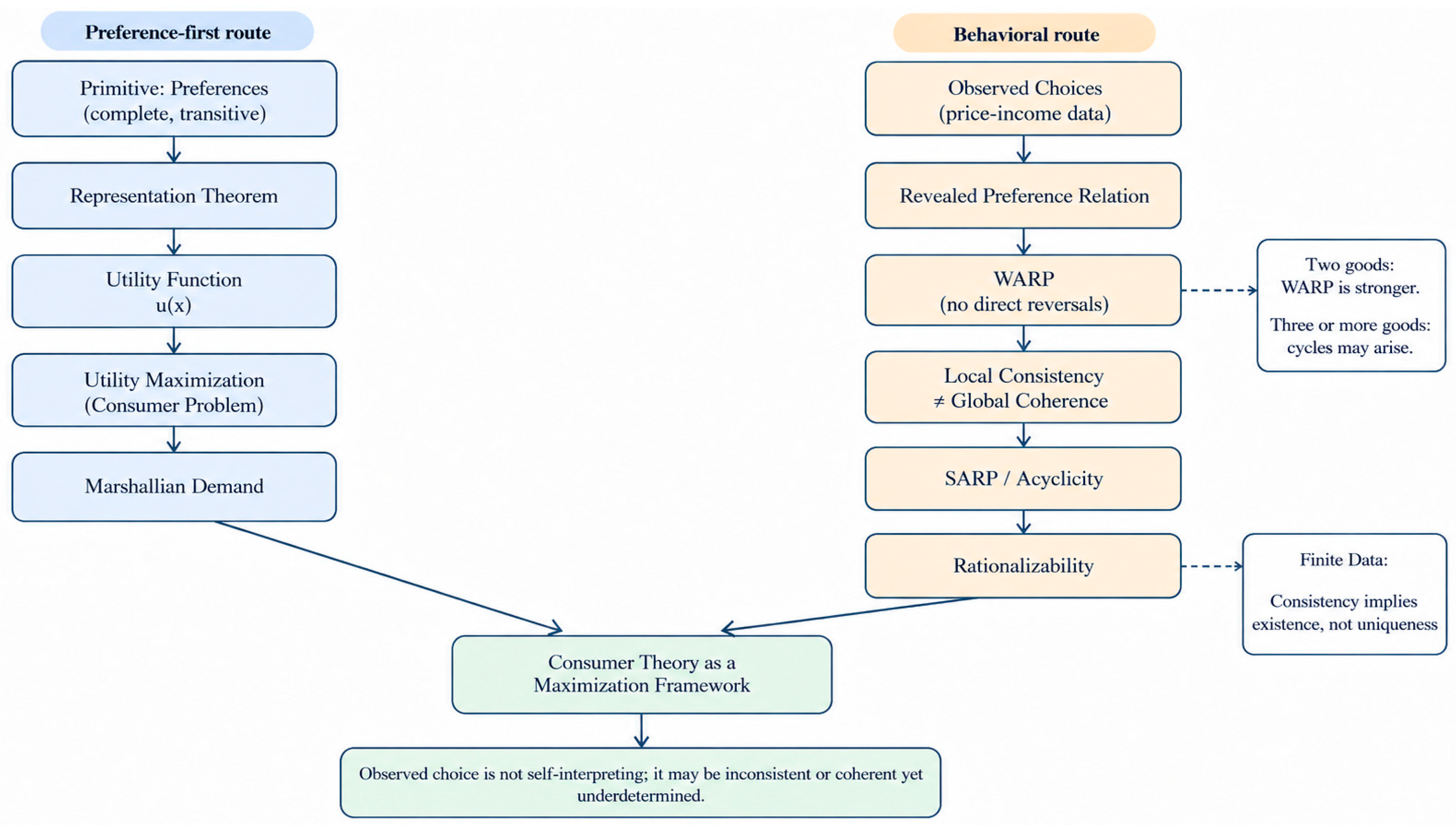
Consumer theory may be developed either from primitive preferences or from observed choice behavior. In the preference-first approach, one begins with a complete and transitive preference relation and then studies utility representation and demand [
1,
2]. In the revealed-preference approach, one begins with observed choices and derives behavioral consistency conditions from them [
3,
4,
5,
6]. This entry surveys the main concepts, historical developments, and applications of revealed preference theory, with particular attention to the distinctions between local consistency, global acyclicity, finite-data rationalization, and underdetermination.
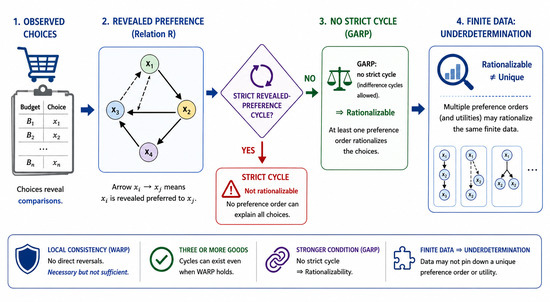
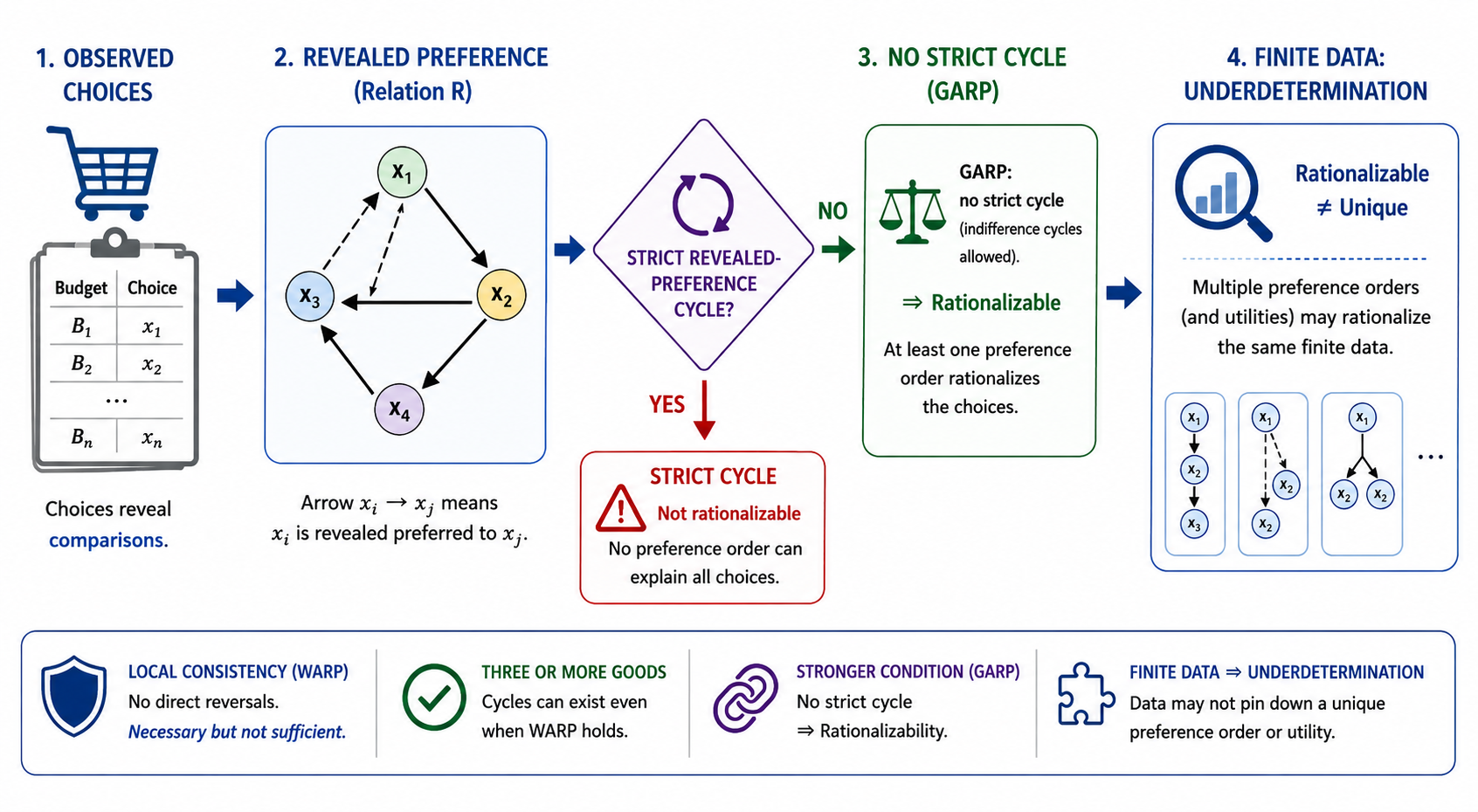
A useful distinction in the literature is among three cases. First, there is local consistency, where direct reversals are absent. Second, there is global coherence, where all revealed comparisons fit a single transitive ordering. Third, there is underdetermination, where such an ordering exists but is not uniquely pinned down by the data. Weak consistency addresses only the first case. Rationalizability requires the second. Finite-data results often deliver the third.
Figure 1 summarizes the main conceptual distinctions discussed in this entry. It shows why weak revealed-preference consistency is insufficient for global coherence, why the issue becomes more salient with three or more goods, and how stronger acyclicity conditions and finite-data results clarify the distinction between rationalizability and underdetermination.
2. Historical Development and Conceptual Vocabulary
A fuller historical perspective helps situate the order-representation problem within the development of revealed preference theory. Samuelson’s [
3,
4,
5] original contribution was to replace introspective utility with observable restrictions on demand. Houthakker [
6] then showed that revealed preference must be extended along chains of comparison if the aim is full rationalizability rather than the mere absence of direct reversals. Richter [
7] generalized the issue by asking whether a choice rule can be rationalized by some preference relation. Afriat [
8] later gave the finite-data version of the problem, and Varian [
9,
10] turned this result into a practical nonparametric approach to demand analysis.
Recent surveys place these developments in a broader perspective. Dziewulski et al.’s [
11] survey reveals preference cycles with particular emphasis on GARP-style acyclicity conditions and their extensions, while Carvajal and Zhou [
12] survey recent advances in the testability of equilibrium models and show how revealed-preference ideas have been extended from individual demand to market and game-theoretic environments.
Taken together, these contributions show how revealed preference theory evolved from a local behavioral restriction into a broader theory of rationalizability, testability, and utility-based interpretation.
The terminology is clearer if one separates revealed-preference definitions, revealed-preference axioms, and revealed-preference theorems. A definition specifies what it means for one observed choice to reveal a preference over another. An axiom imposes consistency restrictions on those revealed comparisons. A theorem states conditions under which the observed choices are rationalizable by a preference relation or by a utility function. This separation is useful because the same choice data may be locally consistent, globally cyclic, rationalizable but nonunique, or compatible with several utility representations.
3. Local Consistency Is Not Global Coherence
Samuelson’s revealed preference approach begins from the idea that if bundle
x is chosen when
y is affordable,
x is thereby revealed preferred to
y; the associated consistency requirement then rules out a direct reversal [
3,
4]. This is an intuitively appealing restriction. It prevents a simple two-way inconsistency. But it does not, by itself, guarantee that all observed choices can be represented by one complete and transitive preference relation.
It is useful to distinguish the objects being related. The revealed-preference relation is constructed from observed choices. A rationalizing preference relation is the theoretical order that would make those choices optimal. A utility representation is a numerical function representing that order under suitable regularity assumptions. The weak axiom of revealed preference (WARP) concerns direct revealed-preference comparisons. The strong axiom of revealed preference (SARP) and related acyclicity requirements concern chains of comparisons. Rationalizability is the existence claim that some preference relation can account for the data. Utility representation is a further claim that such a relation can be represented by a utility function.
For finite demand observations, let
xt be chosen at prices
pt. Bundle
xt is directly revealed preferred to
xs if
pt xt pt xs. WARP rules out a direct contradiction: if
xt is revealed preferred to
xs, then
xs must not be strictly directly revealed preferred to
xt. SARP strengthens the requirement by applying it to the transitive closure of revealed preference, thereby excluding nontrivial cycles. The generalized axiom of revealed preference (GARP) is the finite-data condition associated with Afriat’s theorem [
8]. It permits indifference cycles but rules out cycles containing a strict revealed-preference step. Thus, WARP is local, SARP and acyclicity are global, and GARP provides the standard finite-data bridge between observed choices and utility rationalization.
Houthakker [
6] made the limitation precise. In general, weak revealed preference is insufficient for full rationalizability. The reason is that pairwise discipline does not exclude longer cycles. It is possible to observe behavior supporting
x0 over
x1,
x1 over
x2, and
x2 over
x0 without ever violating a purely pairwise restriction. Such data remain locally well-behaved. Yet they fail to determine a transitive ranking.
The point can be expressed philosophically. A sequence of choices can be mutually compatible one comparison at a time and still fail to express a unified standpoint of agency. What is missing is not local discipline but closure across chains of comparison. Rationalizability is therefore stronger than the absence of immediate reversal. It requires that observed acts be interpretable as the output of one stable order of reasons.
This vocabulary clarifies why the order-representation framing is not a departure from standard revealed preference theory. It shows the common structure behind WARP, SARP, GARP, rationalizability, and utility representation. The question is not whether a revealed-preference relation can be defined, since it can. The question is whether the resulting network of comparisons has enough order structure to be extended into a complete and transitive ranking, and then, under additional assumptions, into a utility function.
This is why the failure at issue should not be described as a defect in the admissibility of the theory’s objects. Budget sets, choice correspondences, and revealed preference relations are perfectly standard constructions. The problem lies instead in the representational step from conduct to order. The data may not warrant the ordering that consumer theory would need to interpret the conduct as maximizing behavior.
4. Why Two Goods Are Special
The limitation of weak revealed preference is not uniform across commodity spaces. In the two-good case, weak consistency is much stronger than it is in higher dimensions. Houthakker [
6] argues that in the two-commodity case, Samuelson’s original hypothesis is enough, whereas with three or more goods, the integrability problem reappears because there are several possible paths between price sets.
The reason is not mysterious. In two dimensions, there is much less room for revealed preference chains to wander before returning to their starting point. Local consistency is therefore closer to global coherence. Once the number of goods exceeds two, WARP need not imply rationalizability. Gale [
13] provided an early three-good example of a demand function satisfying WARP but not generated by a utility function.
The difference matters conceptually. It shows that the revealed preference problem is not merely about the wording of axioms. It is tied to the structure of the choice space. With only two goods, behavior carries enough implicit order to make weak consistency relatively powerful. With more than two goods, that protection disappears. Observable choice then contains too little structure, by itself, to support the recovery of a unified ordering from pairwise restrictions alone.
In
Appendix A, we establish the existence of a three-good dataset that satisfies WARP yet cannot be rationalized by any complete, transitive, and locally nonsatiated preference relation.
5. Cycles as Failures of Representation
Richter [
7] reformulated revealed preference theory as a general problem of rationalization. The question is not simply whether choices are observable or whether they satisfy a local consistency test. The question is whether there exists some preference ordering under which the observed choices are optimizing choices. In that framework, the central issue is whether observed choice behavior satisfies a behavioral condition strong enough to guarantee the existence of a rationalizing ordering.
In this sense, a cycle is not merely an empirical inconvenience. It shows that the revealed-preference graph cannot be embedded in a transitive order without contradiction. Acyclicity is therefore the graph-theoretic expression of the same requirement that consumer theory states in terms of a stable preference ordering. When a cycle contains at least one strict revealed comparison, the data cannot be rationalized by a utility-maximizing consumer satisfying the usual monotonicity assumptions.
Seen from this angle, revealed preference theory does not avoid preference theory. It reconstructs it behaviorally. Sen [
14] pressed this point forcefully. Choice can serve as evidence for preference only under interpretive assumptions linking conduct to evaluation. The revealed preference program therefore does not eliminate structure. It relocates structure from introspection to behavior and then asks whether the behavioral record is coherent enough to bear the theoretical weight placed on it.
6. Acyclicity and Repair
Stronger acyclicity conditions supply the missing global structure. Houthakker’s extended axiom, and later formulations such as SARP and GARP, rule out the cycles that WARP can miss. When the relevant cycles are absent, revealed comparisons can, under appropriate assumptions, support rationalization by a preference ordering and, in finite data, by well-behaved utility representations.
The same point appears in a different language in the integrability literature. There the issue is whether observed demand can be generated by utility maximization. Shafer [
15] relates revealed preference cycles to asymmetry in the Slutsky terms, thereby linking violations of acyclicity to failures of the structure implied by utility-generated demand. In one idiom, the problem is a cycle in revealed rankings. In the other, it is the absence of the structure required for utility-generated demand.
The order-representation problem is therefore the revealed-preference counterpart of the classical integrability problem. In the smooth demand approach, one asks whether a demand function
x(
p,
m) can be integrated back into a utility function whose maximization generated it. The familiar restrictions involve adding-up, homogeneity, and the symmetry and negative semidefiniteness properties of the Slutsky matrix. In revealed preference theory, the same question is asked in discrete or finite-observation language: can observed budget choices be organized into a preference order, and possibly a utility function, that rationalizes them? Cycles in revealed preference thus play a role analogous to failures of integrability in smooth demand theory. Both indicate that observed demand behavior lacks the structure required by utility maximization, although they express this failure in different mathematical languages [
5,
16,
17,
18].
7. Finite Data and Underdetermination
A second issue appears once the data are finite. Afriat [
8] showed that, for finite expenditure data, cyclical consistency is necessary and sufficient for utility consistency, and he constructed an increasing concave utility representation; for finite data, he further noted the equivalence with the usual continuity-based formulation. Varian [
9,
10] turned this into a practical nonparametric approach to demand analysis.
Finite-data revealed preference has also been extended beyond standard linear competitive budgets. Forges and Minelli [
19] generalize Afriat’s theorem to a class of nonlinear and nonconvex budget sets, showing that finite-data rationalizability and constructive recovery of preferences can be studied in more general environments than the classical competitive-budget framework. This extension broadens the scope of finite-data revealed preference and shows that its testability results are not confined to linear budget settings.
A further development concerns not only whether data satisfy revealed-preference conditions but also by how much they violate them. Measures of violation severity, especially Afriat’s efficiency index, also known as the critical cost efficiency index, quantify the extent to which observed choices depart from exact utility maximization [
20,
21]. Rather than yielding a simple pass-or-fail test, these measures provide a graded notion of consistency and are widely used in experimental and applied work to compare the strength of revealed-preference violations across datasets [
21].
Afriat’s theorem is central because it shows that revealed preference can be tested without specifying a parametric utility function. In one standard formulation, a finite dataset D = {(pt, xt)} is rationalizable by a continuous, increasing, concave utility function if and only if it satisfies GARP. Equivalently, there exist numbers Ut and multipliers t > 0 such that, for every pair of observations s and t, Us Ut + t pt(xs − xt). These Afriat inequalities assign utility levels to observed bundles and impose the requirement that no unchosen affordable bundle receives a higher utility level than the bundle chosen.
This result gives the theory a practical empirical interpretation. The analyst needs only prices, quantities, and expenditures to test whether the observed choices can be interpreted as utility-maximizing behavior. The result also explains why finite-data revealed preference is both powerful and limited. It is powerful because it avoids arbitrary functional forms such as Cobb–Douglas or CES. It is limited because successful rationalization generally produces a family of admissible utility functions rather than a uniquely identified preference ordering [
8,
9,
10,
22,
23].
These results separate inconsistency from underdetermination. A finite dataset may fail cyclical consistency, in which case it is not rationalizable. But it may also satisfy cyclical consistency while admitting many utility representations. In that case, the data are coherent but incomplete. Rationalization exists without uniqueness.
This distinction matters. Failure of coherence means that no single ordering can represent the observed choices. Underdetermination means that several orderings can. The first is a breakdown of representation. The second is a limit on identification. Revealed preference theory must confront both, but they are not the same problem.
The distinction between existence and identification should therefore be emphasized. A GARP violation is a failure of rationalizability. Satisfaction of GARP is not a proof that the analyst has recovered the consumer’s true preferences. It shows only that at least one well-behaved preference or utility representation is consistent with the data. This is why finite-data revealed preference is naturally connected to partial identification: the data restrict the set of possible preferences, but they rarely select one.
8. Applications and Explanatory Examples
Revealed preference theory is useful not only as a foundation for consumer theory but also as an empirical method. In household demand analysis, it gives a direct diagnostic for whether observed purchases are consistent with utility maximization. If a household chooses one bundle when another is affordable, subsequent choices should not reverse that revealed ranking without explanation. In nonparametric demand analysis, Afriat-type tests allow economists to assess rationalizability without imposing a specific utility function. This makes the approach valuable when the purpose is to test behavioral consistency rather than estimate a predetermined parametric model.
Classic applications also include welfare and cost-of-living analysis. Revealed preference can bound what may be inferred about consumer welfare from observed choices, even when the underlying utility function is not known. It can also be used in experimental economics to measure the consistency of choices across budgets, risky prospects, or intertemporal alternatives. These examples illustrate why revealed preference theory is not merely a philosophical substitute for utility. It is also a practical framework for testing, bounding, and interpreting economic behavior.
Revealed preference theory is also closely related to neighboring empirical literature that studies choice with different kinds of data. In conjoint analysis and stated-preference analysis, researchers often infer valuations or preference parameters from hypothetical or survey-based choices rather than from observed market behavior [
24,
25]. In discrete-choice methods, observed or stated selections among alternatives are modeled probabilistically, often through random utility frameworks [
26,
27]. These approaches are not identical to classical revealed preference theory, since they frequently rely on parametric structure and may use hypothetical rather than actual choices [
25,
27]. Nevertheless, they address a related question: how preferences can be recovered, approximated, or tested from observed choice behavior. For this reason, they provide useful points of contact for readers interested in the broader empirical analysis of choice.
In stochastic settings, the relevant data consist of observed choice probabilities rather than deterministic choices. Here, the question is whether a distribution of observed choices can be rationalized by a population of utility-maximizing agents or by random utility models [
28,
29]. This extension is especially important in empirical demand analysis and discrete-choice settings, where individual choices may vary across repeated observations or across heterogeneous populations [
29].
A parallel literature applies revealed-preference methods to production rather than consumption. Here, the question is whether observed input–output choices, cost-minimizing behavior, or profit-maximizing behavior are consistent with standard production theory [
30]. This line of work extends the revealed-preference program beyond household demand and shows that the same general concern with rationalizability and testability also arises in the analysis of firms, technologies, and market behavior [
31].
9. Revealed Preference in Strategic Settings
Revealed-preference methods have also been extended to strategic environments. In this setting, the object of analysis is no longer an individual demand choice from a budget set, but a pattern of joint actions or observed outcomes across varying feasible sets or game forms. The central question is whether these observations can be rationalized by an equilibrium concept under some profile of preferences.
In normal-form settings, Sprumont [
32] studies collective choice from a revealed-preference viewpoint. He defines joint choice behavior to be Nash-rationalizable or Pareto-rationalizable when observed joint actions coincide with the Nash equilibria or Pareto optima of the corresponding games for some underlying preferences. He derives necessary and sufficient conditions for Nash-rationalizability and shows, in the deterministic two-agent case, that every Nash-rationalizable joint behavior is also Pareto-rationalizable, though not conversely.
In extensive-form settings with complete information, Ray and Zhou [
33] ask when observed outcomes across reduced game forms can be rationalized by a subgame-perfect Nash equilibrium. They derive necessary and sufficient conditions for such rationalization, namely acyclicity of the revealed base relation, internal consistency, and subgame consistency.
Together, these contributions show how revealed-preference analysis can be extended from consumer choice to strategic interaction by identifying the observable restrictions imposed by equilibrium behavior when preferences are unobserved.
10. Paradoxes and Limits of Revealed-Preference Interpretation
Celebrated paradoxes in decision theory clarify the limits of interpreting choice as preference. The Allais [
34] paradox shows that choices under risk may violate the independence axiom of expected utility. The Ellsberg [
35] paradox shows that choices under ambiguity may violate the subjective expected utility model. Preference reversals [
36] show that choices can depend on the elicitation procedure, while framing effects [
37,
38] show that descriptions of equivalent alternatives may change observed behavior. These findings do not make revealed preference theory irrelevant. They emphasize that the analyst must specify the choice environment, the objects of choice, and the stability assumptions under which behavior is interpreted.
In the language of this entry, such paradoxes are cases in which observed choices may remain meaningful but fail to support the global representation imposed by a decision theory. A revealed-preference inconsistency may therefore indicate a genuine failure of utility maximization, a change in the relevant context, a mistaken description of the alternatives, or a richer preference structure than the one assumed by the model. The order-representation framing helps separate these possibilities by asking exactly which order is supposed to represent the observed choices.
Revealed-preference cycles are often interpreted through the idea of a money pump [
39,
40]. The intuition is that if an agent’s choices form a cycle of strict preferences, an outside trader could in principle exploit those reversals through a sequence of trades that leaves the agent worse off in monetary terms while returning to the original position [
40]. Although this interpretation is stronger than the formal revealed-preference axioms themselves, it provides an intuitive way to understand why cyclic choice is often taken to indicate a form of practical vulnerability [
39].
11. Conclusions
Revealed preference theory studies the conditions under which observed choices can be rationalized by preferences or utility. Its main conceptual distinctions are between local consistency and global acyclicity, and between the existence of a rationalization and identification of a unique underlying ordering. These distinctions help organize the relationships among WARP, SARP, GARP, integrability, and finite-data testability, while also clarifying why observed choices can be behaviorally informative without being self-interpreting.