Article

Enhanced Electrochemical Performance of Lanthanum-Doped Li4Ti5O12 Nanoflakes Synthesized via Hydrothermal Route for Supercapacitor Applications


by
Mudda Deepak
1,
Ullinga Ramesh
1,
Mylapalli Hariprasad Reddy
1,
Obili M. Hussain
1 and
Christian M. Julien
2,*
1
Thin Film Laboratory, Department of Physics, Sri Venkateswara University, Tirupati 517502, India
2
Institut de Minéralogie, de Physique des Matériaux et Cosmologie (IMPMC) Sorbonne Université, UMR-CNRS 7590, 4 Place Jussieu, 75252 Paris, France
*
Author to whom correspondence should be addressed.
Micro 2026, 6(3), 54; https://doi.org/10.3390/micro6030054
Submission received: 16 May 2026 / Revised: 17 June 2026 / Accepted: 25 June 2026 / Published: 8 July 2026

Abstract

In material research, heteroatom doping in a host lattice is regarded as an effective method to modify the structural and electronic properties of the materials, consequently enhancing their electrochemical performance. This study represents the microstructural and electrochemical properties of lanthanum-doped Li4Ti5O12 (Li4Ti5−xLaxO12, x = 0.02, 0.04, and 0.06) using a hydrothermal method. The findings indicate that all three compositions demonstrate a comparable crystallite phase, free from discernible impurities, and exhibit a flake-like morphology. The Li4Ti4.96La0.04O12 sample exhibited a cubic spinel structure with flake-like morphology, a low crystallite size of 9.7 nm and a reasonably good electrical conductivity of 3.56 × 10⁻⁶ S cm−1. In order to delve deeper into the supercapacitive behavior, the electrochemical characteristics of the electrodes were assessed through cycling voltammetry (CV), galvanostatic charge–discharge (GCD), and electrochemical impedance spectroscopy (EIS). Notably, the Li4Ti4.96La0.04O12 electrode demonstrated exceptional electrochemical performance, achieving a specific capacitance of 461 F g−1 at 1 A g−1. Furthermore, it exhibited commendable cycling stability with approximately 80% capacitance retention after 5000 cycles and around 89% Coulombic efficiency, highlighting its potential as a noteworthy electrode material for energy storage applications.

1. Introduction

The increasing demand for sophisticated energy storage and conversion technology has escalated in recent decades, propelled by the swift proliferation of portable gadgets, electric cars, and renewable energy systems [1,2,3]. To satisfy the escalating energy demands, it is imperative to create devices that concurrently provide high energy density, high power density, long-term stability, and environmental sustainability. In this context, electrochemical energy storage devices have arisen as efficient and adaptable platforms, functioning through reversible redox reactions at the electrode–electrolyte interface, facilitating quick and controlled energy conversion. Within the realm of electrochemical systems, supercapacitors have garnered significant interest owing to their remarkable power capabilities, rapid charge–discharge cycles, and outstanding cycling stability. Energy is stored via surface or near-surface processes, which mitigates diffusion limitations and improves rate performance [4,5,6].
Based on the charge storage mechanism, supercapacitors are classified into two categories, which include electrochemical double-layer capacitors (EDLCs) and pseudocapacitors (PCs). EDLCs store charge through electrostatic adsorption of ions at the electrode–electrolyte interface. In contrast, PCs store charge through fast and reversible faradaic redox reactions occurring at the surface and near-surface layer of the electrodes. The efficiency of supercapacitors is predominantly determined by the attributes of the electrode materials, such as the surface area, electric conductivity, and ion transport qualities. In this context, transition metal oxides, hydroxides, and conducting polymers are extensively utilized for their elevated theoretical capacitance and substantial electrochemical activity. Recently, transition metal oxides have been widely accepted as potential electrode materials owing to their structural stability, diverse oxidation states, and excellent conductivity. These characteristics improve charge storage capacity, electrochemical efficacy, and cycling durability, consequently encouraging additional research for their optimization in practical applications [7,8,9,10,11].
Among them, spinel Li4Ti5O12 (currently named LTO) represents a noteworthy electrode material for lithium-ion batteries and supercapacitors, attributed to its remarkable structural stability and superior electrochemical reversibility. It crystalizes in a cubic spinel structure (space group Fd 3 ¯ m) and demonstrates a remarkable “zero-strain” behavior with minimal volume change during lithium insertion and extraction, thereby ensuring an extended cycle life. The three-dimensional pathways for lithium-ion diffusion facilitate rapid ion transport and enhance rate capability. Nonetheless, traditional Li4Ti5O12 demonstrates a limited lithium-ion diffusion coefficient (<10−12 cm2 s−1) coupled with low electronic conductivity (<10−9 S cm−1). The inherent constraints impede the transport of ions and electrons, leading to suboptimal rate performance and diminished power output, thus limiting its practical applications [12,13,14]. To improve the electrochemical performance of Li4Ti5O12, various strategies, such as nanostructuring, morphology engineering, carbon coating, and elemental doping, have been devised. Among these, elemental doping proves to be especially efficacious, as it directly alters the fundamental structural and electronic characteristics of Li4Ti5O12. This methodology allows for the integration of dopant ions into tetrahedral [Li]8a, octahedral [Li, Ti]16d and oxygen [O]32e sites, consequently modifying the lattice environment. The primary benefits encompass: (i) aliovalent doping promotes charge compensation, resulting in the formation of Ti3+ and an enhancement in electronic conductivity; (ii) the introduction of lattice defects that accelerate charge transport and reaction kinetics; (iii) a modest expansion of the lattice attributed to larger dopant ions, which improves Li+ diffusion pathways; and (iv) a comprehensive enhancement in both electronic and ionic transport, culminating in superior rate capability, increased reversible capacity, and improved cycling stability [14,15,16,17].
Recently, considerable scholarly attention has been focused on rare-earth-doped Li4Ti5O12 as a promising avenue for anode materials of lithium-ion batteries attaining improved electrochemical performance. The increasing focus on these subjects stems from the distinctive electronic configuration, various oxidation states, and significant affinity for oxygen exhibited by rare-earth elements. Lanthanides are f-block metals characterized by their partially filled 4f orbitals, predominantly exhibiting stability in the +3-oxidation state, though +2 and +4 states may also be observed. The integration of trivalent lanthanide ions (Ln3+) into the Li4Ti5O12 lattice facilitates charge compensation by generating oxygen vacancies and partially reducing Ti4+ to Ti3+, which enhances electronic conductivity. Moreover, the comparatively larger ionic radii of lanthanide dopants may induce a slight expansion of the lattice framework, thereby promoting more rapid lithium-ion diffusion [18]. A variety of ions, such as La3+ [19], Ce4+ [20], Sm3+ [21], Gd3+ [22], and Dy3+ [23], have exhibited advantageous effects. In general, the incorporation of lanthanides enhances charge transport and electrochemical performance, presenting opportunities for sophisticated energy storage applications that extend beyond traditional anode systems. The existing literature on rare-earth-doped Li4Ti5O12 predominantly emphasizes its role as an anode material in lithium-ion batteries, while there is a notable scarcity of studies exploring its application in supercapacitor systems. Feng et al. [24] illustrated that a Ce-doped Li4Ti5O12/C composite, integrated within a multiwalled carbon nanotube network, serves as a highly effective anode for lithium-ion batteries. It achieves a performance of 171.5 mAh g−1 at 0.2C and 145.3 mAh g−1 at 10C, while maintaining 129.3 mAh g−1 after 600 cycles at 20C, demonstrating an impressive capacity retention of 98.6%. Li et al. [21] illustrated that Sm-doped Li4Ti5O12, with an optimized composition of x = 0.03, exhibits improved rate capability and cycling stability, achieving 131.1 mAh g−1 at 5C and maintaining 125.1 mAh g−1 after 100 cycles, with a capacity retention of 95.2%. Li and colleagues [25] reported that Gd-doped Li4Ti5O12/TiO2 single-crystalline nanosheet composites display improved electrochemical performance, achieving approximately 180.2 mAh g−1 at 0.2 A g−1 and around 111.1 mAh g−1 at 20 A g−1 as anode materials for lithium-ion batteries. Ding et al. [23] illustrated that Dy-doped Li4Ti5O12 exhibits superior electrochemical performance, achieving 145 mA h g−1 after 20 cycles at 0.5C, significantly surpassing the performance of pristine LTO (104 mA h g−1). This enhancement is ascribed to the advantageous effects of Dy incorporation on the structural and charge transport characteristics of LTO. Chandrasekhar et al. [26] have documented that Nb-doped Li4Ti5O12 displays pseudocapacitive characteristics, with the optimized 8% Nb-doped LTO electrode achieving a remarkable specific capacitance of 497 F g−1 at a current density of 1 A g−1, alongside a retention of 92.3% capacitance after 5000 cycles, thereby illustrating exceptional electrochemical stability.
Among the rare-earth elements, lanthanum is esteemed for its efficacy as a dopant in enhancing the electrochemical properties of Li4Ti5O12, attributed to its advantageous electronic and magnetic attributes. The integration of La3+ into the host lattice has the potential to create oxygen vacancies, thereby improving ionic transport through accelerated diffusion and reduced resistance. Furthermore, the electronic configuration of lanthanum facilitates enhanced charge transfer kinetics while inhibiting electron–hole recombination. Furthermore, the incorporation of lanthanum enhances the density of electrochemically active sites and has the potential to diminish the crystallite size, thereby contributing to improved electrochemical performance. Qiu et al. [27] reported that a La-doped Li4Ti5O12 anode demonstrates markedly better electrochemical performance, achieving high reversible capacities of 156.1 mAh g−1 at 1C and 150.79 mAh g−1 at 5C, due to diminished charge transfer resistance and higher rate capability. Gao and co-workers [28] indicated that spherical La3+-doped Li4Ti5O12/C composites demonstrate improved conductivity and superior rate capability, achieving an initial discharge capacity of 140.3 mAh g−1 at a 2C rate and maintaining 135.8 mAh g−1 after 100 cycles.
However, La-doped Li4Ti5O12 has not been applied as an electrode material of supercapacitors so far. According to our knowledge, the impact of La3+ doping on the capacitive performance of Li4Ti5O12 remains to be investigated. Hence, in the present study, lanthanum-doped Li4Ti5O12 nanoflakes are synthesized by a simple and cost-effective hydrothermal method. The impact of La3+ inclusion on the structural, morphological, and electrochemical characteristics of LTO is carefully examined, to establish its viability as an effective electrode material for high-performance supercapacitors.

2. Materials and Methods

2.1. Materials and Method

Lanthanum-doped Li4Ti5O12 (Li4Ti5−xLaxO12; x = 0.02, 0.04, 0.06) nanoflakes were synthesized via a straightforward hydrothermal method. The complete synthesis process is shown in Figure 1. Lithium hydroxide monohydrate (LiOH·H2O, Sigma-Aldrich, St. Louis, MO, USA), titanium (IV) butoxide (C16H36O4Ti, ≥97%, Sigma-Aldrich, St. Louis, MO, USA), lanthanum nitrate hexahydrate (La(NO3)3·6H2O, 99.9%, Sigma-Aldrich, St. Louis, MO, USA), ethanol (C2H6O), and deionized water were utilized as obtained without additional purification. In a standard synthesis procedure, lithium hydroxide monohydrate (LiOH·H2O) was dissolved in 40 mL of deionized (DI) water to create solution A. Concurrently, titanium(IV) butoxide (C16H36O4Ti) was dissolved in 40 mL of ethanol, to which lanthanum nitrate hexahydrate (La(NO3)3·6H2O) was incorporated in specific molar ratios (x = 0.02, 0.04, 0.06) to yield solution B. Each solution was stirred separately to assure thorough dissolution, following which solution A was gradually introduced to solution B while maintaining continuous magnetic stirring to achieve a uniform reaction mixture. The resultant mixture was placed into a hermetically sealed stainless-steel autoclave featuring a PTFE liner and held at a temperature of 180 °C for a duration of 24 h. Upon natural cooling to ambient temperature, the precipitate was collected, subjected to multiple washings with DI water and ethanol to eliminate any residual impurities, and subsequently dried at 80 °C for a duration of 5 h. The dried powder underwent heat treatment at 500 °C for 6 h, with a heating rate of 3 °C per min, resulting in the formation of lanthanum-substituted Li4Ti5O12 (Li4Ti5−xLaxO12, where x = 0.02, 0.04, 0.06) nanoflakes. The pristine Li4Ti5O12 synthesized under the same conditions, excluding the incorporation of the lanthanum precursor, was previously studied and documented for the greater good of comparison.

2.2. Characterization Techniques

The crystal structure and phase composition of the prepared samples were analyzed utilizing an X-ray diffractometer (XRD, Miniflex II, Rigaku, Tokyo, Japan) with CuKα radiation (λ = 1.540598 Å) across a 2θ range of 10–70°. The surface morphology was analyzed using a field emission scanning electron microscope (FESEM, Merlin Compact, Carl Zeiss, Jena, Germany). The internal architecture and lattice characteristics were examined utilizing a high-resolution transmission electron microscope (TEM, Tecnai G2 F30, FEI Company, Hillsboro, OR, USA), in conjunction with selected area electron diffraction (SAED) investigations. Energy-dispersive X-ray analysis (FESEM-EDX, Merlin compact, Carl Zeiss, Jena, Germany) was employed to ascertain the elemental makeup of the synthesized material. A Raman spectroscope (Renishaw, Wotton-under-Edge, UK) utilizing a 532 nm excitation laser (50 mW power) was employed to examine the vibrational modes and the phase purity of the samples.

2.3. Electrochemical Characterizations

Nickel foam (2 × 1 cm2) was utilized as the current collector for electrode construction. Before usage, the substrate was cleansed to eliminate surface oxides and impurities using ultrasonication in 6 mol L−1 HCl solution, followed by washing with deionized water and 100% ethanol, and then dried at 80 °C for 10 h. The active material, Li4Ti5−xLaxO12 (x = 0.02, 0.04, and 0.06), was combined with conductive carbon black and polyvinylidene fluoride (PVDF) binder in a weight ratio of 80:10:10, with a few drops of N-methyl-2-pyrrolidone (NMP) added to achieve a homogeneous slurry. The produced slurry was uniformly applied to the pretreated nickel foam via a drop-casting process, followed by drying at 80 °C to guarantee optimal adhesion and complete elimination of residual solvent. The electrode’s mass loading was ~2 mg cm−2.
Electrochemical studies, i.e., cyclic voltammetry (CV), galvanostatic charge–discharge (GCD), and electrochemical impedance spectroscopy (EIS), were conducted in a three-electrode glass cell with a 1 mol L−1 KOH aqueous electrolyte using a CHI 608C electrochemical workstation (Instrument Inc., Austin, TX, USA). Here, the prepared samples were used as a working electrode, and the Ag/AgCl electrode and a platinum (Pt) metal strip were employed as the reference and counter electrodes, respectively. Cycling stability studies were conducted to assess the long-term electrochemical performance of the electrodes over 5000 charge/discharge cycles at 6 A g−1 current density. EIS measurements were conducted in the frequency range of 0.01 Hz to 100 kHz with an AC amplitude of 5 mV.

3. Results

3.1. Structural Analysis

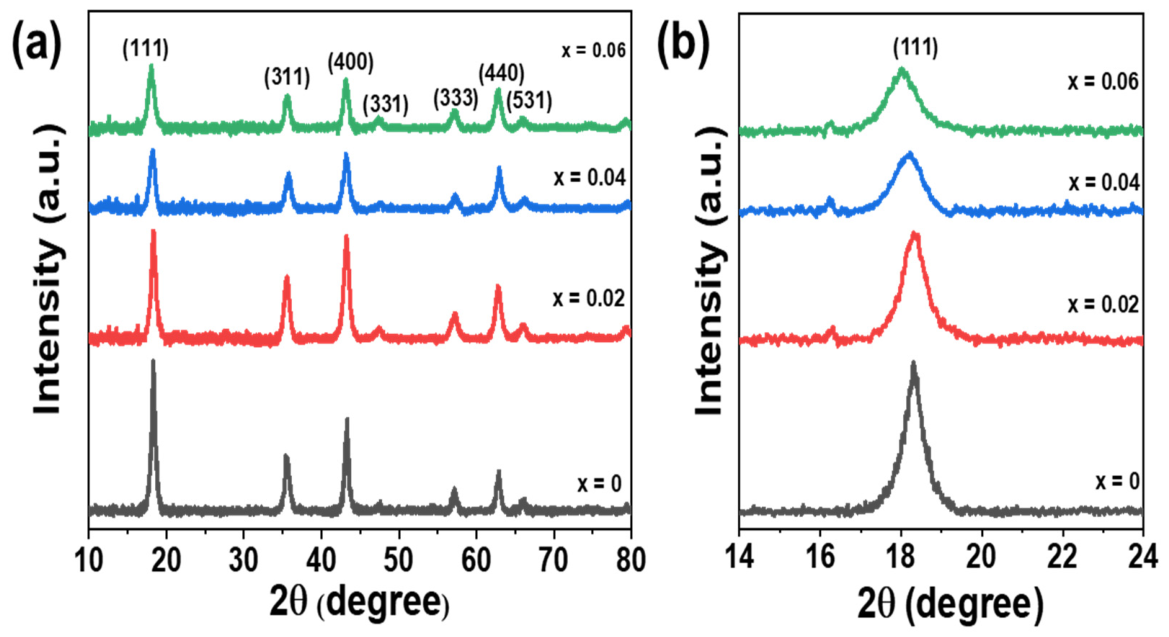
The phase formation and crystal structure of the synthesized lanthanum-doped Li4Ti5O12 samples, denoted as Li4Ti5−xLaxO12 (x = 0.00, 0.02, 0.04, and 0.06), were examined using X-ray diffraction analysis and the results are illustrated in Figure 2a. The diffraction patterns of all compositions exhibited a similar profile and can be indexed to a cubic spinel structure with the Fd 3 ¯ m space group and are in good agreement with the standard Li4Ti5O12 data (JCPDS card no. 49-0207) [29]. The XRD patterns observed at 2θ angles of 18.43°, 35.62°, 43.28°, 47.39°, 57.26°, 62.86° and 66.10° are indexed to the (111), (311), (400), (331), (511), (440), and (531) planes, respectively, indicating the formation of the well-developed spinel phase. No additional peaks are detected within the measurement limits, indicating the absence of secondary phases, suggesting the successful incorporation of lanthanum ions into the Li4Ti5O12 lattice. The variation in the peak position of the (111) planes is clearly observed in the enlarged view shown in Figure 2b, where a systematic shift toward lower 2θ values occurs with the increasing lanthanum content, indicating lattice expansion, The results found are consistent with prior investigations [27,30]. The crystallite size (D), lattice strain (δ) and dislocation density were estimated from the following standard equations [31]:
D = 0.9   λ β   c o s   θ ,
δ = 1 D 2 ,
ε = β c o s   θ 4
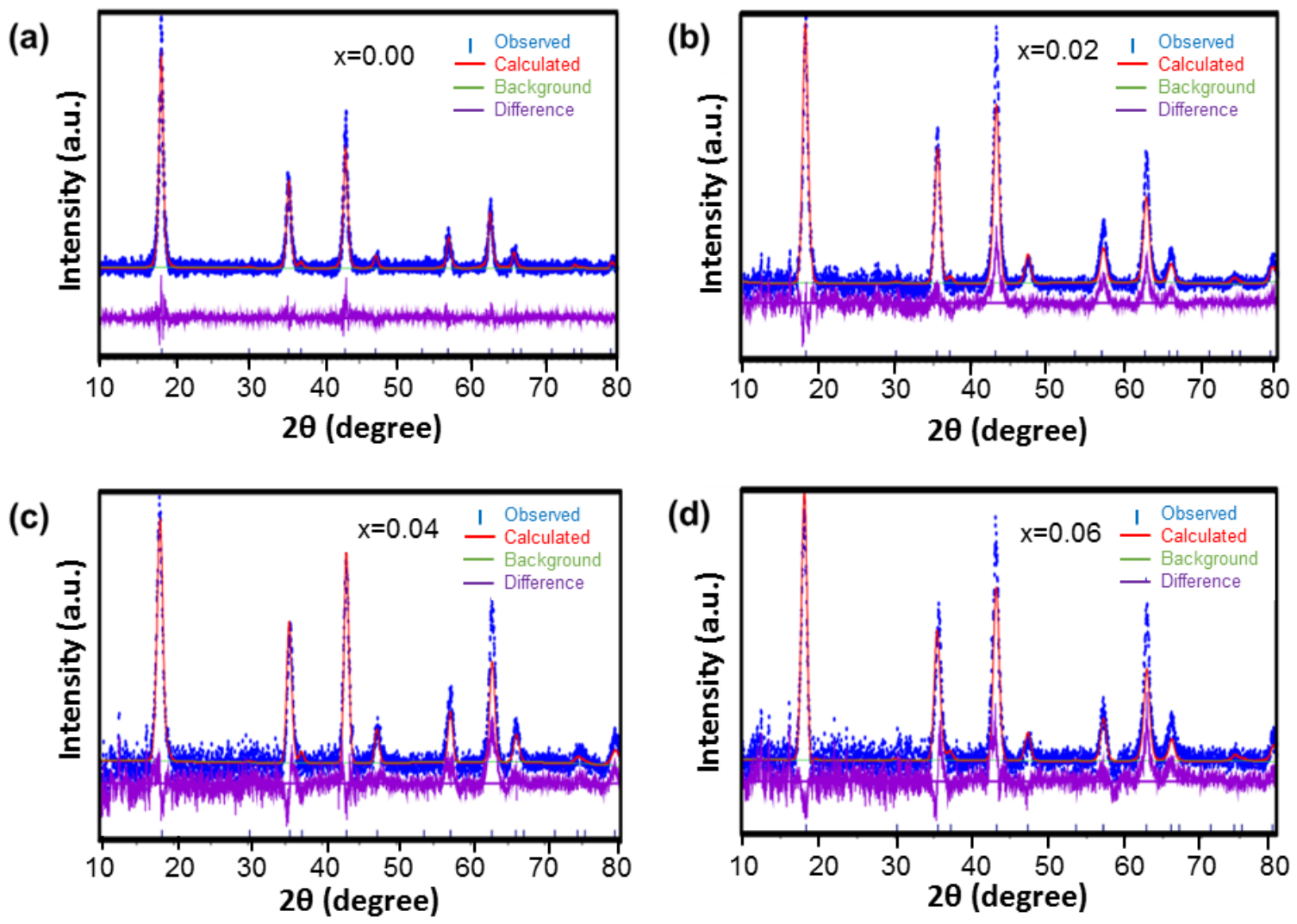
The crystal structure and comprehensive lattice characteristics of the Li4Ti5−xLaxO12 (x = 0.00, 0.02, 0.04, 0.06) samples were analyzed through Rietveld refinement of the XRD data using Fullprof software (Toolbar Fullprof suit program (3.00), version June-2015). Figure 3 shows the Rietveld refinement patterns of Li4Ti5−xLaxO12 (x = 0, 0.02, 0.04, 0.06). The estimated lattice parameters, volume, space group, and Rietveld refinement factor (R factor), are summarized in Table 1. The values of χ2 (the goodness fit) range from 1.06 to 1.6, indicating that the refined data is reliable and confirming the formation of the cubic spinel phase of synthesized Li4Ti5−xLaxO12 (x = 0.00, 0.02, 0.04, 0.06) nanomaterial, which is consistent with Li4Ti5O12 standard data (space group Fd3m, #227). Moreover, the increase in lattice parameters and unit cell volume with the increasing lanthanum content can be attributed to the substitution of La3+ ions at the Ti4+ (16d) sites within the spinel lattice. Due to the larger ionic radius of La3+ (0.103 nm, CN = 6) compared to Ti4+ (0.0605 nm), its incorporation induces lattice expansion, as confirmed by the systematic shift in XRD peaks toward lower 2θ values. Moreover, the aliovalent substitution of La3+ for Ti4+ necessitates charge compensation, which may occur through the partial reduction of Ti4+ to Ti3+ or the formation of oxygen vacancies. Ti3+ ions further contribute to the lattice expansion and enhance the intrinsic electronic conductivity compared to pristine Li4Ti5O12. These findings confirm that La3+ ions are successfully incorporated into the B-site (16d) of the spinel structure without disrupting the fundamental framework [18,30]. The slight expansion of the crystal lattice creates wider diffusion pathways for ions, thereby reducing diffusion resistance and improving ionic conductivity, which is expected to improve electrochemical performance.
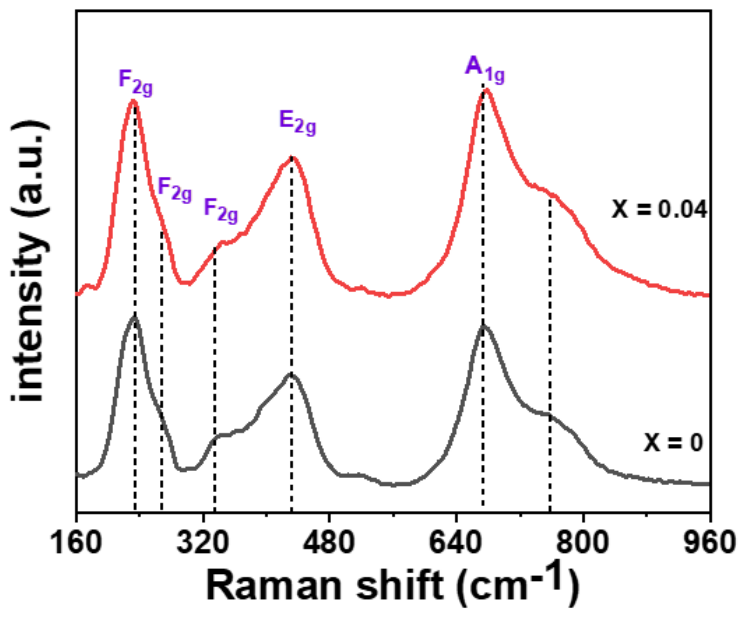
Raman spectroscopy was employed to analyze the vibrational modes and structural properties of Li4Ti5O12 (x = 0.00) and Li4Ti5−xLaxO12 (x = 0.04) and the results are illustrated in Figure 4. In the spectral range 160–960 cm−1, both samples show bands at 233, 265, 334, 428, 623, and 756 cm−1. According to group theory analysis, the cubic spinel Li[Li1/3Ti5/3]O4 lattice with the O7h factor group is expected to possess Raman-allowed phonon modes (A1g + Eg + 3F2g). For spinel Li4Ti5O12, the Raman features appearing in the region between 550 and 700 cm−1 are associated with Ti–O stretching vibration modes within the “TiO6” octahedra, while the bands appearing between the 400 and 550 cm−1 spectral region are attributed to Li–O stretching modes arising from LiO4 tetrahedral sites. In the Raman spectrum, the most intense peak at 673 with shoulder 756 cm−1 is attributed to the A11g and A21g corresponding to Ti–O stretching vibrations associated with TiO6 octahedra. The bands at 233 (F2g1), 265 (F2g2), and 357 (F2g3) are ascribed to the O–Ti–O bending vibrations within the TiO6 octahedra. In addition, the band at 267 cm−1 receives a contribution from the Li–O vibrations, which is related to the partial occupancy of Li ions at the 16d sites (0.1667 occupancy). The second prominent band observed at 428 cm−1 corresponds to the Eg stretching vibrational mode of Li–O ionic bonds located in the LiO4 tetrahedra. A slight shift in the identified Raman A1g1 mode (Figure 4) from 763 cm−1 to 768 cm−1 corresponded to Ti–O stretching vibrations, suggesting the successful substitution of La ions into the spinel Li4Ti5O12 lattice and may indicate partial substitution at the 16d octahedra sites occupied by Ti in pristine Li4Ti5O12. Furthermore, this result indicates that La doping does not significantly affect the vibration properties of Li4Ti5O12, which is consistent with the XRD results [18,29].

3.2. Morphological Analysis and Compositional Analysis

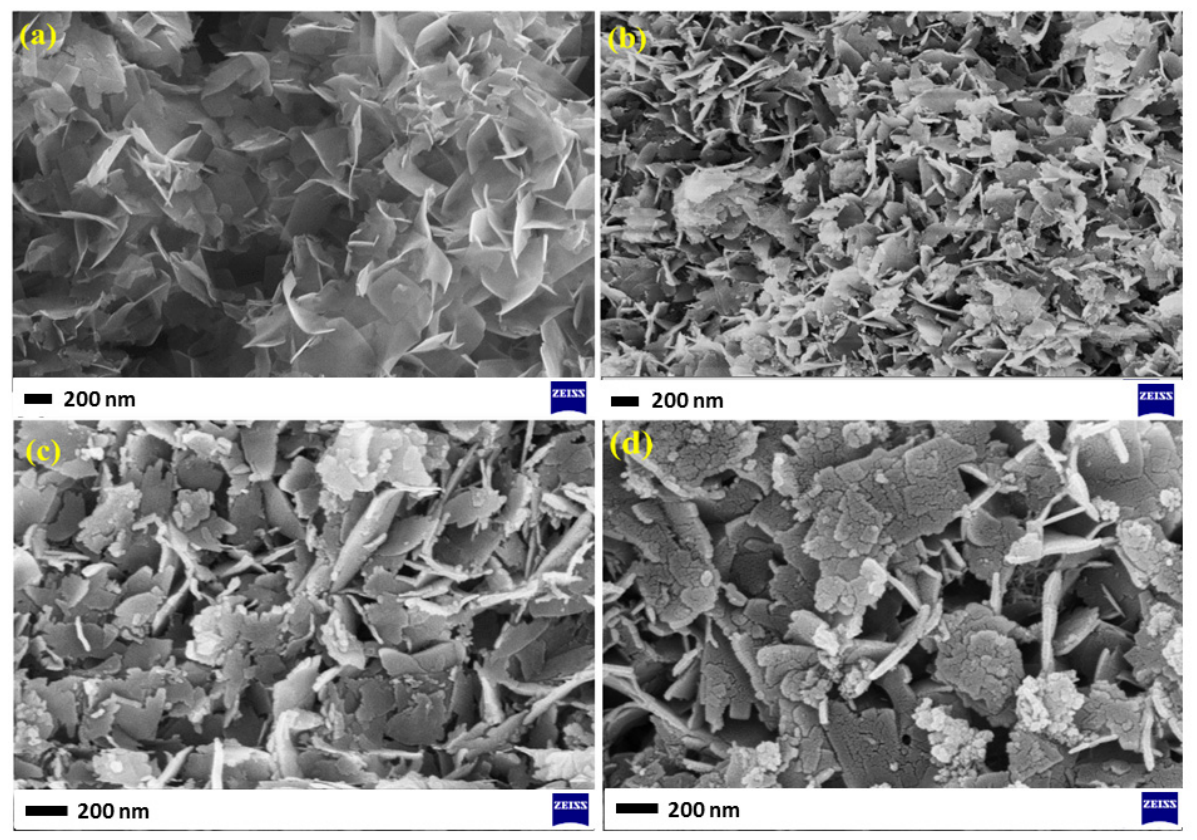
Field emission scanning electron microscopy (FESEM) visuals depict the surface morphology of the pure and lanthanum-doped Li4Ti5−xLaxO12 (x = 0.02, 0.04, and 0.06) samples, demonstrating significant alterations resulting from lanthanum incorporation, as illustrated in Figure 5. The pure Li4Ti5O12 (Figure 5a) displays well-defined nanoflake-like formations characterized by smooth surfaces and identical sharp edges, signifying controlled and homogenous growth. The overall shape of the nanoflakes is predominantly maintained in all the doped LTO samples; nevertheless, progressive alterations in surface features are noted. At a low doping concentration of x = 0.02 (Figure 5b), the nanoflakes closely resemble the pure sample; nonetheless, they exhibit a loosely stacked arrangement with somewhat irregular and less-defined edges, signifying the preliminary effect of La incorporation on growth behavior. With an increase in the lanthanum content to x = 0.04 (Figure 5c), fine nanoparticles begin to manifest on the surface of the nanoflakes, resulting in heightened surface roughness. At this intermediate doping level, lanthanum ions promote the uniform formation of nanoparticles on the nanoflakes, consequently enhancing the effective surface area and creating additional electroactive sites. At elevated doping levels of x = 0.06 (Figure 5d), the nanoflakes exhibit a dense decoration of nanoparticles, leading to a highly rough surface and irregular edges. However, excessive accumulation of nanoparticles at this stage may result in agglomeration, as illustrated in Figure S1 (Supplementary file), and partial obstruction of active sites, which could impede ion diffusion and augment charge transfer resistance, consequently impairing electrochemical performance. The advancement in morphological evolution can be ascribed to the integration of La3+ ions, which generate lattice strain and charge imbalance owing to the discrepancies in ionic size and valence with Ti4+. As result, imperfection-like oxygen vacancies emerge, serving as supplementary nucleation sites for the growth of secondary particles. The observed effects alter the kinetics of nucleation and growth, facilitating the emergence of nanoparticles on the surface of the nanoflakes, all the while maintaining the essential flake-like architecture. Therefore, the optimized nanoparticle–nanoflake hybrid architecture, especially at x = 0.04, proves advantageous for electrochemical applications as it merges a high surface area with effective ion and electron transport pathways.
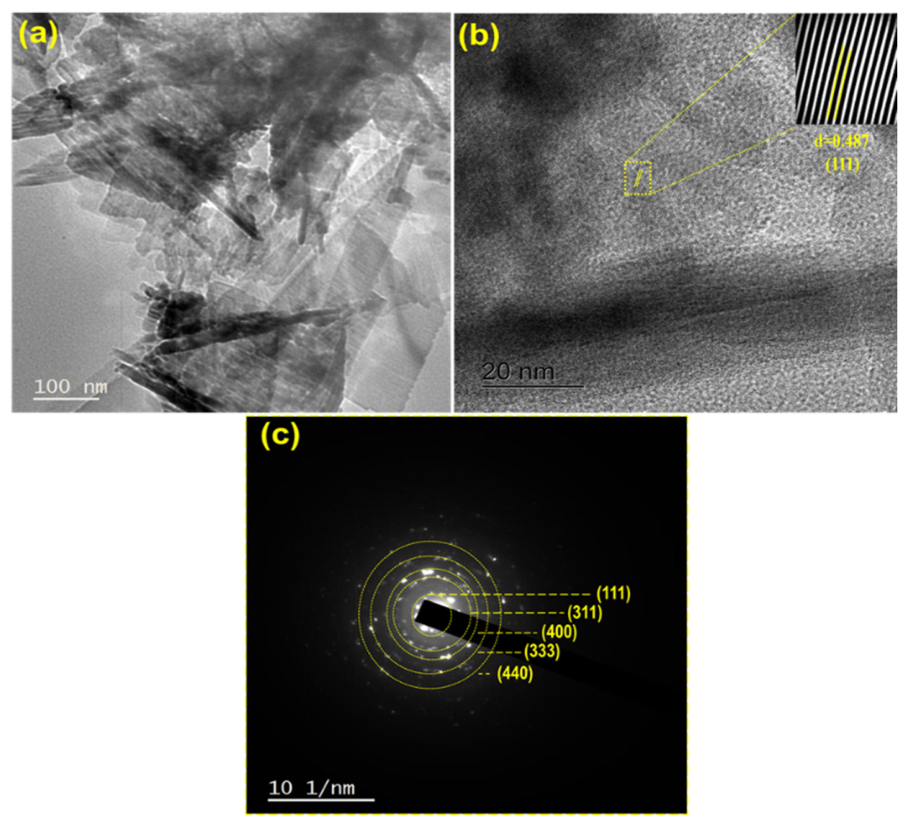
High-resolution transmission electron microscopy (HRTEM) studies were performed to conduct a thorough examination of the internal crystal structure and morphology of the Li4Ti4.96La0.04O12 nanoflakes. Upon examination of the low-magnification TEM image (Figure 6a), it is evident that the sample displays a sheet-like morphology, aligning with the FESEM results and affirming the development of nanoflake structures. The HRTEM image depicted in Figure 6b offers a more pronounced structural insight, distinctly showcasing well-defined lattice fringes with an interplanar spacing of 0.487 nm, corresponding to the (111) plane of Li4Ti5O12. The observed value aligns closely with the results obtained from the XRD analysis. The marginal increase in lattice spacing relative to the standard value (0.483 nm) is ascribed to the introduction of La3+ ions, which possess a greater ionic radius, resulting in lattice expansion and so validating the successful substitution of lanthanum within the crystal lattice. Additionally, the SAED pattern (Figure 6c) displays clear concentric rings with bright spots corresponding to the (111), (311), (400), (333), and (400) planes, which correlated well with the XRD data, hence corroborating the polycrystalline nature of the material.
The elemental composition of the synthesized Li4Ti4.96La0.04O12 nanoflakes was examined through energy-dispersive X-ray analysis (EDX), as illustrated in Figure S2, confirming the existence of titanium, oxygen, and lanthanum in substantial amounts. The detection of La signals along with lithium, titanium and oxygen in the EDX spectrum indicates its presence in the Li4Ti5O12 host lattice without evidence of secondary phases. Lithium is not detected due to its low atomic number and weak X-ray emission, which lies below the sensitivity limit of EDX analysis. The overall elemental composition suggests a homogeneous distribution of the constituent elements, supporting the formation of the doped material. The elemental composition obtained from the EDX analyses is reported as supplementary data in Table S1 (Supplementary file).

3.3. Electrochemical Analyses

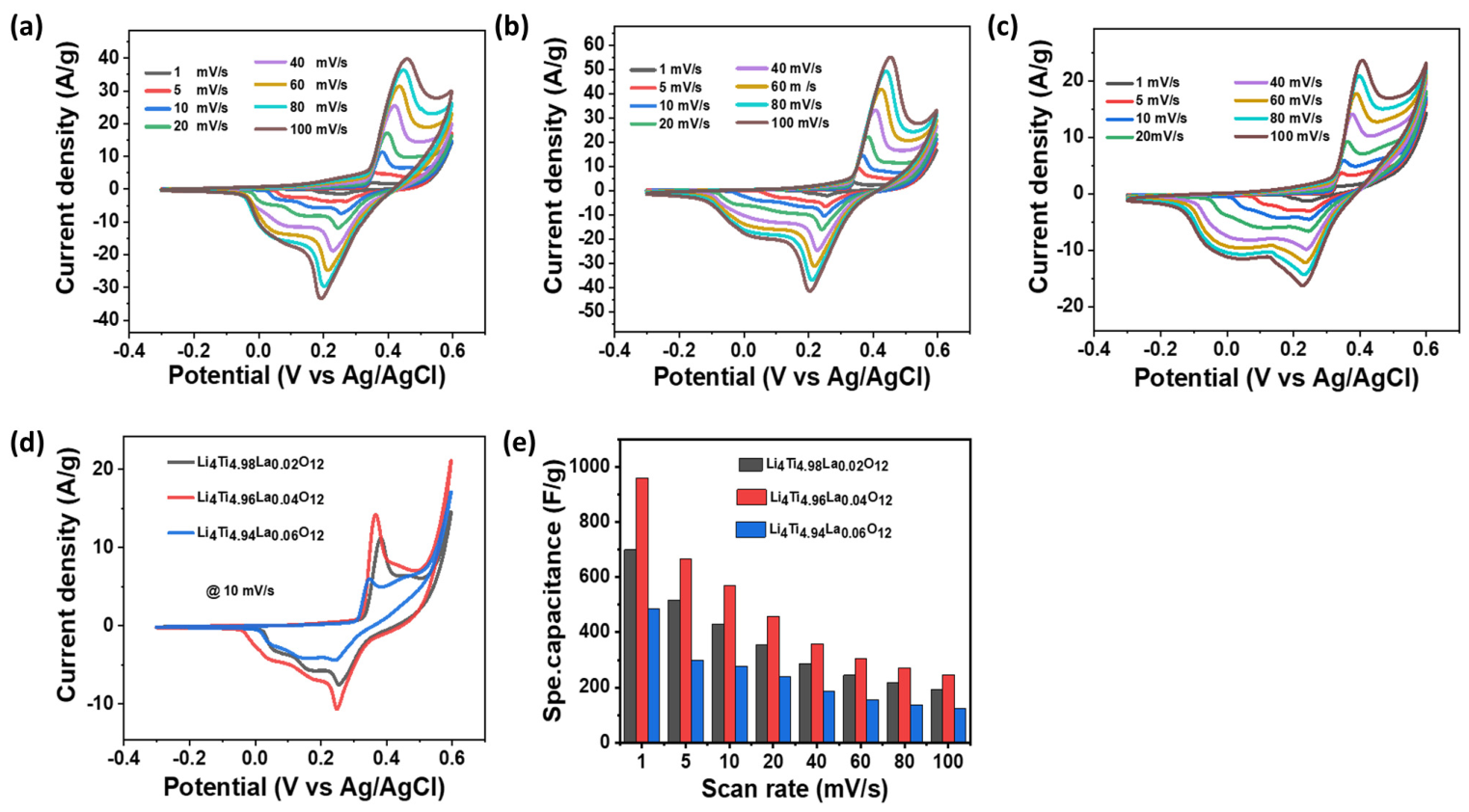
The electrochemical performance of the synthesized Li4Ti5xLaxO12 (x = 0.02, 0.04, 0.06) samples was assessed using a standard three-electrode system in a 1 mol L−1 KOH electrolyte. Cycle voltammetry (CV), galvanostatic charge–discharge (GCD), and electrochemical impedance spectroscopy (EIS) measurements were conducted within a potential window ranging from −0.3 to 0.6. A silver/silver chloride (Ag/AgCl) electrode functioned as the reference electrode, whereas platinum was utilized as the counter electrode throughout all the electrochemical experiments. The CV curves for all the prepared electrodes, captured at an array of scan rates including 1, 5, 10, 20, 40, 60, 80, and 100 mV s−1, are illustrated in Figure 7. The measurements were conducted to evaluate their electrochemical behavior and capacitive performance. The progression of CV profiles with heightened scan rates offers a deeper understanding of the charge storage mechanisms and redox processes that transpire during the electrochemical reaction.
The cyclic voltammetry (CV) profiles of the synthesized Li4T5−xLaxO12 (x = 0.02, 0.04, 0.06) electrodes, obtained at different scan rates and illustrated in Figure 7a–c, exhibit distinct anodic and cathodic peaks for all samples. The redox characteristics arise from the reversible Ti4+/Ti3+ electrochemical transition, which involves the insertion and extraction of K+ ions inside the electrode structure, hence validating the pseudocapacitive charge storage behavior of the electrode [31,32,33]. The redox peaks are distinctly sharp and easily identifiable, even at elevated scan rates, suggesting rapid charge transfer kinetics and excellent reversibility of the faradaic reactions. With an increase in the scan rate, there is a proportional rise in the current response, indicating a heightened level of electrochemical activity at higher sweep rates. Furthermore, an insignificant displacement of the anodic peaks to elevated potentials and the cathodic peaks to diminished potentials is noted with the increasing scan rates, attributable to heightened polarization and internal resistance affecting ion diffusion and electron transport [34]. These findings indicate consistent electrochemical performance characterized by high reversibility and commendable rate capability across all produced compositions.
Figure 7d indicates that the CV profiles recorded at 10 mV s−1 demonstrate that the Li4Ti4.96La0.04O12 electrode possesses a greater enclosed area than the other samples. A larger integral area indicates enhanced charge storage during the redox process, demonstrating superior electrochemical performance under equivalent working circumstances. This behavior indicates improved charge transfer and increased use of active material within the electrode. Subsequently, the specific capacitance of all samples was determined using Equation (4) [35]:
C sp ( F g 1 ) =   1 m . v . v V i V f I V d V ,
where V i V f I V d V signifies the cumulative area beneath the CV curve, m represents the mass of the active material, ν refers to the scan rate, and ΔV signifies the applied potential window. The computed values are displayed in Table 2.
The specific capacitance variation with sweep rates, illustrated in Figure 7e, demonstrates that the Li4Ti4.96La0.04O12 electrode exhibits the highest capacitance among the three compositions; this can be attributed to minimal lanthanum incorporation and its nanoparticle-assembled flake-like morphology, which enhances the electroactive surface area and charge transport. In all instances, the specific capacitance diminishes as the scan rate escalates, primarily due to elevated sweep speeds offering inadequate time for electrolyte ions to infiltrate the electrode architecture. Consequently, charge storage is predominantly restricted to the outer surface, thereby constraining the efficient use of active material. Conversely, with lower scan speeds, ions have sufficient time to diffuse into the electrode’s inner regions, facilitating more comprehensive involvement of electroactive sites and resulting in elevated specific capacitance values [34,36].
In order to deepen the comprehension of the charge storage mechanism demonstrated by the CV curves, a kinetics analysis was conducted. The correlation between the scan rate and the resultant current response can be articulated through the power law equation, a prevalent method for examining the charge storage characteristics of electrode materials (Equation (5)) [37]:
I = ᵇ.
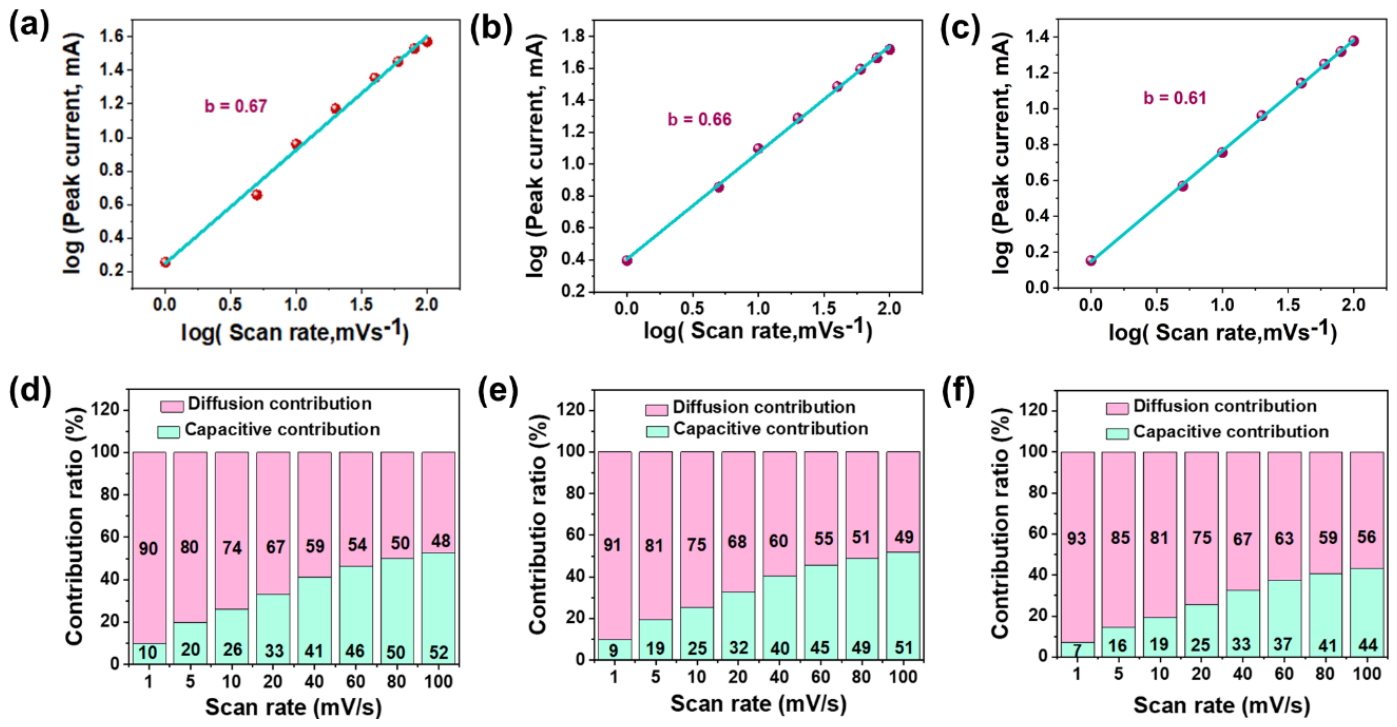
In this equation, I is the peak current and ν indicates the scan rate. A b-value of 0.5 represents that the electrochemical reaction is primarily governed by ion diffusion, while a b-value of 1 denotes a surface-controlled capacitive behavior. In instances where the b-value is situated within the range of 0.5 to 1.0, one can observe that both the surface capacitive effects and diffusion-controlled processes play a significant role in the charge storage mechanism. A linear correlation between log (I) and log (ν) was utilized for the b-values for the Li4Ti5−xLaxO12 (x = 0.02, 0.04, 0.06) electrodes. The b-values determined for these samples were 0.67, 0.66 and 0.61, respectively, as depicted in Figure 8. Given that these values reside within the range of 0.5 to 1.0, the mechanism of charge storage is influenced by an interplay of diffusion-controlled reactions and surface capacitive processes. In order to conduct a more thorough assessment of the charge storage mechanism, Dunn’s method was utilized to distinguish between the capacitive and diffusion-controlled contributions. The current response (i) at a specified potential (V) can be articulated as follows:
I(V) = k1ν + k2 ν1/2,
where ν represents the scan rate, and k1 and k2 are variable parameters. By rearranging the Equation (6), it becomes:
I(V)/ν1/2 = k1ν1/2 + k2.
The constants were derived from the slope and intercept of the linear correlation of I(V)/ν1/2 against ν1/2 [38]. The relevant graphs are illustrated in Figure S3. The quantitative assessment of the contributions from the capacitive and diffusion-controlled process at varying scan rates was conducted. The proportion of capacitive contribution Cc was determined through the application of the Expression (8) [39]:
C c   ( % )   =   k 1 ν I ( V ) × 100 .
As illustrated in Figure 8d–f, each of the three samples demonstrates characteristics of both the capacitive and diffusion-controlled charge storage mechanisms. Nevertheless, the Li4Ti4.94La0.06O12 sample exhibits a relatively more diffusion-controlled contribution, suggesting a more pronounced impact of ion diffusion within the electrode material. Conversely, the Li4Ti4.98La0.02O12 and Li4Ti4.96La0.04O12 electrodes exhibit a more equitable or hybrid contribution from both the capacitive and diffusion-controlled mechanisms. At reduced scan speeds, the diffusion-controlled mechanism prevails as electrolyte ions are afforded adequate opportunity to infiltrate the electrode matrix more profoundly. As the scan rate escalates, the capacitive contribution becomes more pronounced due to the restricted time limiting ion diffusion, resulting in charge storage predominantly occurring via surface-controlling processes.
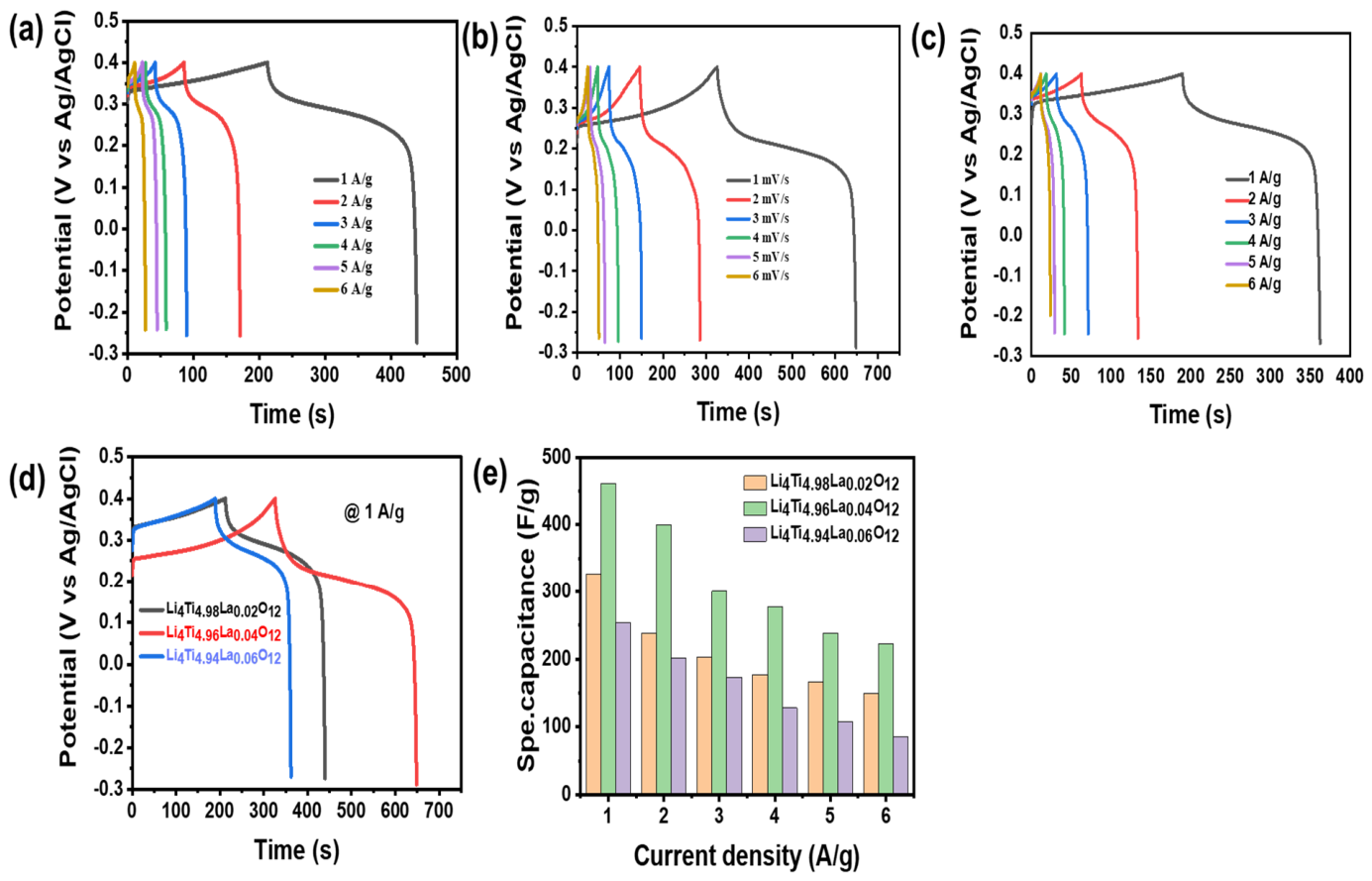
Galvanostatic charge–discharge (GCD) tests were conducted to investigate the charge storage properties of the Li4Ti5−xLaxO12 (x = 0.02, 0.04, and 0.06) electrodes at current densities between 1 and 6 A g−1.
The GCD curves seen in Figure 9a–c display approximately symmetrical triangular profiles, signifying excellent electrochemical reversibility. A minor IR decrease noted at the onset of the discharge curve is ascribed to the internal resistance of the electrode and electrolyte. The specific capacitance (Cs) of the electrodes was determined from the discharge curves utilizing the subsequent equation (Equation (9)):
C S = I   t m V ,
where I denoted the discharge current (A), ∆t signifies the discharge duration (s), m represents the mass of the active material (g), and ∆V indicates the potential window (V). The computed specific capacitance values are presented in Table 3.
Figure 9d presents a comparative GCD curve at 1 A g−1 current density, demonstrating that the Li4Ti4.96La0.04O12 electrode possesses a prolonged discharge duration compared to the other samples, signifying superior charge storage capacity. The determined specific capacitance values at this current density are approximately 327, 461, and 254 F g−1 for Li4Ti4.98La0.02O12, Li4Ti4.96La0.04O12, and Li4Ti4.94La0.06O12, respectively. Moreover, the relationship between the specific capacitance and current density, illustrated in Figure 9e, substantiates that the Li4Ti4.96La0.04O12 electrode exhibits the highest specific capacitance throughout the whole range of current densities in comparison to the other samples. The enhanced performance is due to the appropriate level of lanthanum doping, where moderate La3+ inclusion improves electrical conductivity and increases the availability of electrochemically active sites. Conversely, excessive doping can cause structural distortion and impede efficient charge transport, thereby diminishing electrochemical performance [40]. Moreover, the flake-like shape offers an increased surface area, promotes efficient electrolyte infiltration, and reduces ion diffusion distances [41], all of which promote the electrochemical performance of the Li4Ti4.96La0.04O12 electrode.
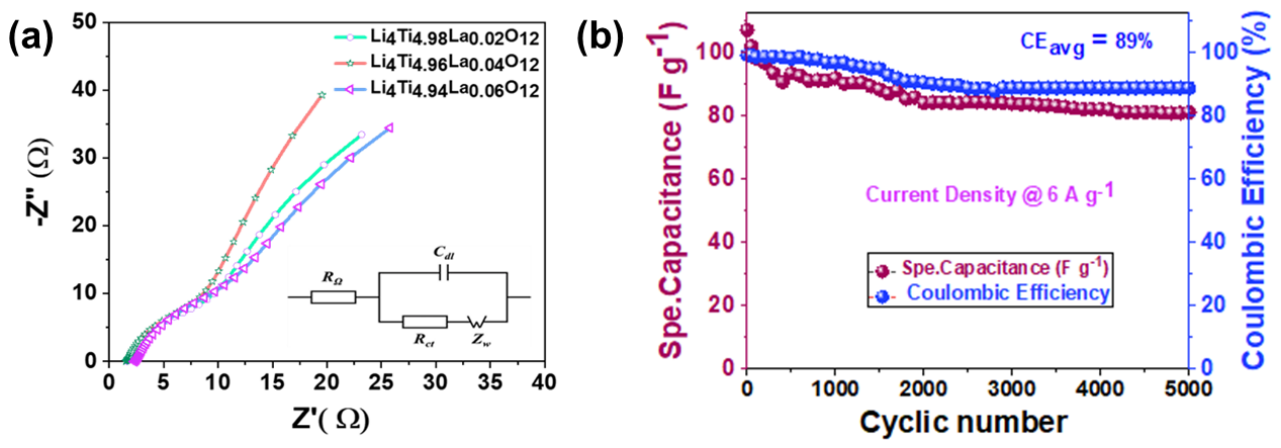
Electrochemical impedance spectroscopy (EIS) was performed to evaluate the charge transport characteristics of Li4Ti5−xLaxO12 (x = 0.02, 0.04, and 006) electrodes throughout a frequency range from 0.01 Hz to 100 kHz with an AC amplitude of 5 mV. The results of the Nyquist plots are illustrated in Figure 10a. The intercept in the high-frequency area signifies the solution resistance (Rs), while the semicircle in the high-to-mid-frequency region represents the charge transfer resistance (Rct) linked to the faradaic processes at the electrode–electrolyte interface. The sloped line seen in the low-frequency range signifies Warburg impedance, which denotes ion diffusion within the electrode material [42,43]. The computed Rs values are 1.5, 1.1, and 2.2 Ω, while the Rct values are 7.2, 6.0, and 8.5 Ω for Li4Ti4.98La0.02O12, Li4Ti4.96La0.04O12 and Li4Ti4.94La0.04O12, respectively. The inclined line has 70 degrees with real impedance (x-axis) in the low-frequency region, corresponding to Warburg impedance (Zw), which confirms the diffusion process. The EIS spectrum is well fitted with the equivalent circuit, as shown in the inset of Figure 10a. Among these samples, Li4Ti4.96La0.04O12 demonstrates the lowest Rs and Rct values, along with low diffusion resistance, indicating fast charge transfer kinetics and enhanced ion transport at the electrode–electrolyte interface.
The enhanced electrochemical performance observed can be ascribed to the judicious integration of lanthanum, which significantly boosts electrical conductivity and promotes the expedited transport of electrons and ions. For justification, the electrical conductivity values of Li4Ti5O12 and Li4Ti4.96La0.04O12 are measured using a standard four-probe technique. The calculated electrical conductivity of Li4Ti4.96La0.04O12 at room temperature is 3.56 × 10⁻⁶ S cm−1, which is higher than the conductivity of 6.42 × 10⁻⁹ S cm−1 for pure Li4Ti5O12. As a result, the Li4Ti4.96La0.04O12 electrode exhibits a more extensive CV integral area and an elevated GCD-derived specific capacitance, thereby affirming its enhanced electrochemical performance. The cycling stability of the Li4Ti4.96La0.04O12 electrode was assessed during 5000 continuous charge–discharge cycles at a current density of 6 A g−1, as illustrated in Figure 10b. The electrode maintains almost 80% of its initial capacitance, indicating commendable electrochemical stability with just a slight performance degradation throughout extended cycling. Furthermore, the electrode demonstrates a Coulombic efficiency of approximately 89%. The enhanced stability is due to the structural integrity of the Li4Ti4.96La0.04O12 framework and the stable interaction between the electrode and electrolyte, which preserve electrochemical performance throughout repeated cycling. The findings indicate that the Li4Ti4.96La0.04O12 electrode demonstrates dependable long-term stability for energy storage applications.
The rate capabilities of the Li4Ti5−xLaxO12 (x = 0.02, 0.04, and 0.06) electrodes were calculated by analyzing the capacitance retention at different current densities (1, 2, 3, 4, 5 and 6 A g−1). As shown in Table S2 (Supplementary file), the capacitance retention decreases with the increasing current densities from 1 to 6 A g−1, which can be attributed to the insufficient ion diffusion at high charge–discharge rates and limited accessibility of electroactive sites. Among the tested electrodes, Li4Ti5−xLaxO12 (x = 0.04) demonstrates a good rate capability due to the optimal La doping and its nanoflake morphology that effectively facilitate charge transport and electrolyte ion diffusion; this observation is consistent with its lower Rs and Rct values observed from the EIS analysis. Finally, these results confirm the Li4Ti4.96La0.04O12 electrode demonstrates the most favorable rate capability and high charge storage performance.
The exceptional specific capacitance of Li4T4.96La0.04O12 can be attributed to the optimal doping of La3+, which improves electronic conductivity and elevates the number of electrochemically active sites while maintaining minimal lattice distortion. The introduction of doping, combined with a marginally dwindled crystallite size, results in an expanded surface area and more concise ion diffusion pathways, thereby enhancing the efficacy of charge storage. Furthermore, the hybrid nanostructure of the electrode, characterized by the assembly of nanoparticles into nanoflakes, provides numerous pathways for electrolyte infiltration and enhances ion accessibility. The integration of these structural benefits, coupled with the minimal charge transfer resistance (Rct) observed in the samples, facilitates swift electron and ion transport. This phenomenon leads to expanded CV integral areas and elevated GCD-derived specific capacitance, thereby affirming the exceptional electrochemical performance of the electrode.
A comparison of the present results with the electrochemical properties of LTO supercapacitive electrodes (i.e., specific capacitance, long-life cycling) reported in the literature is presented in Table 4 [26,29,34,44,45,46,47,48,49,50,51,52,53,54,55,56,57,58,59]. In terms of long-life stability, the 4% La-doped LTO (Li4Ti4.96La0.04O12) operating over 5000 charge/discharge processes at 6 A g−1 current density is better than the the pure LTO nanoparticles synthesized by a solid-state reaction cycled at 500 mA g−1 [45], V-doped LTO/graphene nanocomposite cycled at 1 A g−1 [47], granule LTO prepared by a spray-drying route cycled at 1 A g−1 [51], V-doped LTO nanoflakes cycled at 5 A g−1 [34], and a 3 wt.%CNT/LTO composite exhibiting a specific capacitance of 56 F g−1 [59].

4. Conclusions

In conclusion, for the first time, lanthanum-doped lithium titanate Li4Ti5−xLaxO12 (x = 0.02, 0.04, 0.06) nanoflake-like materials were effectively synthesized using a hydrothermal technique and assessed for electrochemical energy storage applications. XRD investigation verified that all samples exhibit a comparable crystalline phase, with a minor displacement of (111) diffraction peaks toward lower angles, signifying the effective integration of La3+ ions into the lattice. The microstructural characteristics obtained from the XRD data are supported by the Raman studies. The FESEM and TEM analyses demonstrated a flake-like morphology across all compositions. The Li4Ti4.96La0.04O12 sample displayed nanoparticle-assembled nanoflakes that possess relatively advantageous structural and morphological attributes. The EDX analysis confirmed the elemental composition of the optimized sample. Electrochemical analyses revealed that the Li4Ti4.96La0.04O12 electrode has a greater CV integral area and a comparatively low charge transfer resistance (Rct = 6 Ω), signifying enhanced charge transport characteristics. The electrode exhibited a specific capacitance of 461 F g−1 (89.6 mAh g−1) at 1 A g−1, with 80% capacitance retention after 5000 cycles and a Coulombic efficiency of 89%. The results indicate that moderate lanthanum incorporation yields advantageous structural and morphological characteristics that improve electrochemical performance, while excessive doping may cause structural distortion and diminished efficiency, underscoring the potential of optimized Li4Ti4.96La0.04O12 for advanced electrochemical energy storage applications.

Supplementary Materials

The following supporting information can be downloaded at: https://www.mdpi.com/article/10.3390/micro6030054/s1, Figure S1: SEM images for Li4Ti4.94La0.06O12; Figure S2: EDX analysis of Li4Ti4.96La0.04O12 nanoflakes: (a) EDX spectrum and (b) quantitative diagram; Figure S3: log(I) vs log(ν) plots illustrating mixed diffusion- and capacitive-controlled charge storage behavior, accompanied by extracted kinetic parameters (k1 and k2) for Li4Ti4.96LaxO12 nanoflakes: (a) x = 0.02, (b) x = 0.04, and (c) x = 0.06; Table S1: EDX analysis (weight and atomic%) of Li4Ti4.94La0.06O12 nanoflakes; Table S2: analysis of the capacitance retention at different current densities.

Author Contributions

Conceptualization, O.M.H.; investigation, M.D., U.R. and M.H.R.; methodology, O.M.H.; software, M.D.; validation, M.D., U.R. and M.H.R.; formal analysis, M.H.R.; resources, O.M.H.; data curation, M.D., U.R. and M.H.R.; writing—original draft preparation, M.D.; writing—review and editing, C.M.J.; supervision, O.M.H. All authors have read and agreed to the published version of the manuscript.

Funding

This research received no external funding.

Data Availability Statement

Data is available from the corresponding author upon request.

Conflicts of Interest

The authors declare no conflicts of interest.

Abbreviations

The following abbreviations are used in this manuscript:
CNCoordination number
CVCyclic voltammetry
EDLCElectric double-layer capacitor
EDXEnergy-dispersive X-ray spectroscopy
EISElectrochemical impedance spectroscopy
FESEMField emission scanning electron microscopy
GCDGalvanostatic charge–discharge
HRTEMHigh-resolution transmission electron microscopy
LTOLi4Ti5O12
NMPN-methyl-2-pyrrolidone
PVDFPolyvinylidene fluoride
SAEDSelected area electron diffraction
XRDX-ray diffraction

References

  1. Iqbal, S.; Khatoon, H.; Pandit, A.H.; Ahmad, S. Recent development of carbon based materials for energy storage devices. Mater. Sci. Energy Technol. 2019, 2, 417–428. [Google Scholar] [CrossRef] [Scilit]
  2. Elalfy, D.A.; Gouda, E.; Kotb, M.F.; Bureš, V.; Sedhom, B.E. Comprehensive review of energy storage systems technologies, objectives, challenges, and future trends. Energy Strategy Rev. 2024, 54, 101482. [Google Scholar] [CrossRef] [Scilit]
  3. Lu, X.F.; Fang, Y.; Luan, D.; Lou, X.W.D. Metal–organic frameworks derived functional materials for electrochemical energy storage and conversion: A mini review. Nano Lett. 2021, 21, 1555–1565. [Google Scholar] [CrossRef] [Scilit] [PubMed]
  4. Thakkar, P.; Khatri, S.; Dobariya, D.; Patel, D.; Dey, B.; Singh, A.K. Advances in materials and machine learning techniques for energy storage devices: A comprehensive review. J. Energy Storage 2024, 81, 110452. [Google Scholar] [CrossRef] [Scilit]
  5. Chen, M.; Zhang, Y.; Xing, G.; Chou, S.L.; Tang, Y. Electrochemical energy storage devices working in extreme conditions. Energy Environ. Sci. 2021, 14, 3323–3351. [Google Scholar] [CrossRef] [Scilit]
  6. Yu, L.; Chen, G.Z. Supercapatteries as high-performance electrochemical energy storage devices. Electrochem. Energy Rev. 2020, 3, 271–285. [Google Scholar] [CrossRef] [Scilit]
  7. Thaker, A.; Magray, T.; Mani, S.; Makki, A.; Hajar, D.; Nagare, B.J.; Sarawade, P. Solvent-free synthesis of novel cutch tree bark-derived activated carbon decorated with Cu–Co–Mo ternary oxides for high-performance supercapacitor applications. J. Energy Storage 2025, 137, 118591. [Google Scholar] [CrossRef] [Scilit]
  8. Lokhande, P.E.; Kadam, V.; Jagtap, C.; Mohite, D.D.; Udayabhaskar, R.; Thangavelu, P.V.; Qaid, S.M.; Kumar, A. Comparative performance of aqueous and ionic liquid-based gel electrolytes in Co(OH)2/rGO-based supercapacitor. Energy Technol. 2024, 12, 2400995. [Google Scholar] [CrossRef] [Scilit]
  9. Agrahari, D.S.; Thali, B.G.; Kamble, R.M. Reduced graphene oxide dependent optimization of Mn3O4/NiMnO3/rGO composite with high electrochemical performance for asymmetric supercapacitor. J. Energy Storage 2026, 148, 120028. [Google Scholar] [CrossRef] [Scilit]
  10. Mazhar, N.; Khan, Z.; Sandhu, Z.A.; Farhan, M.; Raza, M.A. Next-generation supercapacitors based on samarium nanoparticles: A review of material innovation and charge storage enhancement. Ionics 2026, 32, 2641–2666. [Google Scholar] [CrossRef] [Scilit]
  11. Adriyani, T.R.; Ensafi, A.A. Advanced transition metal electrodes functionalized with chalcogenides and phosphides for enhanced supercapacitor performance. J. Energy Storage 2026, 142, 119526. [Google Scholar] [CrossRef] [Scilit]
  12. Zhao, B.; Ran, R.; Liu, M.; Shao, Z. A comprehensive review of Li4Ti5O12-based electrodes for lithium-ion batteries: The latest advancements and future perspectives. Mater. Sci. Eng. R Rep. 2015, 98, 1–71. [Google Scholar] [CrossRef] [Scilit]
  13. Yuan, T.; Tan, Z.; Ma, C.; Yang, J.; Ma, Z.F.; Zheng, S. Challenges of spinel Li4Ti5O12 for lithium-ion battery industrial applications. Adv. Energy Mater. 2017, 7, 1601625. [Google Scholar] [CrossRef] [Scilit]
  14. Yi, T.F.; Jiang, L.J.; Shu, J.; Yue, C.B.; Zhu, R.S.; Qiao, H.B. Recent development and application of Li4Ti5O12 as anode material of lithium ion battery. J. Phys. Chem. Solids 2010, 71, 1236–1242. [Google Scholar] [CrossRef] [Scilit]
  15. Zhang, Q.; Li, X. Recent developments in the doped-Li4Ti5O12 anode materials of lithium-ion batteries for improving the rate capability. Int. J. Electrochem. Sci. 2013, 8, 6449–6456. [Google Scholar]
  16. Feng, X.; Ding, N.; Dong, Y.; Chen, C.; Liu, Z. A chromium oxide solution modified lithium titanium oxide with much improved rate performance. J. Mater. Chem. A 2013, 1, 15310–15315. [Google Scholar] [CrossRef] [Scilit]
  17. Ezhyeh, Z.N.; Khodaei, M.; Torabi, F. Review on doping strategy in Li4Ti5O12 as an anode material for lithium-ion batteries. Ceram. Int. 2023, 49, 7105–7141. [Google Scholar]
  18. Lakshmi-Narayana, A.; Dhananjaya, M.; Julien, C.M.; Joo, S.W.; Ramana, C.V. Enhanced electrochemical performance of rare-earth metal-ion-doped nanocrystalline Li4Ti5O12 electrodes in high-power Li-ion batteries. ACS Appl. Mater. Interfaces 2023, 15, 20925–20945. [Google Scholar] [PubMed]
  19. Qin, M.; Li, Y.; Lv, X.J. Preparation of Ce-and La-doped Li4Ti5O12 nanosheets and their electrochemical performance in Li half cell and Li4Ti5O12/LiFePO4 full cell batteries. Nanomaterials 2017, 7, 150. [Google Scholar] [PubMed]
  20. Zhou, T.P.; Feng, X.Y.; Guo, X.; Wu, W.W.; Cheng, S.; Xiang, H.F. Solid-state synthesis and electrochemical performance of Ce-doped Li4Ti5O12 anode materials for lithium-ion batteries. Electrochim. Acta 2015, 174, 369–375. [Google Scholar]
  21. Li, Z.; Li, J.; Zhao, Y.; Yang, K.; Gao, F.; Li, X. Structure and electrochemical properties of Sm-doped Li4Ti5O12 as anode material for lithium-ion batteries. RSC Adv. 2016, 6, 15492–15500. [Google Scholar]
  22. Zhang, Q.; Verde, M.G.; Seo, J.K.; Li, X.; Meng, Y.S. Structural and electrochemical properties of Gd-doped Li4Ti5O12 as anode material with improved rate capability for lithium-ion batteries. J. Power Sources 2015, 280, 355–362. [Google Scholar]
  23. Ding, K.; Zhao, J.; Zhou, J.; Zhao, Y.; Chen, Y.; Zhang, Y.; Wei, B.; Wang, L.; He, X. Preparation and characterization of Dy-doped lithium titanate (Li4Ti5O12). Int. J. Electrochem. Sci. 2016, 11, 446–458. [Google Scholar]
  24. Feng, J.; Wang, Y. Ce-doped Li4Ti5O12/C nanoparticles embedded in multiwalled carbon nanotube network as a high-rate and long cycle-life anode for lithium-ion batteries application. Ceram. Int. 2016, 42, 19172–19178. [Google Scholar]
  25. Li, Y.; Wang, Z.; Zhao, D.; Zhang, L. Gd doped single-crystalline Li4Ti5O12/TiO2 nanosheets composites as superior anode material in lithium ion batteries. Electrochim. Acta 2015, 182, 368–375. [Google Scholar] [CrossRef] [Scilit]
  26. Chandrasekhar, J.; Dhananjaya, M.; Hussain, O.M.; Mauger, A.; Julien, C.M. Enhanced electrochemical performance of Li4Ti5O12 by niobium doping for pseudocapacitive applications. Micro 2021, 1, 28–42. [Google Scholar]
  27. Qiu, C.; Yuan, Z.; Liu, L.; Ye, N.; Liu, J. Sol–gel preparation and electrochemical properties of La-doped Li4Ti5O12 anode material for lithium-ion battery. J. Solid State Electrochem. 2013, 17, 841–847. [Google Scholar]
  28. Gao, J.; Jiang, C.; Wan, C. Synthesis and characterization of spherical La-doped nanocrystalline Li4Ti5O12/C compound for lithium-ion batteries. J. Electrochem. Soc. 2010, 157, K39–K42. [Google Scholar]
  29. Deng, S.; Li, J.; Sun, S.; Wang, H.; Liu, J.; Yan, H. Synthesis and electrochemical properties of Li4Ti5O12 spheres and its application for hybrid supercapacitors. Electrochim. Acta 2014, 146, 37–43. [Google Scholar]
  30. Yi, T.F.; Xie, Y.; Wu, Q.; Liu, H.; Jiang, L.; Ye, M.; Zhu, R. High rate cycling performance of lanthanum-modified Li4Ti5O12 anode materials for lithium-ion batteries. J. Power Sources 2012, 214, 220–226. [Google Scholar]
  31. Haritha, B.; Deepak, M.; Dhananjaya, M.; Hussain, O.M.; Julien, C.M. Lanthanum-doped Co3O4 nanocubes synthesized via hydrothermal method for high-performance supercapacitors. Nanomaterials 2025, 15, 1515. [Google Scholar] [PubMed]
  32. Gui, F.; Zhou, X.; Huang, K.; Li, X.; Yan, Z.; Luo, Z.; Yang, L.; Huang, J.; Wang, G.; Xu, G.; et al. Tailoring the ionic conductivity of composite electrolyte by La-doping regulated Li4Ti5O12 for solid state lithium metal batteries. Acta Mater. 2025, 286, 120720. [Google Scholar]
  33. Bhatti, H.S.; Awan, S.U.; Ismail, P.M.; Iqbal, A.M.; Arafat, Y.; Khan, S. Correlation of enhanced electrochemical properties with electrical transport properties in cobalt-doped Li4Ti5O12 anode for supercapacitor applications. Mater. Chem. Phys. 2025, 349, 131658. [Google Scholar]
  34. Deepak, M.; Hussain, O.M.; Julien, C.M. Microstructure and electrochemical properties of pure and vanadium-doped Li4Ti5O12 nanoflakes for high performance supercapacitors. Inorganics 2025, 13, 223. [Google Scholar]
  35. Shaik, D.P.; Kumar, M.S.; Reddy, P.N.K.; Hussain, O.M. High electrochemical performance of spinel Mn3O4 over Co3O4 nanocrystals. J. Mol. Struct. 2021, 1241, 130619. [Google Scholar]
  36. Shaik, D.P.; Pitcheri, R.; Qiu, Y.; Hussain, O.M. Hydrothermally synthesized porous Mn3O4 nanoparticles with enhanced electrochemical performance for supercapacitors. Ceram. Int. 2019, 45, 2226–2233. [Google Scholar] [CrossRef] [Scilit]
  37. Jayakumar, A.; Thiripuranthagan, S.; Mohamed Abubakkar, M.I.; Erusappan, E. Investigating electrochemical impedance and performance variation in nanostructured Mn3O4/activated carbon/reduced graphene oxide asymmetric supercapacitors with different electrolytes. J. Appl. Electrochem. 2025, 55, 527–544. [Google Scholar]
  38. Li, X.; Chen, D.; Luo, Y.; Hu, R.; Huang, L.; Chen, S. Tuning the oxygen vacancies and electronic structure by Co ion doping for electrospun CuMn2O4 high-performance supercapacitors. J. Energy Storage 2026, 143, 119758. [Google Scholar]
  39. Naresh, B.; Sreekanth, T.V.M.; Suma, C.N.; Yoo, K.; Kim, J. Urea-driven synthesis of MnCo2O4 nanocomposites for high-performance supercapacitors. J. Alloys Compd. 2025, 1037, 182232. [Google Scholar]
  40. Yu, J.; Ma, J.; Zhang, H.; Hang, J.; Tian, W.; Tian, X.; Yang, H. Electrochemical behavior of La-doped high-rate LiMn0.6Fe0.4PO4@C nanocomposite battery material. Ceram. Int. 2025, 51, 26443–26451. [Google Scholar]
  41. Li, J.; Hu, X.; Chen, D.; Gu, J.; Wu, Q. Facile synthesis of superthin Co3O4 porous nanoflake for stable electrochemical supercapacitor. ChemistrySelect 2018, 3, 9622–9626. [Google Scholar]
  42. Desai, N.; Mathew, A.J.; Sudhakar, Y.N.; Vinod, T.P.; Joshi, S.S.; Choudhari, K.S. Electrospun PAN/TEMPO nanofiber electrode: Dual charge storage mechanism for supercapacitor applications. Compos. Part B Eng. 2026, 313, 113405. [Google Scholar] [CrossRef] [Scilit]
  43. Azemtsop, T.M. Optical, vibrational, electrical, and electrochemical studies of new plasticized methylcellulose-based solid polymer electrolytes for supercapacitor application. Electrochem. Sci. Adv. 2024, 4, e2300018. [Google Scholar]
  44. Gao, L.; Huang, D.; Shen, Y.; Wang, M. Rutile-TiO2 decorated Li4Ti5O12 nanosheet arrays with 3D interconnected architecture as anodes for high performance hybrid supercapacitors. J. Mater. Chem. A 2015, 3, 23570–23576. [Google Scholar]
  45. Jinka, C.S.; Merum, D.; ObilliMahammad, H. Microsctructural and supercapacitive performance of cubic spinel Li4Ti5O12nanocomposite. Eur. J. Mater. Sci. Eng. 2020, 5, 222–233. [Google Scholar]
  46. Xing, L.-L.; Huang, K.-J.; Cao, S.X.; Pang, H. Chesnut shell-like Li4Ti5O12 hollow spheres for high-performance aqueous asymmetric supercapacitors. Chem. Eng. J. 2018, 333, 253–259. [Google Scholar]
  47. Lee, G.-W.; Kim, M.-S.; Jeong, J.H.; Roh, H.-K.; Roh, K.C.; Kim, K.-B. Comparative study of Li4Ti5O12 composites prepared with pristine, oxidized, and surfactant-treated multiwalled carbon nanotubes for high-power hybrid supercapacitors. ChemElectroChem 2018, 5, 2357–2365. [Google Scholar]
  48. Khairy, M.; Faisal, K.; Mousa, M.A. High-performance hybrid supercapacitor based on pure and doped Li4Ti5O12 and graphene. J. Solid State Electrochem. 2017, 21, 873–882. [Google Scholar]
  49. Jung, H.-G.; Venugopal, N.; Scrosati, B.; Sun, Y.-K. A high energy and power density hybrid supercapacitor based on an advanced carbon-coated Li4Ti5O12 electrode. J. Power Sources 2013, 221, 266–271. [Google Scholar]
  50. Ni, J.; Yang, L.; Wang, H.; Gao, L. A high-performance hybrid supercapacitor with Li4Ti5O12-C nano-composite prepared by in situ and ex situ carbon modification. J. Solid State Electrochem. 2012, 16, 2791–2796. [Google Scholar]
  51. Lee, B.-G.; Lee, S.-H. Application of hybrid supercapacitor using granule Li4Ti5O12/activated carbon with variation of current density. J. Power Sources 2017, 343, 545–549. [Google Scholar]
  52. Choi, H.S.; Im, J.H.; Kim, T.-H.; Park, J.H.; Park, C.R. Advanced energy storage device: A hybrid BatCap system consisting of battery-supercapacitor hybrid electrodes based on Li4Ti5O12-activated-carbon hybrid nanotubes. J. Mater. Chem. 2012, 12, 16986–16993. [Google Scholar]
  53. Dsoke, S.; Fuchs, B.; Gucciardi, E.; Wohlfahrt-Mehrens, M. The importance of the electrode mass ratio in a Li-ion capacitor based on activated carbon and Li4Ti5O12. J. Power Sources 2015, 282, 385–393. [Google Scholar] [CrossRef] [Scilit]
  54. Zuo, W.; Wang, C.; Li, Y.; Liu, J. Directly grown nanostructured electrodes for high volumetric energy density binder-free hybrid supercapacitors: A case study of CNTs//Li4Ti5O12. Sci. Rep. 2014, 5, 7780. [Google Scholar]
  55. Raj, H.; Saxena, S.; Sil, A. Li4Ti5O12/AC hybrid supercapacitor combining high power of supercapacitor and high energy of Li-ion battery. Mater. Today Proc. 2019, 18, 2625–2631. [Google Scholar]
  56. Kim, J.H.; Yoon, J.R. Preparation and characterization of Li4Ti5O12 synthesized using hydrogen titanate nanowire for hybrid super capacitor. J. Adv. Ceram. 2013, 2, 285–290. [Google Scholar]
  57. Xing, L.-L.; Wu, X.; Huang, K.-J. High-performance supercapacitor based on three-dimensional flower-shaped Li4Ti5O12-graphene hybrid and pine needles derived honeycomb carbon. J. Colloid Interface Sci. 2018, 529, 171–179. [Google Scholar] [PubMed]
  58. Gangaja, B.; Nair, S.V.; Santhanagopalan, D. Interface-engineered Li4Ti5O12-TiO2 dual-phase nanoparticles and CNT additive for supercapacitor-like high-power Li-ion battery applications. Nanotechnology 2018, 29, 095402. [Google Scholar] [PubMed]
  59. Lee, B.-G.; Lee, S.-H.; Ahn, H.-J.; Toon, J.-R. High performance hybrid supercapacitors using granule Li4Ti5O12/carbon nanotube anode. J. Alloys Compd. 2018, 748, 882–888. [Google Scholar]
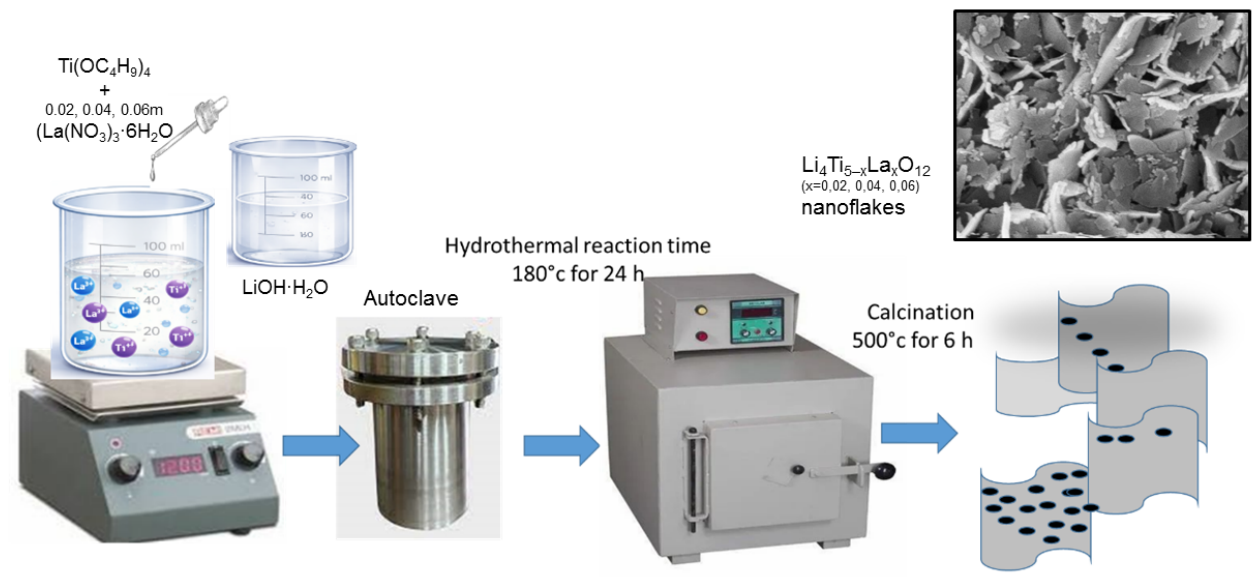
Figure 1. Schematic representation of the hydrothermal synthesis of La-doped Li4Ti5O12 nanoflakes including a final calcination at 500 °C for 6 h.
Micro 06 00054 g001
Figure 2. (a) X- ray diffraction (XRD) pattern of pure and La-doped Li4Ti5O12 (x = 0.00, 0.02, 0.04, and 0.06) samples recorded with the X-ray CuKα radiation. (b) Enlarged perspective of the distinctive (111) diffraction peak.
Micro 06 00054 g002
Figure 3. Rietveld refinement results of Li4Ti5−xLaxO12 nanoflakes: (a) x = 0.00, (b) x = 0.02, (c) x = 0.04, (d) x = 0.06.
Micro 06 00054 g003
Figure 4. Raman spectra of pristine Li4Ti5O12 and Li4Ti5−xLaxO12 nanoflakes (x = 0.04).
Micro 06 00054 g004
Figure 5. SEM micrographs of Li4Ti5−xLaxO12 nanoflakes: (a) pristine Li4Ti5O12, (b) x = 0.02, (c) x = 0.04, and (d) x = 0.06.
Micro 06 00054 g005
Figure 6. TEM analysis of Li4Ti5−xO12 (x = 0.04) nanoflakes: (a) low-magnification image, (b) HRTEM illustrating lattice fringes, and (c) SAED pattern.
Micro 06 00054 g006
Figure 7. Cyclic voltammetry profiles of Li4T5−xLaxO12 electrodes recorded at different scan rates in the range 1–100 mV s−1. (a) x = 0.02, (b) x = 0.04, (c) x = 0.06. (d) Relative comparison of cyclic voltammograms recorded at 10 mV s−1. (e) Histograms of specific capacitance at different scan rates.
Micro 06 00054 g007
Figure 8. Electrochemical kinetics analysis of Li4Ti5−xO12 (x = 0.02, 0.04, and 0.06): (ac) b-value determination from the log (I) vs. log (ν) plots; (df) capacitive and diffusion-controlled contribution.
Micro 06 00054 g008
Figure 9. Galvanostatic charge–discharge (GCD) profiles of Li4Ti5−xO12 electrodes (x = 0.02, 0.04, and 0.06). (ac) GCD curves at different current densities in the range 1–6 A g−1. (d) Relative comparison at 10 mV s−1. (e) Histograms at different current densities.
Micro 06 00054 g009
Figure 10. (a) Nyquist plots for Li4Ti5−xLaO12 nanoflakes (x = 0.02, 0.04, and 0.06). (b) Long-term cyclic performance of Li4Ti4.96La0.04O12 nanoflakes.
Micro 06 00054 g010
Table 1. Crystallographic properties and Rietveld refinement parameters of Li4Ti5−xLaxO12 nanoflakes (x = 0.00, 0.02, 0.04, and 0.06).
ParametersLi4Ti5−xLaxO12 Samples
x = 0.00x = 0.02x = 0.04x = 0.06
χ21.6131.0611.391.061
RWP10.3539.0869.1637.959
RP7.7468.0477.2447.74
RBragg factor6.5778.2688.2718.408
Rstructure factor7.8437.9226.2745.907
a (Å)8.356208.365188.390138.39305
α = β = γ90°90°90°90°
V (Å3)583.48583.36590.62590.612
Crystallite size (nm)139.69.710.3
Dislocation density (line/m2)6.311 × 10151.089 × 10161.094 × 10169.847 × 1015
Microstrain (rd)0.008270.009880.010510.00952
Table 2. Specific capacitance values of Li4T5−xLaxO12 (x = 0.02, 0.04, 006) electrodes at different scan rates.
Scan Rate (mV s−1)Specific Capacitance (F g−1) (Li4Ti5−xLaxO12)
x = 0.02x = 0.04x = 0.06
1700960484
5516666299
10430570277
20354458239
40285357185
60243305155
80217271137
100218271137
Table 3. Specific capacitance values of Li4T5−xLaxO12 (x = 0.02, 0.04, and 006) electrodes at different current densities (1–6 A g−1).
Current Density (A g−1)Specific Capacitance (F g−1) (Li4Ti5−xLaxO12)
x = 0.02x = 0.04x = 0.06
1327461254
2238400201
3203300173
4177277128
5166238107
614922385
Table 4. Comparative study of the electrochemical performance of LTO-based anode for pseudocapacitor devices. Cycle number is given in parenthesis. CR = capacity retention.
MaterialSynthesisElectrochemical PerformanceReference
LTO spheresMolten salt168 mAh g−1 @ 0.2C; CR = 93% (100) [29]
r-TiO2-decorated LTOHydrothermal143 mAh g−1@30C; CR = 92% (3000)[44]
LTO (46 nm)Solid-state route265 F g−1@0.5A g−1; CR = 81% (500)[45]
LTO hollow spheresHydrothermal653 F g−1@1 A g−1[46]
7 wt.% MWCNT/LTOSpray drying164 mAh g−1 @ 0.2C; CR~97% (1000)[47]
V-LTO/grapheneBall milling207 Fg−1@5 mVs−1; 180 F g−1@1 A g−1 (5000)[48]
C-coated LTOHydrothermal163 mAh g−1@1C; CR = 95% @10C (1000)[49]
C-modified LTOIn situ method83 F g−1@2C; CR = 84% @32C (9000)[50]
Granule LTOSpray drying46 F g−1@0.3 Ag−1; CR~84%@1 Ag−1 (10,000)[51]
LTO/AC nanotubesIn situ sol–gel128–84 mAh g−1@0.1–40 A g−1[52]
LTO/carbon blackWet chemistry156 mAh g−1@1C; CR = 70% (1000)[53]
8%Nb-doped LTOSolid-state route497 Fg−1@1 Ag−1; CR = 92% @ 1 Ag−1(5000)[26]
LTO nanowiresSolid-state route0.235 mAhcm−2@0.4mA cm−2 (400)[54]
LTO nanoparticlesSolid-state route10 mAh g−1@100 mA g−1; CR = 86% (80)[55]
V-LTO nanoflakesHydrothermal442 F g−1@1 Ag−1; CR = 90%@5 Ag−1(2000)[34]
LTOHydrothermal196 mAh g−1@1 A g−1; CR = 87% (30)[56]
3D-LTO@grapheneHydrothermal706 mAh g−1@1 A g−1; CR = 90% (2000)[57]
LTO-TiO2 (85:15)Single pot174 mAh g−1@2 Ag−1; CR = 85% (3000)[58]
3 wt.%CNT/LTO2-stage process56 F g−1@6 A g−1; CR = 92% (6000)[59]
4%La3+-doped LTOHydrothermal461 F g−1@1 A g−1(89.6 mAh g−1)This work
CR = 80% @ 6 Ag−1 (5000)
Disclaimer/Publisher’s Note: The statements, opinions and data contained in all publications are solely those of the individual author(s) and contributor(s) and not of MDPI and/or the editor(s). MDPI and/or the editor(s) disclaim responsibility for any injury to people or property resulting from any ideas, methods, instructions or products referred to in the content.