Article

Dynamic Changes in Nutrients and Bioactives During Germination of Two New Mung Bean Cultivars

1
Key Laboratory of Grain Crop Genetic Resources Evaluation and Utilization (MARA), Institute of Crop Sciences, Chinese Academy of Agricultural Sciences, Beijing 100081, China
2
Beijing Fangyuan Pingan Biotechnology Co., Ltd., Beijing 101100, China
*
Author to whom correspondence should be addressed.
Crops 2026, 6(4), 70; https://doi.org/10.3390/crops6040070
Submission received: 14 October 2025 / Revised: 16 July 2026 / Accepted: 16 July 2026 / Published: 17 July 2026

Abstract

Mung bean sprouts are widely consumed for their nutritional value; however, the temporal dynamics of their key nutrients and bioactive compounds during germination remain underexplored, limiting evidence-based strategies for optimizing harvest time and cultivar selection. This study investigated the accumulation patterns of crude protein, crude starch, vitamin C, total polyphenols, total flavonoids, D-chiro-inositol, vitexin, and isovitexin in two new cultivars (Zhonglv 26 and Zhonglv 27) over a 168 h germination period. Our results revealed that germination consistently enhances protein, vitamin C, polyphenols, flavonoids, and D-chiro-inositol, while reducing starch, vitexin, and isovitexin. Notably, each nutrient reached its maximum at distinct time points—polyphenols at 132–144 h, flavonoids and D-chiro-inositol at 156 h, and protein and vitamin C at 168 h—enabling tailored harvest schedules for specific nutritional goals. Among the cultivars, Zhonglv 27 exhibited higher levels of most measured components, suggesting it may be a more suitable candidate for sprout production aimed at bioactive compound enrichment. These findings establish a time-resolved nutritional framework and may offer useful guidance for producing sprouts with enhanced bioactive content, potentially contributing to the development of value-added sprout products.

1. Introduction

Mung bean sprouts are widely consumed vegetables worldwide, valued for their fresh flavor, taste, and well-balanced nutrition. They serve as a particularly important dietary vegetable in northern regions during winter, when field vegetables are relatively scarce due to low temperatures. Extensive research has investigated the nutritional changes in mung bean sprout samples during germination. For instance, sprouting was reported to increase vitamin C content by 2.7-fold compared with mature grains [1], as well as enhancing ascorbic acid, total phenolic content, and antioxidant capacity [2]. Sprout extracts have demonstrated excellent antioxidant properties [3], and polyphenol-rich extracts have been reported to exhibit hypoglycemic effects and improve insulin resistance in diabetic mouse models. Beyond nutritional profiling, technological interventions—such as urea application [4], light manipulation [5,6], and atmospheric cold plasma treatment [7]—have also been explored to modulate sprout quality, yield, and bioactive compound accumulation. Furthermore, mung bean seeds subjected to 6 h of imbibition and 24 h of germination have been identified as potential sources of amino acids, proteins, glycosylated proteins, and other bioactive metabolites for human nutrition [8]. Collectively, these studies establish germination as an effective bioprocess for enhancing the nutritional value of mung beans.
Although germination is recognized as nutritionally beneficial, the temporal dynamics of nutrient accumulation remain poorly understood. Most studies have focused on a limited set of nutritional indicators or single time points, and comprehensive time-course data on the dynamic changes in multiple nutrients and bioactive compounds during the entire germination process (0–168 h) are lacking, particularly regarding cultivar differences in metabolite accumulation, which have rarely been reported [1,5]. In recent years, we developed two new cultivars, Zhonglv 26 and Zhonglv27, both of which are small-seeded and suitable for sprout production [9]. Assessment of the dynamic changes in nutrients and bioactives during germination of these two cultivars may help consumers select sprouts with appropriate harvest times to meet their preferences.
In this study, we assessed the dynamic changes in basic nutrients (crude protein and crude starch) and bioactive compounds (vitamin C, total polyphenols, total flavonoids, D-chiro-inositol, vitexin, and isovitexin) during germination of Zhonglv 26 and Zhonglv 27 from dry seeds to 168 h sprouts. The objectives were: (1) to characterize the temporal accumulation patterns of these nutritional components throughout the 0–168 h germination period; (2) to compare the compositional profiles between the two cultivars; and (3) to identify evidence-based optimal harvest timings for maximizing specific bioactive compounds. The results are expected to provide useful information for producers and consumers in selecting sprouts with the desired compositional characteristics as well as for breeders developing mung bean varieties with enhanced levels of specific components.

2. Materials and Methods

2.1. Plant Material

Zhonglv 26 and Zhonglv 27, two newly developed cultivars, were used for the germination tests [10,11]. The seeds were both harvested at the end of August 2024 in Shanxi province (37.46° N, 112.55° E). The soil is of the cinnamon type and the climate is warm temperate monsoon. During the growth period, the mean temperature was 23.8 °C, with 108 mm/month precipitation, 8.2 h/day of sunshine, and 66.4% relative humidity.

2.2. Standard Samples and Reagents

Standards of rutin, gallic acid, D-chiro-inositol, vitexin, isovitexin, and vitamin C (all ≥98%, HPLC-grade) were purchased from Beijing Solarbio Technology Co., Ltd. (Beijing, China) and solvents/reagents for sample preparation, including methanol, acetic acid, acetonitrile, ethanol, and sodium hydroxide, were obtained from Mreda Co., Ltd. (Beijing, China).

2.3. Germination Procedures

The germination procedure was similar to that described by Gan et al. [2], with the following modifications to accommodate the experimental design. Seeds (1 kg per cultivar) were sterilized with 75% ethanol for 1 min, followed by a thorough wash with distilled water, and then were soaked in distilled water at room temperature (25 ± 1 °C) for 12 h, instead of 10 h at 22 ± 1 °C. After soaking, they were transferred to a walk-in germination chamber (YL(F)-6×2; China State Shipbuilding Group 704 Research Institute, Shanghai, China) and germinated at 26 °C in complete darkness with a relative humidity of 47.5%. The seeds were manually sprayed with distilled water every 12 h, and no water replacement was performed, instead of being automatically sprayed every 10 min and the water being changed every 12 h.

2.4. Sample Preparation

Two-hundred grams of sprout samples for each cultivar were collected every 12 h, up to 168 h. These samples were freeze-dried in a freeze-dryer (FD-1A-80+; Boikang Co., Ltd., Beijing, China) at −80 °C for 72 h, then ground into powder using a grinder (60-mesh screen) and stored at room temperature for component analysis.

Experimental Design and Replication Structure

For each time point (0, 12, 24, 36, 48, 60, 72, 84, 96, 108, 120, 132, 144, 156, and 168 h), three independent germination batches were established per cultivar. From each batch, approximately 200 g of sprouts were collected at each sampling time point. Three independent batches served as biological replicates, and each sample was measured in triplicate during biochemical analysis to ensure data reliability.

2.5. Determination of Nutrients and Bioactive Compounds

2.5.1. Determination of Crude Protein Content

Protein content was determined according to the National Standard for Food Safety, Determination of Crude Protein in Food (GB 5009.5-2016) [12]. Briefly, 0.5 g powder of each sample was digested with 10 mL H2SO4 (98%) and catalyst mixture (1.5 g CuSO4 + 4.5 g K2SO4) at 420 °C for 1 h. After cooling down, the sample was diluted with 10 mL distilled water. Nitrogen content was quantified using an automated Kjeldahl analyzer (Beijing Tongrunyuan Electromechanical Technology Co., Ltd., Beijing, China) with the following parameters: M = 0.1116 mol/L HCl, and titration volume correction V0 = 0.523 mL. Crude protein content was calculated using the following formula: crude protein = 1.401 × M W × ( V V 0 ) × C , where M = molarity of the titrant (mol/L), W = sample weight (g), V = sample titration volume (mL), V0 = blank titration volume (mL), and C = crude protein conversion factor (6.25).

2.5.2. Determination of Crude Starch Content

Starch content was determined using the polarimetric method, in accordance with the Agricultural Industry Standard of the People’s Republic of China, Determination of Crude Starch in Edible Legumes (NY/T 598-2002) [13]. Briefly, samples (2.500 g) were extracted with 50 mL of 1% HCl in 100 mL volumetric flasks using boiling-water-bath incubation (15 min). After cooling, 5 mL 5% phosphomolybdic acid was added, followed by dilution, filtration, and polarimetric measurement. Calculation: Crude starch = a × 10 4 181   ×   L   ×   m   ×   ( 1     H ) , where α = rotation (°), L = tube length (dm), m = mass (g), and H = moisture (%).

2.5.3. Preparation of Test Solution

The test solution for the determination of bioactive compounds was prepared according to the previous reports [14] as follows: Samples were dissolved in 70% aqueous methanol (w/v, 1:20), sonicated at room temperature for 15 min, and then centrifuged at 10,000 rpm for 10 min for the determination of total polyphenols and total flavonoids. The supernatant was filtered through a 0.22 μm syringe filter for the analysis of D-chiro-inositol, vitexin, and isovitexin. For vitamin C analysis, 0.3 g of sample was weighed and 6 mL of 30 g/L metaphosphoric acid was added. The mixture was sonicated for 5 min, left to precipitate for 10 min, and then the supernatant was filtered through a 0.22 μm syringe filter. All analyses were performed in triplicate.

2.5.4. Determination for Vitamin C Content

Vitamin C content was determined using a High-Performance Liquid Chromatography (HPLC) system (Shimadzu, Kyoto, Japan) equipped with a diode-array UV-vis detector [15]. The compounds were separated on an ACQUITY UPLC BEH C18 column (Waters, Wexford, Ireland; 2.1 mm × 100 mm, 1.7 μm). The mobile phases for vitamin C were: solvent A, 1 g/L metaphosphoric acid, and solvent B, 100% methanol. The flow rate was set to 0.3 mL/min, with an injection volume of 20 μL, and the column temperature was set at 25 °C. Vitamin C was detected at 243 nm.

2.5.5. Determination of Total Polyphenol Content

The total polyphenol content was determined using the Folin–Ciocalteu colorimetric method [16]. Briefly, 1 mL of the test solution was put in a 10 mL centrifuge tube. Then, 1 mL of Folin–Ciocalteu reagent and 2 mL of 7.5% anhydrous sodium carbonate were added. The mixture was diluted to 10 mL with 70% ethanol, followed by thorough shaking, and kept in the dark for 2 h. Then, the mixture was centrifuged at 3000 rpm for 10 min. A 0.1 mL aliquot of the supernatant was transferred for absorbance measurement at 765 nm using a SpectraMax M3 microplate reader (Molecular Devices, LLC., San Jose, CA, USA).

2.5.6. Determination of Total Flavonoid Content

The NaNO2-AlCl3-NaOH method was used for the determination of the total flavonoid content [17]. Briefly, 1 mL of the test solution was put into a 10 mL centrifuge tube, and 300 µL of 5% NaNO2 was added, followed by shaking for 6 min. Then, 300 µL of 10% AlCl3 was added, and the mixture was shaken for another 6 min. Finally, 4 mL of 4% NaOH was added, and the solution was diluted to 10 mL with 70% ethanol. The mixture was shaken thoroughly and allowed to stand for 12 min. The absorbance was then measured at 510 nm.

2.5.7. Determination of D-Chiro-Inositol Content

D-chiro-inositol analysis was performed as described by Yao [18] using ultra-high-pressure liquid chromatography coupled with time-of-flight mass spectrometry (UPLC–TOF–MS/MS). Briefly, UPLC–TOF–MS/MS was carried out using the Prominence Modular UPLC system (AB Sciex LLC, Marlborough, MA, USA). Separation was achieved on an ACQUITY UPLC BEH C18 column (Waters, Wexford, Ireland; 2.1 mm × 100 mm, 1.7 μm) with a gradient elution program. The mobile phase consisted of solution A (water) and solution B (acetonitrile), with the following gradient: 0–0.5 min, 95% A; 0.5–8 min, 95–5% A; 8–8.5 min, 5–95% A; 8.5–10 min, 95–95% A. The flow rate was 0.2 mL/min, and the injection volume was 10 μL. Mass spectrometry was conducted using atmospheric pressure chemical ionization (APCI) with the following settings: temperature, 550 °C; ion spray voltage (IS), −4500 V (negative mode), and the curtain gases were set to 55, 55, and 30 psi, respectively. Collision-induced dissociation was set to medium. Data were acquired at an m/z of 179.16.

2.5.8. Determination of Vitexin and Isovitexin Content

Vitexin and isovitexin were analyzed as described by Kalinová [19], with some modifications. Briefly, the analysis was conducted using a High-Performance Liquid Chromatography (HPLC) system (Shimadzu, Kyoto, Japan) equipped with a diode-array UV-vis detector. The compounds were separated on an ACQUITY UPLC BEH C18 column (Waters, Wexford, Ireland; 2.1 mm × 100 mm, 1.7 μm). The mobile phases used were: solvent A, 0.5% acetic acid, and solvent B, methanol. The flow rate was set to 0.2 mL/min, and the column temperature was maintained at 35 °C. Vitexin and isovitexin were detected at 338 nm.

2.6. Statistical Analysis

The data are expressed as mean ± standard deviation (SD) of three independent biological replicates (n = 3). To evaluate the effects of cultivar, germination time, and their interaction on nutrient and bioactive compound accumulation, two-way analysis of variance (ANOVA) was performed with cultivar (Zhonglv 26 and Zhonglv 27) and germination time (0, 12, 24, 36, 48, 60, 72, 84, 96, 108, 120, 132, 144, 156, and 168 h) as fixed factors, including their interaction term. Tukey’s HSD test was used for post hoc multiple comparisons to control the family-wise error rate. To identify differences among time points within each cultivar, one-way ANOVA followed by Duncan’s multiple range test was also conducted separately for each cultivar. To ensure consistency with the precision of different analytical assays, SD values were reported with one or two decimal places as appropriate. When the actual variation was smaller than the reporting precision (e.g., <0.05 or <0.005), rounding resulted in SD values appearing as 0.0 or 0.00. This reflects rounding rather than true zero variance. All statistical analyses were performed using GraphPad Prism 9 (GraphPad Software, San Diego, CA, USA). Figures were generated using GraphPad Prism 9 and Origin 2024 (OriginLab Corporation, Northampton, MA, USA).

3. Results

3.1. Crude Protein Content

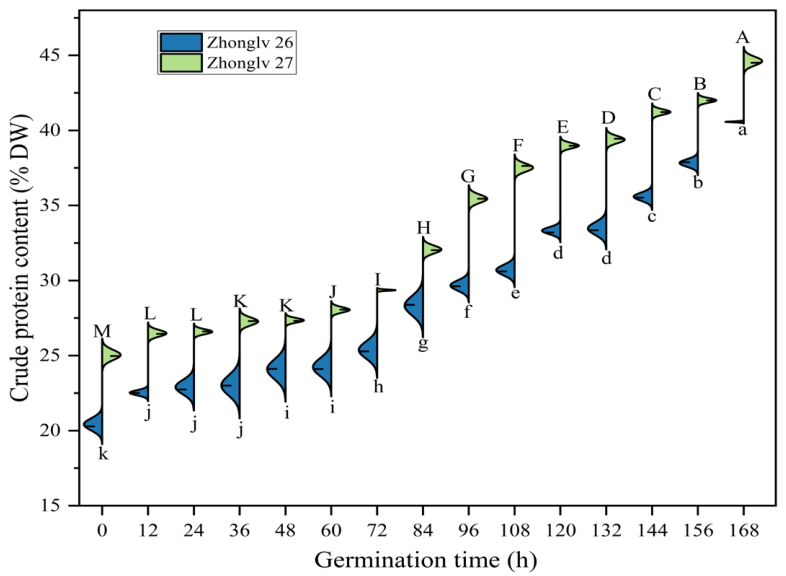
Crude protein content (CP) increased progressively during germination in both cultivars. Zhonglv 27 consistently showed higher CP than Zhonglv 26 throughout the 168 h period, with average values of 30.4% and 25.9%, respectively. At 168 h, CP reached 44.6% in Zhonglv 27 and 40.6% in Zhonglv 26, increasing by 1.8 and 2.0 times, respectively, compared with dry seeds. The fastest increase occurred between 60 and 72 h of germination (Figure 1).

3.2. Crude Starch Content

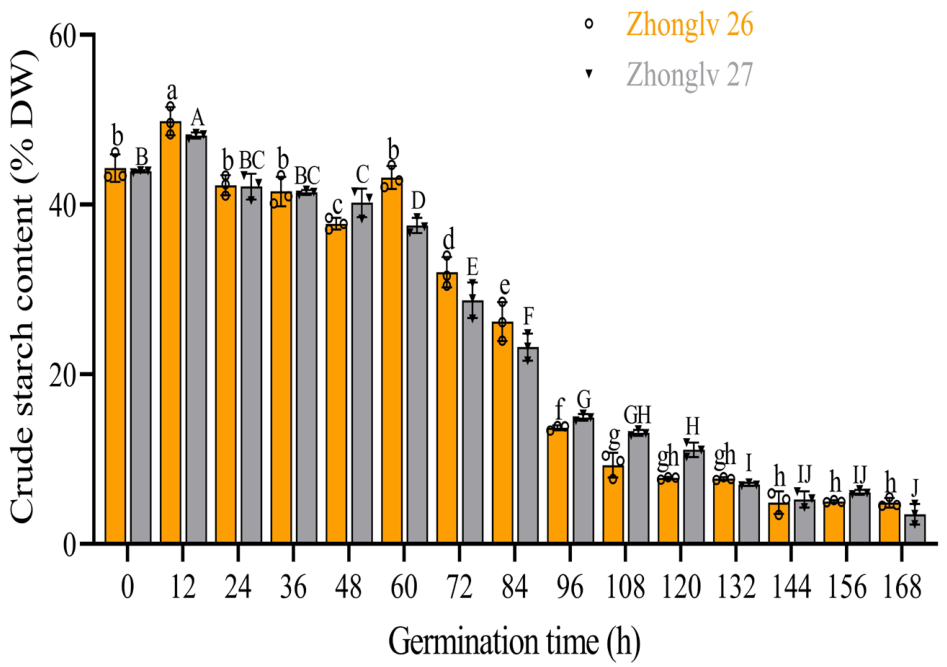
In contrast to CP, crude starch content (CS) decreased steadily during germination in both cultivars. The decline became more obvious after 96 h and reached the minimum values at 168 h. The decrease in Zhonglv 27 (to 3.5%) was slightly larger than that of Zhonglv 26 (to 4.9%). Overall, CS decreased by approximately 89–92% from dry seeds to 168 h sprouts, with no consistent differences between cultivars (Figure 2).

3.3. Vitamin C Content

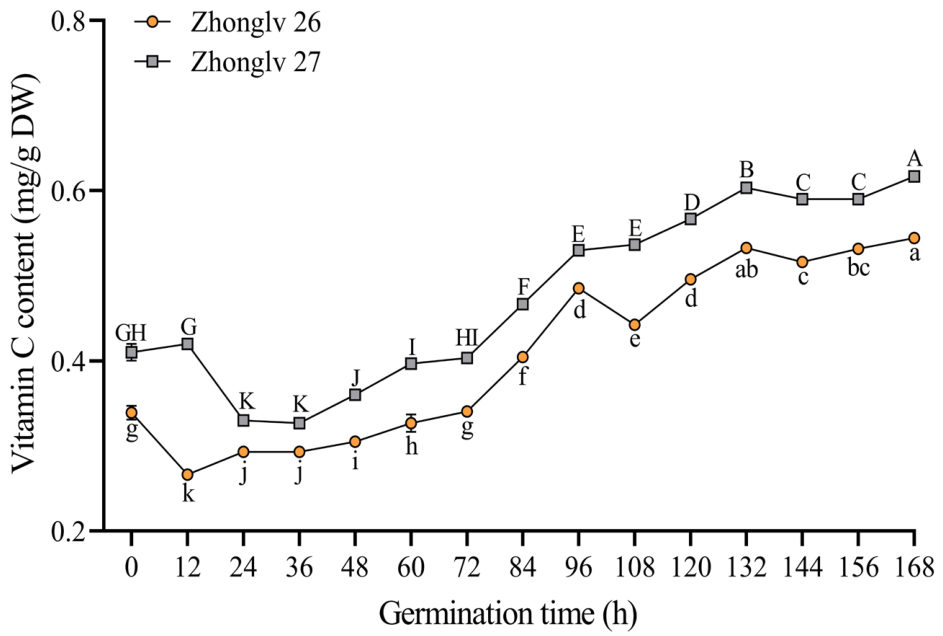
Vitamin C content (VC) showed an overall increasing trend during germination, although a transient decline was observed between 12 and 24 h in both cultivars. At 168 h, VC reached 0.61 mg/g in Zhonglv 27 and 0.54 mg/g in Zhonglv 26, representing a 1.5- and 1.6-times increase, respectively, compared with the dry seeds. Zhonglv 27 maintained higher VC levels than Zhonglv 26 throughout the germination period (Figure 3).

3.4. Total Polyphenol Content

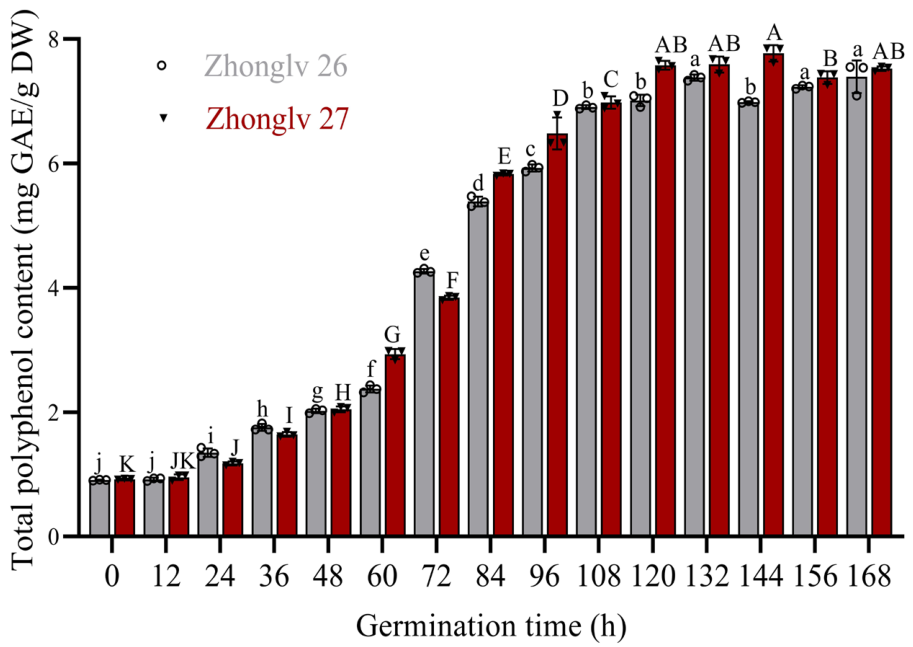
Total polyphenol content (TP) increased continuously during germination in both cultivars too, reaching a peak at 132 h and then beginning to stabilize or slightly decrease. The most rapid accumulation occurred between 60 and 72 h in Zhonglv 26 and between 72 and 84 h in Zhonglv 27. Overall, Zhonglv 27 exhibited slightly higher TP levels than that of Zhonglv 26 throughout the germination period, with average values of 4.7 and 4.5 mg GAE/g DW, respectively. TP reached its peak at 144 h in Zhonglv 27 (7.77 mg GAE/g DW), with a value 8.4 times that of the dry seeds (Figure 4).

3.5. Total Flavonoid Content

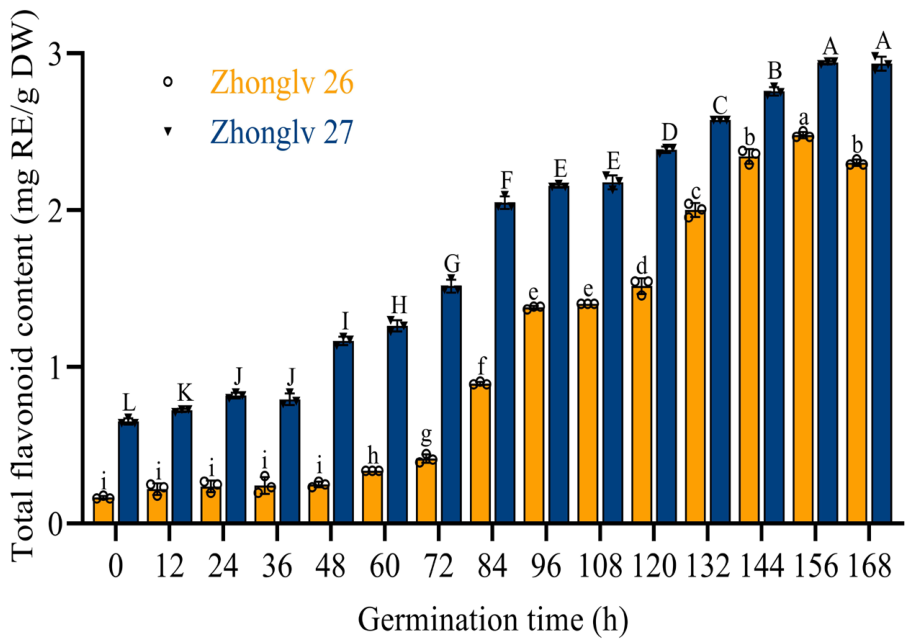
Total flavonoid content (TF) increased steadily during germination, with the most rapid accumulation between 36 and 48 h in both cultivars. At 156 h, TF reached 2.48 mg RE/g DW in Zhonglv 26 and 2.94 mg RE/g DW in Zhonglv 27, which are 15.0 and 4.5 times that of the dry seeds, respectively. Zhonglv 27 consistently maintained higher TF values than Zhonglv 26 throughout germination (Figure 5).

3.6. D-Chiro-Inositol Content

D-chiro-inositol (D-Ci) was not detected in the dry seeds of either cultivar but prominently accumulated during germination, except for a slight decline at 84 h. D-Ci accumulation reached a peak at 156 h both in Zhonglv 26 (3.15 mg/g DW) and Zhonglv 27 (3.93 mg/g DW). Then, D-Ci decreased in both cultivars at 168 h (Table 1).

3.7. Vitexin and Isovitexin Content

Vitexin (VX) and isovitexin (IVX) showed similar accumulation patterns with crude starch, and they were the highest in dry seeds (1.20–1.28 mg/g DW), with continuous declines throughout the germination process. Both VX and IVX reached their minimum values at 168 h for Zhonglv 26 and Zhonglv 27. The decreasing trends were similar for the two cultivars too (Table 2). For VX and IV, somewhat higher values for Zhonglv 27 than for Zhonglv 26 were observed in the dry seeds and the early germination stage, and after germination 120 h, the values were reversed.

3.8. Statistical Comparison Between Cultivars

The two-way ANOVA results for all indices are summarized in Table 3. Crude protein (CP), vitamin C (VC), total polyphenols (TP), total flavonoids (TF) and vitexin (VX) all showed significant cultivar effects (p < 0.001). In contrast, crude starch (CS) and isovitexin (IVX) exhibited no significant cultivar effect (p > 0.05). D-chiro-inositol (D-Ci) also showed a significant cultivar effect (p < 0.01). Germination time had a highly significant effect on all contents (p < 0.0001). Significant cultivar × time interactions were detected for all parameters. Effect-size analysis showed that the most obvious differences between cultivars were found for the total flavonoids (15.41% of total variance), crude protein (11.96%), and vitamin C (10.48%).

3.9. Correlation Analysis

Crude starch was negatively correlated with vitexin and isovitexin (p < 0.01), while both compounds showed significant positive correlations with crude protein, vitamin C, total polyphenols, total flavonoids, and D-chiro-inositol (p < 0.01). This pattern suggests that starch degradation during germination may drive secondary metabolism, leading to the coordinated accumulation of multiple bioactive components in mung bean sprouts.

4. Discussion

Mung bean sprouts are a traditional Asian food ingredient, commonly consumed stir-fried, in soups, in cold dishes, or even raw. Germination has been reported to enhance the levels of nutrients and bioactive compounds in mung beans, and this has been confirmed by numerous studies, leading to the exploration of various techniques for the enhancement of these components during sprout production. Investigating the dynamic changes in nutritional components during sprouting growth can provide useful information for both consumers and producers in selecting appropriate harvest times. In this study, we evaluated eight nutritional and bioactive components in two newly released mung bean cultivars. The results showed that the two cultivars exhibited similar trends in compositional changes during germination, but differed in absolute contents and the time of these changes.

4.1. Metabolic Drivers of Nutrient Dynamics During Germination

Germination is a complex physiological process during which seed reserves are mobilized to support seedling growth. In this study, two distinct patterns of nutrient dynamics were observed: progressive accumulation (crude protein, vitamin C, total polyphenols, total flavonoids, and D-chiro-inositol) and continuous decline (crude starch, vitexin, and isovitexin). These divergent trends are underpinned by the activation of specific metabolic pathways during germination. The progressive increase in phenolic and flavonoid compounds reflects upregulated phenylpropanoid metabolism, with key enzymes such as phenylalanine ammonia-lyase (PAL) and chalcone synthase (CHS) being activated in response to heightened metabolic activity and oxidative stress during seedling establishment [2,20,21]. Vitamin C accumulation is driven by enhanced biosynthesis via the L-galactose pathway, which operates even under dark germination conditions [22]. However, starch degradation is mediated by α- and β-amylase, mobilizing carbohydrate reserves to fuel respiration and provide carbon skeletons for the developing embryo [23]. The decline in vitexin and isovitexin may result from their utilization as substrates in other metabolic pathways or enzymatic degradation during early seedling growth, although the precise catabolic routes warrant further investigation [18].
Crude protein (CP) increased approximately 1.17-fold relative to dry seeds at 120 h, consistent with some previous reports of accumulation [24,25], while a decrease in total protein after germination has also been observed [26]. This discrepancy may be attributable to methodological differences. The Kjeldahl method, used in the present study for CP determination, measures total nitrogen—including protein-bound nitrogen, free amino acids, and peptides generated from storage protein hydrolysis—and converts it to a protein equivalent using a conversion factor of N × 6.25. In contrast, total protein assays (e.g., precipitation-based or dye-binding methods) selectively quantify intact protein fractions. Therefore, the observed increase in CP likely reflects the accumulation of non-protein nitrogenous compounds during germination rather than a true increase in intact protein content.
Crude starch (CS) declined continuously during germination, primarily due to the amylase-mediated hydrolysis of starch to provide energy for respiration and sprout growth [23,27,28]. Notably, Zhonglv 27 showed a more rapid decline after 84 h and reached 3.5% at 168 h compared with 4.9% in Zhonglv 26, indicating that growth rate and energy consumption may vary between cultivars during germination, implying potential for developing specialized varieties for sprout production.
Vitamin C increased during germination, consistent with previous reports [22]. The two cultivars exhibited similar trends, characterized by an initial slight decline (likely due to ROS scavenging during imbibition), followed by a steady increase up to 168 h. A transient decrease was observed in Zhonglv 26 at 108 h, which may reflect a temporary imbalance between synthesis and utilization. The absolute values obtained in our study (on a dry-weight basis) are comparable to those in previous reports [1,29] when accounting for moisture content (85–90% fresh weight), and the qualitative trend of germination-induced accumulation has been consistently reported despite variations in extraction protocols, analytical methods (titration vs. HPLC), and basis of expression across studies [30,31].
Total polyphenols (TP) increased gradually during germination, which is attributed to the activation of phenylpropanoid metabolism in response to oxidative demands of seedling growth [20]. In our results, Zhonglv 27 maintained higher TP levels than Zhonglv 26 throughout germination, indicating a cultivar-dependent difference in phenolic accumulation. Although the peak values obtained in this study were considerably lower than previous reports [6], such quantitative discrepancies are acceptable given the differences in cultivars, germination conditions, and extraction protocols.
Total flavonoids (TF) were consistently higher in Zhonglv 27 than in Zhonglv 26 throughout germination, which aligns with the general trend of flavonoid accumulation during legume sprouting. This cultivar difference further suggests that the capacity for flavonoid accumulation during germination may vary among varieties, providing a potential basis for breeding programs aimed at developing specialized cultivars [7,20].
D-chiro-inositol (D-Ci) was not detected in the dry seeds but appeared after germination, reaching a peak at 156 h in both Zhonglv 26 (3.15 mg/g DW) and Zhonglv 27 (3.93 mg/g DW), followed by a subsequent decline. This peak occurred later than the 80 h peak reported previously [18], which may reflect the differences in cultivars and germination conditions.
Vitexin (VX) and isovitexin (IVX) were most abundant in dry seeds and declined sharply during early germination of the mung beans [1,18]. In terms of absolute values, it could be seen that in the dry seeds or in the early germination stage, both VX and IVX were higher in Zhonglv 27 than in Zhonglv 26. However, after 120 h of germination, the levels in Zhonglv 27 became lower than those in Zhonglv 26. This crossover pattern may provide a reference for selecting appropriate harvest times to obtain sprouts with desired VX and IVX contents.

4.2. Practical Implications for Sprout Production

The compositional dynamics observed in this study may offer practical guidance for mung bean sprout production. The choice of cultivar and harvest time should be aligned with the target compositional outcome. For example, Zhonglv 27 may be more suitable than Zhonglv 26 for producing sprouts enriched in certain bioactive components. The largest cultivar differences were observed for total flavonoids (15.41% of total variance), crude protein (11.96%), and vitamin C (10.48%), indicating that cultivar selection has the greatest impact on these components of nutritional interest. The specific nutrient changes and optimal harvest times for the two cultivars are summarized in Table 4.
These findings may inform the optimization of germination schedules for specific compositional targets, such as the accumulation of bioactive compounds or protein enrichment. The cultivar-specific differences also highlight the potential value of breeding programs for developing mung bean varieties with higher contents of desirable components for sprout production.

5. Conclusions

This study provides a comprehensive time-course characterization of the nutritional and bioactive components of two mung bean cultivars, Zhonglv 26 and Zhonglv 27, during germination (0–168 h). Our results showed that both germination stage and cultivar selection collectively determine the compositional profiles of sprouts, and germination consistently enhanced crude protein, vitamin C, total polyphenols, total flavonoids, and D-chiro-inositol, while reducing crude starch, vitexin, and isovitexin. Among the two cultivars, Zhonglv 27 appeared more suitable for most compositional targets, particularly for protein, vitamin C, and D-chiro-inositol enrichment. The optimal harvest time varied by target compound: 144–156 h for polyphenols and flavonoids, 156 h for D-chiro-inositol, and 168 h for protein and vitamin C; early harvest (<72 h) may be considered for applications requiring higher starch or flavone retention.
Despite these contributions, several limitations should be acknowledged. The germination experiments were conducted under controlled dark conditions with a single seed lot from one growing season; thus, the findings may not be directly generalizable to other cultivars, light regimes, or environmental conditions. Additionally, our analyses were performed on freeze-dried samples, and the stability of bioactive compounds during fresh sprout storage and processing warrants further investigation. Future research should validate these findings under varied cultivation conditions, explore the genetic and enzymatic mechanisms underlying the observed cultivar-specific differences, and assess the retention of key bioactives during post-harvest handling and culinary preparation. Such studies would further strengthen the translational value of time-resolved nutritional frameworks for quality-oriented sprout production.

Author Contributions

Conceptualization, L.W.; methodology, Q.H., C.J. and Y.Y.; investigation, Q.H. and C.J.; data curation, Q.H., H.L. and S.W.; formal analysis, Q.H.; visualization, Q.H.; writing—original draft preparation, Q.H.; writing—review and editing, Q.H. and L.W.; supervision, Y.Y. and L.W.; funding acquisition, L.W. All authors have read and agreed to the published version of the manuscript.

Funding

This research was funded by the National Natural Science Foundation of China (32241042) and the China Agriculture Research System of MOF and MARA-Food Legumes (CARS-08).

Data Availability Statement

All the data are available from the first author upon reasonable request.

Conflicts of Interest

Author Haitao Liu was employed by the company Beijing Fangyuan Pingan Biotechnology Co., Ltd. The remaining authors declare that the research was conducted in the absence of any commercial or financial relationships that could be construed as a potential conflict of interest.

References

  1. Ebert, A.W.; Chang, C.H.; Yan, M.R.; Yang, R.Y. Nutritional composition of mungbean and soybean sprouts compared to their adult growth stage. Food Chem. 2017, 237, 15–22. [Google Scholar] [CrossRef] [Scilit] [PubMed]
  2. Gan, R.Y.; Wang, M.F.; Lui, W.Y.; Wu, K.; Corke, H. Dynamic changes in phytochemical composition and antioxidant capacity in green and black mung bean (Vigna radiata) sprouts. Int. J. Food Sci. Technol. 2016, 51, 2090–2098. [Google Scholar] [CrossRef] [Scilit]
  3. Tang, D.; Dong, Y.; Ren, H.; Li, L.; He, C. A review of phytochemistry, metabolite changes, and medicinal uses of the common food mung bean and its sprouts (Vigna radiata). Chem. Cent. J. 2014, 8, 4. [Google Scholar] [CrossRef] [Scilit] [PubMed]
  4. Wu, L.; Chen, C.Q.; Zhou, X.Y.; Zheng, K.L.; Liang, X.H.; Wei, J. Comparative Proteomics Identified Proteins in Mung Bean Sprouts Under Different Concentrations of Urea. Molecules 2025, 30, 3176. [Google Scholar] [CrossRef] [Scilit] [PubMed]
  5. Perchuk, I.N.; Shelenga, T.V.; Burlyaeva, M.O. The Effect of Illumination Patterns during Mung Bean Seed Germination on the Metabolite Composition of the Sprouts. Plants 2023, 12, 3772. [Google Scholar] [CrossRef] [Scilit] [PubMed]
  6. Siriparu, P.; Panyatip, P.; Pota, T.; Ratha, J.; Yongram, C.; Srisongkram, T.; Sungthong, B.; Puthongking, P. Effect of Germination and Illumination on Melatonin and Its Metabolites, Phenolic Content, and Antioxidant Activity in Mung Bean Sprouts. Plants 2022, 11, 2990. [Google Scholar] [CrossRef] [Scilit] [PubMed]
  7. Chou, Y.J.; Cheng, K.C.; Hsu, F.C.; Wu, J.S.B.; Ting, Y. Producing high quality mung bean sprout using atmospheric cold plasma treatment: Better physical appearance and higher γ-aminobutyric acid (GABA) content. J. Sci. Food Agric. 2021, 101, 6463–6471. [Google Scholar] [CrossRef] [Scilit] [PubMed]
  8. Kartikeyan, A.; Vasudevan, V.; Peter, A.J.; Krishnan, N.; Velmurugan, D.; Velusamy, P.; Anbu, P.; Palani, P.; Raman, P. Effect of incubation period on the glycosylated protein content in germinated and ungerminated seeds of mung bean (Vigna radiata (L.) Wilczek). Int. J. Biol. Macromol. 2022, 217, 633–651. [Google Scholar] [CrossRef] [Scilit] [PubMed]
  9. Wang, S.; Wu, M.; Hu, Q.; Jiang, C.; Wang, S.; Yao, Y.; Wang, L. Nutritional component analysis of mung bean (Vigna radiata L.). SABRAO J. Breed. Genet. 2025, 57, 1050–1059. [Google Scholar] [CrossRef] [Scilit]
  10. Wu, M.M.; Gong, D.; Pan, X.W.; Wang, S.H.; Wang, L.X. Breeding and Utilization Potential of a New Mungbean Variety Zhonglv 26. Chin. Seed Ind. 2023, 41, 133–135. [Google Scholar]
  11. Wang, L.X.; Wang, S.H.; Pan, X.W.; Chen, H.L.; Cheng, X.Z. Breeding of Zhonglv 27. Chin. Seed Ind. 2022, 40, 95–96. [Google Scholar]
  12. GB 5009.5-2016; National Food Safety Standard—Determination of Protein in Food. Standards Press of China: Beijing, China, 2017.
  13. NY/T 598-2002; Edible Mungbean. Standards Press of China: Beijing, China, 2002.
  14. Xiang, Y.; Liu, Z.; Liu, Y.Z.; Dong, B.; Yang, C.Q.; Li, H.H. Ultrasound-assisted extraction, optimization, and purification of total flavonoids from Daphnegenkwa and analysis of their antioxidant, anti-inflammatory, and analgesic activities. Ultrason. Sonochem. 2024, 111, 107079. [Google Scholar] [CrossRef] [Scilit] [PubMed]
  15. Zhong, W.J.; Shi, S.J.; Chen, S.W.; Ji, P.C.; Gong, Y.Y.; Mou, F.S. Determination of vc content in vegetable soybean fresh seed by high performance liquid chromatography. Storage Process 2024, 24, 44–49. [Google Scholar]
  16. Anesini, C.; Ferraro, G.E.; Filip, R. Total Polyphenol Content and Antioxidant Capacity of Commercially Available Tea (Camellia sinensis) in Argentina. J. Agric. Food Chem. 2008, 56, 9225–9229. [Google Scholar] [CrossRef] [Scilit] [PubMed]
  17. Sheng, Z.L.; Wan, P.F.; Dong, C.L.; Li, Y.H. Optimization of total flavonoids content extracted from Flos Populi using response surface methodology. Ind. Crops Prod. 2013, 43, 778–786. [Google Scholar] [CrossRef] [Scilit]
  18. Yao, Y.; Cheng, X.Z.; Ren, G.X. Contents of D-chiro-Inositol, Vitexin, and Isovitexin in Various Varieties of Mung Bean and Its Products. Agric. Sci. China 2011, 10, 1710–1715. [Google Scholar] [CrossRef] [Scilit]
  19. Kalinová, J.P.; Vrchotová, N.; Tříska, J. Vitexin and isovitexin levels in sprouts of selected plants. J. Food Compos. Anal. 2021, 100, 103895. [Google Scholar] [CrossRef] [Scilit]
  20. Xue, Z.H.; Wang, C.; Zhai, L.J.; Yu, W.C.; Chang, H.R.; Kou, X.H.; Zhou, F.J. Bioactive compounds and antioxidant activity of mung bean (Vigna radiata L.), soybean (Glycine max L.) and black bean (Phaseolus vulgaris L.) during the germination process. Czech J. Food Sci. 2016, 34, 68–78. [Google Scholar] [CrossRef] [Scilit]
  21. Kim, J.H.; Lee, B.C.; Kim, J.H.; Sim, G.S.; Lee, D.H.; Lee, K.E.; Yun, Y.P.; Pyc, H.B. The isolation and antioxidative effects of vitexin from Acer palmatum. Arch. Pharmacal Res. 2005, 28, 195–202. [Google Scholar] [CrossRef] [Scilit]
  22. Wang, H.B. Effects of Ultraviolet-B Irradiation on the Quality and Storage of Mung Bean Sprouts (Vigna radiate L. Wilczek). Master’s Thesis, Henan Normal University, Xinxiang, China, 2017. [Google Scholar]
  23. Mubarak, A.E. Nutritional composition and antinutritional factors of mung bean seeds (Phaseolus aureus) as affected by some home traditional processes. Food Chem. 2005, 89, 489–495. [Google Scholar] [CrossRef] [Scilit]
  24. Chandrasiri, S.D.; Liyanage, R.; Vidanarachchi, J.K.; Weththasinghe, P.; Jayawardana, B.C. Does Processing have a Considerable Effect on the Nutritional and Functional Properties of Mung Bean (Vigna radiata)? Procedia Food Sci. 2016, 6, 352–355. [Google Scholar] [CrossRef] [Scilit]
  25. Masood, T.; Shah, H.U.; Zeb, A. Effect of sprouting time on proximate composition and ascorbic acid level of mung bean (vigna radiate L.) and chickpea (cicer arietinum L.) seeds. J. Anim. Plant Sci. 2014, 24, 850–859. [Google Scholar] [CrossRef] [Scilit]
  26. El-Adawy, T.A.; Rahma, E.H.; El-Bedawey, A.A.; El-Beltagy, A.E. Nutritional potential and functional properties of germinated mung bean, pea and lentil seeds. Plant Foods Hum. Nutr. 2003, 58, 1–13. [Google Scholar] [CrossRef] [Scilit]
  27. Wintersohle, C.; Arnold, S.J.; Geis, H.M.; Keutgen, F.; Etzbach, L.; Schweiggert-Weisz, U. Impact of short-term germination on dehulling efficiency, enzymatic activities, and chemical composition of mung bean seeds (Vigna radiata L.). Future Foods 2024, 10, 100416. [Google Scholar] [CrossRef] [Scilit]
  28. Åman, P. Carbohydrates in raw and germinated seeds from mung bean and chick pea. J. Sci. Food Agric. 1979, 30, 869–875. [Google Scholar] [CrossRef] [Scilit]
  29. Islam, M.J.; Hassan, M.K.; Sarker, S.R.; Rahman, A.B.; Fakir, M.S.A. Light and temperature effects on sprout yield and its proximate composition and vitamin C content in Lignosus and Mung beans. J. Bangladesh Agric. Univ. 2017, 15, 248–254. [Google Scholar] [CrossRef] [Scilit]
  30. Ching, S.Y.L.; Prins, A.W.; Beilby, J.P. Stability of ascorbic acid in serum and plasma prior to analysis. Ann. Clin. Biochem. 2002, 39, 518–520. [Google Scholar] [CrossRef] [Scilit] [PubMed]
  31. Biltekin, G.A.; Akdoğan, A.; Soylak, M.; Divrikli, Ü. Validation of an HPLC-UV Method for Simultaneous Analysis of Ascorbic and Oxalic Acids in Beverages. Akad. Gıda 2024, 22, 273–281. [Google Scholar] [CrossRef] [Scilit]
Figure 1. Crude protein content in mung bean sprouts. Lowercase letters refer to Zhonglv 26, and uppercase letters refer to Zhonglv 27. Samples with the same letter indicate no significant difference (p < 0.05).
Crops 06 00070 g001
Figure 2. Crude starch content in mung bean sprouts. Lowercase letters refer to Zhonglv 26, and uppercase letters refer to Zhonglv 27. Samples with the same letter indicate no significant difference between groups (p < 0.05).
Crops 06 00070 g002
Figure 3. Vitamin C content in mung bean sprouts. Lowercase letters refer to Zhonglv 26, and uppercase letters refer to Zhonglv 27. Samples with the same letter indicate no significant difference between groups (p < 0.05).
Crops 06 00070 g003
Figure 4. Total polyphenol content in mung bean sprouts. Lowercase letters refer to Zhonglv 26, and uppercase letters refer to Zhonglv 27. Samples with the same letter indicate no significant difference between groups (p < 0.05).
Crops 06 00070 g004
Figure 5. Total flavonoid content in mung bean sprouts. Lowercase letters refer to Zhonglv 26, and uppercase letters refer to Zhonglv 27. Samples with the same letter indicate no significant difference between groups (p < 0.05).
Crops 06 00070 g005
Table 1. D-chiro-inositol content (mg/g DW) in mung bean sprouts.
Germination Time (h)Zhonglv 26Zhonglv 27
000
120.64 ± 0.07 h0.63 ± 0.04 G
240.67 ± 0.03 h0.73 ± 0.01 G
361.19 ± 0.06 g1.12 ± 0.06 F
481.76 ± 0.05 f1.51 ± 0.10 E
601.86 ± 0.18 ef1.63 ± 0.07 E
722.06 ± 0.10 def1.71 ± 0.00 E
842.03 ± 0.12 def1.57 ± 0.06 E
962.03 ± 0.10 def1.71 ± 0.05 E
1082.16 ± 0.11 de2.21 ± 0.06 D
1202.39 ± 0.15 cd2.34 ± 0.13 CD
1322.66 ± 0.29 bc2.58 ± 0.12 C
1442.75 ± 0.05 bc3.26 ± 0.16 B
1563.15 ± 0.01 a3.93 ± 0.13 A
1682.99 ± 0.01 ab3.53 ± 0.18 B
Note: Different letters within the same column indicate significant differences at p < 0.05 according to Duncan’s multiple range test. Significant differences between groups were determined using one-way analysis of variance (ANOVA) with post hoc Duncan’s test with 95% confidence intervals (α = 0.05). Lowercase letters refer to Zhonglv 26, and uppercase letters refer to Zhonglv 27. Values sharing the same letter are not significantly different.
Table 2. Vitexin and Isovitexin content (mg/g DW) in mung bean sprouts.
Germination Time (h)Zhonglv 26Zhonglv 27
VitexinIsovitexinVitexinIsovitexin
01.20 ± 0.03 a1.24 ± 0.04 a1.27 ± 0.01 A1.28 ± 0.00 A
120.94 ± 0.03 c0.89 ± 0.05 de1.04 ± 0.01 BC1.04 ± 0.01 C
241.08 ± 0.02 b1.16 ± 0.02 b1.10 ± 0.05 B1.17 ± 0.00 B
361.03 ± 0.03 b1.08 ± 0.04 bc1.05 ± 0.03 BC1.08 ± 0.01 C
480.94 ± 0.03 c1.04 ± 0.00 c1.02 ± 0.03 C0.94 ± 0.04 D
600.86 ± 0.01 d1.03 ± 0.01 c0.92 ± 0.02 D0.93 ± 0.01 D
720.84 ± 0.01 de0.94 ± 0.04 d0.87 ± 0.00 DE0.91 ± 0.00 D
840.84 ± 0.01 def0.93 ± 0.01 d0.85 ± 0.04 EF0.90 ± 0.01 D
960.82 ± 0.01 defg0.85 ± 0.02 e0.85 ± 0.01 EF0.85 ± 0.01 E
1080.78 ± 0.02 fgh0.84 ± 0.02 e0.80 ± 0.00 FG0.79 ± 0.01 F
1200.79 ± 0.01 efgh0.71 ± 0.04 f0.78 ± 0.01 G0.62 ± 0.02 G
1320.76 ± 0.00 gh0.65 ± 0.02 f0.77 ± 0.00 G0.57 ± 0.03 H
1440.73 ± 0.00 hi0.57 ± 0.01 g0.66 ± 0.01 H0.44 ± 0.02 I
1560.70 ± 0.00 i0.45 ± 0.00 h0.61 ± 0.01 H0.42 ± 0.01 I
1680.51 ± 0.01 j0.29 ± 0.00 i0.49 ± 0.00 I0.26 ± 0.00 J
Note: Different letters within the same column indicate significant differences at p < 0.05 according to Duncan’s multiple range test. Significant differences between groups were determined using one-way analysis of variance (ANOVA) with post-hoc Duncan’s test at 95% confidence intervals (α = 0.05). Lowercase letters refer to Zhonglv 26, and uppercase letters refer to Zhonglv 27. Values sharing the same letter are not significantly different.
Table 3. Two-way ANOVA results for all measured parameters.
NutrientsCultivar F (1, 60)Time F (14, 60)Cultivar × Time F (14, 60)
CP (%)5973 ***3116 ***20.81 ***
CS (%)1.178 ns1250 ***7.042 ***
VC (mg/g)4841 ***2896 ***54.24 ***
TP (mg GAE/g)96.34 ***5445 ***19.83 ***
TF (mg RE/g)12,470 ***4796 ***90.88 ***
D-Ci (mg/g)12.33 **358.9 ***6.953 ***
VX (mg/g)27.64 ***613.4 ***9.113 ***
IVX (mg/g)0.0878 ns358.2 ***11.15 ***
Note: Data represent F-values from two-way ANOVA assessing the effects of cultivar, germination time, and their interaction on each parameter. Degrees of freedom: Cultivar (1, 60); time and cultivar × time (14, 60). Significance levels: ** p < 0.01; *** p < 0.001; ns, not significant. All measurements were performed with three independent replicates (n = 3).
Table 4. Nutrient changes and optimal harvest times in Zhonglv 26 and Zhonglv 27 sprouts.
NutrientsCultivarInitial ValueMax/Min ValueFold ChangeOptimal Harvest Time
CP (%)Zhonglv 2620.4 ± 0.440.6 ± 0.0%↑ 2.0-fold168 h
Zhonglv 2725.0 ± 0.344.6 ± 0.3%↑ 1.8-fold168 h
CS (%)Zhonglv 2644.3 ± 1.34.9 ± 0.4%↓ 90%168 h
Zhonglv 2743.9 ± 0.13.5 ± 1.0%↓ 92%168 h
VC (mg/g)Zhonglv 260.34± 0.010.54 ± 0.00↑ 1.60-fold168 h
Zhonglv 270.41 ± 0.010.61 ± 0.00↑ 1.50-fold168 h
TP (mg GAE/g)Zhonglv 260.91 ± 0.017.39 ± 0.22↑ 8.15-fold168 h
Zhonglv 270.92 ± 0.017.77 ± 0.11↑ 8.45-fold144 h
TF (mg RE/g)Zhonglv 260.17 ± 0.012.48 ± 0.02↑ 14.96-fold156 h
Zhonglv 270.65 ± 0.022.94 ± 0.01↑ 4.50-fold156 h
DC (mg/g)Zhonglv 2603.15 ± 0.01——156 h
Zhonglv 2703.93 ± 0.13——156 h
VX (mg/g)Zhonglv 261.20 ± 0.030.51 ± 0.01↓ 57.5%168 h
Zhonglv 271.27 ± 0.010.49 ± 0.00↓ 61.4%168 h
IVX (mg/g)Zhonglv 261.24 ± 0.040.29 ± 0.00↓ 76.6%168 h
Zhonglv 271.28 ± 0.000.26 ± 0.00↓ 79.7%168 h
Note: SD values smaller than the reporting precision are shown as 0.0 or 0.00 due to rounding; this reflects rounding rather than true zero variance (see Section 2.6 for details). ↑ and ↓ denote increase and decrease, respectively, compared with the initial value.
Disclaimer/Publisher’s Note: The statements, opinions and data contained in all publications are solely those of the individual author(s) and contributor(s) and not of MDPI and/or the editor(s). MDPI and/or the editor(s) disclaim responsibility for any injury to people or property resulting from any ideas, methods, instructions or products referred to in the content.