Article

Aeroponic Growth System and Soil-Based Cultivation: Insights into Mineral Nutrients, Antioxidant Molecules and Antioxidant Activity in Edible Parts of Different Vegetables


by
Lucia Giorgetti
1,*,†,
Eliana Lanfranca Tassi
2,†,
Vincenzo Longo
1,
Massimiliano Leoncini
3 and
Lorenza Bellani
1
1
Institute of Biology and Agricultural Biotechnology (IBBA), National Research Council, 56124 Pisa, Italy
2
Research Institute on Terrestrial Ecosystems (IRET), National Research Council, 56124 Pisa, Italy
3
Organic Agricultural Company Podere Callaiola, Strada di Magliano 3, Barberino Tavarnelle, 50028 Florence, Italy
*
Author to whom correspondence should be addressed.
These authors contributed equally to this work.
Crops 2026, 6(4), 71; https://doi.org/10.3390/crops6040071
Submission received: 27 May 2026 / Revised: 30 June 2026 / Accepted: 20 July 2026 / Published: 22 July 2026

Abstract

In this study, the growth of tomatoes, basil, lettuce and courgette in aeroponic versus traditional soil-based cultivation revealed key differences in mineral nutrient content, antioxidant molecules, and antioxidant activity. The aeroponic system yielded comparable or higher concentrations of P (in basil), K (in lettuce and basil), Ca and Mg (in all species), Fe (in tomatoes), Mn (in basil, courgette and tomatoes), and Cu and Zn (in courgette). Aeroponic cultivation enhanced or maintained the antioxidant content, with the highest flavonoid levels in basil (75.84 mg QE g−1 DW), followed by lettuce (65.97 mg QE g−1 DW). Consistent with these findings, total antioxidant activity assays were highest in aeroponically grown basil (91.27 ARA%). However, responses varied by crop and maturity stage: DPPH radical-scavenging activity was greater in soil-grown lettuce (92.30 ARA%), while FRAP values were highest in basil in both aeroponic and soil-grown cultures (197.02 and 195.3 mg FeSO4 g−1 DW, respectively). However, the interspecific differences indicate that aeroponic systems cannot be applied uniformly; rather, each species could maximize productivity and quality under appropriate conditions. Overall, aeroponic cultivation proved to be a resource-efficient and sustainable alternative to conventional soil farming, providing comparable or superior nutritional quality and reducing water consumption.

Graphical Abstract

1. Introduction

Innovative agricultural techniques are under study to enhance food production and crop yields [1]. One of such methods is vertical farming, a modern agricultural approach that primarily utilizes hydroponic or aeroponic cultivation systems. These reduce land pressure and enhance per unit area production by exploiting vertical space. Crops are grown in vertically stacked layers within controlled indoor environments. In hydroponics plant roots are immersed in a nutrient-rich aqueous solution, enabling efficient nutrient uptake. In aeroponics plants are suspended in the air, with roots enclosed in a dark chamber periodically misted with a nutrient solution, while the above-ground parts are separated by an artificial structure [2].
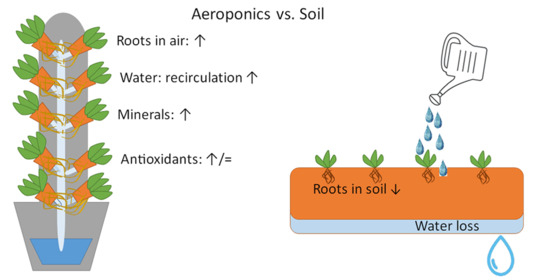
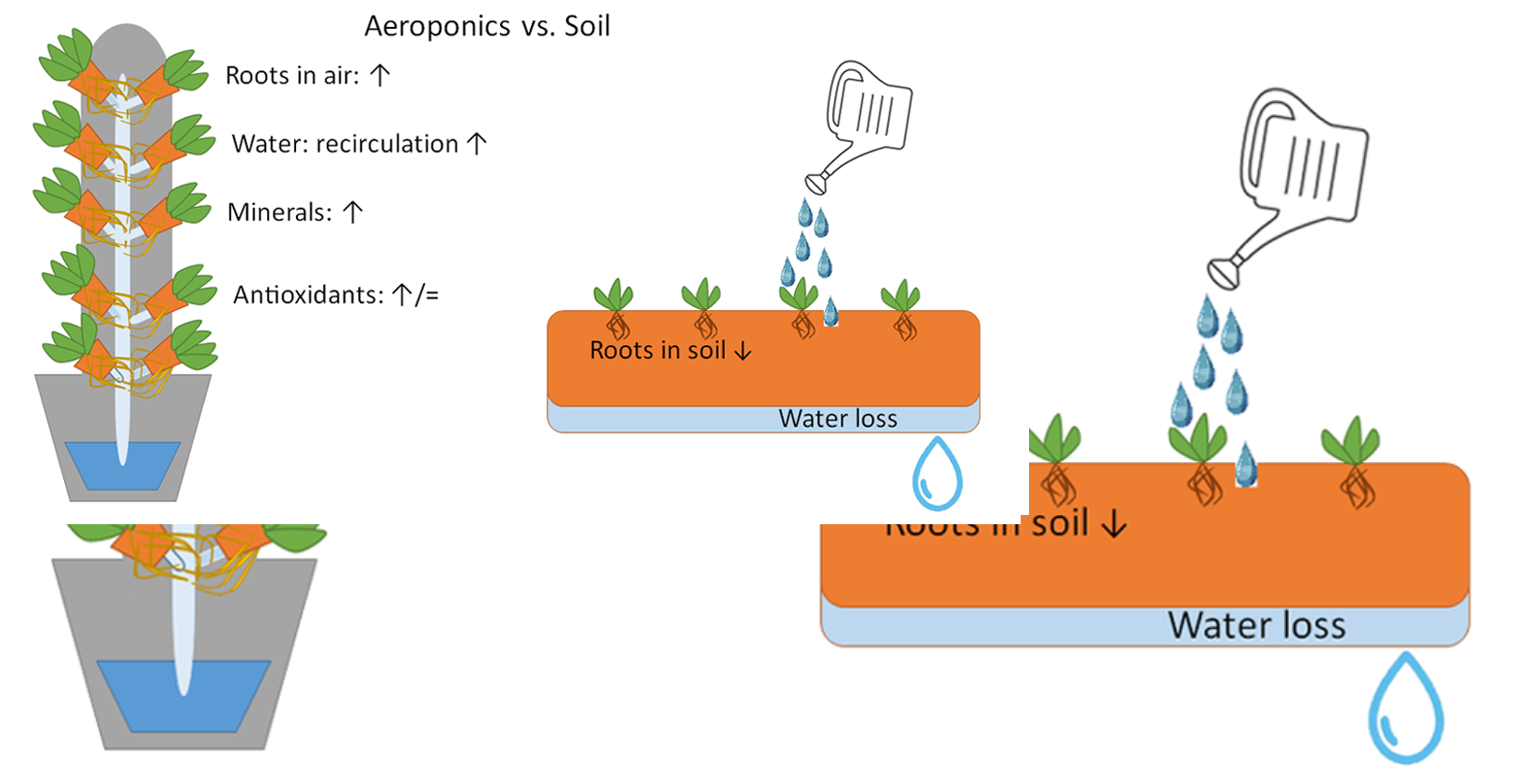
The recirculation system in aeroponic culture is particularly efficient, reducing water usage by up to 98%, compared to the substantial water waste typical of conventional agriculture [3]. In aeroponic systems, plants are grown in plastic pockets with holes into which plastic pots containing seedlings or plantlets are inserted. The tower consists of interconnected cylinders that collect and recirculate irrigation water. The roots are exposed to a nutrient-enriched aerosol sprayed at timed intervals, optimizing nutrient absorption and reducing environmental loss [2,4].
In this system, key parameters, such as EC, which measures all salts dissolved in water (including those added as fertilizer), are monitored to regulate nutrient concentration in the circulating solution [2], thereby optimizing growth conditions at controlled temperature, high humidity and constant pH [5]. Real-time monitoring of aeroponic parameters enables dynamic adjustment of the system to adapt to external conditions and plant growth stages [6]. The sprayed aerosol plays a crucial role in delivering essential macronutrients, in particular N, P, and K, which are required in large amounts for vegetative development, root growth and fruit production, respectively. Additionally, Ca, Mg and S are necessary for cell wall stability, chlorophyll synthesis and enzymatic activity [3] while micronutrients such as Fe, Mn, B, Zn, Mo, and Cu, essential for plant health and crop yield [7], are supplied in the sprayed aerosol in forms readily available for root uptake.
The health benefits of fruits and vegetables are derived not only from their macro- and micronutrient levels but also from their content of protective secondary metabolites, including polyphenols and flavonoids, which provide both nutraceutical value and essential antioxidant activity. In particular, these bioactive substances, owing to their distinctive molecular architecture featuring multiple phenolic hydroxyl groups bonded to the aromatic ring, exert potent antioxidant activity against reactive oxygen species (ROS). The excessive production of these radicals, resulting from oxidative stress, is recognized as an inducing factor in numerous human diseases. For this reason, the consumption of fruits and vegetables is strongly recommended as part of a balanced diet [8]. However, the accumulation of these compounds is subject to significant inter-annual variability, driven by environmental factors such as soil properties (e.g., organic matter depletion), water supply (e.g., drought or flooding), and climatic extremes (e.g., heatwaves) [9].
Controlled plant growing systems, particularly hydroponic and aeroponic farming, offer the potential to mitigate the impacts of climate change on agriculture [10]. Another key advantage of these soilless growth systems is the reduced risk of contamination from pests and soil-based diseases. When grown indoors, these systems allow precise control over nutrient delivery and environmental conditions, maximizing crop yield, nutrient content and production of bioactive antioxidant molecules [11].
For these reasons, aeroponic vertical farming offers numerous advantages, including efficient space utilization, reduced water consumption, shorter growing times, elimination of pesticides and protection from adverse weather conditions. In addition, vertical towers can be set up in diverse locations, shortening food chain length and enabling year-round production of fresh, nutrient-rich foods [12,13]. This makes aeroponics particularly valuable in urban areas where cultivable lands are scarce.
The present research aimed to elucidate and compare the content of bioactive antioxidant molecules, antiradical and antioxidant activity and plant micro- and macronutrient composition in vegetables grown using two biological farming methods: a soil-based tunnel greenhouse and a vertical aeroponic system. In this study, four different plant species were used (basil, lettuce, courgette and tomato), all of which are important cultivated crops consumed both as leafy vegetables and as fruits. This selection also allowed for a comparative assessment of their responses when grown under the same aeroponic conditions.

2. Materials and Methods

2.1. Plant Material and Growth Systems

Plants of lettuce (Lactuca sativa, var Barba dei Frati), basil (Ocimum basilicum, var Italiano Classico), unripe green and red ripe tomatoes (Solanum lycopersicum var Ciliegino Dolcissimo) and courgettes (Cucurbita pepo var Romanesco) were used in the present study. Twenty plants per treatment were analyzed by collecting leaves or fruits and combining them into four pools of five plants. The plants were arranged as follows: (1) in soil: five plots, each with plants in four rows, with each plot containing five plants of each of the four crops; (2) in aeroponic culture: five towers, each containing four plants of each of the four crops.
Three-week-old plantlets of the above-mentioned species were transplanted into rock wool supports and placed individually into each hole of the Tower Garden® (Juice Plus+ Company, Memphis, TN, USA) vertical aeroponic system (Figure S1). Control plantlets of the same species were grown in soil and occasionally amended with aged chicken manure under a tunnel greenhouse following standard spring/summer practices. The soil was amended with aged chicken manure (approximately 1 kg m−2), incorporated about 15–20 days prior to sowing to allow adequate settling and nutrient availability. The edible parts of the plants were harvested at the same growth stage as those in the aeroponic system. The circulating nutrient solution (Table 1) was prepared by adding two Tower Garden nutrient solutions, Nutri Forte A (N P K 8-0-0) and Nutri Forte B (N P K 0-6-12) (Juice Plus+ Company, Memphis, TN, USA) at a dose of 0.8 mL L−1 of each nutrient solution to the water volume (40 L) of the aeroponic tower system. During plant growth, small amounts of nutrient solutions were replenished as needed to maintain the solution volume (40 L), electrical conductivity (EC= 1 mS cm−1) and pH (5.5). The excess solution drained to the base of the system was filtered and was recirculated to the roots at timed intervals, ensuring constant contact of the roots with the oxygenated aerosol (Figures S1 and S2). Table 1 shows the mineral composition of the original nutrient solutions and the final concentration of all elements (N, Ca, Mg, B, Cu, Fe, Mn, Zn and P, K, S) in the circulating solution.

2.2. Soil Characterization

Soil samples were collected from the experimental tunnel greenhouse using a random sampling method. Five subsamples (0–20 cm depth) were mixed to form a composite sample, which was then air-dried and sieved to 0–2 mm for characterization. Standard methods [14] were employed to analyze the main physicochemical soil properties: pH and electrical conductivity (EC) were determined in water, at soil:water ratios of 1:2.5 and 1:2 (m/v), respectively, using specific electrodes. Cation exchange capacity (CEC) was determined using barium chloride (Merk, Sigma-Aldrich KGaA, Darmstadt, Germany) (pH 8.1), while texture analysis (sand, silt and clay percentages) was performed using the pipette method using hexametaphosphate (Sigma-Aldrich Chemie GmbH, Steinheim, Germany) as a dispersant. In addition, organic carbon (Corg) and total nitrogen (Ntot) were quantified after grinding the 0–2 mm fraction to a fine powder and treating it with a 6M HCl (Merk, Sigma-Aldrich KGaA, Darmstadt, Germany) treatment to remove carbonates using a dry combustion method with the FlashSmart Elemental Analyser (Thermo Fisher Scientific, Waltham, MA, USA). The combustion gases were quantified with a thermal conductivity detector, and the soil reference NC ThermoFisher was used for the calibration curve.
The primary physicochemical properties of the soil from the experimental tunnel greenhouse are shown in Table 2. According to the USDA soil classification system [15] the soil had a loamy-sand texture (85.6% sand, 11.4% silt and 3.1% clay). The soil showed a neutral pH (6.8), ideal for the growth of most crops, along with an EC of 354 μS cm−1 and CEC of 16.9 cmol(+) kg−1. These values indicate optimal nutrient availability and represent a good average for cultivated soils. Additionally, the Ntot of 0.19%, Corg of 1.56%, organic matter (OM content 2.7%) and C: N ratio (8.2) fell within the typical ranges for arable land [16,17].
The total content of soil nutrients (P, K, Ca, Mg, Fe, Mn, Cu, Zn) and Na were determined after acidic soil digestion using a mixture of HNO3/H2O2 (Merk, Sigma-Aldrich KGaA, Darmstadt, Germany) (2.5:1 ratio, v/v) in a microwave-assisted system (Ethos 900-FKV Srl, Bergamo, Italy).
The available content of elements was determined through soil extractions using with specific reagents: available P was extracted with 0.5 M NaHCO3 at pH 8.5 (1:20, m/v soil:extractant ratio) [18]. Exchangeable cationic elements (Ca, Mg, K and Na) were extracted with 1 M NH4CH3COO (Merk, Sigma-Aldrich KGaA, Darmstadt, Germany) (at pH 7 and 1:20 ratio (m/v) of soil:extractant. Available micronutrients (Fe, Mn, Cu, Zn) were extracted with 2 mM EDTA (Merk, Sigma-Aldrich, Darmstadt, Germany) (1:10, m/v soil:extractant ratio). Total and available elements in soil extracts (except P) were quantified using an Inductively Coupled Plasma Spectrometer (ICP-OES 5900 Agilent, Santa Clara, CA, USA). Total and available P were determined colorimetrically using the sulfomolybdic reagent (Merk, Sigma-Aldrich KGaA, Darmstadt, Germany) to permit the color development in P extracts [14] and a UV-VIS spectrophotometer (UV-1900i, Shimadzu, Kyoto, Japan) at 720 nm. All mineral analyses were performed in triplicate. Concentrations were expressed as mg kg−1 DW ± SD.

2.3. Vegetable Sample Processing

Edible plant parts (leaves and fruits) of the above-mentioned species from both soil-grown and aeroponic systems were harvested in July after three months of cultivation and immediately transferred to CNR facilities in Pisa. Fresh weight was determined immediately, followed by sample lyophilization to determine dry weight and to calculate water content. Prior to lyophilization tomatoes and courgettes were sliced while leaves of lettuce and basil were kept whole. Vegetable samples were then submitted to a pre-freezing step at −40 °C for approximately 6 h. Freeze-drying was carried out using a Liof5Pascal lyophilizer (Cinquepascal S.r.l., Milan, Italy) for 48 h at a constant vacuum pressure of 0.10 mbar and a condenser temperature of −52 °C, whereas the process chamber was maintained under controlled room temperature conditions. The lyophilized samples were stored in a desiccator to prevent moisture absorption before analysis. For extraction, 1 g of each lyophilized material was placed in 10 mL 80% ethanol. Samples were then homogenized using an Ultra Turrax homogenizer (Kinematica Polytron PT MR 2100, Lucerne, Switzerland) and extracted on an orbital shaker overnight at room temperature. After centrifugation (3500× g, 30 min at 4 °C with Jouan CR31 centrifuge, Newport Pagnell, UK), the supernatant was collected and analyzed spectrophotometrically using a UV/VIS spectrophotometer (Perkin Elmer, Victor TM X3 apparatus, Waltham, MA, USA).

2.4. Determination of Total Phenolic Content

The total phenolic content was determined by a colorimetric method by Singleton et al. [19]. In particular, 50 μL of the plant extract was added to 1 mL of the Folin–Ciocalteau reagent (Merck, Sigma-Aldrich, GmbH, Steinheim, Germany), diluted 1:5 with distilled water and incubated in the dark at room temperature (RT) for 6 min. Subsequently, 660 μL of 20% Na2CO3 (Merk, Sigma-Aldrich KGaA, Darmstadt, Germany) was added, and the mixture was incubated in the dark for one hour at RT. The absorbance was then measured at 760 nm against a blank containing 80% ethanol. The results were expressed in mg of gallic acid (Merk, Sigma-Aldrich KGaA, Darmstadt, Germany) equivalents per gram of dry weight (mg GaE g−1 DW).

2.5. Determination of Total Flavonoid Content

Total flavonoid content was evaluated using a modified version of the method of Heimler et al. [20]. In particular, 150 μL of plant extract was mixed with 600 μL of distilled water and 45 μL of 5% NaNO2 (Merk, Sigma-Aldrich KGaA, Darmstadt, Germany) and then incubated in the dark at RT for 5 min. After, 45 μL of 10% AlCl3 (Merk, Sigma-Aldrich KGaA, Darmstadt, Germany) was added and the mixture was incubated for 6 min. Subsequently, 300 μL of 1 M NaOH (Merk, Sigma-Aldrich KGaA, Darmstadt, Germany) and 360 μL of distilled water were added, and the samples were incubated in the dark for 30 min. The absorbance was measured at 430 nm against a blank of 80% ethanol. The results were expressed as mg of quercetin (Merk, Sigma-Aldrich KGaA, Darmstadt, Germany) equivalents per gram of dry weight (mg QE g−1 DW).

2.6. Determination of Antioxidant Activity (DPPH Assay)

Antioxidant activity was measured using a modified DPPH (Merck, Sigma-Aldrich, GmbH, Steinheim, Germany) assay [21]. A solution of 80 μM DPPH in methanol 80% was stirred for one hour in the dark. Subsequently, 50 μL of the plant extract was mixed with 1470 μL of the DPPH solution and incubated in the dark for one hour. The absorbance was measured at 517 nm against a blank of 80% ethanol. The antiradical activity was expressed as the percentage inhibition of DPPH and calculated using the formula:
ARA = 100 × [1 − (Abs of sample/Abs of control)]

2.7. Determination of Antioxidant Capacity (FRAP Assay)

The antioxidant capacity was measured using a modified version of the method of Benzie and Strain [22], which measures the reduction of ferric (Fe3+) to ferrous (Fe2+) ions at low pH. In particular, 51 μL of the plant extract was added to 1.5 mL of FRAP reagent containing TPTZ (Sigma-Aldrich, Buchs, Switzerland) (10 mM in 40 mM HCl), FeCl3·6H2O (20 mM) (Merk, Sigma-Aldrich KGaA, Darmstadt, Germany) and acetate buffer (300 mM, pH 3.6). The mixture was incubated in the dark at RT for one hour. Absorbance was then measured by a spectrophotometer at 593 nm. The FRAP activity of the plant samples was calibrated against a standard curve of ferrous sulfate (FeSO4·7H2O) (Merk, Sigma-Aldrich KGaA, Darmstadt, Germany). Results were expressed as μM of FeSO4 equivalents per gram of dry weight (μM FeSO4 g−1 DW).

2.8. Determination of Mineral Nutrient Content

The lyophilized plant material was ground to particles smaller than 1 mm using a mortar. Then, 0.5 g was processed following the method described in Bellani et al. [23], which involves an overnight pre-digestion in a mixture of HNO3/H2O2 (2.5:1, v/v) and microwave-assisted digestion (Ethos 900-FKV Srl, Bergamo, Italy). Then, digested plant samples were analyzed for the main mineral nutrients (P, K, Ca, Mg, Fe, Mn, Cu, Zn) using the ICP-OES (5900 Agilent, Santa Clara, CA, USA) and results were expressed in mg kg−1 DW.

2.9. Statistical Analysis

The experimental data were analyzed using two-way ANOVA to compare the effects of two factors: different plant species, cultivation system, and their interaction. When a significant interaction was found (p < 0.05), a post hoc Tukey’s multiple comparisons test was performed on the means. Statistical analysis was performed using version 6.0 of the Statistica package (StatSoft, Hamburg, Germany).
Results were reported as the mean of the three replicates with standard deviation (±SD).
Different letters were used to label treatments that differed significantly.

3. Results

3.1. Mineral Element Concentration in Soil

Total and available concentrations of mineral elements (P, K, Ca, Mg, Na, Fe, Mn, Cu, Zn) are reported in Table 2.
The total fraction represents elements released from strong acid digestion, while the available fraction reflects the pool of elements that can be transferred from the soil solid phase to the soil solution (by mild extractants) and subsequently to the organisms present in the natural environment [24]. Soil element ‘availability’ represents not only the fraction dependent on the soil characteristics (pH, OM, CEC, content of clay, oxides and hydroxides) but it is also influenced by the activity of soil microorganisms and by plant traits including root exudates produced in the rhizosphere [25].
Data from Table 2 revealed significant variability in the availability of mineral elements relative to their total content. Calcium is highly available in soil (representing about 78% of its total content), while P and Fe showed the lowest availability (accounting for about 0.7 and 0.1% of their total content, respectively). Other nutrients in the soil displayed intermediate availability; i.e., K, Mg, Mn, Cu, and Zn represented approximately 4%, 8%, 3%, 23%, and 5% of their total pool, respectively.

3.2. Comparative Analysis of Mineral Nutrient Content in Plants

Vegetables cultivated in the aeroponic system exhibited a well-developed root system, hanging freely inside the central open area of the tower (Figure S2a,b). The vegetative growth of leafy plants developed efficiently (lettuce and basil) (Figures S1 and S2b), while fruiting crops (courgettes and tomato) successfully reached the reproductive stage. Leaves from lettuce and basil, as well as fruits from tomato (green and red) and courgettes grown in both soil and aeroponic systems, were analyzed for their content of macronutrients (P, K, Ca and Mg) and micronutrients (Fe, Mn, Cu and Zn). The results are reported in Table 3 and Table 4.
The data in Table 3 and Table 4 revealed distinct trends in mineral nutrient accumulation between soil-grown and aeroponically cultivated plants. Aeroponically grown plants generally exhibited higher concentration of macronutrients, while greater accumulation of most micronutrients was observed in soil-grown samples. In particular, the concentrations of P (in basil), K (in lettuce and basil), Ca and Mg (in all species), Fe (in tomatoes), Mn (in basil, courgette and tomatoes), and Cu and Zn (in courgette) were significantly greater in samples from aeroponic cultures. Conversely, P (in lettuce, courgette and tomatoes), K (in courgettes and red tomatoes), Fe (in lettuce and basil), Mn (in lettuce), and Cu and Zn (in lettuce, basil and tomatoes) were significantly higher in soil-grown species.

3.3. Content of Water, Antioxidant Molecules (Polyphenols or Flavonoids) and Antioxidant Activity

Plants grown either in soil (S) or in an aeroponic tower (A) were also analyzed for the content of water, antioxidant molecules (polyphenols or flavonoids) and antioxidant activity (Table 5 and Table 6).
Water content was similar across samples cultivated with both techniques, consistently exceeding 90%, except for basil leaves, which showed a significantly higher water content in the aeroponic system (88.4%) compared to soil (78.61%).
Aeroponically cultivated samples of basil exhibited the highest polyphenol content among all species, with this amount being significantly higher than that in plants cultivated in soil.
Differences in polyphenols between plants grown in the two cultivation conditions were found in courgettes (higher in aeroponic) and in lettuce (higher in soil).
Flavonoid content was generally significantly higher in plants cultivated in aeroponic conditions (lettuce, basil, red tomatoes), with the highest content being detected in basil.
Total antioxidant activity was evaluated by DPPH and FRAP assays, which measure the total antiradical activity (ARA) and the capacity to reduce ferric ions, respectively. Notably, basil grown in the aeroponic system showed the highest ARA% among all species with significantly higher DPPH activity compared to its soil-grown counterpart. Red tomatoes showed higher FRAP values when cultivated in the aeroponic system.
It is worth noting that, regardless of the cultivation method, polyphenol content, flavonoids and antioxidant capacity were particularly high in both lettuce and basil leaves compared to the fruits of the other plant species investigated.

4. Discussion

In this study the inclusion of tomatoes, courgettes, basil, and lettuce in the aeroponic study was driven by their distinct morphological, physiological, and economic characteristics, which together provide a comprehensive test for the aeroponic system. Tomatoes and courgettes, as high-biomass fruit crops with extensive root systems and a long growth cycle, were selected to evaluate the system’s ability to consistently supply nutrients and water during flowering and fruit ripening. In contrast, basil and lettuce, as fast-growing leafy greens with shallow root systems and a short production cycle, were used to evaluate the system’s efficiency in supporting rapid vegetative growth and early harvest. This experimental design was adopted to exceed the intrinsic limitations of single-crop validation by characterizing species with different root architectures and nutrient uptake dynamics, consumed as leaves or fruits.
For tomatoes, two different developmental stages, unripe green and red ripe fruits, were considered since green tomatoes can be also considered as valuable food with a unique nutritional profile and a solid market value, benefiting both health (rich in vitamin C, vitamin B7 (biotin), polyphenols, copper, vitamin B5 (pantothenic acid), and vitamin K) and the farming industry (α-tomatine and chlorophyll) [26].
The soil used to grow the plants showed characteristics within the typical range of Italian agricultural soils [27]. Its loamy-sand texture is commonly used in horticulture due to its good water drainage, high aeration, ease of root penetration and relatively rapid warming in spring [28]. However, due to its low water and nutrient retention capacity and its susceptibility to drought stress, the soil requires frequent fertilization and organic amendment [29], justifying the occasional amendment with aged chicken manure in the soil experiment. Indeed, the electrical conductivity and cation exchange capacity of the soil, representing, respectively, the level of soluble salts in the soil solution and the fraction of cations adsorbed onto clay and organic colloids, along with the soil characteristics supporting nutrient availability (pH, organic matter and C/N ratio), meet the nutrient requirement for healthy plant growth.
The analysis of mineral nutrient composition in the vegetable samples grown either in soil or in aeroponic culture showed significantly higher concentrations of Ca, Mg, Mn (in all plant samples, except for Mn in lettuce), K (in lettuce and basil) and P (in basil) from aeroponic cultures compared to those in soil. This reflects, in the controlled environment, more optimized nutrient availability, increased plant uptake and the avoidance of competition from soil microbiota for these nutrients [2,29]. Elevated P and K levels in some soil-grown plants could be due to the composition of the soil and its increased availability resulting from the organic amendment [30,31]. In fact, chicken manure amendment was recently reported to provide a significant influx of plant-available nutrients, in particular P and K, when compared to no organic amendment or background mineral fertilizer [32].
Our observations suggest that aeroponic cultivation may better regulate macronutrients in general, in particular Ca and Mg uptake, which are critical for cell wall stability and photosynthesis [33]. The Mn levels, found to be high in the aeroponic systems (except in lettuce), were consistent with observations across most studied crops [2,33] and may result from optimized pH and solubility conditions in the nutrient solution [34].
In soil systems, available nutrients were subjected to various interactions, including leaching or microbial interactions or microbe–mineral–organic matter interactions [35,36].
Conversely, among the micronutrients, Fe in basil and lettuce and Zn in lettuce, courgette and tomatoes were found to be significantly higher in soil-grown crops which could again be attributed to soil composition, mineral interactions with organic matter, and microbial activities enhancing plant micronutrient availability [29,30]. Species-specific exceptions (e.g., high Fe in tomatoes, Zn in courgettes from the aeroponic growth system) suggested tailored nutrient uptake efficiencies in aeroponics [37] with precise control of nutrient formulations. While soil systems could retain micronutrients like Fe, Cu, and Zn through organic complexes, crop-specific aeroponic strategies could effectively overcome deficiencies [2]. However, in our study it was difficult to explain the striking amount of Fe in soil samples of basil and lettuce and of P in tomatoes. A possible explanation is that the nutrient solution, and environmental condition, while optimal for most species, may have been suboptimal for others, leading to differential nutrient uptake and accumulation patterns [38,39].
Basil and lettuce may have higher root exudation of organic acids or chelators that mobilize Fe from the substrate, leaving excess Fe in the rhizosphere. Tomatoes, on the other hand, may have lower P uptake efficiency or different P transporter affinity, causing more P to remain unabsorbed in the soil. Crucially, the same nutrient solution is not ideal for all plants since it may saturate the uptake systems of some species while limiting others, revealing species-specific optima for each element [40].
The observed efficiency of the aeroponic system could be attributed to the pressurized spray of circulating nutrient solution directed to the roots at specific time intervals. This set-up produces micron-sized droplets of nutrient solution in the form of a fine mist [41], ensuring the full contact of mineral nutrients, water, and oxygen with the root tissues. This intermittent distribution onto the root systems is also essential for preventing root dehydration, ensuring constant nutrient supply, minimizing water waste and avoiding nutrient dispersion into the environment. This demonstrates that the aeroponic system is highly resource-efficient, saving around 90% of water [38]. Moreover, the aeroponic system shows low microbial contamination making it safer than traditional soil-based methods [38]. Antioxidants such as phenolic acids, flavonoids and tannins in plant foods have received attention for their anti-inflammatory, anti-microbial, and anti-carcinogenic effects, as they can counteract the excess of free radicals and the associated diseases [42,43]. The analysis of antioxidant molecules and antioxidant activity evidenced that plants grown in the aeroponic system contained comparable or even higher levels of these molecules than those grown in soil. In particular, the greatest amount was observed in flavonoids across all analyzed plants, except for courgettes. This enhancement was also reported for some leafy vegetables by Gopinath et al. [38]. The literature shows a significantly higher content of phenolic compounds and antioxidant potential in specific organs (e.g., leaves) with respect to fruits or buds [44,45], with values dependent on weather conditions (sunlight and water availability) during the vegetation period [46]. Our observation of systematically higher values of polyphenol content, flavonoids and antioxidant capacity in leaves (lettuce and basil) than in fruits (tomatoes and courgette), in both growth systems investigated, aligns with the production of those active compounds in preferential organs of horticulture crops. While the multicrop approach strengthens the external validity of our findings, future studies could consider large-scale experiments to investigate more crops under the operational complexity of a commercial-scale greenhouse or vertical farm for aeroponics. Furthermore, a different standardized nutrient formulation and spraying schedule could be investigated to fulfill the distinct nutritional requirements at different phenological stages of the considered species [47,48].

5. Conclusions

The present study demonstrates that aeroponic cultivation enhances the uptake of most mineral elements relative to conventional soil-based systems, although significant species-specific differences in mineral nutrition were evident among the four test species. Notably, despite the substantial water savings achieved through the efficient recirculation system, aeroponically grown plants maintained hydration levels comparable to those of soil-grown controls across all species examined. Furthermore, antioxidant concentrations and total antioxidant activity were comparable to, and in several instances exceeded, those observed under soil cultivation, together with elevated levels of selected macro- and micronutrients. Together, these findings corroborate the nutritional efficacy of the aeroponic system in which plants attain reproductive maturity with roots suspended in air while receiving a continuous supply of water, nutrients, and carbon dioxide, a design that supports resource-efficient production. Aeroponic towers thus emerge as a promising platform for sustainable horticulture, offering concrete ecological advantages, including reduced land use, water conservation, and nutrient recycling, with potential applications covering food production, pharmaceutical compound biosynthesis, and ornamental horticulture.
To fully translate these benefits into practice, however, targeted investigations into species-specific nutritional optimization are needed in order to achieve higher yields and improved quality of crops cultivated in aeroponic regimes.

Supplementary Materials

The following supporting information can be downloaded at: https://www.mdpi.com/article/10.3390/crops6040071/s1, Figure S1: Vertical aeroponic tower (Tower Garden®); Figure S2: (a) Tomato in aeroponic tower; (b) Basil and courgette in aeroponic tower.

Author Contributions

Conceptualization, L.G., V.L. and L.B.; methodology, L.G., E.L.T. and L.B.; software, L.G., E.L.T. and L.B.; validation, L.G., E.L.T., V.L., M.L. and L.B.; formal analysis, L.G., E.L.T. and L.B.; investigation, L.G., E.L.T. and L.B.; resources, L.G., V.L. and M.L.; data curation, L.G., E.L.T. and L.B.; writing—original draft preparation, L.G., E.L.T. and L.B.; writing—review and editing, L.G., E.L.T., V.L. and L.B.; visualization, L.G., E.L.T., V.L., M.L. and L.B.; supervision, V.L.; project administration, L.G., V.L. and M.L.; funding acquisition, L.G., V.L. and M.L. All authors have read and agreed to the published version of the manuscript.

Funding

The work was supported by internal funding from National Research Council of Italy.

Data Availability Statement

The authors confirm that the data supporting the findings of this study are available within the article.

Acknowledgments

We thank Massimiliano Casarola from the Biological farm “Radici Umane” in Pomino, Florence, Italy, for kindly providing plant materials within the project ASPIS, “Agricoltura Sociale per l’Inclusione Sostenibile 2030” ASpIS Plus 2030, by Regione Toscana, Italy.

Conflicts of Interest

Author Massimiliano Leoncini was employed by the company Technical Director Organic Agricultural. The remaining authors declare that the research was conducted in the absence of any commercial or financial relationships that could-be-construed as a potential conflict of interest.

Abbreviations

The following abbreviations are used in this manuscript:
AbsAbsorbance
ARAAntiradical activity
BBoron
BCFBioconcentration Factor
CaCalcium
CECCation exchange capacity
CorgOrganic carbon
CuCopper
DPPH2,2-Diphenyl-1-picrylhydrazyl
DWDry weight
ECElectrical conductivity
EDTAEthylenediaminetetraacetic acid
EtOHEthanol
FeIron
FeCl3Iron Chloride
FeSO4Iron Sulphate
FRAPFerric Reducing Antioxidant Power
GaEGallic acid equivalents
H2O2Hydrogen Peroxide
HNO3Nitric Acid
KPotassium
K2OPotassium Oxide
MgMagnesium
MnManganese
MoMolybdenum
NNitrogen
Na2CO3Sodium Carbonate
NaHCO3Sodium Bicarbonate
NaNO2Sodium Nitrite
NaOHSodium Hydroxide
NH4CH3COOAmmonium Acetate
NtotTotal nitrogen
OMOrganic matter
PPhosphorus
P2O5Diphosphorus Pentoxide
QEQuercetine Equivalents
RTRoom temperature
SSulphur
TPTZ 2,4,6-Tris(2-pyridyl)-s-triazine
ZnZinc

References

  1. Hardy, K.; Orridge, T.; Heynes, X.; Gunasena, S.; Grundy, S.; Lu, C. Farming the future: Contemporary innovations enhancing sustainability in the agri-sector. Annu. Plant Rev. Online 2021, 4, 263–294. [Google Scholar] [CrossRef] [Scilit]
  2. Lakhiar, I.A.; Gao, J.; Syed, T.N.; Chandio, F.A.; Buttar, N.A. Modern Plant Cultivation Technologies in Agriculture under Controlled Environment: A Review on Aeroponics. J. Plant Interact. 2018, 13, 338–352. [Google Scholar] [CrossRef] [Scilit]
  3. Kirmani, S.N.; Gulzar, M.; Bhat, S.A.; Raja, W.H. Aeroponics: An Innovative Technique for Production of Vegetable Crops. In Handbook of Agricultural Technologies; Al-Khayri, J.M., Yatoo, A.M., Jain, S.M., Penna, S., Eds.; Springer: Singapore, 2025. [Google Scholar] [CrossRef] [Scilit]
  4. Mangaiyarkarasi, R. Aeroponics System for Production of Horticultural Crops. Madras Agric. J. 2020, 107, 1–3. [Google Scholar] [CrossRef] [Scilit]
  5. Yahiya, O.; Yahya, G.; Al-Omair, A.; Yahya, E.; Jassim, E.; Djavanroodi, F. Aeroponic tower garden solar powered vertical farm. Mater. Res. Proc. 2023, 31, 287–298. [Google Scholar] [CrossRef] [Scilit]
  6. Faisal, A.; Rajashekar, V.; Biswal, P.; Mukherjee, A.; Bhowmick, G.D. Advancing Agriculture with Aeroponics: A Critical Review of Methods, Benefits, and Limitations. In Hydroponics; Kumar, N., Ed.; Encyclopedia of Sustainability Science and Technology Series; Springer: New York, NY, USA, 2024. [Google Scholar] [CrossRef] [Scilit]
  7. Chowdhury, M.; Kabir, M.S.N.; Kim, H.T.; Chung, S.O. Method of pump, pipe, and tank selection for aeroponic nutrient management systems based on crop requirements. J. Agric. Eng. 2020, 51, 119–128. [Google Scholar] [CrossRef] [Scilit]
  8. Bas, T.G. Dietary Polyphenols (Flavonoids) Derived from Plants for Use in Therapeutic Health: Antioxidant Performance, ROS, Molecular Mechanisms, and Bioavailability Limitations. Int. J. Mol. Sci. 2026, 27, 1404. [Google Scholar] [CrossRef] [Scilit] [PubMed]
  9. Reboul, E.; Gomes, A.M.; Petroni, K.; Riso, P.; Toccaceli, M.; Real, C.V.; Martins, A.P.; Del Bò, C.; Martini, D.; Marini, M.; et al. Will climate change affect nutrient, micronutrient and bioactive bioavailability? Crit. Rev. Food Sci. Nutr. 2026, 66, 3889–3912. [Google Scholar] [CrossRef] [Scilit] [PubMed]
  10. Lakhiar, I.A.; Yan, H.; Syed, T.N.; Zhang, C.; Shaikh, S.A.; Rakibuzzaman, M.; Vistro, R.B. Soilless Agricultural Systems: Opportunities, Challenges, and Applications for Enhancing Horticultural Resilience to Climate Change and Urbanization. Horticulturae 2025, 11, 568. [Google Scholar] [CrossRef] [Scilit]
  11. Chandra, S.; Khan, S.; Avula, B.; Lata, H.; Yang, M.H.; ElSohly, M.A.; Khan, I.A. Assessment of Total Phenolic and Flavonoid Content, Antioxidant Properties, and Yield of Aeroponically and Conventionally Grown Leafy Vegetables and Fruit Crops: A Comparative Study. Evid.-Based Complement. Altern. Med. 2014, 253875. [Google Scholar] [CrossRef] [Scilit] [PubMed]
  12. Eldridge, B.M.; Manzoni, L.R.; Graham, C.A.; Rodgers, B.; Farmer, J.R.; Dodd, A.N. Getting to the roots of aeroponic indoor farming. New Phytol. 2020, 228, 1183–1192. [Google Scholar] [CrossRef] [Scilit] [PubMed]
  13. Oh, S.; Lu, C. Vertical farming—Smart urban agriculture for enhancing resilience and sustainability in food security. J. Hortic. Sci. Biotechnol. 2023, 98, 133–140. [Google Scholar] [CrossRef] [Scilit]
  14. American Society of Agronomy Inc.; Soil Science Society of America Inc. Methods of Soil Analysis, Part 3-Chemical Methods, 2nd ed.; Sparks, D.L., Page, A.L., Helmke, P.A., Loeppert, R.H., Soltanpour, P.N., Tabatabai, M.A., Johnston, C.T., Sumner, M.E., Eds.; ASA-SSSA Book Series; American Society of Agronomy Inc.; Soil Science Society of America Inc.: Madison, WI, USA, 1996. [Google Scholar] [CrossRef] [Scilit]
  15. Soil Science Division Staff. Soil survey manual. In USDA Handbook 18; Ditzler, C., Scheffe, K., Monger, H.C., Eds.; Government Printing Office: Washington, DC, USA, 2017. Available online: https://www.nrcs.usda.gov/sites/default/files/2022-09/The-Soil-Survey-Manual.pdf (accessed on 15 April 2026).
  16. Costantini, E.A.C.; Lorenzetti, R. Soil Degradation Processes in the Italian Agricultural and Forest Ecosystems. Ital. J. Agron. 2013, 8, e28. [Google Scholar] [CrossRef] [Scilit]
  17. Brust, G.E. Management Strategies for Organic Vegetable Fertility. In Safety and Practice for Organic Food; Biswas, D., Micallef, S.A., Eds.; Academic Press: Cambridge, MA, USA, 2019; pp. 193–212. [Google Scholar] [CrossRef] [Scilit]
  18. Olsen, S.R.; Sommers, L.E. Phosphorus. In Methods of Soil Analysis. Part 2 Chemical and Microbiological Properties, 2nd ed.; Page, A.L., Miller, R.H., Keeney, D.R., Eds.; American Society of Agronomy Inc.; Soil Science of America, Inc.: Madison, WI, USA, 1982; pp. 403–430. [Google Scholar]
  19. Singleton, V.L.; Orthofer, R.; Lamuela-Raventos, R.M. Analysis of total phenols and other oxidation substrates and antioxidants by means of Folin-Ciocalteu reagent. Methods Enzymol. 1999, 299, 152–178. [Google Scholar] [CrossRef] [Scilit]
  20. Heimler, D.; Vignolini, P.; Dini, M.G.; Romani, A. Rapid tests to assess the antioxidant activity of Phaseolus vulgaris L. dry beans. J. Agric. Food Chem. 2005, 53, 3053–3056. [Google Scholar] [CrossRef] [Scilit] [PubMed]
  21. Boudjou, S.; Oomah, B.D.; Zaidi, F.; Hosseinian, F. Phenolics content and antioxidant and anti-inflammatory activities of legume fractions. Food Chem. 2013, 38, 1543–1550. [Google Scholar] [CrossRef] [Scilit] [PubMed]
  22. Benzie, I.F.; Strain, J.J. Ferric reducing/antioxidant power assay: Direct measure of total antioxidant activity of biological fluids and modified version for simultaneous measurement of total antioxidant power and ascorbic acid concentration. Methods Enzymol. 1999, 299, 15–27. [Google Scholar] [CrossRef] [Scilit] [PubMed]
  23. Bellani, L.; Siracusa, G.; Giorgetti, L.; Di Gregorio, S.; Ruffini Castiglione, M.; Spanò, C.; Muccifora, S.; Bottega, S.; Pini, R.; Tassi, E. TiO2 nanoparticles in a biosolid-amended soil and their implication in soil nutrients, microorganisms and Pisum sativum nutrition. Ecotoxicol. Environ. Saf. 2020, 190, 110095. [Google Scholar] [CrossRef] [Scilit] [PubMed]
  24. Guarino, A.; Albanese, S.; Cicchella, D.; Ebrahimi, P.; Dominech, S.; Pacifico, L.R.; Rofrano, G.; Nicodemo, F.; Pizzolante, A.; Allocca, C.; et al. Factors influencing the bioavailability of some selected elements in the agricultural soil of a geologically varied territory: The Campania region (Italy) case study. Geoderma 2022, 428, 116207. [Google Scholar] [CrossRef] [Scilit]
  25. Harmsen, J. Measuring bioavailability: From a scientific approach to standard methods. J. Environ. Qual. 2007, 36, 1420–1428. [Google Scholar] [CrossRef] [Scilit] [PubMed]
  26. Patel, A.H.; Sharma, H.P.; Vaishali. Physiological functions, pharmacological aspects and nutritional importance of green tomato- a future food. Crit. Rev. Food Sci. Nutr. 2024, 64, 9711–9739. [Google Scholar] [CrossRef] [Scilit] [PubMed]
  27. Vittori Antisari, L.; Trenti, W.; De Feudis, M.; Bianchini, G.; Falsone, G. Soil Quality and Organic Matter Pools in a Temperate Climate (Northern Italy) under Different Land Uses. Agronomy 2021, 11, 1815. [Google Scholar] [CrossRef] [Scilit]
  28. Novak, J.M.; Watts, D.W.; Bauer, P.J.; Karlen, D.; Hunt, P.G.; Umakant, M. Loamy sand soil approaches organic carbon saturation after 37 years of conservation tillage. Agron. J. 2020, 112, 3152–3162. [Google Scholar] [CrossRef] [Scilit]
  29. Mitchell, K.; Beesley, L.; Šípek, V.; Trakal, L. Biochar and its potential to increase water, trace element, and nutrient retention in soils. In Biochar in Agriculture for Achieving Sustainable Development Goals; Tsang, D.C.W., Ok, Y.S., Eds.; Academic Press: Cambridge, MA, USA, 2022; pp. 25–33. [Google Scholar] [CrossRef] [Scilit]
  30. Savvas, D.; Adamidis, C. Automated management of nutrient solutions based on target electrical conductivity, pH, and nutrient concentration ratios. J. Plant Nutr. 1999, 22, 1415–1432. [Google Scholar] [CrossRef] [Scilit]
  31. Marschner, P. Marschner’s Mineral Nutrition of Higher Plants, 3rd ed.; Academic Press: Cambridge, MA, USA, 2012. [Google Scholar]
  32. UIIslam, M.; Jiang, F.; Islam, M.M.; Ibrahim, M.M.; Halder, M.; Liu, Y.; Hou, E. Organic amendment quality as a driver of soil phosphorus enrichment and crop yield: A global synthesis. Soil Tillage Res. 2026, 256, 106836. Available online: https://www.sciencedirect.com/science/article/pii/S0167198725003903 (accessed on 15 April 2026).
  33. Mažeika, R.; Arbačiauskas, J.; Masevičienė, A.; Narutytė, I.; Šumskis, D.; Žičkienė, L.; Rainys, K.; Drapanauskaite, D.; Staugaitis, G.; Baltrusaitis, J. Nutrient Dynamics and Plant Response in Soil to Organic Chicken Manure-Based Fertilizers. Waste Biomass Valorization 2021, 12, 371–382. [Google Scholar] [CrossRef] [Scilit]
  34. Wei, L. Nutritional enhancement of fruit vegetables through aeroponic cultivation: A food quality assessment. J. Curr. Res. Food Sci. 2025, 6, 120–127. [Google Scholar] [CrossRef] [Scilit]
  35. Cakmak, I. Plant nutrition research: Priorities to meet human needs for food in sustainable ways. Plant Soil 2002, 247, 3–24. [Google Scholar] [CrossRef] [Scilit]
  36. Wang, S.; Jia, Y.; Liu, T.; Wang, Y.; Liu, Z.; Feng, X. Delineating the role of calcium in the large-scale distribution of metal-bound organic carbon in soils. Geophys. Res. Lett. 2021, 48, e2021GL092391. [Google Scholar] [CrossRef] [Scilit]
  37. Pignata, G.; Casale, M.; Nicola, S. Water and nutrient supply in horticultural crops grown in soilless culture: Resource efficiency in dynamic and intensive systems. In Advances in Research on Fertilization Management of Vegetable Crops; Springer International Publishing: Cham, Switzerland, 2017; pp. 183–219. [Google Scholar]
  38. Gopinath, P.; Vethamoni, P.I.; Gomathi, M. Aeroponics soilless cultivation system for vegetable crops. Chem. Sci. Rev. Lett. 2017, 6, 838–849. [Google Scholar]
  39. Tan, L.P.; He, J.; Lee, S.K. Effects of root-zone temperature on the root development and nutrient uptake of Lactuca sativa L. “Panama” grown in an aeroponic system in the tropics. J. Plant Nutr. 2002, 25, 297–314. [Google Scholar] [CrossRef] [Scilit]
  40. Tiziani, R.; Pranter, M.; Valentinuzzi, F.; Pii, Y.; Luigimaria, B.; Cesco, S.; Mimmo, T. Unraveling plant adaptation to single and combined nutrient deficiencies in a dicotyledonous and a monocotyledonous plant species. Plant Sci. 2023, 335, 111793. [Google Scholar] [CrossRef] [Scilit] [PubMed]
  41. Hazrati, S.; Pignata, G.; Casale, M.; Binello, A.; Cravotto, G.; Devecchi, M.; Nicola, S. Impact of four hydroponic nutrient solutions and regrowth on yield, safety and essential oil profile of basil (Ocimum basilicum L.) cultivated in soilless culture systems. Folia Hortic. 2024, 36, 517–531. [Google Scholar] [CrossRef] [Scilit]
  42. Bertelli, A.; Biagi, M.; Corsini, M.; Baini, G.; Cappellucci, G.; Miraldi, E. Polyphenols: From theory to practice. Foods 2021, 10, 2595. [Google Scholar] [CrossRef] [Scilit] [PubMed]
  43. Vento, M.; Della Croce, C.M.; Bellani, L.; Tassi, E.L.; Echeverria, M.C.; Giorgetti, L. Effect of Sprouting, Fermentation and Cooking on Antioxidant Content and Total Antioxidant Activity in Quinoa and Amaranth. Int. J. Mol. Sci. 2024, 25, 10972. [Google Scholar] [CrossRef] [Scilit] [PubMed]
  44. Tabart, J.; Kevers, C.; Pincemail, J.; Defraigne, J.-O.; Dommes, J. Antioxidant capacity of black currant varies with organ, season, and cultivar. J. Agric. Food Chem. 2006, 54, 6271–6276. [Google Scholar] [CrossRef] [Scilit] [PubMed]
  45. Teleszko, M.; Wojdyło, A. Comparison of phenolic compounds and antioxidant potential between selected edible fruits and their leaves. J. Funct. Foods 2015, 14, 736–746. [Google Scholar] [CrossRef] [Scilit]
  46. Tabart, J.; Kevers, C.; Sipel, A.; Pincemail, J.; Defraigne, J.O.; Dommes, J. Optimisation of extraction of phenolics and antioxidants from black currant leaves and buds and of stability during storage. Food Chem. 2007, 105, 1268–1275. [Google Scholar] [CrossRef] [Scilit]
  47. Sahil, A.; Singh, S.R.; Yadav, L.P.; Singh, A.K.; Yadav, V.; Kumar, S.; Meena, N.K.; Kaushik, P.; Mahala, P. Aeroponic cultivation of lettuce: Unravelling varietal performance and trait interrelationships for enhanced productivity. PLoS ONE 2026, 21, e0345258. [Google Scholar] [CrossRef] [Scilit] [PubMed]
  48. Chu, S.-W.; Wan, T.-J. Advancing Sustainable Agriculture Through Aeroponics: A Critical Review of Integrated Water–Energy–Nutrient Management and Environmental Impact Mitigation. Agriculture 2026, 16, 265. [Google Scholar] [CrossRef] [Scilit]

Table 1. Mineral-based composition of the nutrient solutions A and B (Nutri Forte) and in the aeroponic tower system.
Mineral Nutrient SolutionsMineral-Based NutrientsConcentration in the Original Nutrient
Solutions % (g L−1)
Concentration in the Aeroponic Circulating Solution mg L−1
Nutri Forte A NPK (8-0-0)N8.0 (80)64.0
Ca6.8 (68)54.4
Mg2.4 (24)19.2
B0.012 (0.12)0.10
Cu0.002 (0.02)0.02
Fe0.065 (0.65)0.52
Mn0.016 (0.16)0.13
Zn0.007 (0.07)0.06
Nutri Forte B NPK (0-6-12)P (P2O5 6%)2.8 (28)22.4
K (K2O 12%)10 (100)80.0
S1.6 (16)12.8
Table 2. Mineral elements concentration in soil.
Elements Total
(mg kg−1 DW)
Available
(mg kg−1 DW)
P293.67 ± 46.242.13 ± 0.26
K6116.84 ± 555.23257.01 ± 1.44
Na164.64 ± 23.13149.14 ± 10.3
Ca3015.95 ± 557.012367.35 ± 141
Mg4632.44 ± 212.04381.07 ± 95.2
Fe19,641.09 ± 651.1226.67 ± 4.24
Mn7544.83 ± 43.7423.20 ± 2.23
Cu101.44 ± 12.9123.03 ± 3.28
Zn71.04 ± 11.733.94 ± 0.84
Note: values represent a mean of three replicates ± SD. Soil elements’ availability was expressed as the amount of the available element in a kg of soil (DW).
Table 3. Composition in macro- and micro-mineral nutrients of the plants grown in the soil (S) and in aeroponic culture (A).
Plant SpeciesCultivation
System
P (g Kg−1)K (g Kg−1)Ca (g Kg−1)Mg (g Kg−1)Fe (mg Kg−1) Mn (mg Kg−1)Cu (mg Kg−1)Zn (mg Kg−1)
Lettuce(S)9.11 ± 0.03 a41.89 ± 0.40 d9.72 ± 0.27 c3.80 ± 0.09 b555.23 ± 2.97 a89.27 ± 0.50 a11.65 ± 0.6138.72 ± 2.54 a
(A)7.72 ± 0.05 b53.1 ± 0.01 a13.22 ± 0.10 b5.13 ± 0.06 a97.3 ± 1.96 c14.2 ± 0.60 c1.42 ± 0.090 g
Basil(S)3.44 ± 0.11 c12.61 ± 0.18 g9.24 ± 0.18 d3.46 ± 0.08 c164.97 ± 9.00 b24.59 ± 0.82 bc6.19 ± 1.308.05 ± 0.83 ef
(A)8.75 ± 0.12 a34.17 ± 0.60 e17.33 ± 0.26 a5.25 ± 0.11 a68.57 ± 2.90 d73.51 ± 1.73 ab3.15 ± 0.105.47 ± 0.62 f
Courgette(S)7.28 ± 0.43 b43.13 ± 0.29 c2.33 ± 0.01 fg2.04 ± 0.04 d70.13 ± 0.68 d0 c6.96 ± 0.1232.50 ± 1.74 b
(A)1.04 ± 0.07 d21.68 ± 0.02 b2.93 ± 0.02 e3.39 ± 0.01 c77.82 ± 6.55 d13.45 ± 0.50 c8.77 ± 0.5339.28 ± 1.49 a
Green
Tomato
(S)9.09 ± 0.03 a29.44 ± 0.09 f0.97 ± 0.02 h1.38 ± 0.05 f35.24 ± 0.81 f0 c5.82 ± 1.1212.65 ± 2.00 cd
(A)1.11 ± 0.15 d29.52 ± 0.25 f2.67 ± 0.10 ef1.62 ± 0.02 e53.90 ± 6.43 e1.07 ± 0.22 c2.69 ± 0.085.27 ± 1.08 f
Red Tomato(S)9.23 ± 0.06 a34.33 ± 0.48 e0.82 ± 0.02 hg1.49 ± 0.01 ef51.67 ± 0.44 e0 c6.55 ± 0.50 15.70 ± 1.40 c
(A)3.42 ± 0.20 c28.92 ± 0.02 f2.09 ± 0.091.45 ± 0.03 ef94.58 ± 1.22 c0.67 ± 0.09 bc0.55 ± 0.1010.77 ± 0.87de
Note: The values are the mean of three replicates ± SD. Different letters indicate statistically significant differences among the different treatments, according to two-way ANOVA followed by Tukey test (p < 0.05).
Table 4. Significant differences for the main factors, plant species (A), cultivation system (B) and their interactions, in bold when significant (p < 0.05).
PKCaMgFeMnCuZn
FactorsFp-LevelFp-LevelFp-LevelFp-LevelFp-LevelFp-LevelFp-LevelFp-Level
Species (A)532.68≤0.0016229.61≤0.0019850.83≤0.0013713.31≤0.0014163.58≤0.00110.220.000110.7830.549394.58≤0.001
Cultivation system (B)2730.2≤0.0012796.11≤0.0013423.27≤0.0011875.99≤0.0013744.29≤0.0010.450.5080.1480.705316.77≤0.001
A × B1505.94≤0.0011590.55≤0.001681.163≤0.001266.91≤0.0013464.39≤0.00110.340.000110.9450.458215.34≤0.001
Note: F test calculated according to the two-way ANOVA.
Table 5. Water content (%), content of total phenolics, total flavonoids, total antioxidant activity by DPPH and FRAP assays in plants grown in soil (S) and in aeroponic tower (A).
SpeciesWater Content (%)Total Phenolics (mg GAE g−1 DW ± SD)Total Flavonoids (mg QEg−1 DW ± SD)DPPH
(ARA%)
FRAP (mg FeSO4 g−1 DW)
Lettuce (S)91.71 ± 0.27 a14.56 ± 0.85 bc54.30 ± 1.36 c92.30 ± 0.29 a183.92 ± 0.76 b
Lettuce (A)92.69 ± 0.89 a11.78 ± 0.70 cd65.97 ± 0.04 b84.50 ± 1.2 ab183.96 ± 3.99 b
Basil (S)78.61 ± 0.41 c17.30 ± 3.35 b57.90 ± 0.02 c82.49 ± 3.32 b195.37 ± 8.84 ab
Basil (A)88.44 ± 1.29 b22.12 ± 2.64 a75.84 ± 6.20 a91.27 ± 2.29 a197.02 ± 3.70 a
Courgettes (S)91.39 ± 0.29 ab5.88 ± 0.43 e9.12 ± 0.26 de18.31 ± 0.96 d25.45 ± 1.64 e
Courgettes (A)91.86 ± 0.74 a10.06 ± 0.93 cde7.07 ± 0.68 de10.13 ± 0.08 d19.70 ± 0.79 e
Green tomato (S)93.07 ± 1.32 a6.75 ± 1.07 e4.20 ± 0.11 d33.78 ± 3.04 c45.91 ± 0.01 d
Green tomato (A)93.45 ± 0.91 a6.80 ± 0.36 e5.36 ± 0.45 de35.48 ± 0.87 c51.29 ± 3.97 d
Red tomato (S)92.5 ± 2.16 a8.85 ± 1.28 de3.13 ± 0.26 e34.30 ± 1.40 c46.91 ± 3.16 d
Red tomato (A)91.71 ± 1.60 a7.99 ± 0.93 de9.51 ± 0.64 d41.94 ± 7.31 c69.16 ± 6.30 c
Note: Values are expressed as follows: total phenolics as mg of gallic acid equivalent/gram of dry weight (mg GaE g−1 DW); total flavonoids as mg of quercetin equivalent/gram of dry weight (mg QE g−1 DW); percentage of anti-radical activity (ARA%); FRAP assay as mg FeSO4 equivalents/gram of dry weight (mg FeSO4 g−1 DW). The values represent means of three replicates ± SD. Different letters indicate statistically significant differences among the different treatments, according to two-way ANOVA followed by Tukey test (p < 0.05).
Table 6. Significant differences in water content, total phenolics, total flavonoids, and total antioxidant activity (DPPH and FRAP assays) observed between plants grown in soil and in the aeroponic tower. The main factors considered were plant species (A), cultivation system (B), and their interaction (A × B).
Water
Content
Total
Phenolics
Total
Flavonoids
DPPHFRAP
FactorsFp-LevelFp-LevelFp-LevelFp-LevelFp-Level
Species (A)70.66≤0.00170.55≤0.0011424.63≤0.001793.26≤0.0012260.46≤0.001
Cultivation system (B)23.78≤0.0013.620.07188.83≤0.0010.1650.6889.4080.006
A × B21.44≤0.0016.700.001323.21≤0.00111.817≤0.0019.4970.0002
Note: F test calculated according to the two-way ANOVA followed by Tukey test (p < 0.05).
Disclaimer/Publisher’s Note: The statements, opinions and data contained in all publications are solely those of the individual author(s) and contributor(s) and not of MDPI and/or the editor(s). MDPI and/or the editor(s) disclaim responsibility for any injury to people or property resulting from any ideas, methods, instructions or products referred to in the content.