


New Reports of Orchidaceae Family in Southern Calabria (Italy): Distribution and Conservation


Abstract
1. Introduction
2. Materials and Methods
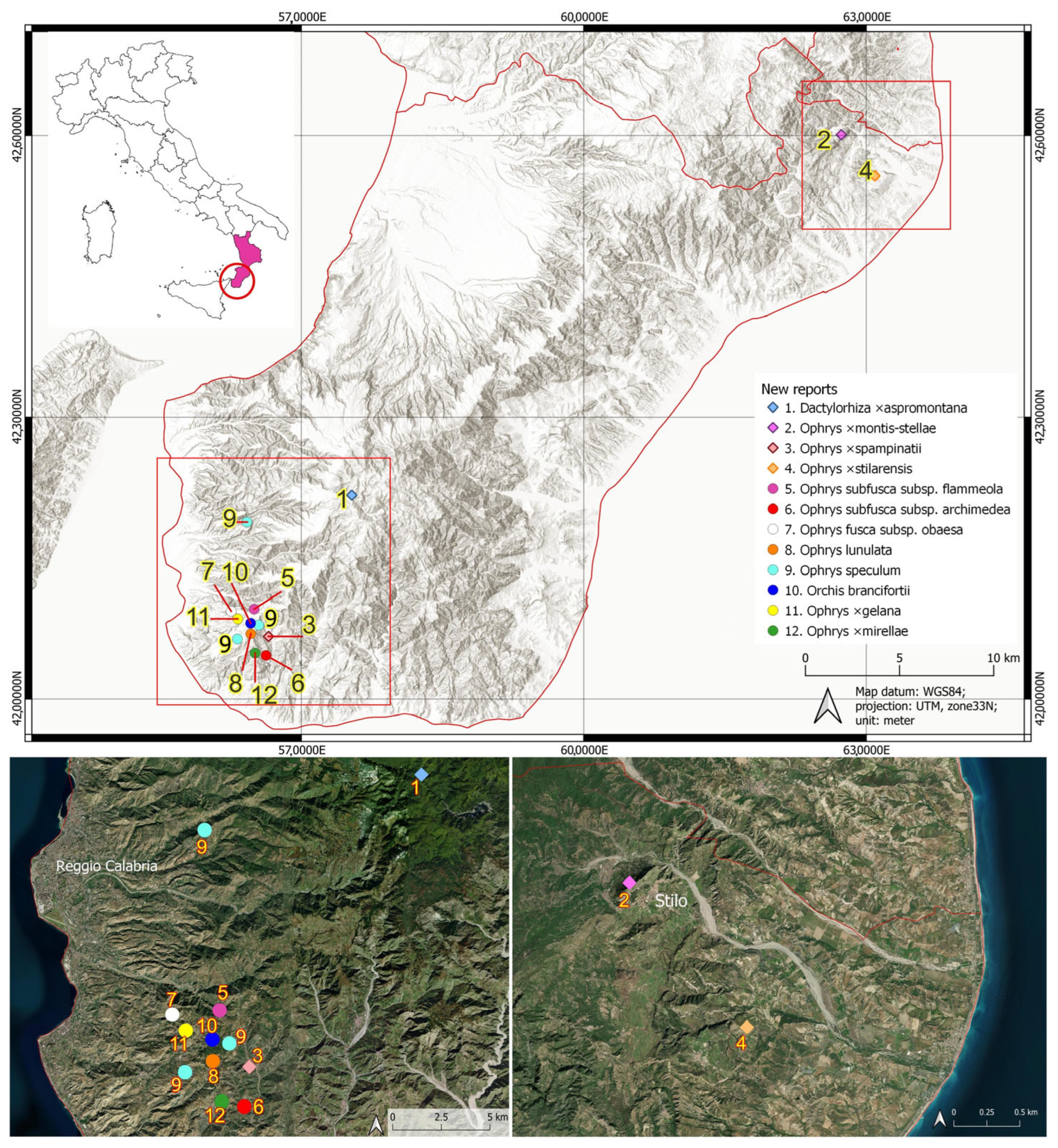
2.1. Study Area
2.2. Morphometric Data
2.3. Conservation Status Assessment
2.4. Hybrids Naming
3. Results
3.1. New Hybrids
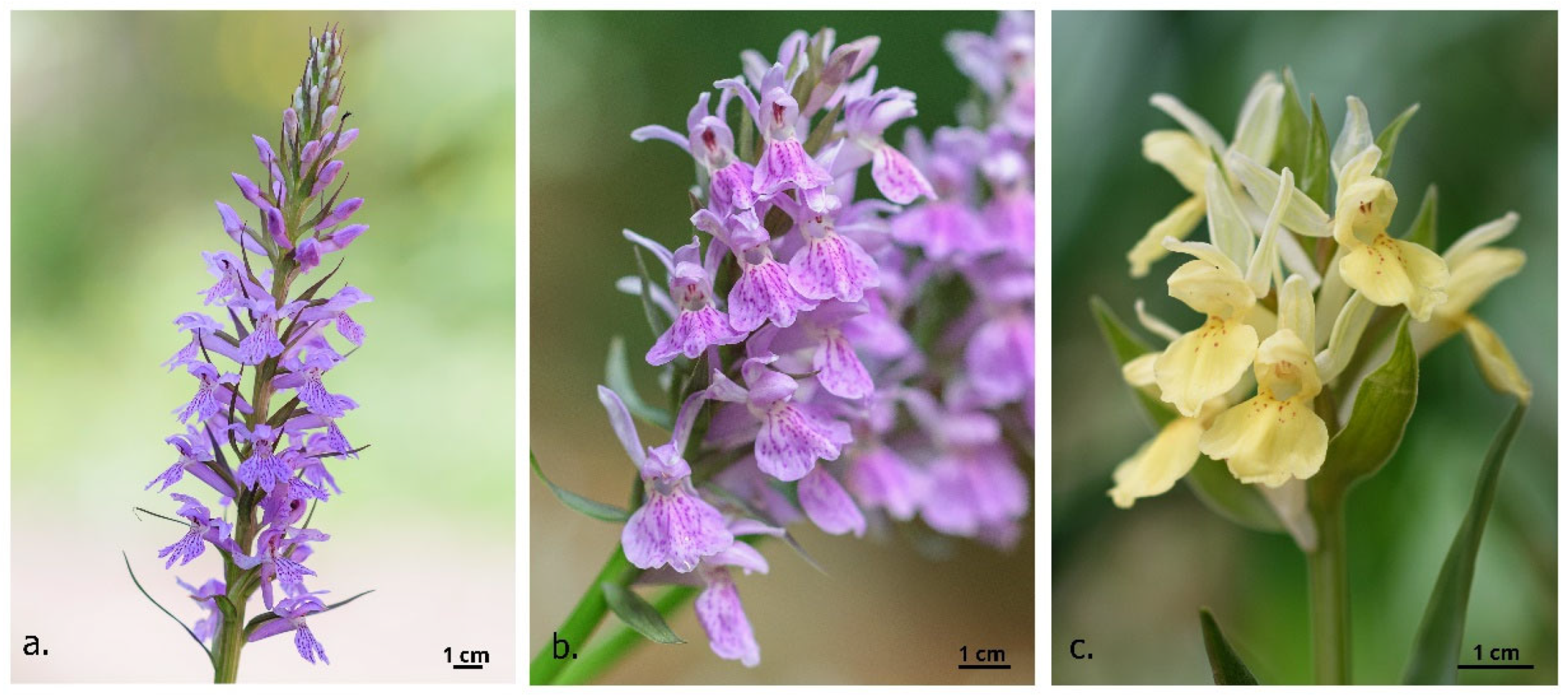
- Dactylorhiza × aspromontana V.L.A. Laface & L. Torino hybr. nov.
- Criterion B: AOO = 4 km2, calculated in GeoCAT [108] using a 2 × 2 km grid.(a) Number of locations = 1.(b) Continuing decline observed in: (iii) habitat quality; (v) number of mature individuals.
- Criterion D1: Population composed of fewer than 50 mature individuals, with only five genets currently observed in the wild.
- 2.
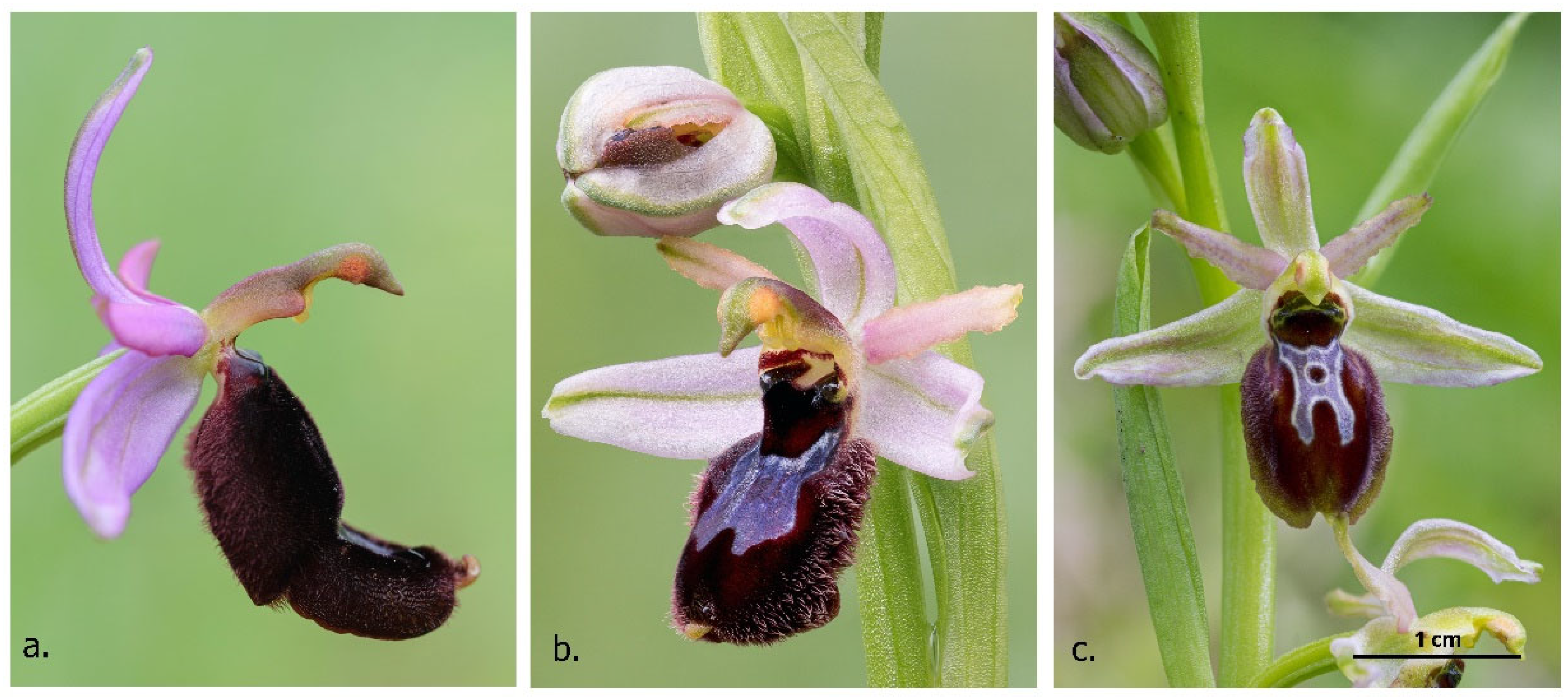
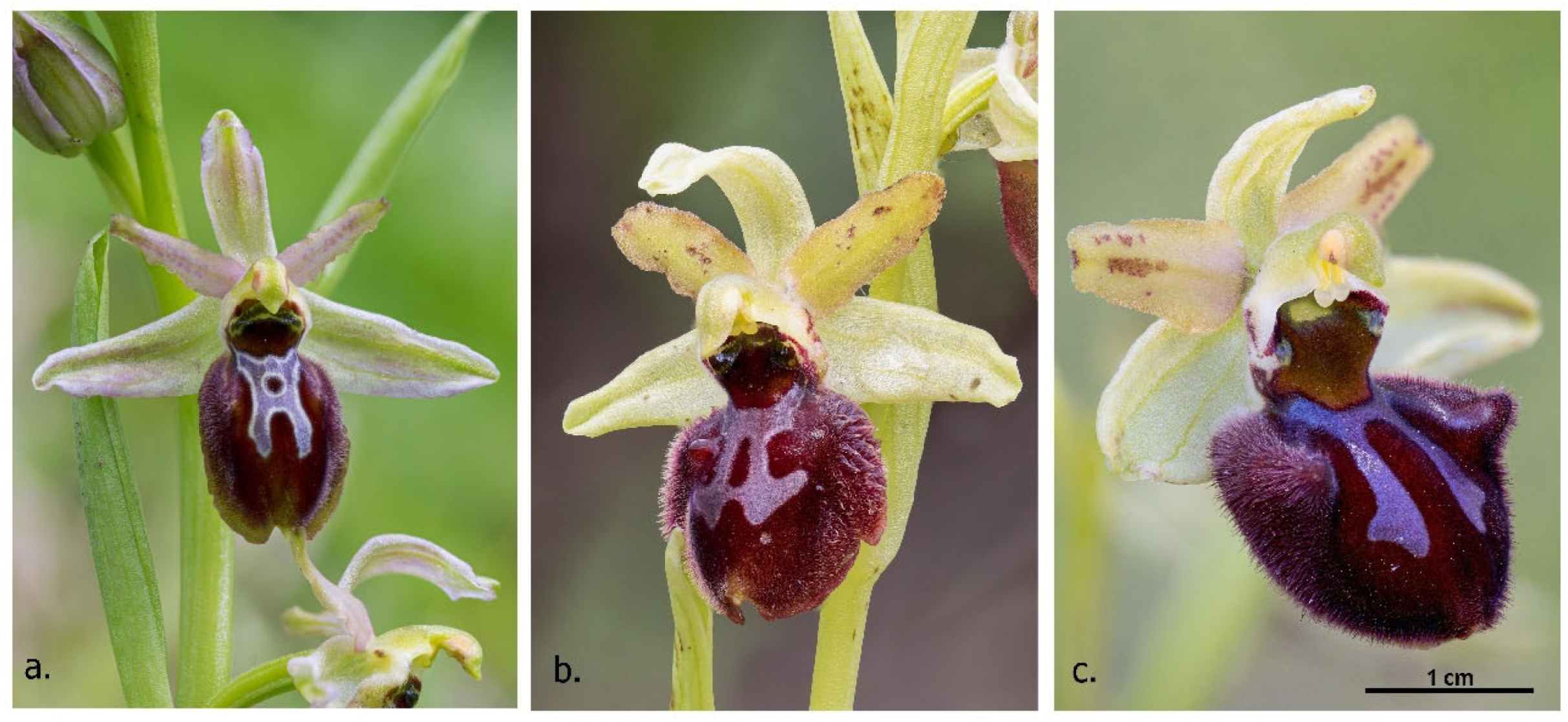
- Ophrys × montis-stellae V.L.A. Laface & L. Torino hybr. nov.
- Criterion B: AOO = 4 km2, calculated in GeoCAT [108] using a 2 × 2 km grid.(a) Number of locations = 1.(b) Continuing decline observed in: (iii) habitat quality; (v) number of mature individuals.
- Criterion D1: Population composed of fewer than 50 mature individuals, with only five genets currently observed in the wild.
- 3.
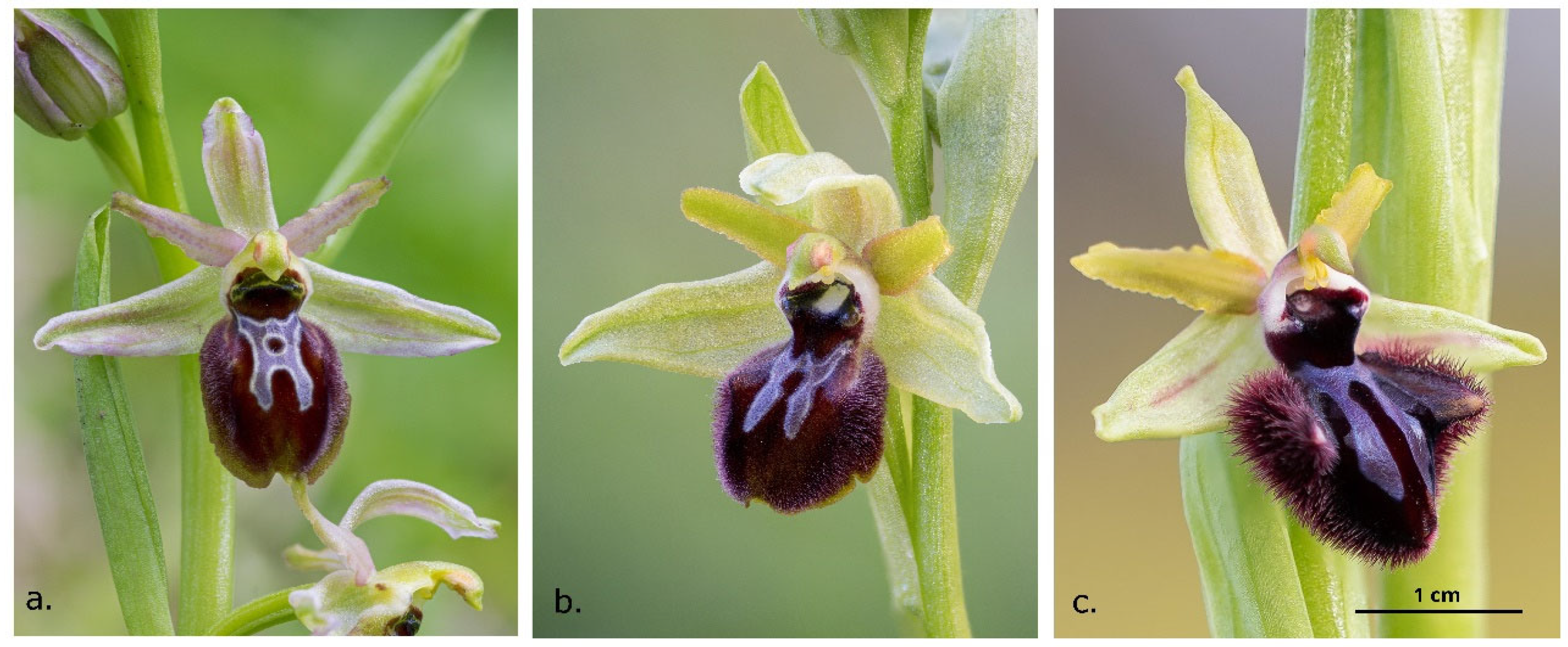
- Ophrys × spampinatii V.L.A. Laface & L. Torino hybr. nov.
- Criterion B: AOO = 4 km2, calculated in GeoCAT [108] using a 2 × 2 km grid.(a) Number of locations = 1.(b) Continuing decline observed in: (iii) habitat quality; (v) number of mature individuals.
- Criterion D1: Population composed of fewer than 50 mature individuals, with about ten genets currently observed in the wild.
- 4.
- Ophrys × stilarensis V.L.A. Laface & L. Torino hybr. nov.
- Criterion B: AOO = 4 km2, calculated in GeoCAT [108] using a 2 × 2 km grid.(a) Number of locations = 1.(b) Continuing decline observed in: (iii) habitat quality; (v) number of mature individuals.
- Criterion D1: Population composed of fewer than 50 mature individuals, with about seven genets currently observed in the wild.
3.2. New Records for Calabria
- Criterion B: AOO = 4 km2, calculated in GeoCAT [108] using a 2 × 2 km grid.(a) Number of locations = 1.(b) Continuing decline observed in: (iii) habitat quality.
- Criterion D1: Population composed of fewer than 250 mature individuals, approximately 100 mature individuals observed in the wild, concentrated within a relatively small area;
- Criterion D2: Occurrence restricted to a single locality with an AOO < 20 km2 and exposure to plausible threats, which could rapidly drive the taxon to a higher threat category.
- Criterion B: AOO = 4 km2, calculated in GeoCAT [108] using a 2 × 2 km grid.(a) Number of locations = 1.(b) Continuing decline observed in: (iii) habitat quality.
- Criterion D1: Population composed of fewer than 250 mature individuals, approximately 100 mature individuals observed in the wild, concentrated within a relatively small area;
- Criterion D2: Occurrence restricted to a single locality with an AOO < 20 km2 and exposure to plausible threats, which could rapidly drive the taxon to a higher threat category.
- Criterion B: AOO = 4 km2, calculated in GeoCAT [108] using a 2 × 2 km grid.(a) Number of locations = 1.(b) Continuing decline observed in: (iii) habitat quality.
- Criterion D1: Population composed of fewer than 250 mature individuals, approximately 50–70 mature individuals observed in the wild, concentrated within a relatively small area;
- Criterion D2: Occurrence restricted to a single locality with an AOO < 20 km2 and exposure to plausible threats, which could rapidly drive the taxon to a higher threat category.
- Criterion B: AOO = 4 km2, calculated in GeoCAT [108] using a 2 × 2 km grid.(a) Number of locations = 1.(b) Continuing decline observed in: (iii) habitat quality; (v) number of mature individuals.
- Criterion D1: Population composed of fewer than 50 mature individuals, with only two genets recorded at the single known site.
- Criterion B: AOO = 4 km2, calculated in GeoCAT [108] using a 2 × 2 km grid.(a) Number of locations = 1.(b) Continuing decline observed in: (iii) habitat quality; (v) number of mature individuals.
- Criterion D1: Population composed of fewer than 50 mature individuals, with only five genets recorded at the single known site.
- Criterion B: AOO = 4 km2, calculated in GeoCAT [108] using a 2 × 2 km grid.(a) Number of locations = 1.(b) Continuing decline observed in: (iii) habitat quality; (v) number of mature individuals.
- Criterion D1: Population composed of fewer than 50 mature individuals, with only five genets recorded at the single known site.
3.3. Rare Species at the Southernmost Limit of Continental Italy
4. Discussion
5. Conclusions
Supplementary Materials
Author Contributions
Funding
Institutional Review Board Statement
Informed Consent Statement
Data Availability Statement
Acknowledgments
Conflicts of Interest
References
- Swarts, N.; Dixon, K.W. Conservation Methods for Terrestrial Orchids; University of Tasmania: Hobart, Australia, 2017. [Google Scholar]
- Chase, M.W. Classification of Orchidaceae in the age of DNA data. Curtis’s Bot. Mag. 2005, 22, 2–7. [Google Scholar] [CrossRef]
- Cribb, P.J.; Kell, S.P.; Dixon, K.W.; Barrett, R.L. Orchid conservation: A global perspective. In Orchid Conservation; Dixon, K.W., Kell, S.P., Barrett, R.L., Cribb, P.J., Eds.; Natural History Publications: Kota Kinabalu, Malaysia, 2003; pp. 1–24. [Google Scholar]
- Givnish, T.J.; Spalink, D.; Ames, M.; Lyon, S.P.; Hunter, S.J.; Zuluaga, A.; Doucette, A.; Caro, G.G.; McDaniel, J.; Clements, M.A.; et al. Orchid historical biogeography, diversification, Antarctica and the paradox of orchid dispersal. J. Biogeogr. 2016, 43, 1905–1916. [Google Scholar] [CrossRef]
- Chase, M.W.; Cameron, K.M.; Barrett, R.L.; Freudenstein, J.V. DNA data and Orchidaceae systematics: A new phylogenetic classification. In Orchid Conservation; Natural History Publications: Kota Kinabalu, Malaysia, 2003; Volume 69, p. 32. [Google Scholar]
- Pridgeon, A.M.; Cribb, P.J.; Chase, M.W.; Rasmussen, F.N. (Eds.) Genera Orchidacearum; Oxford University Press: Oxford, UK, 2001–2014; Volume 1–6. [Google Scholar]
- Fay, M.F. Orchid conservation: Further links. Ann. Bot. 2016, 118, 89–91. [Google Scholar] [CrossRef] [PubMed]
- Khapugin, A.A. A global systematic review on orchid data in protected areas. Nat. Conserv. Res. 2020, 5 (Suppl. 1), 19–33. [Google Scholar] [CrossRef]
- Skotnicki, M.; Copson, G.R.; Doube, J.J.; Gadd, L.; Selkirk-Bell, J.M.; Selkirk, P.M. Biology and population studies of two endemic Nematoceras (orchid) species on Sub-Antarctic Macquarie Island. Pap. Proc. R. Soc. Tasman. 2009, 143, 61–71. [Google Scholar] [CrossRef]
- Christenhusz, M.J.M.; Byng, J.W. The number of known plant species in the world and its annual increase. Phytotaxa 2016, 261, 201–217. [Google Scholar] [CrossRef]
- Bartolo, G.; D’Emerico, S.; Pulvirenti, S. Cytotaxonomical considerations on Epipactis robatschiana (Orchidaceae), a new species from Calabria (S Italy). Caryologia 2012, 56, 439–445. [Google Scholar] [CrossRef][Green Version]
- Barberena, F.F.V.A.; Baumgratz, J.F.A.; de Barros, F. Ecological data for an orchid diversity hotspot show that the subtribe Laeliinae may be endangered in the Brazilian Atlantic Forest. Nord. J. Bot. 2018, 36, e01728. [Google Scholar] [CrossRef]
- Efimov, P.G. Orchids of Russia: Annotated checklist and geographic distribution. Nat. Conserv. Res. 2020, 5 (Suppl. 1), 1–18. [Google Scholar] [CrossRef]
- Fateryga, A.V.; Popovich, A.V.; Fateryga, V.V.; Kreutz, C.A.J. Cephalanthera epipactoides (Orchidaceae) in Russia. Nat. Conserv. Res. 2020, 5 (Suppl. 1), 69–76. [Google Scholar] [CrossRef]
- Darwin, C. The Various Contrivances by Which British and Foreign Orchids Are Fertilised by Insects; John Murray: London, UK, 1862. [Google Scholar]
- Darwin, C. On the Origin of Species by Means of Natural Selection, or the Preservation of Favoured Races in the Struggle for Life; John Murray: London, UK, 1859. [Google Scholar]
- Kullenberg, B.; Bergström, G. The pollination of Ophrys orchids. Bot. Not. 1976, 129, 11–20. [Google Scholar]
- Ackerman, J.D. Systems in orchids. Lindleyana 1986, 1, 108–113. [Google Scholar]
- Nilsson, L.A. Orchid pollination biology. Trends Ecol. Evol. 1992, 7, 255–259. [Google Scholar] [CrossRef]
- Suzuki, K.; Dohzono, I.; Hiei, K. Evolution of pollinator generalization in bumblebee-pollinated plants. Plant Species Biol. 2007, 22, 141–159. [Google Scholar] [CrossRef]
- Peter, C.I. Modes of pollination and the occurrence of deception in the Orchidaceae. In Proceedings of the 20th World Orchid Conference, Singapore, 13–20 November 2011; Elliott, J., Kurzweil, H.F., O’Byrne, P., Tan, K.W., van der Schans, A.S., Wong, S.M., Yam, T.W., Eds.; National Parks Board: Singapore, 2011; pp. 268–272. [Google Scholar]
- Liu, Z.J.; Chen, L.J.; Liu, K.W.; Li, L.Q.; Rao, W.H.; Zhang, Y.T.; Tang, G.D.; Huang, L.Q. Adding perches for cross-pollination ensures the reproduction of a self-incompatible orchid. PLoS ONE 2013, 8, e53695. [Google Scholar] [CrossRef] [PubMed]
- Johnson, S.D.; Schiestl, F.P. Floral Mimicry; Oxford University Press: Oxford, UK, 2016. [Google Scholar]
- Ackerman, J.D.; Phillips, R.D.; Tremblay, R.L.; Karremans, A.; Reiter, N.; Peter, C.I.; Bogarin, D.; Perez-Escobar, O.A.; Liu, H. Beyond the various contrivances by which orchids are pollinated: Global patterns in orchid pollination biology. Bot. J. Linn. Soc. 2023, 202, 295–324. [Google Scholar] [CrossRef]
- van der Pijl, L.; Dodson, C.H. Orchid Flowers: Their Pollination and Evolution; University of Miami Press: Coral Gables, FL, USA, 1966. [Google Scholar]
- van der Cingel, N.A. An Atlas of Orchid Pollination: America, Africa, Asia and Australia; A.A. Balkema: Rotterdam, The Netherlands, 2001. [Google Scholar]
- Dressler, R.L. Phylogeny and Classification of the Orchid Family; Dioscorides Press: Portland, OR, USA, 1993. [Google Scholar]
- Schiestl, F.P. On the success of a swindle: Pollination by deception in orchids. Naturwissenschaften 2005, 92, 255–264. [Google Scholar] [CrossRef]
- Jersáková, J.; Johnson, S.D.; Kindlmann, P. Mechanisms and evolution of deceptive pollination in orchids. Biol. Rev. 2006, 81, 219–235. [Google Scholar] [CrossRef]
- Steffelová, M.; Traxmandlová, I.; Štípková, Z.; Kindlmann, P. Pollination strategies of deceptive orchids—A review. Eur. J. Environ. Sci. 2023, 13, 110–116. [Google Scholar] [CrossRef]
- Carlomagno, F.; Lanzino, M.; Mendicino, F.; Bonacci, T.; Pellegrino, G. Pollinator diversity of the food-deceptive orchids in southern Italy. Plant Biol. 2024, 26, 1144–1153. [Google Scholar] [CrossRef]
- Wróblewska, A.; Ostrowiecka, B.; Kotowicz, J.; Jermakowicz, E.; Tałałaj, I.; Szefer, P. What are the drivers of female success in food-deceptive orchids? Ecol. Evol. 2024, 14, e11233. [Google Scholar] [CrossRef]
- Gaskett, A.C. Orchid pollination by sexual deception: Pollinator perspectives. Biol. Rev. 2011, 86, 33–75. [Google Scholar] [CrossRef]
- Francisco, A.; Ascensão, L. Osmophore structure and labellum micromorphology in Ophrys speculum (Orchidaceae): New interpretations of floral features and implications for a specific sexually deceptive pollination interaction. Plants 2024, 13, 1413. [Google Scholar] [CrossRef]
- Paulus, H.F.; Gack, C. Pollinators as prepollinating isolation factors: Evolution and speciation in Ophrys (Orchidaceae). Isr. J. Bot. 1990, 39, 43–79. [Google Scholar]
- Pellegrino, G.; Musacchio, A.; Noce, M.E.; Palermo, A.M.; Widmer, A. Reproductive versus floral isolation among morphologically similar Serapias L. species (Orchidaceae). J. Hered. 2005, 96, 15–23. [Google Scholar] [CrossRef]
- Bazzicalupo, M.; Calevo, J.; Smeriglio, A.; Cornara, L. Traditional, therapeutic uses and phytochemistry of terrestrial European orchids and implications for conservation. Plants 2023, 12, 257. [Google Scholar] [CrossRef]
- Lussu, M.; Ancillotto, L.; Labadessa, R.; Di Musciano, M.; Zannini, P.; Testolin, R.; Santi, F.; Dolci, D.; Conti, M.; Marignani, M.; et al. Prioritizing conservation of terrestrial orchids: A gap analysis for Italy. Biol. Conserv. 2024, 289, 110385. [Google Scholar] [CrossRef]
- Pillon, Y.; Chase, M.W. Taxonomic exaggeration and its effects on orchid conservation. Conserv. Biol. 2007, 21, 263–265. [Google Scholar] [CrossRef]
- Pellegrino, G.; Luca, A.; Bellusci, F. Relationships between orchid and fungal biodiversity: Mycorrhizal preferences in Mediterranean orchids. Plant Biosyst. 2016, 150, 180–189. [Google Scholar] [CrossRef]
- Pellegrino, G.; Mahmoudi, M.; Palermo, A.M. Pollen viability of Euro-Mediterranean orchids under different storage conditions: The possible effects of climate change. Plant Biol. 2021, 23, 140–147. [Google Scholar] [CrossRef]
- Swarts, N.D.; Dixon, K.W. Terrestrial orchid conservation in the age of extinction. Ann. Bot. 2009, 104, 543–556. [Google Scholar] [CrossRef] [PubMed]
- Molnár, A.; Tökölyi, J.; Végvári, Z.; Sramkó, G.; Sulyok, J.; Barta, Z. Pollination mode predicts phenological response to climate change in terrestrial orchids: A case study from central Europe. J. Ecol. 2012, 100, 1141–1152. [Google Scholar] [CrossRef]
- Robbirt, K.M.; Roberts, D.L.; Hutchings, M.J.; Davy, A.J. Potential disruption of pollination in a sexually deceptive orchid by climatic change. Curr. Biol. 2014, 24, 2845–2849. [Google Scholar] [CrossRef] [PubMed]
- Faleiro, F.V.; Nemésio, A.; Loyola, R. Climate change likely to reduce orchid bee abundance even in climatically suitable sites. Glob. Change Biol. 2018, 24, 2272–2283. [Google Scholar] [CrossRef]
- Štípková, Z.; Kindlmann, P. Factors determining the distribution of orchids—A review with examples from the Czech Republic. Eur. J. Environ. Sci. 2021, 11, 21–30. [Google Scholar] [CrossRef]
- Parmesan, C.; Yohe, G. A globally coherent fingerprint of climate change impacts across natural systems. Nature 2003, 421, 37–42. [Google Scholar] [CrossRef]
- Memmott, J.; Craze, P.G.; Waser, N.M.; Price, M.V. Global warming and the disruption of plant–pollinator interactions. Ecol. Lett. 2007, 10, 710–717. [Google Scholar] [CrossRef]
- Schweiger, O.; Settele, J.; Kudrna, O.; Klotz, S.; Kühn, I. Climate change can cause spatial mismatch of trophically interacting species. Ecology 2008, 89, 3472–3479. [Google Scholar] [CrossRef]
- Pellegrino, G.; Bellusci, F. Effects of human disturbance on reproductive success and population viability of Serapias cordigera (Orchidaceae). Bot. J. Linn. Soc. 2014, 176, 408–420. [Google Scholar] [CrossRef]
- Brinkmann, J.A. Quick Scan of Orchidaceae Species in European Commerce as Components of Cosmetic, Food and Medicinal Products. PC22 Doc. 22.1 Annex. 2014. Available online: https://cites.org/eng/com/pc/22/index.php (accessed on 1 September 2025).
- Kull, T.; Selgis, U.; Peciña, M.V.; Metsare, M.; Ilves, A.; Tali, K.; Sepp, K.; Kull, K.; Shefferson, R.P. Factors influencing IUCN threat levels to orchids across Europe on the basis of national red lists. Ecol. Evol. 2016, 6, 6245–6265. [Google Scholar] [CrossRef]
- Wraith, J.; Pickering, C. Quantifying anthropogenic threats to orchids using the IUCN Red List. Ambio 2018, 47, 307–317. [Google Scholar] [CrossRef]
- Wraith, J.; Norman, P.; Pickering, C. Orchid conservation and research: An analysis of gaps and priorities for globally Red Listed species. Ambio 2020, 49, 1601–1611. [Google Scholar] [CrossRef]
- IUCN. Orchid RLA. Available online: https://www.orchidspecialistgroup.com/orchid-rla (accessed on 3 September 2025).
- Hinsley, A.; De Boer, H.J.; Fay, M.F.; Gale, S.W.; Gardiner, L.M.; Gunasekara, R.S.; Kumar, P.; Masters, S.; Metusala, D.; Roberts, D.L.; et al. A review of the trade in orchids and its implications for conservation. Bot. J. Linn. Soc. 2018, 186, 435–455. [Google Scholar] [CrossRef]
- Conti, F.; Manzi, A.; Pedrotti, F. Liste Rosse Regionali Delle Piante d’Italia; WWF, Società Botanica Italiana: Camerino, Italy, 1997. [Google Scholar]
- Rossi, G.; Montagnani, C.; Gargano, D.; Peruzzi, L.; Abeli, T.; Ravera, S.; Cogoni, A.; Fenu, G.; Magrini, S.; Gennai, M.; et al. (Eds.) Lista Rossa della Flora Italiana. 1: Policy Species e Altre Specie Minacciate; Comitato Italiano IUCN e Ministero dell’Ambiente e della Tutela del Territorio e del Mare: Roma, Italy, 2013. [Google Scholar]
- Rossi, G.; Orsenigo, S.; Gargano, D.; Montagnani, C.; Peruzzi, L.; Fenu, G.; Abeli, T.; Alessandrini, A.; Astuti, G.; Bacchetta, G.; et al. Lista Rossa della Flora Italiana. 2 Endemiti e Altre Specie Minacciate; Ministero dell’Ambiente e della Tutela del Territorio e del Mare: Roma, Italy, 2020. [Google Scholar]
- IUCN. The IUCN Red List of Threatened Species. Version 2025-1. Available online: https://www.iucnredlist.org (accessed on 3 September 2025).
- Mittermeier, R.A.; Turner, W.R.; Larsen, F.W.; Brooks, T.M.; Gascon, C. Global biodiversity conservation: The critical role of hotspots. In Biodiversity Hotspots; Zachos, F., Habel, J., Eds.; Springer: Berlin/Heidelberg, Germany, 2011; pp. 3–22. [Google Scholar] [CrossRef]
- Myers, N.; Cowling, R.M. Mediterranean Basin. In Hotspots; Mittermeier, R.A., Myers, N., Gil, P.R., Mittermeier, C.G., Eds.; CEMEX and Conservation International: Mexico City, Mexico, 1999; pp. 255–265. [Google Scholar]
- Delforge, P. Guide des Orchidées d’Europe, d’Afrique du Nord et du Proche-Orient, 4th ed.; Delachaux et Niestlé: Lausanne, Switzerland, 2016. [Google Scholar]
- Singer, R.B.; Gravendeel, B.; Cross, H.; Ramirez, S.R. The use of orchid pollinia or pollinaria for taxonomic identification. Selbyana 2008, 29, 6–19. [Google Scholar]
- Claessens, J.; Kleynen, J. The Flower of the European Orchid: Form and Function; Jean Claessens & Jacques Kleynen: Geulle, The Netherlands, 2011. [Google Scholar]
- Bartolucci, F.; Peruzzi, L.; Galasso, G.; Alessandrini, A.; Ardenghi, N.M.G.; Bacchetta, G.; Banfi, E.; Barberis, G.; Ballelli, S.; Bernardo, L.; et al. A second update to the checklist of the vascular flora native to Italy. Plant Biosyst. 2024, 158, 219–296. [Google Scholar] [CrossRef]
- Tenore, M. Prodromus Florae Neapolitanae; Typis Filiatre-Sebetii: Napoli, Italy, 1811; pp. 5–58. [Google Scholar]
- Tenore, M. Ad Catalogum Plantarum Horti Regii Neapolitani; Appendix Secunda; Typ. Diarii Encyclopedici: Napoli, Italy, 1819. [Google Scholar]
- Tenore, M. Flora Napolitana; Typis Fibreni: Napoli, Italy, 1828; Volume 2, pp. 398p + pl. 51–100. [Google Scholar]
- Tenore, M. Flora Napolitana; Typis Fibreni: Napoli, Italy, 1830; Volume 4, pp. 358p + [I]–XVIII + pl. 151–200. [Google Scholar]
- Tenore, M. Sylloge Plantarum Vascularium Florae Neapolitanae Hujusque Detectarum; Appendix III; Typ. Fibreni: Napoli, Italy, 1831; pp. 581–639. [Google Scholar]
- Bertoloni, A. Flora Italica; Tipografia Sassi: Bologna, Italy, 1853–1854; Volume 9, 669p. [Google Scholar]
- Parlatore, P. Flora Italiana; Tip. Dei Successori Le Monnier: Firenze, Italy, 1858–1860; Volume 3, 690p. [Google Scholar]
- Macchiati, L. Catalogo delle piante raccolte nei dintorni di Reggio Calabria dal settembre 1881 al febbraio 1883. Nuovo G. Bot. Ital. 1884, 16, 1–114. [Google Scholar]
- Terracciano, N. Synopsis plantarum vascularium montis Pollini. Ann. R. Ist. Bot. Roma 1891, 4, 1–191. [Google Scholar]
- Terracciano, N. Intorno alla flora del monte Pollino e delle terre adiacenti. Tip. Della R. Accad. Delle Sci. Fis. E Mat. 1896, 8, 12–14. [Google Scholar]
- Terracciano, N. Addenda ad synopsidem plantarum vascularium Montis Pollini. Ann. R. Ist. Bot. Roma 1902, 9, 42–46. [Google Scholar]
- Gölz, P.; Reinhard, H.R. Orchideen in Süditalien. Mitt. Bl. Arbeitskr. Heim. Orch. Baden-Württ. 1982, 14, 1–124. [Google Scholar]
- Lorenz, R.; Künkele, S. Die Orchideenflora von Kalabrien und ihre Stellung innerhalb Italiens. Jahresber. Naturwiss. Ver. Wuppertal 1992, 43, 15–35. [Google Scholar]
- Rossi, W. Orchidee d’Italia; Quaderni di Conservazione della Natura; Ministero dell’Ambiente—Istituto Nazionale Fauna Selvatica: Rome, Italy, 2002; p. 15. [Google Scholar]
- Delforge, P. Guide des Orchidées d’Europe, d’Afrique du Nord et du Proche-Orient, 2nd ed.; Delachaux et Niestlé: Lausanne, Switzerland; Paris, France, 2001; p. 592. [Google Scholar]
- Bernardo, L.; Puntillo, M. Le Orchidee Spontanee Della Calabria; Prometeo Editore: Castrovillari, Italy, 2002. [Google Scholar]
- Bernardo, L.; Peruzzi, L.; Passalacqua, N.G. Flora vascolare della Calabria. Inf. Bot. Ital. 2011, 45, 185–332. [Google Scholar]
- Delforge, P. Contribution à la connaissance des orchidées printanières de Calabre (Italie) et description d’Ophrys brutia sp. nova. Nat. Belg. 2003, 84, 55–94. [Google Scholar]
- Torino, L.; Liberti, G. Update of the orchid checklist in the territory of Reggio Calabria. GIROS Orch. Spont. Eur. 2023, 86, 360–375. [Google Scholar]
- QGIS Development Team. QGIS Geographic Information System, Version 3.26.3 “Buenos Aires”; Open Source Geospatial Foundation Project. 2022. Available online: https://qgis.org (accessed on 11 November 2025).
- Esri. World Topographic Map; ©Esri, DigitalGlobe, GeoEye, Earthstar Geographics, CNES/Airbus DS, USDA, USGS, AeroGRID, IGN and the GIS User Community. 2025. Available online: https://www.esri.com (accessed on 11 November 2025).
- Google. Google Satellite Imagery; ©Google. 2025. Available online: https://www.google.com/maps (accessed on 11 November 2025).
- Pesaresi, S.; Galdenzi, D.; Biondi, E.; Casavecchia, S. Bioclimate of Italy: Application of the worldwide bioclimatic classification system. J. Maps 2014, 10, 538–553. [Google Scholar] [CrossRef]
- Rivas-Martínez, S. Global Bioclimatics (Clasificación Bioclimática de la Tierra); Phytosociological Research Center: Madrid, Spain, 2008. [Google Scholar]
- Brullo, S.; Scelsi, F.; Spampinato, G. La Vegetazione dell’Aspromonte: Studio Fitosociologico; Laruffa Editore: Reggio Calabria, Italy, 2001. [Google Scholar]
- Blasi, C.; Capotorti, G.; Copiz, R.; Guida, D.; Mollo, B.; Smiraglia, D.; Zavattero, L. Classification and mapping of the ecoregions of Italy. Plant Biosyst. 2014, 148, 1255–1345. [Google Scholar] [CrossRef]
- Morelli, A. L’arco calabro-peloritano nell’orogene appenninico-maghrebide. Mem. Soc. Geol. Ital. 1976, 17, 1. [Google Scholar]
- Vai, G.B. Il segmento Calabro-Peloritano dell’orogene Ercinico. Disaggregazione palinspacta. Boll. Soc. Geol. Ital. 1992, 111, 109–129. [Google Scholar]
- Cavazza, W.; Ingersoll, R.V. Detrital modes of the Ionian forearc basin fill (Oligocene–Quaternary) reflect the tectonic evolution of the Calabria–Peloritani terrane (southern Italy). J. Sediment. Res. 2005, 75, 268–279. [Google Scholar] [CrossRef]
- Aramini, G.; Colloca, C.; Corea, A.M.; Paone, R. Carta dei Suoli della Calabria in Scala 1:250.000; Serie Pedologica; ARSSA: Calabria, Italy, 2003. [Google Scholar]
- Chapman, A.D. Current Best Practices for Generalizing Sensitive Species Occurrence Data. Copenhagen: GBIF Secretariat. 2020. [Google Scholar] [CrossRef]
- Vladimirov, V.; Aybeke, M.; Tan, K. New floristic records in the Balkans: 37. Phytol. Balc. 2018, 24, 397–461. [Google Scholar]
- Eccarius, W. Die Orchideengattung Gymnadenia mit einem Exkurs zur Gattung Pseudorchis: Phylogenie, Taxonomie, Morphologie, Biologie, Verbreitung, Ökologie und Hybridisation; Selbstverlag der Verfasser: Thüringen, Germany, 2022; p. 336. [Google Scholar]
- GIROS. Classificazione Specie. 2025. Available online: https://demo12.edinet.dev/classificazione-specie (accessed on 4 September 2025).
- Thiers, B.M. Index Herbariorum: A Global Directory of Public Herbaria and Associated Staff. New York Botanical Garden’s Virtual Herbarium. 2025. Available online: https://sweetgum.nybg.org/science/ih/herbarium-details/?irn=170958 (accessed on 3 July 2025).
- Chase, M.W.; Cameron, K.M.; Freudenstein, J.V.; Pridgeon, A.M.; Salazar, G.; Van den Berg, C.; Schuiteman, A. An updated classification of Orchidaceae. Bot. J. Linn. Soc. 2015, 177, 151–174. [Google Scholar] [CrossRef]
- Bateman, R.M.; Rudall, P.J. Morphological continua make poor species: Genus-wide morphometric survey of the European bee orchids (Ophrys L.). Biology 2023, 12, 136. [Google Scholar] [CrossRef] [PubMed]
- POWO. Plants of the World Online. Facilitated by the Royal Botanic Gardens, Kew. 2025. Available online: https://powo.science.kew.org/ (accessed on 4 September 2025).
- IPNI. International Plant Names Index. The Royal Botanic Gardens, Kew, Harvard University Herbaria & Libraries and Australian National Herbarium. 2025. Available online: http://www.ipni.org (accessed on 25 August 2025).
- IUCN. IUCN Red List Categories and Criteria: Version 3.1, 2nd ed.; IUCN: Gland, Switzerland; Cambridge, UK, 2012; pp. iv + 32 pp. [Google Scholar]
- IUCN. Guidelines for Using the IUCN Red List Categories and Criteria, Version 15; Standards and Petitions Committee: Gland, Switzerland, 2022; Available online: https://www.iucnredlist.org/resources/redlistguidelines (accessed on 3 November 2025).
- Bachman, S.; Moat, J.; Hill, A.W.; de la Torre, J.; Scott, B. Supporting Red List threat assessments with GeoCAT: Geospatial conservation assessment tool. ZooKeys 2011, 150, 117–126. [Google Scholar] [CrossRef]
- IUCN. Threats Classification Scheme, Version 3.3; International Union for Conservation of Nature: Gland, Switzerland, 2022. Available online: https://www.iucnredlist.org/resources/threat-classification-scheme (accessed on 3 November 2025).
- Turland, N.J.; Wiersema, J.H.; Barrie, F.R.; Greuter, W.; Hawksworth, D.L.; Herendeen, P.S.; Knapp, S.; Kusber, W.-H.; Li, D.-Z.; Marhold, K.; et al. (Eds.) International Code of Nomenclature for Algae, Fungi, and Plants (Shenzhen Code) Adopted by the Nineteenth International Botanical Congress, Shenzhen, China, July 2017; Regnum Vegetabile; Koeltz Botanical Books: Glashütten, Germany, 2018; Volume 159. [Google Scholar]
- Bateman, R.M.; Smith, R.J.; Fay, M.F. Morphometric and population genetic analyses elucidate the origin, evolutionary significance and conservation implications of Orchis × angusticruris (O. purpurea × O. simia), a hybrid orchid new to Britain. Bot. J. Linn. Soc. 2008, 157, 687–711. [Google Scholar] [CrossRef]
- Baumann, H.; Künkele, S. Beiträge zur Erhaltung und Erforschung heimischer Orchideen. In Mitteilungen des Arbeitskreises Heimische Orchideen Baden-Württemberg; Hochschule Neubrandenburg: Berlin, Germany, 1986; Volume 18, p. 492. [Google Scholar]
- Souche, R. Inventaire des Hybrides du Genre Ophrys (Orchidaceae); Editions Sococor: Reprolaser, France, 2022. [Google Scholar]
- Rosati, L.; Fascetti, S.; Romano, V.A.; Potenza, G.; Lapenna, M.R.; Capano, A.; Nicoletti, P.; Farris, E.; de Lange, P.J.; Del Vico, E.; et al. New Chorological Data for the Italian Vascular Flora. Diversity 2020, 12, 22. [Google Scholar] [CrossRef]
- Tenore, M. Flora Napolitana, Ossia Descrizione Delle Piante Indigene del Regno di Napoli, e Delle Più Rare Specie di Piante Esotiche Coltivate ne’ Giardini; Stamperia Reale: Napoli, Italy, 1820; Volume 1, Pt. II, Tom. II; p. 309. [Google Scholar]
- Parlatore, F. Flora Italiana; Ossia Descrizione Delle Piante Che Nascono Selvatiche o si Sono Inselvatichite, in Italia e Nelle Isole ad Essa Adiacenti; Distribuita Secondo il Metodo Naturale; Tipografia Le Monnier: Firenze, Italy, 1858; Volume 3, p. 555. [Google Scholar]
- Delforge, P. Présence d’Orchis brancifortii en Calabre. Nat. Belg. 2002, 83, 59–66. [Google Scholar]
- Lumaret, R.; Mir, C.; Michaud, H.; Raynal, V. Phylogeographical variation of chloroplast DNA in holm oak (Quercus ilex L.). Mol. Ecol. 2002, 11, 2327–2336. [Google Scholar] [CrossRef]
- Fernández-Mazuecos, M.; Vargas, P. Ecological rather than geographical isolation dominates Quaternary formation of Mediterranean Cistus species. Mol. Ecol. 2010, 19, 1381–1395. [Google Scholar] [CrossRef]
- Spampinato, G.; Musarella, C.M.; Cano-Ortiz, A.; Signorino, G. Habitat, occurrence and conservation status of the Saharo-Macaronesian and Southern-Mediterranean element Fagonia cretica L. (Zygophyllaceae) in Italy. J. Arid Land 2018, 10, 140–151. [Google Scholar] [CrossRef]
- Pignatti, S. Evolutionary trends in Mediterranean flora and vegetation. Vegetatio 1978, 37, 175–185. [Google Scholar] [CrossRef]
- Cozzolino, S.; Widmer, A. Orchid diversity: An evolutionary consequence of deception? Trends Ecol. Evol. 2005, 20, 487–494. [Google Scholar] [CrossRef]
- Cozzolino, S.; Nardella, A.M.; Impagliazzo, S.; Widmer, A.; Lexer, C. Hybridization and conservation of Mediterranean orchids: Should we protect the orchid hybrids or the orchid hybrid zones? Biol. Conserv. 2006, 129, 14–23. [Google Scholar] [CrossRef]
- Scopece, G.; Musacchio, A.; Widmer, A.; Cozzolino, S. Patterns of reproductive isolation in Mediterranean deceptive orchids. Evolution 2007, 61, 2623–2642. [Google Scholar] [CrossRef] [PubMed]
- Sciandrello, S.; Guarino, R.; Minissale, P.; Spampinato, G. The endemic vascular flora of Peloritani Mountains (NE Sicily): Plant functional traits and phytogeographical relationships in the most isolated and fragmentary micro-plate of the Alpine orogeny. Plant Biosyst. 2015, 149, 838–854. [Google Scholar] [CrossRef]
- Sciandrello, S.; Minissale, P.; Del Galdo, G.G. Vascular plant species diversity of Mt. Etna (Sicily): Endemicity, insularity and spatial patterns along the altitudinal gradient of the highest active volcano in Europe. PeerJ 2020, 8, e9875. [Google Scholar] [CrossRef] [PubMed]
- Quézel, P.; Médail, F. Ecology and Biogeography of the Forests of the Mediterranean Basin; Elsevier: Paris, France, 2003; p. 592. [Google Scholar]
- Médail, F.; Diadema, K. Glacial refugia influence plant diversity patterns in the Mediterranean Basin. J. Biogeogr. 2009, 36, 1333–1345. [Google Scholar] [CrossRef]
- Giacobbe, S.; Oliverio, M. The conventional limits of the marine biogeographical Sector 4, for the new Checklist of the Italian Fauna: The Strait of Messina as biogeographical sector. Biogeographia 2024, 39, ucl011. [Google Scholar] [CrossRef]
- Médail, F.; Quézel, P. Hot-spots analysis for conservation of plant biodiversity in the Mediterranean Basin. Ann. Mo. Bot. Gard. 1997, 84, 112–127. [Google Scholar] [CrossRef]
- Paulus, H.F.; Gack, C. Pollination of Ophrys (Orchidaceae) in Cyprus. Plant Syst. Evol. 1990, 169, 177–207. [Google Scholar] [CrossRef]
- Bateman, R.M.; Bradshaw, E.; Devey, D.S.; Glover, B.J.; Malmgren, S.; Sramko, G.; Rudall, P.J. Species arguments: Clarifying competing concepts of species delimitation in the pseudo-copulatory orchid genus Ophrys. Bot. J. Linn. Soc. 2011, 165, 336–347. [Google Scholar] [CrossRef]
- Paulus, H.F. Deceived males—Pollination biology of the Mediterranean orchid genus Ophrys (Orchidaceae). J. Eur. Orch. 2006, 38, 303–353. [Google Scholar]
- Scopece, G.; Cozzolino, S.; Johnson, S.D.; Schiestl, F.P. Pollination efficiency and the evolution of specialized deceptive pollination systems. Am. Nat. 2010, 175, 98–105. [Google Scholar] [CrossRef]
- Vereecken, N.J.; Dafni, A.; Cozzolino, S. Pollination Syndromes in Mediterranean Orchids—Implications for Speciation, Taxonomy and Conservation. Bot. Rev. 2010, 76, 220–240. [Google Scholar] [CrossRef]
- Xu, S.; Schlüter, P.M.; Grossniklaus, U.; Schiestl, F.P. The genetic basis of pollinator adaptation in a sexually deceptive orchid. PLoS Genet. 2012, 8, e1002889. [Google Scholar] [CrossRef] [PubMed]
- Ayasse, M.; Stökl, J.; Francke, W. Chemical Ecology and Pollinator-Driven Speciation in Sexually Deceptive Orchids. Phytochemistry 2011, 72, 1667–1677. [Google Scholar] [CrossRef] [PubMed]
- Heinrichs, S.; Pauchard, A.; Schall, P. Native plant diversity and composition across a Pinus radiata D. Don plantation landscape in south-central Chile. The impact of plantation age, logging roads and alien species. Forests 2018, 9, 567. [Google Scholar] [CrossRef]
- Jakubska-Busse, A.; Tsiftsis, S.; Śliwiński, M.; Křenová, Z.; Djordjević, V.; Steiu, C.; Kreutz, K. How to protect natural habitats of rare terrestrial orchids effectively: A comparative case study of Cypripedium calceolus in different geographical regions of Europe. Plants 2021, 10, 404. [Google Scholar] [CrossRef]
- Magrini, S.; Buono, S.; Fonck, M.; De Vitis, M.; Haile, G.; Rempicci, M.; Gransinigh, E.; Scarici, E.; Zucconi, L. An Integrated Project for the Conservation of Wild Orchids. In Conservation of Threatened Species: Activities and Collaborations Within the Network; RIBES Series 1; Mariotti, M., Magrini, S., Eds.; RIBES: Milano, Italy, 2015; pp. 45–48. [Google Scholar]
- European Environment Agency (EEA). Natura 2000 Data—The European Network of Protected Sites. Available online: https://www.eea.europa.eu/themes/biodiversity/natura-2000 (accessed on 11 November 2025).
- MASE. Ministero Dell’Ambiente e Della Sicurezza Energetica. 2025. Available online: https://www.mase.gov.it/portale/rete-natura-2000 (accessed on 20 September 2025).
- Council of the European Communities. Council Directive 92/43/EEC of 21 May 1992 on the conservation of natural habitats and of wild fauna and flora. Off. J. Eur. Communities 1992, 206, 50. [Google Scholar]
- Landi, M.; Frignani, F.; Lazzeri, C.; Angiolini, C. Abundance of Orchids on Calcareous Grasslands in Relation to Community Species, Environmental, and Vegetational Conditions. Russ. J. Ecol. 2009, 40, 486–494. [Google Scholar] [CrossRef]
- La Rosa, A.; Gianguzzi, L.; Salluzzo, G.; Scuderi, L.; Pasta, S. Floristic Census and Forest Vegetation Survey at Parco di Bilello (Sicily): The Study Site Also Hosts One Habitat of Priority Interest 6220 (i.e., Xerophilous Mediterranean Perennial Grasslands and Annual Swards). Plant Sociol. 2021, 63, 277–288. [Google Scholar] [CrossRef]
- Fekete, R.; Valkó, O.; Török, P.; Kelemen, A.; Köhler, M.; Ruprecht, E.; Molnár, A.; Tóthmérész, B. The Role of Olive Groves in the Conservation of Mediterranean Terrestrial Orchid Communities. J. Landsc. Ecol. 2023, 16, 45–58. [Google Scholar] [CrossRef]
- Köhler, M.; Ruprecht, E.; Kelemen, A.; Fekete, R.; Molnár, A.; Valkó, O. Positive Long-Term Effects of Year-Round Horse Grazing in Orchid-Rich Dry Calcareous Grasslands: Results of a 12-Year Study. Front. Ecol. Evol. 2023, 11, 1107987. [Google Scholar] [CrossRef]
- LIFE Xero-Grazing Project. Semi-Natural Dry-Grassland Conservation and Restoration in val di Susa Through Grazing Management (LIFE12-NAT/IT/000818); European Commission LIFE Programme: Brussels, Belgium, 2015; Available online: https://www.lifexerograzing.eu/it/ (accessed on 11 November 2025).
- Seaton, P.T.; Hu, H.; Perner, H.; Pritchard, H.W. Ex Situ Conservation of Orchids in a Warming World. Bot. Rev. 2010, 76, 193–203. [Google Scholar] [CrossRef]
- Merritt, D.J.; Hay, F.R.; Swarts, N.D.; Sommerville, K.D.; Dixon, K.W. Ex Situ Conservation and Cryopreservation of Orchid Germplasm. Int. J. Plant Sci. 2014, 175, 46–58. [Google Scholar] [CrossRef]
- CITES Secretariat. Appendices I, II and III (Orchidaceae Listed). Convention on International Trade in Endangered Species of Wild Fauna and Flora; CITES Secretariat: Geneva, Switzerland, 2023. [Google Scholar]




| Hybrids Newly Proposed for Science | |
| New hybrids | Parental species |
| Dactylorhiza × aspromontana | D. gervasiana × D. sambucina |
| Ophrys × montis-stellae | O. bertolonii × O. exaltata |
| Ophrys × spampinatii | O. exaltata × O. incubacea subsp. incubacea |
| Ophrys × stilarensis | O. exaltata × O. incubacea subsp. brutia |
| New records for Calabria | |
| Ophrys subfusca (Rchb.f.) Hausskn. subsp. flammeola (P.Delforge) Kreutz | |
| Ophrys subfusca (Rchb.f.) Hausskn. subsp. archimedea (P.Delforge & M.Walravens) Kreutz | |
| Ophrys fusca Link subsp. obaesa (Lojac.) E.G.Camus & A.Camus | |
| Ophrys lunulata Parl. | |
| Ophrys × gelana H.Baumann & Künkele | O. incubacea × O. oxyrrhynchos |
| Ophrys × mirellae (D’Alonzo & Perilli) Soca | O. fusca subsp. forestieri × O. incubacea subsp. incubacea |
| Rare species at the southernmost limit of continental Italy | |
| Ophrys speculum Link | |
| Orchis brancifortii Biv. | |
| Morphological Character | D. gervasiana | Dactylorhiza × aspromontana | Dactylorhiza sambucina |
|---|---|---|---|
| Flowers | Violet-purple, larger, often with spotted sepals | Pink, medium-sized, with whitish to yellowish tinges, variable among individuals | Yellow or purplish, medium-sized, color uniform within the same individual |
| Bracts | Long, especially the lower ones, protruding beyond the inflorescence | Green or purplish-tinged, often exceeding the flower | Green, lanceolate, as long as the flower |
| Inflorescence | Long, dense, up to 22 cm, cylindrical | Dense, conical-cylindrical, 6–15 cm long | Dense, short, ovoid to subcylindrical |
| Sepals | 7–14 mm, sometimes spotted | 9–13 × 4–6 mm, erect, with reflexed margins, pink with violet streaks | 8–13 × 4–5.5 mm, ovate, erect or spreading |
| Petals | Similar, slightly smaller | Uniformly pink, similar to sepals but smaller | Similar to sepals, slightly smaller |
| Labellum | 7–11 × 8.5–16 mm, broad, distinctly trilobed | 8–11 × 9–15 mm, elliptic, subentire or trilobed, with dark-pink dots | 7.5–11 × 11–17 mm, elliptic, subentire to trilobed, with reddish apices |
| Spur | 9–15 × 2–4.5 mm, thick, subconical, longer than the ovary | 10–14 × 2.5–4 mm, subconical to saccate, nearly equalling the ovary | 10–15 × 3 mm, thick, subcylindrical, as long as the ovary |
| Flowering period * | VI–VIII | VI | IV–VI |
| Morphological Character | Ophrys bertolonii | Ophrys × montis-stellae | Ophrys exaltata |
|---|---|---|---|
| Flowers | 2–8, large | 4–10, medium to large | 4–15, medium-sized |
| Bracts | Usually shorter than or equal to the ovary | Longer than the ovary | Longer than the ovary |
| Inflorescence | Few-flowered (pauciflora) | Moderately dense | Dense, multiflorous |
| Sepals | 13–18 × 5–8 mm, whitish-pink, often recurved | 12–16 × 6–8 mm, whitish-pink with green veins | Ovate-lanceolate, 10–15 × 5.5–9 mm, whitish-green to lilac |
| Petals *,1 | 8–12 × 2–4.5 mm, purplish, ciliate, subparallel | 8–11 × 2.5–4 mm, pinkish-purple, with undulate margins | 7–11.5 × 2–3.5 mm, dark, with straight or slightly undulate margins |
| Labellum *,2 | 13–19 mm, rectangular, dark brown to blackish, saddle-shaped | 11–17 × 10–15 mm, oval to elongate, dark brown, with slightly revolute margins | 9–15 × 10–16 mm, ovoid-rhombic, brown to reddish-brown |
| Lateral swellings (gibbosities) | Absent | Absent | Strongly reduced |
| Macula *,3 | Entire, shield- to horseshoe-shaped, shiny | Shield-shaped, glossy, central, extending towards the stigmatic cavity | Simple, H- or X-shaped, sometimes elaborated |
| Basal field | Dark, not well delimited | Weakly distinct, concolorous or slightly darker | Small, concolorous with the labellum |
| Stigmatic cavity | Quadrangular, higher than wide | Intermediate, broad, proportionate | Narrowed at base, small |
| Pseudo-eyes | Blackish, globose, prominent | Grey-greenish, clearly visible | Large, grey with pale ring |
| Gynostemium | Long and acute beak, at a right angle to the labellum | Short rostrum, forming a right angle with the labellum | Elongated beak, forming an obtuse angle with the labellum |
| Apiculus | Thick, greenish-yellow, directed upward and forward | Small, slightly directed forward and upward | Very reduced, directed downward |
| Flowering period | III–V | III–IV | III–IV |
| Morphological character | Ophrys exaltata | Ophrys × spampinatii | Ophrys incubacea subsp. incubacea |
|---|---|---|---|
| Flowers | 4–15, medium-sized | 3–10, large | 3–8, large |
| Bracts | Longer than the ovary | Lanceolate | Not always longer than the ovary |
| Inflorescence | Dense, multiflorous | Moderately few-flowered, compact | Robust, slender |
| Sepals | Ovate-lanceolate, 10–15 × 5.5–9 mm, whitish-green to lilac | 12–15 × 3–7 mm, ovate-lanceolate, light green to whitish, with greenish veins, slightly recurved | 10–15.5 × 4–7.5 mm, light green, sometimes reddish |
| Petals *,1 | 7–11.5 × 2–3.5 mm, dark, with straight or slightly undulate margins | 7–10 × 2–4 mm, relatively long and narrow, yellow-greenish, margin weakly undulate | 6–9.5 × 2.5–5 mm, ovate-oblong, margin always undulate |
| Labellum *,2 | 9–15 × 10–16 mm, ovoid-rhombic, brown to reddish-brown | 10–14 × 10–15 mm, rectangular, entire or subtrilobed, with reflexed margins, brown-reddish submarginal pilosity | 13–14 × 10–14.5 mm, large, ovoid-orbicular, dark brown to blackish, with diffuse brown-reddish pilosity |
| Lateral swellings (gibbosities) | Nearly absent | Strongly reduced | Well developed |
| Macula | Simple, H- or X-shaped, sometimes elaborated | H/X-shaped with two bands sometimes with pale ornamentation, not reaching the gibbosities | Two parallel, grey-violet bands, extending to the gibbosities |
| Basal field | Small, concolorous with the labellum | Darker than the labellum | Same color as the labellum |
| Stigmatic cavity | Narrowed at base, small | Rectangular | Very narrow, dark, with a central white spot |
| Pseudo-eyes *,3 | Large, grey with pale ring | Grey-greenish, bordered with light green | Small, blackish, bordered with white |
| Gynostemium | Elongated beak, forming an obtuse angle with the labellum | Intermediate in length | Short, acute rostrum |
| Apiculus | Very reduced, directed downward | Reduced or absent, forming a small incision | Extremely reduced, often recurved |
| Flowering period | III–IV | III–IV | III–V |
| Morphological character | Ophrys exaltata | Ophrys × stilarensis | Ophrys incubacea subsp. brutia |
|---|---|---|---|
| Flowers | 4–15, medium-sized | 3–10, medium-sized | 3–8, large |
| Bracts | Longer than the ovary | Longer than the ovary | About as long as the ovary |
| Inflorescence | Dense, multiflorous | Moderately dense | Few-flowered, moderately compact |
| Sepals | Ovate-lanceolate, 10–15 × 5.5–9 mm, whitish-green to lilac | 8–13 × 4–7 mm, light green, with faint greenish veins | 7–12 × 3–6 mm, green to whitish or pinkish |
| Petals | 7–11.5 × 2–3.5 mm, dark, with straight or slightly undulate margins | 6–10 × 2–4 mm, ovate-oblong, green or reddish-brown, margin undulate | 5–7 × 2.5–5 mm, ovate-oblong, green, ochre or reddish-brown, margin undulate |
| Labellum *,1 | 9–15 × 10–16 mm, ovoid-rhombic, brown to reddish-brown | 10–12 × 11–13 mm, ovate, dark brown to reddish-brown, recurved margins with submarginal pilosity | 10–14 × 11–15 mm, subequal, brownish, with recurved margins and evident submarginal hairs |
| Lateral swellings (gibbosities) | Strongly reduced | Absent | Absent or faint |
| Macula | Simple, H- or X-shaped, sometimes elaborated | Simple or moderately complex, banded or H/X-shaped | Simple, with two parallel grey-violet or bluish bands |
| Basal field | Small, concolorous with the labellum | Slightly darker than the labellum, reddish-brown | Lighter than the labellum, yellow-orange |
| Stigmatic cavity | Narrowed at base, small | Relatively narrow at the base | Very narrow at the base |
| Pseudo-eyes *,2 | Large, grey with pale ring | Green or grey-blackish, bordered with pale ring | Dark green, often bordered with pale ring |
| Gynostemium | Elongated beak, forming an obtuse angle with the labellum | Intermediate between parental taxa | Robust, typical of the group |
| Apiculus *,3 | Very reduced, directed downward | Very reduced or absent, in a shallow notch, directed downward | Extremely reduced, directed downward and/or forward |
| Flowering period *,4 | III–IV | III–IV | III–IV |
Disclaimer/Publisher’s Note: The statements, opinions and data contained in all publications are solely those of the individual author(s) and contributor(s) and not of MDPI and/or the editor(s). MDPI and/or the editor(s) disclaim responsibility for any injury to people or property resulting from any ideas, methods, instructions or products referred to in the content. |
© 2025 by the authors. Licensee MDPI, Basel, Switzerland. This article is an open access article distributed under the terms and conditions of the Creative Commons Attribution (CC BY) license (https://creativecommons.org/licenses/by/4.0/).
Share and Cite
Laface, V.L.A.; Torino, L. New Reports of Orchidaceae Family in Southern Calabria (Italy): Distribution and Conservation. Conservation 2025, 5, 85. https://doi.org/10.3390/conservation5040085
Laface VLA, Torino L. New Reports of Orchidaceae Family in Southern Calabria (Italy): Distribution and Conservation. Conservation. 2025; 5(4):85. https://doi.org/10.3390/conservation5040085
Chicago/Turabian StyleLaface, Valentina Lucia Astrid, and Luigi Torino. 2025. "New Reports of Orchidaceae Family in Southern Calabria (Italy): Distribution and Conservation" Conservation 5, no. 4: 85. https://doi.org/10.3390/conservation5040085
APA StyleLaface, V. L. A., & Torino, L. (2025). New Reports of Orchidaceae Family in Southern Calabria (Italy): Distribution and Conservation. Conservation, 5(4), 85. https://doi.org/10.3390/conservation5040085