Abstract
Juniper formations are valuable habitats for fauna and flora and play an important role in protecting the ecosystem, where they grow, from erosion and degradation. Juniper habitats are included in the European Directive 92/43. Juniperus phoenicea is of great ecological importance in Mediterranean areas, as it is often among the only species that can survive under extremely unfavorable conditions. Along with other species, it forms the habitat 2250* “Coastal dunes with Juniperus spp.” Habitat 2250* is a priority habitat, and today, it is under threat due to several factors such as coastal erosion, forest fires, etc. Therefore, the main objective of this study is to investigate the factors that affect the rooting of J. phoenicea shoot cuttings collected from plants growing in their natural habitat. Specifically, the effects of the cutting collection season and the different concentrations (0, 3, 6, and 12 g·L−1) of the plant growth regulator K-IBA (indole-3-butyric acid potassium salt) on the rooting of J. phoenicea shoot cuttings in two propagation systems (mist and fog) were investigated. The shoot cuttings of J. phoenicea rooted in high percentages reaching more than 90%. The factors studied played an important role, and significant differences in the rooting ability of cuttings were found, as well as in the number and length of roots. For the optimal results, cuttings should be collected in winter and treated with 6 g·L−1 K-IBA under a mist system or in summer with 3 g·L−1 K-IBA under a fog system. The results of the present study can be used to make up a basic step for conservation and restoration efforts and for sustainable exploitation strategies for this valuable phytogenetic resource.
1. Introduction
Juniperus is an ecologically significant genus of tree and shrub species that grow in temperate and subtropical regions of the Northern Hemisphere [1]. These species hold strong ecological interest in Mediterranean regions, as they are often the only species capable of surviving under extremely adverse conditions such as extreme drought and various climatic fluctuations [2]. Juniperus species play a crucial role in erosion prevention and soil conservation, especially in mountainous areas and slopes of their natural habitats, as well as in sandy areas of coastal regions [3,4]. In this research, the species studied is Juniperus phoenicea, a shrub or small tree with a height of 4–8 m. Its distribution covers the entire Mediterranean basin, from Portugal on the Atlantic coast to the Atlas Mountains in the west, to Jordan, the Sinai peninsula, and Saudi Arabia along the Red Sea in the east, with small and scattered populations, while it is present in Madeira and the Canary Islands as well [5,6,7,8,9].
In Greece, it usually forms dense shrublands or low forests on coastal, sandy, or rocky shores; dry habitats; and limestone slopes, from sea level up to 700 m [10]. Formations are found in Crete; the Peloponnese; mainland Greece, especially in the coastal zone between Itea and Nafpaktos; in Chalkidiki (Marmara region); in Evia; and on many islands of the southern Aegean and Ionian seas [10].
Juniperus phoenicea is a characteristic species of habitat type 2250* “Coastal dunes with Juniperus spp.”, as well as a species of habitat type 5210: “Arborescent matorral with Juniperus spp.”. Habitat type 2250* “Coastal dunes with Juniperus spp.” is a priority habitat type according to the Habitats Directive (Directive 92/43/EEC) [11] and is formed of junipers in coastal areas, on sandy shores [12]. Habitat type 5210 “Arborescent matorral with Juniperus spp.“ consists of arborescent matorral with Juniperus species, which do not form tall forests and typically serves as a transitional area between different ecosystems [13].
The stands and thickets of J. phoenicea are of great importance for biodiversity, serving as a habitat for fauna and numerous flora species, many of which are rare or endemic. At the same time, they play a significant role in protecting the station from erosion and degradation [14]. The wood of J. phoenicea is valued for crafting small objects and veneer work [6]. Furthermore, the leaves and fruits have been utilized in the form of decoctions, dye, and extracts across various domains and in folk medicine [15]. Its essential oils were used centuries ago in cosmetics and are now of interest for their pharmacological properties [16,17].
Most forests of Juniperus species are currently in a degraded state, primarily due to human interventions. The combination of the slow growth of Juniperus, low natural regeneration, difficulty in propagation, and human activities has led to the degradation of their natural habitats [18,19]. In addition, climate change models indicate that J. phoenicea may occupy smaller territories due to climate warming. This would likely lead to a change in the species’ conservation status from least-concern to vulnerable and possibly critically endangered [20,21].
The degradation of these ecosystems can be counteracted by the application of restoration programs, which have to aim at halting biodiversity loss and at the reestablishment of native vegetation. A major constraint to the sexual propagation of Juniperus species is poor and very slow seed germination due to the large number of empty seeds and deep seed dormancy [22]. In this case, asexual propagation techniques could alternatively be used in order to achieve the conservation and restoration of the species.
Juniperus species can be propagated asexually through cuttings, grafting, and tissue culture. Regarding asexual propagation through cuttings, there is significant variation among Juniperus species. The rooting of cuttings can be influenced by their cutting season [23,24,25]. Many species have an optimal period for rooting during the year [26]. Generally, the best period for taking cuttings of Juniperus species is when the mother plants have ceased their growth and are in a dormant state. The propagation period in late autumn and winter results in higher success in rooting compared to summer [23].
Additionally, the rooting of cuttings can be affected by the application of a plant growth regulator [25,27,28,29]. Auxins are fundamental regulators of adventitious root formation, coordinating cell division, elongation, and differentiation within the rooting zone. The principal natural auxin, indole-3-acetic acid (IAA), is synthesized through multiple metabolic pathways that finely regulate its local concentration and biological activity, reflecting the complexity of auxin homeostasis in plants [30]. Given the complexity of auxin biosynthesis and regulation, the exogenous application of auxins has become a crucial strategy to enhance rooting efficiency, particularly in difficult-to-root species [31,32,33,34]. Treating cuttings with plant growth regulators increases the percentage of cuttings that form roots, accelerates root development, and enhances rooting uniformity [23]. For cuttings of species that root relatively easily, solutions of plant growth regulators at lower concentrations are used, while for cuttings of species that root with difficulty, solutions of plant growth regulators at higher concentrations are applied. The increase in the rooting of cuttings, observed in certain species through their immersion in plant growth regulators, may be attributed to the increased hydrolysis of carbohydrates or other reserves [23]. Among synthetic auxins, indole-3-butyric acid (IBA) is the most widely used due to its high rooting efficacy and low phytotoxicity. Its potassium salt form K-IBA demonstrates comparable physiological activity while providing greater solubility and chemical stability, thereby reducing the tissue damage often caused by alcohol-based auxin formulations [23,35].
Another factor influencing cutting root formation is the propagation system. Various methods are used to maintain the water potential of cuttings, with intermittent mist and fog systems being the most common. These systems regulate misting duration and frequency based on light, radiation, and air temperature [36]. The intermittent mist system is widely used for softwood, semi-hardwood, hardwood, and herbaceous cuttings, as it provides fine water droplets (generally 50 to 100 µm) that reduce leaf and air temperature, increase humidity, and minimize water loss [23,37]. Fog systems produce very fine water droplets that average 2 to 40 µm in diameter and remain suspended in the air, offering high-humidity conditions ideal for propagation but with higher installation and maintenance costs [23].
Other factors that can influence rooting include the genotype, the rooting substrate, the position of the cuttings on the donor plant, and the injury to the base of the cuttings [23,24,25]. Light injury to the base of the cuttings sometimes has a positive effect [23].
The purpose of this study is to investigate the asexual propagation (shoot cuttings) of J. phoenicea. This species holds significant ecological interest in Mediterranean regions, often being one of the species capable of surviving under extremely adverse conditions. Specifically, the effects of (i) the season of the collection of cuttings, (ii) the implementation of various concentrations of the plant growth regulator indole-3-butyric acid potassium salt (K-IBA), and (iii) their interaction on the rooting of J. phoenicea cuttings, in two different propagation systems, were evaluated.
2. Materials and Methods
2.1. Propagated Material
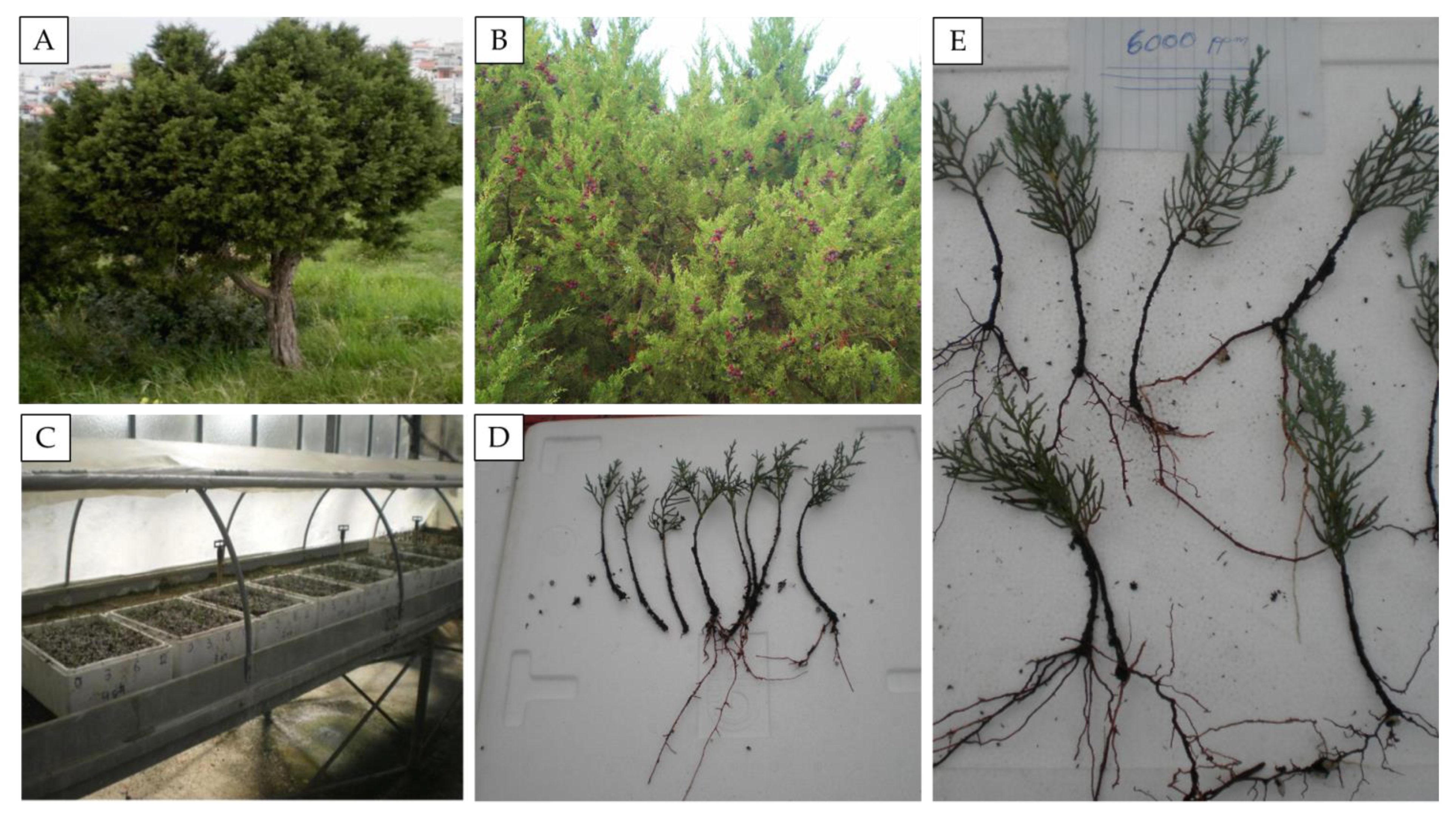
The propagation material (stem cuttings) was collected from individuals of the species located in N. Marmaras of the Sithonia region (40°5′37.14″ N, 23°46′47.29″ E), in the Chalkidiki peninsula, in the geographic region of Macedonia in Northern Greece. The selection of the J. phoenicea mother plants (20 individuals) from which the propagation material was taken was based on their robustness and health (Figure 1A,B). Cuttings were collected from the selected mother plants of J. phoenicea species in four different seasons (October 2012, March 2013, June 2013, and December 2014). In each collection season, the cuttings were taken from the lower part of the tree crowns. The selected cuttings were at least from shoots of the previous growing season. They were terminal and cut to a length of 10–12 cm.
Figure 1.
(A,B) Juniperus phoenicea plants in study area; (C) mist propagation system used to culture shoot cuttings under different treatments; (D) example of rooted and unrooted shoot cuttings of Juniperus phoenicea; (E) example of rooted shoot cuttings of Juniperus phoenicea.
2.2. Stem Cutting Treatment
The experiments were conducted in the greenhouses of the laboratories of Silviculture, School of Forestry and Natural Environment, and of Floriculture, School of Agriculture, Aristotle University of Thessaloniki, Greece.
In each collection season, the leaves were removed from the basal half of each cutting, and the basal portion of each cutting, about 2 cm in length, was immersed in solutions of different concentrations (3, 6, and 12 g·L−1) of K-IBA (indole-3-butyric acid-potassium salt, Sigma-Aldrich, St. Louis, MO, USA), for 10 s. The cuttings were then placed for rooting in polystyrene containers (40 × 27 × 11 cm) with holes in the bottom filled with a 2:1 (v/v) mixture of 3–5 mm perlite (Isocon, Attica, Greece) and enriched peat (TS1 Klasmann Deilmann GmbH, Geeste, Germany). For the preparation of the above K-IBA solutions, the appropriate amount of water-soluble K-IBA hormone was dissolved in distilled water.
The containers were placed in two propagation systems: mist and fog (Figure 1C). The mist system, installed on heated metal benches (18 °C) in the glass greenhouse of the Laboratory of Silviculture, School of Forestry and Natural Environment, Aristotle University of Thessaloniki (Finikas, Thessaloniki, Greece), used overhead micro-sprinklers producing fine droplets (50 to 100 µm), with misting frequency and duration controlled by a timer adjusted according to prevailing weather conditions. The fog system, located in the glass greenhouse of the Laboratory of Floriculture, School of Agriculture, Aristotle University of Thessaloniki (Thessaloniki, Greece), operated on similarly heated benches and used special nozzles that mixed water and air under pressure to generate very fine droplets (2–10 μm). To control humidity, a control unit connected to an electronic leaf moisture sensor (the unit operates automatically with humidity changes in the electronic leaf) was used in the mist system set at 95% and an ambient hygrometer (measured humidity at the point where the cuttings were) set between 93 and 95 RH% in the fog system. Both systems sprayed for 10 s per minute until the desired humidity was reached.
In each season and both propagation systems, cuttings were also placed without a plant growth regulator treatment (control). In each cutting season and K-IBA treatment, 48 cuttings were used, with 4 replicates of 12 cuttings per propagation system.
The effect of the cutting season and K-IBA treatment on the rooting of cuttings was studied for each propagation system. The evaluation of rooting was conducted 20 weeks after their placement in the mist and fog propagation system. The cuttings were carefully extracted from the substrate, and the number of rooted cuttings was recorded for each treatment, and the percentage (%) was calculated (Figure 1D,E). Additionally, the number and mean length of the roots in each rooted cutting were determined.
2.3. Statistical Analysis
The experimental design for each propagation system (mist and fog) was fully randomized with 2 factors. The first factor was the cutting season with four levels: winter, spring, summer, and autumn. The second factor was the application of K-IBA plant growth regulator solutions with four levels: control (0 g·L−1) and 3, 6, and 12 g·L−1. An analysis of variance (ANOVA) in the frame of the GLM (General Linear Model) [38] was conducted on the collected data to determine the effects of the aforementioned factors and their interaction on the rooting of the cuttings. Subsequently, mean comparisons were performed using the LSD criterion at a significance level of α < 0.05. For the comparisons between the two propagation systems on the rooting percentages of the cuttings for each cutting season and K-IBA treatment, the t-test was used [39]. All statistical analyses were conducted using SPSS 21.0 [40].
3. Results
3.1. Effects of Cutting Season and K-IBA Application on Rooting Percentage of J. phoenicea Shoot Cuttings
The GLM analysis confirmed that the ‘collection season’ and ‘K-IBA application’ factors had significant effects on cutting rooting, the number of roots, and the mean length of roots (p < 0.05, Table 1 and Table 2) in both propagation systems. Additionally, the interaction ‘Season × K-IBA’ was statistically significant in the rooting of cuttings and in the number of roots per rooted cutting (p < 0.05, Table 1) in the mist propagation system. On the other hand, in the fog propagation systems, the interaction of the main effects significantly affected the number of roots and the mean root length (p < 0.05, Table 2).
Table 1.
The results of a two-way ANOVA on the effects of ‘cutting season’ and ‘K-IBA application’ and their interaction on the rooting percentage, the number of roots, and the mean length of roots of Juniperus phoenicea shoot cuttings under a mist propagation system. Means and (±) standard error values are given. The comparisons were made using the LSD test.
Table 2.
The results of a two-way ANOVA on the effects of ‘cutting season’ and ‘K-IBA application’ and their interaction on rooting percentage, the number of roots, and the mean length of roots of Juniperus phoenicea shoot cuttings under a fog propagation system. Means and (±) standard error values are given. The comparisons were made using the LSD test.
In the mist propagation system, the greatest mean root length was observed in cuttings collected during autumn (Table 1). No significant differences in the mean root length among the cuttings taken in summer, winter, and spring were observed. Regarding the concentration of the plant growth regulator K-IBA, the treatment of cuttings with 3 and 6 g·L−1 K-IBA resulted in a higher mean length in rooted cuttings than that of control cuttings (Table 1). Due to the significant effect of the ‘Season × K-IBA’ interaction on both rooting percentage and the number of roots per rooted cutting, the interpretation of main effects was considered less meaningful in the mist propagation system.
In the fog propagation system, the highest rooting percentage was recorded in cuttings collected during summer, reaching approximately 60%, whereas the lowest rooting percentages were observed in spring and autumn (Table 2). With respect to K-IBA concentration, treatments with 3 or 12 g·L−1 K-IBA resulted in higher rooting percentages compared with the control (Table 2). Because of the significant ‘factors’ interaction observed for the number of roots and the mean root length of rooted cuttings (p < 0.05, Table 2) in the fog propagation system, it was considered more appropriate to focus on the interaction effects rather than the main effects.
In Table 3, due to the significant ‘Season × K-IBA’ interaction, the results for the rooting percentage and mean number of roots per cutting of J. phoenicea are presented based on this interaction within the mist propagation system. Similarly, owing to the significant ‘Season × K-IBA’ interaction, the results for the mean number of roots per cutting and the mean root length of J. phoenicea cuttings are presented according to this interaction within the fog propagation system (Table 4).
Table 3.
The effect of the interaction of the cutting season and the concentration of the plant growth regulator K-IBA on the rooting percentage and the number of roots per rooted cutting of Juniperus phoenicea cuttings under a mist propagation system. Means and (±) standard error values are given. The comparisons were made using the LSD test.
Table 4.
The effect of the interaction of the cutting season and the concentration of the plant growth regulator K-IBA on the rooting percentage, the number of roots, and the average length of roots of Juniperus phoenicea cuttings under a fog propagation system. Means and (±) standard error values are given. The comparisons were made using the LSD test.
In the mist propagation system (Table 3), the highest rooting percentage was recorded in cuttings collected during winter and treated with 6 g·L−1 of K-IBA, reaching approximately 98%. In addition, in winter, all treatments with K-IBA concentrations produced similar high percentages. A high rooting percentage was also recorded in cuttings collected during spring and treated with 12 g·L−1 of K-IBA. In both collection seasons, the control exhibited the lowest percentage of rooting. In summer collection, the cuttings treated with 3 g·L−1 of K-IBA exhibited higher rooting percentages than those of cuttings treated with 6 and 12 g·L−1 of K-IBA. Meanwhile, in cuttings taken in autumn, the treatment with 6 g·L−1 of K-IBA resulted in a higher percentage of rooted cuttings than the control.
In cuttings taken in winter and summer, the application of the plant growth regulator K-IBA significantly improved the number of roots per rooted cutting (Table 3). Furthermore, in all cutting seasons, the cuttings treated with 12 g·L−1 of K-IBA showed a higher number of roots per rooted cutting than control cuttings. Regardless of the concentration of K-IBA applied, the cuttings taken in winter showed the highest number of roots per cutting. Meanwhile, in control cuttings, no significant difference in the number of roots among the cutting seasons was observed.
In the fog propagation system (Table 4), the number of roots per rooted cutting varied significantly among seasons and K-IBA concentrations. In winter and spring, treatment with 12 g·L−1 K-IBA produced more roots than 3 g·L−1 and the control. During summer, 12 g·L−1 also yielded more roots than the control, while in autumn it produced more roots than 3 g·L−1.
Regarding the mean root length (Table 4), no significant differences among treatments were observed in winter and summer cuttings. In spring and autumn, however, 3 g·L−1 K-IBA produced the longest roots. Among controls, spring cuttings had longer roots than those from winter and autumn. At 12 g·L−1, spring cuttings surpassed winter ones. Root length was unaffected by season at 6 g·L−1 K-IBA.
3.2. Effect of Propagation System on Rooting Percentage of J. phoenicea Shoot Cuttings
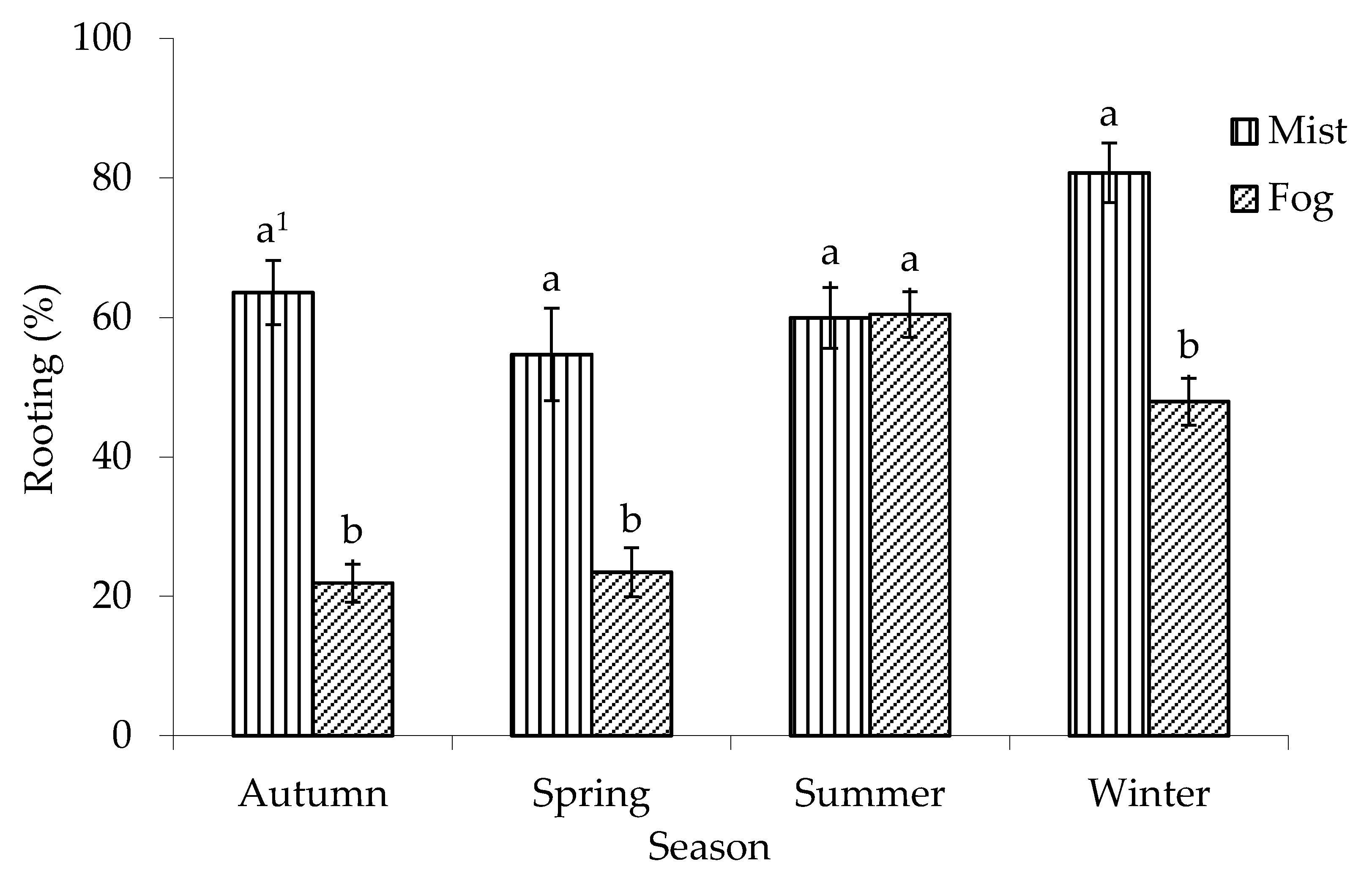
The effect of the mist and fog propagation systems in the rooting percentage of J. phoenicea cuttings was examined. In Figure 2, the results of the rooting percentages of J. phoenicea cuttings are presented, based on the effect of the mist and fog propagation systems, in each cutting season.
Figure 2.
Effect of propagation system on rooting percentage of Juniperus phoenicea shoot cuttings in each cutting season. Bars indicate standard error of means. 1 Means, in each cutting season, followed by same letter are not significantly different (p > 0.05), according to t-test.
The rooting percentage of the terminal cuttings of J. phoenicea was significantly affected by the different propagation systems in each collection season (p < 0.05). Specifically, in cuttings taken in autumn, winter, and spring, the rooting percentages in the mist system were significantly higher than those of cuttings in the fog system. On the other hand, regarding the summer collection season, no significant difference was observed between the two propagation systems (Figure 2).
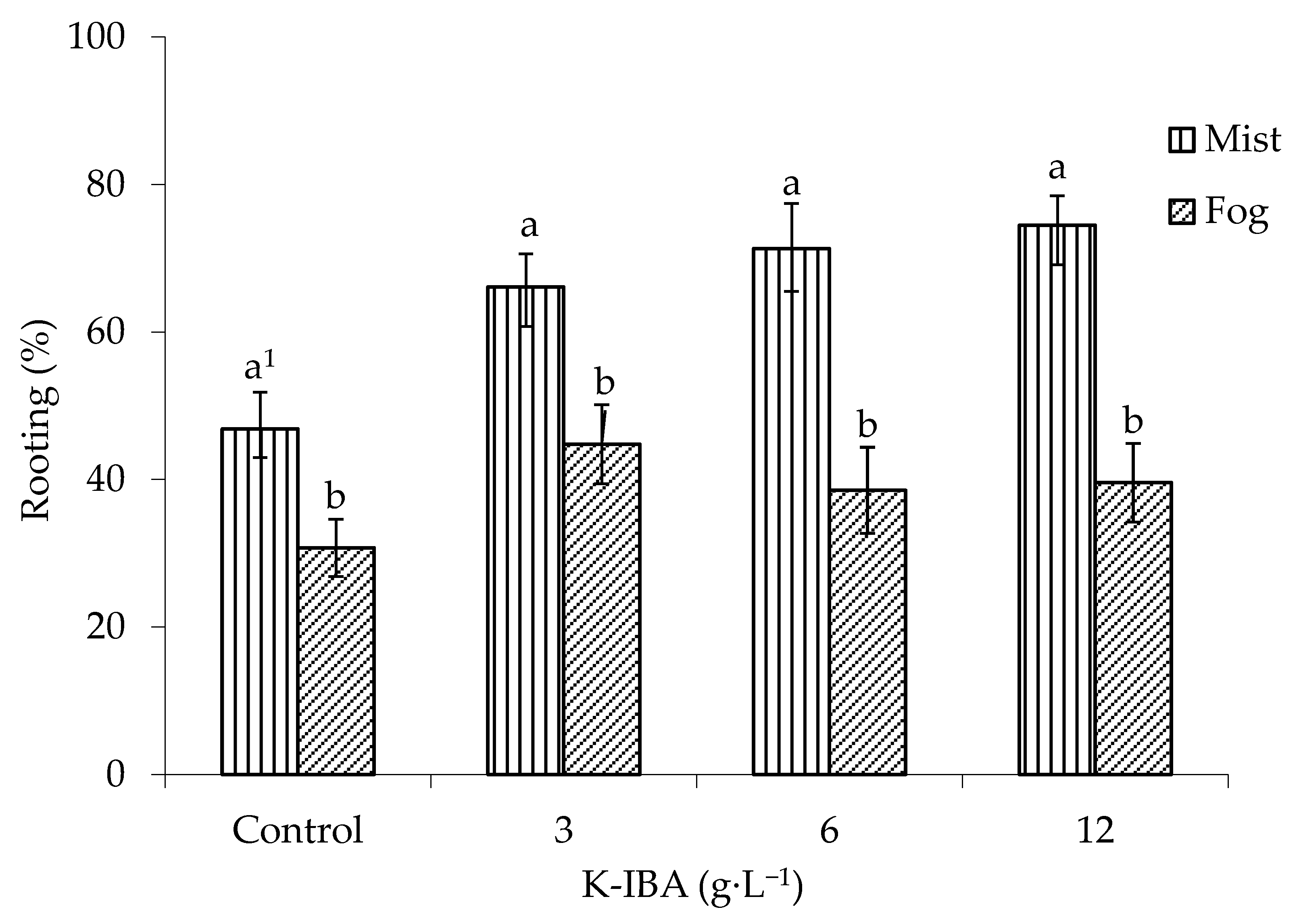
In Figure 3, the results of the rooting percentages of J. phoenicea cuttings are presented, based on the effect of the mist and fog propagation systems, in each concentration of K-IBA applied.
Figure 3.
Effect of propagation system on rooting percentage of Juniperus phoenicea shoot cuttings in each concentration of K-IBA applied. Bars indicate standard error of means. 1 Means, in each concentration of K-IBA, followed by same letter are not significantly different (p > 0.05), according to t-test.
The rooting percentage of the terminal cuttings of J. phoenicea was significantly affected by the different propagation systems in each concentration of K-IBA applied (p < 0.05). In all concentrations of K-IBA used in the experiment (3, 6, and 12 g·L−1) as well as in the control, the cuttings placed in the mist propagation system showed a higher rooting than that of the cuttings placed in the fog system (Figure 3).
4. Discussion
An essential factor in the rooting of cuttings can be the time of year that they are collected. There is a time of year when rooting is the best for many species [23]. From the analysis of the results in the present study, it was observed that the rooting percentage of J. phoenicea cuttings was significantly affected by the different season collections, in both propagation systems. The variation in the rooting of this species’ cuttings based on the season indicates that the physiological condition of the mother plants during the cutting period plays a significant role in rooting. The differences in rooting concerning the cutting season may be related to the competition for carbohydrates and growth substances during the development of shoots, flowers, and fruits. Another reason could be that changes in tissue maturation influence the success of rooting [33].
The rooting percentages of J phoenicea cuttings in the mist system were satisfactory throughout all seasons of the year. However, the highest percentage was observed in winter. The rooting percentages in the fog system in winter, autumn, and spring were lower compared to those in the mist system. The highest rooting percentage in the fog system was observed in summer.
The influence of the cutting season on Juniperus species cuttings has been reported by other researchers as well. Specifically, Abshahi et al. [41] observed that the collection season of J. sabina L. cuttings significantly affected their rooting. However, in contrast with the findings of this study, the best season for rooting was spring. Henry et al. [24] observed the best rooting in experiments with J. virginiana cuttings during the winter, aligning with the results of this study. According to Dumitrascu et al. [42], better rooting in Juniperus chinensis cuttings was observed in spring compared to autumn. Similar results were observed in other species, as Pipinis et al. [43] found that the collection time influenced the rooting of Taxus baccata cuttings taken from juvenile individuals.
In general, the cutting season had an impact on the average number of roots per cutting and the average length per root in the studied species. According to the results, the highest number of roots per cutting was observed during winter in both propagation systems. These results are similar to those of Henry et al. [24]. The longest average root length per root in Juniperus phoenicea cuttings was observed during autumn and spring in the mist and fog systems, respectively. Similar results were observed in other species. According to Rifaki et al. [25], rooting and the number and length of roots of Ilex aquifolium cuttings were significantly affected by the season. According to Vakouftsis et al. [44], in Cupressocyparis leylandii, both the number and length of roots seem to be influenced by the season, whereas in Cupressus macrocarpa, neither the number nor the length of roots is affected by the season [44].
Regarding the effect of the plant growth regulator K-IBA, from the analysis of the results in this study, it was observed that the treatment with K-IBA significantly affected the rooting percentages of J. phoenicea cuttings in both propagation systems.
In J. phoenicea cuttings, a significant improvement in rooting percentage was observed in both propagation systems. A possible explanation is that the exogenous auxin K-IBA increased endogenous auxin, which initiated the rooting initiation phase and subsequently the rooting expression phase. Generally, plant growth regulators promote tissue differentiation towards the formation of adventitious roots [23]. In this study, the application of the plant growth regulator K-IBA and the concentrations used had a positive effect on rooting.
The impact of plant regulators on the rooting of Juniperus species cuttings has been mentioned by other researchers as well. Specifically, Abshahi et al. [41] observed that indole-3-butyric acid (IBA) pretreatment significantly affected the rooting percentage of Juniperus sabina L. cuttings, and the best percentage was taken by the application of IBA at 1 g·L−1. Güney et al. [45] found that the application of plant growth regulators indole-3-acetic acid (IAA) and IBA affected the rooting percentage of J. communis ‘Hibernica’, J. chinensis ‘Stricta’, and J. chinensis ‘Stricta Variegata’. According to Chong et al. [46], the rooting percentage of J. horizontalis ‘Wiltonii’ and J. sabina ‘Tamariscifolia’ cuttings did not show any differentiation with the application of IBA. However, they observed that the application of the studied plant growth regulator positively affected the rooting percentages of J. chinensis ‘Mint Julep’ and J. sabina ‘Blue Danube’ cuttings, up to a certain concentration level. According to Henry et al. [24], the rooting percentage of J. virginiana cuttings was influenced by the application of IBA, and the maximum percentage was observed with a concentration of 5 g·L−1. Higher concentrations did not enhance rooting.
Similar results were obtained by Cope and Rupp [47] with the application of IBA, where an increase in the concentrations of the plant growth regulator increased the rooting of J. osteosperma cuttings. Bąbelewski and Szajsne [28] also reported a positive effect of the plant growth regulator they used in the rooting of J. communis, J. virginiana, and J. chinensis cuttings. Chowdhuri [29] stated that plant growth regulators had a positive effect on the rooting percentage of J. chinensis cuttings. These results align with those in the present study, where the plant growth regulator K-IBA was applied. Negash [27] reported that the rooting percentage of J. procera cuttings increased with the application of IBA up to a certain concentration level. Similar results were reported by Rifaki et al. [48] for J. excelsa, where the highest rooting percentage was observed when the concentration of IBA and K-IBA was 4 g·L−1, while lower rooting was achieved in the control. Finally, according to Blythe et al. [49], the application of IBA on J. conferta ‘Blue Pacific’ cuttings increased the rooting percentage compared to the control.
The application of a plant growth regulator had a significant effect on the number of roots and the mean length per root in J. phoenicea shoot cuttings. An increase in the concentration of K-IBA led to an increase in the mean number of roots per cutting but not in the mean length per root. Similar results to those in this study are reported by several studies. Houle and Babeux [50] report that the IBA concentration had a significant effect on the number of roots, but a lower concentration produced more roots than a higher concentration. Rifaki [51] states that the IBA concentration positively influenced the number of roots but negatively affected their length. Additionally, the use of K-IBA, especially at high concentrations, appears to inhibit the length of the formed roots but positively affects the number of roots. According to Negash [27], the mean number of roots increased with the increase in IBA concentration up to a certain level, after which it decreased abruptly, along with the rooting percentage.
From the analysis of the results in the present study, it was observed that the interaction of different cutting seasons and the application of the plant growth regulator K-IBA significantly affect the rooting percentages of J. phoenicea cuttings in the mist propagation systems. However, the rooting percentage of the cuttings was not significantly affected by the interaction of the collection season of the cuttings and their treatment with the plant growth regulator under the fog propagation system.
In J. phoenicea, within the mist system and considering the interaction of the two factors, it was observed that the best results were obtained from cuttings taken during winter and treated with a 6 g·L−1 solution. Overall, all treatments involving the plant growth regulator during winter showed better results compared to corresponding treatments in other seasons. Additionally, it was observed that the optimal treatment in spring involved a K-IBA solution with a concentration of 12 g·L−1, in summer 3 g·L−1, and in autumn 6 g·L−1. The observed differences may be attributed to the effect of plant growth regulators on the hydrolysis of carbohydrates or other reserves present in the plant [23], in combination with variations in competition for carbohydrates and growth substances during plant development, as well as changes in tissue maturation during different seasons [33]. In J. phoenicea, within the fog system, and based on the interaction of the two factors, it was observed that the best results were obtained from cuttings taken during the summer, with the highest rooting percentage seen in cuttings treated with a 3 g·L−1 solution. Overall, no significant differences were observed among the various K-IBA treatments between summer and winter, except for the 3 g·L−1 treatment.
Abshahi et al. [41] observed that there were also several significant interactions among the studied factors, but only the IBA pretreatment × season interaction significantly affected the rooting of Juniperus sabina L. cuttings. Henry et al. [24] also studied the interaction of different cutting seasons and the application of a plant growth regulator IBA and observed a significant effect on the rooting of Juniperus virginiana cuttings. They particularly noticed that the best rooting percentages were achieved during winter at a concentration of 5 g·L−1 IBA. According to Rifaki et al. [48], the interaction of the cutting season and the application of a plant growth regulator had a significant impact on the rooting percentages of Juniperus excelsa cuttings, with the best results observed in winter and autumn with an IBA solution of 4 g·L−1. The interaction of cutting season and the application of a plant growth regulator also had a significant effect on the rooting percentages of Cupressocyparis leylandii and Cupressus macrocarpa cuttings [52,53].
Furthermore, the interaction of different cutting seasons and the application of the plant growth regulator K-IBA significantly affected the mean number of roots per cutting and the mean length per root, in both propagation systems.
According to the results, the highest average number of roots per cutting, in the mist propagation system, was observed in the cuttings collected in winter and treated with 12 g·L−1 K-IBA solution. The highest mean root length, in the mist propagation system, was shown in the cuttings collected in autumn and treated with 6 g·L−1 K-IBA solution. Regarding the fog propagation system, the highest average number of roots per cutting was also observed in the cuttings collected in winter and treated with 12 g·L−1 K-IBA solution. The highest mean root length was shown in the cuttings collected in spring and autumn and treated with 3 g·L−1 K-IBA solution. In general, the increase in K-IBA concentration had a positive effect on the number of roots in all collection seasons. On the contrary, the increase in the K-IBA concentration did not have a significant effect on the length of the cuttings. According to Rifaki et al. [51], the root length of J. excelsa cuttings was significantly affected by both season and IBA concentration, while the interaction of the two factors was not significant for the number of roots.
Regarding the effect of propagation system on rooting, some of the most important developments in asexual propagation are intermittent mist/fog systems, which allow many species to be successfully propagated by creating an environment with high humidity that is favorable for the rooting of cuttings [54].
Cuttings are unable to absorb moisture because they lack roots. The exposed plant portions, however, are vulnerable to evaporation. Cuttings are usually kept in high-moisture conditions by spraying them to minimize moisture loss [55].
The rooting percentage of the terminal cuttings of J. phoenicea was significantly affected by the different propagation systems in each collection season and in each concentration of K-IBA applied. In the mist propagation system, the highest rooting percentage was recorded in the winter, which was different from the fog propagation system during the same collection season. For the autumn and spring collection seasons, the cuttings that rooted in the mist propagation system were also greater in terms of rooting percentage and showed a significant difference from that of cuttings in the fog system. However, with respect to the summer collecting season, there were no appreciable variations between the two propagation systems. Moreover, cuttings in the mist propagation system exhibited a significantly different rooting percentage at the 12 g·L−1 concentration, compared to the cuttings in the fog propagation system at the same K-IBA concentration. Similarly to this, in all other K-IBA solutions, the rooting percentages of the cuttings in the mist system were higher and showed a significant difference from those in the fog system.
The difference in rooting percentages between the two systems may be attributed to the higher substrate moisture in the mist system compared to the fog. According to Rein et al. [56], the rooting percentage of Juniperus horizontalis Moench ‘Wiltonii’ cuttings, as well as other studied species, was higher in substrates with higher moisture levels.
5. Conclusions
This study highlights the value of asexual propagation as a viable and effective conservation approach for Juniperus phoenicea. The high rooting percentages achieved under controlled conditions (more than 90%) demonstrate the species’ strong regenerative potential when key environmental and hormonal factors are optimized. These results not only provide practical guidelines for the potential large-scale propagation of J. phoenicea but also contribute valuable insights into the development of restoration and reforestation programs in vulnerable Mediterranean habitats.
The main conclusions drawn from this study are as follows:
- Cutting season played a significant role in rooting success in both propagation systems: winter cuttings perform the best in the mist system, while summer cuttings root the best in the fog system.
- K-IBA application significantly increased rooting in both propagation systems; optimal concentrations range from 3 to 12 g·L−1 depending on the system used.
- Propagation system choice affects outcomes; the mist system produced the most consistent rooting results overall.
- Cutting season and K-IBA application also significantly influenced the number and length of roots.
For the best results, it is recommended that cuttings be collected in winter and treated with 6 g·L−1 K-IBA when using a mist system or in summer with 3 g·L−1 K-IBA under a fog system.
Author Contributions
Conceptualization, S.I. and P.S.; methodology, S.I., E.P., S.K. and P.S.; validation, S.I., E.P. and C.D.; formal analysis, S.I., E.P. and S.K.; investigation, S.I.; resources, S.I., E.T. and C.D.; data curation, S.I., E.T. and E.P.; writing—original draft preparation, S.I.; writing—review and editing, S.I., E.T., E.P., S.K., C.D. and K.M.; visualization, S.I. and E.T.; supervision, S.I. and P.S.; project administration, S.I. All authors have read and agreed to the published version of the manuscript.
Funding
This research received no external funding.
Institutional Review Board Statement
Not applicable.
Informed Consent Statement
Not applicable.
Data Availability Statement
Dataset available on request from the authors.
Conflicts of Interest
The authors declare no conflicts of interest.
References
- Thomas, P.A.; El-Barghathi, M.; Polwart, A. Biological Flora of the British Isles: Juniperus communis L. J. Ecol. 2007, 95, 1404–1440. [Google Scholar] [CrossRef]
- Piotto, B.; Di Noi, A. Seed Propagation of Mediterranean Trees and Shrubs; Agency for the Protection of the Environment and for Technical Services (APAT): Roma, Italy, 2003; ISBN 88-448-0081-0. [Google Scholar]
- Ciesla, W.M. Non-Wood Forest Products from Conifers; Food and Agriculture Organization of the United Nations: Rome, Italy, 1998; p. 124. ISBN 92-5-104212-8. [Google Scholar]
- Lawson, E.R. Juniperus virginiana L. Eastern Redcedar. In Silvics of North America: 1 Conifers; Burns, R.M., Honkala, B.H., Eds.; Forest Service, United States Department of Agriculture, Forest Service: Washington DC, USA, 1990; pp. 131–140. [Google Scholar]
- Tutin, T.G. Flora Europaea: Psilotaceae to Platanaceae; Flora Europaea 5 Volume Hardback Set; Cambridge University Press: Cambridge, UK, 1993; ISBN 9780521410076. [Google Scholar]
- Caudullo, G.; de Rigo, D. Juniperus phoenicea in Europe: Distribution, Habitat, Usage and Threats; European Atlas of Forest Tree Species; San-Miguel-Ayanz, J., de Rigo, D., Caudullo, G., Houston Durrant, T., Mauri, A., Eds.; Publication Office of the European Union: Luxembourg, 2016; E012f63+; ISBN 9789279367403. [Google Scholar]
- Farjon, A. A Handbook of the World’s Conifers; Brill: Leiden, The Netherlands, 2010; ISBN 978-90-04-32451-0. [Google Scholar]
- Roloff, A.; H, W.; Lang, U.M.; Stimm, B. Enzyklopädie Der Holzgewächse; Wiley-VCH: Weinheim, Germany, 2008; ISBN 978-3527-32141-4. [Google Scholar]
- Caudullo, G.; Welk, E.; San-Miguel-Ayanz, J. Chorological Maps for the Main European Woody Species. Data Brief 2017, 12, 662–666. [Google Scholar] [CrossRef]
- Dafis, S. The Forests of Greece; The Goulandris Natural History Museum: Thessaloniki, Greece, 2010; ISBN 9789608980822. (In Greek) [Google Scholar]
- European Union. Council Directive 92/43/EEC of 21 May 1992 on the Conservation of Natural Habitats and of Wild Fauna and Flora (Habitats Directive). Official Journal of the European Communities, 1992, L206, 7–50. Available online: https://eur-lex.europa.eu/legal-content/EN/TXT/PDF/?uri=CELEX:31992L0043 (accessed on 29 September 2025).
- Picchi, S. Management of Natura 2000 Habitats: Coastal Dunes with Juniperus spp.; European Commission: Brussels, Luxembourg, 2008; p. 2250. [Google Scholar]
- Calaciura, B.; Spinelli, O. Management of Natura 2000 Habitats Arborescent Matorral with Juniperus spp.; Directive 92/43/EEC on the Conservation of Natural Habitats and of Wild Fauna and Flora, European Commission; European Commission: Brussels, Luxembourg, 2008; p. 5210. [Google Scholar]
- Korakis, G. Forest Botany, Native Trees and Shrubs of Greece; Kallipos, Open Academic Publications: Athens, Greece, 2015; ISBN 978-960-603-282-0. (In Greek) [Google Scholar]
- Ennajar, M.; Bouajila, J.; Lebrihi, A.; Mathieu, F.; Savagnac, A.; Abderraba, M.; Raies, A.; Romdhane, M. The Influence of Organ, Season and Drying Method on Chemical Composition and Antioxidant and Antimicrobial Activities of Juniperus phoenicea L. Essential Oils. J. Sci. Food Agric. 2010, 90, 462–470. [Google Scholar] [CrossRef] [PubMed]
- Mazari, K.; Bendimerad, N.; Bekhechi, C.; Fernandez, X. Chemical Composition and Antimicrobial Activity of Essential Oils Isolated from Algerian Juniperus phoenicea L. and Cupressus sempervirens L. J. Med. Plants Res. 2010, 4, 959–964. [Google Scholar]
- Caibnes, D.A.; Ekundayo, O.; Kingston, D.G.I. Plant Anticancer Agents. X. 1 Lignans from Juniperus phoenicea. J. Nat. Prod. 1980, 43, 495–497. [Google Scholar] [CrossRef]
- Ciesla, W.M. Juniper Forests—A Special Challenge for Sustainable Forestry. For. Trees Livelihoods 2002, 12, 195–207. [Google Scholar] [CrossRef]
- Ahani, H.; Jalilvand, H.; Hosseini Nasr, S.M.; Soltani Kouhbanani, H.; Ghazi, M.R.; Mohammadzadeh, H. Reproduction of Juniper (Juniperus polycarpos) in Khorasan Razavi, Iran. For. Sci. Pract. 2013, 15, 231–237. [Google Scholar] [CrossRef]
- Salvà-Catarineu, M.; Romo, A.; Mazur, M.; Zielińska, M.; Minissale, P.; Dönmez, A.A.; Boratyńska, K.; Boratyński, A. Past, Present, and Future Geographic Range of the Relict Mediterranean and Macaronesian Juniperus phoenicea Complex. Ecol. Evol. 2021, 11, 5075–5095. [Google Scholar] [CrossRef]
- El-Barougy, R.F.; Dakhil, M.A.; Halmy, M.W.A.; Cadotte, M.; Dias, S.; Farahat, E.A.; El-keblawy, A.; Bersier, L.F. Potential Extinction Risk of Juniperus phoenicea under Global Climate Change: Towards Conservation Planning. Glob. Ecol. Conserv. 2023, 46, e02541. [Google Scholar] [CrossRef]
- Bonner, F.T. Juniperus L. Juniper. In The Woody Plant Seed Manual; Bonne, F.T., Ed.; US Department of Agriculture Forest Service, Government Printing Office: Washington, DC, USA, 2008; pp. 607–614. [Google Scholar]
- Hartmann, H.T.; Kester, D.E.; Davies, F.T.; Geneve, R.L. Hartmann & Kester’s Plant Propagation: Principles and Practices: Pearson New International Edition; Pearson Education: London, UK, 2013; ISBN 9781292034133. [Google Scholar]
- Henry, P.H.; Blazich, F.A.; Hinesley, L.E. Vegetative Propagation of Eastern Redcedar by Stem Cuttings. HortScience 1992, 27, 1272–1274. [Google Scholar] [CrossRef]
- Rifaki, N.; Economou, A.; Scaltsoyiannes, A. Factors Affecting the Rooting of Ilex aquifolium L. Cuttings. Propag. Ornam. Plants 2001, 1, 31–35. [Google Scholar]
- Anand, V.K.; Heberlein, G.T. Seasonal Changes in the Effects of Auxin on Rooting in Stem Cuttings of Ficus Infectoria. Physiol. Plant. 1975, 34, 330–334. [Google Scholar] [CrossRef]
- Negash, L. Successful Vegetative Propagation Techniques for the Threatened African Pencil Cedar (Juniperus procera Hoechst. ex Endl.). For. Ecol. Manag. 2002, 161, 53–64. [Google Scholar] [CrossRef]
- Bąbelewski, P.; Szajsner, H. Attemption of Applying Laser Photostimulation to the Rooting of Shoot Cuttings of Juniper Species. Acta Sci. Polonorum. Hortorum Cultus 2014, 13, 135–144. [Google Scholar]
- Chowdhuri, T. Performance Evaluation of Different Growth Regulators on Propagation of Chinese Juniper (Juniperus chinensis Var. Pyramidalis) in Subtropical Zone. J. Pharmacogn. Phytochem. 2017, 6, 2190–2193. [Google Scholar]
- Di, D.W.; Zhang, C.; Luo, P.; An, C.W.; Guo, G.Q. The Biosynthesis of Auxin: How Many Paths Truly Lead to IAA? Plant Growth Regul. 2016, 78, 275–285. [Google Scholar] [CrossRef]
- Sanz Gallego, M.; Tomás Gascón, M.; Esteban Pascual, L.S. Optimization of Vegetative Propagation Techniques for Juniperus communis L. Under Greenhouse Conditions. Int. J. Plant Biol. 2025, 16, 57. [Google Scholar] [CrossRef]
- Dirr, M. Manual of Woody Landscape Plants: Their Identification, Ornamental Characteristics, Culture, Propagation and Uses; Stipes Publishing Company: Champaign, IL, USA, 1998; ISBN 9780875632261. [Google Scholar]
- Beyl, C.A.; Sharma, G.C. Plant Physiology Concepts Important for Propagation Success. In Plant Propagation Concepts and Laboratory Exercises; Beyl, C.A., Trigiano, R.N., Eds.; CRC Press: Boca Raton, NY, USA, 2014; pp. 29–46. [Google Scholar]
- Leakey, R.R.B. Plant Cloning: Macropropagation. In Encyclopedia of Agriculture and Food Systems; Van Alfen, N., Ed.; Elsevier Publishers: San Diego, CA, USA, 2014; pp. 349–359. [Google Scholar] [CrossRef]
- Lesmes-Vesga, R.A.; Chaparro, J.X.; Sarkhosh, A.; Ritenour, M.A.; Cano, L.M.; Rossi, L. Effect of Propagation Systems and Indole-3-Butyric Acid Potassium Salt (K-Iba) Concentrations on the Propagation of Peach Rootstocks by Stem Cuttings. Plants 2021, 10, 1151. [Google Scholar] [CrossRef]
- Acquaah, G. Horticulture: Principles and Practices, 4th ed.; Pearson Education, Inc.: Upper Saddle River, NJ, USA, Pearson Prentice Hall; 2009; ISBN 0131592475. [Google Scholar]
- Burger, D.W. Intermittent Mist Control for Plant Propagation. In Plant Propagation Concepts and Laboratory Exercises; Beyl, C.A., Trigiano, R.N., Eds.; Taylor & Francis Group, LLC.: New York, NY, USA, 2014; pp. 123–127. [Google Scholar]
- Gomez, K.A.; Gomez, A.A. Statistical Procedures for Agricultural Research; A Wiley-Interscience publication; John Wiley and Sons: New York, NY, USA, 1984; ISBN 9780471870920. [Google Scholar]
- Klockars, A.J.; Sax, G. Multiple Comparisons; Multiple Comparisons; SAGE Publications: California, USA, 1986; ISBN 9780803920514. [Google Scholar]
- Released IBM SPSS Statistics for Mac, Version 21.0; IBM Corp: New York, NY, USA, 2012.
- Abshahi, M.; García-Morote, F.A.; Zarei, H.; Zahedi, B.; Nejad, A.R. Improvement of Rooting Performance in Stem Cuttings of Savin Juniper (Juniperus sabina L.) as a Function of IBA Pretreatment, Substrate, and Season. Forests 2022, 13, 1705. [Google Scholar] [CrossRef]
- Dumitrascu, M.; Stanica, F.; Peticila, A.G.; Davidescu, V.E.; Madjar, R.M. Rooting of Evergreen Stem Cuttings in Different Substrates. Acta Hortic. 2003, 608, 267–271. [Google Scholar] [CrossRef]
- Pipinis, E.; Kostas, S.; Hatzilazarou, S.; Petropoulos, S.; Mitsi, D.; Stampoulidis, A.; Milios, E.; Smiris, P. Effects of Donor Tree Age, Cutting Collection Time and K-IBA Application on Rooting Ability of Taxus baccata L. Stem Cuttings: Preliminary Results. Folia Oecologica 2023, 50. [Google Scholar] [CrossRef]
- Vakouftsis, G. Study of Shoot Proliferation of Forest Ornamental Plant Species Cupressus macrocarpa Var. Goldcrest and Cupressocyparis leylandii Var. Castlewellan Gold; Aristotle University of Thessaloniki: Thessaloniki, Greece, 2006. (In Greek) [Google Scholar]
- Güney, D.; Chavoshi, S.H.; Bayraktar, A.; Atar, F. The Effects of Temperature and Exogenous Auxin on Cutting Propagation of Some Junipers. Dendrobiology 2021, 86, 29–38. [Google Scholar] [CrossRef]
- Chong, C.; Allen, O.B.; Barnes, H.W. Comparative Rooting of Stem Cuttings of Selected Woody Landscape Shrub and Tree Taxa to Varying Concentrations of IBA in Talc, Ethanol and Glycol Carriers. J. Environ. Hortic. 1992, 10, 245–250. [Google Scholar] [CrossRef]
- Cope, K.R.; Rupp, L.A. Vegetative Propagation of Juniperus Osteosperma (Utah Juniper) by Cuttings. Nativ. Plants J. 2013, 14, 76–84. [Google Scholar] [CrossRef]
- Rifaki, N.; Economou, A.S.; Hatzilazarou, S.; Hatzistathis, A. Shoot Regeneration from Shoot Tip Explants of Juniperus Excelsa Bieb. Propag. Ornam. Plants 2009, 9, 53–55. [Google Scholar]
- Blythe, E.K.; Sibley, J.L.; Tilt, K.M.; Ruter, J.M. Auxin Application to Stem Cuttings of Selected Woody Landscape Plants by Incorporation Into a Stabilized Organic Rooting Substrate. J. Environ. Hortic. 2004, 22, 63–70. [Google Scholar] [CrossRef]
- Houle, G.; Babeux, P. Variations in Rooting Ability of Cuttings and in Seed Characteristics of Five Populations of Juniperus Communis Var. Depressa from Subarctic Quebec. Can. J. Bot. 1994, 72, 493–498. [Google Scholar] [CrossRef]
- Rifaki, N. Study of the Vegetative Propagation of the Forest Species Ilex aquifolium and Juniperus excelsa; Aristotle University of Thessaloniki: Thessaloniki, Greece, 2000. (In Greek) [Google Scholar]
- Vakouftsis, G.; Syros, T.; Kostas, S.; Economou, A.; Tsoulpha, P.; Scaltsoyiannes, A.; Metaxas, D. Effect of IBA, Time of Cutting Collection, Type of Cuttings and Rooting Substrate on Vegetative Propagation in Cupressus Macrocarpa “Goldcrest”. Propag. Ornam. Plants 2009, 9, 65–70. [Google Scholar]
- Vakouftsis, G.; Kostas, S.; Syros, T.; Economou, A.; Tsaktsira, M.; Scaltsoyiannes, A.; Metaxas, D. Rooting of x Cupressocyparis Leylandii “Castlewellan Gold” by Cuttings as Influenced by IBA, Harvesting Season, Type of Cuttings, and Rooting Medium. Propag. Ornam. Plants 2008, 8, 125–132. [Google Scholar]
- Beyl, C.A.; Trigiano, R.N. Introduction to Plant Propagation. Plant Propagation Concepts and Laboratory Exercises, 2nd ed.; Beyl, C.A., Trigiano, R.N., Eds.; Taylor & Francis Group/CRC Press: Boca Raton, FL, USA, 2014. [Google Scholar]
- Acquaah, G. Horticulture: Principles and Practices; Pearson Prentice Hall: Upper Saddle River, NJ, USA, 2009; ISBN 9780131592476. [Google Scholar]
- Rein, W.H.; Wright, R.D.; Seiler, J.R. Propagation Medium Moisture Level Influences Adventitious Rooting of Woody Stem Cuttings. J. Am. Soc. Hortic. Sci. 1991, 116, 632–636. [Google Scholar] [CrossRef]
Disclaimer/Publisher’s Note: The statements, opinions and data contained in all publications are solely those of the individual author(s) and contributor(s) and not of MDPI and/or the editor(s). MDPI and/or the editor(s) disclaim responsibility for any injury to people or property resulting from any ideas, methods, instructions or products referred to in the content. |
© 2025 by the authors. Licensee MDPI, Basel, Switzerland. This article is an open access article distributed under the terms and conditions of the Creative Commons Attribution (CC BY) license (https://creativecommons.org/licenses/by/4.0/).