
Abstract
Ex situ collections of rare and endangered plant species are crucial components of integrated conservation systems, as outlined in the Global Strategy for Plant Conservation. Plant tissue culture collections play an essential role in achieving conservation objectives, as they offer a means of propagating plant material for habitat restoration and other practical applications. This study analyzes existing tissue culture protocols for coastal plant species of the Baltic Sea region, reviewing micropropagation research spanning 25 families and 112 highly coastal-specific species. The analysis of 232 experimental studies showed that tissue culture studies have been conducted with 38 coastal-specific species of the Baltic Sea region, which is only 34% of the initially identified target species. Special attention in the field of tissue culture technology development should be paid to several highly coastal-specific species with great potential for practical use, such as Blysmus rufus, Bolboschoenus maritimus, Schoenoplectus tabernaemontani, Halimione spp., Cochlearia spp., Euphrasia spp., and Odontites spp. Comprehensive research on tissue cultures of coastal plant species is imperative to establish micropropagation protocols for underrepresented taxonomic groups. The research should prioritize functional studies with ecological relevance and the development of practical biotechnological approaches for commercial applications.
1. Introduction
Within the framework of the Convention on Biological Diversity, the Global Strategy for Plant Conservation coordinates global efforts to protect plant diversity [1]. As outlined in the strategy’s targets, ex situ collections are essential and critical means to safeguard genetic resources, serving as a foundation for subsequent recovery and restoration initiatives. Among the various types of ex situ collections, those pertaining to tissue cultures hold a unique and specialized significance [2].
Plant tissue culture is an effective method for large-scale plant production, particularly for valuable species. This technique facilitates clonal propagation through various tissue or cell culture methods. It is recognized as one of the most efficient propagation strategies, enabling the generation of numerous offspring plants from minimal quantities of source material [3].
Tissue culture has been predominantly used for establishing genetic material repositories, which hold significant importance in scenarios where seed storage is restricted or impossible [4]. For instance, in cases characterized by a scarcity of seeds or their availability being limited to sporadic periods, or exhibiting profound dormancy, tissue culture proves to be an invaluable tool [5]. Furthermore, recalcitrant seeds cannot be stored at low temperatures [6]. Notably, seeds are not a requisite starting material; any tissue capable of differentiation, such as fragments of leaves, shoots, roots, or even individual cell groups like meristems, may be utilized. This aspect is especially significant for species that lack seed production and can only be propagated vegetatively. Some species exhibit both sterile and seed-producing genotypes; however, these genotypes are typically highly heterozygous, resulting in a limited contribution to species conservation due to the restricted number of individual genotypes [7].
Plant regeneration in tissue culture can be categorized into four primary pathways (Table 1).
Table 1.
Comparison of different tissue culture methods used for plant regeneration and propagation.
Direct organogenesis. Direct organogenesis refers to a process whereby organs, such as roots or shoots, develop directly from the initial tissue (explant) [9]. Organogenesis generally comprises three distinct phases: (1) the induction of organogenic competence, during which explant cells experience dedifferentiation influenced by phytohormones, thus becoming capable of organ formation; (2) organ determination, wherein cells commit to developing a specific organ, such as a shoot or root, contingent upon the balance of auxins and cytokinins; and (3) morphogenesis, which involves the establishment of the organ’s outline (meristem) and the subsequent development of the organ, independent of external hormonal regulation [19]. In the context of direct organogenesis, the dedifferentiation phase is abbreviated; root and shoot primordia emerge from the surface layers of the explant, such as the epidermis, without the necessity for intermediate callus formation [10]. Cytokinins, such as 6-benzylaminopurine/6-benzyladenine (BA), kinetin (KN), and the notably effective thidiazuron (TDZ), are commonly employed to facilitate direct organogenesis. This process is frequently enhanced by the minimal inclusion of auxins or, in some instances, conducted without auxins altogether to prevent the excessive formation of callus tissue [20].
Indirect organogenesis. Indirect organogenesis is a technique for plant regeneration in vitro, whereby the explant initially experiences dedifferentiation, resulting in callus formation, and subsequently progresses to the regeneration of shoots and roots [12]. This process facilitates the large-scale production of regenerative material and is especially advantageous for species that pose challenges for direct regeneration. Nevertheless, it is essential to consider the potential risk of somaclonal variation in comparison to direct regeneration [13,14].
Direct somatic embryogenesis. Direct somatic embryogenesis refers to a process whereby somatic embryos are generated directly from explant cells. During this process, the explant cells acquire embryogenic potential while preserving a high level of genetic stability. Subsequently, these cells initiate the formation of somatic embryos, which progress through distinct developmental stages, including globular, heart-shaped, torpedo-shaped, and cotyledon stages, mirroring the stages observed in zygotic embryogenesis [16].
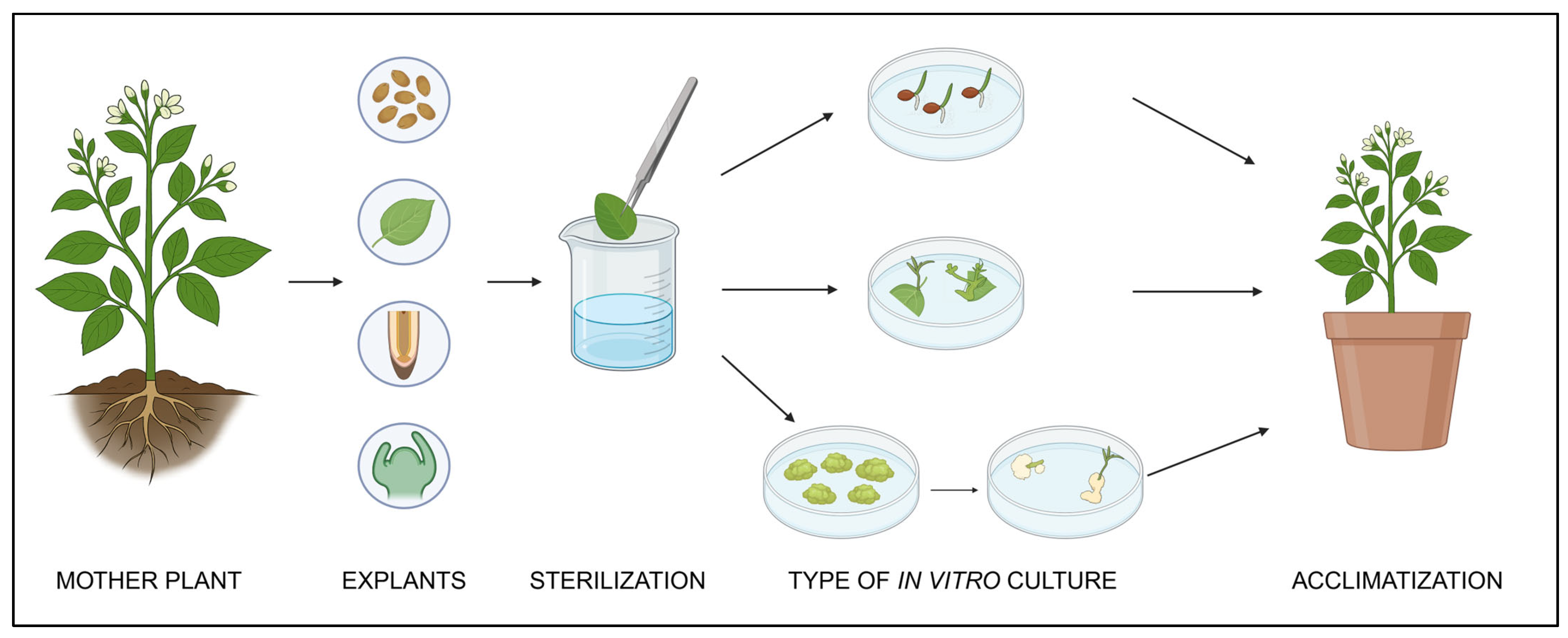
Indirect somatic embryogenesis. Indirect somatic embryogenesis is a process whereby somatic embryos are generated from callus cells, serving as an intermediary stage between the explant and the regenerated plant. Callus cells develop embryogenic competence under the influence of a suitable growth regulator system, typically characterized by elevated concentrations of auxins, subsequently differentiating into somatic embryos that exhibit typical morphological features [18]. A concise summary of the primary explant types and regeneration pathways is presented in Figure 1.
Figure 1.
A schematic diagram summarizing the primary explant sources and regeneration pathways (direct vs. indirect organogenesis). Created in BioRender by L. Banaszczyk. https://BioRender.com/83c4ect (accessed on 20 November 2025).
Nevertheless, the application of tissue cultures in the conservation of endangered species extends beyond the creation of ex situ collections. With the development of successful specific multiplication protocols for a specific plant taxon, efficient propagation of homogeneous genetic material becomes feasible, enabling its utilization for diverse purposes. Within the context of the Global Strategy for Plant Conservation, the restoration of natural habitats is achievable through the propagation of homogeneous material in tissue culture, followed by ex vitro acclimatization. Numerous endangered species possess significant practical value, yet their utilization is constrained due to the scarcity of seeds or other propagation materials. In such instances, propagation in tissue culture alleviates the strain on wild populations and presents extensive commercialization opportunities [21,22]. The establishment of bioreactors for the cell culture of such rare species facilitates the purposeful acquisition of valuable raw materials for industrial applications [23].
Tissue culture of rare and specially protected plant species serves as a potent instrument in physiological research, facilitating the cultivation of plants, cells, and tissues within a controlled and sterile milieu. This controlled environment enables researchers to conduct focused analyses of specific processes, thereby mitigating the influence of external variables. Tissue culture finds applications in studying plant hormones, stress responses (including salinity and drought), plant–pathogen interactions, and developmental processes. By manipulating conditions such as nutrients, light, and hormones within the culture medium, insights into these phenomena can be gained [24]. In this manner, it is possible to gain insight into ecophysiologically important functional properties of rare species. Secondly, homogeneous plant material propagated in tissue culture can be utilized to obtain plants for vegetation container experiments under controlled conditions [25].
Historically, the role of tissue culture in the conservation of endangered plant species has been analyzed since the 1980s and 1990s [26,27,28]. This analysis provided the foundation for contemporary scientific perspectives on the significance of tissue culture in preserving wild plant resources and served as a practical basis for international initiatives that marked the subsequent period of scientific activity aimed at halting the decline of biodiversity. Numerous aspects of tissue culture utilization in plant conservation have been comprehensively analyzed in previous reviews. Readers are referred to these sources for further specific information, as it was not feasible to encompass all pertinent details within this review.
Overviews of tissue culture methods for plant biodiversity conservation, analyzing key features in the context of diverse applications, have been presented in several reviews [29,30,31,32,33,34,35,36,37]. In the analysis of approaches to plant diversity conservation, cryopreservation emerged as the sole viable and cost-effective method for long-term tissue culture preservation [38]. Further, Coelho et al. (2020) [39] conducted a review that further explored biotechnological approaches for the conservation of endemic species, with a specific focus on cryopreservation.
Aspects of in vitro conservation by means of slow-growth storage were analyzed by Chauhan et al. (2019) [40]. Pence (2010; 2011; 2013) [2,4,32] provided a comprehensive description of the factors influencing the selection of tissue culture methods for plant propagation and conservation, along with a corresponding cost evaluation. Kulak et al. (2022) [41] examined the socio-cultural relevance of in vitro technologies in plant conservation, particularly focusing on the needs of indigenous communities. Numerous reviews have specifically addressed the application of tissue culture methods in plant biodiversity conservation within specific countries. González-Benito and Martin (2011) [42] assessed in vitro efforts aimed at preserving plant diversity in Spain. Radomir et al. (2023) [43] reviewed studies pertaining to the use of in vitro culture methods for ex situ conservation of endemic and subendemic wild plants in Romania. Sankararamasubramanian et al. (2012) [44] analyzed biotechnology methods employed in the conservation of coastal ecosystems, with a specific emphasis on mangroves.
Coastal vegetation occupies the boundary between the open sea and the inland, characterized by a blend of environmental conditions from both extremes. The specific arrangement of plants on the sea-to-land transition results in distinct plant zonation. The existence and extent of these zones are influenced by factors such as seawater salinity, availability of free substrate, wave and wind activity, and other local environmental conditions.
Coastal plant communities exhibit unique characteristics in terms of species taxonomic diversity and functional adaptations. Species found on the coast exhibit varying degrees of specificity in relation to marine-influenced habitats [45]. Some species are exclusively found in these habitats, while others are highly abundant but also occur outside the coastal zone. The greatest scientific interest lies in species absolutely specific to the coast due to their distinctive functional adaptations. However, other commonly found species in coastal habitats are also worthy of study, as there is potential for discovering unique coastal-specific ecotypes of these species [46,47].
Coastal plant species exhibit diverse morphological and biochemical adaptations that facilitate their growth under specific environmental conditions [48]. For instance, the growth of certain dune species is stimulated by sand accumulation, while the growth and development of salt marsh species rely on the increased salt concentration. Consequently, it is pertinent to determine whether coastal species necessitate any specialized cultivation conditions for their propagation and tissue culture. Recent scientific advancements in tissue culture research with halophytic plant species have been reviewed, but no evidence suggests that such plants require specific cultivation conditions or chemical media composition [49].
The paramount significance of specific conservation measures for coastal flora is underscored by the fact that 37% of littoral vascular plant species on European coastlines are classified as threatened [50]. To date, only a limited number of studies have specifically focused on tissue culture of coastal plant species in various regions. In the context of vegetation restoration in degraded coastal wetlands in China, Zhou et al. (2003) [51] developed tissue culture protocols for in vitro propagation of five salt-tolerant species. Furthermore, Kļaviņa et al. (2006) [52] assessed the potential of 29 species for establishing in vitro cultures in Latvia to initiate tissue culture collection of rare and endangered coastal plant species. Additionally, Panayotova et al. (2008) [53] successfully introduced 14 psammophyte species from sand dunes on the Black Sea coast of Bulgaria into culture, with several achieving successful propagation. In a study involving several Mediterranean coastal dune plant species, Romano et al. (2022) [54] utilized tissue culture as one of the propagation methods in the context of dune restoration.
Several compelling reasons justify the in-depth study and conservation of coastal plants [55]. From a biological perspective, coastal plant species exhibit distinctive physiological and morphological adaptations that enable them to thrive in highly specialized environmental conditions. From a practical standpoint, numerous coastal species hold significant interest for the pharmaceutical and food industries. Additionally, many coastal species possess potential applications in habitat restoration, environmental technologies, and ornamental horticulture.
The objective of this review was to evaluate the potential of tissue culture in the conservation and functional assessment of rare coastal plant species, particularly within the Baltic Sea ecosystem. The primary focus was to determine whether the extant knowledge is sufficient to ensure the conservation and functional research of coastal plants. Specifically, it was investigated whether efficient methods are available for (i) initiating tissue culture; (ii) multiplication, rooting, and acclimatization; and (iii) establishing long-term cultures. In the event of information gaps or deficiencies, opportunities were identified for utilizing the existing knowledge on the associated plant taxa.
The use of in vitro tools in plant conservation presents several challenges in relation to the goals of the Global Strategy for Plant Conservation, as analyzed in detail by Pence (2013) [4]. Among them, the information challenge encompasses several aspects, including (i) the identification of target species for conservation and (ii) the determination of the most suitable methods for each species, considering the goals for ex situ conservation and/or restoration. With respect to the coastal species of the Baltic Sea, the first aspect can be solved by selecting as target species those for which coastal habitats are the only or main location. Recently, a working list of 491 vascular plant species found in a landscape of the Baltic Sea has been prepared [55]. From the provided list, only 112 species exhibiting a high coastal specificity of appearance in Sweden (with index values at least five points out of 10) [45] were selected (Table 2). Consequently, “coastal specificity” in this context refers to the relative frequency of a species within two distinct vegetation types specifically associated with the sea coast: “Sandy/stony/rocky sea shores” and “Sea shore meadows”. Only species exhibiting high coastal specificity (with an index value of five or more, meaning that at least 50% of the species’ occurrences are in coastal habitats) were selected. Within the scope of this study, “coastal species” encompass all plant species found in coastal ecosystems of the Baltic Sea [55]. However, “coastal-specific species” are those with a coastal specificity index of at least five points, as defined by Tyler et al. 2021 [45]. This is also defined as “high coastal specificity”. In turn, species “absolutely specific to the coast” are those that are not found outside coastal habitats (having an index value of 10). Several additional taxa (five in total) were included from the list of Ievinsh (2024) [55] that were not found in Sweden. A relatively large number (31) of these species have been designated as “diagnostic” or “constant” for the EUNIS habitats of the Baltic Sea [56]. The second aspect related to the information challenge was addressed by a targeted search for tissue culture-related information conducted in scientific literature databases at the specific species level, or, if no tissue culture study information was available for a particular species, up to the genus level.
Table 2.
List of specific or partially specific plant species for coastal habitats of the Baltic Sea. Taxonomy is according to the World Flora Online (https://www.worldfloraonline.org, accessed on 10 October 2025).
2. Materials and Methods
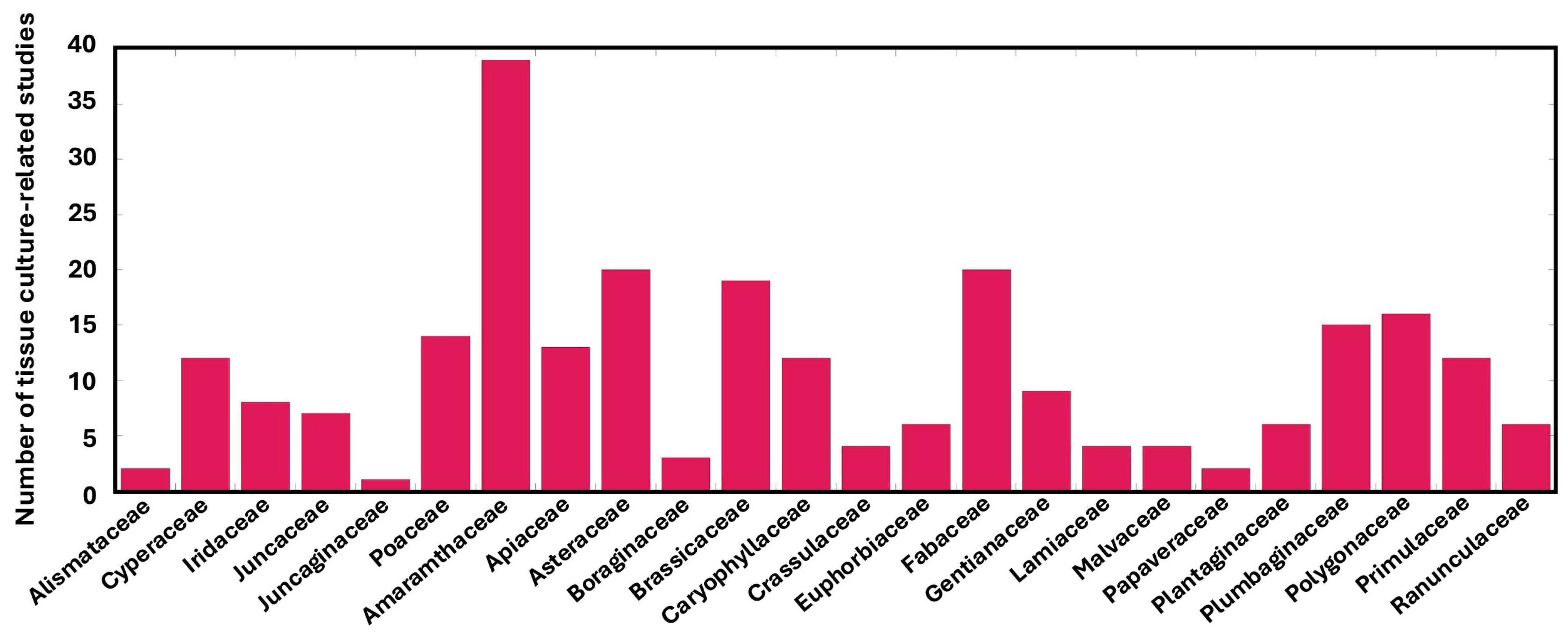
The objective of this review was to systematically analyze existing tissue culture protocols for coastal-specific plant species found in the Baltic Sea region. Google Scholar was employed as a search engine, utilizing Latin names of coastal plants as keywords. This was followed by a careful selection of sources based on the following criteria: (1) the article was peer-reviewed and published in a legitimate journal according to generally accepted criteria, (2) it was an experimental article, and (3) it detailed tissue culture methods for the specific species. In the event that no appropriate information sources were available for a particular species, the search was conducted at the genus level, adhering to the aforementioned inclusion criteria. Tissue culture protocols were identified for 38 species out of 112 (Table 1). However, when considering related species within the same genus, the total number of relevant publications was 232 (Figure 2).
Figure 2.
Number of experimental publications related to tissue culture research by family.
3. Analysis of Tissue Culture Studies with Coastal Plant Species
3.1. Alismataceae
Four species of the Alismataceae family are found in coastal wetlands of the Baltic Sea [55]. However, only Alisma wahlenbergii possesses the requisite level of specificity for inclusion in this study (Table 2). No information regarding tissue culture studies conducted with any species of the genus Alisma has been identified. Nevertheless, some studies have been conducted on the micropropagation of Sagittaria sagittifolia, another aquatic plant species within the same family, which is also commonly found in brackish wetland habitats of the Baltic Sea [55] (Table S1).
Comparison of various tissue culture systems employed in the micropropagation of Sagittaria sagittifolia was conducted, utilizing semi-solid agar-based medium, liquid medium, and a temporary immersion bioreactor system (TIBS) [57]. By employing rhizome-derived explants and media with identical compositions of plant growth regulators (BA + 1-naphthaleneacetic acid (NAA)), a multiplication rate of up to 23 was achieved in the TIBS, in contrast to 3.6 and 4.5 in semi-solid and liquid media, respectively.
Furthermore, a micropropagation protocol for Sagittaria latifolia has been developed and utilized to assess potential ex vitro growth variations among plants from six distinct potential ecotypes collected from wild populations [58].
3.2. Cyperaceae
In total, 32 species from seven genera of the Cyperaceae family are characteristic of coastal habitats in the Baltic Sea [55]. Of these, 15 species from five genera exhibit relatively high coastal specificity and are included in the present study (Table 2). Available information on tissue culture experiments conducted with these or related species is summarized in Table S2.
The rare coastal species Carex ligerica was successfully introduced into tissue culture using seeds as explants [52]. However, this was not feasible for another species, Carex reichenbachii, due to its intense seed dormancy [52]. Possibilities for slow-growth storage of micropropagated shoot explants have been investigated with Carex davalliana and Carex otrubae [59]. Microplants of Carex davalliana exhibited diminished growth on medium containing sorbitol or mannitol. However, long-term storage at 5 °C for up to three years was achievable only in a medium with 1.5% sucrose, as cultivation in the presence of polyols resulted in necrotization due to poor root development. In contrast, it was possible to store cultivated tissues of Carex otrubae in the presence of 2% sorbitol for over two years. Direct organogenesis on aseptically cultivated seedlings of certain Carex species has been demonstrated, including successful rooting and ex vitro acclimatization of regenerants [60]. In addition, effective methods for in vitro germination of coastal dune pioneer species, Carex arenaria, have been developed [61].
Tissue culture studies involving other species and even genera of interest appear to be severely limited. However, a unified micropropagation protocol was employed in a specific study for several Cyperaceae species, including 10 species of Carex, five species of Cyperus, two species of Eleocharis, and Schoenoplectus tabernaemontani [62]. Immature inflorescences served as initial explants for the induction of embryogenic callus, which was achieved through a complex medium containing adenine, indole-3-butyric acid (IBA), indole-3-propionic acid (IPA), and zeatin, in conjunction with 2,4-dichlorophenoxyacetic acid (2,4D). Subsequently, plant regeneration was conducted using TDZ. It appears that this approach exhibits universal applicability to various monocotyledonous species for the induction of callus and the subsequent regeneration of plants.
Eleocharis dulcis, an edible corm-producing species, has been propagated in tissue culture through direct organogenesis on apical explants. This induction was achieved by combining BA and NAA, resulting in successful rooting on a medium containing NAA [63].
Several species of Scirpus were investigated for micropropagation through callus induction and subsequent plant regeneration for wetland restoration [60,64]. However, the outcomes were inconsistent. While regeneration of Scirpus robustus was successful [64], a viable organogenic callus for Scirpus polyphyllus could not be established [60]. Consequently, direct organogenesis on aseptically cultivated seedlings of Scirpus polyphyllus was induced by BA.
Furthermore, information is available on the micropropagation of other species within this family through various methods. These findings may be useful in the development of tissue culture protocols for research and propagation of coastal Cyperaceae species [65,66,67,68,69].
3.3. Iridaceae
Only two Iris species, Iris orientalis and Iris spuria, exhibit absolute coastal specificity (Table 2). However, another species, Iris pseudacorus, is frequently found in brackish coastal wetlands and wet meadows [55]. Given that all Iris species possess high ornamental value, various micropropagation methods are available for species within this genus in general [70,71,72]. These reviews indicate that Iris species can be relatively straightforward to propagate in tissue culture by direct organogenesis or somatic embryogenesis, utilizing seeds, flower parts, and leaf bases as explants (Table S3). Notably, Iris spuria, a coastal species, has been successfully micropropagated from flower bud explants through direct organogenesis using BA [73].
In addition to conventional ornamental Iris species, micropropagation protocols have been developed for several endangered wild species, encompassing both regeneration through callus formation [74], somatic embryogenesis [75], and direct organogenesis through adventitious bud formation from explants [76]. Iris germanica appears to exhibit relatively high genetic stability, as evidenced by the absence of somaclonal variation in the plants produced through somatic embryogenesis [77].
3.4. Juncaceae
At least 11 species of the Juncaceae family are found in coastal habitats of the Baltic Sea [55]. However, only four of them—Juncus balticus, Juncus gerardii, Juncus maritimus, and Juncus ranarius—exhibit coastal specificity, allowing their inclusion in the current study (Table 2). Only Juncus maritimus possesses absolute coastal preference. A concise summary of tissue culture experiments conducted with these or related species is presented in Table S4.
Clonal species Juncus balticus and Juncus gerardii demonstrated typical clonal growth characteristics within six months when cultivated on Murashige and Skoog (MS) medium without growth regulators [52]. In these conditions, they formed very short rhizome internodes. In contrast, in natural conditions, hypogeogenous rhizomes of both species exhibit a spreading capability of 13 cm per year [78]. Both species are well-known halophytes, but no studies have been conducted on the effects of salinity on these species in tissue culture. However, the salinity tolerance of other halophytic Juncus species has been assessed in tissue culture conditions. For instance, NaCl up to 200 mM in both solid and liquid medium had no impact on shoot proliferation in Juncus rigidus [79].
Micropropagation protocols for several species of the genus encompass both direct organogenesis and callus induction, leading to plant regeneration. Protocols have been developed for Juncus gerardii [80,81], which are particularly relevant to the purpose of this review. Notably, explants of this species have been maintained viable for over four years using slow-growth technology at low temperatures [59]. While established protocols for micropropagation of Juncus balticus, Juncus maritimus, and Juncus ranarius are not available, their relatively high similarity in particular micropropagation requirements suggests that developing specific protocols should not pose significant challenges.
A protocol for cryopreservation has been established and successfully applied to Juncus effusus [82]. This approach involves a series of preconditioning steps, including hardening at 5 °C, precultivation with 0.3 M sucrose at 5 °C, followed by a short osmoprotection phase with 2 M glycerol and 0.6 M sucrose, and finally, dehydration in vitrification solution, followed by immersion in liquid nitrogen.
3.5. Juncaginaceae
Only two species of the Juncaginaceae family, Triglochin maritima and Triglochin palustris, are found in the wet coastal habitats of the Baltic Sea [55]. Among these, Triglochin maritima plants are specifically associated with seacoast habitats (Table 2, Table S5). There are no specific studies available in the literature on Triglochin maritima in tissue culture conditions. However, tissue culture of Triglochin maritima has been established for ex situ conservation purposes using seeds as explants [52].
3.6. Poaceae
Although the grass family (Poaceae) comprises 46 species on the seacoast [55], only 12 exhibit high coastal specificity (Table 2). Despite the extensive tissue culture studies conducted in the Poaceae family, primarily associated with economically significant crops such as cereals, sugarcane, and turfgrass, information on coastal grasses in tissue culture experiments remains limited. Results from tissue culture studies involving grasses, including micropropagation, have been compiled and serve as reference material for the development and adaptation of new protocols for coastal grass species [83]. Previous work on related taxa within this family is summarized in Table S6.
Tissue culture work with Calamagrostis arenaria (syn. Ammophila arenaria), a dune-building grass, has been confined to studies on viable leaf protoplast isolation [84].
In the genus Deschampsia, tissue culture experiments have been conducted with Deschampsia antarctica, an Antarctic grass species. This botanical rarity is one of only two herbaceous plant species found in the Antarctic. Methods of direct organogenesis on seedling explants [85] and mature apical explants [86], or callus induction by 2,4D and shoot multiplication on a hormone-free medium [87], have proven effective for successful micropropagation. Notably, no genetic differences were observed between callus-regenerated and vegetatively propagated wild Deschampsia antarctica plants [87]. Micropropagation through callus induction and somatic embryogenesis has also been described [88]. Furthermore, a temporary immersion cultivation system has been employed for the cultivation of Deschampsia antarctica [89].
No tissue culture studies have been conducted with the European dune-building coastal-specific species Leymus arenarius or with related American–Asian species Leymus mollis. However, substantial amounts of in vitro studies have been performed with Leymus chinensis, which is characteristic of alkaline–saline soils in Northern China, Mongolia, and Siberia [90]. These studies are of lesser importance in preserving the genetic material of wild forms, as attention has primarily been focused on micropropagation through callus culture (discussed in detail in Jin et al. 2011 [90]).
One of the coastal grass species, Lolium arundinaceum, has been used for callus induction using seeds by a standard protocol involving 2,4D and BA, followed by plant regeneration using KN [91]. An almost identical approach has been used for another species of the genus, Lolium multiflorum [92].
Two coastal-specific grass species of the genus Puccinellia, Puccinellia distans (syn. Puccinellia capillaris) and Puccinellia maritima, are important salt-tolerant constituents of salt marshes and wet beaches [78]. Puccinellia distans has been introduced in tissue culture using seeds as explants [52], but no further tissue culture studies on direct organogenesis have been conducted. Instead, a micropropagation protocol involving callus induction using 2,4D on seed explants followed by plant regeneration using KN and indole-3-acetic acid (IAA) has been employed [93]. Plant regeneration from callus induced on seed explants was subsequently used as a method for micropropagation of another species of the genus, Puccinellia chinampoensis, resulting in a high frequency of somaclonal variation [94].
3.7. Amaranthaceae
Species belonging to the Amaranthaceae family are highly abundant in coastal habitats, as evidenced by 24 taxa in the Baltic Sea region [55]. These species exhibit relatively high coastal specificity, with 16 entities from seven genera selected for the present study (Table 2). A summary of previous research conducted on related taxa within this family is presented in Table S7.
Plants of the genus Atriplex are known as xerophytic and halophytic subshrubs or shrubs from arid and subarid regions, as well as annual halophytic and nitrophilous herbs characteristic of coastal habitats. Given the significant interest in the species of the first group as potential forage crops for salt-affected, drought-prone marginal lands, their propagation possibilities in tissue culture and various biotechnological activities have been extensively studied. In contrast, tissue culture studies on the second group of species have been virtually nonexistent, except for the possibility of introducing them into tissue culture using seeds as explants [52].
Micropropagation of Atriplex canescens can be achieved through either direct organogenesis of axillary buds on shoot explants or shoot organogenesis of calluses on leaf explants [95]. In the former case, bud dormancy was induced by applying auxin, followed by shoot induction with cytokinin. Alternatively, seeds can be utilized as explants for initiating tissue culture of Atriplex canescens, followed by inducing shoot proliferation [96]. To address the development of hyperhydricity in closed cultivation containers due to high humidity, casein hydrolysate was substituted for inorganic nitrogen, and vented lids were employed to promote the development of high-quality, good-rooting shoots.
Hypocotyl explants were employed for callus induction, subsequent shoot induction, and proliferation of several species, including Atriplex gmelini (Ushida et al. 2003) [97] and Atriplex halimus [98]. Additionally, meristematic tissues, such as axillary buds from mature plants, were utilized for initiating tissue culture of Atriplex halimus, followed by shoot proliferation and rooting [99]. In another study, stem node segments from young Atriplex halimus plants were employed for culture initiation, subsequently leading to multiple shoot induction through a combination of BA and TDZ, rooting, and ex vitro establishment [100]. Micropropagated plants exhibited genetic homogeneity, as confirmed by molecular analysis. An efficient micropropagation technique has been developed for ex situ conservation purposes of endemic Chilean species, namely Atriplex taltalensis. This technique induces direct organogenesis on stem explants, followed by multiplication and spontaneous rooting on IBA-containing medium [101].
A tissue culture system utilizing cultivated axillary buds of Atriplex halimus was employed to assess salinity tolerance. It was observed that shoot length was inhibited at 200 mM NaCl, while proliferation intensity decreased only at 600 mM NaCl [99]. Furthermore, in vitro-cultivated seedlings of Atriplex halimus exhibited optimal growth at 8 g L−1 CaCl2 in the medium, resulting in a threefold increase in shoot biomass compared to the control group [102].
Within the Amaranthaceae family, Beta vulgaris and other closely related species hold significant practical interest as wild ancestors and relatives of contemporary beet crops. Initial research primarily focused on the induction of callus formation and plant regeneration [103,104]. Studies demonstrated the ability to develop callus cultures from mature leaf explants [103,104], juvenile hypocotyl explants [105], and mature zygotic embryos isolated from seeds [106]. However, the use of these approaches resulted in substantial somaclonal variations [103]. Consequently, protocols specifically designed for meristematic tissue propagation were necessary to explore and preserve the genetic resources of Beta.
As a result, several wild accessions of Beta, including Beta vulgaris subsp. maritima, have been utilized to develop effective methods for germplasm conservation [107]. These approaches encompassed the use of either petiole or cotyledon node explants of aseptically germinated seedlings. Pretreatment with TDZ was followed by cultivation in the presence of BA, NAA, or gibberellic acid (GA3) to initiate shoot proliferation [107,108]. Subsequently, plantlets were rooted in the presence of NAA, IBA, or IAA and successfully acclimatized ex vitro. Notably, it was also possible to induce direct root formation on mature leaf explants of Beta vulgaris through a 24 h exposure to NAA [109].
From a functional standpoint, callus cultures of Beta vulgaris have demonstrated that the salt tolerance mechanisms of the species operate at the cellular level [110]. Similarly, callus cultures of two other Amaranthaceae species, obligate halophytes Suaeda maritima and Salicornia europaea, cultivated in the presence of 1 mg L−1 IAA and 10 mg L−1 KN, exhibited significantly enhanced cell proliferation rates at concentrations of 0.25–0.75% NaCl, indicating that the requirement for increased salinity for optimal growth is already manifested at the cellular level [111].
Early tissue culture experiments with Chenopodium rubrum involved the utilization of photoautotrophic cell suspension cultures with CO2 as the sole carbon source [112,113]. Additionally, cell suspension culture of Chenopodium album has been developed [114]. However, micropropagation studies have been conducted exclusively with Chenopodium quinoa, a pseudocereal crop species. In this regard, apical explants from in vitro germinated seedlings produced multiple shoots on B5 medium supplemented with BA and NAA. Nevertheless, rooting was achieved on hormone-free medium [115]. In another study, a two-step protocol was devised, employing 1 mg L−1 KN and 1 mg L−1 BA for shoot induction on apical segments, followed by multiplication in the presence of 2 mg L−1 BA [116].
Another coastal-specific halophyte species, Halimione portulacoides (syn. Atriplex portulacoides), is a potential crop species for saline agriculture [117]. Although no information on tissue culture-related studies can be found in the literature, it is possible to use information on taxonomically related Atriplex species, as discussed above.
Species of the genus Salicornia are considered euhalophytes, exhibiting optimum growth at moderately increased salinity [118]. Therefore, from a fundamental point of view, it is extremely interesting if dependence on salinity is also present at the tissue or cellular level. In vitro cultivated seedlings of Salicornia europaea and Salicornia persica were used for evaluating salinity tolerance in these species [119].
Micropropagation method for Salicornia europaea involved callus induction on seed explants by TDZ and NAA, followed by shoot regeneration in a medium containing TDZ and NaCl [120]. Approaches of micropropagation involving meristematic tissues have not been described for Salicornia europaea. However, this type of approach was used for related species, Salicornia bigelovii and Salicornia brachiata. In particular, Salicornia brachiata was propagated both by direct organogenesis through induction of axillary buds on stem explants by BA and zeatin as well as from callus, followed by shoot proliferation in the presence of TDZ and NAA [121]. Interestingly, double-strength MS medium was used throughout the propagation, and a relatively high concentration of MgCl2 (20 g L−1) resulted in the highest percentage of rooting. In another study, a combination of BA and NAA was used for shoot induction and proliferation of apical and nodal explants from mature Salicornia brachiata plants [122]. Additionally, somatic embryogenesis was achieved for Salicornia brachiata from embryogenic callus using 0.25 mg L−1 2,4D [123].
Sodium chloride (NaCl) at moderate and high concentrations (250 and 500 mM) enhanced shoot proliferation in Salicornia brachiata [122]. In contrast, no effect of NaCl on shoot bud development was observed for the same species in another study [121]. These discrepancies may be attributed to genetic variations or diverse applications of plant growth regulators.
Salsola kali, a coastal-specific species inhabiting littoral sandy beach habitats [55], lacks tissue culture studies. However, callus cultures were successfully obtained for several xerohalophytic Salsola species and utilized for assessing salinity tolerance [124,125]. Additionally, zygotic embryos were employed to establish tissue culture of xerohalophytic Salsola pestifer and Salsola lanata, followed by callus induction and plant regeneration [126].
Suaeda maritima, another coastal-specific species of Amaranthaceae, exhibits high tolerance to flooding with saline water [127]. Despite its significance, there have been limited tissue culture studies conducted with this species. To date, no micropropagation protocols have been established for Suaeda maritima. The sole study involving this species focused on callus induction and its utilization as an experimental system to elucidate salinity tolerance mechanisms across different accessions [128].
Micropropagation protocols for several other species within the genus Suaeda have been developed, encompassing both callus induction followed by organogenesis [129,130] or shoot proliferation utilizing meristematic tissues [130,131,132,133].
3.8. Apiaceae
The total number of Apiaceae taxa in coastal habitats is relatively high, with seven species listed [55]. However, only four of these species (Apium graveolens, Eryngium maritimum, Ligusticum scoticum, and Oenanthe lachenalii) exhibit high coastal specificity in the Baltic Sea region (Table 2). Information on in vitro studies with coastal plant species and related taxa from this family is consolidated in Table S8.
Wild populations of Apium graveolens (subsp. graveolens) serve as a significant genetic reserve for improving celery and celeriac crops [134]. In the Baltic Sea region, the wild species is exclusively associated with coastal habitats. The majority of studies on Apium graveolens in tissue culture have focused on somatic embryogenesis, primarily due to the species’ high embryogenic potential. Typically, 2,4D and BA are employed for callus initiation, while regeneration is initiated by removing growth regulators [135,136]. Due to specific metabolic characteristics of celery plants, mannitol is a crucial component for producing distinct somatic embryos [135]. Additionally, a micropropagation protocol involving the proliferation of meristematic material has been developed [137].
Conium maculatum plants contain highly toxic piperidine alkaloids and furanocoumarins with substantial pharmacological potential. Consequently, tissue culture studies have been conducted to develop cultures for the production of secondary metabolites [138]. In particular, the elicitation of furanocoumarin biosynthesis in cell suspension culture was achieved through the use of alginic acid, cellulase, chitosan, AgNO3, and CuSO4 [138]. However, no micropropagation methods for Conium maculatum have been developed.
Tissue culture studies on Eryngium maritimum have primarily focused on commercializing biologically active compounds [22,139,140]. Additionally, a micropropagation protocol has been developed, which finds applications in conservation efforts and practical propagation [21]. A crucial aspect to consider is efficient surface sterilization through a multi-step disinfectant application protocol. Proliferation of axillary buds was achieved using various cytokinin types, including zeatin and 2-isopentenyladenine, with meta-topolin demonstrating the highest efficiency.
The initiation of tissue culture for Eryngium maritimum involves afterripening of seeds at room temperature for at least two weeks, followed by cold stratification for a minimum of two months at 5 °C [52]. Tissue cultures of Eryngium maritimum have demonstrated survival for two years in slow-growth conditions at 5 °C, utilizing a medium with either sorbitol or mannitol as a carbon source [59]. Optimum results were achieved by adding 30 g L−1 sucrose, 0.1 mg L−1 meta-topolin, or 0.1 mg L−1 BA.
Regrettably, no tissue culture-related information is available for Ligusticum scoticum and Oenanthe lachenalii. However, protocols for inducing callus cultures and plant regeneration through somatic embryogenesis have been established for certain other species within the genus Oenanthe, including Oenanthe javanica [141,142].
3.9. Asteraceae
Species belonging to the Asteraceae family are prevalent in coastal habitats, with 54 representatives identified in the Baltic Sea region [55]. Notably, this family also boasts a substantial number of species exhibiting relatively high coastal specificity, comprising 10 species (Artemisia maritima, Artemisia stelleriana, Cotula coronopifolia, Lactuca tatarica, Petasites spurius, Pulicaria dysenterica, Tragopogon heterospermus, Tripleurospermum inodorum, Tripleurospermum maritimum, Tripolium pannonicum), each belonging to eight distinct genera (Table 2). Detailed information regarding tissue culture experiments conducted with these or related species is summarized in Table S9.
The genus Artemisia comprises a diverse range of species renowned for their rich concentration of essential oils and secondary metabolites. These compounds possess significant pharmacological potential, making them a highly sought-after source of biologically active compounds [143]. Two notable species within this genus, Artemisia maritima and Artemisia stelleriana, exhibit absolute coastal specificity in the Baltic Sea region (Table 2). Artemisia stelleriana, however, lacks well-established micropropagation protocols. In contrast, Artemisia maritima, a halophytic clonal species characterized by bud-bearing roots [78], has demonstrated remarkable adaptability and has been successfully propagated through direct organogenesis on mature stem explants [144]. Additionally, callus induction on the explants, followed by indirect shoot organogenesis or somatic embryo formation, has proven effective in generating regenerated plants. These regenerated plants exhibit high genetic stability, ensuring their long-term viability.
Research on micropropagation techniques has been conducted for other species within the genus Artemisia, including Artemisia annua [145,146] and Artemisia vulgaris [147,148]. These studies have demonstrated the feasibility of using in vitro-derived seedling tissues and mature apical shoots as explants. Furthermore, micropropagated nodal explants of Artemisia annua have been successfully utilized to produce artificial seeds that exhibited remarkable survival rates after storage for 60 weeks at 5 °C [149].
Cotula coronopifolia, native to South Africa, has become invasive in European, Australian, and North American wetlands [150]. Its invasive nature likely explains the absence of protocols for its micropropagation, despite protocols available for other Cotula species, such as Cotula bipinnata [151]. Similarly, Lactuca tatarica, while meeting the criteria for inclusion in this review, is a neophyte in the Baltic region with a potentially invasive character [152]. Consequently, it does not require conservation measures in this region.
Information on tissue culture studies with Petasites spurius is scarce. However, micropropagation protocols exist for related species, including Petasites japonicus [153] and Petasites hybridus [154]. In both cases, immature inflorescence explants were used for proliferation initiation using BA and NAA, followed by shoot elongation.
Research on Pulicaria dysenterica (syn. Inula dysenterica) primarily focuses on its valuable properties and bioactive compounds [155]. Despite the availability of protocols for other species within the genus, such as Pulicaria crispa [156] and Pulicaria microcephala [157], no micropropagation protocol has been identified for Pulicaria dysenterica.
Tragopogon heterospermus, an endemic species found in the sand dunes of the southeastern coast of the Baltic Sea, exhibits relatively high tolerance to sand burial [158]. In vitro culture of this species can be initiated using immature seeds as explants [52]. In a slow-growth culture condition, Tragopogon heterospermus shoots can be stored for at least one year, utilizing sucrose or sorbitol as a carbon source [59].
The genus Tripleurospermum comprises nearly 40 species that possess medicinal potential [159]. Two species, Tripleurospermum inodorum and Tripleurospermum maritimum, are highly specific for coastal habitats (Table 2). However, there are currently no studies on micropropagation of these species. Although a study conducted in 1984 on Matricaria inodora, which is considered a synonym of Tripleurospermum inodorum, covers callus initiation [160], it is likely that the protocol could be adapted for both species. These species are sometimes regarded as subspecies of Tripleurospermum maritimum due to phenotypic plasticity [161]. Micropropagation studies are available for other species within the genus, Tripleurospermum ziganaense [162] and Tripleurospermum fissurale [163]. These studies suggest the use of MS medium with GA3 or 1 mg L−1 KN for germination, MS with 1 mg L−1 BA and 0.1 mg L−1 IBA for multiplication, and MS with 1 mg L−1 IBA on 0.5 mg L−1 NAA for rooting.
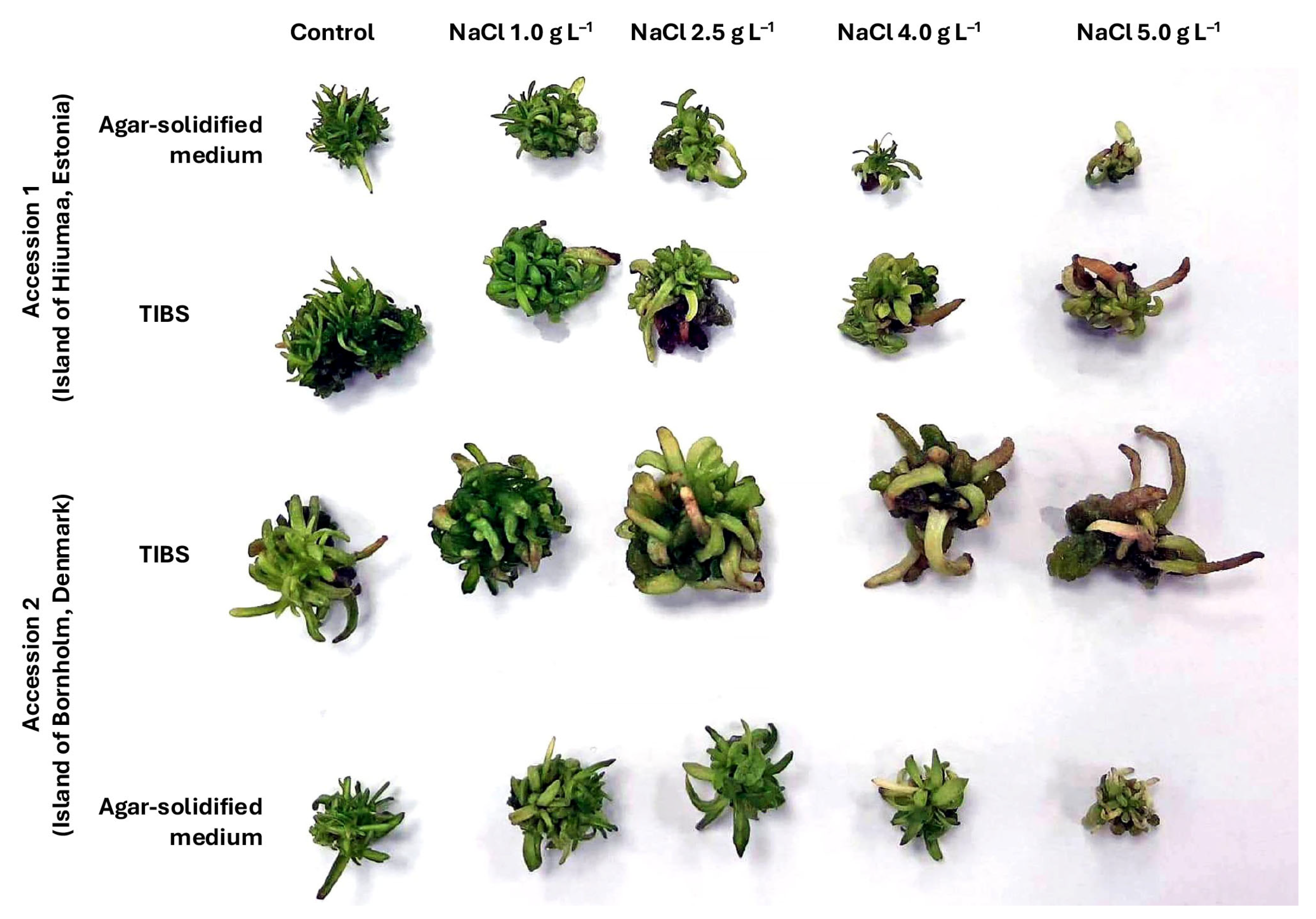
Tripolium pannonicum (syn. Aster tripolium, Tripolium vulgare) is a prominent halophyte species found in diverse wet coastal environments. Micropropagation protocols for this species encompass both direct organogenesis and indirect organogenesis on callus explants, as demonstrated by Uno et al. (2006) [164]. In a comparative study, conventional (agar-solidified medium) and TIBS (liquid medium) were evaluated during micropropagation of Tripolium pannonicum through direct shoot multiplication on seedling explants [165]. The results indicated that explants produced in the TIBS exhibited significantly higher fresh and dry biomass, as well as enhanced multiplication potential (Figure 3).
Figure 3.
Tripolium pannonicum explants of two accessions, cultivated for 4 weeks with different NaCl concentrations and growth conditions. TIBS, temporary immersion bioreactor system. Photo by L. Purmale-Trasūne. Modified from [165].
Salt-tolerant suspension-cultured cells of Aster tripolium were successfully generated from leaves through repeated subculture in NaCl-containing media [166]. Notably, a specific cell line exhibited a remarkable 15-fold biomass increase within a 25-day period at 150 mM NaCl, in contrast to the biomass observed in non-saline conditions. This observation suggests the euhalophytic nature of the cells. Furthermore, a subsequent study revealed that NaCl significantly increased the biomass of Tripolium pannonicum explants during the multiplication stage, without affecting the dry biomass [165].
3.10. Boraginaceae
Six species belonging to the Boraginaceae family are found in coastal habitats of the Baltic Sea [55]. However, only one of these species, Mertensia maritima, is considered a coastal-specific species (Table 2). Further information on tissue culture studies conducted with Mertensia maritima is provided in Table S10.
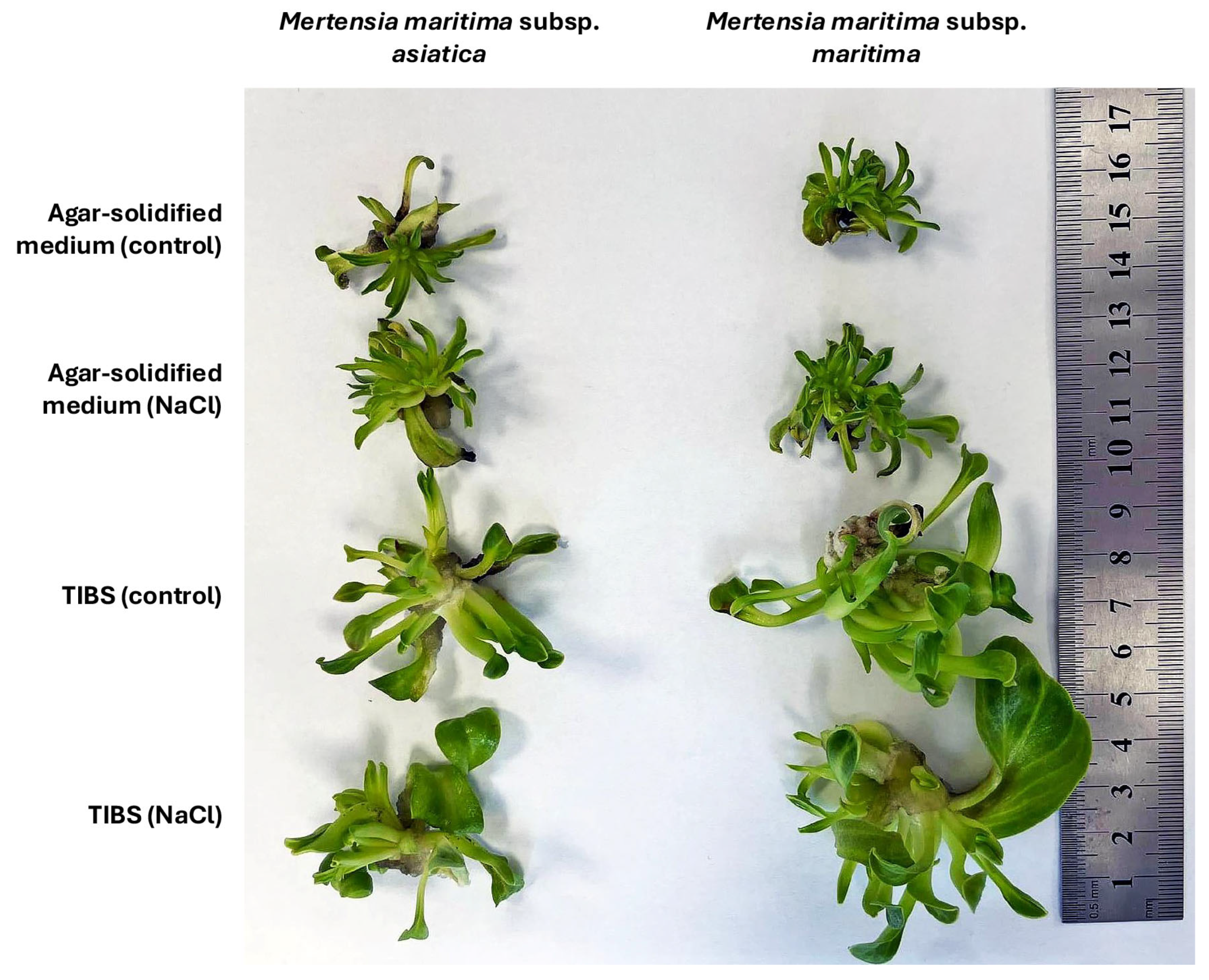
Successful micropropagation of Mertensia maritima through direct shoot proliferation has been achieved utilizing both explants from mature plants and aseptically germinated seedling tissues. For induction of shoot multiplication, either BA [167] or a combination of TDZ and NAA [25,168] has been employed, followed by IBA treatment for rooting. Micropropagation efficiency was compared for agar-solidified and liquid media using TIBS, and it was observed that cultivation in the latter system resulted in a lower number of shoots per explant and a higher hyperhydricity rate [167]. The positive effect of TIBS was observed only when explants propagated on agar-solidified medium were transferred to a liquid system, leading to a higher final survival rate during acclimatization. In another study, Mertensia maritima explants in TIBS exhibited higher biomass and water content, while the multiplication rate remained unaffected (Figure 4) [25]. Additionally, callus culture was initiated for Mertensia maritima and utilized for the quantification of bioactive compounds [169].
Figure 4.
Mertensia maritima subsp. asiatica and Mertensia maritima subsp. maritima explants cultivated on agar-solidified medium and in liquid medium (temporary immersion bioreactor system, TIBS) without and with additional NaCl 1 g L−1. Unpublished photo by L. Purmale-Trasūne.
Functional studies in tissue culture have also been conducted with this species. For instance, the addition of NaCl (1 mg L−1) during the multiplication phase resulted in increased explant biomass when cultivated on agar-solidified medium. However, the effect of salinity in the TIBS was genotype-dependent [25].
3.11. Brassicaceae
The Brassicaceae family is represented in coastal habitats with 25 species [55], seven of which (Alyssum montanum subsp. gmelinii, Cakile maritima, Cochlearia danica, Cochlearia officinalis, Crambe maritima, Isatis tinctoria, Lepidium latifolium) are highly specific to the coast (Table 2). A comprehensive compilation of in vitro studies conducted with coastal plant species and their associated taxa belonging to this family is presented in Table S11.
Alyssum montanum subsp. gmelinii represents a geographically isolated taxon associated with white and grey sand dune habitats in the Eastern Baltic regions, sometimes known as Alyssum gmelinii [170]. For conservation purposes, coastal ecotype has been introduced in tissue culture using seeds [52], and a protocol for long-term storage for up to three years has been developed using sorbitol as a sole carbon source [59]. Micropropagation protocols for other ecotypes of Alyssum montanum are available [171,172].
Functional studies with in vitro cultivated Alyssum montanum were aimed at assessing heavy metal tolerance and accumulation potential in different ecotypes of the species. Low and moderate doses of Cd (0.5 and 2.5 μM) during a multiplication phase stimulated shoot proliferation and rooting of Alyssum montanum calamine ecotype [171]. When metallicolous and nonmetallicolous ecotypes were compared with respect to multimetallic treatment (Zn, Pb, Cd), it appeared that microplants from a metal-adapted ecotype were more tolerant to the treatment at the level of multiplication intensity and root formation and growth, with no apparent phytotoxicity symptoms [173].
Another species of Brassicaceae, Cakile maritima, is a coastal-specific halophyte with a high potential for use in saline agriculture [174]. Surprisingly, no micropropagation protocols have been developed for this species using direct or indirect organogenesis. Instead, a method for initiating callus-derived cell suspension culture has been developed [175], which has been further used for comparative assessment of cellular salinity tolerance mechanisms of Cakile maritima [176,177].
No tissue culture-related information can be found for halophytic species of the genus Cochlearia. Both Cochlearia danica and Cochlearia officinalis exhibit absolute coastal preference in the Baltic Sea region (Table 2).
A comprehensive review of tissue culture studies with Crambe maritima and other species of the genus can be found in recent literature [178]. It can be concluded that efficient micropropagation protocols are available for Crambe species, primarily utilizing direct shoot regeneration from differentiated tissues (leaves, petioles, roots) induced by low NAA (0.1–0.5 mg L−1) and moderate BA (1.0–2.5 mg L−1) [178]. Early protocols for Crambe maritima micropropagation by indirect organogenesis through callus cultures also exist [179,180].
Isatis tinctoria, a renowned plant for centuries, has been utilized both for dye production and medicinal purposes [181]. Using aseptically germinated seeds, direct shoot proliferation can be induced by combining BA and NAA on leaf and hypocotyl explants [182,183] or directly on seeds [184]. Furthermore, rooting of produced microshoots can be induced by IBA. Studies have demonstrated that the concentration of antioxidant-active metabolites in shoot cultures of Isatis tinctoria can be increased by adding tyrosine, methyl jasmonate, and CaCl2 to the multiplication medium [184]. Additionally, hairy root cultures of Isatis tinctoria are utilized for efficient alkaloid production [185].
Although no information regarding tissue culture studies with Lepidium latifolium is available, micropropagation protocols are available for other species within the genus. Lepidium ostleri was propagated through indirect shoot organogenesis, involving callus formation and somatic embryo formation [186]. In contrast, hypocotyl callus regeneration was observed in Lepidium sativum [187], while direct organogenesis was employed for micropropagation of Lepidium virginicum [188].
3.12. Caryophyllaceae
The coastal representation of the Caryophyllaceae family is relatively diverse, comprising 34 species across 10 genera [55]. Among these, nine species meet the inclusion criteria for the present study. Six of these species—Cerastium diffusum, Honckenya peploides, Sagina maritima, Spergularia marina, Spergularia media, and Stellaria fennica—demonstrate absolute coastal specificity in the Baltic Sea region (Table 2). Information on tissue culture experiments conducted with these or related species is summarized in Table S12.
Cerastium diffusum lacks available tissue culture-related information. However, micropropagation protocols for two other species of the genus, Cerastium banaticum [189] and Cerastium transsilvanicum [190], have been successfully developed for ex situ conservation purposes.
Honckenya peploides, a dune-building species with hypogeogenous rhizomes exhibiting high salinity tolerance, is found on both sandy and shingle beaches [78]. Tissue culture of Honckenya peploides was initiated from seeds, as shoot fragments exhibited a high rate of infections and explant death [191]. The effect of NaCl in the multiplication medium was tested, and it was observed that explant growth or multiplication remained unaffected at 25 or 50 mM salinity, while it was negatively impacted by 75 mM NaCl [191].
Within the genus Silene, one species, Silene borysthenica, has been successfully introduced in tissue culture from seeds [52]. However, protocols for multiplication and rooting have not yet been established for this species. Surprisingly, there is a lack of tissue culture studies conducted with Silene uniflora, a species that inhabits rocky shores and is typical of inland metal-rich soils [192]. Nevertheless, tissue culture-related information is available for some related species. Silene vulgaris, a taproot-forming short-lived perennial species, is a metallophyte renowned for its exceptional tolerance to various heavy metals. Specific ecotypes of Silene vulgaris thrive in calamine soils, which are rich in zinc, lead, and cadmium, and in serpentine soils, which are rich in nickel, chromium, and cobalt [193]. Tissue culture protocols for Silene vulgaris have been established and utilized for vegetative propagation in studies focused on resistance to anther-smut disease [194]. Additionally, these protocols have been employed for further research on the mechanisms underlying metal tolerance [195,196]. Furthermore, cell suspension culture of Silene vulgaris has been developed and employed in metal tolerance studies [197]. In addition, a tissue culture protocol for another species of the genus, Silene schimperiana, has been established to facilitate efficient ex situ conservation of this alpine plant [198].
Two species of the genus Spergularia, Spergularia marina and Spergularia media, exhibit absolute coastal specificity in the Baltic Sea region (Table 2). Both species are obligate halophytes, characteristic of coastal and inland salt marshes, as well as wet sandy shores that are periodically flooded with seawater [199]. To date, only one study has been conducted on the micropropagation of Spergularia marina [200]. This study revealed that increased salinity induced increased water accumulation in tissues and had no detrimental effect on dry biomass accumulation up to 75 mM NaCl. Furthermore, the species (identified as Spergularia salina) has been introduced in tissue culture by seeds as explants [52]. While cultivated on agar-solidified half-diluted MS medium, these annual plants flowered within six months and produced viable seeds that germinated within the cultivation vessel. Additionally, it was feasible to achieve low-temperature slow-growth storage of Spergularia marina explants for up to three years using 2 or 3% sorbitol as a carbon source in conjunction with activated charcoal [59].
It appears that tissue culture studies involving Stellaria species are relatively limited. One notable study described the heat inactivation of cucumber mosaic virus in meristematic cultures of Stellaria media [201].
3.13. Crassulaceae
Five species of the Crassulaceae family are found in coastal habitats [55], but only Sedum anglicum exhibits relatively high coastal specificity (Table 2). Unfortunately, there is no tissue culture-related information available for this specific species. However, numerous micropropagation studies have been conducted with other species of the genus (Table S13).
A common successful method for several Sedum species involves initiating direct organogenesis on flower bud petal explants at a concentration of 3 mg L−1 BA and 1 mg L−1 IBA. Subsequently, the explants are rooted on a medium devoid of plant growth regulators (PGRs) [202]. Another approach entails using leaf explants of aseptically cultivated apical meristems from mature plants for inducing organogenesis by NAA and/or BA [203]. In this case, individual species exhibited specific requirements regarding growth regulator concentrations for optimal organogenesis. Protocols for micropropagation of several other Sedum species include callus induction on leaf or stem explants, followed by proliferation and adventitious shoot regeneration [204,205].
3.14. Euphorbiaceae
In total, four Euphorbia species, representing the genus Euphorbiaceae, can be found in coastal habitats of the Baltic Sea [55]. Only Euphorbia palustris, an endangered European species [206], exhibits relatively high coastal specificity (Table 2). Information on in vitro studies conducted with this and related species is summarized in Table S14.
Euphorbia palustris has been introduced in tissue culture using apical shoot fragments from mature plants as explants [52]. Under these conditions, a relatively low propagation coefficient (1.2–1.5) was achieved without root development. However, no further specific micropropagation protocols have been developed. Nevertheless, there are several successful examples of propagation in tissue culture of other species within the same genus. A significant portion of this research focuses on the propagation of ornamental species, such as Euphorbia pulcherrima [207,208] and Euphorbia milii [209]. Additionally, there are studies involving potentially invasive weed species, including Euphorbia esula [210], which is also found in coastal habitats [78]. Comprehensive information regarding micropropagation of various species within the Euphorbiaceae family can be found in the review article by Kondamundi et al. (2009) [211].
3.15. Fabaceae
Plant species belonging to the Fabaceae family are relatively widely distributed in coastal habitats. Of the 34 legume taxa found in various habitats [55], seven (Anthyllis vulneraria subsp. maritima, Lathyrus japonicus, Lotus maritimus, Lotus tenuis, Melilotus dentatus, Ononis spinosa, and Trifolium fragiferum) exhibit a high degree of specificity to coastal environments (Table 2). Only Lathyrus japonicus and Anthyllis vulneraria subsp. maritima are exclusively found in coastal habitats. Available information on in vitro experiments conducted with these or related species is summarized in Table S15.
Anthyllis vulneraria has attracted research interest for its metal tolerance and accumulation potential [212]. However, tissue culture studies have not been conducted with this species. Nevertheless, the potential of certain other species within the genus has been explored in tissue culture [213,214].
For ex situ conservation purposes, Lathyrus japonicus was introduced in tissue culture using seeds [52]. Callus induction on stem and leaf explants from mature Lathyrus japonicus plants has been documented [215,216]. Plant regeneration was also achieved [216], although information on propagation in plant culture was not readily available. Consequently, it was necessary to seek out relevant information on other taxa, and the most pertinent information was identified in Lathyrus sativus. Utilizing seeds as explants, it was possible to induce axillary shoot development on Lathyrus sativus seedlings using TDZ [217] or achieve multiplication on epicotyl explants by combining BA and NAA [218]. Subsequently, successful rooting and acclimatization were achieved.
Lotus tenuis, along with Lotus corniculatus and Lotus pedunculatus, was introduced into tissue culture using stem explants from mature plants [219]. Subsequently, multiplication and rooting were achieved, followed by ex vitro acclimatization. A long-term low-temperature maintenance of callus cultures of Lotus corniculatus was experimentally assessed [220]. Regular subculturing was ensured, allowing for the maintenance of a good regenerative capacity for 1.5 to 2.5 years, albeit with a decreasing multiplication capacity. Notably, a single seedling among approximately 8000 seedlings of Lotus corniculatus exhibited vigorously proliferating roots, referred to as “super roots,” which exhibited continuous growth on a medium devoid of growth regulators within 5 years of initiation [221]. Additionally, plant regeneration has been successfully achieved from protoplast cultures of Lotus corniculatus [222]. However, no tissue culture-related information regarding Lotus maritimus was available. Given the remarkable similarity in tissue culture maintenance and propagation requirements among other species within the genus, there is no doubt that the available information can be effectively applied to the case of Lotus maritimus.
For the genus Melilotus, represented in this study by a species with a relatively high occurrence on the coast, Melilotus dentatus, tissue culture studies have been conducted exclusively with Melilotus alba [223,224]. Callus cultures were efficiently initiated from both hypocotyl and cotyledon tissues of germinated seeds using 2 mg L−1 2,4D in the presence of casein hydrolysate. However, vigorous proliferation was supported by 1 mg L−1 2,4D [224]. Furthermore, suspension culture of Melilotus alba cells was successfully obtained, yet no attempts to regenerate plants from callus tissues were successful.
Hairy root culture has been established by transforming mature Ononis spinosa plants with Agrobacterium rhizogenes [225]. This technique was utilized for comparative phytochemical analysis in relation to isoflavonoid production, revealing that hairy root culture yielded twice the amount of phytochemicals compared to wild-grown Ononis spinosa plants. Callus culture of Ononis arvensis has been employed for the elicitation of flavolignan and flavonoid production [226]. Furthermore, callus culture of Ononis natrix has been utilized for the establishment of cell suspension cultures [227]. Information regarding the micropropagation of Ononis species is currently lacking in the literature.
Plants belonging to the clover genus (Trifolium) are commonly found in coastal habitats. However, only one species, Trifolium fragiferum, exhibits relatively high coastal specificity in the Baltic Sea region (Table 2). Callus cultures have been employed to detect NaCl tolerance in three pasture legume species: Medicago sativa, Trifolium repens, and Trifolium fragiferum [228]. While only calli from Medicago sativa persisted to 62.5 mM NaCl, regenerated plants demonstrated the same level of tolerance as cultivated tissues, underscoring the utility of callus culture in screening for salinity tolerance. Regeneration protocols for Trifolium fragiferum have been developed from callus, cell suspension, and protoplast cultures [229].
Tissue culture-related information on taxonomically and functionally related species, such as Trifolium repens, which is also frequently found in coastal habitats, is relatively more common and can be used as a reference for further development of efficient micropropagation protocols for Trifolium fragiferum without involving callus cultures. Consequently, efficient shoot proliferation of seedling-derived shoot explants was achieved using 0.2 mg L−1 BA in the presence of 3% sucrose [230]. The shoots were successfully stored at 5 °C for 10 months without any loss of proliferation potential. However, special approaches are necessary for more prolonged storage. Therefore, low-temperature storage of Trifolium fragiferum shoot explants has been accomplished for up to 5 years using 3% sorbitol as a single carbon source at 5 °C [59].
3.16. Gentianaceae
In total, eight species from the Gentianaceae family are found in the coastal habitats of the Baltic Sea [55]. Two of these species, Centaurium littorale and Centaurium pulchellum, exhibit high coastal specificity (Table 2). Previous work on related taxa within this family is summarized in Table S16.
To date, a limited number of tissue culture studies have been conducted exclusively with Centaurium pulchellum [231,232]. In one study, the composition of secondary metabolites was examined in aseptically cultured seedlings in vitro, and it was concluded that cultivated tissues accumulated pharmacologically significant compounds in substantial quantities [231]. Another study demonstrated that Centaurium pulchellum plants developed flower buds in tissue culture conditions [232]. Utilizing these flower buds or flowers as explants, it was feasible to produce viable germinating seeds on a PGR-free medium. However, no micropropagation protocols for the species have been established.
A substantial number of tissue culture studies have been conducted with another species of the genus Centaurium erythraea. Efficient micropropagation protocols have been established, involving direct organogenesis on seedling or leaf explants [233,234,235], on root explants [236], callus-derived adventitious shoots [233,234], and somatic embryogenesis [234,237]. The species exhibits spontaneous morphogenesis on nutrient media without the addition of PGRs due to its high endogenous hormone levels [235].
A micropropagation protocol for the rare species Centaurium scilloides has been established [238]. Additionally, a cryopreservation approach has been developed for the storage of nodal explants of Centaurium rigualii using the encapsulation–dehydration method [239]. Furthermore, hairy root culture has been established as a means for the production of secondary metabolites in Centaurium maritimum [240].
3.17. Lamiaceae
Only one of the 11 species of Lamiaceae found on the coast [55], Scutellaria hastifolia, exhibits relatively high coastal specificity in the Baltic Sea region (Table 2). A concise summary of tissue culture experiments conducted with these or related species is presented in Table S17.
Numerous species within the genus possess pharmaceutical significance and have been utilized as models for biotechnological applications to medicinal plants [241,242]. Consequently, various in vitro propagation systems have been developed for several Scutellaria species [243]. However, concerns regarding somaclonal variation potentially arising from the use of high levels of PGRs have been addressed with Scutellaria baicalensis [244]. For this species, direct organogenesis was successfully induced on nodal stem explants using KN, while indirect organogenesis from callus structures formed at the base of explants by BA yielded a higher shoot proliferation efficiency. Molecular analysis revealed that the type of cytokinin employed significantly impacted genetic stability during plant regeneration, with induction of indirect organogenesis by BA resulting in elevated genetic differentiation.
In the context of genetic resource conservation, a short-term (8 weeks) preservation strategy involving the production of synthetic seeds has been established for Scutellaria alpina and Scutellaria altissima [245]. Furthermore, long-term preservation of Scutellaria hastifolia culture was achieved through a slow-growth technique at low temperatures, utilizing sorbitol as the sole carbon source [59].
3.18. Malvaceae
In coastal habitats, the Malvaceae family comprises three species [55]. However, only Althaea officinalis has met the inclusion criteria for the present study (Table 2, Table S18). Given its significant medicinal importance, Althaea officinalis has garnered a substantial number of studies in the field of tissue culture and micropropagation. Notable approaches include direct organogenesis on seedling-derived stem explants [246,247], induction of shoot formation on callus explants [247,248], and somatic embryogenesis [248]. Additionally, the production of artificial seeds (synseeds) from nodal stem explants of in vitro proliferating shoots has been employed as an approach for short-term (8 weeks) cold storage of Althaea officinalis germplasm [249].
3.19. Orobanchaceae
Parasitic plants belonging to the Orobanchaceae family are represented by 13 species in coastal habitats [55]. These hemiparasitic species are commonly found in coastal grasslands, including meadows that experience periodical flooding with saltwater [250]. The absence of specificity in host plant selection enables these species to form associations with various typical coastal halophytes, such as Honckenya peploides and Artemisia maritima. However, only two species, Euphrasia bottnica and Odontites littoralis, exhibit relatively high coastal specificity (Table 2). Regrettably, there is no available information regarding tissue culture-related studies conducted with any of the species from either genus. In general, species of this family have been infrequently utilized in tissue culture research, with the exception of certain genera, such as Castilleja [251] and Rehmannia [252].
3.20. Papaveraceae
Of the three Papaveraceae species found in coastal habitats of the Baltic Sea [55], only Glaucium flavum exhibits high coastal specificity (Table 2, Table S19). Given its pharmacologically important alkaloid content, several micropropagation approaches have been employed for Glaucium flavum, including callus production [253] and somatic embryogenesis [254]. However, a comprehensive protocol for successful micropropagation of Glaucium flavum has yet to be established.
3.21. Plantaginaceae
Plantaginaceae species are prevalent in coastal habitats, with 18 representatives in the Baltic Sea region [55]. Five species (Hippuris lanceolata, Hippuris tetraphylla, Linaria loeeselii, Plantago coronopus, and Plantago maritima) exhibit a high degree of coastal specificity (Table 2). Information on in vitro experiments with coastal plant species and related taxa from this family is consolidated in Table S20. However, no tissue culture-related information is available for Hippuris species.
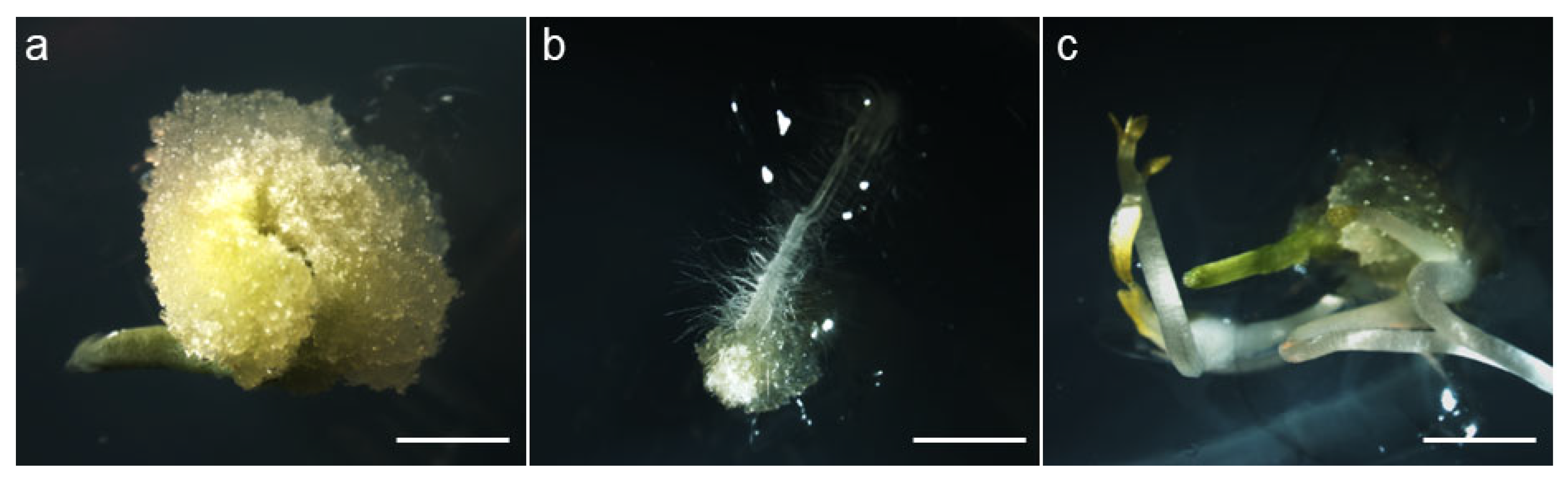
Linaria loeselii is an endemic species found on the eastern coast of the Baltic Sea in Poland, Lithuania, and Latvia [255]. Tissue culture of Linaria loeselii was initiated from seeds after breaking dormancy using gibberellic acid or cold stratification [52]. For ex situ conservation purposes, in vitro cultivated shoot explants were maintained in slow-growth conditions at 5 °C for up to 5 years, utilizing mannitol and sucrose as carbon sources [59]. Additionally, a protocol for micropropagation by indirect organogenesis was developed for Linaria loeselii [256]. Callus induction and shoot multiplication were achieved using MS medium containing BA and NAA (Figure 5). Activated charcoal was employed for short-term storage, and rooting was induced on MS medium supplemented with IAA and paclobutrazol. Functional studies conducted with Linaria loeselii included assessment of salinity tolerance in tissue culture conditions [257].
Figure 5.
Indirect organogenesis in Linaria loeselii cultured on MS medium supplemented with 1 μmol L−1 BA and 1 μmol L−1 NAA (a), 1 μmol L−1 BA and 5 μmol L−1 NAA (b), 5 μmol L−1 BA (c). The culture was established following the method reported in [254]. Photos represent unpublished data from L. Banaszczyk’s collection. All bars indicate 1 mm.
Plantago maritima is an obligate halophyte species. In vitro culture of Plantago maritima was established from seeds [52]. Shoot cultures have been stored for 3 years in slow-growth conditions using sorbitol as the sole carbon source [59]. A micropropagation protocol for the species includes initiating culture from various types of seedling-derived explants and inducing adventitious shoot formation through the induction of IAA and zeatin [258].
3.22. Plumbaginaceae
In the Baltic Sea coastal habitats, only three Plumbaginaceae species (Armeria maritima, Limonium humile, and Limonium vulgare) are found, all exhibiting high coastal specificity (Table 2). A summary of previous research conducted on related taxa within this family is presented in Table S21.
Armeria maritima is also found in inland salt marshes, on roadsides, and as a component of acidic sandy grasslands and metalliferous alpine soils in the rest of Europe [259]. Tissue culture collection for ex situ conservation purposes has been established for coastal accessions of Armeria maritima [52]. A protocol for long-term storage using slow growth at 5 °C has been established, employing 2% sorbitol as the sole carbon source [59]. This protocol enabled the storage of shoot cultures of Armeria maritima in conditions of retarded growth, maintaining good vitality for 3 years. Several studies involving Armeria maritima have demonstrated callus induction followed by organogenesis [260], somatic embryo production [261], and the establishment of cell suspension cultures [262].
A protocol for the aseptically cultivated micropropagation of Armeria maritima seedlings through direct shoot multiplication was established and subsequently utilized for comparative analysis of heavy metal tolerance [263] and salinity tolerance [264] in comparison to soil-grown plants. In contrast to soil-grown plants, which exhibited remarkable tolerance even to elevated levels of cadmium (Cd), copper (Cu), lead (Pb), manganese (Mn), and zinc (Zn) in the substrate, in vitro cultivated shoot explants exhibited high sensitivity to Cd and Cu. This sensitivity was correlated with the extreme accumulation of these metals within explant tissues [263]. Furthermore, in tissue culture, both shoot proliferation and growth exhibited relative sensitivity to salinity, with significant reductions already observed at 100 mM NaCl. Concurrently, increased Na+ accumulation was accompanied by a concomitant decrease in potassium (K+) levels [264]. However, at the whole plant level, even a concentration of 200 mM NaCl demonstrated no detrimental impact on plant growth.
Of the two Limonium species, Limonium humile and Limonium vulgare, found in the coastal habitats of the Baltic Sea, limited tissue culture work has been conducted exclusively with Limonium vulgare [265]. In this study, explants derived from immature inflorescence stems were utilized for a single-step induction of proliferation, shoot elongation, and rooting on a medium containing myo-inositol (mINO), IBA, BA, and GA3. This type of explant has also been employed for the initiation of micropropagation of Limonium cavanillesii [266] and Limonium cordatum [267]. In particular, in the most recent study, efficient micropropagation was achieved without the addition of any growth regulators. While low BA concentration enhanced the shoot proliferation rate, it simultaneously decreased the rooting rate. Conversely, low IBA concentration facilitated root formation but hindered shoot development.
Other protocols for direct organogenesis of Limonium species include the regeneration of shoots from leaf explants of Limonium perigrinum using TDZ [268], somatic embryo induction on leaf explants of Limonium sinensis by BA and NAA [269], and the proliferation of apical explants of Limonium sinuatum by BA and NAA [270]. Furthermore, methods for cryopreservation have been developed for several Limonium species [271,272].
3.23. Polygonaceae
Species belonging to the Polygonaceae family are relatively prevalent in coastal habitats, with 15 species described for the Baltic Sea region [55]. However, only three of these species—Polygonum oxyspermum, Rumex maritimus, and Rumex pseudonatronatus—exhibit relatively high coastal specificity (Table 2). Whereas no information is available on these species from tissue culture studies, information on tissue culture studies conducted with related species is summarized in Table S22.
A micropropagation protocol has been developed for Polygonum maritimum, a coastal-specific medicinal species from other regions [273]. The combination of 3 mg L−1 BA and 0.1 mg L−1 IAA resulted in maximum shoot proliferation, with 100% rooting achieved on a plant growth regulator-free medium. Several other medicinal Polygonum species have been propagated through plant regeneration from callus culture [274] or adventitious shoot induction on nodal stem explants [275,276,277].
Persicaria hydropiper (syn. Polygonum hydropiper) is a typical wetland plant that occasionally occurs in brackish coastal habitats [55]. The species has been introduced in tissue culture using apical explants from mature plants and subsequently propagated by inducing adventitious shoot formation [278,279]. Additionally, callus formation has been induced on leaf and stem explants from mature plants [278].
Rumex pseudonatronatus and Rumex maritimus, the two species of the genus Rumex exhibiting high coastal specificity in the Baltic Sea region [45], lack tissue culture studies. However, several other species within the genus possess medicinal significance [280], and micropropagation protocols are available for several of them [281,282,283]. For Rumex nepalensis, micropropagation techniques include direct organogenesis from mature nodal stem explants using 2-isopentenyladenine and indirect organogenesis through callus formation followed by BA and IBA-induced shoot proliferation [281]. Genetic stability was observed in the direct organogenesis method, while indirect organogenesis resulted in visible somaclonal variation.
A specific approach for micropropagating Rumex hastatus was developed by Singh and Agrawal (2023) [284]. Nodal stem explants from mature plants were cultivated on a plant growth regulator-free medium, leading to root development. These roots were used for callus induction by TDZ. Subsequently, morphogenic callus developed shoot buds during subculturing on the same medium, exhibiting no pronounced elongation. Callus explants with buds were subcultured on a basal medium without growth regulators. Further, shoot explants developed roots in the presence of IBA and were successfully acclimatized ex vitro. Most importantly, the obtained regenerants exhibited genetic identity to the source material.
Several tissue culture experiments have been conducted with Rumex thyrsiflorus, a dioecious plant exhibiting pronounced sexual dimorphism [285,286,287,288]. A specific micropropagation protocol was developed, involving morphogenic callus induction on seedling hypocotyl explants by TDZ. This led to adventitious shoot formation from callus structures and somatic embryos [285].
3.24. Primulaceae
Six species belonging to the Primulaceae family are found in coastal habitats [55]. Only three of these species (Lysimachia maritima, Primula nutans, and Samolus valerandi) exhibit high coastal specificity (Table 2). A comprehensive compilation of in vitro studies conducted with coastal plant species and their associated taxa belonging to this family is presented in Table S23.
Lysimachia maritima (syn. Glaux maritima) is one of the most widespread coastal-specific halophyte species, exhibiting intriguing clonal growth characteristics [78]. The species has been successfully introduced in tissue culture through seeds [52]. Subsequently, a slow-growth protocol has been established for ex situ conservation purposes by employing tissue culture. This protocol involves using 4% sorbitol as the sole carbon source, in conjunction with activated charcoal and BA. This approach has enabled the reduction in proliferation rates and the maintenance of plantlet vitality for three consecutive years at a temperature of 5 °C, without the need for subcultures [59]. The obligate halophytic nature of Lysimachia maritima in tissue culture conditions has been substantiated through the analysis of nodal stem explants [257]. Notably, Lysimachia maritima exhibits a maximum explant height, a number of leaves, and a number of roots in the presence of 100 mM NaCl. However, it is worth noting that an inhibitory effect on these parameters becomes evident at equiosmotic concentrations of polyethylene glycol. In contrast, a study conducted by Pungin et al. (2023) [200] did not observe any positive impact of NaCl on the growth of Lysimachia maritima in tissue culture.
Regarding micropropagation approaches for Lysimachia maritima, both multiplication through nodal segments on a medium containing BA and IAA [289] and regeneration through callus culture [290] have been developed. However, it is worth mentioning that in other studies, a growth regulator-free medium has been employed for the proliferation of apical explants [200,257].
Primula scotica, an endemic Scottish coastal species of Primula, exemplifies the successful application of micropropagation technology for conservation and reintroduction of the genus’s species [291]. Similarly, protocols for in vitro propagation and ex situ conservation have been established for Primula heterochroma [292], Primula farinosa [293], and other species. Recently compiled information on in vitro cultivation of Primula species serves as a valuable resource for the development of further strategies of micropropagation protocols of related taxa [294].
3.25. Ranunculaceae
Species of the Ranunculaceae family are relatively common in coastal habitats, with 15 representatives noted for the Baltic Sea region [55]. However, only two of them (Halerpestes cymbalaria and Ranunculus peltatus) met the specificity criteria for inclusion in this study (Table 2). Previous tissue culture work on related taxa within this family is summarized in Table S24.
Among Ranunculus species, the most research in tissue culture has been conducted on the commercially important ornamental species Ranunculus asiaticus [295]. Mass propagation protocols have been developed for these species, involving both direct organogenesis from axillary bud explants and callus induction on different explant types, followed by initiation of shoot proliferation. Importantly, cold storage (2 °C) at reduced oxygen and carbon dioxide levels was feasible for Ranunculus asiaticus explants during both multiplication and rooting stages [296]. With survival rates approaching 100%, shoot growth was not compromised during storage, and rooting was even stimulated.
Tissue culture protocols for several other species of the genus Ranunculus with medicinal significance have been established [297,298,299,300]. Among the successful approaches employed, micropropagation of Ranunculus illyricus involved organogenic callus induction on stolon explants using picloram and KN, followed by shoot regeneration on a medium containing IBA and BA [300]. The regenerated plants exhibited identical DNA content and exhibited the same developmental pattern as plants propagated by seeds. For Ranunculus sceleratus, direct somatic embryogenesis was achieved on stem, leaf, and root explants by employing a high concentration of NAA (10 mg L−1) [298]. For other species, micropropagation protocols were developed utilizing direct organogenesis on seed-derived (Ranunculus lyallii) [297] or nodal stem explants (Ranunculus wallichianus) [299].
4. Successes and Challenges Identified
4.1. Tissue Cultures and Propagation In Vitro
The primary objective of the present review was to ascertain whether the existing scientific knowledge is adequate to ensure the minimum necessary conservation measures and assess the functional diversity of coastal-specific plant species using tissue cultures. The analysis revealed that tissue culture studies have been conducted on 38 species out of the 112 included in this analysis (Table 3). Consequently, information on tissue culture activities is available for only 34% of Baltic Sea coastal species. However, for the majority of species lacking information on tissue culture studies, data was available on related species within the same genus. Regrettably, there were also individual species exhibiting a high level of coastal specificity that lacked appropriate studies even at the genus level: Blysmus rufus, Bolboschoenus maritimus, Schoenoplectus tabernaemontani, Calamagrostis arenaria, Halimione pedunculata, Halimione portulacoides, Ligusticum scoticum, Oenanthe lachenalii, Cotula coronopifolia, Cochlearia danica, Cochlearia officinalis, Stellaria fennica, Euphrasia bottnica, Odontites litoralis, Hippuris lanceolata, Samolus valerandi, and Halerpestes cymbalaria. Several of these species are important for ecosystem services, including high potential for restoration activities or other practical applications [55]. Therefore, tissue culture studies with species such as Blysmus rufus, Bolboschoenus maritimus, Schoenoplectus tabernaemontani, Halimione spp., Cochlearia spp., Euphrasia spp., and Odontites spp. should receive special attention.
Table 3.
Overview of propagation pathways, explant types, and conservation strategies established for coastal plant families. Data are synthesized from Supplementary Tables S1–S24.
Regarding the tissue culture approaches used, methods involving direct organogenesis would be preferable in the context of preserving genetic diversity. It is well-established that prolonged periods of callus formation can lead to somaclonal variation due to both genetic and epigenetic changes [301]. However, for several families, only indirect organogenesis methods, which involve the initiation of callus cultures, were available, such as Iridaceae, Poaceae, Malvaceae, and Papaveraceae (Table 3).
In addition, for the purpose of true-to-type genotype conservation, the utilization of PGR-free media or media with reduced growth substance content has been recommended in the context of plant biodiversity conservation [302]. This approach effectively mitigates the risk of genetic instability and saves resources. A significant challenge in establishing ex situ tissue culture collections lies in the specific response of certain annual species to tissue culture conditions in PGR-free media. Examples include Phleum arenarium [52], Spergularia marina [52], and Centaurium pulchellum [232], which exhibited flower formation resulting in germinating seeds on explants in tissue culture vessels. However, vegetative propagation was not achievable for these species. Consequently, specialized research is imperative to address this specific issue.
In the context of establishing and maintaining resource-efficient ex situ tissue culture collections of coastal plant species, more research has been conducted on slow-growth systems, but significantly less on cryopreservation. The most recent analysis indicates that both approaches are routinely used for the conservation of plant resources [303]. However, recent technological advancements in cryopreservation have now brought this approach to the forefront. In contrast, the slow-growth approach is less reliant on technical solutions and more based on functional knowledge regarding the most appropriate conditions.
4.2. Long-Term Storage of Tissue Cultures by Slow Growth
Plant tissue culture collections serve as a crucial means of preserving ex situ genetic material. For a substantial number of coastal species, a designated slow-growth protocol has been devised, effectively reducing the resources necessary for maintenance. Notably, certain species have achieved storage periods exceeding five years without recultivation, as exemplified by Linaria loeselii and Trifolium fragiferum [59]. The primary conditions for successful culture preservation include low temperatures and a meticulously selected composition of the culture medium. This composition ensures slow growth and the preservation of viability, facilitating intensive regrowth and multiplication upon storage.
Regarding the culture medium, its significance lies in the utilization of diverse carbohydrates and their combinations. Sugar alcohols, or polyols, particularly mannitol and sorbitol, are commonly employed as the sole source of carbohydrates. Beyond their role as energy and carbon skeleton providers, polyols can function as osmotically active substances, metabolic regulators, or radical scavengers [304,305]. Additionally, activated charcoal and other additives are frequently incorporated to enhance plant vitality and propagation capabilities following storage.
4.3. Long-Term Storage of Tissue Cultures by Cryopreservation
Although it has been previously noted, a comparison of various ex situ conservation approaches has demonstrated that cryopreservation is the most cost-effective and accident-proof method for long-term tissue culture preservation [38]. In contrast, the situation for coastal plant species is significantly more challenging compared to the slow-growth approach for creating and maintaining ex situ collections. Successful design and implementation of cryopreservation protocols have been documented only for a limited number of coastal or taxonomically related species, including Juncus effusus [82], Centaurium rigualii [239], and several Limonium species [271,272]. The widespread adoption of this approach is hindered by several specific biological challenges associated with the characteristics of plant material, particularly for novel taxa. These challenges have been comprehensively analyzed elsewhere [306,307,308]. Only a few of the most pertinent challenges can be highlighted here. Certain plants, particularly wetland species, exhibit increased sensitivity to dehydration. Furthermore, prolonged cryopreservation can potentially induce genetic alterations in plant material. Additionally, some plant species may exhibit sensitivity to specific cryoprotectants employed.
4.4. Functional Studies and Other Applications
In addition to direct conservation efforts such as ex situ collections and restoration of wild populations, tissue culture of coastal plant species can offer additional benefits. Two notable aspects are functional research and practical applications. In both cases, tissue culture material can be utilized directly. Furthermore, micropropagation provides genetically homogeneous material, which can be further employed for diverse scientific experiments and practical applications, particularly in situations involving rare and endangered plant species.
When considering dedicated functional studies with coastal plant species at the tissue culture level, it becomes evident that their number is limited, and the scientific issues they address are rather narrow. Coastal plant species are generally considered halophytic, which explains why most functional studies on species found on the Baltic Sea coast have focused on salt tolerance. Tissue cultures provide a system that enables the examination of tissue-level resistance to chemical factors, including elevated NaCl levels, in contrast to the physiological tolerance mechanisms of the entire plant. Specifically, in relation to the phenomenon of so-called true halophytism, it is possible to determine whether the growth-stimulating effect of NaCl, observed in certain halophyte species, is also present at the level of isolated tissues.
Several compelling reasons justify the in-depth study of coastal plants at the tissue culture level. From a biological perspective, coastal plant species exhibit distinctive physiological and morphological adaptations that enable them to thrive in highly specialized environmental conditions [48]. The expression of these properties can be comprehensively analyzed using isolated tissues. Furthermore, it is feasible to investigate gradual alterations in various abiotic environmental factors by employing isolated plant parts, thereby establishing an ecophysiological model system. Additionally, the effects of xenobiotic agents and other environmental pollutants can be scrutinized at the tissue culture level, providing a functional foundation for practical applications of these taxa, such as in phytoremediation systems [309]. The primary advantage of such a system lies in the inherent nature of plant tissue culture as a system of plant cultivation characterized by exceptionally controlled conditions. This enables resource-efficient and precisely targeted experiments at the cellular, tissue, and organ levels.
In the context of salinity studies, tissue culture techniques were employed to identify and characterize plant cell cultures exhibiting tolerance to elevated salt concentration within the medium, with whole-plant regeneration as a breeding strategy for salt-tolerant crops [310,311]. These methods included both mutant cell line selection and regeneration of somaclones, as well as in vitro screening of genetic material for the selection of tolerant crop varieties. Mechanistic studies involving halophytic species under tissue culture conditions are relatively limited in number [176,177,312]. The existing knowledge gaps are attributed to the absence of standardized model systems for halophytic plant species. In addition, halophytes use diverse, intricate adaptation strategies to cope with conditions of high substrate salinity.
From a physiological standpoint, it is crucial to comprehend that certain traits, particularly those pertaining to resistance to soil chemical factors, may manifest differently at the whole plant level compared to the level of isolated tissues and cells. For instance, inherent resistance to chemicals can be provided at the cellular level through cellular sequestration, enzymatic antioxidative systems, and osmotic protection, as exemplified in the case of salinity tolerance [313,314]. Furthermore, at the whole plant level, tolerance entails coordination across various levels of organization, involving hormonal signaling, long-distance interorgan substance transport, and organ- or tissue-specific sequestration/detoxification. Consequently, a more promising approach involves combining tissue culture-based experiments with whole-plant studies. This synergy enables the distinction between cellular mechanisms of tolerance, including antioxidative protection, osmotic balance restoration, vacuolar ion/metal sequestration, and the acquisition of mineral nutrients, and whole-plant mechanisms, such as ion and metal sequestration between organs, long-distance transport facilitation, and root mineral nutrient acquisition.
One of the initial questions posed in the present study was whether coastal-specific plant species necessitate specific conditions during tissue culture. Considering the analysis of tissue culture studies of halophytic species, it was assumed that elevated salinity in the medium is not indispensable for explant propagation [49]. The detailed analysis conducted revealed that increased medium salinity manifests two distinct types of effects on coastal halophytic plant tissue cultures [25,119,121,122,124,165,257,264]. Firstly, the capacity for vegetative propagation is typically negatively affected by increasing salinity levels. Secondly, relatively low salinity in the medium can have a positive effect on growth rate, biomass, and tissue water content, albeit with a high degree of dependence on other cultivation conditions.
Several coastal plant species were indeed found to exhibit growth stimulation by the presence of NaCl in the culture medium. These include Suaeda maritima and Salicornia europaea [111], Tripolium pannonicum [166], Lysimachia maritima [257], and Mertensia maritima [25]. However, for other species whose whole plants exhibited resistance even to high salt concentrations, tissue cultivation under elevated salinity conditions proved to be quite inhibitory. These include Armeria maritima [264] and Honckenya peploides [191].
However, certain studies have demonstrated that elevated NaCl levels can yield positive results regarding propagation. For instance, in the case of extreme halophytic species Salicornia brachiata, the addition of 250 to 500 mM NaCl stimulated micropropagation, but with a PGR-dependent effect [122]. Furthermore, in vitro regeneration of Salicornia europaea from callus cultures in the presence of TDZ exhibited an increase from 27.6 to 55.2% when 170 mol L−1 NaCl was added [120]. The chemical composition of the substances that constitute salinity may also play a role, as MgCl2 demonstrated a positive effect on rooting of Salicornia brachiata explants that was not achieved by NaCl [121]. Consequently, further comprehensive studies would be necessary to establish whether the positive effect of salt is specific to Salicornia species and to elucidate the underlying mechanisms.
Another type of functional study involving coastal species in tissue culture model systems focused on tolerance to and accumulation of heavy metals. Different accessions of Armeria maritima, which demonstrated relatively high tolerance to heavy metals in vegetation container studies conducted under controlled conditions, exhibited pronounced sensitivity to cadmium (Cd) and copper (Cu) in tissue culture settings [263]. This sensitivity was associated with extreme accumulation of these metals in tissues. Additionally, heavy metal tolerance studies have been conducted on various ecotypes of Alyssum montanum [171,173].
Plant tissue cultures hold significant potential for investigating ecologically relevant inter-organism relationships. Previous research has focused on the formation and function of mycorrhizal symbiosis [315] and plant–pathogen interactions [316] in in vitro cultures. However, research on coastal-specific plant species has not yet been conducted in this area. A promising and unexplored topic within the context of coastal ecosystem functioning is the interaction between plants and parasitic plants. This interaction could play a crucial role in maintaining biodiversity [250]. Root cultures, or hairy root cultures, of potential host plants enable the development of parasitic relationships in model systems by introducing propagules of parasitic plants. Additionally, establishing root cultures of parasitic plants themselves represents a significant challenge. To date, this has only been feasible for a limited number of obligate parasites, such as Striga [317], and hemiparasitic species, including Triphysarria versicolor [318].
From a practical standpoint, numerous coastal plant species hold significant interest for the pharmaceutical and food industries [319]. In particular, the coastal beach and dune species Eryngium maritimum has gained particular attention for developing tissue culture methods for the production of biologically active compounds with pharmacological and cosmetic importance [21,22,139,140]. Tissue cultures of species of genus Artemisia, especially coastal wetland species Artemisia maritima, arouse interest as a source of pharmacologically active substances, in particular, antimalarial compound artemisinin [143,144,320,321,322]. Other examples of interest in production of bioactive compounds include Conium maculatum [138], Pulicaria dysenterica [155], Mertensia maritima [169], Isatis tinctoria [184,185], Ononis spinosa [225], Centaurium pulchellum [231], and Glaucium flavum [253,254].
Moreover, several of these species possess potential applications in habitat restoration, environmental technologies, and ornamental horticulture [323,324,325]. These aspects of Baltic Sea coastal plants have been comprehensively analyzed elsewhere [55]. Therefore, practically oriented functional biotechnology research is of particular importance in the context of coastal plants.
4.5. Aspects of Genetic Diversity
Genetic alterations that occur during the in vitro cultivation of plant tissues, known as somaclonal variation, are generally considered detrimental [326]. Somaclonal variation can manifest as both genetic and heritable, or epigenetic and non-heritable, depending on the underlying mechanism [301]. This phenomenon holds significant importance in plant micropropagation, where the attainment of genetic homogeneity with source plants is paramount. Consequently, in plant culture technologies employed for rare and protected species, methods that minimize somaclonal variation are preferred.
Within the context of the present review, instances of genetic changes have been observed in several target species. These changes were induced through plant regeneration from callus cultures [94,103,281] or prolonged exposure to high concentrations of PGRs [244].
However, targeted induction of somaclonal changes can also be strategically employed in nature conservation and restoration initiatives. Restoration of native habitats utilizing plant material with limited genetic diversity may lead to reduced viability of established populations. Consequently, induction of genetic variability is proposed as a more sustainable alternative. The occurrence of somaclonal variation in tissue culture-regenerated salt marsh species, including Juncus gerardii, has been extensively discussed [64].
In the context of ecological considerations regarding the utilization of tissue culture-propagated plant material in habitat restoration, certain concerns persist. For instance, vegetative propagation in comparison to seed propagation uses fewer genotypes. However, ensuring a sufficiently high number of unrelated plant genotypes is crucial to preserve relatively high allelic diversity [327]. While data on coastal plant species is limited, suitable levels for a clone mixture in woody plants may range from approximately 6 (minimum) to 18 (optimum) clones [328]. Furthermore, long-term research on reintroduced micropropagated coastal plants is severely constrained, primarily focusing on handling plantlets up to the acclimatization stage. In the case of woody plants, ongoing research in Punkaharju research forests in Finland involves the prolonged growth of micropropagated conifers [329].
It can be concluded that, in the context of ex situ conservation, the preservation of precise genetic identity and homogeneity is a fundamental principle. Taking into account the intraspecific genetic diversity and the existence of ecotypes, it is imperative to maintain material from individual populations in the form of separate tissue cultures. However, restoring natural populations necessitates a detailed analysis of the situation, preferably employing molecular genetic methods. The established population must possess sufficient genetic diversity to ensure its resilience and natural regeneration. Consequently, in instances where an ex situ collection is founded solely on a limited number of generatively propagated specimens, it may be necessary to increase the genetic diversity of the source material, which will be utilized in habitat restoration, in a targeted and controlled manner. As a result, the adaptability and survival capacity of the plant material obtained through the mass micropropagation process in natural conditions can be assured.
4.6. Importance of Technological Advances
The adoption of novel cultivation systems in lieu of conventional agar-based media presents a highly promising direction for tissue culture research, particularly with regard to coastal plant conservation. The utilization of a temporary immersion liquid culture bioreactor system (TIBS) presents several advantages over conventional systems employing agar-solidified media, including enhanced multiplication rates and improved vigor of produced explants [330,331]. Several researchers have reported enhanced stomatal functionality in plants propagated in TIBS compared to those propagated on agar-solidified medium; this phenomenon contributes to higher acclimatization rates and improved survival in ex vitro conditions [332,333].
In the present review, the use of TIBS for micropropagation of Sagittaria sagittifolia has been demonstrated to significantly enhance the multiplication rate compared to conventional methods [57]. Similarly, Tripolium pannonicum has exhibited increased multiplication potential and larger explants when propagated using TIBS [165]. Furthermore, TIBS has been employed for Mertensia maritima propagation, resulting in improved survival rates and increased biomass [25,167]. Nevertheless, there are also problematic aspects to using TIBS, such as hyperhydricity [334] and the low genotype specificity of the effects [335].
5. Conclusions
The performed analysis revealed that tissue culture studies have been conducted with 38 coastal-specific species of the Baltic Sea region, which represents only 34% of the initially identified target species. While studies of other species within the same genus are available for a significant proportion of species with missing information, there are several species for which even such information is not available (Blysmus rufus, Bolboschoenus maritimus, Schoenoplectus tabernaemontani, Calamagrostis arenaria, Halimione pedunculata, Halimione portulacoides, Ligusticum scoticum, Oenanthe lachenalii, Cotula coronopifolia, Cochlearia danica, Cochlearia officinalis, Stellaria fennica, Euphrasia bottnica, Odontites litoralis, Hippuris lanceolata, Samolus valerandi, Halerpestes cymbalaria). In the field of tissue culture propagation protocol development, special attention should be given to several highly coastal-specific species with significance for ecosystem services, such as Blysmus rufus, Bolboschoenus maritimus, Schoenoplectus tabernaemontani, Halimione spp., Cochlearia spp., Euphrasia spp., and Odontites spp. For several families (Iridaceae, Poaceae, Malvaceae, Papaveraceae), only methods of indirect organogenesis were employed, which can result in somaclonal variation. Consequently, it is imperative to develop direct organogenesis methods that minimize the use of plant growth regulators. Vegetative propagation has not been accomplished for a number of annual species (Phleum arenarium, Spergularia marina, Centaurium pulchellum), which completed the generative cycle under in vitro conditions but did not show organogenesis. While efficient protocols have been established for long-term tissue culture storage of numerous coastal species, suitable cryopreservation protocols have only been developed for a limited number of species. Despite the limited number of functional studies on coastal plants in tissue culture, highly controlled experiments can be conducted to analyze physiological and morphological adaptations, investigate effect of environmental factors, and study the effects of pollutants. Tissue cultures of coastal plants possess significant potential for investigating ecologically relevant inter-organism relationships. Research on inter-organism interactions essential for the functioning of coastal ecosystems, such as mycorrhizal symbiosis, plant–pathogen interactions, and interactions between plants and parasitic plants, should be prioritized. From a practical standpoint, several coastal species (Eryngium maritimum, Artemisia maritima, Conium maculatum, Pulicaria dysenterica, Mertensia maritima, Isatis tinctoria, Ononis spinosa, Centaurium pulchellum, Glacium flavum) exhibit substantial biotechnological potential as sources of biologically active substances. The adoption of novel cultivation approaches, such as the use of temporary immersion liquid culture bioreactor systems, offers promising perspectives in micropropagation and ex vitro acclimatization, with potential significance for coastal plant conservation. To date, in vitro collections of coastal species have been established on a local scale. However, their scientific and practical significance could be substantially enhanced by creating collections that encompass a broader diversity.
Supplementary Materials
The following supporting information can be downloaded at: https://www.mdpi.com/article/10.3390/conservation5040080/s1, Table S1: Tissue culture experiments with coastal species of Alismataceae from the Baltic Sea region and related taxa; Table S2: Tissue culture experiments with coastal species of Cyperaceae from the Baltic Sea region and related taxa; Table S3: Tissue culture experiments with coastal species of Iridaceae from the Baltic Sea region and related taxa; Table S4: Tissue culture experiments with coastal species of Juncaceae from the Baltic Sea region and related taxa; Table S5: Tissue culture experiments with coastal species of Juncaginaceae from the Baltic Sea region and related taxa; Table S6: Tissue culture experiments with coastal species of Poaceae from the Baltic Sea region and related taxa; Table S7: Tissue culture experiments with coastal species of Amaranthaceae from the Baltic Sea region and related taxa; Table S8: Tissue culture experiments with coastal species of Apiaceae from the Baltic Sea region and related taxa; Table S9: Tissue culture experiments with coastal species of Asteraceae from the Baltic Sea region and related taxa; Table S10: Tissue culture experiments with coastal species of Boraginaceae from the Baltic Sea region and related taxa; Table S11: Tissue culture experiments with coastal species of Brassicaceae from the Baltic Sea region and related taxa; Table S12: Tissue culture experiments with coastal species of Caryophyllaceae from the Baltic Sea region and related taxa; Table S13: Tissue culture experiments with coastal species of Crassulaceae from the Baltic Sea region and related taxa; Table S14: Tissue culture experiments with coastal species of Euphorbiaceae from the Baltic Sea region and related taxa; Table S15: Tissue culture experiments with coastal species of Fabaceae from the Baltic Sea region and related taxa; Table S16: Tissue culture experiments with coastal species of Gentianaceae from the Baltic Sea region and related taxa; Table S17: Tissue culture experiments with coastal species of Lamiaceae from the Baltic Sea region and related taxa; Table S18: Tissue culture experiments with coastal species of Malvaceae from the Baltic Sea region and related taxa; Table S19: Tissue culture experiments with coastal species of Papaveraceae from the Baltic Sea region and related taxa; Table S20: Tissue culture experiments with coastal species of Plantaginaceae from the Baltic Sea region and related taxa; Table S21: Tissue culture experiments with coastal species of Plumbaginaceae from the Baltic Sea region and related taxa; Table S22: Tissue culture experiments with coastal species of Polygonaceae from the Baltic Sea region and related taxa; Table S23: Tissue culture experiments with coastal species of Primulaceae from the Baltic Sea region and related taxa; Table S24: Tissue culture experiments with coastal species of Ranunculaceae from the Baltic Sea region and related taxa.
Author Contributions
Conceptualization, G.I.; writing—original draft preparation, L.P.-T., L.B. and G.I.; writing—review and editing, L.P.-T., L.B. and G.I. All authors have read and agreed to the published version of the manuscript.
Funding
This research received no external funding.
Institutional Review Board Statement
Not applicable.
Informed Consent Statement
Not applicable.
Data Availability Statement
All data generated during this study are included in this paper and its Supplementary Files.
Acknowledgments
During the preparation of this manuscript, the authors used Apple Intelligence Writing tools (macOS Sequoia 15.7.1) for the purposes of proofreading. The authors have reviewed and edited the output and take full responsibility for the content of this publication.
Conflicts of Interest
The authors declare no conflicts of interest. The funders had no role in the design of the study; in the collection, analyses, or interpretation of data; in the writing of the manuscript; or in the decision to publish the results.
Abbreviations
The following abbreviations are used in this manuscript:
| 2,4D | 2,4-Dichlorophenoxyacetic acid |
| BA | 6-Benzylaminopurine/6-benzyladenine |
| GA3 | Gibberellic acid |
| IAA | Indole-3-acetic acid |
| IBA | Indole-3-butyric acid |
| IPA | Indole-3-propionic acid |
| KN | Kinetin |
| LN | Liquid nitrogen |
| mINO | myo-Inositol |
| MS | Murashige & Skoog |
| NAA | Naphthaleene-3-acetic acid |
| PGRs | Plant growth regulators |
| TDZ | Thidiazuron |
| TIBS | Temporary immersion bioreactor system |
References
- CBD (Convention on Biological Diversity). Decision Adopted by the Conference of the Parties to the Convention on Biological Diversity on 1 November 2024. UN Environment Programme, CBD/CP/DEC/16/20. Available online: https://www.cbd.int/doc/decisions/cop-16/cop-16-dec-20-en.pdf (accessed on 10 October 2025).
- Pence, V.C. Evaluating costs for the in vitro propagation and preservation of endangered plants. In Vitro Cell. Dev. Biol. Plant 2011, 47, 176–187. [Google Scholar] [CrossRef]
- Jain, S.M.; Nakhooda, M. Clonal and micropropagation. In Encyclopedia of Applied Plant Sciences; Breeding Genetic and Biotechnology; Thomas, B., Murphy, D.J., Murray, B.G., Eds.; Elsevier Academic Press: Cambridge, MA, USA, 2017; Volume 2, pp. 428–432. [Google Scholar]
- Pence, V.C. In vitro methods and the challenge of exceptional species for Target 8 of the Global Strategy for Plant Conservation. Ann. Mo. Bot. Gard. 2013, 99, 214–220. [Google Scholar] [CrossRef]
- Skarpaas, O.; Stabbetrop, O.E. Diaspore ecology of Mertensia maritima: Effects of physical treatments and their relative timing on dispersal and germination. OIKOS 2001, 95, 374–382. [Google Scholar] [CrossRef]
- Lah, N.H.C.; El Enshasy, H.A.; Mediani, A.; Azizan, K.A.; Aizat, W.M.; Tan, J.K.; Afzan, A.; Noor, N.M.; Rohani, E.R. An insight into the behaviour of recalcitrant seeds by understanding their molecular changes upon desiccation and low temperature. Agronomy 2023, 13, 2099. [Google Scholar] [CrossRef]
- Banaszczyk, L.; Starke, M.; Szelbracikowski, D.; Kapusta, M. Kultury in vitro w ochronie gatunków cennych dla bioróżnorodności. Alcumena 2023, 2, 73–83. [Google Scholar]
- Wang, D.; Su, P.; Gao, Y.; Chen, X.; Kan, W.; Hou, J.; Wu, L. Efficient plant regeneration through direct shoot organogenesis and two-step rooting in Eucommia ulmoides Oliver. Front. Plant Sci. 2024, 15, 1444878. [Google Scholar] [CrossRef]
- Bhatia, S. Application of plant biotechnology. In Modern Applications of Plant Biotechnology in Pharmaceutical Sciences; Bhatia, S., Dahiya, R., Sharma, K., Bera, T., Eds.; Elsevier: Amsterdam, The Netherlands, 2015; pp. 157–207. [Google Scholar]
- Taha, R.A.; Allam, M.A.; Hassan, S.A.M.; Bakr, B.M.M.; Hassan, M.M. Thidiazuron-induced direct organogenesis from immature inflorescence of three date palm cultivars. J. Genet. Eng. Biotechnol. 2021, 19, 14. [Google Scholar] [CrossRef] [PubMed]
- Fehér, A. Somatic embryogenesis—Stress-induced remodeling of plant cell fate. Biochim. Biophys. Acta 2015, 1849, 385–402. [Google Scholar] [CrossRef] [PubMed]
- García-Hernández, E.; Loera-Quezada, M.M.; Morán-Velázquez, D.C.; López, M.G.; Chable-Vega, M.A.; Santillán-Fernández, A.; Zavaleta-Mancera, H.A.; Tang, J.Z.; Azadi, P.; Ibarra-Laclette, E.; et al. Indirect organogenesis for high frequency shoot regeneration of two cultivars of Sansevieria trifasciata Prain differing in fiber production. Sci. Rep. 2022, 12, 8507. [Google Scholar] [CrossRef] [PubMed]
- Mosoh, D.A.; Khandel, A.K.; Verma, S.K.; Vendrame, W.A. Optimizing callus induction and indirect organogenesis in non-dormant corm explants of Gloriosa superba (L.) via media priming. Front. Hortic. 2024, 3, 1378098. [Google Scholar] [CrossRef]
- Majumder, S.; Igamberdiev, A.U.; Debnath, S.C. Somaclonal variation and clonal fidelity in commercial micropropagation: Challenges and perspectives. Agronomy 2025, 15, 1489. [Google Scholar] [CrossRef]
- Long, Y.; Yang, Y.; Pan, G.; Shen, Y. New insights into tissue culture plant-regeneration mechanisms. Front. Plant Sci. 2022, 13, 926752. [Google Scholar] [CrossRef] [PubMed]
- Liu, Y.; Zhan, Y.; Fu, Q.; Li, S.; Sun, X.; Wang, Y.; Yu, M.; Qin, D.; Huo, J.; Zhu, C. Plant regeneration via somatic embryogenesis and indirect organogenesis in blue honeysuckle (Lonicera caerulea L.). Horticulturae 2023, 9, 996. [Google Scholar] [CrossRef]
- de Sousa, P.C.A.; e Souza, S.S.S.; Nogueira, G.F.; de Araújo Silva-Cardoso, I.M.; Scherwinski-Pereira, J.E. Indirect somatic embryogenesis of Piper hispidinervum L. and evaluation of the regenerated plants by flow cytometry. J. Genet. Eng. Biotechnol. 2022, 20, 40. [Google Scholar] [CrossRef] [PubMed]
- Ahmed, M.W.A.-M. An efficient protocol for indirect somatic embryogenesis and shoot organogenesis from leaf segments of date palm (Phoenix dactylifera L.) cv. Quntar. Afr. J. Agric. Res. 2015, 10, 1031–1042. [Google Scholar] [CrossRef]
- Pulianmackal, A.J.; Kareem, A.V.K.; Durgaprasad, K.; Trivedi, Z.B.; Prasad, K. Competence and regulatory interactions during regeneration in plants. Front. Plant Sci. 2014, 5, 142. [Google Scholar] [CrossRef]
- Belaizi, M.; Paul, H.; Sangwan, R.S.; Sangwan-Norreel, B.S. Direct organogenesis from internodal segments of in vitro grown shoots of apple cv. Golden delicious. Plant Cell Rep. 1991, 9, 471–474. [Google Scholar] [CrossRef]
- Mežaka, I.; Kļaviņa, D.; Kaļāne, L.; Kronberga, A. Large-scale in vitro propagation and ex vitro adaptation of the endangered medicinal plant Eryngium maritimum L. Horticulturae 2023, 9, 271. [Google Scholar] [CrossRef]
- Nakurte, I.; Berga, M.; Mežaka, I. Phytochemical diversity comparison in leaves and roots of wild and micropropagated Latvian sea holly (Eryngium maritimum L.). Molecules 2023, 28, 3924. [Google Scholar] [CrossRef]
- Arya, S.S.; Rookes, J.E.; Cahill, D.M.; Lenka, S.K. Next-generation metabolic engineering approaches towards development of plant cell suspension cultures as specialized metabolite producing biofactories. Biotechnol. Adv. 2020, 45, 107635. [Google Scholar] [CrossRef]
- Wijerathna-Yapa, A.; Hiti-Bandaralage, J. Tissue culture—A sustainable approach to explore plant stresses. Life 2023, 13, 780. [Google Scholar] [CrossRef]
- Purmale, L.; Osvalde, A.; Karlsons, A.; Ievinsh, G. Comparison of two subspecies of a halophytic multi-use plant Mertensia maritima in vitro and ex vitro: Propagation, salinity tolerance and mineral nutrition. Environ. Exp. Biol. 2024, 22, 29–40. [Google Scholar] [CrossRef]
- Wochok, Z.S. The role of tissue culture in preserving threatened and endangered plant species. Biol. Conserv. 1981, 20, 83–89. [Google Scholar] [CrossRef]
- Fay, M.F. Conservation of rare and endangered plants using in vitro methods. In Vitro Cell. Dev. Biol. Plant 1992, 28, 1–4. [Google Scholar] [CrossRef]
- Fay, M.F. In what situations is in vitro culture appropriate to plant conservations? Biodivers. Conserv. 1994, 3, 176–183. [Google Scholar] [CrossRef]
- Johnson, K.A. In vitro conservation including rare and endangered plants, heritage plants and important agricultural plants. In The Importance of Tissue Culture and Biotechnology in Plant Sciences; Taji, A., Williams, R., Eds.; University of New England Publications Unit: Amidale, Australia, 2002; pp. 79–90. [Google Scholar]
- Sarasan, V.; Cripps, R.; Ramsay, M.M.; Atherton, C.; McMichen, M.; Prendergast, G.; Rowntree, J.K. Conservation in vitro of threatened plants—Progress in the past decade. In Vitro Cell. Dev. Biol. Plant 2006, 42, 206–214. [Google Scholar] [CrossRef]
- Engelmann, F. Use of biotechnologies for the conservation of plant biodiversity. In Vitro Cell. Dev. Biol. Plant 2011, 47, 5–16. [Google Scholar] [CrossRef]
- Pence, V.C. The possibilities and challenges of in vitro methods for plant conservation. Kew Bull. 2010, 65, 539–547. [Google Scholar] [CrossRef]
- Pathak, M.R.; Abido, M.S. The role of biotechnology in the conservation of biodiversity. J. Exp. Biol. Agric. Sci. 2014, 2, 352–363. [Google Scholar]
- Shahzad, A.; Parveen, S.; Sharma, S.; Shaheen, A.; Saeed, T.; Yadav, V.; Akhtar, R.; Ahmad, Z.; Upadhay, A. Plant tissue culture: Applications in plant improvement and conservation. In Plant Biotechnology: Principles and Applications; Abdin, M.Z., Kiran, U., Kamaluddin, A.A., Eds.; Springer Nature Singapore: Singapore, 2017; pp. 37–72. [Google Scholar]
- Oseni, O.M.; Pande, V.; Nailwal, T.K. A review on plant tissue culture, a technique for propagation and conservation of endangered plant species. Int. J. Curr. Microbiol. Appl. Sci. 2018, 7, 3778–3786. [Google Scholar] [CrossRef]
- Thakur, J.; Abbas, N.S.; Bhardwaj, S.; Kaula, B.C. Biotechnological tools in the propagation and conservation of threatened species: An overview. Indian J. Biotechnol. 2021, 20, 217–235. [Google Scholar]
- Ruikar, S.S.; Pathade, A.G.; Ghatage, A.A. The role of plant tissue culture in ex situ conservation of biodiversity. Nat. Camp. 2024, 28, 206–211. [Google Scholar]
- Cruz-Cruz, C.A.; González-Arnao, M.T.; Engelmann, F. Biotechnology and conservation of plant biodiversity. Resources 2013, 2, 73–95. [Google Scholar] [CrossRef]
- Coelho, N.; Gonçalves, S.; Romano, A. Endemic plant species conservation: Biotechnological approaches. Plants 2020, 9, 345. [Google Scholar] [CrossRef]
- Chauhan, R.; Singh, V.; Quraishi, A. In vitro conservation through slow-growth storage. In Synthetic Seeds; Faisal., M., Alatar, A.A., Eds.; Springer Nature Switzerland AG: Cham, Switzerland, 2019; pp. 397–416. [Google Scholar]
- Kulak, V.; Longboat, S.; Brunet, N.D.; Shukla, M.; Saxena, P. In vitro technology in plant conservation: Relevance to biocultural diversity. Plants 2022, 11, 503. [Google Scholar] [CrossRef]
- González-Benito, M.E.; Martin, C. In vitro preservation of Spanish biodiversity. In Vitro Cell. Dev. Biol. Plant 2011, 47, 46–54. [Google Scholar] [CrossRef]
- Radomir, A.-M.; Stan, R.; Florea, A.; Ciobotea, C.-M.; Bănuță, F.M.; Negru, M.; Neblea, M.A.; Sumedrea, D.I. Overview of the success of in vitro culture for ex situ conservation and sustainable utilization of endemic and subendemic native plants of Romania. Sustainability 2023, 15, 2581. [Google Scholar] [CrossRef]
- Sankararamasubramanian, H.M.; Selvam, V.; Parida, A. Biotechnological tools for the conservation and enhancement of coastal ecosystem. Proc. Natl. Acad. Sci. India Sect. B Biol. Sci. 2012, 82, 357–362. [Google Scholar] [CrossRef]
- Tyler, T.; Herbertsson, L.; Olofsson, J.; Olsson, P.A. Ecological indicator and traits values for Swedish vascular plants. Ecol. Indic. 2021, 120, 106923. [Google Scholar] [CrossRef]
- Bona, C.; Moryel Pellanda, R.; Bergmann Carlucci, M.; Giese de Paula Machado, R.; Ciccarelli, D. Functional traits reveal coastal vegetation assembly patterns in a short edaphic gradient in southern Brazil. Flora 2020, 271, 151661. [Google Scholar] [CrossRef]
- Ciccarelli, D.; Bona, C. Exploring the functional strategies adopted by coastal plants along an ecological gradient using morpho-functional traits. Estuaries Coasts 2022, 45, 114–129. [Google Scholar] [CrossRef]
- Ievinsh, G. Biological basis of biological diversity: Physiological adaptations of plants to heterogeneous habitats along a sea coast. Acta Univ. Latv. 2006, 710, 53–79. [Google Scholar]
- Custódio, L.; Charles, G.; Magné, C.; Barba-Espín, G.; Piqueras, A.; Hernández, J.A.; Hamed, K.B.; Castañeda-Loaiza, V.; Fernandes, E.; Rodrigues, M.J. Application of in vitro plant tissue culture techniques to halophyte species: A review. Plants 2023, 12, 126. [Google Scholar] [CrossRef] [PubMed]
- van der Maarel, E.; van der Maarel-Versluys, M. Distribution and conservation status of littoral vascular plant species along the European coasts. J. Coast. Conserv. 1996, 2, 73–92. [Google Scholar] [CrossRef]
- Zhou, C.-F.; Qin, P.; Xie, M. Vegetating coastal areas of east China: Species selection, seedling cloning and transplantation. Ecol. Eng. 2003, 20, 275–286. [Google Scholar] [CrossRef]
- Kļaviņa, D.; Gailīte, A.; Ievinsh, G. Initial responses of explants from rare and endangered coastal plant species during initiation of tissue culture. Acta Univ. Latv. 2006, 710, 81–91. [Google Scholar]
- Panayotova, L.G.; Ivanova, T.A.; Bogdanova, Y.Y.; Gussev, C.V.; Stanilova, M.I.; Bosseva, Y.Z.; Stoeva, T.D. In vitro cultivation of plant species from sandy dunes along the Bulgarian Black Sea coast. Phytol. Balcan. 2008, 14, 119–123. [Google Scholar]
- Romano, G.; Ricci, G.F.; Leronni, V.; Venerito, P.; Gentile, F. Soil bioengineering techniques for Mediterranean coastal dune restoration using autochthonous vegetation species. J. Coast. Conserv. 2022, 26, 71. [Google Scholar] [CrossRef]
- Ievinsh, G. Creating a conceptual framework for analysis of vascular plant diversity in a coastal landscape: Functional aspects and ecosystem services for plants at the Baltic Sea. Environ. Exp. Biol. 2024, 22, 201–244. [Google Scholar] [CrossRef]
- Chytrý, M.; Tichý, L.; Hennekens, S.M.; Knollová, I.; Janssen, J.A.M.; Rodwell, J.S.; Peterka, T.; Marcenò, C.; Landucci, F.; Danihelka, J.; et al. EUNIS Habitat Classification: Expert system, characteristic species combinations and distribution maps of European habitats. Appl. Veg. Sci. 2020, 23, 648–675. [Google Scholar] [CrossRef]
- Gao, M.; Lin, Z.; Luo, C.; Chi, Z.; Mo, Z.; He, F.; Jiang, W.; Chen, L.; He, X.; Wei, S. High efficiency of propagation for Sagittaria sagittifolia using a temporary immersion bioreactor system. J. Agric. Sci. Technol. A 2016, 6, 161–170. [Google Scholar] [CrossRef]
- Kane, M.E.; Philman, N.L.; Emshousen, C. Wetland plant propagation: Comparative growth and reproduction of micropropagated Sagittaria latifolia ecotypes. In Combined Proceedings of the International Plant Propagators’ Society; International Plant Propagators’ Society: Bellefonte, PA, USA, 2002; Volume 52, pp. 43–459. [Google Scholar]
- Kļaviņa, D.; Kļaviņa, D. Ex situ conservation of endangered plant species of Latvia by slow growth storage. Environ. Exp. Biol. 2018, 16, 129–138. [Google Scholar] [CrossRef]
- Rogers, S.M.D. Tissue culture and wetland establishment of the freshwater monocots Carex, Juncus, Scirpus, and Typha. In Vitro Cell. Dev. Biol. Plant 2003, 39, 1–5. [Google Scholar] [CrossRef]
- Banaszczyk, L.; Kapusta, M.; Rojek, J.; Kozieradzka-Kiszkurno, M. Effective germination strategies for the coastal dune pioneer Carex arenaria L. Plant Cell Tissue Organ Cult. 2025, 160, 22. [Google Scholar] [CrossRef]
- Czakó, M.; Feng, X.; He, Y.; Liang, D.; Márton, L. Genetic modification of wetland grasses for phytoremediation. Z. Für Naturforsch. 2005, 60, 285–291. [Google Scholar] [CrossRef]
- Gao, M.; Jiang, W.; Wei, S.; Lin, Z.; Cai, B.; Yang, L.; Luo, C.; He, X.; Tan, J.; Chen, L. High efficiency propagation of Chinese water chestnut [Eleocharis dulcis (Burm.f.) Trin ex Hensch] using a temporary immersion bioreactor system. Plant Cell Tissue Organ Cult. 2015, 121, 761–772. [Google Scholar] [CrossRef]
- Wang, J.; Seliskar, D.M.; Gallagher, J.L. Growth of tissue culture-regenerated salt marsh monocots in a simulated marsh field plot: Implication for wetland creation and restoration. Ecol. Eng. 2007, 29, 8–16. [Google Scholar] [CrossRef]
- Rossetto, M.; Dixon, K.W.; Meney, K.A.; Bunn, E. In vitro propagation of Chinese Puzzle (Caustis dioica Cyperaceae)—A commercial sedge species from Western Australia. Plant Cell Tissue Organ Cult. 1992, 30, 65–67. [Google Scholar] [CrossRef]
- Panaia, M.; Bunn, E.; McComb, J. Primary and repetitive secondary somatic embryogenesis of Lepidosperma drummondii (Cyperaceae) and Baloskion tetraphyllum (Restionaceae) for land restoration and horticulture. In Vitro Cell. Dev. Biol. Plant 2011, 47, 379–386. [Google Scholar] [CrossRef]
- Rewers, M.; Kisiala, A.; Drouin, J.; Sliwinska, E.; Cholewa, E. In vitro-regenerated wetland sedge Eriophorum vaginatum L. is genetically stable. Acta Physiol. Plant. 2012, 34, 2197–2206. [Google Scholar] [CrossRef]
- Kodym, A.; Clarke, I.; Aponte, C.; Turner, S.; Bunn, E.; Delpratt, J. Large-scale micropropagation of the Australian key species Gahnia radula (Cyperaceae) and its return to revegetation sites. Aust. J. Bot. 2014, 62, 417–427. [Google Scholar] [CrossRef]
- Lai, S.; Menon, A.; Turner, S.; Kodym, A.; Bunn, E. Development of an in vitro protocol for a difficult-to-propagate endemic Australian dryland sedge species Mesomelaena pseudostygia (Cyperaceae). In Vitro Cell. Dev. Biol. Plant 2014, 50, 99–109. [Google Scholar] [CrossRef]
- Ascough, G.D.; Erwin, J.E.; van Staden, J. Micropropagation of Iridaceae—A review. Plant Cell Tissue Organ Cult. 2009, 97, 1–19. [Google Scholar] [CrossRef]
- Jevremović, S.; Jeknić, Z.; Subotić, A. Micropropagation of Iris sp. In Protocols for Micropropagation of Selected Economically-Important Horticultural Plants; Lombardi, M., Ed.; Springer Science & Business Media: New York, NY, USA, 2013; pp. 291–303. [Google Scholar]
- Tikhomirova, L.I. Scientific framework for selecting explants of Iris L. genus for direct shoot regeneration. IOP Conf. Ser. Earth Environ. Sci. 2020, 421, 052014. [Google Scholar] [CrossRef]
- Dolganova, Z.V.; Tikhomirova, L.I. Reproduction methods of Iris spuria varieties in the forest steppe of the Altai Territory. IOP Conf. Ser. Mater. Sci. Eng. 2020, 941, 012034. [Google Scholar] [CrossRef]
- Safari, N.; Tehranifar, A.; Kharrazi, M.; Shoor, M. Micropropagation of endangered Iris ferdowsii Joharchi & Memariani through callus induction. Plant Cell Tissue Organ Cult. 2023, 154, 595–604. [Google Scholar]
- Meucci, A.; Ghelardi, C.; Maggini, R.; Malorgio, F.; Chietera, G.; Mensuali, A. Micropropagation via somatic embryogenesis of Iris pallida Lam. ecotypes. Plant Cell Tissue Organ Cult. 2024, 158, 21. [Google Scholar] [CrossRef]
- Wang, L.; Du, Y.; Rahman, M.M.; Tang, B.; Fan, L.-J.; Kilaru, A. Establishment of an efficient in vitro propagation system for Iris sanguinea. Sci. Rep. 2018, 8, 17100. [Google Scholar] [CrossRef] [PubMed]
- Petolescu, C.; Lapadatescu, S.; Velicevici, G.; Danci, M.; Lazar, A.; Cretescu, L.; Bala, M. Genetic stability of micropropagated Iris germanica L. varieties assessed by RAPD markers. Roman. Biotechnol. Lett. 2014, 19, 9778–9784. [Google Scholar]
- Ievinsh, G. Halophytic clonal plant species: Important functional aspects for existence in heterogeneous saline habitats. Plants 2023, 12, 1728. [Google Scholar] [CrossRef]
- Vyas, K.D.; Ranawat, B.; Singh, A. Development of high frequency cost-effective micropropagation protocol for Juncus rigidus using liquid culture medium and extraction of cellulose from their in vitro shoots—An important rush. Biocatal. Agric. Biotechnol. 2021, 35, 102099. [Google Scholar] [CrossRef]
- Wang, J.; Seliskar, D.M.; Gallagher, J.L. Tissue culture and plant regeneration of the salt marsh monocots Juncus roemerianus and Juncus gerardi. In Vitro Cell. Dev. Biol. Plant 2005, 41, 274–280. [Google Scholar] [CrossRef]
- Vaněk, T.; Mot’ková, K.; Podlipná, R. Accumulation of cadmium by halophytic and non-halophytic Juncus species. Theor. Exp. Plant Physiol. 2016, 28, 415–423. [Google Scholar] [CrossRef]
- Niino, T.; Tanaka, D.; Tantely, R.R.; Fukui, K.; Shirata, K. Cryopreservation of basal stem buds of in vitro-grown mat rush (Juncus spp.) by vitrification. CryoLetters 2007, 28, 197–206. [Google Scholar]
- Giri, C.C.; Praveena, M. In vitro regeneration, somatic hybridization and genetic transformation studies: An appraisal for biotechnological interventions in grasses. Plant Cell Tissue Organ Cult. 2015, 120, 843–860. [Google Scholar] [CrossRef]
- Balestri, E.; Luccarini, G.; Cinelli, F. Isolation of leaf protoplasts from Pancratium maritimum L. and two other dune plants: Possible applications. J. Coast. Res. 2001, 17, 188–194. [Google Scholar]
- Twardovska, M.; Konvalyuk, I.; Lystvan, K.; Andreev, I.; Parnikoza, I.; Kunakh, V. Phenolic and flavonoid contents in Deschampsia antarctica plants growing in nature and cultured in vitro. Pol. Polar Res. 2021, 42, 97–116. [Google Scholar] [CrossRef]
- Zamora, P.; Rasmussen, S.; Pardo, A.; Prieto, H.; Zúñiga, G.E. Antioxidant responses of in vitro shoots of Deschampsia antarctica to polyethylene glycol treatment. Antarct. Sci. 2010, 22, 163–169. [Google Scholar] [CrossRef]
- Cuba, M.; Gutiérrez-Moraga, A.; Butendieck, B.; Gidekel, M. Micropropagation of Deschampsia antarctica—A frost resistant Antarctic plant. Antarct. Sci. 2005, 17, 69–70. [Google Scholar] [CrossRef]
- Osorio, J.; Calderón, C.; Gutiérrez-Moraga, A.; Gidekel, M. The effects of growth regulators and a scanning electron microscope study of somatic embryogenesis in Antartic hair grass (Deschampsia antarctica Desv.). Polar Biol. 2014, 37, 217–225. [Google Scholar] [CrossRef]
- Sequeida, Á.; Tapia, E.; Ortega, M.; Zamora, P.; Castro, Á.; Montes, C.; Zúñiga, G.E.; Prieto, H. Production of phenolic metabolites by Deschampsia antarctica shoots using UV-B treatments during cultivation in a photobioreactor. Electr. J. Biotechnol. 2012, 15, 7. [Google Scholar]
- Jin, C.-W.; Sun, Y.-L.; Hong, S.-K. Recent advances in plant tissue culture of the halophyte Leymus chinensis T. (Poaceaea). Afr. J. Agric. Res. 2011, 6, 4412–4423. [Google Scholar]
- Regalado González, J.J.; Berdion, V.; Tossi, V.E.; Iannone, L.J.; Pitta-Alvarez, S.I.; Novas, M.V. Influence of Epichloë coenophiala, a seed-borne endophyte, on the micropropagation of tall fescue. Mycol. Prog. 2020, 19, 1301–1308. [Google Scholar] [CrossRef]
- Regalado, J.J.; Vignale, M.V.; Novas, M.V.; Pitta-Alvarez, S.I.; Iannone, L.J. Epichloë occultans enhances micropropagation efficiency in Lolium multiflorum. Plant Cell Tissue Organ Cult. 2017, 130, 37–46. [Google Scholar] [CrossRef]
- Binh, D.Q.; Heszky, L.E.; Gyulai, G.; Kiss, E.; Csillag, A. Plant regeneration from callus of Puccinellia distans (L.) Parl. Plant Cell Tissue Organ Cult. 1989, 18, 195–200. [Google Scholar] [CrossRef]
- Li, X.L.; Fang, Q.; Guo, W.L.; Fei, R.; Yu, X.M.; Zhang, J.L. Assessment of genetic instabilities induced by tissue culture in alkaligrass. Russ. J. Plant Physiol. 2016, 63, 401–408. [Google Scholar] [CrossRef]
- Mei, B.; No, E.G.; McWilliams, E.L.; Gould, J.H.; Newton, R.J. In vitro regeneration of fourwing saltbush [Atriplex canescens (Pursh) Nutt.]. J. Range Manag. 1997, 50, 413–418. [Google Scholar] [CrossRef]
- Reyes-Vera, I.; Potenza, C.; Barrow, J. Hyperhydricity reversal and clonal propagation of four-wing saltbush (Atriplex canescens, Chenopodiaceae) cultivated in vitro. Aust. J. Bot. 2008, 56, 358–362. [Google Scholar] [CrossRef]
- Uchida, A.; Nagamiya, K.; Takabe, T. Transformation of Atriplex gmelini plants from callus lines using Agrobacterium tumefaciens. Plant Cell Tissue Organ Cult. 2003, 75, 51–157. [Google Scholar] [CrossRef]
- Halfaoui, Y.; Kadiri, A.; Ighilhariz, Z. Atriplex halimus (Amarantacees) callogenesis induction from different explant type. J. Fundam. Appl. Sci. 2018, 10, 20–34. [Google Scholar] [CrossRef]
- Aldahhak, O.; Zaid, S.; Abdul-Kader, A.M. Development of in vitro propagation system for Atriplex halimus L. Int. J. Hortic. Sci. 2014, 20, 123–129. [Google Scholar] [CrossRef]
- Vinod, K.; Sabah, A.; Anisha, S.; Hamed, A.-A.; Fadila, A.-S.; Sindhu, N. High-frequency multiple shoot induction from nodal segments and assessment of genetic homogeneity of micropropagated Atriplex halimus L. Res. J. Biotechnol. 2019, 14, 7–15. [Google Scholar]
- Muñoz-Alcayaga, C.; Soto, J.; Román-Figueroa, C.; Paneque, M. Ex situ conservation of Atriplex taltalensis I.M. Johnst. via in vitro culturing of its axillary shoots. Diversity 2023, 15, 13. [Google Scholar] [CrossRef]
- Neddjimi, B.; Daoud, Y.; Touati, M. Growth, water relations, proline and ion content of in vitro cultured Atriplex halimus subsp. schweinfurthii as affected by CaCl2. Commun. Biometry Crop Sci. 2006, 1, 79–89. [Google Scholar]
- Saunders, J.W.; Doley, W.P. One step shoot regeneration from callus of whole plant leaf explants of sugarbeet lines and somaclonal variant for in vitro behavior. J. Plant Physiol. 1986, 124, 473–479. [Google Scholar] [CrossRef]
- Zhong, Z.; Smith, H.G.; Thomas, T.H. In vitro culture of petioles and intact leaves of sugar beet (Beta vulgaris). Plant Growth Regul. 1993, 12, 59–66. [Google Scholar] [CrossRef]
- Jacq, B.; Tétu, T.; Sangwan, R.S.; De Laat, A.; Sangwan-Norreel, B.S. Plant regeneration from sugarbeet (Beta vulgaris L.) hypocotyls cultured in vitro and flow cytometric nuclear DNA analysis of regenerants. Plant Cell Rep. 1992, 11, 329–333. [Google Scholar] [CrossRef]
- Kulshrestha, S.; Coutts, R.H.A. Direct somatic embryogenesis and plant regeneration from mature sugarbeet (Beta vulgaris L.) zygotic cotyledons. Plant Growth Regul. 1997, 22, 87–92. [Google Scholar] [CrossRef]
- Ergül, A.; Khabbazi, S.D.; Oğuz, M.Ç.; Özmen, C.Y.; Gürel, S.; Gürel, E. In vitro multiplication of wild relatives in genus Beta conserves the invaluable threatened germplasms. Plant Cell Tissue Organ Cult. 2018, 134, 169–175. [Google Scholar] [CrossRef]
- Gürel, S.; Topal, E.; Gürel, E. The effect of pretreating seedlings with TDZ on direct shoot regeneration from petiole explants of sugar beet (Beta vulgaris L.). Asia Pac. J. Mol. Biol. Biotechnol. 2003, 11, 57–62. [Google Scholar]
- Gürel, E.; Wren, M.J. In vitro development from leaf explants of sugar beet (Beta vulgaris L.). Rhizogenesis and the effect of sequential exposure to auxin and cytokinin. Ann. Bot. 1995, 75, 31–38. [Google Scholar] [CrossRef] [PubMed]
- Smith, M.K.; Mccomb, J.A. Effect of NaCl on the growth of whole plants and their corresponding callus cultures. Austr. J. Plant Physiol. 1981, 8, 267–275. [Google Scholar] [CrossRef]
- von Hedenström, H.; Breckle, S.-W. Obligate halophytes? A test with tissue culture methods. Z. Pflanzenphysiol. 1974, 74, 183–185. [Google Scholar] [CrossRef]
- Hüsemann, W.; Plohr, A.; Barz, W. Photosynthetic characteristics of photomixotrophic and photoautotrophic cell suspension cultures of Chenopodium rubrum. Protoplasma 1979, 100, 101–112. [Google Scholar] [CrossRef]
- Peters, W.; Ritter, J.; Tiller, H.; Valdes, O.; Renner, U.; Fountain, M.; Beck, E. Growth, ageing and death of a photoautotrophic plant cell culture. Planta 2000, 210, 478–487. [Google Scholar] [CrossRef]
- Knösche, R.; Günter, G. A cell division cycle in suspension cultures from Chenopodium album with unspecific arrest at G1 and G2 phase under stationary growth conditions. Biol. Zenytralblatt 1988, 107, 653–661. [Google Scholar]
- Burnouf-Radosevich, M.; Paupardin, C. Vegetative propagation of Chenopodium quinoa by shoot tip culture. Am. J. Bot. 1985, 72, 278–283. [Google Scholar] [CrossRef]
- Regalado, J.J.; Tossi, V.E.; Burrieza, H.P.; Encina, C.L.; Pitta-Alvarez, S.I. Micropropagation protocol for coastal quinoa. Plant Cell Tissue Organ Cult. 2020, 142, 213–219. [Google Scholar] [CrossRef]
- Zanella, L.; Vianello, F. Functional food from endangered ecosystems: Atriplex portulacoides as a case study. Foods 2020, 9, 1533. [Google Scholar] [CrossRef]
- Cárdenas-Pérez, S.; Piernik, A.; Chanona-Pérez, J.J.; Grigore, M.N.; Perea-Flores, M.J. An overview of the emerging trends of the Salicornia L. genus as a sustainable crop. Environ. Exp. Bot. 2021, 191, 104606. [Google Scholar] [CrossRef]
- Aghaleh, M.; Niknam, V.; Ebrahimzadeh, H.; Razavi, K. Antioxidative enzymes in two in vitro cultured Salicornia species in response to increasing salinity. Biol. Plant. 2014, 58, 391–394. [Google Scholar] [CrossRef]
- Shi, X.-L.; Han, H.-P.; Shi, W.-L.; Li, Y.-X. NaCl and TDZ are two key factors for the improvement of in vitro regeneration rate of Salicornia europaea L. J. Integr. Plant Biol. 2006, 48, 1185–1189. [Google Scholar] [CrossRef]
- Singh, A.; Jani, K.; Kumari, P.; Agarwal, P.K. Effect of MgCl2 and double concentration of Murashige and Skoog medium on in vitro plantlet and root cultures generation in halophytic grasswort Salicornia brachiata. Plant Cell Tissue Organ Cult. 2015, 120, 563–570. [Google Scholar] [CrossRef]
- Joshi, M.; Mishra, A.; Jha, B. NaCl plays a key role for in vitro micropropagation of Salicornia brachiata, an extreme halophyte. Ind. Crops Prod. 2012, 35, 313–316. [Google Scholar] [CrossRef]
- Rathore, M.S.; Paliwal, N.; Anand, K.G.V.; Agarwal, P.K. Somatic embryogenesis and in vitro plantlet regeneration in Salicornia brachiata Roxb. Plant Cell Tissue Organ Cult. 2015, 120, 355–360. [Google Scholar] [CrossRef]
- Sharma, V.; Ramawat, K.G. Salt stress enhanced antioxidant response in callus of three halophytes (Salsola baryosma, Trianthema triquetra, Zygophyllum simplex) of Thar Desert. Biologia 2014, 69, 178–185. [Google Scholar] [CrossRef]
- Amini, F.; Ghanbarzadeh, Z.; Askary, M. Biochemical and physiological response of Salsola arbuscula callus to salt stress. Iran. J. Sci. Technol. Trans. A Sci. 2017, 41, 321–328. [Google Scholar] [CrossRef]
- Stefaniak, B.; Woźny, A.; Li, V. Plant micropropagation and callus induction of some annual Salsola species. Biol. Plant. 2003, 46, 305–308. [Google Scholar] [CrossRef]
- Behr, J.H.; Bouchereau, A.; Berardocco, S.; Seal, C.E.; Flowers, T.J.; Zörb, C. Metabolic and physiological adjustment of Suaeda maritima to combined salinity and hypoxia. Ann. Bot. 2017, 119, 965–976. [Google Scholar]
- Mohamed, E.; Matsuda, R.; El-Khatib, A.A.; Takechi, K.; Takano, H.; Takio, S. Differential tolerance to high salt with regard to cell growth and superoxide dismutase (SOD) activity in calluses of the halophyte Suaeda maritima from Japan and Egypt. Plant Omics J. 2016, 9, 81–89. [Google Scholar]
- Singh, A.; Chikara, J.; Pandya, J.B. Plant regeneration from callus cultures in Suaeda nudiflora (Wild.) Moq. Indian J. Biotechnol. 2004, 3, 454–456. [Google Scholar]
- Mohammadi, M.A.; Xu, M.; Wang, Y.; Zhang, Z.; Wai, M.H.; Rizwan, H.M.; An, C.; Aslam, M.; Zhang, C.; Wang, G.; et al. A highly efficient organogenesis system based on 6-benzylaminopurine and indole-6-butyric acid in Suaeda glauca—A medicinal halophyte under varying photoperiods. Ind. Crops Prod. 2024, 216, 118672. [Google Scholar] [CrossRef]
- Zhao, S.; Ruan, Y.; Wang, B. Tissue culture and plant regeneration from immature inflorescence explants of Suaeda salsa. Chin. Bull. Bot. 2006, 23, 52–55. [Google Scholar]
- Cerrillo-Rojas, G.V.; Tiscareño-Andrade, M.; Ochoa-Alfaro, A.E.; Balch, E.P.-M.; Soria-Guerra, R.E.; Morales-Domínguez, J.F. In vitro propagation, isolation and expression studies of Suaeda edulis genes involved in the osmoprotectant biosynthesis. Phyton Int. J. Exp. Bot. 2020, 89, 715–726. [Google Scholar] [CrossRef]
- Khalbekova, K.; Ziyavitdinov, J. Biotechnological assessment of Suaeda arcuate under in vitro conditions. Adv. Biosci. Biotechnol. 2023, 14, 359–367. [Google Scholar] [CrossRef]
- Frese, L.; Bönisch, M.; Nachtigall, M.; Schirmak, U. Patterns of genetic diversity and implications for in situ conservation of wild celery (Apium graveolens L. ssp. graveolens). Agriculture 2018, 8, 129. [Google Scholar] [CrossRef]
- Nadel, B.L.; Altman, A.; Ziv, M. Regulation of somatic embryogenesis in celery cell suspensions. 1. Promoting effects of mannitol on somatic embryo development. Plant Cell Tissue Organ Cult. 1989, 18, 181–189. [Google Scholar] [CrossRef]
- Vítová, L.; Stodlková, E.; Bartoníčková, A.; Lipavská, H. Mannitol utilisation by celery (Apium graveolens) plants grown under different conditions in vitro. Plant Sci. 2002, 163, 907–916. [Google Scholar] [CrossRef]
- McCormick, N.; Ford, R.; Rodoni, B. Production and Assessment of Virus Resistant Carrot and Celery Cultivars for the Fresh Market; Horticulture Australia: Sydney, Australia, 2006; 93p, ISBN 0734112661. [Google Scholar]
- Meier, P.; Hotti, H.; Rischer, H. Elicitation of furanocoumarins in poison hemlock (Conium maculatum L.) cell culture. Plant Cell Tissue Organ Cult. 2015, 123, 443–453. [Google Scholar] [CrossRef]
- Kikowska, M.; Chanaj-Kaczmarek, J.; Derda, M.; Budzianowska, A.; Thiem, B.; Ekiert, H.; Szopa, A. The evaluation of phenolic acids and flavonoids content and antiprotozoal activity of Eryngium species biomass produced by biotechnological methods. Molecules 2022, 27, 363. [Google Scholar] [CrossRef]
- Kikowska, M.; Thiem, B.; Sliwinska, E.; Rewers, M.; Kowalczyk, M.; Stochmal, A.; Oleszek, W. The effect of nutritional factors and plant growth regulators on micropropagation and production of phenolic acids and saponins from plantlets and adventitious root cultures of Eryngium maritimum L. J. Plant Growth Regul. 2014, 33, 809–819. [Google Scholar] [CrossRef]
- Koh, G.C.; Ahn, C.S. Production and developmental pattern of embryogenic callus in Oenanthe javanica (Bl.) DC. Korean J. Plant Tissue Cult. 1995, 22, 283–289. [Google Scholar]
- Koh, G.C.; Ahn, C.S. Production of somatic embryos in Oenanthe javanica (BL.) DC. Korean J. Plant Tissue Cult. 1997, 24, 107–112. [Google Scholar]
- Bora, K.S.; Sharma, A. The genus Artemisia: A comprehensive review. Pharm. Biol. 2010, 49, 101–109. [Google Scholar] [CrossRef]
- Nabi, N.; Saffeullah, P.; Singh, S. Micropropagation using direct and indirect organogenesis in Artemisia maritima L.: Scanning electron microscopy of somatic embryos and genome size analysis by flow cytometry. In Vitro Cell. Dev. Biol. Plant 2022, 58, 1012–1024. [Google Scholar] [CrossRef]
- Georgieva, Z.E.; Atanasov, N.T.; Hristova, P.D.; Konstantinova, Z.M.; Todorova, C.G. Efficient protocol for mass propagation of Artemisia annua L. GSC Biol. Pharmacol. Sci. 2018, 5, 59–68. [Google Scholar]
- Blando, F.; Rizzello, F.; Durante, M.; De Paoilis, A.; Caretto, S.; Mita, G. In vitro adventitious regeneration of Artemisia annua L. influencing artemisinin metabolism. Horticulturae 2021, 7, 438. [Google Scholar] [CrossRef]
- Sujatha, G.; Kumari, B.D.R. Effect of phytohormones on micropropagation of Artemisia vulgaris L. Acta Physiol. Plant. 2007, 29, 189–195. [Google Scholar]
- Govindaraj, S.; Kumari, B.D.R.; Cioni, P.L.; Flamini, G. Mass propagation and essential oil analysis of Artemisia vulgaris. J. Biosci. Bioeng. 2008, 105, 176–183. [Google Scholar] [CrossRef]
- Sujatha, G.; Kumari, B.D.R. Micropropagation, encapsulation and growth of Artemisia vulgaris node explants for germplasm preservation. S. Afr. J. Bot. 2008, 74, 93–100. [Google Scholar] [CrossRef]
- Sánchez-García, R.; Green, A.J.; Tomasson, L.; Hortas, F.; Ortiz, M.A. Invasive buttonweed Cotula coronopifolia (Asteraceae) is halotolerant and has high potential for dispersal by endozoochory. Plants 2024, 13, 2219. [Google Scholar] [CrossRef]
- Sacco, E.; Mascarello, C.; Pamato, M.; Di Silvestro, D.; Ruffoni, B. In vitro propagation of Cotula bipinnata Thunb. and Chironia linoides L., South African ornamental species suitable for cultivation in Mediterranean area. Acta Hortic. 2017, 1155, 625–630. [Google Scholar] [CrossRef]
- Laime, B.; Tjarve, D.; Znotiņa, V.; Laukalēja, Z. Distribution and ecology of neophyte Lactuca tatarica population on the east Baltic Sea coast in Latvia. Proc. Latv. Acad. Sci. Sect. B 2022, 76, 267–277. [Google Scholar] [CrossRef]
- Iwamoto, Y.; Kagi, T. Mass-propagation of virus-free plants of Japanese butterbur (Petasites japonicus Fr. Schmidt) by tissue culture. J. Jpn. Soc. Hortic. Sci. 1995, 64, 103–111. [Google Scholar] [CrossRef]
- Wildi, E.; Schaffner, W.; Büter, K.B. In vitro propagation of Petasites hybridus (Asteraceae) from leaf and petiole explants and from inflorescence buds. Plant Cell Rep. 1998, 18, 336–340. [Google Scholar] [CrossRef] [PubMed]
- Radulović, N.S.; Mladenović, M.Z.; Vukićević, D.R.; Stojanović, N.M.; Randjelović, P.J.; Stojanović-Radić, Z.Z.; Boylan, F. Pulicaria dysenterica (L.) Bernh.— rightfully earned name? Identification and biological activity of new 3-methoxycuminyl esters from P. dysenterica essential oil. Plants 2022, 11, 3340. [Google Scholar] [CrossRef]
- Ushahra, J.; Malik, C.P. In vitro cloning of Pulicaria crispa: An important medicinal plant. LS Int. J. Life Sci. 2012, 1, 171–174. [Google Scholar] [CrossRef]
- Franco, I.; Mouga, T.M.; Afonso, C.N. In-vitro setting and multiplication of Pulicaria microcephala, an endemic species from Berlengas Island. Front. Mar. Sci. 2016, 3, 00076. [Google Scholar] [CrossRef]
- Ievinsh, G.; Lejniece, K.K. Comparison of sand burial-dependent growth responses of two Tragopogon species from different habitats. Botanica 2021, 27, 13–22. [Google Scholar] [CrossRef]
- Sheydaei, P.; Duarte, A.P. The genus Tripleurospermum Sch. Bip. (Asteraceae): A comprehensive review of its ethnobotanical utilizations, pharmacology, phytochemistry, and toxicity. Life 2023, 13, 1323. [Google Scholar] [CrossRef]
- Rychlová, M.; Čellárová, E.; Hončariv, R. The study of morphological and histological changes in tissue cultures of Matricaria inodora L. Biol. Plant. 1984, 26, 197–201. [Google Scholar]
- Kay, Q.O.N. Tripleurospermum inodorum (L.) Schultz Bip. J. Ecol. 1994, 82, 681–697. [Google Scholar] [CrossRef]
- Cuce, M.; Inceer, H. Micropropagation and reintroduction of the endemic Tripleurospermum ziganaense (Asteraceae) to its natural habitat. In Vitro Cell. Dev. Biol. Plant 2024, 60, 646–658. [Google Scholar] [CrossRef]
- Cuce, M.; Inceer, H.; Imamoglu, K.V.; Ergin, T.; Ucler, A.O. Towards ex situ conservation of globally rare Turkish endemic Tripleurospermum fissurale (Asteraceae). In Vitro Cell. Dev. Biol. Plant 2022, 58, 1002–1011. [Google Scholar] [CrossRef]
- Uno, Y.; Nakao, S.; Yamai, Y.; Koyama, R.; Kanechi, M.; Inagaki, N. Callus formation, plant regeneration, and transient expression in the halophyte sea aster (Aster tripolium L.). Plant Cell Tissue Organ Cult. 2009, 98, 303–309. [Google Scholar] [CrossRef]
- Purmale, L.; Ievinsh, G. Comparison of salt tolerance of Tripolium pannonicum in tissue culture using agar-solidified and liquid medium with a temporary immersion system. Environ. Exp. Biol. 2024, 22, 49–50. [Google Scholar]
- Uno, Y.; Kanechi, M.; Inagaki, N.; Taki, N.; Maekawa, S. Growth and protein profile responses in the halophyte sea aster (Aster tripolium L.) suspension-cultured cells to salinity. J. Plant Res. 1996, 109, 409–414. [Google Scholar] [CrossRef]
- Copetta, A.; Bazzicalupo, M.; Cassetti, A.; Marchioni, I.; Mascarello, C.; Cornara, L.; Pistelli, L.; Ruffoni, B. Plant production and leaf anatomy of Mertensia maritima (L.) Gray: Comparison of in vitro culture methods to improve acclimatization. Horticulturae 2021, 7, 111. [Google Scholar] [CrossRef]
- Park, H.Y.; Kim, D.H.; Saini, R.K.; Gopal, J.; Keum, Y.-S.; Sivanesan, I. Micropropagation and quantification of bioactive compounds in Mertensia maritima (L.) Gray. Int. J. Mol. Sci. 2019, 20, 2141. [Google Scholar] [CrossRef]
- Fedoreyev, S.A.; Inyushkina, Y.V.; Bulgakov, V.P.; Veselova, M.V.; Tchernoded, G.K.; Gerasimenko, A.V.; Zhuravlev, Y.N. Production of allantoin, rabdosiin and rosmarinic acid in callus cultures of the seacoastal plant Mertensia maritima (Boraginaceae). Plant Cell Tissue Organ Cult. 2012, 110, 183–188. [Google Scholar] [CrossRef]
- Samsone, I.; Druva-Lūsīte, I.; Andersone, U.; Nečajeva, J.; Karlsons, A.; Ievinsh, G. Plasticity of a dune plant Alyssum gmelinii in response to sand burial in natural conditions. Acta Univ. Latv. 2009, 753, 125–136. [Google Scholar]
- Wiszniewska, A.; Hanus-Fajerska, E.; Muszyńska, E.; Smoleń, S. Comparative assessment of response to cadmium in heavy metal-tolerant shrubs cultured in vitro. Water Air Soil Pollut. 2017, 228, 304. [Google Scholar] [CrossRef]
- Górecka, M.; Koszelnik-Leszek, A.; Rusaczonek, A.; Marek, N.; Matz, O.; Muszyńska, E. In vitro propagation of Alyssum species with different metal accumulation strategies. Plants 2024, 13, 3122. [Google Scholar] [CrossRef]
- Muszyńska, E.; Labudda, M.; Różańska, E.; Hanus-Fajerska, E.; Znojek, E. Heavy metal tolerance in contrasting ecotypes of Alyssum montanum. Ecotoxicol. Environ. Saf. 2018, 161, 305–317. [Google Scholar] [CrossRef]
- Mir, R.; Mircea, D.M.; Ruiz-González, M.X.; Brocal-Rubio, P.; Boscaiu, M.; Vicente, O. Cakile maritima: A halophyte model to study salt tolerance mechanisms and potential useful crop for sustainable saline agriculture in the context of climate change. Plants 2024, 13, 2880. [Google Scholar] [CrossRef] [PubMed]
- Ben Hamed, I.; Biligui, B.; Arbelet-Bonnin, D.; Abdelly, C.; Ben Hamed, K.; Bouteau, F. Establishment of a cell suspension culture of the halophyte Cakile maritima. Adv. Hortic. Sci. 2014, 28, 43–48. [Google Scholar]
- Ben Hamed-Laouti, I.; Arbelet-Bonnin, D.; De Bont, L.; Biligui, B.; Gakière, B.; Abdelly, C.; Ben Hamed, K.; Bouteau, F. Comparison of NaCl-induced programmed cell death in the obligate halophyte Cakile maritima and the glycophyte Arabidopsis thaliana. Plant Sci. 2016, 247, 49–59. [Google Scholar] [CrossRef] [PubMed]
- Arbelet-Bonnin, D.; Ben Hamed-Laouti, I.; Laurenti, P.; Abdelly, C.; Ben Hamed, K.; Bouteau, F. Cellular mechanisms to survive salt in the halophyte Cakile maritima. Plant Sci. 2018, 272, 173–178. [Google Scholar] [CrossRef]
- Pushkarova, N.; Yemets, A. Biotechnological approaches for improvement of Crambe species as valuable oilseed plants for industrial purposes. RSC Adv. 2022, 12, 7168. [Google Scholar] [CrossRef]
- Drew, R.L.K.; Fellows, J.R. Generation of seakale (Crambe maritima L.) plantlets by tissue culture. Ann. Bot. 1986, 58, 179–181. [Google Scholar] [CrossRef]
- Peron, J.Y.; Regnier, E. In vitro propagation of Crambe maritima. Can. J. Bot. 1987, 65, 72–75. [Google Scholar] [CrossRef]
- Speranza, J.; Miceli, N.; Taviano, M.F.; Ragusa, S.; Kwiecień, I.; Szopa, A.; Ekiert, H. Isatis tinctoria L. (woad): A review of its botany, ethnobotanical uses, phytochemistry, biological activities, and biotechnological studies. Plants 2020, 9, 298. [Google Scholar] [CrossRef] [PubMed]
- Zhang, L.; Kai, G.; Xu, T.; Pi, Y.; Zhang, H.; Sun, X.; Tang, K. Efficient regeneration of tetraploid Isatis indigotica plants via adventitious organogenesis from hypocotyl explants. Biol. Plant. 2004, 48, 121–124. [Google Scholar] [CrossRef]
- Saglam, S.; Cifici, C.Y. Effects of agar and isubgol on adventitious shoot regeneration of woad (Isatis tictoria). Int. J. Agric. Biol. 2010, 12, 281–285. [Google Scholar]
- Miceli, N.; Kwiecień, I.; Nicosia, N.; Speranza, J.; Ragusa, S.; Cavò, E.; Davì, F.; Taviano, M.F.; Ekiert, H. Improvement in the biosynthesis of antioxidant-active metabolites in in vitro cultures of Isatis tinctoria (Brassicaceae) by biotechnological methods/elicitation and precursor feeding. Antioxidants 2023, 12, 1111. [Google Scholar] [CrossRef]
- Gai, Q.-Y.; Jiao, J.; Luo, M.; Wang, W.; Ma, W.; Zu, Y.-G.; Fu, Y.-J. Establishment of high-productive Isatis tinctoria L. hairy root cultures: A promising approach for efficient production of bioactive alkaloids. Biochem. Eng. J. 2015, 95, 37–47. [Google Scholar] [CrossRef]
- DeNittis, A.M.; Larson, J.M.; Kopp, O.R. Micropropagation of Lepidium ostleri (Brassicaceae), a native endemic plant species. In Vitro Cell. Dev. Biol. Plant 2023, 59, 684–691. [Google Scholar] [CrossRef]
- Pande, D.; Malik, S.; Bora, M.; Srivastava, P.S. A rapid protocol for in vitro micropropagation of Lepidium sativum Linn. and enhancement in the yield of lepidine. In Vitro Cell. Dev. Biol. Plant 2002, 38, 451–455. [Google Scholar] [CrossRef]
- Osuna, L.; Tapia-Pérez, M.E.; Figueroa, O.; Jiménez-Ferrer, E.; Garduño-Ramírez, M.L.; González-Garza, M.T.; Carranza-Rosales, P.; Cruz-Vega, D.E. Micropropagation of Lepidium virginicum (Brassicaceae), a plant with antiprotozoal activity. In Vitro Cell. Dev. Biol. Plant 2006, 42, 596–600. [Google Scholar] [CrossRef]
- Cristea, V.; Besenyei, E.; Jarda, L.; Farkas, A.; Marcu, D.; Clapa, D.; Halmagyi, A.; Butiuc-Keul, A. In situ genetic variability and micropropagation of Cerastium banaticum (Rochel) Heuff. (Caryophyllaceae)—A rare and endemic species from Romania. Acta Biol. Cracov. Bot. 2019, 61, 53–62. [Google Scholar] [CrossRef]
- Holobiuc, I.; Pǎunescu, A.; Blȋndu, R. Ex situ conservation using in vitro methods in some Caryophyllaceae plant species from the Red List of vascular plants in Romania. Rom. J. Biol. 2004–2005, 49–50, 3–16. [Google Scholar]
- Kulpa, D.; Wrobel, M.; Bednarek, M. Type of explant affects in vitro development and multiplication success of the rare halophyte plant Honckenya peploides L. Ehrh. Plants 2020, 9, 1526. [Google Scholar] [CrossRef]
- Davy, A.J.; Baker, A.J.M.; Willis, A.J. Biological flora of Britain and Ireland: Silene uniflora. J. Ecol. 2024, 112, 2135–2157. [Google Scholar] [CrossRef]
- Muszyńska, E.; Labudda, M.; Kamińska, I.; Górecka, M.; Bederska-Błaszczyk, M. Evaluation of heavy metal-induced responses in Silene vulgaris ecotypes. Protoplasma 2019, 256, 1279–1297. [Google Scholar] [CrossRef] [PubMed]
- Cafuir, L.; Antonovics, J.; Hood, M.E. Tissue culture and quantification of individual-level resistance to anther-smut disease in Silene vulgaris. Int. J. Plant Sci. 2007, 168, 415–419. [Google Scholar] [CrossRef]
- Muszyńska, E.; Labudda, M.; Kral, A. Ecotype-specific pathways of reactive oxygen species deactivation in facultative metallophyte Silene vulgaris (Moench) Garcke treated with heavy metals. Antioxidants 2020, 9, 102. [Google Scholar] [CrossRef] [PubMed]
- Muszyńska, E.; Labudda, M.; Różańska, E.; Hanus-Fajerska, E.; Koszelnik-Leszek, A. Structural, physiological and genetic diversification of Silene vulgaris ecotypes from heavy metal-contaminated areas and their synchronous in vitro cultivation. Planta 2019, 249, 1761–1778. [Google Scholar] [CrossRef]
- Miszczak, S.; Sychta, K.; Dresler, S.; Kurdziel, A.; Hanaka, A.; Słomka, A. Innate, high tolerance to zinc and lead in violets confirmed at the suspended cell level. Cells 2022, 11, 2355. [Google Scholar] [CrossRef]
- Ghareb, H.E.-S.; Ibrahim, S.D.; Hegazi, G.A.E.-M. In vitro propagation and DNA barcode analysis of the endangered Silene schimperiana in Saint Katherine protectorate. J. Genet. Eng. Biotechnol. 2020, 18, 41. [Google Scholar] [CrossRef]
- Sterk, A.A. Biosystematic studies on Spergularia media and S. marina in the Netherlands. III. The variability of S. media and S. marina in relation to the environment. Acta Bot. Neerl. 1969, 18, 561–577. [Google Scholar] [CrossRef]
- Pungin, A.; Lartseva, L.; Loskutnikova, V.; Shakhov, V.; Popova, E.; Skrypnik, L.; Krol, O. Effect of salinity stress on phenolic compounds and antioxidant activity in halophytes Spergularia marina (L.) Griseb. and Glaux maritima L. cultured in vitro. Plants 2023, 12, 1905. [Google Scholar] [CrossRef]
- Walkey, D.G.A.; Cooper, J. Heat inactivation of cucumber mosaic virus in cultured tissues of Stellaria media. Ann. Appl. Biol. 1976, 84, 425–428. [Google Scholar] [CrossRef]
- Wojciechowicz, M.K. Comparison of regenerative potential of petals, stamens and pistils of five Sedum species in vitro. Biodivers. Res. Conserv. 2007, 5, 87–94. [Google Scholar] [CrossRef]
- Burbulis, N.; Blinstrubienė, A.; Jonytienė, V. Organogenesis induction in leaf explants of Sedum L. J. Food Agric. Environ. 2013, 11, 2110–2112. [Google Scholar]
- Kitamura, Y.; Kubo, K.; Rahman, L.; Ikenaga, T. Reproduction of Sedum drymarioides, an endangered rare species, by micropropagation. Plant Biotechnol. 2002, 19, 303–309. [Google Scholar] [CrossRef]
- Zhao, S.-J.; Zhang, Z.-C.; Gao, X.; Tohsun, G.; Qiu, B.-S. Plant regeneration of the mining ecotype of Sedum alfredii and cadmium hyperaccumulation in regenerated plants. Plant Cell Tissue Organ Cult. 2009, 99, 9–16. [Google Scholar] [CrossRef]
- Wärner, C.; Welk, E.; Durka, W.; Wittig, B.; Diekmann, M. Biological flora of Central Europe: Euphorbia palustris L. Perspect. Plant Ecol. Evol. Syst. 2011, 13, 57–71. [Google Scholar] [CrossRef]
- Perera, D.; Trader, B.W. Poinsettia ‘PrestigeTM Red’ (Euphorbia pulcherrima) in vitro propagation. HortScience 2010, 45, 1126–1128. [Google Scholar] [CrossRef]
- Danial, G.H.; Ibrahim, D.A. Efficient protocol of micropropagation, and organogenesis of Euphorbia pulcherrima Willd. plants via stem and leaf segments. Int. J. Adv. Eng. Res. Sci. 2016, 3, 131–137. [Google Scholar] [CrossRef]
- Dewir, Y.H.; Chakrabarty, E.J.; Hahn, E.J.; Paek, K.Y. Reversion of inflorescence development in Euphorbia millii and its application to large-scale micropropagation in an air-lift bioreactor. J. Hortic. Sci. Biotechnol. 2005, 80, 581–587. [Google Scholar] [CrossRef]
- Xu, B.; Dai, W.; Chao, W.S. An efficient method for in vitro regeneration of leafy spurge (Euphorbia esula L.). In Vitro Cell. Dev. Biol. Plant 2008, 44, 548–556. [Google Scholar] [CrossRef]
- Kondamundi, R.; Murthy, K.S.R.; Pullaiah, T. Euphorbiaceae—A critical review on plant tissue culture. Tropic. Subtropic. Agroecosyst. 2009, 10, 313–335. [Google Scholar]
- Sujkowska-Rybkowska, M.; Muszyńska, E.; Labudda, M. Structural adaptation and physiological mechanisms in the leaves of Anthyllis vulneraria L. from metallicolous and non-metallicolous populations. Plants 2020, 9, 662. [Google Scholar] [CrossRef] [PubMed]
- Gavidia, I.; Zaragozá, C.; Segura, J.; Pérez-Bermúdez, P. Plant regeneration from juvenile and adult Anthyllis cytisoides, a multipurpose leguminous shrub. J. Plant Physiol. 1997, 150, 714–718. [Google Scholar] [CrossRef]
- Martini, A.N.; Papafotiou, M. In vitro seed and clonal propagation of the Mediterranean bee friendly plant Anthyllis hermanniae L. Sustainability 2023, 15, 4025. [Google Scholar] [CrossRef]
- Salmia, M.A. Cytology of two Lathyrus tissues grown in vitro. Ann. Bot. Fenn. 1974, 11, 279–284. [Google Scholar]
- Debnath, S.C.; McKenzie, D.B.; McRae, K.B. Callus induction and shoot regeneration from stem, rachis and leaf explants in beach pea (Lathyrus japonicus Willd). J. Plant Biochem. Biotechnol. 2001, 10, 57–60. [Google Scholar] [CrossRef]
- Malik, K.A.; Ali-Khan, S.T.; Saxena, P.K. High-frequency organogenesis from direct seed culture in Lathyrus. Ann. Bot. 1993, 72, 629–637. [Google Scholar] [CrossRef]
- Barik, D.P.; Mohapatra, U.; Chand, P.K. High frequency in vitro regeneration of Lathyrus sativus L. Biol. Plant. 2005, 49, 637–639. [Google Scholar] [CrossRef]
- Pupilli, F.; Damiani, F.; Nenz, E.; Arcioni, S. In vitro propagation of Medicago and Lotus species by node culture. In Vitro Cell. Dev. Biol. Plant 1992, 28, 167–171. [Google Scholar] [CrossRef]
- Orshinsky, B.R.; Tomes, D.T. Effect of long-term culture and low temperature incubation on plant regeneration from a callus line of birdsfoot trefoil (Lotus corniculatus L.). J. Plant Physiol. 1985, 119, 389–397. [Google Scholar] [CrossRef]
- Akashi, R.; Kawano, T.; Hashiguchi, M.; Kutsuna, Y.; Hoffmann-Tsay, S.-S.; Hoffmann, F. Super roots in Lotus corniculatus: A unique tissue culture and regeneration system in a legume species. Plant Soil 2003, 255, 27–33. [Google Scholar] [CrossRef]
- Webb, K.J.; Woodcock, S.; Chamberlain, D.A. Plant regeneration from protoplasts of Trifolium repens and Lotus corniculatus. Plant Breed. 1987, 98, 111–118. [Google Scholar] [CrossRef]
- El Hinnawy, E.; Pierrot, H. Effect of some growth regulating substances and carbohydrates on chlorophyll production in Melilotus alba (Desr.) callus tissue cultures. Z. Für Pflanzenphysiol. 1974, 74, 95–105. [Google Scholar] [CrossRef]
- Taira, T.; Haskins, F.A.; Gorz, H.J. Callus and suspension cultures of Melilotus alba tissues and cells. Crop Sci. 1977, 17, 407–411. [Google Scholar] [CrossRef]
- Gampe, N.; Szakács, Z.; Darcsi, A.; Boldizsár, I.; Szőke, E.; Kuzovkina, I.; Kursinszki, L.; Béni, S. Qualitative and quantitative phytochemical analysis of Ononis hairy root cultures. Front. Plant Sci. 2021, 11, 622585. [Google Scholar] [CrossRef] [PubMed]
- Tumova, L.; Tuma, J.; Dolezal, M. Pyrazinecarboxamides as potential elicitors of flavonolignan and flavonoid production in Silybum marianum and Ononis arvensis cultures in vitro. Molecules 2011, 16, 9142–9152. [Google Scholar] [CrossRef] [PubMed]
- Miguel, M.G.; Barroso, J.G. Cell suspension cultures of Ononis natrix L. subspecies ramosissima: Establishment and culture conditions. Biotechnol. Lett. 1992, 14, 223–226. [Google Scholar] [CrossRef]
- Smith, M.K.; Mccomb, J.A. Use of callus cultures to detect NaCl tolerance in cultivars of three species of pasture legumes. Austr. J. Plant Physiol. 1981, 8, 437–442. [Google Scholar] [CrossRef]
- Rybczynski, J.J. Plant regeneration from highly embryogenic callus, cell suspension and protoplast cultures of Trifolium fragiferum. Plant Cell Tissue Organ Cult. 1997, 51, 159–170. [Google Scholar] [CrossRef]
- Bhojwani, S.S. A tissue culture method for propagation and low temperature storage of Trifolium repens genotypes. Physiol. Plant. 1981, 52, 187–190. [Google Scholar] [CrossRef]
- Krstić, D.; Janković, T.; Šavikin-Fodulović, K.; Menković, N.; Grubišić, D. Secoiridoids and xanthones in the shoots and roots of Centaurium pulchellum cultured in vitro. In Vitro Cell. Dev. Biol. Plant 2003, 39, 203–207. [Google Scholar] [CrossRef]
- Todorović, S.; Grubišić, D.; Giba, Z.; Mišić, D.; Konjević, R. Sucrose effects on in vitro fruiting and seed production of Centaurium pulchellum. Biol. Plant. 2006, 50, 771–774. [Google Scholar] [CrossRef]
- Piątczak, E.; Wysokińska, H. In vitro regeneration of Centaurium erythraea Rafn from shoot tips and other seedling explants. Acta Soc. Bot. Pol. 2003, 72, 283–288. [Google Scholar] [CrossRef]
- Filipović, B.K.; Simonović, A.D.; Trifunović, M.M.; Dmitrović, S.S.; Savić, J.M.; Jevremović, S.B.; Subotić, A.R. Plant regeneration in leaf culture of Centaurium erythraea Rafn. Part 1: The role of antioxidant enzymes. Plant Cell Tissue Organ Cult. 2015, 121, 703–719. [Google Scholar] [CrossRef]
- Trifunović-Momčilov, M.; Motyka, V.; Dragićević, I.Č.; Petrić, M.; Jevremović, S.; Malbeck, J.; Holík, J.; Dobrev, P.I.; Subotić, A. Endogenous phytohormones in spontaneously regenerated Centaurium erythraea Rafn. plants grown in vitro. J. Plant Growth Regul. 2016, 35, 543–552. [Google Scholar] [CrossRef]
- Subotić, A.; Jevremović, S.; Grubišić, D. Influence of cytokinins on in vitro morphogenesis in root cultures of Centaurium erythraea—Valuable medicinal plant. Sci. Hortic. 2009, 120, 386–390. [Google Scholar] [CrossRef]
- Simonović, A.D.; Trifunović-Momčilov, M.A.; Filipović, B.K.; Marković, M.P.; Bogdanović, M.D.; Subotić, A.R. Somatic embryogenesis in Centaurium erythraea Rafn—Current status and perspectives: A review. Plants 2021, 10, 70. [Google Scholar] [CrossRef]
- Nishikawa, K.; Shimomura, K.; Kayano, T.; Ishimaru, K. Shoot regeneration in root cultures of Centaurium scilloides. Plant Biotechnol. 1997, 14, 117–119. [Google Scholar] [CrossRef]
- González-Benito, M.E.; Pérez, C.; Viviani, A.B. Cryopreservation of nodal explants of an endangered plant species (Centaurium rigualii Esteve) using the encapsulation–dehydration method. Biodivers. Conserv. 1997, 6, 583–590. [Google Scholar] [CrossRef]
- Mišić, D.; Šiler, B.; Skorić, M.; Djurickovic, M.S.; Nestorovi-Živković, J.; Jovanović, V.; Giba, Z. Secoiridoid glycosides production by Centaurium maritimum (L.) Fritch hairy root cultures in temporary immersion bioreactor. Process Biochem. 2013, 48, 1587–1591. [Google Scholar] [CrossRef]
- Cole, I.B.; Saxena, P.K.; Murch, S.J. Medicinal biotechnology in the genus Scutellaria. In Vitro Cell. Dev. Biol. Plant 2007, 43, 318–327. [Google Scholar] [CrossRef]
- Yang, X.; Zheng, S.; Wang, X.; Wang, J.; Shah, S.B.A.; Wang, Y.; Gao, R.; Xu, Z. Advances in pharmacology, biosynthesis, and metabolic engineering of Scutellaria-specialized metabolites. Crit. Rev. Biotechnol. 2024, 44, 302–318. [Google Scholar] [CrossRef]
- Joshee, N.; Tascan, A.; Medina-Bolivar, F.; Parajuli, P.; Rimando, A.M.; Shannon, D.A.; Adelberg, J.W. Scutellaria: Biotechnology, phytochemistry and its potential as a commercial medicinal crop. In Biotechnology for Medicinal Plants: Micropropagation and Improvement; Chandra, S., Lata, H., Varma, A., Eds.; Springer: Berlin/Heidelberg, Germany, 2013; pp. 69–99. [Google Scholar]
- Dyduch-Siemińska, M.; Gawroński, J. The influence of cytokinin on the multiplication efficiency and genetic stability of Scutellaria baicalensis regenerants in in vitro culture conditions. Appl. Sci. 2024, 14, 4791. [Google Scholar] [CrossRef]
- Zakaria, I.A.; Sherman, S.H.; Vaidya, B.N.; Joshee, N. In vitro propagation and synseed mediated short-term conservation of Scutellaria alpina L. and Scutellaria altissima L. Plant Cell Cult. Micropropag. 2020, 16, e163. [Google Scholar]
- Naz, R.; Anis, M.; Aref, I.M. Management of cytokinin–auxin interactions for in vitro shoot proliferation of Althaea officinalis L.: A valuable medicinal plant. Rend. Fis. Acc. Lincei 2015, 26, 323–334. [Google Scholar] [CrossRef]
- Mujib, A.; Pipal, T.; Ali, M.; Tonk, D.; Zafar, N.; Gulzar, B. In vitro propagation of Althaea officinalis: The role of plant growth regulators in morphogenesis. BioTechnologia 2017, 98, 167–173. [Google Scholar] [CrossRef]
- Naz, R.; Anis, M.; Alatar, A.A. Embling production in Althaea officinalis L., through somatic embryogenesis and their appraisal via histological and scanning electron microscopical studies. Appl. Biochem. Biotechnol. 2017, 182, 1182–1197. [Google Scholar] [CrossRef]
- Naz, R.; Anis, M.; Alatar, A.A.; Ahmad, A.; Naaz, A. Nutrient alginate encapsulation of nodal segments of Althaea officinalis L., for short-term conservation and germplasm exchange. Plant Biosyst. 2018, 152, 1256–1262. [Google Scholar] [CrossRef]
- Ievinsh, G. Disentangling the belowground web of biotic interactions in temperate coastal grasslands: From fundamental knowledge to novel applications. Land 2023, 12, 1209. [Google Scholar] [CrossRef]
- Salama, A.; Shukla, M.R.; Popova, E.; Fisk, N.S.; Jones, M.P.; Saxena, P.K. In vitro propagation and reintroduction of golden paintbrush (Castilleja levisecta), a critically imperilled plant species. Can. J. Plant Sci. 2018, 98, 762–770. [Google Scholar] [CrossRef]
- Piątczak, E.; Talar, A.; Kuźma, L.; Wysokińska, H. Iridoid and phenylethanoid glycoside production in multiple shoots and regenerated Rehmannia elata N.E. Brown ex Prain plants following micropropagation. Acta Physiol. Plant. 2015, 37, 255. [Google Scholar] [CrossRef]
- Mohamed, M.E.; Arafa, A.M.; Soliman, S.S.; Eldahmy, S.I. Plant germination and production of callus from the yellow hornpoppy (Glaucium flavum): The first stage of micropropagation. Pharmazie 2014, 69, 715–720. [Google Scholar] [PubMed]
- Doycheva, I.; Yankova-Tsvetkova, E.; Stanilova, M. Somatic embryogenesis induction in Glaucium flavum Crantz. (Papaveraceae). C. R. Acad. Bulg. Sci. 2017, 70, 525–530. [Google Scholar]
- Necajeva, J.; Ievinsh, G. Seed germination of six coastal plant species of the Baltic region: Effect of salinity and dormancy-breaking treatments. Seed Sci. Res. 2008, 18, 173–177. [Google Scholar] [CrossRef]
- Banaszczyk, L.; Starke, M.D.; Szelbracikowski, D.; Ścibior, J.; Kapusta, M. In vitro germination and organogenesis of endangered neo-endemic Baltic dunes species Linaria loeselii Scweigg. Plants 2024, 13, 2461. [Google Scholar] [CrossRef]
- Freipica, I.; Ievinsh, G. Relative NaCl tolerance of rare and endangered coastal plant species in conditions of tissue culture. Environ. Exp. Biol. 2010, 8, 35–42. [Google Scholar]
- Makowczyńska, J.; Andrzejewska-Golec, E. Micropropagation of Plantago maritima L.—A vanishing species in Poland. Acta Soc. Bot. Pol. 2009, 78, 13–18. [Google Scholar]
- Lefèbvre, C. Population variation and taxonomy in Armeria maritima with special reference to heavy-metal-tolerant populations. New Phytol. 1974, 73, 209–219. [Google Scholar] [CrossRef]
- Pan, J.; Cai, R.; Liu, T.Y.; He, H.; Wu, A. Propagation in vitro and karyotype analysis of Armeria maritima. Guangxi Zhiwu 2004, 24, 33–36. [Google Scholar]
- Aly, M.A.M.; Rathinasabapathi, B.; Bhalsod, S. Somatic embryogenesis in members of the Plumbaginaceae ornamental statice Limonium and sea thrift Armeria maritima. HortScience 2002, 37, 1122–1123. [Google Scholar] [CrossRef]
- Gourguillon, L.; Rustenholz, C.; Lobstein, A.; Gondet, L. Callus induction and establishment of cell suspension cultures of the halophyte Armeria maritima (Mill.) Willd. Sci. Hortic. 2018, 233, 407–411. [Google Scholar] [CrossRef]
- Purmale, L.; Jēkabsone, A.; Andersone-Ozola, U.; Karlsons, A.; Osvalde, A.; Ievinsh, G. Comparison of in vitro and in planta heavy metal tolerance and accumulation potential of different Armeria maritima accessions from a dry coastal meadow. Plants 2022, 11, 2104. [Google Scholar] [CrossRef] [PubMed]
- Purmale, L.; Jēkabsone, A.; Andersone-Ozola, U.; Ievinsh, G. Salinity tolerance, ion accumulation potential and osmotic adjustment in vitro and in planta of different Armeria maritima accessions from a dry coastal meadow. Plants 2022, 11, 2570. [Google Scholar] [CrossRef] [PubMed]
- Kaninski, A.I.; Ivanova, I.; Bistrichanov, S.; Zapryanova, N.; Atanassova, B.; Iakimova, E.T. Ex situ conservation of endangered Limonium species in the Bulgarian flora. J. Fruit Ornam. Plant Res. 2012, 20, 115–129. [Google Scholar] [CrossRef]
- Amo-Marco, J.B.; Ibañez, M.R. Micropropagation of Limonium cavanillesii Erben, a threatened statice, from inflorescence stems. Plant Growth Regul. 1998, 24, 49–54. [Google Scholar] [CrossRef]
- Casazza, G.; Savona, M.; Carli, S.; Minuto, L.; Profumo, P. Micropropagation of Limonium cordatum (L.) Mill. for conservation purposes. J. Hortic. Sci. Biotechnol. 2002, 77, 541–545. [Google Scholar] [CrossRef]
- Seelye, J.F.; Maddocks, D.J.; Burge, G.K.; Morgan, E.R. Shoot regeneration from leaf discs of Limonium perigrinum using thidiazuron. N. Z. J. Crop Hortic. Sci. 1994, 22, 23–29. [Google Scholar] [CrossRef]
- Dam, A.; Paul, S.; Bandyopadhyay, T.K. Direct somatic embryogenesis and plant regeneration from leaf explants of Limonium sinensis (Girard) Kuntze. Sci. Hortic. 2010, 126, 253–260. [Google Scholar] [CrossRef]
- Khadka, S.; Rana, N.; Rajbahak, S. In-vitro mass propagation of Limonium sinuatum L. Mill. (Statice). J. Plant Ecol. 2019, 17, 147–151. [Google Scholar]
- Matsumoto, T. Cryopreservation of Limonium shoot tips and shoot primordia. In Floriculture, Ornamental and Plant Biotechnology; Teixeira da Silva, J.A., Ed.; Global Science Books: London, UK, 2008; Volume V, pp. 234–239. [Google Scholar]
- Barraco, G.; Sylvestre, I.; Iapichino, G.; Engelmann, F. Cryopreservation of Limonium serotinum apical meristems from in vitro plantlets using droplet-vitrification. Sci. Hortic. 2011, 130, 309–313. [Google Scholar] [CrossRef]
- Custodio, L.; Garcia-Caparros, P.; Pereira, C.G.; Castelo-Branco, P. Halophyte plants as potential sources of anticancer agents: A comprehensive review. Pharmaceutics 2022, 14, 2406. [Google Scholar] [CrossRef] [PubMed]
- Haneef, S.; Varghese, S.K.; Job, J. An efficient protocol for the rapid micropropagation of Polygonum glabrum Willd. Plant Cell Biotechnol. Mol. Biol. 2019, 20, 473–477. [Google Scholar]
- Lin, L.-C.; Nalawade, S.M.; Mulabagal, V.; Yeh, M.-S.; Tsay, H.-S. Micropropagation of Polygonum multiflorum Thunb and quantitative analysis of the anthraquinones emodin and physcion formed in in vitro propagated shoots and plants. Biol. Pharm. Bull. 2003, 26, 1467–1471. [Google Scholar] [CrossRef]
- de Lima, S.S.; de Lima Moreira, D.; Affonso, V.R.; Henriques, A.B.; Sato, A.; Esquibel, M.A.; Leitão, G.G.; Lage, C.L.S. Micropropagation of Polygonum acre Kunth var. aquatile (Mart.) Meisn, and seasonal variation of tannins in acclimatized plants. J. Med. Plants Res. 2010, 4, 573–578. [Google Scholar]
- Pham, T.H.T.; Nguyen, T.A.; Ashaolu, T.J.; Le, T.-D.; Le, T.T.M.; Ha, M.K.T.T.; Ha, T.M.N.; Vu, T.H.; Le, T.H.; Ho, T.-T. Rapid in vitro propagation and bioactive compounds evaluation in Polygonum multiflorum Thunb. Plant Cell Tissue Organ Cult. 2024, 159, 44. [Google Scholar] [CrossRef]
- Marc, J.M.; Hagendoorn, M.J.M.; Geelan, T.A.M.; Beek, T.A.V.; Jamar, D.C.L.; Tetteroo, F.A.A.; van der Plas, L.H.W. Occurrence of polygodial in plant organs and tissue culture of Polygonum hydropiper. Physiol. Plant. 1994, 92, 595–600. [Google Scholar]
- Hasan, M.F.; Sikdar, B. In vitro propagation of Polygonum hydropiper L. from shoot tips. Plant Tissue Cult. Biotechnol. 2010, 20, 73–79. [Google Scholar] [CrossRef]
- Vasas, A.; Orbán-Gyapai, O.; Hohmann, J. The genus Rumex: Review of traditional uses, phytochemistry and pharmacology. J. Ethnopharmacol. 2015, 175, 198–228. [Google Scholar] [CrossRef]
- Bhattacharyya, P.; Kumaria, S.; Bose, B.; Paul, P.; Tandon, P. Evaluation of genetic stability and analysis of phytomedicinal potential in micropropagated plants of Rumex nepalensis—A medicinally important source of pharmaceutical biomolecules. J. Appl. Res. Med. Aromat. Plants 2017, 6, 80–91. [Google Scholar] [CrossRef]
- El-Shafey, N.M.; Sayed, M.; Ahmed, E.S.; Hammouda, O.; Khodary, S.E.-D.A. Effect of growth regulators on micropropagation, callus induction and callus flavonoid content of Rumex pictus Forssk. Egypt. J. Bot. 2019, 59, 293–302. [Google Scholar] [CrossRef]
- Alfarraj, N.S.; Al-Qurainy, F.; Nadeem, M.; Tarroum, M.; Alansi, S.; Salih, A.M.; Alenezi, N.; Shaikhaldein, H.O.; Alanazi, A.R.; Al-Humaid, L.A. An efficient and improved micropropagation method of Rumex nervosus: A valuable medicinal plant from Saudi Arabia. Pak. J. Bot. 2022, 54, 1909–1917. [Google Scholar] [CrossRef] [PubMed]
- Singh, T.; Agrawal, V. Optimization of micropropagation protocol and elicitation of luteolin and rutin biomolecules using phenylalanine and chitosan in root callus of Rumex hastatus D. Don. Plant Cell Tissue Organ Cult. 2023, 152, 183–200. [Google Scholar] [CrossRef]
- Ślesak, H.; Dziedzic, K.; Kwolek, D.; Cygan, M.; Mizia, P.; Olejniczak, P.; Joachimiak, A.J. Female versus male: Rumex thyrsiflorus Fingerh. under in vitro conditions. Does sex influence in vitro morphogenesis? Plant Cell Tissue Organ Cult. 2017, 129, 521–532. [Google Scholar] [CrossRef]
- Ślesak, H.; Góralski, G.; Kwolek, D.; Dziedzic, K.; Grabowska-Joachimiak, A. Male adventitious roots of Rumex thyrsiflorus Fingerh. as a source of genetically stable micropropagated plantlets. Plant Cell Tissue Organ Cult. 2015, 123, 193–203. [Google Scholar] [CrossRef]
- Gozdur, K.; Ślesak, I.; Ślesak, H. Photosynthetic and antioxidant activity in the sex-related heat stress response of the dioecious species Rumex thyrsiflorus Fingerh. Plant Cell Tissue Organ Cult. 2023, 152, 151–165. [Google Scholar] [CrossRef]
- Gozdur, K.; Szopa, A.; Ślesak, H. Effect of salt stress on growth and phenolic compounds production in callus suspension culture of the dioecious species thyrse sorrel (Rumex thyrsiflorus Fingerh.). Plant Cell Tissue Organ Cult. 2024, 158, 54. [Google Scholar] [CrossRef]
- Bae, S.-J.; Kang, B.-C.; Jeong, M.; Kim, S.; Kim, C.K.; Han, J.-S. In vitro multiplication through single-node culture of sea-milkwort (Glaux maritima L.). Korean J. Hortic. Sci. Technol. 2016, 34, 461–471. [Google Scholar] [CrossRef]
- Han, J.-S. Plant regeneration via callus culture of sea-milkwort (Glaux maritima L.). J. Plant Biotechnol. 2017, 44, 171–177. [Google Scholar] [CrossRef]
- Benson, E.E.; Danaher, J.E.; Pimbley, I.M.; Anderson, C.T.; Wake, J.E.; Daley, S.; Adams, L.K. In vitro micropropagation of Primula scotica: A rare Scottish plant. Biodivers. Conserv. 2000, 9, 711–726. [Google Scholar] [CrossRef]
- Sharaf, A.R.N.; Hamidoghli, Y.; Zakizadeh, H. In vitro seed germination and micropropagation of primrose (Primula heterochroma Stapf.) an endemic endangered Iranian species via shoot tip explants. Hortic. Environ. Biotechnol. 2011, 52, 298–302. [Google Scholar] [CrossRef]
- Sitek, E.; Nowak, B.; Fecowicz, M.; Gajewski, Z.; Dańda, P.; Kapała, K.; Kozik-Dąbek, B. Application of horticultural and tissue culture methods for ex situ conservation of endangered Primula farinosa L. Acta Soc. Bot. Pol. 2020, 89, 8913. [Google Scholar]
- Tütüncü, M. In vitro culture of Primula: A review. Int. J. Agric. Nat. Sci. 2020, 13, 118–125. [Google Scholar]
- Beruto, M.; Debergh, P. Micropropagation of Ranunculus asiaticus: A review and perspectives. Plant Cell Tissue Organ Cult. 2004, 77, 221–230. [Google Scholar] [CrossRef]
- Beruto, M.; Rinino, S.; Bisignano, A.; Fibiani, M. Study of slow growth conditions of Ranunculus in vitro shoots. Acta Hortic. 2011, 908, 391–403. [Google Scholar] [CrossRef]
- Bicknell, R.A.; Braun, R.H.; Evans, A.C.; Morgan, E.R. Tissue culture of Ranunculus lyallii Hook. f. N. Z. J. Crop Hortic. Sci. 1996, 24, 303–306. [Google Scholar] [CrossRef]
- Xu, K.-D.; Wang, W.; Yu, D.-S.; Li, X.-L.; Chen, J.-M.; Feng, B.-J.; Zhao, Y.-W.; Cheng, M.-J.; Liu, X.-X.; Li, C.-W. NAA at a high concentration promotes efficient plant regeneration via direct somatic embryogenesis and SE-mediated transformation system in Ranunculus sceleratus. Sci. Rep. 2019, 9, 18321. [Google Scholar] [CrossRef] [PubMed]
- Srinivasan, P.; Raja, H.D.; Tamilvanan, R. Effect of coconut water and cytokinins on rapid micropropagation of Ranunculus wallichianus Wight & Arnn—A rare and endemic medicinal plant of the Western Ghats, India. In Vitro Cell. Dev. Biol. Plant 2021, 57, 365–371. [Google Scholar]
- Kocot, D.; Nowak, B.; Sitek, E. Long-term organogenic callus cultivation of Ranunculus illyricus L.: A blueprint for sustainable ex situ conservation of the species in urban greenery. BMC Plant Biol. 2024, 24, 212. [Google Scholar] [CrossRef]
- Jain, S.M. Tissue culture-derived variation in crop improvement. Euphytica 2001, 118, 153–166. [Google Scholar] [CrossRef]
- Anju, T.R.; Theresa, M.; Mohanlal, J. Conservation approaches of plant genetic resources. In Sustainable Utilization and Conservation of Plant Genetic Resources; Al-Khayri, J.M., Jain, S.M., Penna, S., Eds.; Springer: Singapore, 2024; pp. 643–681. [Google Scholar]
- Rai, M.K. Plant tissue culture targeting germplasm conservation. In Advances in Plant Tissue Culture: Current Developments and Future Trends; Rai, A.C., Kumar, A., Modi, A., Singh, M., Eds.; Academic Press: London, UK, 2022; pp. 205–221. [Google Scholar]
- Kanayama, Y. Physiological roles of polyols in horticultural crops. J. Jpn. Soc. Hortic. Sci. 2009, 78, 158–168. [Google Scholar] [CrossRef]
- Patel, T.K.; Williamson, J.D. Mannitol in plants, fungi, and plant-fungal interactions. Trends Plant Sci. 2016, 21, 486–497. [Google Scholar] [CrossRef] [PubMed]
- Kaczmarczyk, A.; Funnekotter, B.; Menon, A.; Phang, P.Y.; Al-Hanbali, A.; Bunn, E.; Mancera, R. Current issues in plant cryopreservation. In Current Frontiers in Cryobiology; Katkov, I.I., Ed.; IntechOpen: London, UK, 2012; pp. 417–436. [Google Scholar]
- Pence, V.C. Tissue cryopreservation for plant conservation: Potential and challenges. Int. J. Plant Sci. 2014, 175, 40–45. [Google Scholar] [CrossRef]
- Kim, H.-H.; Popova, E. Improvement and innovation of cryopreservation and in vitro methods in plant resource protection. Biology 2024, 13, 741. [Google Scholar] [CrossRef] [PubMed]
- Doran, P.M. Application of plant tissue cultures in phytoremediation research: Incentives and limitations. Biotechnol. Bioeng. 2009, 103, 60–76. [Google Scholar] [CrossRef]
- Chandler, S.F.; Thorpe, T.A. Variation from plant tissue cultures: Biotechnological application to improving salinity tolerance. Biotechnol. Adv. 1986, 4, 117–135. [Google Scholar] [CrossRef]
- Arzani, A. Improving salinity tolerance in crop plants: A biotechnological view. In Vitro Cell. Dev. Biol. Plant 2008, 44, 373–383. [Google Scholar] [CrossRef]
- Jurado-Mañogil, C.; Díaz-Vivancos, P.; Hernández, J.A.; Piqueras, A.; Barba-Espin, G. Efficient in vitro platform for multiplication, acclimatization, and deliver of high-NaCl-tolerant clones of the halophyte Arthrocaulon macrostachyum. J. Plant Growth Regul. 2024, 43, 1631–1641. [Google Scholar] [CrossRef]
- Tester, M.; Davenport, R. Na+ tolerance and Na+ transport in higher plants. Ann. Bot. 2003, 91, 503–527. [Google Scholar] [CrossRef]
- Acosta-Motos, J.R.; Ortuño, M.F.; Bernal-Vicente, A.; Diaz-Vivancos, P.; Sanchez-Blanco, M.J.; Hernandez, J.A. Plant responses to salt stress: Adaptive mechanisms. Agronomy 2017, 7, 18. [Google Scholar] [CrossRef]
- Radi, H.; Koufan, M.; Belkoura, I.; Koussa, T.; Mazri, M.A. In vitro mycorrhization for plant propagation and enhanced resilience to environmental stress: A review. Plants 2025, 14, 2097. [Google Scholar] [CrossRef]
- Nawrot-Chorabik, K. The use of interactions in dual cultures in vitro to evaluate the pathogenicity of fungi and susceptibility of host plant genotypes. In Environmental Biotechnology—New Approaches and Prospective Applications; Petra, M., Ed.; IntechOpen Science Publisher: London, UK, 2013; pp. 287–301. [Google Scholar]
- Cai, T.; Babiker, A.G.; Ejeta, G.; Butler, L.G. Morphological response of witchweed (Striga asiatica) to in vitro culture. J. Exp. Bot. 1993, 44, 1377–1384. [Google Scholar] [CrossRef]
- Tomilov, A.; Tomilova, N.; Yoder, J.I. In vitro haustorium development in roots and root cultures of the hemiparasitic plant Triphysaria versicolor. Plant Cell Tissue Organ Cult. 2004, 77, 257–265. [Google Scholar] [CrossRef]
- Stanković, M.; Stojanović-Radić, Z.; Jakovljević, D.; Zlatić, N.; Luković, M.; Dajić-Stevanović, Z. Coastal halophytes: Potent source of bioactive molecules from saline environment. Plants 2023, 12, 1857. [Google Scholar] [CrossRef] [PubMed]
- Nigam, M.; Atanassova, M.; Mishra, A.P.; Pezzani, R.; Devkota, H.P.; Plygun, S.; Salehi, B.; Setzer, W.N.; Sharifi-Rad, J. Bioactive compounds and health benefits of Artemisia species. Nat. Prod. Commun. 2019, 14, 1–17. [Google Scholar] [CrossRef]
- Al-Khayri, J.M.; Sudheer, W.N.; Lakshmaiah, V.V.; Mukherjee, E.; Nizam, A.; Thiruvengadam, M.; Nagella, P.; Alessa, F.M.; Al-Mssallem, M.Q.; Rezk, A.; et al. Biotechnological approaches for production of artemisinin, an anti-malarial drug from Artemisia annua L. Molecules 2022, 27, 3040. [Google Scholar] [CrossRef]
- Zaman, S.; Barkatulllah; Zahoor, M.; Shah, S.W.A.; Ullah, Z.; Ullah, R.; Alotaibi, A. Pharmacognostic evaluation of Artemisia maritima L. a highly medicinal species of genus Artemisia. Saudi J. Biol. Sci. 2022, 29, 103419. [Google Scholar]
- Ksouri, R.; Ksouri, W.M.; Jallali, I.; Debez, A.; Magné, C.; Hiroko, I.; Abdelly, C. Medicinal halophytes: Potent source of health promoting biomolecules with medical, nutraceutical and food applications. Crit. Rev. Biotechnol. 2012, 32, 289–326. [Google Scholar] [CrossRef]
- Petropoulos, S.A.; Karkanis, A.; Martins, N.; Ferreira, I.C.F.R. Halophytic herbs of the Mediterranean basin: An alternative approach to health. Food Chem. Toxicol. 2018, 114, 155–169. [Google Scholar] [CrossRef]
- Custódio, L.; Slusarczyk, S.; Matkowski, A.; Castañeda-Loaiza, V.; Fernandes, E.; Pereira, C.; Rodrigues, M.J. A first approach for the micropropagation of the medicinal halophyte Polygonum maritimum L. and phenolic profile of acclimatized plants. Front. Plant Sci. 2022, 13, 960306. [Google Scholar] [CrossRef]
- Bairu, M.W.; Aremu, A.O.; Van Staden, J. Somaclonal variation in plants: Causes and detection methods. Plant Growth Regul. 2011, 63, 147–173. [Google Scholar] [CrossRef]
- Aronen, T.; Sota, V.; Cvjetković, B.; Christie, B.; Rupps, A.; Fischerova, L.; Rathore, D.S.; Werbrouck, S.P.O. From lab to forest: Overcoming barriers to in vitro propagation of forest trees. J. For. Res. 2025, 36, 120. [Google Scholar] [CrossRef]
- Rosvall, O.; Bradshaw, R.H.W.; Egertsdotter, U.; Ingvarsson, P.K.; Mullin, T.J.; Wu, H. Using Norway spruce clones in Swedish forestry: Implications of clones for management. Scand. J. For. Res. 2019, 34, 390–404. [Google Scholar] [CrossRef]
- Varis, S.; Klimaszewska, K.; Aronen, T. Somatic Embryogenesis and plant regeneration from primordial shoot explants of Picea abies (L.) H. Karst. somatic trees. Front. Plant Sci. 2018, 9, 1551. [Google Scholar] [CrossRef]
- Ruffoni, B.; Savona, M. The temporary immersion system (T.I.S.) for the improvement of micropropagation of ornamental plants. Acta Hortic. 2003, 683, 445–454. [Google Scholar] [CrossRef]
- De Carlo, A.; Tarraf, W.; Lambardi, M.; Benelli, C. Temporary immersion system for production of biomass and bioactive compounds from medicinal plants. Agronomy 2021, 11, 2414. [Google Scholar] [CrossRef]
- Bello-Bello, J.J.; Cruz-Cruz, C.A.; Pérez-Guerra, J.C. A new temporary immersion system for commercial micropropagation of banana (Musa AAA cv. Grand Naine). In Vitro Cell. Dev. Biol. Plant 2019, 55, 313–320. [Google Scholar] [CrossRef]
- Martínez-Estrada, E.; Islas-Luna, B.; Pérez-Sato, J.A.; Bello-Bello, J.J. Temporary immersion improves in vitro multiplication and acclimatization of Anthurium andreanum Lind. Sci. Hortic. 2019, 249, 185–191. [Google Scholar] [CrossRef]
- Polivanova, O.B.; Bedarev, V.A. Hyperhydricity in plant tissue culture. Plants 2022, 11, 3313. [Google Scholar] [CrossRef]
- Mirzabe, A.H.; Hajiahmad, A.; Fadavi, A.; Rafiee, S. Temporary immersion systems (TISs): A comprehensive review. J. Biotechnol. 2022, 357, 56–83. [Google Scholar] [CrossRef]
Disclaimer/Publisher’s Note: The statements, opinions and data contained in all publications are solely those of the individual author(s) and contributor(s) and not of MDPI and/or the editor(s). MDPI and/or the editor(s) disclaim responsibility for any injury to people or property resulting from any ideas, methods, instructions or products referred to in the content. |
© 2025 by the authors. Licensee MDPI, Basel, Switzerland. This article is an open access article distributed under the terms and conditions of the Creative Commons Attribution (CC BY) license (https://creativecommons.org/licenses/by/4.0/).