Article

Assessment of Intestinal Parasite Risk Factors in Children from Nicaragua’s Caribbean Islands

1
Department of Pharmacy and Pharmaceutical Technology and Parasitology, Faculty of Pharmacy and Food Sciences, University Valencia, 46100 Valencia, Spain
2
Grupo de Investigación Salud y Comunidad, Universidad Tecnológica del Chocó Diego Luis Córdoba, Chocó, Quibdó 270009, Colombia
3
Center for Research and Health Studies, National Autonomous University of Nicaragua, UNAN-Managua, Managua 14172, Nicaragua
*
Author to whom correspondence should be addressed.
Parasitologia 2026, 6(3), 29; https://doi.org/10.3390/parasitologia6030029

Submission received: 4 May 2026 / Revised: 1 June 2026 / Accepted: 3 June 2026 / Published: 8 June 2026

Abstract

Background: The lack of set up in vulnerable population settings increases inhabitant’s exposure to fecal–oral pathogens. Objectives: A cross-sectional study was conducted in two Nicaraguan Caribbean islands to determine the prevalence and associated risk factors for intestinal parasitism. Methods: A total of 228 stool samples were analyzed by modified concentration technique. A structured questionnaire was used to gather variables. Univariate and multivariable logistic regression analysis to determine potential risk factors was employed. Findings: In both islands, overall prevalence of parasitism reached 88.2%. Most parasitism with protist species appeared in El Bluff compared to Rama Cay (p < 0.0001). Trichuris trichiura was the dominant helminth species in El Bluff (79.8%) while Ascaris lumbricoides was in Rama Cay (64.7%). Those who live in Rama Cay had approximately a 78.8% lower chance (odds) (0.212; 95% CI: 0.069–0.541; p = 0.002) of experiencing parasitism than those in El Bluff. The use of latrines remained as the only significant predictor for parasitism (p = 0.013). Main Conclusion: It seems that Rama Cay currently has an improvement in the sanitary facilities that could limit protist parasitism. However, using latrines was assessed as a risk factor for being infected. In addition to the existence of latrines, their proper maintenance and cleaning is necessary to prevent parasitism.

1. Introduction

Intestinal parasitism (IP) is prevalent worldwide, with a particularly high endemic rate in regions including Africa, Southeast Asia, Eastern Europe and South-Central America [1]. Children are the most important risk group for IP in many developing countries [2]. Approximately 270 million preschool and 600 million school children inhabit areas where high IP takes place [3].
Distribution of IP often is linked to lack of access to clean water, poor sanitation and poor hygiene; therefore, it largely affects children living in resource-limited areas where poverty prevails [4,5]. This study was conducted to assess the prevalence of IP and potential risk factors, including several socio-demographic, environmental and habit-related practices, among children of two island environments, El Bluff (EB) and Rama Cay (RC), on the Nicaraguan Caribbean coast.
Nicaragua, the largest country in the Central American isthmus, is the second poorest country in the Latin American and Caribbean region. The southern Caribbean coastal region suffers from a profound socioeconomic gap compared to the rest of the country and it has extreme and rural poverty rates exceeding 60% [6]. Previous studies conducted in that area show a prevalence of intestinal parasites reaching 94.6% [7] and rates of 54.3% for soil-transmitted helminths (STHs) in the Corn Island archipelago [8]. In those areas where children have multiple environmental exposures to enteropathogens, identifying the main sources of exposure is critical for planning and implementing effective strategies to reduce transmission of enteric infection [4].
Both islands, EB and RC, present limited sanitation facilities, rely on untreated water resources, and have close contact with natural environments, which increases inhabitants’ exposure to fecal–oral pathogens. Nevertheless, RC island has undergone some infrastructure interventions (water management) that may influence the health of their inhabitants.

2. Materials and Methods

2.1. Study Area

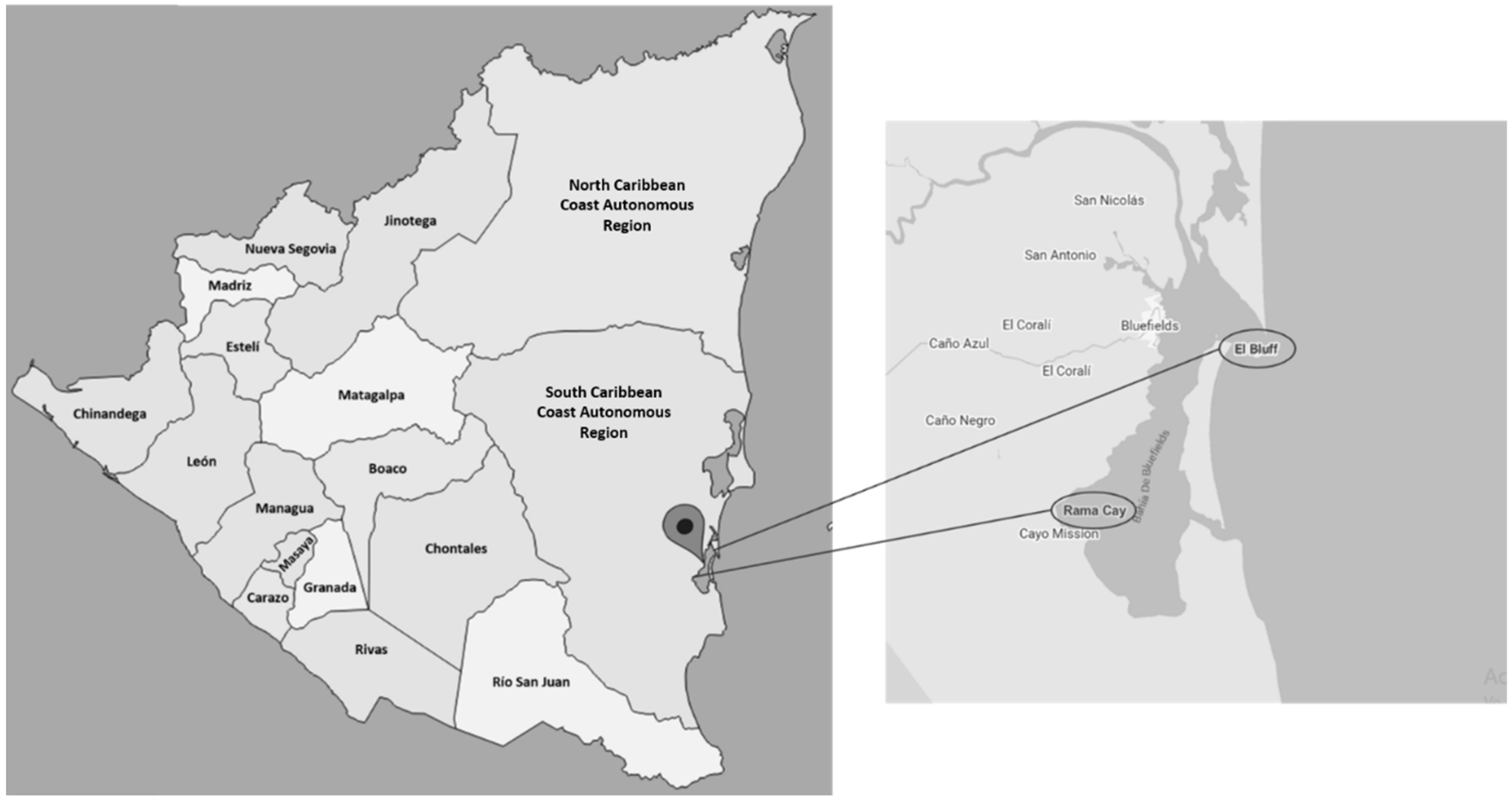
El Bluff (EB) (11°59′41″ N 83°41′25″ W) and Rama Cay (RC) (11°52′52″ N 83°48′32″ W) are islands in the Bluefields bay on the eastern coast of Nicaragua as part of the South Caribbean Coast Autonomous Region (Figure 1). EB is located at the northeast of the bay, while RC is at the southeast. The direct distance between EB and RC is a few nautical miles. The EB population is ethnically diverse, while indigenous people live in RC.

2.2. Study Design

A school-based cross-sectional study was conducted in EB and RC from January to February 2023 to determine the prevalence and associated risk factors for IP. A sample size calculation resulted in 197 children to be surveyed (determined based on a population of 400 children (20% total inhabitants); 50% heterogeneity; 5% margin of error; 95% confidence level with Netquest calculators). Participants, pupils from the two only schools on each island and their younger siblings those whose parents or guardians voluntarily gave their written consent, received detailed instructions on proper sample handling and were provided with plastic containers. Finally, a total of 228 students (109 students from EB and 119 students from RC) participated voluntarily in the study.

2.3. Data Collection

-
Questionnaire: Structured, closed-ended questionnaires were employed to gather socio-demographic, environmental and behavioral (habit-related) data.
-
Parasitological technique: The fresh stool samples were emulsified in situ with 10% saline prior to being transported to the laboratory (Managua, Nicaragua) where direct wet mount technique was conducted as follows: a drop of the above stool sample was applied to the coverslip with iodine on clean glass slides, which were examined under a light microscope at 10× and 40× magnifications to detect the parasitic forms (ova, larvae, cysts, and trophozoites) of intestinal parasites. Afterwards, stool samples were sent to the Spanish laboratory (Valencia), where a modified formol-ether concentration technique was implemented as follows: 3 mL of emulsified stool samples was placed in 7 mL of 10% formalin and filtered through gauze. Subsequently, 3 mL of ethyl-acetate was added and the mixture was vigorously agitated. The sample was then centrifuged at 1500 rpm for 3 min. The sediment with the cysts and ova parasitic forms was observed on a microscope slide using 10× and 40× objective lenses.

2.4. Data Analysis

The statistical analysis was performed using R program version 4.3.1. A p-value ≤ 0.05 was considered statistically significant. Socio-demographic, environmental and behavioral data were treated as categorical variables. The association between the prevalence of IP and those variables was assessed using Pearson’s chi-squared test (χ2). Univariate logistic regression analysis was first employed to determine the strength of association for each of the potential risk factor variables, expressed as crude odds ratios (CORs) and 95% confidence intervals (CIs). Those independent variables with a p-value < 0.05 were purposely selected and entered into the final multivariable logistic regression model [9]. Adjusted odds ratios (AORs) with the corresponding 95% CI were used.

2.5. Ethics

This study was approved by the Ethics Committee for Human Research of the University of Valencia (procedure number: H1477378643204). Moreover, the study was authorized by the Nicaraguan University authorities and met the principles established by the Helsinki Declaration and by the Nicaraguan/Spanish legislations regarding biomedical research and personal data protection. Permission was obtained from school principals in both study areas. Those students diagnosed with parasitism were referred to medical doctors for treatment.

3. Results

3.1. Intestinal Parasitism (IP)

Among the 228 children examined, 88.2% (201/228) were diagnosed with IP (Table 1). The rate of polyparasitism was 75.4% (172/228). A total of 13 species were identified, including nine protists and four helminths. Protists exhibited a similar prevalence (75.4%; 172/228) as helminths (78.1%; 178/228). Blastocystis sp. was the most prevalent protist (51.3%; 117/228), while Trichuris trichiura was the most common helminth (68.9%; 157/228).
The prevalence of total parasitism was found to be significantly higher in EB compared to RC (p-value = 0.002). The main difference between EB and RC parasitism was observed in protist species (86.2% and 65.5%, respectively) (p < 0.0001), while the percentages of children with helminth parasitism were similar in number (81.7% and 74.8%, respectively).
The dominant protist species in both islands was Blastocystis sp. (EB 63.3%; RC 40.3%) followed by G. duodenalis (EB 38.5%; RC 22.7%), predominantly occurring in EB with notable statistical differences (p = 0.0008 and p = 0.014, respectively).
T. trichiura was the dominant STH species in EB (79.8%), with significant statistical differences (p = 0.001), while A. lumbricoides was the dominant STH species in RC (64.7%), with significant statistical differences (p < 0.0001).

3.2. Variables Associated with IP

The total sample comprised 124 males (54.4%) and 104 females (45.6%). The age of the participants ranged from 2 to 14 years, with the minority (7%) falling within the 12–14 age group (teenagers) (Table 2).
Chi-square analysis on the entire population revealed age group as the only socio-demographic variable that predicted IP with statistical significance (p = 0.0021). From the environmental variables, chi-square analysis revealed no significant associations with the prevalence of IP. Habit-related variables such as using a latrine and going barefoot revealed significantly higher prevalence of IP (80.6% and 68.7%, respectively) with significant associations (p = 0.0019 and p = 0.039, respectively).

3.3. Frequency of IP According to Variables

The most prevalent protist (Blastocystis sp. and G. duodenalis) and helminth species (T. trichiura and A. lumbricoides) detected among the infected children of the entire population were selected to examine how they appeared according to different variables (Table 3).
The parasitism distribution is similar in both sexes. By age group, the highest frequency of parasitism was observed in the 6–11 age group (school age), mainly in G. duodenalis (p = 0.028) and T. trichiura (p = 0.038). However, A. lumbricoides appeared highly distributed among preschool age children (p < 0.0001).
From the environmental variables, house flooring shows low parasitism frequency in soil conditions, and reaches statistically significant differences in the case of A. lumbricoides (p = 0.033). Moreover, the frequency of A. lumbricoides parasitism reaches statistically significant differences among those in contact with animals (p = 0.043).
From the habit-related variables, high frequency appears in those using latrines, mostly for A. lumbricoides parasitism (p < 0.0001). Usually, the distribution appears to be related to eating raw unwashed vegetables/fruits and walking barefoot, reaching statistically significant differences in A. lumbricoides parasitism (p = 0.037 and p < 0.0001, respectively).

3.4. Multivariable Analysis of Potential Risk Factors Associated with IP

Univariate analysis used to identify the most significant risk factors for IP among children in both Caribbean islands (Table 4) showed that those who live in RC had approximately a 78.8% lower chance (odds) (0.212; 95%CI:0.069–0.541; p = 0.002) of experiencing IP than those in EB.
A significant association appeared between the presence of IP and children aged < 12 years old (p = 0.003), children who used latrines (p = 0.0015) and those walking barefoot (p = 0.040). These four independent variables with a p-value < 0.05 in the univariate analysis were selected for multivariable logistic regression analysis, whereas the other variables, including sex, house floor, animal keeper and raw unwashed vegetable/fruit consumption, were not selected (Table 4).
The multivariate model for the final significant predictors for IP indicates that the use of latrines, located under habit-related factors, remained as the only significant predictor for IP (p = 0.013).

4. Discussion

This study was aimed at assessing the prevalence and associated risk factors of IP among students on two Caribbean islands at the eastern coast of Nicaragua, both situated in the same Bluefields bay. Results show that in the Caribbean eastern cost of Nicaragua, intestinal parasitism remained an essential child-related public health problem, with a prevalence exceeding 50%. Understanding the potential risk factors for IP, considering the local and cultural situation in different localities, is vital for implementing adequate control strategies.
The overall IP prevalence in this study was 88.2%, which is lower than the 97% in children from the northern Caribbean area [10]. However, the prevalence of helminth parasitism (78.1%) was higher than the 54.3% reported previously among schoolchildren of Corn Island [9] and similar to the 76.7% reported from Laguna de Perlas, also at the eastern coast of Nicaragua [7].
The overall prevalence of protist parasitism in this study was 75.4%, which is comparable to the rate of 78.1% reported among schoolchildren in Laguna de Perlas [7]. On the northern Caribbean coast, protist infections (90.7%) were more prevalent than helminth infections (61.6%) [10].
Total Blastocystis sp. parasitism (51.3%) was similar to the 58.1% previously cited in Laguna de Perlas [7]. The prevalence of G. duodenalis (30.3%) was higher compared to a previous study in the eastern Caribbean coast (17.4%) [7] and close to the 45.3% detected in the northern Caribbean coast [10]. Moreover, these and other protist species were statistically higher in EB (86.2%) compared to RC (65.5%). It seems that RC currently has an improvement in the sanitary facilities for water treatment that could limit protist parasitism. Nevertheless, the presence of several commensal protist species, with transmission mechanisms identical to the pathogenic species, is important, since they are connected through the fecal–oral route, including contaminated hands, food, and water [11]. Although the transmission of protists primarily occurs through waterborne pathways, living conditions can facilitate its colonization, largely due to fecal-environmental contamination and poor hygienic-sanitary conditions.
Helminth species prevalence is not the same in both communities studied: A. lumbricoides prevalence in RC (64.7%) was almost 40 times higher than in EB (18.3%) while T. trichiura prevalence in RC (58.8%) was almost 20 times lower than in EB (79.8%). In the previous work on Laguna de Perlas [10], T. trichiura reached the highest infection rate (72.4%), similar to the situation observed in EB (79.8%), and the 27.1% reported for A. lumbricoides also agreed with the 18.3% obtained in EB. These findings may suggest that the infection scenario in Laguna de Perlas is comparable to that in EB, whereas RC needs to fulfill specific requirements in order to be infected with A. lumbricoides. Furthermore, no hookworm parasitism was identified among participants from RC while a prevalence of 10.1% was found in EB, similar to the 12.7% reported from Laguna de Perlas [7] and the 9.9% reported from the northern Caribbean coast [10].
The pattern of parasitism in the current study showed that three-quarters of children presented with polyparasitism (75.4%). This pattern was in accordance with that found previously in Laguna de Perlas, where 75.8% polyparasitism was also reported [7].
The present study revealed a similar prevalence of IP among male and female participants. Males and females are most likely equally vulnerable to parasitism and transmission. This finding disagrees with the previous research conducted among schoolchildren in Corn Island [8]. In addition, higher parasitism rates were found specifically among students aged < 12 years old. This finding suggests that older children may have improved knowledge of hygiene practices.
Variations in sanitation and hygiene practices, public health infrastructure, food and water safety, nutritional status, host immunity, access to safe water, socioeconomic conditions, and environmental determinants are all possible causes of the increased prevalence in island settings [11]. Additionally, agricultural practices, contact with contaminated soil, inadequate hand washing practices, poor environmental and personal hygiene, and ignorance of transmission are all potential risk factors for STH infection [11]. Furthermore, it was demonstrated in different Peruvian locations that different outdoor areas around homes can have varying levels of parasite contamination, emphasizing the importance of spatial consideration in parasitic risk assessments [12].
In previous work in Argentina [13], the main determinant of parasitic infections was the source of water, precarious housing and lack of access to sanitary toilets. Traditionally, it has been acknowledged that open defecation can increase the risk of infection [14,15,16], while access to latrines significantly lowers parasitic infection rates in endemic areas [17,18]. Likewise, children who lived in families who practiced open defecation had higher exposure to intestinal parasites compared with children who lived in families who used a latrine [19]. Additionally, animal excrement and open defecation coexist which could increase environmental contamination for zoonotic infections [20]. Studies done in low- and middle-income countries have also suspected animal excreta as a contributor to fecal contamination [19,21,22].
Nevertheless, in our study, behavioral factors, mainly using latrines, were assessed risk factors for IP. The regression analysis showed that the risk of being infected was higher in children who lived in EB than in RC. Reviewing individual data revealed that all children in EB (99%; 108/109) used latrines, but only 57% (68/119) in RC did. The results obtained in both Caribbean islands demonstrate that not only the existence of latrines, but their proper maintenance and cleaning is necessary to prevent IP. Most latrines in EB are simple pits dug in the ground without ventilation. Despite the existence of sanitary manuals for the proper maintenance of these latrines, latrine maintenance depends heavily on family and community education. This result is consistent with studies in Haiti [23] where they recommended implementing barrier measures and self-protection mechanisms for feces-composting operations to ensure that established guidelines have been respected and that the compost produced is truly sanitized.
In faraway countries on other continents such as Ethiopia, the improper use of latrines was significantly associated with helminth co-infection [24]. The chance of being infected was increased by about 3.03 folds among children who had the practice of using latrines that are not properly maintained. Similar to our results, results in Ethiopia showed that the odds of IP among children from households that have unclean latrines were 1.8 times higher when compared with children from households that have clean latrines [16]. In that sense, it has been shown that both, pit-latrine without slab and shared pit-latrine with slab, were significantly associated with IP [25]. Everything seems to indicate that latrines were significant risk factors for IP [26]. Recently, a multivariate analysis highlighted an association between the unavailability of pour-flush latrines and a higher odds of contracting IP [27].
In this regard, it was more successful to wash hands with the proper material before eating and after using the restroom, demonstrating that hand washing with water alone is not as effective at preventing infection as washing with soap [28,29].
The importance of improved sanitation facilities in reducing transmission is crucial. To preserve the environment from contamination and to prevent child exposure to IP, water, sanitation and hygiene (WASH) measures such as proper waste disposal, food safety, hand hygiene promotion, household water treatment, containment of domestic animals and their excreta, etc., are important. However, improving WASH infrastructure has been shown to be insufficient in both islands studied, EB and RC, resulting in no differences in IP. The promotion of WASH-ED (education improvements in WASH) [20,30] will help to prevent and control infection in these endemic areas. Continuous health training, particularly on proper hygienic practices and maintenance, should be emphasized, especially concerning parasites transmitted via the fecal–oral route.
Despite the persistence of parasitism, this study demonstrates how infrastructure improvements (water management) can reduce parasite transmission. Thus, the comparison between the two islands studied reveals the lower protist parasitism in RC related to the increased healthfulness of drinking water. However, the poor hygienic maintenance of the latrines prevents the disappearance of the parasitism. In any case, it seems that in RC, changes in habits could be more easily achieved among its indigenous populations (Ramas) than in EB, with the coexistence of multiple groups (Creoles, Mestizos, Garifuna and Miskitos) with different origins, cultures, customs and habits.

5. Limitations of the Study

This study has some limitations. First, we used a single fecal sample which may underestimate the prevalence of IP. Second, the study did not apply a more sensitive diagnostic method than microscopic examination. Other limitations include the small number of variables and veracity of questionnaire responses. In the future, incorporating a longitudinal study with a larger sample size would be useful.

Author Contributions

J.C., conceptualization, formal analysis, investigation, methodology, writing—original draft and figure preparation; V.P., investigation and methodology, and statistical interpretation of data; A.P., investigation and methodology; R.T., critical revision; J.G.E., validation; C.M.-A., conceptualization, funding acquisition, and writing—original draft, review and editing. All authors have read and agreed to the published version of the manuscript.

Funding

Ayudas Especiales 2026 (UV_INV_AE-4211753) Vicerrectorado Investigación, Universidad de Valencia.

Institutional Review Board Statement

This study was approved by the Ethics Committee for Human Research of the University of Valencia (procedure number: H1477378643204, 16 October 2021). Moreover, the study was authorized by the Nicaraguan University authorities and met the principles established by the Helsinki Declaration and by the Nicaraguan/Spanish legislations regarding biomedical research and personal data protection. Permissions were obtained from school principals in both study areas. Those students diagnosed with parasitic infections were referred to medical doctors for treatment.

Informed Consent Statement

The informed consent was signed by the parents/guardians of the participating minors.

Data Availability Statement

Due to the requirement to preserve anonymity, the data provided in this work are available upon request from the corresponding author (it is pseudo-anonymized data).

Acknowledgments

To all participating children and their guardians/parents for their collaboration. To the staff of the Center for Research and Health Studies, National Autonomous University of Nicaragua, UNAN-Managua for their availability.

Conflicts of Interest

The authors declare no conflicts of interest.

References

  1. Kumma, P.W.; Meskele, W.; Admasie, A. Prevalence of intestinal parasitic infections and associated factors among food handlers in Wolaita Sodo University student caterings, Wolaita Sodo, Southern Ethiopia: A cross-sectional study. Front. Public Health 2019, 7, 140. [Google Scholar] [CrossRef]
  2. Awasthi, S.; Bundy, D.A.; Savioli, L. Helminthic infections. BMJ 2003, 327, 431–433. [Google Scholar] [CrossRef] [PubMed]
  3. WHO. Soil-Transmitted Helminth Infections; WHO: Geneva, Switzerland, 2016. [Google Scholar]
  4. Hotez, P.J.; Fenwick, A.; Savioli, L.; Molyneux, D.H. Rescuing the bottom billion through control of neglected tropical diseases. Lancet 2009, 373, 1570–1575. [Google Scholar] [CrossRef] [PubMed]
  5. Workneh, T.; Esmael, A.; Ayichiluhm, M. Prevalence of intestinal parasitic infections and associated factors among Debre Elias primary schools children, East Gojjam zone, Amhara Region, northwest Ethiopia. J. Bacteriol. Parasitol. 2014, 5, 11–19. [Google Scholar] [CrossRef]
  6. Gómez, A.G.; González, C.A.; Lindenberg, C.S.; Majano, S.B.; García, V.M.; Guillen, L.F.; Romanjek, M.H.; Coffman, M. Harnessing the Power of Technology to Improve Sexual and Reproductive Youth Health in Nicaragua: A Randomized Field Study. Hisp. Health Care Int. 2023, 21, 142–149. [Google Scholar] [CrossRef] [PubMed]
  7. Muñoz-Antoli, C.; Pavón, A.; Pérez, P.; Toledo, R.; Esteban, J.G. Soil-transmitted Helminths Infections in schoolchildren of Laguna de Perlas (Nicaragua). J. Trop. Pediatr. 2017, 63, 124–134. [Google Scholar] [CrossRef]
  8. Muñoz-Antoli, C.; Pérez, P.; Pavón, A.; Toledo, R.; Esteban, J.G. Soil-Transmitted Helminth infections and anemia in schoolchildren from Corn Island archipelago (RAAS, Nicaragua). Am. J. Trop. Med. Hyg. 2018, 99, 1591–1597. [Google Scholar] [CrossRef]
  9. Bursac, Z.; Gauss, C.H.; Williams, D.K.; Hosmer, D.W. Purposeful selection of variables in logistic regression. Source Code Biol. Med. 2008, 3, 17. [Google Scholar] [CrossRef]
  10. Muñoz-Antoli, C.; Pérez, P.; Pavón, A.; Toledo, R.; Esteban, J.G. High intestinal parasite infection detected in children from Región Autónoma Atlántico Norte (R.A.A.N.) of Nicaragua. Sci. Rep. 2022, 12, 5872. [Google Scholar] [CrossRef]
  11. Adugna, A.; Yohannes, T.; Tesfaye, S. Prevalence of Gastrointestinal Parasitic Infections and Associated Risk Factors Among Secondary School Students in Wonji Shoa, Adama District, East Shoa Zone, Oromia Region, Ethiopia. BioMed Res. Int. 2024, 2024, 5520924. [Google Scholar] [CrossRef]
  12. Pineda, C.; Rivera, M.D.C.; Sabino, E.M.; Mejia, L.E.; Keegan, K.E.; Alvarez, L.P.P.; Mora, J.J.; Vega, F.E.; Mejia, E.R.; Herrera, P.O.; et al. Parasite contamination of soil in different Peruvian locations and outside built environments. Parasites Vectors 2025, 18, 134. [Google Scholar] [CrossRef]
  13. Zonta, M.L.; Servián, A.; Panisse, G.; Oyhenart, E.E.; Navone, G.T. Nutritional status, intestinal parasitic infections, and socioenvironmental conditions in Mbyá-guarani children: The current situation in communities in central Misiones, Argentina. Am. J. Hum. Biol. 2022, 34, e23749. [Google Scholar] [CrossRef]
  14. Sumbele, I.U.N.; Otia, O.V.; Bopda, O.S.M.; Ebai, C.B.; Kimbi, H.K.; Nkuo-Akenji, T. Polyparasitism with Schistosoma haematobium, Plasmodium and soil transmitted helminths in school-aged children in Muyuka–Cameroon following implementation of control measures: A cross sectional study. Infect. Dis. Poverty 2021, 10, 14. [Google Scholar] [CrossRef] [PubMed]
  15. Nadia, N.A.C.; Cedric, Y.; Ibrahim, A.M.; Raoul, S.N.S.; Guy-Armand, G.N.; Kevin, T.D.A.; Lucien, K.F.H. Prevalence and risk factors of geohelminths in primary schools children aged 5 to 15 years in the city of Moundou, southwestern Chad. Parasite Epidemiol. Control 2023, 23, e00330. [Google Scholar] [CrossRef] [PubMed]
  16. Gebru, H.; Deyissia, N.; Medhin, G.; Kloos, H. The Association of Sanitation and Hygiene Practices with Intestinal Parasitic Infections Among Under-14 Children in Rural Dire Dawa, Eastern Ethiopia: A Community Based Cross-sectional Study. Environ. Health Insights 2023, 17, 1–9. [Google Scholar] [CrossRef]
  17. Sclar, G.D.; Penakalapati, G.; Amato, H.K.; Garn, J.V.; Alexander, K.; Freeman, M.C.; Boisson, S.; Medlicott, K.O.; Clasen, T. Assessing the impact of sanitation on indicators of fecal exposure along principal transmission pathways: A systematic review. Int. J. Hyg. Environ. Health 2016, 219, 709–723. [Google Scholar] [CrossRef] [PubMed]
  18. Zonta, M.L.; Cociancic, P.; Oyhenart, E.E.; Navone, G.T. Intestinal parasitosis, undernutrition, and socio-environmental factors in schoolchildren from Clorinda Formosa, Argentina. Rev. Esp. Salud Públ. 2019, 21, 224–231. [Google Scholar] [CrossRef]
  19. Gizaw, Z.; Yalew, A.W.; Bitwe, B.D.; Lee, J.; Bisesi, M. Fecal indicator bacteria along multiple environmental exposure pathways (water, food, and soil) and intestinal parasites among children in the rural northwest Ethiopia. BMC Gastroenterol. 2022, 22, 84. [Google Scholar] [CrossRef]
  20. Muslim, A.; Mohd Sofian, S.; Shaari, S.A.; Hoh, B.-P.; Lim, Y.A.-L. Prevalence, intensity and associated risk factors of soil transmitted helminth infections: A comparison between Negritos (indigenous) in inland jungle and those in resettlement at town peripheries. PLoS Negl. Trop. Dis. 2019, 13, e0007331. [Google Scholar] [CrossRef]
  21. Schriewer, A.; Odagiri, M.; Wuertz, S.; Misra, P.R.; Panigrahi, P.; Clasen, T.; Jenkins, M.W. Human and animal fecal contamination of community water sources, stored drinking water and hands in rural India measured with validated microbial source tracking assays. Am. J. Trop. Med. Hyg. 2015, 93, 509. [Google Scholar] [CrossRef]
  22. Dos Santos, S.; Ouédraogo, F.d.C.; Soura, A.B. Water-related factors and childhood diarrhoea in African informal settlements. A cross-sectional study in Ouagadougou (Burkina Faso). J. Water Health 2015, 13, 562–574. [Google Scholar] [CrossRef][Green Version]
  23. Jean-Baptiste, D.; De Giudici, P.; Monette, F. Quantitative microbial risk assessment associated with the use of container-based toilets in Haiti. Water Sci. Technol. 2023, 88, 1332. [Google Scholar] [CrossRef]
  24. Hailu, T.; Siyadatpanah, A.; Norouzi, R. Co-infection prevalence of helminths and associated risk factors among schoolchildren in the Lake Tana Basin, Northwest Ethiopia. BMC Infect. Dis. 2025, 25, 1018. [Google Scholar] [CrossRef] [PubMed]
  25. Hailu, G.G.; Ayele, E.T. Assessment of the prevalence of intestinal parasitic infections and associated habit and culture-related risk factors among primary schoolchildren in Debre Berhan town, Northeast Ethiopia. BMC Public Health 2021, 21, 112. [Google Scholar] [CrossRef] [PubMed]
  26. Ramayanti, I.; Ghiffari, A. Factors of soil-transmitted helminths infections in children who live in the surrounding of the final disposal landfill of Sukawinatan. Palembang. J. Phys. Conf. Ser. 2019, 1246, 012045. [Google Scholar] [CrossRef]
  27. Rozani, N.S.; Aazmi, M.S.; Attah, A.O.; Termizi, F.H.M.; Shahrizal, S.; Idorus, M.Y.; Muslim, A. Blastocystis colonization among inland and forest periphery Negritos in Malaysia: The crucial role of sanitation and hygiene practices. Parasitol. Int. 2025, 108, 103075. [Google Scholar] [CrossRef]
  28. Alemu, A.; Atnafu, A.; Addis, Z.; Shifera, Y.; Teklu, T.; Mathewos, B.; Birhan, W.; Gebretsadik, S.; Gelaw, B. Soil transmitted helminths and Schistosoma mansoni infections among school children in Zarima town, northwest Ethiopia. BMC Infect. Dis. 2011, 11, 189. [Google Scholar] [CrossRef]
  29. Khan, W.; Rahman, H.; Rafiq, N.; Kabir, M.; Ahmed, M.S.; De Los Rios Escalante, P. Risk factors associated with intestinal pathogenic parasites in schoolchildren. Saudi J. Biol. Sci. 2022, 29, 2782–2786. [Google Scholar] [CrossRef]
  30. Ngui, R.; Lim, Y.A.; Traub, R.; Mahmud, R.; Mistam, M.S. Epidemiological and genetic data supporting the transmission of Ancylostoma ceylanicum among human and domestic animals. PLoS Negl. Trop. Dis. 2012, 6, e1522. [Google Scholar] [CrossRef] [PubMed]
Figure 1. Location of El Bluff (EB) and Rama Cay (RC) islands on the map, at the eastern coast of Nicaragua as part of the South Caribbean Coast Autonomous Region.
Parasitologia 06 00029 g001
Table 1. Prevalence of parasitism in the total population of children and in each island (EB and RC) studied (EB: El Bluff; RC: Rama Cay; n %: number detected and percentage).
Total
N = 228
EB
N = 109
RC
N = 119
Speciesn%n%n%p-Value
Protist17275.49486.27865.5<0.0001
Blastocystis sp.11751.36963.34840.30.0008
Chilomastix mesnili114.821.897.60.063
Dientamoeba fragilis10.40-10.8-
Endolimax nana6227.23330.32924.40.394
Entamoeba coli6528.53532.13025.20.316
Entamoeba complex135.765.575.90.870
Entamoeba hartmanni2611.41311.91310.90.976
Giardia duodenalis6930.34238.52722.70.014
Iodamoeba buetschli93.987.310.80.029
Helminths17878.18981.78974.80.276
Ascaris lumbricoides9742.52018.37764.7<0.0001
Hookworm114.81110.10--
Hymenolepis nana20.921.80--
Trichuris trichiura15768.98779.87058.80.001
Polyparasitism17275.485788773.10.484
Total positives20188.210495.49781.50.002
Total negatives2711.854.62218.50.002
Table 2. Variables associated with IP (n %: number detected and percentage; * significant statistical differences).
VariablesTotal N = 228Positive N = 201p-Value
Socio-Demographicn%n%
SexMale12454.411155.20.626
Female10445.69044.8
AgePreschool age
(2–5)
10746.98441.80.0021 *
School age
(6–11)
10546.110150.2
Teenagers
(12–14)
167167.9
Environmental
House floorSoil177.5157.50.704
Other21192.518692.5
Animal keepersYes17677.215376.10.341
No5222.84823.9
Habit-related
Use of latrineYes17677.216280.60.0019 *
No5222.83919.4
Raw unwashed vegetables/fruitsYes21694.719094.50.942
No125.3115.5
BarefootYes16271.113868.70.039 *
No6628.96331.3
Table 3. Frequency of main IP detected according to variables (n (%): number detected and percentage; * significant statistical differences).
Total Positive N = 201
VariablesBlastocystis sp. G. duodenalis T. trichiura A. lumbricoides
Socio-demographicN = 117
n (%)
p-valueN = 69
n (%)
p-valueN = 157
n (%)
p-valueN = 97
n (%)
p-value
SexMale67 (57.3)0.49243 (62.3)0.14589 (56.7)0.43152 (53.6)0.656
Female50 (42.7) 26 (37.7) 68 (43.3) 45 (46.4)
AgePreschool age43 (36.8)0.26320 (28.9)0.028 *60 (38.2)0.038 *66 (68.0)<0.0001 *
School age60 (51.3) 42 (60.9) 85 (54.1) 26 (26.8)
Teenagers14 (11.9) 7 (10.1) 12 (7.6) 5 (5.2)
Environmental
House floorSoil8 (6.8)0.6916 (8.7)0.63112 (7.6)0.8543 (3.1)0.033 *
Other109 (93.2) 63 (91.3) 145 (92.4) 94 (96.9)
Animal keepersYes86 (73.5)0.30656 (81.2)0.228115 (73.2)0.07780 (82.5)0.043 *
No31 (26.5) 13 (18.8) 42 (26.8) 17 (16.5)
Habit-related
Use of latrineYes92 (78.6)0.40754 (78.3)0.545127 (80.9)0.84265 (67.0)<0.0001 *
No25 (21.4) 15 (21.7) 30 (19.1) 32 (32.9)
Raw unwashed vegetables/fruitsYes108 (92.3)0.12265 (94.2)0.884148 (94.3)0.76088 (90.7)0.037 *
No9 (7.7) 4 (5.8) 9 (5.7) 9 (9.3)
BarefootYes77 (65.8)0.30646 (66.7)0.660106 (67.5)0.51185 (87.6)<0.0001 *
No40 (34.2) 23 (33.3) 51 (32.5) 12 (12.4)
Table 4. Univariate and multivariable logistic regression analysis of potential risk factors associated with IP in both Caribbean islands (Nicaragua) (IP: intestinal parasitism; EB: El Bluff; RC: Rama Cay; OR = odds ratio: 95% CI = confidence interval; COR = crude; AOR = adjusted, *: significant difference).
IPOR (95% CI)
PositiveNegativeCORAOR
EB10450.212 (0.069–0.541) *0.316 (0.047–1.299)
RC9722
Variables
Socio-demographic
SexMale111130.753 (0.333–1.69)-
Female9014
AgePreschool age84214.208 (1.716–11.90) *2.9 (0.859–13.303)
School age1016
Teenagers160
Environmental
House floorSoil1521.008 (0.263–6.634)-
Other18625
Animal keepersYes153230.554 (0.157–1.529)-
No484
Habit-related
Use of latrineYes162143.857 (1666–8.917) *3.033 (1.262–7.38) *
No3913
Raw unwashed vegetables/fruitsYes190260.664 (0.036–3.632)-
No111
BarefootYes138240.274 (0.063–0.821) *0.416 (0.092–1.368)
No633
Disclaimer/Publisher’s Note: The statements, opinions and data contained in all publications are solely those of the individual author(s) and contributor(s) and not of MDPI and/or the editor(s). MDPI and/or the editor(s) disclaim responsibility for any injury to people or property resulting from any ideas, methods, instructions or products referred to in the content.