
Between Leisure and Business: A Cluster Analysis of Golf Tourism in Spain

 , , and
Abstract
1. Introduction
2. Literature Review
2.1. Sport Tourism
2.2. Motivations in Tourism and Active Sports Tourism
2.2.1. Motivations in Tourism
2.2.2. Motivations in Active Sport Tourism
2.3. Segmentation in Golf Tourism
2.4. Motivational Constructs
2.4.1. Business Opportunity
2.4.2. Financial Savings
2.4.3. Escape and Relaxation
2.4.4. Learning and Challenge
3. Methodology
3.1. Data Collection
3.2. Data Processing and Analysis
3.3. Exploratory Factor Analysis (EFA)
3.4. Confirmatory Factor Analysis (CFA)
3.5. Cluster Analysis
4. Results
4.1. The Demographic Profile
4.2. Descriptive Analysis of Motivations
4.3. Exploratory Factor Analysis of Principal Components
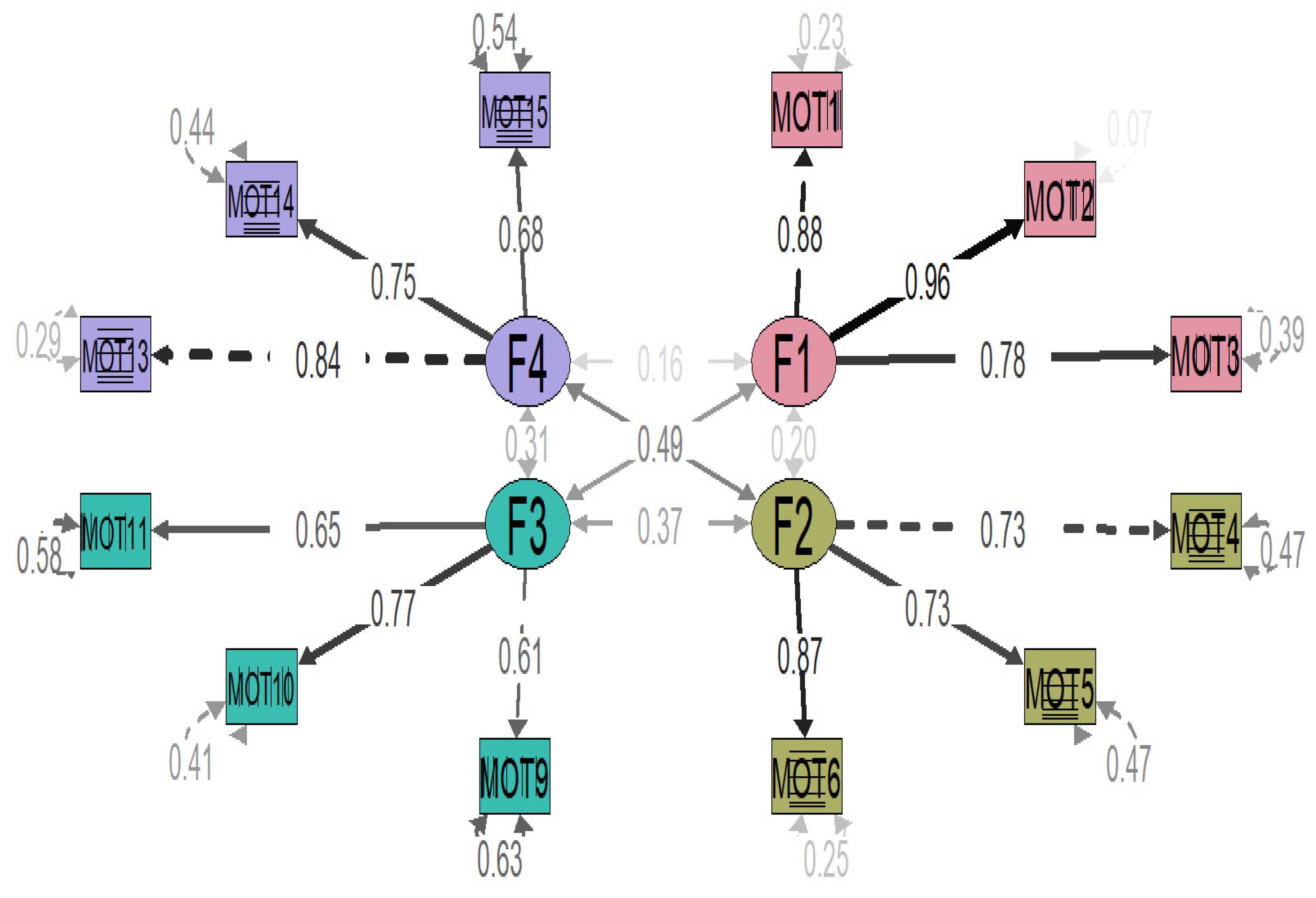
4.4. Confirmatory Factor Analysis
4.5. Cluster Analysis
4.5.1. Cluster Interpretation
4.5.2. Demographic Profile of the Clusters
4.5.3. Cluster Preferences Analysis
5. Discussion
6. Conclusions
6.1. Practical Applications
6.2. Limitations
6.3. Future Research Lines
Author Contributions
Funding
Institutional Review Board Statement
Informed Consent Statement
Data Availability Statement
Acknowledgments
Conflicts of Interest
References
- Andreu, L., Kozak, M., Avci, N., & Cifter, N. (2006). Market segmentation by motivations to travel: British tourists visiting Turkey. Journal of Travel & Tourism Marketing, 19(1), 1–14. [Google Scholar]
- Babinger, F. (2012). El golf en España: La concentración social y territorial de un fenómeno que trasciende ampliamente lo deportivo. Ería: Revista Cuatrimestral de Geografía, 88, 185–197. [Google Scholar]
- Barros, C. P., Butler, R., & Correia, A. (2010). The length of stay of golf tourism: A survival analysis. Tourism Management, 31(1), 13–21. [Google Scholar] [CrossRef] [Scilit]
- Bason, T. (2023). Follow, follow, follow: Analysing the motivations for attending small-scale events abroad. Journal of Sport & Tourism, 27(1), 1–14. [Google Scholar]
- Bichler, B. F., & Pikkemaat, B. (2021). Winter sports tourism to urban destinations: Identifying potential and comparing motivational differences across skier groups. Journal of Outdoor Recreation and Tourism, 36, 100420. [Google Scholar] [CrossRef] [Scilit]
- Boukas, N., & Ziakas, V. (2013, June 5–8). Golf tourist motivation and sustainable development: A marketing management approach for promoting responsible golf tourism in Cyprus. International Conference on Tourism (ICOT 2013): Trends Impacts and Policies on Sustainable Tourism Development, Limassol, Cyprus. [Google Scholar]
- Carvache-Franco, M., Hassan, T., Orden-Mejía, M., Carvache-Franco, O., & Carvache-Franco, W. (2025). Understanding tourist satisfaction and loyalty at world cups: A comprehensive analysis of motivations and age effects. Cogent Business & Management, 12(1), 2593093. [Google Scholar] [CrossRef] [Scilit]
- Cha, S., McCleary, K. W., & Uysal, M. (1995). Travel motivations of Japanese overseas travelers: A factor-cluster segmentation approach. Journal of Travel Research, 34(1), 33–39. [Google Scholar] [CrossRef] [Scilit]
- Cham, T.-H., Cheah, J.-H., Ting, H., & Memon, M. A. (2022). Will destination image drive the intention to revisit and recommend? Empirical evidence from golf tourism. International Journal of Sports Marketing and Sponsorship, 23(2), 385–409. [Google Scholar] [CrossRef] [Scilit]
- Cohen, J. (2013). Statistical power analysis for the behavioral sciences. Routledge. [Google Scholar] [CrossRef] [Scilit]
- Correia, A., Oliveira, N., & Silva, F. (2009). Bridging perceived destination image and market segmentation–An application to golf tourism. European Journal of Tourism Research, 2(1), 41–69. [Google Scholar] [CrossRef] [Scilit]
- Crompton, J. L. (1979). Motivations for pleasure vacation. Annals of Tourism Research, 6(4), 408–424. [Google Scholar] [CrossRef] [Scilit]
- Cronbach, L. J. (1951). Coefficient alpha and the internal structure of tests. Psychometrika, 16(3), 297–334. [Google Scholar] [CrossRef] [Scilit]
- Dann, G. M. (1977). Anomie, ego-enhancement and tourism. Annals of Tourism Research, 4(4), 184–194. [Google Scholar] [CrossRef] [Scilit]
- Dickson, T., & Dolnicar, S. (2006). Ascending mount kosciusko: An exploration of motivational patterns. University of Wollongong. [Google Scholar]
- Dolnicar, S., & Fluker, M. (2003). Behavioural market segments among surf tourists: Investigating past destination choice. Journal of Sport Tourism, 8(3), 186–196. [Google Scholar] [CrossRef] [Scilit]
- Dolnicar, S., & Leisch, F. (2003). Winter tourist segments in Austria: Identifying stable vacation styles using bagged clustering techniques. Journal of Travel Research, 41(3), 281–292. [Google Scholar] [CrossRef] [Scilit]
- Eskelinen, O., Garrod, B., Sthapit, E., & Suni, J. (2025). Motivations for domestic overnight travel by Finnish disc golfers: A serious-leisure perspective. Leisure Studies, 44(1), 15–30. [Google Scholar] [CrossRef] [Scilit]
- European Golf Association. (2025). Annual report 2025. European Golf Association. [Google Scholar]
- Field, A. (2009). Discovering statistics using SPSS: Book plus code for E version of text (Vol. 896). SAGE Publications Limited. [Google Scholar]
- Fodness, D. (1994). Measuring tourist motivation. Annals of Tourism Research, 21(3), 555–581. [Google Scholar] [CrossRef] [Scilit]
- Fornell, C., & Larcker, D. F. (1981). Evaluating structural equation models with unobservable variables and measurement error. Journal of Marketing Research, 18(1), 39–50. [Google Scholar] [CrossRef] [Scilit]
- Forscher, B. K. (1963). Chaos in the brickyard. Science, 142(3590), 339. [Google Scholar] [CrossRef] [Scilit]
- Garau-Vadell, J. B., & de Borja-Solé, L. (2008). Golf in mass tourism destinations facing seasonality: A longitudinal study. Tourism Review, 63(2), 16–24. [Google Scholar] [CrossRef] [Scilit]
- García, M. d. M. M. (2021). El turismo de golf en Almería y su carácter desestacionalizador. PASOS Revista de Turismo y Patrimonio Cultural, 19(4), 763–773. [Google Scholar] [CrossRef] [Scilit]
- Gibson, H. J. (1998). Sport tourism: A critical analysis of research. Sport Management Review, 1(1), 45–76. [Google Scholar] [CrossRef] [Scilit]
- Gibson, H. J., & Pennington-Gray, L. (2005). Insights from role theory: Understanding golf tourism. European Sport Management Quarterly, 5(4), 443–468. [Google Scholar] [CrossRef] [Scilit]
- Gnoth, J. (1997). Tourism motivation and expectation formation. Annals of Tourism Research, 24(2), 283–304. [Google Scholar] [CrossRef] [Scilit]
- Hair, J., Jr., Page, M., & Brunsveld, N. (2019). Essentials of business research methods. Routledge. [Google Scholar] [CrossRef] [Scilit]
- Hair, J. F., Black, W. C., Babin, B. J., Anderson, R. E., & Tatham, R. L. (2006). Multivariate data analysis (Vol. 6). Pearson. [Google Scholar]
- Hair, J. F., Jr., Black, W. C., Babin, B. J., & Anderson, R. E. (2010). Multivariate data analysis. Prentice Hall. [Google Scholar]
- Hodeck, A., & Hovemann, G. (2018). Motivation of active sport tourists in a German highland destination–a cross-seasonal comparison. In Sport tourism and sustainable destinations (pp. 173–186). Routledge. [Google Scholar]
- Hodeck, A., Kuehnast, J., & Wohlfart, O. (2018, September 5–8). Comparing two types of nature sport (event) tourists in Germany based on travel motivation and behaviour—The case of ski tourers vs. trail runners. The 26th European Sport Management Conference Managing Sport in a Changing Europe, Malmö, Sweden. [Google Scholar]
- Hu, L. t., & Bentler, P. M. (1999). Cutoff criteria for fit indexes in covariance structure analysis: Conventional criteria versus new alternatives. Structural Equation Modeling: A Multidisciplinary Journal, 6(1), 1–55. [Google Scholar] [CrossRef] [Scilit]
- Hudson, S., & Hudson, L. (2014). Golf tourism. Goodfellow Publishers. [Google Scholar]
- Humphreys, C. (2010). Golf tourism. Journal of Sport and Tourism, 15(3), 261–264. [Google Scholar] [CrossRef] [Scilit]
- Hungenberg, E., Gray, D., Gould, J., & Stotlar, D. (2016). An examination of motives underlying active sport tourist behavior: A market segmentation approach. Journal of Sport & Tourism, 20(2), 81–101. [Google Scholar] [CrossRef] [Scilit]
- Iso-Ahola, S. E. (1980). The social psychology of leisure and recreation Dubuque. IA Brown. [Google Scholar]
- Kim, J. H., & Ritchie, B. W. (2012). Motivation-based typology: An empirical study of golf tourists. Journal of Hospitality & Tourism Research, 36(2), 251–280. [Google Scholar]
- Kim, S., Clemenz, C., & Weaver, P. (2001). Segmenting golfers by their attitudes toward food and beverage service available during play. Journal of Hospitality & Leisure Marketing, 9(3–4), 67–82. [Google Scholar] [CrossRef] [Scilit]
- Kim, S. S., Chun, H., & Petrick, J. F. (2005). Positioning analysis of overseas golf tour destinations by Korean golf tourists. Tourism Management, 26(6), 905–917. [Google Scholar] [CrossRef] [Scilit]
- Kim, S. S., Kim, J. H., & Ritchie, B. W. (2008). Segmenting overseas golf tourists by the concept of specialization. Journal of Travel & Tourism Marketing, 25(2), 199–217. [Google Scholar] [CrossRef] [Scilit]
- Kolmogorov, A. (1933). Sulla determinazione empirica di una legge didistribuzione. Giorn Dell’inst Ital Degli Att, 4, 89–91. [Google Scholar]
- Lee, C.-K., Lee, Y.-K., Bernhard, B. J., & Yoon, Y.-S. (2006). Segmenting casino gamblers by motivation: A cluster analysis of Korean gamblers. Tourism Management, 27(5), 856–866. [Google Scholar] [CrossRef] [Scilit]
- Lee, J.-H., Cho, H.-K., & Kim, M.-J. (2022). Does self-monitoring influence golfers? Analysis of golf tourism using the existence–relatedness–growth theory. Sustainability, 14(19), 12458. [Google Scholar] [CrossRef] [Scilit]
- Lee, S.-Y., & Lee, R.-S. (2022). An empirical study of the behaviors of Korean golf travelers based on the choice attributes of golf courses in Southeast Asia. International Journal of Environmental Research and Public Health, 19(14), 8648. [Google Scholar] [CrossRef] [Scilit]
- Martínez Ávila, M. (2021). Análisis factorial confirmatorio: Un modelo de gestión del conocimiento en la universidad pública. RIDE. Revista Iberoamericana para la Investigación y el Desarrollo Educativo, 12(23), e306. [Google Scholar] [CrossRef] [Scilit]
- Mavrou, I. (2015). Análisis factorial exploratorio: Cuestiones conceptuales y metodológicas. Revista Nebrija de Lingüística Aplicada a la Enseñanza de Lenguas, (19), 71–80. [Google Scholar] [CrossRef] [Scilit]
- McDonald, R. P. (1989). An index of goodness-of-fit based on noncentrality. Journal of Classification, 6(1), 97–103. [Google Scholar] [CrossRef] [Scilit]
- McLean, D., & Hurd, A. (2011). Kraus’ recreation and leisure in modern society. Jones & Bartlett Publishers. [Google Scholar]
- Middleton, V. T., & Clarke, J. R. (2012). Marketing in travel and tourism. Routledge. [Google Scholar] [CrossRef] [Scilit]
- Morata-Ramírez, M., Holgado-Tello, F. P., Barbero-García, I., & Mendez, G. (2015). Análisis factorial confirmatorio: Recomendaciones sobre mínimos cuadrados no ponderados en función del error Tipo I de Ji-Cuadrado y RMSEA. Acción Psicológica, 12(1), 79–90. [Google Scholar] [CrossRef] [Scilit]
- National Golf Foundation. (2025). Golf participation in the U.S. 2024. National Golf Foundation. [Google Scholar]
- Nunnally, J., & Bernstein, I. (1994). Psychometric theory (3rd ed.). MacGraw-Hill. [Google Scholar]
- Perić, M., Vitezić, V., & Badurina, J. Đ. (2019). Business models for active outdoor sport event tourism experiences. Tourism Management Perspectives, 32, 100561. [Google Scholar] [CrossRef] [Scilit]
- Petrick, J. F., Backman, S. J., Bixler, R., & Norman, W. C. (2001). Analysis of golfer motivations and constraints by experience use history. Journal of Leisure Research, 33(1), 56–70. [Google Scholar] [CrossRef] [Scilit]
- Ramírez-Hurtado, J. M., & Berbel-Pineda, J. M. (2015). Identification of segments for overseas tourists playing golf in Spain: A latent class approach. Journal of Hospitality Marketing & Management, 24(6), 652–680. [Google Scholar]
- Ramos-Ruiz, J. E., Guzmán-Dorado, L., Ferreira-Gomes, P. C., & Algaba-Navarro, D. (2026). Expanding motivational frameworks in sports tourism: Inclusiveness, digital interaction and runner segmentation in the Half Marathon Magaluf (Mallorca, Spain). Tourism and Hospitality, 7(1), 13. [Google Scholar] [CrossRef] [Scilit]
- Ramshaw, G., & Gammon, S. (2005). More than just nostalgia? Exploring the heritage/sport tourism nexus. Journal of Sport Tourism, 10(4), 229–241. [Google Scholar] [CrossRef] [Scilit]
- Readman, M. (2012). Golf tourism. In Sport and adventure tourism (pp. 190–227). Routledge. [Google Scholar]
- Real Federación Española de Golf. (2024). II informe impacto económico del golf en España. Real Federación Española de Golf. [Google Scholar]
- Real Federación Española de Golf. (2025). Evolución de licencias de golf en España. Real Federación Española de Golf. [Google Scholar]
- Reynolds, Z. (2012). Surfing as adventure travel: Motivations and lifestyles. Journal of Tourism Insights, 3(1), 2. [Google Scholar] [CrossRef] [Scilit]
- Robinson, T., & Gammon, S. (2004). A question of primary and secondary motives: Revisiting and applying the sport tourism framework. Journal of Sport & Tourism, 9(3), 221–233. [Google Scholar] [CrossRef] [Scilit]
- Romero, K. P., & Mora, O. M. (2020). Análisis factorial exploratorio mediante el uso de las medidas de adecuación muestral kmo y esfericidad de bartlett para determinar factores principales. Journal of Science and Research, 5(CININGEC), 903–924. [Google Scholar]
- Royal & Ancient. (2025). Global golf participation 2024. Royal & Ancient. [Google Scholar]
- Shapiro, S. S., & Wilk, M. B. (1965). An analysis of variance test for normality (complete samples). Biometrika, 52(3–4), 591–611. [Google Scholar] [CrossRef] [Scilit]
- Smirnov, N. (1948). Table for estimating the goodness of fit of empirical distributions. The Annals of Mathematical Statistics, 19(2), 279–281. [Google Scholar] [CrossRef] [Scilit]
- Terzić, A., Demirović, D., Petrevska, B., & Limbert, W. (2021). Active sport tourism in Europe: Applying market segmentation model based on human values. Journal of Hospitality & Tourism Research, 45(7), 1214–1236. [Google Scholar]
- Vadell, J. B. G., de Borja Solé, L., & de Juan Vigaray, M. D. (2005). El turismo de golf en destinos turísticos maduros con alto componente estacional. El caso de Baleares. Tirant lo Blanc. [Google Scholar]
- Velicer, W. F., & Fava, J. L. (1998). Affects of variable and subject sampling on factor pattern recovery. Psychological Methods, 3(2), 231. [Google Scholar] [CrossRef]
- Visintin, F., Tomasinsig, E., Pagani, L., Bassi, I., Deotto, V., Montefiori, L., & Iseppi, L. (2026). Visitor segmentation in alpine tourism: Evidence from a survey-based cluster analysis in northern Italy. Journal of Mountain Science, 23(2), 738–754. [Google Scholar] [CrossRef] [Scilit]
- Wann, D. L., Grieve, F. G., Zapalac, R. K., & Pease, D. G. (2008). Motivational profiles of sport fans of different sports. Sport Marketing Quarterly, 17(1), 6–19. [Google Scholar] [CrossRef] [Scilit]
- Weed, M. (2005). Sports tourism theory and method—Concepts, issues and epistemologies. European Sport Management Quarterly, 5(3), 229–242. [Google Scholar] [CrossRef] [Scilit]
- Weed, M., & Bull, C. (2012). Sports tourism: Participants, policy and providers. Routledge. [Google Scholar]
- Woratschek, H., Hannich, F. M., & Ritchie, B. (2007). Motivations of sports tourists: An empirical analysis in several European rock climbing regions. Available online: https://eref.uni-bayreuth.de/id/eprint/4120 (accessed on 15 May 2026).


| Authors (Year) | Title | Target Tourism | Number of Segments | Method Used | |
|---|---|---|---|---|---|
| Dolnicar and Leisch (2003) | Winter tourist segments in Austria: Identifying stable holiday styles using bagged clustering techniques | Active winter sports tourism in Austria | 7 | Cluster analysis | Active winter sports tourism |
| Hodeck and Hovemann (2018) | Motivation of active sport tourists in a German highland destination—a cross-seasonal comparison | Active sports tourists in the Metallic Mountains (Germany) | 3 | Exploratory factor analysis (EFA) and cluster analysis | |
| Bichler and Pikkemaat (2021) | Winter sports tourism to urban destinations: Identifying potential and comparing motivational differences across skier groups | Ski tourists in urban destinations | 3 | Exploratory factor analysis and cluster analysis | |
| Visintin et al. (2026) | Visitor segmentation in alpine tourism: Evidence from a survey-based cluster analysis in northern Italy | Alpine tourism (hiking) | 3 | Cluster analysis | |
| Dolnicar and Fluker (2003) | Behavioural market segments among surf tourists: Investigating past destination choice | Active surfing tourism | 6 | Cluster analysis | Active summer sports tourism |
| Dickson and Dolnicar (2006) | Ascending Mount Kosciusko: An exploration of motivational patterns | Climbing tourism on Mount Kosciusko (Australia) | 6 | Exploratory factor analysis (EFA) and cluster analysis | |
| Woratschek et al. (2007) | Motivations of sports tourists: An empirical analysis in several European rock climbing regions | Climbing tourism | 4 | Cluster analysis | |
| J. H. Kim and Ritchie (2012) | Motivation-based typology: An empirical study of golf tourists | Golf tourism | 3 | Exploratory factor analysis (EFA), cluster analysis and multiple discriminant analysis | |
| Reynolds (2012) | Surfing as adventure travel: Motivations and lifestyles | Active surfing tourists in the south-east of the United States | 3 | Exploratory factor analysis (EFA) | |
| Boukas and Ziakas (2013) | Golf tourist motivation and sustainable development: A marketing management approach for promoting responsible golf tourism in Cyprus | Active golf tourists in Cyprus | 4 | Chi-square and Kruskal–Wallis tests | |
| Eskelinen et al. (2025) | Motivations for domestic overnight travel by Finnish disc golfers: a serious-leisure perspective | Disc golf tourism | 5 | Cluster analysis |
| Authors (Year) | Title | Target Tourism | Number of Segments | Segmentation Criteria |
|---|---|---|---|---|
| S. Kim et al. (2001) | Segmenting Golfers by Their Attitudes Toward Food and Beverage Service Available During Play | Golfers in the Dallas, Texas area | 3 | Segmentation based on golfers’ attitudes towards the availability of food and beverage service on the course |
| Gibson and Pennington-Gray (2005) | Insights from Role Theory: Understanding Golf Tourism | Canadian active golf tourists | 4 | Role theory |
| S. S. Kim et al. (2008) | Segmenting overseas golf tourists by the concept of specialisation | Korean active golf tourists abroad | 3 | Concept of specialisation |
| Correia et al. (2009) | Bridging perceived destination image and market segmentation—An application to golf tourism | Golf tourists in Algarve (Portugal) | 3 | Motivations, expectations, and perceptions |
| J. H. Kim and Ritchie (2012) | Motivation-based typology: An empirical study of golf tourists | Active Korean golf tourists | 3 | Motivation theory |
| Boukas and Ziakas (2013) | Golf tourist motivation and sustainable development: A marketing management approach for promoting responsible golf tourism in Cyprus | Active golf tourists in Cyprus | 4 | Theory of motivations |
| Ramírez-Hurtado and Berbel-Pineda (2015) | Identification of segments for overseas tourists playing golf in Spain: A latent class approach | Overseas golf tourists travelling to Spain | 4 | Travel preferences and personal characteristics |
| Preference Factors | |
|---|---|
| Climate | Cham et al. (2022) |
| Accessibility | |
| Safety and security | |
| Prior knowledge of the area | |
| Variety of courses in the area | |
| Availability of other leisure activities | |
| The area’s fame and reputation | |
| Range of hotels and restaurants in the area | |
| Preference factors regarding the golf course | |
| Service received | S.-Y. Lee and Lee (2022) |
| Quality of the course | |
| Restaurant | |
| Green fee | |
| Practice facilities | |
| Course management | |
| Accommodation | |
| Accessibility | |
| Motivational factors | |
| Business opportunity | J. H. Kim and Ritchie (2012) |
| I like to talk business when I play golf | |
| I could achieve business objectives by playing golf | |
| I enjoy entertaining clients/partners through golf | |
| Benefits | |
| I can play more rounds of golf more cheaply | |
| I can play without needing a membership | |
| I can travel more cheaply than playing golf at home | |
| I can avoid bad weather | |
| I can enjoy multi-purpose trips during my golf holidays | |
| Learning and challenge | |
| I want to play on a highly regarded course | |
| I want to play in golf tournament qualifiers | |
| I like to improve my golf skills and knowledge | |
| I enjoy taking part in physical activities | |
| Escape/relaxation | |
| I want to escape the domestic difficulties of golf resorts | |
| I want to escape the crowds | |
| I want to escape the elitist image of golf | |
| I want to escape the daily grind to watch golf tournaments | |
| Social interaction/fellowship | |
| It could improve relationships with friends | |
| I enjoy building relationships with members of the local club | |
| I like travelling with my family | |
| Visiting family or friends |
| Age | Gender | ||||
| Under 30 years | 15 | 3.9% | Female | 81 | 21.3% |
| Between 31 and 45 years | 51 | 13.4% | Male | 298 | 78.2% |
| Between 46 and 65 years | 227 | 59.6% | Non-binary | 2 | 0.5% |
| 66 years or older | 88 | 23.1% | |||
| Occupation | Income level | ||||
| Independent professional | 55 | 14.4% | Less than 700 euros | 4 | 1.0% |
| Civil servant | 43 | 11.3% | Between 700 and 1000 euros | 1 | 0.3% |
| Private company employee | 107 | 28.1% | Between 1001 and 1500 euros | 19 | 5.0% |
| Self-employed | 34 | 8.9% | Between 1501 and 2500 euros | 94 | 24.7% |
| Student | 4 | 1.0% | Between 2501 and 3500 | 106 | 27.8% |
| Unemployed | 5 | 1.3% | More than 3500 | 157 | 41.2% |
| Retired | 129 | 33.9% | |||
| Household work | 4 | 1.0% | |||
| Education | |||||
| Primary education | 7 | 1.8% | |||
| Secondary education | 32 | 8.4% | |||
| Vocational training | 58 | 15.2% | |||
| University degree | 202 | 53.0% | |||
| Postgraduate degree | 82 | 21.5% | |||
| Motivation Group/Item | Standard Deviation | Mean | Cronbach’s Alpha (α) | Omega McDonald (ω) | |
|---|---|---|---|---|---|
| Business Opportunity | |||||
| MOT1. I like to discuss business when playing golf | 1.613 | 2.197 | 2.597 1 | 0.857 | 0.851 |
| MOT2. I could achieve business goals by playing golf | 1.812 | 2.399 | |||
| MOT3. I enjoy entertaining clients/partners through golf | 2.111 | 3.194 | |||
| Benefits | |||||
| MOT4. I can play more rounds of golf at a lower cost | 1.937 | 4.598 | 4.951 | 0.774 | 0.787 |
| MOT5. I can play without needing a membership | 1.876 | 5.089 | |||
| MOT6. I can travel at lower cost than domestic golf | 1.810 | 4.470 | |||
| MOT7. I can avoid bad weather | 1.752 | 5.171 | |||
| MOT8. I can take multipurpose trips during golf vacations | 1.504 | 5.428 | |||
| Learning & Challenge | |||||
| MOT9. I want to play on a highly reputable course | 1.722 | 4.816 | 4.748 | 0.7 | 0.7 |
| MOT10. I want to play in golf championship preliminaries | 1.962 | 3.751 | |||
| MOT11. I enjoy improving my golf skills and knowledge | 1.380 | 5.675 | |||
| MOT12. I like participating in physical activities | 1.766 | 4.751 | |||
| Escape/Relaxation | |||||
| MOT13. I want to escape domestic golf booking difficulties | 1.857 | 4.449 | 4.716 | 0.773 | 0.775 |
| MOT14. I want to escape the crowds | 1.742 | 5.084 | |||
| MOT15. I want to escape the elitist view of golf | 1.990 | 5.013 | |||
| MOT16. I want to escape the routine to watch golf championships | 1.867 | 4.318 | |||
| Social Interaction & Kinship | |||||
| MOT17. I could improve relationships with friends | 1.706 | 5.063 | 4.955 | 0.656 | 0.685 |
| MOT18. I like establishing relationships with local club members | 1.902 | 4.444 | |||
| MOT19. I like traveling with my family | 1.621 | 5.522 | |||
| MOT20. Visiting relatives or friends | 1.869 | 4.790 | |||
| Kaiser–Meyer–Olkin Measure | 0.753 | |
|---|---|---|
| Bartlett’s Test of Sphericity: | χ2 | 1560.05 |
| gl | 66 | |
| p | <0.001 | |
| Factors | Items | Factor Loadings | Eigenvalues | Explained Variance % | AVE | CR |
|---|---|---|---|---|---|---|
| Business opportunity | MOT1 | 0.906 | 3.576 | 29.799 | 0.751 | 0.900 |
| MOT2 | 0.906 | |||||
| MOT3 | 0.782 | |||||
| Economic benefit | MOT4 | 0.698 | 2.108 | 17.563 | 0.644 | 0.843 |
| MOT5 | 0.855 | |||||
| MOT6 | 0.845 | |||||
| Learning and challenge | MOT9 | 0.794 | 1.342 | 11.182 | 0.639 | 0.841 |
| MOT10 | 0.741 | |||||
| MOT11 | 0.708 | |||||
| Escape and relaxation | MOT13 | 0.775 | 1.307 | 10.894 | 0.560 | 0.792 |
| MOT14 | 0.87 | |||||
| MOT15 | 0.747 |
| Adjustment Indicators | |
|---|---|
| χ2 | 218.701 |
| gl | 48 |
| p | 0.0000 |
| CFI | 0.962 |
| TLI | 0.947 |
| RMSEA | 0.097 |
| SRMR | 0.071 |
| GFI | 0.99 |
| RNI | 0.962 |
| IFI | 0.985 |
| GFI | 0.99 |
| NNFI | 0.98 |
| Factors | Cluster | Error | F | Sig. | ||
|---|---|---|---|---|---|---|
| Mean Square | df | Mean Square | df | |||
| (1) Business Opportunity | 63.897 | 4 | 0.331 | 376 | 193.108 | 0.000 |
| (2) Economic benefit | 44.438 | 4 | 0.538 | 376 | 82.614 | 0.000 |
| (3) Learning/Challenge | 52.967 | 4 | 0.447 | 376 | 118.451 | 0.000 |
| (4) Escape/relaxation | 45.330 | 4 | 0.528 | 376 | 85.785 | 0.000 |
| Cluster 1 | Cluster 2 | Cluster 3 | Cluster 4 | Cluster 5 | ||||||
|---|---|---|---|---|---|---|---|---|---|---|
| Experiential Golfers | Wellness-Oriented Golfers | Multifunctional Golfers | Low Involvement Golfers | Learning-Oriented Golfers | ||||||
| Items | N = 76 (19.95%) | N = 91 (23.88%) | N = 82 (21.52%) | N = 60 (15.75%) | N = 72 (18.9%) | |||||
| Mean | SD | Mean | SD | Mean | SD | Mean | SD | Mean | SD | |
| (1) Business opportunity | 1.68 | 0.811 | 1.81 | 0.91922 | 5.03 | 0.93139 | 1.53 | 0.79616 | 2.68 | 1.158 |
| (2) Economic benefit | 5.87 | 0.9443 | 5.01 | 1.16955 | 5.52 | 0.92985 | 2.91 | 1.46506 | 3.74 | 1.17876 |
| (3) Learning/challenge | 5.77 | 0.7484 | 3.51 | 0.78778 | 5.51 | 1.02666 | 3.64 | 0.92525 | 5.29 | 0.86364 |
| (4) Escape/relaxation | 5.77 | 0.9816 | 5.32 | 1.12586 | 5.57 | 1.13224 | 2.75 | 0.99078 | 4.21 | 1.2652 |
| Gender (V = 0.150; p = 0.028) [n; %] | ||||||||||
| Male | 51 | 17.10% | 67 | 22.40% | 74 | 24.70% | 50 | 16.70% | 57 | 19.10% |
| Female | 24 | 30.00% | 24 | 30.00% | 8 | 10.00% | 10 | 12.50% | 14 | 17.50% |
| Non-binary | 1 | 50.00% | 0 | 0.00% | 0 | 0.00% | 0 | 0.00% | 1 | 50.00% |
| Age (V = 0.159; p = 0.04) [n; %] | ||||||||||
| Under 30 years | 2 | 14.30% | 1 | 7.10% | 7 | 50.00% | 1 | 7.10% | 3 | 21.40% |
| Between 30 and 45 years | 9 | 23.70% | 5 | 13.20% | 13 | 34.20% | 2 | 5.30% | 9 | 23.70% |
| Between 45 and 60 years | 31 | 20.50% | 37 | 24.50% | 39 | 25.80% | 24 | 15.90% | 20 | 13.20% |
| Over 60 years | 34 | 19.10% | 48 | 27.00% | 23 | 12.90% | 33 | 18.50% | 40 | 22.50% |
| Education (V = 0.109; p= 325) [n; %] | ||||||||||
| Primary education | 2 | 28.60% | 1 | 14.30% | 1 | 14.30% | 1 | 14.30% | 2 | 28.60% |
| Secondary education | 3 | 9.40% | 12 | 37.50% | 7 | 21.90% | 2 | 6.30% | 8 | 25.00% |
| Vocational training | 18 | 31.00% | 13 | 22.40% | 13 | 22.40% | 9 | 15.50% | 5 | 8.60% |
| Postgraduate | 12 | 14.60% | 21 | 25.60% | 21 | 25.60% | 13 | 15.90% | 15 | 18.30% |
| University degree | 41 | 20.30% | 44 | 21.80% | 40 | 19.80% | 35 | 17.30% | 42 | 20.80% |
| Occupation (V = 0.158; p= 0.035) [n; %] | ||||||||||
| Public employee | 12 | 27.90% | 9 | 20.90% | 7 | 16.30% | 11 | 25.60% | 4 | 9.30% |
| Unemployed | 1 | 20.00% | 2 | 40.00% | 1 | 20.00% | 1 | 20.00% | 0 | 0.00% |
| Student | 1 | 25.00% | 0 | 0.00% | 1 | 25.00% | 0 | 0.00% | 2 | 50.00% |
| Retired | 24 | 18.60% | 40 | 31.00% | 13 | 10.10% | 19 | 14.70% | 33 | 25.60% |
| Household work | 1 | 25.00% | 1 | 25.00% | 1 | 25.00% | 0 | 0.00% | 1 | 25.00% |
| Freelance worker | 10 | 18.20% | 8 | 14.50% | 16 | 29.10% | 9 | 16.40% | 12 | 21.80% |
| Self-employed professional | 6 | 17.60% | 7 | 20.60% | 10 | 29.40% | 7 | 20.60% | 4 | 11.80% |
| Private company employee | 21 | 19.60% | 24 | 22.40% | 33 | 30.80% | 13 | 12.10% | 16 | 15.00% |
| Income (V = 0.118; p = 0.379) [n; %] | ||||||||||
| Less than 700 euros | 2 | 50.00% | 0 | 0.00% | 1 | 25.00% | 0 | 0.00% | 1 | 25.00% |
| Between 700 and 1000 euros | 0 | 0.00% | 0 | 0.00% | 1 | 100.00% | 0 | 0.00% | 0 | 0.00% |
| Between 1001 and 1500 euros | 5 | 26.30% | 1 | 5.30% | 7 | 36.80% | 4 | 21.10% | 2 | 10.50% |
| Between 1501 and 2500 euros | 21 | 22.60% | 20 | 21.50% | 23 | 24.70% | 11 | 11.80% | 18 | 19.40% |
| Between 2501 and 3500 euros | 16 | 15.10% | 32 | 30.20% | 17 | 16.00% | 17 | 16.00% | 24 | 22.60% |
| More than 3500 euros | 32 | 20.30% | 38 | 24.10% | 33 | 20.90% | 28 | 17.70% | 27 | 17.10% |
| Cluster 1 | Cluster 2 | Cluster 3 | Cluster 4 | Cluster 5 | |
|---|---|---|---|---|---|
| Experiential | Escape Golfers | Multifunctional | Low-Involvement Golfers | Learning-Oriented | |
| N = 76 (19.95%) | N = 91 (23.88%) | N = 82 (21.52%) | N = 60 (15.75%) | N = 72 (18.9%) | |
| (1) Business opportunity | 1.68 | 1.81 | 5.03 | 1.53 | 2.68 |
| (2) Economic benefit | 5.87 | 5.01 | 5.52 | 2.91 | 3.74 |
| (3) Learning/challenge | 5.77 | 3.51 | 5.51 | 3.64 | 5.29 |
| (4) Escape/relaxation | 5.77 | 5.32 | 5.57 | 2.75 | 4.21 |
| Gender | Male | Male | Male | Male | Male |
| Age | Over 60 years | Over 60 years | Between 45 and 60 years | Over 60 years | Over 60 years |
| Occupation | Retired | Retired | Private company employee | Retired | Retired |
| Income | More than 3500 euros | More than 3500 euros | More than 3500 euros | More than 3500 euros | More than 3500 euros |
| Education | University degree | University degree | University degree | University degree | University degree |
| Cluster 1 | Cluster 2 | Cluster 3 | Cluster 4 | Cluster 5 | ||||||||
|---|---|---|---|---|---|---|---|---|---|---|---|---|
| Experiential Golfers | Escape Golfers | Multifunctional Golfers | Low-Involvement Golfers | Learning-Oriented Golfers | Total | |||||||
| Mean | Std. Dev. | Mean | Std. Dev. | Mean | Std. Dev. | Mean | Std. Dev. | Mean | Std. Dev. | Mean | Std. Dev. | |
| Preferences regarding place of posting | ||||||||||||
| Climate | 5.61 | 1.28 | 5.22 | 1.56 | 5.78 | 1.20 | 4.95 | 1.72 | 5.03 | 1.68 | 5.34 | 1.51 |
| Accessibility | 5.11 | 1.41 | 4.84 | 1.73 | 5.48 | 1.48 | 4.38 | 1.68 | 4.69 | 1.42 | 4.93 | 1.59 |
| Safety and security | 5.29 | 1.48 | 4.90 | 1.75 | 5.30 | 1.58 | 4.13 | 1.87 | 4.68 | 1.70 | 4.90 | 1.72 |
| Prior knowledge of the area | 3.93 | 1.75 | 3.71 | 1.67 | 4.67 | 1.70 | 3.00 | 1.67 | 3.63 | 1.66 | 3.83 | 1.76 |
| Variety of courses in the area | 5.41 | 1.59 | 4.77 | 1.56 | 5.60 | 1.46 | 4.25 | 1.76 | 5.10 | 1.48 | 5.06 | 1.62 |
| Availability of other leisure activities | 5.05 | 1.74 | 4.55 | 1.92 | 5.05 | 1.60 | 3.68 | 1.79 | 4.79 | 1.74 | 4.67 | 1.82 |
| The area’s fame and reputation | 5.08 | 1.40 | 4.34 | 1.54 | 5.28 | 1.30 | 4.25 | 1.60 | 4.78 | 1.44 | 4.76 | 1.50 |
| Hotels and restaurants in the area | 5.78 | 1.24 | 5.22 | 1.58 | 5.90 | 1.14 | 4.65 | 1.76 | 5.46 | 1.35 | 5.43 | 1.47 |
| Proximity to my place of residence | 4.25 | 1.66 | 3.95 | 1.88 | 4.23 | 1.81 | 3.63 | 1.72 | 3.49 | 1.82 | 3.93 | 1.80 |
| Golf course preferences | ||||||||||||
| Service received | 5.96 | 1.17 | 5.82 | 1.16 | 6.33 | 0.85 | 5.43 | 1.27 | 5.72 | 1.15 | 5.88 | 1.15 |
| Field quality | 6.42 | 1.01 | 6.01 | 1.02 | 6.49 | 0.76 | 6.07 | 1.13 | 6.04 | 1.11 | 6.21 | 1.02 |
| Restaurant | 5.17 | 1.54 | 4.35 | 1.64 | 5.26 | 1.34 | 4.17 | 1.79 | 4.65 | 1.35 | 4.74 | 1.58 |
| Green fee prices | 6.45 | 1.19 | 6.24 | 0.97 | 6.21 | 1.19 | 5.38 | 1.51 | 5.50 | 1.28 | 6.00 | 1.28 |
| Practical training facilities | 5.11 | 1.50 | 4.26 | 1.71 | 5.38 | 1.27 | 3.62 | 1.50 | 4.56 | 1.49 | 4.62 | 1.62 |
| Field management | 5.49 | 1.43 | 4.74 | 1.57 | 5.78 | 1.11 | 4.10 | 1.58 | 4.94 | 1.45 | 5.05 | 1.53 |
| Accommodation | 5.67 | 1.42 | 4.70 | 1.79 | 5.76 | 1.29 | 4.42 | 1.75 | 5.22 | 1.50 | 5.18 | 1.64 |
| Accessibility | 5.26 | 1.44 | 4.75 | 1.66 | 5.61 | 1.26 | 4.28 | 1.74 | 4.85 | 1.62 | 4.98 | 1.60 |
Disclaimer/Publisher’s Note: The statements, opinions and data contained in all publications are solely those of the individual author(s) and contributor(s) and not of MDPI and/or the editor(s). MDPI and/or the editor(s) disclaim responsibility for any injury to people or property resulting from any ideas, methods, instructions or products referred to in the content. |
© 2026 by the authors. Licensee MDPI, Basel, Switzerland. This article is an open access article distributed under the terms and conditions of the Creative Commons Attribution (CC BY) license.
Share and Cite
Fuentes-Collado, M.; Alcaide-Sillero, M.Á.; Ferreira-Gomes, P.C.; Algaba-Navarro, D. Between Leisure and Business: A Cluster Analysis of Golf Tourism in Spain. Tour. Hosp. 2026, 7, 158. https://doi.org/10.3390/tourhosp7060158
Fuentes-Collado M, Alcaide-Sillero MÁ, Ferreira-Gomes PC, Algaba-Navarro D. Between Leisure and Business: A Cluster Analysis of Golf Tourism in Spain. Tourism and Hospitality. 2026; 7(6):158. https://doi.org/10.3390/tourhosp7060158
Chicago/Turabian StyleFuentes-Collado, Miguel, Miguel Ángel Alcaide-Sillero, Paula C. Ferreira-Gomes, and David Algaba-Navarro. 2026. "Between Leisure and Business: A Cluster Analysis of Golf Tourism in Spain" Tourism and Hospitality 7, no. 6: 158. https://doi.org/10.3390/tourhosp7060158
APA StyleFuentes-Collado, M., Alcaide-Sillero, M. Á., Ferreira-Gomes, P. C., & Algaba-Navarro, D. (2026). Between Leisure and Business: A Cluster Analysis of Golf Tourism in Spain. Tourism and Hospitality, 7(6), 158. https://doi.org/10.3390/tourhosp7060158