

A Holistic Approach to Customer Journey Management: Driving Satisfaction and Competitive Advantage in Tourism


Abstract
1. Introduction
2. Theoretical Framework
2.1. Hospitality and Tourism—Learning from a Complex Tourism Experience Journey
2.2. Customer Experience Theory
2.3. A Holistic Approach to Understanding the Customer Journey
2.4. The Stages of the Customer Journey and the Integration of Behavioral, Cognitive, and Affective Data
2.5. Integrating Behavioral, Cognitive, and Affective Data for a Comprehensive Understanding
2.6. The Role of Moderating Variables in the Customer Journey and the Feedback Loop: Satisfaction, Customer Delight, and Decision-Making
3. Customer Journey Tool: Pyramid and the Customer Journey Tool
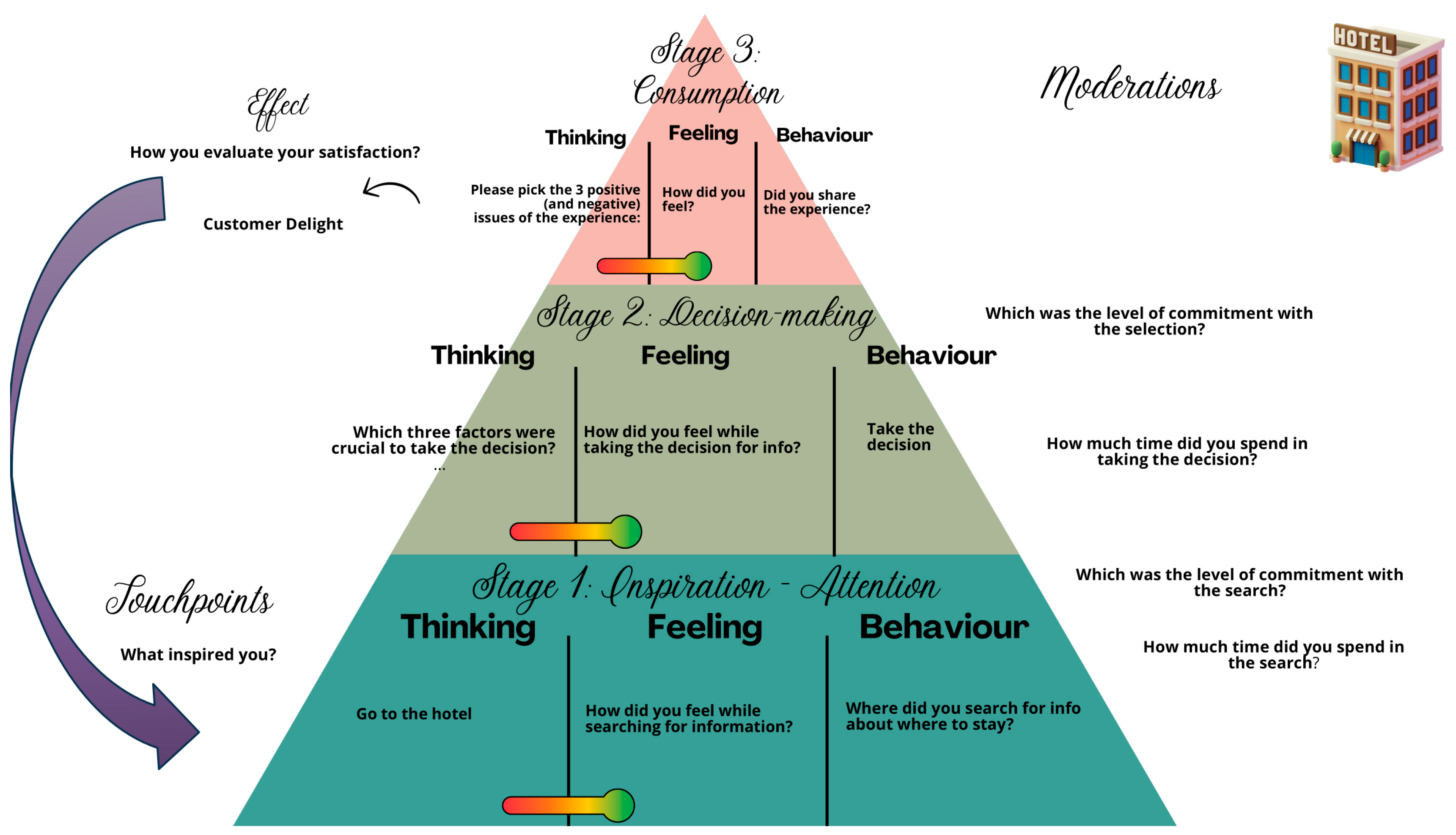
3.1. The Pyramid Model: Integrating Cognitive, Emotional, and Behavioral Dimensions
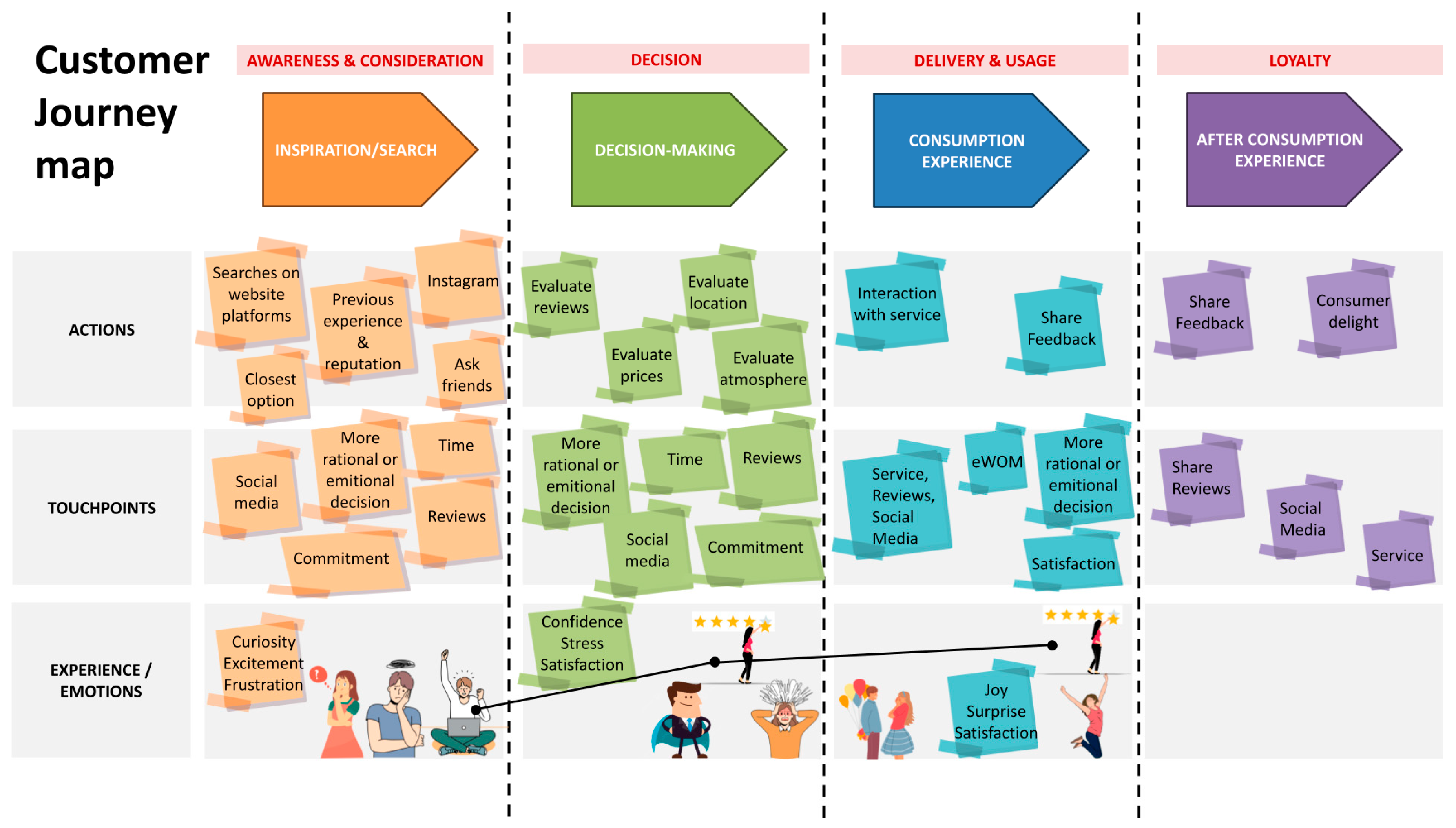
3.2. Operationalizing the Customer Journey: From Inspiration to Post-Consumption
4. The Customer Journey Tool in Practice: Measuring Cognitive, Emotional, and Behavioral Variables
Measurement Tool Evaluation Across the Customer Journey Stages
5. Conclusions
5.1. Theoretical Contributions
5.2. Practical Implications
5.3. Limitations
5.4. Future Research
Author Contributions
Funding
Institutional Review Board Statement
Informed Consent Statement
Data Availability Statement
Acknowledgments
Conflicts of Interest
Appendix A

| Phase | Construct | Question | Items | Authors |
|---|---|---|---|---|
| Inspiration and search | Inspiration & Attention | Describe what you did to find inspiration or how you got in touch with information that caught your attention about the hotel: | 1. A message in Instagram got my attention 2. My friends/family recommended it 3. My previous experience in the hotel 4. I knew because the reputation of the hotel. 5. I was in the area, and I show the hotel 6. It was the closest option given the aim of the tryp 7. I was searching for a hotel in internet | Adapted from Bhinde et al. (2023). |
| Information search | Where did you search for information (you can select 3 options) about where to stay? | 1. Google (or another search engine) 2. Recommendation at a restaurant, travel agency or other face-to-face external source 3. TripAdvisor 4. Comments on social media about the restaurant 5. Website (of the restaurant) 6. Instagram or other social media 7. I asked my friends/family 8. I didn’t search for information | Based on the study of Ho et al. (2012). | |
| Rational versus Emotional | In this search you would say that we were: | 1. More rational 2. More emotional 3. None of them | Based on the study of VanBergen et al. (2022). | |
| Commitment | Which was the level of commitment with the search, in a scale from 0 to 5 (being 0 not committed at all and 5 very committed? | 1. Not committed 2 3 4 5. Very committed | Adapted from Ni et al. (2022). | |
| Feelings | How did you feel while searching for information? (multiple options can be chosen): | 1. Happy 2. Understood 3. Frustrated 4. Angry 5. Ashamed 6. Guilty 7. Fearful 8. Proud 9. Pleased 10. Loved 11. Joyful 12. Respected 13. Sure 14. Overwhelmed 15. Worried 16. Unsure 17. None of the previous ones | Adapted from studies of Burns and Neisner (2006), and J. Kim and Fesenmaier (2017). | |
| Time | How much time did you spend in the search?: | 1. Less than 10 min 2. Between 10 and 20 min 3. Between 20 and 30 min 4. Between 30 min and 1 h 5. More than 1 h | Based on the study of Mieli (2023). | |
| Decision-making | Decision factors | Which three factors where crucial to take the decision? (you can select 5 options): | 1. The location 2. The restaurant 3. The atmosphere (in terms of other clients) 4. The staff 5. The size of the room 6. The design of the room 7. The luminosity (in terms of windows) of the room 8. The photos of the reception and entrance hall 9. The option of a spa 10. The option of a gym 11. The price 12. The breakfast 13. The local character of the hotel 14. The design 15. The prestige of the hotel 16. The exclusive atmosphere 17. The comments (TripAdvisor or other social media) 18. The comments from family/friends 19. The Parking 20. The photos of the bathroom 21. Available offers 22. The international atmosphere 23. The originality | Adapted for study’s purpose from Castro et al. (2017). |
| Rational versus Emotional | In your selection you would say that we were: | See “Inspiration and search” phase | ||
| Commitment | Which was the level of commitment with the selection, in a scale from 0 to 5 (being 0 not committed at all and 5 very committed?: | See “Inspiration and search” phase | ||
| Feelings | How did you feel while taking the decision for information? (multiple options can be chosen): | See “Inspiration and search” phase | ||
| Time | How much time did you spend in the taking the decision?: | See “Inspiration and search” phase | ||
| Consumption experience | Decision factors | Please pick the 3 main positive issues of the experience: | See “Decision-making” phase | |
| Please pick the 3 main negative issue of the experience: | ||||
| Feelings | How did you feel?: | See “Inspiration and search” phase | ||
| Rational versus Emotional | During the experience, you would say that you were: | See “Inspiration and search” phase | ||
| Satisfaction | How to you evaluate your satisfaction from 1 to 5 (being 1 very dissatisfied and 5 very satisfied): | 1. Very dissatisfied 2 3 4 5. Very satisfied | Adapted from Busser et al. (2022). | |
| eWOM | Did you share the experience?: | 1. Yes, online during the stay 2. Yes, online afterwards 3. Yes, online while and after the stay 4. Yes, talking with my family/friends 5. No | Based on the studies of Hysa et al. (2022), Meijerink and Schoenmakers (2021), and Lin et al. (2022). | |
| After consumption experience | Consumer delight | Finally, can you describe your level of agreement or disagreement with the following statements?: | 1. The experience in the hotel was very pleasant 2. The staff seemed interested in helping me 3. They were really helpful and polite 4. Most services were very satisfying 5. They made me think that I was very important 6. I was treated like royalty 7. The service I received was much more than generally necessary Affective dimension 8. The experience at the hotel was full of wonderful surprises 9. The hotel was a pleasant surprise 10. The stay was very exciting 11. I felt stimulated during the stay 12. My day/s in the hotel is truly a special one 13. I felt that I was exceptionally lucky that day 14. I never thought that I could enjoy a stay at a hotel so much | Based on the study of Liu and Keh (2015). |
References
- Aaker, J. (1997). Dimensions of brand personality. Journal of Marketing Research, 34(3), 347–356. [Google Scholar] [CrossRef]
- Abid, M. F., Quach, S., Shamim, A., Thaichon, P., & Siddique, J. (2025). Customer experience of co-creation vs. co-destruction in retailing: The role of key moments throughout the customer journey. Marketing Intelligence & Planning, 44(1), 96–120. [Google Scholar] [CrossRef]
- Agapito, D., & Sigala, M. (2024). Experience management in hospitality and tourism: Reflections and implications for future research. International Journal of Contemporary Hospitality Management, 36(13), 57–76. [Google Scholar] [CrossRef]
- Assiouras, I., Skourtis, G., Giannopoulos, A., Buhalis, D., & Karaosmanoglu, E. (2023). Testing the relationship between value co-creation, perceived justice and guests’ enjoyment. Current Issues in Tourism, 26(4), 587–602. [Google Scholar] [CrossRef]
- Bang, X., & Schweitzer, F. (2026). The role of digital and interpersonal touchpoints as drivers of future customer engagement intention in B2B service firms. Industrial Marketing Management, 134, 363–380. [Google Scholar] [CrossRef]
- Becker, L., & Jaakkola, E. (2020). Customer experience: Fundamental premises and implications for research. Journal of the Academy of Marketing Science, 48(4), 630–648. [Google Scholar] [CrossRef]
- Bhinde, H., Agarwal, P., Burande, A., Bobde, A., & Shukla, A. (2023). Influence of Instagram on buying behavior of Gen-Z and Zillennial consumers. IUP Journal of Brand Management, 20(3), 27–40. [Google Scholar]
- Bitner, M. J., Brown, S. W., & Meuter, M. L. (2000). Technology infusion in service encounters. Journal of the Academy of Marketing Science, 28(1), 138–149. [Google Scholar] [CrossRef]
- Bolton, R. N., McColl-Kennedy, J. R., Cheung, L., Gallan, A., Orsingher, C., Witell, L., & Zaki, M. (2018). Customer experience challenges: Bringing together digital, physical and social realms. Journal of Service Management, 29(5), 776–808. [Google Scholar] [CrossRef]
- Bonfanti, A., Vigolo, V., & Yfantidou, G. (2021). The impact of the COVID-19 pandemic on customer experience design: The hotel managers’ perspective. International Journal of Hospitality Management, 94, 102871. [Google Scholar] [CrossRef]
- Bonfanti, A., Vigolo, V., Yfantidou, G., & Gutuleac, R. (2023). Customer experience management strategies in upscale restaurants: Lessons from the COVID-19 pandemic. International Journal of Hospitality Management, 109, 103416. [Google Scholar] [CrossRef]
- Bowden, J. L.-H. (2009). The process of customer engagement: A conceptual framework. Journal of Marketing Theory and Practice, 17(1), 63–74. [Google Scholar] [CrossRef]
- Brunner-Sperdin, A., & Peters, M. (2009). What influences guests’ emotions? The case of high-quality hotels. International Journal of Tourism Research, 11(2), 171–183. [Google Scholar] [CrossRef]
- Buhalis, D., Papathanassis, A., & Vafeidou, M. (2022). Smart cruising: Smart technology applications and their diffusion in cruise tourism. Journal of Hospitality and Tourism Technology, 13(4), 626–649. [Google Scholar] [CrossRef]
- Burns, D. J., & Neisner, L. (2006). Customer satisfaction in a retail setting: The contribution of emotion. International Journal of Retail & Distribution Management, 34(1), 49–66. [Google Scholar] [CrossRef]
- Busser, J. A., Molintas, D. H., Shulga, L. V., & Lee, S. (2022). Check-in experience: What is the role of emotions and satisfaction? Journal of Hospitality and Tourism Management, 53, 188–197. [Google Scholar] [CrossRef]
- Carreira, R., Patrício, L., Jorge, R. N., & Magee, C. L. (2014). Understanding the travel experience and its impact on attitudes, emotions and loyalty towards the transportation provider—A quantitative study with mid-distance bus trips. Transport Policy, 31, 35–46. [Google Scholar] [CrossRef]
- Carvalho, P., & Alves, H. (2023). Customer value co-creation in the hospitality and tourism industry: A systematic literature review. International Journal of Contemporary Hospitality Management, 35(1), 250–273. [Google Scholar] [CrossRef]
- Castro, J. C., Quisimalin, M., de Pablos, C., Gancino, V., & Jerez, J. (2017). Tourism marketing: Measuring tourist satisfaction. Journal of Service Science and Management, 10(3), 280–308. [Google Scholar] [CrossRef]
- Cheong, Y. S., Seah, C. S., Loh, Y. X., & Loh, L. H. (2021). Artificial Intelligence (AI) in the food and beverage industry improves the customer experience. In 2021 2nd International Conference on Artificial Intelligence and Data Sciences (AiDAS) (pp. 1–6). IEEE. [Google Scholar] [CrossRef]
- Custódio Santos, M., Ferreira, A., Costa, C., & Santos, J. A. C. (2020). A model for the development of innovative tourism products: From service to transformation. Sustainability, 12(11), 4362. [Google Scholar] [CrossRef]
- De Keyser, A., Verleye, K., Lemon, K. N., Keiningham, T. L., & Klaus, P. (2020). Moving the customer experience field forward: Introducing the touchpoints, context, qualities (TCQ) nomenclature. Journal of Service Research, 23(4), 433–455. [Google Scholar] [CrossRef]
- Dolan, R., Seo, Y., & Kemper, J. (2019). Complaining practices on social media in tourism: A value co-creation and co-destruction perspective. Tourism Management, 73, 35–45. [Google Scholar] [CrossRef]
- Dominici, G., & Guzzo, R. (2010). Customer satisfaction in the hotel industry: A case study from Sicily. International Journal of Marketing Studies, 2(2), 3–12. [Google Scholar] [CrossRef]
- Fuller, R., Stocchi, L., Gruber, T., & Romaniuk, J. (2023). Advancing the understanding of the pre-purchase stage of the customer journey for service brands. European Journal of Marketing, 57(2), 360–386. [Google Scholar] [CrossRef]
- Griessmair, M., Han, S. H., & Masuda, H. (2022). Being moved or being satisfied? The effect of unexpected acts of personal kindness in hospitality service encounters. Cornell Hospitality Quarterly, 63(2), 267–288. [Google Scholar] [CrossRef]
- Guan, J., Wang, W., Guo, Z., Chan, J. H., & Qi, X. (2021). Customer experience and brand loyalty in the full-service hotel sector: The role of brand affect. International Journal of Contemporary Hospitality Management, 33(5), 1620–1645. [Google Scholar] [CrossRef]
- Ho, C. I., Lin, M. H., & Chen, H. M. (2012). Web users’ behavioural patterns of tourism information search: From online to offline. Tourism Management, 33(6), 1468–1482. [Google Scholar] [CrossRef]
- Hysa, B., Zdonek, I., & Karasek, A. (2022). Social media in sustainable tourism recovery. Sustainability, 14(2), 760. [Google Scholar] [CrossRef]
- Kim, H., & So, K. K. F. (2022). Two decades of customer experience research in hospitality and tourism: A bibliometric analysis and thematic content analysis. International Journal of Hospitality Management, 100, 103082. [Google Scholar] [CrossRef]
- Kim, J., & Fesenmaier, D. R. (2017). Sharing tourism experiences: The post trip experience. Journal of Travel Research, 56(1), 28–40. [Google Scholar] [CrossRef]
- Kim, Y. J., & Kim, H. S. (2022). The impact of hotel customer experience on customer satisfaction through online reviews. Sustainability, 14(2), 848. [Google Scholar] [CrossRef]
- Kotler, P., & Keller, K. L. (2016). Marketing management (15th ed.). Pearson. [Google Scholar]
- Larke, R., Kilgour, M., & O’Connor, H. (2018). Build touchpoints and they will come: Transitioning to omnichannel retailing. International Journal of Physical Distribution & Logistics Management, 48(4), 465–483. [Google Scholar] [CrossRef]
- Lemon, K. N., & Verhoef, P. C. (2016). Understanding customer experience throughout the customer journey. Journal of Marketing, 80(6), 69–96. [Google Scholar] [CrossRef]
- Lin, L. Z., Marine-Roig, E., & Llonch-Molina, N. (2022). Gastronomy tourism and well-being: Evidence from Taiwan and Catalonia Michelin-starred restaurants. International Journal of Environmental Research and Public Health, 19(5), 2778. [Google Scholar] [CrossRef] [PubMed]
- Liu, M. W., & Keh, H. T. (2015). Consumer delight and outrage: Scale development and validation. Journal of Service Theory and Practice, 25(6), 680–699. [Google Scholar] [CrossRef]
- Lyu, J., Krasonikolakis, I., & Chen, C. H. S. (2023). Unlocking the shopping myth: Can smartphone dependency relieve shopping anxiety?–A mixed-methods approach in UK Omnichannel retail. Information & Management, 60(5), 103818. [Google Scholar] [CrossRef]
- Masorgo, N., Mir, S., & Hofer, A. R. (2022). Expectations vs. experience: Managing the adverse effects of service failures on customer satisfaction in the airline industry. Transportation Journal, 61(3), 231–262. [Google Scholar] [CrossRef]
- Meijerink, J., & Schoenmakers, E. (2021). Why are online reviews in the sharing economy skewed toward positive ratings? Linking customer perceptions of service quality to leaving a review of an Airbnb stay. Journal of Tourism Futures, 7(1), 5–19. [Google Scholar] [CrossRef]
- Meyer, C., & Schwager, A. (2007). Understanding customer experience. Harvard Business Review, 85(2), 116. [Google Scholar]
- Mieli, M. (2023). Planned serendipity: Exploring tourists’ on-site information behaviour. Current Issues in Tourism, 27(6), 988–1002. [Google Scholar] [CrossRef]
- Narangajavana Kaosiri, Y., Callarisa Fiol, L. J., Moliner Tena, M. Á., Rodríguez Artola, R. M., & Sánchez García, J. (2019). User-generated content sources in social media: A new approach to explore tourist satisfaction. Journal of Travel Research, 58(2), 253–265. [Google Scholar] [CrossRef]
- Ni, J., Rhim, A. H. R., Chiu, D. K. W., & Ho, K. K. W. (2022). Information search behavior among Chinese self-drive tourists in the smartphone era. Information Discovery and Delivery, 50(3), 285–296. [Google Scholar] [CrossRef]
- Oliver, R. L. (1980). A cognitive model of the antecedents and consequences of satisfaction decisions. Journal of Marketing Research, 17(4), 460–469. [Google Scholar] [CrossRef]
- Oliver, R. L. (1999). Whence consumer loyalty? Journal of Marketing, 63(4), 33–44. [Google Scholar] [CrossRef]
- Reitsamer, B. F., Stokburger-Sauer, N. E., & Kuhnle, J. S. (2024). How and when effective customer journeys drive brand loyalty: The role of consumer-brand identification. Journal of Service Management, 35(6), 109–135. [Google Scholar] [CrossRef]
- Rong-Da Liang, A., Tung, W., Wang, T. S., & Hui, V. W. S. (2023). The use of co-creation within the community-based tourism experiences. Tourism Management Perspectives, 48, 101157. [Google Scholar] [CrossRef]
- Schmitt, B. H. (2003). Customer experience management: A revolutionary approach to connecting with your customers. John Wiley & Sons. [Google Scholar]
- Sharpley, R. (2021). On the need for sustainable tourism consumption. Tourist Studies, 21(1), 96–107. [Google Scholar] [CrossRef]
- So, K. K. F., Kim, H., & Oh, H. (2021). What makes Airbnb experiences enjoyable? The effects of environmental stimuli on perceived enjoyment and repurchase intention. Journal of Travel Research, 60(5), 1018–1038. [Google Scholar] [CrossRef]
- Sørensen, F., & Jensen, J. F. (2015). Value creation and knowledge development in tourism experience encounters. Tourism Management, 46, 336–346. [Google Scholar] [CrossRef]
- Tang, J. W., Tsai, P. H., & Hsieh, M. C. (2026). How to strengthen brand loyalty based on CBBE: An innovative evaluation model for mapping the customer journey and loyalty spiral. Journal of Innovation & Knowledge, 14, 100968. [Google Scholar] [CrossRef]
- Tayaba, M., Ayon, E. H., Mia, M. T., Sarkar, M., Ray, R. K., Chowdhury, M. S., Al-Imran, M., Nobe, N., Ghosh, B. P., Islam, M. T., & Puja, A. R. (2023). Transforming customer experience in the airline industry: A comprehensive analysis of twitter sentiments using machine learning and association rule mining. Journal of Computer Science and Technology Studies, 5(4), 194–202. [Google Scholar] [CrossRef]
- Tueanrat, Y., Papagiannidis, S., & Alamanos, E. (2021). Going on a journey: A review of the customer journey literature. Journal of Business Research, 125, 336–353. [Google Scholar] [CrossRef]
- VanBergen, N., Lurie, N. H., & Chen, Z. (2022). More rational or more emotional than others? Lay beliefs about decision-making strategies. Journal of Consumer Psychology, 32(2), 274–292. [Google Scholar] [CrossRef]
- Vargo, S. L., & Lusch, R. F. (2004). Evolving to a new dominant logic for marketing. Journal of Marketing, 68(1), 1–17. [Google Scholar] [CrossRef]
- Veblen, T. (1899). Mr. Cummings’s strictures on “the theory of the leisure class”. Journal of Political Economy, 8(1), 106–117. [Google Scholar] [CrossRef] [PubMed]
- Yachin, J. M. (2018). The ‘customer journey’: Learning from customers in tourism experience encounters. Tourism Management Perspectives, 28, 201–210. [Google Scholar] [CrossRef]
- Zheng, L., & Li, Y. (2024). Customer journey design in omnichannel retailing: Examining the effect of autonomy-competence-relatedness in brand relationship building. Journal of Retailing and Consumer Services, 78, 103776. [Google Scholar] [CrossRef]


Disclaimer/Publisher’s Note: The statements, opinions and data contained in all publications are solely those of the individual author(s) and contributor(s) and not of MDPI and/or the editor(s). MDPI and/or the editor(s) disclaim responsibility for any injury to people or property resulting from any ideas, methods, instructions or products referred to in the content. |
© 2026 by the authors. Licensee MDPI, Basel, Switzerland. This article is an open access article distributed under the terms and conditions of the Creative Commons Attribution (CC BY) license.
Share and Cite
Santos, C.R.; Blanco-Moreno, S.; hAnnracháin, C.Ó.; Bayram-Arlı, N. A Holistic Approach to Customer Journey Management: Driving Satisfaction and Competitive Advantage in Tourism. Tour. Hosp. 2026, 7, 126. https://doi.org/10.3390/tourhosp7050126
Santos CR, Blanco-Moreno S, hAnnracháin CÓ, Bayram-Arlı N. A Holistic Approach to Customer Journey Management: Driving Satisfaction and Competitive Advantage in Tourism. Tourism and Hospitality. 2026; 7(5):126. https://doi.org/10.3390/tourhosp7050126
Chicago/Turabian StyleSantos, Carmen R., Sofía Blanco-Moreno, Ciarán Ó hAnnracháin, and Nuran Bayram-Arlı. 2026. "A Holistic Approach to Customer Journey Management: Driving Satisfaction and Competitive Advantage in Tourism" Tourism and Hospitality 7, no. 5: 126. https://doi.org/10.3390/tourhosp7050126
APA StyleSantos, C. R., Blanco-Moreno, S., hAnnracháin, C. Ó., & Bayram-Arlı, N. (2026). A Holistic Approach to Customer Journey Management: Driving Satisfaction and Competitive Advantage in Tourism. Tourism and Hospitality, 7(5), 126. https://doi.org/10.3390/tourhosp7050126