

Influence of Brand Personality on Tourist Behavior in Peruvian Destinations: The Mediating Role of Experience, Authenticity, and Trust
 and
and
Abstract
1. Introduction
1.1. Literature Review
1.2. Brand Personality
1.3. Tourist Behavior
1.4. Tourist Experience
1.5. Authenticity of the Tourist Destination
1.6. Trust in the Tourist Destination
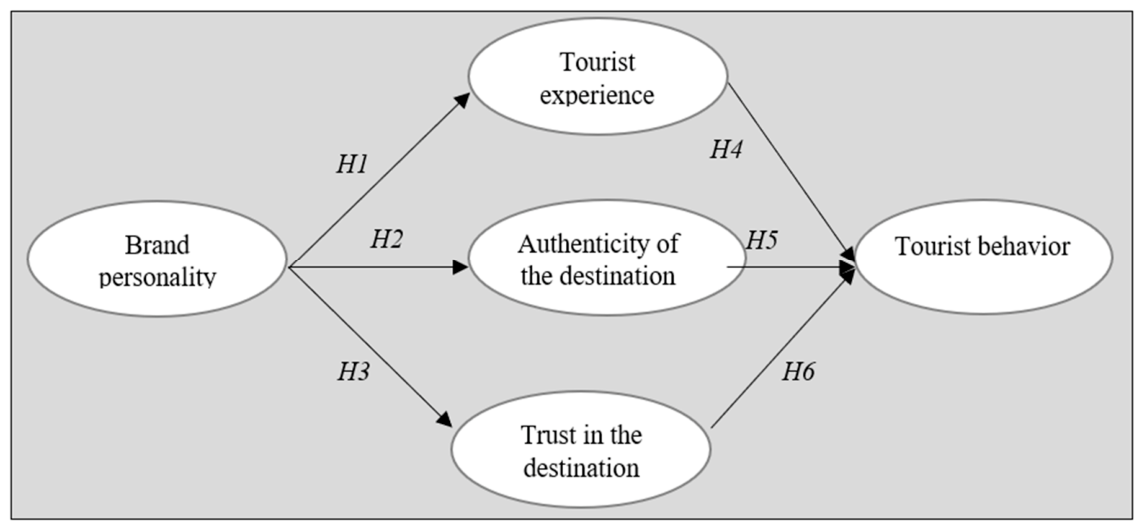
1.7. Hypothesis Development
2. Materials and Methods
2.1. Research Design
2.2. Sample
2.3. Instruments and Data Collection
2.4. Data Analysis
3. Results
3.1. Sample Characterization
3.2. Descriptive Analysis
3.3. Analysis of the Theoretical Model
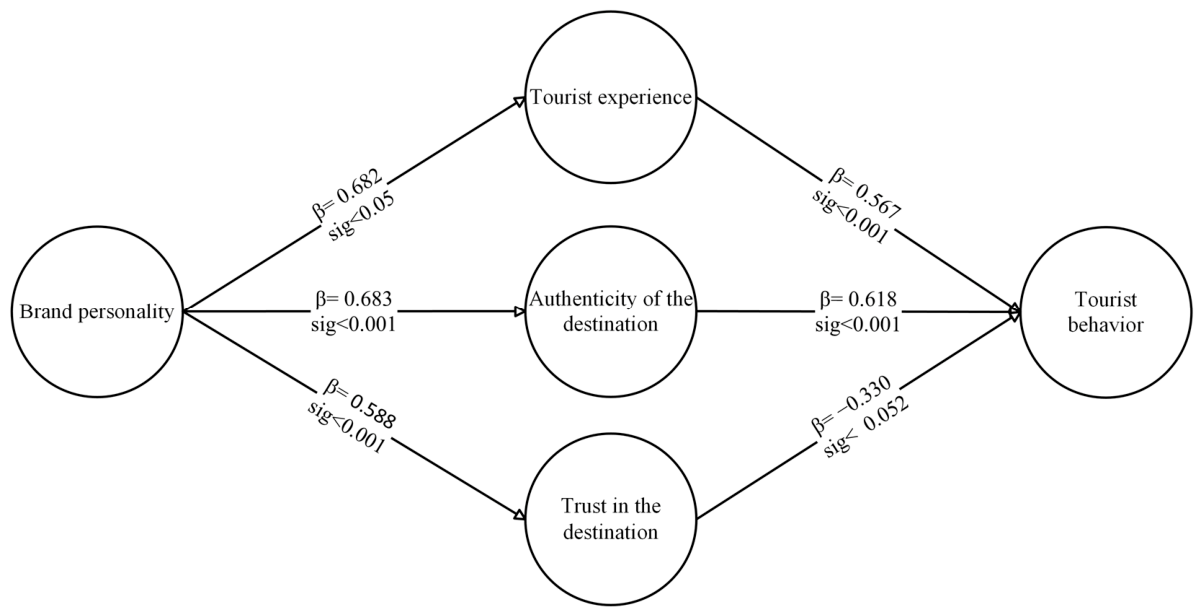
3.4. Hypothesis Testing
4. Discussion
4.1. Theoretical and Practical Implications of the Study
4.2. Limitations and Future Research Directions
5. Conclusions
Author Contributions
Funding
Institutional Review Board Statement
Informed Consent Statement
Data Availability Statement
Conflicts of Interest
References
- Aguilar-Rivero, M., Orgaz-Agüera, F., López-Guzmán, T., & Moral-Cuadra, S. (2025). Narratives, emotions and return: A proposed SOR model of film tourism. Current Issues in Tourism, 1–23. [Google Scholar] [CrossRef]
- Ajeyalemi, O. F., & Olarewaju, A. D. (2021). Destination personality as predictor of symbolic consumption in Nigeria’s tourism industry. In New frontiers in hospitality and tourism management in Africa (pp. 35–53). Tourism, hospitality and event management. Springer. [Google Scholar] [CrossRef]
- Al-Haddad, S. (2025). The impact of brand personality of smartphones on customer loyalty: Mediating role of brand awareness [أثر شخصية العلامة التجارية للهواتف الذكية في ولاء العملاء: الدور الوسيط للوعي بالعلامة التجارية]. Jordan Journal of Business Administration, 21(2), 195–219. [Google Scholar] [CrossRef]
- Attiq, S., Kashif, M., Shamim, A., & Afzal, H. (2025). Influence of brand personality congruence, brand attachment, brand love and obsessive passion on compulsive buying behavior. Pakistan Journal of Commerce and Social Sciences, 19(2), 357–384. [Google Scholar] [CrossRef]
- Azeez, Z. A. (2021). The impact of destination image on tourist behavior: Karbala as a case study. International Journal of Sustainable Development and Planning, 16(7), 1287–1298. [Google Scholar] [CrossRef]
- Bo, L. (2026). How online reviews, word-of-mouth, brand image, and tourism experience influence tourist satisfaction? Sage Open, 16(1). [Google Scholar] [CrossRef]
- Borthakur, M., & Kondasani, R. K. R. (2026). Responsible tourist behavior in ecotourism: The roles of value, satisfaction and intention. Leisure/Loisir, 50(2), 413–436. [Google Scholar] [CrossRef]
- Chang, A. Y. P., & Hung, K. P. (2021). Development and validation of a tourist experience scale for cultural and creative industries parks. Journal of Destination Marketing and Management, 20, 100560. [Google Scholar] [CrossRef]
- Chang, J., Okumus, B., Li, Z.-W., & Lin, H.-H. (2021). What serves as the best bridge in food consumption: Experiential value or place attachment? Asia Pacific Journal of Tourism Research, 26(12), 1302–1317. [Google Scholar] [CrossRef]
- Chauhan, J. S., Agarwal, P., Kumar, H., Sharma, M., & Thapliyal, M. (2024). Analysing antecedent and consequences of trust in m-commerce for sustainability in tourism industry in Uttarakhand. International Journal of Electronic Business, 19(2), 139–155. [Google Scholar] [CrossRef]
- Chen, C. F., & Phou, S. (2013). A closer look at destination: Image, personality, relationship and loyalty. Tourism Management, 36, 269–278. [Google Scholar] [CrossRef]
- Chen, R., Zhou, Z., Zhan, G., & Zhou, N. (2020). The impact of destination brand authenticity and destination brand self-congruence on tourist loyalty: The mediating role of destination brand engagement. Journal of Destination Marketing & Management, 15, 100402. [Google Scholar] [CrossRef]
- Chen, X., & Lee, G. (2021). How does brand legitimacy shapes brand authenticity and tourism destination loyalty: Focus on cultural heritage tourism. Global Business and Finance Review, 26(1), 53–67. [Google Scholar] [CrossRef]
- Chen, X., Lee, T. J., & Hyun, S. S. (2025). Visitors’ self-expansion and perceived brand authenticity in a cultural heritage tourism destination. Journal of Vacation Marketing. [Google Scholar] [CrossRef]
- Cheng, X., Chi, X., & Han, H. (2023). Perceived authenticity and the heritage tourism experience: The case of Emperor Qinshihuang’s Mausoleum Site Museum. Asia Pacific Journal of Tourism Research, 28(6), 503–520. [Google Scholar] [CrossRef]
- Churchill, G. A. (1979). A paradigm for developing better measures of marketing constructs. Journal of Marketing Research, 16(1), 64. [Google Scholar] [CrossRef]
- Claudino, A. de L., Perinotto, A. R. C., & Lanzarini, R. (2026). Considerações sobre a marca “cidade da moda” em destinos turísticos. Revista Prâksis, 1, 260–283. [Google Scholar] [CrossRef]
- Cruz-Tarrillo, J. J. (2025). Psychometric evaluation of the tourist behavior scale: Insights from Peruvian tourists. Innovative Marketing, 21(2), 68–78. [Google Scholar] [CrossRef]
- Cruz-Tarrillo, J. J., Tarqui, E. E. A., Turpo-Chaparro, J., & Haro-Zea, K. L. (2022). Design and validation of the brand personality scale in tourist destinations. Innovative Marketing, 18(2), 1–12. [Google Scholar] [CrossRef]
- Çizel, B., Kırtıl, İ. G., Aşkun, V., Ajanovic, E., & Karakaş, H. (2022). Symmetric and asymmetric analysis of tourist behavioral intention’s antecedents. Quality and Quantity, 56(6), 4599–4622. [Google Scholar] [CrossRef]
- Escobedo, M., Hernández, A. J., Estebané, V., & Martínez, G. (2016). Modelos de ecuaciones estructurales: Características, fases, construcción, aplicación y resultados structural equation modeling: Features, phases, construction, implementation and results. Revista Ciencia y Trabajo, 18(55), 16–22. [Google Scholar] [CrossRef]
- Gao, W., Cao, D., Lyu, T., & Yang, Y. (2026). Revisit intentions of sports tourists: An extended theory of planned behavior approach. BMC Psychology, 14(1), 152. [Google Scholar] [CrossRef]
- Guleria, A., Joshi, R., & Adil, M. (2024). The impact of memorable tourism experiences on customer-based destination brand equity: The mediating role of destination attachment and overall satisfaction. Journal of Hospitality and Tourism Insights, 7(4), 1994–2013. [Google Scholar] [CrossRef]
- Guo, Y., Yu, M., & Zhao, Y. (2024). Impact of destination advertising on tourists’ visit intention: The influence of self-congruence, self-confidence, and destination reputation. Journal of Destination Marketing and Management, 31, 100852. [Google Scholar] [CrossRef]
- Gupta, S. K., Gupta, S., & Jaiswal, R. (2026). Mobile wallet adoption in tourism economies: The role of trust, incentives, and user behavior. Quality & Quantity, 60(2), 3813–3845. [Google Scholar] [CrossRef]
- Gupta, V., & Sharma, K. (2024). Fusion or confusion: How customization of Fijian street food influences tourist’s perceived authenticity and destination experiences? Tourism Recreation Research, 49(6), 1512–1529. [Google Scholar] [CrossRef]
- Han, C., Cui, X., Fan, J., Wang, Y., & Zhong, D. (2025). The impact of tourism experience-sharing behavior on consumer tourism loyalty: The moderating role of psychological satisfaction. International Journal of Human-Computer Interaction, 42(3), 1576–1596. [Google Scholar] [CrossRef]
- Hariani, D., Hanafiah, M. H., Anuar, N. A. M., & Ahmad, K. N. (2026). Promoting halal tourism in sharia -compliant destination: Insights on aceh competitiveness and tourist perceived value and behavior. Tourism and Hospitality Research, 26(1), 159–175. [Google Scholar] [CrossRef]
- Hasan, M. K., Ray, R., & Neela, N. M. (2023). Tourists’ behavioural intention in coastal tourism settings: Examining the mediating role of attitude to behaviour. Tourism Planning and Development, 20(6), 955–972. [Google Scholar] [CrossRef]
- He, X., Ye, C., Huang, S., & Su, L. (2026). The “green persuasion effect” of negative messages: How and when message framing influences tourists’ environmentally responsible behavior. Journal of Travel Research, 65(1), 121–139. [Google Scholar] [CrossRef]
- Heine, K. (2010). The personality of luxury fashion brands. Journal of Global Fashion Marketing, 1(3), 154–163. [Google Scholar] [CrossRef]
- Hosany, S., Ekinci, Y., & Uysal, M. (2006). Destination image and destination personality: An application of branding theories to tourism places. Journal of Business Research, 59(5), 638–642. [Google Scholar] [CrossRef]
- Hultman, M., Skarmeas, D., & Robson, M. (2016). The effects of destination personality on tourist satisfaction, identification, and behaviour. In Developments in marketing science: Proceedings of the academy of marketing science (pp. 285–286). Springer Nature. [Google Scholar] [CrossRef]
- Hultman, M., Strandberg, C., Oghazi, P., & Mostaghel, R. (2017). The role of destination personality fit in destination branding: Antecedents and outcomes. Psychology and Marketing, 34(12), 1073–1083. [Google Scholar] [CrossRef]
- Huo, T., Yuan, F., Huo, M., Shao, Y., Li, S., & Li, Z. (2023). Residents’ participation in rural tourism and interpersonal trust in tourists: The mediating role of residents’ perceptions of tourism impacts. Journal of Hospitality and Tourism Management, 54, 457–471. [Google Scholar] [CrossRef]
- Jan, S. Q., Junfeng, J., Iqbal, M. B., Raza, A., Baig, M., & Majeed, K. A. (2025a). The role of sustainable digital innovation in achieving sustainability in female-owned businesses of Gilgit-Baltistan: Do entrepreneurial attitude, perceived behavior and subjective norms matter. Discover Sustainability, 6(1), 304. [Google Scholar] [CrossRef]
- Jan, S. Q., Junfeng, J., Iqbal, M. B., Raza, A., Naz, M., & Bhatt, T. K. (2025b). The impact of entrepreneurial ecosystems and sustainable digital innovation on business performance: A study of Gilgit-Baltistan Pakistan. Frontiers in Sustainability, 6, 1485680. [Google Scholar] [CrossRef]
- Jimenez-García, D., Espinoza Heredia, O., Cruz Lizana, E., Cruz-Tarrillo, J. J., & Millones-Liza, D. Y. (2025). Destination image and brand value as predictors of tourist behavior: Happiness as a mediating link. Administrative Sciences, 15(5), 176. [Google Scholar] [CrossRef]
- Kim, J.-H. (2018). The impact of memorable tourism experiences on loyalty behaviors: The mediating effects of destination image and satisfaction. Journal of Travel Research, 57(7), 856–870. [Google Scholar] [CrossRef]
- Kim, M., & Kim, J. (2020). Destination authenticity as a trigger of tourists’ online engagement on social media. Journal of Travel Research, 59(7), 1238–1252. [Google Scholar] [CrossRef]
- Kolar, T., & Zabkar, V. (2010). A consumer-based model of authenticity: An oxymoron or the foundation of cultural heritage marketing? Tourism Management, 31(5), 652–664. [Google Scholar] [CrossRef]
- Kong, Y.-Q., Kwon, Y.-J., Girish, V. G., Lee, C.-K., & Reisinger, Y. (2024). The impact of destination brand experience on arousal, memorable tourism experience, and revisit intention: Gyeongbok palace night tour. Asia Pacific Journal of Tourism Research, 29(9), 1063–1078. [Google Scholar] [CrossRef]
- Kovačić, S., & Šagovnović, I. (2023). Exploring the relationship between tourists’ emotional experience, destination personality perception, satisfaction and behavioral intentions. Psihologija, 56(3), 371–398. [Google Scholar] [CrossRef]
- Kumar, V., & Kaushik, A. K. (2017). Achieving destination advocacy and destination loyalty through destination brand identification. Journal of Travel and Tourism Marketing, 34(9), 1247–1260. [Google Scholar] [CrossRef]
- Lee, S., & Kim, D.-Y. (2020). The BRAND tourism effect on loyal customer experiences in luxury hotel: The moderating role of psychological ownership. Tourism Management Perspectives, 35, 100725. [Google Scholar] [CrossRef]
- Liu, J., Wang, C., Fang, S., & Zhang, T. (2019). Scale development for tourist trust toward a tourism destination. Tourism Management Perspectives, 31, 383–397. [Google Scholar] [CrossRef]
- Loureiro, S. M. C. (2020). How does the experience and destination authenticity influence “affect”? Anatolia, 31(3), 449–465. [Google Scholar] [CrossRef]
- Maciel, J. R. B., Francisco-Maffezzolli, E. C., & Martins, E. (2018). Autenticidade de lugar. Revista Turismo em Análise, 29(3), 413–427. [Google Scholar] [CrossRef]
- Maghrifani, D., Li, T., & Liu, J. (2019). Understanding tourists’ experience expectation: A study of Chinese tourists’ behavior in Bali. International Journal of Business, 24(3), 249–260. [Google Scholar]
- Mahajan, Y., Chandwaskar, P., Malhotra, M., Sharma, V., & Nandurkar, P. (2026). Does gender matter? Exploring the brand personality–loyalty relationship in the Indian FMCG market. Cogent Business & Management, 13(1). [Google Scholar] [CrossRef]
- Majeed, S., & Kim, W. G. (2024). Investigating the role of destination-based brand authenticity and brand love on tourist–brand interaction, destination brand engagement, and tourist behavior (pp. 255–271). Springer. [Google Scholar] [CrossRef]
- Medina, M., Rojas, R., Bustamante, W., Loaiza, R., Martel, C., & Castillo, R. (2023). Metodología de la investigación: Técnicas e instrumentos de investigación. In Metodología de la investigación: Técnicas e instrumentos de investigación. Instituto Universitario de Innovación Ciencia y Tecnología Inudi Perú. [Google Scholar] [CrossRef]
- Melo, H. M. P., Moniz, A. I. D. S. A., Silva, F. J. F., & Santos, C. A. S. M. (2021). TourExponomy: Development of a conceptual model of the relationship between the tourist experience at the destination and destination image. In A. Abreu, D. Liberato, E. A. González, & J. C. Garcia Ojeda (Eds.), Smart innovation, systems and technologies (Vol. 209, pp. 66–75). Springer Science and Business Media Deutschland GmbH. [Google Scholar] [CrossRef]
- Nguyen, T. T. T., & Duong, T. D. H. (2025). The role of nostalgic emotion in shaping destination image and behavioral intentions—An empirical study. Journal of Hospitality and Tourism Insights, 8(2), 735–752. [Google Scholar] [CrossRef]
- Ortiz, M. S. (2018). Modelo de Ecuaciones Estructurales: Una guía para ciencias médicas y ciencias de la salud Structural Equation modeling: A guide for Medical and Health sciences. Terapia Psicológica, 36, 47–53. [Google Scholar] [CrossRef]
- Ragab, H., Mahrous, A. A., & Ghoneim, A. (2020). Egypt’s perceived destination image and its impact on tourist’s future behavioural intentions. International Journal of Tourism Cities, 6(2), 449–466. [Google Scholar] [CrossRef]
- Ragb, H., Mahrous, A. A., & Ghoneim, A. (2020). A proposed measurement scale for mixed-images destinations and its interrelationships with destination loyalty and travel experience. Tourism Management Perspectives, 35, 100677. [Google Scholar] [CrossRef]
- Rasoolimanesh, S. M., Seyfi, S., Hall, C. M., & Hatamifar, P. (2021). Understanding memorable tourism experiences and behavioural intentions of heritage tourists. Journal of Destination Marketing and Management, 21, 100621. [Google Scholar] [CrossRef]
- Rickly, J. M. (2022). A review of authenticity research in tourism: Launching the annals of tourism research curated collection on authenticity. Annals of Tourism Research, 92, 103349. [Google Scholar] [CrossRef]
- Rini, E. S., Rombe, E., & Tarigan, M. I. (2024). Brand destination loyalty: The antecedents of destination brand experience. Cogent Business and Management, 11(1), 2320992. [Google Scholar] [CrossRef]
- Roy, S. (2026). From shoreline to shrine: Restructuring Digha’s destination brand identity through spiritual tourism. South Asian Journal of Business and Management Cases, 15(1), 37–58. [Google Scholar] [CrossRef]
- Sahoo, M. (2019). Structural equation modeling: Threshold criteria for assessing model fit. In Methodological issues in management research: Advances, challenges, and the way ahead (pp. 269–276). Emerald Group Publishing Ltd. [Google Scholar] [CrossRef]
- Saltık, Z., & Akova, O. (2026). Who goes green? Demographic drivers of sustainable tourist behavior. Anatolia, 37(1), 82–97. [Google Scholar] [CrossRef]
- Shang, W., Yuan, Q., & Chen, N. (2020). Examining structural relationships among brand experience, existential authenticity, and place attachment in slow tourism destinations. Sustainability, 12(7), 2784. [Google Scholar] [CrossRef]
- Sharifsamet, S., Jin, H. S., & Martin, B. (2020). Marketing destinations: The impact of destination personality on consumer attitude. Journal of Strategic Marketing, 28(1), 60–69. [Google Scholar] [CrossRef]
- Shi, H., Liu, Y., Kumail, T., & Pan, L. (2022). Tourism destination brand equity, brand authenticity and revisit intention: The mediating role of tourist satisfaction and the moderating role of destination familiarity. Tourism Review, 77(3), 751–779. [Google Scholar] [CrossRef]
- Sincić, D., & Roglić, M. (2015). Luxury fashion brand’s personality. Ekonomski Pregled, 66(2), 138–155. [Google Scholar]
- Sop, S. A., & Kozak, N. (2019). Effects of brand personality, self-congruity and functional congruity on hotel brand loyalty. Journal of Hospitality Marketing and Management, 28(8), 926–956. [Google Scholar] [CrossRef]
- Steriopoulos, E., Hall, J., Lockstone-Binney, L., Steel, M., & Wong, H. Y. (2024). Transformative brand experiences and consumer-based brand equity in heritage tourism: The role of authenticity and motives. Journal of Vacation Marketing, 32(1), 202–218. [Google Scholar] [CrossRef]
- Su, C.-W., Meng, X.-L., Tao, R., & Umar, M. (2023). Chinese consumer confidence: A catalyst for the outbound tourism expenditure? Tourism Economics, 29(3), 696–717. [Google Scholar] [CrossRef]
- Taheri, B., Gannon, M. J., & Kesgin, M. (2020). Visitors’ perceived trust in sincere, authentic, and memorable heritage experiences. Service Industries Journal, 40(9–10), 705–725. [Google Scholar] [CrossRef]
- Takata, K., & Hallmann, K. (2025). Experiencing authenticity at heritage sporting events. Event Management, 29(4), 601–618. [Google Scholar] [CrossRef]
- Tang, J., Wang, J., Zhang, M., & Huang, W. (2023). How destination brand experience influences tourist citizenship behavior: Testing mediation of brand relationship quality and moderation effects on commitment. Frontiers in Psychology, 14, 1080457. [Google Scholar] [CrossRef] [PubMed]
- Teng, H.-Y., & Chen, C.-Y. (2020). Enhancing celebrity fan-destination relationship in film-induced tourism: The effect of authenticity. Tourism Management Perspectives, 33, 100605. [Google Scholar] [CrossRef]
- Tsaur, S.-H., Hsu, F.-S., & Ching, H.-W. (2023). The impacts of brand personality and self-congruity on consumers’ intention to stay in a hotel: Does consumer affinity matter? Journal of Hospitality and Tourism Insights, 6(1), 246–262. [Google Scholar] [CrossRef]
- Vicencio-Ríos, G., Rubio, A., Araya-Castillo, L., & Moraga-Flores, H. (2023). Scientometric analysis of brand personality. Sustainability, 15(1), 731. [Google Scholar] [CrossRef]
- Wut, T. M., Lee, D., & Lee, S. W. (2023). Does attitude or intention affect behavior in sustainable tourism? A review and research agenda. Sustainability, 15(19), 14076. [Google Scholar] [CrossRef]
- Yanu, A., Fianto, A., & Candraningrat. (2018). The influence of destination brand communication and destination brand trust toward visitor loyalty of marine tourism in east Java, Indonesia. International Journal of Civil Engineering and Technology, 9(8), 910–923. [Google Scholar]
- Yildirim, H. M., & Türkmen, S. (2026). Beyond the cup: Exploring the dynamics from brand experience, personality, and prestige to trust, satisfaction and loyalty in coffee houses. Journal of Quality Assurance in Hospitality & Tourism, 1–21. [Google Scholar] [CrossRef]
- Yin, S., & Dai, G. (2021). Authenticity and tourist loyalty: A meta-analysis. Asia Pacific Journal of Tourism Research, 26(12), 1331–1349. [Google Scholar] [CrossRef]
- Zhang, X., Wong, H. S.-M., & Tavitiyaman, P. (2025). Travel confidence, constraints and behaviors of Chinese outbound tourists in the new normal: A longitudinal case study of Hong Kong. Journal of Hospitality and Tourism Insights, 8(9), 3302–3319. [Google Scholar] [CrossRef]
- Zhou, G., & Chen, W. (2023). Agritourism experience value cocreation impact on the brand equity of rural tourism destinations in China. Tourism Review, 78(5), 1315–1335. [Google Scholar] [CrossRef]
- Zhou, G., Chen, Y., & Liu, Y. (2025). From inner needs to external actions: The impact of face consciousness on tourists’ pro-environmental behavior. Asia Pacific Journal of Tourism Research, 30(1), 92–109. [Google Scholar] [CrossRef]



| Variables | Categories | Frequency | % |
|---|---|---|---|
| Sex | Female | 296 | 57.6% |
| Male | 218 | 42.4% | |
| Educational level | Elementary | 13 | 2.5% |
| Secondary | 91 | 17.7% | |
| University | 314 | 61.1% | |
| Postgraduate | 96 | 18.7% | |
| Type of tourist | Local tourist | 188 | 36.6% |
| Regional tourist | 168 | 32.7% | |
| National tourist | 143 | 27.8% | |
| International tourist | 15 | 2.9% | |
| Household income level | Less than 1000 soles | 95 | 18.5% |
| Between 1001 and 1500 soles | 139 | 27.0% | |
| Between 1501 and 2000 soles | 103 | 20.0% | |
| Between 2001 and 2500 soles | 70 | 13.6% | |
| More than 2500 soles | 107 | 20.8% | |
| Employment status | Dependent | 249 | 48.4% |
| Independent | 159 | 30.9% | |
| Unemployed | 23 | 4.5% | |
| Retired | 9 | 1.8% | |
| Student | 74 | 14.4% | |
| Duration of the tourist trip | Less than 24 h | 204 | 39.7% |
| Between 2 and 3 days | 221 | 43.0% | |
| More than 3 days | 89 | 17.3% | |
| Daily expenditure | Less than 50 soles | 117 | 22.8% |
| Between 51 and 100 soles | 204 | 39.7% | |
| Between 100 and 150 soles | 117 | 22.8% | |
| More than 150 soles | 76 | 14.8% | |
| Whom did you travel with? | Alone | 61 | 11.9% |
| With my partner | 136 | 26.5% | |
| With my friends | 183 | 35.6% | |
| With family members | 134 | 26.1% |
| Construct | Aiken | Alpha | CR | AVE |
|---|---|---|---|---|
| Brand personality | 1.00 | 0.954 | 0.969 | 0.887 |
| Tourist experience | 0.966 | 0.886 | 0.923 | 0.857 |
| Destination authenticity | 0.992 | 0.882 | 0.917 | 0.847 |
| Confidence in the destination | 0.990 | 0.912 | 0.925 | 0.805 |
| Tourist behavior | 0.990 | 0.902 | 0.951 | 0.764 |
| Construct | PM | EXP | AUT | CONF | COMP |
|---|---|---|---|---|---|
| Brand personality (PM) | 0.920 | ||||
| Tourist experience (EXP) | 0.682 | 0.874 | |||
| Destination authenticity (AUT) | 0.683 | 0.891 | 0.897 | ||
| Confidence in the destination (CONF) | 0.588 | 0.858 | 0.877 | 0.926 | |
| Tourist behavior (COMP) | 0.614 | 0.834 | 0.834 | 0.698 | 0.942 |
| Research Hypothesis Test | Path Coefficient | p-Value | Decision | |||
|---|---|---|---|---|---|---|
| H1 | Brand personality | ---> | Tourist experience | 0.682 | *** | Accepted |
| H2 | Brand personality | ---> | Tourist trust | 0.588 | *** | Accepted |
| H3 | Brand personality | ---> | Authenticity of the destination | 0.683 | *** | Accepted |
| H4 | Tourist trust | ---> | Tourist behavior | −0.330 | 0.052 | Rejected |
| H5 | Tourist authenticity | ---> | Tourist behavior | 0.618 | *** | Accepted |
| H6 | Destination experience | ---> | Tourist behavior | 0.567 | *** | Accepted |
| Indirect effects | ||||||
| Brand personality → Experience → Tourist behavior | 0.386 | 0.002 | Supported | |||
| Brand personality → Authenticity → Tourist behavior | 0.422 | 0.006 | Supported | |||
| Brand personality → Tourist trust → Behavior | −0.194 | 0.051 | Rejected | |||
| Total indirect effect | 0.614 | 0.000 | Supported | |||
Disclaimer/Publisher’s Note: The statements, opinions and data contained in all publications are solely those of the individual author(s) and contributor(s) and not of MDPI and/or the editor(s). MDPI and/or the editor(s) disclaim responsibility for any injury to people or property resulting from any ideas, methods, instructions or products referred to in the content. |
© 2026 by the authors. Licensee MDPI, Basel, Switzerland. This article is an open access article distributed under the terms and conditions of the Creative Commons Attribution (CC BY) license.
Share and Cite
Trigoso-Guevara, V.; Torres-Cortez, K.L.; Peralta-Córdova, F.M.; Cruz-Tarrillo, J.; Diaz-Saavedra, R.A. Influence of Brand Personality on Tourist Behavior in Peruvian Destinations: The Mediating Role of Experience, Authenticity, and Trust. Tour. Hosp. 2026, 7, 151. https://doi.org/10.3390/tourhosp7060151
Trigoso-Guevara V, Torres-Cortez KL, Peralta-Córdova FM, Cruz-Tarrillo J, Diaz-Saavedra RA. Influence of Brand Personality on Tourist Behavior in Peruvian Destinations: The Mediating Role of Experience, Authenticity, and Trust. Tourism and Hospitality. 2026; 7(6):151. https://doi.org/10.3390/tourhosp7060151
Chicago/Turabian StyleTrigoso-Guevara, Vilma, Kasandra Lisset Torres-Cortez, Fiorely Margoth Peralta-Córdova, Joel Cruz-Tarrillo, and Robin Alexander Diaz-Saavedra. 2026. "Influence of Brand Personality on Tourist Behavior in Peruvian Destinations: The Mediating Role of Experience, Authenticity, and Trust" Tourism and Hospitality 7, no. 6: 151. https://doi.org/10.3390/tourhosp7060151
APA StyleTrigoso-Guevara, V., Torres-Cortez, K. L., Peralta-Córdova, F. M., Cruz-Tarrillo, J., & Diaz-Saavedra, R. A. (2026). Influence of Brand Personality on Tourist Behavior in Peruvian Destinations: The Mediating Role of Experience, Authenticity, and Trust. Tourism and Hospitality, 7(6), 151. https://doi.org/10.3390/tourhosp7060151