
How Cultural Tourism Itineraries Shape Tourist Guide Satisfaction and Retention



Abstract
1. Introduction
2. Literature Review
2.1. Cultural Tourism and Cultural Tourism Itineraries
Characteristics of Cultural Tourism Itineraries
2.2. Job Satisfaction
2.3. Career Retention
2.4. Cultural Tourism Itineraries, Job Satisfaction and Career Retention
The Mediating Role of Job Satisfaction in Career Retention
3. Methodology
3.1. Research Design
3.2. Participants
3.3. Survey Instrument
3.4. Data Collection Process
3.5. Data Analysis Procedures
3.6. Statistical Procedures
4. Results
4.1. Descriptive Analysis
4.2. Gender and Scope-of-Activity Differences
4.3. Hypothesis Testing
5. Discussion
6. Conclusions
6.1. Theoretical Implications
6.2. Practical Implications
6.3. Limitations and Future Research
Author Contributions
Funding
Institutional Review Board Statement
Informed Consent Statement
Data Availability Statement
Acknowledgments
Conflicts of Interest
References
- Ajzen, I. (1985). From intentions to actions: A theory of planned behavior. In J. Kuhl, & J. Beckmann (Eds.), Action-control: From cognition to behavior (pp. 11–39). Springer. [Google Scholar] [CrossRef]
- Ajzen, I. (1991). The theory of planned behavior. Organizational Behavior and Human Decision Processes, 50(2), 179–211. [Google Scholar] [CrossRef]
- Akgunduz, Y., & Eser, S. (2022). The effects of tourist incivility, job stress and job satisfaction on tourist guides’ vocational commitment. Journal of Hospitality and Tourism Insights, 5(1), 186–204. [Google Scholar] [CrossRef]
- Akkuş, G., & Arslan, A. (2023). Work-related stress experienced by tour guides. Turyzm/Tourism, 33(2), 95–110. [Google Scholar] [CrossRef]
- Amissah, E. F., Blankson-Stiles-Ocran, S., & Mensah, I. (2022). Emotional labour, emotional exhaustion and job satisfaction in the hospitality industry. Journal of Hospitality and Tourism Insights, 5(5), 805–821. [Google Scholar] [CrossRef]
- Ap, J., & Wong, K. K. (2001). Case study on tour guiding: Professionalism, issues and problems. Tourism Management, 22(5), 551–563. [Google Scholar] [CrossRef]
- Armitage, C. J., & Conner, M. (2001). Efficacy of the theory of planned behaviour: A meta-analytic review. British Journal of Social Psychology, 40(4), 471–499. [Google Scholar] [CrossRef]
- Avan, A., & Öcal, M. (2025). Behind the scenes: Exploring how organizational culture shapes turnover intention indirectly. Advances in Hospitality and Tourism Research, 14(1), 144–170. [Google Scholar] [CrossRef]
- Baizal, Z. K., Rahmawati, A. A., Lhaksmana, K. M., Mubarok, M. Z., & Qadrian, M. (2018). Generating travel itinerary using ant collony optimization. TELKOMNIKA (Telecommunication Computing Electronics and Control), 16(3), 1208–1216. [Google Scholar] [CrossRef]
- Bakker, A. B., & Demerouti, E. (2017). Job demands–resources theory: Taking stock and looking forward. Journal of Occupational Health Psychology, 22(3), 273–285. [Google Scholar] [CrossRef]
- Bakker, A. B., Demerouti, E., & Sanz-Vergel, A. (2023). Job demands–resources theory: Ten years later. Annual Review of Organizational Psychology and Organizational Behavior, 10, 25–53. [Google Scholar] [CrossRef]
- Baum, T., Mooney, S. K. F., Robinson, R. N. S., & Solnet, D. (2020). COVID-19’s impact on the hospitality workforce—New crisis or amplification of the norm? International Journal of Contemporary Hospitality Management, 32(9), 2813–2829. [Google Scholar] [CrossRef]
- Bayram, G. E. (2020). Tour guides’ roles and responsibilities in a community-based tourism approach. In M. A. Sánchez, & D. C. McCool (Eds.), The routledge handbook of community based tourism management (pp. 225–237). Routledge. [Google Scholar]
- Boateng, G. O., Neilands, T. B., Frongillo, E. A., Melgar-Quiñonez, H. R., & Young, S. L. (2018). Best practices for developing and validating scales for health, social, and behavioral research: A primer. Frontiers in Public Health, 6, 149. [Google Scholar] [CrossRef]
- Breakwell, G. M., Hammond, S., Fife-Schaw, C., & Smith, J. A. (Eds.). (2006). Research methods in psychology (3rd ed.). SAGE Publications. [Google Scholar]
- Calvo, R. (2010). Costa Rica license certification for tour guiding. e-Review of Tourism Research, 8(6), 179–195. [Google Scholar]
- Cardia, G. (2018). Routes and itineraries as a means of contribution to sustainable tourism development. In V. Katsoni, & K. Velander (Eds.), Innovative approaches to tourism and leisure: Fourth international conference IACuDiT (pp. 17–33). Springer International Publishing. [Google Scholar] [CrossRef]
- Cheong, S. M., & Miller, M. L. (2000). Power and tourism: A foucauldian observation. Annals of Tourism Research, 27(2), 371–390. [Google Scholar] [CrossRef]
- Chiavenato, I. (2009). Gestão de pessoas: O novo papel dos recursoshumanosnasorganizações (3rd ed.). Elsevier. [Google Scholar]
- Chomeya, R. (2010). Quality of psychology test between Likert scale 5 and 6 points. Journal of Social Sciences, 6(3), 399–403. [Google Scholar] [CrossRef]
- Costello, A. B., & Osborne, J. W. (2005). Best practices in exploratory factor analysis: Four recommendations for getting the most from your analysis. Practical Assessment, Research, and Evaluation, 10(1), 7. [Google Scholar] [CrossRef]
- de Carvalho, P. T., & Raimundo, R. J. (2025). Ikigai and career choices in hospitality and tourism: A study of student motivations amidst industry disruptions. Tourism and Hospitality, 6(2), 74. [Google Scholar] [CrossRef]
- Duarte, A. P., & Silva, V. H. (2023). Satisfaction with internal communication and hospitality employees’ turnover intention: Exploring the mediating role of organizational support and job satisfaction. Administrative Sciences, 13(10), 216. [Google Scholar] [CrossRef]
- Durão, M., Costa, C., Carneiro, M. J., & Segovia-Pérez, M. (2024). Perceptions of quality of work life in hospitality jobs: The role of interpersonal and supportive relations at work. CIEO Journal, 12(2), 146–166. [Google Scholar] [CrossRef]
- Erkasap, A., & Özkan, A. H. (2022). A meta-analytic review in the tourism and hospitality literature: Antecedents of intention to quit. Journal of Tourismology, 8(1), 89–114. [Google Scholar] [CrossRef]
- Ertan, F., & Çeşmeci, N. (2025). Meaningful work in tourism and tour guiding: A systematic literature review. Journal of Hospitality and Tourism Issues, 7(2), 203–224. [Google Scholar] [CrossRef]
- EylülKoç, D., & Ulema, Ş. (2024). The effect of tourist guide performance on memorable tourism experiences and revisit intention. In Future tourism trends volume 1: Tourism in the changing world. Emerald Publishing. [Google Scholar] [CrossRef]
- Fabrigar, L. R., Wegener, D. T., MacCallum, R. C., & Strahan, E. J. (1999). Evaluating the use of exploratory factor analysis in psychological research. Psychological Methods, 4(3), 272–299. [Google Scholar] [CrossRef]
- Faul, F., Erdfelder, E., Lang, A.-G., & Buchner, A. (2007). G*Power 3: A flexible statistical power analysis program for the social, behavioral, and biomedical sciences. Behavior Research Methods, 39(2), 175–191. [Google Scholar] [CrossRef]
- Field, A. (2024). Discovering statistics using IBM SPSS statistics. SAGE Publications. [Google Scholar]
- González-Navasa, C., Moreno-Pérez, J. A., Brito-Santana, J., & Alonso-Afonso, H. (2023). Recommendation of tourist itineraries with dependence on transport time. Transportation Research Procedia, 71, 77–84. [Google Scholar] [CrossRef]
- Hackman, J. R., & Oldham, G. R. (1976). Motivation through the design of work: Test of a theory. Organizational Behavior and Human Performance, 16(2), 250–279. [Google Scholar] [CrossRef]
- Hair, J. F., Black, W. C., Babin, B. J., & Anderson, R. E. (2019). Multivariate data analysis (8th ed.). Cengage Learning. [Google Scholar]
- Halder, S., Lim, K. H., Chan, J., & Zhang, X. (2024). A survey on personalized itinerary recommendation: From optimisation to deep learning. Applied Soft Computing, 152, 111200. [Google Scholar] [CrossRef]
- Hobfoll, S. E. (1989). Conservation of resources: A new attempt at conceptualizing stress. American Psychologist, 44(3), 513–524. [Google Scholar] [CrossRef] [PubMed]
- Hu, W., Yuan, Q., Wang, Y., & Chen, N. (2024). The influence factors of tour guides’ professional identity and professional decision before and after the COVID-19 pandemic. Heliyon, 10(10), e31588. [Google Scholar] [CrossRef]
- Huang, S., Hsu, C., & Chan, A. (2010). The tour guide performance and tourist satisfaction: A study of the package tours in Shanghai. Journal of Hospitality & Tourism Research, 34(1), 3–33. [Google Scholar] [CrossRef]
- Huang, S., Weiler, B., & Assaker, G. (2015). Effects of interpretive guiding outcomes on tourist satisfaction and behavioral intention. Journal of Travel Research, 54(3), 344–358. [Google Scholar] [CrossRef]
- Irish Tourism Industry Confederation [ITIC]. (2008). Review of Ireland’s coach tourism sector & future recruitment challenges. ITIC. [Google Scholar]
- Ivanov, S., & Webster, C. (Eds.). (2019). Robots, artificial intelligence and service automation in travel, tourism and hospitality. Emerald Publishing. [Google Scholar] [CrossRef]
- Kapa, M. G., de Crom, E. P., & Hermann, U. P. (2023). Perceived challenges facing tourist guides in South Africa. African Journal of Hospitality, Tourism and Leisure, 12(2), 491–503. [Google Scholar]
- Karatepe, O. M., & Sokmen, A. (2006). The effects of work role and family role variables on psychological and behavioral outcomes of frontline employees. Tourism Management, 27(2), 255–268. [Google Scholar] [CrossRef]
- Kilson, G. A. (2025). Optimizing employee attraction and retention in hospitality and tourism: A systematic review of employer branding research. Administrative Sciences, 15(5), 153. [Google Scholar] [CrossRef]
- Kong, H., Jiang, X., Chan, W., & Zhou, X. (2018). Job satisfaction research in the field of hospitality and tourism. International Journal of Contemporary Hospitality Management, 30(5), 2178–2194. [Google Scholar] [CrossRef]
- Ladkin, A., Mooney, S., Solnet, D., Baum, T., Robinson, R., & Yan, H. (2023). A review of research into tourism work and employment: Launching the Annals of Tourism Research curated collection on tourism work and employment. Annals of Tourism Research, 100, 103554. [Google Scholar] [CrossRef]
- Lam, R., Cheung, C., & Lugosi, P. (2022). The impacts of cultural intelligence and emotional labor on the job satisfaction of luxury hotel employees. International Journal of Hospitality Management, 100, 103084. [Google Scholar] [CrossRef]
- Laosrirattanachai, P., & Laosrirattanachai, P. (2021). Applying lexical profiling to construct technical word lists for Thai tourist guides. PASAA: Journal of Language Teaching and Learning in Thailand, 62(1), 61–91. [Google Scholar] [CrossRef]
- Lesener, T., Gusy, B., & Wolter, C. (2019). The job demands-resources model: A meta-analytic review of longitudinal studies. Work & Stress, 33(1), 76–103. [Google Scholar] [CrossRef]
- Liang, Y., Lichtenwagner, C., Lemański, M. K., & Watters, C. (2026). Employee perceptions of humanistic management: A path to easing hotel labor shortages. Tourism and Hospitality, 7(2), 35. [Google Scholar] [CrossRef]
- Lim, K. H., Chan, J., Karunasekera, S., & Leckie, C. (2019). Tour recommendation and trip planning using location-based social media: A survey. Knowledge and Information Systems, 60(3), 1247–1275. [Google Scholar] [CrossRef]
- Lin, L.-Z., & Heeren, K. (2024). Developing sustainable development indicators for low-carbon tourism itinerary. Current Issues in Tourism, 27(19), 3086–3108. [Google Scholar] [CrossRef]
- Linh, L. H., Hancer, M., Chaulagain, S., & Pham, P. (2023). Reducing hotel employee turnover intention by promoting pride in job and meaning of work: A cross-cultural perspective. International Journal of Hospitality Management, 109, 103409. [Google Scholar] [CrossRef]
- Liu, W., Deeprasert, J., & Jiang, S. (2025). Drivers of revisit intention in a sacred heritage site: An integrated theory of planned behavior, attribution theory, and elaboration likelihood model approach at Mount Wutai. Tourism and Hospitality, 7(1), 5. [Google Scholar] [CrossRef]
- Locke, E. A. (1976). The nature and causes of job satisfaction. In M. D. Dunnette (Ed.), Handbook of industrial and organizational psychology (pp. 1297–1349). Rand McNally. [Google Scholar]
- Melia, D., & Rice, J. (2012, October 25–27). Is there a future/career for tourist guides? EuroCHRIE Conference, Lausanne, Switzerland. [Google Scholar] [CrossRef]
- Mira, M. D. R., Costa, V., Pereira, R., & Moura, A. A. (2025). Employment in Portugal’s tourism sector: Structural transformation and working conditions from 2012 to 2022. Sustainability, 17(19), 8839. [Google Scholar] [CrossRef]
- Nag, A., & Mishra, S. (2023). Destination competitiveness and sustainability: Heritage planning from the perspective of the tourism industry stakeholders. In G. Catenazzo (Ed.), Cases on traveler preferences, attitudes, and behaviors: Impact in the hospitality industry (pp. 1–32). IGI Global. [Google Scholar] [CrossRef]
- Nag, A., & Mishra, S. (2024a). Exploring dark tourism in mining heritage: Competitiveness and ethical dilemmas. Journal of Mining and Environment, 15(3), 863–887. [Google Scholar] [CrossRef]
- Nag, A., & Mishra, S. (2024b). Mining ghost town revitalization through heritage tourism initiatives. Journal of Mining and Environment, 15(2), 439–461. [Google Scholar] [CrossRef]
- Nag, A., & Mishra, S. (2024c). Revitalizing mining heritage tourism: A machine learning approach to tourism management. Journal of Mining and Environment, 15(4), 1193–1225. [Google Scholar] [CrossRef]
- Nag, A., & Mishra, S. (2024d). Tourism management with AI integration for mining heritage: A literature review approach. Journal of Mining and Environment, 15(1), 115–149. [Google Scholar] [CrossRef]
- Nag, A., & Rathore, A. S. (2025). Digital innovation and destination competitiveness: Leveraging mining heritage for virtual tourism experiences. Journal of Mining and Environment, 16(2), 453–478. [Google Scholar] [CrossRef]
- Nascimento, M., Marques, F., & Afonso Alcântara, A. (2023). Turismo cultural, itineráriosturísticos e impactosnosdestinos. Tourismand Hospitality International Journal, 9(1), 49–71. [Google Scholar] [CrossRef]
- Nguyen, C. N., Hoang, G., & Luu, T. T. (2023). Frontline employees’ turnover intentions in tourism and hospitality sectors: A systematic literature review and research agenda. Tourism Management Perspectives, 49, 101197. [Google Scholar] [CrossRef]
- Ninpradith, N., Viriyasuebphong, P., & Voraseyanont, P. (2018). A study of tour guide competency, service quality, and tourist satisfaction of Chinese tourist. Burapha Journal of Business Management Burapha University, 7(2), 106–121. [Google Scholar]
- Organisation for Economic Co-Operation and Development. (2022). OECD tourism trends and policies 2022. OECD Publishing. [Google Scholar] [CrossRef]
- Ozturk, A. B., Hancer, M., & Im, J. Y. (2014). Job characteristics, job satisfaction, and organizational commitment for hotel workers in Turkey. Journal of Hospitality Marketing & Management, 23, 294–313. [Google Scholar] [CrossRef]
- Padia, P., Lim, K. H., Chan, J., & Zhang, X. (2019). User-relative personalized tour recommendation. In Proceedings of the 28th ACM international conference on information and knowledge management (CIKM 2019). Association for Computing Machinery. [Google Scholar]
- Park, J., & Min, H. (2020). Turnover intention in the hospitality industry: A meta-analysis. International Journal of Hospitality Management, 90, 102599. [Google Scholar] [CrossRef]
- Philips, N. (2024). Tourism education and workforce development. Hospitality and Tourism Journal, 1(1), 48–59. [Google Scholar]
- Plecha, M. J. (2020). “Segs and the city” and cutting-edge aesthetic experiences: Resolving the circuit split on tour guides’ licensing requirements and the first amendment. University of Chicago Legal Forum, 2020, 17. [Google Scholar]
- Podsakoff, P. M., MacKenzie, S. B., Lee, J.-Y., & Podsakoff, N. P. (2003). Common method biases in behavioral research: A critical review of the literature and recommended remedies. Journal of Applied Psychology, 88(5), 879–903. [Google Scholar] [CrossRef]
- Pond, K. (1993). The professional guide: Dynamics of tour guiding. Van Nostrand Reinhold. [Google Scholar]
- Rizzo, L. S., Rizzo, R. G., & Smerghetto, F. (2015). Land-use and landscape changes: A methodological proposal for the creation of sustainable cultural tourism itineraries. In M. Luc, U. Somorowska, & J. Szmańda (Eds.), Landscape analysis and planning (Springer Geography). Springer. [Google Scholar] [CrossRef]
- Ruiz-Meza, J., & Montoya-Torres, J. R. (2022). A systematic literature review for the tourist trip design problem: Extensions, solution techniques and future research lines. Operations Research Perspectives, 9, 100228. [Google Scholar] [CrossRef]
- Rutledge, E. J. (2023). The tour guide role in the United Arab Emirates: Emiratisation, satisfaction and retention. Tourism and Hospitality Research, 23(1), 3–17. [Google Scholar] [CrossRef]
- Sarkar, J. L., & Majumder, A. (2021). A new point-of-interest approach based on multi-itinerary recommendation engine. Expert Systems with Applications, 181, 115026. [Google Scholar] [CrossRef]
- Scherle, N., & Kung, H. (2010). Cosmopolitans of the 21st century? Conceptualising tour guides as intercultural mediators. In A. Hallin, & R. Soli (Eds.), First international research forum on guided tours—Proceedings (pp. 6–22). Gothenburg Research Institute. [Google Scholar]
- Spector, P. E. (1985). Measurement of human service staff satisfaction: Development of the job satisfaction survey. American Journal of Community Psychology, 13(6), 693–713. [Google Scholar] [CrossRef]
- Spector, P. E. (1997). Job satisfaction: Application, assessment, causes, and consequences. SAGE Publications. [Google Scholar]
- Sun, H. P., Isha, A. S. N., Ahmed, U., & Li, J. (2022). Challenges and strategies for employee retention in the hospitality industry: A review. Sustainability, 14(5), 2885. [Google Scholar] [CrossRef]
- Taylor, K., Lim, K. H., & Chan, J. (2018). Travel itinerary recommendations with must-see points-of-interest. In WWW ‘18 companion: Proceedings of the web conference 2018 (pp. 1–8). ACM. [Google Scholar] [CrossRef]
- Tribe, J., & Lewis, A. (2003). Attitudes of the young to careers in hospitality and tourism: Review and recommendations. In S. Kulsuvan (Ed.), Managing employee attitudes and behaviors in the tourism and hospitality industry (pp. 67–76). Chapter 4. Nova Science Publishers, Inc. [Google Scholar]
- United Nations Tourism Organisation. (2017). Tourism and culture. Available online: https://www.untourism.int/tourism-and-culture (accessed on 20 January 2026).
- Vazquez-Garcia, M. J., Ceular-Villamandos, N., & Muniz, N. M. (2025). Tourism labor market and the attainment of the 2030 agenda for sustainable development goals: Pending challenges, ongoing opportunities and more responsible and inclusive scientific research for the advancement of the tourism industry. Sustainable Development. early view. [CrossRef]
- Weiler, B., & Black, R. (2014). Tour guiding research: Insights, issues and implications. Channel View Publications. [Google Scholar] [CrossRef]
- World Federation of Tourist Guide Associations. (2024). About WFTGA. Available online: https://wftga.org/about/ (accessed on 13 October 2025).
- Yetgin, D., & Benligiray, S. (2019). The effect of economic anxiety and occupational burnout levels of tour guides on their occupational commitment. Asia Pacific Journal of Tourism Research, 24(4), 333–347. [Google Scholar] [CrossRef]
- Yi, H., & Yun, J. (2024). Mobility and stability: How do tour guides manage multiple identities? Journal of Hospitality and Tourism Management, 58, 322–332. [Google Scholar] [CrossRef]
- Yoon, H., Zheng, Y., Xie, X., & Woo, W. (2010). Smart itinerary recommendation based on user-generated GPS trajectories. In Proceedings of the 7th international conference on ubiquitous intelligence and computing (UIC 2010) (Vol. 6406). Lecture Notes in Computer Science. Springer. [Google Scholar] [CrossRef]
- Zammit, V. (2020). Roles and responsibilities of a tourist guide and their trainers: Reflections and recommendations. International Journal of Tour Guiding Research, 1(1), 5. [Google Scholar] [CrossRef]
- Zhao, S., & Timothy, D. (2017). The dynamics of guiding and interpreting in red tourism. International Journal of Tourism Cities, 3(3), 243–259. [Google Scholar] [CrossRef]
- Zopiatis, A., Constanti, P., & Theocharous, A. L. (2014). Job involvement, commitment, satisfaction and turnover: Evidence from hotel employees in Cyprus. Tourism Management, 41, 129–140. [Google Scholar] [CrossRef]


| Item | F1 Itinerary Org. | F2 Components | F3 Technology | F4 Tourism Attr. | F5 Sustainability | h2 |
|---|---|---|---|---|---|---|
| 11.7. Good time management helps me perform better | 0.506 | 0.62 | ||||
| 11.8. Flexible schedules contribute to my well-being | 0.561 | 0.58 | ||||
| 11.9. Well-planned budgets make my routine efficient | 0.711 | 0.67 | ||||
| 11.10. Well-planned budgets make my routine satisfying | 0.716 | 0.65 | ||||
| 11.13. Accessible itineraries make me feel more valued | 0.785 | 0.71 | ||||
| 11.14. Accommodation meeting needs makes experience positive | 0.628 | 0.59 | ||||
| 11.15. Quality of meals positively influences satisfaction | 0.812 | 0.73 | ||||
| 11.11. I feel satisfied when transportation is appropriate | 0.853 | 0.78 | ||||
| 11.5. Technology makes my work easier | 0.898 | 0.81 | ||||
| 11.6. Technology increases my satisfaction | 0.914 | 0.84 | ||||
| 11.1. POI enhance the value of my work | 0.885 | 0.79 | ||||
| 11.2. Diversity of attractions contributes to satisfaction | 0.891 | 0.81 | ||||
| 11.16. I feel more committed with sustainable itineraries | 0.631 | 0.57 | ||||
| 11.17. Territory interaction increases my professional pride | 0.621 | 0.55 | ||||
| 11.3. I feel fulfilled when itineraries promote local culture | 0.763 | 0.69 | ||||
| Eigen value | 6.072 | 1.667 | 1.424 | 1.156 | 1.090 | |
| % Variance explained | 18.78% | 15.88% | 13.38% | 11.82% | 11.45% | |
| Cumulative % variance | 18.78% | 34.66% | 48.04% | 59.86% | 71.31% | |
| Cronbach’s α | 0.827 | 0.773 | 0.902 | 0.849 | 0.637 |
| Dimension | M | SD | Min | Max | Skewness | Kurtosis |
|---|---|---|---|---|---|---|
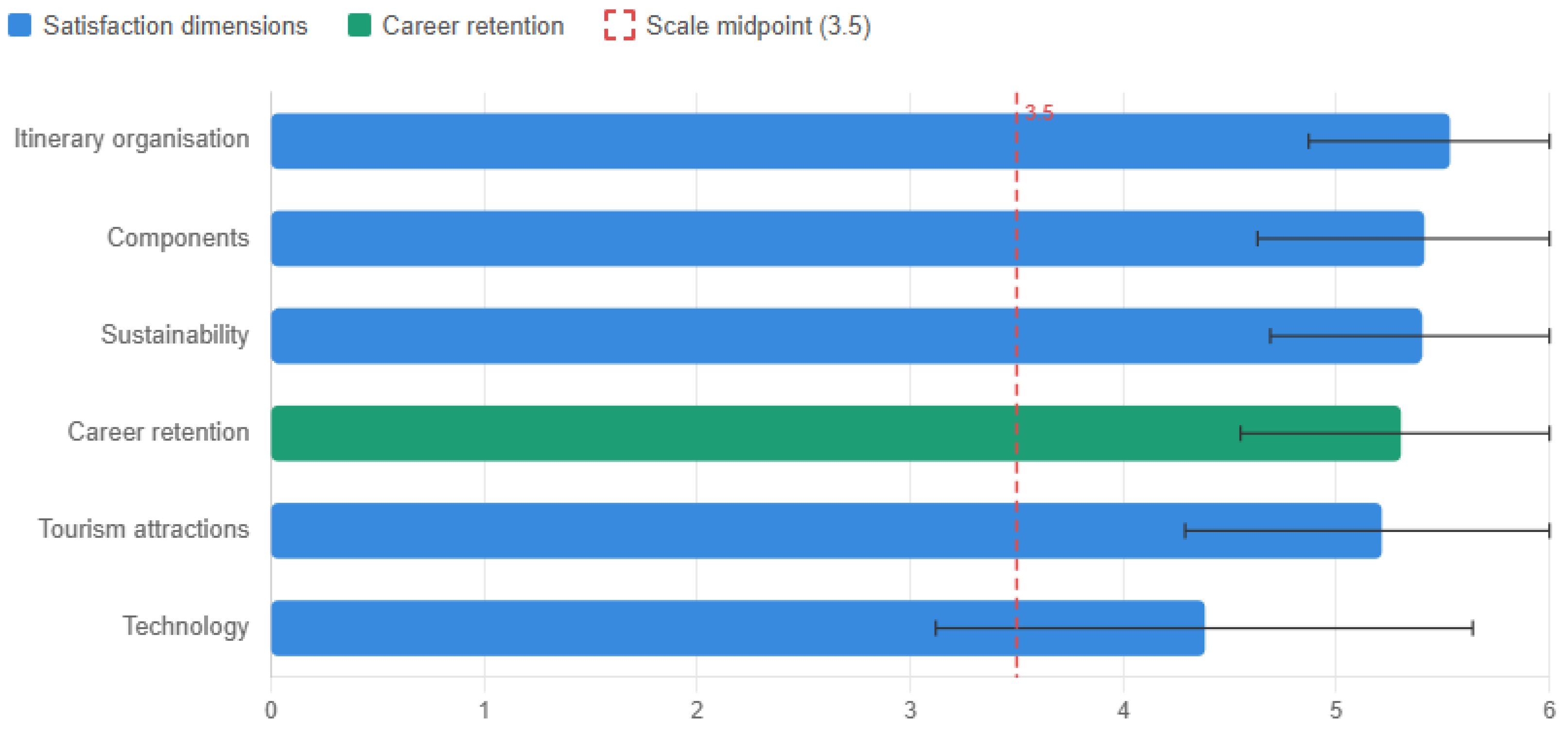
| Itinerary Organisation | 5.53 | 0.66 | 1.60 | 6.00 | −1.97 | 6.60 |
| Components | 5.41 | 0.78 | 2.33 | 6.00 | −2.32 | 6.14 |
| Technology | 4.38 | 1.26 | 1.00 | 6.00 | −0.53 | −0.25 |
| Tourism Attractions | 5.21 | 0.92 | 1.00 | 6.00 | −1.50 | 2.87 |
| Sustainability | 5.40 | 0.71 | 1.67 | 6.00 | −1.78 | 4.97 |
| Career Retention | 5.30 | 0.75 | 2.86 | 6.00 | −1.18 | 1.18 |
| Variable | 1 | 2 | 3 | 4 | 5 | 6 |
|---|---|---|---|---|---|---|
| 1. Itinerary Organisation | — | |||||
| 2. Components | 0.52 *** | — | ||||
| 3. Technology | 0.44 *** | 0.30 *** | — | |||
| 4. Tourism Attractions | 0.43 *** | 0.25 ** | 0.29 ** | — | ||
| 5. Sustainability | 0.56 *** | 0.40 *** | 0.26 ** | 0.33 *** | — | |
| 6. Career Retention | 0.47 *** | 0.52 *** | 0.23 ** | 0.29 *** | 0.65 *** | — |
| Predictor | B | SE | β | t | p |
|---|---|---|---|---|---|
| Itinerary Organisation | 0.009 | 0.093 | 0.007 | 0.092 | 0.927 |
| Components | 0.420 | 0.069 | 0.435 | 6.089 | <0.001 |
| Technology | 0.001 | 0.039 | 0.002 | 0.032 | 0.974 |
| Tourism Attractions | 0.045 | 0.054 | 0.055 | 0.828 | 0.409 |
| Sustainability | 0.452 | 0.075 | 0.430 | 6.052 | <0.001 |
| Model statistics: F(5,121) = 33.32, p < 0.001; R2 = 0.562; Adjusted R2 = 0.531 | |||||
Disclaimer/Publisher’s Note: The statements, opinions and data contained in all publications are solely those of the individual author(s) and contributor(s) and not of MDPI and/or the editor(s). MDPI and/or the editor(s) disclaim responsibility for any injury to people or property resulting from any ideas, methods, instructions or products referred to in the content. |
© 2026 by the authors. Licensee MDPI, Basel, Switzerland. This article is an open access article distributed under the terms and conditions of the Creative Commons Attribution (CC BY) license.
Share and Cite
Rodrigues, C.; Lavaredas, A.; Almeida, P. How Cultural Tourism Itineraries Shape Tourist Guide Satisfaction and Retention. Tour. Hosp. 2026, 7, 152. https://doi.org/10.3390/tourhosp7060152
Rodrigues C, Lavaredas A, Almeida P. How Cultural Tourism Itineraries Shape Tourist Guide Satisfaction and Retention. Tourism and Hospitality. 2026; 7(6):152. https://doi.org/10.3390/tourhosp7060152
Chicago/Turabian StyleRodrigues, Cátia, Alexandra Lavaredas, and Paulo Almeida. 2026. "How Cultural Tourism Itineraries Shape Tourist Guide Satisfaction and Retention" Tourism and Hospitality 7, no. 6: 152. https://doi.org/10.3390/tourhosp7060152
APA StyleRodrigues, C., Lavaredas, A., & Almeida, P. (2026). How Cultural Tourism Itineraries Shape Tourist Guide Satisfaction and Retention. Tourism and Hospitality, 7(6), 152. https://doi.org/10.3390/tourhosp7060152