

State-of-the-Art Review on the Rise of Experiential and Transformative Travel: Reassessing Value, Meaning and Impact



Abstract
1. Introduction
1.1. Review Approach: Narrated Critical Integrative Review
1.1.1. Phase 1: Scoping and Boundary Setting
1.1.2. Phase 2: Search Strategy and Corpus Construction
1.1.3. Phase 3: Analytic Synthesis and Framework Construction
1.1.4. Reflexivity and Limitations
2. Conceptual Foundations: A Genealogy of Experiential and Transformative Travel
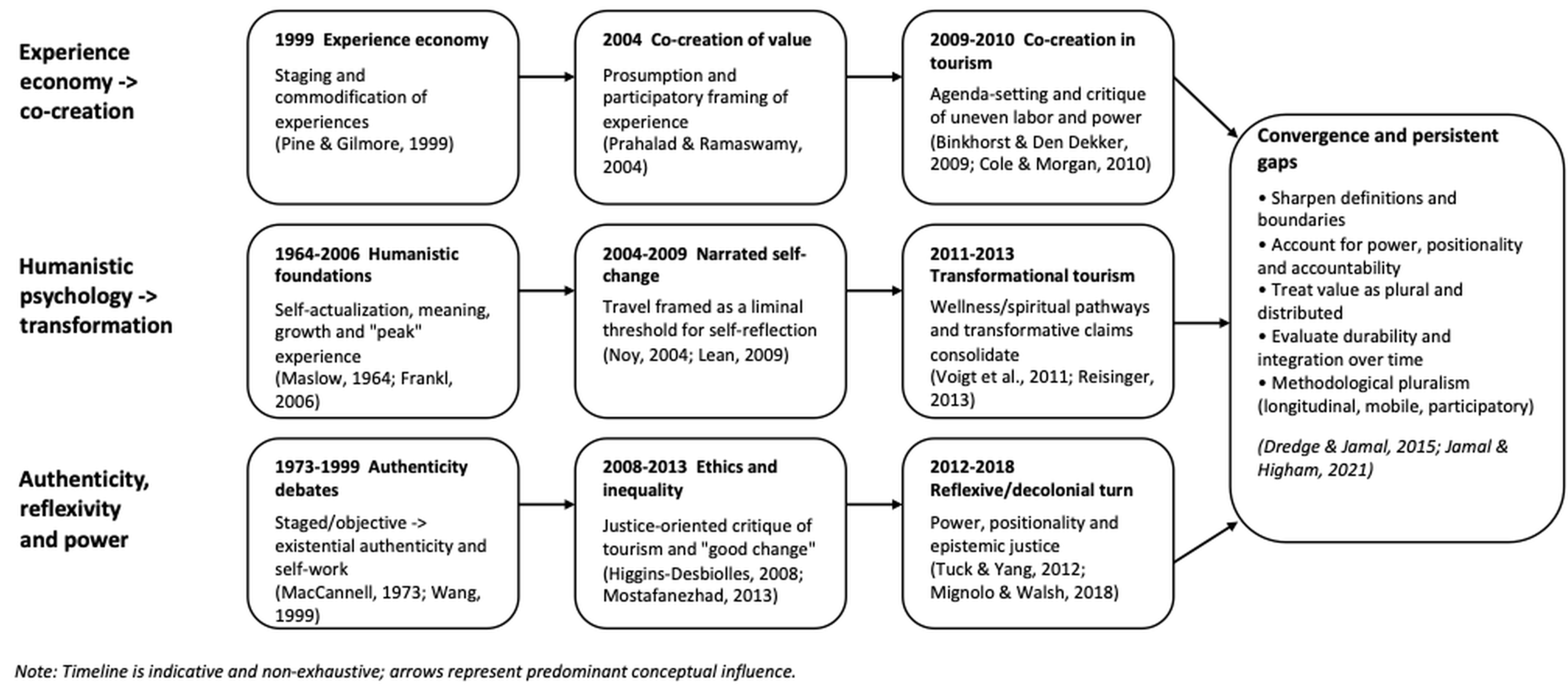
2.1. From Experience Economy to Co-Creation
2.2. Humanistic Psychology and Self-Actualization
2.3. Authenticity, Reflexivity, and Power
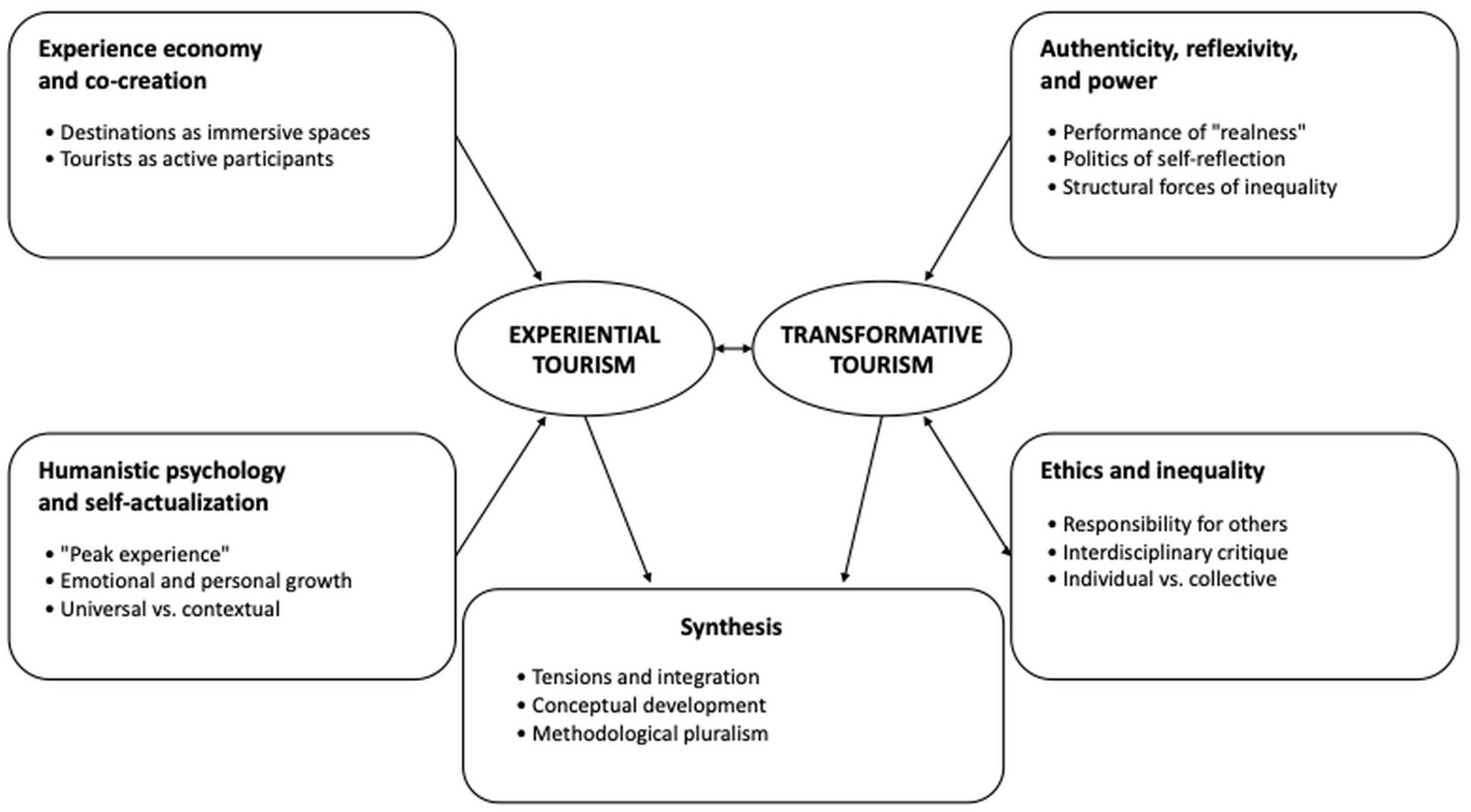
2.4. Synthesis and Implications: Divergence, Integration and Gaps
3. Reframing Value in Tourism
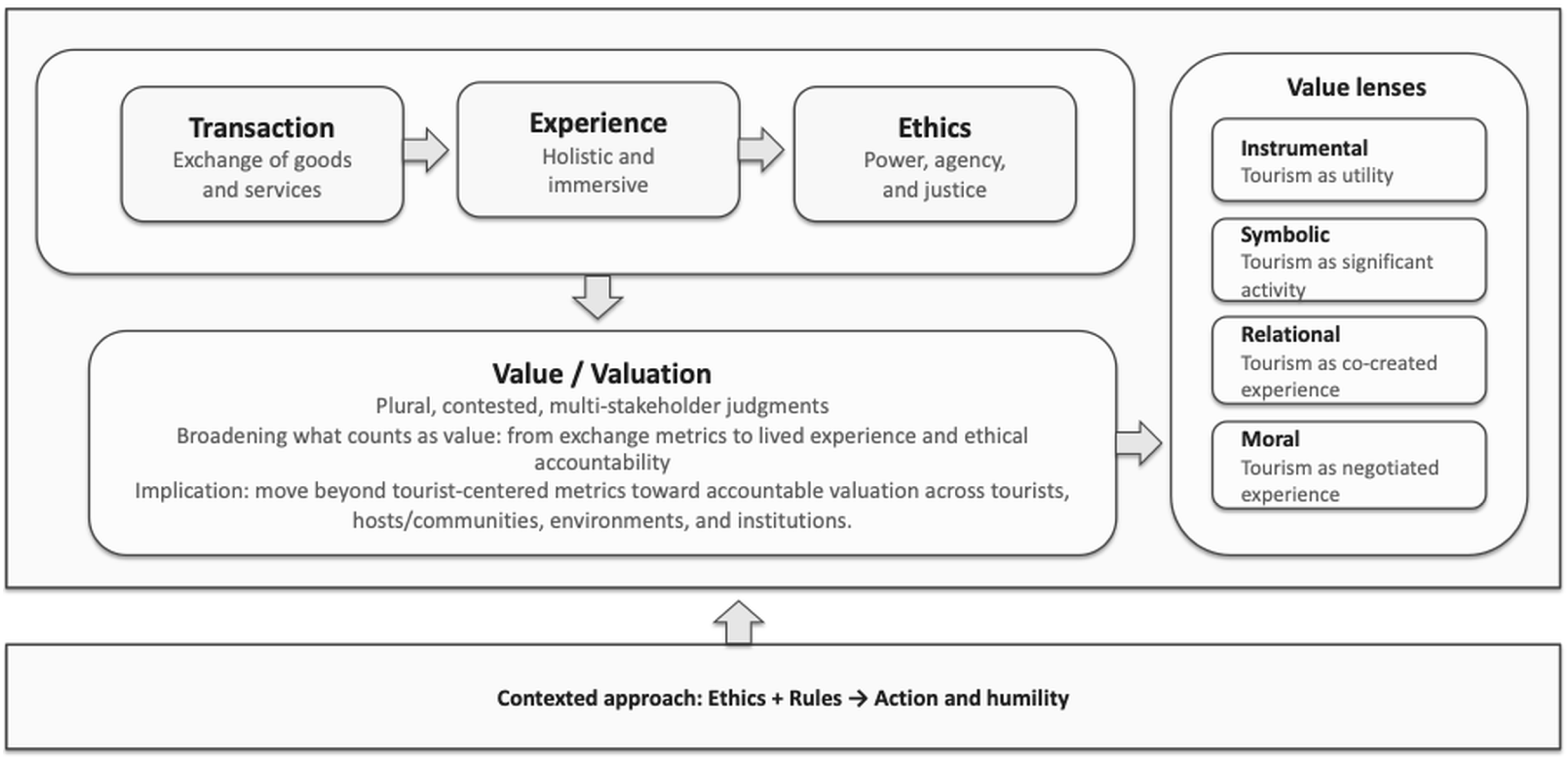
3.1. From Transactional Utility to Experiential Co-Creation
3.2. Emotional, Ethical, and Existential Dimensions of Value
3.3. Value for Whom? Decentring the Tourist
3.4. Measuring the Immeasurable? Challenges and Innovations
3.5. Synthesis and Implications: Value as a Moral Terrain in Transformative Tourism
4. Meaning-Making in Travel Experiences
4.1. Tourism as a Site of Narrative Construction
4.2. The Role of Immersion, Disruption and Reflection
4.3. Beyond the Tourist: Collective and Non-Human Meaning
4.4. Synthesis and Implications: Meaning as a Lived, Layered and Located Process
5. Assessing Impact
5.1. Personal Impact: Growth, Change and Complexity
5.2. Cultural and Social Impact: Exchange or Extraction?
5.3. Environmental Impact: Stewardship or Greenwashing?
5.4. Synthesis and Implications: Impact as a Multi-Sited, Contested Process
6. Methodological Approaches
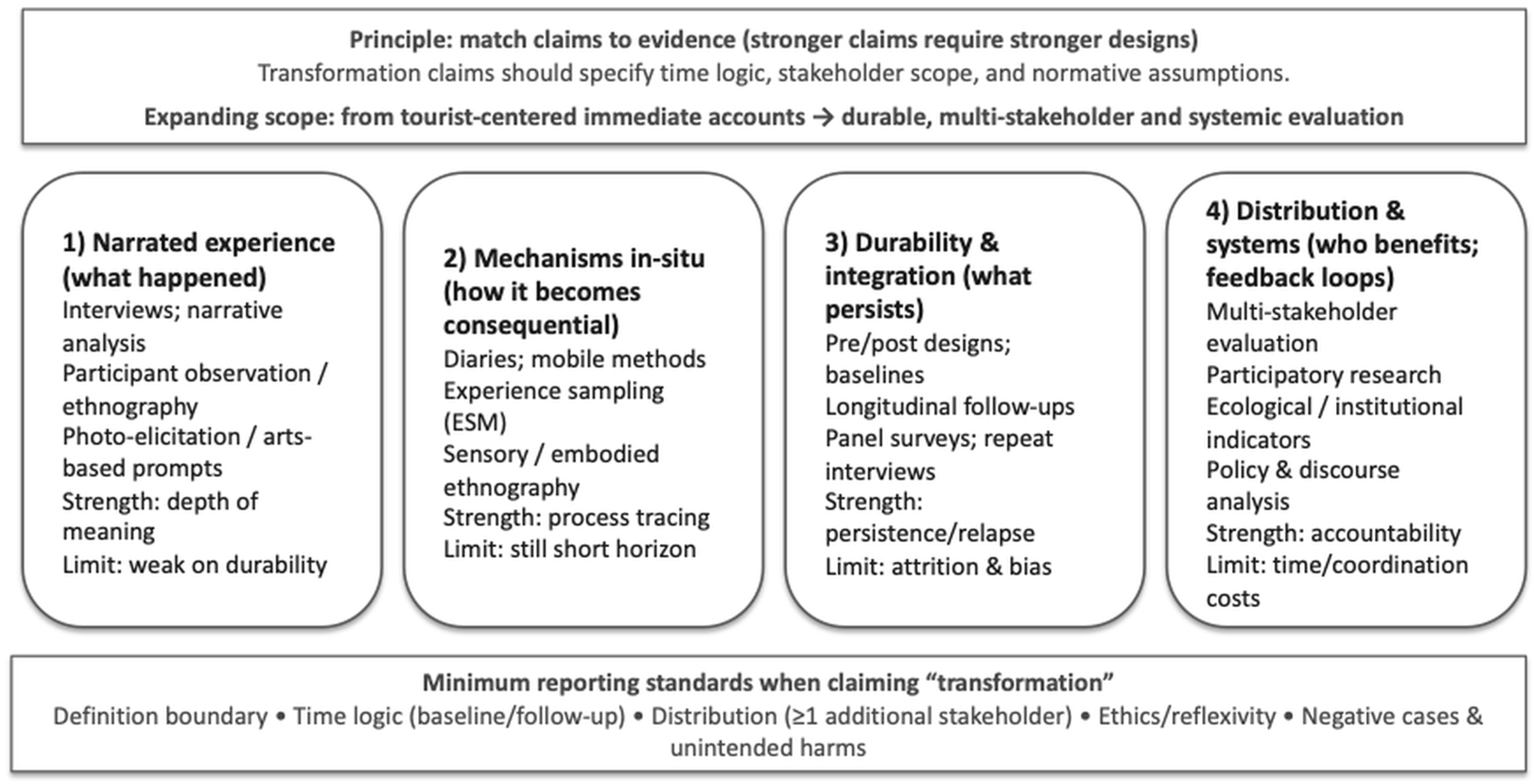
6.1. Qualitative Dominance: Narratives, Interviews, and Reflexivity
6.2. Emerging Tools: Mixed Methods, Mobile Ethnography and Digital Traces
6.3. Participatory and Decolonial Approaches
6.4. Synthesis and Implications: Toward Methodological Pluralism and Justice
7. Industry Response and Practitioner Engagement
7.1. From Experience Design to Life Design
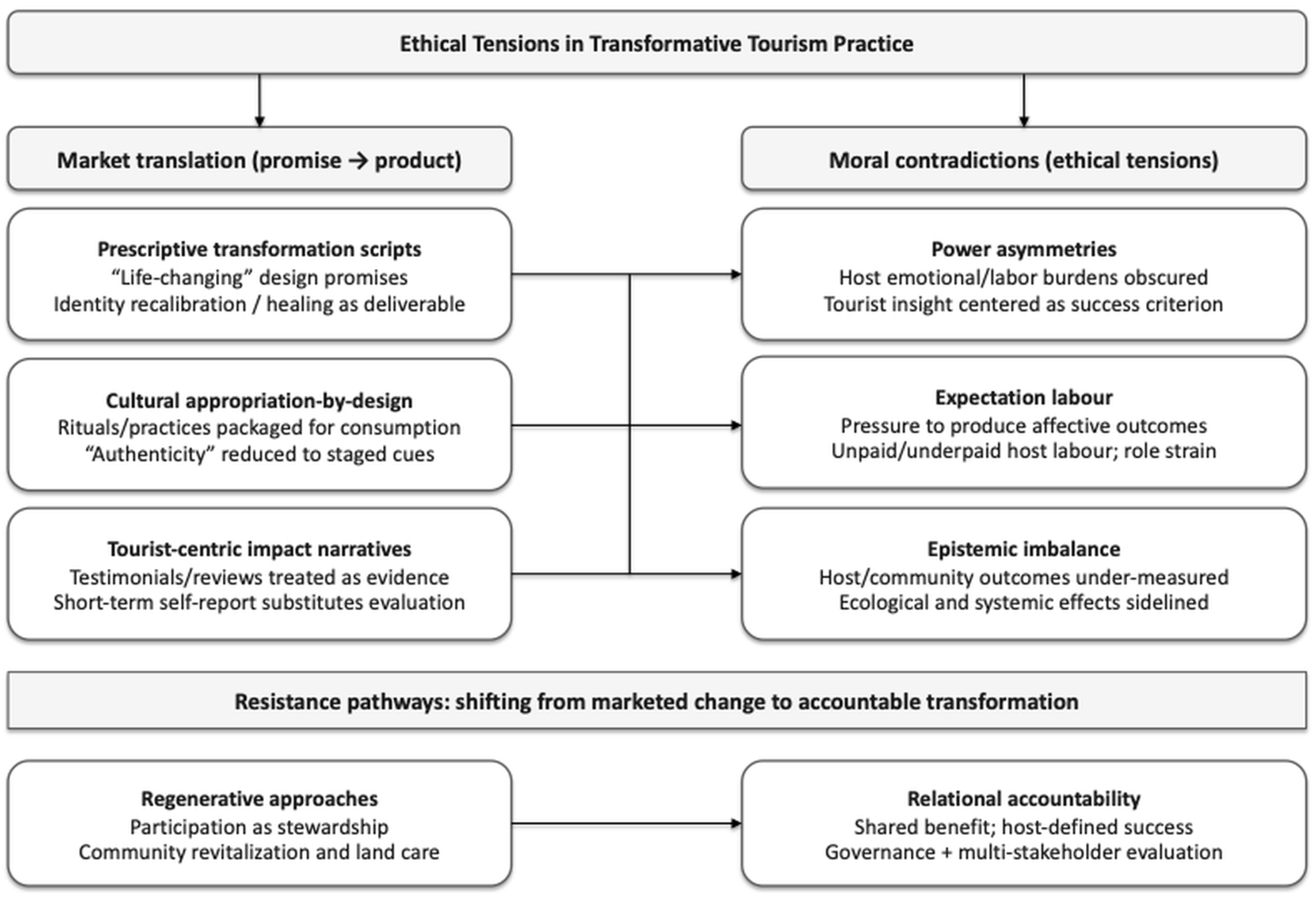
7.2. The Ethical Tensions of Selling Change
7.3. Innovation, Resistance and Regenerative Practice
7.4. Synthesis and Implications: Between Promise and Practice
- Be specific about what change is promised (and for whom) and avoid universal “life-changing” claims without evidence.
- Co-define success criteria with hosts/workers and monitor impacts beyond tourists (including unintended harms and trade-offs).
- Design for durability (e.g., follow-up, aftercare, and opportunities for reciprocity) rather than only peak moments and narrative closure.
8. Future Directions and Research Agenda
8.1. Re-Politicizing the Transformative Turn
Gap Evidenced in the Review
- Research questions: How do pricing, platform visibility, land/heritage control, and labour arrangements shape who is positioned as a “transformative” traveller and who bears costs? When does “transformative” branding intensify commodification pressures, and when can it support redistributive arrangements?
- Minimum methods: comparative case studies across destinations/products; analysis of business models and value capture (who earns what); multi-stakeholder interviews (workers, hosts, operators, policymakers), not only tourists.
- Research questions: How do race/class/gender/citizenship and mobility constraints shape what kinds of “disruption,” learning, or responsibility are possible? When do transformation narratives reflect privilege rather than change?
- Minimum methods: purposive and intersectional sampling; reflexive positionality statements; designs that compare groups (not necessarily experiments—comparative qualitative panels also work).
- Research questions: Who defines legitimate “good change” (tourists, hosts, firms, states)? What accountability mechanisms exist for harms or broken promises?
- Minimum methods: policy and governance analysis; document/discourse analysis of standards and claims; stakeholder workshops to co-define legitimate evaluation criteria.
8.2. Decentring the Tourist and Reframing Epistemology
Gap Evidenced in the Review
- Research questions: What counts as “transformative” from host/community perspectives? What forms of change are desired, refused, or experienced as harm?
- Minimum methods: participatory action research, co-authored narrative work, or community-led evaluation designs; explicit benefit-sharing and data governance agreements.
- Research questions: Where do tourists’ valuations clash with host/community valuations or ecological constraints? How are conflicts negotiated, and who has the authority to resolve them?
- Minimum methods: deliberative or multi-criteria valuation; mixed stakeholder sampling; explicit mapping of which indicators are used.
- Research questions: How do research instruments and platform-mediated storytelling shape what becomes “sayable” as transformation? Which voices are amplified by academic and industry selection practices?
- Minimum methods: reflexive method reporting; inclusion of non-tourist data sources (host interviews, worker diaries, ecological indicators); transparent limits of generalization.
8.3. Rethinking Impact: From Metrics to Meaning
Gap Evidenced in the Review
- Research questions: Which changes persist after travel, which fade, and why? How do everyday constraints and social contexts shape whether “transformation” becomes practice?
- Minimum methods: longitudinal follow-ups (e.g., pre-trip baseline + post-trip + 3/6/12 months); diary or experience-sampling components; transparent reporting of attrition.
- Research questions: What are the convergent and divergent impacts across stakeholders? How do environmental and community outcomes relate to tourists’ reported meaning and responsibility claims?
- Minimum methods: mixed-method evaluation with at least two stakeholder groups; inclusion of ecological or infrastructural indicators where relevant; triangulation (not reliance on a single narrative source).
- Research questions: When does “transformation” produce guilt without responsibility, appropriation without reciprocity, or harm framed as growth? How do hosts experience tourists’ transformative quests?
- Minimum methods: critical incident approaches; ethically sensitive protocols; designs that allow for refusal, non-closure, and negative cases.
8.4. Bridging the Scholar–Practitioner Divide Without Neutralizing Critique
Gap Evidenced in the Review
- Research questions: How do operators define transformation, what mechanisms do they claim, and what evidence is offered? How do tourists interpret and act on these promises?
- Minimum methods: systematic content analysis of marketing and product design scripts; interviews with operators and frontline workers; consumer experiments or field studies on expectation formation.
- Research questions: What design features support responsibility and reciprocity rather than extraction? What “aftercare” supports sustain change post-trip?
- Minimum methods: design-based research cycles (co-design → pilot → evaluate → revise); pre/post and follow-up evaluation; inclusion of host/community-defined success criteria.
8.5. Designing for Uncertainty, Discomfort and Non-Closure
Gap Evidenced in the Review
- Research questions: Under what conditions does discomfort support learning and responsibility, and when does it produce defensiveness, voyeurism, or harm? How do these dynamics differ by positionality and context?
- Minimum methods: experience-sampling/diaries linked to follow-ups; ethical risk assessment; clear stopping rules and support structures in field research.
- Research questions: What happens when transformative designs emphasize ongoing responsibility rather than a “life-changing moment”? How can programmes support long-term relational accountability with places and communities?
- Minimum methods: longitudinal designs; community feedback loops; evaluation that tracks post-trip practices (not only self-reported intentions).
8.6. Synthesis and Implications: A Call to Recommit
Minimum Reporting Standards by Claim Type
9. Conclusions
- Political economy and governance of transformation claims (who defines “good change,” who benefits, and who is accountable).
- Epistemic justice and host/community-defined outcomes (whose knowledge counts, and how valuation conflicts are negotiated).
- Durability and distributed impacts (longitudinal designs and multi-stakeholder evaluation, including more-than-human indicators where relevant).
- Practice, design, and auditing (how “transformative” products are built, promised, and evaluated, including post-trip “aftercare”).
- Above all, epistemic humility: a readiness to unlearn, to decentre mastery, and to treat accountability as part of method rather than as an optional add-on.
Funding
Institutional Review Board Statement
Informed Consent Statement
Data Availability Statement
Acknowledgments
Conflicts of Interest
Appendix A
Appendix A.1. Purpose and Review Logic
Appendix A.2. Database Searching and Retrieval
Appendix A.2.1. Search Strings
Appendix A.2.2. Targeted “Conceptual Roots” Searches (Used to Capture Foundations Outside Tourism Journals)
- experiential consumption; extraordinary experience
- transformative learning; adult development
- narrative identity; meaning-making
- awe AND (tourism OR travel) AND transform
- existential authenticity; liminality
- co-creation AND (tourism OR travel) AND experience
Appendix A.3. Citation Chasing (Forward/Backward) and Anchor-Set Procedure
Appendix A.4. Inclusion and Exclusion Criteria
Appendix A.4.1. Inclusion Criteria
- Conceptual relevance: explicitly conceptualized, theorized, operationalized, or critically examined experiential travel and/or transformative travel (including close labels used in the field).
- Tourism/travel relevance: engaged tourism/travel as a substantive context rather than using “transformative” in unrelated disciplinary senses.
- Analytic contribution: contributed to at least one of the review’s synthesis dimensions (value/valuation, meaning-making, impact distribution, methods/epistemics).
- Foundational grounding: where repeatedly mobilized in tourism scholarship, foundational works from adjacent disciplines were included to clarify conceptual genealogy (e.g., experiential consumption; humanistic psychology; transformative learning; narrative and identity theory).
Appendix A.4.2. Exclusion Criteria
- “Transformative” referred primarily to organizational/service transformation without conceptual linkage to travel experience or travel-related change processes.
- The work lacked sufficient conceptual/empirical substance for synthesis (e.g., brief mentions with no definitional or analytic development).
- The context was not meaningfully tourism/travel (unless included as a foundational conceptual anchor repeatedly invoked in tourism debates).
Appendix A.5. Screening and Corpus Construction
Appendix A.5.1. What Counts as the “Corpus” in This Narrated Integrative Review
Appendix A.5.2. Disciplinary Location Coding (Tourism-Focused vs. Adjacent Foundations)
- Tourism-focused: published in a tourism/hospitality/leisure outlet and/or empirically/theoretically centred on tourism travel contexts; or.
- Adjacent/foundational: drawn from neighbouring disciplines (e.g., consumer research, learning theory, political ecology, feminist/decolonial scholarship, evaluation studies) and used primarily for conceptual grounding.
- 168 tourism-focused sources.
- 103 adjacent/foundational sources.
Appendix A.6. Analytic Extraction and Coding Protocol
Appendix A.6.1. Extraction Fields (Recorded for Each Included Source)
- Definition use: how “experiential” and/or “transformative” travel is defined, or what assumptions substitute for a definition.
- Mechanisms: processes linking travel to value/meaning/change (e.g., immersion, disruption/liminality, awe/discomfort, reflection, narration, co-creation, relational encounter).
- Valuation language: how “value” is framed (transactional, experiential/hedonic, eudaimonic, ethical/political; individual vs. multi-stakeholder).
- Temporality: how durability is treated (in situ, immediate post-trip, delayed integration, longitudinal follow-up; reversibility/relapse).
- Stakeholder centring: whose outcomes are foregrounded (tourists, hosts/communities, environment, institutions/markets).
- Evidence type/methods: research design (cross-sectional survey, qualitative interviews, diaries, ethnography, mixed methods, participatory designs, digital trace data, etc.).
- Normative assumptions: how “good transformation” is implicitly or explicitly defined; ethical risks (commodification, extraction, performativity, inequality).
Appendix A.6.2. Theme Development (How Section 3, Section 4, Section 5, Section 6 and Section 7 of This Manuscript Were Produced)
- First-cycle coding (open): extracting and labelling recurring concepts, mechanisms, and evaluative claims.
- Second-cycle coding (axial clustering): grouping codes into higher-order clusters aligned with the framework’s dimensions: value/valuation, meaning-making, impact distribution, and methods/epistemics.
- Constant comparison: checking whether clusters held across (i) experiential vs. transformative sub-streams, (ii) time periods, and (iii) tourism vs. adjacent foundations.
- Memo-writing: documenting why a theme was retained, merged, or split, and linking each theme to representative evidentiary sources.
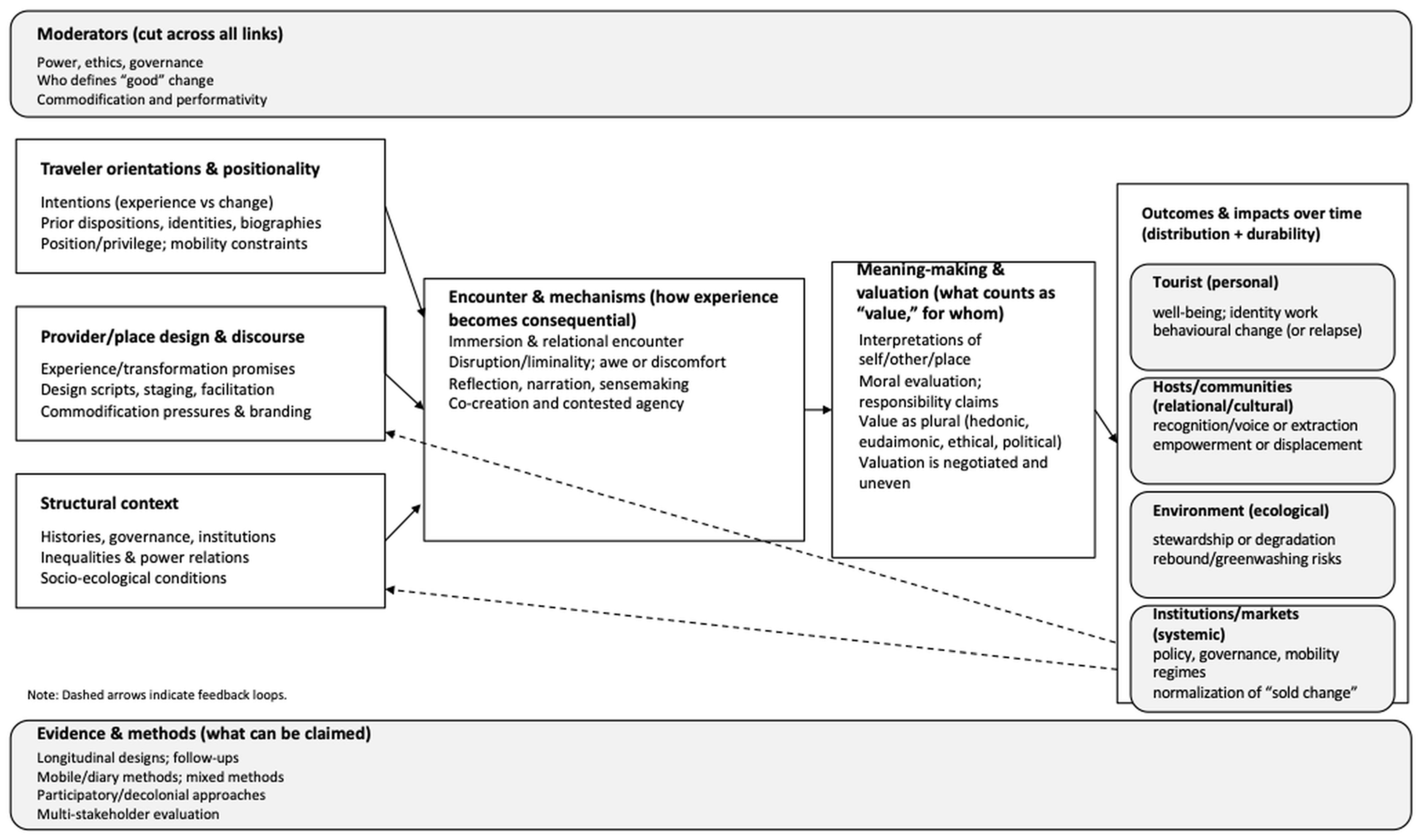
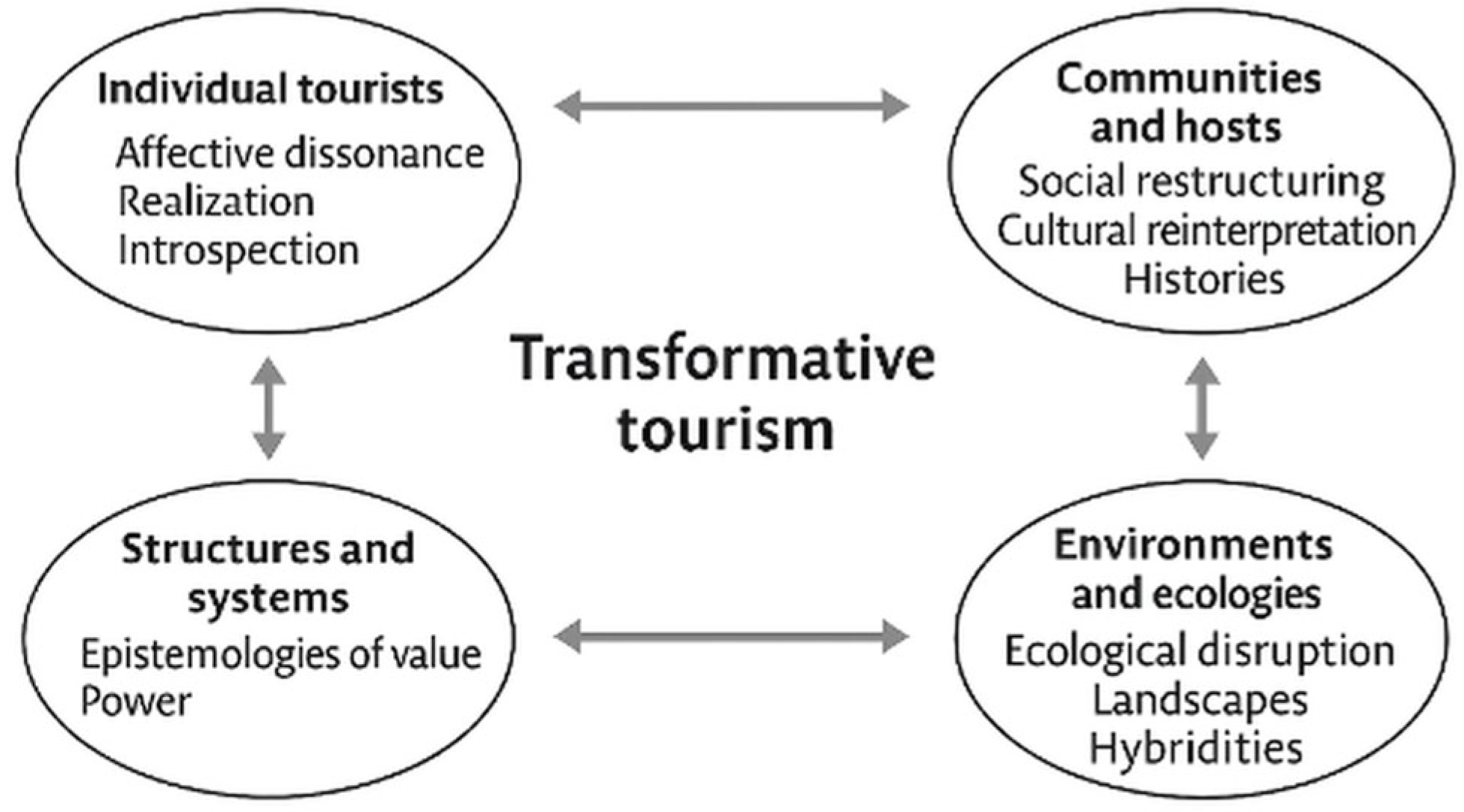
Appendix A.7. Framework Construction (Presented at Figure 1 in the Main Text)
- Antecedents (traveller orientations/positionality; provider/place design discourse; structural context).
- Mechanisms (encounter processes: immersion, disruption, reflection, narration, co-creation, contested agency).
- Meaning-making and valuation (how value is negotiated, plural, and uneven).
- Outcomes/impacts (distribution and durability across tourists, hosts/communities, environment, institutions/markets).
- Moderators (power, ethics, governance; who defines “good change”; commodification/performativity).
- Evidence constraints (methods capable of supporting particular claims).
Appendix A.8. Flow Counts

| Stage | n |
|---|---|
| Records retrieved (Scopus + Web of Science Core Collection) | 1284 |
| Duplicates removed | 392 |
| Unique records after de-duplication | 892 |
| Retained after title/abstract screening (full texts sought) | 358 |
| Excluded after title/abstract screening | 534 |
| Tourism-focused sources included after full-text screening (core corpus) | 168 |
| Excluded after full-text screening | 190 |
| Adjacent/foundational sources retained for conceptual grounding | 103 |
| Final evidentiary base used in synthesis (168 + 103) | 271 |
Appendix A.9. Limitations
References
- Absolon, K., & Willett, C. (2005). Putting ourselves forward: Location in Aboriginal research. In L. Brown, & S. Strega (Eds.), Research as resistance: Critical, Indigenous, and anti-oppressive approaches (pp. 97–126). Canadian Scholars’ Press. [Google Scholar]
- Abu-Lughod, L. (1991). Writing against culture. In R. G. Fox (Ed.), Recapturing anthropology: Working in the present (pp. 137–162). School of American Research Press. [Google Scholar]
- Adsit, J. (2021). Epistemic justice, mindfulness, and the environmental humanities: Reflections on teaching. Routledge. [Google Scholar] [CrossRef]
- Agapito, D., & Sigala, M. (2024). Experience management in hospitality and tourism: Reflections and implications for future research. International Journal of Contemporary Hospitality Management, 36(13), 57–76. [Google Scholar] [CrossRef]
- Ahmed, S. (2004). The cultural politics of emotion. Edinburgh University Press. [Google Scholar]
- Amaro, D., Caldeira, A. M., & Seabra, C. (2023). Transformative experiences in tourism: A conceptual and critical analysis integrating consumer and managerial perspectives. Tourism and Hospitality Research, 25(1), 135–146. [Google Scholar] [CrossRef]
- Andreotti, V. (2016). The educational challenges of imagining the world differently. Canadian Journal of Development Studies/Revue Canadienne D’études du Développement, 37(1), 101–112. [Google Scholar] [CrossRef]
- Andreotti, V., Stein, S., Ahenakew, C., & Hunt, D. (2015). Mapping interpretations of decolonization in the context of higher education. Decolonization: Indigeneity, Education & Society, 4(1), 21–40. [Google Scholar]
- Arnould, E. J., & Price, L. L. (1993). River magic: Extraordinary experience and the extended service encounter. Journal of Consumer Research, 20(1), 24–45. [Google Scholar] [CrossRef]
- Ateljevic, I. (2009). Transmodernity and transformation: Remaking our (tourism) world? In J. Tribe (Ed.), Philosophical Issues in Tourism (pp. 278–302). Channel View Publications. [Google Scholar] [CrossRef]
- Ateljevic, I., Morgan, N., & Pritchard, A. (2007). The critical turn in tourism studies: Innovative research methodologies. Elsevier. [Google Scholar]
- Baka, V. (2015). The becoming of user-generated reviews: Looking at the past to understand the future of managing reputation in the travel sector. Tourism Management, 53, 148–162. [Google Scholar] [CrossRef]
- Ballantyne, R., Packer, J., & Falk, J. (2011). Visitors’ learning for environmental sustainability: Testing short- and long-term impacts of wildlife tourism experiences using structural equation modelling. Tourism Management, 32(6), 1243–1252. [Google Scholar] [CrossRef]
- Bamberg, M. (2004). Narrative discourse and identities. In J. C. Meister, T. Kindt, W. Schernus, & M. Stein (Eds.), Narratology beyond literary criticism: Mediality, disciplinarity (pp. 213–237). Walter de Gruyter. [Google Scholar]
- Bandyopadhyay, R., & Nair, B. B. (2019). Marketing kerala in India as God’s own country! for tourists’ spiritual transformation, rejuvenation and well-being. Journal of Destination Marketing & Management, 14, 100369. [Google Scholar] [CrossRef]
- Beaumont, N., & Dredge, D. (2010). Local tourism governance: A comparison of three network approaches. Journal of Sustainable Tourism, 18(1), 7–28. [Google Scholar] [CrossRef]
- Becken, S. (2007). Tourists’ perception of international air travel’s impact on the global climate and potential climate change policies. Journal of Sustainable Tourism, 15(4), 351–368. [Google Scholar] [CrossRef]
- Becken, S. (2019). Decarbonising tourism: Mission impossible? Tourism Recreation Research, 44(4), 419–433. [Google Scholar] [CrossRef]
- Bellato, L., Frantzeskaki, N., tebrakunna country, & Lee, L. (2023). Transformative epistemologies for regenerative tourism: Towards a decolonial paradigm in science and practice? Journal of Sustainable Tourism, 32(6), 1161–1181. [Google Scholar] [CrossRef]
- Bhabha, H. K. (1994). The location of culture. Routledge. [Google Scholar]
- Bhambra, G. K. (2014). Connected sociologies. Bloomsbury Publishing. [Google Scholar]
- Bianchi, R. V. (2009). The ‘critical turn’ in tourism studies: A radical critique. Tourism Geographies, 11(4), 484–504. [Google Scholar] [CrossRef]
- Bianchi, R. V., & de Man, F. (2021). Tourism, inclusive growth and decent work: A political economy critique. Journal of Sustainable Tourism, 29(2–3), 353–371. [Google Scholar] [CrossRef]
- Binkhorst, E., & Den Dekker, T. (2009). Agenda for co-creation tourism experience research. Journal of Hospitality Marketing & Management, 18(2–3), 311–327. [Google Scholar] [CrossRef]
- Boluk, K., Cavaliere, C., & Higgins-Desbiolles, F. (2019). A critical framework for interrogating the United Nations Sustainable Development Goals 2030 Agenda in tourism. Journal of Sustainable Tourism, 27(7), 847–864. [Google Scholar] [CrossRef]
- Bourdieu, P. (1984). Distinction: A social critique of the judgement of taste (R. Nice, Trans.). Harvard University Press. [Google Scholar]
- Bowman, M. (2020). Privileged ignorance, “world”-traveling, and epistemic tourism. Hypatia, 35(3), 475–489. [Google Scholar] [CrossRef]
- Braidotti, R. (2013). The posthuman. Polity Press. [Google Scholar]
- Brockington, D., Duffy, R., & Igoe, J. (2008). Nature unbound: Conservation, capitalism and the future of protected areas. Earthscan. [Google Scholar]
- Brown, L. (2009). The transformative power of the international sojourn: An ethnographic study of the international student experience. Annals of Tourism Research, 36(3), 502–521. [Google Scholar] [CrossRef]
- Bruner, E. M. (2005). Culture on tour: Ethnographies of travel. University of Chicago Press. [Google Scholar]
- Bryon, J. (2012). Tour guides as storytellers–from selling to sharing. Scandinavian Journal of Hospitality and Tourism, 12(1), 27–43. [Google Scholar] [CrossRef]
- Buda, D. M., d’Hauteserre, A.-M., & Johnston, L. (2014). Feeling and tourism studies. Annals of Tourism Research, 46, 102–114. [Google Scholar] [CrossRef]
- Bueddefeld, J., & Duerden, M. D. (2022). The transformative tourism learning model. Annals of Tourism Research, 94, 103405. [Google Scholar] [CrossRef]
- Bunten, A. C. (2010). More like ourselves: Indigenous capitalism through tourism. American Indian Quarterly, 34(3), 285–311. [Google Scholar] [CrossRef]
- Büscher, B., & Fletcher, R. (2019). Towards convivial conservation. Conservation & Society, 17(3), 283–296. [Google Scholar] [CrossRef]
- Calver, S. J., & Page, S. J. (2013). Enlightened hedonism: Exploring the relationship of service value, visitor knowledge and interest, to visitor enjoyment at heritage attractions. Tourism Management, 39, 23–36. [Google Scholar] [CrossRef]
- Canessa, A. (2012). Gender, indigeneity, and the performance of authenticity in Latin American tourism. Latin American Perspectives, 39(2), 60–78. [Google Scholar] [CrossRef]
- Canteiro, M., Córdova-Tapia, F., & Brazeiro, A. (2018). Tourism impact assessment: A tool to evaluate the environmental impacts of touristic activities in Natural Protected Areas. Tourism Management Perspectives, 28, 220–227. [Google Scholar] [CrossRef]
- Carr, A., Ruhanen, L., & Whitford, M. (2016). Indigenous peoples and tourism: The challenges and opportunities for sustainable tourism. Journal of Sustainable Tourism, 24(8–9), 1067–1079. [Google Scholar] [CrossRef]
- Caru, A., & Cova, B. (2015). Co-creating the experience: The experiential marketing perspective. Journal of Service Management, 26(2), 276–294. [Google Scholar] [CrossRef]
- Caruana, R., Glozer, S., Crane, A., & McCabe, S. (2014). Tourists’ accounts of responsible tourism. Annals of Tourism Research, 46, 115–129. [Google Scholar] [CrossRef]
- Cave, J., & Dredge, D. (2021). Regenerative tourism needs diverse economic practices. In A. Lew, J. Cheer, P. Brouder, & M. Mostafanezhad (Eds.), Global tourism and COVID-19: Implications for theory and practice (pp. 49–59). Routledge. [Google Scholar] [CrossRef]
- Chakrabarty, D. (2009). Provincializing Europe: Postcolonial thought and historical difference (2nd ed.). Princeton University Press. [Google Scholar]
- Chambers, D. (2007). Interrogating the ‘critical’ in critical approaches to tourism research. In I. Ateljevic, A. Pritchard, & N. Morgan (Eds.), The critical turn in tourism studies: Innovative research methodologies (pp. 105–119). Routledge. [Google Scholar] [CrossRef]
- Chang, S. (2018). Experience economy in hospitality and tourism: Gain and loss values for service and experience. Tourism Management, 64, 55–63. [Google Scholar] [CrossRef]
- Chatzigeorgiou, C., Christou, E., & Simeli, I. (2025). From Brochures to Bytes: Destination Branding through Social, Mobile, and AI—A Systematic Narrative Review with Meta-Analysis. Administrative Sciences, 15(9), 371. [Google Scholar] [CrossRef]
- Chilisa, B. (2020). Indigenous research methodologies (2nd ed.). SAGE Publications. [Google Scholar]
- Christou, E., Fotiadis, A., & Giannopoulos, A. (2025a). Generative AI as a tourism actor: Reconceptualising experience co-creation, destination governance and responsible innovation in the synthetic experience economy. Journal of Tourism, Heritage & Services Marketing, 11(2), 16–41. [Google Scholar] [CrossRef]
- Christou, E., Giannopoulos, A., & Simeli, I. (2025b). The evolution of digital tourism marketing: From hashtags to AI-immersive journeys in the metaverse era. Sustainability, 17(13), 6016. [Google Scholar] [CrossRef]
- Coghlan, A., & Weiler, B. (2018). Examining transformative processes in volunteer tourism. Current Issues in Tourism, 21(5), 567–582. [Google Scholar] [CrossRef]
- Cohen, E. (1979). A phenomenology of tourist experiences. Sociology, 13(2), 179–201. [Google Scholar] [CrossRef]
- Cole, S. (2007). Beyond authenticity and commodification. Annals of Tourism Research, 34(4), 943–960. [Google Scholar] [CrossRef]
- Cole, S., & Morgan, N. (2010). Tourism and inequality: Problems and prospects. CABI. [Google Scholar]
- Coudounaris, D. N., Björk, P., Trifonova Marinova, S., Jafarguliyev, F., Kvasova, O., Sthapit, E., Varblane, U., & Talias, M. A. (2025). ‘Big-5’ personality traits and revisit intentions: The mediating effect of memorable tourism experiences. Journal of Tourism, Heritage & Services Marketing, 11(1), 46–60. [Google Scholar] [CrossRef]
- Cresswell, T. (2006). On the move: Mobility in the modern western world. Routledge. [Google Scholar]
- Csapó, J., & Kusumaningrum, S. D. (2025). Uncovering trends in destination branding and destination brand equity research: Results of a topic modelling approach. Journal of Tourism, Heritage & Services Marketing, 11(1), 34–45. [Google Scholar] [CrossRef]
- Csikszentmihalyi, M. (1990). Flow: The psychology of optimal experience. Harper & Row. [Google Scholar]
- Dashper, K. (2020). More-than-human emotions: Multispecies emotional labour in the tourism industry. Gender, Work & Organization, 27(1), 24–40. [Google Scholar] [CrossRef]
- Datta, R. (2018). Decolonizing both researcher and research and its effectiveness in Indigenous research. Research Ethics, 14(2), 1–24. [Google Scholar] [CrossRef]
- Decrop, A., & Del Chiappa, G. (2024). Choice overload in consumer services: The mediating role of decision strategy complexity on subjective states and behavioral outcomes. Journal of Tourism, Heritage & Services Marketing, 10(1), 48–55. [Google Scholar] [CrossRef]
- de la Cadena, M. (2015). Earth beings: Ecologies of practice across Andean worlds. Duke University Press. [Google Scholar]
- de la Cadena, M., & Blaser, M. (Eds.). (2018). A world of many worlds. Duke University Press. [Google Scholar]
- Dias, A., Santos, M., & Pereira, L. (2024). Green marketing strategies and customer satisfaction in rural accommodations: A configurational approach. Journal of Tourism, Heritage & Services Marketing, 10(2), 69–78. [Google Scholar] [CrossRef]
- Dimou, V., Vassiliadis, C., Folinas, D., Agapitou, C., & Sampazioti, N. (2025). Exploring the viability of pilgrimage tourism along Apostle Paul’s route. Journal of Tourism, Heritage & Services Marketing, 11(1), 11–20. [Google Scholar] [CrossRef]
- Dinhopl, A., & Gretzel, U. (2016). Selfie-taking as touristic looking. Annals of Tourism Research, 57, 126–139. [Google Scholar] [CrossRef]
- Djohossou, P., Bulbul, S., & Hendrix-Jenkins, A. (2023). Creating spaces for knowledge decolonization: Changing relationships and shifting power dynamics for co-creation across the movement for community-led development (Part 2). The Movement for Community-Led Development. Available online: https://www.researchgate.net/publication/368713967 (accessed on 19 December 2025).
- Doering, A., & Zhang, J. (2018). Critical tourism studies and the world: Sense, praxis, and the politics of creation. Tourism Analysis, 23(2), 227–237. [Google Scholar] [CrossRef]
- Dolezal, C. (2011). Community-based tourism in Thailand: (Dis-)illusions of authenticity and the necessity for dynamic concepts of culture and power. Austrian Journal of South-East Asian Studies, 4(1), 129–138. [Google Scholar] [CrossRef]
- Dredge, D. (2022). Regenerative tourism: Transforming mindsets, systems and practices. Journal of Tourism Futures, 8(3), 312–324. [Google Scholar] [CrossRef]
- Dredge, D., & Jamal, T. (2015). Progress in tourism planning and policy: A post-structural perspective on knowledge production. Tourism Management, 51, 285–297. [Google Scholar] [CrossRef]
- Duffy, R. (2006). The Politics of Ecotourism and the Developing World. Journal of Ecotourism, 5(1–2), 1–6. [Google Scholar] [CrossRef]
- Escobar, A. (2008). Territories of difference: Place, movements, life, redes. Duke University Press. [Google Scholar] [CrossRef]
- Everingham, P., & Motta, S. C. (2022). Decolonising the ‘autonomy of affect’ in volunteer tourism encounters. Tourism Geographies, 24(2–3), 223–243. [Google Scholar] [CrossRef]
- Fennell, D. A. (2022). Tourism ethics (3rd ed.). Channel View Publications. [Google Scholar]
- Filep, S., & Laing, J. (2018). Trends and directions in tourism and positive psychology. Journal of Travel Research, 58(3), 343–354. [Google Scholar] [CrossRef]
- Filep, S., Laing, J., & Csikszentmihalyi, M. (Eds.). (2016). Positive tourism (1st ed.). Routledge. [Google Scholar] [CrossRef]
- Fleming, P. (2021). Dark academia: How neoliberalism and narcissism corrupted the university. Pluto Press. [Google Scholar]
- Fletcher, R., Murray Mas, I., Blázquez-Salom, M., & Blanco-Romero, A. (2019). Tourism and degrowth: An emerging agenda for research and practice. Journal of Sustainable Tourism, 27(12), 1745–1763. [Google Scholar] [CrossRef]
- Frankl, V. E. (2006). Man’s search for meaning (I. Lasch, Trans.; 4th ed.). Beacon Press. (Original work published 1959). [Google Scholar]
- Franklin, A., & Crang, M. (2001). The trouble with tourism and travel theory? Tourist Studies, 1(1), 5–22. [Google Scholar] [CrossRef]
- Freire, P. (1978). Pedagogy of the oppressed. In J. Beck, C. Jenks, N. Keddie, & M. F. D. Young (Eds.), Toward a sociology of education (1st ed., p. 13). Routledge. [Google Scholar] [CrossRef]
- Frenzel, F., & Koens, K. (2012). Slum tourism: Developments in a young field of interdisciplinary tourism research. Tourism Geographies, 14(2), 195–212. [Google Scholar] [CrossRef]
- Germann Molz, J. (2012). Travel connections: Tourism, technology and togetherness in a mobile world. Routledge. [Google Scholar]
- Gibson-Graham, J. K. (2006). A postcapitalist politics. University of Minnesota Press. [Google Scholar]
- Gill, R. (2016). Breaking the silence: The hidden injuries of neo-liberal academia. Feministische Studien, 34(1), 39–55. [Google Scholar] [CrossRef]
- Gilligan, C. (1993). In a different voice: Psychological theory and women’s development. Harvard University Press. [Google Scholar]
- Godovykh, M. (2024). Transformative experiences in tourism: Where, when, with whom, and how does tourists’ transformation occur? Frontiers in Sustainable Tourism, 1, 1377844. [Google Scholar] [CrossRef]
- Gómez-Barris, M. (2017). The extractive zone: Social ecologies and decolonial perspectives. Duke University Press. [Google Scholar]
- Gössling, S., & Peeters, P. (2015). Assessing tourism’s global environmental impact 1900–2050. Journal of Sustainable Tourism, 23(5), 639–659. [Google Scholar] [CrossRef]
- Graeber, D. (2001). Toward an anthropological theory of value: The false coin of our own dreams. Palgrave. [Google Scholar]
- Gretzel, U., Fuchs, M., Baggio, R., Hoepken, W., Law, R., Neidhardt, J., Pesonen, J., & Zanker, M. (2020). e-Tourism beyond COVID-19: A call for transformative research. Information Technology & Tourism, 22(2), 187–203. [Google Scholar] [CrossRef]
- Gretzel, U., & Koo, C. (2021). Smart tourism cities: A duality of place where technology supports the convergence of touristic and residential experiences. Asia Pacific Journal of Tourism Research, 26(4), 352–364. [Google Scholar] [CrossRef]
- Grimwood, B. S. R., & Johnson, C. W. (2019). Collective memory work as an unsettling methodology in tourism. Tourism Geographies, 21(2), 193–212. [Google Scholar] [CrossRef]
- Hall, C. M. (2019). Constructing sustainable tourism development: The 2030 agenda and the managerial ecology of sustainable tourism. Journal of Sustainable Tourism, 27(4), 1044–1060. [Google Scholar] [CrossRef]
- Hall, C. M., & Tucker, H. (2004). Tourism and postcolonialism: Contested discourses, identities and representations. Routledge. [Google Scholar]
- Hamington, M. (2004). Embodied care: Jane addams, maurice Merleau-Ponty, and feminist ethics. University of Illinois Press. [Google Scholar]
- Hann, C., & Hart, K. (2011). Economic anthropology: History, ethnography, critique. Polity. [Google Scholar]
- Haraway, D. (2016). Staying with the trouble: Making kin in the Chthulucene. Duke University Press. [Google Scholar]
- Harding, S. (2013). Rethinking standpoint epistemology: What is “strong objectivity”? In S. Harding (Ed.), The feminist standpoint theory reader: Intellectual and political controversies (pp. 127–140). Routledge. [Google Scholar]
- Harmsworth, G. R., & Awatere, S. (2013). Indigenous Māori knowledge and perspectives of ecosystems. In J. Dymond (Ed.), Ecosystem services in New Zealand (pp. 274–286). Manaaki Whenua Press. [Google Scholar]
- Hartwell, H., Fyall, A., Willis, C., Page, S., Ladkin, A., & Hemingway, A. (2018). Progress in tourism and destination wellbeing research. Current Issues in Tourism, 21(16), 1830–1892. [Google Scholar] [CrossRef]
- Hawthorne, C. (2019). Black matters are spatial matters: Black geographies for the twenty-first century. Geography Compass, 13(11), e12468. [Google Scholar] [CrossRef]
- Heise, U. K. (2016). Imagining extinction: The cultural meanings of endangered species. University of Chicago Press. [Google Scholar]
- Hemmings, C. (2012). Affective solidarity: Feminist reflexivity and political transformation. Feminist Theory, 13(2), 147–161. [Google Scholar] [CrossRef]
- Higgins-Desbiolles, F. (2008). Justice tourism and alternative globalisation. Journal of Sustainable Tourism, 16(3), 345–364. [Google Scholar] [CrossRef]
- Higgins-Desbiolles, F. (2018). Sustainable tourism: Sustaining tourism or something more? Tourism Management Perspectives, 25, 157–160. [Google Scholar] [CrossRef]
- Higgins-Desbiolles, F. (2020). The “war over tourism”: Challenges to sustainable tourism in the tourism academy after COVID-19. Journal of Sustainable Tourism, 29(4), 551–569. [Google Scholar] [CrossRef]
- Higgins-Desbiolles, F., Carnicelli, S., Krolikowski, C., Wijesinghe, G., & Boluk, K. (2019). Degrowing tourism: Rethinking tourism. Journal of Sustainable Tourism, 27(12), 1926–1944. [Google Scholar] [CrossRef]
- Higham, J. E. S., Ellis, L., & Maclaurin, J. (2019). Tourist aviation emissions: A problem of collective action. Journal of Travel Research, 58(4), 535–545. [Google Scholar] [CrossRef]
- Hobson, P., & Welbourne, L. (1998). Adult development and transformative learning. International Journal of Lifelong Education, 17(2), 72–86. [Google Scholar] [CrossRef]
- Holbrook, M. B. (2006). Consumption experience, customer value, and subjective personal introspection: An illustrative photographic essay. Journal of Business Research, 59(6), 714–725. [Google Scholar] [CrossRef]
- Holbrook, M. B., & Hirschman, E. C. (1982). The experiential aspects of consumption: Consumer fantasies, feelings, and fun. Journal of Consumer Research, 9(2), 132–140. [Google Scholar] [CrossRef]
- Hollinshead, K. (2004). Ontological craft in tourism studies: The productive mapping of identity and image in tourism settings. In J. Phillimore, & L. Goodson (Eds.), Qualitative research in tourism: Ontologies, epistemologies and methodologies (pp. 63–82). Routledge. [Google Scholar]
- Hollinshead, K. (2007). “Worldmaking” and the transformation of place and culture: The enlargement of Meethan’s analysis. In I. Ateljevic, A. Pritchard, & N. Morgan (Eds.), The critical turn in tourism studies (pp. 165–193). Elsevier. [Google Scholar]
- Hooks, B. (1992). Yearning: Race, gender, and cultural politics. Hypatia, 7(2), 177–187. [Google Scholar]
- Hooks, B. (1996). Teaching to Transgress: Education as the Practice of Freedom. Journal of Leisure Research, 28(4), 316. [Google Scholar]
- Höckert, E., & Grimwood, B. S. R. (2024). Inquiring with Hospitable Methodologies. In O. Rantala, V. Kinnunen, & E. Höckert (Eds.), Researching with proximity. Arctic encounters. Palgrave Macmillan. [Google Scholar] [CrossRef]
- Hunter, W. C. (2021). Cultural representations and experience in tourism: Two forms of mimesis. Journal of Smart Tourism, 1(1), 65–67. [Google Scholar] [CrossRef]
- Jamal, T., & Higham, J. (2021). Justice and ethics: Towards a new platform for tourism and sustainability. Journal of Sustainable Tourism, 29(2–3), 143–157. [Google Scholar] [CrossRef]
- Jazeel, T. (2019). Postcolonialism. Routledge. [Google Scholar] [CrossRef]
- Jernsand, E. M. (2017). Engagement as transformation: Learnings from a tourism development project in Dunga by Lake Victoria, Kenya. Action Research, 15(1), 81–99. [Google Scholar] [CrossRef]
- Kauppila, P., Saarinen, J., & Leinonen, R. (2009). Sustainable tourism planning and regional development in peripheries: A Nordic view. Scandinavian Journal of Hospitality and Tourism, 9(4), 424–435. [Google Scholar] [CrossRef]
- Khan, S. A., Khan, V., & Khan, M. A. (2023). Behavioural intention of tourists towards volunteer tourism: A developing country perspective. Journal of Tourism, Heritage & Services Marketing, 9(1), 37–47. [Google Scholar] [CrossRef]
- Kim, H., & Jamal, T. (2007). Touristic quest for existential authenticity. Annals of Tourism Research, 34(1), 181–201. [Google Scholar] [CrossRef]
- Kim, J. H., Ritchie, J. R. B., & McCormick, B. (2012). Development of a scale to measure memorable tourism experiences. Journal of Travel Research, 51(1), 12–25. [Google Scholar] [CrossRef]
- Kindon, S., Pain, R., & Kesby, M. (2007). Participatory action research approaches and methods: Connecting people, participation and place. Routledge. [Google Scholar]
- Kirillova, K., Lehto, X., & Cai, L. (2017). Existential authenticity and anxiety as outcomes: The tourist in the experience economy. International Journal of Tourism Research, 19(1), 13–26. [Google Scholar] [CrossRef]
- Kirillova, K., & Lehto, X. Y. (2015). An existential conceptualization of the vacation cycle. Annals of Tourism Research, 55, 110–123. [Google Scholar] [CrossRef]
- Kunwar, R. R., & Ulak, N. (2024). Understanding transformative learning and transformative tourism. Journal of Tourism & Adventure, 7(1), 1–40. [Google Scholar] [CrossRef]
- Kuokkanen, R. (2011). Reshaping the university: Responsibility, Indigenous epistemes, and the logic of the gift. UBC Press. [Google Scholar]
- Kyriakaki, A., Arvanitaki, E., Adamopoulos, A., Bertsatos, G., & Agiomirgianakis, G. (2025). Overtourism and gender equality: Empirical evidence from the EU27 member states. Journal of Tourism, Heritage & Services Marketing, 11(1), 72–81. [Google Scholar] [CrossRef]
- Lariza Corral-Gonzalez, L., Judith Cavazos-Arroyo, J., & García-Mestanza, J. (2023). Regenerative tourism: A bibliometric analysis. Journal of Tourism, Heritage & Services Marketing, 9(2), 41–54. [Google Scholar] [CrossRef]
- La Rocca, L., Rippa, P., Vitale Brovarone, E., & Gravagnuolo, A. (2025). Towards a circular cultural tourism impact assessment framework for decision support in less-known and remote destinations. In B. Neuts, J. Martins, & M. Ioannides (Eds.), Advances in cultural tourism research. ICCT 2023. Advances in digital and cultural tourism management. Springer. [Google Scholar] [CrossRef]
- Larsen, J., & Urry, J. (2011). Gazing and performing. Environment and Planning D: Society and Space, 29(6), 1110–1125. [Google Scholar] [CrossRef]
- Le, T. H., Novais, M. A., Arcodia, C., Berchtenbreiter, R., Humpe, A., & Nguyen, N. (2024). How authenticity in events fosters social sustainability: Towards an authenticity ecosystem and implications for destination management. Tourism Management Perspectives, 51, 101222. [Google Scholar] [CrossRef]
- Lean, G. (2009). Transformative travel: Inspiring sustainability. In J. Tribe (Ed.), Philosophical issues in tourism (pp. 233–251). Channel View Publications. [Google Scholar]
- Lean, G., Staiff, R., & Waterton, E. (2014). Travel and imagination. Ashgate Publishing. [Google Scholar]
- Leavy, P. (2020). Method meets art: Arts-based research practice (3rd ed.). Guilford Publications. [Google Scholar]
- Lind, J., & Kristensson Uggla, B. (2018). The narrative capital of the place: How the Millennium narratives generate place-related values and attract tourists to Sweden. In C. Lundberg, & V. Ziakas (Eds.), The Routledge handbook of popular culture and tourism (1st ed., p. 14). Routledge. [Google Scholar] [CrossRef]
- Liu, S., & Mair, J. (2023). The impact of uncertainty on tourists’ controllability, mood state and the persuasiveness of message framing in the pandemic era. Tourism Management, 94, 104634. [Google Scholar] [CrossRef]
- Lovelock, B., & Lovelock, K. (2013). The ethics of tourism: Critical and applied perspectives. Routledge. [Google Scholar]
- López-González, J. L. (2018). Exploring discourse ethics for tourism transformation. Tourism: An International Interdisciplinary Journal, 66(3), 269–281. [Google Scholar]
- Lugones, M. (2010). Toward a decolonial feminism. Hypatia, 25(4), 742–759. [Google Scholar] [CrossRef]
- Luong, T.-B. (2024). The impact of uses and motivation gratifications on tourist behavioral intention: The mediating role of destination image and tourists’ attitudes. Journal of Tourism, Heritage & Services Marketing, 10(1), 3–13. [Google Scholar] [CrossRef]
- Lupton, D. (2016). The diverse domains of quantified selves: Self-tracking modes and dataveillance. Economy and Society, 45(1), 101–122. [Google Scholar] [CrossRef]
- MacCannell, D. (1973). Staged authenticity: Arrangements of social space in tourist settings. American Journal of Sociology, 79(3), 589–603. Available online: http://www.jstor.org/stable/2776259 (accessed on 28 December 2025). [CrossRef]
- Maccarrone-Eaglen, A. (2009). An analysis of culture as a tourism commodity. Tourism Culture & Communication, 9(3), 151–163. [Google Scholar] [CrossRef][Green Version]
- Machado, M., Dias, Á., Patuleia, M., & Pereira, L. (2025). A model of marketing-driven innovation in lifestyle tourism businesses. Journal of Tourism, Heritage & Services Marketing, 11(1), 21–33. [Google Scholar] [CrossRef]
- Magrizos, S., Kostopoulos, I., & Powers, L. (2020). Volunteer tourism as a transformative experience: A mixed methods empirical study. Journal of Travel Research, 60(4), 878–895. [Google Scholar] [CrossRef]
- Mair, H., & Reid, D. G. (2007). Tourism and community development vs. tourism for community development: Conceptualizing planning as power, knowledge, and control. Leisure/Loisir, 31(2), 403–425. [Google Scholar] [CrossRef]
- Maldonado-Torres, N. (2007). On the coloniality of being. Cultural Studies, 21(2–3), 240–270. [Google Scholar] [CrossRef]
- Maldonado-Villalpando, E., Paneque-Gálvez, J., Demaria, F., & Napoletano, B. M. (2022). Grassroots innovation for the pluriverse: Evidence from Zapatismo and autonomous Zapatista education. Sustainability Science, 17, 1301–1316. [Google Scholar] [CrossRef]
- Marco-Gardoqui, M., García-Feijoo, M., & Eizaguirre, A. (2024). Changes in marketing strategies at Spanish hotel chains under the framework of sustainability. Journal of Tourism, Heritage & Services Marketing, 10(1), 28–38. [Google Scholar] [CrossRef]
- Maslow, A. H. (1964). Religions, values, and peak experiences. Ohio State University Press. [Google Scholar]
- Massey, D. (2005). For space. SAGE Publications Ltd. [Google Scholar]
- Mbaiwa, J. E. (2017). Poverty or riches: Who benefits from the booming tourism industry in Botswana? Journal of Contemporary African Studies, 35(2), 196–214. [Google Scholar] [CrossRef]
- McCabe, S. (2020). “Tourism for all?” Considering social tourism: A perspective paper. Tourism Review, 75(1), 61–64. [Google Scholar] [CrossRef]
- McCabe, S., & Foster, C. (2006). The Role and Function of Narrative in Tourist Interaction. Journal of Tourism and Cultural Change, 4(3), 194–215. [Google Scholar] [CrossRef]
- McCabe, S., & Johnson, S. (2013). The happiness factor in tourism: Subjective well-being and social tourism. Annals of Tourism Research, 41, 42–65. [Google Scholar] [CrossRef]
- Melis, G., McCabe, S., Atzeni, M., & Del Chiappa, G. (2022). Collaboration and learning processes in value co-creation: A destination perspective. Journal of Travel Research, 62(3), 699–716. [Google Scholar] [CrossRef]
- Merry, S. E. (2011). Measuring the world: Indicators, human rights, and global governance. Current Anthropology, 52(S3), S83–S95. [Google Scholar] [CrossRef]
- Mezirow, J. (2000). Learning as transformation: Critical perspectives on a theory in progress (J. Mezirow, & Associates, Eds.). Jossey-Bass. [Google Scholar]
- Michael, N., Chunawala, M. A., & Fusté-Forné, F. (2025). Instagrammable destinations: The use of photographs in digital tourism marketing in the United Arab Emirates. Journal of Tourism, Heritage & Services Marketing, 11(1), 3–10. [Google Scholar] [CrossRef]
- Mignolo, W., & Walsh, C. (2018). On decoloniality: Concepts, analytics, praxis. Duke University Press. [Google Scholar]
- Milan, S., & Treré, E. (2019). Big data from the South(s): Beyond data universalism. Television & New Media, 20(4), 319–335. [Google Scholar] [CrossRef]
- Mitchell, J., & Muckosy, P. (2008). A misguided quest: Community-based tourism in Latin America (Volume 102). Overseas Development Institute. [Google Scholar]
- Mitev, A. Z., Irimiás, A. R., & Michalkó, G. (2024). Making parasocial identification tangible: Can film memorabilia strengthen travel intention? Journal of Tourism, Heritage & Services Marketing, 10(2), 24–32. [Google Scholar] [CrossRef]
- Mkono, M. (2020). The age of digital activism in tourism: Evaluating the limits of Facebook activism for sustainable tourism. Journal of Sustainable Tourism, 26(9), 1608–1624. [Google Scholar] [CrossRef]
- Morgan, N., Pritchard, A., & Sedgley, D. (2015). Social tourism and well-being in later life. Annals of Tourism Research, 52, 1–15. [Google Scholar] [CrossRef]
- Mostafanezhad, M. (2013). The geography of compassion in volunteer tourism. Tourism Geographies, 15(2), 318–337. [Google Scholar] [CrossRef]
- Mostafanezhad, M. (2014). Volunteer tourism and the popular humanitarian gaze. Geoforum, 54, 111–118. [Google Scholar] [CrossRef]
- Mostafanezhad, M., & Promburom, T. (2016). “Lost in Thailand”: The Popular Geopolitics of Film-Induced Tourism in Northern Thailand. Social & Cultural Geography, 19(1), 81–101. [Google Scholar] [CrossRef]
- Mura, P., & Sharif, S. P. (2017). Narrative analysis in tourism: A critical review. Scandinavian Journal of Hospitality and Tourism, 17(2), 194–207. [Google Scholar] [CrossRef]
- Mzee, A., & Khamis, H. (2020). Community-based tourism in Zanzibar: Challenges of sustainability and ownership after NGO withdrawal. [Unpublished report]. Zanzibar Local Development Initiative. [Google Scholar]
- Nagy-Zekmi, S. (2019). The Commodification of History and the Spectacle of Tourism. In Negotiating space in Latin America (pp. 129–145). Brill Rodopi. [Google Scholar]
- Nakabugo, R., & Tumwine, D. (2022). Piloting community-led impact storytelling in Ugandan tourism. [Unpublished report]. Uganda Community Tourism Development Trust. [Google Scholar]
- Nandasena, R., Morrison, A. M., & Coca-Stefaniak, J. A. (2022). Transformational tourism—A systematic literature review and research agenda. Journal of Tourism Futures, 8(3), 282–297. [Google Scholar] [CrossRef]
- Neimanis, A. (2019). Bodies of water: Posthuman feminist phenomenology. Bloomsbury. [Google Scholar]
- Nepal, S. K. (2000). Tourism in protected areas. The Nepalese Himalaya. Annals of Tourism Research, 27(3), 660–681. [Google Scholar] [CrossRef]
- Neuhofer, B. (2025). Positive tourism experiences for human transformation: A Horizon 2050 paper. Tourism Review, 80(1), 39–52. [Google Scholar] [CrossRef]
- Neuhofer, B., Egger, R., Yu, J., & Celuch, K. (2021). Designing experiences in the age of human transformation: An analysis of Burning Man. Annals of Tourism Research, 91, 103310. [Google Scholar] [CrossRef]
- Noy, C. (2004). This trip really changed me: Backpackers’ narratives of self-change. Annals of Tourism Research, 31(1), 78–102. [Google Scholar] [CrossRef]
- Oh, H., Fiore, A. M., & Jeong, M. (2007). Measuring experience economy concepts: Tourism applications. Journal of Travel Research, 46(2), 119–132. [Google Scholar] [CrossRef]
- Onosu, G. (2021). The impact of cultural immersion experience on identity transformation process. International Journal of Environmental Research and Public Health, 18(5), 2680. [Google Scholar] [CrossRef]
- Orea-Giner, A. (2025). Ecofeminism and food activism in transformative travel as a tool for change. Journal of Sustainable Tourism, 33(4), 567–582. [Google Scholar] [CrossRef]
- Page, S. J., Connell, J., Price, S., Owen, S., Ledingham, K., & Clare, L. (2025). Operationalizing transformative tourism: Creating dementia-friendly outdoor and nature-based visitor experiences. Journal of Travel Research, 64(2), 337–359. [Google Scholar] [CrossRef]
- Pain, R. (2004). Social geography: Participatory research. Progress in Human Geography, 28(5), 652–663. [Google Scholar] [CrossRef]
- Palmer, C. (2017). Being and dwelling through tourism: An anthropological perspective. Routledge. [Google Scholar]
- Pashby, K., da Costa, M., Stein, S., & Andreotti, V. (2020). A meta-review of typologies of global citizenship education. Comparative Education, 56(2), 144–164. [Google Scholar] [CrossRef]
- Pearce, P., & Packer, J. (2013). Minds on the move: New links from psychology to tourism. Annals of Tourism Research, 40, 386–411. [Google Scholar] [CrossRef]
- Pere, R. R. (1991). Te Wheke: A celebration of infinite wisdom. Ao Ako Global Learning New Zealand. [Google Scholar]
- Picard, D., & Di Giovine, M. A. (Eds.). (2014). Tourism and the power of otherness: Seductions of difference. Channel View Publications. [Google Scholar]
- Pine, B. J., & Gilmore, J. H. (1999). The experience economy: Work is theatre & every business a stage. Harvard Business Press. [Google Scholar]
- Pine, B. J., & Gilmore, J. H. (2011). The experience economy (Updated ed.). Harvard Business Review Press. [Google Scholar]
- Pink, S., Horst, H., Postill, J., Hjorth, L., Lewis, T., & Tacchi, J. (2018). Digital ethnography: Principles and practice. SAGE Publications. [Google Scholar]
- Plumwood, V. (2002). Environmental culture: The ecological crisis of reason. Routledge. [Google Scholar] [CrossRef]
- Podems, D. (2010). Feminist evaluation and gender approaches: There’s a difference? Journal of MultiDisciplinary Evaluation, 6(14), 1–17. [Google Scholar] [CrossRef]
- Porter, M. E., & Kramer, M. R. (2011). Creating shared value. Harvard Business Review, 89(1/2), 62–77. [Google Scholar]
- Powell, R. B., & Ham, S. H. (2008). Can ecotourism interpretation really lead to pro-conservation knowledge, attitudes and behaviour? Evidence from the Galapagos Islands. Journal of Sustainable Tourism, 16(4), 467–489. [Google Scholar] [CrossRef]
- Prahalad, C. K., & Ramaswamy, V. (2004). The future of competition: Co-creating unique value with customers. Harvard Business School Press. [Google Scholar]
- Pritchard, A., & Morgan, N. (2007). De-centring tourism’s intellectual universe, or traversing the dialogue between change and tradition. In I. Ateljevic, N. Morgan, & A. Pritchard (Eds.), The critical turn in tourism studies: Innovative research methodologies (pp. 11–28). Elsevier. [Google Scholar] [CrossRef]
- Pritchard, A., Morgan, N., & Ateljevic, I. (2011). Hopeful tourism: A new transformative perspective. Annals of Tourism Research, 38(3), 941–963. [Google Scholar] [CrossRef]
- Pung, J. M., Gnoth, J., & Del Chiappa, G. (2020). Tourist transformation: Towards a conceptual model. Annals of Tourism Research, 81, 102885. [Google Scholar] [CrossRef]
- Rastegar, R. (2025). Regenerative justice and tourism: How can tourism go beyond restoration? Annals of Tourism Research, 111, 103896. [Google Scholar] [CrossRef]
- Rastegar, R., Higgins-Desbiolles, F., & Ruhanen, L. (2023). Tourism, global crises and justice: Rethinking, redefining and reorienting tourism futures. Journal of Sustainable Tourism, 31(11), 2613–2627. [Google Scholar] [CrossRef]
- Reisinger, Y. (2013). Transformational tourism: Tourist perspectives. CABI. [Google Scholar]
- Rickly, J. M. (2016). Lifestyle mobilities: A politics of lifestyle rock climbing. Mobilities, 11(2), 243–263. [Google Scholar] [CrossRef]
- Rickly-Boyd, J. M. (2013). Existential Authenticity: Place Matters. Tourism Geographies, 15(4), 680–686. [Google Scholar] [CrossRef]
- Riessman, C. K. (2008). Narrative methods for the human sciences. SAGE Publications. [Google Scholar]
- Robbins, P. (2019). Political ecology: A critical introduction. John Wiley & Sons. [Google Scholar]
- Rose, D. B., & van Dooren, T. (2011). Unloved others: Death of the disregarded in the time of extinctions. Australian Humanities Review, 50, 89–99. [Google Scholar]
- Royal Government of Bhutan. (2012). The report of the high-level meeting on wellbeing and happiness: Defining a new economic paradigm. The Permanent Mission of the Kingdom of Bhutan to the United Nations. Office of the Prime Minister. Available online: https://sustainabledevelopment.un.org/content/documents/617BhutanReport_WEB_F.pdf (accessed on 11 December 2025).
- Ryan, R. M., & Deci, E. L. (2001). On happiness and human potentials: A review of research on hedonic and eudaimonic well-being. Annual Review of Psychology, 52, 141–166. [Google Scholar] [CrossRef]
- Saarinen, J. (2014). Critical sustainability: Setting the limits to growth and responsibility in tourism. Sustainability, 6(1), 1. [Google Scholar] [CrossRef]
- Said, E. W. (1978). Orientalism. Pantheon Books. [Google Scholar]
- Salazar, N. B. (2010). Envisioning Eden: Mobilizing imaginaries in tourism and beyond. Berghahn Books. [Google Scholar]
- Salazar, N. B. (2012). Community-based cultural tourism: Issues, threats and opportunities. Journal of Sustainable Tourism, 20(1), 9–22. [Google Scholar] [CrossRef]
- Scheyvens, R., & Biddulph, R. (2018). Inclusive tourism development. Tourism Geographies, 20(4), 589–609. [Google Scholar] [CrossRef]
- Schilcher, D. (2007). Growth Versus Equity: The Continuum of Pro-Poor Tourism and Neoliberal Governance. Current Issues in Tourism, 10(2–3), 166–193. [Google Scholar] [CrossRef]
- Schurr, C., & Segebart, D. (2012). Engaging with feminist postcolonial concerns through participatory research. Geographica Helvetica, 67(3), 147–154. [Google Scholar] [CrossRef]
- Sharpley, R., & Stone, P. R. (2012). Contemporary tourist experience: Concepts and consequences. Routledge. [Google Scholar]
- Sheller, M. (2018). Mobility justice: The politics of movement in an age of extremes. Verso. [Google Scholar]
- Sheller, M., & Urry, J. (2004). Tourism mobilities: Places to play, places in play. Routledge. [Google Scholar] [CrossRef]
- Shepherd, R. (2002). Commodification, culture and tourism. Tourist Studies, 2(2), 183–201. [Google Scholar] [CrossRef]
- Shrestha, R. K., L’Espoir Decosta, J. N. P., & Whitford, M. (2025). Reimagining community-based Indigenous tourism: Insights from the traditional knowledge of Indigenous Newars of Nepal. Tourism Management, 108, 105110. [Google Scholar] [CrossRef]
- Sihombing, A., Liu, L.-W., & Pahrudin, P. (2024). The impact of online marketing on tourists’ visit intention: Mediating roles of trust. Journal of Tourism, Heritage & Services Marketing, 10(2), 15–23. [Google Scholar] [CrossRef]
- Silvey, R. (2006). Geographies of gender and migration: Spatializing social difference. International Migration Review, 40(1), 64–81. [Google Scholar] [CrossRef]
- Simeli, I., Christou, E., & Chatzigeorgiou, C. (2025). Digital nomads as unintentional influencers in destination branding: A multi-method study of ambient influence. Journal of Theoretical and Applied Electronic Commerce Research, 20(4), 340. [Google Scholar] [CrossRef]
- Simpson, K. (2004). Doing development’: The gap year, volunteer-tourists and a popular practice of development. Journal of International Development, 16(5), 681–692. [Google Scholar] [CrossRef]
- Simpson, L. B. (2014). Land as pedagogy: Nishnaabeg intelligence and rebellious transformation. Decolonization: Indigeneity, Education & Society, 3(3), 1–25. [Google Scholar]
- Sin, H. L. (2010). Who are we responsible to? Locals’ tales of volunteer tourism. Geoforum, 41(6), 983–992. [Google Scholar] [CrossRef]
- Smit, B., Melissen, F., & Font, X. (2024). Co-designing tourism experience systems: A living lab experiment in reflexivity. Journal of Destination Marketing & Management, 31, 2–10. [Google Scholar] [CrossRef]
- Smith, L. T. (2021). Decolonizing methodologies: Research and Indigenous peoples (3rd ed.). Bloomsbury Publishing. [Google Scholar]
- Smith, M. K., & Diekmann, A. (2017). Tourism and wellbeing. Annals of Tourism Research, 66, 1–13. [Google Scholar] [CrossRef]
- Somers, M. R. (1994). The narrative constitution of identity: A relational and network approach. Theory and Society, 23(5), 605–649. [Google Scholar] [CrossRef]
- Soulard, J., McGehee, N. G., Stern, M. J., & Lamoureux, K. M. (2021). Transformative tourism: Tourists’ drawings, symbols, and narratives of change. Annals of Tourism Research, 87, 103141. [Google Scholar] [CrossRef]
- Spivak, G. C. (1988). Can the subaltern speak? In C. Nelson, & L. Grossberg (Eds.), Marxism and the interpretation of culture (pp. 271–313). University of Illinois Press. [Google Scholar]
- Stankov, U., Gretzel, U., & Filimonau, V. (2022). Transformational power of mindful tourism experiences. In The mindful tourist: The power of presence in tourism (pp. 69–80). Emerald Publishing Limited. [Google Scholar] [CrossRef]
- Sundberg, J. (2014). Decolonizing posthumanist geographies. Cultural Geographies, 21(1), 33–47. [Google Scholar] [CrossRef]
- Swanson, D. M., & le Roux, K. (2016). Sharing conceptual gifts by bringing into dialogue sociopolitical mathematics education, decolonial thought, and critical global citizenship education. In D. M. Swanson, & Y. Atweh (Eds.), Troubling notions of global citizenship and diversity in mathematics education (pp. 89–106). Routledge. [Google Scholar]
- Tamboukou, M. (2018). The ethics of storytelling: Narrative hermeneutics, history and the possible: By Hanna Meretoja, New York, Oxford University Press, 2018, 368pp., £69 (hardback), ISBN: 9780190649364. Life Writing, 17(1), 129–130. [Google Scholar] [CrossRef]
- Tasci, A. D. A., & Godovykh, M. (2021). An empirical modeling of transformation process through trip experiences. Tourism Management, 86, 104332. [Google Scholar] [CrossRef]
- Taylor, E. W. (2009). Fostering transformative learning. In J. Mezirow, & E. W. Taylor (Eds.), Transformative learning in practice (pp. 3–17). Jossey-Bass. [Google Scholar]
- Teo, P., & Leong, S. (2006). A postcolonial analysis of backpacking. Annals of Tourism Research, 33(1), 109–131. [Google Scholar] [CrossRef]
- Teoh, M. W., Wang, Y., & Kwek, A. (2021). Conceptualising co-created transformative tourism experiences: A systematic narrative review. Journal of Hospitality and Tourism Management, 47, 176–189. [Google Scholar] [CrossRef]
- Thambinathan, V., & Kinsella, E. A. (2021). Decolonizing methodologies in qualitative research: Creating spaces for transformative praxis. International Journal of Qualitative Methods, 20. [Google Scholar] [CrossRef]
- Todd, Z. (2016). An Indigenous feminist’s take on the ontological turn: ‘Ontology’ is just another word for colonialism. Journal of Historical Sociology, 29(1), 4–22. [Google Scholar] [CrossRef]
- Tribe, J. (2010). Tribes, territories and networks in the tourism academy. Annals of Tourism Research, 37(1), 7–33. [Google Scholar] [CrossRef]
- Tronto, J. C. (1993). Moral boundaries: A political argument for an ethic of care. Routledge. [Google Scholar] [CrossRef]
- Tsing, A., Swanson, H. A., Gan, E., & Bubandt, N. O. (Eds.). (2017). Arts of Living on a Damaged Planet: Ghosts and Monsters of the Anthropocene. University of Minnesota Press. [Google Scholar]
- Tsing, A. L. (2021). The mushroom at the end of the world: On the possibility of life in capitalist ruins. Princeton University Press. [Google Scholar]
- Tuck, E., & Yang, K. W. (2012). Decolonization is not a metaphor. Decolonization: Indigeneity, Education & Society, 1(1), 1–40. [Google Scholar]
- Tucker, H., & Boonabaana, B. (2012). A critical analysis of tourism, gender and poverty reduction. Journal of Sustainable Tourism, 20(3), 437–455. [Google Scholar] [CrossRef]
- Tung, V. W. S., & Ritchie, J. R. B. (2011). Exploring the essence of memorable tourism experiences. Annals of Tourism Research, 38(4), 1367–1386. [Google Scholar] [CrossRef]
- UNWTO. (2019). International tourism highlights. World Tourism Organization. Available online: https://www.e-unwto.org/doi/pdf/10.18111/9789284421152 (accessed on 28 December 2025).
- UNWTO. (2021). Measuring the sustainability of tourism: A statistical framework. United Nations World Tourism Organization. [Google Scholar]
- Uriely, N. (2005). The tourist experience: Conceptual developments. Annals of Tourism Research, 32(1), 199–216. [Google Scholar] [CrossRef]
- Urry, J., & Larsen, J. (2011). The tourist gaze 3.0. Sage Publications. [Google Scholar]
- van Dooren, T., Kirksey, E., & Münster, U. (2016). Multispecies studies: Cultivating arts of attentiveness. Environmental Humanities, 8(1), 1–23. [Google Scholar] [CrossRef]
- van Nuenen, T. (2019). Algorithmic authenticity: Sociotechnical authentication processes on online travel platforms. Tourist Studies, 19(3), 378–403. [Google Scholar] [CrossRef]
- Velu, N., & Anuradha, A. (2024). Reinvigorating rural tourism market potential through entrepreneurial self-efficacy and heritage education. Journal of Tourism, Heritage & Services Marketing, 10(2), 33–46. [Google Scholar] [CrossRef]
- Viken, A., Höckert, E., & Grimwood, B. S. R. (2021). Cultural sensitivity: Engaging difference in tourism. Annals of Tourism Research, 89, 103223. [Google Scholar] [CrossRef]
- Viken, A., & Müller, D. K. (2017). Indigeneity and the performance of Sámi tourism. In D. K. Müller, & A. Viken (Eds.), Tourism and indigeneity in the Arctic (pp. 168–183). Channel View Publications. [Google Scholar]
- Voigt, C., Brown, G., & Howat, G. (2011). Wellness tourists: In search of transformation. Tourism Review, 66(1/2), 16–30. [Google Scholar] [CrossRef]
- Wang, N. (1999). Rethinking authenticity in tourism experience. Annals of Tourism Research, 26(2), 349–370. [Google Scholar] [CrossRef]
- Wang, Y.-C., Chen, P.-J., Shi, H., & Shi, W. (2021). Travel for mindfulness through Zen retreat experience: A case study at Donghua Zen Temple. Tourism Management, 83, 104211. [Google Scholar] [CrossRef]
- Wanitchakorn, T., & Muangasame, K. (2021). The identity change of rural–urban transformational tourism development in Chiang Mai heritage city: Local residents’ perspectives. International Journal of Tourism Cities, 7(4), 1008–1028. [Google Scholar] [CrossRef]
- Watene, K. (2016). Valuing nature: Māori philosophy and the capability approach. Oxford Development Studies, 44(3), 287–296. [Google Scholar] [CrossRef]
- Wearing, S., & Wearing, M. (2006). “Rereading the Subjugating Tourist” in Neoliberalism: Postcolonial Otherness and the Tourist Experience. Tourism Analysis, 11(2), 145–163. [Google Scholar] [CrossRef]
- Wearing, S., Young, T., & Everingham, P. (2017). Evaluating volunteer tourism: Has it made a difference? Tourism Recreation Research, 42(4), 512–521. [Google Scholar] [CrossRef]
- Wearing, S. L. (2003). Volunteer Tourism. Tourism Recreation Research, 28(3), 3–4. [Google Scholar] [CrossRef]
- Wengel, Y., McIntosh, A. J., & Cockburn-Wootten, C. (2019). Co-creating knowledge in tourism research using the Ketso method. Tourism Recreation Research, 44(3), 311–322. [Google Scholar] [CrossRef]
- White, N. R., & White, P. B. (2004). Travel as transition: Identity and place. Annals of Tourism Research, 31(1), 200–218. [Google Scholar] [CrossRef]
- Whyte, K. (2020). Too late for indigenous climate justice: Ecological and relational tipping points. WIREs Climate Change, 11(1), e603. [Google Scholar] [CrossRef]
- Whyte, K. P. (2018). Indigenous science (fiction) for the Anthropocene: Ancestral dystopias and fantasies of climate change crises. Environment and Planning E: Nature and Space, 1(12), 224–242. [Google Scholar] [CrossRef]
- Williams, P., & Soutar, G. N. (2009). Value, satisfaction and behavioral intentions in an adventure tourism context. Annals of Tourism Research, 36(3), 413–438. [Google Scholar] [CrossRef]
- Wilner, K. B., Wiber, M., Charles, A., Kearney, J., Landry, M., Wilson, L., & on behalf of the Coastal CURA Team. (2012). Transformative learning for better resource management: The role of critical reflection. Journal of Environmental Planning and Management, 55(10), 1331–1347. [Google Scholar] [CrossRef]
- Wilson, S. (2008). Research is ceremony: Indigenous research methods. Fernwood Publishing. [Google Scholar]
- Winter, T. (2009). Asian tourism and the retreat of Anglo-Western centrism in tourism theory. Current Issues in Tourism, 12(1), 21–31. [Google Scholar] [CrossRef]
- Wolf, I. D., Ainsworth, G. B., & Crowley, J. (2017). Transformative travel as a sustainable market niche for protected areas: A new development, marketing and conservation model. Journal of Sustainable Tourism, 25(11), 1650–1673. [Google Scholar] [CrossRef]
- Yagmur, Y., & Demirel, A. (2024). An exploratory study on determining motivations, constraints, and strategies for coping with constraints to participate in outdoor recreation activities: Generation Z. Journal of Tourism, Heritage & Services Marketing, 10(1), 14–27. [Google Scholar] [CrossRef]
- Yeh, S.-P., Chiang, T.-Y., Zhong, J.-H., & Yeh, S.-S. (2024). Religious tourism and life satisfaction: The role of motivation, perceived value and social cohesion. Journal of Tourism, Heritage & Services Marketing, 10(1), 79–89. [Google Scholar] [CrossRef]
- Zeithaml, V. A., Berry, L. L., & Parasuraman, A. (1996). The behavioral consequences of service quality. Journal of Marketing, 60(2), 31–46. [Google Scholar] [CrossRef]
- Zhao, Y., & Agyeiwaah, E. (2023). Understanding tourists’ transformative experience: A systematic literature review. Journal of Hospitality and Tourism Management, 54, 188–199. [Google Scholar] [CrossRef]
- Zheng, Y., Han, X., Wu, J., (Snow), & Xiao, L. (2025). Transformative value in cultural tourism: Scale development and its impact on tourist eudaimonic well-being. Tourism Management Perspectives, 56, 101346. [Google Scholar] [CrossRef]
- Zuboff, S. (2019). The age of surveillance capitalism: The fight for a human future at the new frontier of power. Profile Books. [Google Scholar]


| Dimension | Experiential Travel (Working Use Here) | Transformative Travel (Working Use Here) |
|---|---|---|
| Core idea | Experience as a value-generating episode created through encounters among tourists, providers and places. | Travel as a contingent process that can reconfigure meaning systems, identity, responsibilities or practices over time. |
| Working definition | Research that conceptualizes travel primarily through experience design/encounter and evaluates perceived value, meaning, memorability, satisfaction or engagement in/around the trip. | Research that explicitly theorizes or examines change beyond immediate experience (e.g., perspective shifts, identity work, ethical reorientation, behavioural change, relational consequences), with attention to durability or integration. |
| Primary analytic focus | How experiences are staged, curated, co-created, narrated and appraised as “valuable” or “meaningful.” | How experience becomes consequential (or contested) through reflection, narration, learning, incorporation into everyday life, and distribution of effects across stakeholders. |
| Temporal horizon | Mostly in situ and immediate post-trip appraisal; short-term evaluation is common. | Pre-trip orientations, in-trip mechanisms, and post-trip integration; emphasis on durability, recurrence, or delayed effects. |
| Typical “value” language | Perceived value, experience quality, memorability, authenticity, satisfaction, engagement. | Eudaimonic value, learning, self-formation, moral/ethical change, relational responsibility; value can be uneven or negative. |
| Mechanisms commonly invoked | Staging/design, immersion, co-creation, service encounter quality, affective intensity, authenticity cues. | Disruption/liminality, awe or discomfort, reflection, narrative identity work, learning/transformative learning, relational encounters and responsibility. |
| Outcomes emphasized | Enjoyment, satisfaction, loyalty, well-being, memorable tourism experiences; sometimes meaning and identity as “experience outcomes.” | Enduring shifts in interpretation and practice; changes may be partial, reversible, ambivalent, or contested rather than uniformly “positive.” |
| Who is centred | Typically the tourist as evaluator; other stakeholders appear mainly as experience enablers. | Multi-stakeholder consequences are foregrounded: tourists, hosts/communities, environments, institutions; asks who benefits and who bears costs. |
| Evidence base (typical) | Cross-sectional surveys, experiments, service design research, post-trip recall; limited longitudinal verification. | Qualitative narratives/interviews/diaries dominate; growing use of longitudinal follow-ups, mobile methods, mixed methods and participatory approaches. |
| Boundary conditions in this review | Included when “experience” is the primary analytic object and the paper contributes to value/meaning/impact debates in tourism travel contexts. | Included when the work explicitly engages transformation as change-over-time and/or considers distribution of impacts; excluded when “transformative” is used in unrelated senses (e.g., generic service/organizational transformation without travel-experience linkage). |
| Adjacent Label (Examples) | Typical Use in the Literature | How it Maps in This Review (Boundary Note) |
|---|---|---|
| Wellness/retreat/mindfulness tourism | Often framed around wellbeing, restoration, and curated experiences (sometimes marketed as “life-changing”). | Usually experiential unless studies theorize and assess durable change beyond the trip and specify what counts as “better” (time logic + evaluation). |
| Volunteer/humanitarian/“impact” tourism | Frequently claims moral growth, empathy, and “making a difference”; can reproduce saviour narratives. | May be transformative only when change is evidenced over time AND distributed impacts are assessed (not tourist-only). Otherwise treated as experiential/meaningful participation. |
| Spiritual/pilgrimage/sacred-site tourism | Often mobilizes authenticity and liminality to explain meaning and identity shifts. | Can be transformative in the strict sense when research traces integration into everyday life; otherwise treated as experiential meaning-making. |
| Adventure/extreme/dark tourism | Emphasizes intensity, disruption, and memorable peak experiences. | Typically experiential; may be transformative only when disruption produces evidenced, durable reorientation (not just momentary arousal or narrative claim). |
| Decolonial/Indigenous-led tourism | Sometimes framed as transformative via justice, sovereignty, and alternative epistemologies. | Not automatically “transformative travel” for tourists. Treated as transformative only when the study specifies who transforms (tourists, hosts, institutions) and provides evidence for those claims. |
| Regenerative/sustainable/responsible tourism | Focuses on environmental/social outcomes and governance claims. | Maps primarily to the impact dimension: can be compatible with experiential or transformative travel, but requires multi-stakeholder indicators to support impact claims. |
| Claim Type | What the Claim Implies | Minimum Evidence/Design Features | Minimum Reporting Standards (Checklist) |
|---|---|---|---|
| Experiential claim | An in situ experience is memorable/meaningful and produces perceived value for participants. | Clearly specified context and participants; defensible operationalization of “experience” (qualitative and/or quantitative). Cross-sectional designs acceptable when claims remain experiential. | Anchor definition (Table 1 and Table 2); describe encounter mechanisms; report sampling/context limits; avoid labelling short-term self-reports as “transformation”. |
| Transformative claim | Change extends beyond the trip and is integrated (at least partly) into everyday life (attitudes, identity, practices, relationships). | Time logic (baseline + follow-up, or credible retrospective design); attention to durability, relapse, and alternative explanations; inclusion of negative/ambivalent cases where possible. | Specify when/how change is assessed; define what counts as “durable” in context; make normative assumptions explicit (what is “good change” and who defines it); use cautious language (e.g., “transformative potential”) when evidence is short-term. |
| Multi-stakeholder impact claim | Tourism produces distributed consequences for tourists, hosts/workers, institutions, and/or environments (including trade-offs). | Data from at least two stakeholder groups and/or relevant ecological/infrastructural indicators; triangulation of outcomes; attention to benefit distribution and harm. | Explicit stakeholder scope; indicators for each group; transparency on data governance and consent; report conflicts/trade-offs (who benefits/loses); avoid inferring community/environment impacts from tourist-only data. |
| Theme (Headline Priorities) | Priority | Gap Evidenced in the Review | Example Research Questions | Minimum Methods to Support Claims |
|---|---|---|---|---|
| Political economy & governance | A1 Transformation as political economy | Transformation treated as individual outcome; value capture and labour often hidden. | How do pricing, platforms, land/heritage control, and labour arrangements shape who is positioned as “transformative” and who captures value? | Comparative case studies; business model/value-chain analysis; multi-stakeholder interviews. |
| Political economy & governance | A2 Positionality and differential capacity for change | “Transformative” assumed universal; privilege and mobility constraints under-specified. | How do race/class/gender/citizenship and mobility regimes shape access, interpretation, and outcomes? Who is excluded from “transformative” products? | Intersectional sampling; reflexive positionality statements; comparative designs across groups/settings. |
| Political economy & governance | A3 Accountability and governance of transformation claims | Ambitious moral promises outpace accountability mechanisms for harms or broken promises. | Who defines legitimate “good change” (tourists, hosts, firms, states)? What governance tools exist for auditing claims and addressing harm? | Policy/governance analysis; discourse analysis of standards and claims; stakeholder workshops to co-define evaluation criteria. |
| Epistemic justice & valuation | A4 Host-defined outcomes and counter-narratives | Hosts/communities often appear as context, not evaluators of what “transformation” means. | What counts as “transformative” from host/community perspectives? What forms of change are desired, refused, or experienced as harm? | Participatory or co-authored designs; community-led indicators; explicit benefit-sharing and data governance. |
| Epistemic justice & valuation | A5 Multi-stakeholder valuation and value conflict | Co-creation rhetoric does not ensure redistribution or resolve value conflict. | Where do tourists’ valuations clash with community/ecological valuations? How are conflicts negotiated, and who has authority to arbitrate? | Deliberative or multi-criteria valuation; mixed stakeholder sampling; explicit mapping of whose indicators count. |
| Epistemic justice & valuation | A6 Epistemic justice in methods and interpretation | Tourists’ accounts become the default evidence base; other epistemologies/outcomes are under-specified. | How do research instruments and platform storytelling shape what becomes “sayable” as transformation? Which voices are amplified or muted? | Reflexive method reporting; non-tourist data sources (hosts/workers/ecological indicators); transparent limits of generalization. |
| Durability & distributed impacts | A7 Durability, integration, and relapse | Short-term post-trip self-report dominates; durability and relapse are rarely assessed. | Which changes persist (e.g., 3/6/12 months later) and why? Which fade or reverse as everyday constraints reassert? | Baseline + follow-ups; diaries/experience sampling; attrition and negative-case reporting. |
| Durability & distributed impacts | A8 Distributed impact evaluation | Tourist outcomes dominate; community/ecological/institutional outcomes are weak or inferred. | What are convergent/divergent impacts across tourists, hosts/workers, institutions, and environments? How do trade-offs distribute? | Mixed-method evaluation with at least two stakeholder groups; inclusion of ecological/institutional indicators where relevant; triangulation. |
| Durability & distributed impacts | A9 Ambivalent and negative transformation | “Positive change” is often assumed; harms and ambivalence are under-theorized. | When does “transformation” produce appropriation, guilt without responsibility, or harm framed as growth? How do hosts experience these dynamics? | Critical-incident/negative-case approaches; ethically sensitive protocols; designs that allow refusal and non-closure. |
| Practice, design & accountability | A10 Auditing transformative claims and consumer-facing promises | Branding outpaces evidence; operators’ transformation promises are rarely audited. | What is promised as transformation, what mechanisms are claimed, and what evidence is offered? How do tourists interpret these promises? | Content analysis of marketing/scripts; interviews with operators and frontline workers; consumer research/fieldwork. |
| Practice, design & accountability | A11 Design-based research and living labs for accountable transformation | Scholar-practitioner links are thin or promotional; design mechanisms are under-tested. | What design features support reciprocity and long-term responsibility (including “aftercare”) rather than extraction? | Design-based cycles (co-design → pilot → evaluate → revise); pre/post + follow-up evaluation; host-defined success criteria. |
| Practice, design & accountability | A12 Discomfort, awe, and ethical learning—conditions and limits | Discomfort is invoked as a mechanism but poorly bounded; risks are under-specified. | Under what conditions does discomfort support learning/responsibility, and when does it produce defensiveness, voyeurism, or harm? | Experience sampling/diaries linked to follow-ups; ethical risk assessment; contextual comparisons. |
| Practice, design & accountability | A13 Refusing premature closure and building relational continuity | Designs often optimize narrative closure, while durable responsibility requires ongoing relations. | What happens when programmes emphasize ongoing responsibility rather than a “life-changing moment”? How can continuity and reciprocity be supported post-trip? | Longitudinal designs; community feedback loops; evaluation that tracks post-trip practices (not only intentions). |
Disclaimer/Publisher’s Note: The statements, opinions and data contained in all publications are solely those of the individual author(s) and contributor(s) and not of MDPI and/or the editor(s). MDPI and/or the editor(s) disclaim responsibility for any injury to people or property resulting from any ideas, methods, instructions or products referred to in the content. |
© 2026 by the authors. Licensee MDPI, Basel, Switzerland. This article is an open access article distributed under the terms and conditions of the Creative Commons Attribution (CC BY) license.
Share and Cite
Christou, E.; Chatzigeorgiou, C.; Simeli, I. State-of-the-Art Review on the Rise of Experiential and Transformative Travel: Reassessing Value, Meaning and Impact. Tour. Hosp. 2026, 7, 59. https://doi.org/10.3390/tourhosp7020059
Christou E, Chatzigeorgiou C, Simeli I. State-of-the-Art Review on the Rise of Experiential and Transformative Travel: Reassessing Value, Meaning and Impact. Tourism and Hospitality. 2026; 7(2):59. https://doi.org/10.3390/tourhosp7020059
Chicago/Turabian StyleChristou, Evangelos, Chryssoula Chatzigeorgiou, and Ioanna Simeli. 2026. "State-of-the-Art Review on the Rise of Experiential and Transformative Travel: Reassessing Value, Meaning and Impact" Tourism and Hospitality 7, no. 2: 59. https://doi.org/10.3390/tourhosp7020059
APA StyleChristou, E., Chatzigeorgiou, C., & Simeli, I. (2026). State-of-the-Art Review on the Rise of Experiential and Transformative Travel: Reassessing Value, Meaning and Impact. Tourism and Hospitality, 7(2), 59. https://doi.org/10.3390/tourhosp7020059