1. Introduction
In the past thirty years, competition among destination cities has steadily intensified. As a result, increasing focus has been placed on heritage-led urban regeneration projects to preserve cultural heritage and enhance the distinct identity of urban environments. These projects are being led by diverse managing authorities; Top-down managing authorities such as public, governmental, or municipal authorities and bottom-up such as private investors, local stakeholders, or citizens’ initiatives.
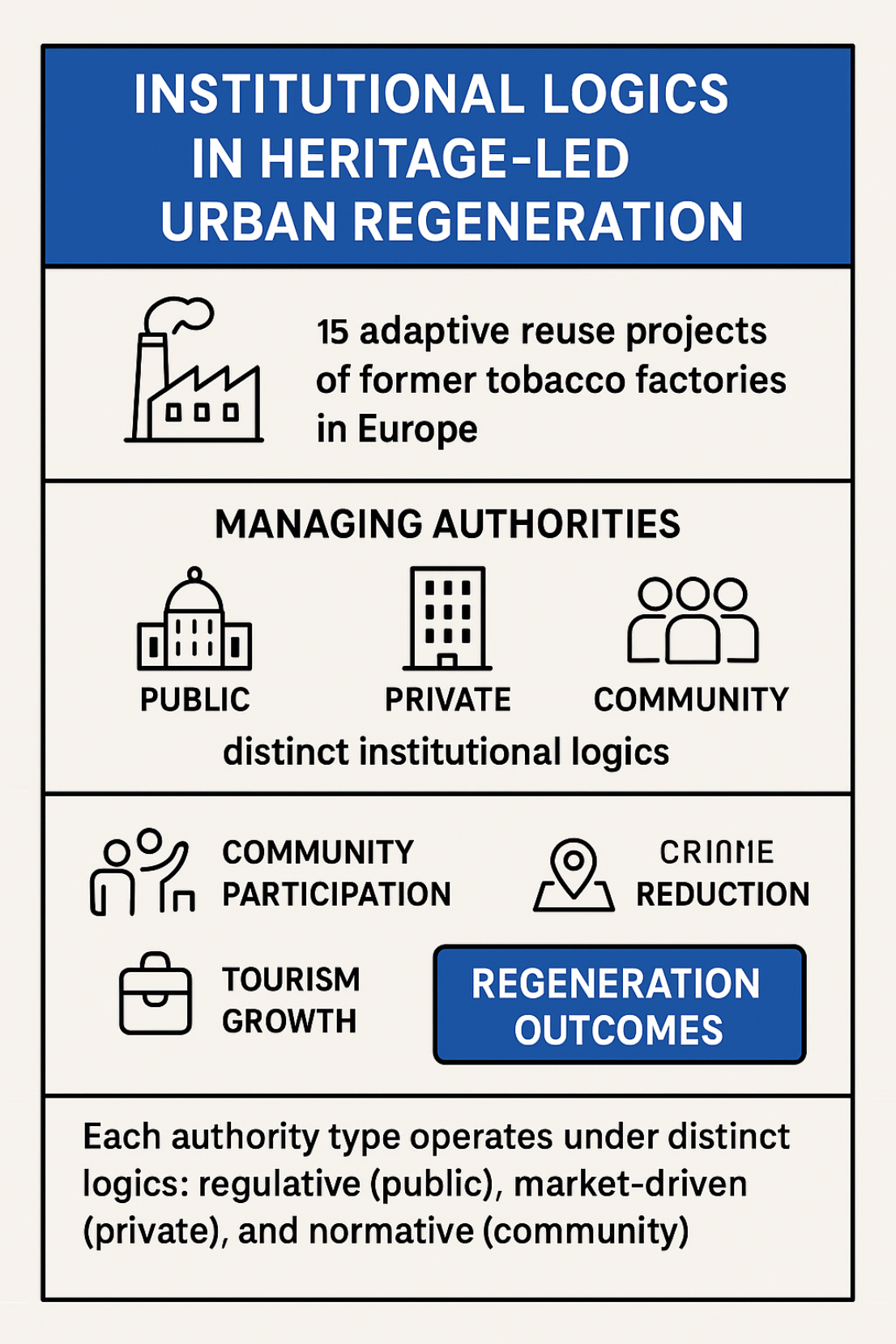
Drawing from institutional theory, this study recognizes managing authorities not merely as administrative actors, but as institutional agents operating under specific regulative, normative, or market-driven frameworks (
Scott, 2013). Public authorities typically operate within regulative institutional structures, emphasizing rules, accountability, and collective provision of services. Private actors are influenced by market institutions, driven by efficiency, investment return, and consumer demand. Community-led initiatives often embody normative institutions, shaped by shared values, collective memory, and grassroots engagement. These institutional frameworks influence the regeneration process—from funding sources and decision-making hierarchies to the intended functions and community participation levels.
Industrial heritage, as a subset of cultural heritage, refers to the remnants of industrial facilities that have fallen into disuse, often located within contemporary urban settings. As
Raines (
2011) notes, these remnants of industrial decline can serve as opportunities for revitalization, rather than simply marking an economic downturn. The architectural traces of former industries and aging factories present ideal opportunities for regeneration by urban planners, government bodies, or private investors. According to
Sınmaz and Altanlar (
2021), the departure of industry from cities offers significant prospects for improving cultural economies through spatial transformation. The technological and scientific value of industrial heritage sites, as well as their intangible elements (such as memories and records), are also of considerable importance, as emphasized by
Çakır and Edis (
2022). This study specifically focuses on tobacco factories and warehouses across Europe, given the richness of their underutilized industrial heritage.
Heritage-led urban regeneration goes beyond the simple reuse of physical structures. It seeks to respect and preserve the core elements—structural, ethical, tangible, and intangible—that are inherent in cultural heritage. This approach ensures that regeneration efforts not only revitalize spaces but also uphold the historical and cultural significance of the area, creating a deeper connection with the past while integrating it into the modern urban landscape. Urban regeneration serves as a tool for shaping improved political, cultural, and economic conditions, thereby enhancing the quality of services provided by the city or region and fostering a socio-political network of interconnected relationships. Achieving this balance requires carefully planned interventions that consider existing socio-economic dynamics (
Elnokaly & Wong, 2014).
Social integration is another key factor, as community acceptance of urban regeneration projects depends on how well they become part of residents’ everyday lives. This intergration is shaped by the economic, social, and historical impacts of these projects, such as job creation, improved urban spaces, respect for previous land uses, community participation, crime rates, and tourism growth. Furthermore, the contemporary function of regenerated spaces within the community is crucial for fostering social inclusion and ensuring long-term project success. As institutional theory suggests, the degree of legitimacy, inclusivity, and alignment with local norms plays a critical role in securing public support (
DiMaggio & Powell, 1983). Furthermore, the contemporary function of regenerated spaces within the community is crucial for fostering social inclusion and ensuring long-term project success.
Greffe (
2004) suggests that a heritage “ecosystem” is balanced by two interrelated factors: the condition of the objects and sites (if unrestored, few socio-economic benefits are realized) and the level of appreciation from those invested in maintaining heritage-related services. Furthermore, as
Bohnet et al. (
2022) suggest, “landscape provides the setting for people’s day-to-day activities and results from the way that different components of the environment—both natural and cultural—interact and are perceived and imagined by people”.
The social integration of heritage-led regeneration inevitably has a significant impact on destination identity. Destination identity refers to distinctive characteristics, such as social, cultural, historical, and natural elements, which define a tourism destination and differentiate it from others (
Konecnik Ruzzier & de Chernatony, 2013). Local communities and stakeholders, and the way they interact with their environment, play a pivotal role in shaping the destination’s identity.
The primary aim of this study is to examine how the type of managing authority initiating heritage-led urban regeneration influences its integration into the modern social fabric. By managing authority, we signify the entity adopting the administrative responsibility and often—but not necessarily—the funding procedure. This research is grounded in institutional theory, which highlights how different actors, public institutions, private enterprises, or community groups are embedded within distinct institutional logics (
Scott, 2013). These logics influence priorities, stakeholder engagement, governance mechanisms, and ultimately, regeneration outcomes.
Specifically, this research focuses on heritage-led regeneration based on industrial heritage, particularly tobacco factories and warehouses, as a significant yet underexplored theme. This research analyzes fifteen case studies of heritage-led regeneration projects with different managing authorities and funding sources (public, private, or community-driven initiatives). Either respecting the building’s heritage, tangible and intangible elements, and prior use, along with carefully considering the renovation process, funding sources, and its new function, is crucial to its successful integration into the modern urban fabric. This approach ensures that all these elements are managed effectively to deliver a project that serves society’s future needs while honoring and respecting its past.
After the regeneration process is completed, these buildings are repurposed to serve the needs of the local community: universities, libraries, offices and workspaces, museums and cultural hubs, restaurants and shopping malls, or even residential units and hotels. Managing authorities set the priorities for the reuse, focusing either on profit generation, heritage restoration, or cultural and social needs. In parallel, regeneration has a significant impact on community participation, neighborhood safety, crime reduction, and tourism development, all of which contribute to broader processes of identity construction and place-making.
Therefore, the secondary aim of this research is to examine the impact of managing authorities initiating heritage-led urban regeneration on destination identity, focusing on how institutional frameworks shape heritage narratives, tourism appeal, and perceptions of place authenticity.
2. Defining Heritage-Led Urban Regeneration
Heritage-led urban regeneration refers to the process of revitalizing urban areas through the adaptive reuse of cultural heritage, particularly built heritage, in a way that fosters social, economic, and environmental revitalization. It is increasingly used as a strategy to address urban decline while contributing to place identity, tourism, and social cohesion.
Tweed and Sutherland (
2007) emphasize the critical role that cultural heritage plays in fostering societal and community well-being. Additionally, the rise of a global service-based economy has positioned culture at the forefront of urban development, highlighting its economic value (
Banks & O’Connor, 2014).
Grodach and Loukaitou-Sideris (
2007) affirm that investing in culture and enhancing the global competitiveness and image of cities through cultural initiatives has become a common strategy for both central and local authorities, often neglecting private or community-led initiatives. In this context, culture is regarded as a key driver for urban development, contributing to local economic growth, job creation, cultural sustainability, urban identity, and an overall improvement in quality of life (
Niu et al., 2018).
This is not coincidental, as strategic planning increasingly focuses on leveraging existing cultural heritage in combination with cultural, social, and economic benefits to transform cities into hubs of creativity and economic progress. Over the past three decades, urban regeneration has been increasingly framed in terms of cultural and creative value. In such approaches, culture is often treated as a vehicle for economic growth, tourism development, and city branding. Yet, the institutional actors driving these strategies—public bodies, private investors, or grassroots communities—bring different motivations, priorities, and values to the process. This dimension is often neglected in policy and academic discourse, which tends to treat “regeneration” as a technocratic process rather than a normatively charged, institutionally embedded one.
2.1. From Industrial Decline to Cultural Opportunity
Since the 1960s, the phenomenon of deindustrialization has emerged, marked by the closure or relocation of industrial units. This trend became particularly pronounced in the mid-20th century, resulting in many industrial sites being abandoned, sold off, or repurposed.
Bertacchini and Frontuto (
2024) argue that, in this context, industrial brownfields have been increasingly recognized as valuable heritage assets, establishing industrial archaeology as a distinct field within historical and heritage preservation.
Sinnett and Sardo (
2020) agree that cleaning up pollution is a priority on the sites, particularly if this is sensitive to any cultural heritage, and combined with high-quality restoration that includes vegetation establishment.
The remnants of these industrial sites make up what is known as industrial heritage. According to the Charter of The International Committee for the Conservation of Industrial Heritage (
The Nizhny Tagil, 2003), industrial heritage encompasses the remains of industrial culture that hold historical, technological, social, architectural, or scientific significance. These remains include buildings, machinery, workshops, mills, factories, mines, processing sites, warehouses, energy generation and distribution facilities, transport infrastructure, as well as social spaces related to industry, such as housing, religious centers, and educational institutions.
The value of industrial heritage extends beyond the specific sectors it once served. Its maintenance and preservation are essential for retaining knowledge, supporting commercial activity, and reflecting social stratification and daily life, giving it significant historical value for society. Additionally, industrial heritage holds social value as it serves as an important element of identity. The industrial process profoundly shaped entire regions, influencing not only local customs and moral frameworks but also modern urban structures. Many urban centers evolved to meet industrial needs, with residents—whether directly or indirectly involved in industrial processes—adapting their lifestyles, including leisure activities, to the rhythms of industrialization. As
Slotta (
1992) notes, the importance of industrial monuments lies less in the artistic vision of their architects or founders and more in their role as immediate testimonies of the development of production, transportation, and utility networks.
Finally, preserving the processes related to industrial production is a critical aspect of industrial heritage. In turn, past best practices can be retained, while avoiding serious mistakes that could lead to economic failure. As
Dredge and Jenkins (
2003) observe, regions are networks of social relations, and the rarity of surviving industrial processes further enhances their value. All this information, along with elements of identity, daily life, work, customs, and traditions (social value), as well as supporting trade and industrial activity (economic value) and transforming former hotspots of neglect into functional hubs (aesthetic value), should be safeguarded for the future. In this context, urban regeneration fosters a modern urban environment that respects, preserves, and showcases its rich past.
The term “Urban Regeneration” refers to the revitalization of typically degraded urban areas, with the goal of creatively reclaiming the urban landscape. Key priorities include implementing best practices, such as repurposing buildings, creating green and recreational spaces, and promoting cultural heritage. As
Leary and McCarthy (
2013) explain, “Urban Regeneration is an area-based intervention initiated, funded, supported, or inspired by the public sector, aimed at achieving significant, sustainable improvements in the conditions of local people, communities, and places suffering from various forms of deprivation.” The definition of urban regeneration given above neglects urban regeneration from private investors and community-driven initiatives, focusing only on the public sector.
Konior and Pokojska (
2020) agree that revitalization is a long-term process focused on pulling urban areas out of crisis, addressing both material aspects—such as buildings, public spaces, and green areas—and intangible elements, including economic, social, or cultural factors, with heritage playing a crucial role.
Since the mid-20th century, culture has evolved from merely being protected to becoming a proactive tool for intervention (
Janssen et al., 2014). As
Sınmaz and Altanlar (
2021) note, culture has emerged as a key theme in urban transformation and revitalization programs, helping preserve and reinforce the character of cities, boost local economies, and foster creative management. In this context, urban planners develop strategies centered around culture. In a service-based economy, attracting investors, capital, and ultimately visitors and tourists become the top priority. These strategies have the potential to reshape urban economies, positioning the city as a hub of creativity and cultural activity (
Degen & Gacia, 2012).
Even though culture is often used as a tool for urban regeneration, its application varies across different contexts.
Evans (
2005) classifies culture-led development models, which include cultural programs and activities in the revitalization process, into three categories: “culture and regeneration,” “cultural regeneration,” and “culture-led regeneration.” However, he notes that these models do not differ significantly in practice. In the first model, culture and regeneration, urban regeneration is typically managed by separate authorities, with culture playing a supportive role in strategic planning, but not a central one.
Chiu et al. (
2019) argue that for this model to be effective, a strong local or global leader is needed to counteract negative social perceptions, while placing importance on integrating cultural activities and preserving ethnic groups and values. The second model, cultural regeneration, involves smaller-scale projects where culture is used as a tool for partial regeneration, such as establishing a local museum. While strategic planning is more organized and coordinated in this model, there is often a lack of cooperation between various entities and institutions.
According to
Evans (
2005), the third framework, culture-led urban regeneration, prioritizes public interest. In this approach, culture is strongly advocated as a key strategy for urban renewal (
Aboukhater, 2020). As
Sasaki (
2004) notes, many cities actively engage their citizens in cultural activities to help revive their economies.
Graci (
2012) further emphasizes that a multi-stakeholder partnership fosters a cohesive vision for urban development, enabling city destinations to efficiently focus resources, share knowledge, and enhance environmental and social initiatives. Within this model, physical renewal is undertaken with the goal of ensuring cultural activities and programs remain accessible.
2.2. Institutional Logic in Regeneration Practice
While much literature frames culture-led regeneration as a top-down, public-sector strategy (
Evans, 2005;
Grodach & Loukaitou-Sideris, 2007), less attention is given to the diversity of institutional actors that shape regeneration processes. To address this gap, this paper draws on institutional theory (
Scott, 2013), which conceptualizes institutions as composed of regulative, normative, and market logics that influence how actors frame problems, mobilize resources, and define success (
Table 1).
Public institutions typically operate within a regulative logic, prioritizing rule-bound procedures, transparency, and public benefit. Their regeneration projects often emphasize civic uses—museums, libraries, universities—aimed at democratizing cultural access. Private actors function within a market logic, evaluating heritage through its economic potential and often privileging tourist-facing or profit-generating outcomes. Community-driven actors embody a normative logic, rooted in shared values, local memory, and collective agency. These projects may be less capital-intensive, but they offer profound cultural and social returns.
Many regeneration initiatives reflect hybrid institutional configurations. For example, governments may provide regulatory support and initial funding, private investors bring capital and business models, while communities offer legitimacy, memory, and stewardship. This interplay determines not just outcomes, but how heritage is interpreted and who benefits.
Ultimately, institutional theory enables a more nuanced understanding of regeneration as not merely technical, but political and social. Whether a site becomes a luxury boutique or a local archive is determined less by its physical characteristics than by the logics and actors involved in managing its transformation.
3. Methodology
This study investigates how the type of managing authority initiating heritage-led urban regeneration influences its integration into the modern social fabric and contributes to shaping destination identity. To explore this, we adopt a comparative, multiple-case study methodology, drawing on mixed data sources and grounded in institutional theory (
Scott, 2013). The research examines fifteen regeneration projects across Europe involving former tobacco warehouses and factories—industrial heritage sites that had been abandoned and later repurposed through heritage-led regeneration.
The focus on tobacco-related sites stems from the unique architectural and symbolic legacy of the tobacco industry in Europe. Flourishing throughout the 20th century, the tobacco trade left a widespread network of industrial facilities that were largely decommissioned from the 1960s onward. These sites, often centrally located, present strong potential for adaptive reuse. Despite the richness of tobacco heritage, it remains underexplored in regeneration literature, particularly in terms of its social integration and governance dynamics.
A key contribution of this study is its focus on the role of the managing authority as an institutional actor. While existing literature often emphasizes economic impacts or cultural branding outcomes, this research centers on the social dimension of heritage-led regeneration, exploring how different managing authorities—public bodies, private investors, or community-driven groups—approach regeneration under varying institutional logics. Drawing on institutional theory, we classify these authorities according to:
Regulative institutions (e.g., municipal governments, national ministries),
Market-driven institutions (e.g., real estate developers, private cultural operators), and
Normative institutions (e.g., citizen-led initiatives, cultural collectives).
These institutional logics influence how heritage is interpreted, whose needs are prioritized, and how outcomes such as inclusion, community participation, safety, and destination identity are shaped.
3.1. Case Study Selection
The fifteen cases were selected based on the following criteria: alignment with the core research themes, as each case demonstrated clear focus on heritage management, urban regeneration and organizational decision-making processes, availability of primary sources—as each case selected provided sufficient access to essential material and stakeholder access, geographic and contextual diversity in order to represent a wide range of regional context and organizational types, data completeness and reliability to ensure whether available material was comprehensive, verifiable, and suitable for triangulated analysis, and comparative analytical value. More specifically:
The site is a former tobacco factory or warehouse with documented heritage value.
The regeneration project was completed (or significantly underway) within the last 30 years.
Sufficient data is available to assess economic, social, spatial, and environmental impacts, including both formal reports and the gray literature.
The research unfolds in two phases:
- 1.
Qualitative Phase
This stage involved document analysis, review of project reports and archival materials, field observation where available, and textual interpretation of regeneration narratives (e.g., mission statements, community feedback, institutional press releases). These materials allowed us to understand how each managing authority framed the purpose and process of regeneration. During Phase 1 (mapping and preliminary evaluation), several candidate cases were ultimately excluded to preserve analytical focus, avoid redundancy, and ensure methodological rigor. The key reasons for omission included: insufficient thematic relevance to the mechanisms under investigation, persistent institutional or archival access barriers despite formal data requests, key activities occurring outside the defined temporal scope, and substantial overlap with other higher-value cases, limiting additional comparative insight.
- 2.
Quantitative Contextualization
We supplemented qualitative findings with contextual indicators related to tourism rates, crime statistics, and community participation levels, both before and after regeneration. These were not analyzed using statistical models but served to support and contextualize institutional comparisons by illustrating concrete impacts.
The study does not seek to produce generalizable statistical claims but instead aims for analytical generalization—identifying patterns of institutional behavior and outcomes that can inform broader theory and practice in heritage-led urban regeneration.
3.2. Categorization of Managing Authorities
The selected case studies were categorized according to the managing authority responsible for initiating and overseeing the regeneration process:
Public institutions: Altadis Tobacco Factory, Cibali Tobacco Museum, Manufacture des Tabacs de Lyon, University of Seville, Rijeka Former Tobacco Factory, Kunsthalle Kremst
Private investors: Van Nelle Tobacco Factory, Yenidze Tobacco Factory, Stanley Tobacco Warehouse, Bristol Tobacco Warehouse, Landewyck Tobacco Factory, Manifattura Tabacchi Firenze, Hydrama Hotel
Community-driven efforts: La Tabacalera de Lavapiés, Plovdiv Tobacco Factory
This classification forms the analytical basis for comparing how institutional logics shape regeneration outcomes, particularly in terms of integration into everyday community life, perceived and actual safety improvements, heritage narrative construction, and tourism development and destination identity formation. Through this design, the study contributes to a growing body of work that emphasizes the governance of regeneration as a key determinant of sustainable, socially inclusive, and culturally authentic urban redevelopment.
4. Results
4.1. Managing Authorities and Institutional Logic
The empirical analysis of fifteen heritage-led urban regeneration projects across Europe reveals that the type of managing authority—whether public, private, or community-based—functions not merely as an administrative category, but as an embodiment of distinct institutional logics (
Scott, 2013). These logics—regulative, market-driven, and normative—not only shape the priorities and decision-making processes of regeneration initiatives but also influence the extent to which such projects succeed in achieving social integration, heritage preservation, and destination identity transformation.
Projects led by public institutions consistently reflect a regulative logic, wherein regeneration is guided by legal frameworks, policy instruments, and a commitment to civic objectives. In these cases, managing authorities emphasize heritage conservation, accessibility, and public value. For instance, the transformation of the Tobacco Factory in Seville into a university complex and civic space demonstrates a conscious effort to anchor the regeneration process in historical continuity and community use. Similarly, the Manufacture des Tabacs in Lyon has been reimagined as a mixed-use educational and cultural district that retains the industrial aesthetic while providing socially inclusive functions. These public sector initiatives are typically funded by governmental bodies or supported through European Union subsidies, enabling them to prioritize long-term social outcomes over short-term profitability. Within these contexts, the institutional framework supports transparency, stakeholder involvement, and strategic urban planning aimed at reinforcing collective memory and civic identity.
In contrast, projects initiated by private investors exhibit a market-based logic, where decision-making is oriented toward efficiency, profitability, and urban competitiveness. Heritage is often leveraged as a commercial asset, contributing to branding and tourism appeal. The Van Nelle Factory in Rotterdam, for instance, has been transformed into a high-end business and event complex, offering a model of commercial heritage reuse that aligns with UNESCO preservation standards but remains economically oriented. The Hydrama Hotel in Drama, Greece, and the Manifattura Tabacchi in Florence similarly exemplify private-led projects where regeneration outcomes favor luxury consumption, office space, and high-end leisure. These cases demonstrate a clear divergence from civic or cultural priorities, instead focusing on value extraction, real estate development, and global marketability. While such projects often succeed in revitalizing neglected industrial spaces and attracting investment, they may risk limiting public access and undermining the authenticity of heritage narratives.
A third category emerges from cases that are community-driven or grassroots-initiated, aligned with normative institutional logics. These projects are grounded in shared cultural values, collective memory, and social engagement rather than regulatory mandates or profit motives. La Tabacalera de Lavapiés in Madrid stands out as a self-managed cultural and social center, where local collectives have reclaimed an abandoned tobacco factory to host art workshops, performances, and community services. Similarly, the Plovdiv Tobacco Warehouses in Bulgaria, activated during the city’s tenure as European Capital of Culture, showcase how communities can reinterpret industrial heritage in participatory and inclusive ways. These projects, while often under-resourced and lacking institutional stability, reveal the powerful social potential of heritage reuse when guided by communal values and cultural attachment.
Across all three categories, it becomes evident that the managing authority operates as a proxy for institutional framing, shaping not only the trajectory of regeneration but also its social implications. Public-led projects foster stronger integration into the urban social fabric through inclusive programming and cultural preservation. Private-led initiatives tend to prioritize economic viability and aesthetic branding, often at the cost of long-term community inclusion. Community-led efforts, while limited in scale, underscore the importance of local agency, memory, and social capital in reactivating industrial heritage.
This comparative framework, grounded in institutional theory, allows for a more nuanced understanding of how different regeneration models perform across key dimensions—namely, heritage preservation, destination identity formation, and social integration. Rather than treating these outcomes as contingent on architectural or economic variables alone, this analysis positions them as the result of institutional logics embedded within each managing authority type. As such, the findings challenge conventional dichotomies between top-down and bottom-up planning, revealing a spectrum of institutional approaches whose logics fundamentally shape the purpose, process, and social impact of heritage-led urban regeneration.
4.2. Impacts of Regeneration by Institutional Logic
The analysis of heritage-led urban regeneration outcomes across the fifteen case studies demonstrates a clear relationship between institutional logics and the type and depth of impact achieved. By categorizing managing authorities into three ideal types—regulative (public institutions), market-based (private investors), and normative (community-led actors)—we observe patterned variations across three key indicators: community participation, tourism visibility, and crime/safety. These indicators are not only practical measures of success but also reflect how institutional values shape both process and outcome.
Public-led projects, driven by a regulative logic, consistently register higher levels of community participation and perceived safety. These results stem from structured stakeholder engagement and an emphasis on social inclusion. Projects such as the Tobacco Factory in Seville and the Cibali Tobacco Museum in Istanbul integrated participatory planning workshops, educational programming, and civic uses that encouraged long-term community involvement. These initiatives also benefited from policy-driven safety enhancements and EU funding mechanisms tied to social cohesion. As such, public-led regeneration aligns procedural design with long-term integration goals and community development (
Table 2).
Private-led projects tend to emphasize tourism rates and economic revitalization, often at the expense of participatory planning or social equity. In sites such as Van Nelle Factory in Rotterdam or Hydrama Hotel in Greece, high tourism visibility and strong branding were achieved through adaptive reuse aligned with heritage aesthetics—but with minimal grassroots involvement. While these projects contribute significantly to local economies and international visibility, they often reflect a limited public role and ambiguous outcomes regarding local safety and long-term community access (
Table 3).
Community-led initiatives, driven by normative logics, consistently score highest in community participation and identity reinforcement. La Tabacalera de Lavapiés and the Plovdiv Tobacco Warehouse exemplify bottom-up regeneration. These initiatives transform disused spaces into inclusive cultural hubs through grassroots governance and cultural self-determination. Though typically under-resourced, they demonstrate substantial social cohesion benefits and help build collective memory. Tourism remains modest but often meaningful in terms of cultural authenticity (
Table 4).
This comparative analysis underscores that institutional logics shape not only the design of regeneration projects, but also the distribution of their benefits. Public-led models tend to promote social integration through civic-oriented programming; private-led models prioritize economic growth and branding yet often restrict access and community influence; community-led models, though typically resource-constrained, foreground participation, local identity, and grassroots agency.
Viewing these differences through the lens of institutional theory reveals that regeneration outcomes are not merely products of spatial reuse or policy instruments but are fundamentally mediated by the institutional rationalities embedded in governance structures. This perspective allows us to move beyond binary classifications—such as top-down versus bottom-up—and toward a more nuanced understanding of how urban regeneration serves divergent institutional goals, whether advancing public value, market priorities, or communal visions.
The findings reinforce a more sophisticated conceptualization of heritage-led regeneration as a socially embedded and institutionally framed process. Rather than interpreting outcomes as the result of technical planning or economic calculus alone, this approach foregrounds how institutional logics condition the possibilities for inclusion, sustainability, and cultural continuity. In this context, institutional framing is not a background condition but a central force shaping project legitimacy, community acceptance, and long-term public value.
Taken together, the results suggest that institutional logics are not ancillary, but foundational in shaping both the procedural and substantive dimensions of urban regeneration. Whether privileging social equity, economic efficiency, or cultural resilience, each managing authority type operates within a distinct institutional paradigm that mediates its relationship to place, memory, and transformation. These insights call for a critical reassessment of how governance structures inform not only regeneration outcomes but also their social meaning and enduring significance. The next section explores these dynamics further by situating the findings within broader debates in urban regeneration theory and institutional analysis, and by identifying key implications for policy and practice.
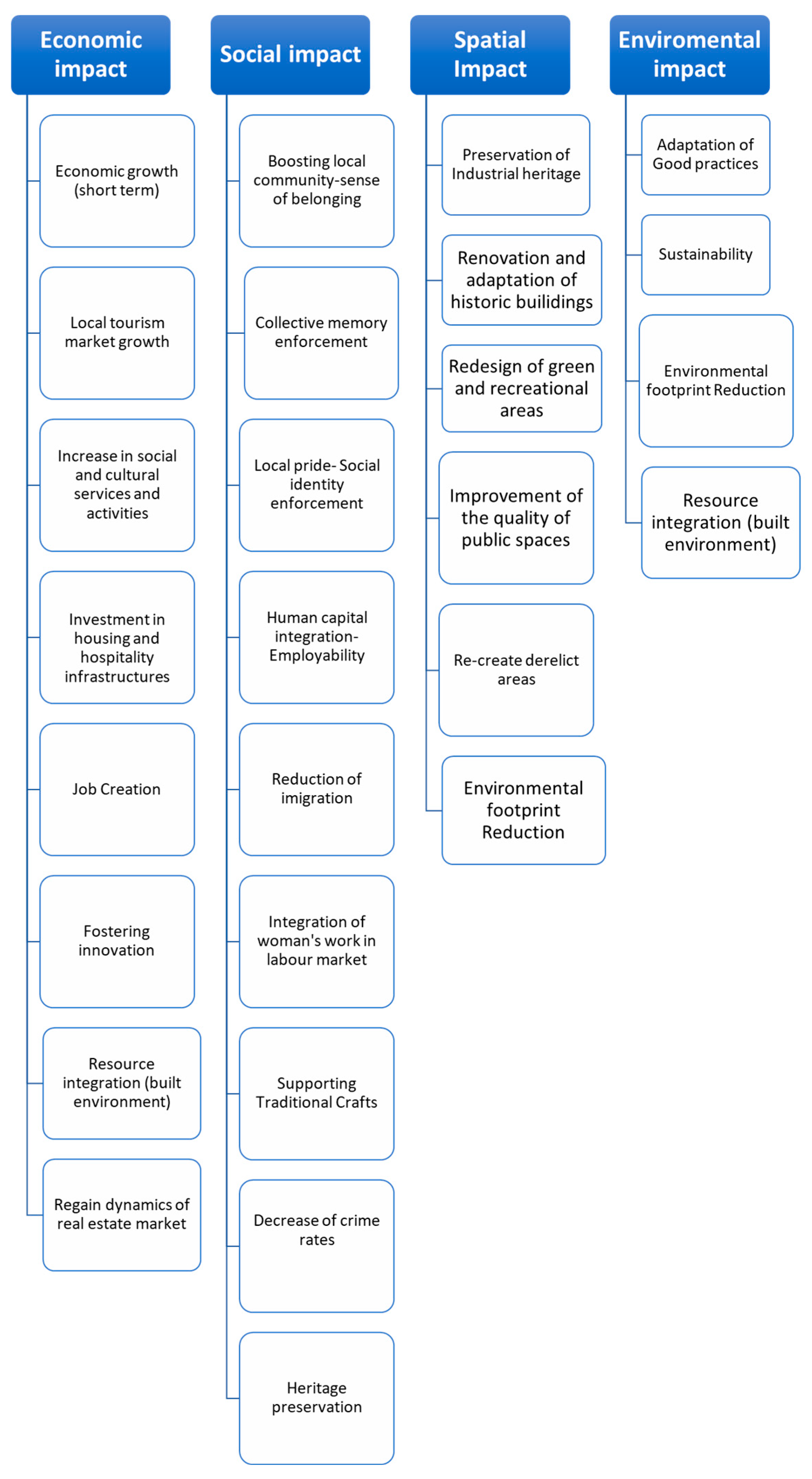
Finally, in order to synthesize the diverse effects observed across the regeneration cases,
Figure 1 provides a consolidated visual overview of the economic, social, spatial, and environmental impacts that emerged from the comparative analysis. While each project varied in emphasis depending on its institutional logic—whether public, private, or community-led—this diagram captures the common impact categories and sub-themes reported across the full dataset. Evidence gathered from multiple data streams is synthesized, including policy and strategic documents from the cultural organizations, stakeholder interview data, and field observations conducted on-site. By cross-referencing these sources, we were able to identify recurring operational priorities—such as preservation, maintenance, reduction strategies, and adaptive reuse—and represent them visually in a coherent analytical framework. We further note that each element of the figure corresponds to themes that consistently emerged across the triangulated evidence. For example, references to preservation practices were corroborated in organizational reports, validated through interview statements, and observed directly during field visits. Similarly, the “Reduction” category reflects documented sustainability measures, interview accounts of resource management, and corroborating observational data. This triangulated approach ensures that
Figure 1 is not conceptual only, but rather an evidence-based synthesis grounded in multiple, mutually reinforcing data sources.
The figure serves as a bridge between case-specific outcomes and a broader conceptual understanding of how heritage-led regeneration contributes to urban transformation on multiple levels. Importantly, it reinforces the view that such projects extend beyond architectural reuse or economic revitalization; they are deeply embedded in societal, cultural, and environmental frameworks that reflect the priorities of their managing authorities.
5. Discussion
The results of this research highlight the significant influence of institutional logics—regulative, market-based, and normative—on the outcomes of heritage-led urban regeneration. By integrating institutional theory (
Scott, 2013) into the analysis, we move beyond understanding managing authority as a static category and instead view it as a dynamic institutional actor shaped by and shaping the frameworks of governance, economic rationality, and cultural legitimacy.
The cases were analyzed using a structured, multi-stage qualitative protocol, and included within-case analysis based on predefined indicators improving consistency, cross-case thematic comparison, iterative coding (both deductive and inductive) to allow deeper theme extraction, and data triangulation to strengthen credibility across documents, interviews, archives, and field observations. The challenges arose concern inconsistent archival/reporting formats and limited interview follow-ups, which reduced analytical symmetry in some cases. Limitations of the research include reliance on data accessibility, typical of qualitative case research, and the use of narrative or proportional inference when disaggregated quantitative records were unavailable.
In line with the original intent of this study, it becomes evident that the type of managing authority is not only central to operational aspects of regeneration but also to its broader social meaning and community impact. This finding is particularly salient when considered against the existing literature on culture-led urban regeneration. Scholars such as
Tweed and Sutherland (
2007) and
Banks and O’Connor (
2014) have emphasized the potential of cultural heritage to foster community well-being and economic vitality, especially in post-industrial urban contexts. However, what has remained underexplored is how the institutional form of governance mediates the realization of such potential.
The comparative analysis of public, private, and community-led projects reinforces this gap. Public institutions, guided by regulative logic, are more likely to adopt inclusive planning practices, prioritizing heritage authenticity, educational value, and long-term community engagement. These findings align with
Leary and McCarthy’s (
2013) understanding of urban regeneration as a civic intervention rooted in place-based identity formation. In contrast, private investors, operating through a market-based logic, emphasize profitability, aesthetics, and economic regeneration through tourism, echoing the entrepreneurial urbanism discussed by
Grodach and Loukaitou-Sideris (
2007). These approaches may offer short-term benefits but risk undermining social cohesion or limiting access.
Community-led initiatives, though fewer in number and scale, demonstrate a unique ability to reinterpret industrial heritage in ways that foster cultural resilience and participatory governance. They confirm what
Evans (
2005) describes as “culture-led regeneration” in its most grassroots and transformative sense, where cultural memory and local agency drive urban change. Yet, these efforts often lack institutional stability and require long-term policy support to scale and sustain their impact.
What this study adds to the literature is a more nuanced understanding of institutional hybridity and tension in urban regeneration. As
Janssen et al. (
2014) and
Degen and Gacia (
2012) note, culture is increasingly embedded in strategic planning across governance levels. Yet our findings suggest that strategic use of culture is filtered through different institutional worldviews, which materially affect how regeneration is executed and to whose benefit. Even when projects adopt similar architectural or environmental practices, their institutional logic can lead to very different social outcomes.
Moreover, these insights challenge dichotomies between top-down (state-led) and bottom-up (community-driven) regeneration. In practice, many cases operate in hybrid zones, with intersecting actors and overlapping values. For instance, EU co-funded projects may be initiated by municipalities but shaped by local cultural associations. Recognizing these configurations demands a more flexible theoretical lens that accounts for institutional assemblages, power asymmetries, and context-specific negotiations.
In summary, this study proposes that the managing authority should be treated as a proxy for institutional logic, which determines not only planning mechanisms and funding routes but also how heritage is defined, interpreted, and mobilized. Such framing opens space for future research into policy design, particularly the need for governance models that combine accountability, inclusivity, and cultural responsiveness in heritage reuse.
6. Conclusions
This paper has examined heritage-led urban regeneration through the analytical lens of institutional theory, revealing that the outcomes of such processes are not merely shaped by architectural reuse or economic investment, but are fundamentally conditioned by the institutional logics embedded within the governance structures overseeing them. By categorizing fifteen European case studies according to their managing authorities—public, private, and community-based—and interpreting them through the corresponding regulative, market-based, and normative logics, we have demonstrated that each model embodies distinct assumptions about value, participation, and the role of heritage in urban development.
The comparative analysis revealed that public-led projects, underpinned by regulative logics, tend to produce outcomes that favor social inclusion, participatory governance, and cultural programming. This was evident in high community participation rates, reductions in crime, and the preservation of collective memory, often supported by public subsidies or policy mandates. In contrast, private-led initiatives, following a market-based logic, prioritize efficiency, branding, and economic viability. These cases demonstrated significant increases in tourism rates and real estate value, but with more limited evidence of local community involvement or long-term integration into the social fabric. Community-led projects, though often underfunded and less institutionally embedded, reflected a normative logic where regeneration was driven by cultural values, local identity, and grassroots activism. These cases exhibited strong community engagement and social innovation, despite lower visibility in traditional economic metrics.
The integration of quantitative indicators—community participation, tourism rates, and crime reduction—allowed for a comparative typology that moves beyond anecdotal or descriptive assessments. These indicators provided a measurable basis for evaluating regeneration impacts across institutional types and helped illuminate the trade-offs inherent in each governance model. For example, while private-led projects may score highly on tourism and revenue generation, they often fall short in terms of participatory inclusion or social equity. Similarly, community-led initiatives may produce substantial intangible value, such as cultural continuity and empowerment, yet face barriers in achieving visibility, funding, or systemic stability. Public-sector models attempt to balance both objectives but are often constrained by bureaucratic inertia, funding cycles, or political contingencies.
Conceptually, this study reframes heritage-led regeneration as a socially embedded, institutionally contingent process, rather than a neutral or purely technical exercise in urban design. By foregrounding the role of institutional logic, we challenge the dominant narratives in urban regeneration literature that privilege either top-down state planning or bottom-up community activism. Instead, we propose a more nuanced spectrum of institutional arrangements, each generating specific forms of value, legitimacy, and impact. This approach offers both analytical clarity and normative insight: regeneration does not merely happen on the ground; it is framed, enabled, and constrained by institutional cultures, priorities, and path dependencies.
From a policy perspective, the findings underscore the need for differentiated strategies based on governance type. Public institutions should prioritize mechanisms that strengthen participatory governance and ensure long-term community access to regenerated heritage spaces. Funding frameworks at the European or national level could be reoriented to reward projects that embed social inclusion as a formal evaluation criterion. Private actors, by contrast, should be incentivized to adopt socially responsible regeneration practices through tax incentives, public–private partnerships, or heritage leasing schemes that preserve public access. Meanwhile, community-led initiatives require structural support in the form of flexible financing, legal protections, and access to technical expertise, to ensure their survival and scalability without diluting their grassroots ethos. More broadly, urban policy should recognize that regeneration is not only about physical transformation but about sustaining civic trust, shared memory, and collective agency.
Despite its contributions, this study also faces limitations. First, while our three ideal types offer analytical clarity, real-world cases often involve hybrid governance models, where public, private, and community actors interact in complex ways. Second, the selection of quantitative indicators, while empirically grounded, may not fully capture the richness of regeneration outcomes, particularly those related to cultural meaning, memory, or social cohesion. Third, the analysis is limited by data availability and consistency across cases, especially regarding long-term impacts, gentrification, or displacement, which remain underexplored.
Future research should extend this framework by investigating hybrid or collaborative models of governance, where institutional logics intersect or compete in shaping regeneration outcomes. Longitudinal studies would also be valuable, particularly in assessing the durability of impacts over time and the evolving role of community actors in sustaining heritage value. Moreover, incorporating qualitative metrics of place attachment, identity transformation, or intergenerational memory would deepen our understanding of regeneration as a lived, symbolic process, not just a spatial or economic intervention. Comparative studies across different policy regimes, cultural contexts, or legal environments would also help refine the typology and increase its global applicability.
In sum, heritage-led regeneration must be approached not simply as a policy tool or architectural strategy, but as a deeply institutional practice, one that reflects broader societal values, priorities, and power structures. By making these logics visible and critically examining their outcomes, we can better design, assess, and advocate for regeneration models that are not only economically viable but also socially just, culturally meaningful, and environmentally sustainable.