1. Introduction
Generation Z, born and raised in a digital environment, forms its identities and social practices within a context largely shaped by the presence and influence of social media. This generation has now reached adulthood, entered the labor market, and become an active participant in contemporary cultural and social trends, including the music festival industry (
Barhate & Dirani, 2022). According to
Rosenberg et al. (
2025),
Yılmaz et al. (
2024), and others, Generation Z comprises individuals born between 1995 and 2010. Today, they make up approximately 24% of the world’s population, making them one of the most significant demographic cohorts for analyzing cultural, media, and economic phenomena. Members of this generation represent a key segment of the festival audience, and understanding their motivational patterns and digital media habits is crucial for the future development of the festival industry (
Dunne et al., 2023).
Generation Z is characterized by strong digital literacy, heightened environmental awareness, and social sensitivity. As the first generation to grow up entirely with the internet, mobile devices, and social media, it has a distinct communication and cognitive profile (
Dabija et al., 2019), with a shorter attention span that influences how content is consumed and the effectiveness of promotional formats (
Konieczna & Trybuś-Borowiecka, 2025). The daily lives of this generation are closely linked to platforms such as TikTok and Instagram, which serve as primary spaces for expression, social interaction, and identity formation. TikTok encourages spontaneous and highly engaging communication through algorithmically curated content (
Schellewald, 2023;
Stiller, 2023), while Instagram remains the leading network for visually crafted narratives, aesthetic representations, and personal branding (
Abidin, 2016;
Lough, 2023). These digital environments directly shape cultural experiences, including those related to music festivals, which for Generation Z are hybrid events experienced simultaneously in physical and digital spaces (
Collie & Wilson-Barnao, 2020).
Social media influencers have become key figures in the contemporary digital ecosystem, shaping the attitudes, preferences, and behavior of their followers (
Bastrygina & Lim, 2023;
Joshi et al., 2025). By creating content that emphasizes authenticity, accessibility, and community participation, influencers position themselves as trusted sources of recommendations (
Boerman, 2020;
Reinikainen et al., 2020). This relationship also influences the behavior of festival audiences, including festival brand perception, visitation decisions, and engagement during events (
Caraka et al., 2022;
Stiller, 2023).
Despite growing interest in the digital habits of Generation Z, the existing literature still lacks a clear distinction between influencer content and user-generated content (UGC) in the context of music festivals. Most research considers these phenomena together, without insight into their specific effects, and there are almost no studies examining this relationship in the context of Serbia and Generation Z as the primary festival audience. This gap is the central theoretical and empirical motivation for this study.
Therefore, this paper explicitly separates and compares the impacts of influencer content and UGC in the context of music festivals, addressing a clear research gap in the existing literature—especially regarding Generation Z in Serbia, where this type of analysis has not previously been conducted.
The aim of this research is to examine how the digital practices of Generation Z on TikTok and Instagram shape their experiences of music festivals. Particular attention is given to how algorithmic mechanisms and influencer-created content contribute to the perception of festivals, as well as how UGC created by visitors influences the collective narrative and digital representation of the festival experience. The study investigates the differences between these two types of content, their specific effects, and their roles in forming a sense of community belonging.
In order to precisely examine the digital behavior patterns of Generation Z in the context of music festivals, and in line with the identified research gaps in the literature, this paper poses the following questions:
Q1: How does the use of TikTok and Instagram affect the perception and festival practices of Generation Z in Serbia?
Q2: How do the algorithmic mechanisms of TikTok and Instagram influence the visibility, interpretation, and formation of digital narratives about music festivals?
Q3: What is the impact of content created by influencers on decisions about festival attendance, participation, and post-festival communication?
Q4: How does user-generated content (UGC) contribute to a sense of belonging and collective identity among festival attendees?
Q5: What are the differences in the impact of influencer content and UGC on Generation Z’s perception of music festivals?
Q6: How do content sharing activities affect the digital representation of the festival?
To empirically examine these tasks, the research was conducted as a quantitative study using an online survey with a purposive sample of Generation Z members. Data were collected via TikTok, Instagram, and Facebook between September and November 2025, resulting in 248 valid responses from various regions of Serbia. The questionnaire included socio-geographic data, platform usage habits, festival attendance frequency and motives, as well as four theoretically grounded measurement subscales. Data were analyzed using descriptive and inferential statistics, with non-parametric tests applied due to non-normal distribution.
This paper makes a theoretical contribution by distinguishing and comparing the effects of influencer content and UGC within the context of Generation Z’s festival experience—an area that has not been adequately explored to date. From a practical perspective, the research findings can directly benefit music festival organizers by enabling more precise digital strategy development, audience targeting, and the creation of content that fosters Generation Z engagement and loyalty. Thus, the results of this study provide operational guidelines for improving communication, promotion, and the design of the festival experience in the digital environment.
3. Materials and Methods
In line with the defined aim and research tasks, and based on a comprehensive review of the relevant literature, the research hypotheses presented in
Table 1 were formulated. A quantitative research approach was used to test these hypotheses. Data for statistical analysis were collected using the survey method with a self-developed questionnaire.
Following the scale development procedure proposed by
Chang and Hung (
2021), the questionnaire development process included establishing a theoretical framework and operational definitions, generating items, conducting expert review, collecting data, and performing factor analysis to confirm the structure and reliability of the measurement instrument. None of the questionnaire items were adapted, adopted, or translated from existing scales. All items were originally developed by the authors. The item pool was developed using a theory-driven process. Key dimensions were identified based on prior studies of music festival experiences and related constructs; however, the wording and content of individual items were newly formulated to operationalize these dimensions in the specific research context. This approach was chosen because no established or validated scale fully captures Music Festival Experience in the examined digital and generational context. Accordingly, exploratory factor analysis (EFA) was used to examine the underlying factor structure of the newly developed items, while confirmatory factor analysis (CFA) was not conducted at this stage. Therefore, the study is exploratory, and further research is recommended to confirm the stability and generalizability of the observed relationships. Statistical data processing was conducted using SPSS 26.0 (Statistical Package for the Social Sciences).
3.1. Sample and Data Collection
For this research, purposive sampling was used, targeting individuals born between 1995 and 2010 from all regions of Serbia. The online questionnaire was created using the free software Google Forms and distributed via a link on Instagram, TikTok, and Facebook over a three-month period (September to November 2025). Facebook is a convenient channel for survey distribution because it features thematic groups that bring together people with similar characteristics or interests, facilitating access to the target population. Instagram and TikTok do not have a developed system for grouping users; instead, each user must be reached directly. On Facebook, the survey was shared in thematic groups related to music festivals, while on Instagram and TikTok each user was approached directly based on visible engagement with music festival content, such as following festival-related accounts, liking posts, or sharing festival-related content on their profiles. When distributing the questionnaire, it was emphasized that the invitation to participate was intended only for members of Generation Z. However, a control question was included, requiring participants to enter their date of birth due to varying interpretations of the birth year range for Generation Z (
Jayatissa, 2023). Of the 255 participants, 248 were born between 1995 and 2010. By activating the Google Forms option that allows the survey to be completed only once per email address, control over duplicate responses was ensured.
3.2. Questionnaire Design
The questionnaire comprises three parts. The first part collects socio-demographic data about participants, such as gender, age or year of birth, place of residence, and current employment or educational status. The second part examines participants’ habits regarding the use of Instagram and TikTok, music festival attendance, and motives. It also includes a subscale measuring participants’ general attitude towards music festivals (Music Festival Perception). The third part contains four theoretically defined subscales. The first subscale concerns the perception of music festivals under the influence of influencers (Influencer Content Perception). The second subscale addresses the perception and influence of content on Instagram and TikTok created by festival attendees (Attendee Content Perception). The third subscale relates to participants’ activities as content creators for Instagram and TikTok during music festival visits (Content Sharing Activity), and the fourth subscale concerns participants’ perception of the importance of using Instagram and TikTok in shaping the festival experience (Platform Importance). All subscales in the questionnaire use a five-point Likert agreement scale (1—‘strongly disagree’, 5—‘strongly agree’), which participants used to indicate their level of agreement with the statements. All items in the scales were defined positively.
3.3. Statistical Analysis and Hypothesis Testing
The validity of the measurement scale was assessed using exploratory factor analysis (EFA), and the reliability of the scale was estimated using Cronbach’s α coefficient. Both descriptive and inferential statistics were used for data analysis.
Participants’ responses on the five-point Likert agreement scale were scored from 1 (‘strongly disagree’) to 5 (‘strongly agree’). The mean score for each subscale was calculated for every participant, these values were used in further statistical analyses. Higher values indicate more positive attitudes towards the constructs measured by the subscales.
The normality of the data distribution was assessed using the Kolmogorov–Smirnov test, which indicated a non-normal distribution. Consequently, non-parametric tests were applied in the data analysis (
Appendix A). Spearman’s correlation was used to test the first, second, and fourth hypotheses, and the Mann–Whitney U test was used to test the fifth hypothesis. Due to the lack of a normal data distribution, quantile regression with the quantile set at 0.50 was used to test the third hypothesis, meaning the median of the dependent variable was examined to obtain stable estimates not influenced by extreme values. Since SPSS does not display VIF coefficients and tolerance values for quantile regression, a multicollinearity analysis was conducted using a standard linear regression model to determine whether a high linear relationship existed among the independent variables that could destabilize the quantile regression coefficient estimates.
4. Results
The distribution of the sample by socio-demographic variables is presented in
Table 2. The gender composition of the participants is relatively balanced, as is the distribution across the defined age categories. Big Zs remember a time before the widespread use of smartphones and mobile devices, whereas Little Zs grew up in a world where these technologies were constantly present and widely used (
Seemiller & Grace, 2019;
Matos et al., 2022). In this research, Generation Z is defined as individuals born between 1995 and 2010. Following
Rosenberg et al. (
2025) and
Yılmaz et al. (
2024), this cohort is described as “digital natives”, a term originally introduced by
Prensky (
2001) to denote individuals who grew up surrounded by digital technologies. Three-quarters of the participants live in urban areas, while one quarter live in rural areas. Half of the participants are students, and the smallest group comprises those who have graduated from university and are currently unemployed.
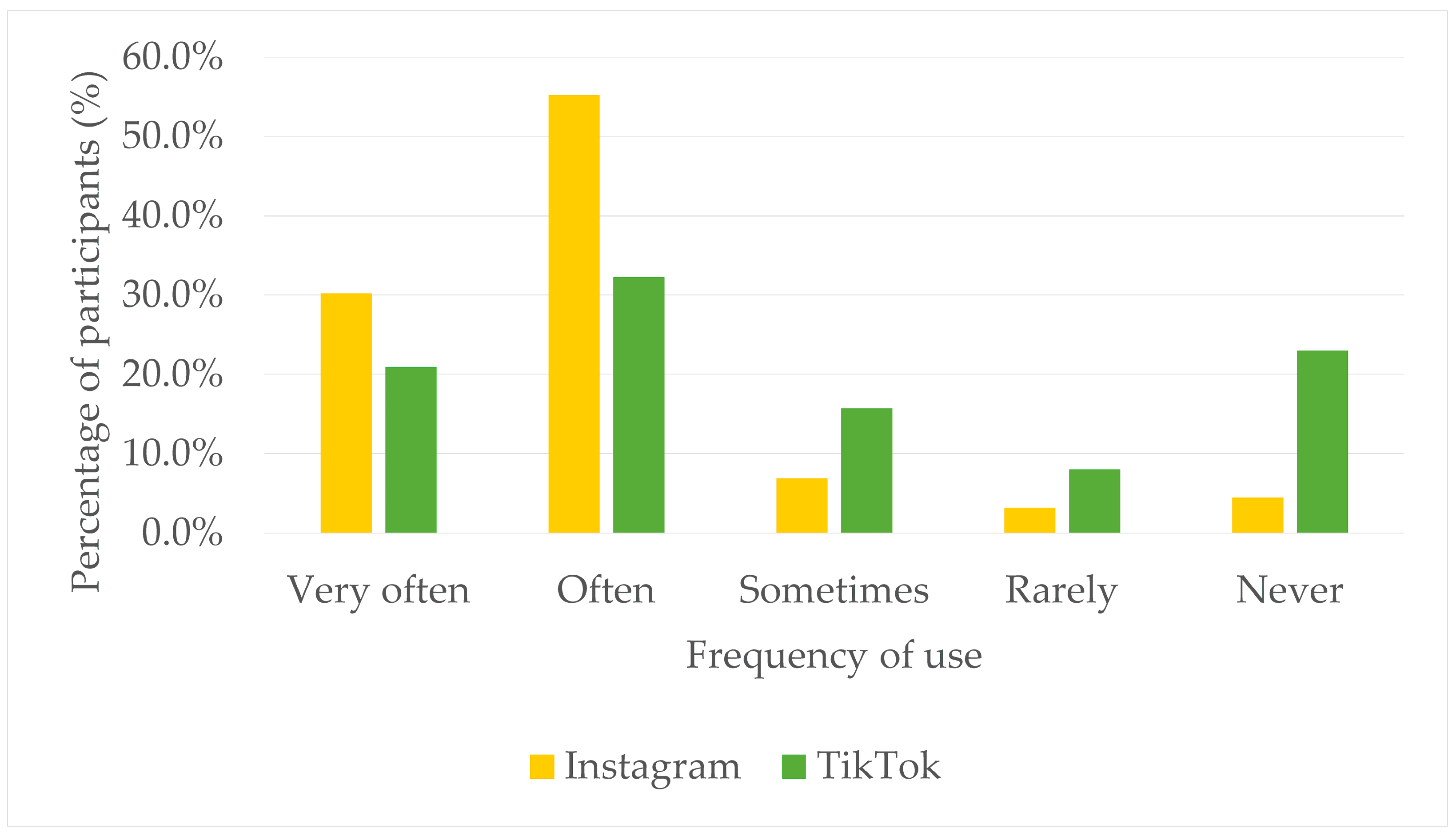
The results indicate that Generation Z uses Instagram more frequently than TikTok. The largest proportion of participants (55.2%) report using Instagram often, while a further 32.2% use it very often. A small percentage use it sometimes (6.9%), rarely (3.2%), or never (4.4%). In comparison, TikTok is used often by 32.2% of participants and very often by 21%. Over 30% of participants use TikTok rarely or never. Instagram is the dominant platform in the participants’ daily digital habits (
Figure 1).
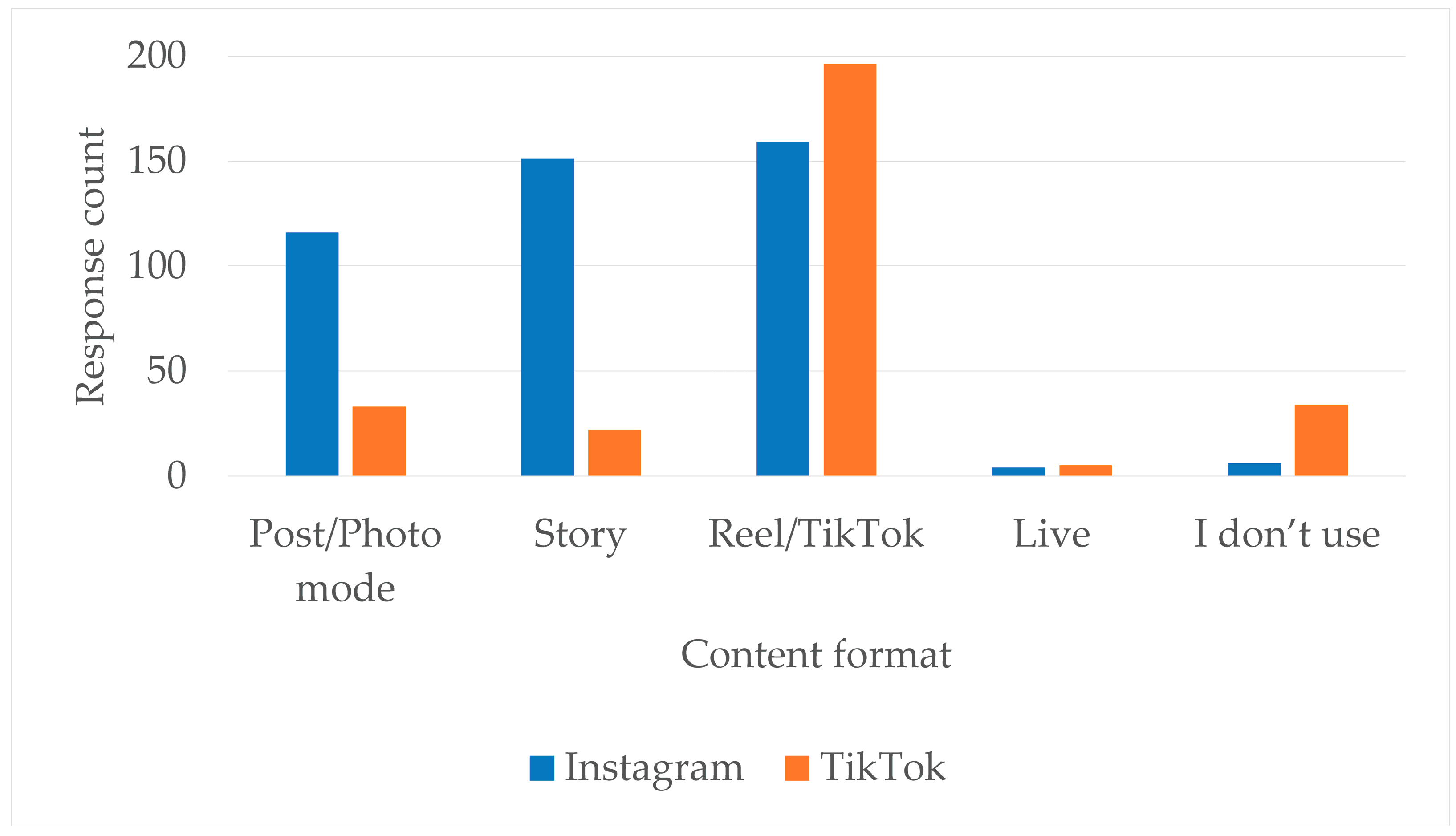
Video clips (Reel/TikTok) are the most viewed content format on both Instagram and TikTok. Although photos were the main content format when Instagram was first launched, participants in this study now watch more video clips and Stories on the platform. TikTok is centered on sharing short video clips, which are by far the most viewed content format on that platform. Live streams are the least viewed content format on both social networks among participants. These results show a clear preference for short, visually dynamic formats over static posts (
Figure 2).
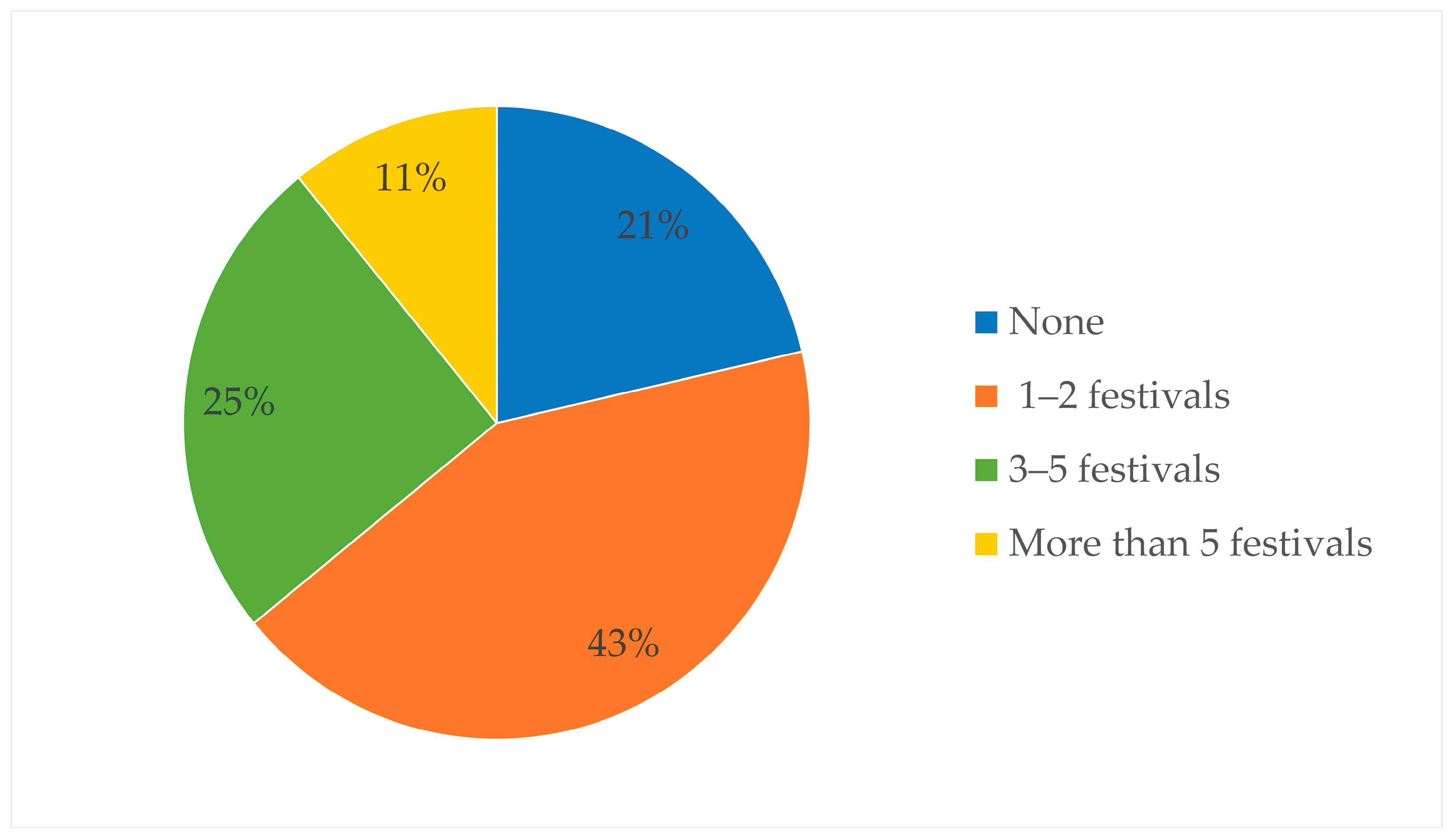
The largest proportion of participants attended one or two music festivals in the previous three years, and the smallest number attended more than five. One-fifth of the participants did not attend any music festival in the previous three years (
Figure 3).
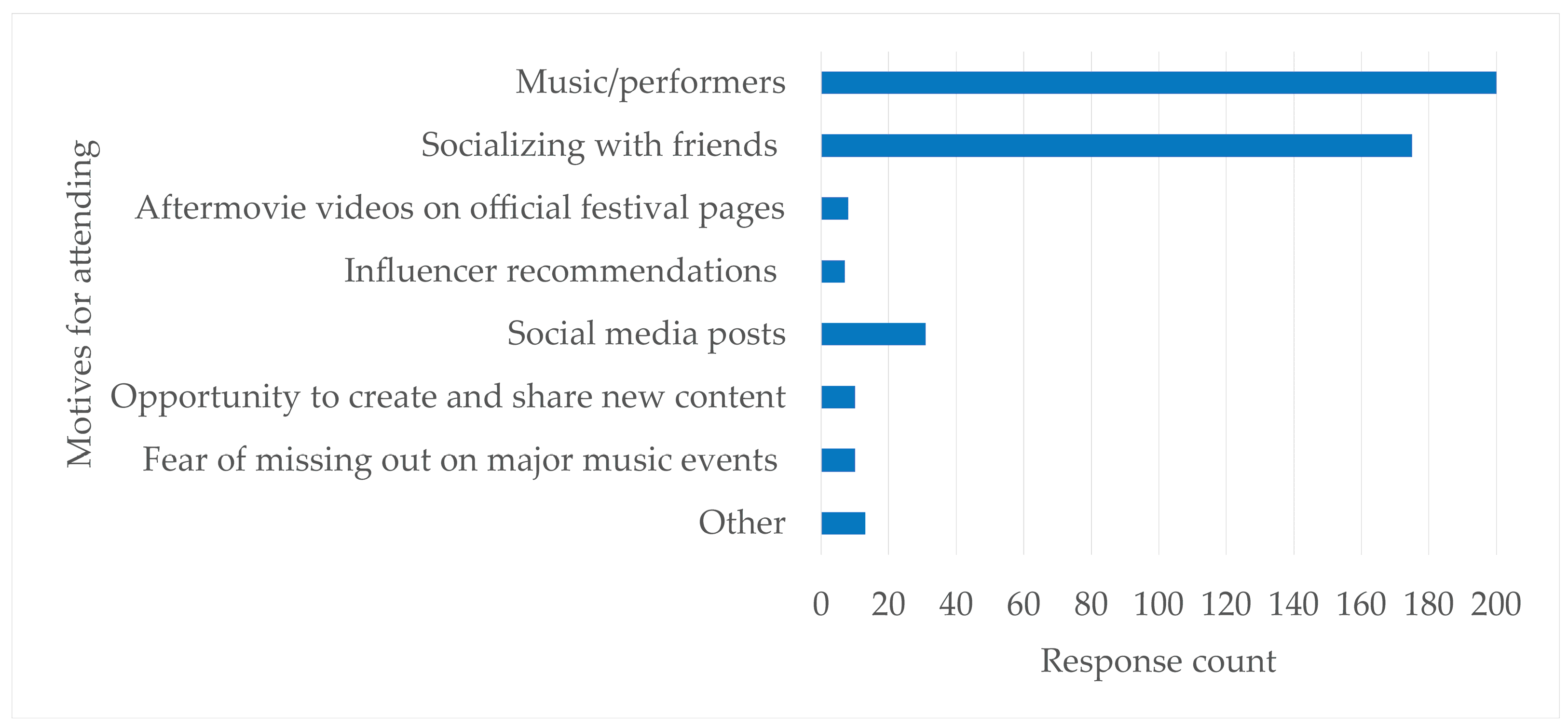
Among the motives for attending music festivals, music and performers (200 responses) and socializing with friends (175 responses) stand out the most. This demonstrates that the festival program and performers are key attractions, but also that music festivals are perceived as social and experiential events, not just musical ones. Responses related to social networks, such as aftermovie videos, influencer recommendations, content about music festivals on social media, or the opportunity to create and share new content, were not frequently chosen. Ten participants indicated that the fear of missing out (FOMO) on major music events is one of the most important motivating factors. FOMO (fear of missing out) is a psychological phenomenon describing an individual’s fear of missing important experiences, events, or content that others are attending. This feeling arises and intensifies under the influence of social networks, due to the constant comparison of one’s own life with the activities displayed by others (
Montag & Markett, 2023) (
Figure 4).
The construct validity of the questionnaire was assessed using exploratory factor analysis (EFA). The results indicated that the sample was adequate for factor analysis (KMO = 0.926), and Bartlett’s test of sphericity was statistically significant (χ
2 = 4666.44,
p = 0.000), indicating sufficient correlation between the items to justify factor extraction (
Appendix B). Based on the eigenvalue criterion (eigenvalue > 1), five factors were extracted, collectively explaining 67.79% of the total variance (
Appendix C). Factor loadings for items within individual factors ranged from 0.504 to 0.833, indicating strong associations with the corresponding dimensions. The scale initially contained 28 items, theoretically distributed across five subscales (factors). Factor analysis also extracted five factors, but 25 items were retained. Three items were moved to different factors, where they demonstrated statistical belonging and conceptual consistency, while three items were removed from further analysis because they showed statistical affiliation to a factor with which they were not conceptually consistent (
Table 3).
The reliability of the scale and each subscale was assessed using Cronbach’s α coefficient. Cronbach’s alpha coefficient values above 0.79 (the lowest value for the ‘Attendee Content Perception’ subscale) indicate that the scale and subscales have very good reliability, meaning the items are interrelated and measure the same construct (
Table 4).
A Mann–Whitney U test was conducted to examine differences in overall Music Festival Experience between respondents living in urban and rural areas. The results indicated no statistically significant difference between the two groups (
p > 0.05) (
Appendix D). This suggests that, overall, place of residence did not significantly influence participants’ music festival experiences in this study.
Spearman’s correlation test showed a very weak positive correlation between the frequency of using Instagram and TikTok and the perceived importance of these platforms for the festival experience (r
s = 0.169,
p = 0.008). Although the statistical results support the first hypothesis (H
1), the low coefficient value indicates a very weak relationship, meaning that the frequency of using these platforms explains only a small part of the variability in the perception of their significance for the festival experience (
Appendix E).
The correlation between the influence of content released by influencers regarding music festivals and the importance of Instagram and TikTok for the festival experience is positive and strong (
p = 0.000, r
s = 0.619). This means that greater exposure to influencer content on social media is associated with a greater perceived importance of Instagram and TikTok for shaping the festival experience, thus confirming the second hypothesis (H
2) (
Appendix F).
Quantile regression (q = 0.50) determined that content posted by music festival attendees (UGC) has a greater influence (
p = 0.000, β = 0.434) on participants’ attitudes and interest in music festivals than content published by influencers (
p > 0.05). The results confirm the third hypothesis (H
3), indicating that content created by festival attendees attracts more attention than content created by influencers about music festivals. Multicollinearity analysis shows that there is no high linear correlation among the predictors (VIF = 1.222, Tolerance = 0.819), indicating that the quantile regression coefficient estimates are stable and reliable (
Appendix G).
There is a moderate positive correlation between the perceived importance of Instagram and TikTok in shaping the festival experience and the frequency of creating and publishing content related to music festivals (
p = 0.000, rs = 0.576). Participants who attribute greater importance to social networks as a factor in shaping the festival experience also share their own music festival experiences on Instagram and TikTok more frequently, thus confirming the fourth hypothesis (H
4) (
Appendix H).
The Mann–Whitney U test showed that men and women differ statistically significantly (
p = 0.002) in their perception of content published by influencers on social media. However, contrary to the fifth hypothesis (H
5), in this sample, men expressed more positive attitudes towards influencer content related to music festivals (Mdn = 3.0) than women (Mdn = 2.6) (
Appendix I).
6. Conclusions
The theoretical contribution of this research is to demonstrate that members of Generation Z experience festivals through the interplay of their platform habits, algorithmic recommendations, and digital narratives, confirming TikTok and Instagram as key spaces where their cultural experiences are shaped. This supports the understanding that digital media are not merely communication channels but integral components in constructing the event itself. The empirical contribution stems from the finding that algorithms influence the visibility and interpretation of festival content, but exposure does not guarantee greater loyalty. Furthermore, UGC has a stronger influence on the sense of community, identity, and the decision to attend than influencers, whose effect is supplementary and conditioned by individual differences such as gender and communities of interest. The practical contribution includes the insight that promotion strategies based solely on influencers are insufficient, and that greater effectiveness is achieved through approaches encouraging active audience participation, collaborative challenges, and user-to-user communication. This results in a richer digital representation of festivals and a stronger connection between online and offline experiences, as well as the need to tailor messages to different subcultural and gender groups.
6.1. Limitations
A limitation of the study is that the sample is not fully representative of the entire Generation Z population in Serbia. Although the number of participants is sufficient for the statistical analyses used, the findings should be interpreted with caution regarding generalization. While the data did not follow a normal distribution, appropriate statistical techniques were applied, so the lack of normality does not limit generalizability. The use of exploratory factor analysis (EFA) without subsequent confirmatory factor analysis (CFA) limits the ability to fully validate the factor structure and constrains the robustness and transferability of the findings. Therefore, the results should be considered exploratory, and further research is needed to confirm the stability and generalizability of the observed constructs. The survey was distributed via social networks, so it is likely that individuals who are generally more active on these platforms participated, which may introduce sample bias. Additionally, participants may have provided answers they considered socially desirable rather than their actual attitudes and behaviors. The research did not collect data on the time spent using social networks; instead, relative categorization was used, which limits the ability to assess in detail the influence of time spent on the platforms on respondents’ attitudes.
6.2. Recommendations for Future Research
The lack of contemporary empirical studies on the media habits of Generation Z in Serbia, particularly in relation to cultural events and festivals, reveals a significant research gap in the domestic literature. This study therefore represents an initial contribution to the field. Future research should build on these findings through more extensive and representative samples, as well as comparative international studies, in order to examine differences in the digital practices of Generation Z across diverse cultural contexts. The use of confirmatory factor analysis (CFA) and structural equation modeling (SEM) would provide further validation of the factor structure and facilitate investigation of causal relationships. Combining quantitative methods with a qualitative approach, such as interviews or focus groups, would offer a deeper understanding of the motives, emotions, and meanings that Generation Z attributes to content on Instagram and TikTok. Similar research could be applied to other tourist events, not only music festivals. A longitudinal study design could identify changes in digital habits over time. A comparative approach to researching the digital habits of Generations Y, Z, and Alpha would provide more detailed insight into intergenerational differences in digital culture and contribute to a more precise understanding of the role of social networks in the context of contemporary music festivals. An experimental study design could be used to examine the influence of different types of content (e.g., informational, entertaining, or promotional) on the attitudes and behavior of social media users regarding music festivals, thereby determining more precisely the strength and direction of the effect of specific content on interest and the decision to attend a festival.




 ,
,