1. Introduction
Shopping is a central travel motive, and previous research links store environment, service quality, and product layout to customer satisfaction and shopping behavior (
Singh et al., 2014;
Behera & Mishra, 2017;
Rudkowski et al., 2020;
Terblanche & Kidd, 2021;
Chen, 2024). Previous luxury customer experience (LCX) research has primarily modeled stable settings and enduring relationships (
Ho et al., 2024;
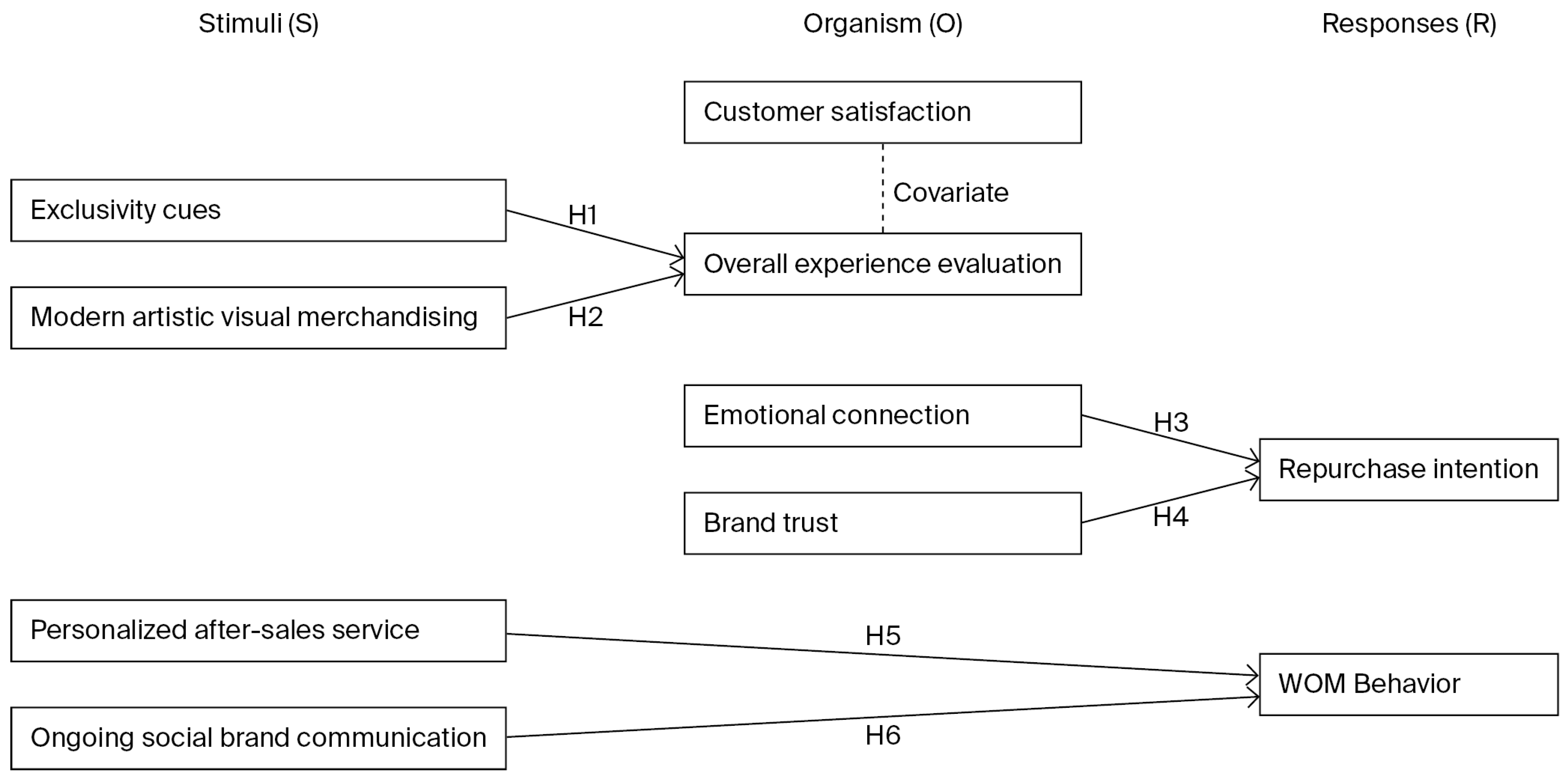
Wilson et al., 2024). Despite this, little is known about how experiential factors shape Chinese consumers’ behavior in luxury travel retail—a context characterized by episodic, time-constrained, high-value, and low-relational encounters. We address this gap by (1) testing the LCX framework in an international travel retail setting with Chinese luxury shoppers and (2) proposing transient experience, relationship quality, action outcomes, connection, and engagement (TRACE) as a conceptual implication that explains how short-term encounters can accumulate into durable brand relationships across the travel experience. Our approach provides a contextualized extension of LCX and actionable implications for luxury retailers. Therefore, this study aims to achieve two objectives. First, utilizing the LCX framework, we empirically investigate the factors influencing the overall evaluation of the luxury travel retail experience and associated behavioral consequences (repurchase intention and word-of-mouth behavior), including boundary-condition effects relevant to time-constrained interactions. Second, in light of the identified theoretical limitations when LCX is utilized in transient, cross-border contexts, we propose TRACE (transient experience, relationship quality, action outcomes, connection, and engagement) as a conceptual framework to structure travel-retail-specific experience mechanisms throughout the travel experience. TRACE is presented as a conceptual framework and has not been empirically tested as an integrated model in the current study.
6. Discussion
6.1. Interpretation of the Findings
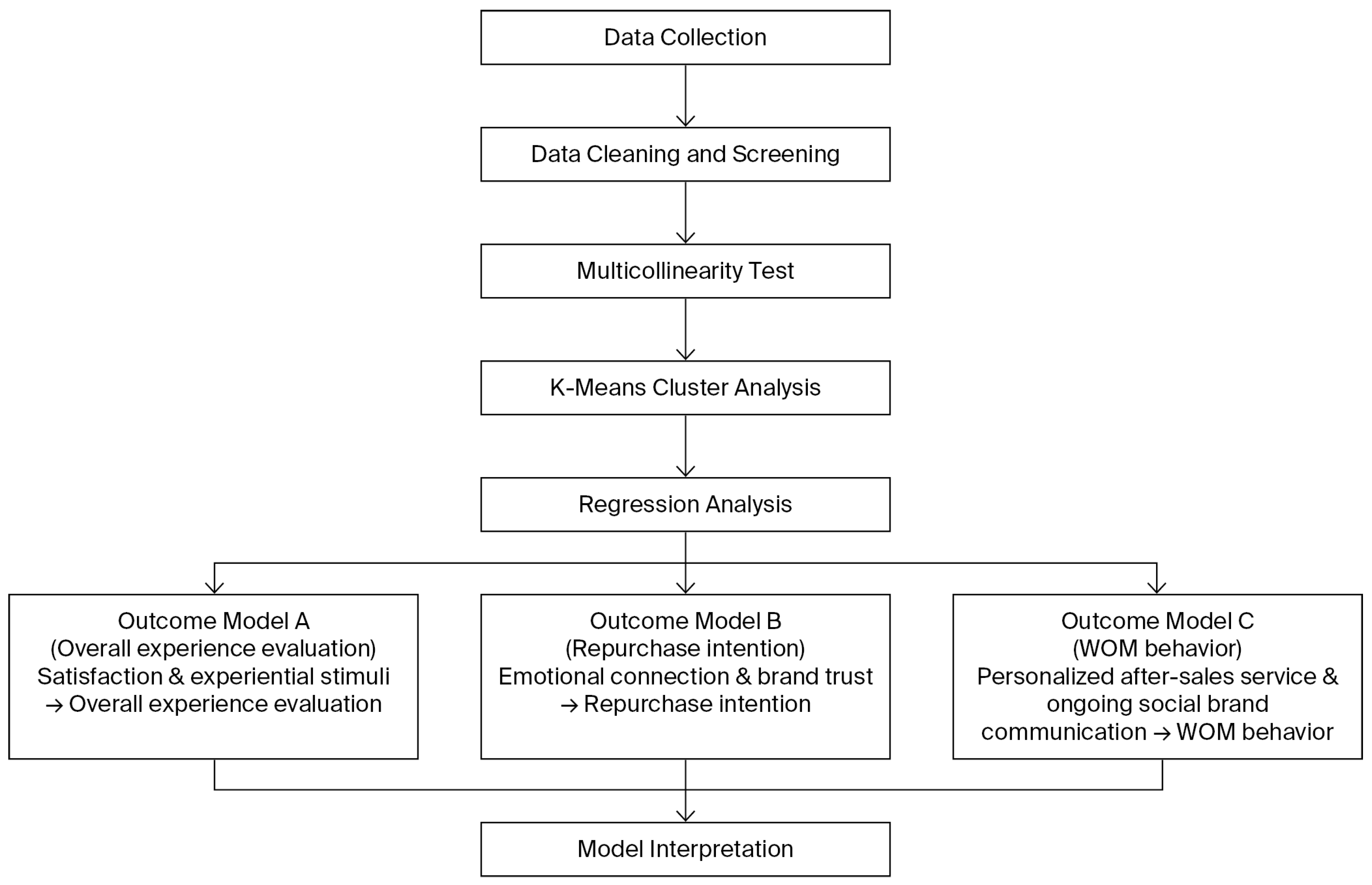
Across the three models predicting overall experience, WOM behavior, and repurchase, the omnibus F-tests are significant (
p ≤ 0.001), indicating that the included predictors explain meaningful variance in each outcome. We avoid causal language, interpreting these results as associations conditional on controls. The R
2 values are moderate (
Table 11), which is common in emotion-driven, short-cycle luxury contexts. K-means profiling identified three stable segments, confirmed in cross-validated discriminant analysis (
Table 12), indicating group-level heterogeneity despite modest individual-level R
2. In research focusing on customer perceptions and behavioral intention, moderate R
2 values are normal and acceptable in complex, emotion-driven luxury retail settings (
Ozili, 2023).
These results show that although the explanatory power of the regression models is modest at the individual level, significant group-level differences can be detected, offering practical value for customer relationship management and targeted marketing strategies. Moreover, the regression models capture the linear impact of individual predictors and provide insights into the contribution of specific variables. The clustering methods reveal behavioral patterns among consumers and highlight diversity in perceptions and loyalty behaviors. Some predictors exhibit weak or non-significant effects when other touchpoints are considered. During time-constrained interactions in travel retail, consumers often focus on a limited range of diagnostic cues and signals that help reduce risk, while other aspects of the experience may fade into the background due to cognitive overload. The uncertainty that arises from cross-border interactions may lead to a greater focus on assurance-related mechanisms, such as trust and the feasibility of after-sales support. This shift could diminish the additional impact, such as emotional resonance (β = 0.014, p = 0.778). The observed patterns support the argument for LCX in transient contexts and highlight TRACE’s focus on the outcomes of post-purchase actions and the mechanisms of engagement. Future research should employ longitudinal or experimental methodologies to examine whether these null effects differ across time pressure, travel stage, and previous luxury experience.
While the findings are broadly consistent with the LCX framework in an international travel retail context, several observed trends deviate from its assumptions, suggesting the need for theoretical expansion.
6.2. Theoretical Implications: Extending LCX with TRACE
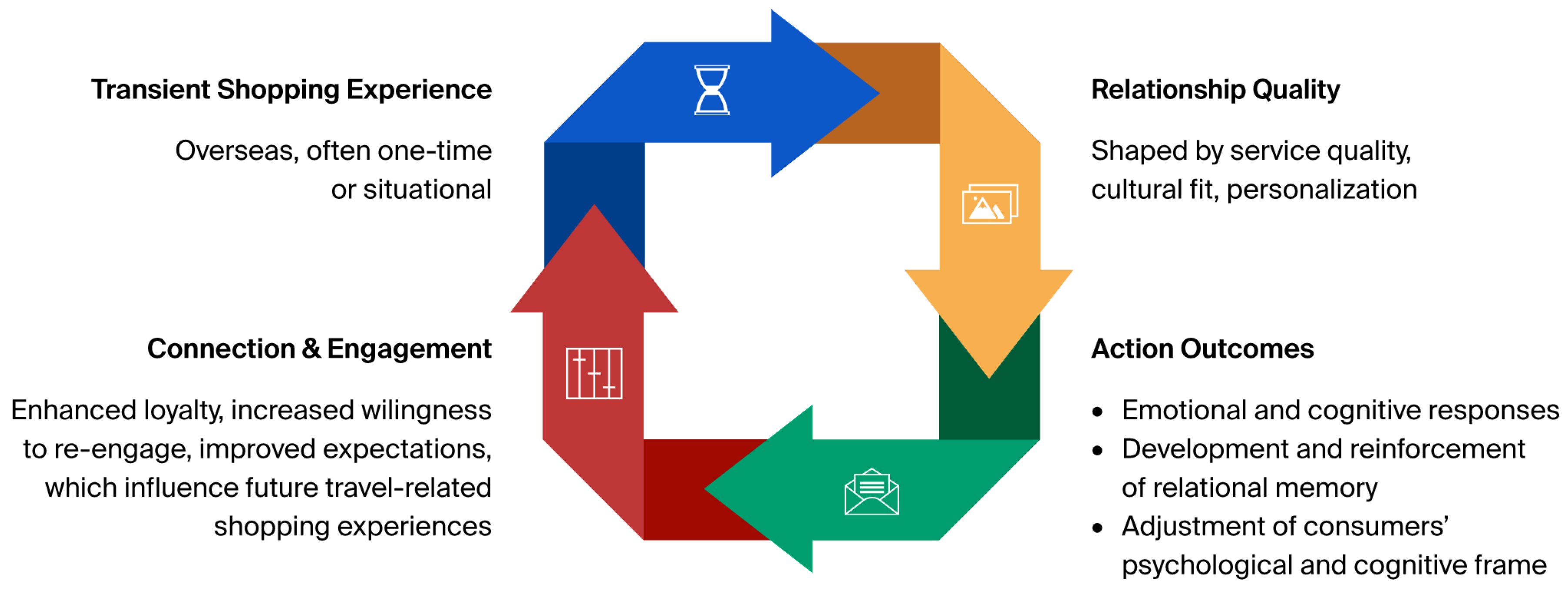
The findings are consistent with an SOR interpretation of LCX, yet they reveal two refinements critical for travel retail. First, emotional connection shows a direct and meaningful association with repurchase (β = 0.197, p < 0.001), consistent with the idea that under time pressure, travelers rely more on affective heuristics than on careful consideration. Second, brand trust also predicts repurchase (β = 0.126, p = 0.012), reflecting cross-border frictions (tax refunds, warranty, and authenticity) that heighten perceived risk. Together, these patterns support TRACE—a conceptual dynamic framework in which transient experience (stimuli under time constraints) shapes relationship quality (brand trust/connection), which drives action outcomes (repurchase), builds connection, and sustains engagement (WOM and ongoing communication). The observed WOM effects of post-purchase service (β = 0.112, p < 0.05) and ongoing social brand communication (β = 0.184, p < 0.001) further indicate that post-purchase touchpoints are not merely consequences but inputs that feed back into the experience loop. LCX provides a comprehensive framework for understanding and classifying luxury consumption experiences, while TRACE identifies the essential mechanisms and contextual factors that influence how these experiences are engaged with, processed, and transformed into behavioral and relational outcomes.
Testing this study’s hypotheses confirms that attending to consumers’ emotions throughout a brand’s service journey is as important as providing a superior retail environment. Additionally, visually appealing elements, such as architectural and aesthetic touchpoints, and exclusivity cues, such as limited-edition products, can shape consumers’ brand perceptions and enhance customer satisfaction and loyalty; in other words, sensory and affective experiences contribute to overall shopping experiences, while cognitive experiences influence subsequent luxury consumption. Brand trust reduces perceived risk, particularly in overseas purchases where customers may doubt product authenticity or service consistency. Social experiences foster a sense of belonging and motivate consumers to recommend a brand to others. Likewise, relational experiences enhance brand–customer interactions, supporting emotional loyalty and social recommendation.
However, these empirical data challenge existing theories, such as the LCX framework, that do consider all aspects of LCX in this context. This study embraces these paradoxes as the theoretical basis for developing the TRACE conceptual model (
Figure 3), a continuous, feedback-driven framework that more accurately captures the dynamics of high-value, low-frequency, emotionally driven consumption in luxury travel retail. The proposed feedback-driven loop is regarded as a conceptual implication of TRACE rather than an experimentally validated dynamic mechanism in this study. We cannot determine temporal ordering or feedback effects because the data are cross-sectional. Further studies would need to evaluate TRACE’s dynamic claims using longitudinal designs, empirical sampling methods, or multidimensional data that encompass pre-trip, in-trip, and post-trip interactions. Additionally, it would be valuable for scholars to explore the potential variations in TRACE pathways across different consumer segments, cultural backgrounds, or retail formats and channels. Through this approach, researchers can enhance the validation of TRACE as a transferable extension to LCX and further refine its boundary conditions.
6.3. Practical Implications
For luxury retailers in travel channels, designs should prioritize easy comprehension under time constraints—for example, by simplifying layouts, emphasizing key offers, and using clear storytelling to reduce cognitive load. These strategies enhance the “stimulus to experience” effect. Additionally, artistic collaborations, visually appealing art installations, and other aesthetic elements can be integrated into physical store design. For flagship stores of luxury brands located overseas, incorporating local cultural and visual immersion elements can strengthen consumers’ emotional connection and encourage WOM behavior.
Retailers should provide trust-oriented solutions at checkout and post-purchase, clearly communicating authenticity, warranty, and return policies at the point of sale and offering personalized assistance within 24 h to 48 h. This supports the trust-to-WOM cycle. Luxury brands must ensure service quality throughout the entire shopping journey (
Hyun et al., 2024) and deliver consistent after-sales services—such as holiday greetings and exclusive events—to reinforce consumer trust and loyalty. Salesperson training, including individualized and post-sales services, is critical for improving overall shopping experiences and repurchase intentions.
Segment-specific engagement can be achieved by leveraging the three identified clusters to tailor VM and after-sales support. For example, travelers with a strong aesthetic orientation respond well to art-infused VM, while risk-averse travelers respond to clear assurances and accessible service. Luxury businesses can shift the LCX strategy from a linear approach to a tactical one, adopting social-affective strategies based on the TRACE model to stimulate relational loyalty. Brands can also create a robust digital communication ecosystem (e.g., a WeChat group) to maintain exclusivity and visibility in consumers’ social networks, further boosting repurchase intentions and WOM behavior.
6.4. Managerial Implications
Managers should adjust LCX levers specifically for travel retail. First, they must allocate additional budget to post-purchase and trust cues, such as warranty and authenticity signaling and tax-refund assistance, because emotional connection (β = 0.197, p < 0.001) and brand trust (β = 0.126, p = 0.012) independently predict repurchase. Second, they should treat modern artistic visual merchandising (VM) as conditional, intensifying it for segments with high aesthetic orientation and prior luxury exposure, while prioritizing legibility under time pressure for other segments. Third, they must institutionalize experimentation by running A/B pilots (e.g., legible vs. concept-heavy VM; standard vs. trust-focused checkout scripts) and tracking return on investment through conversion rates, 90-day repurchase, and WOM outcomes.
Finally, they must ensure that salespersons’ incentive structures and evaluation systems are not based solely on sales volume. They should also account for measures such as completed tax returns, after-sales response time, and repeat-purchase frequency. The findings of the cluster analysis show substantial variation across travelers; no single linear approach works for all. Therefore, segmentation and customized implementation are essential. Overall, the three segments correspond to moderately engaged, convertible consumers (Cluster 1), highly engaged advocates (Cluster 2), and loyal repurchasers (Cluster 3). Accordingly, managerial priorities should focus on conversion and churn reduction (Cluster 1), amplifying WOM and community-based engagement (Cluster 2), and optimizing repurchase pathways and strengthening post-sales relationship maintenance (Cluster 3).
7. Conclusions, Limitations, and Future Research
This study examines the multifaceted drivers shaping Chinese luxury consumers’ overseas shopping experiences, extending prior work by empirically linking emotional engagement, ongoing social brand communication, and cross-cultural contextual factors to behavioral outcomes (WOM behavior and repurchase intention). This research offers three contributions. Theoretically, this study identifies key situations in which LCX may be insufficient in dynamic travel retail contexts and explains why post-purchase and social interaction factors must be considered. Methodologically, it offers a systematic, quantitative evaluation of recognized measurement reliability and validity protocols while also addressing common method bias. Practically, it identifies actionable levers across the travel journey, such as visual merchandising, personalized after-sales service, and social brand communication, that improve the travel experience and stimulate advocacy. While the findings offer strategies to optimize in-store experiences and post-purchase engagement, three study limitations should be noted.
First, the self-reported data collected via structured surveys (
Rosenman et al., 2011) may not fully capture shifts in luxury consumption patterns among Chinese consumers, and the sample—drawn from an online platform—was disproportionately female. Another problem is that many focus constructs were assessed with single-item indicators, which makes it harder to check for internal consistency and latent measurement error. Second, this study relied solely on quantitative analysis, which could oversimplify complex psychological constructs among Chinese luxury consumers (
Lim, 2025). Third, the relatively small sample of Chinese consumers who purchase luxury goods overseas may limit the generalizability of the findings.
Future empirical research could extend this framework in several ways. First, although we addressed self-report biases through post-stratification and sub-sample matching, data collection and respondent selection should be approached with caution in future studies. Subsequent studies ought to implement TRACE dimensions using verified multi-item scales and utilize longitudinal or multi-source methodologies to properly evaluate the proposed conceptual framework. Second, integrating surveys with behavioral data and evaluating field interventions (e.g., legible vs. concept-heavy VM; trust-cue prompts) would strengthen causal inferences. Exploring moderation by category, store format, and travel stage could also clarify the contextual boundaries proposed here. Third, future studies could compare Eastern and Western consumer responses to brand strategies (e.g., larger samples examining Chinese and Korean consumers vs. Italian and French consumers in cross-border comparisons). Lastly, we propose TRACE as a conceptual supplement to help arrange temporary travel retail experience processes. However, this study does not test TRACE as a whole model. Subsequent studies should evaluate TRACE’s structural and dynamic claims using longitudinal, multi-wave, or behavioral data to clarify feedback mechanisms across pre-trip, in-trip, and post-trip processes.
T (transient experience): Investigate the influence of time constraints and the arrangement of travel stages on the interpretation of visual and service cues through methods such as experience sampling or field experiments.
R (relationship quality): Explore the ways in which cross-border uncertainty, including factors such as authenticity and warranty feasibility, influences the development of brand trust and its subsequent effects through the use of multi-wave surveys.
A (action outcomes): Use behavioral or managerial data to connect post-purchase service (such as refunds and repairs) to repurchase behavior.
C (connection): Investigate the differences between the connection that consumers have with brands and the connections formed through salespeople or specific locations, and examine how these distinct relationships function in various travel contexts.
E (engagement): Use longitudinal social and CRM interaction logs to show how ongoing social brand communication changes over time during different stages of a travel experience.
These directions would enhance the theoretical value of the TRACE model and support the development of cross-cultural consumer behavior theory, positioning luxury consumption as both an emotionally grounded economic model and a strategic, interactive approach.