Abstract
The invasive red palm weevil (Rhynchophorus ferrugineus, RPW) poses a severe threat to heritage palm collections across the Mediterranean Region, necessitating robust protection strategies. This study addresses the urgent challenge of safeguarding the Spanish Phoenix Collection at Miguel Hernandez University (EPSO) and the Orihuela Palmetum by analyzing the efficacy of applied Integrated Pest Management (IPM) strategies over a ten-year period (2014–2024). Monitoring and treatment protocols included targeted chemical, biological, and cultural controls, and were benchmarked against infestation progression data, climatic trends, and comparative case studies from Murcia, Elche, Nice, and Palermo. Results indicate that a proactive, multi-component IPM strategy, especially when coupled with probabilistic risk models, can significantly improve survival and recovery indicators in Phoenix taxa, although species-specific susceptibility to RPW was a major differentiating factor. Comparative analysis reveals common regional patterns in R. ferrugineus management but underscores the critical need for collection-specific, resource-sensitive protocols for high-value heritage plants, demonstrating that evidence-based best practices and coordinated monitoring are essential for effective heritage palm conservation amid continuous pest pressure.
1. Introduction
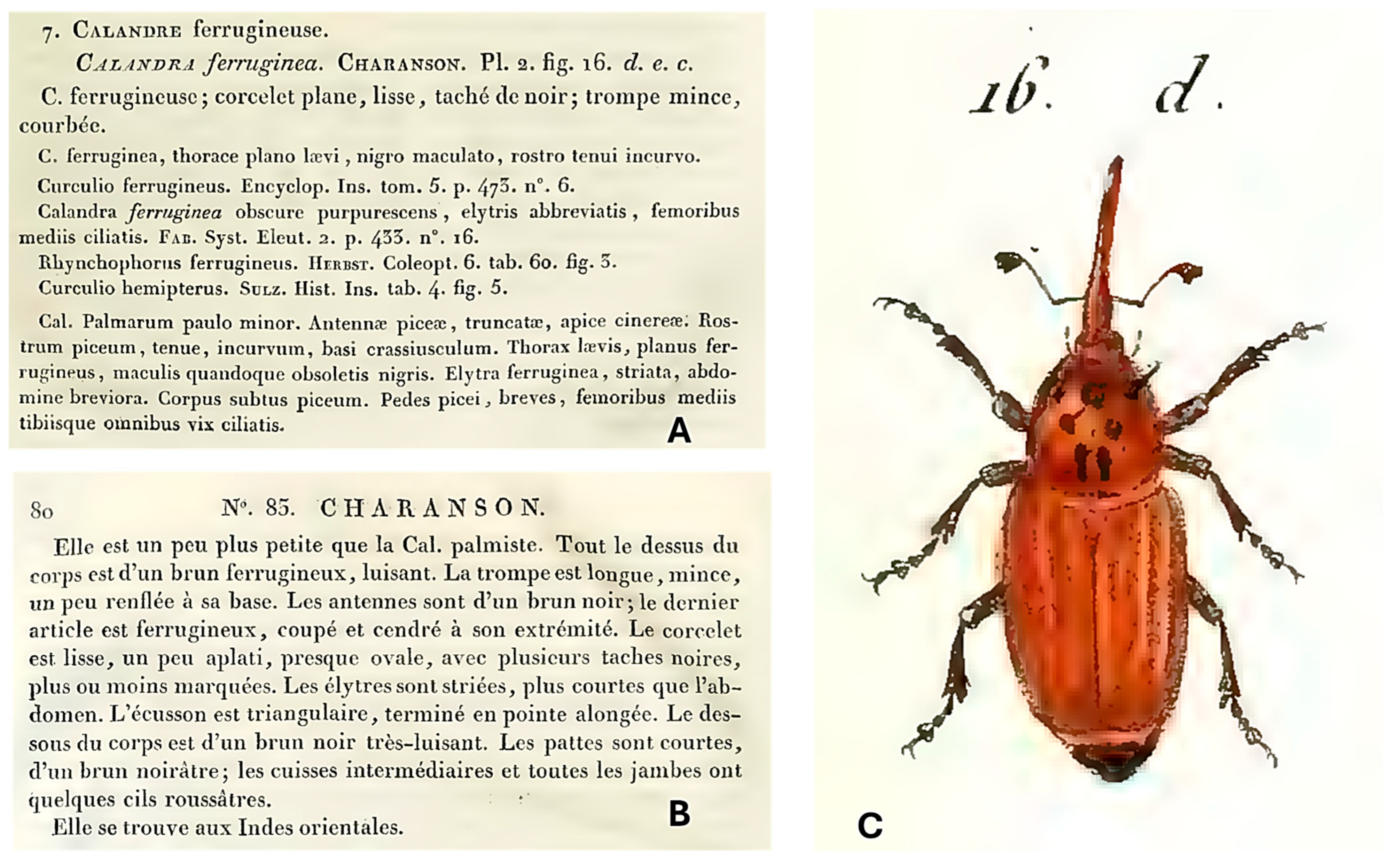
The red palm weevil (RPW), Rhynchophorus ferrugineus (Olivier, A.G., 1790) (Dryophthoridae Schoenherr, C.J., 1825) [1,2,3], is recognized as one of the most devastating pests affecting palm trees globally. The red palm weevil is indigenous to South and Southeast Asia, with its native range encompassing countries such as India, Sri Lanka, Pakistan, the Philippines, Cambodia, Vietnam, Laos, and extending to parts of Indonesia, and other regions within tropical Asia. The species was initially described as Curculio ferrugineus in the fifth volume of the Encyclopedie Méthodique (Insectes) from specimens collected in the East Indies by Olivier in 1790 (Figure 1).
Figure 1.
Description and image of Rhynchophorus ferrugineus. (A). Page 79 of the 5th volume of the Entomologie (Entomology) by A.G. Olivier in 1807 [2]. (B). Page 80 of the 5th volume of the Entomologie by A.G. Olivier in 1807 [2]. (C). Plate 2 corresponding to the 83rd genus (Charanson) in the 8th volume of the Entomologie by A.G. Olivier in 1808 [3].
The genus Rhynchophorus was established by Herbst in 1795 [4] (pp. 3–4) as a result of his major work on Coleoptera survey, where he had created the taxonomic framework. As a result of his work species changed genus from Curculio to Rhynchophorus [4] (p. 8). The genus has undergone several extensive revisions since Herbst’s original description, notably by Wattanapongsiri in 1966 [5], but Herbst’s 1795 establishment of the genus remains the foundation of palm weevil taxonomy.
Historically, the red palm weevil (RPW) has been closely associated with coconut palms (Cocos nucifera L.) within its native habitat, but also Arenga pinnata (Wurmb) Merr., Corypha utan Lam., Elaeis guineensis Jacq., or Metroxylon sagu Rottb. [6,7,8]. Wattanapongsiri in 1966 [5] defined the native range of RPW as an area stretching east from India throughout Southeast Asia in his detailed revision of the genus Rhynchophorus, based on a comprehensive revision that examined museum specimens from throughout the region.
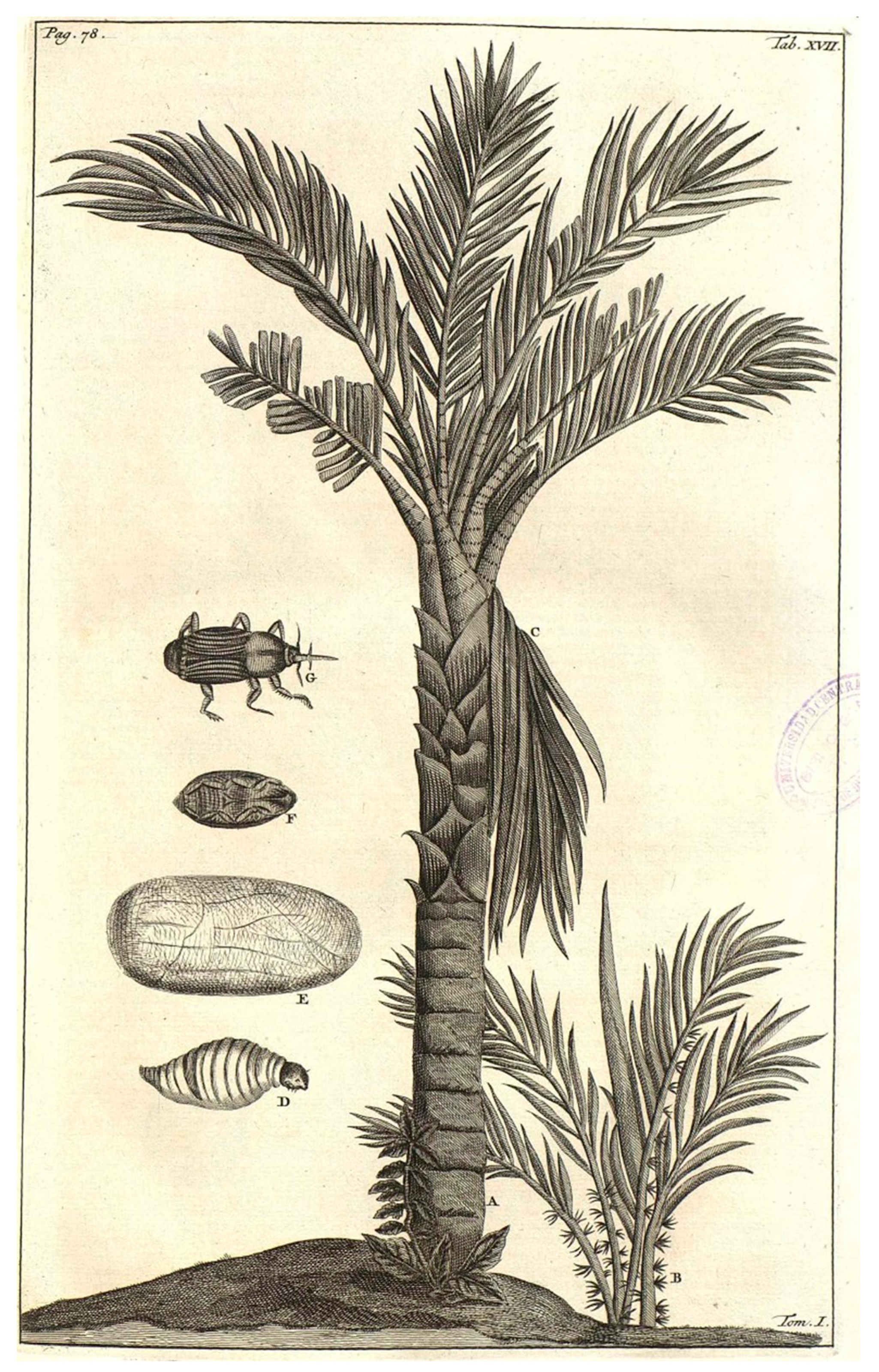
The earliest known record of this weevil species dates back to observations by Georg Eberhard Rumpf (1627–1702) in the late 17th century and published posthumously in 1741 and in a reimpression in 1750, likely on the sago palm, Metroxylon sagu, in Amboina (modern-day Indonesia) (Figure 2) [5,9,10].
Figure 2.
Image of Sagu-Cossum (D) identified by Wattanapongsiri in 1966 [5] as Rhynchophorus ferrugineus, and of the sago palm, Metroxylon sagu Rottb. Page 78 and Plate XVII of the 1st volume of the Herbarium Amboinense by G. Rumpf, published in 1750 [9] as a reimpression of the original of 1741 [10]. (A) Sagu palm. (B) Young sagu palm tree. (C) Dried decaying palm frond. (D) RPW Larva. (E) Cocoon. (F) Pupa. (G) Adult weevil.
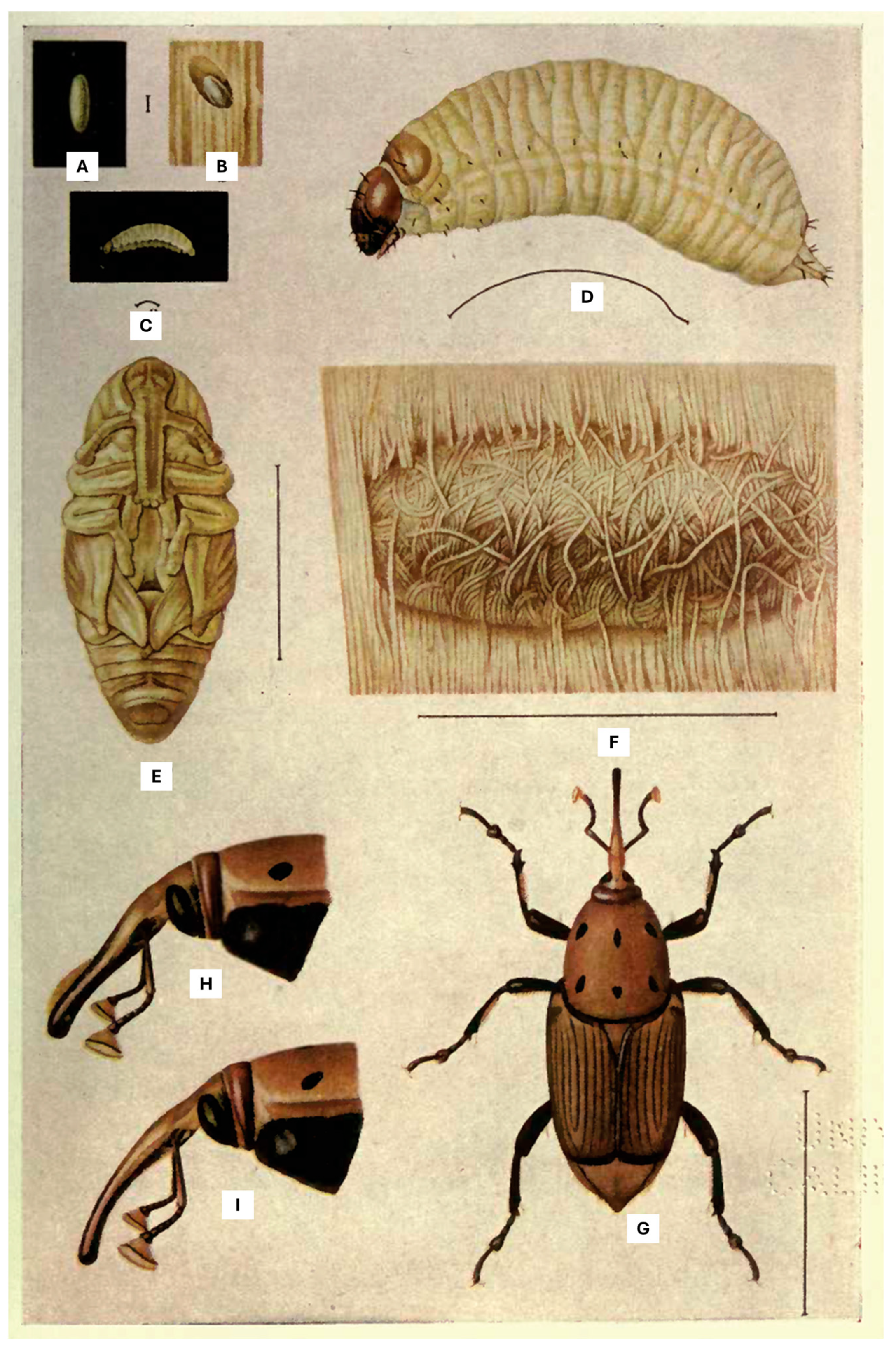
The weevil was first illustrated and identified in India by Sulzer in 1776 as Curculio hemipterus Linnaeus, 1758, and later redescribed by Olivier (1790) as Curculio ferrugineus, a name subsequently retained. Chevrolat (1882) proposed additional taxonomic distinctions based on pronotal spot morphology, describing specimens from Assam and Ceylon as Rhynchophorus indostanus and R. signaticollis, respectively [5]. In the early 20th century, Milne (Figure 3) documented the species in several districts of Punjab, complementing earlier records from numerous localities across the Indian subcontinent and Sri Lanka [11].
Figure 3.
Images of Rhynchophorus ferrugineus, (A) Egg. (B) Egg laid in hole in palm tissue. (C) Newly hatched larva. (D) Full-grown larva. (E) Pupa. (F) Cocoon. (G) Adult weevil. (H) Side view of head of male weevil, enlarged. (I) Side view of head of female weevil, enlarged. The relative sizes of the stages shown in subfigures (A–G) are indicated by the hairlines alongside each subfigure [11].
The late 20th-century expansion of Rhynchophorus ferrugineus unfolded in distinct phases [12,13]. During the 1980s–1990s, the weevil first emerged outside its native range in the United Arab Emirates, rapidly spreading across the Middle East and devastating date palm plantations. By 1992, it reached Egypt, marking its initial African incursion.
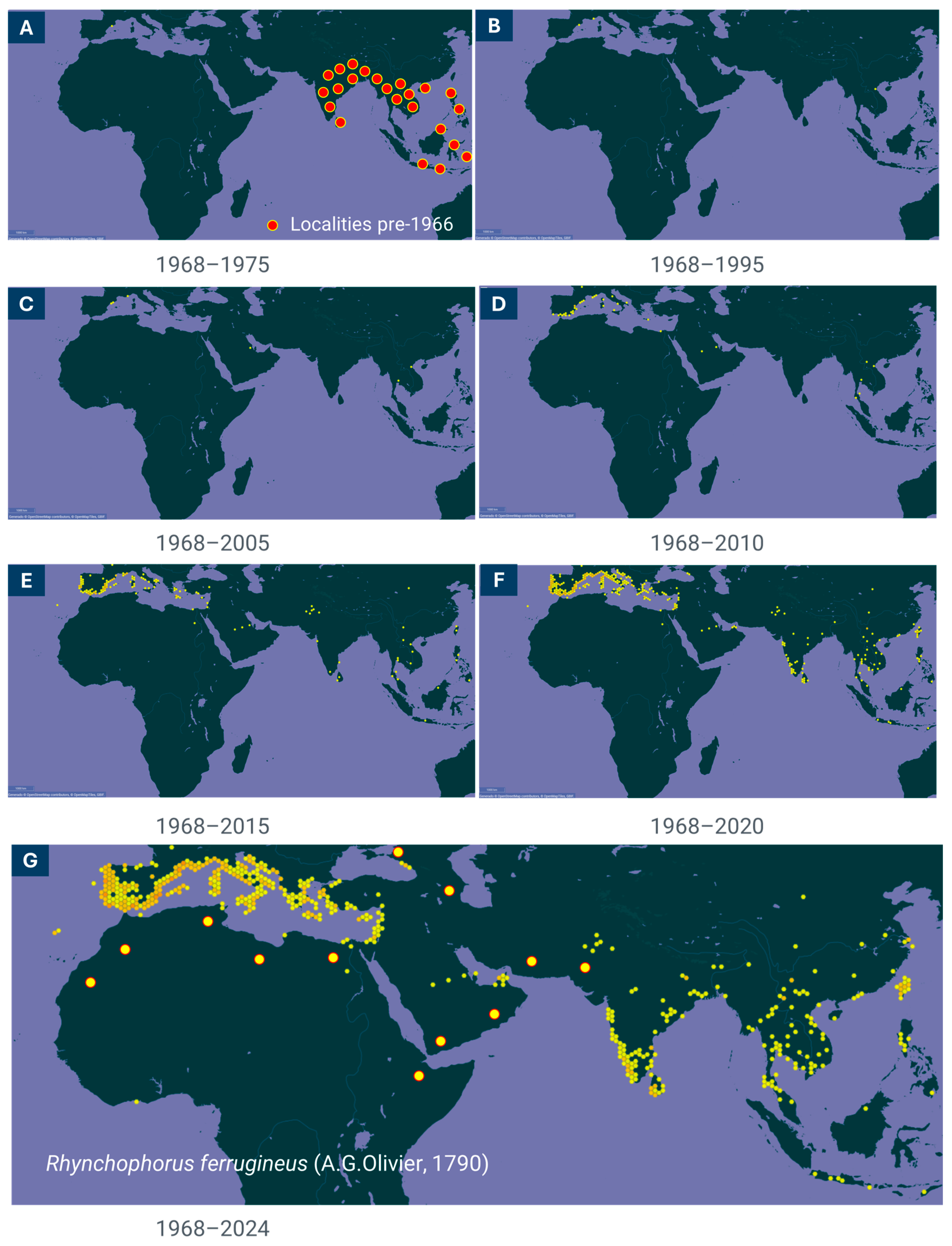
The subsequent phase (1990s–2000s) saw its invasion of the Mediterranean Basin, with the first European detection in Spain (1994). By the early 2000s, the weevil had established itself in Portugal, Italy, France, Greece, Turkey, and several North African countries. This expansion aligned with the surge in international ornamental palm trade, likely accelerating its dispersal (Figure 4).
Figure 4.
Chronology of the geographic expansion of Rhynchophorus ferrugineus (RPW) during the latter half of the 20th century. Cumulative distribution maps were generated using primary data sourced from GBIF [13], where the dots change from yellow to various shades of orange depending on the increasing number of records they represent. Due to gaps in the GBIF dataset, supplementary information was incorporated to ensure accuracy. In panel (A), red dots indicate regions and dates not recorded in GBIF, derived from additional sources. In panels (B,C), to 1995 and 2005, respectively the increasing number of localities is represented in terms of yellow dots. In panels (D–F), to 2010, 2015 and 2020, respectively, the increasing number of records is representd in terms of yellow dots number but where the localities are closer at the scale of the map this is represented in shades of orange. In panel (G), to 2024, were added large yellow dots with red margins to represent countries reported by EPPO [14,15] but absent from the GBIF database [13].
In the most recent phase, from the 2000s to the present, the red palm weevil has continued its global expansion. It was detected in the Caribbean, specifically in Aruba and Curaçao, between 2008 and 2009, and has since spread to parts of Oceania. The weevil’s expansion has extended into Sub-Saharan Africa, and it has most recently been reported in new areas of the Americas (Figure 4) [13,14,15].
The dispersal of Rhynchophorus ferrugineus is driven by two primary mechanisms: human-mediated transport—notably through the international trade of infested palm trees, especially mature specimens—and natural flight. While flight mill studies confirm adult weevils can exceed 50 km, most exhibit short-range flight (<100 m), primarily during daylight [16].
This study documents the weevil’s attack process on our collection, its progression, implemented defensive measures, and outcomes, comparing these with neighboring palm groves at Murcia and Elche universities and placing it within the context of the western Mediterranean. We emphasize the differential impact of the pest across Phoenix species and P. dactylifera L. cultivars. Our overarching goal is to identify effective, experience-based responses to improve palm grove resilience.
2. Materials and Methods
2.1. The History of the Study Site Preparation
The Spanish National Collection of date palm and related species is located in Orihuela and was incorporated into the network of germplasm banks coordinated by INIA, under bank E-160 managed by the Higher Polytechnic School of Orihuela (EPSO) at Miguel Hernández University. All palms have been obtained from seeds derived from fruits (dates) collected in the field by the research team and numerous collaborators or acquired from markets. Additionally, seeds from other germplasm banks were utilized, notably from USDA Riverside, CA (USA). Seeds are stored at temperatures between 4 and 5 °C following a desiccation process to reduce moisture content to approximately 10% [17]. These seeds have been maintained as reserves, with germination trials conducted several years after their incorporation into the collections [17,18]. Standard practice for each incoming accession involves separating 15 to 20 seeds for immediate sowing in pots after registration. These seeds do not undergo the desiccation process. Although sowing occurs throughout the year upon seed arrival, maximum germination rates are achieved during months when soil temperature exceeds 20 °C, typically from June through September inclusive. Plants are transferred to soil when leaves exceed 50 cm in length and some exhibit pinnation, as the first leaves emerge entire not divided. More than 1600 accessions have been registered, of which over 700 have been transferred to field conditions. The initial planting occurred in 2014 on the EPSO campus, occupying approximately 1 ha with a total of 323 specimens. In 2015, the first planting of 77 accessions was established at the Orihuela Palmetum on land belonging to the Segura Hydrographic Confederation (Soto I6), within a pre-existing 16-ha park managed by the Orihuela City Council. The palms in this public park are maintained and monitored under an agreement between Miguel Hernández University of Elche and the Orihuela City Council. This initial planting largely failed, with only eight palms surviving to date due to widespread irrigation system failure. Following complete restoration of the park’s irrigation system, 337 palms were planted in 2018, along with several specimens of Chamaerops humilis L. The collection’s objectives include the conservation and characterization of the genetic and morphological diversity of Spanish date palms [16], detailed study of the genus Phoenix and its diversity [17,18,19], and currently, the evaluation of disease and pest resistance across different palm taxa.
2.2. Study Sites and Collections
The study was conducted within a specialized Phoenix palm collection situated in southeastern Spain, adjacent to both agricultural and riparian ecosystems. The plantation comprises multiple Phoenix species and is bordered by a natural watercourse, which imposes stringent restrictions on the use of phytosanitary products under Spanish environmental protection legislation (Royal Decree 1311/2012). The regional climate is characterized by a Mediterranean pattern, featuring hot, dry summers and mild winters—conditions known to favor the development and proliferation of Rhynchophorus spp. We documented Rhynchophorus ferrugineus infestation and management outcomes in two Spanish Phoenix collections: the Spanish National Phoenix Collection at Miguel Hernández University (EPSO) and Orihuela Palmetum (Alicante), the palms of the Miguel Hernández University at Elche and the Phoenix canariensis H.Wildpret plantation at University of Murcia campus (Murcia), between 2014 and 2025.
The Orihuela collection is divided into two distinct areas. The first, the EPSO area, with an extension of c. 1 ha, is located at 38°4′10″ N (38.0694444° N) and 0°59′9″ W (−0.9858333° W), at an elevation of 25 m a.s.l., approximately 60 m south of the Segura River. This site contains 341 accessions representing 33 species, subspecies, and cultivar groups.
The second area, the Palmetum, with an extension of c. 16 hectares, is situated at 38°5′1″ N (38.0836111° N) and 0°57′59″ W (−0.9663889° W), at an elevation of 28 m a.s.l., around 20 m north of the Segura River and 2.3 km from the EPSO site. It also includes 341 accessions, representing 29 species, subspecies, and cultivar groups.
The Espinardo Campus of the University of Murcia originally maintained more than 400 specimens of Phoenix canariensis. These were planted in the early 1980s in an alternating pattern with sour orange trees along a 1.6 km pedestrian pathway that traverses the 64 ha core of the campus, which itself covers more than 140 ha. The Espinardo Campus maintains in 2025 a census of approximately 250 Canary Island date palms (Phoenix canariensis), most located along the main green walkway, with the remainder situated in the northern sector near the ancient Faculty of Medicine. In addition to this structured plantation, scattered individuals of Phoenix dactylifera are also present throughout the campus, along with other palm species such as Chamaerops humilis, Syagrus romanzoffiana (Cham.) Glassman, Brahea armata S.Watson, and Nannorrhops ritchieana (Griff.) Aitch., among others. However, the impact of the red palm weevil (RPW) and resulting control measures have primarily focused on species of Phoenix.
The Elche Campus of Miguel Hernández University spans 70.3 ha of public open space, predominantly planted with Phoenix dactylifera. This design fulfills UNESCO’s landscape integration requirements for the Palmeral of Elche (a World Heritage Site) while reinforcing the institution’s cultural-historical ties to palm heritage, honoring both Miguel Hernández’s legacy and Elche’s traditions.
To contextualize our RPW infestation challenges within the Mediterranean, we synthesized published and gray literature on infestation patterns and management strategies from key sites: Parc Vigier (Nice, France), the Palmeral de Elche (Spain), and Palermo Gardens (Italy).
2.3. Monitoring and Data Collection
2.3.1. Data Sources and Documentation
The dataset for this study was derived from chronological maintenance records maintained by the palm management team between 2014 and 2025. These records provided a comprehensive longitudinal account of pest management activities, including the dates and descriptions of all control treatments applied. Documentation also encompassed the active ingredients used, their application doses, and the methods of administration, such as irrigation, foliar spraying, or trunk treatment. Biological control interventions, cultural practices (e.g., pruning, soil tilling, and removal of symptomatic palms), observed pest symptoms, and notes on regulatory constraints affecting treatment availability were systematically recorded. This dataset enabled the reconstruction of treatment patterns and the analysis of the evolution of the integrated pest management approach over the study period.
2.3.2. Maintenance and Inspection Procedure
Prior to any phytosanitary intervention, each palm underwent a visual inspection conducted by trained technical personnel specializing in palm maintenance. The inspection focused on identifying key indicators of Rhynchophorus infestation, such as visible feeding holes, frond collapse or chlorosis, exudate or breakdown of apical tissues, and the presence of larvae, pupae, or feeding galleries. Evidence of secondary fungal colonization was also noted. Palms deemed severely compromised were scheduled for immediate sanitation measures, which could include the localized extraction of infested material, complete removal of the trunk in terminal cases, or on-site treatment of vegetative debris until formal collection by authorized services.
2.3.3. Weather Records
Climatic data were collected from the AEMET meteorological station at Desamparados (Orihuela) (Code 7244X; Altitude 26 m a.s.l., Latitude 38°4′4″ N; Longitude 0°58′53″ W), located within the EPSO area. Monthly records of temperature, precipitation, and wind gust were obtained in JSON format from the AEMET Open Data “Acceso General” platform (https://opendata.aemet.es/centrodedescargas/productosAEMET, accessed on 16 June 2025). The data were subsequently tabulated using DeepSeek (https://chat.deepseek.com/).
2.4. Treatment Protocols at EPSO and Palmetum
2.4.1. Treatment Modalities at EPSO
The integrated pest management strategy employed a combination of cultural, chemical, and biological control methods. Cultural management practices were applied continuously throughout the study period and included soil cultivation, weed removal to enhance visibility and access, pruning of dry or symptomatic fronds, and the removal of highly infested palms to reduce local pest pressure.
Chemical treatments were implemented based on regulatory availability and pest pressure, with the primary active substances including imidacloprid (1H-Imidazol-2-amine, 1-[(6-chloro-3-pyridinyl)methyl]-4,5-dihydro-N-nitro-), thiamethoxam (4H-1,3,5-Oxadiazin-4-imine, 3-(2-chloro-5-thiazolyl)methyltetrahydro-5-methyl-N-nitro-), acetamiprid (Ethanimidamide, N-[(6-chloro-3-pyridinyl)methyl]-N′-cyano-N-methyl-, (1E)-), esfenvalerate (Benzeneacetic acid, 4-chloro-.alpha.-(1-methylethyl)-, (S)-cyano(3-phenoxyphenyl)methyl ester, (.alpha.S)-), and deltamethrin (Cyclopropanecarboxylic acid, 3-(2,2-dibromoethenyl)-2,2-dimethyl-, (S)-cyano(3-phenoxyphenyl)methyl ester, (1R,3R)-). These products were administered through foliar hydraulic spraying, irrigation-based injection or flushing, and targeted trunk or crown applications for severely affected individuals. Dosages adhered to manufacturer specifications, though irrigation-based applications were typically calculated per hectare or per cubic meter of irrigation solution [20,21].
Biological control agents were introduced in 2015 and became increasingly prominent after 2018. Entomopathogenic fungi were applied across entire sectors of the plantation during critical periods, with seasonal repetitions based on infestation levels.
This study benefited from a collaborative agreement with Glen Biotech, which developed a novel clone of the entomopathogenic fungus Beauveria bassiana isolated from the Hondo de Crevillente area and specifically targeted against Rhynchophorus spp. [22,23,24,25].
From 2022 onward, Steinernema carpocapsae emerged as the principal biological agent, applied via hydraulic spraying or irrigation, with doses adjusted according to plot volume [26,27,28]. Applications were timed to coincide with moderate temperatures, primarily in spring and early autumn, to ensure nematode viability.
2.4.2. Seasonal Treatment Scheduling and Regulatory Framework at EPSO
By 2023–2024, a standardized Integrated Pest Management (IPM) calendar had been established. During the first trimester, full-collection treatments with nematodes were conducted. The second trimester focused on targeted chemical applications supplemented by nematode treatments, while the third trimester involved summer chemical treatments followed by nematode reinforcement in September. The fourth trimester featured localized chemical and biological interventions, informed by post-inspection assessments.
All chemical applications complied with the restrictions outlined by the Spanish Official Registry of Plant Protection Products and the environmental regulations under Royal Decree 1311/2012 [29]. The plantation’s proximity to a river further limited the availability of approved insecticides, necessitating a strategic shift toward biological agents and selective chemical use.
2.4.3. Record of Treatment Results
Following each treatment cycle, technical staff meticulously documented the treatment date and method, the chemical or biological product applied, the location and number of palms treated, and the condition of symptomatic or removed palms. Observational comments on efficacy were also recorded. This continuous documentation formed the basis for the longitudinal reconstruction of management practices and facilitated the adaptation of strategies over the decade-long intervention period.
2.4.4. The Case of the Palmetum
The legal restrictions and framework are similar to those imposed on the treatments in the EPSO collection, treatments in the Palmetum are those standard for the gardens of Orihuela and the “-Historical Palmeral de San Antón-”. We have only fragmentary information.
The treatment of Rhynchophorus in the Historic Palm Grove of Orihuela in 2018 consisted in interventions that commenced on Monday, 13 August, involving the treatment of 4333 specimens with the insecticide Thiametoxam (commercial name Actara 25 WG, Syngenta España S.A.U., Madrid, Spain). This chemical treatment complements the biological control methods previously applied during pruning operations and inflorescence removal, which included the application of Beauveria bassiana [30].
In 2019, the authorization of the compound Acetamiprid 20% (commercial name EPIK 20 SG) by the regional authorities enabled appropriate treatment operations in El Palmeral through foliar spray application. Following pruning, immediate treatment was administered using Epik 20 SG, authorized for use in 2019. This product requires no safety interval, thereby allowing normal activities in the area to continue uninterrupted [31].
In 2020, a specific Management and Directorial Plan was approved for the historic Palmeral area to compile updated inventory data, assess palm conservation status, and establish protocols for maintenance, pest and disease management, and new plantings. The Management Plan proposed a phased intervention strategy encompassing palm renewal, felling, pruning, and phytosanitary control within an Integrated Pest Management framework, scheduled across different improvement stages. Although the Palmetum was initially intended to benefit from these measures, this has not occurred [32,33,34].
The COVID-19 pandemic resulted in substantial information gaps from 2021, with limitations becoming more pronounced from 2023 [34].
2.5. Data Analysis
In the method used for the Integrated Susceptibility Assessment, for each taxon we examined the following: presence or absence of RPW mortality at each site (EPSO and Palmetum) and mortality percentage among 2015–2025 plantings at each site. For high-n taxa like P. canariensis var. canariensis, the sample size weight showed much more statistical strength than taxa with n = 1–3. We generated a consensus classification of Phoenix taxa into five red palm weevil (RPW) risk classes based on mean infestation intensity and response variability. Risk classes were derived by integrating three independent approaches: (i) biologically interpretable grouping, (ii) k-means clustering (k = 4), and (iii) hierarchical clustering using Ward’s method on standardized variables. Final risk attribution represents a consensus classification, with hierarchical clustering used as a tie-breaker when necessary. R1 = resistant/non-host (mean ≤ 5%, s.d. ≤ 5); R2 = low susceptibility (mean 5–18%, s.d. ≤ 25); R3 = moderate susceptibility with stable response (mean 18–30%, s.d. ≤ 20); R4 = moderate–high susceptibility with unstable response (mean 25–40%, s.d. > 20); R5 = Extremely susceptible, outbreak-prone taxa (mean > 40%, any).
We calculated treatment efficacy as mortality rates and compared outcomes between sites using qualitative comparative analysis. The available information on treatments for the EPSO was extensive; however, we had no access to the detailed treatment protocols followed in the Palmetum, which is the responsibility of the Orihuela municipality.
2.6. Probabilistic Models of RPW Infestation in EPSO and Palmetum
Transmission models are commonly used in the analyses of epidemics in humans, wildlife and livestock [35,36,37,38].
We employed a distance-based transmission model to quantify infestation pressure dynamics for Rhynchophorus ferrugineus across two study sites. For each census time t and individual palm i, infestation pressure was calculated as the cumulative probability of infestation from all infested neighbors within the landscape.
The model incorporates a distance decay kernel defined as K(dij) = exp(−α × dij), where dij represents the Euclidean distance between focal palm i and infested neighbor j, and α is the distance decay parameter governing transmission range. Species susceptibility (S) was initially set to 1.0 for all Phoenix taxa, assuming equal vulnerability. The probability of infestation from at least one infested neighbor (pi) was derived from the combined infestation pressure (IP) of all proximally infested individuals (1).
Parameter estimation employed maximum likelihood optimization. For each palm at each census, log-likelihood contributions were calculated as log(pi) for infested plants and log(1 − pi) for non-infested plants. The negative log-likelihood was summed across all plants and census periods, with optimization seeking the α value minimizing this quantity. Higher α values indicate short-range transmission dynamics, while lower values suggest long-distance dispersal capacity.
Model fitting yielded site-specific distance decay parameters: α = 7465.7 for Palmetum and α = 47,254 for EPSO. The substantially higher α at EPSO indicates more localized transmission, consistent with closer interplant spacing at that site compared to the Palmetum.
To assess variation in infestation probability across plant species, infestation records from repeated censuses were restructured into a long-format dataset, with each plant contributing multiple binary observations (infested/not infested) per census date, linked to a unique plant identifier and species. Infestation pressure, derived independently from spatiotemporal infestation patterns, was assigned to each observation. A generalized linear mixed model with a binomial distribution and logit link was fitted, modeling infestation probability as a function of infestation pressure while incorporating species-level random intercepts to account for baseline susceptibility differences.
Species-specific susceptibility estimates were approximated using a parametric bootstrap, generating sampling distributions for each species by refitting the model to resampled datasets. Median susceptibility and 95% credible intervals were computed, ranked from highest to lowest susceptibility, and visualized in a horizontal caterpillar plot with a zero-reference line indicating the overall mean susceptibility.
All analyses were conducted in R version 4.5.1 (13 June 2025 ucrt; “Great Square Root”), leveraging key packages for data manipulation, visualization, and statistical modeling: dplyr for dataset transformation, readxl for Excel data import, ggplot2 and gganimate for static and dynamic visualizations, sp for spatial data processing, viridis for perceptually uniform color scaling, tidyr for dataset reshaping, and lme4 for fitting generalized linear mixed models to assess species-level random effects in infestation susceptibility.
3. Results
3.1. Temporal Progression of Infestation (Orihuela and Murcia Detailed Chronology)
3.1.1. Initial Detection and Spread Patterns
As the main plantings in the collection were carried out in two different locations and four years apart, the impacts detected are different. At the time of planting, the Rhynchophorus pest was well established in Spain, particularly in the province of Alicante, but in the chosen area the surrounding palm trees appeared to be healthy. Unfortunately, in the EPSO area, several specimens of Phoenix canariensis and P. dactylifera planted on the banks of the Segura River were soon found to be infested with Rhynchophorus. It seems that these specimens were the initial focus of the infestation. The first specimen clearly affected in the EPSO collection (Table 1) was a P. reclinata Jacq. palm tree obtained from seeds collected in Stellenbosch (South Africa) in 2009, which died in June 2015. It was located near those next to the Segura River that already showed obvious symptoms of attack by Rhynchophorus.
Table 1.
Plantations and mortality in the Phoenix palms of the EPSO and Palmetum Collections at Orihuela.
In the case of the Palmetum in Orihuela, although most of the 77 palm trees of the first plantation had died before 2017 due to causes attributed to failures in the irrigation system or errors during weed removal, the first four dead palm trees detected due to Rhynchophorus infestation in June 2021 (Table 1), were located on the periphery of the collection, suggesting that the pest entered from outside. These were two specimens of Phoenix loureiroi Kunth, one of Phoenix canariensis, and one of Phoenix dactylifera “Candits.”
In both collections, in the three years following the detection of the first cases, the number of dead palm trees increased twentyfold (Table 1).
3.1.2. Year-by-Year Incidence Data
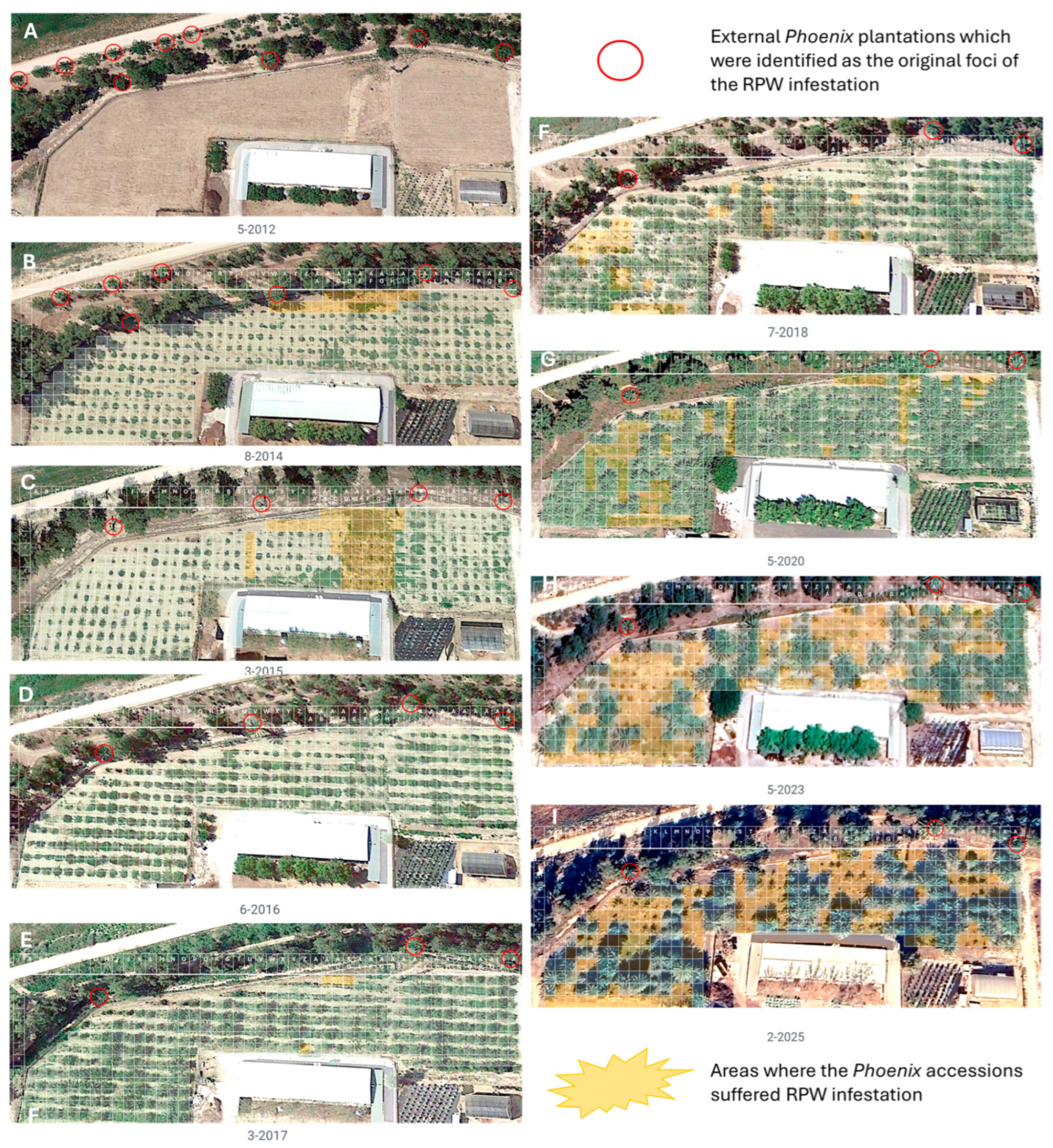
Since 2012, systematic monitoring of RPW infestation has been conducted at two sites housing the National Phoenix Collection (Spanish date palm and related species). At the EPSO site, where plot re-layout commenced in 2012, monitoring has employed a dual methodology: Google Earth imagery analysis (Figure 5) to identify infestation patterns, origins, and successive waves of attack, complemented by ground-based plant-by-plant field inventories (summarized in Table 1). This integrated approach has enabled documentation of the escalating annual impact and subsequent replanting efforts to fill gaps left by palm mortality (Figure 5).
Figure 5.
Chronology of the Phoenix plantation at EPSO (Orihuela) and of the impact of the RPW infestation [3]. Subfigures: (A) Image of the plot in 2012 prior to planting the accessions. (B) Image taken after the first planting phase in 2014. (C) Loss due to RPW infestation of some of the palm trees planted in the first phase. (D) Recovery after effective treatment and replacement of four palm trees. (E–G) New RPW infestation. (H) Second planting phase in 2019. (H,I) Evolution of RPW infestation since 2021.
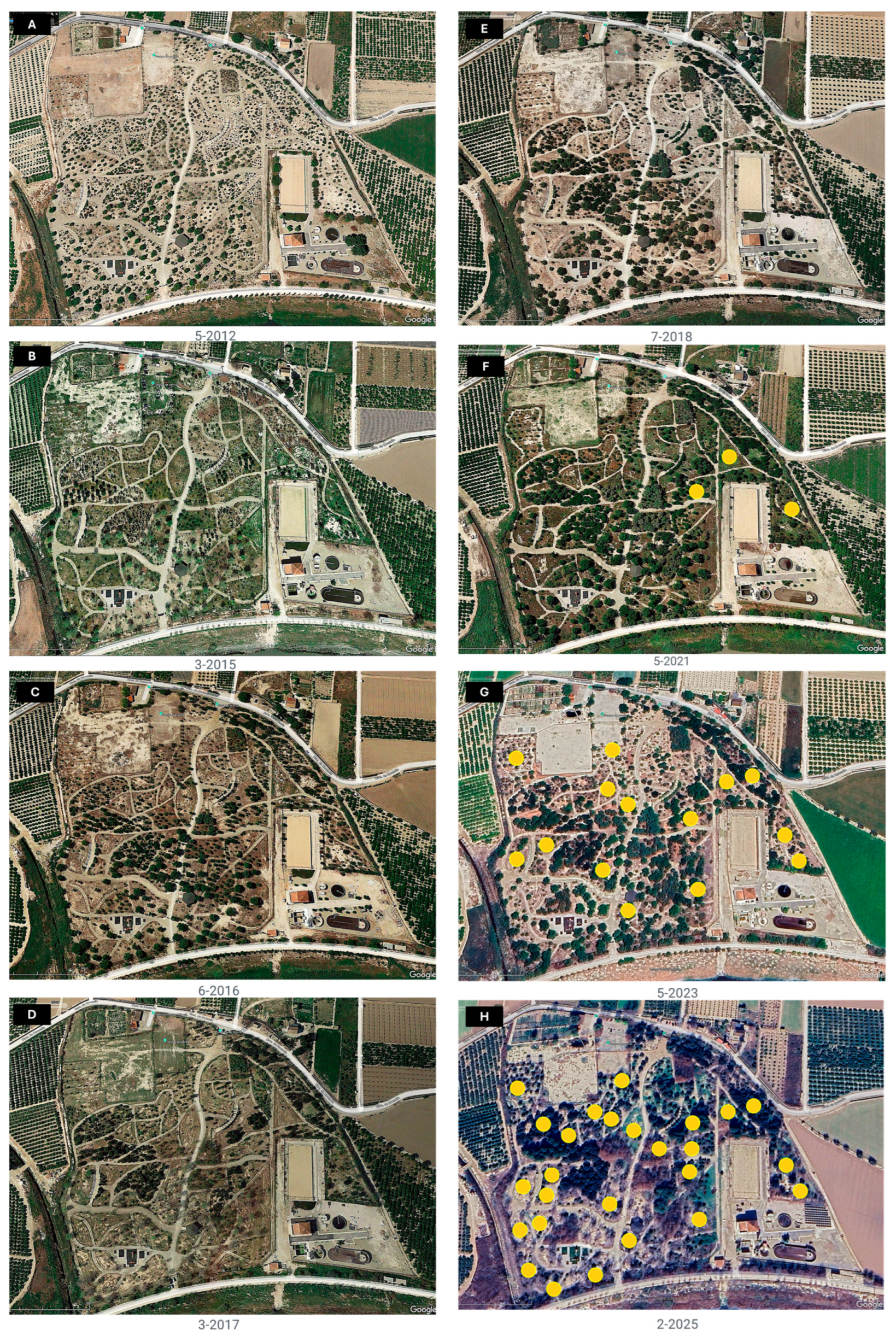
A parallel monitoring protocol was established at the Palmetum site beginning in 2014, when re-layout of its designated plot commenced. The same dual methodology—Google Earth imagery analysis (Figure 6) combined with systematic field inventories—has similarly documented progressive infestation dynamics and replanting interventions at this location (Figure 6).
Figure 6.
Chronology of the Phoenix plantation at the Palmetum in Soto I6 (Orihuela) and of the impact of the RPW infestation. During years 2014 to 2017 the park suffered severe drought and failed irrigation which led to de death of 55 accessions, but without evidence of RPW presence. Orange-yellowish dots represent zones where at least one palm died infested by RPW. Subfigures: (A) Image of the park prior to the planting of the accessions. (B) Image taken after the first planting phase in 2014. (C,D) Loss due to irrigation failure of most of the palm trees planted in the first phase. (E) Second planting phase in 2018. (F–H) Evolution of RPW infestation since 2021. Infestation seems to have its origin in the EDAR zone (see (F)).
3.1.3. Climatic Trends and Observations (2014–2024)
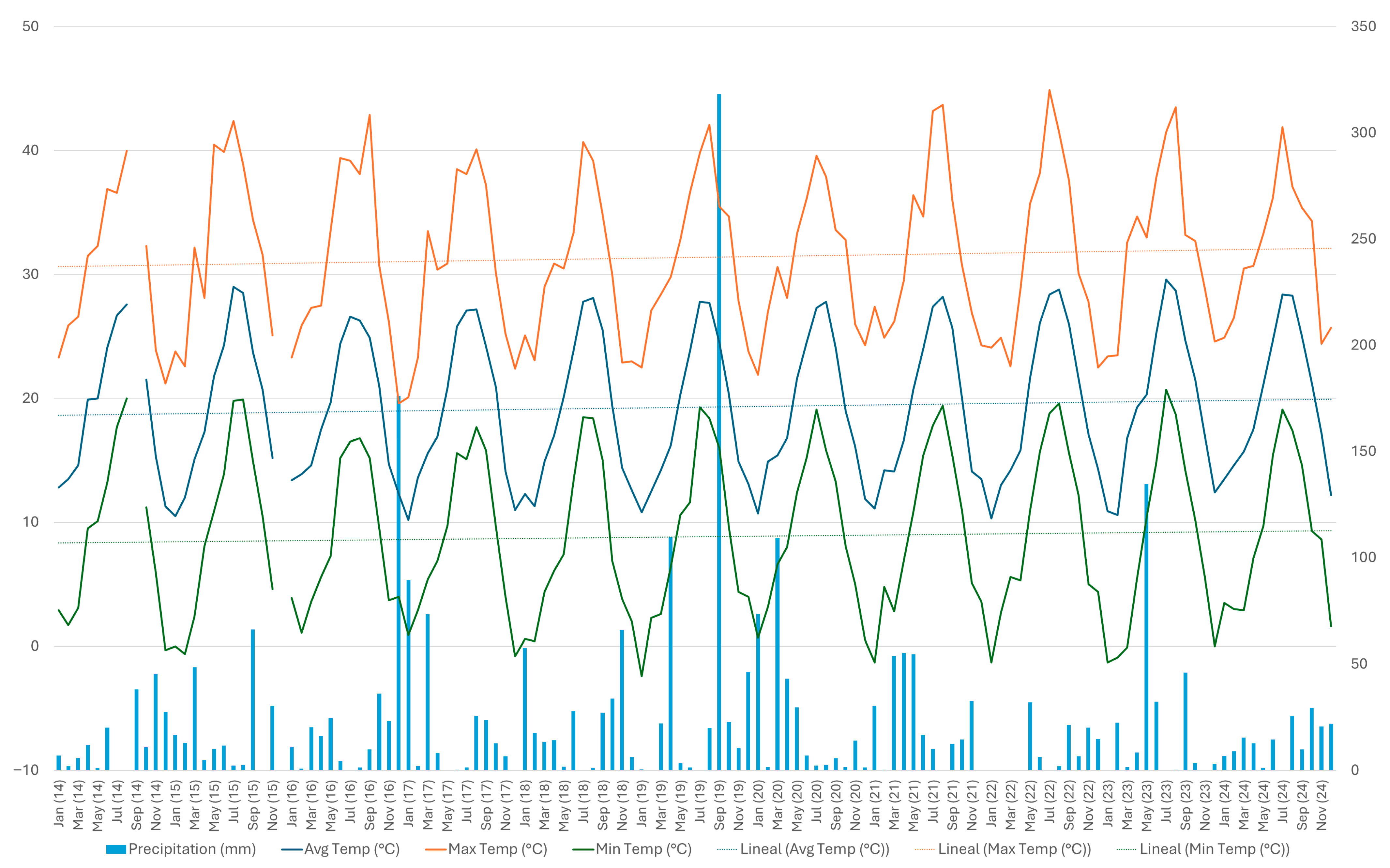
Analysis of the climatic data reveals several notable patterns across the study period (Figure 7, Table 2).
Figure 7.
Monthly maximum, mean, and minimum temperatures, and precipitation for years 2014 to 2024, the period during which Phoenix plantings were conducted and the impact of Rhynchophorus spp. was monitored. Coordinates: The x-axis (abscissa) denotes the months of the period under consideration. The left y-axis (ordinate) represents the average monthly temperatures in degrees Celsius (°C), while the right y-axis indicates the monthly precipitation in liters per square meter (L/m2) or millimeters (mm). Climatic conditions are relevant because they influence the development and spread of the red palm weevil. Data were obtained from the AEMET Orihuela station (Code 7244X; 26 m a.s.l.; 38°04′04″ N, 0°58′53″ W).
Table 2.
Full Eleven-Year Summary Comparison of climatic data: 2014–2024. Complete side-by-side comparison of the annual data for all eleven years. AEMET Orihuela station (Code 7244X; Altitude 26 m a.s.l., Latitude 38°4′4″ N; Longitude 0°58′53″ W).
Temperature records demonstrate a clear warming trend (Figure 7), with average annual temperatures rising from 18.8–19.2 °C during 2018–2020 to 20.0 °C in 2024. The most extreme temperature recorded during this period was 44.9 °C in 2022, while the lowest temperature of −2.4 °C occurred in 2019.
Precipitation patterns exhibited considerable interannual variability. The year 2019 was exceptional, registering 555.6 mm of rainfall—more than double that of most other years in the dataset—largely attributable to an extreme precipitation event in September (Figure 7). Although 2018 recorded the highest frequency of rain days (64 days), its total precipitation remained lower than that of 2019. In contrast, 2024 emerged as the driest year among those with complete data records, while 2014 also exhibited relatively low precipitation levels.
Wind speed measurements indicated that the strongest gusts during the study period occurred in 2018, from the west, reaching 98 km/h. Notably strong gusts were also recorded in 2014 (WNW, c. 98 km/h), as well as during 2017 and 2020, suggesting episodic high-wind events concentrated in March throughout the observation period (Table 2). High-wind events in heavily infested palms accelerate death of P. canariensis individuals and can provoke the fall of crowns of P. dactylifera.
3.2. Treatment Outcomes by Intervention Type
3.2.1. Relationships Between Treatments, Survival Rates and Recovery Indicators
Seemingly the optimal procedures were adopted in the period 2015–2017 with a minimal loss of accessions (Table 3) and Figure 5D,E.
Table 3.
Summary Timeline of Major Shifts of treatments at National Collection at the EPSO of Orihuela.
The census data (Figure 5) clearly demonstrates the long-term impact of red palm weevil (RPW) infestation on an untreated Phoenix palm population along the Segura River bordering to the N of the EPSO collection, over 13 years. Between 2012 and 2015, the number of palms declined rapidly from nine to four, suggesting that RPW was already established in the area and that the most susceptible individuals, those of P. canariensis, succumbed early. Mortality then slowed markedly, with only one additional loss between 2015 and 2020, followed by five years (2020–2025) of stability, as the remaining three palms showed no further decline despite continued exposure.
This pattern indicates that the surviving palms, all Phoenix dactylifera, may exhibit inherent or environmental traits conferring partial resistance—through genetic factors, higher physiological vigor, or reduced attractiveness to ovipositing females. The apparent stabilization may represent a temporary equilibrium between pest pressure and host tolerance, though undetected sublethal infestations cannot be excluded.
3.2.2. Unsuccessful Treatments (Mortality, Reinfestation)
The increased mortality of palm trees in the EPSO collection is unlikely to stem solely from a local rise in weevil populations. Key contributing factors include the maturation of accessions—initially seedlings with trunk diameters under 5 cm, which grew to over 50 cm within years—rendering them more vulnerable to infestation. Persistent external infestation sources along the river, including infested palms that collapsed onto the property’s boundary fence, further exacerbated the issue. Most critically, the cessation of previously effective treatment protocols likely played a decisive role.
3.2.3. Comparative Efficacy Between Sites
Direct comparison between EPSO and Palmetum is hindered by incomplete documentation of treatment protocols at the latter. However, their contrasting plantation strategies—Palmetum’s low-density, diverse layout (palms interspersed with olives, elms, and poplars across a tenfold larger area) versus EPSO’s high-density, uniform palm clusters—suggests Palmetum’s design theoretically supports more effective RPW management (Figure 4 and Figure 5). Despite EPSO’s presumably more systematic treatment regimens, both sites exhibit similar mortality trends: losses of roughly 100 individuals (~30% of original plantings) approximately seven years post-establishment (2014 and 2018, respectively; Table 1).
3.2.4. Probabilistic Models for Assessing Infestation Risk and Damage Expansion Caused by RPW at EPSO and Palmetum Phoenix Collections
Probabilistic models were developed to evaluate the risk of infestation hotspots within palm collections and the subsequent expansion of damage caused by the red palm weevil (RPW). The model, constructed based on the proximity of infested palms to healthy ones within the collection, enables the identification of hotspots requiring intensive preventive treatment. Furthermore, it underscores the necessity for continuous monitoring, early detection, and the removal of infested palms.
A persistent challenge arises from the tendency to attempt palm recovery through targeted treatments before the palm succumbs to infestation. In cases where treatment fails to inhibit the development of larvae and pupae, the treated palm risks becoming a new infestation source for neighboring palms. It is important to note that the current models do not account for the possibility of RPW infestations originating from palms located outside the collection, a scenario that typically occurs during the initial infestation event and continues in subsequent years.
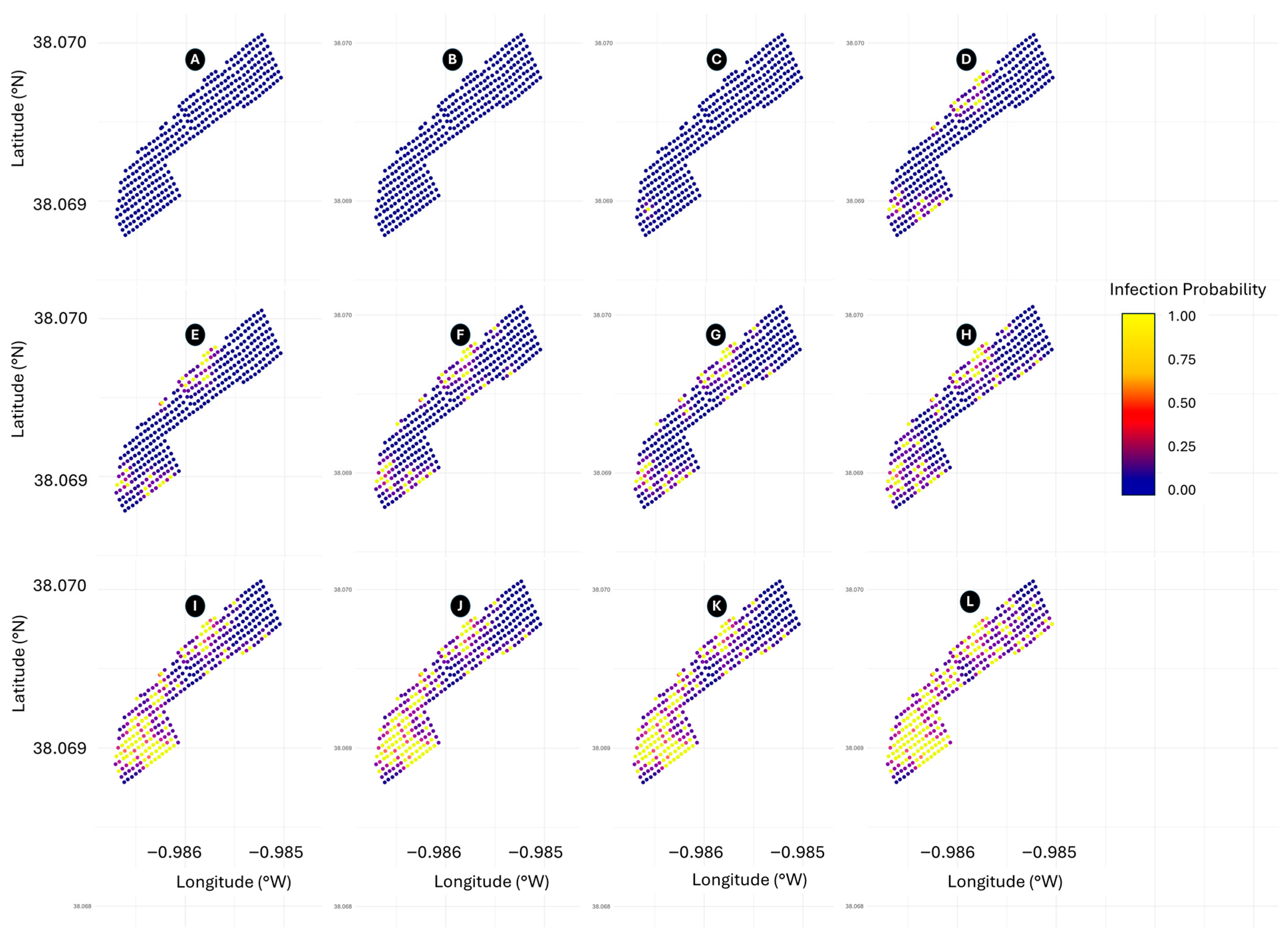
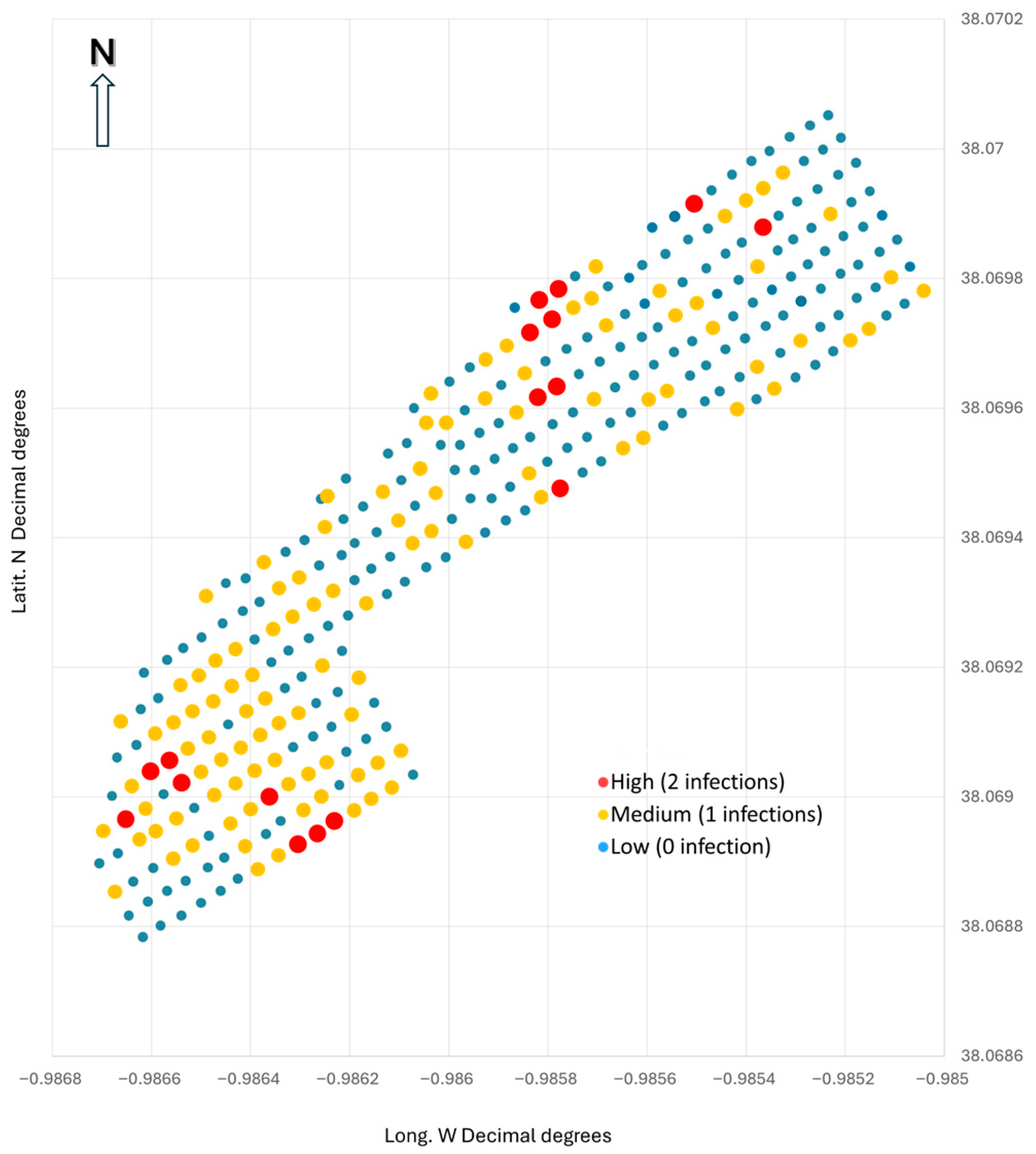
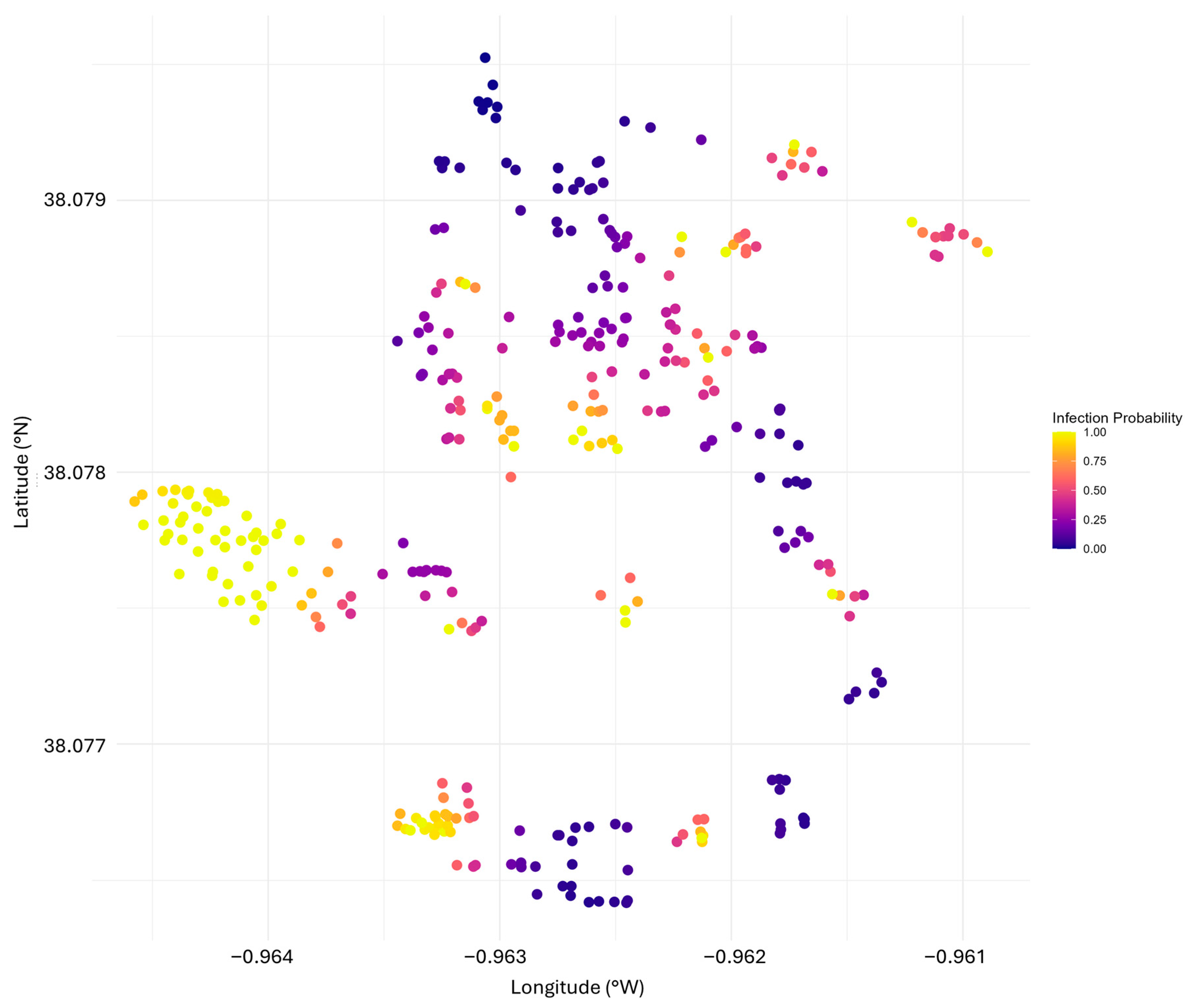
Figure 8 illustrates the development of a probabilistic infestation model based on historical data from the EPSO palm collection. The model does not account for external infestation foci and represents cumulative risk rather than mortality at specific timepoints. Consequently, areas depicted in colors other than dark blue do not indicate dead palms at those dates, as affected specimens have been replaced. However, as demonstrated in Figure 8 replacement palms remain vulnerable to infestation. This model can be compared with Figure 9, which summarizes detected infestation events, including instances where replacement palms—planted to substitute those lost to RPW—were reinfested and ultimately perished. A notable correlation between the last model predictions (Figure 8J,K) and observed events (Figure 9) is evident.
Figure 8.
Spatial Probability Maps of RPW Infestation in Orihuela, Spain Data Source: EPSO, Universidad Miguel Hernández de Elche. This composite figure presents the predicted probabilities of RPW infestation across 321 sample points, based on census data collected between July 2014 and April 2025. Each subfigure corresponds to a specific census date: (A) 8 July 2014, (B) 8 June 2015, (C) 10 April 2016, (D) 9 October 2016, (E) 22 July 2019, (F) 15 March 2020, (G) 3 November 2020, (H) 17 January 2021, (I) 22 April 2021, (J) 6 June 2021, (K) 10 June 2023, and (L) 26 April 2025.
Figure 9.
Red palm weevil (RPW) infestation hotspots at the EPSO campus, Universidad Miguel Hernández de Elche, Orihuela, Spain (n = 321 points). Blue markers: healthy palm trees. Red markers: locations with recurrent infestation in replacement palms after original palms died. Orange-yellowish markers: locations with RPW-induced mortality in a single palm. The graph is a schematic representation of the palm accessions in the collection, considering the georeferencing of each specimen in terms of geographic coordinates in decimal degrees (a format expressing latitude and longitude as decimal fractions, e.g., 38.0698° N, −0.9864° E).
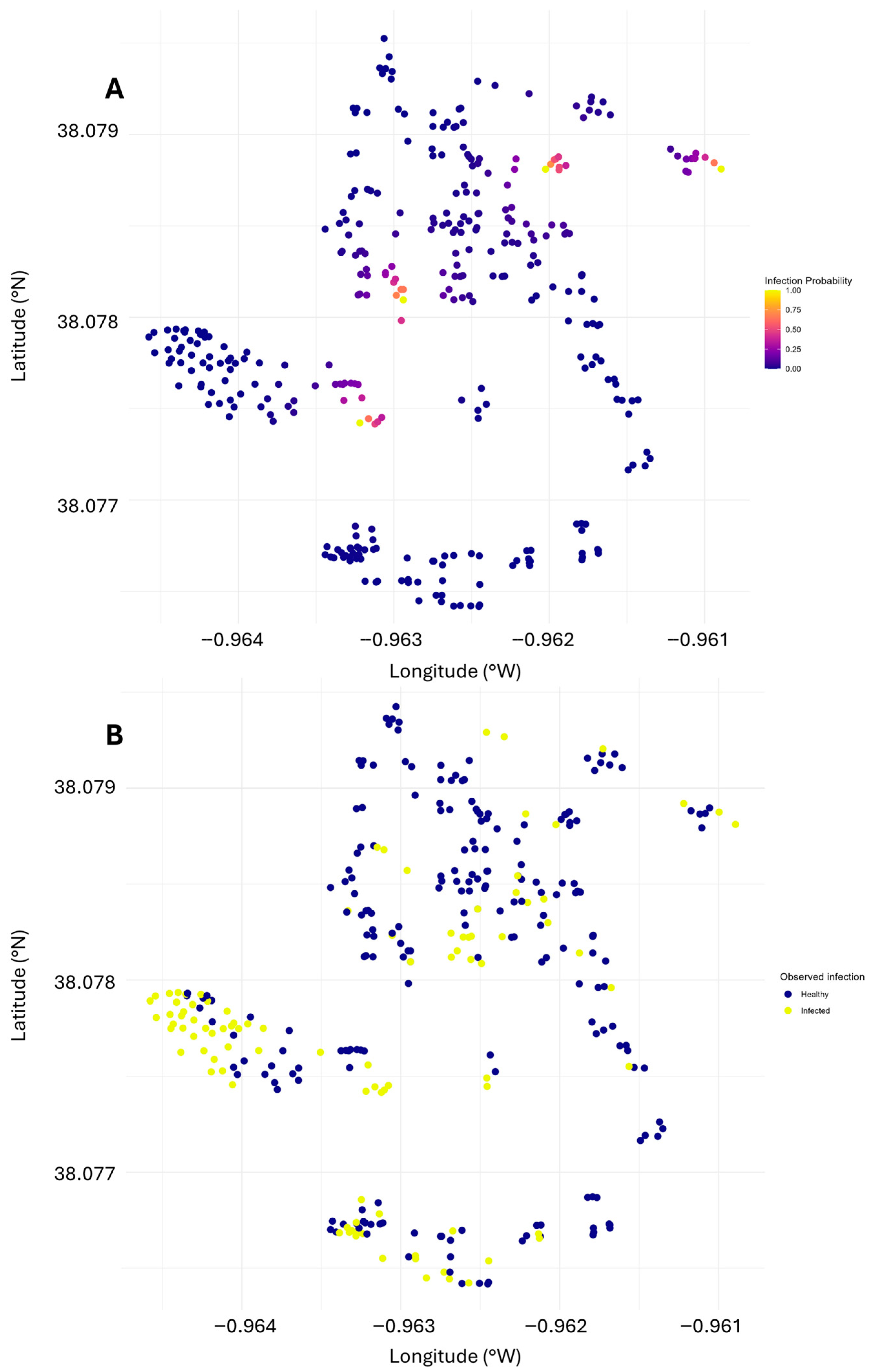
Figure 10 presents two panels for the most recent period: probabilistic predictions of infestations, detected infestations, and Figure 11 projections for 2026. These projections are intended to guide the intensity of preventive treatment efforts in the coming year.
Figure 10.
Comparison between predicted probabilities of red palm weevil (RPW)–induced palm mortality in the Palmetum collection for early 2025 and observed mortality events. (A) Spatial distribution of infestation risk projected for 2025, based on historical records of RPW-infested palms. (B) Spatial distribution of palm specimens confirmed as destroyed by RPW infestation in early 2025. The analysis includes 341 sampled locations. Yellow markers indicate sites with the highest predicted infestation probability in (A) and the corresponding confirmed mortality events in (B). Overall the model failed to predict most of the recorded mortality events. The graphs (A,B) are a schematic representation of the palm accessions in the Palmetum collection, considering the georeferencing of each specimen in terms of geographic coordinates in decimal degrees (a format expressing latitude and longitude as decimal fractions, e.g., 38.0698° N, −0.9864° E).
Figure 11.
Predicted probabilities of red palm weevil (RPW)–induced palm mortality in the Palmetum collection for 2026. The analysis is based on 341 sampled locations. Yellow markers indicate sites with the highest predicted infestation risk, including areas corresponding to previously affected individuals. The graph is a schematic representation of the palm accessions in the Palmetum collection, considering the georeferencing of each specimen in terms of geographic coordinates in decimal degrees (a format expressing latitude and longitude as decimal fractions, e.g., 38.0698° N, −0.9864° E).
The significant discrepancy between the predicted and actually affected palms (Figure 10A,B) is primarily attributable to the proliferation of external infestation hotspots during this period, located at distances ranging from 60 to 250 m or more from the Palmetum collection. This represents a critical issue, as these external hotspots—falling outside the jurisdiction of the collection and the intervention zone of the Orihuela City Council—remain untreated. Consequently, until all infested palms in these areas perish, the collection will continue to suffer severe impacts, necessitating mass replanting and intensive treatments.
Incorporating data from 2025, the forecast for 2026 (Figure 11) suggests catastrophic dimensions, although this scenario will test the resilience of the most “resistant” species and varieties. It is important to note that while the model is based on spatial contiguity, it does not account for the variations in susceptibility to RPW observed in the data from both the EPSO and Palmetum collections.
3.3. Species-Specific Susceptibility
3.3.1. Primary Evidence for Species-Specific Susceptibility
In the EPSO collection, the taxa with the highest proportional losses included: Phoenix dactylifera var. cylindrocarpa Mart., P. dactylifera ‘Excelsior’, P. dactylifera ‘Mednoor’, P. dactylifera ‘Chevalier’, P. loureiroi var. loureiroi, P. reclinata var. reclinata, P. canariensis var. porphyrococca Vasc. & Franco, P. iberica D.Rivera, S.Ríos & Obón, P. iberica ‘Abanilla’, P. hanceana Schaedtler, P. canariensis var. canariensis, and P. dactylifera var. costata Becc. (Supplementary Table S1).
Among the taxa that experienced the most significant losses in the Palmetum collection, Phoenix dactylifera ‘Excelsior’ and P. canariensis var. canariensis were particularly affected (Supplementary Table S2). In contrast, the taxa most severely impacted in the EPSO collection were P. canariensis var. macrocarpa H. Wildpret and P. canariensis var. canariensis (Supplementary Table S1). Further details on the morphology and nomenclature of the different taxa can be found in [17,39,40,41,42,43,44,45].
When assessed in terms of proportional losses, the most affected taxa in the Palmetum collection were Phoenix canariensis var. porphyrococca, P. canariensis var. macrocarpa, P. canariensis var. canariensis, P. rupicola T. Anderson, and P. theophrasti Greuter (from Datça) (Supplementary Table S2).
3.3.2. Integrated Susceptibility Assessment of Palm Taxa Resistance to Red Palm Weevil (RPW)
The susceptibility of various palm taxa to red palm weevil (RPW) infestation has been systematically evaluated over approximately a decade in two distinct Mediterranean environments: EPSO and the Orihuela Palmetum. The findings reveal a spectrum of resistance levels, ranging from functional resistance to extreme susceptibility, with implications for both natural attractiveness to RPW and inherent resistance traits.
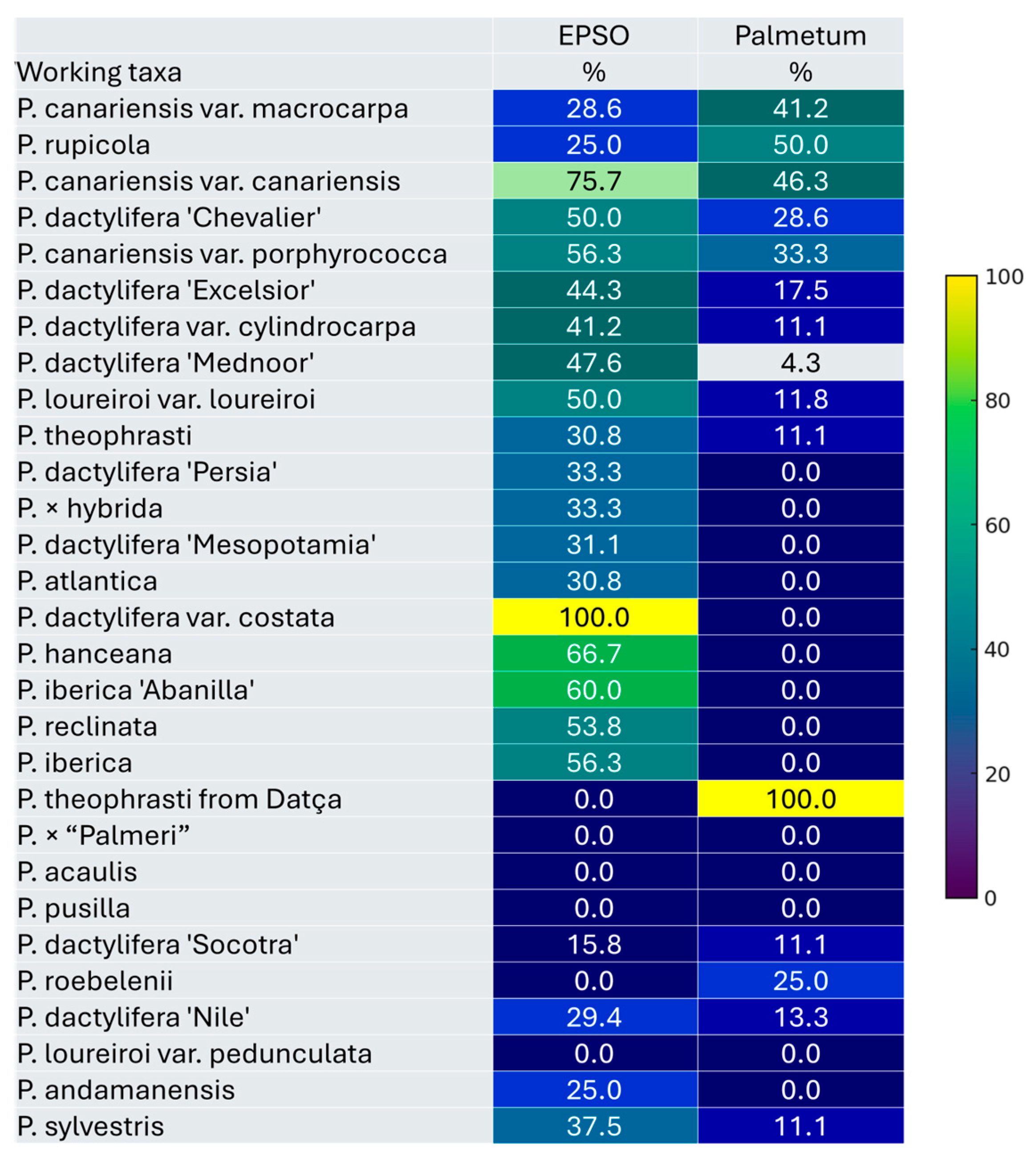
Strong Evidence of Functional Resistance. A subset of taxa exhibited zero RPW-induced mortality across both study sites, indicating functional resistance under Mediterranean conditions (Supplementary Tables S1 and S2, Figure 12). These taxa include Phoenix × ‘Palmeri’, P. acaulis Roxb., P. pusilla Gaertn., P. loureiroi var. pedunculata (Griff.) Govaerts, and P. spinosa Schumach. & Thonn. Among the seven accessions at EPSO of P. × arehuquensis P.A. Sosa et al., two were lost because other causes than RPW. The consistent absence of mortality suggests that these taxa are either inherently resistant or naturally unattractive to RPW under the tested conditions.
Figure 12.
Cluster-ordered heat map of % of deaths by Rhynchophorus in the two main zones of the Phoenix collection, during the period from 2014 to 2025. The colors vary from dark blue and light gray for palm tree mortality rates close to 0% to yellow for rates close to 100%. The color scale with the percentages can be seen in detail on the right side of the figure.
P. caespitosa Chiov., P. sylvestris × P. dactylifera and P. zeylanica Trimen., are represented each by one single specimen in the EPSO collection, which survived.
Low Susceptibility. A second group of taxa displayed occasional RPW attacks but maintained mortality rates below 20%., This category includes P. roebelenii O’Brien, P. andamanensis auct., P atlantica A.Chev., P. × hybrida André, and several P. dactylifera groups of varieties—such as dactylifera ‘Mesopotamia’, ‘Socotra’ and ‘Persia’. These taxa are occasionally targeted by RPW, but their overall incidence of mortality remains low unless environmental conditions favor outbreaks.
Moderate Susceptibility (stable). Taxa exhibiting moderate stable susceptibility, include, P. sylvestris (L.) Roxb. (both edulis and sylvestris variants), P. theophrasti var. theophrasti (from Crete), P. theophrasti (from Gölköy), P. dactylifera groups of varieties—such as ‘Nile’, ‘Excelsior’ and ‘Chevalier’, P. canariensis var. macrocarpa, and P. rupicola.
Moderate–High Susceptibility (unstable). Taxa exhibiting moderate to high unstable susceptibility (s.d. > 20), include P. dactylifera ‘Mednoor’, P. dactylifera var. cylindrocarpa, P. iberica (including the Abanilla variant), P. hanceana, P. loureiroi var. loureiroi, and P. reclinate. While P. dactylifera ‘Mednoor’ showed considerable variability between sites, the Palmetum dataset, being more robust, supports its classification as moderately susceptible. These taxa are consistently targeted by RPW, necessitating protective measures in infested areas. The variability in mortality rates across sites further highlights the role of local conditions in determining susceptibility (Figure 12).
Extreme Susceptibility. Finally, certain taxa exhibited extreme susceptibility, P. canariensis var. porphyrococca. The observed variability in susceptibility underscores the influence of environmental factors and local RPW populations.
P. canariensis var. canariensis emerged as the most vulnerable taxon, with mortality rates of 75.7% at EPSO and 46.3% at the Palmetum. While P. theophrasti (from Datça) showed 100% mortality at the Palmetum, and P. dactylifera var. costata, at the EPSO, the limited sample sizes preclude definitive classification as extremely susceptible (Figure 12).
Observed resistance and susceptibility patterns reveal critical vulnerabilities among palm taxa. Taxa with functional resistance likely possess inherent deterrents to RPW, while low-to-moderately susceptible taxa require monitoring, and highly susceptible taxa demand proactive protection. Caution is advised in interpreting results, as developmental stage (e.g., immature stems) and uneven sample sizes across taxa may influence infesta-tion rates; further studies with larger samples of less susceptible taxa are needed.
A generalized linear mixed model (logit link) quantified infestation probability based on spatial susceptibility and species-specific traits. Susceptibility rankings were consistent across study sites, indicating a stable hierarchy of host preference. Highly susceptible taxa—notably the Phoenix canariensis complex and soft-tissued P. dactylifera cultivars (western group)—exhibited positive intercepts and confidence intervals (Supplementary Figures S1 and S2), suggesting intrinsic biological vulnerability. Conversely, resistant taxa (P. acaulis, P. atlantica, P. andamanensis, and hybrids like P. × “Palmeri”) showed negative intercepts, implying morphological or anatomical resistance.
Intermediate-susceptibility taxa (P. theophrasti, P. rupicola, and eastern P. dactylifera cultivars) displayed site-dependent variability, likely due to local conditions or sampling differences. Despite this, species identity remained the primary predictor of RPW attack probability, reinforcing its utility for risk assessment and management in threatened regions. These replicated patterns identify both high-risk and resistant taxa, offering a biologically grounded framework for planting and mitigation strategies.
4. Discussion
4.1. Mediterranean Context: Comparative Case Studies
In order to contextualize the issues caused by the red palm weevil (RPW) in the Orihuela collections—and the treatment strategies adopted—we compared them with the evolution of the date palm collections at the UMH campus in Elche and the UMU campus in Espinardo (Murcia), as well as the experiences in three reference cities: Elche, the only European palm grove declared a UNESCO World Heritage Site; Nice, a pioneer in RPW treatment; and Palermo.
4.1.1. Evaluation of Integrated Pest Management for Phoenix Palms in the Green Areas of the University of Murcia
Since 2008, red palm weevil infestations have caused substantial damage, primarily through apical bud destruction leading to palm mortality. A structured treatment program was implemented to mitigate damage and control pest proliferation. Initial 2009 mapping identified 450 Canary Island date palms (Phoenix canariensis) on campus; 201 losses have since occurred, predominantly from RPW damage, with fungal infestations occasionally contributing—potentially facilitated by weevil-generated cavities. From 2014 to 2025, the number of living Phoenix canariensis palms declined from approximately 375 to 250 individuals, representing a reduction of about 33%. Over the same period, cumulative mortality attributed to Rhynchophorus increased from roughly 75 to 200 palms. Mortality accelerated after 2017, with cumulative deaths rising by more than 60 individuals between 2017 and 2020 alone. The progressive increase in accumulated deaths closely mirrored the continuous decline in living palms, indicating a sustained and intensifying impact of Rhynchophorus on plantation survival over time.
Early treatment protocols adhered to the guidelines established by the Regional Department of Agriculture’s Plant Health Department. These involved the rotational application of four active ingredients—abamectin (1.8% EC), phosmet (45% WP), thiamethoxam (25% WG), and imidacloprid (20% SL)—each applied according to labeled dosage rates. This rotation strategy minimized resistance development while exploiting complementary systemic and contact mechanisms, providing sustained efficacy.
Biological agents—nematodes (Steinernema carpocapsae) and entomopathogenic fungus Beauveria bassiana—were also recommended. However, despite minimal toxicity, campus-scale deployment proved economically and operationally prohibitive due to stringent storage requirements (cold, humid conditions), narrow application parameters incompatible with regional climate, and specialized equipment needs for nematode delivery. Although field trials were conducted, treatment efficacy remained unquantifiable. Consequently, the Technical Unit prioritized chemical control measures.
Concurrently, mechanical extraction of infested tissues and larvae from palm crowns was implemented to eliminate active developmental stages in apical regions.
Subsequent European directives progressively restricted authorized chemical products, leaving only one neonicotinoid—Acetamiprid (20%), structurally similar to Imidacloprid—approved for palm application. Since 2017, campus treatments have exclusively employed this compound via direct crown drench application.
Declining commercial viability and prohibitive regulatory costs prompted manufacturers to withdraw most palm-use formulations. Only EPIK (SIPCAM) remains authorized through 31 December 2025.
Product labeling permits four annual crown drench applications (approximately 20 L per palm), with dosage standardized via flow meters on tractor-mounted tanks. Applications align with regional red palm weevil flight periods (March–October) and are administered preventively: March–April, May–June, July–August, and September–October, given persistent pest presence in critical campus zones.
Program efficacy is monitored using nine Picusan pheromone traps with Sansan-brand attractants. However, unmanaged infestations in adjacent ravines occasionally inflate trap counts, obscuring actual infestation levels among treated palms.
Current regulations now restrict Acetamiprid to endotherapy exclusively. Hazard statement H361d (suspected fetal toxicity) prohibits outdoor application in public areas per Annex VIII of Royal Decree 1050/2022 [46], eliminating foliar and crown drench methods regardless of area cordoning.
Future management requires endotherapy-authorized compounds, increasing operational costs through specialized equipment and training. Endotherapy presents additional risks: pathogen introduction via injection sites, uncertain dosage-to-palm-size ratios, and variable translocation rates dependent on tree physiology.
These constraints substantially threaten long-term Phoenix canariensis population viability on campus—a decline parallel to that occurring in the EPSO and Palmetum collections.
4.1.2. Evaluation of Integrated Pest Management for Palms in the Green Areas of the Campus of Elche (Universidad Miguel Hernández de Elche)
The campus adjoins several UNESCO-designated orchards (Hort de la Torre de Vaillos, Hort de Molins, Hort de Revenga) and buffer zone sites (Hort de Bernia, Hort de Bernia II).
Palm distribution includes linear alignments, clusters, isolated specimens, and plantation-mimicking configurations with varied spacing—uniform patterns (Huerto de Altabix) or grid layouts (Huerto de Hèlike).
Initial inventory identified 3208 palm positions in Elche campus (including 53 stumps); 17 date palms (Phoenix dactylifera) exhibited red palm weevil infestation, with symptoms on one stump. All affected specimens were date palms (17/2845), consistent with population dominance.
Despite date palm predominance, landscaping incorporates diverse species including other palm genera. The palm tree census conducted in July 2024 on the UMH Campus (Elche) recorded a total of 3057 individuals distributed among ten species. Phoenix dactylifera L. was by far the most abundant species, with 2766 individuals, accounting for the vast majority of the population. Much lower abundances were observed for Chamaerops humilis L. (124 individuals) and Washingtonia filifera var. robusta (H. Wendl.) Parish (98 individuals), followed by Livistona chinensis (Jacq.) R. Br. ex Mart. with 44 individuals. The remaining species were represented by fewer than 15 individuals each, including Syagrus romanzoffiana (Cham.) Glassman (11), Caryota urens L. (7), and Bismarckia nobilis Hildebrandt & H. Wendl. (3). Phoenix canariensis H. Wildpret was represented by only two individuals, while Sabal palmetto (Walter) Lodd. ex Schult. & Schult. f. and Chrysalidocarpus decaryi (Jum.) Eiserhardt & W. J. Baker (syn. Dypsis decaryi) were each represented by a single individual.
Project initiation coincided with final authorization extensions for chlorpyrifos and neonicotinoids (imidacloprid, thiamethoxam). Chlorpyrifos was never deployed due to toxicity and public area restrictions; only one thiamethoxam foliar application occurred (late 2018).
Regulatory constraints have progressively limited chemical control, rendering resistance-mitigating rotation strategies impractical. Two synthetic treatments remain authorized, though heavily regulated:
- Deltamethrin 1.5% WE (commercial name Decis Protech): Four annual applications permitted; currently unavailable.
- Lambda-cyhalothrin 5% WG (commercial name Kaiso Sorbie): One annual application, justified under Royal Decree 1311/2012 Annex VIII toxicity criteria.
Biological control via entomopathogenic nematodes (Steinernema carpocapsae) is applied during cooler, humid periods to reduce pesticide dependence.
Treatment schedules are adapted to real-time pest dynamics rather than fixed calendars, prioritizing early detection and targeted interventions to minimize pesticide use while maximizing efficacy. During 2024, adult red palm weevil flight activity showed clear temporal patterns but must be interpreted in light of unequal trapping effort and host availability among campuses. The Elche Campus, where four traps were deployed and more than 3000 palms are present, recorded the highest absolute captures, with monthly values ranging from 10 to 139 individuals and pronounced peaks in spring (March–May) and a secondary increase in autumn. In contrast, Sant Joan d’Alacant and the Orihuela School of Engineering (EPSO), each monitored with a single trap and hosting substantially smaller palm populations (particularly at Sant Joan), consistently yielded much lower capture numbers, generally below 15 individuals per month. When considered relative to trapping intensity and palm abundance, these results suggest that the higher captures at Elche primarily reflect greater sampling effort and host density rather than disproportionately higher weevil pressure, while the shared spring and autumn increases across campuses indicate a common seasonal flight pattern at the regional scale.
All campus palms are GIS-tracked for infestations, enabling targeted interventions. GIS data and trap captures show on-/off-campus dynamics, with external outbreaks near abandoned sites. Immediate assessments and sanitation eliminate pests at entry points. Bi-monthly monitoring ensures eradication or removal of severely damaged palms, with centralized coordination minimizing delays.
During the initial four-year contract, 3078 of 3155 palms were preserved through early detection and tailored treatments. Recent surveys found only two infested Phoenix dactylifera among 3054 palms.
4.1.3. Comparative Synthesis of Rhynchophorus Treatment Strategies at the City Level
Red palm weevil infestations typically destroy significant Phoenix populations within affected groves, though devastation varies due to feeding preferences. RPW strongly favors sugar-rich species: Phoenix canariensis, P. reclinata, and certain P. dactylifera varieties—particularly western genotypes prevalent in the Iberian Peninsula and North Africa. This selectivity produces differential impacts across collections.
In 2015, Elche’s municipal government responded to Rhynchophorus ferrugineus threats to the Palm Grove’s UNESCO status by establishing an Integrated Pest Management (IPM) service, enhancing coordination between local authorities and plant health agencies [44]. While subsequent measures received positive stakeholder feedback [47], Paysandisia archon has since become the primary cause of palm mortality in the region.
Protected Palmeral zones shares IPM principles with the UMH campus, but faces two major challenges: fragmented governance among multiple stakeholders (including the Valencian Ministry of Agriculture and TRAGSA) causes coordination delays, while dense nursery plantations with juvenile palms act as primary weevil foci, increasing vulnerability despite the resilience of mature specimens. Although Valencian resources generally maintain manageable infestation levels, pest surges can overwhelm control efforts, leading to hotspot resurgence. The loss of 325 date palms in Hort de la Torre de Vaillos (2015–2025) underscores these IPM limitations, as minor coordination failures enable permanent weevil establishment and irreversible damage [44].
UNESCO designation elevates pest management from a phytosanitary issue to a cultural preservation challenge. Heritage groves, embodying centuries of agricultural tradition, require resource-intensive interventions (e.g., chemical treatments, specimen replacement) to preserve their cultural and historical value. In contrast, ornamental groves prioritize cost-effective, adaptive strategies, such as selecting resistant species. Economic incentives for pest management are limited due to Elche’s minimal commercial date production, further distinguishing resource allocation across heritage, ornamental, and productive contexts [44].
Heritage status unlocks international funding and technical cooperation, enabling advanced IPM strategies (e.g., biological controls, precision monitoring) that align with UNESCO’s emphasis on traditional knowledge and heritage authenticity. It also facilitates genetic conservation efforts, such as seed banking, and positions Elche as a global case study for pest management innovation. The city’s inclusion in international heritage networks (e.g., Al-Ahsa Oasis) fosters knowledge exchange, transforming local challenges into shared global priorities [44].
In France, Nice pioneered a national RPW control strategy in 2010, collaborating with municipalities, professional associations, and researcher Michel Ferry to implement mass trapping, systematic surveillance, and severity-calibrated sanitation. This approach expanded to 30 coastal municipalities by 2014 [48]. Despite its success, historical sites like Parc Vigier lost most of their centenary Phoenix canariensis (planted in 1865), with only 24 healthy trees remaining by May 2024 [49,50,51,52,53].
In Palermo, palms are integral to urban architecture and cultural identity, but RPW infestations have drastically reduced populations, altering landscapes and threatening native species like Chamaerops humilis across Sicily. The potential long-term ecosystem impacts remain uncertain, risking the loss of palms’ centuries-old cultural, economic, and ecological significance in Mediterranean art, tradition, and daily life [54].
European regulatory withdrawal of effective chemical agents has exacerbated garden vulnerability, often rendering progressive specimen loss inevitable. Conversely, rapid post-detection intervention effectively contains infestations, as demonstrated in the Canary Islands, underscoring timely action’s importance.
Contrary to published infestation maps depicting Mediterranean coastal confinement, RPW’s destructive impact extends far beyond. Spanish cases include P. canariensis and P. dactylifera mortality at La Toja Island, Galician pazos, Asturian and Cantabrian casas de indiano, and Zaragoza parks [55,56]. All instances trace to infested adult palm importation, highlighting human-mediated dispersal and necessitating stringent biosecurity measures preventing RPW introduction and establishment.
4.2. Management Strategy Evaluation
4.2.1. Critical Analysis of What Worked and Why
Systematic treatment with Beauveria bassiana alternating with the external application of nicotinoid insecticide results were highly effective in the EPSO collection until production ceased of the fungi clone by the supplier and the replacement of insecticides significantly reduced the control levels attained (see the impact in the collections in Figure 5 and Figure 8). Furthermore, when intervention is necessary, the approach has shifted toward selective pruning—removing only affected fronds or offshoots—rather than resorting to the complete felling of specimens. This targeted strategy helps preserve the overall health of the palm population while minimizing losses.
4.2.2. Factors Contributing to Treatment Failure
Treatment failures in Spain’s Orihuela Phoenix collection, located in a SIGPAC-designated “Sustainable Use Zone for Plant Protection Products,” often result from procedural errors or external infestation sources. High plant density—with most palms producing multiple offshoots—complicates inspections, reduces treatment efficacy, and delays early detection and control. Regulatory restrictions further limit effective treatments, as approved active ingredients frequently fail against the red palm weevil.
Adjacent uncontrolled infested palms, particularly P. dactylifera along the Segura River’s southern bank, act as persistent reinfestation sources. These palms exhibited symptoms by 2012 and died by 2014 (EPSO area), while Palmetum palms across the river perished by 2015. This sustained pressure likely explains recurrent mortality in the EPSO germplasm collection (Figure 9). Additionally, shifts in treatment protocols—replacing effective methods with environmentally sustainable alternatives mandated by European and Spanish legislation—have increased collection vulnerability.
Gameel et al. identified critical management errors in Egypt’s New Valley Governorate, including neglecting preventive post-pruning treatments, transferring infested propagative material, and improper disposal of infested debris, which facilitated reinfestation. Farmers also overlooked inspections of non-productive palms, monthly surveys, and rodent vector management [54]. Misconceptions about treatments—such as relying on foliar pesticides, sulfur dusting, or burning infested material—proved equally damaging. Improper application methods, excessive concentrations, and incorrect mechanical injections targeting the apical meristem caused significant palm mortality instead of pest control [57]. Some of these harmful practices were observed in palm groves around the EPSO and Palmetum collections.
4.2.3. Cost–Benefit Considerations
Annual per-palm treatment costs USD 50–100, averaging USD 56 in agricultural contexts, with national programs costing millions [55,56,57]. For botanical gardens, targeted injections are cost-effective compared to removal/replacement, while pheromone traps enable low-cost surveillance (~tens of USD/year) [58]. Innovative paste formulations combining pheromones and insecticides offer new control options [59].
Seed propagation is more economical than maintaining or replacing mature palms, which can cost thousands of dollars. Effective management in botanical gardens combines surveillance (visual/acoustic, pheromone traps) and targeted protection (trunk injections or biological controls for high-value palms). Seed-based replacement works for species conservation but not for preserving specific genotypes, except for Phoenix dactylifera and P. canariensis [18].
A tiered approach optimizes resources: High-value accessions (rare, historic, or recalcitrant-seed species) require intensive monitoring, combined treatments, and seed banking. Medium-value palms need routine surveillance and selective intervention, while replaceable palms only require monitoring and trapping.
Removal is limited to cases of apical meristem failure, structural instability, or persistent infestation after two failed treatments, always ensuring seed-bank security first. For clonal/multi-stemmed palms, selective stem removal is preferred over full removal.
Seed-based replacement maintains genetic representation without micropropagation risks. For recalcitrant seeds, frequent collections and immediate sowing are critical. Replacement involves propagating 2–5 seedlings per site, nursery cultivation for 1–2 years, and preventive biological treatments during establishment.
4.2.4. Differences Between Ex Situ Conservation Collections and Landscape Plantings
Ex situ conservation collections and landscape plantings play distinct but complementary roles in managing Phoenix species threatened by Rhynchophorus. Ex situ collections—such as botanical gardens and germplasm banks—focus on preserving genetic diversity, documented provenance, and long-term species survival. For Phoenix species, this includes living collections and stored orthodox seeds (P. dactylifera, P. canariensis [18]), enabling genetically continuous replacement. These collections use intensive monitoring, early detection, targeted interventions, and regeneration from stored genetic material.
In contrast, landscape plantings prioritize aesthetic, ecological, and cultural functions, with conservation as a secondary goal. This adaptive approach emphasizes practical resilience, aiming to reduce the need for chemical interventions and improve the overall stability of the landscape [60,61,62]. Management emphasizes functional resilience over genetic preservation, often replacing highly susceptible species (e.g., P. canariensis) with less vulnerable taxa or cultivars, such as certain P. dactylifera varieties, to reduce chemical use and improve landscape stability [63,64].
Genetic diversity is central to ex situ conservation, where seed banks preserve multiple accessions to maintain adaptive potential against pests, diseases, or climate change. Landscape plantings, while prioritizing performance and appearance, can still enhance resilience by incorporating resistant species or cultivars, aligning with integrated pest management principles.
Long-term strategies differ, ex situ collections rely on proactive seed banking and controlled propagation to safeguard genetic resources, while landscape plantings adopt adaptive, research-driven approaches focused on reducing susceptibility and ensuring practical sustainability. Despite their constraints, ex situ collections uniquely enable genetically informed replacement, while landscape plantings mitigate pest impacts through inherently resilient planting schemes.
4.3. Mediterranean Basin Perspective
4.3.1. Regional Patterns in R. ferrugineus Management
The EPPO outlines standard containment and eradication protocols [65,66], but these have proven ineffective against the rapid expansion of Rhynchophorus ferrugineus (RPW) in the Mediterranean. Conventional biological control methods—such as pheromone traps (targeting adults), entomopathogenic nematodes (Steinernema carpocapsae; parasitizing larvae), and fungal pathogens (Beauveria bassiana; inducing white muscardine disease in both larvae and adults)—are costly and technically demanding.
In response, Capelli et al. [67] proposed a scalable biological control strategy in France, integrating indigenous predatory and parasitic macro-organisms (e.g., Neuroptera, Formicidae, Coleoptera, and Dermaptera) with existing control measures.
4.3.2. Evidence-Based Best Practices
Few techniques have achieved lasting success, mostly just delaying infestation effects or buying limited time for palm populations. The only well-documented success occurred in the Canary Islands, where early chemical controls and a strict ban on importing adult palms yielded positive long-term results—though new pests like the palm weevil borer (Diocalandra frumenti) now threaten Phoenix survival there.
At Hanbury Botanical Garden, Boero et al. (2023) reported effective use of nematodes and fungal parasites: after losing over 40 Phoenix canariensis (2015–2018), only one specimen was infested by 2021, confirming the efficacy of R. ferrugineus and Paysandisia archon control measures [68,69].
However, European-level strategies have largely failed. Successive regulations, intended to ensure safety, have instead hindered mitigation efforts in gardens, parks, and collections by restricting access to effective treatments. This gap between policy and practice highlights the need for adaptive, regionally tailored approaches to RPW management [70].
4.3.3. Early Detection Protocols
Rhynchophorus ferrugineus was included in the EPPO A2 List of quarantine pests in 2005. Since then, outbreaks have spread across multiple EPPO countries. While early domestic phytosanitary measures effectively contain short-term outbreaks, preventing introduction through stringent measures—requiring imports from pest-free areas/production sites or restricting plant type/size—remains the most robust long-term strategy for uninfested regions [71].
In established-pest countries, FAO (2020) [16] recommends comprehensive measures: delimiting infested areas and buffer zones, and regulating palm tree/offshoot movement from infested zones.
Experimental results demonstrate trunk circumference and temperature are critical predictive features for RPW infestation, consistent with research showing elevated internal trunk temperatures and positive correlations between circumference and RPW populations, though identifying specific infestation characteristics remains challenging [70]. Trunk diameter shows significant positive correlation with infestation probability, though additional factors like sap sugar content also contribute.
4.3.4. Integration of Conservation Priorities with Phytosanitary Measures
Fajardo et al. [71] highlight the successful eradication of Rhynchophorus ferrugineus in the Canary Islands—the native habitat of Phoenix canariensis—as evidence that existing knowledge and control strategies are adequate. The primary obstacle is not technical expertise but the establishment of an effective organizational framework and its management to achieve eradication.
Currently, the Canary Islands confront a new challenge: maintaining public and institutional engagement to prevent RPW reintroductions and enable early detection. Additionally, educational initiatives, such as those implemented at the Cagliari Botanic Garden in Sardinia [72], offer a valuable yet often overlooked approach to integrating conservation priorities with treatment protocols.
4.4. Future Directions
4.4.1. Knowledge Gaps
Abdel-Banat et al. [58] highlight persistent knowledge gaps—such as weevil biology, behavior, host interactions, and early detection methods—that hinder RPW eradication. Key research priorities include insecticide resistance, biological control sustainability, environmental impacts of current strategies, and scalable interventions. Future efforts should focus on eco-friendly insecticides, advanced detection technologies, and locally adapted Integrated Pest Management (IPM), with community engagement ensuring equitable access.
Susceptibility varies even within species, challenging assumptions of uniform resistance. For example, P. dactylifera ranges from negligible to 50% susceptibility, while P. canariensis consistently shows high mortality. Conversely, species like P. acaulis and P. roebelenii exhibit zero mortality over decades, suggesting adaptive traits worth further study. Hybrids typically show intermediate susceptibility (0–33%), while P. theophrasti populations vary from resistant to moderately susceptible.
These findings support diversified replanting strategies, aligning with Cinnirella et al. [73], to enhance resilience against RPW while balancing cultural, ecological, and economic needs.
4.4.2. Need for Coordinated Monitoring Networks
Rhynchophorus ferrugineus has invaded 27 countries over three decades, driven by human-mediated transport of infested date palms and offshoots [74,75]. While localized eradications have succeeded, a global research effort—examining behavioral, morphological, biological, and genetic traits across native and invaded ranges—is critical to understanding invasion mechanisms and improving adaptive management [74].
Proactive surveillance using emerging technologies enhances early detection and containment, particularly in vulnerable areas [76]. Pontikakos et al. [77] proposed a location-aware system (LAS) for real-time risk assessment in urban palm landscapes, integrating web-mapping for stakeholder collaboration, data sharing, and scientifically informed management.
Climate change is expanding RPW’s range, with warming trends creating more favorable conditions [78,79]. Spatial overlap of climatically suitable habitats with palm-rich and economically vital regions underscores the urgency for early detection systems and integrated pest management. Wang et al. [78] used MaxEnt modeling to project RPW distributions in China under future climate scenarios, identifying five key bioclimatic variables: annual mean temperature, driest quarter precipitation, coldest month minimum temperature, diurnal range, and wettest quarter precipitation. Souza et al. [79] confirmed similar invasion risks in Brazil, reinforcing RPW’s global expansion potential.
5. Conclusions
The red palm weevil (Rhynchophorus ferrugineus) remains a major and persistent threat to heritage palm collections across the Mediterranean Basin. The ten-year evaluation of Integrated Pest Management (IPM) strategies applied to the Spanish Phoenix Collection at Miguel Hernández University (EPSO) and the Orihuela Palmetum demonstrates that proactive, multi-component IPM programs can significantly improve palm survival and recovery when consistently implemented and adapted to local conditions.
Effective management depends on early detection, coordinated monitoring, and the integrated use of chemical, biological, and cultural control measures, particularly when supported by probabilistic risk models that enable anticipatory interventions. However, pronounced interspecific differences in susceptibility among Phoenix taxa necessitate species and accession-specific prioritization of protection efforts.
Our data reveal wide susceptibility variation among Phoenix taxa, enabling risk stratification from resistant species and hybrids to extremely susceptible.
The increasing economic burden of RPW management highlights the importance of cost-effective strategies, including the replacement of lost individuals with seed-derived palms from conserved accessions in species with orthodox seeds. At the same time, regulatory constraints—especially those limiting chemical and biological control options—reduce management flexibility and should be reconsidered to better align legislation with scientific evidence.
Overall, long-term conservation of heritage palm collections under continuous RPW pressure requires adaptive IPM frameworks, standardized monitoring, risk-based decision tools, and collection-specific management protocols that balance biological value, economic feasibility, and regulatory context.
Supplementary Materials
The following supporting information can be downloaded at: https://www.mdpi.com/article/10.3390/jzbg7010008/s1, Figure S1: Species, varieties and Cultivar Groups Susceptibility to RPW infestation estimated based on the infestation rates recorded 2015 to 2025 in the EPSO of Orihuela; Figure S2: Species, varieties and Cultivar Groups Susceptibility to RPW infestation estimated based on the infestation rates recorded 2018 to 2025 in the Palmetum of Orihuela. Table S1: Deaths by species, varieties and Cultivar Groups in the Phoenix palms of the Collection at the EPSO. Table S2: Deaths by species, varieties and Cultivar Groups in the Phoenix palms of the Collection at the Palmetum of Orihuela.
Author Contributions
Conceptualization, D.R. and C.O.; methodology, D.R.; software, D.J.R.-O.; validation, C.O., D.J. and D.R.; formal analysis, D.R. and D.J.R.-O.; investigation, A.G.S., G.M.-L., N.V., J.J.S., C.O. and D.R.; resources, C.O.; data curation, G.M.-L., N.V., J.J.S., C.O. and D.R.; writing—original draft preparation, D.R.; writing—review and editing, D.J. and C.O.; visualization, D.R. and D.J.R.-O.; supervision, C.O.; project administration, C.O.; funding acquisition, C.O. All authors have read and agreed to the published version of the manuscript.
Funding
This research was funded by INIA projects RF2007-00010-C03 and RF2010-00006-C02 (European Regional Development Fund 2007–2013), Prospección y recogida de recursos fitogenéticos autóctonos de palmera datilera y especies silvestres emparentadas, RFP2017-00004-00-00, INIA/Agencia Estatal de Investigación within Plan Estatal de Investigación Científica y Técnica y de Innovación, 2013-2016 and from the Ministerio de Ciencia e Innovación of Spain, project CGL 2009-10215.
Institutional Review Board Statement
Not applicable.
Data Availability Statement
The original contributions presented in the study are included in the article/Supplementary Material, further inquiries can be directed to the corresponding authors.
Acknowledgments
We acknowledge here the support by the Ayuntamiento de Orihuela, who is responsible of the conservation of the Palmetum, the Escuela Politécnica Superior de Orihuela and Vicerrectorado de Infraestructuras of the Miguel Hernandez University of Elche, who presently support the treatments of the EPSO collection and of the Vicerrectorado de Infraestructuras who allowed us to publish data on the Espinardo University Campus. We also acknowledged the collaboration of Berenice Güerri Agulló, from Glen Biotech, Jorge Sánchez Balibrea and colleagues of the Asociación de Naturalistas del Sureste, and Rubén Vives for their support.
Conflicts of Interest
The authors declare no conflicts of interest.
Abbreviations
The following abbreviations are used in this manuscript:
| AEMET | Agencia Estatal de Meteorología |
| EPSO | Escuela Politécnica Superior de Orihuela |
| IPM | Integrated Pest Management |
| JSON | JavaScript Object Notation |
| LAS | Location-aware system |
| RPW | Red Palm Weevil |
References
- Olivier, A.G. Encyclopedie Méthodique. Histoire Naturelle. Insectes; Tome Cinquième; Panckoucke: Paris, France, 1790. [Google Scholar]
- Olivier, A.G. Entomologie, ou Histoire Naturelle des Insectes, Coléoptères; Tome Cinquième; Desray, Libraire: Paris, France, 1807. [Google Scholar]
- Olivier, A.G. Entomologie, ou Histoire Naturelle des Insectes, Coléoptères; Tome Huitieme. Planches.—Genres 66 a 100; Desray, Libraire: Paris, France, 1808. [Google Scholar]
- Jablonsky, C.G. Natursystem Aller Bekannten in-und Ausländischen Insekten (Natural System of All Known Domestic and Foreign Insects); J. Pauli: Berlin, Germany, 1785; Volume 6, pp. i–xxiv, 1–520, plates 60–95. [Google Scholar]
- Wattanapongsiri, A. A Revision of the General Rhynchophorus and Dynamis (Coleoptera, Cuculionidae); Department of Agricultural Sciences Bulletin: Bangkok, Thailand, 1966; Volume 1, p. 328. [Google Scholar]
- Kalshoven, L.G.E.; Vecht, J. De Plagen van de Cultuurgewassen in Indonésie; Gravenhage Hoeve: Bandung, Indonesia; The Hage, The Netherlands, 1951; Volume 2. [Google Scholar]
- Kalshoven, L.G.E. Habits and host-associations of Indomalayan Rhynchophorinae (Coleoptera, Curculionidae). Beaufortia 1961, 9, 49–73. Available online: https://repository.naturalis.nl/pub/504846/ (accessed on 8 November 2025).
- Faleiro, J.R. A review of the issues and management of the red palm weevil Rhynchophorus ferrugineus (Coleoptera: Rhynchophoridae) in coconut and date palm during the last one hundred years. Int. J. Trop. Insect Sci. 2006, 26, 135–154. [Google Scholar]
- Rumpf, G.E. Herbarium Amboinese, 1st Reimpression; Meinárdum Uytwerf: Amsterdam, The Netherland, 1750; Volume 1, pp. 78–83. [Google Scholar]
- Rumpf, G.E. Herbarium Amboinese, 1st ed.; François Changuion, Jan Catuffe, Hermanus Uytwerf: Amsterdam, The Netherland, 1741; Volume 1, pp. 78–83. [Google Scholar]
- Milne, D. The Date Palm and its Cultivation in The Punjab; The Punjab Government and Thacker, Spink and Co.: Calcutta, India, 1918. [Google Scholar]
- Catalogue of Life. Rhynchophorus ferrugineus (Olivier, A.G., 1791). Available online: https://www.catalogueoflife.org/data/taxon/4SS63 (accessed on 8 November 2025).
- GBIF. Rhynchophorus ferrugineus (A.G.Olivier, 1791). Available online: https://hal.science/hal-03464319/document (accessed on 8 November 2025).
- EPPO Global Database. Rhynchophorus ferrugineus (RHYCFE). Distribution. Available online: https://gd.eppo.int/taxon/RHYCFE/distribution (accessed on 8 November 2025).
- EPPO. European and Mediterranean Plant Protection Organization PM 7/83 (1) Organisation Européenne et Méditerranéenne pour la Protection des Plantes Diagnostics Diagnostic Rhynchophorus ferrugineus and Rhynchophorus palmarum Specific Scope This Standard Describes a Diagnostic Protocol for Rhynchophorus ferrugineus and Rhynchophorus palmarum. Specific Approval and Amendment Approved in 2007/09. Available online: https://gd.eppo.int/standards/pm7/ (accessed on 8 November 2025).
- FAO. Red Palm Weevil, Guidelines on Management Practices; Food and Agriculture Organization of the United Nations: Rome, Italy, 2020. [Google Scholar] [CrossRef]
- Obón, C.; Rivera, D.; Amorós, A.; Díaz, G.; Alcaraz, F.; Carreño, E.; Martínez-Rico, M.; Larrosa, E.; Laguna, E. El banco de germoplasma español de palmera datilera y especies próximas. In Huellas Inéditas del VI Congreso Internacional de Etnobotánica; Herrer, F., Hurrel, J.A., García, F.T., Bermejo, J.E.H., Eds.; Editorial Universidad de Córdoba: Córdoba, Spain, 2018; pp. 235–254. [Google Scholar]
- Obón, C.; Pardo-Pina, S.; Johnson, D.; Rivera, D. Orthodox vs. recalcitrant? Germination and early growth of Phoenix species (Arecaceae) stored for up to ten years. Horticulturae 2025, 11, 537. [Google Scholar] [CrossRef]
- Phoenix Spain. Colección Nacional. Available online: http://www.phoenix-spain.org/ (accessed on 8 November 2025).
- EPA. Pesticide Chemical Search. Available online: https://ordspub.epa.gov/ords/pesticides/f?p=CHEMICALSEARCH:1: (accessed on 8 January 2026).
- National Library of Medicine. PubChem. Available online: https://pubchem.ncbi.nlm.nih.gov/ (accessed on 8 January 2026).
- Ricaño, J.; Güerri-Agulló, B.; Serna-Sarriás, M.J.; Rubio-Llorca, G.; Asensio, L.; Barranco, P.; Lopez-Llorca, L.V. Evaluation of the pathogenicity of multiple isolates of Beauveria bassiana (Hypocreales: Clavicipitaceae) on Rhynchophorus ferrugineus (Coleoptera: Dryophthoridae) for the assessment of a solid formulation under simulated field conditions. Fla. Entomol. 2013, 96, 1311–1324. [Google Scholar] [CrossRef]
- Güerri-Agulló, B.; Gómez-Vidal, S.; Asensio, L.; Barranco, P.; Lopez-Llorca, L.V. Infection of the red palm weevil (Rhynchophorus ferrugineus) by the entomopathogenic fungus Beauveria bassiana: A SEM study. Microsc. Res. Tech. 2010, 73, 714–725. [Google Scholar] [CrossRef]
- Jalinas, J.; Güerri-Agulló, B.; Mankin, R.W.; Lopez-Follana, R.; Lopez-Llorca, L.V. Acoustic assessment of Beauveria bassiana (Hypocreales: Clavicipitaceae) effects on Rhynchophorus ferrugineus (Coleoptera: Dryophthoridae) larval activity and mortality. J. Econ. Entomol. 2015, 108, 444–453. [Google Scholar] [CrossRef] [PubMed]
- Jalinas, J.; Lopez-Moya, F.; Marhuenda-Egea, F.C.; Lopez-Llorca, L.V. Beauveria bassiana (Hypocreales: Clavicipitaceae) volatile organic compounds (VOCs) repel Rhynchophorus ferrugineus (Coleoptera: Dryophthoridae). J. Fungi 2022, 8, 843. [Google Scholar] [CrossRef]
- Manachini, B.; Schillaci, D.; Arizza, V. Biological responses of Rhynchophorus ferrugineus (Coleoptera: Curculionidae) to Steinernema carpocapsae (nematoda: Steinernematidae). J. Econ. Entomol. 2013, 106, 1582–1589. [Google Scholar] [CrossRef]
- Rehman, G.; Mamoon-ur-Rashid, M. Evaluation of entomopathogenic nematodes against red palm weevil, Rhynchophorus ferrugineus (Olivier) (Coleoptera: Curculionidae). Insects 2022, 13, 733. [Google Scholar] [CrossRef]
- Santhi, V.S.; Ment, D.; Salame, L.; Soroker, V.; Glazer, I. Genetic improvement of host-seeking ability in the entomopathogenic nematodes Steinernema carpocapsae and Heterorhabditis bacteriophora toward the Red Palm Weevil Rhynchophorus ferrugineus. Biol. Control 2016, 100, 29–36. [Google Scholar] [CrossRef]
- BOE. Real Decreto 1311/2012, de 14 de Septiembre, por el que se Establece el Marco de Actuación Para Conseguir un uso Sostenible de los Productos Fitosanitarios. BOE-A-2012-11605. Available online: https://www.boe.es/buscar/act.php?id=BOE-A-2012-11605 (accessed on 8 November 2025).
- Orihuela. Medio Ambiente Inicia el Tratamiento de las Palmeras del Palmeral de San Antón Contra el Picudo Rojo. 14-8-2018. Available online: https://www.orihuela.es/medio-ambiente-inicia-el-tratamiento-de-las-palmeras-del-palmeral-de-san-anton-contra-el-picudo-rojo/ (accessed on 8 November 2025).
- Orihuela. Medio Ambiente Reanuda los Trabajos de Poda y Tratamiento Fitosanitario en El Palmeral de Orihuela. 8-3-2019. Available online: https://www.orihuela.es/medio-ambiente-reanuda-los-trabajos-de-poda-y-tratamiento-fitosanitario-en-el-palmeral-de-orihuela/ (accessed on 8 November 2025).
- Orihuela. Medio Ambiente presentará el 19 de Febrero el Plan Director y de Gestión Para la Adecuación y Mantenimiento del Palmeral de Orihuela. 10-2-2020. Available online: https://www.orihuela.es/medio-ambiente-presentara-el-19-de-febrero-el-plan-director-y-de-gestion-para-la-adecuacion-y-mantenimiento-del-palmeral-de-orihuela/ (accessed on 8 November 2025).
- Orihuela. Plan Director del Palmeral de San Antón de Orihuela. Available online: https://orihuela.governalia.es/wp-content/uploads/sites/17/2020/06/Plan-Director-del-Palmeral-de-San-Ant%C3%B3n-Orihuela.pdf (accessed on 8 November 2025).
- Palmeral. Palmeral de Orihuela. Available online: https://www.palmeraldeorihuela.com/el-palmeral/historia/ (accessed on 8 November 2025).
- Charu, V.; Zeger, S.; Gog, J.; Bjørnstad, O.N.; Kissler, S.; Simonsen, L.; Grenfell, B.T.; Viboud, C. Human mobility and the spatial transmission of influenza in the United States. PLoS Comput. Biol. 2017, 13, e1005382. [Google Scholar] [CrossRef]
- Eggo, R.M.; Cauchemez, S.; Ferguson, N.M. Spatial dynamics of the 1918 influenza pandemic in England, Wales and the United States. J. R. Soc. Interface 2011, 8, 233–243. [Google Scholar] [CrossRef] [PubMed]
- Retkute, R.; Jewell, C.P.; Van Boeckel, T.P.; Zhang, G.; Xiao, X.; Thanapongtharm, W.; Tildesley, M.J. Dynamics of the 2004 avian influenza H5N1 outbreak in Thailand: The role of duck farming, sequential model fitting and control. Prev. Vet. Med. 2018, 159, 171–181. [Google Scholar] [CrossRef] [PubMed]
- Romero, J.F.; Gardner, I.A.; Saksida, S.; McKenzie, P.; Garver, K.; Price, D.; Thakur, K. Simulated waterborne transmission of infectious hematopoietic necrosis virus among farmed salmon populations in British Columbia, Canada following a hypothetical virus incursion. Aquaculture 2022, 548, 737658. [Google Scholar] [CrossRef]
- Obón, C.; Sosa, P.A.; Alcaraz, F.; Saro, I.; Martínez-Rico, M.; Laguna, E.; Ferrer-Gallego, P.P.; Johnson, D.; Pérez de Paz, P.L.; Rivera, D. Phoenix× arehuquensis nov. hybr. (Arecaceae): The hybrid of P. canariensis× P. reclinata in garden and forest. S. Afr. J. Bot. 2024, 168, 124–129. [Google Scholar] [CrossRef]
- Rivera, D.; Martínez-Rico, M.; Morales, J.; Alcaraz, F.; Valera, J.; Johnson, D.; Sosa, P.A.; Abellán, J.; Palazón, J.A.; Rivera-Obón, D.J.; et al. Bayesian morphometric analysis for archaeological seed identification: Phoenix (Arecaceae) Palms from the Canary Islands (Spain). Seeds 2025, 4, 19. [Google Scholar] [CrossRef]
- Rivera, D.; Obón, C.; Alcaraz, F.; Egea, T.; Martínez-Rico, M.; Carreño, E.; Laguna, E.; Johnson, D.; Saro, I.; Sosa, P.; et al. Nomenclature and typification of Phoenix senegalensis and Fulchironia senegalensis (Arecaceae). Taxon 2019, 68, 370–378. [Google Scholar] [CrossRef]
- Carreño, E.; Rivera, D.; Obón, C.; Alcaraz, F.; Johnson, D.; Bartual, J. What are candits? Study of a date palm landrace in Spain belonging to the western cluster of Phoenix dactylifera L. Genet. Resour. Crop Evol. 2021, 68, 135–149. [Google Scholar] [CrossRef]
- Rivera, D.; Obón, C.; García, J.; Egea, T.; Alcaraz, F.; Laguna, E.; Carreño, E.; Johnson, D.; Krueger, R.; Delgadillo, J.; et al. Carpological analysis of Phoenix (Arecaceae): Contributions to the taxonomy and evolutionary history of the genus. Bot. J. Linn. Soc. 2014, 175, 74–122. [Google Scholar] [CrossRef]
- Rivera, D.; Alcaraz, F.; Rivera-Obón, D.J.; Obón, C. Phenotypic diversity in wild and cultivated date palm (Phoenix, Arecaceae): Quantitative analysis using information theory. Horticulturae 2022, 8, 287. [Google Scholar] [CrossRef]
- POWO. Phoenix L. Available online: https://powo.science.kew.org/taxon/urn:lsid:ipni.org:names:31428-1 (accessed on 8 November 2025).
- BOE. Real Decreto 1050/2022, de 27 de Diciembre, por el que se Modifica el Real Decreto 1311/2012, de 14 de Septiembre, Que establece el Marco de Actuación Para Conseguir un uso Sostenible de los Productos Fitosanitarios. BOE-A-2022-23051. Available online: https://www.boe.es/eli/es/rd/2022/12/27/1050 (accessed on 8 January 2026).
- Sigüenza Murcia, J.J.; Maciá García, T. Resultados de la Estrategia de Control Integrado para Picudo Rojo (“Rhynchophorus ferrugineus” Olivier 1790) en el Palmeral de Elche. Phytoma España Rev. Prof. Sanid. Veg. 2022, 342, 34–35. [Google Scholar]
- Societé Palmophile Francophone. La Ville de Nice Contre le Rhynchophorus ferrugineus. Available online: https://societepalmophilefra.forumactif.fr/t120-la-ville-de-nice-contre-le-rhynchophorus-ferrugineus (accessed on 8 November 2025).
- Chabaud, B. Le Phoenix canariensis. Provence Agric. Hortic. Illus. 1882, 22, 293–297. [Google Scholar]
- Chabaud, B. Les Palmiers de la Côte d’Azur; Librairie Agricole de la Maison Rustique: Paris, France, 1915. [Google Scholar]
- André, E. Les palmiers dans la région Méditerranéenne. L’illustration Hortic. 1879, 26, 178–179. [Google Scholar]
- Rivera, D.; Obón, C.; Alcaraz, F.; Egea, T.; Carreño, E.; Laguna, E.; Santos, A.; Wildpret, W. A review of the nomenclature and typification of the Canary Islands endemic palm, Phoenix canariensis (Arecaceae). Taxon 2013, 62, 1275–1282. [Google Scholar] [CrossRef]
- Rivera, D.; Abellán, J.; Rivera-Obón, D.J.; Palazón, J.A.; Martínez-Rico, M.; Alcaraz, F.; Johnson, D.; Obón, C.; Sosa, P.A. Expanding dendrochronology to palms: A Bayesian approach to the visual estimate of a palm tree age in urban and natural spaces. Curr. Plant Biol. 2023, 35, 100301. [Google Scholar] [CrossRef]
- Manachini, B.; Billeci, N.; Palla, F. Exotic insect pests: The impact of the red palm weevil on natural and cultural heritage in Palermo (Italy). J. Cult. Herit. 2013, 14, e177–e182. [Google Scholar] [CrossRef]
- Gasión, D. Geolocation of Palm Trees (Phoenix canariensis Hort. ex Chabaud Hort. ex Chabaud and P. dactylifera L.) and Monitoring of the Red Weevil Pest (Rhynchophorus ferrugineus Olivier) in Zaragoza and Surrounding Areas. Bachelor’s Thesis, Universidad de Zaragoza, Zaragoza, Spain, 2021. Available online: https://zaguan.unizar.es/record/112358/files/TAZ-TFG-2021-4625.pdf?version=1 (accessed on 8 November 2025).
- Quijano, G. Caracterización de las Poblaciones-Plaga del Picudo Rojo, Rynchophorus ferrugineus (Olivier, 1790), en Áreas Verdes del Concejo de Gijón (Asturias). Master’s Thesis, Universidad de Oviedo, Oviedo, Spain, 2024. Available online: https://digibuo.uniovi.es/dspace/bitstream/handle/10651/74561/TFM_GonzaloAugustoQuijanoLopez.pdf?sequence=4&isAllowed=y (accessed on 8 November 2025).
- Gameel, S.M.M.; Osman, A.O.M.; Gameel, A.S. The positive impact of correcting date palm farmers’ mistakes that hinder the control of the red palm weevil (Rhynchophorus ferrugineus, Olivier). Egypt. Int. J. Palms 2025, 5, 41–52. [Google Scholar] [CrossRef]
- Abdel-Banat, B.M.; El-Shafie, H.A.; Faleiro, J.R. A comprehensive analysis of more than a century of research on red palm weevil, Rhynchophorus ferrugineus: Trends, gaps, and future directions. J. Agric. Food Res. 2025, 24, 102449. [Google Scholar] [CrossRef]
- Ghanem, A.M.; Alrwis, K.N.; Alnashwan, O.S.; Kamara, S.A.; Ahamed, S.B.; Aldawdahi, N.M. Valuing and controlling the economic losses from red palm weevils (Rhynchophorus ferrugineus) in Riyadh, Saudi Arabia. J. Exp. Biol. Agric. Sci. 2020, 8, 418–425. [Google Scholar] [CrossRef]
- Al-Zyoud, F.; Shibli, R.; Ghabeish, I. Current status, challenges, management and future perspectives of the red palm weevil Rhynchophorus ferrugineus Olivier (Coleoptera, Curculionidae) eradication-a review. J. Exp. Biol. Agric. Sci. 2021, 9, 697–714. [Google Scholar] [CrossRef]
- Wakil, W.; Boukouvala, M.C.; Kavallieratos, N.G.; Filintas, C.S.; Eleftheriadou, N.; Ghazanfar, M.U.; Yasin, M.; Qayyum, M.A.; Avery, P.B. Current Status of Biology–Biotechnic, Agronomic, and Biological Control of Rhynchophorus ferrugineus: A Review. Insects 2024, 15, 955. [Google Scholar] [CrossRef]
- Gonzalez, F.; Kharrat, S.; Rodríguez, C.; Calvo, C.; Oehlschlager, A.C. Red palm weevil (Rhynchophorus ferrugineus Olivier): Recent advances. Arab. J. Plant Prot. 2019, 37, 178–187. Available online: https://iraqi-datepalms.net/wp-content/uploads/2023/02/AJPP-Volume-37-issue-2-June-2019-Special-issue-for-printing-by-FAO_compressed.pdf#page=100 (accessed on 8 November 2025). [CrossRef]
- Sardaro, R.; Grittani, R.; Scrascia, M.; Pazzani, C.; Russo, V.; Garganese, F.; Porfido, C.; Diana, L.; Porcelli, F. The red palm weevil in the city of Bari: A first damage assessment. Forests 2018, 9, 452. [Google Scholar] [CrossRef]
- Yaseen, T.; Al-Jboory, I. Proceedings of an International Meeting: Innovative and Sustainable Approaches for the Control of Red Palm Weevil; Food & Agriculture Organization: Rome, Italy, 2024; Available online: https://openknowledge.fao.org/items/195a5f1e-938e-4496-ae7e-bc6caf43c775 (accessed on 8 November 2025).
- EPPO. EPPO Datasheet: Rhynchophorus ferrugineus. Available online: https://gd.eppo.int/taxon/RHYCFE/datasheet (accessed on 8 November 2025).
- EPPO. Rhynchophorus ferrugineus and Rhynchophorus palmarum. EPPO Bull. 2007, 37, 571–579. [Google Scholar] [CrossRef]
- Capelli, M.; Colombel, E.; De Bodard, M.; Hoff, E.; Humbert, L.; Tabone, E. Biocontrôle de Rhynchophorus ferrugineus, le Charançon Rouge des Palmiers. Available online: https://hal.science/hal-03464319v1/document (accessed on 8 November 2025).
- Boero, F.; Zappa, E.; Ferrari, S.; Monroy, F.; Mariotti, M. Role of botanic gardens for ornamental plant conservation through sustainable management: Case studies at Hanbury Botanic Gardens. In Proceedings of the XXVII International EUCARPIA Symposium Section Ornamentals: From Nature to Culture-Breeding Ornamentals for Sustainability, Genoa, Italy, 2–5 July 2023; Volume 1383, pp. 327–336. [Google Scholar] [CrossRef]
- MacLeod, A.; Hussein, M. Economic and Social Impacts of Rhynchophorus ferrugineus and Paysandisia archon on palms. In Handbook of Major Palm Pests: Biology and Management; Soroker, V., Colazza, S., Eds.; Wiley online library: Hoboken, NJ, USA, 2017; pp. 54–68. [Google Scholar] [CrossRef]
- Kurdi, H.; Al-Aldawsari, A.; Al-Turaiki, I.; Aldawood, A.S. Early Detection of red palm weevil, Rhynchophorus ferrugineus (Olivier), infestation using data mining. Plants 2021, 10, 95. [Google Scholar] [CrossRef]
- Fajardo, M.; Rodríguez, X.; Hernández, C.D.; Barroso, L.; Morales, M.; González, A.; Martín, R. The eradication of the invasive red palm weevil in the Canary Islands. In Area-Wide Integrated Pest Management; Hendrichs, J., Pereira, R., Vreysen, M., Eds.; CRC Press: Boca Raton, FL, USA, 2021; pp. 539–550. [Google Scholar]
- Delunas, C.; Fois, G. Pericolo punteruolo rosso delle palme (Rhynchophorus ferrugineus Olivier): Un’esperienza formativa al Museo botanico dell’Università di Cagliari. Museol. Sci. Mem. 2011, 8, 72–75. Available online: https://www.anms.it/upload/rivistefiles/424.PDF (accessed on 8 November 2025).
- Cinnirella, A.; Bisci, C.; Nardi, S.; Ricci, E.; Palermo, F.; Bracchetti, L. Analysis of the spread of Rhynchophorus ferrugineus in an urban area, using GIS techniques: A study case in Central Italy. Urban Ecosyst. 2020, 23, 255–269. [Google Scholar] [CrossRef]
- Al Thabiani, A. Red palm weevil, Rhynchophorus ferrugineus, a significant threat to date palm tree, global invasions, consequences, and management techniques. J. Plant Dis. Prot. 2024, 131, 9–26. [Google Scholar] [CrossRef]
- Fiaboe, K.; Peterson, A.; Kairo, M.; Roda, A.L. Predicting the potential worldwide distribution of the red palm weevil Rhynchophorus ferrugineus (Olivier) (Coleoptera: Curculionidae) using ecological niche modeling. Fla. Entomol. 2012, 95, 659–673. Available online: https://www.jstor.org/stable/23268490 (accessed on 8 November 2025). [CrossRef]
- Hoddle, M.S.; Antony, B.; El-Shafie, H.A.; Chamorro, M.; Milosavljević, I.; Löhr, B.; Faleiro, J.R. Taxonomy, biology, symbionts, omics, and management of Rhynchophorus palm weevils (Coleoptera: Curculionidae: Dryophthorinae). Annu. Rev. Entomol. 2024, 69, 455–479. [Google Scholar] [CrossRef]
- Pontikakos, C.M.; Kontodimas, D.C.; Tsiligiridis, T. A location aware system for integrated management of Rhynchophorus ferrugineus in urban systems. Comput. Environ. Urban Syst. 2015, 50, 74–88. [Google Scholar] [CrossRef]
- Wang, Z.; Zhuo, Z.; Ali, H.; Mureed, S.; Liu, Q.; Yang, X.; Xu, D. Predicting potential habitat distribution of the invasive species Rhynchophorus ferrugineus Olivier in China based on MaxEnt modelling technique and future climate change. Bull. Entomol. Res. 2024, 114, 524–533. [Google Scholar] [CrossRef] [PubMed]
- de Souza, M.B.N.; Campelo, B.R.M.; Monteiro, A.J.D.; de Lima, D.B.; Melo, J.W.D.S. Predictive modeling of the distribution of the red palm weevil Rhynchophorus ferrugineus Olivier (Coleoptera: Curculionidae) in Brazil: Identifying vulnerable areas and potential impacts. Neotrop. Entomol. 2025, 54, 106. [Google Scholar] [CrossRef] [PubMed]
Disclaimer/Publisher’s Note: The statements, opinions and data contained in all publications are solely those of the individual author(s) and contributor(s) and not of MDPI and/or the editor(s). MDPI and/or the editor(s) disclaim responsibility for any injury to people or property resulting from any ideas, methods, instructions or products referred to in the content. |
© 2026 by the authors. Licensee MDPI, Basel, Switzerland. This article is an open access article distributed under the terms and conditions of the Creative Commons Attribution (CC BY) license.