

Skip Content
You are currently on the new version of our website. Access the old version .

Journal of Zoological and Botanical Gardens, Volume 5, Issue 2

2024 June - 18 articles

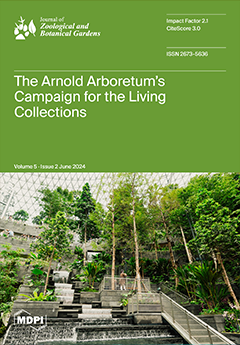
Cover Story: In 2015, the Arnold Arboretum of Harvard University began an ambitious plant acquisition program: The Campaign for the Living Collections. Prior to the initiative’s launch, the Arboretum underwent several years of strategic planning to assess the values, strengths, and gaps within its renowned living collection of temperate woody plants and then set goals that would profoundly shape the collection and its research and conservation potential for decades if not for centuries. Core genera, conservation value, phylogenetic breadth, biogeography, and climate change responses were among the priority themes used to generate a targeted list of 395 desiderata to acquire from wild populations. View this paper
  • Issues are regarded as officially published after their release is announced to the table of contents alert mailing list .
  • You may sign up for email alerts to receive table of contents of newly released issues.
  • PDF is the official format for papers published in both, html and pdf forms. To view the papers in pdf format, click on the "PDF Full-text" link, and use the free Adobe Reader to open them.

Articles (18)

  • Protocol
  • Open Access
2,883 Views
20 Pages

Captive Management and Reproduction of the Rio Pescado Stubfoot Toad (Atelopus balios)

  • Chris Buttermore,
  • Luis Daniel Navarro Gutierrez and
  • Luis Sigler

The Rio Pescado stubfoot toad (Atelopus balios) is a critically endangered member of the struggling Atelopus genus which has been ravaged by the fungal pathogen Batrachochytridium dendrobatidis. Captive management of this species is crucial to improv...

  • Commentary
  • Open Access
3 Citations
12,182 Views
20 Pages

Understanding animal behaviour can feel like deciphering a foreign language. In 1963, pioneering ethologist Nikolaas Tinbergen offered a key: four fundamental questions to dissect behaviour’s complexities and reduce interpretive bias. These &ld...

  • Article
  • Open Access
4 Citations
3,828 Views
13 Pages

The Impact of Food Enrichment on the Behavior of Cownose Ray (Rhinoptera bonasus) Kept under Human Care

  • Isabella Brosens Barros,
  • Cristiano Schetini de Azevedo,
  • Cynthia Fernandes Cipreste,
  • Laura Chrispim Reisfeld,
  • Thais Suzana,
  • Rafael Gutierrez Capriolli and
  • Cristiane Schilbach Pizzutto

The cownose ray (Rhinoptera bonasus) faces vulnerability primarily due to unregulated fishing, resource overexploitation, and habitat degradation. Consequently, individuals maintained under human care play a pivotal role in species conservation, part...

  • Protocol
  • Open Access
1,536 Views
9 Pages

New, more efficient ways to accomplish objectives are key to improving the ability of zoological and conservation organizations to protect the animals they study and care for. Here, we describe an ovocesarean procedure, a novel task to assist the hat...

  • Article
  • Open Access
2 Citations
2,801 Views
11 Pages

Cryopreservation of Potamotrygon Stingrays’ Semen: Enhancing One Conservation Effort

  • Sofia Dressel Ramos,
  • Pedro Nacib Jorge-Neto,
  • Helen Colbachini,
  • Emanuele Almeida Gricio,
  • Fábio de Moraes Francisco,
  • Fabiana Lucia André Padilha,
  • Rafael Caprioli Gutierrez,
  • Letícia Alecho Requena,
  • Laura Chrispim Reisfeld and
  • Cristiane Schilbach Pizzutto
  • + 2 authors

This pioneering study aimed to evaluate the cryopreservation of semen from P. falkneri (n = 4) and P. motoro (n = 4), maintained ex situ at the Sao Paulo Aquarium, Brazil. For this purpose, the animals were physically restrained, biometric data of th...

  • Article
  • Open Access
1 Citations
3,224 Views
11 Pages

Testing Mini-FLOTAC for the Monitorization of Gastrointestinal Parasitic Infections in Birds Kept at Four Iberian Zoological Institutions

  • João Lozano,
  • Cándido Pombo,
  • Rami Salmo,
  • Cristiana Cazapal-Monteiro,
  • María Sol Arias,
  • Daniela Carvalho,
  • Madalena Lordelo,
  • Augusto Batista,
  • Rui Bernardino and
  • Luís Madeira de Carvalho
  • + 3 authors

Birds kept in zoological institutions are highly exposed to gastrointestinal (GI) parasitism caused by coccidia and nematodes. The current research aimed to characterize the avian GI parasitic fauna in several zoological collections in Portugal and S...

  • Review
  • Open Access
1 Citations
3,621 Views
18 Pages

The conservation of endemic plant species has come into the global spotlight, not only because of their contribution to biodiversity but also their vulnerability and high extinction risk due to environmental and anthropogenic threats. Based on these...

  • Review
  • Open Access
12 Citations
10,488 Views
16 Pages

Botanic gardens are increasingly important agents of plant research and conservation. A large number of botanic gardens have been established throughout the globe since the mid-20th century to pursue new socio-environmental missions. Others, with his...

  • Review
  • Open Access
1 Citations
2,395 Views
22 Pages

Green Legacy: Plant Introduction and Dendrological Collections in Yerevan Botanical Garden: From the Past to the Future

  • Zhirayr Vardanyan,
  • Alla Aleksanyan,
  • Arsen Gasparyan,
  • Manik Grigoryan,
  • Gayane Gatrchyan and
  • Nelli Muradyan

Botanical living collections within botanical gardens are a crucial global asset for plant diversity. Special attention should be directed towards dendrological collections due to their significant contribution to biodiversity conservation, support f...

  • Article
  • Open Access
2,586 Views
12 Pages

In Absentia—Can a Lack of Behaviour Be a Useful Welfare Indicator? An Application to the Captive Management of Livingstone’s Fruit Bats, Pteropus livingstonii

  • Morgan J. Edwards,
  • Charlotte A. Hosie,
  • Laura Naidenov,
  • Eluned Price,
  • Tessa E. Smith,
  • Dominic Wormell and
  • Christina R. Stanley

Non-invasive behavioural indicators of welfare can be particularly useful for managing captive breeding populations of endangered species; these allow individual welfare to be monitored and reproductive success maximised without the need for capture...

of 2

Get Alerted

Add your email address to receive forthcoming issues of this journal.

XFacebookLinkedIn
J. Zool. Bot. Gard. - ISSN 2673-5636