1. Introduction
Anorexia nervosa (AN) is a severe eating disorder characterized by persistent restriction of energy intake, significantly low body weight, intense fear of weight gain, and disturbances in the experience of body weight or shape [
1]. Among psychiatric conditions in young people, AN imposes a particularly heavy public-health burden because it combines high disability with rising incidence in several international samples and elevated long-term mortality [
2,
3]. In children and adolescents, prompt recognition and effective treatment are especially important, given that protracted starvation and frequent psychiatric comorbidity disrupt physical maturation, cognition, schooling, and socioemotional development [
4,
5].
AN occurs predominantly in girls and women, although recognition among boys and men has grown and the proportion of male cases has increased in clinical samples, including in Brazil [
6,
7]. Contemporary estimates indicate that males account for roughly one in four cases of AN and bulimia nervosa [
2,
8,
9]. In Brazil, sociocultural pressure toward a thin body is pronounced among adolescents, and longitudinal and trend data show high and increasing body dissatisfaction, driven mainly by media and peer influences and more common among girls, a pattern linked to disordered eating [
10,
11].
Family involvement remains central to outpatient treatment planning. Pediatric and psychiatric guidelines continue to recommend family participation as a core component of care for medically stable adolescents with AN [
4,
12], and recent evidence updates and meta-analytic reviews support family-based treatment (FBT) and related eating-disorder-focused family therapies as the best-established psychosocial approaches for this population [
13,
14,
15,
16,
17]. In Brazil, preliminary observational work has likewise suggested that family-centered approaches are feasible and acceptable for adolescents with AN [
18]. Nevertheless, remission rates remain modest, and treatment response varies according to early weight gain, parental criticism, caregiver burden, psychiatric comorbidity, and parental self-efficacy, which suggests that some families benefit from individualized pacing or augmentation strategies that go beyond standard parent-led refeeding [
19,
20,
21,
22]. The reference to medically stable adolescents denotes the applicable level of care rather than a restriction on the relevance of family involvement: medically unstable adolescents are typically stabilized in inpatient or higher-intensity medical settings before or alongside family-based outpatient treatment, and family participation remains central once outpatient management is appropriate [
4,
12].
A second limitation of refeeding-focused models (that is, treatments whose initial priority is reversing starvation through parent-supported nutritional rehabilitation and weight restoration, as in the early phase of standard FBT) is that they may not directly address broader family processes that often become clinically relevant once the disorder is established. Recent qualitative and scoping reviews indicate that families value the urgency and structure of family-based interventions, but also report a need for greater attention to emotional processes, caregiver wellbeing, and explicit work on family functioning, parenting styles, and caregivers’ socioemotional skills [
23,
24,
25,
26]. Within standard FBT, an agnostic stance toward etiology is one of the core tenets [
27], which can leave family and emotional variables relatively unaddressed during the earliest treatment phases even when they are clinically relevant to maintenance and longer-term recovery.
Certain parenting styles and family relational patterns appear to constitute a context of vulnerability for restrictive eating symptoms during adolescence. Parenting styles characterized by higher control, lower responsiveness, and overprotection have been associated with greater disordered-eating symptoms and emotional difficulties in youth [
28]. More broadly, reviews of familial risk and family functioning in AN identify clinically relevant variables, including high parental demands, perfectionism, low family involvement, and overall poorer family functioning [
29,
30]. Parental eating disorders, heightened concerns about weight and shape, and nonresponsive feeding practices may also affect parent–child interactions and have been prospectively associated with eating-related symptoms in offspring [
31,
32]. These factors should not, however, be interpreted as simple or linear causes of AN, as the disorder is multifactorial and current prospective evidence remains insufficient to establish robust predictors of onset [
33].
From a behavior-analytic perspective, restrictive eating, body checking, food refusal, and excessive exercise can be conceptualized as operant classes shaped and maintained by their consequences. In the short term, these behaviors may reduce anxiety, shame, perceived fatness, or interpersonal conflict, while also producing praise for weight loss, a sense of control, or increased parental attention. Starvation further alters the reinforcing and aversive value of environmental events, often intensifying rigid rules, food-related fear, and the emotional salience of eating-related cues. This framework points to the importance of analyzing family contingencies, not to assign blame, but to identify modifiable patterns that may currently sustain anorexic behavior and that may therefore require direct therapeutic attention if gains are to be maintained over time [
34].
The intervention described in this study was developed to preserve the core components of FBT for adolescents with AN while extending its therapeutic scope. In addition to psychoeducation and parent-led behavioral strategies aimed at weight restoration, the protocol explicitly targets parents’ socioemotional and educational skills. The goal is to help parents recognize the functions of anorexic behavior, reduce inadvertent reinforcement and accommodation, modify their own food- and body-related modeling, and respond more effectively to the adolescent’s emotional and developmental needs.
This paper reports a four-case series describing the application of this intervention to families of adolescent girls with AN. The aims were to characterize feasibility and acceptability in a Brazilian outpatient setting; to document changes in anthropometric indicators, eating-disorder psychopathology, adaptive functioning, behavior problems, parenting style, and perceived family support across baseline, post-treatment, and three-month follow-up; and to examine remission status using both physiological and multidimensional definitions. Reporting follows the CARE guideline for case reports [
35].
2. Materials and Methods
2.1. Study Design and Setting
This study used a repeated-measures case-series design. The design was selected because it is well-suited to the initial development and testing of psychological treatments, particularly when the intervention is intensive, individualized, and not yet ready for large controlled trials [
36,
37]. Each family served as its own control across three time points: baseline, post-treatment, and three-month follow-up. The intervention was delivered at the Behavior Therapy Laboratory of the Institute of Psychology, University of São Paulo, Brazil. The present report includes the four families that completed the protocol with full repeated assessments.
2.2. Participants and Recruitment
Families were recruited through a public announcement in the University of São Paulo newspaper, the lead researcher’s social media channels, and referrals from clinicians working with eating disorders. Inclusion criteria for adolescents were age 12–17 years, a current DSM-5 diagnosis of AN [
1], and residence with at least one parent. Exclusion criteria for adolescents were a body mass index (BMI) below 15 kg/m
2, medical instability, suicidal ideation at initial screening, or a physical condition likely to directly affect weight or eating (for example, diabetes or pregnancy). Medical stability was assessed by a child and adolescent psychiatrist specialized in eating disorders. Consistent with established clinical guidance [
4], medical instability was operationalized through indicators such as bradycardia, hypotension or orthostatic instability, hypothermia, hydroelectrolyte disturbance, clinically significant dehydration, and severe malnutrition requiring life-preserving hospitalization; the body mass index below 15 kg/m
2 used as an exclusion threshold served as the anthropometric marker of severe malnutrition. Baseline anthropometric assessment was performed by a behavioral nutritionist also specialized in eating disorders.
Inclusion criteria for parents were age up to 59 years, availability for weekly psychotherapy sessions across approximately six months, availability to bring the adolescent when requested, residence with or frequent weekly contact with the adolescent, and agreement with all research procedures. Parents were excluded if they were already engaged in psychological treatment or if the triad could not regularly attend sessions together when needed. The upper age limit of 59 years was adopted so that parental functioning could be characterized with the Brazilian version of the Adult Self-Report (ASR; Achenbach System of Empirically Based Assessment, Burlington, VT, USA) [
38], which is standardized for adults up to 59 years of age. No lower age limit was applied; the youngest parent enrolled was 35 years of age, and younger parents would have been eligible had they presented.
2.3. Assessment Measures
Anthropometric assessment was performed by a nutritionist specialized in eating disorders. Weight was measured at baseline, post-treatment, follow-up, and weekly throughout treatment on the same digital scale (Welmy W200-A; Welmy Indústria e Comércio Ltda., Santa Bárbara d’Oeste, SP, Brazil; 100 g precision), with participants asked to remove accessories that could affect body weight. Height was measured barefoot in an upright position using the anthropometric rod attached to the scale. BMI was calculated as weight/height
2, and BMI-for-age percentile and z-scores were interpreted according to the WHO growth reference for school-aged children and adolescents and WHO AnthroPlus (World Health Organization, Geneva, Switzerland) [
39,
40]. Menstrual status was also recorded as an additional marker of physical recovery.
Eating-disorder severity was assessed with the Eating Disorder Examination Questionnaire (EDE-Q), a 28-item self-report instrument derived from the Eating Disorder Examination interview. The EDE-Q evaluates restraint, eating concern, weight concern, and shape concern over the previous four weeks on 0–6 response scales, with higher scores indicating greater symptom severity [
41,
42,
43].
Adolescent adaptive functioning and emotional/behavioral problems were assessed using the Youth Self-Report (YSR; Achenbach System of Empirically Based Assessment, Burlington, VT, USA), which yields scores for adaptive functioning and for syndrome-based internalizing, externalizing, and total-problem scales referring to the previous six months [
44,
45]. Parents completed the Adult Self-Report (ASR) to assess their own adaptive functioning, internalizing and externalizing problems, thought problems, and substance use over the same period [
38].
Parenting style was assessed from the adolescent’s perspective using the Responsiveness and Demandingness Scale (Escala de Responsividade e Exigência; ERE), a 24-item self-report measure that separately evaluates maternal and paternal demandingness and responsiveness. These scores are used to classify each parent’s style as authoritative, authoritarian, indulgent, or neglectful [
46]. Perceived family support was assessed in adolescents and parents using the Family Support Perception Inventory (Inventário de Percepção de Suporte Familiar; IPSF; Vetor Editora, São Paulo, Brazil), a 42-item instrument covering affective-consistent support, family adaptation, and family autonomy [
47,
48,
49].
Treatment acceptability was evaluated using the Intervention Satisfaction Inventory developed for the present study, comprising eight closed-ended items and two open-ended questions on parental satisfaction with the program, perceived impact on adolescent eating behavior and family functioning, and suggestions for improvement. Audio notes recorded after sessions supported case formulation and ongoing functional analysis.
Semi-structured clinical interview. Developed for the study, this instrument included 29 questions (17 closed-ended and 12 open-ended) and was conducted individually with parents in Session 6. It gathered information on family psychiatric history, parental eating- and weight-related practices, the onset and course of AN, parental explanatory hypotheses, caregiving difficulties, and developmental history relevant to case formulation. Interviews lasted approximately 50 min and contributed to the functional analyses used to individualize treatment.
2.4. Intervention
The intervention is a 20-session manualized family protocol of Brazilian behavior-analytic clinical psychotherapy. The term “behavior-analytic” here refers to the Brazilian clinical tradition of Psicoterapia Analítico-Comportamental, derived from Skinner’s Radical Behaviorism and developed within Brazilian clinical psychology to address complex psychiatric presentations through functional analysis and the contextual-behavioral manipulation of antecedent and consequent variables. This tradition is distinct from Applied Behavior Analysis (ABA) as practiced in the anglophone world and does not assume single-case experimental designs, repeated direct-observation measurement, or operationalized target-response counts as primary outcome data.
All sessions used a study-specific guidebook, “Anorexia Nervosa in Adolescence: How Can the Family Help?” (
Supplementary Materials S1). This guidebook was provided to parents at the first session, immediately after the diagnosis of anorexia nervosa, and it details the parent-directed behavioral procedures for weight recovery used throughout treatment. One session also included a structured psychoeducational discussion of dieting culture and disordered eating, supported by an additional reading provided to each parental dyad. The full session-by-session protocol is detailed in
Supplementary Materials S2. The intervention organized three overlapping treatment logics into three phases of the protocol. The protocol was delivered by the lead researcher and was monitored through weekly clinical supervision by the senior author, a doctoral-level clinical psychologist, throughout the study period; supervision supported consistent, manual-guided application of the protocol across families.
2.4.1. Phase 1—Diagnosis, Psychoeducation, and Behavioral Containment (Sessions 1–7)
The first phase combines diagnostic assessment, psychoeducation about AN, and the establishment of acute parent-led behavioral management for refeeding. Sessions 1 and 2 are devoted to confirming the DSM-5 diagnosis, completing the assessment battery, and beginning to build the therapeutic alliance. Session 3 returns assessment findings to the family and begins explicit psychoeducation about cognitive and behavioral changes characteristic of AN. Sessions 4 and 5 deepen this psychoeducation and address the multifactorial etiology of the disorder. Session 6 is reserved for the semi-structured clinical interview with parents (described below in
Section 2.5). Session 7 introduces the family’s role in treatment and operationalizes parent-led refeeding.
The behavioral management component conveys to parents that the adolescent is, temporarily, unable to choose what to eat or to evaluate quantities and timing of meals. Parents therefore assume responsibility for meal planning, portioning, supervision during and after meals, prevention of compensatory exercise, and removal of body-checking cues such as scales and full-length mirrors. Therapist guidance focuses on coaching parents not to negotiate with anorexic behaviors, on recognizing typical patterns of food refusal and barter, and on managing post-extinction bursts. When clinically indicated, parents may temporarily withdraw the adolescent from school or extracurricular activities to enable home-based intensive supervision until anthropometric stability is achieved.
2.4.2. Phase 2—Family Skills, Parenting Practices, and Autonomy (Sessions 8–17)
The second phase shifts emphasis toward family processes that may have selected and that may currently maintain restrictive eating, while continuing acute behavioral management as needed. Sessions 8 and 9 address the contrast between idealized and real family functioning, with explicit attention to perfectionism, rigidity, and intolerance of difference. Sessions 10 and 11 train communication skills, particularly the consistent expression of expectations, the use of clear and contingent feedback, and the management of conflict without escalation. Sessions 12 and 13 focus on the identification, validation, and expression of feelings, with structured exercises drawn from the supporting guidebook.
Sessions 14 and 15 address individuality and graduated autonomy. Parents are coached to progressively return age-appropriate eating- and life-related decisions to the adolescent as anthropometric stability is consolidated, and to temporarily reinstate stricter parental control if signs of relapse appear. The graduated return of autonomy follows a hierarchy of activities ordered by perceived risk, beginning with low-risk decisions (for example, choosing among predefined snacks) and advancing toward higher-risk situations (for example, eating at school, eating outside the home, choosing portion sizes). Sessions 16 and 17 address general adolescent developmental themes, including peer relationships, academic demands, and the negotiation of dependency and independence within the family system.
2.4.3. Phase 3—Disordered Eating in Context and Relapse Prevention (Sessions 18–20)
The final phase addresses disordered eating culture and consolidates gains. Session 18 reviews dieting practices, body-image distortion, and the broader cultural context of weight-related pressure on adolescent girls, with explicit attention to how such material may continue to shape family interactions after acute recovery. Session 19 is devoted to family testimonials about the treatment process and to relapse prevention, with concrete planning for the early identification of warning signs and for parental responses if symptom recurrence appears. Session 20 is devoted to the post-treatment assessment battery and a structured review of progress across measures.
Across all sessions, a sessional decision rule guided clinical pacing. When anthropometric or eating-related indicators worsened between sessions, the therapist returned the family to acute behavioral management, regardless of the planned topic for that week. When indicators were stable or improving, the therapist proceeded with the planned family-skills work. This decision rule reflects the protocol’s design as a flexible-within-structure intervention rather than a strictly time-driven manual.
2.5. Procedures
Initial contact was conducted by telephone, during which inclusion and exclusion criteria and practical predictors of adherence were reviewed. The first in-person meeting brought together parents and adolescents to present the study, explain the treatment structure, and begin establishing the therapeutic alliance.
Baseline assessment took place across two meetings. Diagnosis was established by the lead researcher, a clinical psychologist, according to DSM-5 criteria [
1] and was supported by the EDE-Q. At baseline, parents completed the ASR and IPSF, while adolescents completed the EDE-Q, YSR, ERE, and IPSF and underwent anthropometric assessment.
In Session 6 the lead researcher conducted a semi-structured clinical interview with each pair of parents. The interview consisted of 29 questions (17 closed-ended and 12 open-ended) and gathered information on family psychiatric history, parental eating- and weight-related practices, the onset and course of AN, parental explanatory hypotheses, caregiving difficulties, and developmental history relevant to case formulation. Interviews lasted approximately 50 min and contributed directly to the molecular functional analyses used to individualize subsequent intervention. The interview was a clinical formulation tool rather than a standardized baseline outcome measure.
Post-treatment assessment occurred across two meetings scheduled approximately one week after the final session. In the first, parents completed the ASR, IPSF, and the Intervention Satisfaction Inventory, while adolescents completed the EDE-Q, YSR, ERE, and IPSF and repeated anthropometric assessment. The second meeting was devoted to feedback on the main psychological and anthropometric findings.
A three-month follow-up also occurred across two meetings. In the first, parents completed the ASR and IPSF, while adolescents completed the EDE-Q, YSR, ERE, and IPSF and underwent repeat anthropometric assessment. The second meeting provided feedback to the family by integrating findings across baseline, post-treatment, and follow-up. Brief audio notes recorded after each treatment session documented relevant contingencies, barriers, and changes in target behaviors and were later used to refine the functional formulation of each case. No financial compensation was provided to research participants.
2.6. Concomitant Care
Throughout this article, the adolescents are identified by pseudonyms, and potentially identifying details were altered to protect confidentiality (
Section 2.9). All adolescents received concurrent specialist nutritional follow-up by a behavioral nutritionist specialized in eating disorders, with weekly anthropometric assessment and tailored meal planning, throughout the protocol. Three of four adolescents were also followed by a child and adolescent psychiatrist specialized in eating disorders. Pharmacological treatment differed across cases. Mayra (Case 1) received sertraline 50 mg daily for a comorbid generalized anxiety disorder. Bianca (Case 3) was prescribed venlafaxine 37.5 mg but did not adhere to treatment because of subjective side effects. Márcia (Case 2) had psychiatric follow-up without specific psychotropic medication. Maria Luiza (Case 4) was not assessed by a psychiatrist because parents declined psychiatric referral. Concomitant nutritional and psychiatric care followed standard practice and was not protocolized for this study.
2.7. Operational Definitions of Outcome
Two operational definitions of remission were applied a priori. Physiological remission required (a) BMI-for-age within the normal range according to the WHO reference (z-score ≥ −1.0) at follow-up and (b) regular menstrual cycles at follow-up. Multidimensional remission required physiological remission plus (c) EDE-Q total score within one standard deviation of the published Brazilian community norm and (d) absence of clinical-range scores on the YSR Total Problems scale at follow-up [
41,
42,
43,
50].
Reliable change on the EDE-Q was computed using the Reliable Change Index proposed by Jacobson and Truax [
51]. Using a community standard deviation of 1.30 and a test–retest reliability of 0.93 derived from the published validation studies [
41,
42], the standard error of difference was 0.487; therefore, the minimum raw-score change required for reliable change at
p < 0.05 (two-tailed) was 0.95, corresponding to an RCI threshold of |1.96|. Pre-to-follow-up raw change scores exceeding 0.95 were classified as reliable improvement.
2.8. Data Analysis
Analyses were descriptive and clinically oriented. Instrument scores were interpreted according to each measure’s standardization procedures and cutoffs. For the YSR and ASR, raw scores, T scores, percentiles, and normative classifications were considered. Repeated assessments were examined within case (baseline, post-treatment, and follow-up), with each adolescent and parent serving as his or her own control. Cross-case summary tables were prepared to facilitate the identification of convergent and divergent patterns while preserving the case-series logic of the study.
2.9. Ethical Considerations
The study was approved by the Human Research Ethics Committee of the Institute of Psychology, University of São Paulo (CAAE 67037317.3.00005561). Parents signed written informed consent forms, and adolescents signed assent forms before participation. Families were informed that participation was voluntary and that they could withdraw at any time without prejudice. To protect confidentiality, names were replaced with pseudonyms, and biographical or contextual details that could facilitate identification were modified.
3. Results
3.1. Recruitment, Retention, and Treatment Exposure
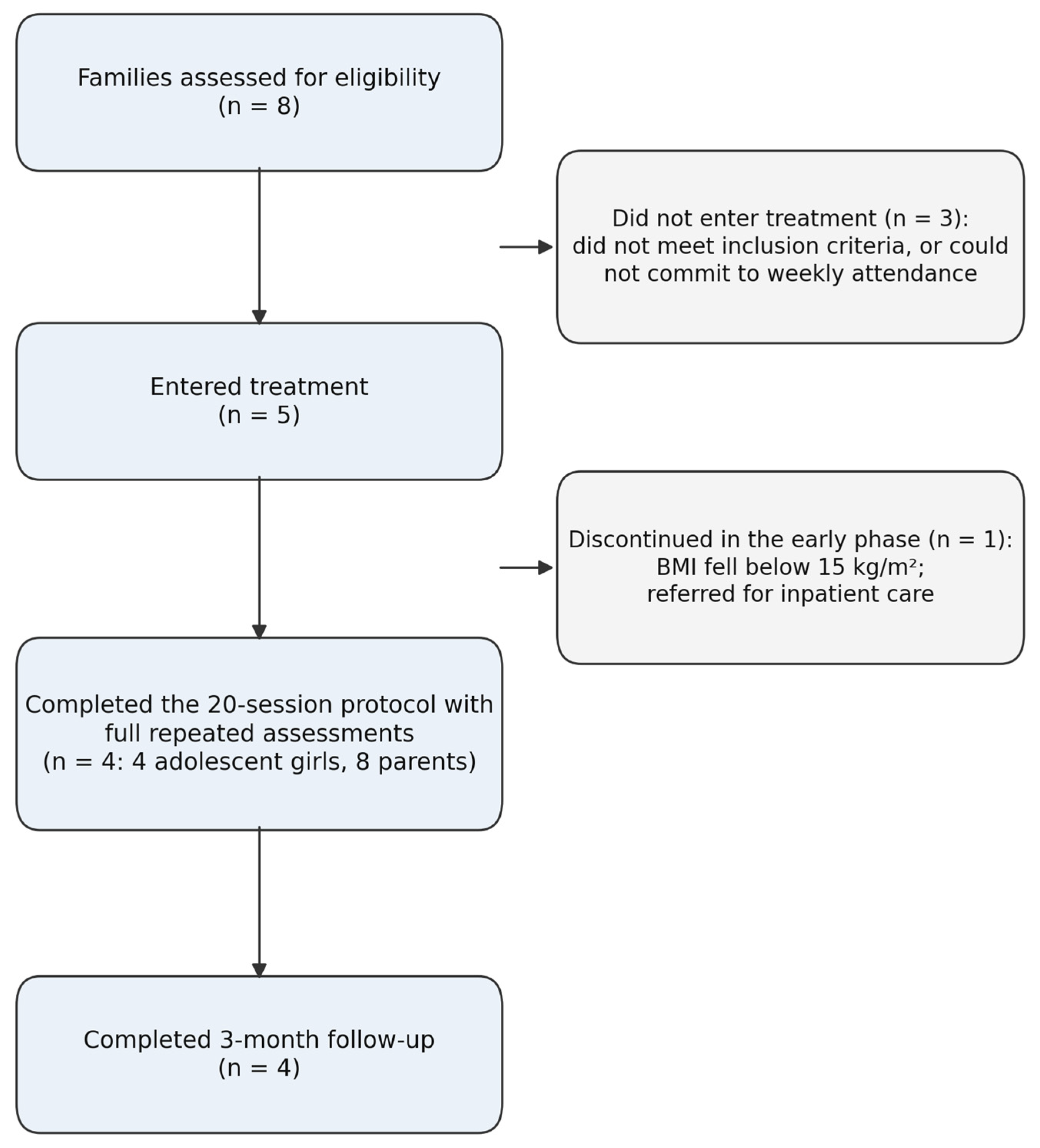
Eight families were screened, five entered treatment, and four completed the entire protocol. Three families did not enter treatment because they did not meet inclusion criteria at screening or were unable to commit to the weekly attendance schedule. Among the five families that entered treatment, one adolescent deteriorated during the early phase, with BMI dropping below 15 kg/m
2, which led to discontinuation of the outpatient protocol and referral for inpatient care. The present report therefore focuses on the four families that completed treatment, comprising four adolescent girls and eight parents. Participant flow from screening through three-month follow-up is summarized in
Figure 1.
Among completer families, session attendance was 100%, with no missed sessions or premature interruptions. This level of attendance is noteworthy given the intensity of the intervention and the substantial demands placed on caregivers during the acute refeeding phase. Engagement, however, was not uniform. Some parents participated actively in both feeding management and reflective psychotherapeutic work, whereas others complied with acute behavioral instructions but struggled with the broader self-examination expected during the family-skills phase.
3.2. Case Descriptions
3.2.1. Case 1 (Mayra)
Mayra, a 12-year-old girl with restricting-type AN, presented after rapid weight loss in the context of intensive ballet practice and frequent additional exercise. The family environment was marked by rigid dietary rules, frequent body- and weight-related discussion, and parental engagement in restrictive dieting. The functional formulation also identified maintaining variables related to the recent adoption of a sister, a perceived reduction in exclusive parental attention, parental conflict, and the father’s difficulty coping with Mayra’s progression toward adolescence.
Treatment for this family required intensive behavioral management. Mayra temporarily stopped ballet, entered a home-based refeeding arrangement with school leave, and was supervised during meals, after meals, and at night. Mirrors, scales, and measuring tapes were removed from the home. Parents were trained not to negotiate with anorexic behaviors, to stop modeling restrictive dieting, and to reinforce direct bids for attention rather than symptom expression. During the early phase, transient suicidal ideation required additional safety measures. By follow-up, Mayra had gained 8.0 kg from baseline, had resumed regular menstruation, and had reduced her EDE-Q total score from 4.22 to 0.89. Behavior problems normalized, although adaptive social functioning worsened at post-treatment before returning to the normal range at follow-up.
3.2.2. Case 2 (Márcia)
Márcia, a 13-year-old girl, lost almost one quarter of her body weight in approximately two months. The case formulation highlighted perfectionism, shame related to school comments about her body, a family culture that strongly valued thinness, exercise, and “healthy” restriction, and parental reinforcement of weight-control behavior. Márcia’s mother retrospectively recognized a personal history suggestive of eating-disorder symptoms in her own adolescence.
The acute refeeding phase was particularly difficult in this family. Márcia cried, became aggressive during meals, threw food away, and expressed suicidal thoughts. Parents initially negotiated portions, struggled to maintain agreed nutritional targets, and experienced high caregiver burden. A temporary home-based intensive care arrangement with night supervision was therefore implemented. Despite these difficulties, outcomes were among the strongest in the series. BMI rose from 17.18 to 19.46 at post-treatment and remained 19.22 at follow-up. Menstruation was normalized by follow-up, and EDE-Q total declined from 5.60 to 0.50 and then to 0.10. Adolescent adaptive functioning and total behavior problems remained in the normal range after treatment, and the father’s parenting style classification shifted from indulgent to authoritative.
3.2.3. Case 3 (Bianca)
Bianca, aged 13 years, presented with AN in the context of pediatric advice to avoid fatty or high-calorie foods, competitive appearance-related school activities, and a family environment that strongly overvalued physical attractiveness. The formulation also included exposure to relatives with disordered eating, parental praise for thinness, marked dependency and limited autonomy, and abrupt family changes involving the birth of a sibling, the departure of a long-term caregiver, and long parental work hours.
The intervention focused not only on refeeding but also on the family’s reinforcement of appearance-based self-worth. Parents were coached to stop criticizing “fattening” foods, to reduce exposure to triggering conversations about weight and body shape, to reinforce competencies unrelated to appearance, and to gradually shape age-appropriate autonomy. Bianca did not resist meals as strongly as some other adolescents in the series, but covert exercise and incomplete meal supervision interfered with early weight gain and required the team to reiterate the management plan and suspend extracurricular activities that reinforced thinness. By follow-up, Bianca maintained weight restoration and regular menstrual cycles, and her EDE-Q total score had decreased from 3.63 to 0.61. However, adaptive functioning remained clinically impaired or borderline across time, and total behavior problems returned to the clinical range by follow-up, indicating incomplete psychosocial recovery.
3.2.4. Case 4 (Maria Luiza)
Maria Luiza, a 12-year-old girl, began restrictive eating after medical advice to lose weight because of perceived overweightness. The case formulation emphasized anti-fat bias within the family, the father’s history of obesity-related bullying, the mother’s chronic struggle with dieting and body dissatisfaction, high rigidity and perfectionism, and a family pattern combining emotional distance from the father with marked maternal overprotection.
The intervention reoriented parental responses away from weight policing and toward structured refeeding, supervision, and emotional validation. Maria Luiza covertly exercised at night and disposed of food, so parents were instructed to monitor more closely, restrict activity, and remove body-checking cues. Although she did not display overt mealtime aggression, family anxiety and guilt led parents at times to overcorrect and deviate from the agreed nutritional plan. Maria Luiza gained 8.2 kg by post-treatment, entered the adequate weight range, and maintained regular menstrual cycles through follow-up. Her EDE-Q total score fell from 3.56 to 1.30 by follow-up. Nevertheless, she showed a less favorable psychosocial course than the other completers, with worsening internalizing and total behavior problems during treatment and only partial remission at follow-up.
3.3. Sociodemographic and Baseline Clinical Characteristics
The four complete cases involved girls aged 12–13 years, all living with two caregiving parents. Maternal ages ranged from 38 to 50 years, and paternal ages from 38 to 51 years. Baseline symptom duration ranged from approximately two to seven months, and baseline BMI values ranged from 15.60 to 18.12 kg/m
2. Three adolescents presented secondary amenorrhea at baseline, and one reported irregular menstrual cycles. Across cases, restrictive eating was accompanied by marked anxiety, body- or weight-related preoccupation, and contextual pressures linked to dieting, appearance, exercise, or family food rules. All four adolescents received concurrent nutritional follow-up by a behavioral nutritionist specialized in eating disorders, and three were also followed by a child and adolescent psychiatrist (see
Section 2.6).
3.4. Summary of Individual Case Results
Table 1 complements the narrative case descriptions presented above by summarizing the principal clinical formulations, individualized therapeutic maneuvers, and outcomes across the four cases. The table is intended to facilitate cross-case interpretation while preserving the idiographic logic of the study.
3.5. Combined Adolescent Outcomes
Table 2 presents the combined outcomes of the four adolescent completers across baseline, post-treatment, and follow-up. The most consistent treatment effects were observed in anthropometric recovery and eating-disorder psychopathology. Mean BMI rose from 16.72 at baseline to 18.91 at post-treatment and 19.03 at follow-up, while mean BMI-for-age z-score moved from −1.02 to −0.05 and then to +0.03. All four adolescents were within an adequate weight range by the end of treatment and maintained or slightly improved these gains at follow-up.
The same pattern appeared in menstrual recovery. At baseline, three adolescents had amenorrhea and one had irregular menstrual cycles. By post-treatment, three reported regular menstruation and one remained irregular. By follow-up, all four had regular cycles. Eating-disorder severity, as assessed by the EDE-Q total score, declined sharply in every case, with the mean decreasing from 4.25 to 1.40 at post-treatment and to 0.73 at follow-up. All four adolescents achieved reliable change on the EDE-Q from baseline to follow-up using the Reliable Change Index (
Table 2). Reliable change values ranged from 4.64 (Maria Luiza) to 11.29 (Márcia), well above the critical threshold of 1.96.
Changes in broader psychosocial indicators were less linear. Adaptive functioning scores did not improve uniformly during the acute treatment phase. Three adolescents had clinically impaired or worsened adaptive functioning at post-treatment, which reflected the temporary restriction of school attendance, exercise, and social activities required to prioritize weight restoration in the most acute presentations. By follow-up, no adolescent remained in the clinical range for overall adaptive functioning, although two were still borderline. Total behavior problems improved for all adolescents immediately after treatment, but two cases (Bianca and Maria Luiza) returned to the clinical range at follow-up, largely because of internalizing symptoms such as anxiety, depressed mood, and somatic complaints.
According to the operational definitions adopted in this study (
Section 2.7), all four adolescents met the physiological remission criteria at follow-up (BMI-for-age z-score ≥ −1.0 plus regular menstrual cycles). Three of the four (Mayra, Márcia, and Bianca) also met the multidimensional remission criteria, which additionally required EDE-Q within one standard deviation of the normative mean and absence of clinical-range YSR Total Problems. Maria Luiza met physiological but not multidimensional remission criteria because her YSR Total Problems remained in the clinical range at follow-up.
3.6. Combined Caregiver Outcomes
Caregiver outcomes are summarized in
Table 3. Across mothers, adaptive functioning and total behavior problems were mostly within the normal range at all three assessments, with only modest fluctuations. Changes in maternal perceived family support were also limited, with most mothers starting in the moderately high or high range and remaining there, although one mother’s support scores temporarily decreased after treatment.
Fathers showed greater variability and generally higher distress. At baseline, three of the four fathers had clinical total behavior-problem scores. By follow-up, only one father remained in the clinical range for total behavior problems, while the others had improved to borderline or normal levels. These trends suggest that the intervention may have reduced paternal distress in some families, but the change was slower and more heterogeneous than the change observed in adolescent anthropometric and eating-disorder indicators.
Parenting style classifications became more homogeneous over time. At baseline, seven of eight parents were classified as authoritative and one father was classified as indulgent. By post-treatment and follow-up, all parents were classified as authoritative. As discussed in
Section 4, however, these questionnaire-based classifications did not always fully align with clinical observations of family interactions, particularly in cases characterized by overprotection, overcontrol, or low emotional reciprocity.
3.7. Parent Satisfaction and Acceptability
Parent satisfaction was high across all four families. Satisfaction scores ranged from 34 to 39 on a 0–40 scale, and no parent evaluated the intervention negatively. The most valued features were the graded and comprehensible pace of the program, the combination of practical feeding guidance with broader family work, and the clear explanation that parents needed to actively take charge of refeeding.
The most common suggestion was to extend the duration of the intervention or to offer a longer maintenance phase, reflecting how demanding and anxiety-provoking the refeeding process had been. Other suggestions included providing psychoeducational materials earlier in treatment and involving extended family members, who were perceived as relevant to the adolescent’s everyday environment. Taken together, these reports support the feasibility and acceptability of the intervention and indicate where implementation could be strengthened in future versions.
4. Discussion
This case series examined a behavior-analytic family intervention developed for adolescents with AN and their parents. The most robust findings were consistent across all four completer cases: weight restoration, improvement in BMI-for-age z-scores, normalization of menstrual status, and reliable reductions in eating-disorder psychopathology. These results are broadly consistent with recent guidelines, evidence updates, and meta-analyses identifying family-based or eating-disorder-focused family therapy as the leading outpatient psychosocial approach for adolescent AN [
12,
13,
14,
15,
16,
17]. At the same time, the magnitude of improvement on the EDE-Q (mean reduction from 4.25 at baseline to 0.73 at follow-up) and the universal achievement of reliable change on this measure should be interpreted in the light of the methodological caveats discussed in
Section 4.6, particularly the absence of a comparison group and the confound between therapist and assessor.
The findings also reinforce a nuance that endpoint weight data alone tend to obscure: improvement in overt eating behavior and weight does not necessarily coincide with full psychosocial recovery. Recent reviews have argued for broader definitions of recovery that include behavioral, physical, psychological, and family-process domains rather than weight restoration alone [
23,
24,
25,
26]. In this series, adaptive functioning temporarily worsened in several adolescents during the acute phase, likely because effective refeeding required temporary restriction of school attendance, exercise, dance, or other age-typical activities. This temporal sequence suggests that treatment evaluation in AN should distinguish short-term medical priorities from later developmental reintegration.
The case comparisons were particularly informative. Mayra and Márcia showed the clearest global improvement by follow-up, despite the high intensity of the acute phase. By contrast, Bianca and Maria Luiza improved physically but had more residual psychosocial difficulties, with internalizing symptoms (anxiety, depressed mood, somatic complaints) returning to the clinical range at follow-up. This pattern resembles recent naturalistic, stepped-care, and augmentation studies showing that standard family treatment can be effective in routine practice, but that a subgroup of adolescents may require additional intensity, parental coaching, or home-based support to consolidate gains [
17,
21,
52,
53]. Notably, symptom improvement in core AN does not necessarily translate into parallel gains in emotional and behavioral functioning, and recent staging models for eating disorders emphasize that residual symptoms during apparent recovery are clinically meaningful and prognostically relevant [
54].
4.1. Cross-Case Functional Patterns and Therapeutic Targets
When the four cases were examined together, several functional regularities became visible despite notable differences in socioeconomic background and symptom history. Restrictive eating rarely emerged in a vacuum. In all cases, symptom onset or intensification occurred in social contexts that made weight loss or dietary restraint appear legitimate, desirable, or both. These contexts included school comments about body size, ballet or cheerleading performance ideals, medical advice centered on weight control, and parental or extended-family discourse that normalized dieting, food surveillance, or anti-fat bias. Such contingencies did not determine AN in a simple linear way, but they repeatedly helped establish the value of weight-loss behavior before the syndrome became clinically clear. These precipitating contexts were strongly gendered: ballet and cheerleading body ideals, peer and school comments about girls’ bodies, and family discourse equating thinness with health and self-control bore specifically on the girls in this series. This pattern is consistent with the marked female predominance of AN, even as recognition among boys continues to increase [
8,
9].
The same symptom topographies served partially different functions across families. Restriction, food refusal, and excessive movement reduced immediate anxiety in some adolescents, delayed feared pubertal development in others, and sometimes produced attention, praise, or a sense of control that competed with the aversiveness of refeeding. In some families, parental conflict, emotional distance, or abrupt reorganizations of care appeared to increase the reinforcing value of symptom-linked closeness or of highly controlled routines. A purely topographical description of AN behavior would therefore have obscured clinically important differences between cases that, in practice, required different emphases within the same manual-guided protocol. The functional analyses suggested that restrictive eating and excessive activity were maintained not only by fear of weight gain, but also by relief from shame, escape from criticism, access to attention, conformity with family rules about body and food, and protection against developmental demands such as autonomy or pubertal change. Recent qualitative and scoping reviews similarly highlight that adolescents and caregivers often experience therapeutic change not only through nutritional restoration, but also through shifts in emotional attunement, family relationships, caregiver beliefs, and the handling of perfectionism, rigidity, and interpersonal stress [
23,
24,
25,
26].
These cross-case similarities help explain why the intervention combined three levels of action: (a) acute parent-led behavioral management to interrupt starvation and compensatory patterns; (b) systematic coaching to reduce accommodation, inconsistency, and escalation during meals; and (c) broader family-focused work on communication, autonomy, perfectionism, and emotional validation. Weight restoration improved in all completers, but the pathways to those gains were not identical. In some cases, acute behavioral containment was the primary driver of change. In others, the durability of improvement seemed more dependent on whether family interaction patterns also shifted in ways that reduced the future reinforcement of restrictive behavior.
4.2. Remission Status and Residual Difficulties
A clinically important finding of this case series is that remission was not a unitary event. By the end of treatment, all four adolescents had achieved substantial weight restoration and reliable reductions in eating-disorder severity, and three had already resumed regular menstruation. These changes indicate that the acute behavioral objective of reversing starvation was achieved consistently. However, broader psychosocial indicators and residual symptom patterns varied across cases, which underscores that physiological stabilization, symptomatic reduction, and broader recovery should not be collapsed into a single endpoint.
Operationalizing this distinction matters methodologically. Recent work using DSM-5 remission criteria in inpatient and outpatient samples consistently shows that physiological recovery rates exceed multidimensional remission rates by a substantial margin, and that the choice of operational definition strongly conditions reported outcomes [
17,
55]. Comparing parent-report and self-report remission indices in adolescent FBT samples, Huryk and colleagues likewise showed that the EDE Global Score alone may miss adolescents who continue to exhibit clinically significant psychological symptoms, supporting a multidimensional approach that includes diagnostic items, behavioral indicators, and informant agreement [
56]. The two-tier remission definition used in the present study (
Section 2.7) is intended to make this distinction explicit and, in this small sample, yielded a four-of-four physiological remission rate alongside a three-of-four multidimensional remission rate at follow-up.
Mayra and Márcia showed the most globally favorable trajectories, with strong nutritional recovery, large reductions in EDE-Q scores, and low levels of behavior problems by follow-up. Bianca also showed durable anthropometric recovery and persistently low eating-disorder psychopathology, but her psychosocial profile remained more fragile, with clinically significant or borderline difficulties in adaptive functioning and behavior problems. Maria Luiza improved substantially in weight and menstrual status and maintained lower EDE-Q scores than at baseline, yet residual vulnerability remained more visible, particularly in behavior-problem indicators and in the less complete normalization of psychosocial measures. These distinctions matter clinically because they suggest different post-acute care needs, even though all four adolescents improved on the most urgent medical and eating-disorder variables.
An especially important clinical observation is that physiological remission–weight restoration and menstrual normalization–proved substantially more straightforward to achieve than cognitive and emotional remission. All four adolescents met physiological criteria by follow-up, but shifting the core cognitions that maintain eating-disorder psychopathology (such as overvaluation of shape and weight, fear of fatness, and rigid dietary rules) required more sustained therapeutic work and remained incomplete in some cases even after substantial weight gain. This asymmetry between physiological recovery and cognitive change is consistent with recent staging models and longitudinal outcome research in AN. The present findings therefore underscore the need for longer-term psychotherapeutic follow-up even after acute medical stabilization, particularly to address the cognitive and emotional processes that are more resistant to change than anthropometric indicators.
The follow-up data therefore support a layered interpretation of outcome. Short-term recovery seemed to depend primarily on decisive parent-led interruption of starvation and compensatory routines, whereas the consolidation of broader remission appeared more sensitive to family interaction patterns, emotional communication, developmental autonomy issues, and possibly the burden created by concurrent school withdrawal or home-based care.
4.3. Implementation-Relevant Process Findings
Beyond outcome indicators, the treatment process yielded several implementation-relevant observations. Attendance among completer families was perfect, but engagement was not uniform within or between families. In all cases, adolescents and parents attended the scheduled meetings; however, the degree to which parents implemented meal supervision, behavior blocking, and between-session homework varied substantially over time. These observations suggest that simple attendance is an insufficient index of treatment dose in family-based AN care. A family may be fully procedural in adhering, while still requiring considerable therapist effort to achieve consistent home implementation. Between-session implementation was monitored clinically during supervision rather than with a structured instrument, and no quantitative index of homework completion or parent adherence was recorded. Future studies should incorporate session-by-session adherence checklists and independent ratings of between-session implementation so that treatment dose can be quantified rather than inferred from attendance.
Acute feeding work was often distributed asymmetrically between caregivers. Mothers tended to assume more of the day-to-day burden of preparing meals, supervising intake, and managing emotional crises, whereas fathers were sometimes initially peripheral, work-absent, or unsure how firm they should be. Cases with more active paternal involvement appeared to achieve greater continuity in home implementation and less caregiver overload. This pattern converges with the parent-satisfaction responses, which repeatedly highlighted the value of practical guidance that could be shared across caregivers rather than carried by one parent alone.
Some of the most effective behavioral maneuvers were also the most demanding for families. Temporary interruption of sport or dance activities, close monitoring after meals, removal of body-checking cues, and short periods of home-based intensive supervision were clinically useful in selected cases, but they also increased the logistical and emotional costs of treatment. These findings imply that dissemination of the protocol would benefit from explicit planning for intensity adjustments, crisis management, and step-down phases. In practice, the intervention seemed most feasible when acute intensification could be justified clearly to families and framed as time-limited, goal-directed, and embedded within a broader therapeutic plan.
4.4. Caregiver Findings and Family Process
The caregiver findings are clinically important in their own right. Parents, particularly fathers, often entered treatment distressed, guilty, and ambivalent about the demands of refeeding. Recent studies have shown that caregiver burden, anxiety, and parental self-efficacy are clinically relevant variables in family-based care, even when they do not map neatly onto short-term weight outcomes [
20,
21]. In this sample, caregiver outcomes were much more heterogeneous than adolescent anthropometric and EDE-Q results, which may reflect the intense burden of the acute treatment phase, slower change in parent functioning, or the limitations of self-report measures in rigid or highly defensive family systems.
One of the most revealing observations was the discrepancy between questionnaire scores and clinical observation. Several parents were classified as authoritative by the ERE even when sessions suggested marked overcontrol, overprotection, emotional invalidation, or low reciprocity. This discrepancy does not invalidate self-report measures, but it does support the recommendation that family-process indicators be interpreted alongside direct clinical observation and qualitative information, especially in interventions that temporarily increase parental control as part of acute risk management [
23,
24].
A particularly important interpretive issue is the nonlinear course of psychosocial change. In this sample, some adaptive-functioning or behavior-problem indicators worsened temporarily even as eating-disorder severity declined. Recent reviews of psychotherapy outcomes and treatment processes argue that recovery in eating disorders should be conceptualized across multiple asynchronous domains, including weight, symptoms, functioning, family relationships, and subjective well-being [
23,
26]. Within that framework, short-term deterioration in some psychosocial indicators may sometimes reflect the cost of intensive acute care rather than simple treatment failure. This interpretation also helps explain the discrepancy between marked nutritional gains and the slower or mixed movement observed in perceived family support. During acute refeeding, families often had to become more directive, vigilant, and less negotiable. Such reorganization may be life-preserving, but it is not necessarily experienced by adolescents (or even by caregivers themselves) as immediately more supportive or harmonious.
4.5. Implications for Treatment Development and Future Research
From a treatment-development perspective, the present protocol is best conceptualized as a family-centered intervention with explicit behavioral and contextual augmentation. It preserved the urgency of nutritional rehabilitation and strong parental responsibility that characterize family-based approaches, while adding functional analysis and structured work on communication, affect regulation, autonomy negotiation, and family rules about food and body shape. Recent evidence suggests that such augmentation is plausible within the current family-treatment literature, particularly when standard care is adapted through stepped intensity, parent-focused support, or adjunctive family formats [
15,
17,
21,
25,
53,
57,
58].
The acceptability data add a practical dimension to the outcome findings. Parents consistently valued the graded psychoeducation and the concrete guidance about how to feed their child. Their requests for longer treatment or stronger maintenance support are understandable and resonate with recent literature emphasizing the need for flexible treatment duration, consolidation phases, and broader support for families as they move from acute containment to recovery maintenance [
23,
24,
25,
57]. This broader formulation may be particularly relevant for families in which symptom maintenance is intertwined with dieting culture, emotional avoidance, perfectionism, or developmental impasses around separation and autonomy.
Future research should evaluate the protocol in larger samples with independent assessment of outcomes, comparison to standard FBT, longer follow-up, and inclusion of male adolescents, who were not represented in this series and who present with eating disorders at increasing rates [
6,
7,
9]. The functional-analytic framework also supports the development of process measures (for example, structured ratings of accommodation, mealtime contingencies, and parental modeling of food and body talk) that may be more sensitive to mechanism-of-change questions than current symptom inventories alone.
4.6. Limitations
Several limitations merit explicit consideration. The most consequential is that the lead researcher served simultaneously as protocol developer, sole therapist, diagnostician, and primary outcome assessor. This concentration of roles introduces a substantial risk of researcher allegiance bias, which has been shown to inflate effect estimates in psychotherapy studies even when treatment fidelity is preserved [
59,
60]. In meta-analyses of psychotherapy trials in cognate fields (for example, exposure and response prevention for OCD, mindfulness-based interventions, and humanistic psychotherapies), allegiance has been a significant moderator of effect size, with effects sometimes reduced to non-significance once researcher allegiance is statistically controlled [
61,
62]. Findings from the present case series should therefore be read as a feasibility and treatment-development signal rather than as evidence of comparative efficacy.
Second, the sample is small and demographically homogeneous (four 12–13-year-old girls from middle- and upper-middle-class families recruited through a single university-affiliated outpatient service in Brazil). Generalization beyond this profile is not warranted. Third, all four adolescents received concurrent nutritional follow-up, three received psychiatric follow-up, and one received an SSRI throughout the protocol; the contribution of these concomitant treatments to observed gains cannot be disentangled from the contribution of the family protocol itself. The outcomes reported here therefore reflect a combined, multidisciplinary package of family intervention plus concurrent nutritional and, in most cases, psychiatric care; the specific contribution of the behavior-analytic family protocol cannot be isolated in this design, and any causal attribution to the family component alone would be unwarranted.
Fourth, the EDE-Q is a self-report instrument, and minimization of symptoms is well-documented in adolescent AN. Although reliable change was observed in all four cases, parent-report and clinician-rated indicators of eating-disorder psychopathology were not collected and would have provided important convergent information [
56]. Fifth, the three-month follow-up window is relatively short for AN, where relapse risk extends well beyond the first year of recovery [
3,
17]. No longer-term follow-up was conducted, so the durability of the observed gains and the risk of relapse over the first post-treatment year and beyond could not be evaluated; given that relapse in AN frequently occurs after this interval, this constraint should weigh heavily in interpreting the results. Sixth, no comparison group was included, and the case-series design cannot rule out spontaneous improvement, regression to the mean, or the effects of concomitant care.
Seventh, the study was not prospectively registered. The original investigation was conducted as a doctoral case-series project beginning in 2017, before prospective registration of single-arm psychotherapy studies became standard practice in this field. The reporting of the present manuscript follows the CARE guideline for case reports [
35]. Eighth, the questionnaire-based assessment of parenting style classified all parents as authoritative at follow-up, which contrasted with clinical observation and may reflect either the limited sensitivity of the ERE to subtle features of overcontrol and overprotection or social-desirability effects in self-report at follow-up. Brief self-report parenting measures may be insufficiently sensitive to the overcontrol and overprotection that are clinically salient in AN; future studies would benefit from multi-method assessment of parenting that combines self-report with observational and clinician-rated indices. Ninth, although the protocol was manualized and delivered under weekly clinical supervision, treatment fidelity was not formally assessed: there was no independent coding of session recordings, no structured adherence checklist, and no quantitative index of between-session implementation, so the degree of protocol fidelity cannot be established empirically.
5. Conclusions
This four-case series describes the development and preliminary application of a behavior-analytic family intervention for adolescents with AN that combines parent-led refeeding with structured work on parental socioemotional and educational skills. Among the four families that completed the 20-session protocol, all four achieved physiological remission criteria at three-month follow-up, three of four met multidimensional remission criteria, and all four showed reliable change on the EDE-Q. Caregiver outcomes and broader psychosocial indicators were more heterogeneous and changed more slowly than anthropometric and core eating-disorder variables, which is consistent with recent literature emphasizing the asynchronous nature of recovery in adolescent AN.
The intervention appears feasible and acceptable in this small Brazilian outpatient sample, and parent satisfaction was uniformly high. The findings should be interpreted as a treatment-development signal rather than as evidence of comparative efficacy, given the small sample, the absence of a comparison group, the concurrent nutritional and psychiatric care, and the substantial risk of researcher allegiance associated with the concentration of roles in the lead investigator. Larger studies with independent outcome assessment, comparison to standard family-based treatment, longer follow-up, and inclusion of male adolescents are needed to establish whether the protocol adds clinically meaningful value beyond established family-based approaches for adolescent AN.
A critical finding is that physiological recovery (weight and menstruation) was achieved more readily than full cognitive remission. Altering the core cognitions that sustain eating-disorder psychopathology–overvaluation of body shape and weight, fear of fatness, and rigid dietary control–proved more challenging and time-consuming than restoring anthropometric indicators. This pattern indicates that adolescents who achieve weight restoration may still require extended psychotherapeutic support to address residual cognitive symptoms and to prevent relapse.



 ,
,