
Article

Temporal Fluctuations of Suicide Mortality and Their Attributed Motives in Governmental Databases of Student Suicides in Japan from 2009 to 2025

Department of Neuropsychiatry, Division of Neuroscience, Graduate School of Medicine, Mie University, Tsu 514-8507, Japan
*
Author to whom correspondence should be addressed.
Psychiatry Int. 2026, 7(4), 143; https://doi.org/10.3390/psychiatryint7040143

Submission received: 27 April 2026 / Revised: 31 May 2026 / Accepted: 18 June 2026 / Published: 1 July 2026
(This article belongs to the Special Issue Advances and Innovations in Child and Adolescent Mental Health)

Abstract

National crude suicide mortality rates (CMRs) in Japan trended downward throughout the 2010s, yet the CMR for the youth population moved in the opposite direction, rising from the mid-2010s onwards. To clarify the risk groups and underlying mechanisms of increasing student suicides, the temporal fluctuations of CMRs of students in middle school, high school, special vocational school, and university were analyzed by joinpoint regression analysis, and identification of high CMR groups were detected by a linear mixed-effect model using government suicide databases. CMRs of female students in all school categories increased from the mid-2010s. CMRs of male students in middle and high schools increased, whereas those in university and special vocational school moved from a decreasing to a stable level. Among the average of CMRs from 2022 to 2025, the highest CMR was observed in part-time high school students, which was approximately fivefold higher than the average of all students overall. The major leading suicide motives for all student subgroups were concerned with underachievement and career-path-associated problems within school-related problems. Family-related problems, such as conflict with parents and parental reprimands, were leading suicide motives for middle school students, but these impacts attenuated with age. Instead, the impacts of psychiatric disorders, including depression and other psychiatric disorders, enhanced with age. Student suicides attributed in the government suicide database to these leading suicide motives showed an upward inflexion, moving from a decreasing or stable pattern to a rising one, beginning in the mid-2010s. Taken together, these patterns indicate that mental health concerns among students have re-emerged as a substantial motive behind student suicide from the mid-2010s.

1. Introduction

Suicide is preventable death that imposes substantial social and public health burdens [1,2,3,4]. In light of the fact that suicide is preventable and exerts considerable societal costs, the World Health Organization (WHO), under its Comprehensive Mental Health Action Plan 2013–2030, set a global objective of reducing suicide mortality by one-third by 2030. Although suicide prevention efforts in many high-income nations have focused predominantly on the working-age and older adult populations [5,6,7,8,9,10,11,12], Japan has taken a distinctive approach since 2007, where the General Principles of Suicide Prevention Policy (GPSPP) has advanced a comprehensive, all-age approach to suicide prevention, a stance that distinguishes Japan from many other countries [13,14].
Although Japan had achieved a reduction in suicide mortality exceeding 30% over the course of the 2010s, the country experienced an atypical upturn in 2020 amid the COVID-19 pandemic, an increase that was internationally unusual. A clear return to the prior downward trajectory was not evident until 2024; in 2025, however, the annual count of suicides dropped sharply from the preceding year and fell below 20,000 for the first time since the inception of national suicide statistics [15]. Although the government and majority of academics have largely attributed the stagnation in suicide reduction during the early 2020s to pandemic-related psychosocial and/or socioeconomic disruptions, several studies have reported the possibility that the deceleration in the downward trend had already begun in the late 2010s [13,16,17,18]. Furthermore, the demographic composition of high-risk groups for suicide has also been reported to have shifted markedly in the 2020s compared with the early 2010s [13,16,17,19,20].
Worldwide, suicide in young populations has become a pressing contemporary public health priority [1,2,21,22,23,24]. Trends in Japan align with this international pattern: suicide mortality in those younger than 30 has been rising in recent years [13,16,17,19,25,26,27,28,29]. However, the increase in youth suicides (<30 years old) in Japan is particularly alarming, because reported statistical results have contradicted two established epidemiological consensuses in suicide statistics [30,31]: age-dependence (suicides increase after adolescence) and sex-dependence (male suicides are more frequent than female suicides) [19,20,28,32].
Among adolescents in Japan, crude annual suicide mortality per 100,000 population (CMR) is now higher in females (8.0) than in males (6.6) [20], deviating from the typical sex-dependent pattern of suicides [21,22,23,33,34,35]. Moreover, among females, the highest CMR is observed in those aged 20–29 years (14.7) [17,19,27,36], contradicting the usual age-dependent pattern in which suicide risk increases with age [21,22,23,33,34,35]. Internationally, countries where young women exhibit the highest CMR among females are exceedingly rare [28,29]. Additionally, suicide is not only the leading cause of death among individuals under 30 in Japan, but also accounts for more than 50% of all deaths in this age group, a proportion which far exceeds that of other OECD countries (20–30%) [28,29]. However, the high-risk suicide groups among young people and their motives in Japan remains to be clarified. Therefore, identifying suicide risk groups and their underlying factors among youth in Japan can provide essential findings for improving suicide prevention programmes.
Conducting comprehensive investigations into the suicide risk among young people is exceedingly hard, and obtaining actual valid or representative findings is arguably impossible, since adolescence constitutes a heterogeneous population composed of diverse psychosocial and socioeconomic backgrounds [9,27,28,29,37]. Adolescence, as a developmental stage, is characterized by unique psychological structures and drastically transforming social contexts: adolescents face various specific problems, such as demands for independence, educational transitions, and early career decision-making, that collectively shape adolescent-specific vulnerability to psychiatric disorders [38,39]. In other words, adolescents exhibit a unique profile of vulnerability to psychiatric disorders, one that is obviously differentiated from the risks seen in people of working age [13,25,27,28,29]. Based on these backgrounds, this study determined the suicide mortality and the impacts of their motives among students in middle, high, and special vocational schools and university, where social standing is clearly defined. The findings from this study have the potential to generate evidence aligned with the principles of evidence-based policy making (EBPM), which may be particularly valuable for predicting the effectiveness of, and informing future revisions to, school-based suicide prevention programmes currently promoted by the Ministry of Education, Culture, Sports, Science, and Technology (MEXT), and the Children and Families Agency (CFA) [40,41,42,43,44].

2. Materials and Methods

2.1. Ethics

Because the present analysis relied exclusively on de-identified, openly accessible governmental records, namely the Suicide Statistics released by the National Police Agency (SSNPA) and the Basic Data on Suicide in the Region (BDSR) by the Ministry of Health, Labour, and Welfare (MHLW), the requirement for a formal ethical review was waived by the Medical Ethics Review Committee of Mie University. Reporting of this observational study followed the Strengthening Reporting of Observational Studies in Epidemiology (STROBE) guidelines.

2.2. Databases

For the period from 2009 to 2025, monthly and annual counts of student suicides in middle school, high school, special vocational school, and university were retrieved from the SSNPA and BDSR [15,45]. Corresponding student enrollment counts for middle school, regular-time high school, part-time high school, special support high school, special vocational school, and university (the latter further stratified by under and over 20 years of age), each disaggregated by sex, were drawn from the School Basic Survey conducted by MEXT [46].
The statutory framework underpinning these statistics operates as follows. The Medical Practitioners Act in Japan requires physicians to notify the National Police Agency (NPA) of any abnormal death within 24 h from discovery. Upon receiving such reports, the NPA is required to conduct a physiological examination to determine the cause of death. Subsequently, police investigators document the personal characteristics of the decedent, including age, sex, and social status, as well as background factors comprising suicide motives, location, time, and residential address. The SSNPA aggregates individual case records collected by local police stations within their respective jurisdictions. Accordingly, the SSNPA and BDSR compile judicial statistics from jurisdiction-level survey data, but not administrative statistics.
Within the SSNPA/BDSR, suicide motives are organized into seven principal domains: health-related, family-related, economic-related, romance-related, employment-related, school-related, and other, each with their own subcategories. Since motives cannot be elicited from the decedent themselves, local police rely on objective sources of evidence, including suicide notes and official documentation such as medical certificates and clinical records, in order to minimize subjective bias as far as possible. Where the decedent had a documented history of treatment for any psychiatric disorder, the attending physician is formally consulted, and the impacts of the psychiatric disorder and/or mental health issue on the suicide is assessed as a background factor.

2.3. Statistical Analyses

Annual and monthly crude suicide mortality rates per 100,000 population (CMR) of students were calculated by dividing the annual/monthly suicide numbers by the population of corresponding groups (student population in each student group) in the same period. Especially, because the CMR for each month reflects the number of days within that month, ranging from 28 to 31 days, a discrepancy of up to 10% exists between months. As this difference is non-negligible in the context of JPRA, all monthly CMR values were standardized to an annual 365-day CMR before conducting the analyses.
Joinpoint regression analysis (JPRA) has been evaluated to be an appropriate statistical method which can detect unknown joinpoints where trends change via fitting the simplest joinpoint model that the trend data allows [25,27,47,48,49]. Based on these statistical backgrounds, to analyze the temporal fluctuations in the CMRs of students in Japan from January 2009 to December 2025, this study adopted the Joinpoint Regression Program ver. 6.0.1. (The National Cancer Institute, Bethesda, MD, USA). A detailed description of “the Methods Used in the Joinpoint Regression Software” is provided in the user manual published by the National Cancer Institute (NCI). The CMRs were derived from the national suicide number of each student group; where standard errors were unavailable, the Constant Variance (homoscedasticity) option was applied. When the Durbin–Watson statistic indicated no significant first-order autocorrelation (DW > 1.5), the uncorrelated error structure was retained as the default setting, whereas when DW < 1.5, the ‘First Order Autocorrelated Errors Estimated from the Data’ option was specified to fit an AR(1) error structure, which accounts for residual serial dependence, including autocorrelation arising from seasonal fluctuation patterns (thereby reducing the risk of spurious joinpoint detection attributable to periodic oscillations in the CMR series). Sensitivity analyses were conducted under both the AR(1) and the uncorrelated-error specifications; results were consistent across both [47,48,49].
Survey methods regarding suicidal motives in SSNPA/BDSR were revised from January 2022 [50,51]. In 2022, the number of subcategories of suicide motives in the revised SSNPA/BDSR increased from 52 to 75, and the maximum number of permitted suicide motives in each case also increased from 3 to 4. Accordingly, fluctuations in CMRs disaggregated by suicide motive were analyzed using jump-model JPRA, which can detect fluctuations when coding changes cause discontinuities (jump effects), since the SSNPA/BDSR did not provide the formal bridged data with dual coding (between before and after survey methods) [47,52]. In jump-model JPRA, which implements comparability ratio (CR) estimation to quantify the magnitude of the impact of coding revisions, the jump parameter and trend slopes are estimated simultaneously, allowing detection of genuine inflexion points (joinpoints) independently of the coding-induced discontinuity [47,52]. When the joinpoint does not coincide with 2022, the detected joinpoint period can be evaluated to be unaffected by artefacts from revision of the survey method. Sensitivity analyses were conducted as follows. For each suicide motive series, this study determined whether detected joinpoints coincided with 2022. Joinpoints at 2022 would suggest the detected trend change is attributable to the coding revision artefact, whereas joinpoints detected at years other than 2022 indicate genuine epidemiological trend changes unconfounded by the revision. Analyses were repeated, restricting the observation period to 2009–2021 (pre-revision only) to confirm that the direction and approximate timing of trend changes detected in the full-period analyses were consistent with those observed in the pre-revision period alone.
Additionally, following the revision of the survey method of the SSNPA/BDSR in 2022, previous overall suicide data of high school students were disaggregated into regular-time, part-time, and special support high schools (Supplementary Table S1). Therefore, although the observation period was short, differences in the average CMRs among these high school student subgroups between 2022 and 2025 were analyzed by t-test or linear mixed-effect model for repeated measures (LMM) alongside Scheffe’s post hoc test using IBM SPSS Statistics 30.0 for Windows (IBM, Armonk, NY, USA) [16].

3. Results

3.1. Temporal Fluctuation in CMRs of Total Students from 2009 to 2025 and Average CMRs of Students from 2022 to 2025

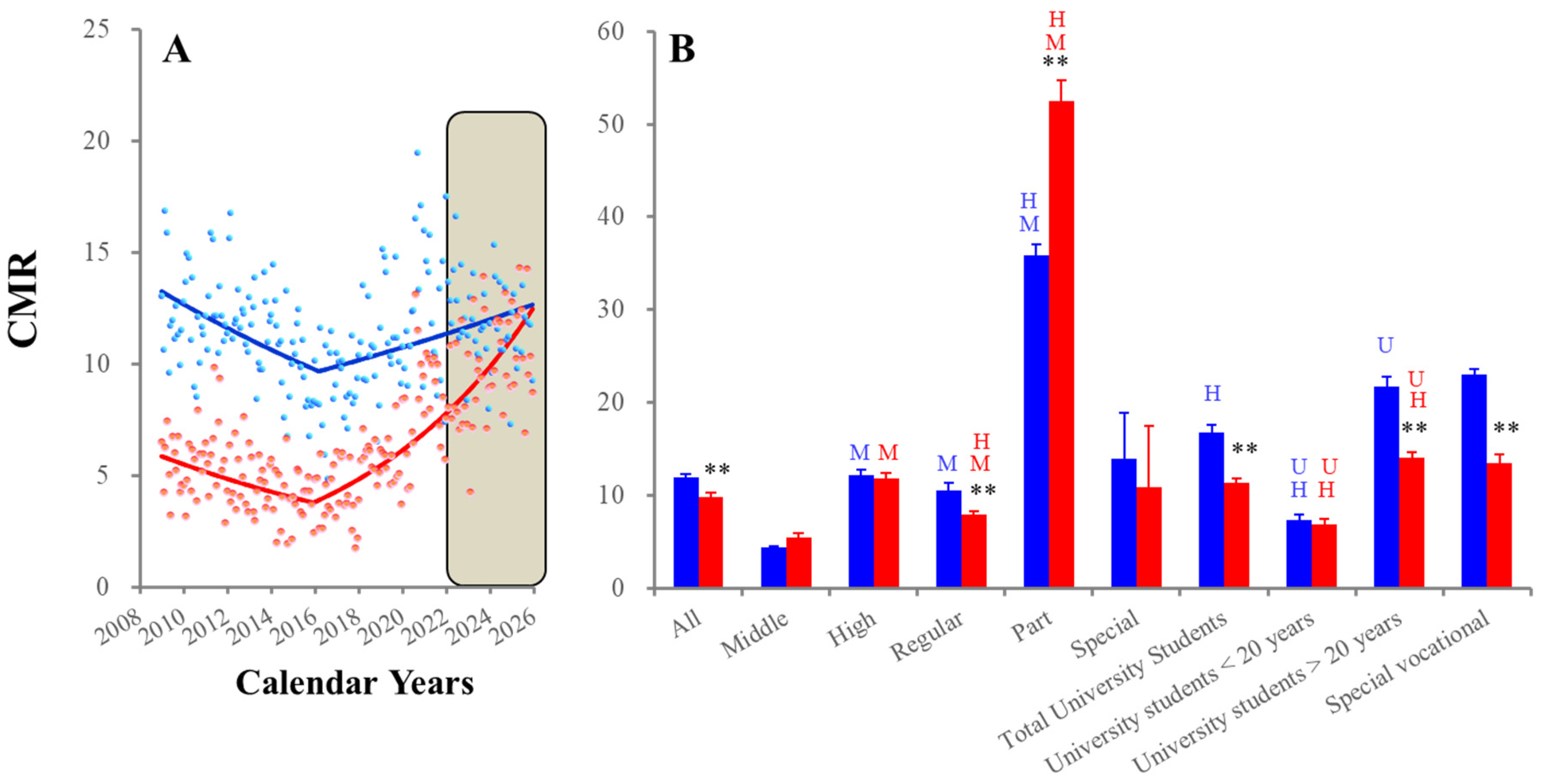
The SSNPA/BDSR have provided annual and monthly suicide numbers of middle school, high school, university, and special vocational school students since 2009. Therefore, trends for both male and female monthly CMRs of total students in middle school, high school, university, and special vocational school from 2009 to 2025 were determined using JPAR. Trends of CMRs of both male and female students moved from a decreasing to an increasing trend from 2016 (Figure 1 and Supplementary Table S2). Importantly, increasing trends of female CMRs exceeded that of males, showing that the CMR of females became almost equivalent to males in 2025 (Figure 1 and Supplementary Table S1).
The SSNPA/BDSR have published the annual suicide numbers among middle school, high school, special vocational school, and university students from 2009 to 2025. Further, the SSNPA/BDSR have provided annual suicide numbers for high school students, disaggregated by school type (regular-time, part-time, and special support high schools), since 2022. Therefore, in this study, average CMRs among middle school, special vocational school, university, and high school students, including regular-time, part-time, and special support high school students, were analyzed. Both the CMRs of male and female students among middle school, high school, and university increased age-dependently. The CMRs of part-time high school (males < females) students were the highest among the overall student population. The CMRs of male and female part-time high school students were 3.38- (95% CI: 2.98–3.86) and 6.6-fold (95% CI: 5.88–7.40) higher compared to those of regular-time high school students, respectively (Figure 1). CMRs of university male and female students under 20 years of age were smaller than those of high school students (Figure 1).

3.2. Temporal Fluctuation of CMRs of Students

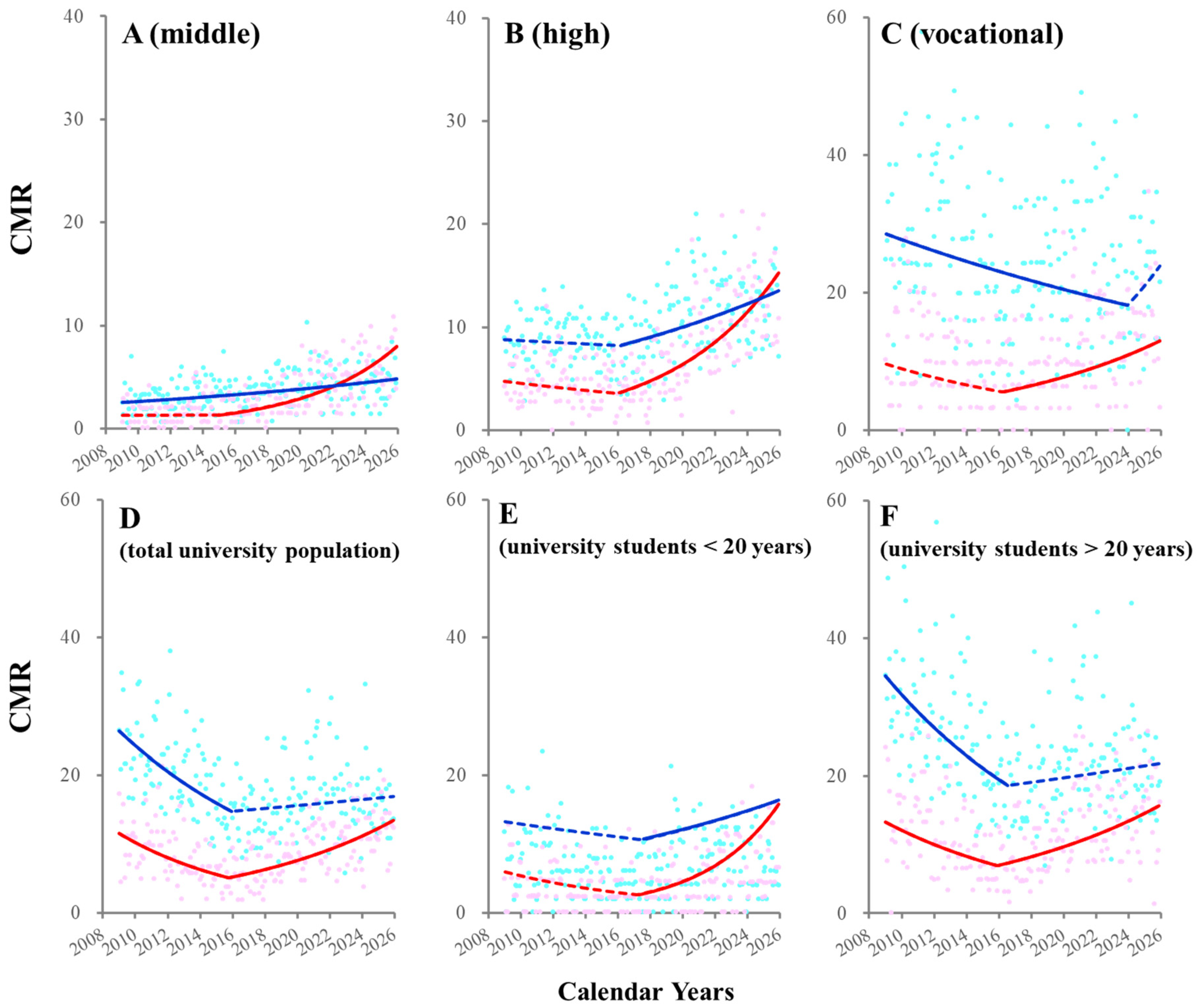
Monthly CMRs of male students in middle school consistently increased from 2009 to 2025, whereas that of females changed from a stable to an increasing trend in 2016. The CMRs of both male and female students in high school moved from stable to increasing trends in 2016 (Figure 2 and Supplementary Table S2). The CMR of female students in special vocational school also moved from a stable to an increasing pattern in 2016, whereas that of males decreased from 2009 to 2024, possibly moving to a non-significant increase after 2024 (Figure 2 and Supplementary Table S2).
The CMR of total male university students (younger plus older than 20 years) moved from a decreasing to an unchanging trend in 2016, whereas that of females changed from a decreasing to an increasing trend (Figure 2 and Supplementary Table S2). Fluctuation patterns in the CMRs of both male and female university students over 20 years old showed the same pattern as total university students; however, the CMRs of university students for both males and females under 20 years old moved from a stable to an increasing trend in 2016 (Figure 2 and Supplementary Table S2).

3.3. Fluctuations in Student Suicides Disaggregated by Suicide Motives

The SSNPA provids annual suicide numbers disaggregated by suicidal motives. However, the SSNPA revised the methods for the survey of suicidal motives in January 2022 [50,51]. Details in the revised SSNPA include the number of subcategories for suicide motives in the survey master sheet, which increased from 52 to 75, and the number of listable suicide motives per case, which increased from 3 to 4. Due to this revision, direct comparison of the impacts of suicide motives across before and after revision periods is no longer feasible [50,51].
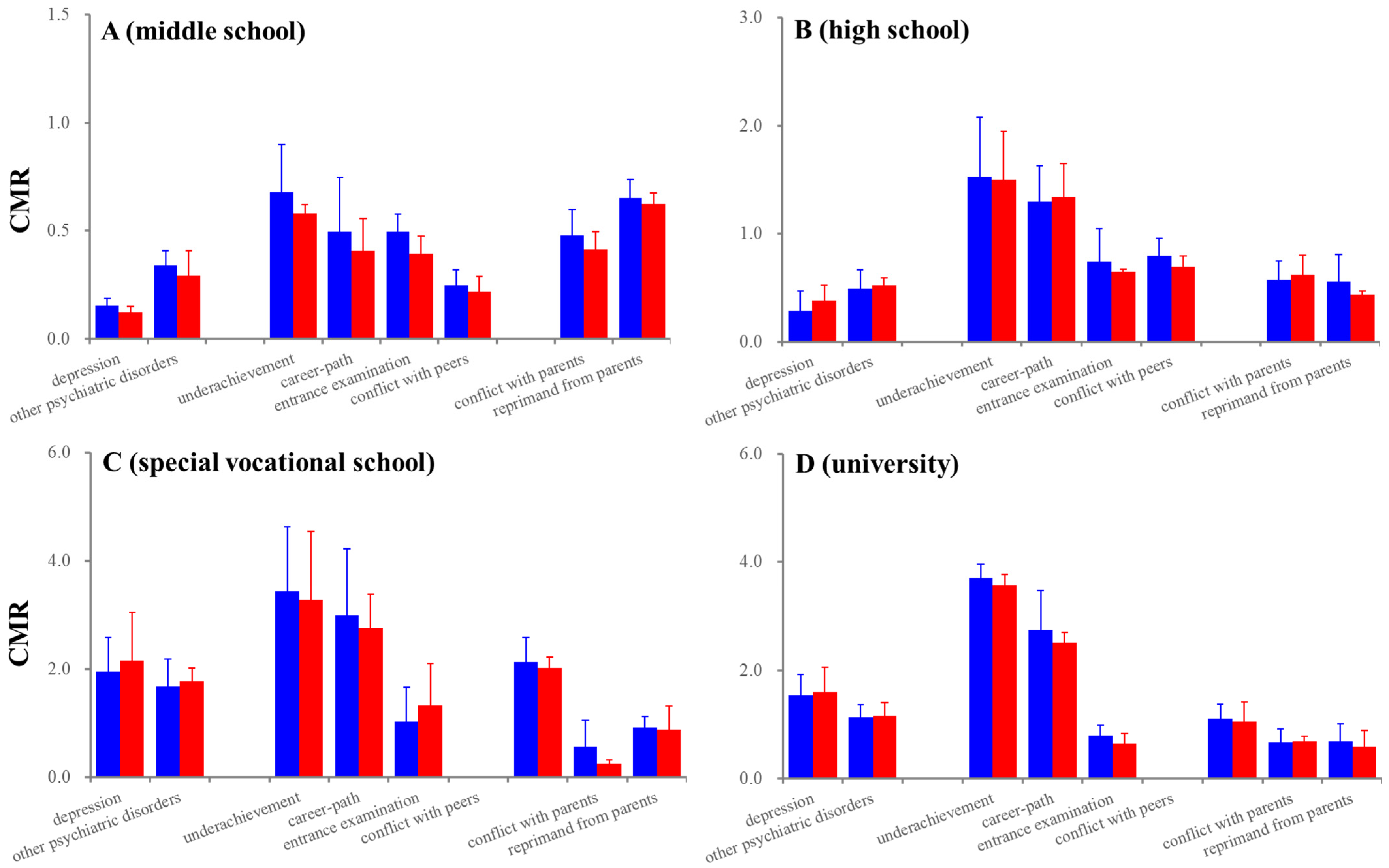
Major leading suicide motives among junior high school, high school, university, and special vocational school students from 2022 to 2025 are represented in Figure 3. Temporal fluctuations in CMRs disaggregated by suicide motives were determined using jump-model JPRA, which can detect fluctuations induced by coding changes caused by discontinuities (jump effects) [47,52].

3.3.1. Fluctuation in the CMRs of Middle School Students Disaggregated by Major Leading Suicide Motives

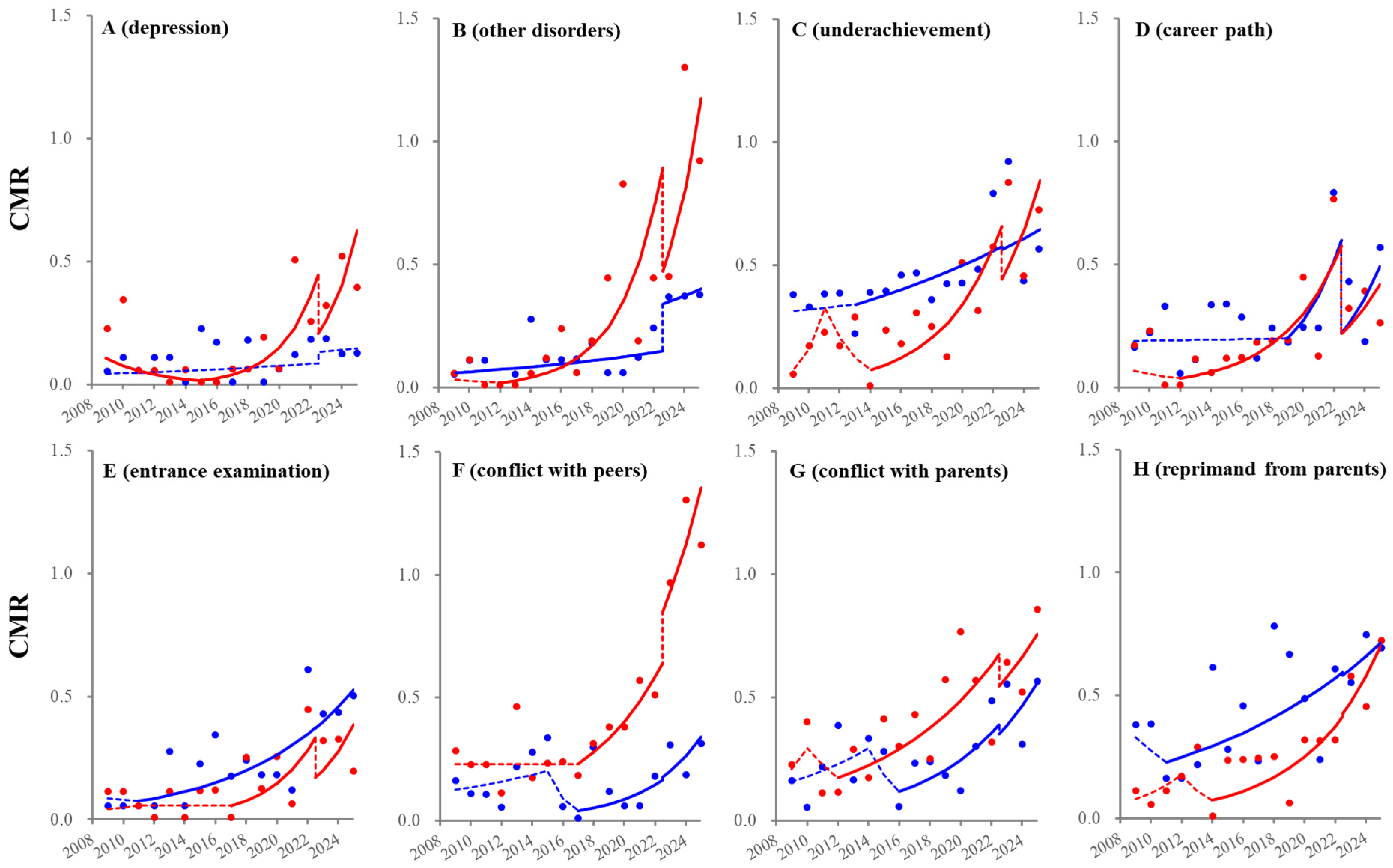
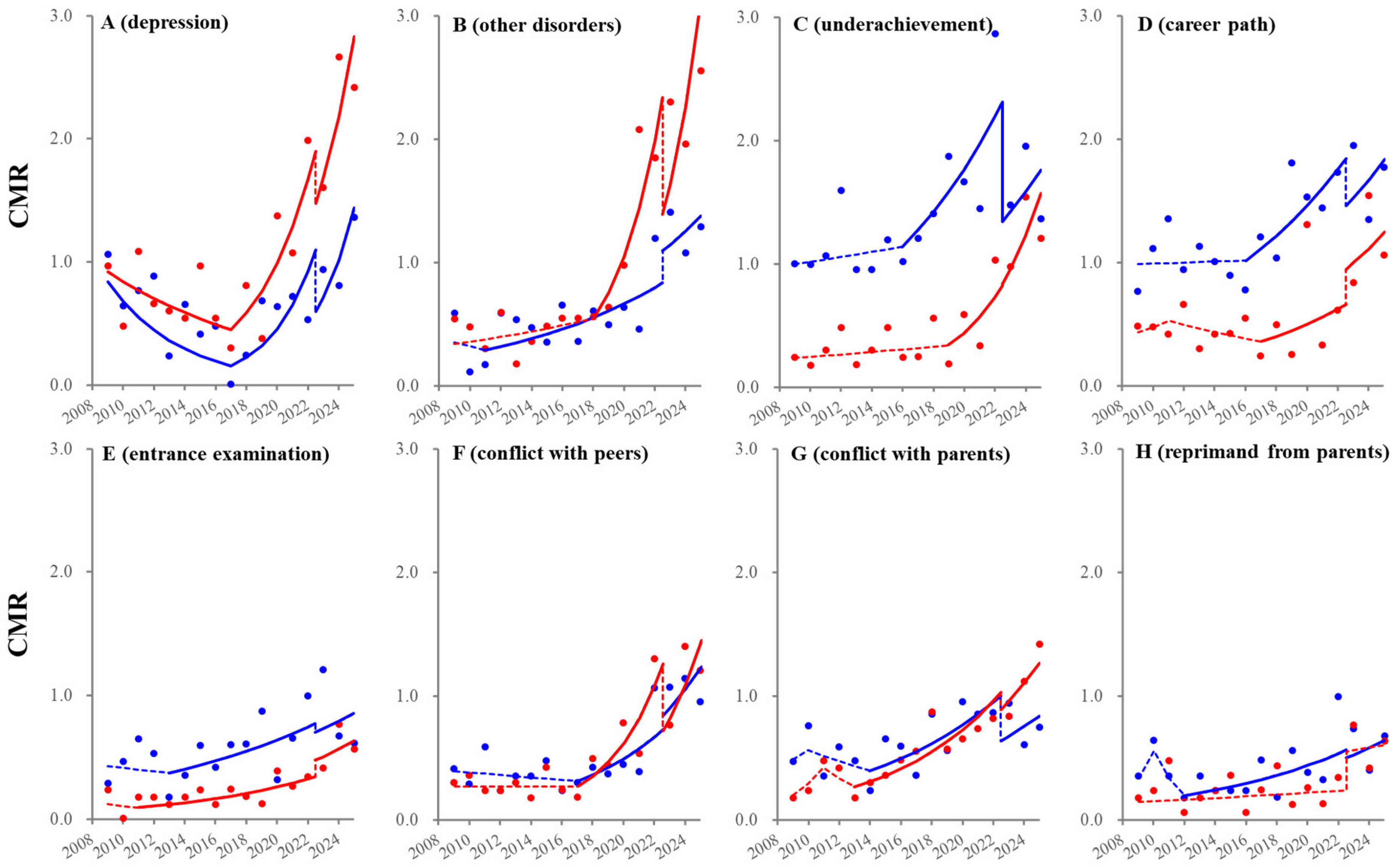
Major leading suicide motives for middle school students included health-related motives (depression and other psychiatric disorders [mainly anxiety disorders, excluding depression and schizophrenia]), school-related motives (underachievement, career-path-associated problems, entrance-examination-associated problems, conflict with peers), and family-related motives (conflict with parents and reprimand from parents) (Figure 3 and Figure 4).
Among middle school students, the CMRs of females attributed in the SSNPA to major leading suicide motives increased from approximately the mid-2010s, whereas the CMRs of males attributed to major leading suicide motives, except for depression, increased (Figure 4 and Supplementary Table S3). Importantly, trends of the CMRs of females attributed to depression, other psychiatric disorders, and conflict with peers were predominant compared to males, resulting in the fact that, during the 2020s, the CMRs of female students attributed to these three motives were markedly higher compared to males (Figure 4 and Supplementary Table S3). Notably, these increasing CMRs had already begun to increase before the outbreak of the COVID-19 pandemic.

3.3.2. Fluctuation in the CMRs of High School Students Disaggregated by Major Leading Suicide Motives

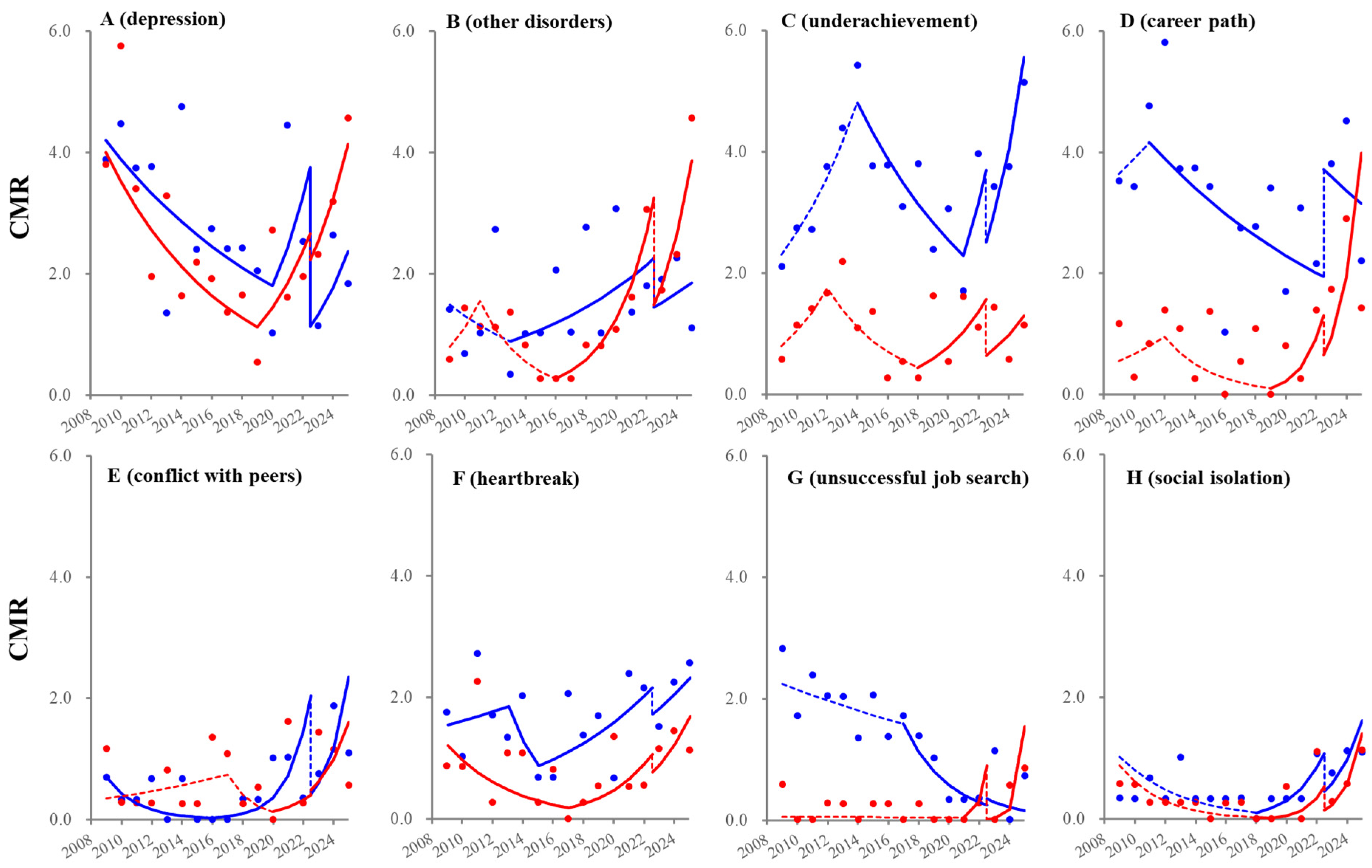
Major leading suicide motives for high school students were identical to middle school students, including depression, other psychiatric disorders, underachievement, career-path-associated problems, entrance-examination-associated problems, conflict with peers, conflict with parents, and reprimands from parents.
Among high school students, the CMRs of females attributed in the SSNPA to major leading suicide motives, except for reprimands from parents, increased, whereas the CMRs of males attributed to major leading suicide motives increased from the mid-2010s (Figure 5 and Supplementary Table S4). Trends of the CMRs of females attributed to underachievement and conflict with peers were also more predominant compared to males, resulting in their totals being almost equivalent between males and females in the early 2020s (Figure 5). None of the disaggregated CMRs of males were obviously higher than females. Compared to middle school students, the impact of family-related motives (conflict with parents and reprimands from parents) on the CMRs of high school students decreased, but conversely the impact of health-related motives (depression and other psychiatric disorders) and school-related motives (underachievement and conflict with peers) became dominant (Figure 3, Figure 4 and Figure 5).

3.3.3. Fluctuation in the CMRs of University Students Disaggregated by Major Leading Suicide Motives

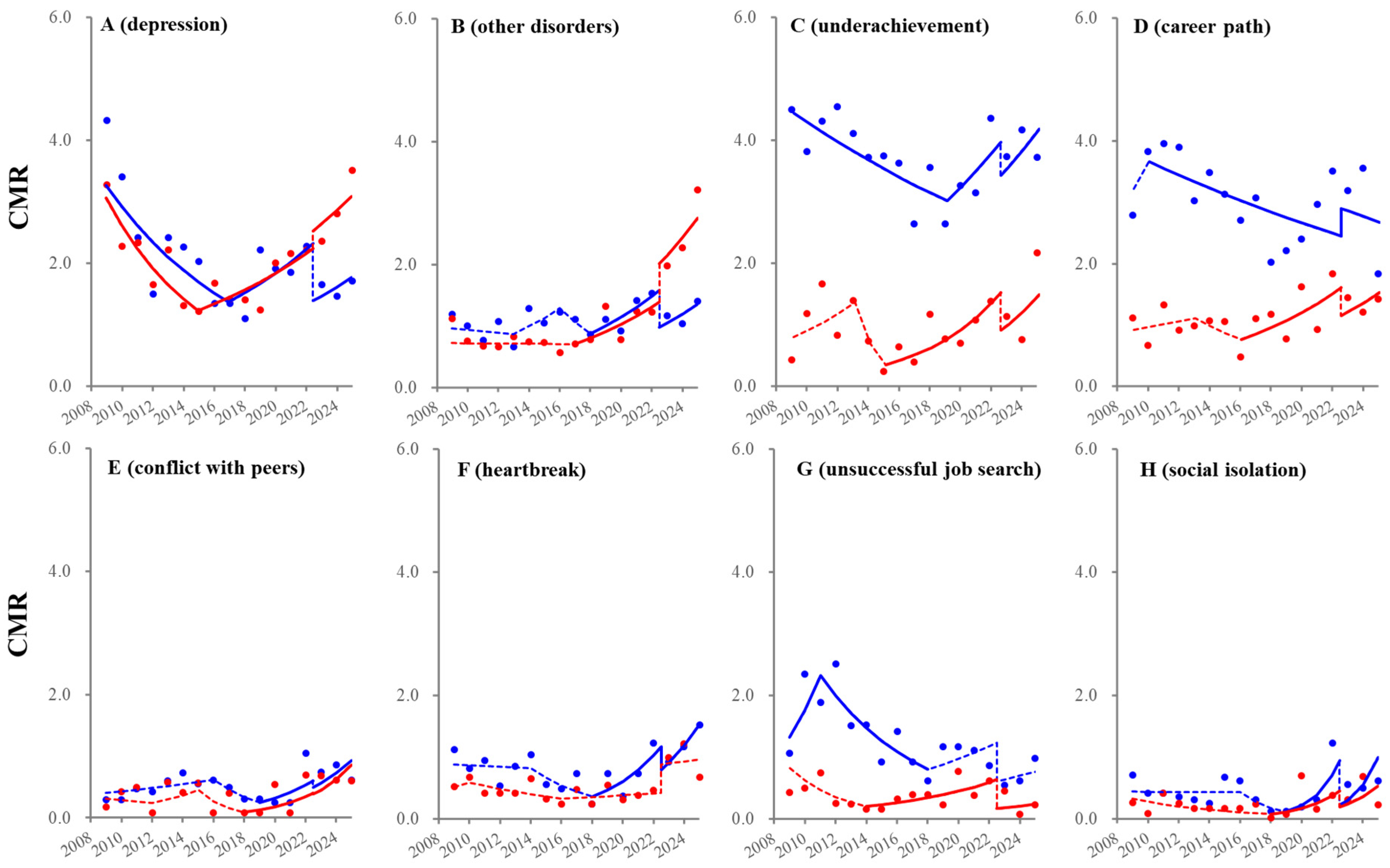
Major leading suicide motives for university students comprised health-related motives (depression and other psychiatric disorders), school-related motives (underachievement, career-path-associated problems and conflict with peers), heartbreak, unsuccessful job search, and social isolation. However, family-related motives and entrance-examination-associated problems, which were major leading suicide motives for middle and high school students, were no longer the major leading motives for university students; instead, heartbreak, an unsuccessful job search, and social isolation have become the predominant motives (Figure 6). Nonetheless, the impacts of depression, other psychiatric disorders, underachievement, and career-path-associated problems were greater than the other four motives (Figure 6).
Among university students, the CMRs of females attributed in the SSNPA to underachievement increased from the mid-2010s, whereas that of males decreased during the 2010s but moved to an increasing pattern from the late 2010s (Figure 6 and Supplementary Table S5). CMRs attributed to depression for both males and females decreased until the mid-2010s, but changed to an increasing trend from the mid-2010s (Figure 6 and Supplementary Table S5). CMRs attributed to other psychiatric disorders moved from a stable to an increasing pattern from the late 2010s (Figure 6 and Supplementary Table S5). The CMRs of females attributed to underachievement and career-path-associated problems moved to an increasing trend from the mid-2010s. Contrarily, the CRM of males attributed to career-path-associated problems consistently decreased, whereas that attributed to underachievement changed from a stable to an increasing trend in the late 2010s (Figure 6 and Supplementary Table S5). The CMRs of both males and females attributed to conflict with peers and social isolation changed to an increasing pattern from the late 2010s (Figure 6 and Supplementary Table S5). The CMR of males attributed to heartbreak increased from the late 2010s, and the CMR of females attributed to an unsuccessful job search increased from the mid-2010s (Figure 6 and Supplementary Table S5).

3.3.4. Fluctuations in the CMR of Special Vocational School Students Disaggregated by Major Leading Suicide Motives

Major leading suicide motives for special vocational school students were identical to university students, consisting of depression, other psychiatric disorders, underachievement, career-path-associated problems, conflict with peers, heartbreak, an unsuccessful job search, and social isolation.
Among female special vocational school students, all CMRs attributed to major leading motives increased during the 2020s, whereas those of males attributed to major leading motives, except for career-path-associated problems and an unsuccessful search job, also increased during the 2020s. The CMRs of males attributed to career-path-associated problems and an unsuccessful search job decreased from the mid-2010s (Figure 7 and Supplementary Table S6). Importantly, the CMR of females attributed to other psychiatric disorders changed to an increasing trend in 2016, whereas the CMRs of females attributed to other major leading motives moved to an increasing pattern around approximately 2018 (Figure 7 and Supplementary Table S6). The CMRs of males attributed to depression and underachievement began to increase from around 2020, and those attributed to social isolation also increased from 2018 (Figure 7 and Supplementary Table S6). As a result, one can observe that increasing CMRs among special vocational school students seem to increase at a slower rate than among university students.

4. Discussion

Our analysis brought to light a number of features of student suicide in present-day Japan that depart markedly from conclusions previously drawn from general suicide statistics in the governmental database. First, while the national CMR in Japan declined throughout the 2010s, the CMR specific to students moved in the opposite direction from the mid-2010s. Second, beginning in the mid-2010s, the upward shift in the CMR was steeper among female than among male students; by 2022, 2024, and 2025, respectively, the CMRs for female students in middle school, high school, and in the under-20 university subgroup had overtaken the corresponding male rates. Third, the highest CMR among student categories was observed in part-time high school students, exceeding the average for all students and for all high school students by roughly three- to six-fold. Fourth, the dominant motives identified for student suicides overall lay in the school-related domain; specifically, academic underperformance and career-related concerns. Family-centred difficulties (conflict with parents and parental reprimand), which had figured prominently among middle school cases, attenuated with age, whereas the relative contribution of psychiatric issues, depression, and other psychiatric disorders increased with age. Of particular note, mental health concerns now stand as priority targets for suicide prevention among students, since impacts of mental health disorders have increased drastically as factors for suicide among female students in Japan.

4.1. Features of Student CMRs

A long-standing epidemiological observation is that, considered across all age groups, suicide mortality among males exceeds that among females. In East Asian populations, including Japan, this male-to-female ratio in suicide mortality has been reported as lower than the corresponding ratio in Western settings. The male-to-female ratio is known to widen with increasing age, and adolescents are no exception to this pattern [28,29,53]. Gender ratio (males/females) increases with age, and adolescents are no exception [21,28,29,53]. The widening of this sex difference with age reflects a steep rise in male suicide rates during the late teens against a more modest concurrent rise among females [21,23]. Against this backdrop, the trajectory observed among students in Japan represents a marked deviation from the global sex-dependent features of suicides [21]. Indeed, the gender ratios of student CMRs in middle school, high school, and university (<20 years) became equal in 2022, 2024, and 2025, respectively; subsequently, the CMRs of these females groups were higher than male equivalents. Put differently, although suicide rates have been climbing in both male and female student populations in present-day Japan, the accelerating rise observed in female students since the mid-2010s constitutes a particularly pressing priority for adolescent-focused suicide prevention efforts. Collectively, these results suggest that the rise in student suicides, more marked among female students than males, appeared first in middle school cohorts and then spread outward to high school, university, and special vocational school students. The continuing escalation observed among female students at every educational stage indicates that this trajectory is unlikely to reverse without intervention.
Notably, the CMR observed in part-time high school students stood out as markedly elevated relative to other student categories. Recent national statistics have documented a substantial expansion in enrolment at part-time high schools [46]. Over 80% of middle school students who had been unable to attend regular middle school owing to school refusal or their own disabilities have subsequently enrolled in part-time high schools [46,54,55]. Part-time high schools confer their graduation qualifications principally through correspondence-style coursework and formal assessments, with attendance obligations that are considerably less stringent than those imposed in regular-time high schools. This more flexible structure positions part-time high school as a viable route for obtaining a high school diploma, and, by extension, a pathway to university admission, for those who, owing to school refusal or their own disabilities, find the conventional educational route inaccessible [56]. Given the demographic profile of those increasingly choosing this route, the possibility that students with poor school adaptation or with elevated suicide risk are disproportionately concentrated within part-time high schools warrants serious consideration.
Most part-time high schools are administratively attached to full-time high schools, and the same mental health professionals, school counsellors, and school caseworkers are typically expected to cover both school formats. Dedicated specialists for part-time high schools therefore remain in short supply [56,57,58,59,60]. Many part-time high schools, moreover, mandate only around 10–20 days of in-person attendance per year, leaving teaching staff and school mental health professionals with little opportunity to gain a substantive understanding of each student’s wellbeing [56,60]. Given that part-time high schools combine a high concentration of at-risk students with markedly limited in-person attendance [55,56], the kind of mental-health-professional-led support system used effectively in middle schools and in regular-time high schools cannot be expected to function comparably well in this setting. Accordingly, the initial step should fall to teachers themselves, who must take responsibility for investigating and gaining a substantive grasp of each student’s situation; once high-risk students have been identified, collaboration with educational psychological staff must result in the development of appropriate support programmes for each individual high-risk student.

4.2. Features of Suicide Motive for Student Suicides

Characterizing the temporal, age-related, and sex-related dimensions of prevalent suicide motives among students serves a dual purpose: it enables suicide prevention efforts to be deployed more efficiently, and it supports the planning of interventions tailored to the psychosocial transitions that students undergo. In our middle school sample, family-centered difficulties, particularly regarding conflict with parents and parental reprimand, emerged as the dominant suicide motives, yet the salience of these family-related factors progressively diminished in high school students and was no longer prominent among university and special vocational school students. By the high school stage, school-centred difficulties such as academic underperformance, career path concerns, problems linked to entrance examinations, and peer conflict had displaced family-related issues as the leading concerns. Such an age-related reorganization is consistent with the well-described life cycle pattern in which psychosocial dependence on the parental dyad gradually attenuates in line with individual psychological maturation [61,62,63]. Consistent with this developmental view, the contribution of peer conflict was more prominent in high school students than in middle school students. By contrast, in university and special vocational school students, the relative weight of entrance examination concerns and of peer conflict declined, while underperformance and career-related concerns became more salient. For middle and high school students, gaining admission to a higher educational institution, i.e., passing an entrance examination, constitutes a pivotal event tied directly to their future career trajectory. In university and special vocational school students, however, whose primary objective is to acquire the skills, knowledge, and qualifications required for employment, the entrance examination is no longer a major event; rather, the career path itself has become a major event for them. This can also be fully interpreted when considering the life cycle [37,64]. For students who died by suicide across middle school, high school, special vocational school, and university combined, two motives—academic underperformance and career-related concerns—were consistently among the leading recorded factors. The school system bears responsibility for equipping young people with the knowledge and competencies they will need to construct economically and emotionally fulfilling adult lives, and for verifying that each student is in fact acquiring those competencies. It is widely understood, however, that the very process of evaluating individual academic outcomes can itself constitute a substantial stressor for students. Yet underperformance or career-related concerns alone are unlikely to be sufficient to precipitate suicide; instead, the more plausible scenario is that these school-related difficulties arise out of a confluence of factors, including inadequate parenting, psychiatric morbidity, problematic interpersonal relationships within the community, and others, that interact with one another [65,66,67].
Beyond these age-related shifts in dominant motives, our analysis revealed several distinctive features of mental health-related suicide motives that may help to account for the recent rise in student suicide in Japan. First, the upward shift in CMR has been steeper in female than in male students. Second, this pattern, in which the female CMR has come to exceed the male CMR, first emerged in middle school students and then propagated, age-dependently, to high school and university student populations. Third, within the middle school group, the relative contribution of other psychiatric disorders (predominantly anxiety) outweighed that of depression; with advancing age, the relative weight of other psychiatric disorders declined while that of depression rose, such that in university and special vocational school students the two became roughly comparable, with depression exerting a marginally larger contribution. Collectively, these observations are highly suggestive of a role of internalizing disorders in the rising CMR among Japanese students, and especially among female students. In short, the evidence assembled here is sufficient to motivate an attempt, informed by the existing literature, to interpret and intervene in the mechanisms underlying the increase in Japanese student suicide through the lens of internalizing disorders.
Although internalizing disorders have not been recognized as a formal diagnostic category within ICD-10, ICD-11, or DSM-5 [68], the term is nonetheless well entrenched as a higher-order construct in the fields of child and adolescent psychiatry and developmental psychology [69]. The construct encompasses depressive symptoms, anxiety, obsessive–compulsive features, hypochondriacal presentations, and suicidal behaviour, and has been linked to an overcontrolled behavioural pattern [70]. The onset age is around 15 years of age [71,72,73], and is consistently prevalent in females than in males [69]. It is well-known that individuals with internalizing symptoms have a high suicide risk, and being female further increases suicide risk [74,75]. National data from the MHLW Patient Survey have documented a recent rise in the prevalence of depressive and anxiety disorders in Japanese adolescents [13,25]. Recent work analyzing social media content has further suggested that internalizing processes may manifest more prominently in young women than in young men. In particular, locutions such as ‘life is painful’ or ‘life is unbearable’ have been treated as markers of a diminished ability to form autonomous social ties, and tend to co-occur with loneliness, anxiety, low self-worth, hopelessness, and anger [76,77,78,79,80]. Posts containing such expressions on Japanese social media platforms have shown a sustained increase among females; the frequency among young women is reported to exceed that among young men by more than fivefold [77]. Taken together, these lines of prior work offer convergent symptom-based and epidemiological support for a link between the rising burden of internalizing disorders and the rise in suicide among Japanese adolescent females [13,25].
The development of internalizing disorders is thought to reflect a gene–environment interaction in which adverse childhood experiences constitute a major environmental contributor [81]. More recent work has highlighted parenting factors, including negative parental mood, reluctance to express emotion, only-child status, an unfulfilling maternal relationship, and over-restrictive paternal behaviour, as playing important roles in the pathomechanisms underlying internalizing disorders [78,79,80,82,83,84,85,86,87,88,89,90]. The age-dependent reorganization of leading suicide motives observed across student groups can be situated within a developmental psychopathology framework [38,39,91]. In middle school students, whose age precedes the typical onset of internalizing disorders, the heightened CMR linked to conflict with parents and parental reprimands reflects the central role that the parent–child relationship plays as the principal source of psychosocial strain at this developmental stage [90,92,93]. As students move up to higher educational levels, the relative contribution of family-related motives diminishes; in its place, peer conflict, that is, the demands of interpersonal communication with peers, together with concerns surrounding education and career trajectory, becomes an increasingly salient factor of suicide risk [64]. Running in parallel, the age-dependent rise in CMR attributed to psychiatric disorders, most notably depression and anxiety disorders, is congruent with the developmental course of internalizing disorders, which are widely viewed as the core expressions of adolescent internalizing psychopathology and which characteristically rise in prevalence throughout mid-to-late adolescence [71,72,73,94]. These findings may be consistent with the hypothesis that psychological internalization contributes to recent increases in student suicides, but the present registry-based analysis cannot directly determine the mechanism.

4.3. Proposal for Measures to PreventRising Student Suicides

Under the Fourth GPSPP, prefectural boards of education have begun rolling out suicide prevention curricula based on locally developed instructional materials, with provision extending to all students. The principal aims of these curricula are to strengthen resilience (psychological recovery), to enable the identification of peers at elevated risk of suicide, and to teach students how to seek support when they are in a high-risk situation [95]. The validity of these objectives is supported by the results of this study.
The deployment of school counsellors in Japanese schools has been progressively expanded since 2008, such that virtually all schools are now staffed with at least one counsellor [57,58]. Depression-related student suicides followed a downward trajectory from 2009 to the mid-2010s, but turned upward thereafter. This pattern raises the possibility that school counselling on its own, or student-directed counselling on its own, may not be sufficient to stem the rising tide of suicide among students with psychiatric disorders [96,97,98]. In the Japanese setting, school counsellors are most commonly clinical psychologists who deliver one-on-one counselling to students and provide indirect support to teachers. Because most are engaged on a non-full-time basis, with their on-site hours typically capped at around four hours per week, the time available for case conceptualisation, interdisciplinary case meetings, or coordination with external medical providers is severely constrained [56,59]. Even within their own schools, counsellors encounter obstacles to building collaborative relationships owing to fragmented schedules, ambiguous role definitions, and only sporadic chances for sustained interaction with teachers [56,57,58,59,60]. Under such conditions, it is difficult for school counsellors to coordinate the care needed by students with complex psychiatric presentations, students whose situations frequently call for ongoing monitoring, pharmacological management, and specialized interventions that extend beyond what school-based services can offer [56,57,58,59,60].
The internalizing disorders whose contribution to student suicide has been increasing, as documented here, fall within the category of treatable adolescent psychiatric conditions. Combined treatment with cognitive behavioural therapy and medication using selective serotonin transporter inhibitors has been reported to deliver a more substantial benefit than either modality administered alone [99]. In light of this, prefectural and municipal boards of education will need to invest school counsellors with the authority to set up collaborative arrangements with psychiatric medical institutions as needed, and to put in place an operating environment that allows psychiatric care, including pharmacotherapy where indicated, to be delivered promptly to those students who require it [100,101,102]. In a number of European countries, school counsellors function as formal liaisons with psychiatric services, yet no equivalent institutional role exists in Japan. The practical consequence is that general teachers, who have not received specialized training, end up performing duties analogous to those of European school counsellors [103,104]. Beyond linkages with psychiatric services, partnerships extending to parents, caregivers, teachers, and administrative bodies such as the prefectural Child Welfare Centre are equally important. The collaborative framework must therefore be expanded systemically as the situation requires, rather than depending on ad hoc “personal” arrangements between individuals.

4.4. Limitations

Direct comparability analysis between before and after the revision of the survey method of the SSNPA was not feasible, since the SSNPA did not provide formal bridge data derived from dual coding of cases under both the pre- and post-revision schemes. Consequently, we were constrained to adopt a jump-model JPRA alone, in which the effect of the coding revision is parameterized as an additive level shift (as jump parameter) at the changepoint year. This formulation assumes that the magnitude of the revision’s influence remains constant throughout the post-2022 period. Should the effect of the coding change have varied over time rather than remaining stable, the model would be unable to fully capture such temporal heterogeneity, underscoring the need for ongoing monitoring as additional data become available. Notwithstanding this limitation, the validity of the jump-model JPRA was supported through sensitivity analyses, including verification of the assumed changepoint year and a reproducibility check using data restricted to the pre-2022 period, both of which yielded results consistent with the primary findings. Nevertheless, because the data underlying this study are registry-based, the observed temporal trends cannot be directly linked to the psychological processes that motivated individual deaths. Although the suicide motives attributed in the SSNPA are officially determined through meticulous investigation, suicide is a multifactorial phenomenon, and the attributed motives may not necessarily identify the entire psychological, social, and clinical pathways leading to individual suicide. In other words, elucidating such mechanisms would require analyses using collected data derived from systematic psychological autopsy studies.
A further limitation of this study is the relatively short observation period of four years for analyzing high-risk groups among students, which is insufficient for robust analysis. Despite this constraint, the CMR of students in part-time high schools was markedly higher compared to all other groups, a finding that possibly remained consistent. However, the comparative results across the remaining groups should be interpreted with caution, as the brevity of the observation period introduces the possibility of estimation error and may compromise the stability of trend estimates for those subgroups. Continued surveillance with an extended observation window is therefore indispensable to verify and refine these comparative findings.

5. Conclusions

The present analysis documents a sustained rise in suicide mortality among Japanese students in middle school, high school, special vocational school, and university beginning in the mid-2010s. Of particular note, the CMRs among female students in middle and high school surpassed that of their male counterparts during the 2020s. Across student categories, the principal recorded motives for suicide underwent a developmentally patterned shift, beginning with family-related issues such as conflict with parents and parental reprimands in the youngest cohort and giving way, in accordance with the life cycle, to school-related concerns such as academic underperformance, problems associated with career trajectories, and conflict with peers. Increases in suicides attributed to depression and other psychiatric disorders were considerably more pronounced among female students than among male students. Concurrent with these trends, suicides attributed to social isolation and to conflict with peers began to rise from the late 2010s or early 2020s, signalling the emergence of socially struggling students as an additional risk group. Taken together, our observations point to a rising trend in student CMRs that took hold in the mid-2010s, with the steepest increases concentrated in female student populations and the CMRs of part-time high school students reaching exceptionally high levels. The leading recorded motives identified here vary as a function of age, spanning family, school, and mental health domains. Accommodating these age-related shifts in the design of suicide prevention programmes offers substantial promise for improving their effectiveness. Dedicated cohort investigations that permit fine-grained longitudinal monitoring of individual psychological trajectories and evolving suicide motives are likewise needed to clarify the psychological mechanisms underpinning these age-dependent shifts.

Supplementary Materials

The following supporting information can be downloaded at: https://www.mdpi.com/article/10.3390/psychiatryint7040143/s1, Supplementary Table S1: Total suicide numbers and population of students between 2022–2025 in Japan. Supplementary Table S2: Temporal fluctuation of CMRs of students between 2009–2025 in Japan. Supplementary Table S3: Temporal fluctuation of CMRs of middle school students caused by prevalent suicide motives between 2009–2025 in Japan. Supplementary Table S4: Temporal fluctuation of CMRs of high school students caused by prevalent suicide motives between 2009–2025 in Japan. Supplementary Table S5: Temporal fluctuation of CMRs of university students caused by prevalent suicide motives between 2009–2025 in Japan. Supplementary Table S6: Temporal fluctuation of CMRs of special vocational school students caused by prevalent suicide motives between 2009–2025 in Japan.

Author Contributions

Conceptualization, R.M. and M.O.; Methodology, R.M., Y.I., T.O., E.M. and M.O.; Software, E.M. and M.O.; Validation, R.M., Y.I., T.O., E.M. and M.O.; Formal analysis, R.M., Y.I., T.O., E.M. and M.O.; Investigation, E.M. and M.O.; Resources, Y.I., T.O., E.M. and M.O.; Data curation, R.M., Y.I., T.O., E.M. and M.O.; Writing – original draft, M.O.; Writing – review & editing, R.M., Y.I., T.O. and E.M.; Visualization, M.O.; Supervision, E.M. and M.O.; Project administration, M.O.; Funding acquisition, R.M. and M.O. All authors have read and agreed to the published version of the manuscript.

Funding

This study is supported by the Japan Society for the Promotion of Science (23K06987) and the Regional Suicide Countermeasures Emergency Enhancement Fund of Mie Prefecture (2025-40). The funding bodies played no part in study design or execution, in data collection, management, analysis, or interpretation, in the writing, revision, or approval of the manuscript, or in the decision to submit it for publication.

Institutional Review Board Statement

The Medical Ethics Review Committee of Mie University waived ethical approval for this study, which utilized publicly available, de-identified governmental data from the SSNPA and BDSR. The study adhered to the Strengthening Reporting of Observational Studies in Epidemiology (STROBE) guidelines.

Informed Consent Statement

Informed consent was waived due to the study using anonymized publicly accessible national suicide data from the National Police Agency of Japan.

Data Availability Statement

The data presented in this study are available in Japanese national databases from the SSNPA (Suicide Statistics): https://www.npa.go.jp/english/index.html (accessed on 1 November 2025); BDSR (Basic Data on Suicide in Region): https://www.mhlw.go.jp/stf/seisakunitsuite/bunya/0000140901.html (accessed on 1 April 2026); and School Basic Survey https://www.e-stat.go.jp/en/statistics/00400001.

Acknowledgments

The authors are grateful for all the participants in the research.

Conflicts of Interest

The authors declare no conflicts of interest.

Abbreviations

The following abbreviations are used in this manuscript:
BDSRBasic Data on Suicide in Region
CFAChildren and Families Agency
CMRCrude suicide mortality rate
GPSPPGeneral Principles of Suicide Prevention Policy
JPRAJoinpoint regression analysis
LMMLinear mixed-effect model for repeated measures
MEXTMinistry of Education, Culture, Sports, Science, and Technology
MHLWMinistry of Health, Labour, and Welfare
NPANational Police Agency
SSNPASuicide statistics released by the National Police Agency
VSRVital Statistics Registration
WHOWorld Health Organization

References

  1. Na, P.J.; Shin, J.; Kwak, H.R.; Lee, J.; Jester, D.J.; Bandara, P.; Kim, J.Y.; Moutier, C.Y.; Pietrzak, R.H.; Oquendo, M.A.; et al. Social Determinants of Health and Suicide-Related Outcomes: A Review of Meta-Analyses. JAMA Psychiatry 2025, 82, 337–346. [Google Scholar] [PubMed]
  2. Favril, L.; Yu, R.; Geddes, J.R.; Fazel, S. Individual-Level Risk Factors for Suicide Mortality in the General Population: An Umbrella Review. Lancet Public Health 2023, 8, e868–e877. [Google Scholar] [CrossRef] [PubMed]
  3. Arias, D.; Saxena, S.; Verguet, S. Quantifying the Global Burden of Mental Disorders and Their Economic Value. EClinicalMedicine 2022, 54, 101675. [Google Scholar] [CrossRef] [PubMed]
  4. Peterson, C.; Haileyesus, T.; Stone, D.M. Economic Cost of U.S. Suicide and Nonfatal Self-Harm. Am. J. Prev. Med. 2024, 67, 129–133. [Google Scholar] [CrossRef] [PubMed]
  5. Baker, S.R.; Bloom, N.; Davis, S.J. Measuring Economic Policy Uncertainty. Q. J. Econ. 2016, 131, 1593–1636. [Google Scholar] [CrossRef]
  6. Brent, D.A. Commentary: Reducing Adolescent Suicide: A Global Imperative—A Reflection on Glenn Et Al. (2020). J. Child Psychol. Psychiatry 2020, 61, 309–311. [Google Scholar] [PubMed]
  7. Campisi, S.C.; Carducci, B.; Akseer, N.; Zasowski, C.; Szatmari, P.; Bhutta, Z.A. Suicidal Behaviours among Adolescents from 90 Countries: A Pooled Analysis of the Global School-Based Student Health Survey. BMC Public Health 2020, 20, 1102. [Google Scholar] [CrossRef] [PubMed]
  8. Abio, A.; Owusu, P.N.; Posti, J.P.; Barnighausen, T.; Shaikh, M.A.; Shankar, V.; Wilson, M.L. Cross-National Examination of Adolescent Suicidal Behavior: A Pooled and Multi-Level Analysis of 193,484 Students from 53 Lmic Countries. Soc. Psychiatry Psychiatr. Epidemiol. 2022, 57, 1603–1613. [Google Scholar] [CrossRef] [PubMed]
  9. Pirkis, J.; Bantjes, J.; Dandona, R.; Knipe, D.; Pitman, A.; Robinson, J.; Silverman, M.; Hawton, K. Addressing Key Risk Factors for Suicide at a Societal Level. Lancet Public Health 2024, 9, e816–e824. [Google Scholar] [CrossRef] [PubMed]
  10. Lapierre, S.; Erlangsen, A.; Waern, M.; De Leo, D.; Oyama, H.; Scocco, P.; Gallo, J.; Szanto, K.; Conwell, Y.; Draper, B.; et al. A Systematic Review of Elderly Suicide Prevention Programs. Crisis 2011, 32, 88–98. [Google Scholar] [CrossRef] [PubMed]
  11. Lewitzka, U.; Sauer, C.; Bauer, M.; Felber, W. Are National Suicide Prevention Programs Effective? A Comparison of 4 Verum and 4 Control Countries over 30 Years. BMC Psychiatry 2019, 19, 158. [Google Scholar] [CrossRef] [PubMed]
  12. Wasserman, D.; Iosue, M.; Wuestefeld, A.; Carli, V. Adaptation of Evidence-Based Suicide Prevention Strategies during and after the COVID-19 Pandemic. World Psychiatry 2020, 19, 294–306. [Google Scholar] [PubMed]
  13. Matsumoto, R.; Motomura, E.; Shiroyama, T.; Okada, M. Impact of the Japanese Government’s “General Policies for Comprehensive Measures against Suicide” on Youth Suicide from 2007–2022. BJPsy Open 2023, 10, e16. [Google Scholar]
  14. WHO. Suicide Prevention in Japan: A Public Health Priority. Available online: https://www.who.int/news-room/feature-stories/detail/suicide-prevention-in-japan--a-public-health-priority (accessed on 1 April 2026).
  15. MHLW. Basic Data on Suicide in Region. Available online: https://www.mhlw.go.jp/stf/seisakunitsuite/bunya/0000140901.html (accessed on 1 April 2025).
  16. Okada, M.; Matsumoto, R.; Motomura, E.; Shiroyama, T.; Murata, M. Exploring Characteristics of Increased Suicide during the COVID-19 Pandemic in Japan Using Provisional Governmental Data. Lancet Reg. Health West. Pac. 2022, 24, 100481. [Google Scholar] [CrossRef] [PubMed]
  17. Matsumoto, R.; Motomura, E.; Okada, M. Fluctuation of Suicide Mortality and Temporal Causality from Unemployment Duration to Suicide Mortality in Japan during 2009–2022. Asian J. Psychiatry 2023, 84, 103574. [Google Scholar] [CrossRef]
  18. Okada, M. Is an Increase in Japan’s Suicides Caused by COVID-19 Alone? Asian J. Psychiatry 2022, 78, 103320. [Google Scholar] [CrossRef]
  19. Oka, T.; Matsumoto, R.; Motomura, E.; Okada, M. Suicides Mortality of Unemployed Individuals Becomes a Serious Public Health Concern in Japan in Post-COVID-19 Pandemic Era. Int. J. Environ. Res. Public Health 2025, 22, 1315. [Google Scholar] [CrossRef] [PubMed]
  20. Matsumoto, R.; Oka, T.; Motomura, E.; Okada, M. Increasing Suicide Mortality of Female Students Became Greater Than Males in Current Japan. Adolescents 2026, 6, 18. [Google Scholar] [CrossRef]
  21. Hughes, J.L.; Horowitz, L.M.; Ackerman, J.P.; Adrian, M.C.; Campo, J.V.; Bridge, J.A. Suicide in Young People: Screening, Risk Assessment, and Intervention. BMJ 2023, 381, e070630. [Google Scholar] [CrossRef] [PubMed]
  22. Naghavi, M.; Collaborators Global Burden of Disease Self-Harm. Global, Regional, and National Burden of Suicide Mortality 1990 to 2016: Systematic Analysis for the Global Burden of Disease Study 2016. BMJ 2019, 364, l94. [Google Scholar] [PubMed]
  23. Turecki, G.; Brent, D.A.; Gunnell, D.; O’Connor, R.C.; Oquendo, M.A.; Pirkis, J.; Stanley, B.H. Suicide and Suicide Risk. Nat. Rev. Dis. Primers 2019, 5, 74. [Google Scholar] [CrossRef] [PubMed]
  24. Goldston, D.B.; Walrath, C. The Garrett Lee Smith Memorial Act: A Description and Review of the Suicide Prevention Initiative. Annu. Rev. Clin. Psychol. 2023, 19, 261–275. [Google Scholar] [CrossRef] [PubMed]
  25. Okada, M.; Matsumoto, R.; Shiroyama, T.; Motomura, E. Suicidal Mortality and Motives among Middle-School, High-School and University Students. JAMA Netw. Open 2023, 6, e2328144. [Google Scholar] [PubMed]
  26. Matsumoto, R.; Motomura, E.; Okada, M. Impacts of Working Hours, Wages, and Regular Employment Opportunity on Suicide Mortalities of Employed and Unemployed Individuals before and during the COVID-19 Pandemic in Japan. Int. J. Environ. Res. Public Health 2024, 21, 499. [Google Scholar] [CrossRef] [PubMed]
  27. Okada, M.; Matsumoto, R.; Motomura, E. Suicide Mortality Rates in Japan before and Beyond the COVID-19 Pandemic Era. Psychiatry Clin. Neurosci. Rep. 2024, 3, e188. [Google Scholar]
  28. Okubo, R.; Matsumoto, R.; Motomura, E.; Okada, M. Adolescent Suicides in the Western Pacific Region Have Become a More Serious Public Health Problem Than in Other Regions. Psychiatry Int. 2024, 5, 564. [Google Scholar] [CrossRef]
  29. Okubo, R.; Matsumoto, R.; Motomura, E.; Okada, M. Temporal Fluctuations of Adolescent Suicides in Oecd Countries from 1990–2019. J. Affect. Disord. Rep. 2025, 19, 100857. [Google Scholar]
  30. Connors, M.H.; Draper, B.; Wand, A.P.; De Leo, D.; Reppermund, S. Suicide and Self-Harm in Older Adults. Nat. Rev. Psychol. 2025, 4, 440–456. [Google Scholar] [CrossRef]
  31. GBD 2021 Suicide Collaborators. Global, Regional, and National Burden of Suicide, 1990-2021: A Systematic Analysis for the Global Burden of Disease Study 2021. Lancet Public Health 2025, 10, e189–e202. [PubMed]
  32. Okubo, R.; Matsumoto, R.; Motomura, E.; Okada, M. Uncertainties of Economic Policy and Government Management Stability Played Important Roles in Increasing Suicides in Japan from 2009 to 2023. Int. J. Environ. Res. Public Health 2024, 21, 1366. [Google Scholar] [CrossRef] [PubMed]
  33. Hawton, K.; Pirkis, J. Preventing Suicide: A Call to Action. Lancet Public Health 2024, 9, e825–e830. [Google Scholar] [CrossRef] [PubMed]
  34. O’Connor, R.C.; Kirtley, O.J.; de Beurs, D. Preventing Suicide: Understanding the Complex Interplay between Individual and Societal Factors. Lancet Public Health 2024, 9, e714–e715. [Google Scholar] [CrossRef] [PubMed]
  35. Pirkis, J.; Dandona, R.; Silverman, M.; Khan, M.; Hawton, K. Preventing Suicide: A Public Health Approach to a Global Problem. Lancet Public Health 2024, 9, e787–e795. [Google Scholar] [CrossRef] [PubMed]
  36. Matsumoto, R.; Motomura, E.; Onitsuka, T.; Okada, M. Trends in Suicidal Mortality and Motives among Working-Ages Individuals in Japan during 2007–2022. Eur. J. Investig. Health Psychol. Educ. 2023, 13, 2795–2810. [Google Scholar] [CrossRef] [PubMed]
  37. Nigam, A.; Vuddemarry, M.; Zadey, S. Economic Burden of Suicide Deaths in India (2019): A Retrospective, Cross-Sectional Study. Lancet Reg. Health Southeast. Asia 2024, 29, 100477. [Google Scholar] [CrossRef] [PubMed]
  38. Sisk, L.M.; Gee, D.G. Stress and Adolescence: Vulnerability and Opportunity during a Sensitive Window of Development. Curr. Opin. Psychol. 2022, 44, 286–292. [Google Scholar] [PubMed]
  39. Sawyer, S.M.; Azzopardi, P.S.; Wickremarathne, D.; Patton, G.C. The Age of Adolescence. Lancet Child Adolesc. Health 2018, 2, 223–228. [Google Scholar] [CrossRef] [PubMed]
  40. CFA. Emergency Strengthening Plan for Children’s Suicide Prevention. Available online: https://www.cfa.go.jp/policies/kodomonojisatsutaisaku (accessed on 1 April 2026).
  41. MHLW. The 2024 White Paper on Suicide Countermeasures. Available online: https://www.mhlw.go.jp/content/001464705.pdf (accessed on 1 April 2025).
  42. The 2025 White Paper on Suicide Countermeasures. Available online: https://www.mhlw.go.jp/stf/seisakunitsuite/bunya/hukushi_kaigo/seikatsuhogo/jisatsu/jisatsuhakusyo2025.html (accessed on 1 April 2026).
  43. CO. Basic Act for Persons with Disability and Related Laws. Available online: https://www8.cao.go.jp/shougai/suishin/sabekai.html (accessed on 1 September 2025). (In Japanese)
  44. Children and Families Agency. Available online: https://www.cfa.go.jp/en (accessed on 1 September 2025).
  45. NPA. Suicide Statistics. Available online: https://www.npa.go.jp/publications/statistics/safetylife/jisatsu.html (accessed on 1 April 2026).
  46. MEXT. School Basic Survey. Available online: https://www.e-stat.go.jp/en/statistics/00400001 (accessed on 1 April 2026).
  47. Kim, H.J.; Fay, M.P.; Feuer, E.J.; Midthune, D.N. Permutation Tests for Joinpoint Regression with Applications to Cancer Rates. Stat. Med. 2000, 19, 335–351. [Google Scholar] [CrossRef] [PubMed]
  48. Li, J.; Chan, N.B.; Xue, J.; Tsoi, K.K.F. Time Series Models Show Comparable Projection Performance with Joinpoint Regression: A Comparison Using Historical Cancer Data from World Health Organization. Front. Public Health 2022, 10, 1003162. [Google Scholar] [CrossRef] [PubMed]
  49. Liu, B.; Kim, H.J.; Feuer, E.J.; Graubard, B.I. Joinpoint Regression Methods of Aggregate Outcomes for Complex Survey Data. J. Surv. Stat. Methodol. 2023, 11, 967–989. [Google Scholar]
  50. Harada, N.; Koda, M.; Nomura, S. Early Outcomes of Changes to Collection of Suicide Data in Japan. JAMA Netw. Open 2023, 6, e2347543. [Google Scholar] [CrossRef] [PubMed]
  51. Inoue, K.; Takeshima, T.; Yamauchi, T.; Fukunaga, T. An Urgent Problem: The Major Revisions of Suicide Statistics in Japan Greatly Hamper the Research. Lancet Reg. Health West. Pac. 2023, 39, 100852. [Google Scholar] [CrossRef] [PubMed]
  52. Chen, H.S.; Zeichner, S.; Anderson, R.N.; Espey, D.K.; Kim, H.J.; Feuer, E.J. The Joinpoint-Jump and Joinpoint-Comparability Ratio Model for Trend Analysis with Applications to Coding Changes in Health Statistics. J. Off. Stat. 2020, 36, 49–62. [Google Scholar] [PubMed]
  53. Chen, Y.Y.; Wu, K.C.; Yousuf, S.; Yip, P.S. Suicide in Asia: Opportunities and Challenges. Epidemiol. Rev. 2012, 34, 129–144. [Google Scholar] [PubMed]
  54. MEXT. Survey on Undesirable Behavior and School Non-Attendance of Students. Available online: https://www.mext.go.jp/b_menu/toukei/chousa01/shidou/1267646.htm (accessed on 1 April 2025).
  55. Matsubara, D.; Kotani, K.; Osaka, H. School Refusal Behavior in Japan: The Impact of COVID-19 on Children. Children 2025, 12, 1105. [Google Scholar] [CrossRef] [PubMed]
  56. Ishii, A.; Okuno, H.; Nakaoka, T.; Iwasaka, H.; Taniike, M. Effectiveness of a Teacher Training Program for Students with Symptoms of Developmental Disorders: Data from a Correspondence High School in Japan. Int. J. Environ. Res. Public Health 2020, 17, 3100. [Google Scholar] [CrossRef] [PubMed]
  57. Nishio, A.; Kakimoto, M.; Horita, R.; Yamamoto, M. Compulsory Educational Mental Health Support System in Japan. Pediatr. Int. 2020, 62, 529–534. [Google Scholar] [CrossRef] [PubMed]
  58. Hirata, Y.; Ozawa, E. Characteristics of Students Who Require Elementary School Counselors’ Support Owing to Developmental Disorders. Heliyon 2023, 9, e13791. [Google Scholar] [CrossRef] [PubMed]
  59. Usami, M.; Sasaki, Y.; Ichikawa, M.; Matsudo, M.; Hashimoto, A.; Ohashi, M.; Higashino, Y.; Kono, Y.; Matsudo, H.; Nomura, Y.; et al. Regional Disparities in Japanese Children’s Mental Health Profession Shortage Areas. PCN Rep. 2025, 4, e70107. [Google Scholar] [PubMed]
  60. Kameda, Q. Challenges of Fostering Student and Teacher Well-Being in Schools in Japan. Eur. J. Educ. Pedagog. 2025, 6, 66–71. [Google Scholar] [CrossRef]
  61. Yuksel Dogan, R.; Demircioglu, H. The Latent Profiles of Parent and Peer Attachment through the Lens of Adolescents: Differences in Life Satisfaction, Resilient Mindset, Basic Psychological Needs, and Relative Deprivation. Front. Psychol. 2026, 17, 1770861. [Google Scholar] [CrossRef] [PubMed]
  62. Delgado, E.; Serna, C.; Martinez, I.; Cruise, E. Parental Attachment and Peer Relationships in Adolescence: A Systematic Review. Int. J. Environ. Res. Public Health 2022, 19, 1064. [Google Scholar] [CrossRef] [PubMed]
  63. Steinberg, L.; Morris, A.S. Adolescent Development. J. Cogn. Educ. Psychol. 2001, 2, 55–87. [Google Scholar] [CrossRef]
  64. Pitman, A.; Osborn, D.; King, M.; Erlangsen, A. Effects of Suicide Bereavement on Mental Health and Suicide Risk. Lancet Psychiatry 2014, 1, 86–94. [Google Scholar] [CrossRef] [PubMed]
  65. Yu, M.; Xia, Y.; Ye, W.; Zhang, J.; Gu, Y. Cumulative Ecological Risk and Academic Adjustment in Freshmen: Mediation by Problematic Mobile Phone Use and Moderation by Self-Control. Front. Psychol. 2025, 16, 1554500. [Google Scholar] [CrossRef] [PubMed]
  66. Houtepen, L.C.; Heron, J.; Suderman, M.J.; Fraser, A.; Chittleborough, C.R.; Howe, L.D. Associations of Adverse Childhood Experiences with Educational Attainment and Adolescent Health and the Role of Family and Socioeconomic Factors: A Prospective Cohort Study in the UK. PLoS Med. 2020, 17, e1003031. [Google Scholar] [CrossRef] [PubMed]
  67. Gubbels, J.; van der Put, C.E.; Assink, M. Risk Factors for School Absenteeism and Dropout: A Meta-Analytic Review. J. Youth Adolesc. 2019, 48, 1637–1667. [Google Scholar] [CrossRef] [PubMed]
  68. Roberts, M.C.; Reed, G.M.; Medina-Mora, M.E.; Keeley, J.W.; Sharan, P.; Johnson, D.K.; Jde, J.M.; Ayuso-Mateos, J.L.; Gureje, O.; Xiao, Z.; et al. A Global Clinicians’ Map of Mental Disorders to Improve Icd-11: Analysing Meta-Structure to Enhance Clinical Utility. Int. Rev. Psychiatry 2012, 24, 578–590. [Google Scholar] [CrossRef] [PubMed]
  69. Ribeiro, S.M.; Caye, A.; Fitzpatrick, C.; Silva, F.D., Jr.; Haas, L.M.; de Giusti, C.; Salto, A.B.R.; Bressan, R.A.; Miguel, E.C.; Rohde, L.A.; et al. Incidence and Persistence of Internalizing Disorders from Late Childhood to Young Adulthood: An 8-Year Follow-up Analysis of a Community-Based Cohort. J. Affect. Disord. 2026, 392, 120095. [Google Scholar] [PubMed]
  70. Reynolds, W.M. Introduction to the Nature and Study of Internalizing Disorders in Children and Adolescents. Sch. Psychol. Rev. 2019, 19, 137–141. [Google Scholar]
  71. Achenbach, T.M.; Edelbrock, C.S. The Classification of Child Psychopathology: A Review and Analysis of Empirical Efforts. Psychol. Bull. 1978, 85, 1275–1301. [Google Scholar] [PubMed]
  72. Vasileva, M.; Graf, R.K.; Reinelt, T.; Petermann, U.; Petermann, F. Research Review: A Meta-Analysis of the International Prevalence and Comorbidity of Mental Disorders in Children between 1 and 7 Years. J. Child Psychol. Psychiatry 2021, 62, 372–381. [Google Scholar] [PubMed]
  73. Nagaoka, D.; Uno, A.; Usami, S.; Tanaka, R.; Minami, R.; Sawai, Y.; Okuma, A.; Yamasaki, S.; Miyashita, M.; Nishida, A.; et al. Identify Adolescents’ Help-Seeking Intention on Suicide through Self- and Caregiver’s Assessments of Psychobehavioral Problems: Deep Clustering of the Tokyo Teen Cohort Study. Lancet Reg. Health West. Pac. 2024, 43, 100979. [Google Scholar] [PubMed]
  74. Piqueras, J.A.; Soto-Sanz, V.; Rodriguez-Marin, J.; Garcia-Oliva, C. What Is the Role of Internalizing and Externalizing Symptoms in Adolescent Suicide Behaviors? Int. J. Environ. Res. Public Health 2019, 16, 2511. [Google Scholar] [CrossRef] [PubMed]
  75. Sivertsen, B.; O’Connor, R.C.; Nilsen, S.A.; Heradstveit, O.; Askeland, K.G.; Boe, T.; Hysing, M. Mental Health Problems and Suicidal Behavior from Adolescence to Young Adulthood in College: Linking Two Population-Based Studies. Eur. Child Adolesc. Psychiatry 2024, 33, 421–429. [Google Scholar] [PubMed]
  76. Nae, N. Quo Vadis? Japanese Youth and the Burden of Living. Euromentor J.-Stud. About Educ. 2018, 9, 15–25. [Google Scholar]
  77. Tsuno, K.; Arimoto, A.; Imamatsu, Y.; Kobayashi, Y.; Satoh, M.; Miyazaki, T. Expressions of “Ikizurasa” in Posts on X (Formerly Twitter) in Japan in 2023: Descriptive Analysis. JMIR Form. Res. 2025, 9, e70613. [Google Scholar] [CrossRef] [PubMed]
  78. Perez, J.C.; Huerta, P.; Rubio, B.; Fernandez, O. Parental Psychological Control: Maternal, Adolescent, and Contextual Predictors. Front. Psychol. 2021, 12, 712087. [Google Scholar] [CrossRef] [PubMed]
  79. Khaleque, A. Perceived Parental Hostility and Aggression, and Children’s Psychological Maladjustment, and Negative Personality Dispositions: A Meta-Analysis. J. Child Fam. Stud. 2016, 26, 977–988. [Google Scholar] [CrossRef]
  80. Manuele, S.J.; Yap, M.B.H.; Lin, S.C.; Pozzi, E.; Whittle, S. Associations between Paternal Versus Maternal Parenting Behaviors and Child and Adolescent Internalizing Problems: A Systematic Review and Meta-Analysis. Clin. Psychol. Rev. 2023, 105, 102339. [Google Scholar] [CrossRef] [PubMed]
  81. Hicks, B.M.; DiRago, A.C.; Iacono, W.G.; McGue, M. Gene-Environment Interplay in Internalizing Disorders: Consistent Findings across Six Environmental Risk Factors. J. Child Psychol. Psychiatry 2009, 50, 1309–1317. [Google Scholar] [PubMed]
  82. Meng, X.; Kou, C.; Shi, J.; Yu, Y.; Huang, Y. Susceptibility Genes, Social Environmental Risk Factors and Their Interactions in Internalizing Disorders among Mainland Chinese Undergraduates. J. Affect. Disord. 2011, 132, 254–259. [Google Scholar] [CrossRef] [PubMed]
  83. Otani, K.; Suzuki, A.; Matsumoto, Y.; Enokido, M.; Shirata, T. Effects of Perceived Affectionless Control Parenting on Working Models of the Self and Other. Psychiatry Res. 2016, 242, 315–318. [Google Scholar] [CrossRef] [PubMed]
  84. Chen, D.; Bienvenu, O.J.; Krasnow, J.; Wang, Y.; Grados, M.A.; Cullen, B.; Goes, F.S.; Maher, B.; Greenberg, B.D.; McLaughlin, N.C.; et al. Parental Bonding and Hoarding in Obsessive-Compulsive Disorder. Compr. Psychiatry 2017, 73, 43–52. [Google Scholar] [PubMed]
  85. Lennertz, L.; Grabe, H.J.; Ruhrmann, S.; Rampacher, F.; Vogeley, A.; Schulze-Rauschenbach, S.; Ettelt, S.; Meyer, K.; Kraft, S.; Reck, C.; et al. Perceived Parental Rearing in Subjects with Obsessive-Compulsive Disorder and Their Siblings. Acta Psychiatr. Scand. 2010, 121, 280–288. [Google Scholar] [CrossRef] [PubMed]
  86. Heider, D.; Matschinger, H.; Bernert, S.; Alonso, J.; Brugha, T.S.; Bruffaerts, R.; de Girolamo, G.; Dietrich, S.; Angermeyer, M.C.; ESEMeD/MHEDEA 2000 Investigators. Adverse Parenting as a Risk Factor in the Occurrence of Anxiety Disorders: A Study in Six European Countries. Soc. Psychiatry Psychiatr. Epidemiol. 2008, 43, 266–272. [Google Scholar] [PubMed]
  87. Heider, D.; Matschinger, H.; Bernert, S.; Alonso, J.; Angermeyer, M.C.; ESEMeD/MHEDEA 2000 Investigators. Relationship between Parental Bonding and Mood Disorder in Six European Countries. Psychiatry Res. 2006, 143, 89–98. [Google Scholar] [PubMed]
  88. Parker, G. Parental Characteristics in Relation to Depressive Disorders. Br. J. Psychiatry 1979, 134, 138–147. [Google Scholar] [CrossRef] [PubMed]
  89. Goschin, S.; Briggs, J.; Blanco-Lutzen, S.; Cohen, L.J.; Galynker, I. Parental Affectionless Control and Suicidality. J. Affect. Disord. 2013, 151, 1–6. [Google Scholar] [CrossRef] [PubMed]
  90. Goldston, D.B.; Daniel, S.S.; Erkanli, A.; Reboussin, B.A.; Mayfield, A.; Frazier, P.H.; Treadway, S.L. Psychiatric Diagnoses as Contemporaneous Risk Factors for Suicide Attempts among Adolescents and Young Adults: Developmental Changes. J. Consult. Clin. Psychol. 2009, 77, 281–290. [Google Scholar] [CrossRef] [PubMed]
  91. Cicchetti, D.; Rogosch, F.A. A Developmental Psychopathology Perspective on Adolescence. J. Consult. Clin. Psychol. 2002, 70, 6–20. [Google Scholar] [CrossRef] [PubMed]
  92. Pu, M.; Guo, L.; Cheng, P.; Gao, Q.; Zhu, H. Family Dysfunction and Risk of Suicidal Behavior in Adolescents: A Systematic Review and Meta-Analysis. J. Affect. Disord. 2025, 370, 427–433. [Google Scholar] [PubMed]
  93. Liu, R.T.; Scopelliti, K.M.; Pittman, S.K.; Zamora, A.S. Childhood Maltreatment and Non-Suicidal Self-Injury: A Systematic Review and Meta-Analysis. Lancet Psychiatry 2018, 5, 51–64. [Google Scholar] [PubMed]
  94. Merikangas, K.R.; He, J.P.; Burstein, M.; Swanson, S.A.; Avenevoli, S.; Cui, L.; Benjet, C.; Georgiades, K.; Swendsen, J. Lifetime Prevalence of Mental Disorders in U.S. Adolescents: Results from the National Comorbidity Survey Replication–Adolescent Supplement (Ncs-a). J. Am. Acad. Child Adolesc. Psychiatry 2010, 49, 980–989. [Google Scholar] [PubMed]
  95. JSCP. Area Suicide Countermeasures Policy Package. Available online: https://jscp.or.jp/english/activities/children-youth/detail/educational-institution-sos.html (accessed on 1 April 2026).
  96. Ayer, L.; Colpe, L.J. The Key Role of Schools in Youth Suicide Prevention. J. Am. Acad. Child Adolesc. Psychiatry 2023, 62, 19–21. [Google Scholar] [PubMed]
  97. Brann, K.L.; Baker, D.; Smith-Millman, M.K.; Watt, S.J.; DiOrio, C. A Meta-Analysis of Suicide Prevention Programs for School-Aged Youth. Child. Youth Serv. Rev. 2021, 121, 105826. [Google Scholar]
  98. Zalsman, G.; Hawton, K.; Wasserman, D.; van Heeringen, K.; Arensman, E.; Sarchiapone, M.; Carli, V.; Hoschl, C.; Barzilay, R.; Balazs, J.; et al. Suicide Prevention Strategies Revisited: 10-Year Systematic Review. Lancet Psychiatry 2016, 3, 646–659. [Google Scholar] [CrossRef] [PubMed]
  99. Dardas, L.A.; Xu, H.; Franklin, M.S.; Scott, J.; Vance, A.; van de Water, B.; Pan, W. Cognitive Behavioural Therapy and Medication for Treatment of Adolescent Depression: A Network Meta-Analysis. Behav. Cogn. Psychother. 2023, 51, 230–245. [Google Scholar] [CrossRef] [PubMed]
  100. Sesso, G.; Bargnesi, F.; Olzi, F.; Mutti, G.; Berloffa, S.; Viglione, V.; Fantozzi, P.; Tolomei, G.; Guccione, F.; Milone, A.; et al. Efficacy and Safety of Lithium for Suicide and Suicide-Related Behaviors in Youth: A Review of the Literature. Brain Sci. 2024, 14, 1139. [Google Scholar] [CrossRef] [PubMed]
  101. Mann, J.J.; Michel, C.A.; Auerbach, R.P. Improving Suicide Prevention through Evidence-Based Strategies: A Systematic Review. Am. J. Psychiatry 2021, 178, 611–624. [Google Scholar] [CrossRef] [PubMed]
  102. Lee, K.C.; Tiefenthaler, C.M. A Narrative Review of Advances in Pharmacotherapy for Depression and Suicidal Behavior in Youth within the Era of Heightened Social Media. Pediatr. Med. 2024, 7, 13. [Google Scholar] [CrossRef]
  103. Usami, M.; Mizumoto, Y.; Itagaki, K.; Yamamoto, K.; Ohcho, K.; Fukuda, M.; Taniguchi, A.; Okuno, M.; Tsujii, N.; Harada, Y.; et al. From Silos to Synergy: Trainee Responses to Multidisciplinary Training in Child and Adolescent Psychiatry. Front. Psychiatry 2025, 16, 1679862. [Google Scholar] [CrossRef] [PubMed]
  104. Yamaguchi, S.; Foo, J.C.; Sasaki, T. Teacher Mental Health Literacy and Its Effects on Helping Behaviors for Students with Mental Health Problems. PCN Rep. 2025, 4, e70168. [Google Scholar] [CrossRef] [PubMed]
Figure 1. Temporal fluctuation in the CMRs of total students from 2009 to 2025, and the average CMRs of students from 2022 to 2025. Panel (A) indicates the temporal fluctuations in the CMRs of total male and female students from 2009 to 2025, analyzed by JPRA. Ordinates indicate the annualized monthly CMR (per 100,000). Abscissa indicates calendar year. Observed are plotted as blue and red circles for males and females, respectively, with the JPRA-fitted significant trends overlaid as solid lines in the corresponding colours. Panel (B) indicates the average annual CMRs of students from 2022 to 2025 (grey region in panel (A). Blue and red columns indicate average CMRs of males and females from 2022 to 2025, respectively. Ordinates indicate the mean ± SD of annual CMRs (per 100,000). **: p < 0.01 vs. average male CMR. M: p < 0.05 vs. average middle school student CMR. H: p < 0.05 vs. average CMR of total high school students. U: p < 0.05 vs. average CMR of university students using LLM or t-test.
Psychiatryint 07 00143 g001
Figure 2. Temporal fluctuation in the CMRs of students. Temporal fluctuation in annualized monthly CMRs among middle school students (A), high school students (B), special vocational school students (C), total university students (D), university students under 20 years of age (E), and university students over 20 years of age (F) from 2009 to 2025, analyzed by JPRA. The y-axis denotes the annualized monthly CMR per 100,000 population, and the x-axis denotes calendar year. Male and female series are plotted in blue and red, respectively. Observed CMR values appear as circles, with significant and non-significant JPRA trend segments rendered as solid and dashed lines, respectively.
Psychiatryint 07 00143 g002
Figure 3. Average CMRs of students in middle school (A), high school (B), special vocational schools (C), and university (D) attributed in the SSNPA to major leading suicide motives from 2022 to 2025. Mean annual CMR per 100,000 population (±SD) is plotted on the y-axis; columns coloured blue represent male data and columns coloured red represent female data for 2022–2025.
Psychiatryint 07 00143 g003
Figure 4. Temporal fluctuations in the CMRs of middle school students disaggregated by major leading suicide motives from 2009 to 2025 using jump-model JPRA. Temporal fluctuations in the CMRs of middle school students attributed in the SSNPA to depression (A), other psychiatric disorders (B), underachievement (C), career-path-associated problems (D), entrance-examination-associated problems (E), conflict with peers (F), conflict with parents (G), and reprimand from parents (H). The y-axis displays the annual CMR per 100,000 population, while the x-axis denotes calendar year. Data for males appear in blue and for females in red. Statistically significant jump-model JPRA trends are shown as solid lines, while non-significant trends are shown as dashed lines.
Psychiatryint 07 00143 g004
Figure 5. Temporal fluctuations in the CMRs of high school students disaggregated by major leading suicide motives from 2009 to 2025 using jump-model JPRA. Temporal fluctuations in the CMRs of high school students attributed to depression (A), other psychiatric disorders (B), underachievement (C), career-path-associated problems (D), entrance-examination-associated problems (E), conflict with peers (F), conflict with parents (G), and reprimands from parents (H). Annual CMR per 100,000 population is plotted on the y-axis against calendar year on the x-axis. Male and female data are shown in blue and red, respectively. Each circle represents an observed CMR. Significant and non-significant CMR trends identified by the jump-model JPRA are rendered as solid and dashed lines, respectively.
Psychiatryint 07 00143 g005
Figure 6. Temporal fluctuations in the CMRs of university students disaggregated by major leading suicide motives from 2009 to 2025 using jump-model JPRA. Temporal fluctuations in the CMRs of university students attributed in the SSNPA to depression (A), other psychiatric disorders (B), underachievement (C), career-path-associated problems (D), conflict with peers (E), heartbreak (F), an unsuccessful job search (G), and social isolation (H). The y-axis presents the annual CMR (per 100,000); the x-axis presents calendar year. Blue denotes male and red denotes female data. Circles correspond to observed CMRs. Solid lines depict statistically significant CMR trends identified by the jump-model JPRA, and dashed lines depict non-significant trends.
Psychiatryint 07 00143 g006
Figure 7. Temporal fluctuations in the CMRs of special vocational school students disaggregated by major leading suicide motives from 2009 to 2025 using jump-model JPRA. Temporal fluctuations in the CMRs of special vocational school students attributed to depression (A), other psychiatric disorders (B), underachievement (C), career-path-associated problems (D), conflict with peers (E), heartbreak (F), an unsuccessful job search (G), and social isolation (H). Calendar year is represented by the x-axis, and annual CMR per 100,000 population on the y-axis. Male data are blue, and female data is in red. Jump-model JPRA trends reaching statistical significance are drawn as solid lines, while non-significant trends appear as dashed lines.
Psychiatryint 07 00143 g007
Disclaimer/Publisher’s Note: The statements, opinions and data contained in all publications are solely those of the individual author(s) and contributor(s) and not of MDPI and/or the editor(s). MDPI and/or the editor(s) disclaim responsibility for any injury to people or property resulting from any ideas, methods, instructions or products referred to in the content.