
Skip to Content
  • 1.8
    Impact Factor
  • 1.5
    CiteScore
  • 28 days
    Submission to First Decision
  • 8 days
    Acceptance to Publication

Psychiatry International

Psychiatry International is an international, peer-reviewed, open access journal on psychiatric research and practice, published bimonthly online by MDPI.

Get Alerted

Add your email address to receive forthcoming issues of this journal.

All Articles (602)

  • Article
  • Open Access

Prevalence and Clinical Correlates of Insomnia Severity in Patients with Heart Failure: A Cross-Sectional Study

  • Maja Mirocevic Rotolo,
  • Olgica Mihaljevic and
  • Mateja Zdravkovic
  • + 11 authors

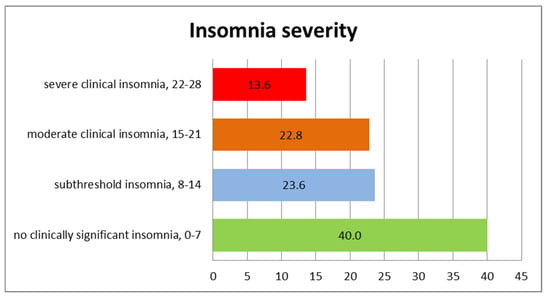
Background and Objectives: Sleep disturbances are common among patients with heart failure (HF), but the factors associated with insomnia severity remain incompletely characterized. This study aimed to determine the prevalence and severity of insomnia symptoms among patients with HF and to examine their associations with psychological, sociodemographic, lifestyle, and clinical factors. Materials and Methods: This observational cross-sectional study included 250 adults with HF consecutively recruited from an outpatient cardiology clinic between October 2025 and April 2026. Insomnia severity was assessed using the Insomnia Severity Index (ISI) and categorized as no clinically significant insomnia (ISI 0–7), subthreshold insomnia (ISI 8–14), moderate clinical insomnia (ISI 15–21), or severe clinical insomnia (ISI 22–28). Depression, anxiety, and stress were assessed using the Depression, Anxiety and Stress Scale-21 (DASS-21). Sociodemographic, lifestyle, and clinical characteristics were also evaluated. Group comparisons, Spearman’s rank correlation, and multinomial logistic regression were performed. Results: Of the 250 participants, 100 (40.0%) had no clinically significant insomnia, 59 (23.6%) had subthreshold insomnia, 57 (22.8%) had moderate clinical insomnia, and 34 (13.6%) had severe clinical insomnia. Overall, 60.0% had at least subthreshold insomnia symptoms, while 36.4% had moderate or severe symptoms. In group comparisons, insomnia severity was significantly associated with sex (p = 0.039) and left ventricular ejection fraction (LVEF) category (p = 0.006). The overall multinomial logistic regression model did not reach statistical significance (p = 0.095); however, sex and LVEF category showed statistically significant contributions at the predictor level. Female sex was associated with higher adjusted odds of subthreshold and moderate insomnia relative to no clinically significant insomnia. Compared with HFrEF, HFmrEF was associated with lower adjusted odds of subthreshold and moderate insomnia, whereas HFpEF was not significantly associated with either category. No significant associations were observed for severe insomnia. Depression, anxiety, and stress scores were not independently associated with insomnia severity. Conclusions: Insomnia symptoms were common among patients with HF. Sex and LVEF category showed category-specific associations with insomnia severity, whereas depression, anxiety, and stress were not significantly associated with ISI severity in this sample. These findings support routine assessment of insomnia in HF and highlight the need for further prospective studies to clarify the relationships between cardiac phenotype, psychological symptoms, and insomnia severity.

Psychiatry Int.

19 November 2026

Insomnia symptom severity among patients with heart failure.
  • Review
  • Open Access

The Rorschach Test (RT) has historically informed descriptions of perceptual and thought disturbances, but its contemporary clinical applications require appraisal at the level of specific scores and purposes. Objective: This critical narrative review distinguishes historical observations, empirical assessment evidence, and the limited literature on change during treatment in psychotic-spectrum disorders. Methods: PubMed, supplementary Google Scholar searches, and reference lists were used to identify historical, clinical, psychometric, and treatment-related sources available through 30 June 2026. Heterogeneous designs and scoring systems were synthesized narratively without formal risk-of-bias grading or an exhaustive screening audit. Results: Contemporary support is variable-specific: the Comprehensive System Perceptual Thinking Index (PTI) has construct-validity support, whereas Rorschach Performance Assessment System (R-PAS) studies provide separate evidence concerning coding reliability and broader patient–nonpatient discrimination. These findings do not establish diagnostic accuracy for individual psychotic disorders. Treatment evidence includes a small longitudinal thought-disorder study, historical observations, a non-psychotic depression study, and a cross-sectional PTI study in a mixed psychotic-disorder/bipolar I sample. Cross-sectional associations cannot demonstrate within-patient responsiveness, and changes during treatment cannot establish medication-specific effects. Conclusions: The RT is not established as a stand-alone diagnostic or pharmacological-monitoring instrument. Selected measures of thought and perceptual disturbance may complement multimethod assessment, but incremental clinical utility and sensitivity to meaningful longitudinal change remain insufficiently established. Prospective controlled studies should assess symptoms, cognition, medication exposure, adverse effects, functioning, and quality of life alongside predefined Rorschach outcomes.

Psychiatry Int.

20 November 2026

  • Article
  • Open Access

Regional forensic studies can complement national suicide mortality statistics by providing detailed case-level information. We examined all deaths classified medico-legally as suicide at the Institute of Legal Medicine, Târgu Mureș, between 1 January 2023 and 31 December 2025. The analysis characterized their sociodemographic profile, distribution of suicide methods, and post-mortem alcohol findings, and explored whether age, sex, and alcohol detection differed between hanging and non-hanging deaths. The retrospective dataset comprised 210 cases; descriptive and bivariate analyses were complemented by an exploratory logistic regression model. Men represented 82.86% of the series, and the mean age was 57.08 years. Hanging accounted for 83.81% of deaths, while alcohol was detected in 44.29% of cases. In the multivariable model, no statistically significant independent associations were observed for sex (male vs. female: OR = 1.98, 95% CI 0.83–4.71; p = 0.122), age (per year increase: OR = 1.01, 95% CI 0.97–1.05; p = 0.579), or alcohol detection (yes vs. no: OR = 1.12, 95% CI 0.60–2.08; p = 0.728). These data provide a current regional forensic description of suicide mortality in Mureș County. Because hanging overwhelmingly predominated and comparatively few deaths involved other methods, method-specific conclusions remain limited; larger multicenter datasets with standardized quantitative toxicology and clinical information are required.

Psychiatry Int.

18 November 2026

  • Article
  • Open Access

The Internet Gaming Disorder Scale-Short Form (IGDS9-SF) is widely used to assess Internet Gaming Disorder (IGD) based on the DSM-5 criteria; however, evidence of its psychometric properties in Latin America populations remains limited. This study examined the reliability and validity of the IGDS9-SF in a sample of 782 school-attending Mexican adolescents aged 12–18 years. Psychometric evidence was evaluated through analyses of internal structure, internal consistency, measurement invariance across sex and educational level, item functioning using Item Response Theory (IRT), and nomological validity. The IGDS9-SF showed evidence of a unidimensional structure, with excellent model fit and good internal consistency (ω = 0.85–0.87) Measurement invariance analyses supported scalar invariance across sex and educational level, although strict invariance was not established. Differential item functioning analyses identified statistically significant differences for the items assessing tolerance, escape, and jeopardizing relationships items; however, all effects sizes were trivial (∆R2 McFadden < 0.02) indicating negligible practical impact. IRT analyses showed that most items exhibited strong discrimination, particularly those assessing preoccupation, withdrawal, and tolerance, whereas the deception and escape items showed comparatively weaker performance. The test information curve indicated that the IGDS9-SF provided the greatest measurement precision at moderate to high levels of the latent trait. Nomological validity was supported by significant correlations with measures of internet addiction, depressive symptoms, anxiety, negative gaming consequences and online social capital. Overall, these findings provide psychometric support for using the IGDS9-SF to assess IGD symptoms in school-attending Mexican adolescents.

Psychiatry Int.

17 November 2026

Featured Articles of Last Quarter

Highly Accessed Articles

News & Conferences

Latest Issues

Open for Submission

Journal Sections

XFacebookLinkedIn
Psychiatry Int. - ISSN 2673-5318