Brief Report

Self-Loathing in Psychiatric Disorders: Self-Disgust Is Associated with Pathological Skin-Picking


Clinical Psychology, University of Graz, 8010 Graz, Austria
*
Author to whom correspondence should be addressed.
Psychiatry Int. 2026, 7(3), 117; https://doi.org/10.3390/psychiatryint7030117
Submission received: 22 January 2026 / Revised: 27 April 2026 / Accepted: 13 May 2026 / Published: 1 June 2026
(This article belongs to the Section Clinical Psychiatry and Psychotherapy)

Abstract

Background: Psychiatric disorders, including skin-picking disorder (SPD), may be conceptualized as manifestations of a dysregulated behavioral immune system or maladaptive emotion schema, in which disgust—typically elicited by external threats—is directed toward the self. Method: A total of 147 females (mean age = 32 years) with SPD completed disorder-specific measures of automatic and focused skin-picking, as well as scales assessing self-disgust and disgust sensitivity. Correlation and path analyses were conducted to examine whether misdirected disgust toward one’s own body (self-disgust) and difficulties in regulating disgust (disgust sensitivity) are associated with pathological skin picking. Results: Self-disgust was substantially correlated with focused skin-picking. The path analysis indicated a direct path from self-disgust to focused skin-picking and an indirect path from disgust sensitivity, mediated by self-disgust, to focused skin-picking. Similar associations were not present for automatic skin-picking. Limitations: Due to the cross-sectional design of the study, the results should be interpreted as associative rather than causal and do not allow conclusions about temporal or directional mediation processes. Conclusions: Assessment of both disgust-related traits should be integrated into the diagnostic process for SPD. Disgust regulation training, as well as compassion-based strategies, may be beneficial in modifying pathological skin-picking.

1. Introduction

Disgust is a basic emotion that—from an evolutionary perspective—has emerged as an adaptive mechanism to protect humans from disease [1,2]. Within this framework, disgust constitutes a central component of the behavioral immune system [3], which serves to detect, avoid, and withdraw from threats originally related to pathogens and parasites. Disgust can also motivate hygiene-related behaviors intended to eliminate such threats [4].
In several psychopathologies, disgust emerges as a predominant emotional response. Patients diagnosed with specific phobias (e.g., spider phobia, blood-injection-injury phobia) or obsessive–compulsive disorder (OCD) with washing/cleaning symptoms often report excessive and difficult-to-control feelings of disgust when exposed to disorder-relevant stimuli [5,6]. This pattern suggests both an elevated propensity for disgust and heightened disgust sensitivity.
Disgust responses in the aforementioned psychopathologies are elicited by stimuli present in the external environment. However, in certain psychiatric disorders, the self can become the target of this basic emotion. Self-disgust is defined as the tendency to experience disgust when evaluating one’s own personal characteristics and behaviors [7]. Persistently elevated self-disgust is dysfunctional and has been associated with a range of mental disorders and related symptoms, including depression, borderline personality disorder, eating disorders, trauma-related symptoms, and suicidal ideation [7,8,9,10].
Self-disgust can be conceptualized as an autoimmune-like dysfunction of the behavioral immune system [3]. By analogy, an autoimmune disease involves a misdirected immune response in which the body attacks its own healthy cells, tissues, or organs rather than targeting harmful invaders such as bacteria or viruses. Similarly, in self-disgust, the behavioral immune system treats normal internal characteristics as foreign and disgusting. This is often accompanied by exaggerated and difficult-to-regulate responses, reflecting elevated disgust propensity and disgust sensitivity toward internal disgust elicitors.
Another conceptualization of self-disgust has been provided by Overton et al. [11]. In their framework, self-disgust is described as a stable pattern of disgust-based cognitive-affective responding to the self. This emotion schema is characterized by a maladaptive and persistent self-focused generalization of what is otherwise an adaptive disgust response. Thus, self-disgust can be understood as a trait-like construct and measured as such [7]. The model further suggests that self-disgust may develop through the internalization of others’ disgust reactions and early experiences of criticism, rejection, or abuse. Self-disgust is marked by strong visceral disgust feelings and urges to withdraw or “get rid of” the perceived disgusting parts of oneself [11].
Considering these models, self-disgust may contribute to psychopathologies involving body-focused repetitive behaviors (BFRBs). One example is skin-picking disorder (SPD), which is characterized by repetitive and excessive manipulation of one’s own skin (e.g., squeezing, scratching) resulting in visible wounds. SPD is a relatively common psychiatric disorder, with prevalence estimates ranging from 3% to 5% in the general population and a female predominance (female-to-male odds ratio = 1.45) [12]. The disorder typically has its onset during adolescence (puberty), although for some individuals, symptoms may emerge later. According to Lin et al. [13], skin-picking severity peaks at the transition to adulthood.
Manifestations of SPD vary with respect to the individual’s level of awareness. Specifically, individuals may engage in either automatic or focused skin-picking. The automatic subtype occurs outside of conscious awareness, typically while the person is engaged in other activities. In contrast, the focused subtype involves intentional behavior (e.g., performed in front of a mirror) and often has the quality of a ritual [14].
Pathological skin picking is associated with functional impairment and/or clinically significant distress [15]. A qualitative study [16] found that participants’ distress was partly mediated by beliefs about changes in their appearance resulting from skin-picking. Central emotional experiences in this context included shame, guilt, and embarrassment, which are self-conscious emotions and conceptually related to self-disgust [17].
To date, only a limited number of studies have examined self-disgust in BFRB disorders. Research on SPD has shown that individuals with self-reported pathological skin picking, as well as those with a clinical diagnosis of SPD [18,19], exhibit elevated levels of self-disgust. However, the relationship between self-disgust and pathological skin picking, including its directionality, has not yet been investigated.
For the present investigation, path analysis was used to estimate the pattern of direct associations between self-disgust and skin-picking behavior, while accounting for behavioral subtypes (focused vs. automatic picking) and disgust sensitivity (i.e., the capacity to regulate disgust), as well as the associations among these variables. Based on the conceptualization of self-disgust [3,11], it was tested whether disgust regulation deficits are associated with elevated self-disgust, which is in turn linked to greater skin-picking severity. A competing model, based on the findings of [16], tested whether a specified path leading from pathological skin-picking to self-disgust would be supported by the data.

2. Materials and Methods

2.1. Participants

Data were derived from an online survey conducted in two German-speaking countries (Germany, Austria) that had been advertised on social media and in self-help groups for BFRBs. Inclusion criteria for participation were a minimum age of 18 years and a self-reported primary diagnosis of SPD. All participants were informed that the data collection was anonymous, that the study could be terminated at any time without giving reasons, and that publication of the anonymized data was planned. All participants provided their informed consent. The survey was approved by the ethics committee of the university. The survey was open to all genders. Since the majority of respondents indicated female sex (87%), data analysis was restricted to females (n = 147).

2.2. Questionnaires

The survey included the following questionnaires:
(a)
The Milwaukee Inventory for the Dimensions of Adult Skin-picking (MIDAS, [14]) consists of 12 items, which assess focused picking (‘I pick my skin when I am experiencing a negative emotion, such as stress, anger, frustration, or sadness’; 6 items) and automatic picking (‘I don’t notice that I have picked my skin until after it happened’; 6 items). Items are rated from 1 (“not true for any of my picking”) to 5 (“true for all of my picking”). Both subscales demonstrated very good internal consistency (focused; Cronbach’s α = 0.90; automatic: α = 0.87). Across all items, two data points were missing.
(b)
The subscale Personal Self-Disgust of the Questionnaire for Assessing Self-Disgust (QASD, [20]) consists of 9 items (α = 0.90) and focuses on disgust elicited by one’s own physical appearance and personality; e.g., ‘I find myself repulsive’. The items are rated on 5-point scales (0 = never; 4 = always). Possible mean scores range between 0 and 4. According to an ROC (Receiver Operating Characteristic) analysis, the cut-off score that differentiated between clinical and nonclinical groups was 0.39. This score was associated with a sensitivity of 83% (correct identification of individuals with a diagnosis of a mental disorder) and 75% specificity (correct identification of healthy individuals). The AUC was 0.89, indexing excellent classifying accuracy.
(c)
The Scale for the Assessment of Disgust Sensitivity (SADS; [21]) is a 7-item scale assessing difficulties in regulating one’s own feelings of disgust (e.g., ‘Experiencing disgust is stressful for me’). Items are rated on 5-point Likert scales (1 = not at all; 5 = very much). The internal consistency of the scale was α = 0.88. Across all items, 28 data points were missing.

2.3. Statistical Analysis

Associations between questionnaire scores were assessed with Pearson’s correlations.
For the path analysis, the primary model was based on the assumption that difficulties in regulating disgust (Disgust Sensitivity) contribute to increased self-directed disgust (Self-Disgust), which in turn is linked to skin-picking behavior (Focused Picking and Automatic Picking). A competing model tested whether disgust sensitivity is directly linked with pathological skin-picking behavior (automatic and focused), with self-disgust emerging as a correlate. Both models were estimated using maximum likelihood (listwise deletion) with Satorra–Bentler scaled χ2 tests to account for non-normality. Standard errors and confidence intervals were obtained via bias-corrected bootstrapping with 2000 iterations.
Path analysis allows for the simultaneous estimation of all specified relationships among observed variables, enabling direct evaluation of both direct and combined associations within a single model. This approach provides an efficient framework for testing complex dependency structures, allowing for a comprehensive assessment of the relationships between variables.
Model fit was evaluated using χ2, SRMR, CFI and RMSEA. For all analyses, results were considered statistically significant if p < 0.05. All analyses were carried out with JAMOVI (v 2.7.13.0) and the pathj-package (v 1.1.1).
Post hoc Monte Carlo power analyses were conducted to evaluate whether the sample size was sufficient to detect the hypothesized associations. Using 1000 Monte Carlo replications and the observed sample size (n = 147), population parameters were fixed to the empirically observed path coefficients. Power was estimated for all paths and combined associations in the final path model.

3. Results

3.1. Descriptive Statistics and Correlations

Mean scores on the questionnaires, as well as participants’ sociodemographic characteristics, are presented in Table 1.
Disgust sensitivity and self-disgust were substantially correlated with each other (Table 2). Self-disgust was associated with focused but not with automatic skin-picking. Participants’ age was neither correlated with the degree of focused/automatic skin-picking, disgust sensitivity, nor self-disgust (all r < 0.09).

3.2. Post Hoc Power Analysis

Post hoc power analysis showed excellent power for the combined association via Self-Disgust (power = 1.00), whereas power for paths involving Automatic Picking was low (power ≈ 0.32–0.35).

3.3. Path Model

The path model showed excellent fit indices for Model 1: SRMR = 0.02, CFI = 1.00, and RMSEA = 0.00 [CI: 0.00–0.17], RMSEAp = 0.555; χ2 = 1.58, p = 0.454. Explained variance for Self-Disgust was R2 = 0.26; Focused Picking: R2 = 0.30; Automatic Picking: R2 = 0.02.
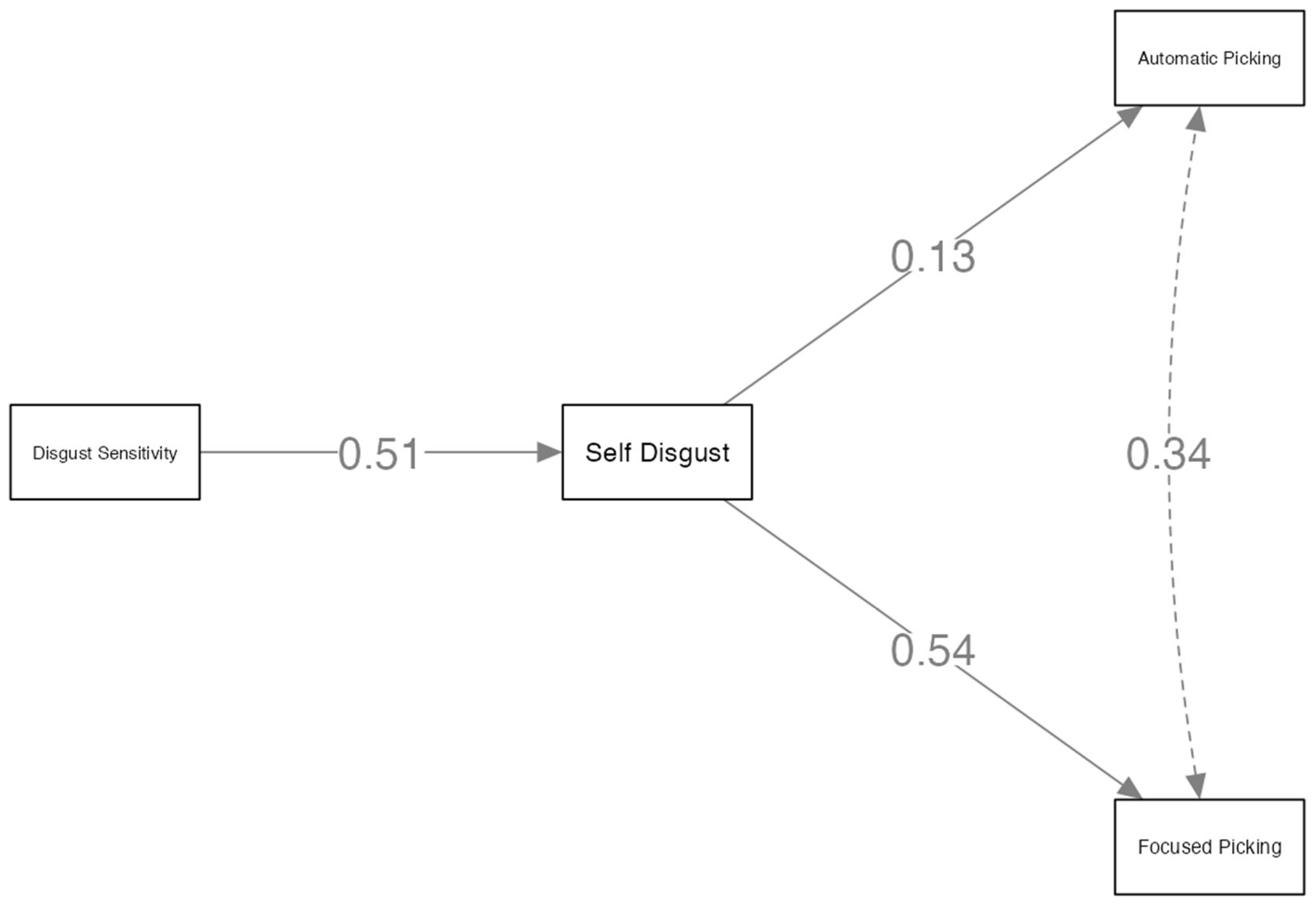
The direct paths from Disgust Sensitivity to Self-Disgust (B = 0.60 [0.38, 0.87], SE = 0.10; β = 0.51) and from Self-Disgust to Focused Picking (B = 4.37 [3.11, 5.63], SE = 0.65; β = 0.54) were statistically significant (p < 0.001; see Figure 1). The path from Self-Disgust to Automatic Picking did not reach statistical significance. Moreover, the association pattern linking disgust sensitivity to self-disgust and, in turn, to focused picking was statistically significant, as the 95% bootstrapped confidence interval for this combined association did not include zero (B = 2.63 [1.69, 3.77], SE = 0.56; β = 0.28, p < 0.001). The corresponding combined association from disgust sensitivity through self-disgust to automatic picking was not statistically significant. Detailed statistical values for all direct and combined paths are provided in Appendix A.
Model 2 showed a poor fit (SRMR = 0.14, RMSEA = 0.42 [0.32, 0.54], RMSEAp < 0.001, CFI = 0.52; χ2 = 44.55, p < 0.001) and is thus not further considered.

4. Discussion

This analysis focused on self-disgust in individuals with pathological skin-picking. Mean self-disgust scores for these participants exceeded the clinical cut-off, indicating dysfunctional levels of self-loathing. According to Powell et al. [22], self-disgust is a self-conscious emotion that targets core aspects of the self. Unlike guilt or embarrassment, which are typically transient and linked to discrete behaviors, self-disgust can become enduring and motivates behaviors that directly or indirectly harm the body.
This conceptualization is consistent with empirical evidence. Clinical interviews and reports from online support forums indicate that individuals with skin-picking disorder (SPD) frequently experience disgust when viewing their skin in a mirror. Such visual inspection amplifies the disgust-driven urge to pick—for example: “I must get anything dirty out of my body, so I pick and pick!” (see [23], p. 1778). This aligns with findings from the path analysis, which identified a direct association between self-disgust and focused skin-picking, as well as a pattern in which disgust sensitivity was related to self-disgust, which in turn was related to focused skin-picking. These associations may reflect a dysregulated behavioral immune system, characterized by difficulties in down-regulating disgust directed toward one’s own body, which in turn may be linked to focused skin-picking.
It is notable that levels of automatic skin-picking were not correlated with self-disgust. This finding aligns with the concept of self-disgust as a conscious emotional schema, a cognitive-affective structure of which individuals are clearly aware [11]. Moreover, the model that tested whether skin-picking severity is linked to self-disgust was not significant. Anderson and Clarke [23] suggested that patients perceive the damage caused by skin-picking as disgusting. This view was not supported by the path analysis. However, the present study did not address a potentially relevant factor in this context: experienced stigmatization. A large-scale study involving over 5000 dermatological patients (e.g., with psoriasis or atopic dermatitis) demonstrated that visible skin alterations are associated with perceived stigmatization [24]. Individuals with these conditions frequently report being stared at or treated differently by others. Therefore, future research should consider including this construct.
Additional limitations of the present study include the reliance on self-reported diagnoses provided by a relatively small convenience sample. However, 38 percent indicated having received clinical verification of their diagnosis. Furthermore, the dataset included only female participants, limiting the generalizability of the findings. We also lacked data on comorbid psychopathology (e.g., depression, anxiety disorders), which precluded adjustment for these potentially confounding variables. Moreover, the post hoc power analysis indicated that not all paths were adequately powered, particularly those involving automatic picking. Finally, this study had a cross-sectional design, and we acknowledge the concern regarding temporal ordering [25]. However, we note that our aim was not to make causal claims but to examine whether the observed pattern of associations is consistent with a theoretically specified indirect pathway. As recommended by some authors [26], cross-sectional indirect effects can be informative as preliminary, theory-driven evidence when interpreted strictly as associative rather than temporal or causal mediation. It also should be noted that longitudinal mediation models taking time into account bring problems of their own, such as choosing measurement intervals and the number of measurement occasions.
Future research should nevertheless implement longitudinal designs in order to enable causal inferences. In addition, future research on self-disgust and skin-picking could employ complementary qualitative methodologies to further investigate related lived experiences and potential causal mechanisms. For example, interpretative phenomenological analysis could help elucidate how individuals with SPD make sense of their experiences of disgust, and how disgust is embodied, narrated, and regulated.

5. Conclusions

The computed analyses demonstrated that self-disgust is strongly associated with focused skin-picking, with potentially mediating effects of disgust sensitivity.
The present findings (correlational, path-analytical) have important clinical implications. First, given the clear link between self-disgust and the severity of skin-picking disorder (SPD), particularly with respect to focused skin-picking, the assessment of this emotion schema should be incorporated into standard diagnostic procedures for this psychiatric condition. Second, interventions targeting disgust regulation may represent a promising therapeutic avenue for modifying skin-picking behavior. As outlined in the model proposed by Overton et al. [11], self-disgust typically develops early in an individual’s developmental history and acquires trait-like characteristics. It is therefore persistent and may be difficult to modify directly. However, targeting emotion regulation in response to external disgust stimuli may constitute a feasible first step. For example, strategies such as perspective taking and cognitive reappraisal have been shown to effectively reduce the intensity of disgust responses [27]. In a second step, compassion-based approaches may be beneficial by aiming to replace rejection with care (e.g., “this part of me deserves kindness, not expulsion”). A study by Powell et al. [22] demonstrated that self-affirming trait kindness regulates disgust toward one’s physical appearance. Accordingly, self-compassion practices (e.g., imagery-based interventions) targeting disgust toward one’s own body, thoughts, or memories may help to reduce self-disgust and associated pathological skin-picking.

Author Contributions

Conceptualization, A.S.; formal analysis, A.W.; writing—original draft preparation, A.S.; writing—review and editing, A.W. All authors have read and agreed to the published version of the manuscript.

Funding

This research received no external funding.

Institutional Review Board Statement

The study was conducted in accordance with the Declaration of Helsinki and approved by the Ethics Committee of the University of Graz (GZ 39/29/26ex2018/19, date of approval: 25 February 2019).

Informed Consent Statement

Informed consent was obtained from all subjects involved in the study.

Data Availability Statement

Acknowledgments

Open Access Funding by the University of Graz. During the preparation of this manuscript, the authors used ChatGPT 5.5 for language editing. The authors have reviewed and edited the output and take full responsibility for the content of this publication.

Conflicts of Interest

The authors declare no conflicts of interest.

Appendix A

Table A1. Parameter estimates for the direct associations.
95% Confidence Interval
Dependent variablePredictorEstimateSELowerUpperβzp
Self-DisgustDisgust Sensitivity0.600.100.380.780.515.82<0.001
Automatic PickingSelf-Disgust0.760.62−0.432.010.131.220.221
Focused PickingSelf-Disgust4.370.653.115.630.546.78<0.001
Table A2. Parameter estimates for the combined associations.
95% Confidence Interval
DescriptionEstimateSELowerUpperβzp
Disgust Sensitivity ⇒ Self-Disgust ⇒ Automatic Picking0.460.41−0.221.350.071.130.258
Disgust Sensitivity ⇒ Self-Disgust ⇒ Focused Picking2.630.561.693.770.284.73<0.001

References

  1. Tybur, J.M.; Lieberman, D.; Kurzban, R.; DeScioli, P. Disgust: Evolved function and structure. Psychol. Rev. 2013, 120, 65–84. [Google Scholar] [CrossRef]
  2. van Leeuwen, F.; Jaeger, B.; Tybur, J.M. A behavioural immune system perspective on disgust and social prejudice. Nat. Rev. Psychol. 2023, 2, 676–687. [Google Scholar] [CrossRef]
  3. Schaller, M.; Duncan, L.A. The behavioral immune system: Its evolution and social psychological implications. In Evolution and the Social Mind: Evolutionary Psychology and Social Cognition; Sydney Symposium of Social Psychology; Routledge/Taylor & Francis Group: Abingdon, UK, 2007; pp. 293–307. [Google Scholar]
  4. Curtis, V.; Aunger, R.; Rabie, T. Evidence that disgust evolved to protect from risk of disease. Proc. R. Soc. B Biol. Sci. 2004, 271, 131–133. [Google Scholar] [CrossRef]
  5. Davey, G.C.L. Disgust: The disease-avoidance emotion and its dysfunctions. Philos. Trans. R. Soc. B Biol. Sci. 2011, 366, 3453–3465. [Google Scholar] [CrossRef]
  6. Mitchell, B.J.; Olatunji, B.O. State of the Science: Disgust and the Anxiety Disorders. Behav. Ther. 2024, 55, 1144–1157. [Google Scholar] [CrossRef]
  7. Overton, P.G.; Markland, F.E.; Taggart, H.S.; Bagshaw, G.L.; Simpson, J. Self-disgust mediates the relationship between dysfunctional cognitions and depressive symptomatology. Emotion 2008, 8, 379–385. [Google Scholar] [CrossRef]
  8. Clarke, A.; Simpson, J.; Varese, F. A systematic review of the clinical utility of the concept of self-disgust. Clin. Psychol. Psychother. 2019, 26, 110–134. [Google Scholar] [CrossRef] [PubMed]
  9. Ille, R.; Schöggl, H.; Kapfhammer, H.-P.; Arendasy, M.; Sommer, M.; Schienle, A. Self-disgust in mental disorders—Symptom-related or disorder-specific? Compr. Psychiatry 2014, 55, 938–943. [Google Scholar] [CrossRef]
  10. Schienle, A.; Schwab, D.; Höfler, C.; Freudenthaler, H.H. Self-disgust and its relationship with lifetime suicidal ideation and behavior. Crisis 2020, 41, 344–350. [Google Scholar] [CrossRef]
  11. Overton, P.G.; Powell, P.A.; Simpson, J. (Eds.) The Revolting Self: Perspectives on the Psychological, Social, and Clinical Implications of Self-Directed Disgust; Routledge/Taylor & Francis: Abingdon, UK, 2015. [Google Scholar]
  12. Farhat, L.C.; Reid, M.; Bloch, M.H.; Olfson, E. Prevalence and gender distribution of excoriation (skin-picking) disorder: A systematic review and meta-analysis. J. Psychiatr. Res. 2023, 161, 412–418. [Google Scholar] [CrossRef]
  13. Lin, A.; Farhat, L.C.; Flores, J.M.; Levine, J.L.; Fernandez, T.V.; Bloch, M.H.; Olfson, E. Characteristics of trichotillomania and excoriation disorder across the lifespan. Psychiatry Res. 2023, 322, 115120. [Google Scholar] [CrossRef]
  14. Walther, M.R.; Flessner, C.A.; Conelea, C.A.; Woods, D.W. The Milwaukee Inventory for the Dimensions of Adult Skin Picking (MIDAS): Initial development and psychometric properties. J. Behav. Ther. Exp. Psychiatry 2009, 40, 127–135. [Google Scholar] [CrossRef]
  15. American Psychiatric Association. Diagnostic and Statistical Manual of Mental Disorders, 5th ed.; American Psychiatric Association: Arlington, VA, USA, 2013. [Google Scholar] [CrossRef]
  16. Anderson, S.; Clarke, V.; Thomas, Z. The problem with picking: Permittance, escape and shame in problematic skin picking. Psychol. Psychother. 2023, 96, 83–100. [Google Scholar] [CrossRef]
  17. Schienle, A. The clinical phenomenology of skin-picking disorder—Are there any obsessive-compulsive components? Compr. Psychiatry 2025, 138, 152575. [Google Scholar] [CrossRef]
  18. Schienle, A.; Zorjan, S.; Übel, S.; Wabnegger, A. Prediction of automatic and focused skin picking based on trait disgust and emotion dysregulation. J. Obsessive Compul. Relat. Disord. 2018, 16, 1–5. [Google Scholar] [CrossRef]
  19. Schienle, A.; Schlintl, C.; Wabnegger, A. A neurobiological evaluation of soft touch training for patients with skin-picking disorder. NeuroImage Clin. 2022, 36, 103254. [Google Scholar] [CrossRef]
  20. Schienle, A.; Ille, R.; Sommer, M.; Arendasy, M. Diagnostik von Selbstekel im Rahmen der Depression. Verhaltenstherapie 2014, 24, 15–20. [Google Scholar] [CrossRef]
  21. Schienle, A.; Dietmaier, G.; Ille, R.; Leutgeb, V. Eine Skala zur Erfassung der Ekelsensitivität (SEE). Z. Klin. Psychol. Psychother. 2010, 39, 80–86. [Google Scholar] [CrossRef]
  22. Powell, P.A.; Simpson, J.; Overton, P.G. Self-affirming trait kindness regulates disgust toward one’s physical appearance. Body Image 2015, 12, 98–107. [Google Scholar] [CrossRef]
  23. Anderson, S.; Clarke, V. Disgust, shame and the psychosocial impact of skin picking: Evidence from an online support forum. J. Health Psychol. 2019, 24, 1773–1784. [Google Scholar] [CrossRef]
  24. Van Beugen, S.; Schut, C.; Kupfer, J.; Bewley, A.P.; Finlay, A.Y.; Gieler, U.; Thompson, A.R.; Grazia-Cazaña, T.; Balieva, F.; Ferreira, B.R.; et al. Perceived Stigmatization among Dermatological Outpatients Compared with Controls: An Observational Multicentre Study in 17 European Countries. Acta Derm. Venereol. 2023, 103, adv6485. [Google Scholar] [CrossRef]
  25. Cole, D.A.; Maxwell, S.E. Testing mediational models with longitudinal data: Questions and tips in the use of structural equation modeling. J. Abnorm. Psychol. 2003, 112, 558–577. [Google Scholar] [CrossRef]
  26. Shrout, P.E.; Bolger, N. Mediation in experimental and nonexperimental studies: New procedures and recommendations. Psychol. Methods 2002, 7, 422–445. [Google Scholar] [CrossRef]
  27. Olatunji, B.O.; Berg, H.E.; Zhao, Z. Emotion regulation of fear and disgust: Differential effects of reappraisal and suppression. Cogn. Emot. 2017, 31, 403–410. [Google Scholar] [CrossRef]
Figure 1. Path diagram including standardized beta estimates for both direct and combined associations between manifest variables.
Psychiatryint 07 00117 g001
Table 1. Participant characteristics.
VariableM [95% CI] (SD)Skewness; Kurtosis
Age (years) 31.75 (13.00) 1.14; 0.36
Education (years) 12.24 (2.13) 0.49; −0.23
Automatic skin-picking 17.54 [16.75, 18.34] (4.85) 0.31; −0.22
Focused skin-picking 17.63 [16.32, 18.94] (7.98) −0.01; −1.28
Self-disgust 1.04 [0.88, 1.20] (0.97) 0.77; −0.45
Disgust sensitivity 1.89 [1.76, 2.03] (0.74) 0.90; 0.99
Note: Means [confidence intervals] (standard deviations).
Table 2. Pearson correlations.
Automatic
Skin-Picking
Focused
Skin-Picking
Self-Disgust
Automatic skin-picking -
Focused skin-picking 0.33 *** -
Self-disgust 0.160.59 *** -
Disgust sensitivity 0.120.22 *0.51 ***
Note: * p < 0.05, *** p < 0.001.
Disclaimer/Publisher’s Note: The statements, opinions and data contained in all publications are solely those of the individual author(s) and contributor(s) and not of MDPI and/or the editor(s). MDPI and/or the editor(s) disclaim responsibility for any injury to people or property resulting from any ideas, methods, instructions or products referred to in the content.