

Self-Loathing in Psychiatric Disorders: Self-Disgust Is Associated with Pathological Skin-Picking


Abstract
1. Introduction
2. Materials and Methods
2.1. Participants
2.2. Questionnaires
- (a)
- The Milwaukee Inventory for the Dimensions of Adult Skin-picking (MIDAS, [14]) consists of 12 items, which assess focused picking (‘I pick my skin when I am experiencing a negative emotion, such as stress, anger, frustration, or sadness’; 6 items) and automatic picking (‘I don’t notice that I have picked my skin until after it happened’; 6 items). Items are rated from 1 (“not true for any of my picking”) to 5 (“true for all of my picking”). Both subscales demonstrated very good internal consistency (focused; Cronbach’s α = 0.90; automatic: α = 0.87). Across all items, two data points were missing.
- (b)
- The subscale Personal Self-Disgust of the Questionnaire for Assessing Self-Disgust (QASD, [20]) consists of 9 items (α = 0.90) and focuses on disgust elicited by one’s own physical appearance and personality; e.g., ‘I find myself repulsive’. The items are rated on 5-point scales (0 = never; 4 = always). Possible mean scores range between 0 and 4. According to an ROC (Receiver Operating Characteristic) analysis, the cut-off score that differentiated between clinical and nonclinical groups was 0.39. This score was associated with a sensitivity of 83% (correct identification of individuals with a diagnosis of a mental disorder) and 75% specificity (correct identification of healthy individuals). The AUC was 0.89, indexing excellent classifying accuracy.
- (c)
- The Scale for the Assessment of Disgust Sensitivity (SADS; [21]) is a 7-item scale assessing difficulties in regulating one’s own feelings of disgust (e.g., ‘Experiencing disgust is stressful for me’). Items are rated on 5-point Likert scales (1 = not at all; 5 = very much). The internal consistency of the scale was α = 0.88. Across all items, 28 data points were missing.
2.3. Statistical Analysis
3. Results
3.1. Descriptive Statistics and Correlations
3.2. Post Hoc Power Analysis
3.3. Path Model
4. Discussion
5. Conclusions
Author Contributions
Funding
Institutional Review Board Statement
Informed Consent Statement
Data Availability Statement
Acknowledgments
Conflicts of Interest
Appendix A

| 95% Confidence Interval | ||||||||
|---|---|---|---|---|---|---|---|---|
| Dependent variable | Predictor | Estimate | SE | Lower | Upper | β | z | p |
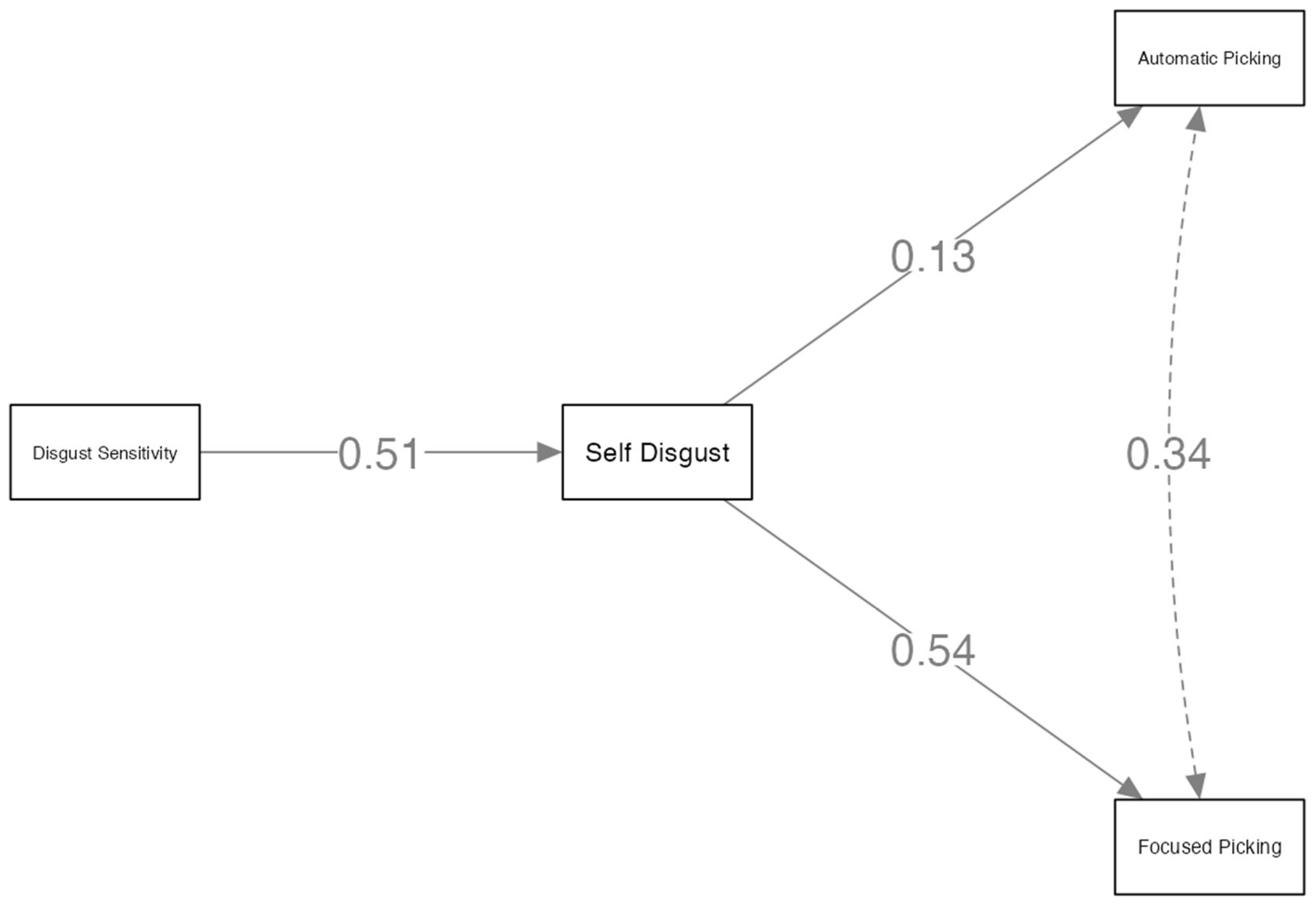
| Self-Disgust | Disgust Sensitivity | 0.60 | 0.10 | 0.38 | 0.78 | 0.51 | 5.82 | <0.001 |
| Automatic Picking | Self-Disgust | 0.76 | 0.62 | −0.43 | 2.01 | 0.13 | 1.22 | 0.221 |
| Focused Picking | Self-Disgust | 4.37 | 0.65 | 3.11 | 5.63 | 0.54 | 6.78 | <0.001 |
| 95% Confidence Interval | |||||||
|---|---|---|---|---|---|---|---|
| Description | Estimate | SE | Lower | Upper | β | z | p |
| Disgust Sensitivity ⇒ Self-Disgust ⇒ Automatic Picking | 0.46 | 0.41 | −0.22 | 1.35 | 0.07 | 1.13 | 0.258 |
| Disgust Sensitivity ⇒ Self-Disgust ⇒ Focused Picking | 2.63 | 0.56 | 1.69 | 3.77 | 0.28 | 4.73 | <0.001 |
References
- Tybur, J.M.; Lieberman, D.; Kurzban, R.; DeScioli, P. Disgust: Evolved function and structure. Psychol. Rev. 2013, 120, 65–84. [Google Scholar] [CrossRef]
- van Leeuwen, F.; Jaeger, B.; Tybur, J.M. A behavioural immune system perspective on disgust and social prejudice. Nat. Rev. Psychol. 2023, 2, 676–687. [Google Scholar] [CrossRef]
- Schaller, M.; Duncan, L.A. The behavioral immune system: Its evolution and social psychological implications. In Evolution and the Social Mind: Evolutionary Psychology and Social Cognition; Sydney Symposium of Social Psychology; Routledge/Taylor & Francis Group: Abingdon, UK, 2007; pp. 293–307. [Google Scholar]
- Curtis, V.; Aunger, R.; Rabie, T. Evidence that disgust evolved to protect from risk of disease. Proc. R. Soc. B Biol. Sci. 2004, 271, 131–133. [Google Scholar] [CrossRef]
- Davey, G.C.L. Disgust: The disease-avoidance emotion and its dysfunctions. Philos. Trans. R. Soc. B Biol. Sci. 2011, 366, 3453–3465. [Google Scholar] [CrossRef]
- Mitchell, B.J.; Olatunji, B.O. State of the Science: Disgust and the Anxiety Disorders. Behav. Ther. 2024, 55, 1144–1157. [Google Scholar] [CrossRef]
- Overton, P.G.; Markland, F.E.; Taggart, H.S.; Bagshaw, G.L.; Simpson, J. Self-disgust mediates the relationship between dysfunctional cognitions and depressive symptomatology. Emotion 2008, 8, 379–385. [Google Scholar] [CrossRef]
- Clarke, A.; Simpson, J.; Varese, F. A systematic review of the clinical utility of the concept of self-disgust. Clin. Psychol. Psychother. 2019, 26, 110–134. [Google Scholar] [CrossRef] [PubMed]
- Ille, R.; Schöggl, H.; Kapfhammer, H.-P.; Arendasy, M.; Sommer, M.; Schienle, A. Self-disgust in mental disorders—Symptom-related or disorder-specific? Compr. Psychiatry 2014, 55, 938–943. [Google Scholar] [CrossRef]
- Schienle, A.; Schwab, D.; Höfler, C.; Freudenthaler, H.H. Self-disgust and its relationship with lifetime suicidal ideation and behavior. Crisis 2020, 41, 344–350. [Google Scholar] [CrossRef]
- Overton, P.G.; Powell, P.A.; Simpson, J. (Eds.) The Revolting Self: Perspectives on the Psychological, Social, and Clinical Implications of Self-Directed Disgust; Routledge/Taylor & Francis: Abingdon, UK, 2015. [Google Scholar]
- Farhat, L.C.; Reid, M.; Bloch, M.H.; Olfson, E. Prevalence and gender distribution of excoriation (skin-picking) disorder: A systematic review and meta-analysis. J. Psychiatr. Res. 2023, 161, 412–418. [Google Scholar] [CrossRef]
- Lin, A.; Farhat, L.C.; Flores, J.M.; Levine, J.L.; Fernandez, T.V.; Bloch, M.H.; Olfson, E. Characteristics of trichotillomania and excoriation disorder across the lifespan. Psychiatry Res. 2023, 322, 115120. [Google Scholar] [CrossRef]
- Walther, M.R.; Flessner, C.A.; Conelea, C.A.; Woods, D.W. The Milwaukee Inventory for the Dimensions of Adult Skin Picking (MIDAS): Initial development and psychometric properties. J. Behav. Ther. Exp. Psychiatry 2009, 40, 127–135. [Google Scholar] [CrossRef]
- American Psychiatric Association. Diagnostic and Statistical Manual of Mental Disorders, 5th ed.; American Psychiatric Association: Arlington, VA, USA, 2013. [Google Scholar] [CrossRef]
- Anderson, S.; Clarke, V.; Thomas, Z. The problem with picking: Permittance, escape and shame in problematic skin picking. Psychol. Psychother. 2023, 96, 83–100. [Google Scholar] [CrossRef]
- Schienle, A. The clinical phenomenology of skin-picking disorder—Are there any obsessive-compulsive components? Compr. Psychiatry 2025, 138, 152575. [Google Scholar] [CrossRef]
- Schienle, A.; Zorjan, S.; Übel, S.; Wabnegger, A. Prediction of automatic and focused skin picking based on trait disgust and emotion dysregulation. J. Obsessive Compul. Relat. Disord. 2018, 16, 1–5. [Google Scholar] [CrossRef]
- Schienle, A.; Schlintl, C.; Wabnegger, A. A neurobiological evaluation of soft touch training for patients with skin-picking disorder. NeuroImage Clin. 2022, 36, 103254. [Google Scholar] [CrossRef]
- Schienle, A.; Ille, R.; Sommer, M.; Arendasy, M. Diagnostik von Selbstekel im Rahmen der Depression. Verhaltenstherapie 2014, 24, 15–20. [Google Scholar] [CrossRef]
- Schienle, A.; Dietmaier, G.; Ille, R.; Leutgeb, V. Eine Skala zur Erfassung der Ekelsensitivität (SEE). Z. Klin. Psychol. Psychother. 2010, 39, 80–86. [Google Scholar] [CrossRef]
- Powell, P.A.; Simpson, J.; Overton, P.G. Self-affirming trait kindness regulates disgust toward one’s physical appearance. Body Image 2015, 12, 98–107. [Google Scholar] [CrossRef]
- Anderson, S.; Clarke, V. Disgust, shame and the psychosocial impact of skin picking: Evidence from an online support forum. J. Health Psychol. 2019, 24, 1773–1784. [Google Scholar] [CrossRef]
- Van Beugen, S.; Schut, C.; Kupfer, J.; Bewley, A.P.; Finlay, A.Y.; Gieler, U.; Thompson, A.R.; Grazia-Cazaña, T.; Balieva, F.; Ferreira, B.R.; et al. Perceived Stigmatization among Dermatological Outpatients Compared with Controls: An Observational Multicentre Study in 17 European Countries. Acta Derm. Venereol. 2023, 103, adv6485. [Google Scholar] [CrossRef]
- Cole, D.A.; Maxwell, S.E. Testing mediational models with longitudinal data: Questions and tips in the use of structural equation modeling. J. Abnorm. Psychol. 2003, 112, 558–577. [Google Scholar] [CrossRef]
- Shrout, P.E.; Bolger, N. Mediation in experimental and nonexperimental studies: New procedures and recommendations. Psychol. Methods 2002, 7, 422–445. [Google Scholar] [CrossRef]
- Olatunji, B.O.; Berg, H.E.; Zhao, Z. Emotion regulation of fear and disgust: Differential effects of reappraisal and suppression. Cogn. Emot. 2017, 31, 403–410. [Google Scholar] [CrossRef]

| Variable | M [95% CI] (SD) | Skewness; Kurtosis |
|---|---|---|
| Age (years) | 31.75 (13.00) | 1.14; 0.36 |
| Education (years) | 12.24 (2.13) | 0.49; −0.23 |
| Automatic skin-picking | 17.54 [16.75, 18.34] (4.85) | 0.31; −0.22 |
| Focused skin-picking | 17.63 [16.32, 18.94] (7.98) | −0.01; −1.28 |
| Self-disgust | 1.04 [0.88, 1.20] (0.97) | 0.77; −0.45 |
| Disgust sensitivity | 1.89 [1.76, 2.03] (0.74) | 0.90; 0.99 |
| Automatic Skin-Picking | Focused Skin-Picking | Self-Disgust | |
|---|---|---|---|
| Automatic skin-picking | - | ||
| Focused skin-picking | 0.33 *** | - | |
| Self-disgust | 0.16 | 0.59 *** | - |
| Disgust sensitivity | 0.12 | 0.22 * | 0.51 *** |
Disclaimer/Publisher’s Note: The statements, opinions and data contained in all publications are solely those of the individual author(s) and contributor(s) and not of MDPI and/or the editor(s). MDPI and/or the editor(s) disclaim responsibility for any injury to people or property resulting from any ideas, methods, instructions or products referred to in the content. |
© 2026 by the authors. Licensee MDPI, Basel, Switzerland. This article is an open access article distributed under the terms and conditions of the Creative Commons Attribution (CC BY) license.
Share and Cite
Schienle, A.; Wabnegger, A. Self-Loathing in Psychiatric Disorders: Self-Disgust Is Associated with Pathological Skin-Picking. Psychiatry Int. 2026, 7, 117. https://doi.org/10.3390/psychiatryint7030117
Schienle A, Wabnegger A. Self-Loathing in Psychiatric Disorders: Self-Disgust Is Associated with Pathological Skin-Picking. Psychiatry International. 2026; 7(3):117. https://doi.org/10.3390/psychiatryint7030117
Chicago/Turabian StyleSchienle, Anne, and Albert Wabnegger. 2026. "Self-Loathing in Psychiatric Disorders: Self-Disgust Is Associated with Pathological Skin-Picking" Psychiatry International 7, no. 3: 117. https://doi.org/10.3390/psychiatryint7030117
APA StyleSchienle, A., & Wabnegger, A. (2026). Self-Loathing in Psychiatric Disorders: Self-Disgust Is Associated with Pathological Skin-Picking. Psychiatry International, 7(3), 117. https://doi.org/10.3390/psychiatryint7030117