
Resilient Information Quality in Social Media Environments: A Framework for Evaluating Information Under Misinformation and Algorithmic Amplification

Abstract
1. Introduction
2. Literature Review
2.1. Emotional and Communicative Dynamics of Misinformation
2.2. The Role of Algorithms and Platform Logic
2.3. AI as a Double-Edged Sword on Misinformation
2.4. From Information Breakdown to Rethinking Quality
3. Materials and Methods
3.1. Research Design
3.2. Sample Selection and Analytical Approach
- Examples adapted from real-world misleading content, designed to replicate persuasive communication patterns (e.g., climate misinformation claims).
- Representative samples that reflect recurring patterns of misinformation (e.g., conspiracy narratives, crisis alerts, scam messages).
- Adapted examples based on institutional or public communication formats (e.g., policy statements, public health guidance).
3.3. Conceptual Structure of the RIQ Framework
3.4. Operationalization of RIQ Dimensions
3.4.1. Manipulability Resilience
3.4.2. Contextual Transparency
3.4.3. Interpretability
3.4.4. Emotional Framing
3.4.5. Audience Resilience
3.4.6. Platform Suitability
3.5. Scoring Procedure
3.6. Inter-Rater Reliability
3.7. Classification Framework
3.7.1. Performance-Level Categorization
3.7.2. Structural Classification and Threshold Definition
4. Results
4.1. Case-Based Analysis
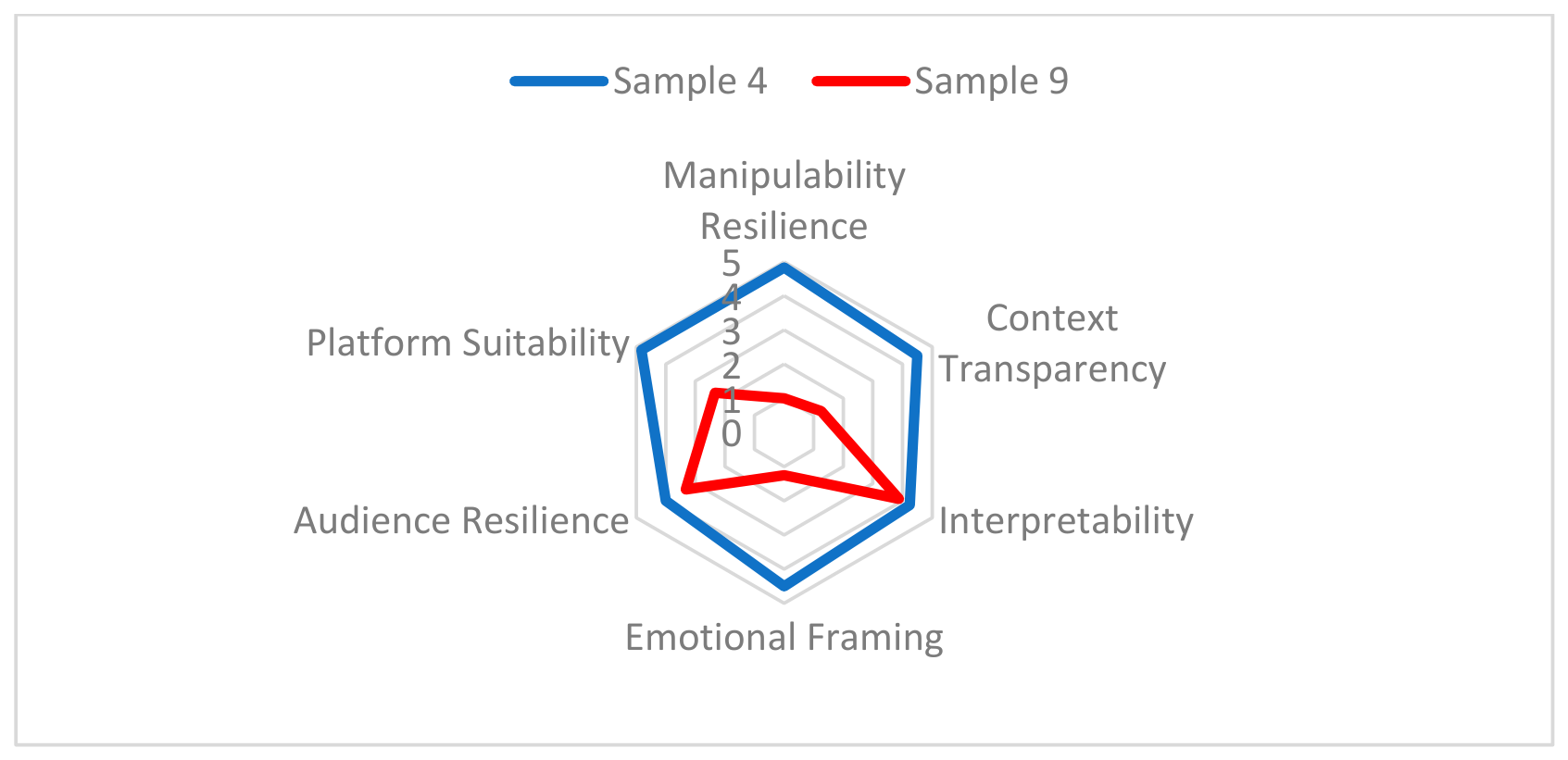
“According to the Intergovernmental Panel on Climate Change’s sixth assessment report (AR6), limiting global warming to 1.5 °C requires rapid, deep and immediate cuts in greenhouse gas emissions across all sectors.”(Adapted from the IPCC Sixth Assessment Report (AR6) (IPCC, 2023); representative of institutional, evidence-based communication.)
“URGENT: Tap water has been contaminated. Authorities are hiding the truth. Do NOT drink it!”(Representative of false public safety alerts documented during crisis events and debunked by Snopes)
4.2. Comparative Analysis Across Samples
4.3. Integrated Assessment
5. Discussion
5.1. Interpretation of Findings
5.2. Theoretical Implications
5.3. Practical Implications
6. Conclusions
Author Contributions
Funding
Institutional Review Board Statement
Informed Consent Statement
Data Availability Statement
Conflicts of Interest
Appendix A. Scoring Rubric

| Dimension | Sub-Criterion | 1 (Very Low Resilience) | 2 (Low) | 3 (Moderate) | 4 (High) | 5 (Very High Resilience) |
|---|---|---|---|---|---|---|
| Manipulability Resilience | Ambiguity Resistance (Can this message be plausibly interpreted in multiple ways?) | No resistance; highly ambiguous wording enables multiple interpretations | Limited resistance; frequent ambiguity allows reinterpretation | Partial resistance; some ambiguity but meaning generally clear | Strong resistance; mostly explicit and constrained meaning | Full resistance; precise, unambiguous, and resistant to reinterpretation |
| Detail Specificity (Does the message contain concrete, verifiable details that can be fact-checked?) | No verifiable details; entirely vague | Limited details; unclear or ambiguous references | Partial details; some verifiable elements but incomplete | Strong detail; clear and specific references | Full detail; highly precise, verifiable, and comprehensive | |
| Context Protection (Does the message retain its intended meaning when removed from its original context?) | Meaning collapses outside original context | Limited protection; easily distorted when decontextualized | Partial protection; retains some meaning outside context | Strong protection; meaning largely preserved when quoted | Full protection; meaning fully robust across contexts | |
| Contextual Transparency | Source Transparency and Credibility (Is the source of the information clearly identifiable and credible?) | No source identified | Limited source indication; vague or unclear reference | Partial transparency; source hinted but incomplete | Strong transparency; clearly identified and credible source | Full transparency; explicit, specific, and authoritative source |
| Time Reference (Is the temporal context of the information clearly specified?) | No temporal reference | Limited reference; vague timing (e.g., “recently”) | Partial reference; general timeframe implied | Strong reference; clear but broad timeframe | Full reference; precise and explicit date/time | |
| Interpretability | Clarity (Is the message immediately understandable to a general audience?) | No clarity; confusing or unintelligible wording | Limited clarity; meaning often unclear | Partial clarity; generally understandable with some ambiguity | Strong clarity; mostly clear and accessible | Full clarity; fully clear, precise, and easily understood |
| Logical Flow (Are the ideas presented in a coherent and logically consistent manner?) | No logical structure; disconnected elements | Limited structure; weak or inconsistent connections | Partial structure; some logical progression | Strong structure; coherent and well-organized | Full structure; fully logical, consistent, and sequential | |
| Jargon Level (Does the message avoid unnecessary technical or specialized language?) | Excessive jargon; inaccessible to most audiences | High jargon; frequent barriers to understanding | Moderate jargon; partially accessible | Low jargon; mostly accessible | No unnecessary jargon; fully accessible to general audiences | |
| Length Appropriateness (Is the length of the message appropriate for conveying its content effectively?) | Inappropriate length; severely too short or too dense | Limited appropriateness; often imbalanced | Partial appropriateness; generally acceptable length | Strong appropriateness; well-balanced for purpose | Full appropriateness; optimal length for clarity and context | |
| Emotional Framing | Emotional Restraint (Does the message avoid inducing strong emotional reactions such as fear, urgency, or outrage?) | No restraint; highly alarmist or emotionally intense | Limited restraint; strong emotional tone | Partial restraint; moderate emotional expression | Strong restraint; mostly neutral tone | Full restraint; consistently neutral and balanced |
| Moral Balance (Does the message avoid polarizing or absolutist moral framing?) | No balance; extreme or absolutist moral framing | Limited balance; strongly polarizing framing | Partial balance; moderate moral positioning | Strong balance; mostly nuanced framing | Full balance; fully nuanced and non-polarizing | |
| Audience Resilience | Digital Literacy Demand (Can the message be accurately understood without requiring advanced knowledge or expertise?) | Requires expert knowledge | High literacy demand; difficult for general audiences | Moderate literacy demand; partially accessible | Low literacy demand; mostly accessible | Minimal literacy demand; fully accessible to general audiences |
| Emotional Safety (Does the message avoid exploiting emotional vulnerabilities?) | No safety; exploits fear, outrage, or empathy | Limited safety; frequent emotional manipulation | Partial safety; moderate manipulation risk | Strong safety; mostly non-exploitative | Full safety; consistently non-exploitative and emotionally safe | |
| Inclusiveness of Appeal (Is the message accessible and relevant to a broad and diverse audience?) | No inclusiveness; restricted to niche or echo chamber | Limited inclusiveness; narrow audience appeal | Partial inclusiveness; moderate audience reach | Strong inclusiveness; broadly accessible | Full inclusiveness; universally accessible and inclusive | |
| Platform Suitability | Format Alignment (Is the message well adapted to the conventions and format of the platform?) | No alignment; incompatible with platform norms | Limited alignment; weak fit to platform | Partial alignment; some adaptation | Strong alignment; mostly aligned with platform norms | Full alignment; fully optimized for platform |
| Safe Shareability (Can the message be shared without causing harm or misinformation?) | Unsafe; likely to cause harm if shared | Limited safety; high risk of harm | Partial safety; moderate risk | Strong safety; low risk | Full safety; safe to share with minimal risk | |
| Moderation Compliance (Is the message likely to comply with platform moderation policies?) | Non-compliant; likely to be removed or flagged | Limited compliance; high risk of flagging | Partial compliance; possible risk | Strong compliance; low risk | Full compliance; fully aligned with platform policies |
Appendix B. Samples
“Claims circulating online suggest that volcanic CO2 emissions exceed human emissions and therefore climate change is not driven by human activity.”(Adapted from misinformation claims fact-checked by NASA and NOAA)
“Urgent: Thousands still buried under rubble. You can help save a child’s life. Donate here now.”(Representative of fraudulent donation appeals reported after the 2023 Turkey–Syria earthquake, documented by Interpol and Federal Trade Commission.)
“AI-generated scams are widespread and becoming increasingly difficult to detect. Scammers can use information available on the internet, including images and audio from social media, to convince people that the voice on the other end of the call is someone they can trust.”(Adapted from public warnings issued by the State of California Department of Justice, 2024.)
“According to the Intergovernmental Panel on Climate Change’s sixth assessment report (AR6), limiting global warming to 1.5 °C requires rapid, deep and immediate cuts in greenhouse gas emissions across all sectors.”(Adapted from the IPCC Sixth Assessment Report (AR6) (IPCC, 2023); representative of institutional, evidence-based communication.)
“They are spraying us again!!! Wake up before it is too late. Look at those lines—they are poisons, not contrails.”(Representative of “chemtrail” conspiracy content widely debunked by European Space Agency and NASA.)
“Thanks to your support, we just surpassed 50 million trees planted! Each sapling means hope, cleaner air and new jobs for rural families.”(Representative of milestone posts by Eden Reforestation Projects and similar NGOs; adapted for illustration.)
“Doctors won’t tell you this, but the new vaccines contain tracking microchips activated by 5G towers.”(Representative of COVID-19 misinformation narratives documented by World Health Organization and Reuters Fact Check)
“Thousands of votes mysteriously disappeared overnight. Observers are being silenced.”(Representative of election misinformation narratives documented in reports by European Commission and Pew Research Centre)
“URGENT: Tap water has been contaminated. Authorities are hiding the truth. Do NOT drink it!”(Representative of false public safety alerts documented during crisis events and debunked by Snopes)
“Your bank account has been temporarily locked due to suspicious activity. Please verify your identity immediately to avoid permanent suspension: [link]”(Adapted from phishing patterns reported by Europol and Federal Trade Commission)
“We are offering flexible remote positions with a weekly salary of €1,200. No experience required.”(Representative of online job scams documented by Europol and LinkedIn safety reports)
“Recent studies suggest that natural immunity provides stronger protection than vaccines in most cases. Experts are beginning to reconsider long-standing assumptions.”(Representative of health misinformation narratives documented during COVID-19 and analysed by World Health Organization and Centres for Disease Control and Prevention)
“Regular handwashing with soap significantly reduces the spread of infectious diseases. It is recommended to wash hands for at least 20 s, especially before eating and after public exposure.”(Adapted from standard public health communication guidelines issued by international organizations such as the World Health Organization.)
“It’s okay to not feel okay. Talking to someone you trust can make a difference. Small steps matter—reach out, listen, and support each other.”(Representative of mental health awareness campaigns disseminated by NGOs and public institutions.)
Appendix C. RIQ Classification Procedure
| Mean Score | Performance Level | Rationale |
|---|---|---|
| High | Strong and consistent resilience across the evaluated sub-criteria | |
| 3.00–3.99 | Moderate | Acceptable performance with identifiable weaknesses |
| <3 | Low | Insufficient resilience requiring attention |
| Classification | Rule | Conceptual Rationale |
|---|---|---|
| Critical | A single critical weakness may substantially compromise the overall resilience of the information | |
| Vulnerable | Although no critical failures exist, multiple moderate weaknesses may accumulate and reduce structural robustness | |
| Robust | ≤ 1 | The information demonstrates consistently strong performance with no significant vulnerabilities. |
References
- Aïmeur, E., Amri, S., & Brassard, G. (2023). Fake news, disinformation and misinformation in social media: A review. Social Network Analysis and Mining, 13, 30. [Google Scholar] [CrossRef] [PubMed]
- Association of College and Research Libraries (ACRL). (2016). Framework for information literacy for higher education. American Library Association. Available online: https://www.ala.org/acrl/standards/ilframework (accessed on 1 July 2026).
- Bates, B. R., Romina, S., Ahmed, R., & Hopson, D. (2006). The effect of source credibility on consumers’ perceptions of the quality of health information on the Internet. Medical Informatics and the Internet in Medicine, 31(1), 45–52. [Google Scholar] [CrossRef] [PubMed]
- Battineni, G., Baldoni, S., Chintalapudi, N., Sagaro, G. G., Pallotta, G., Nittari, G., & Amenta, F. (2020). Factors affecting the quality and reliability of online health information. Digital Health, 6, 1–11. [Google Scholar] [CrossRef] [PubMed]
- Billard, T. J., & Moran, R. E. (2022). Designing trust: Design style, political ideology, and trust in “fake” news websites. Digital Journalism, 11, 519–546. [Google Scholar] [CrossRef]
- Blay, K. B., Yeomans, S., Demian, P., & Murguia, D. (2020). The information resilience framework: Vulnerabilities, capabilities, and requirements. Journal of Data and Information Quality, 12(3), 1–25. [Google Scholar] [CrossRef]
- Boyd, D. (2010). Social network sites as networked publics: Affordances, dynamics, and implications. In Z. Papacharissi (Ed.), A networked self (pp. 47–66). Routledge. [Google Scholar] [CrossRef]
- Cinelli, M., Quattrociocchi, W., Galeazzi, A., Valensise, C. M., Brugnoli, E., Schmidt, A. L., Zola, P., Zollo, F., & Scala, A. (2020). The COVID-19 social media infodemic. Scientific Reports, 10, 16598. [Google Scholar] [CrossRef] [PubMed]
- Cohen, J. (1968). Weighted kappa: Nominal scale agreement with provision for scaled disagreement or partial credit. Psychological Bulletin, 70(4), 213–220. [Google Scholar] [CrossRef] [PubMed]
- Danry, V., Pataranutaporn, P., Groh, M., & Epstein, Z. (2025). Deceptive explanations by large language models lead people to change their beliefs about misinformation more often than honest explanations. In Proceedings of the 2025 CHI conference on human factors in computing systems (pp. 1–31). Association for Computing Machinery. [Google Scholar] [CrossRef]
- Diel, A., Lalgi, T., Schröter, I., MacDorman, K., Teufel, M., & Bäuerle, A. (2024). Human performance in detecting deepfakes: A systematic review and meta-analysis of 56 papers. Computers in Human Behavior Reports, 16, 100538. [Google Scholar] [CrossRef]
- Drolsbach, C., & Pröllochs, N. (2025). Characterizing AI-generated misinformation on social media. arXiv. [Google Scholar] [CrossRef]
- Eppler, M. J. (2006). Managing information quality: Increasing the value of information in knowledge-intensive products and processes. Springer. [Google Scholar] [CrossRef]
- Eppler, M. J., & Wittig, D. (2000). Conceptualizing information quality: A review of information quality frameworks from the last ten years. In Proceedings of the 2000 conference on information quality (ICIQ 2000) (pp. 83–96). Massachusetts Institute of Technology (MIT). [Google Scholar]
- Fischhoff, B. (2013). The sciences of science communication. Proceedings of the National Academy of Sciences, 110, 14033–14039. [Google Scholar] [CrossRef] [PubMed]
- Gillespie, T. (2014). The relevance of algorithms. In T. Gillespie, P. Boczkowski, & K. Foot (Eds.), Media technologies (pp. 167–194). MIT Press. [Google Scholar] [CrossRef]
- Herrero-Diz, P., & López-Rufino, C. (2021). Libraries fight disinformation: An analysis of online practices to help users’ generations in spotting fake news. Societies, 11(4), 133. [Google Scholar] [CrossRef]
- Hovland, C. I., Janis, I. L., & Kelley, H. H. (1953). Communication and persuasion: Psychological studies of opinion change. Yale University Press. [Google Scholar]
- IPCC. (2023). Sixth assessment report (AR6): Synthesis report. IPCC. [Google Scholar] [CrossRef]
- Jamieson, K. H. (2018). Cyberwar: How Russian hackers and trolls helped elect a president—What we don’t, can’t, and do know. Oxford University Press. [Google Scholar]
- Kahan, D. M. (2017). Misconceptions, misinformation, and the logic of identity-protective cognition. SSRN Electronic Journal. [Google Scholar] [CrossRef]
- Kahneman, D. (2011). Thinking, fast and slow. Farrar, Straus and Giroux. [Google Scholar]
- Landis, J. R., & Koch, G. G. (1977). The measurement of observer agreement for categorical data. Biometrics, 33(1), 159–174. [Google Scholar] [CrossRef]
- Lee, Y. W., Strong, D. M., Kahn, B. K., & Wang, R. Y. (2002). AIMQ: A methodology for information quality assessment. Information & Management, 40(2), 133–146. [Google Scholar] [CrossRef]
- Lewandowsky, S., Ecker, U. K. H., & Cook, J. (2017). Beyond misinformation: Understanding and coping with the “post-truth” era. Journal of Applied Research in Memory and Cognition, 6(4), 353–369. [Google Scholar] [CrossRef]
- Liu, Z., Zhang, T., Yang, K., Thompson, P., Yu, Z., & Ananiadou, S. (2024). Emotion detection for misinformation: A review. Information Fusion, 107, 102300. [Google Scholar] [CrossRef]
- López, A., Pastor Galindo, J., & Ruipérez-Valiente, J. A. (2024). Frameworks, modeling, and simulations of misinformation: A systematic literature review. arXiv. [Google Scholar] [CrossRef]
- Misirlis, N., & Munawar, H. B. (2023). From deepfake to deep useful: Risks and opportunities through a systematic literature review. arXiv. [Google Scholar] [CrossRef]
- Monteith, S., Glenn, T., Geddes, J. R., Whybrow, P. C., Achtyes, E., & Bauer, M. (2024). Artificial intelligence and increasing misinformation. British Journal of Psychiatry, 224(2), 33–35. [Google Scholar] [CrossRef] [PubMed]
- Muhammed, T. S., & Mathew, S. K. (2022). The disaster of misinformation: A review of research in social media. International Journal of Data Science and Analytics, 13, 271–285. [Google Scholar] [CrossRef] [PubMed]
- Nyhan, B., Porter, E., Reifler, J., & Wood, T. J. (2019). Taking fact-checks literally but not seriously? The effects of journalistic fact-checking on factual beliefs and candidate favourability. Political Behaviour, 42, 939–960. [Google Scholar] [CrossRef]
- Pariser, E. (2011). The filter bubble: What the Internet is hiding from you. Penguin Press. [Google Scholar]
- Pennycook, G., & Rand, D. (2019). Lazy, not biased: Susceptibility to partisan fake news is better explained by lack of reasoning than by motivated reasoning. Cognition, 188, 39–50. [Google Scholar] [CrossRef] [PubMed]
- Rodríguez Castillo, N. E., Mendoza Carrera, J. E., Andrade-Vásquez, M. M., & Acosta-Barreno, K. (2026). Media literacy education and misinformation in social media among adolescents: A systematic review and meta-analysis. Journalism and Media, 7(2), 71. [Google Scholar] [CrossRef]
- Scheufele, D. A. (2014). Science communication as political communication. Proceedings of the National Academy of Sciences, 111, 13585–13592. [Google Scholar] [CrossRef] [PubMed]
- Simon, F. M., Altay, S., & Mercier, H. (2023). Misinformation reloaded? Fears about the impact of generative AI on misinformation are overblown. Harvard Kennedy School Misinformation Review, 4(5), 1–11. [Google Scholar] [CrossRef]
- Slovic, P., Finucane, M. L., Peters, E., & MacGregor, D. G. (2007). The affect heuristic. European Journal of Operational Research, 177, 1333–1352. [Google Scholar] [CrossRef]
- State of California Department of Justice. (2024). Attorney General Bonta warns Californians: AI-generated scams are widespread and tricky to spot. Available online: https://oag.ca.gov/news/press-releases/attorney-general-bonta-warns-californians-ai-generated-scams-are-widespread-and (accessed on 17 March 2026).
- Strong, D. M., Lee, Y. W., & Wang, R. Y. (1997). Data quality in context. Communications of the ACM, 40(5), 103–109. [Google Scholar] [CrossRef]
- Sundar, S. S. (2008). The MAIN model: A heuristic approach to understanding technology effects on credibility. In M. J. Metzger, & A. J. Flanagin (Eds.), Digital media, youth, and credibility (pp. 73–100). MIT Press. [Google Scholar]
- Sweller, J. (1988). Cognitive load during problem solving: Effects on learning. Cognitive Science, 12, 257–285. [Google Scholar] [CrossRef] [PubMed]
- Trninić, D., Kuprešanin Vukelić, A., & Bokan, J. (2022). Perception of “fake news” and potentially manipulative content in digital media—A generational approach. Societies, 12(1), 3. [Google Scholar] [CrossRef]
- Tufekci, Z. (2017). Twitter and tear gas: The power and fragility of networked protest. Yale University Press. [Google Scholar]
- United Nations. (2023). Our common agenda: Policy brief 8—Information integrity on digital platforms. United Nations. Available online: https://disinfopacific.org/infointegrity/ (accessed on 1 July 2026).
- van Dijck, J. (2013). The culture of connectivity: A critical history of social media. Oxford University Press. [Google Scholar] [CrossRef]
- Vishnupriya, G., Jeriel, K. A., RNS, A., Ajay, G., & J, A. G. (2024). Combating fake news in the digital age: A review of AI-based approaches. In Proceedings of the IEEE international conference on convergence in technology (pp. 1–6). IEEE. [Google Scholar] [CrossRef]
- Vosoughi, S., Roy, D., & Aral, S. (2018). The spread of true and false news online. Science, 359(6380), 1146–1151. [Google Scholar] [CrossRef] [PubMed]
- Wang, R. Y., & Strong, D. M. (1996). Beyond accuracy: What data quality means to data consumers. Journal of Management Information Systems, 12(4), 5–33. [Google Scholar] [CrossRef]
- Wardle, C. (2018). Understanding information disorder. In Journalism, “fake news” & disinformation (pp. 43–54). UNESCO. [Google Scholar]
- Wardle, C., & Derakhshan, H. (2017). Information disorder: Toward an interdisciplinary framework for research and policy making. Council of Europe. [Google Scholar]
- Weikmann, T., & Lecheler, S. (2022). Visual disinformation in a digital age: A literature synthesis and research agenda. New Media & Society, 25, 3696–3713. [Google Scholar] [CrossRef]
- Zárraga-Rodríguez, M., & Álvarez, M. J. (2014). Does the EFQM model identify and reinforce information capability? Procedia—Social and Behavioural Sciences, 109, 716–721. [Google Scholar] [CrossRef]
- Zhou, X., & Zafarani, R. (2020). A survey of fake news: Fundamental theories, detection methods, and opportunities. ACM Computing Surveys, 53(5), 109. [Google Scholar] [CrossRef]
- Zrnec, A., Poženel, M., & Lavbič, D. (2022). Users’ ability to perceive misinformation: An information quality assessment approach. Information Processing & Management, 59(1), 102739. [Google Scholar] [CrossRef]


| Sub-Criterion | Description | Purpose |
|---|---|---|
| Ambiguity Resistance | Degree to which the content avoids ambiguous or open-ended wording. | Restricted interpretation minimizes the chances of misrepresentation or manipulation |
| Detail Specificity | Existence of specific details, sources or clarity in the message | Specific information is easier to confirm, decreasing possibilities of distortion or misunderstanding |
| Context Protection | Degree to which the message retains intended meaning when decontextualized | Well-anchored content is harder to twist or misuse outside its original setting |
| Sub-Criterion | Description | Purpose |
|---|---|---|
| Source Transparency and Credibility | Clarity and specificity with which the message identifies its origin (e.g., author, institution, or source of evidence), enabling verification and assessment of trustworthiness. | Clear and explicit sourcing allows audiences to trace the information and evaluate its credibility, while vague or absent sourcing increases uncertainty and susceptibility to misinterpretation. |
| Time Reference | Whether the message includes a specific time frame or date relevant to the content. | Defining a specific time reference prevents misinterpretation by anchoring claims to a point in time. |
| Sub-Criterion | Description | Purpose |
|---|---|---|
| Clarity | How easy the message is to understand at a surface level | Clear wording reduces confusion and helps readers grasp the main point quickly |
| Logical Flow | Whether ideas are connected in a coherent, step-by-step progression | Logical sequencing makes it easier for readers to follow the reasoning and absorb the message |
| Jargon Level | The degree to which the message uses complex, technical or domain-specific terms | High jargon can exclude non-experts or cause misunderstandings; low jargon improves accessibility |
| Length Appropriateness | Whether the length fits the task and audience | Optimal length ensures the message is neither vague nor exhausting to read |
| Sub-Criterion | Description | Purpose |
|---|---|---|
| Emotional Restraint | Strength and vividness of the affective tone embedded in the message | High intensity increases salience and shareability but may reduce critical scrutiny |
| Moral Balance | Extent to which the message appeals to moral or ethical judgements (e.g., justice, outrage, duty, compassion) | Strong moral framing mobilizes action but may polarize interpretation and reduce nuance |
| Sub-Criterion | Description | Purpose |
|---|---|---|
| Digital Literacy | Degree to which understanding the message requires prior knowledge, technical expertise, or advanced media literacy | High demand reduces accessibility and increases the risk of misinterpretation among general audiences |
| Emotional Safety | Extent to which the message avoids exploiting fear, empathy, outrage, or identity to trigger responses | Emotionally safe framing supports critical reflection, while strong exploitation may bypass it and disproportionately affect vulnerable groups |
| Inclusiveness of Appeal | Degree to which the message resonates broadly across audiences versus targeting niche or echo-chamber groups. | Broad appeal increases resilience, while selective targeting intensifies polarization and reduces interpretive balance |
| Sub-Criterion | Description | Purpose |
|---|---|---|
| Format Alignment | Match between the message’s length, structure, and style with the norms of the platform where it circulates | Strong alignment enhances visibility, clarity, and engagement within platform constraints; misalignment may reduce interpretability or distort the intended message |
| Safe Shareability | Likelihood of the message spreading without harm and within the platform’s affordances (e.g., brevity, visuality, algorithmic boosts) | High engagement increases reach, which can amplify both credible and misleading content |
| Moderation Compliance | Probability that the message aligns with platform policies and avoids being flagged, challenged, or removed by moderation systems | High compliance ensures stable visibility and fosters audience trust, while low compliance reduces exposure and may prevent harmful amplification |
| Dimension | Sub-Criteria | 1 (Very Low) | 5 (Very High) |
|---|---|---|---|
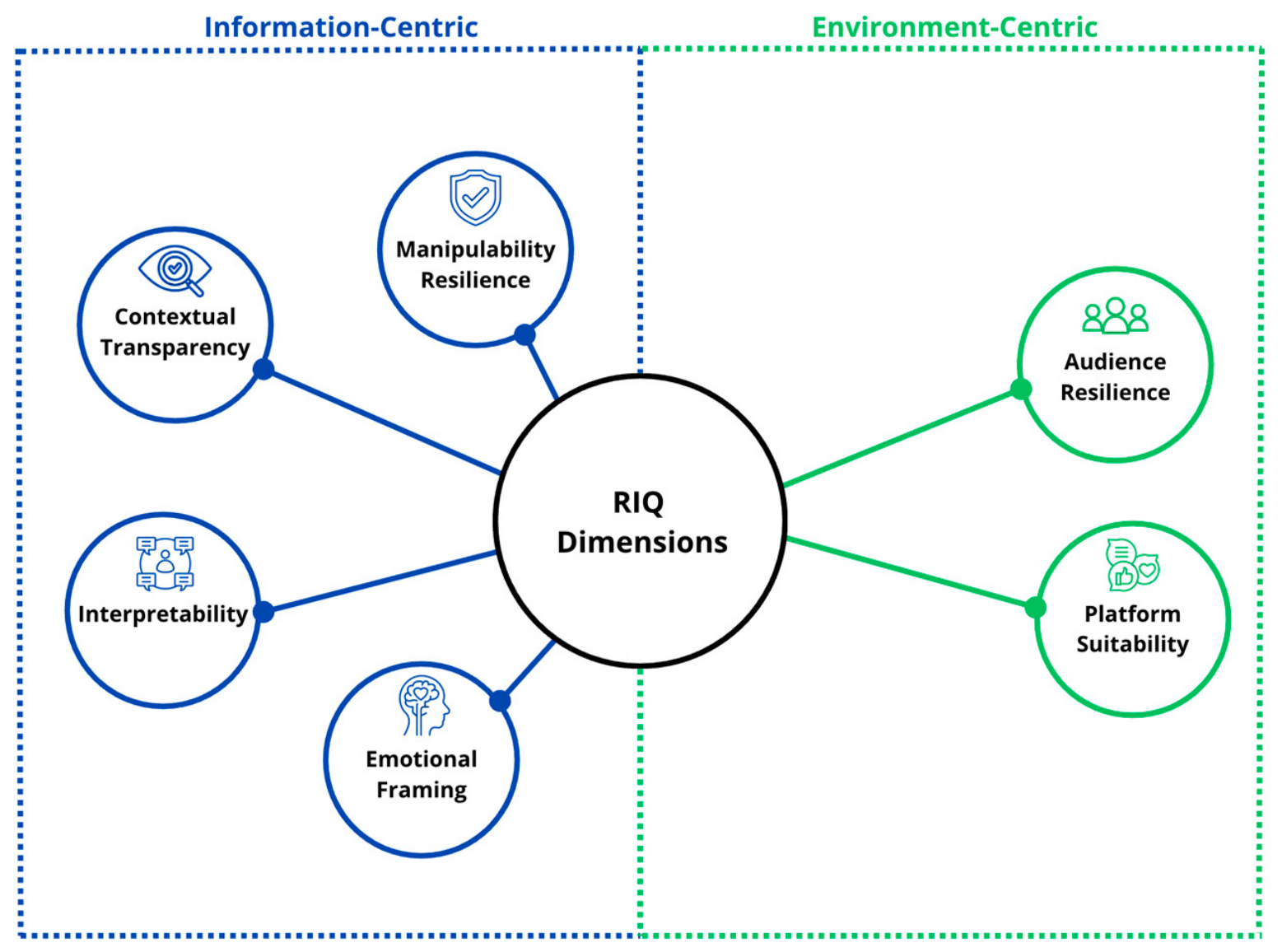
| Manipulability Resilience | Ambiguity Resistance, detail specificity, context protection | Highly emotional, vague, easy to twist, manipulative authority | Neutral tone, precise and specific, hard to distort, transparent sources |
| Contextual Transparency | Source transparency and credibility, time reference | No source/date, vague, contextless | Fully sourced, dated, detailed |
| Interpretability | Clarity, logical flow, jargon level, length appropriateness | Dense, confusing, jargon-heavy, no examples | Clear, logical, jargon-free, well-illustrated |
| Emotional Framing | Emotional restraint, moral balance | Alarmist, moralizing | Neutral, balanced |
| Audience Resilience | Digital literacy, emotional safety, inclusiveness of appeal | Requires expertise, exploits fear, polarizing | Accessible to all, emotionally safe, broadly inclusive |
| Platform Suitability | Format alignment, safe shareability, moderation compliance | Viral but harmful, high flag risk | Well-adapted, shareable without harm, fully compliant |
| Dimension | Kappa (κ) | Interpretation |
|---|---|---|
| Manipulability Resilience | 0.904 | Almost perfect agreement |
| Contextual Transparency | 0.783 | Substantial agreement |
| Interpretability | 0.785 | Substantial agreement |
| Emotional Framing | 0.840 | Almost perfect agreement |
| Audience Resilience | 0.896 | Almost perfect agreement |
| Platform Suitability | 0.966 | Almost perfect agreement |
| Overall | ≈0.908 | Almost perfect agreement |
| Dimension Score Range | Performance Level |
|---|---|
| ≥4 | High |
| 3–3.99 | Moderate |
| <3 | Low |
| Condition | |
|---|---|
| (x < 1.5) | |
| (1.5 ≤ x < 2.5) | |
| (2.5 ≤ x < 3.5) |
| Classification | Condition |
|---|---|
| Critical | |
| Vulnerable | |
| Robust | ≤ 1 |
| Dimension | Sub-Criteria Scores | Mean | Performance Level |
|---|---|---|---|
| Manipulability Resilience | 5, 4.5, 5 | 4.83 | High |
| Contextual Transparency | 5, 4 | 4.50 | High |
| Interpretability | 4.5, 5, 3, 4.5 | 4.25 | High |
| Emotional Framing | 4.5, 4.5 | 4.50 | High |
| Audience Resilience | 3, 4.5, 4.5 | 4.00 | High |
| Platform Suitability | 4.5, 5, 5 | 4.83 | High |
| Dimension | Sub-Criteria Scores | Mean | Performance Level |
|---|---|---|---|
| Manipulability Resilience | 1, 1, 1 | 1.00 | Low |
| Contextual Transparency | 1, 1.5 | 1.25 | Low |
| Interpretability | 4, 3, 5, 3.5 | 3.88 | Moderate |
| Emotional Framing | 1.5, 1 | 1.25 | Low |
| Audience Resilience | 5, 1, 4 | 3.33 | Moderate |
| Platform Suitability | 5, 1, 1 | 2.33 | Low |
| Level | Metric | Definition | Formalization | Interpretation |
|---|---|---|---|---|
| Sub-criteria | Raw Score | Individual evaluation | 1–5 scale | Base measurement |
| Dimension/Sample (continuous) | Mean Score ( | Average across sub-criteria | Overall performance level | |
| Performance Level | Categorization of mean scores | Threshold-based ( high, 3−3.99 moderate, <3 low) | Overall effectiveness | |
| Sample (risk-based) | Critical | ≥1 critical failure | Single-point failure | |
| Vulnerable | Accumulated weaknesses | Cumulative fragility | ||
| Robust | No significant weaknesses | ≤ 1 | Structurally stable | |
| (Flag) Borderline | High concentration of mid-range scores | Interpretative signal (no classifying) | ||
| Global (geometric) | Radar Area (A) | Polygon area from all dimensions | * | Overall multidimensional performance |
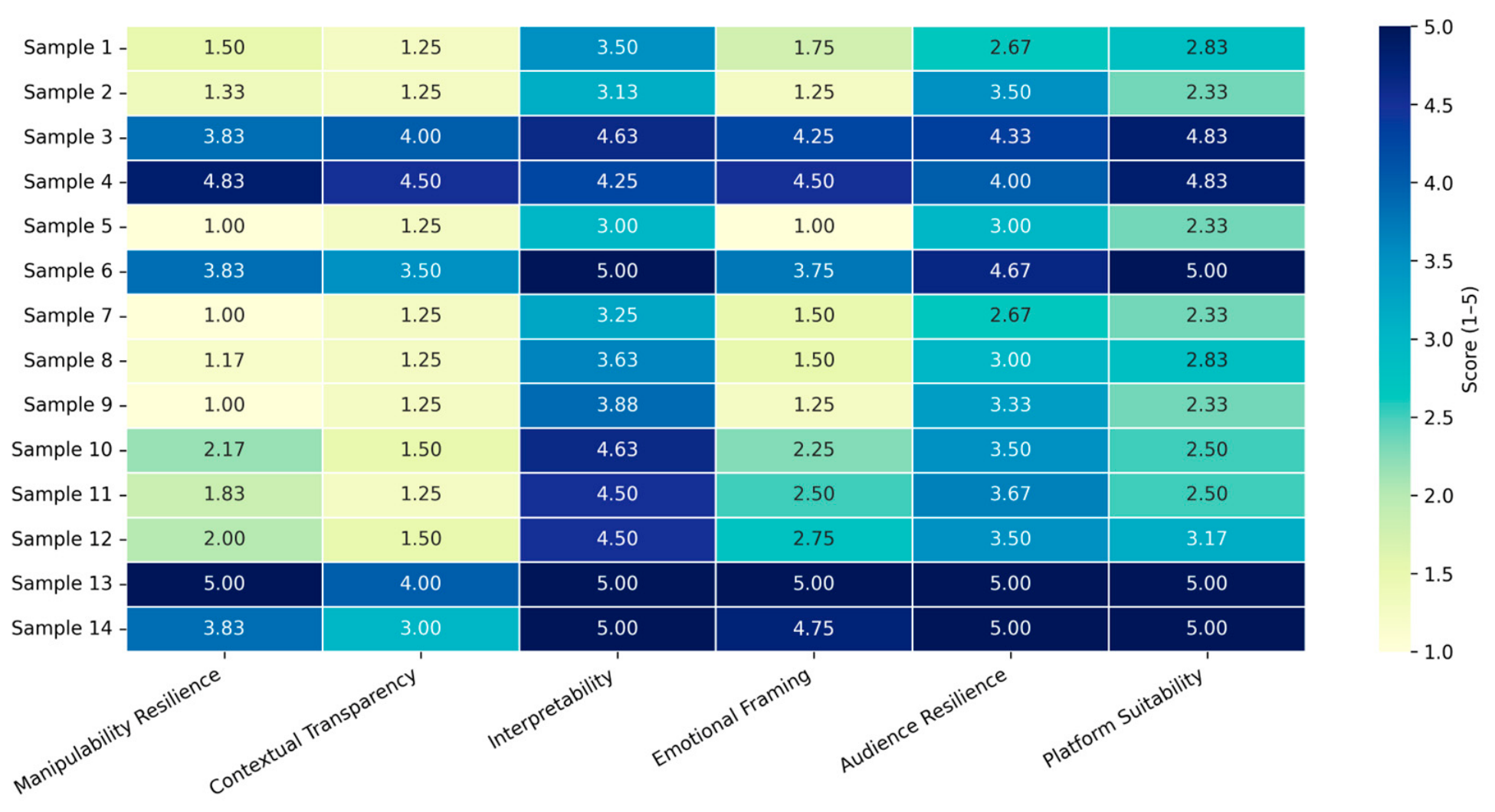
| Sample | Overall Mean Score | Performance Level | Structural Condition (n) | Structural Classification (n) | Radar Area | Overall Assessment |
|---|---|---|---|---|---|---|
| 1 | 2.25 | Low | Critical | 12.43 | Unreliable | |
| 2 | 2.13 | Low | Critical | 10.95 | Unreliable | |
| 3 | 4.31 | High | ≤ 1 | Robust | 48.15 | Trustworthy |
| 4 | 4.49 | High | ≤ 1 | Robust | 52.23 | Trustworthy |
| 5 | 1.93 | Low | Critical | 8.80 | Unreliable | |
| 6 | 4.29 | High | ≤ 1 | Robust | 47.58 | Trustworthy |
| 7 | 2.00 | Low | Critical | 9.48 | Unreliable | |
| 8 | 2.23 | Low | Critical | 11.73 | Unreliable | |
| 9 | 2.17 | Low | Critical | 10.63 | Unreliable | |
| 10 | 2.76 | Low | Vulnerable | 18.71 | Weak | |
| 11 | 2.71 | Low | Critical | 17.74 | Unreliable | |
| 12 | 2.90 | Low | Vulnerable | 20.86 | Weak | |
| 13 | 4.83 | High | ≤ 1 | Robust | 60.62 | Trustworthy |
| 14 | 4.43 | High | ≤ 1 | Robust | 50.37 | Trustworthy |
| Stakeholder | How the RIQ Framework Can Be Used |
|---|---|
| Researchers | Utilize the six dimensions as a coding scheme in content analysis studies for comparing different samples and monitoring message resilience |
| Journalists & Communicators | Analyse and correct any weaknesses in their message design (such as lack of transparency or interpretability) to enhance resilience before publication |
| Educators & Media Literacy Programs | Teach students to identify emotional appeals, lack of context, and manipulation strategies by applying the framework as a checklist |
| Policy-Makers & Regulators | Inform policy guidelines and risk assessments by identifying message types that are susceptible to misinterpretation or harmful amplification |
| Platform Designers | Integrate the framework’s dimensions into automated tools for flagging high-risk content or requesting context information before sharing |
Disclaimer/Publisher’s Note: The statements, opinions and data contained in all publications are solely those of the individual author(s) and contributor(s) and not of MDPI and/or the editor(s). MDPI and/or the editor(s) disclaim responsibility for any injury to people or property resulting from any ideas, methods, instructions or products referred to in the content. |
© 2026 by the authors. Licensee MDPI, Basel, Switzerland. This article is an open access article distributed under the terms and conditions of the Creative Commons Attribution (CC BY) license.
Share and Cite
Azevedo, A.R.; Gonçalves, F.; Brigas, J. Resilient Information Quality in Social Media Environments: A Framework for Evaluating Information Under Misinformation and Algorithmic Amplification. Journal. Media 2026, 7, 137. https://doi.org/10.3390/journalmedia7030137
Azevedo AR, Gonçalves F, Brigas J. Resilient Information Quality in Social Media Environments: A Framework for Evaluating Information Under Misinformation and Algorithmic Amplification. Journalism and Media. 2026; 7(3):137. https://doi.org/10.3390/journalmedia7030137
Chicago/Turabian StyleAzevedo, Ana Raquel, Fátima Gonçalves, and Joaquim Brigas. 2026. "Resilient Information Quality in Social Media Environments: A Framework for Evaluating Information Under Misinformation and Algorithmic Amplification" Journalism and Media 7, no. 3: 137. https://doi.org/10.3390/journalmedia7030137
APA StyleAzevedo, A. R., Gonçalves, F., & Brigas, J. (2026). Resilient Information Quality in Social Media Environments: A Framework for Evaluating Information Under Misinformation and Algorithmic Amplification. Journalism and Media, 7(3), 137. https://doi.org/10.3390/journalmedia7030137