
Article

How Confederate Monument Controversies Unfold Across Reddit Communities: Topics, Posting Patterns, and Community Responses

Department of Global Convergence, Kangwon National University, Chuncheon 24341, Republic of Korea
*
Author to whom correspondence should be addressed.
Journal. Media 2026, 7(3), 136; https://doi.org/10.3390/journalmedia7030136
Submission received: 28 April 2026 / Revised: 1 July 2026 / Accepted: 3 July 2026 / Published: 8 July 2026
(This article belongs to the Special Issue The Ritual Functioning of Online Media)

Abstract

Confederate monuments have long stood at the center of public memory controversies in the United States, and social media platforms increasingly shape how these controversies circulate and receive responses. This study examines Confederate monument controversies across five Reddit communities—r/politics, r/news, r/PoliticalDiscussion, r/AskAnAmerican, and r/AskHistorians—using 2379 posts and 117,556 comments. Combining BERTopic modeling, zero-shot classification, and event-based statistical analysis, it investigates temporal patterns, topic structures, post categories, and responses. Discussion rose most sharply around the Charlottesville rally and the George Floyd event window, with peaks in r/politics and r/news. Topic modeling identified nine stable topics across national political debate, local removal actions, legal disputes, legislative processes, and historical interpretation. Among non-news posts, Seeking Information/Opinion was most common (41.9%), followed by Removal/Implementation Update (20.5%), Resource Sharing/Mobilization (18.9%), and Complaint/Normative Condemnation (18.7%). Protest, removal, and legal-conflict topics generated higher comment volumes and scores, whereas historically oriented topics showed lower interaction intensity. Comment sections were dominated by Explanation or Interpretation, indicating that Reddit discussions extended monument controversies mainly through explanation, comparison, and historical analogy rather than interpersonal conflict. The findings show that Reddit reorganizes public memory controversy through platform rules, community norms, and interactional mechanisms. By connecting event peaks, topic structures, post categories, and comment pathways, the study also interprets Reddit-based monument controversy as a platformed media ritual of attention, classification, and public memory negotiation.

1. Introduction

Public monuments are not only material objects placed in civic space; they are also rhetorical and mnemonic sites through which publics authorize, contest, and revise versions of the past (Blair et al., 2010; Dwyer & Alderman, 2008). Recent disputes over statues associated with slavery, colonialism, dictatorship, and racial hierarchy, including Rhodes Must Fall and debates over colonial statues in postcolonial African cities, show that monument controversies form part of a broader negotiation over difficult heritage (Drayton, 2019; Labadi, 2024). This article focuses on Confederate monument controversies in the United States, but it treats them as one case of a wider problem: how contested monuments continue to generate public memory conflict after they enter platformed discussion. This framing also connects the study to media ritual scholarship: the article treats repeated platform practices not as formal ceremonies but as mediated routines through which users gather around events, mark them as publicly significant, and assign meaning to contested symbols (Carey, 2008; Couldry, 2003; Dayan & Katz, 1992).

1.1. Confederate Monuments in Public Memory Controversies

Confederate monuments have long stood at the center of public memory controversies in the United States (Forest & Johnson, 2019). Debates over whether these monuments should be retained, relocated, removed, or reinterpreted do not remain confined to their physical preservation. They continually extend into broader questions of historical narrative, local identity, racial relations, and national belonging (Dwyer & Alderman, 2008). Existing scholarship has treated Confederate monuments as concrete carriers of public memory, emphasizing that they are not neutral historical remains but symbolic objects that continue to participate in contemporary struggles over the interpretation of the past (Forest & Johnson, 2019; O’Connell, 2022).
Controversies over Confederate monuments are not limited to policy disagreement over whether particular statues should be removed (Cooper et al., 2021). Studies have shown that these monuments are historically connected to the legacy of slavery, racial hierarchy, and contemporary Black-White inequality; for this reason, they continue to carry strong political and social meanings in the present (Britt et al., 2020; Rios et al., 2022). Public discussion of Confederate monuments therefore often intensifies after moments of racial conflict, violence, or political mobilization, reopening disputes over which histories should be publicly commemorated and which symbols should leave public space (Burns et al., 2024; Talbert, 2022).
Monument controversies also involve the redefinition of public space (Dwyer & Alderman, 2008). Studies of New Orleans and Richmond show that removal actions and protest practices do more than negate existing monuments. They also reorganize the use of commemorative space, the objects of commemoration, and the ways public narratives are produced (Sheehan & Speights-Binet, 2019; Logan, 2021). The Confederate monument issue therefore deserves continued study not only because it concerns a number of specific statues or sites but also because it concentrates broader negotiations over historical meaning, symbolic order, and the legitimacy of public memory in the United States (Forest & Johnson, 2019).

1.2. Digital Platforms, Reddit Affordances, and Platformed Public Memory

As public controversies increasingly unfold online, digital platforms have become important arenas for observing struggles over public memory (Birkner & Donk, 2020). Memory studies have shown that social media are not merely technical containers for preserving the past. They also participate in the re-presentation, reordering, and reinterpretation of the past, thereby influencing how public events are remembered, how they are debated, and which narratives acquire continuing visibility (Ben-David et al., 2024; Smit et al., 2024). This point is especially important for monument controversies because monuments themselves transform history into visible public symbols, while platforms further alter how those symbols circulate and are understood (Jacobsen, 2024).
Among different platforms, Reddit deserves particular attention (Proferes et al., 2021). Unlike platforms organized around a single feed, Reddit is composed of multiple subreddits with distinct rules, audience expectations, and discussion habits (Singer et al., 2014). Its pseudonymous participation, threaded comment chains, upvote/downvote visibility, and decentralized moderation further distinguish it from short-cycle broadcast platforms and make it useful for observing extended explanation, disagreement, analogy, and correction (Prakasam & Huxtable-Thomas, 2021; Proferes et al., 2021). This structure allows the same event to enter different contexts within the platform and to be organized as news sharing, positional debate, knowledge explanation, or experiential judgment (Ammari et al., 2019; Ben-David & Soffer, 2019). Studies of Reddit also indicate that ranking mechanisms, voting systems, anonymity, and community boundaries jointly shape discussion climates and the production of meaning. Reddit therefore does not simply receive controversies passively; it actively influences how controversies unfold as a media structure (Massanari, 2017; Chandrasekharan et al., 2018).
For this reason, online discussion of Confederate monuments does not naturally form a unified public sphere (Chandrasekharan et al., 2018). The same monument-related event may acquire different problem framings in different subreddits and may generate different response pathways (Ammari et al., 2019; Proferes et al., 2021). Some communities are more likely to focus on immediate attention to the event itself, while others may move discussion toward institutional judgment, historical interpretation, or public understanding (Ben-David & Soffer, 2019). Reddit thus offers a particularly suitable case for studying public memory controversies because it preserves traces of controversy while also revealing how controversy becomes stratified and organized within the platform (Proferes et al., 2021).

1.3. Confederate Monument Controversies in Platform Contexts

Existing research on Confederate monuments has already discussed their historical conditions of emergence, racial-political meanings, and continuing effects on public space in considerable depth (Britt et al., 2020; O’Connell, 2022). This scholarship shows that Confederate monuments are not neutral preservations of Southern history. They are closely linked to the white supremacist order, anti-Black stereotypes, and the political and social structures of the post-Reconstruction American South (Strother et al., 2017). At the same time, controversies over these monuments are often situated within frameworks of public memory crisis, commemorative spatial reorganization, and the legitimacy of removal (Forest & Johnson, 2019; Logan, 2021). Comparable debates over colonial and authoritarian monuments in Europe and Africa also show that such objects can remain politically active long after the regimes or imperial orders that produced them have changed, although the present study does not conduct a global comparison (Drayton, 2019; Labadi, 2024). Existing scholarship has therefore made clear why these monuments become objects of high-intensity controversy (Cooper et al., 2021).
By comparison, much less work has examined how monument controversies unfold on digital platforms (Birkner & Donk, 2020). A small number of studies have begun to note that social media are not simply auxiliary channels for controversy but may become spaces in which monument discourse persists and continues to differentiate (Jacobsen & Beer, 2021). For example, research on Facebook comment pages related to North Carolina’s “Silent Sam” has shown that even after a monument is removed from physical space, supportive and oppositional discourses around it can continue to accumulate online and form new sites of dispute (March, 2020). This finding is important because it indicates that monument controversies do not automatically end with the removal of physical objects; they continue in new forms on platforms (Birkner & Donk, 2020).
However, existing platform studies remain concentrated on single platform pages, single-site cases, or specific local controversies. There is still insufficient work on platforms such as Reddit, which are organized through multiple subreddits (March, 2020; Proferes et al., 2021). In particular, few studies systematically examine how the same controversy forms different topical layers across communities, why users participate through particular posting modes, and how comments form differentiated response mechanisms around different types of posts (Chandrasekharan et al., 2018). This study addresses that gap. Rather than focusing only on the historical origins, local governance, or symbolic meanings of monuments, it examines community differentiation, interactional pathways, and response structures within the platform in order to show how public memory controversies are reorganized in a multi-community platform such as Reddit (Proferes et al., 2021).

1.4. Theoretical Background: Public Memory and Community Norms

Public memory research has long argued that monuments are not neutral preservations of the past but symbolic forms that fix particular historical interpretations in public space (Dwyer & Alderman, 2008). In rhetorical and communication-oriented memory studies, public memory is understood as a socially constructed process in which place, material objects, narratives, bodies, and audiences interact to shape how publics encounter and debate the past (Blair et al., 2010). Controversies over monuments persist because monuments not only point to the past but also continue to participate in present-day definitions of historical meaning (Forest & Johnson, 2019). In the case of Confederate monuments, scholarship has made clear that these objects are closely tied to questions of what should be remembered, what should be removed, and how forgetting should be handled after removal. They are therefore better understood as material carriers of public memory conflict than as simple historical remains (Forest & Johnson, 2019; Logan, 2021).
This perspective has been further extended in digital platform research (Ben-David et al., 2024). Scholars of social memory have argued that social media do not passively receive memory content. They actively shape the media environments through which memory is produced, re-presented, and reinterpreted (Smit et al., 2024). This process has been conceptualized within social media memory studies, which emphasize the role of platforms in the formation of historical consciousness and note that algorithms, interfaces, and interaction mechanisms influence how the past is retold (Ben-David et al., 2024; Jungselius & Weilenmann, 2023). Research on algorithmic social networks also shows that platforms participate in memory-making through their own technical and institutional logics rather than merely storing preexisting memories (Ben-David, 2019, 2020).
Media ritual theory further clarifies how these platformed memory processes acquire patterned form. In the ritual view of communication, media not only transmit information; they also draw participants into shared practices through which events are made meaningful (Carey, 2008). Couldry (2003) similarly argues that media rituals organize symbolic attention and legitimate certain centers of public meaning. In this study, media rituals are therefore understood not as formal ceremonies but as repeated mediated practices of posting, voting, commenting, comparing, and interpreting through which Reddit users collectively mark contested monuments as public-memory issues.
This theoretical orientation is especially relevant to Reddit (Proferes et al., 2021). Reddit is not a homogeneous discussion space. It consists of multiple subreddits with different norms and interactional boundaries (Singer et al., 2014). In this study, macro norms refer to broader national memory narratives, racial-political frameworks, and platform-wide expectations; meso norms refer to subreddit-level rules, audiences, topic boundaries, and discussion habits; and micro norms refer to post/comment-level interactional patterns such as explanation, questioning, analogy, sarcasm, support, and conflict. Research on Reddit community norms has shown clear differences across macro, meso, and micro norms, meaning that the same public event is often placed into different discussion frames when it enters different subreddits (Chandrasekharan et al., 2018). A subreddit is, therefore, not only a technical classification unit but also a social space that affects topic organization, interactional style, and competition over meaning (Massanari, 2017).
Building on these studies, this article understands Confederate monument controversies as public memory processes that are continuously reorganized within platforms. Monuments provide the material objects of controversy, platforms provide the media conditions for continued diffusion and reclassification, and subreddit differences further shape topical layers, posting intentions, and response mechanisms (Ben-David et al., 2024; Smit et al., 2024). Reddit is therefore treated not as a simple echo of real-world controversy but as an important arena in which public memory controversy continues to unfold in digital space (Proferes et al., 2021).

1.5. Present Study

This study treats Reddit as a platformed arena for observing Confederate monument controversies and examines how this controversy is organized, diffused, and responded to across different communities (Ben-David et al., 2024). More specifically, it examines how monument-related narratives unfold across subreddits, how users participate in posting around these issues, and how different types of posts further shape community responses (Chandrasekharan et al., 2018; Proferes et al., 2021). By analyzing user-generated content, the study seeks to show that social media platforms are not only spaces of circulation for public memory controversies but also important mechanisms through which controversies are reclassified, reinterpreted, and amplified over time (Smit et al., 2024).
To avoid combining several analytical tasks in a single question, the study separates temporal activation, topic structure, post-category distribution, and comment-response patterns into four research questions.
RQ1: How do major public events influence the temporal patterns of Confederate monument discussion on Reddit?
Second, the study identifies the main topical layers through which the Confederate monument controversy appears across the dataset.
RQ2: What major topic structures emerge in Reddit discussions of Confederate monument controversies?
Third, the study examines how users enter these topics through post categories.
RQ3: How are post categories distributed across the major topics of Confederate monument discussion?
Finally, the study examines how post categories and subreddit contexts are associated with different comment-response patterns.
RQ4: How are post categories and subreddit contexts associated with different comment-response patterns?

2. Methodology

This work used BERTopic modeling to analyze subreddit posts and comments because BERTopic represents a significant advance in topic modeling by drawing on the contextual understanding of transformer-based language models (Grootendorst, 2022). Unlike traditional approaches based on bag-of-words representations, BERTopic uses BERT embeddings to capture semantic relationships between words and thereby produces more meaningful topic representations (Devlin et al., 2019; Grootendorst, 2022). A key methodological advantage of BERTopic is its modular architecture, which consists of four independent steps: document embedding, dimensionality reduction, clustering, and topic representation (Grootendorst, 2022). This modularity allows researchers to customize each step without affecting the others, providing flexibility to integrate different algorithms or techniques at various stages of the pipeline (Grootendorst, 2022).
This adaptability enables BERTopic to support multiple topic modeling variants, including guided topic modeling, dynamic topic modeling, and class-based topic modeling (Grootendorst, 2022). Another important advantage is that BERTopic can generate topic structures without requiring a fixed topic number to be imposed in the same way as traditional approaches such as LDA (Blei et al., 2003; Grootendorst, 2022). In this study, the final retained topic solution was selected through manual interpretability assessment after initial clustering, which made it possible to balance topic granularity, semantic coherence, and analytical clarity. BERTopic is also effective for short texts of fewer than 512 words, which makes it appropriate for modern communication formats such as tweets, reviews, and comments (Grootendorst, 2022).
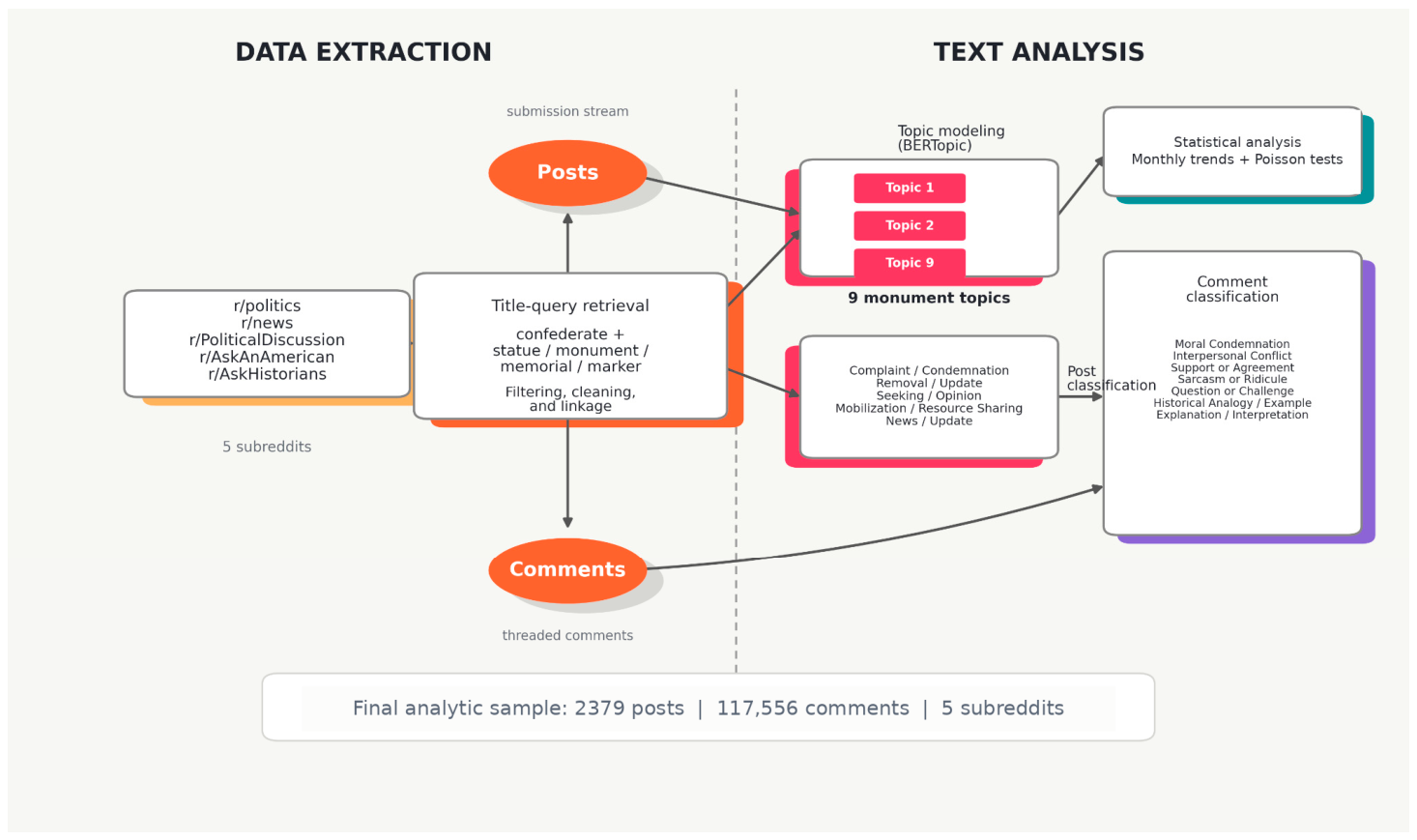
The modeling process begins by transforming input text into numerical representations using embedding vectorization. These embeddings are then processed through Uniform Manifold Approximation and Projection (UMAP), a dimensionality reduction technique that improves topic-cluster clarity by positioning similar data points closer together (McInnes & Healy, 2018). Topic clusters are subsequently generated using Hierarchical Density-Based Spatial Clustering of Applications with Noise (HDBSCAN), which identifies dense regions in the data while filtering out noise and unrelated points (McInnes et al., 2017). BERTopic’s pretraining on diverse text collections enables it to capture contextual nuance more effectively than traditional methods, making it useful for extracting insights from complex language data (Devlin et al., 2019; Reimers & Gurevych, 2019). This contextual capability is especially valuable for datasets that contain subtle linguistic and interpretive features. The methodology consisted of four main components: data extraction, BERTopic modeling, post and comment classification, and statistical analysis, as illustrated in Figure 1. The following sections describe each component of the framework used to analyze Reddit discussions of Confederate monuments.

2.1. Data Extraction

The data for this research were collected through the public PullPush (https://pullpush.io/) search interface. The collection targeted Reddit posts and comments related to Confederate monuments (Baumgartner et al., 2020). The collection script ran on a server, with the retrieval window set from 1 January 2015 to 31 December 2025. Matched posts and their associated comments were written to an SQLite (https://sqlite.org/) database in order to support resumable collection, monthly aggregation, and later export. Five subreddits were selected for analysis: r/politics, r/news, r/PoliticalDiscussion, r/AskAnAmerican, and r/AskHistorians. Together, these communities provide a multi-community sample covering different discussion contexts, including news circulation, political debate, public question-and-answer interaction, and historical explanation.
To improve data quality and relevance, four preprocessing steps were implemented. Temporal filtering set the collection window from 1 January 2015 to 31 December 2025 and divided the retrieval process into monthly windows in order to support long-period collection and later time-series analysis. Query filtering used title-oriented searches. It constructed 22 title queries around the core term “confederate” and monument-related terms such as “statue”, “monument”, “memorial”, and “marker”, and also included action expressions such as “remove”, “removed”, “relocate”, and “take down” in order to improve topical precision.
Relevance filtering required the text to contain both Confederate-related terms and monument-related terms. Hard exclusion patterns were also used to remove spillover noise related to license plates, flags, street names, school names, holidays, and similar irrelevant uses. Comment collection was then based on the matched submissions, and comments were retrieved for each submission. Cleaning and linkage further removed duplicate posts, posts with empty titles or bodies, deleted or removed comments, isolated comments, very short comments, and automated comments. Post and comment text was normalized, and fields directly relevant to topic modeling, comment classification, and monthly statistical analysis were retained.
After this process, the final dataset retained 2379 posts and 117,556 comments across the five subreddits. The post volume was concentrated mainly in r/politics and r/news, with 1383 and 885 posts retained, respectively. Comment volume in these two communities was 54,083 and 56,912, respectively. The other three communities were smaller in sample size, but they provided necessary supplementary contexts for institutional discussion, public question-and-answer interaction, and historical explanation. The cleaned post corpus ranged from 19 January 2015 to 29 March 2025, and the comment corpus ranged from 24 March 2015 to 29 March 2025. The retained posts and linked comments formed the discussion-thread dataset used for topic identification, post-type analysis, community-response analysis, and temporal testing. Table 1 summarizes the distribution of retained posts, linked comments, and unique authors across the five subreddits included in the final dataset.

2.2. BERTopic Application and Implementation

BERTopic (https://maartengr.github.io/BERTopic/) modeling was used to identify topics in Confederate monument-related posts because it can extract semantically coherent topics from unstructured social media text (Grootendorst, 2022). The BERTopic model combined transformer-based embeddings with class-based TF-IDF to generate topic clusters (Devlin et al., 2019; Reimers & Gurevych, 2019). The standard parameter configuration included UMAP (https://umap-learn.readthedocs.io/) dimensionality reduction with both the number of neighbors and the number of components set to 3, followed by HDBSCAN (https://hdbscan.readthedocs.io/) clustering (McInnes & Healy, 2018; McInnes et al., 2017). The SentenceTransformer model all-MiniLM-L6-v2 (https://huggingface.co/sentence-transformers/all-MiniLM-L6-v2, accessed on 2 July 2026) was used to generate text embeddings (Reimers & Gurevych, 2019).
The model ultimately identified nine distinct topics, which were manually refined according to dominant keywords and thematic relevance. Topic-number determination was based on a manual interpretability assessment. After initial clustering, the semantic coherence and distinctiveness of each topic were evaluated in four respects: the representativeness and consistency of within-topic keywords, separation among topics, the ability of topic labels to summarize the main discourse content, and the degree to which topic granularity captured the diversity of monument discussion. Through this iterative assessment, the final nine topics achieved a relatively stable balance between topical differentiation and interpretive clarity. The nine-topic solution was retained because it separated the corpus into interpretable public-memory functions, such as legal dispute, removal implementation, protest action, legislative process, and historical interpretation, without fragmenting the material into overly narrow, event-only clusters. This procedure should therefore be understood as an interpretability-based topic-selection strategy rather than as a claim that nine is the only possible topic number. To improve interpretability, major topics were further named according to their core terms and representative content, in line with the interpretability orientation emphasized in BERTopic research (Grootendorst, 2022). Table 2 presents the nine topics generated by the BERTopic model, including post counts, representative keywords, and illustrative sample titles.

2.3. Post and Comment Classification

Zero-shot classification is suitable for analyzing online text related to the Confederate monument controversy because this domain lacks an existing labeled corpus and its forms of expression change over time (Yin et al., 2019). This study used the MoritzLaurer/deberta-v3-large-zeroshot-v1 model (https://huggingface.co/MoritzLaurer/deberta-v3-large-zeroshot-v1, accessed on 2 July 2026) to classify posts and comments separately. The model is based on a natural language inference framework and can classify input text by assessing the semantic match between text and candidate labels without requiring a task-specific training set (He et al., 2020; Yin et al., 2019). Model implementation was conducted through the Hugging Face transformers ecosystem (Wolf et al., 2020).
For post-classification, the sample was divided into five categories: Complaint/Normative Condemnation, Removal/Implementation Update, Seeking Information/Opinion, Resource Sharing/Mobilization, and News/General Update. For comment classification, the sample was divided into seven categories: Moral Condemnation, Interpersonal Conflict, Support or Agreement, Sarcasm or Ridicule, Question or Challenge, Historical Analogy or Example, and Explanation or Interpretation. Post classification was used to identify posting patterns across topics, while comment classification was used to analyze community response patterns across topics and subreddits.

2.4. Statistical Analysis

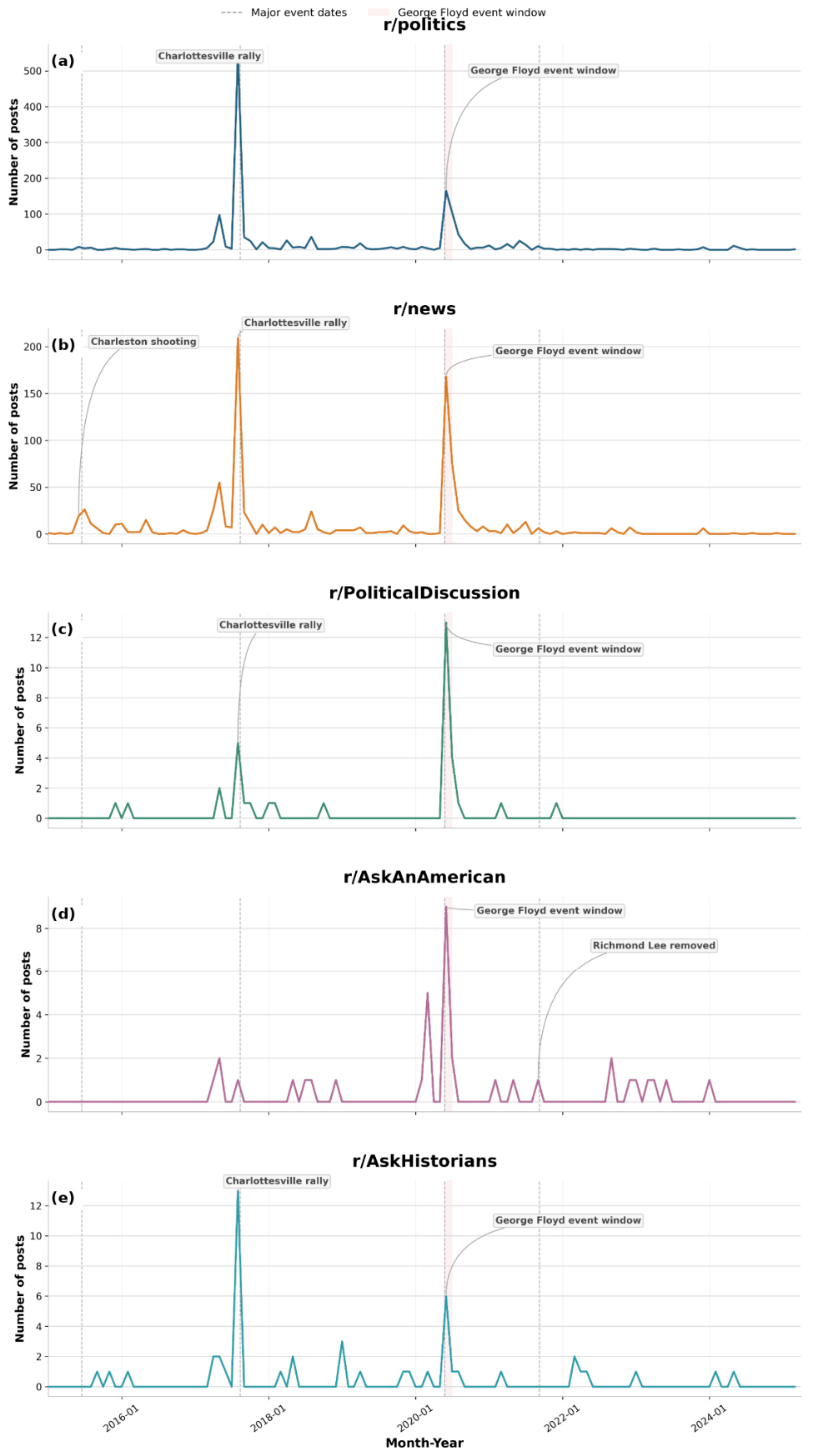
To examine temporal variation in Confederate monument discussion, monthly post counts were aggregated by subreddit and used to observe posting fluctuations around major public events. The time-trend analysis was based on the cleaned submission corpus and corresponds to Figure 2 and Table 3. The focal events were the Charleston church shooting, the Charlottesville rally, the George Floyd event window, and the removal of the Richmond Lee statue. These nodes were selected because they had national visibility and direct relevance to the Confederate monument controversy, racial violence, public-space conflict, removal policy, or platform-level discussion spikes. Charleston was included because it reshaped public debate over Confederate symbols; Charlottesville, because the rally centered directly on the defense of a Confederate statue; the George Floyd event window, because the 2020 protest cycle renewed monument-removal campaigns; and the Richmond Lee removal, because it was a highly symbolic removal event whose platform response could be compared with more conflict-centered windows. Because the primary increase related to George Floyd occurred in June 2020 rather than during the final week of May 2020, the event was analyzed using June 2020 as the event month.
In addition to graphical observation, Poisson tests were used to evaluate whether post volume in event-associated months was significantly higher than baseline activity. Specifically, the number of posts in the analysis month for each event and subreddit was compared with the mean number of posts in the preceding three months. If a preceding month had zero posts, that month was counted as 0 in the baseline mean. Table 3 reports event posts, baseline mean, rate ratio, p-value, and significance markers for each event across subreddits. This procedure allowed visible peaks in the time-trend figure to be translated into testable event-associated increases.

3. Results

3.1. RQ1: Event-Driven Temporal Patterns of Monument-Related Posts

Figure 2 shows the monthly variation in Confederate monument-related discussion across the five subreddits. Overall, post volume did not fluctuate evenly. Instead, it rose sharply around several major public events. The increases associated with the Charlottesville rally and the George Floyd event window were the most pronounced, indicating that monument discussion was especially likely to develop into high-intensity topics when violence, street protest, and racial-political crises escalated. By contrast, the fluctuation associated with the removal of the Richmond Lee statue was much weaker, suggesting an asymmetrical platform response across different types of events.
In terms of subreddit distribution, r/politics and r/news were the main spaces carrying temporal fluctuations. During the Charlottesville rally, r/politics reached 547 posts in August 2017 and r/news reached 209 posts. These levels were significantly higher than their respective preceding three-month baseline means of 36.33 and 23.33, with rate ratios of 15.06 and 8.96; both reached statistical significance. A similar concentration appeared during the George Floyd event window. In June 2020, r/politics reached 165 posts and r/news reached 168 posts, both significantly higher than their preceding three-month baselines of 3 and 0.33. These results indicate that when monument controversy became connected to a national racial-political crisis, discussion could rapidly transform from a local issue into a cross-community public topic.
Several smaller subreddits also showed identifiable increases during key events, but their intensity and stability were clearly lower than those of r/politics and r/news. In the case of the Charlottesville rally, r/PoliticalDiscussion reached 5 posts in August 2017, significantly higher than the baseline mean of 0.67, and r/AskHistorians reached 13 posts in the same month, significantly higher than the baseline level of 1. This shows that beyond news circulation and immediate political debate, monument events also entered spaces of institutional discussion and historical explanation. By contrast, r/AskAnAmerican did not show a significant increase during the same event, and the removal of the Richmond Lee statue did not produce a significant rise across multiple subreddits. Not all removal events therefore produced sustained high-intensity discussion. Platform response depended more on the political conflict, symbolic meaning, and national circulation conditions connected to an event.
Taken together, the time-trend analysis shows a clear temporal association between Confederate monument discussion on Reddit and major public events, but this association was unevenly distributed. Events with stronger national circulation and conflict potential were more likely to form significant peaks in r/politics and r/news and then spill over into communities oriented toward institutional discussion or historical interpretation. By comparison, a single removal action could still attract attention but did not necessarily become a platform-wide concentrated discussion. This difference suggests that the visibility of monument controversy within the platform depended not only on whether an event occurred but also on whether the event could be connected to larger political narratives and public memory conflicts.
Read through the concept of media rituals, these event-driven peaks are not merely increases in posting frequency. They mark moments of ritualized platform gathering, in which users repeatedly return to a contested symbol when it becomes attached to racial violence, protest, or national memory crisis. The temporal pattern therefore shows how Reddit transforms offline events into recurring mediated occasions for attention, classification, and public interpretation.

3.2. RQ2: Topic Structure of Confederate Monument Discussions

BERTopic modeling of the final analysis sample identified nine topics, thereby revealing the basic discussion structure of the Confederate monument controversy on Reddit. In terms of post count, the largest topic was Trump and historical-memory debate, with 667 posts; this was followed by North Carolina toppling protests, with 358 posts, and Alabama/Birmingham monument law dispute, with 328 posts. This distribution indicates that platform discussion of monuments was concentrated first around national political figures and historical memory debate, North Carolina-related protest events, and state-level conflicts over monument laws.
The remaining topics further show differentiation between event-level and interpretive discussion. Charlottesville/Virginia legal and rally disputes included 229 posts, and Texas/Baltimore removal actions included 201 posts; both were connected to specific regional removal actions or escalated controversies. Civil War memory, Lost Cause, and civil rights debate included only 168 posts; however, they corresponded not to a single event but to broader questions of historical interpretation. This indicates that some discussion moved beyond immediate news into reinterpretations of Civil War memory, Lost Cause narratives, and civil rights history. Other topics were more closely tied to concrete removal actions and institutional processes: Capitol statue removal bills included 154 posts, New Orleans statue removal included 139 posts, and Richmond Lee statue removal included 135 posts.
Overall, the Confederate monument controversy on Reddit did not appear as a homogeneous discussion repeatedly centered on a single symbol. Instead, it formed several relatively stable discussion pathways across national political debate, local removal implementation, legislative process, and historical interpretation. This topic structure includes both event-oriented and interpretation-oriented layers. Some topics remain closely tied to particular cities, statues, or policy actions, while others connect monument issues to broader debates over historical memory and national identity. This point is important for the subsequent analysis because it shows that Reddit does not merely redistribute related events; it also organizes, extends, and rewrites the meanings of monument controversy over time.

3.3. RQ3: Post-Category Patterns Across Monument Topics

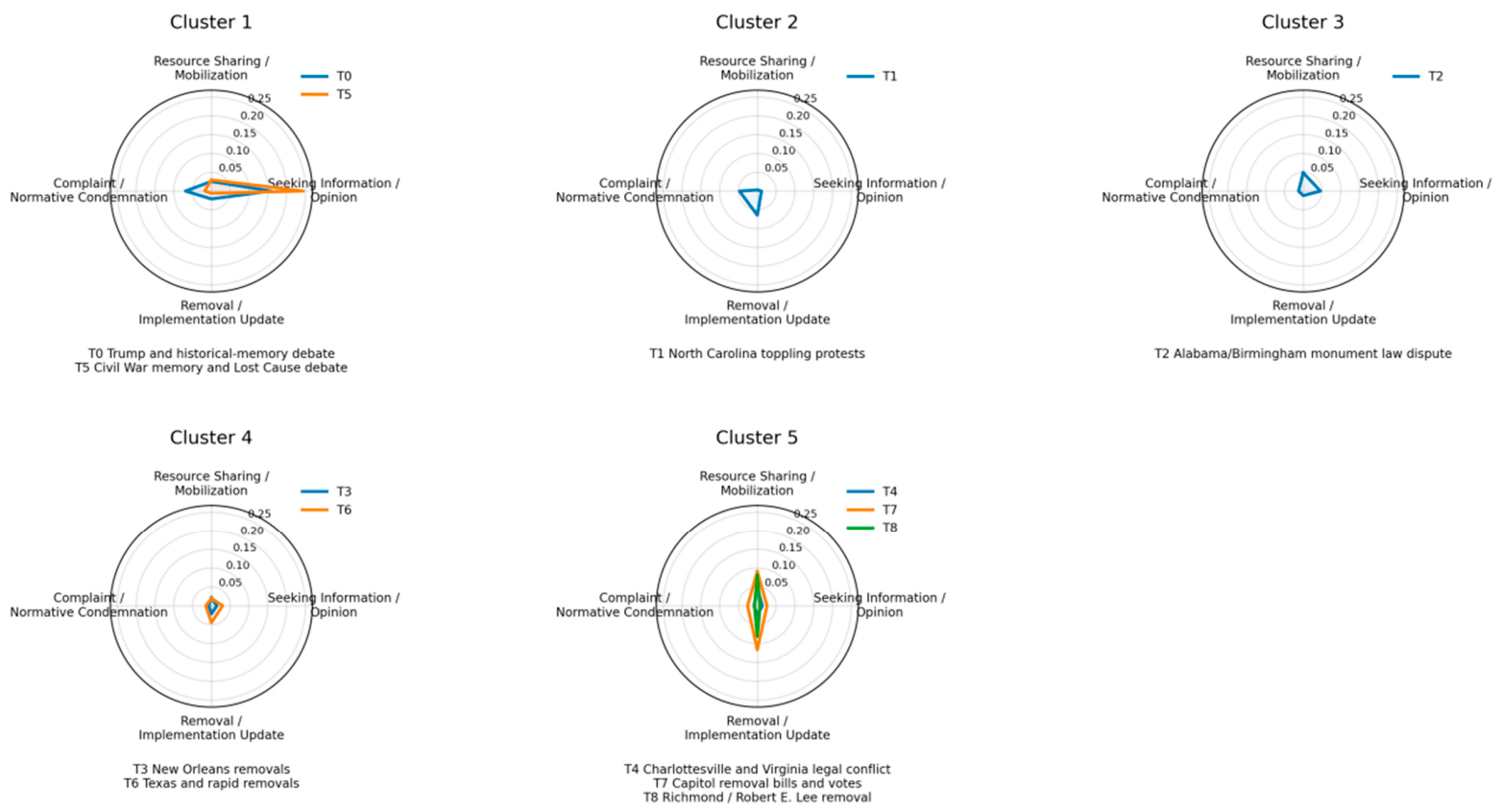
Figure 3 shows clear differences in the distribution of non-news post categories across topic clusters. Overall, Seeking Information/Opinion had the highest proportion, followed by Removal/Implementation Update, Resource Sharing/Mobilization, and Complaint/Normative Condemnation. This result indicates that beyond news sharing, monument discussion most often entered controversy through questions, requests for judgment, and searches for explanation.
Cluster 1 includes Trump and historical-memory debate and Civil War memory and Lost Cause debate, and it is dominated by Seeking Information/Opinion. Trump and historical-memory debate also retains a certain proportion of Complaint/Normative Condemnation. This suggests that topics related to historical memory interpretation were more likely to enter discussion through questioning and judgment.
Cluster 2 includes only North Carolina toppling protests. It is dominated by Removal/Implementation Update and also shows a relatively high proportion of Complaint/Normative Condemnation. This indicates that the topic was organized mainly around protest action and its legitimacy.
Cluster 3 includes only Alabama/Birmingham monument law dispute. It shows a combination of Resource Sharing/Mobilization and Seeking Information/Opinion, while other categories remain relatively low. This indicates that the topic contained both institutional information circulation and interpretation of legal controversy.
Cluster 4 includes New Orleans removals and Texas and rapid removals. It is more strongly oriented toward Removal/Implementation Update while retaining a certain degree of Resource Sharing/Mobilization. This suggests that the themes in this cluster mainly concerned concrete removal processes and subsequent handling.
Cluster 5 includes Charlottesville and Virginia legal conflict, Capitol removal bills and votes, and Richmond/Robert E. Lee removal. Removal/Implementation Update and Resource Sharing/Mobilization dominate this cluster, while Seeking Information/Opinion and Complaint/Normative Condemnation are lower. This indicates that when controversy entered the stages of legislative advance, administrative implementation, and symbolic statue handling, posts were more likely to be organized around action information and institutional process. Table 4 provides illustrative examples for the five post categories used in the post-classification analysis.

3.4. RQ4a: Community Response Differences Across Monument Topics

This section addresses RQ4 at the topic level by comparing how comment volume, post score, and comment-style distributions differ across monument topics.
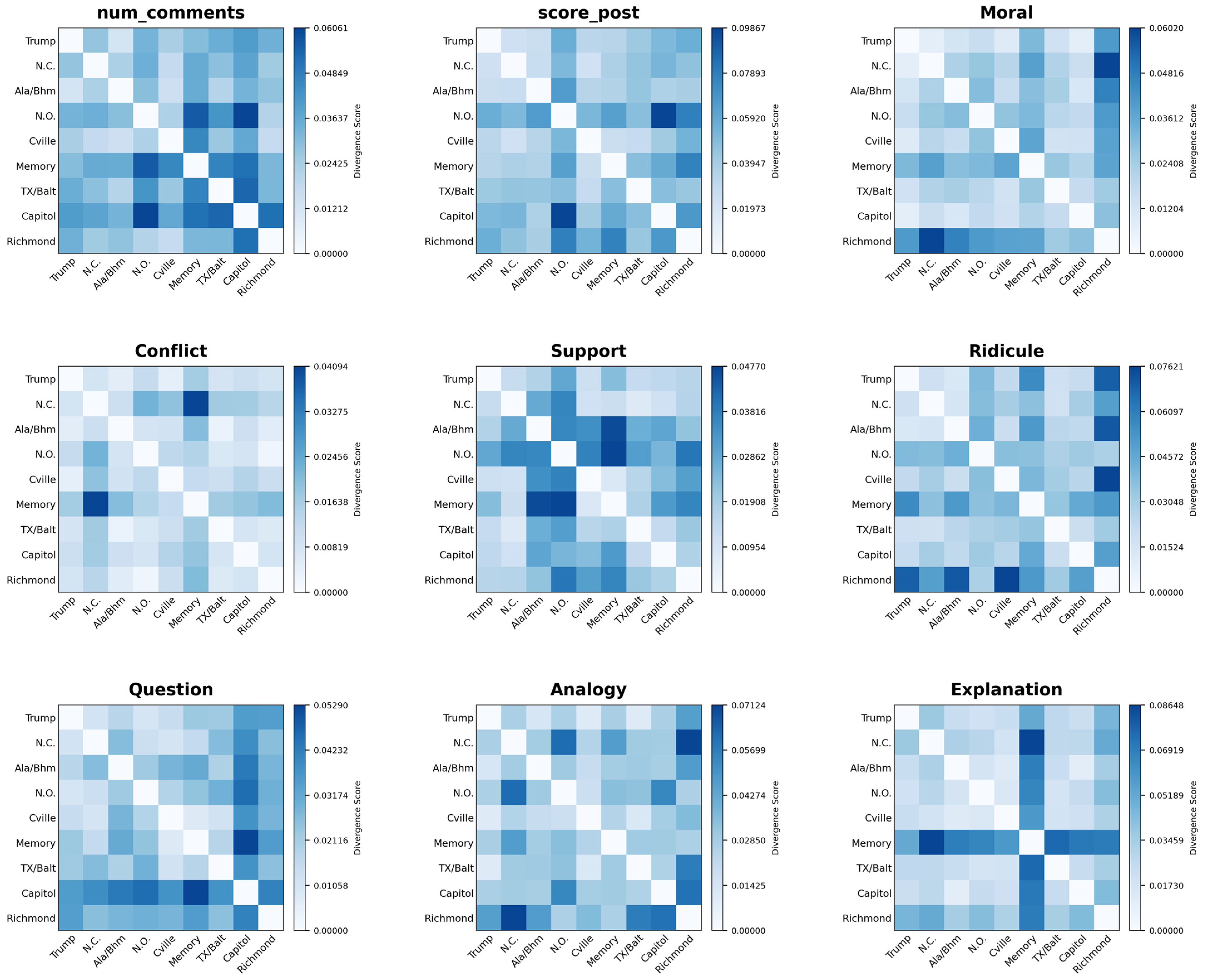
Community responses differed clearly in volume and style across monument topics. Figure 4 shows that comment volume, post score, and comment-style dimensions varied across topics; Table 5 further summarizes average comment volume, average post score, and seven comment-category metrics for each topic, making it possible to compare the response patterns elicited by different themes more specifically.
In terms of comment volume, North Carolina toppling protests had the highest average number of comments, at 69.23. It was followed by New Orleans statue removal, at 60.44, and Texas/Baltimore removal actions, at 50.85. By contrast, Civil War memory, Lost Cause, and civil rights debate had the lowest average comment count, at only 22.46. This suggests that topics directly connected to protest actions, removal implementation, and escalation of local conflict more readily generated concentrated responses, whereas topics oriented toward historical interpretation entered discussion but showed lower comment density.
In terms of post score, Alabama/Birmingham monument law dispute had the highest average score, at 1351.64. Charlottesville/Virginia legal and rally disputes and North Carolina toppling protests also had high average scores at 1220.71 and 1166.70, respectively. By contrast, New Orleans statue removal had the lowest average score, at 188.90. These differences show that although all topics revolved around the monument controversy, their visibility and attention within the platform differed. Topics linked to legal conflict, collective protest, and high-intensity public events were more likely to receive higher voting support.
Comment style also differed across topics. Explanation or Interpretation was the most frequent comment category in most topics, reaching the highest value in Civil War memory, Lost Cause, and civil rights debate (0.2643). This shows that even in highly contentious monument discussions, comment sections often perform the work of explanation, supplementation, and reinterpretation. At the same time, Sarcasm or Ridicule remained relatively high in several topics, especially Trump and historical-memory debate (0.1646) and Alabama/Birmingham monument law dispute (0.1549), indicating the continuing presence of sarcastic responses in the monument controversy.
Other comment categories were more closely tied to specific thematic content. Support or Agreement was relatively higher in New Orleans statue removal and Richmond Lee statue removal, at 0.0739 and 0.0712, respectively. Historical Analogy or Example also remained relatively high in New Orleans statue removal and Richmond Lee statue removal, at 0.1255 and 0.1035. By contrast, Interpersonal Conflict remained low across topics, with the highest value appearing in North Carolina toppling protests at only 0.0228. Overall, although the monument discussion was clearly contentious, the comment sections were not dominated by interpersonal conflict. They more often combined explanation, examples, sarcasm, and limited support-oriented responses.

3.5. RQ4b: Post-Comment Response Networks Across Subreddits

This section addresses RQ4 at the subreddit level by examining how post categories connect with comment-response categories within each community.
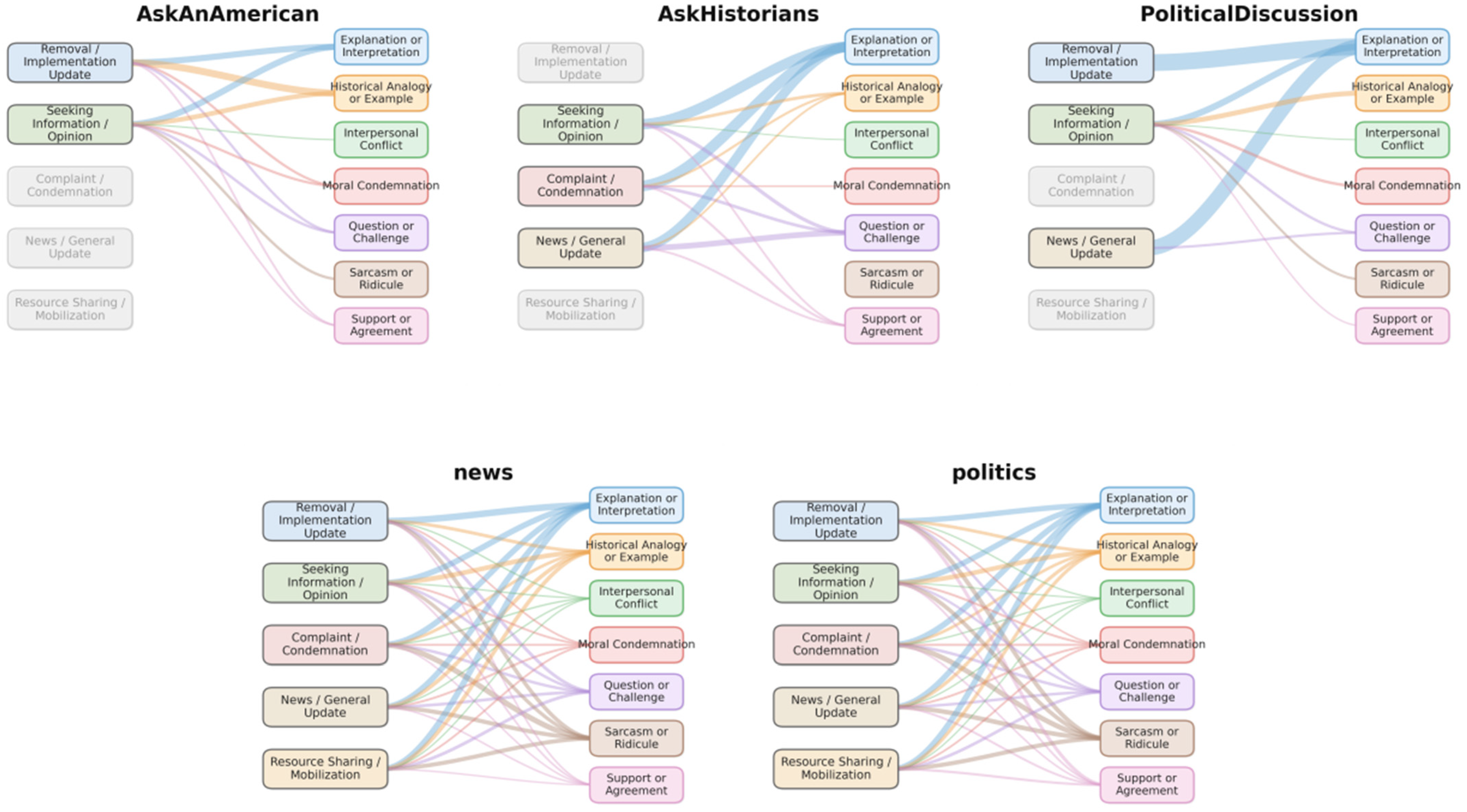
Figure 5 shows conditional probability relationships between post types and comment types across subreddits. The left side of the network contains the five post categories, and the right side contains the seven comment styles. Thicker edges indicate a higher probability that a given comment type appears under a given post category. Overall, although all communities discussed the same monument controversy, the entry modes of posts and the response pathways of comments differed. Larger r/news and r/politics communities displayed more complete response structures, whereas smaller institutional-discussion and knowledge-oriented communities showed more concentrated response patterns. Figure 5 includes all five post categories, including News/General Update.
In the three smaller communities, response pathways were more compressed. In r/AskHistorians, the main connections pointed toward Explanation or Interpretation, while Historical Analogy or Example and Question or Challenge also remained present. This pattern is consistent with the community’s emphasis on historical explanation and knowledge-oriented response. r/PoliticalDiscussion showed a similar tendency, with Removal/Implementation Update and News/General Update most prominently connected to Explanation or Interpretation, while other comment types were weaker. r/AskAnAmerican was somewhat more dispersed but still centered mainly on Explanation or Interpretation and Historical Analogy or Example. This indicates that although the community has a public question-and-answer character, its discussion was less likely to move toward strong emotional confrontation and more likely to develop through explanation, comparison, and examples.
In the two main discussion spaces, the network structure was more complex. In both r/news and r/politics, almost all post categories maintained stable and prominent connections to Explanation or Interpretation, showing that interpretive response was the most common comment pathway on the platform. Historical Analogy or Example also functioned as a persistent secondary channel, especially in relation to Seeking Information/Opinion, Removal/Implementation Update, and News/General Update. This suggests that in large-scale news and political discussion, users did not simply express support or opposition. They repeatedly organized controversy through historical analogies, background supplementation, and explanatory discourse. By comparison, Support or Agreement, Moral Condemnation, and Interpersonal Conflict were not absent, but their edges were generally thinner, indicating that they were not the main response directions under most post categories.
Several more specific patterns are also worth noting. First, News/General Update was retained in both r/news and r/politics and was clearly connected to Explanation or Interpretation. This means that news sharing did not simply remain at the level of information circulation; it continued to trigger explanation and reinterpretation. Second, Resource Sharing/Mobilization in larger communities also elicited interpretive and historical-analogy responses, suggesting that resource-mobilization posts were not only functional information but also often triggered further debate over the meaning and handling of monuments. Finally, the larger number of gray nodes in smaller communities indicates that some post categories appeared less often in those spaces, and their comment networks were therefore concentrated along a limited number of response pathways. Overall, Figure 5 shows that subreddits are not merely different locations for carrying the same controversy. They shape how post types enter discussion and how comments proceed along different pathways of explanation, comparison, challenge, or support.
This network pattern also gives the media ritual concept an empirical role in the analysis. The repeated movement from post categories to explanatory, analogical, or questioning comments indicates that Reddit users do not only react to monument news; they repeatedly enact a platformed ritual of sorting, interpreting, and reassigning public meaning. In this sense, post-comment pathways function as observable traces of how media rituals operate within subreddit-specific interaction structures.

4. Discussion

The results of this study further show that Reddit should not be understood as a passive echo of real-world monument controversy. It is better understood as an organizational space in which public memory conflict continues to unfold in a platform environment. Discussion around Confederate monuments showed not only event-driven temporal fluctuations but also clear community differentiation, post-type differences, and response-structure differences. The platform-based monument controversy was therefore not a synchronized reaction in a single public sphere. It was reclassified and reinterpreted through the rules, audience expectations, and interactional boundaries of different subreddits (Chandrasekharan et al., 2018). In this article, continuing interpretive memory work refers to the repeated use of posts and comments to explain, compare, challenge, and reassign meaning to Confederate monuments after offline events have entered the platform. This interpretation is consistent with recent work on platformed remembering and social media memory (Ben-David et al., 2024; Smit et al., 2024). These studies show that social media are not merely containers for memory content but influence how the past is organized, made visible, and contested; at the same time, Reddit communities have distinguishable macro, meso, and micro norms that lead to different topic frames and response pathways (Chandrasekharan et al., 2018).
The concept of media rituals helps specify this process. Reddit discussions around Confederate monuments are not rituals in the ceremonial sense; rather, they are ritualized media practices in which event peaks, subreddit rules, post genres, votes, and comment chains repeatedly organize attention and public interpretation. Continuing interpretive memory work is therefore also a form of platformed media ritual: a recurring mediated practice through which users gather around disputed symbols and negotiate their legitimacy.
From this perspective, the significance of the present study lies not only in identifying several Confederate monument-related topics. It also lies in showing how these topics are differentially organized within the platform. Larger r/news and r/politics communities more readily carry event peaks and multiple response pathways, while smaller institutional-discussion and knowledge-oriented communities are more likely to absorb interpretive and comparative discussion. Platform structure is therefore not simply the background condition of controversy. It forms an important part of how controversy becomes visible, which meanings are amplified, and which responses are repeatedly reproduced.

4.1. Event-Driven Surges and Uneven Platform Attention

The most prominent result related to RQ1 is not simply that post volume increased during particular months but that platform attention clustered around events that connected monument disputes to broader crises of racial violence, public protest, and national memory. Charlottesville and the George Floyd event window produced the strongest temporal activations, whereas the Richmond Lee removal did not generate a comparable platform-wide surge. This indicates that Reddit’s attention was selective: an event became highly visible when it could be framed as part of a larger conflict over racial order and historical legitimacy, not merely because a statue was removed or debated.
This result is broadly consistent with existing interpretations of the Confederate monument controversy. Research has repeatedly shown that these monuments are not neutral historical remains but are tied to white supremacist order, racial hierarchy, and the problem of forgetting in public space (Forest & Johnson, 2019; Strother et al., 2017). Disputes around them are often reactivated during moments of racial violence, political mobilization, and the redefinition of public space (Britt et al., 2020; Burns et al., 2024). Research on Charlottesville has shown that the 2017 white nationalist rally pushed Confederate symbols back to the center of national political debate and simultaneously intensified monument controversies in other places (Benjamin et al., 2020). Research on Richmond and the 2020 protest context has similarly shown that Black Lives Matter protests did not leave the monument issue at the level of local governance but reinserted it into broader conflicts over racial justice, historical revision, and commemorative legitimacy (Logan, 2021).
The findings also show that event intensity is not determined solely by the symbolic status of a statue. It depends on whether the event can connect to a larger public crisis. The removal of the Richmond Lee statue was highly symbolic in itself, but it did not produce a peak in r/politics and r/news comparable to Charlottesville or George Floyd. This echoes a basic insight in monument-removal research: whether removal becomes a high-intensity public issue often depends on local political structure, state-level institutional constraints, partisan environments, and media circulation conditions, not only on the historical importance of the monument itself (Benjamin et al., 2020; Carrington & Strother, 2021; Cooper et al., 2022). For Reddit, this means that platform attention is not a simple mirror of real-world events but a process of re-amplification after issue connection and community selection (Proferes et al., 2021).
This uneven event response further suggests that the Confederate monument controversy becomes highly visible on the platform primarily as a crisis moment rather than as a routine governance issue. Charlottesville and George Floyd were not only monument-related events; they were also national conflict nodes around racial order, public violence, and national memory (Burns et al., 2024; Talbert, 2022). Under these conditions, monument issues moved from local controversy into high-intensity cross-community topics and simultaneously entered spaces of news, politics, question-and-answer exchange, and historical explanation. Temporal peaks on the platform therefore represent more than an increase in discussion volume. They indicate moments when public memory conflict was reorganized with unusual concentration (Forest & Johnson, 2019).

4.2. Topic-Specific Modes of Entering Monument Controversy

The topic and post-category results show that monument controversy entered Reddit through several distinct interpretive pathways. Some topics were organized as questions of historical meaning and public judgment, while others were organized around removal progress, legal conflict, resource sharing, or institutional action. These patterns address RQ2 and RQ3 together: the topic structure shows what forms the controversy took, while the post categories show how users entered and extended those forms of controversy.
This difference is consistent with a basic insight in public memory research: monument controversy is not only a binary policy disagreement over retention or removal but also a continuing negotiation over which past should be interpreted, how it should be displayed, and who has the authority to assign public meaning to it (Dwyer & Alderman, 2008). Topics related to historical memory and the Lost Cause were more likely to enter discussion through questioning and judgment, indicating that they were treated first as interpretive problems. Topics related to removal, legislation, and local implementation were more likely to take the form of updates and mobilization, suggesting that when controversy moved into policy and action stages, the function of posts shifted from interpretation to coordination and transmission. The nature of the topic itself therefore shaped the main function of posts. Studies of monuments and the problem of forgetting have already shown that removal controversies persist because monuments continue to force publics to confront both how the past should be interpreted and how disappearance should be handled (Forest & Johnson, 2019; Logan, 2021).
This result can also be understood through Reddit’s community-norm structure. Research on Reddit has shown that subreddits have distinguishable macro, meso, and micro norms, which influence what kinds of expression are considered appropriate and what kinds of posting modes are more likely to receive continued response (Chandrasekharan et al., 2018). In the context of this study, this means that posts around monument controversy do not automatically adopt the same expression mode across topics. Topics leaning toward historical meaning and legitimacy are more likely to enter discussion through questioning, judgment, and debate, while topics leaning toward local removal, legislative advancement, and public action are more likely to enter through progress updates and resource circulation. The platform structure here does not merely distribute content. It helps different topics form relatively stable expressive scripts (Ammari et al., 2019; Massanari, 2017).
From a broader perspective in digital memory studies, these differences in posting patterns show that public memory on social platforms is not a one-dimensional representation of the past. It is repeatedly reorganized through different communicative purposes. Studies have noted that online forums and social media can form mediated remembering communities, where memory content is not simply stored but is continually reorganized through questioning, narration, comparison, and mobilization (Birkner & Donk, 2020; Hoskins, 2011). In this study, interpretation-oriented topics and action-update topics coexist, showing that monument controversy on Reddit performed two functions at once: interpretive work around historical meaning and action-oriented work around the handling of public space. Through the alternation of these two kinds of work, monument controversy expanded from specific statue issues into a continuing public memory conflict (Jacobsen & Beer, 2021).

4.3. Community Response Styles and Interpretive Dominance

A prominent feature of the comment results is that high controversy did not automatically translate into high interpersonal conflict. Across topics, comment sections more often performed explanatory and analogical work than direct personal confrontation. This matters because Confederate monuments are not only policy objects but also public-memory objects: responses to them frequently require users to explain context, compare historical cases, question legitimacy, or reframe what a statue is understood to represent.
In terms of comment style, the most stable pattern was not interpersonal conflict but interpretive response. Explanation or Interpretation remained the highest or near-highest category across the nine topics, reaching 0.2643 in Civil War memory, Lost Cause, and civil rights debate and 0.2245 in Trump and historical-memory debate. Historical Analogy or Example also appeared steadily across topics, reaching 0.1255 in New Orleans statue removal. By contrast, Interpersonal Conflict remained low across topics, with a maximum of only 0.0228 in North Carolina toppling protests; Moral Condemnation also showed limited cross-topic variation, with the highest value of 0.0596 in Trump and historical-memory debate. These findings show that although monument controversy contained clear political tension, the main work of the comment section was not sustained interpersonal confrontation. It was explanation, exemplification, comparison, and reinterpretation.
This finding echoes an important insight in online political discussion research. Studies of online incivility show that conflict in political discussion does not appear evenly across all topics and all interactional settings. Incivility often emerges as a sequential and contextual phenomenon, rather than as an automatic consequence of any contentious issue (Rowe, 2015). At the same time, Reddit communities have distinguishable macro, meso, and micro norms that affect which expressions are retained, diffused, and responded to (Chandrasekharan et al., 2018). In the present results, this means that although monument discussion revolved around a highly divisive symbolic object, many topics were handled through explanation, background supplementation, and historical analogy rather than through direct conflict (Gervais, 2015; Rega et al., 2023).
These interpretive responses matter because Confederate monuments are themselves objects of public memory conflict (Forest & Johnson, 2019). Social memory research has shown that social media are not merely containers for existing memory content. They participate in memory construction through commenting, sharing, comparison, and retelling (Ben-David et al., 2024). In this study, the continuing dominance of Explanation or Interpretation and Historical Analogy or Example suggests that comments around monuments did not simply react to events in the moment. They continually connected individual statues, local disputes, and larger historical narratives. The comment section therefore functioned not only as a space for emotional release but also as a site of continuing interpretive memory work (Ben-David & Soffer, 2019; Hoskins, 2011).

4.4. Subreddit-Specific Response Pathways

The main issue revealed by RQ4 is how post categories and subreddit contexts jointly shape response pathways. Larger r/news and r/politics communities had more complex post-comment networks, while r/AskHistorians, r/PoliticalDiscussion, and r/AskAnAmerican showed more concentrated pathways of explanation, comparison, and questioning. These differences show that subreddits are not parallel containers for the same controversy; they are meso-level arenas that mediate how macro-level memory conflicts become micro-level practices of commenting and interpretation.
This point is consistent with research on Reddit community structure. Studies have shown that although Reddit shares a common technical framework and voting system, different subreddits do not follow identical communication patterns. Instead, communities form their own expression norms, interaction rhythms, and acceptable discourse boundaries on top of shared platform rules (Singer et al., 2014). Research on digital debate culture also shows that Reddit discussion is not a single “platform style”, but a juxtaposition of multiple community styles (Massanari, 2017; Proferes et al., 2021). In the context of the present study, this means that the same monument event, even when it appears in multiple subreddits, does not automatically generate the same comment structure (Chandrasekharan et al., 2018).
The most stable feature in Figure 5 is the continued dominance of interpretive response across communities. Whether in high-traffic communities such as r/news and r/politics or in knowledge-oriented communities such as r/AskHistorians, Explanation or Interpretation was the main comment pathway, while Historical Analogy or Example formed an important supplement. This structure indicates that interaction around Confederate monuments did not rely primarily on immediate position-taking. It proceeded through background supplementation, historical comparison, and meaning-making. This is especially important for monument controversy because such controversy is not merely a policy disagreement. It is a continuing negotiation over historical authority, public-space legitimacy, and symbolic order (Dwyer & Alderman, 2008; Forest & Johnson, 2019). Social media memory research likewise emphasizes that memory practices on platforms are continually organized through everyday comments, responses, and retellings, not only through formal commemorative moments (Ben-David et al., 2024; Smit et al., 2024).
The concentration of response pathways in smaller communities also has interpretive significance. r/AskHistorians concentrated more strongly on explanation and historical analogy, indicating that its community norms restricted emotional diffusion and strengthened knowledge-oriented responses. r/PoliticalDiscussion remained connected to contemporary politics, but its main pathway was also closer to explanation and institutional judgment than to dense sarcasm or conflict. By comparison, the networks of r/news and r/politics were more complex, indicating that in high-traffic settings, monument events could elicit explanation while also generating a wider range of comparison, questioning, and limited support-oriented responses. Overall, community differences within the platform did not weaken the monument controversy. They gave it different forms of unfolding, allowing the same symbolic conflict to appear simultaneously as news follow-up, political debate, knowledge explanation, and historical comparison.

4.5. Implications

The findings of this study have three main implications. At the research level, the study shows that the Confederate monument controversy should be understood not only as a local policy disagreement over whether statues should remain or be removed but also as a platformed public-memory process that is repeatedly activated, classified, and interpreted through community-specific mechanisms. The Reddit-specific contribution of the study is therefore to show how subreddit boundaries, post genres, voting-oriented visibility, and threaded comments help transform offline monument disputes into continuing interpretive memory work (Ben-David et al., 2024; Smit et al., 2024). Framed through media rituals, this contribution shows that Reddit not only circulates memory controversies after they occur; it ritualizes them through repeated acts of attention, categorization, voting, explanation, and analogy.
At the methodological level, the study shows that combining temporal trends, topic identification, post types, and comment styles within a single analytical chain helps capture the online operation of monument controversy more fully. Analysis based only on posting peaks can show when controversy attracts concentrated attention; analysis based only on topic distribution can show what the discussion is about. When these are connected to the comment structure, it becomes possible to see how controversy moves from event reporting into explanation, comparison, questioning, or institutional discussion. For public memory research, this approach makes it possible to understand when an issue is discussed, how it is discussed, and how it is responded to within one framework, which is close to recent calls in social memory research for multi-level empirical modeling (Ben-David et al., 2024).
At the practical level, the findings suggest that different types of monument controversy should not be treated as homogeneous content. Event-conflict topics are more likely to generate high-intensity attention, whereas historical-interpretation topics rely more heavily on explanatory responses and historical analogies. For platform governance, digital public history, and communication practices by public institutions, this means that the handling of controversial information should not be organized only around removal, retention, or position-taking. It should also consider the response mechanisms that users need under different topics. In high-conflict event windows, providing background explanation and institutional information may stabilize discussion more effectively than simply recirculating the event itself. In historically oriented controversies, providing verifiable explanatory resources may help prevent monument issues from being reduced to a single emotional confrontation. Given that Confederate symbols have continuing racialized effects in public space, the interpretive structures and response pathways within platforms are not merely matters of communication style. They are directly connected to the social consequences of public memory (Britt et al., 2020; Ehrlinger et al., 2011; Rios et al., 2022).

4.6. Limitations

This study has several limitations that should be made explicit. First, data collection was based on search rules centered on Confederate and terms such as monument, statue, memorial, and marker. This approach helps ensure sample relevance, but it may miss posts that entered discussion through place names, personal names, event abbreviations, or implicit expressions without using these exact terms. Similarly, the study focused on several key event windows. This helps connect temporal fluctuations to major public events, but it may weaken attention to discussions that accumulated more slowly and did not concentrate around a single event node.
Second, Reddit users are not equivalent to the broader American public. The results should therefore be understood as reflecting the expression structures of specific discussion communities within the platform, rather than as direct mappings of overall social opinion. Existing research has shown that Reddit users have clear selectivity in age structure, participation style, and platform-use context, meaning that platform samples carry demographic and cultural biases (Chew et al., 2021; Proferes et al., 2021; Zapcic et al., 2023). The peaks, topics, and response patterns observed in this study first reflect the structure of monument controversy in Reddit communities and should not be simply generalized to offline public attitudes as a whole.
Third, the classification of posts and comments relied on zero-shot models, and topic division relied on pretrained semantic representations and clustering results. These methods improve the efficiency of large-scale text processing, but this does not mean that classifications are completely neutral. The study did not conduct formal inter-rater reliability testing or a human-coded validation sample for the post and comment labels, and the BERTopic solution was selected through interpretability assessment rather than reported multi-run stability metrics. Existing research shows that large pretrained language models retain social biases from training corpora and may reproduce those biases in downstream tasks. The post labels, comment labels, and topic boundaries in this study should therefore be understood as analytical approximations that help organize the material, not as the only possible divisions of textual meaning. The post and comment categories capture communicative functions and response styles, but they do not substitute for a dedicated sentiment or emotion analysis of anger, grief, moral outrage, or other affective dimensions. This point is especially important in a corpus of monument controversy, where interpretation depends strongly on historical context, sarcasm, and political implication; model classification may compress some semantic details (Bender et al., 2021; Blodgett et al., 2020).
Finally, the network visualization and topic comparisons mainly reveal association structures within the platform rather than strict causal mechanisms. The fact that a certain post type is more likely to connect with a certain comment type does not mean that the former automatically determines the latter. It is more likely to reflect the combined effects of community norms, event type, user composition, and platform interaction mechanisms. On this basis, the study should be understood as a descriptive and associative analysis of the online structure of monument controversy rather than as a causal account of user motivation, opinion change, or offline political effects.

4.7. Future Directions

Future research can proceed in three directions. First, the present Reddit-based analytical framework can be extended to other platforms such as X, Facebook public pages, YouTube comments, or local news comment sections. The significance of such expansion lies not only in increasing sample size but also in comparing whether the same monument event is organized in the same way across different platform environments. If Reddit more readily produces interpretive responses while other platforms more readily produce emotional position-taking or short-cycle diffusion, the platform difference itself becomes an important variable in understanding public memory controversies.
Second, future studies can introduce more explicit human validation in addition to topic modeling and zero-shot classification in order to improve the stability of topic boundaries and comment-type judgments. For the present study, three extensions would be especially valuable: human review of high-frequency topics, multi-run topic-stability checks, and cross-checking of sarcasm, historical analogy, and interpretive comments. Future work could also add sentiment or emotion modeling to examine how affective intensity interacts with public memory interpretation. This would test the degree of agreement between model output and human judgment and clarify which patterns derive from the text itself and which may be shaped by the classification procedure (Bender et al., 2021; Blodgett et al., 2020).
Third, online discussion peaks can be connected more directly to offline governance processes, such as local removal decisions, state-level legislation, public institutional statements, and news circulation before and after major events. This would make it possible to test a more specific question: whether the rise in monument controversy on platforms mainly follows offline events or whether it also participates in the public amplification and reorganization of the issue itself. If online discussion structures and offline institutional processes can be examined within the same temporal framework, research on the Confederate monument controversy can move from asking what happened on the platform to asking how the platform intervened in the controversy itself.

5. Conclusions

This study examined Reddit as a platformed arena in which Confederate monument controversies are organized, diffused, and responded to across communities. The results show that such a discussion did not unfold evenly. Instead, it rose markedly around a small number of major public events and was concentrated primarily in high-traffic communities such as r/news and r/politics. At the same time, topic modeling showed that monument controversy did not repeatedly revolve around a single issue. It formed nine relatively stable discussion topics across national political debate, local removal actions, legislative processes, and historical interpretation.
Different topics were associated with different posting patterns and response structures. Topics oriented toward historical meaning and public explanation more often entered discussion through Seeking Information/Opinion, while topics oriented toward removal implementation, legislative advancement, and local action more often unfolded through Removal/Implementation Update and Resource Sharing/Mobilization. At the comment level, interpretive responses and historical analogies consistently played important roles, while high-intensity interpersonal conflict did not become the dominant mode in most topics. Online controversy over monuments was therefore not only an accumulation of immediate position-taking. In this article, continuing interpretive memory work refers to this repeated process of explaining, comparing, challenging, and reassigning meaning to Confederate monuments through posts and comment chains.
Differences across subreddits further show that communities within the platform are not parallel containers for the same controversy. Larger r/news and r/politics communities displayed more complex post-comment networks, while r/AskHistorians, r/PoliticalDiscussion, and r/AskAnAmerican showed more concentrated pathways of explanation and comparison. Reddit is therefore not merely a channel for transmitting real-world monument controversy. It is also an important space in which the meaning of monuments is continuously reorganized through platform rules, community norms, and interaction structures.
Overall, this study shows that the Confederate monument controversy on Reddit appears as an event-driven, topically differentiated, and unevenly structured public memory process. Placing temporal trends, topic identification, post types, and comment styles within a single analytical chain helps explain more concretely how platforms participate in the continuing visibility, reinterpretation, and reorganization of historical controversy. In doing so, the article links public memory, subreddit-specific interaction, and media rituals by showing how repeated platform practices transform contested monuments into recurring occasions for collective attention and interpretive negotiation.

Author Contributions

Conceptualization, S.Y.; methodology, S.Y.; software, S.Y.; validation, S.Y.; formal analysis, S.Y.; investigation, S.Y.; resources, S.Y.; data curation, S.Y.; writing—original draft preparation, S.Y.; writing—review and editing, S.Y. and W.K.; visualization, S.Y.; supervision, W.K.; project administration, W.K. All authors have read and agreed to the published version of the manuscript.

Funding

This research received no external funding.

Institutional Review Board Statement

Not applicable. This study analyzed only publicly accessible Reddit posts and comments and did not involve intervention, recruitment, direct interaction with individuals, or the collection of private, restricted, or directly identifiable human-subject data. During reporting, usernames, profile links, and other direct identifiers were excluded from the manuscript, and the findings were presented in anonymized and aggregate form.

Informed Consent Statement

Not applicable because the study analyzed publicly accessible online content and did not involve direct contact with individual participants.

Data Availability Statement

The processed dataset and supporting materials used in this study are available in Zenodo at https://doi.org/10.5281/zenodo.19844969. The data were derived from publicly accessible Reddit content collected through public archive/search interfaces and were processed for research purposes.

Conflicts of Interest

The authors declare no conflicts of interest.

References

  1. Ammari, T., Schoenebeck, S., & Romero, D. M. (2019). Self-declared throwaway accounts on reddit: How platform affordances and shared norms enable parenting disclosure and support. Proceedings of the ACM on Human-Computer Interaction, 3(CSCW), 135. [Google Scholar] [CrossRef]
  2. Baumgartner, J., Zannettou, S., Keegan, B., Squire, M., & Blackburn, J. (2020). The pushshift reddit dataset. Proceedings of the International AAAI Conference on Web and Social Media, 14(1), 830–839. [Google Scholar] [CrossRef]
  3. Ben-David, A. (2019). 2014 not found: A cross-platform approach to retrospective web archiving. Internet Histories, 3(3–4), 316–342. [Google Scholar] [CrossRef]
  4. Ben-David, A. (2020). Counter-archiving Facebook. European Journal of Communication, 35(3), 249–264. [Google Scholar] [CrossRef]
  5. Ben-David, A., Meyers, O., & Neiger, M. (2024). How social memory works on social media: A methodological framework. Memory, Mind & Media, 3, e20. [Google Scholar] [CrossRef]
  6. Ben-David, A., & Soffer, O. (2019). User comments across platforms and journalistic genres. Information, Communication & Society, 22(12), 1810–1829. [Google Scholar] [CrossRef]
  7. Bender, E. M., Gebru, T., McMillan-Major, A., & Shmitchell, S. (2021). On the dangers of stochastic parrots: Can language models be too big? In Proceedings of the 2021 ACM conference on fairness, accountability, and transparency (pp. 610–623). Association for Computing Machinery. [Google Scholar] [CrossRef]
  8. Benjamin, A., Block, R., Jr., Clemons, J., Laird, C., & Wamble, J. (2020). Set in stone? predicting confederate monument removal. PS: Political Science & Politics, 53(2), 237–242. [Google Scholar] [CrossRef]
  9. Birkner, T., & Donk, A. (2020). Collective memory and social media: Fostering a new historical consciousness in the digital age? Memory Studies, 13(4), 367–383. [Google Scholar] [CrossRef]
  10. Blair, C., Dickinson, G., & Ott, B. L. (2010). Rhetoric/memory/place. In G. Dickinson, C. Blair, & B. L. Ott (Eds.), Places of public memory: The rhetoric of museums and memorials (pp. 1–54). University of Alabama Press. [Google Scholar]
  11. Blei, D. M., Ng, A. Y., & Jordan, M. I. (2003). Latent Dirichlet allocation. Journal of Machine Learning Research, 3, 993–1022. Available online: https://www.jmlr.org/papers/v3/blei03a.html (accessed on 2 July 2026).
  12. Blodgett, S. L., Barocas, S., Daumé, H., III, & Wallach, H. (2020). Language (technology) is power: A critical survey of ‘bias’ in NLP. In Proceedings of the 58th annual meeting of the association for computational linguistics (pp. 5454–5476). Association for Computational Linguistics. [Google Scholar] [CrossRef]
  13. Britt, L., Wager, E., & Steelman, T. (2020). Meanings and impacts of confederate monuments in the U.S. south. Du Bois Review: Social Science Research on Race, 17(1), 105–123. [Google Scholar] [CrossRef]
  14. Burns, M. D., Granz, E. L., & Williams, K. D. (2024). Beyond ‘pride or prejudice’: Conservatism, opposition to political correctness, and support for confederate and other controversial statues. Group Processes & Intergroup Relations, 27(7), 1477–1500. [Google Scholar] [CrossRef]
  15. Carey, J. W. (2008). Communication as culture: Essays on media and society (Rev. ed.). Routledge. [Google Scholar]
  16. Carrington, N. T., & Strother, L. (2021). Who thinks removing confederate icons violates free speech? Politics, Groups, and Identities, 9(1), 208–218. [Google Scholar] [CrossRef]
  17. Chandrasekharan, E., Samory, M., Jhaver, S., Charvat, H., Bruckman, A., Lampe, C., Eisenstein, J., & Gilbert, E. (2018). The internet’s hidden rules: An empirical study of reddit norm violations at micro, meso, and macro scales. Proceedings of the ACM on Human-Computer Interaction, 2(CSCW), 32. [Google Scholar] [CrossRef]
  18. Chew, R., Kery, C., Baum, L., Bukowski, T., Kim, A., & Navarro, M. (2021). Predicting age groups of reddit users based on posting behavior and metadata: Classification model development and validation. JMIR Public Health and Surveillance, 7(3), e25807. [Google Scholar] [CrossRef] [PubMed]
  19. Cooper, C. A., Hood, M. V., III, Huffmon, S. H., Kidd, Q., Knotts, H. G., & McKee, S. C. (2022). Switching sides but still fighting the civil war in southern politics. Politics, Groups, and Identities, 10(1), 100–116. [Google Scholar] [CrossRef]
  20. Cooper, C. A., Huffmon, S. H., Knotts, H. G., & McKee, S. C. (2021). Heritage versus hate: Assessing opinions in the debate over confederate monuments and memorials. Social Science Quarterly, 102(3), 1098–1110. [Google Scholar] [CrossRef]
  21. Couldry, N. (2003). Media rituals: A critical approach. Routledge. [Google Scholar]
  22. Dayan, D., & Katz, E. (1992). Media events: The live broadcasting of history. Harvard University Press. [Google Scholar]
  23. Devlin, J., Chang, M.-W., Lee, K., & Toutanova, K. (2019). BERT: Pre-training of deep bidirectional transformers for language understanding. In Proceedings of the 2019 conference of the North American chapter of the association for computational linguistics: Human language technologies, volume 1 (long and short papers) (pp. 4171–4186). Association for Computational Linguistics. [Google Scholar] [CrossRef]
  24. Drayton, R. (2019). Rhodes must not fall? Statues, postcolonial “heritage” and temporality. Third Text, 33(4–5), 651–666. [Google Scholar] [CrossRef]
  25. Dwyer, O. J., & Alderman, D. H. (2008). Memorial landscapes: Analytic questions and metaphors. GeoJournal, 73(3), 165–178. [Google Scholar] [CrossRef]
  26. Ehrlinger, J., Plant, E. A., Eibach, R. P., Columb, C. J., Goplen, J. L., Kunstman, J. W., & Butz, D. A. (2011). How exposure to the confederate flag affects willingness to vote for Barack Obama. Political Psychology, 32(1), 131–146. [Google Scholar] [CrossRef]
  27. Forest, B., & Johnson, J. (2019). Confederate monuments and the problem of forgetting. Cultural Geographies, 26(1), 127–131. [Google Scholar] [CrossRef]
  28. Gervais, B. T. (2015). Incivility online: Affective and behavioral reactions to uncivil political posts in a web-based experiment. Journal of Information Technology & Politics, 12(2), 167–185. [Google Scholar] [CrossRef]
  29. Grootendorst, M. (2022). BERTopic: Neural topic modeling with a class-based TF-IDF procedure. arXiv. [Google Scholar] [CrossRef]
  30. He, P., Liu, X., Gao, J., & Chen, W. (2020). DeBERTa: Decoding-enhanced BERT with disentangled attention. arXiv. [Google Scholar] [CrossRef]
  31. Hoskins, A. (2011). 7/7 and connective memory: Interactional trajectories of remembering in post-scarcity culture. Memory Studies, 4(3), 269–280. [Google Scholar] [CrossRef]
  32. Jacobsen, B. N. (2024). When is the right time to remember? social media memories, temporality and the Kairologic. New Media & Society, 26(5), 2872–2888. [Google Scholar] [CrossRef]
  33. Jacobsen, B. N., & Beer, D. (2021). Quantified nostalgia: Social media, metrics, and memory. Social Media + Society, 7(2), 20563051211008822. [Google Scholar] [CrossRef]
  34. Jungselius, B., & Weilenmann, A. (2023). Keeping memories alive: A decennial study of social media reminiscing, memories, and nostalgia. Social Media + Society, 9(4), 20563051231207850. [Google Scholar] [CrossRef]
  35. Labadi, S. (2024). Colonial statues in post-colonial Africa: A multidimensional heritage. International Journal of Heritage Studies, 30(3), 318–331. [Google Scholar] [CrossRef]
  36. Logan, K. (2021). ‘History is illuminating’: Public memory crises and collectives in Richmond, Virginia. Memory Studies, 14(6), 1465–1479. [Google Scholar] [CrossRef]
  37. March, L. (2020). Rebel reviewers: Social media review pages as sites of confederate memorial discourses. First Monday, 25(12). [Google Scholar] [CrossRef]
  38. Massanari, A. (2017). #Gamergate and the Fappening: How reddit’s algorithm, governance, and culture support toxic technocultures. New Media & Society, 19(3), 329–346. [Google Scholar] [CrossRef]
  39. McInnes, L., & Healy, J. (2018). UMAP: Uniform manifold approximation and projection for dimension reduction. arXiv. [Google Scholar] [CrossRef]
  40. McInnes, L., Healy, J., & Astels, S. (2017). Hdbscan: Hierarchical density based clustering. Journal of Open Source Software, 2(11), 205. [Google Scholar] [CrossRef]
  41. O’Connell, H. A. (2022). Racism and confederate monument construction: Temporal regimes distinguishing the 1900s, 1960s, and contemporary decades. Sociology of Race and Ethnicity, 8(1), 62–78. [Google Scholar] [CrossRef]
  42. Prakasam, N., & Huxtable-Thomas, L. (2021). Reddit: Affordances as an enabler for shifting loyalties. Information Systems Frontiers, 23(3), 723–751. [Google Scholar] [CrossRef]
  43. Proferes, N., Jones, N., Gilbert, S., Fiesler, C., & Zimmer, M. (2021). Studying reddit: A systematic overview of disciplines, approaches, methods, and ethics. Social Media + Society, 7(2), 20563051211019004. [Google Scholar] [CrossRef]
  44. Rega, R., Marchetti, R., & Stanziano, A. (2023). Incivility in online discussion: An examination of impolite and intolerant comments. Social Media + Society, 9(2), 20563051231180638. [Google Scholar] [CrossRef]
  45. Reimers, N., & Gurevych, I. (2019). Sentence-BERT: Sentence embeddings using Siamese BERT-networks. In Proceedings of the 2019 conference on empirical methods in natural language processing and the 9th international joint conference on natural language processing (EMNLP-IJCNLP) (pp. 3982–3992). Association for Computational Linguistics. [Google Scholar] [CrossRef]
  46. Rios, K., Mischkowski, D., & Stephenson, N. B. (2022). White people problems? white privilege beliefs predict attitudes toward confederate symbols. Social Psychological and Personality Science, 13(7), 1510–1520. [Google Scholar] [CrossRef]
  47. Rowe, I. (2015). Civility 2.0: A comparative analysis of incivility in online political discussion. Information, Communication & Society, 18(2), 121–138. [Google Scholar] [CrossRef]
  48. Sheehan, R., & Speights-Binet, J. (2019). Negotiating strategies in new Orleans’s memory-work: White fragility in the politics of removing four confederate-inspired monuments. Journal of Cultural Geography, 36(3), 346–367. [Google Scholar] [CrossRef]
  49. Singer, P., Flöck, F., Meinhart, C., Zeitfogel, E., & Strohmaier, M. (2014). Evolution of reddit: From the front page of the internet to a self-referential community? In Proceedings of the 23rd international conference on world wide web companion (pp. 517–522). Association for Computing Machinery. [Google Scholar] [CrossRef]
  50. Smit, R., Jacobsen, B. N., & Annabell, T. (2024). The multiplicities of platformed remembering. Memory, Mind & Media, 3, e3. [Google Scholar] [CrossRef]
  51. Strother, L., Piston, S., & Ogorzalek, T. (2017). Pride or prejudice? Racial prejudice, southern heritage, and white support for the confederate battle flag. Du Bois Review: Social Science Research on Race, 14(1), 295–323. [Google Scholar] [CrossRef]
  52. Talbert, R. D. (2022). How do you react to seeing the confederate flag? Examining public reactions by race-ethnicity and region. Sociological Spectrum, 42(1), 40–60. [Google Scholar] [CrossRef]
  53. Wolf, T., Debut, L., Sanh, V., Chaumond, J., Delangue, C., Moi, A., Cistac, P., Rault, T., Louf, R., Funtowicz, M., Davison, J., Shleifer, S., von Platen, P., Ma, C., Jernite, Y., Plu, J., Xu, C., Le Scao, T., Gugger, S., … Rush, A. (2020). Transformers: State-of-the-art natural language processing. In Proceedings of the 2020 conference on empirical methods in natural language processing: System demonstrations (pp. 38–45). Association for Computational Linguistics. [Google Scholar] [CrossRef]
  54. Yin, W., Hay, J., & Roth, D. (2019). Benchmarking zero-shot text classification: Datasets, evaluation, and entailment approach. In Proceedings of the 2019 conference on empirical methods in natural language processing and the 9th international joint conference on natural language processing (EMNLP-IJCNLP) (pp. 3914–3923). Association for Computational Linguistics. [Google Scholar] [CrossRef]
  55. Zapcic, I., Fabbri, M., & Karandikar, S. (2023). Using reddit as a source for recruiting participants for in-depth and phenomenological research. International Journal of Qualitative Methods, 22, 16094069231162674. [Google Scholar] [CrossRef]
Figure 1. Research methodology: data extraction, text analysis, and statistical/network analysis phases.
Journalmedia 07 00136 g001
Figure 2. Temporal patterns of Confederate monument-related posting activity across five subreddits (2015–2025). Monthly post volumes are shown for r/politics (a), r/news (b), r/PoliticalDiscussion (c), r/AskAnAmerican (d), and r/AskHistorians (e). Key event windows include the Charleston church shooting, the Charlottesville rally, the George Floyd event window, and the removal of the Richmond Lee statue. The figure shows posting fluctuations between event months and adjacent baseline periods, with related statistical tests reported in Table 3.
Journalmedia 07 00136 g002
Figure 3. Posting patterns across monument-topic clusters. The radar plot displays the distribution of non-news post categories across topic clusters. Topics are grouped by similarity in post-category composition and show the relative frequencies of Complaint/Normative Condemnation, Removal/Implementation Update, Seeking Information/Opinion, and Resource Sharing/Mobilization. To avoid obscuring structural differences among non-news posts, News/General Update is excluded from the proportional calculation in this figure.
Journalmedia 07 00136 g003
Figure 4. Differences in community response between monument topics. For each response dimension, the heatmap displays Jensen-Shannon divergence between topic distributions; darker or higher values indicate greater differences between topics in comment volume, post score, or comment style.
Journalmedia 07 00136 g004
Figure 5. Network visualization of comment-category probabilities across subreddit communities. Edges represent the probability of a comment category given a post category; thicker edges indicate higher probabilities. The figure retains the five post categories, including News/General Update, to show relationships between post types and comment-response pathways across subreddits.
Journalmedia 07 00136 g005
Table 1. Summary of subreddits: posts, comments, and unique authors used in this study.
SubredditUnique PostsUnique Authors (Posts)Unique CommentsUnique Authors (Comments)
r/politics138379554,08322,862
r/news88548456,91219,563
r/PoliticalDiscussion33232236912
r/AskAnAmerican322339991528
r/AskHistorians4637326152
Table 2. Topics created by the BERTopic model, with post counts, keywords, and sample titles.
CountNameRepresentationSample Title
667Trump and historical-memory debatetrump, history, memorials, confederacy, racist, AmericansTrump Chief of Staff John Kelly Defends Confederate Monuments
358North Carolina toppling protestsprotesters, topple, North Carolina, UNC, police, arrestsProtesters in Durham, NC topple Confederate statue
328Alabama/Birmingham monument law disputeAlabama, Birmingham, monument law, Supreme Court, mayor, removalConfederate Monument Law Upheld By Alabama Supreme Court
139New Orleans statue removalNew Orleans, mayor, removal, Confederate statues, city actionAP Top News New Orleans takes down 1st of 4 Confederate statues
229Charlottesville/Virginia legal and rally disputesCharlottesville, Virginia, rally, judge, court, removal disputeCharlottesville rally aimed to defend a Confederate statue. It may have doomed others
168Civil War memory, Lost Cause, and civil rights debateCivil War memory, Lost Cause, civil rights, Jim Crow, commemorative politics, historical interpretationWhy were Confederate monuments raised in Union and border states?
201Texas/Baltimore removal actionsTexas, Baltimore, university, Jefferson Davis, overnight removal, local actionUniversity of Texas student government votes to remove Jefferson Davis statue from campus
154Capitol statue removal billsCapitol, House, votes, bill, Pelosi, legislative removalThe House Votes To Remove Confederate Statues In The U.S. Capitol
135Richmond Lee statue removalRichmond, Robert E. Lee, Virginia, governor, Lee statue, removal orderVirginia governor to announce removal of Richmond statue of Confederate Gen. Robert E. Lee
Table 3. Results of Poisson tests comparing subreddit post volumes during major Confederate monument-related events with baseline activity. The table compares event-month post counts with the mean number of posts during the preceding three months and reports event posts, baseline mean, rate ratio, p-value, and significance markers. When the baseline mean was 0 or unsuitable for calculation, “—” is used. George Floyd-related discussion is analyzed using Jun-20 as the event month. *** p < 0.001; — = not calculated or not applicable.
EventEvent DateAnalysis MonthSubredditEvent PostsBaseline MeanRate Ratiop-ValueSig.
Charleston church shooting2015/6/17Jun-15r/politics80.6712<0.001***
Charleston church shooting2015/6/17Jun-15r/news190.6728.5<0.001***
Charleston church shooting2015/6/17Jun-15r/PoliticalDiscussion00
Charleston church shooting2015/6/17Jun-15r/AskAnAmerican00
Charleston church shooting2015/6/17Jun-15r/AskHistorians00
Charlottesville rally2017/8/12Aug-17r/politics54736.3315.06<0.001***
Charlottesville rally2017/8/12Aug-17r/news20923.338.96<0.001***
Charlottesville rally2017/8/12Aug-17r/PoliticalDiscussion50.677.5<0.001***
Charlottesville rally2017/8/12Aug-17r/AskAnAmerican10.671.50.487
Charlottesville rally2017/8/12Aug-17r/AskHistorians13113<0.001***
George Floyd event window2020/5/25Jun-20r/politics165355<0.001***
George Floyd event window2020/5/25Jun-20r/news1680.33504<0.001***
George Floyd event window2020/5/25Jun-20r/PoliticalDiscussion130
George Floyd event window2020/5/25Jun-20r/AskAnAmerican91.675.4<0.001***
George Floyd event window2020/5/25Jun-20r/AskHistorians60.3318<0.001***
Richmond Lee statue removed2021/9/8Sep-21r/politics10130.770.834
Richmond Lee statue removed2021/9/8Sep-21r/news66.330.950.606
Richmond Lee statue removed2021/9/8Sep-21r/PoliticalDiscussion00
Richmond Lee statue removed2021/9/8Sep-21r/AskAnAmerican10
Richmond Lee statue removed2021/9/8Sep-21r/AskHistorians00
Table 4. Illustrative examples of posts across the five post categories. These examples clarify distinctions among the labels used in the post-classification analysis.
Post CategorySample Titles
Complaint/Normative CondemnationOpinion | Enough of the Confederate statues, the alt-right heroes and Trump’s moral idiocy
It’s time to get rid of old, racist Confederate statues
Airbnb Is Deactivating Accounts Of People Trying To Attend A White Supremacist Rally
Removal/Implementation UpdateHundreds of UNC students protest plan to relocate toppled Confederate statue Silent Sam
House votes to remove statues of Gen. Lee and other Confederate leaders from U.S. Capitol
New Orleans removes statue of Confederate president overnight
Seeking Information/OpinionDid the construction of Confederate monuments significantly increase during periods of debate over civil rights?
What are your thoughts on the idea that removal or destruction of the Confederate statues would be a slippery slope?
What do you think of the removal of Confederate statues?
Resource Sharing/MobilizationGoFundMe campaign to relocate Confederate statue in Tampa meets fundraising goal
Petition calls for Confederate monument to be replaced with statue of Missy Elliott
Northam calls for taking down Confederate statues in Virginia and moving them to museums
News/General UpdateAP Top News New Orleans takes down 1st of 4 Confederate statues
Jefferson Memorial, Confederate statues enter national race debate
Mayor unveils preservation task force amid Confederate statue debate
Table 5. Community response across monument topics. The table reports the average and standard deviation of comment volume, post score, and seven comment-category metrics for each topic. Comment style is described through comment categories.
MetricT1T2T3T4T5T6T7T8T9
Num Comments46.7046 (135.7061)69.2346 (504.1855)48.7195 (136.9853)60.4388 (176.3916)48.2009 (152.8833)22.4583 (55.7854)50.8458 (157.6548)40.2987 (113.9216)44.4444 (162.3652)
Score Post493.4033 (2406.1204)1166.7011 (6564.9777)1351.6372 (8818.6354)188.8993 (542.3885)1220.7074 (6260.9807)471.6310 (3339.3216)761.5672 (3306.2647)936.9935 (4306.6344)912.6370 (3562.7048)
Moral Condemnation0.0596 (0.1189)0.0595 (0.1264)0.0487 (0.0821)0.0501 (0.1092)0.0591 (0.1248)0.0339 (0.0992)0.0455 (0.1126)0.0508 (0.1104)0.0532 (0.1424)
Interpersonal Conflict0.0179 (0.0593)0.0228 (0.0826)0.0145 (0.0343)0.0123 (0.0308)0.0165 (0.0521)0.0133 (0.0537)0.0136 (0.0362)0.0163 (0.0380)0.0122 (0.0297)
Support or Agreement0.0516 (0.1239)0.0459 (0.0953)0.0652 (0.1435)0.0739 (0.1610)0.0351 (0.0649)0.0292 (0.0621)0.0529 (0.1056)0.0593 (0.1173)0.0712 (0.1700)
Sarcasm or Ridicule0.1646 (0.1929)0.1462 (0.2057)0.1549 (0.1918)0.1171 (0.1834)0.1283 (0.1568)0.0843 (0.1409)0.1259 (0.1691)0.1326 (0.1795)0.1145 (0.2090)
Question or Challenge0.0857 (0.1381)0.0690 (0.1271)0.0713 (0.1116)0.0719 (0.1027)0.0733 (0.1419)0.0746 (0.1585)0.0660 (0.1276)0.0885 (0.1460)0.0470 (0.0715)
Historical Analogy or Example0.1022 (0.1550)0.0596 (0.1017)0.1015 (0.1593)0.1255 (0.1841)0.0920 (0.1378)0.1076 (0.1893)0.0996 (0.1598)0.0833 (0.1224)0.1035 (0.1566)
Explanation or Interpretation0.2245 (0.2447)0.1585 (0.2122)0.1750 (0.1958)0.1822 (0.2164)0.1721 (0.2120)0.2643 (0.3236)0.1785 (0.2098)0.1794 (0.2086)0.1541 (0.2051)
Note: Values are reported as mean (standard deviation). T1 = Trump and historical-memory debate; T2 = North Carolina toppling protests; T3 = Alabama/Birmingham monument law dispute; T4 = New Orleans statue removal; T5 = Charlottesville/Virginia legal and rally disputes; T6 = Civil War memory, Lost Cause, and civil rights debate; T7 = Texas/Baltimore removal actions; T8 = Capitol statue removal bills; T9 = Richmond Lee statue removal.
Disclaimer/Publisher’s Note: The statements, opinions and data contained in all publications are solely those of the individual author(s) and contributor(s) and not of MDPI and/or the editor(s). MDPI and/or the editor(s) disclaim responsibility for any injury to people or property resulting from any ideas, methods, instructions or products referred to in the content.