1. Introduction
From the first presidential administration of D. Trump to the January 6 insurrection, the COVID-19 pandemic, and the highly polarizing re-election campaign and second incumbency of Trump, the socio-cultural fabric of American society has undergone monumental changes. A major force underlying these changes is digital communication and the specific impact that internet technologies are having on social and political behavior. Each year, more and more people are obtaining information about politics and news from social media. On a broader scale, many people are looking at screens throughout most of their day—screen time is increasing and was estimated to be over five hours per day for adults. Furthermore, teens are spending close to 5 h a day on social media (
DeAngelis, 2024). Meanwhile, reliance on traditional news networks for obtaining political information has decreased to historically record lows (
Ardia et al., 2020), and conspiracy theories appear to be gaining steam online due to echo chambers that are inherent to social media platforms (
Cinelli et al., 2022). Social media has become a key arena for political communication wherein partisan identities get performed and contested recursively and continuously across time.
Particular functions within these digital platforms have reshaped how much of the public engages with politics. We have witnessed how hashtags have evolved from being used on social media as identifiers of a given topic, activity, or location into clear-cut political symbols that are used to rally movements and create discursive spaces for political debate online. The rise of hashtag activism has transformed contemporary political communication on social media. Hashtags function as symbolic markers that allow users to signal affiliation and create networked publics (
Bruns & Burgess, 2011;
Rambukkana, 2015). During the height of the 2024 presidential election, many hashtags were circulated on conspiratorial topics. Scholars have observed that beliefs in conspiracy theories might possibly be correlated with social media usage frequency and that the predisposition of individuals to interpret events through a conspiratorial lens is also a relevant factor that can intensify conspiratorial thinking (
Enders et al., 2023). Others have emphasized the need to assess how social identity can shape conspiratorial beliefs and whether or not in-grouping and out-grouping underpin people’s attraction to such theories (
Robertson et al., 2022).
While research has focused on campaigns such as the #BlackLivesMatter and #MeToo movements (
Jackson et al., 2020;
Mendes et al., 2019), and it has also been revealed that conservative and populist actors can exploit these same hashtag dynamics (
Engesser et al., 2017;
Krämer, 2017), we still lack understanding of how conspiracy-based hashtags intersected with pro-Trump hashtags at the height of one of recent history’s most pivotal electoral cycles. Some scholars have warned that conspiracy theories can spread virally on social media, and in turn, threaten the basis of democratic discourse (
Benkler et al., 2018;
Lewandowsky et al., 2017). This study analyzes conspiracy and pro-Trump hashtags that were posted on Instagram at the height of the 2024 presidential election. It asks two questions. First, to what extent do identity-affirming pro-Trump hashtags (such as #MAGA, #blacksfortrump, #latinosfortrump) differ from conspiracy-oriented hashtags (such as #freemasonic, #illuminatis, #secretsocieties) in their capacity to predict comment engagement on Instagram? Second, how do condemnation-oriented hashtags (such as #impeachbiden) compare with affirmation-based hashtags in their ability to generate and intensify discursive interaction online?
The inquiry put forward in this study adds to the literature on the conspiratorial salience of political communication on social media. Statistical analyses help to gauge how conspiracy discourse intertwines with partisan identity performance in the digital age. Specifically, this study analyzes levels of engagement and debate intensity from a large amount of web-scraped Instagram data. Results reveal that hashtags are associated with differences in interaction dynamics on Instagram. Identity-focused hashtags, notably #blacksfortrump and #MAGA, are associated with higher comment activity. Their presence is associated with higher comment counts on posts. Posts that were tagged #blacksfortrump received close to seven times as many comments as comparable posts without that hashtag. Similarly, #impeachbiden is associated with increased discussion. To contrast, the conspiratorial hashtags of #freemasonic, #illuminatis, #secretsocieties had mixed effects. While #secretsocieties was associated with relatively higher debate intensity, the broader pattern was one of suppressed engagement for conspiratorial hashtags as both #freemasonic and #illuminatis underperformed as drivers of discussion. The latter finding lends support to the claim that conspiracy beliefs often serve to reinforce in-group cohesion rather than invite broad public dialogue.
The order of this study is as follows. A two-part literature review is presented on the increasing prevalence of conspiratorial thinking in American society along with heightened rates of political and affective polarization. Subsequently, a theoretical and research design section explains the data gathering and collection process that went into this study, hypotheses, as well as the methodological approach that is adopted for empirical analysis. Afterwards, statistical analyses featuring descriptive statistics and regression are carried out and are visualized. Results are provided and are accompanied by an explanation of findings which provide new empirical insight into how digital media dynamics are reshaping political communication. The conclusion offers directions for future social inquiry on this topic and highlights its methodological limitations.
2. Literature Review
Conspiracy theories are not new; they have played varied roles in different periods of American political culture and history (
Hofstadter, 1964;
Fenster, 2008). Over the past decade, however, it appears that technological changes in how masses communicate and consume information have dramatically changed the socio-cultural and political salience of conspiracy theories.
Benkler et al. (
2018) make a plausible set of claims in noting that social media has expanded both the complexity and power of conspiracy theories. In the U.S. context, Donald Trump’s first electoral campaign saw a transformation of how high-profile politicians used social media for political purposes, and retrospectively, this led to a fundamental set of changes in how public discourse would evolve (and by many standards, devolve) as time went on. Questioning the mainstream political narrative started to become normal, and populistic forms of discourse gained steam across much of the developed world. Simultaneously, with more and more political talk arising online, social media platforms morphed into primary digital venues in which society would discuss social affairs. This period also coincided with the rise of the vice of self-righteousness in which moral and emotional dimensions became more common in political communication. Questioning mainstream political narratives became normalized and digital platforms began to function as spaces in which moral certainty and performative indignation would flourish. Self-righteous communication often frames political opponents as ignorant and ethically inferior. This belongs to the vices of pride (
Lippitt, 2026) and can intensify antagonization throughout online exchanges. In social media environments such expressions can be rewarded with engagement and reproduced at scale due to algorithmic amplification. Political talk is now frequently moralized and identity-laden. Users engage in virtue-performances and condemnation. Much political discourse online is marked by us-versus-them boundaries and affective as well as political forms of polarization. Moreover, throughout recent presidential elections in the U.S., a pro-Trump online milieu developed in which conspiratorial narratives became salient. These changes, argue
Muirhead and Rosenblum (
2019), moved from the fringes to a position of influence in mainstream partisan talk. Furthermore, some conspiracy theories even morphed into focal points of partisan movements such as the QAnon conspiracy or the false stop the steal narrative about election fraud (
Bergmann, 2018;
Busi, 2024).
In social psychology, scholars have noted that conspiracy beliefs can fulfill different facets of an individual’s motivational drive through providing a sense of certainty that can lead him/her to attribute societal problems to a given out-group. In turn, this can breed and justify hatred towards an out-group (
van Dijck & Poell, 2013;
Lewandowsky et al., 2017). In politically polarized contexts, the inclusion of conspiracy discourse into partisan talk can increase the stakes of political competition as well as the antagonistic nature of politics. When political polarization rises, epistemic polarization is also bound to increase as opposing camps will not only disagree in their opinions on socio-political topics, but they will start to develop divergent values and beliefs about social reality. As such, the U.S. context is heavily marked by both political and epistemic forms of polarization which have been on the rise for decades. As these two forms of polarization have increased, it seems that so too have conspiratorial beliefs.
For instance,
Min’s (
2021) analysis of 3441 U.S. social media users investigated beliefs in conspiracy theories via respondents’ reactions to three conspiracies that were coded according to right- and left-wing views (9/11 was an inside job; Obama was not born in the U.S.; global warming hoax). The inquiry revealed interesting partisan findings. Conservative ideology was predictive of conservative conspiracy endorsement, yet liberal ideology did not significantly predict belief in the 9/11 conspiracy theory. Along similar lines,
Robertson et al.’s (
2022) inquiry shifted attention towards the role of group identity and its relationship to conspiracy theories. Here, it is argued that conspiratorial thinking can operate as an identity-protective narrative because when groups feel threatened, they can become motivated to adopt storylines that absolve an in-group of blame. Simultaneously, they attribute malice towards out-groups. The latter provides psychological comfort and a sense of superiority and cohesion. If identity needs predominate, then false or implausible claims can gain traction and strengthen and reinforce the in-group. This leads the authors to the term of collective narcissism which they define as a conviction of one’s group being great but insufficiently recognized. Such a construct can lead to feelings of victimization being associated with hostility toward outsiders.
Further, the ways that individuals come across news and political information online also matters in relation to how conspiratorial thinking forms and manifests.
Xiao and Su (
2023) analyzed a situational dynamic in which individuals encountered news by chance (incidental news exposure), and then probed whether narcissistic individual traits and media literacy increase the odds of engagement with misinformation. The authors found a significant interaction effect, wherein individuals with higher narcissistic traits who frequently encountered news by chance were likelier to hold misperceptions and share misinformation. This correlation, however, was reduced for those who were literate in new media. The latter, argue the authors, functions as a buffering factor. In a similar vein,
Birchall and Knight’s (
2022) inquiry delved into the information environment underlying self-directed inquiry into conspiracy theories. The notion of one doing their own research is premised through engagement with echo chambers, which present users with fragments of belief-reinforcing information, and importantly, this is often interpreted by individuals as an independent form of investigation. Birchall & Knight argue that self-guided exploration can reinforce false narratives as a result of algorithmic recommendation systems. The overarching dynamic here is marked by an epistemic fallacy that empirically valorizes individuals’ investigations and synchronously masks biases that are inherent to information which is derived from search engines and recommendation algorithms. The latter prioritize fast-paced and easily digestible content (
Anisin, 2025). Birchall & Knight’s argument captures what appears to be the underlying nature of how engagement with digital platforms in the information age can lead to broader societal consequences of conspiratorial thinking—as masses doing their own research in the absence of mechanisms of peer review, expert consensus, and institutional authority can lead to truth becoming personalized and getting self-righteously construed.
In terms of survey-based inquiries into conspiratorial thinking,
Strömbäck et al. (
2023) utilize cross-sectional evidence (drawn from U.S. respondents) and match respondent information to census data. Surveys carried out in 2020 (March and June) were combined and totaled 3000 respondents. The authors measured outcomes of belief in specific conspiracy theories as well as COVID-19 related conspiracies, which were weighed in relation to measures of media use and a predisposition of respondents’ interpreting events in conspiratorial ways. Findings revealed that social media were not homogeneously harmful in driving conspiratorial beliefs as their effects depended on individual predispositions toward conspiracy thinking. The authors thus conclude that a combination of predisposition and media usage is potentially causal in spurring individuals towards conspiracy beliefs and misinformation.
Critically, the role of digital and social media platforms matters for the formation of the aforementioned beliefs and for political communication in the current media age more broadly.
Rambukkana (
2015) was among the first to have conceptualized hashtags as discursive networks that can actively contribute to the formation of hashtag
publics in which digital interactions spur political positioning and identity-articulation through iterative processes of user engagement. On social media platforms, hashtags function as dynamic sites of affective alignment and contestation. They enable users to perform earnest moral judgment in digitally mediated political spaces. When it comes to Instagram-based social media dynamics, recent research has indicated that this platform should not be treated as analogous to Twitter or Facebook. Instagram has been argued to be a distinct communicative environment that is greatly shaped by visuality and aesthetics.
Highfield and Leaver (
2016) argue that on Instagram, images, captions, and hashtags operate together as intertextual units that express meaning and can even structure interaction(s). Visual elements thus are not necessarily secondary because they mediate how users communicate and articulate meaning. In such a context, hashtags such as #MAGA or #impeachbiden function as components of visually mediated political expression. Hence, in contrast to X (Twitter), on Instagram, hashtags have historically been embedded within image-based narratives.
Studying conspiratorial and political discourse online can be significantly advanced through Instagram hashtag analyses because hashtags play a role of observable markers of how ideas circulate and gain visibility. For example,
Lalancette and Raynauld (
2019) examined how Canadian leader, Justin Trudeau, used Instagram to construct a form of celebrity politics that was based on visual storytelling and emotional connection. His posts were commonly accompanied by hashtags. The usage of Instagram enabled a political humanization process to unfold, which the authors argue made him appear relatable and authentic.
Polarization and Digital Hashtag Interactions
The increasing political salience of conspiratorial thinking and digitally based dissemination of such ideas cannot be studied in the absence of consideration of political and affective polarization. Political polarization has been on the rise since the 1980s in American society. Back in the 1980s, Americans’ political attitudes were more mixed, and the two major parties contained broader ideological diversity than they do today. Both Democrats and Republicans had substantial moderate factions, and there were still (at least, some) liberal Republicans and conservative Democrats in the electorate. Over time, however, the center of American politics has contracted as more voters sorted into consistent ideological camps. By the 2010s, measures of ideological polarization reached record highs in the modern era. Pew Research Center’s large-scale political values surveys document that the partisan overlap in ideology has virtually disappeared. For example, back in 1994, there was a sizeable overlap between rank-and-file Democrats and Republicans—23% of Republicans were more liberal than the median Democrat, and 17% of Democrats were more conservative than the median Republican that year (
Kiley, 2017). By 2017, the median Republican was more conservative than about 97% of Democrats, while the median Democrat was more liberal than roughly 95% of Republicans. In other words, the distribution of public ideology has become bimodal, with Democrats clustering to the left and Republicans to the right. Furthermore, there is almost no ideological common ground between them. (
Kiley, 2017). The overall left-right balance of the electorate has not shifted entirely in one direction—both parties have changed.
Through data drawn from the American National Election Studies (ANES) feeling thermometer measure in which individuals rate warmth toward each party on a 0–100 scale, researchers found that the average in-party minus out-party score grew from 22.6 points in 1978 to 40.9 points by 2016. This is a major increase in partisan animosity that was driven by declines in out-party feelings (at the expense of in-party warmth) (
Iyengar et al., 2019). A rise of this sort also reflects a change in partisan sentiment as Americans have grown hostile toward the opposing party. When it comes to affective polarization, this form of polarization gauges the extent to which partisans trust and share solidarity toward their own side with relation to the other side (or outgroup) and the extent to which an individual expresses distrust, dislike, and even hostility toward the other. In other words, affective polarization captures how warmly citizens feel toward their own side and how coldly toward the other. In the U.S. context, affective polarization has also increased. A recent inquiry compared 12 OECD countries over the course of four decades and observed that the U.S. experienced the largest increase of any state since the 1980s (
Boxell et al., 2024). Other scholars have described these changes as constituting a potential epistemic divide in which each side not only has its own opinions, but articulates its own facts and criteria for truth (
Lewandowsky et al., 2017;
Tucker et al., 2018). Within these partisan conditions, conspiratorial thinking has become salient as echo chambers and epistemic bubbles have contributed to the formation (and persistence) of fragmented communities that, over time, resulted in groups with shared narratives that are insulated from outside correction.
Many of the aforementioned dynamics have arisen within a broader context of mediatization wherein social media platforms have evolved to shape political communication and discourse (
Strömbäck, 2008;
Hjarvard, 2008). Political actors must adapt to the dominant media of their time and follow the formats and incentives that media impose (
Esser & Strömbäck, 2014). In the age of Twitter, Facebook, Instagram, YouTube, and now, TikTok, political communication has changed. The growing usage of such platforms and their changes pertain to what
van Dijck and Poell (
2013) called a social media logic. Such a logic encompasses visual impact, virality along with continuous engagement. There is no clearer manifestation of this than Donald Trump’s usage of social media, whether it is Twitter or his own “Truth” social (which he created after he was banned from the former). Across social media platforms, especially on Twitter, Instagram, and TikTok, a hegemonic prevalence of hashtags is recognizable. Hashtags, in their most powerful form, constitute campaigns of different manifestations of aggregated social messages and opinions. In political discourse, they represent speech and have profound impact(s) on the type of content that goes viral. For example, in the first and second presidential campaign of D. Trump, the #MAGA (Make America Great Again) phenomenon revealed how a political slogan can be mediatized into a hashtag, which then took on a life of its own and made its way into merchandise, slogans, political advertisements, and public discourse more broadly. The Trump campaign and its supporters connected platform features to keep #MAGA highly visible—as trending hashtags can algorithmically attract attention and signify digital momentum which then translates into real-world political mobilization.
Referring again to
Rambukkana’s (
2015) hashtag publics, we must consider that these phenomena operate as networked domains for moralized performances and behavior. Users signal conviction and assert epistemic superiority commonly in political communicative acts on social media platforms. They also engage in boundary drawing practices that serialize virtuous in-groups from what are articulated as deficient and polarizing out-groups. Hashtag participation is not just a communicative act, but it enables specific types of political and discursive expressions to heighten moralized partisan discourse. This brings us into the second presidential campaign of Trump. As subsequent sections of this study will reveal, the #impeachbiden hashtag formed in an attempt to mediatize dissent. Concurrently, pro-Trump discourse manifested alongside conspiratorial hashtags. Political posts were prominent at the height of the 2024 election campaign, and many were marked by informational antagonisms and new manifestations of highly antagonistic digital political conflict. This also pertains to what communication scholars call the attention economy wherein competition for eyes, views, and clicks has been observed to reward the most provocative content, and over time, this has posed eroding effects on public discourse (
Tufekci, 2017). Whether or not conspiracy-based hashtags and activity were as significant as those of formal mainstream (pro-Trump) hashtags remains unclear. This study addresses this gap in knowledge by disentangling the heterogeneous roles that political and conspiratorial hashtags played.
3. Theoretical Approach
The first element of this study’s theoretical approach aligns with
Papacharissi (
2015) who argues that networked publics are often organized around affective attachment, as individuals come together online not only for rational deliberation but also to engage in forms of shared emotional expression. Hashtags such as #MAGA and #impeachbiden might be prone to generate the highest comment-to-like ratios because they function as affective flashpoints around which supporters and opponents converge. Flashpoints might be mechanistically associated with identity-affirming in-group hashtag circulation. These dynamics can also be considered through the concept of networked counterpublics (
Jackson & Foucault Welles, 2015), in which groups leverage hashtags to contest narratives and engage in discursive struggle. Hashtags that are of a political nature can generate heightened levels of interaction by fostering in-group affirmation and inviting cross-group confrontation.
Huddy et al.’s (
2015) theory of expressive partisanship is also appropriate here as citizens engage in politics to express emotions and identities, as much as to influence policy. Throughout different social and digital media platforms, hashtags have grown to play ritualized functions through enabling individuals to carry out digital performances—participation in reposting or circulating #MAGA is akin to pledging allegiance to both a physical and mythically imagined community. Likewise, posting with #impeachbiden is a performative rejection of the out-group or party. Hashtag usage symbolizes how content can transform Instagram posts and their associated comment sections into arenas of digital partisan contestation.
To explain why some hashtag environments empirically generate greater comment activity than others, we must consider conditions that may invite users to carry out comparative moral posturing. As noted by
Lippitt (
2026), vices of pride such as self-righteousness, domination, presumption, vanity, and hyper-autonomy can distort truth-seeking and can foster moral overconfidence in online settings. Comment sections on a major social media platform such as Instagram constitute spaces that invite users to judge and rebuke content that is posted by other users or content that is circulating through algorithmically driven digital discursive spaces. If a given post, story, or video of content is political in nature, this often leads to denunciation or affirmation, which helps users to display allegiance in front of a visible digital audience. A hashtag can play an important function here through signaling who an imagined
we is in relation to who an imagined
they are. Hashtags can be conceptualized as symbolic cues that condense identity and issue position while concurrently facilitating low thresholds of political participation. This process pertains to how connective action can form through personalized public alignment (
Bennett & Segerberg, 2013). This contributes to what political (and often, moral) standards are presumed to be appropriate and what forms of affective response are treated as socially fitting. Through circulating and commenting on political and conspiratorial hashtags, users not only react to content, but they concurrently position themselves relative to an in-group and an out-group.
Conceptually, political communication via hashtag-based content sharing is a low-threshold form of participation. If we take
Verba et al.’s (
1995) classical civic voluntarism framework into consideration, participation is weighed as being dependent on time, money, civic skills along with recruitment networks—all of which are unevenly distributed empirically. Commenting and recirculating hashtags is a low-threshold engagement trace that may, under some conditions, connect to broader political participation, but not always. Commenting on posts and recirculating hashtags require fewer resources than activities such as voting, donating, canvassing, attending meetings and joining a given formal organization.
Beaufort’s (
2018) claims surrounding polarization and declines in democratic information performance are also relevant at this juncture, as they are linked to problems of communication. Engagement metrics from social media comment activity (e.g., from Instagram) are not directly representative of democratic participation, but rather, their empirical function appears to rest at the intersection of platform design and political communication logics. In the context examined in this study, hashtag use and comment activity are indicators of digitally mediated political expression (rather than direct measures of electoral participation). This study suggests that comments and comment metrics drawn from social media do matter as they can reveal moments when users get drawn into morally overconfident (and polarizing) positions. Although hashtags and their role in communication networks are relatively new historically, they can be understood as sites of symbolic power and counter-power in a Castellsian sense. Hashtags greatly enhance the capacity of actors to circulate meaning and contest political narratives within networked communication environments (
Castells, 2009).
By quantitatively analyzing hashtags that were widely circulated on one of the biggest social media platforms, we can gain insight into how a part of online political discourse was structured during one of recent history’s most significant electoral cycles. In the age of social and digital media, political visibility on platforms tends to get rewarded when messages are concise and easily parceled. A given platform can exert opinion power through curation and feedback metrics that make some forms of interaction more likely than others (
Strömbäck, 2008;
Esser, 2014;
Helberger, 2019,
2020). Comments per post can function, analytically, as traces of engagement that get produced at the intersection of affective connective action and media and platform governance. This is particularly important for the present study’s analytical differentiation of identity-based hashtags from conspiratorial hashtags. The former type of hashtag (such as #blacksfortrump, #latinosfortrump, #MAGA, #impeachbiden) may have offered users a concisely packaged moral script. Such hashtags tell users what kinds of political belonging are being performed and what kind of opposition is being marked. For example, the #MAGA hashtag symbolizes characteristics of moral and political identity, which include (but are not limited to): the notion of a loyal patriot, persecuted truth-teller, racial or ethnic supporter defying liberal expectations, a defender of a threatened national community. Such an identity cue may have provided users an easy basis for moral comparison. In the data (and the most commented posts), supporters widely affirmed the righteousness of the in-group and condemned the political out-group.
To contrast, this study also hypothesizes that with conspiratorial hashtags, different dynamics and mechanisms are likely to come into action. Conspiratorial hashtags such as #illuminatis, #freemasonic, and #secretsocieties can also generate moral overconfidence, yet they do so through a less identity-based stabilized trajectory. Here, epistemic claims come before identity and tend to be based upon inviting users and viewers to ponder over the proposed activities of illicit groups who may (or may not) be said to manipulate and conceal truth in the world. Depending on the context, conspiratorial hashtags are likelier to spur reflection over more abstract and obscure characteristics. In this important way, they have weaker ties to a recognizable partisan identity in comparison to the identity and political-based type of hashtag. While it is realistic to consider that conspiratorial hashtags can invite suspicion and foster beliefs about epistemic superiority, they are unlikely to bring about reciprocal moral positioning and provide users and viewers with the same legible digital structure of social comparison.
Lippitt’s (
2026) aforementioned vices of pride (especially self-righteousness), encompass judging others against a standard and then positioning oneself (or one’s group), as morally more justified and even entitled to enforce a given political and moral set of standards. Identity-based hashtags are likelier to be more powerful when it comes to generating comment activity because they can make such a reference network seem unequivocal. Such hashtags and their associated content invite comments not only because they communicate an idea, but for the reason that they provide an opportunity for users to demonstrate loyalty, courage, patriotism, racial and ethnic identity positioning
1. The action of commenting becomes an act of group alignment, and hence, is likelier to occur at a greater frequency with identity and political-based hashtags.
4. Research Design
As argued thus far, viral content and comments per post can reveal how effectively a hashtag activates belonging with political topics and content. To explore how this occurs, this study analyzes hashtags that were identified through web-scraping processes. The search criteria of these hashtags spanned between 2019–2025. The data gathering process contained an analysis of automated web scraping via Apify’s Instagram scraping tool as configured through a JSON input
2. Specifically, the JSON script was designed for data retrieval and contained a field called (directUrls) that listed Instagram hashtag feeds which were then scraped. The scraper was instructed to collect all available posts including captions, hashtags as well as engagement metrics (likes as well as comments), metadata (timestamp), and user identifiers. Posts were provided in a structured format suitable for analysis. Importantly, the data collection process was designed to capture all retrievable public posts that were associated with these hashtag feeds. The scraper operated across the defined timeframe (2019–2025) and captured fluctuations in hashtag usage during peak electoral moments.
In total, 302,114 hashtag uses were identified during the data collection process. From this, eight of the most focal political and conspiratorial hashtags were selected based on their (1) frequency of occurrence; (2) recurrence across distinct posts; and (3) theoretical relevance to partisan identity and conspiracy discourse. The eight hashtags are #blacksfortrump; #donaldtrump; #freemasonic; #illuminatis; #impeachbiden; #latinosfortrump; #MAGA; and #secretsocieties. These hashtags appeared 17,750 times which is exactly 5.6% of all hashtags that were in the data. The 17,750 total uses of these eight hashtags were spread across an estimated 15,000–16,000 posts—as many posts used more than one of the hashtags. The broader post-level dataset includes posts with and without focal hashtags. This provides a structure for estimating hashtag effects. As with most social media trace data, the sampling frame drawn on in this study is, indeed, limited to publicly accessible posts. It does not capture private and deleted content. Nor does it capture posts that were made on X (Twitter) or other social networking platforms.
Additionally, this study’s classification of hashtags into identity-affirming, condemnation-oriented, and conspiracy-oriented categories was made according to analytic coding heuristics. These categories are not mutually exclusive in practice as some hashtags function as hybrid symbols whose meanings shift across different digital discursive contexts. For example, #MAGA can work in chorus with partisan identity affirmations and themes of populist grievances. At times, #MAGA also functioned as a transporter for conspiratorial narratives. In the same vein, hashtags such as #secretsocieties can overlap with anti-elite political signaling. Hence, the categorization drawn on in this study reflects each hashtag’s leading communicative orientation in the dataset. Moreover, an interesting dynamic arose when identifying these hashtags and their positioning in relation to all other posts—exactly 17,030 mentions of the eight hashtags make up more than 1 in 20 hashtags in the dataset. This indicates that a small set of politically charged and conspiratorial markers dominated online discourse.
To analyze these hashtags as data, binary indicators were created for each hashtag and were coded as 1 if the tag appeared in a given post and 0 if otherwise. A count of the total number of hashtags per post was also included to capture posting style.
Table 1 displays information on the total incidence of hashtags appearing in posts at the peak years of activity in the data.
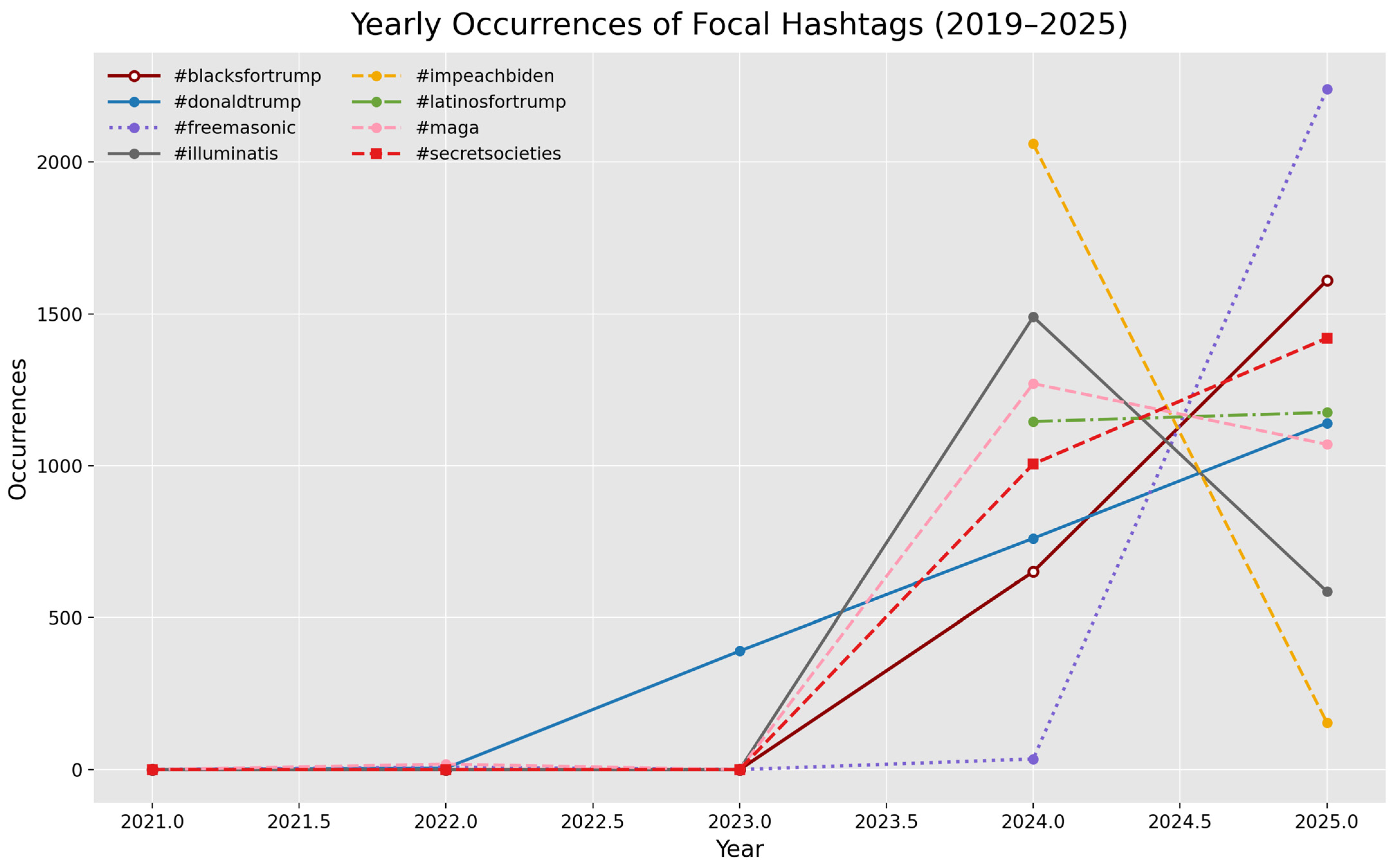
Estimates are based on the full post-level sample, including comparison posts without focal hashtags. The years 2021, 2022, and 2023 saw hardly any usage of these hashtags. Importantly, a single post can carry several of these hashtags at once—a post might use #MAGA, #donaldtrump, and #secretsocieties all together if the user is attempting to depict and paint a picture of Trump as heroically battling a hidden political faction. Of the political hashtags, #MAGA, #blacksfortrump, #latinosfortrump, #donaldtrump, and #impeachbiden, symbolize affirmation and condemnation dynamics in U.S. partisan (right-wing) discourse. For the conspiratorial hashtags, those of #freemasonic, #illuminatis, and #secretsocieties were the most prevalent and are common in digital conspiracy discourse. Together, their circulation is symbolic of heightened affective polarization and the formation of what can be considered to be hashtag publics that have arisen in the larger prism of the mediatization of politics. For example, the hashtag of #MAGA underlies the base of Trump supporters and a variety of themes ranging from policy debates to culture-war memes and personal testimonials get shared through this hashtag. Alongside this broad pro-Trump hashtag are more specialized manifestations of parts of American society that were not expected to vote for Trump to a great extent—such as #BlacksForTrump and #LatinosForTrump. Trump ended up making “historic” gains by attracting more votes from Blacks and Hispanics than was expected (
Luscombe, 2024). These hashtags highlight particular forms of racial or ethnic identity within the broader MAGA movement. The last of the political hashtags, #ImpeachBiden, represents the MAGA movement’s and Trump’s base opposition to the then incumbent president. With regard to the conspiracy hashtags (#Freemasonic, #Illuminatis, #SecretSocieties) in the dataset, here, we can observe how individuals (and subsets of American society) have articulated, spread, and put out content that is based around esoteric and anti-establishment topics.
As such, these hashtags function as forms of connective tissue that enable hybrid assemblages of people to get united by common narratives and sentiments to connect online (
Meraz & Papacharissi, 2013). Additionally, as mentioned, when it comes to identity-affirming hashtags, it is plausible to believe that they can certainly outperform more obscure conspiratorial terms. Moreover, this study posits two research questions, with the first being: how do identity-affirming pro-Trump hashtags (#MAGA, #blacksfortrump, #latinosfortrump) compare to conspiracy-related hashtags (#freemasonic, #illuminatis, #secretsocieties) in predicting comment engagement on Instagram?
This study contends that identity-affirming hashtags do more than signal political affiliation—they help digital and social media users communicate moral conviction and claims to righteousness that invite affirmation and contestation. In polarized digital environments, hashtags such as #MAGA or #blacksfortrump function as symbols through which users express loyalty to an in-group and enable users to develop (and reinforce) a moral position over perceived opponents. This can intensify engagement because self-righteous discourse tends to provoke reaction, whether through support from allies or opposition from critics. In turn, this can increase comment activity. In contrast, conspiracy hashtags can, indeed, reinforce suspicion and in-group cohesion, yet they often circulate within narrower epistemic communities and are likelier to generate fewer broad interactions on a major social media platform such as Instagram. This leads to the first hypothesis.
H1:
Identity-affirming hashtags will be associated with higher comment counts than conspiracy hashtags.
With the second research question, this study asks how condemnation hashtags (e.g., #impeachbiden) perform in relation to affirmation hashtags in stimulating discursive interaction on Instagram? Condemnation-oriented communication often operates through moral accusation and the public displaying of blame. Hashtags such as #impeachbiden do more than express partisan opposition as users denounce perceived wrongdoing and even corruption. In highly polarized digital environments, moralized political condemnation has become commonplace. Expressive partisanship in digital speeches regularly features political engagement that is based around emotionally charged cleavages. Condemnation hashtags are thus likelier to intensify interactions, which leads to the second hypothesis.
H2:
Condemnation hashtags will also increase comment engagement, reflecting affective polarization and expressive partisanship.
To test these hypotheses, the dependent variable is comments per post and is treated as a proxy for discursive interaction. The decision to analyze this as the dependent variable over other potential options warrants justification. Likes indicate visibility and approval, while comments involve a higher threshold of active participation and are more likely to capture audience and public support or criticism. Since comment counts are count data, we must consider that they exhibit overdispersion. For this reason, the main part of this study’s statistical assessment features a Negative Binomial Regression (which is chosen over ordinary least squares or Poisson models). Incident rate ratios are used to quantify the proportional change in expected comments that are associated with the presence of each hashtag. This is done while simultaneously accounting for potential overdispersion in the outcome. The regression also controls for year in order to capture temporal decline or growth in engagement across the 2019–2025 period as well as Instagram media type (such as carousel, feed or IGTV). Lastly, as the unit of analysis is the post rather than individual hashtag occurrences, each observation enters statistical models only once. Hashtags are also operationalized as binary indicators that were coded at the post level. Since multiple hashtags can co-occur within a post, all hashtag indicators are estimated simultaneously. Alongside controls for total hashtag count, year, and media type, coefficients capture independent associations with engagement net of co-occurring signals.
5. Empirical Analysis
We begin with an overview of the descriptive statistics of the eight hashtags under consideration. Statistical analyses were conducted using Stata 17 (StataCorp, College Station, TX, USA) (
StataCorp, 2021). Results in
Table 2 reveal variation in the ability of these hashtags to generate engagement and stimulate debate on Instagram. Among the political hashtags, #impeachbiden has the highest mean comment count (11.4), which is paired with comparatively strong like activity (141.9). Similarly, we can observe how both #MAGA and #blacksfortrump also perform strongly, averaging 8.2 and 8.7 comments per post. These also have a higher rate of average likes (191.9 and 158.5), which might imply that loyalty signals resonate widely within digital communities and in-groups.
To contrast, the descriptive statistics also reveal that #donaldtrump and #latinosfortrump are comparatively weak drivers of engagement, as they produced only close to 2 comments per post. This is despite them appearing in nearly 2000 posts each.
Figure 1 visualizes these trends.
In terms of the temporal scope of these datamost hashtag use occurred during 2024–2025 which coincides with the U.S. election cycle and its aftermath. Discursive political activity on digital and social media platforms was expectedly higher during the peak of the presidential election and hence, and as to be expected, condemnation of the incumbent leader (#impeachbiden) was extremely high in 2024 (2059 mentions), then collapsed in 2025 (154). The interesting dynamic here is that the conspiratorial hashtag, #illuminatis, increased massively in 2024 (1489), then fell in 2025. Likewise, the #freemasonic hashtag saw an explosion in 2025 (2243) and was the most important conspiratorial hashtag. Meanwhile, the #secretsocieties also peaked in 2025 (1416).
Table 3 presents results from the regression analysis on predicting comments per post. Each focal hashtag is operationalized as a binary indicator (coded 1 when present in a post) and coded 0 if otherwise. Zero values include posts without a given hashtag, including posts without any of the eight hashtags, which serve as comparison observations in the broader post-level model. Since the model outputs are presented as incident rate ratios, values that are above 1 indicate that posts with a given hashtag generate more comments than other similar posts. Values below 1 entail a weakening effect on comment activity.
The results in the regression reveal differences in how specific political and conspiratorial hashtags are associated with differences in engagement on Instagram
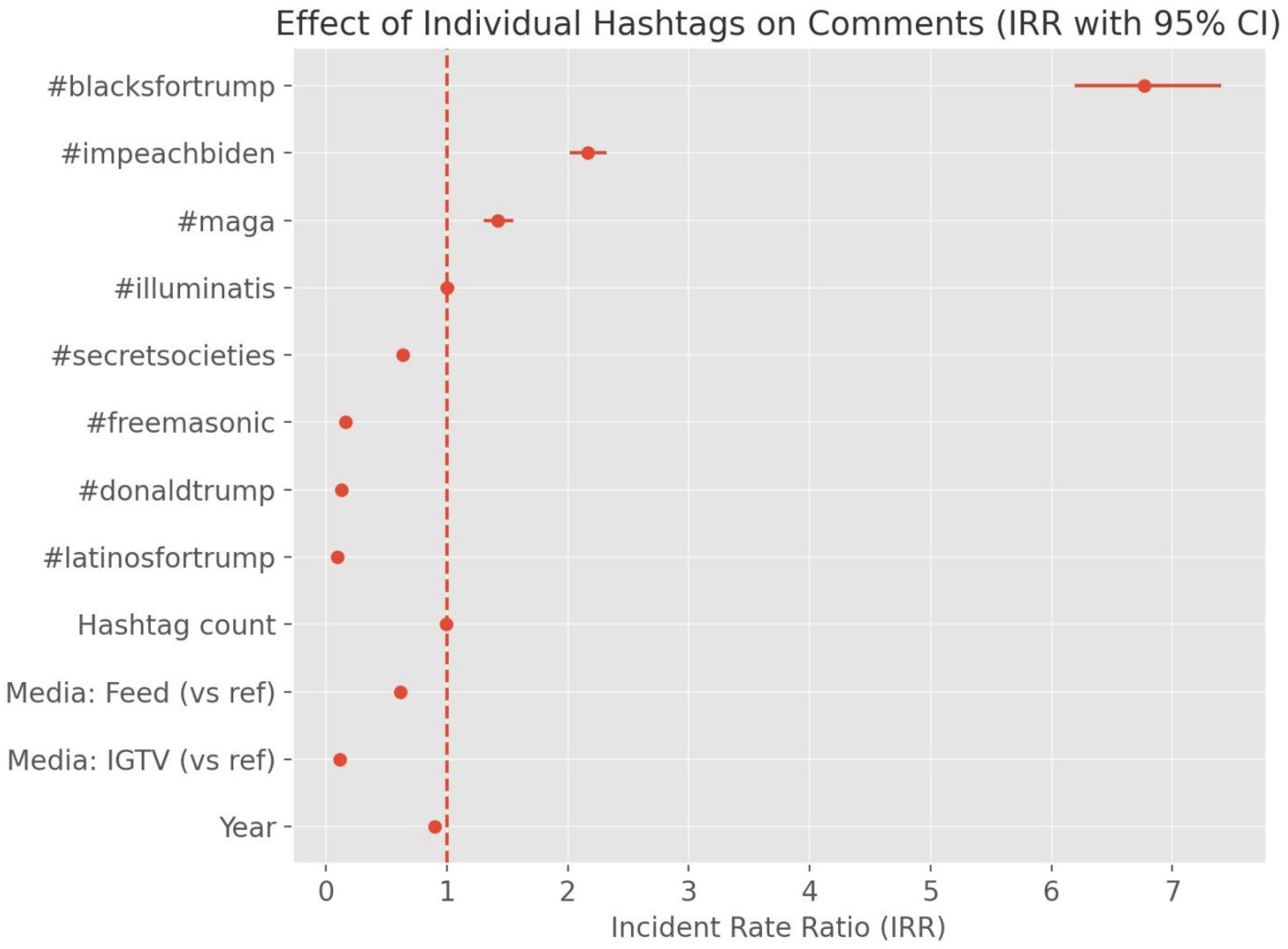
3. In terms of the eight hashtags, three are particularly significant drivers of engagement—#blacksfortrump, #impeachbiden, #MAGA. Posts containing #blacksfortrump are associated with nearly seven times as many comments as posts without this hashtag (incident rate ratio = 6.77). This is the most powerful impact in the model and reflects the rhetorical force of minority identity hash-tagging in a historical context where African American voters typically voted for Democratic candidates dating back to when this subset of society achieved rights to vote in elections after the civil rights movement in the 1960s. Another notable finding reveals that the #impeachbiden hashtag is associated with approximately double the expected comment count with an incident rate ratio of 2.16. As expected, the pro-Trump slogan #MAGA is positively associated with engagement with an incident rate ratio = 1.42. In contrast, there are hashtags that experienced diminishing effects. Surprisingly, posts with #latinosfortrump generated only one-tenth the number of comments of comparable posts (incident rate ratio = 0.09). The generic #donaldtrump hashtag also reduced expected comment counts by close to 90% (incident rate ratio = 0.13). When it comes to the conspiracy-related hashtags, #freemasonic has an incident rate ratio = 0.16, and the hashtag #secretsocieties (incident rate ratio = 0.63), both are negatively associated with engagement. This suggests that conspiracy-related discourse tends to bring about narrower insular interactions and not expansive discussion. Specifically, the #illuminatis hashtag is not statistically significant (incident rate ratio = 1.00,
p = 0.991)
4.
With the control variables, we can observe that posts with more hashtags receive fewer comments (incident rate ratio = 0.99). This might entail that there are diminishing returns from over-tagging a given post. Media format also plays a role in the Instagram environment. For example, when compared to carousel posts, feed posts had an incident rate ratio = 0.56 and IGTV posts had an incident rate ratio = 0.05, both of which are less effective at generating comments. Engagement also appears to have declined modestly year by year (incident rate ratio = 0.90), which may entail that audience fatigue arose or that there were broader (latent) shifts in platform use.
Figure 2 visualizes the results of the model.
This forest plot provides a visual summary of the results of the regression and shows the estimated incident rate ratios and their 95% confidence intervals. The vertical dashed line at “IRR” = 1 represents the null value wherein a predictor has no effect on the number of comments per post. The points to the right of the line indicate how hashtags are associated with higher engagement. Those to the left are associated with lower engagement. This figure reveals that certain hashtags are powerful amplifiers of discussion. The hashtag, #blacksfortrump stands out as the strongest, as do #impeachbiden and #MAGA. These results offer insight into how the Republican Party garnered minority conservative votes and countered a salient mainstream narrative that stated that their demographic uniformly supports the other party. Up until the 2024 election, it was commonly assumed that more than a majority of the Black and Hispanic demographic would vote for Democrats, but the actual electoral results were markedly different as Trump won an estimated 46% of the Hispanic vote share (more than 14% greater than the 2020 election result), and 55% of all Latino male votes (
Higgins, 2024). With the Black vote, Kamala Harris still won 80% of it, but this is 10% lower than the Democratic nominee received in 2020. Trump got 20% of the total Black vote which is substantially more than was predicted. Trump also doubled his vote among Black men. Significantly, posts with #blacksfortrump were predicted to receive nearly seven times as many comments as posts without this hashtag.
These results also illustrate how identity markers function as high-salience cues in digital discourse on Instagram. When groups feel threatened, they adopt narratives that bolster in-group cohesion. These results support H1 as they reveal that identity-affirming hashtags outperform conspiracy-related hashtags in stimulating discursive interaction. The hashtags #blacksfortrump and #MAGA appear to the right of the null line (IRR = 1). Confidence intervals are well above one which indicates robust positive associations with comment activity. In contrast, the conspiratorial hashtags #freemasonic and #secretsocieties lie to the left of the null line, while #illuminatis clusters around it. The latter signals weak effects on comment activity. This visual contrast lends support to the first hypothesis of identity-affirming hashtags being stronger drivers of engagement than conspiracy hashtags. In the same vein, conspiratorial discourse is heterogeneous and not uniformly mobilizing.
Contemporary American society is marked by record levels of affective polarization and mutual dislike and distrust between opposing groups—the division between what constitutes left and right appears to be at a historical peak. Importantly, within these divisions disagreement goes beyond divergences on policy (
Iyengar & Westwood, 2015). In digital spaces, affective polarization is frequently put on display and hashtags are commonly used to advance political messages across content that can go viral and peak in response to political event cycles (the most common of which are elections). The analysis above was able to capture some of this—as hashtags such as #MAGA positively affirmed Donald Trump and his agenda, while simultaneously, they show disdain towards opponents (#impeachbiden) and negative partisanship. The usage of these hashtags elucidates how affective polarization happens in real time on one of the biggest social networking sites. The results also support H2 and the claim that condemnation hashtags are likelier to inspire engagement through affective polarization and expressive partisanship. Specifically, in
Figure 2, the positioning of #impeachbiden is to the right of the null line and has an incident rate ratio above two and narrow confidence intervals. This is indicative of the fact that condemnation-oriented discourse significantly increases comment activity. Theoretically, the self-righteous person or group is likely to judge others against a presumed moral standard. In some cases, it may find them deficient and treats indignation and condemnation as being justifiable. It is thus expected that the hashtags that produced the greatest amount of comment activity were identity-affirming and condemnation-oriented. These hashtags generated more comment activity because they supplied users with strong symbolic cues for comparison that enabled some to determine which side is morally or politically superior. Such hashtags drew users and viewers into comment sections and offered opportunities to affirm the in-group and condemn perceived defects of the out-group.
Overall, these results reveal that identity affirmation generates the strongest engagement and condemnation rhetoric also significantly intensifies discussion, while conspiratorial hashtags remain comparatively marginal. The analysis of hashtags here complements the ethnographic findings of
Koenig and Mendelberg (
2025) who found that MAGA movement participants felt dishonored, silenced, and disrespected by political elites, institutions, and workplaces. Unequal recognition fed suspicion of the incumbent political party and intensified emotional expression. Just as MAGA participants in Northern Pennsylvania voiced their frustrations about being marginalized in face-to-face interactions, the popularity of these hashtags demonstrates how social media provides a symbolic stage to reclaim voice and potentially assert belonging. The relatively low engagement produced by more conspiratorial hashtags #freemasonic and #secretsocieties pertains to a key point made by
Koenig and Mendelberg (
2025) who argue that the political power of the MAGA movement is not necessarily in its abstract claims, but features a greater degree of emotionally charged affirmation of identity and collective grievances than generally considered. In a similar vein, while conspiracy hashtags do appear to encourage suspicion and claims to hidden knowledge, they do not always provide the same immediately legible in-group and out-group framing as partisan identity hashtags do. Conspiratorial hashtags can foster epistemic overconfidence, yet it may be the case that they simply lack enough characteristics to produce large-scale moral posturing.
In future social inquiry on digital discourse and social media political communication, scholars should probe whether the salience of identity-laden topics is greater than that of conspiratorial topics across other platforms. This pertains to a pertinent point that was made by
Douglas et al. (
2019) who argued that conspiracy beliefs satisfy needs for uniqueness and belonging but often reinforce subcultural cohesion rather than mobilizing broad political action. From this perspective, the weak or negative salience of conspiracy hashtags on Instagram can be understood as a digital manifestation of what perhaps is the same type of dynamic—they may have given adherents a narrow sense of belonging and shared knowledge, but questions remain as to whether they were effective tools for generating open contestation or persuasion in the wider Republican base.