1. Introduction and State of the Issue
Líbero magazine was founded in the summer of 2012, with one of its key strengths being design, which is reflected in the way it uses photographs, illustrations, and infographics. As stated by the editors on the magazine’s website, “We have always believed that the new world of journalism, where digital content has caused an upheaval in the business model of newspapers, demands differentiation in its offering. For that reason, we have made a commitment to design in order to continue offering readers a traditional print magazine, which is a product that is not only worth paying for, but can be used as a collector’s item as well”.
The magazine was created as an independent project unaffiliated with large publishing groups. The reason for this approach, as stated on its website, was to create a “product designed by a group of journalists who had a dream of making a football magazine that covers the passion of the sport without shouting, along with good taste and depth”. Published quarterly in print format, it seeks to attract football fans by offering them “social reflection, the pleasure of enjoying a carefully crafted product, and a preferential space for sports writing”.
As one of its founders points out, Líbero “emerged from our journalistic ambition to create a new and unique magazine that would dignify sports journalism by telling stories to our readers. At Líbero, what we set out to do was to spread a type of ‘football acculturation’, or at least ‘educate’ people about the sport” (
Abou-Kassem & Galocha, 2015). Therefore, this was a pioneering endeavour in Spain, because at the time of its founding, there were no magazines on newsstands with a similar focus. Its promoters, who were Diego Barcala and the aforementioned Óscar Abou-Kassem, along with Artur Galocha (the initial art director), had a vision: they were convinced that in order to establish themselves in the print magazine market, they needed to commit to a publication that featured slow journalism, not only through quality content, but also by emphasising design and image as differentiating factors.
Although it is no simple task to provide an exhaustive definition of slow journalism, as there is no consensus in the scientific literature to date, Rosique-Cedillo and Barranquero-Carretero offer the following description:
Slow journalism has emerged as a response to the dominant journalistic trend toward novelty, brevity, and immediacy, as it compels us to rethink the time needed to produce and consume rigorous, creative, and high-quality information. This type of reporting avoids extreme competition for scoops, and even questions genres and formats, such as the very nature of news itself, the need to have a press that is free of charge, social media journalism and other aspects, which are somehow doomed to extreme brevity, with the consequences of simplification, decontextualization, and fragmentation of more complex realities.
Faced with the current information overload where immediacy reigns supreme, both communication professionals and academics agree that slow journalism should be classified as a narrative format, given that “an increasing number of social sectors are demanding a pause along the way, or a type of leisurely, enjoyable, and gratifying reading of analytical texts that provide us with keys to understand the world” (
Ramírez, 2018, p. 274).
Though not a new concept, slow journalism has increased its presence in response to certain features of digital environments, such as “the transformation of any given news item into an event to be covered either live or through constant alerts”, which increases the “sense of informational urgency” (
Ventura-Salom & González-Díez, 2022, p. 240).
As asserted by
García-Avilés (
2021), magazines are the places where this type of slow narrative fits best, as they represent the ideal breeding ground for deep and unhurried storytelling due to their intermittent publication frequency, either weekly or longer, compared to other formats where constant updating is the standard. This magazine was not an isolated publication of its type, but actually it was one of the most outstanding examples within the emergence of independent football print magazines since 2000 in Europe. As
Ramon and Tulloch (
2019) explain, those niche magazines that started publishing in countries like Germany, France, Austria, the United Kingdom, and later in Spain (
Panenka first, and Líbero a year later), represented “a journalistic counteroffensive to the metric-driven, routinized, and complacent approach that currently shapes mainstream sports media output” (p. 619). Their editorial philosophy is built on three core axes aimed at developing cultural capital, including “the importance of dedicating time and resources to create a visually distinctive output” (
Ramon & Tulloch, 2019, p. 619). As a quarterly publication, Líbero follows this rationale, making it possible for ongoing topics to find their place and to allow more time to produce narratives that require further development, which is the case with infographics. Thus, this magazine is a clear example of slow journalism, which has emerged “as a reaction to the prevalent journalistic trend toward novelty, brevity, and immediacy, thereby inviting us to rethink the time needed to produce and consume rigorous, creative and quality information” (
Rosique-Cedillo & Barranquero-Carretero, 2015, p. 451).
2. Theoretical Framework
Journalistic design is no longer a purely aesthetic dimension to become an editorial strategy that structures the reading experience, hierarchises information, and contributes to the construction of journalistic discourse (
Salaverría, 2005;
García & Stark, 1991). From a semiotic perspective, design can be analysed as a system of signs that articulates meanings through spatial arrangement, typography, colour, and image.
Kress and van Leeuwen (
2006) propose the concept of visual design grammar, which makes it possible to understand how graphic elements create meaning in interaction with text. This grammar is not neutral, but rather responds to cultural conventions, communicative intentions, and editorial decisions that affect the way readers access and process information.
In the context of slow journalism, design takes on a particularly relevant dimension: in contrast to the logic of immediacy, it proposes a slower, more reflective, and visually stimulating reading experience. Magazines such as Líbero have explored this approach, opting for a careful editorial aesthetic that reinforces the identity of the medium and enhances the depth of the content.
Design is used not only to communicate ideas clearly and accurately, but it also helps to attract and maintain the reader’s attention, make text less cumbersome, and complement the writing with visual resources. This achieves effective communication without renouncing creativity, thereby avoiding unnecessary aspects that might distract the reader.
When designing a publication, it is essential to define its style, which consists of “determining how all the visual features will be displayed, based on achieving a creative balance between typography and image; moreover, the style of the design is inseparably linked to the brand” (
Caldwell & Zappaterra, 2014, p. 143). A fundamental part of journalism today is the use of infographics, as content relies increasingly on visual elements to facilitate understanding (
Valero, 2008), to accompany the text as a decorative feature, and to contextualise the information presented (
Ivars-Nicolás, 2019).
Infographics have evolved from their origins as an auxiliary resource in print media to become an autonomous visual genre within the journalistic ecosystem. Their ability to synthesise complex information, establish relationships between data, and create visual narratives makes them a key tool for contemporary journalism (
Cairo, 2011;
Salaverría, 2005). Unlike other conventional genres, infographics articulate their discourse through visual codes—icons, diagrams, maps, typography—that enable a non-linear, more intuitive, and, in many cases, more effective reading.
Authors such as
Cairo (
2011) have defended its value as a form of ‘functional art,’ as it combines informational accuracy with visual clarity. In this regard, infographics should not be understood as a mere graphic complement, but as an informational unit with its own narrative capacity, capable of generating knowledge and providing depth from a visual logic.
Many authors have addressed the definition of this discipline over the decades, including the following considerable list of scholars: (
Tufte, 1983;
Peltzer, 1991;
De Pablos, 1991,
1999;
Stark, 1991;
Piñuela, 1993;
Canga, 1994;
Clapers, 1998;
Colle, 1998;
Leturia, 1998;
Serra, 1998;
Valero, 2001,
2008;
Abreu, 2002;
Barnhurst, 2003;
Franco, 2005;
Cairo, 2008,
2011;
García-González, 2014;
Uyan Dur, 2014;
Alcalde, 2015;
Nogueira, 2018; and
Ivars-Nicolás, 2019). The most recent approach is that of Ivars-Nicolás, who has gone even further by establishing a typology based on the use of this format, in addition to clarifying the types of graphics considered journalistic infographics, as well as when they should be employed. This author offers the following description:
Journalistic infographics are graphic and visual by nature, consisting mainly of iconic features, as well as typography, when necessary, in order to clarify the graphic content. This graphic format is information in itself and can either be self-contained or used to round out or complement a text. Its purpose is to offer information about anything that cannot be expressed with words alone, or for matters which, if only text were used, would not be clear, and might engender doubt, confusion, or ambiguity.
Thus, infographics is a type of journalism with its own rules, materials, and experiences, consisting of a visual display used to aid understanding and give meaning to current events. In the words of Vilches, “Infographics reveal hidden information that was previously kept in storage” (
Valero, 2001).
Despite its communicative virtues, infographics still have tensions and limitations. Several studies have highlighted the need to take a critical look at its use, especially when it becomes a resource for impact rather than depth (
Segel & Heer, 2010). One of the main risks is the aestheticisation of information, where design takes precedence over content, generating visually appealing but conceptually empty products.
Likewise, the false neutrality of the data visualised has been questioned. As
Cairo (
2011) and
D’Ignazio and Klein (
2020) warn, all visualisation involves editorial decisions: which data is selected, how it is represented, what is omitted, and what is emphasised. Infographics, therefore, are not an objective reflection of reality, but a narrative construction with ideological implications.
The homogenisation of formats in digital environments has also been pointed out, where automated templates proliferate, limiting creativity and reducing the expressive potential of the genre. Added to this is the gap in visual literacy, which can make it difficult for certain audiences to interpret complex graphics, creating inequalities in access to information.
These critical perspectives invite us to rethink infographics as a communicative act with cultural, cognitive, and ethical implications. In the context of slow journalism, this line of thinking allows us to explore more conscious, inclusive, and narratively rich forms of visualisation.
On the other hand, data visualisation has found an ideal setting in sports publications. As
Horky and Pelka (
2017) assert, “data visualisation is an area developing strongly in sports journalism” (p. 587), and “sports journalism is in the driver’s seat for the digital age of mass media” (p. 588). However,
Horky and Kamp (
2012) also warn that “numbers and data belong to the essence of sport. However, used excessively, statistics also have the opposite effect and compromise comprehensibility… We ought to always ask, whether numbers and data really benefit the audience, or whether they do not represent, much rather, useless fan-info, distorting our view of the actual analysis” (
Horky & Kamp, 2012, p. 92). As it turns out, sports publications represent an ideal context for data journalism because “data journalism profits, above all, from the possibility of illustrating complex and differentiated connections in content simply” (
Horky & Pelka, 2017, p. 589). As
Albalad and Sánchez (
2014) explain, “spectators are sport fans who already know the rules of the game and follow the athletes. As such, their consumption of sports news goes beyond merely obtaining information” (p. 21). As
Arias-Robles (
2017) points out, “it is difficult to imagine a speciality that is better suited to data journalism than sports reporting” because of the large amount of quantifiable information generated by competitions and also due to the possibility that methodical processing of this data can identify significant cases, patterns or trends.
Armentia and Caminos point out that sports publications “avoid excessively long stretches of text; on the contrary, they tend to break down the information into sections, or supporting material, and accompany it with a considerable amount of graphic content, usually infographics, graphs, and tables, which make it easy to obtain a quick view of the topics” (
Armentia & Caminos, 2003, p. 17). This trend, as Rojas-Torrijos and García-Cepero point out, has been reinforced by the development of data journalism, whose great potential allows, “through the use of techniques for extracting, analysing and visualising statistics, the development of new angles in the coverage of competitions and better use of graphic and multimedia resources for the visual representation of information” (
Rojas-Torrijos & García-Cepero, 2020, p. 298).
Infographics have taken the main stage at a time when the power of moving images such as videos, reels, and others has achieved much greater reach. Furthermore, this is justified by the fact that in many cases, one graphic image conveys more information than minutes of audiovisual content or an extensive photo report. As Rojas-Torrijos points out, “Sports journalism is betting on new information formats, which are highlighted by the features used to display content visually, such as graphics, video stories, multimedia reports, data journalism, and long-form narrative pieces” (
Rojas-Torrijos, 2014, p. 186). For this author, “Sports journalism obtains much of its strength from the visual nature of its content (…). It has always known how to innovate to make its text more attractive, and to capture the reader’s attention through spectacular photographs, large headlines, unique infographics (…) and, more recently, through other multimedia features that complement the visual and audio display of the data produced during competitive events” (
Rojas-Torrijos, 2014, p. 186). From a more conceptual perspective, Horky and Pelka warn that “data journalism in sports figures as a journalistic form of expression characterised by numerical data. Whilst presenting informative data is distinguished rather more by its nature as a service for recipients, journalistic added value can, above all, be generated where the content combines several sets of differing and relevant data” (
Horky & Pelka, 2017, p. 603), which is particularly relevant when analysing how Líbero integrates infographics to enhance its slow journalism approach.
For these reasons, the logical approach is to ask ourselves how sports magazines are using this graphic feature. Therefore, this research aims to shed light on the issue by focusing on Líbero magazine, considered a benchmark in the industry (
Rojas-Torrijos, 2014;
Manfredi-Sánchez et al., 2015;
González-Alba, 2016;
Labarga-Adán et al., 2018;
García-Avilés, 2021). Moreover, the magazine’s prominence is not only due to its design and information layout, but also to the aforementioned attention paid to the visual aspect in general, and to infographics in particular. In fact, these features have received numerous awards over the last decade, most notably the prize for Best Magazine Design in Spain, Portugal, and Latin America, which was granted by the Spanish Chapter of the SND (Society for News Design) at the prestigious 2017 ÑH Awards Ceremony, a benchmark accolade in the field of newspaper design.
3. Objectives and Methodology
The main objective of this research is to examine the features of the infographics used by the Spanish magazine Líbero and the role they play in its success. The study period ranges from its founding in the summer of 2012 until the last issue recorded at the end of this research, No. 52, which appeared in the summer of 2025. To this end, we have taken two approaches: descriptive, which is based on describing and evaluating certain characteristics of a particular situation in a subject of study; and longitudinal, due to its nature as an observational study, which involves collecting data that is repeated over a prolonged period of time. Therefore, this is a case study, as it addresses a contemporary phenomenon in depth and within its actual context (
Yin, 2018).
In line with this objective, the following research questions (RQ) are posed, each of which is linked to a specific objective (SO) as follows:
RQ1. How often are infographics published in Líbero magazine?
SO1. Measure the number and location of infographics published throughout its history and identify trends in this regard.
RQ2. How does the structural and informational complexity of infographics change across Líbero’s editorial trajectory?
SO2. Analyse infographic complexity evolution based on four operationalized dimensions grounded in previous research: (1) structural complexity: number and typology of constituent elements—icons, diagrams, maps, charts, photographs (
Cairo, 2011;
Ivars-Nicolás, 2019); (2) informational density: data units represented and textual support extent (
Valero, 2008); (3) spatial extension: physical size and layout integration (
Kress & van Leeuwen, 2006); and (4) functional autonomy: self-contained vs. text-dependent nature (
Ivars-Nicolás, 2019). This framework enables systematic assessment of editorial investment in visual journalism across Líbero’s trajectory.
RQ3. What type of infographics does Líbero use, and for what purpose?
SO3. Understand the nature of the infographics published and link them to their informative roles, based on the classification offered by
Ivars-Nicolás (
2019).
RQ4. Do Líbero’s infographics exhibit internal stylistic consistency to constitute a recognisable visual signature?
SO4. Study the stylistic coherence of infographics through systematic analysis of: (1) recurring visual elements: types of graphic resources used (hand-drawn vs. vector illustrations, integrated photography, iconography), treatment of statistical data, and compositional hierarchy; (2) chromatic identity: predominant colour palettes, figure-ground contrast, and use of colour as a semantic or purely aesthetic resource; and (3) typographic criteria: type families, textual hierarchies, and text-image relationship. The notion of “visual style” is operationalised following the definition of
Caldwell and Zappaterra (
2014, p. 143): “determining how all the visual features will be displayed, based on achieving a creative balance between typography and image; moreover, the style of the design is inseparably linked to the brand”. An identifiable style would imply the presence of consistent formal patterns that allow Líbero’s editorial authorship to be recognised without the need to see its logo, constituting what
Kress and van Leeuwen (
2006) call a coherent “visual grammar”.
To answer the questions posed, a methodological triangulation was used, combining both qualitative and quantitative techniques.
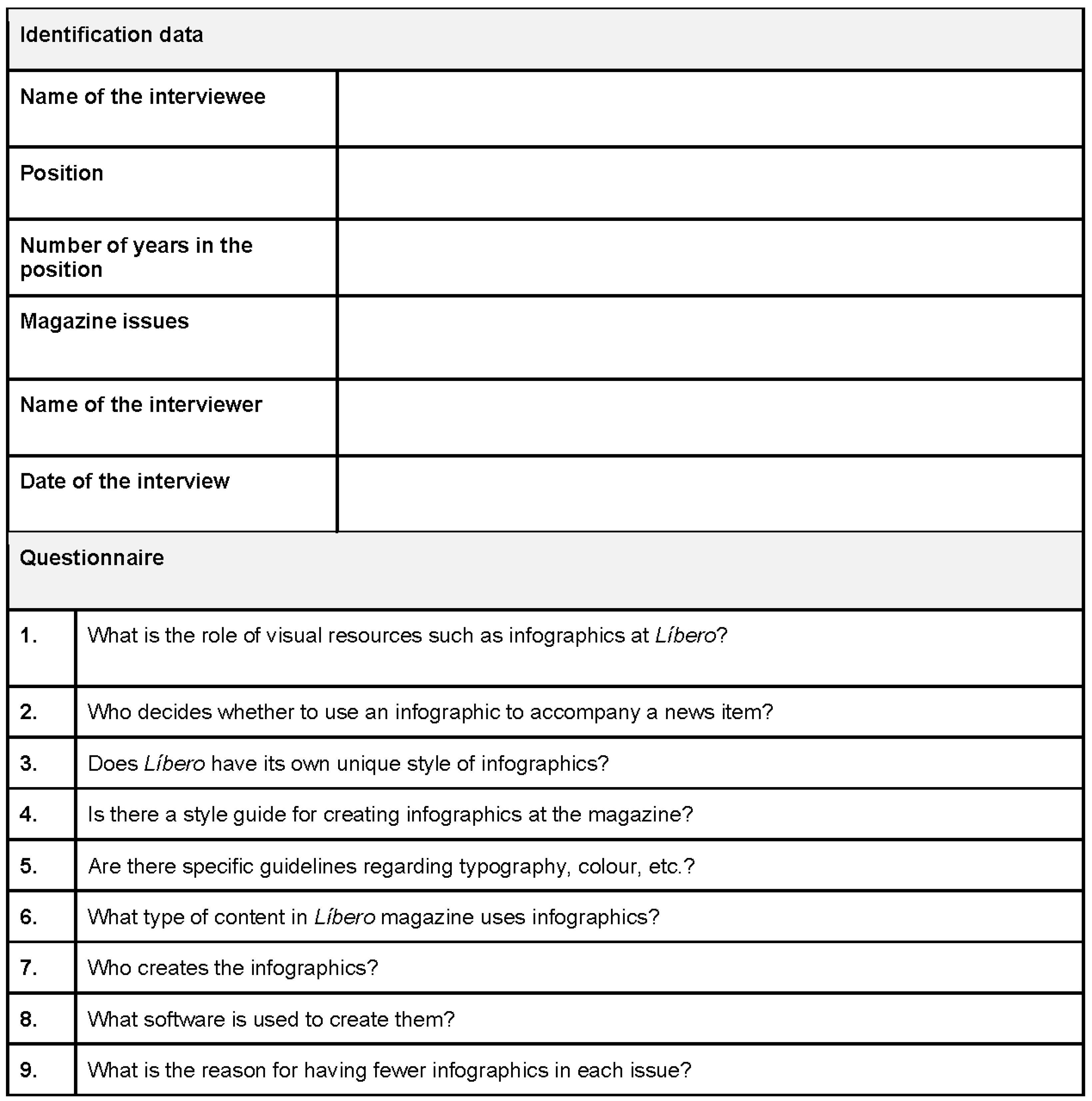
Firstly, semi-structured, in-depth interviews were conducted with Diego Barcala (founder and editor of the magazine), Pedro Rollán (former art director), and Sandra de Miguel (the latter’s replacement), which served as a starting point for the fieldwork. A semi-structured questionnaire designed ad hoc by the authors of this research was used as a reference, following the methodology established by
Kvale and Brinkmann (
2009) for qualitative interviews with key informants. This method is particularly appropriate when seeking to understand editorial processes and design decisions from the perspective of those involved, as previous studies on sports media organisations have shown (
Ramon & Tulloch, 2019;
Serazio, 2019). The instrument was structured around nine open-ended questions organised into three analytical dimensions: (1) the strategic role and decision-making processes associated with the use of infographics in Líbero (questions 1, 2 and 6); (2) the formal, stylistic and production characteristics of these graphic elements (questions 3, 4, 5, 7 and 8); and (3) the evolution of their presence over time and the contextual factors that conditioned it (question 9). The questionnaire design was based on a theoretical review of journalistic design and infographics and on a preliminary analysis of the 52 issues of the magazine, which identified key areas to be explored with the responsible professionals (see
Figure 1).
Secondly, the sample was analysed, which coincides with the universe, as the former comprises all the infographics published in the 52 issues examined. There is a total of 77 infographics, some of which are complex, as they combine several elements into a composite narrative, which is why a total of 113 graphics were recorded.
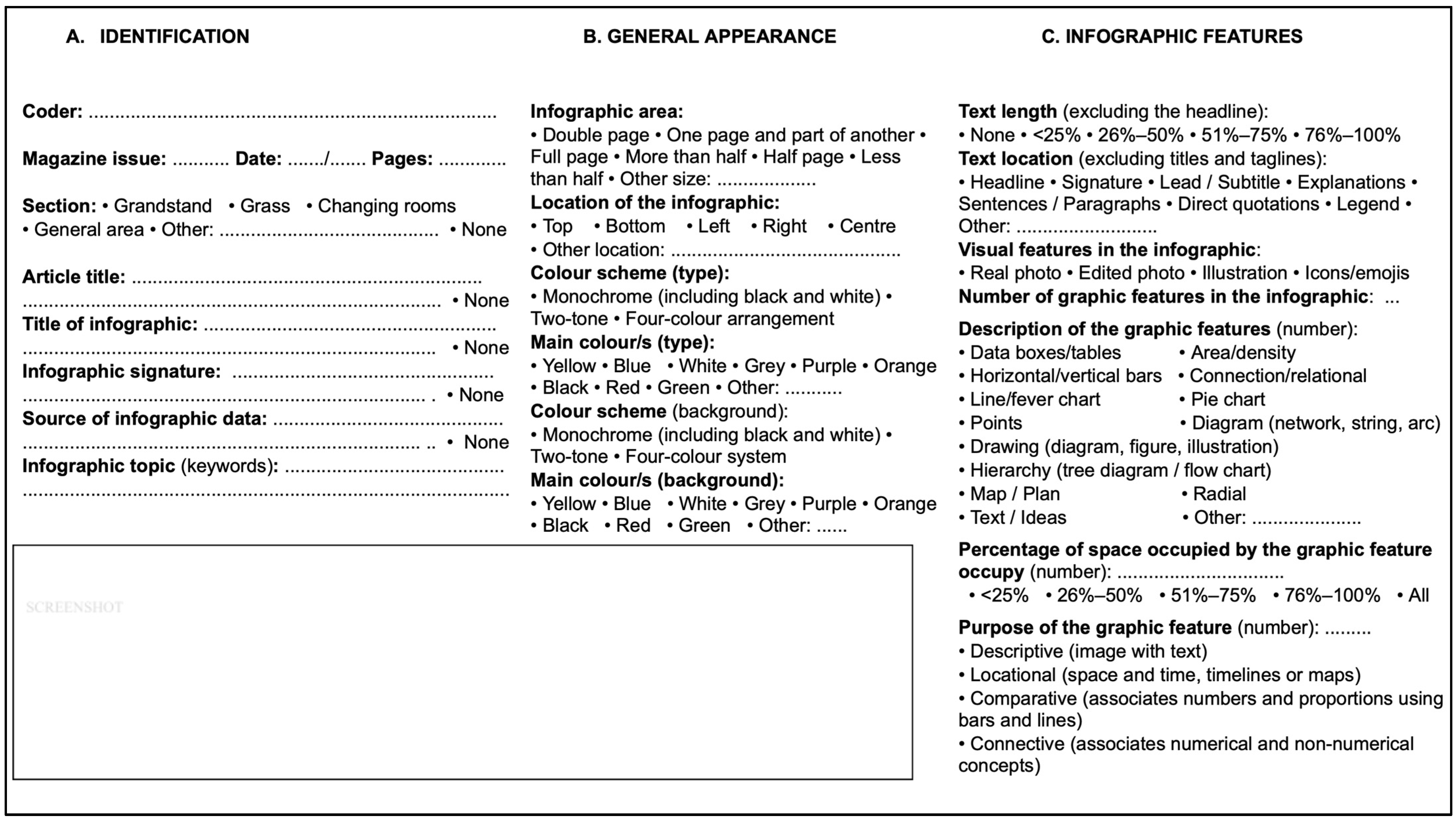
For data collection, a coding instrument was designed to formally and functionally describe each infographic, which was tested prior to this research (
Ventura-Salom et al., 2023). This instrument consists of 24 variables, grouped according to logical affinities into three blocks (see
Figure 2), which were used to perform both a quantitative analysis (i.e., an incidence measurement) and a content analysis.
The first block contains variables related to the identification data of each infographic analysed, which includes the following information: the magazine’s issue number and publication date; the location of the infographic (page number and section); title of the content; title of the article that accompanies the infographic (if any); name of the author; the name and brief description of the source; names of the data coders; and space for a snapshot.
The second block contains variables related to the formal aspects of the informative graphic depiction, or in other words, the following features: size category (double page, more than one page, a full page, more than half, half, less than half, and other); location on the page (top, bottom, centre, left, or right); the use of colour (whether printed using a four-colour process, two-colour, or monochrome) and, if colour is present, coding is carried out for both the dominant colour in the background of the graphic depiction, and for the main shape.
The third block includes the variables and categories related to content. Specifically, the features that comprise the infographic. Firstly, if the infographic contains text, it is coded. If this is the case, consideration is given to how much space the text occupies and in which features it is reflected. Consideration is also given to whether the infographic has visual elements. If so, what types are they, such as photographs, illustrations, graphs, icons, or others? Additionally, the infographic is registered depending on whether it is simple (with a single graphic) or complex. Moreover, for each graphic within the infographic, its type and function are also determined.
In this regard, a specific typology has been developed based on the classification proposed by
Ribecca (
n.d.) in his catalogue of formats for data visualisation. The aim of constructing this typology was to gather the formats most frequently used in meaningful and descriptive categories in a concise, orderly, and coherent way.
Thus, in alphabetical order, we refer to graphs in the following categories: Data Box or Table; Area or Density graph; Bar; Line or Fever Chart; Point; Connection or Relational (these include Sankey or coordinate graphs, among others); Diagram (includes network, string, or arc); Drawing (includes counting graphs, figures, or illustrated diagrams); Hierarchy (includes tree diagrams and flowcharts); Maps and Radial-type plans or diagrams.
To complete the analysis, along with the typology of each graphic, the function it performs in relation to the information unit in which it appears has also been included. For this purpose, the contribution of
Ivars-Nicolás (
2019) regarding the different uses, which the author classifies as descriptive (describe something), locational (locate something physically or geographically), comparative (compare data), and connective (relate or arrange elements or non-numerical data), has been highly useful.
Furthermore, this analysis sheet has been applied to all the published graphics. In other words, not only to comprehensive infographics, but in the case of composite infographics, it has been applied to the different graphics that may be included within them. The data obtained have been used for two purposes: firstly, to perform a statistical approximation, which allows the incidence of each variable to be measured; secondly, to carry out a contextualised content analysis based on these data and the aforementioned interviews.
Performed by the three signatories, the coding process began in September 2022 and was completed in the summer of 2025. To ensure its reliability, Krippendorff’s alpha coefficient was calculated, which is widely recognised in the field of content analysis for its ability to assess the level of agreement among multiple coders (
Krippendorff, 2018). The value obtained was α = 0.95, indicating a very high level of agreement and, therefore, excellent consistency in the application of the established criteria, which indicates that the categories used were interpreted consistently by the different coders.
The 5% level of disagreement found in the selected subsample was addressed through a systematic process of consensus among the three coders, which consisted of joint review sessions in which the contradictory cases were analysed in detail. At this point, a reasoned deliberation was carried out to clarify the causes of the disagreement, following the methodological recommendations of
Miles et al. (
2020), who highlight the importance of dialogue between coders as a way of reinforcing the internal validity of qualitative analyses. In cases where deficiencies in the instrument’s operability were identified, specific adjustments were made to reinforce the internal consistency of the system and to ensure its applicability to the entire corpus, as well as its potential for duplication, as recommended by
Krippendorff (
2018) and
Neuendorf (
2017) in the context of systematic content analysis.
4. Results
4.1. Timeframe Distribution and Infographic Quantity
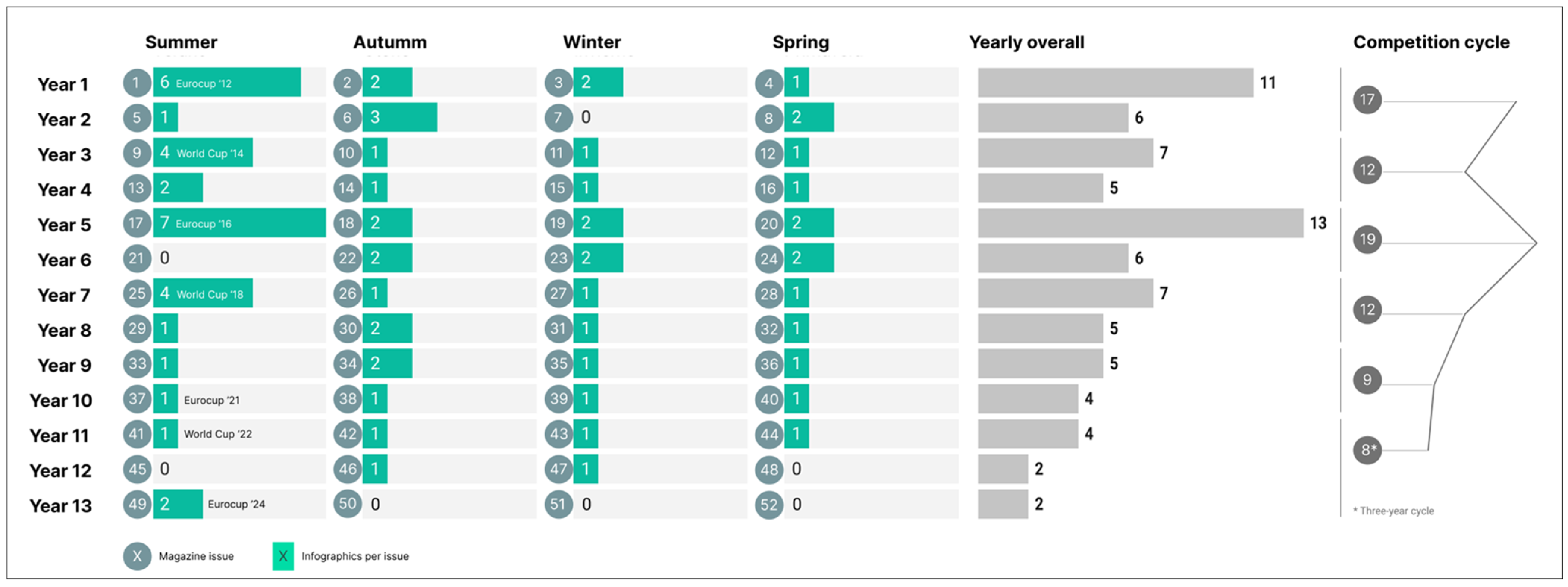
An initial view of the sample reveals a certain seasonal regularity in the number of infographics published, yet with two exceptions. On the one hand, the number of infographics significantly increases in summer issues when the magazine’s publication coincides with international football tournaments involving national teams, or the European Championship and World Cup. On the other hand, this trend becomes static from 2019 onward and actually declines starting in 2021.
Looking at
Figure 3, the issues with the highest number of infographics include No. 1 with six (Euro Cup), No. 9 with four (World Cup), No. 17 with seven (Euro Cup), and No. 7 with four (World Cup). From 2022 onward, none of the issues has more than one infographic, even when competitions of this scale take place, including the following examples: Issue 37, Euro Cup, delayed due to COVID; Issue 41, World Cup; and Issue 49, Euro Cup.
Excluding the summer issues, those that remain in the series are consistent; as a rule, each issue includes one infographic (in 27 of the 52 issues) or two (in 13 issues). However, there are six issues that contain no infographics, four of which appeared in the last two years of publication.
When the analysis is broadened to include every year the magazine was published, with the first issue of each year being published in summer and the last in spring, the following can be observed: The first and fifth issues have the most infographics, which coincides with the two issues that create inconsistency in the series, namely Issue 17 (before the Euro cup in 2016), and Issue 1 (before the Euro cup in 2012).
Consequently, to provide an improved context, we also offer the annual accumulation of infographics, as well as those for the competition cycle defined by the aforementioned international tournaments, which are organised alternately every two years. The only exception to this rule was Euro 2021, which was postponed due to the COVID-19 pandemic. Thus, the sample of 13 full years is divided into six periods (five biannual and one triannual), for the purpose of including the last year, the cycle of which would end in 2026 with the World Cup. This distribution confirms that the number of infographics has been gradually decreasing, ranging from a maximum of 19 graphics during the 2016 Euro Cup cycle, to 12 during the 2018 World Cup, down to 9 during the COVID-19 period, and standing at the current number of 8, which is the lowest of the series, despite having one additional year, without which there would be 6.
4.2. Overview of the Complexity of Published Infographics
Based on the analysis, the authors have observed that there is a specific type of infographic that appears frequently as a regular feature. This refers to content where a famous person is asked to mention the fictional line-up that they would choose to create a “dream team” with players from different clubs and epochs, or variations on the idea, such as particular individuals, etc. This section is depicted by a diagram of the playing area with the athletes arranged on the pitch, which is usually referred to as “11+6”, in reference to 11 players on the field and 6 other positions, such as coach, president, etc. This resource appears 35 times in a total of 77 graphics analysed. Moreover, this setting alters the analysis of the items collected.
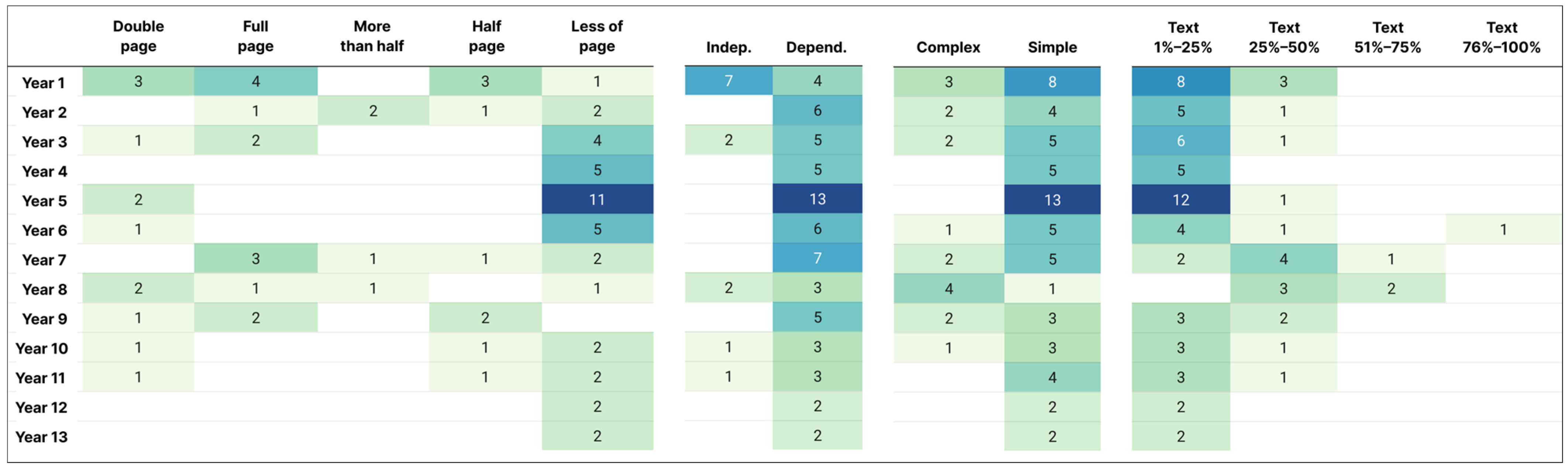
In considering this specific feature, the first approach to the complexity and creation of infographics focuses on four variables: how much space they occupy on the pages (the larger they are, the more relevant they are); whether the infographics are dependent or independent (independence implies greater relevance); whether they are simple or composites (composites suggest more complexity); and finally, the amount of text they contain (less text indicates higher complexity) (see
Figure 4).
Firstly, the space occupied by each infographic on the pages of the magazine was analysed. There is a tendency to occupy large spaces so that the items can display their full visual potential. Thus, 12 infographics occupy two pages, and 13 occupy a full page. Medium-sized infographics show a similar proportion, as 9 of them occupy half a page, and 4 occupy more than half a page, for a total of 13 when these categories are combined. Finally, the small items occupy less than half a page, which occurs in 4 of the infographics, in addition to 35 of this type that belong to the recurring section known as “11+6”.
Secondly, independent infographics are those that are stand-alone, information items that represent a specific feature. By contrast, although a dependent infographic also provides information and a rational meaning, it is merely one part of an article that has other types of informative features, generally text and images.
Of the 77 infographics analysed, 13 are independent, and 64 are dependent. Of these, 35 belong to the recurring “11+6” section, which means there are 29 diverse infographics that are dependent.
Thirdly, simple infographics are defined as those consisting of a single graphic unit. By contrast, complex infographics are those that generally analyse more comprehensive information and require the use of several graphic units, often of different types.
Of the 77 infographics analysed, 17 are complex, and 60 are simple, the latter of which include 35 from the category of “11+6” recurring content, meaning there are 25 simple infographics that are distinct from those of the “11+6” classification.
Fourthly, the amount of text contained in each infographic has also been examined, as a larger amount of text indicates less complexity. Regarding this aspect, all the infographics contain text, although in most of the samples it occupies less than 25% of the space, which is the case in 55 of the 77 items analysed. Moreover, of the 55 items, a total of 35 are part of the “11+6” group, with the remaining 20 belonging to diverse cases. Another 18 have a higher percentage of text, but only in 4 cases is it more than half the total.
Based on the location of text, it is most frequently used for headlines, lead paragraphs, and subheadings, as well as for individual sentences or paragraphs within the infographics. In addition, all the infographics contain text for specific explanations, but almost none of them include the author’s name or the source of the data used.
4.3. Types of Infographics and Their Functions
As originally set forth in the specific objectives of this research, an additional part of the analysis consists of examining the types of infographics used and their functions. To this end, categories were developed based on the typologies of
Ribecca (
n.d.) and
Ivars-Nicolás (
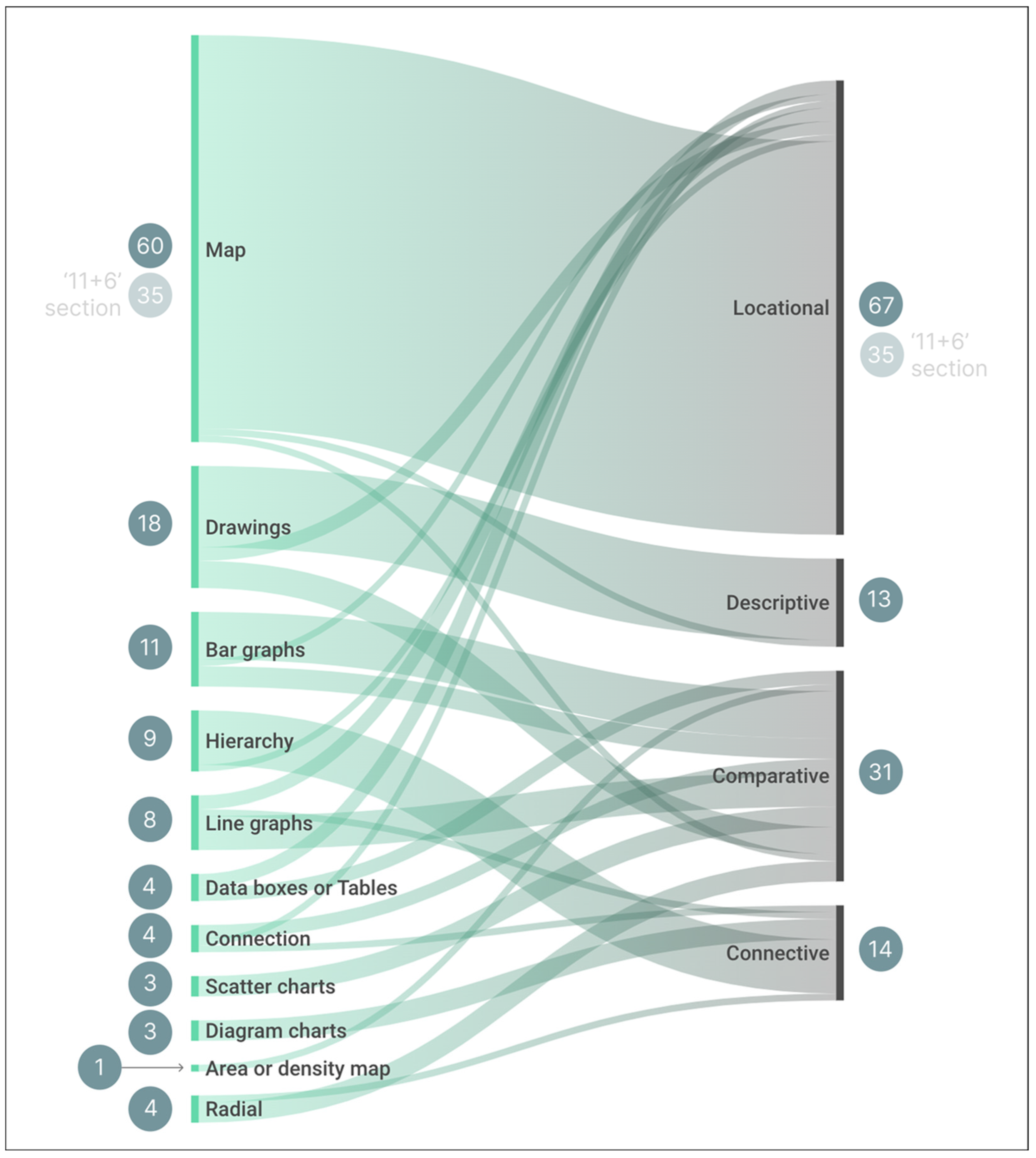
2019), and the 113 graphic units contained in the 77 infographics in the sample have been classified (see
Figure 5).
The first conclusion is that most of the graphs are of the Map typology, comprising 60 of the 113. We should also note that this includes the 35 “11+6” graphs, so if these are excluded, there are 25 so-called maps that are different from the 35 mentioned.
Other commonly used types of graphs are Drawings (18), Bar graphs (11), Hierarchy (9), and Line graphs (8). Less frequent types include Radial, Connection, Data Boxes, and Tables (4 times each), Scatter and Diagram charts (3 times each), and a single Area or Density graph.
There are several functions directly related to the type of graph used: Descriptive, in which the images used are accompanied by explanatory text; Locational, used to pinpoint an element with regard to its space location of time-frame; Comparative, which associates numerical data with visual proportions; and Connective, used to establish relationships or dependencies between concepts that are not necessarily numerical.
Each type of graph generally has a specific purpose. However, the context of each suggests that in addition to the intended function, there are occasions when it fulfils an additional purpose. Thus, the 113 graphs recorded comprise a total of 125 functions in these four categories.
The most notable function is Location, which is typical of Map-style charts. This feature is enhanced by the “11+6” graphs. Without the latter, there would be 32 graphs that provide this function. In addition to graphs of the Map type, this function is also present in Drawings, Bars, Hierarchies, and, with considerable frequency, in Line graphs, as well as in Data Boxes or Tables.
The second most frequently observed function is Comparative, which occurs in 31 of the cases. It also has a very broad distribution, mostly proceeding from Bar, Line, Dot, Drawing, or Radial graphs.
Finally, the Connective and Descriptive functions have a very similar distribution, with 14 and 13 cases, respectively. Regarding the Connective function, the majority proceed from Hierarchy graphs, while in the case of the Descriptive function, most of them come from Drawing graphs.
4.4. Features of Visual Style
The aim of this study is to identify whether there is a consistent style in Líbero’s infographics. As such, the authors have analysed the use of visual features, as well as the utilisation of colour.
Regarding the first point, the use of visual features other than those specific to infographics is not common. While all the infographics include text (none are exclusively visual), only some include additional visual aspects. Most of these include the following: icons or emojis, which are used in 14 of the 77 infographics; photographs, either real or edited, appear in ten cases; and illustrations are used in only five cases.
As for the second point, to carry out a detailed analysis of the use of colour, a distinction was made between its use in the background and in the centrepiece shapes of the infographics, which, respectively, refer to the homogeneous surface on which the infographic elements are displayed (background) and the infographic components themselves (main shapes).
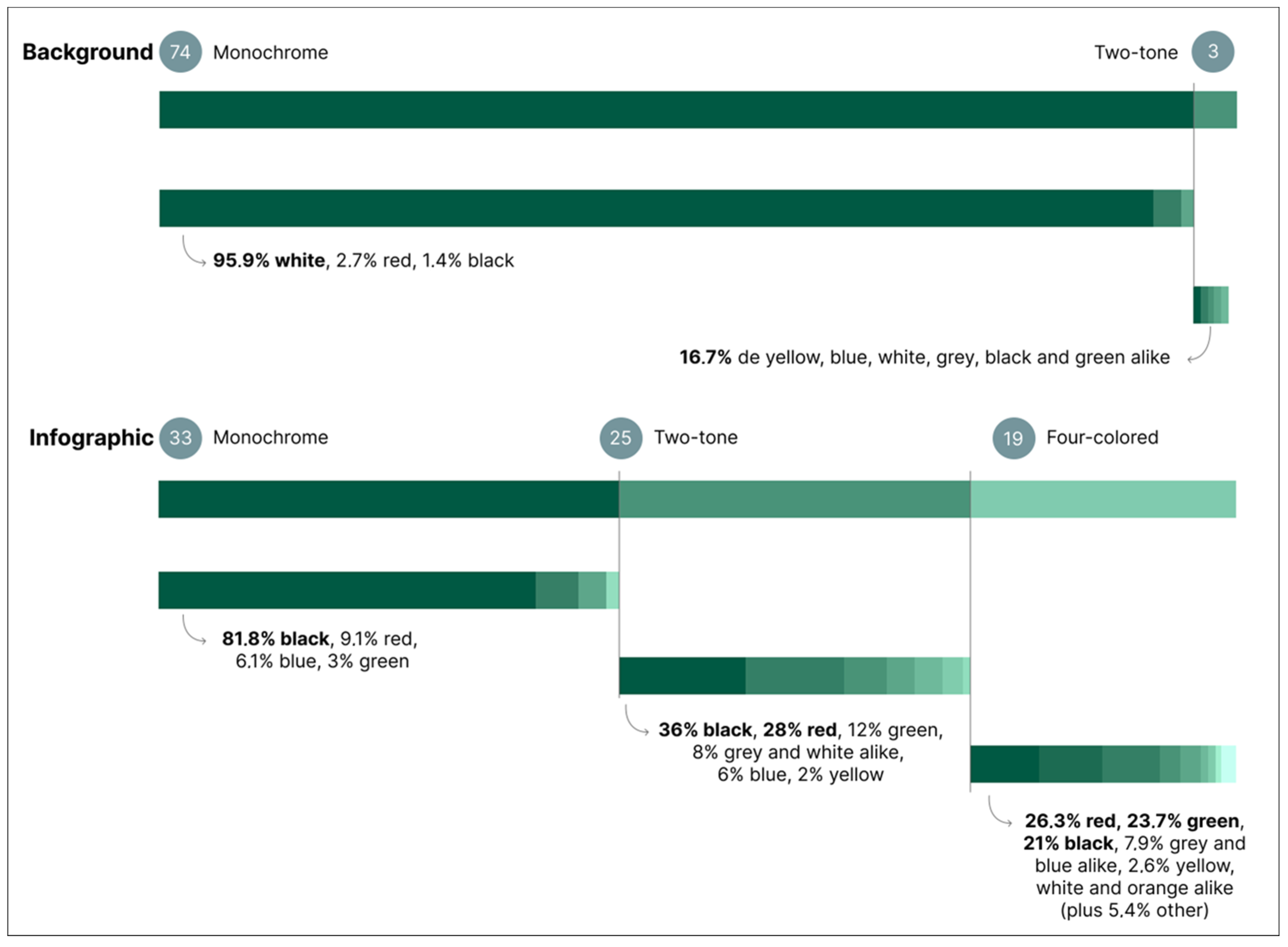
Furthermore, this analysis has been conducted on two different levels. The first focuses on the colour combination used, if any, which indicates whether it is monochrome, two-tone, or four-coloured. The second level identifies the specific colour used (see
Figure 6).
Thus, the use of colour in the background is simple and plain, resulting in compositions that are clean and clear. This is due to the nearly complete dominance of monochrome in 74 of the 77 infographics, compared to the use of two-tone colours in the remaining three.
Moreover, regarding the monochrome palette, white is used almost exclusively as the background colour in 95.9% of the cases, with red or black used only sporadically. In the few cases where a two-tone shade is used, there is a homogeneous distribution of colours, with yellow, blue, and green on one side, and white, black, and grey on the other.
Regarding the use of colour within the infographics, the distribution of colour combinations is much more even: in 33 cases a monochrome is used; in 25 cases a two-tone composite is employed; and in 19 cases a four-colour combination is applied. Thus, though simplicity dominates, the distribution is nearly equal among the three options.
When a monochrome is used, black is the most prevalent colour, appearing in 81.8% of the cases. If we combine this with the fact that most infographics have a white background, this indicates a commitment to contrast and legibility in the visual display of information. It bears mentioning that among the cases with this combination, many, though not all, belong to the “11+6” infographics group.
The use of two-tone combinations provides a wider range of colours, although with 36% of the total, black continues to dominate. This is followed by red at 28%, and green with 12%. Less common colours are grey and white, with 8% each, blue with 6%, and yellow with 2%. Examples of using a two-tone style to achieve mixed ranges include lighter or darker shades of green and blue to achieve a turquoise hue, darker or lighter yellows to make cream tones, and various shades of red.
When four-colour combinations are used, there is a more even distribution of the dominant colour, yet once again, certain colours predominate: red is used in 26.3% of the cases, followed by green (23.7%), and black (21%). Next in line are grey and blue with 7.9% each, yellow, white, and orange with 2.6%, and an additional 5.4% with several other colours.
5. Discussion and Conclusions
Although this study falls within the academic field of content analysis and data visualisation, its relevance extends beyond a strictly research-based framework for three reasons. Firstly, it addresses a widespread cultural phenomenon, which is football, not only as a sport, but also as a shared social narrative. Líbero magazine has managed to create a journalistic discourse by combining rigour, design, and editorial sensitivity.
Secondly, it highlights the role of infographics as a kind of visual storytelling that enables the understanding of complex phenomena, which is especially relevant in the current scenario of information overload. This ability to summarise and provide clarity makes infographics a resource of interest to the general public, which is beneficial for any reader who seeks information in a more accessible, visual, and reflective way.
Thirdly, this article offers insights into why information design and visualisation are not merely adornments, but narrative strategies that impact the reader’s experience, which is relevant to professionals who work in journalism, graphic design, visual communication, and digital culture. Consequently, this study helps to bridge the gap between academic research and professional practice, as well as between specialised analysis and the interests of the general public.
The data obtained regarding the frequency and quantity of infographics used by Líbero magazine throughout its history reveal three clear trends: firstly, there is a continuous presence of infographics in the first 35 issues of the journal; secondly, this presence intensifies during international football events such as the European Championship or the World Cup; thirdly, the publication of infographics has declined significantly in recent years.
Regarding the degree of complexity in the production of these works, a general observation suggests that most infographics are dependent, complex, and large. In other words, they are embedded within broader informative content such as news reports and interviews, and consist of more than one graphic, in most cases occupying one full page or two entire pages. This indicates that infographics are used for explanatory purposes, tackling complex issues in order to clarify or supplement the content of articles by using a variety of graphic approaches. However, consistent with the third research question noted at the beginning, there has been a noticeable decline in the number of infographics published, as well as a decrease in their complexity, independence, and length.
In addition to these conclusions, the notable impact of one specific, simple graphic bears mentioning, referring to the Map style, which was published repeatedly in the “11+6” section, comprising nearly half the sample. Its prevalence reinforces the idea that Líbero magazine’s infographic work has been declining in recent years. Thus, in the first 20 infographics analysed, only three were of this type, while in the last 20, there were seven, which is more than double.
To conclude with the nature of the infographics published and their corresponding informative functions, it should be noted that the most typical formats of the graphics are maps, drawings, and bar charts, which means that their most frequent roles are Locational and Comparative. In other words, they are used to describe, explain, or give an account of the magnitude of certain events, thereby allowing the articles in which they appear to provide a more in-depth focus on the narrative. This is consistent with Líbero’s overall commitment to slow journalism, which emphasises detailed explanations rather than a simple approach to current events.
According to
Velloso (
2022), the pandemic intensified sports journalism’s interest in more contextual and data-driven formats over live or current event coverage. Moreover, Líbero had already been working along these lines, as its quarterly publication had previously made, and continues to make, timeless and in-depth coverage. Moreover, this is one of their hallmarks, where infographics play a decisive role. However, the problems arose later with the economic impact of the pandemic on newspapers, along with the price inflation that followed, which coincides with the gradual decline reported above.
Only a commitment to slow journalism allowed the kind of rich infographics that appeared on the pages of Líbero magazine in its early years. However, in order for that approach to continue to bear fruit beyond the period of decline, its infographics must be consistent in terms of design. As stated by Pedro Rollán, former art director of the magazine, “Infographics at Líbero are used to explain issues that might otherwise be more difficult for readers to understand, and it does so in a way that is more educational and accessible”. In fact, the data gathered indicate the truth of this statement, as the infographics are clear and effective in achieving their informative purpose, in spite of being filled with aesthetically appealing detail.
In terms of the visual style of Líbero’s infographics, the analysis indicates its use of a simple colour palette that conveys a perception of simplicity, along with a composition that is clean and clear. The backgrounds are mostly monochromatic, nearly always white, while the main shapes use black tones that are either monochromatic, two-tone, or four-coloured, and the two colours mentioned are combined with green and/or red. In other words, the infographics use simple colour combinations, yet they are complex when it comes to information, which enables a layout that is clean and clear, with adequate contrast that allows the content to be read properly and effectively.
Thus, Líbero clearly has its own style of infographics. As attested by Rollán, “this infographic style is just one additional feature among those that comprise the graphic system, and it must comply with the standards proposed by this system. It must use specific fonts and maintain a certain relationship between size and scale, among other things. As for colours, we have a palette of shades that appear throughout the different publications, and others that are specific to each issue”.
Overall, infographics are a resource that demands considerable skill in order to adequately meet the generally accepted standards and to unify the design, content, appearance, and narrative. According to the journal’s editor, Diego Barcala, Líbero is inspired by the style created by Fernando Rapa Carballo in the daily newspaper Público. In this regard, the gradual decline in the number of infographics in recent years coincides with the departure in 2020 of its initial art director, Artur Galocha, who is a world-renowned infographic designer.
However, in spite of this situation, Líbero has proven that offering attractive and distinctive aesthetics in reporting is effective, alongside timeless, high-quality content, which has made this magazine a unique publication with its own personality. This type of distinctive attribute is common among new media outlets, which are “innovative in terms of journalistic narratives, encompassing not only different genres, but also the intensive use of data, infographics, analysis, forecasting, and slow reading”. Additionally, the new media have made this possible by innovating “in terms of value, which is related to design, illustration, and the use of diverse genres, in addition to a revenue-based business model” (
Manfredi-Sánchez et al., 2015, p. 266).
In any case, the results should be understood within the limitations of a single case study. The research has deliberately focused on reconstructing Líbero’s infographic trajectory and linking it to its philosophy of slow journalism and the economic and organisational conditions of the publication, without systematically comparing it with other sports magazines. This lack of direct comparison with similar independent publications or the mainstream sports press limits the assessment of the degree of specificity or exemplarity of the case analysed. Nevertheless, the exploratory nature of this work allows us to establish a methodological framework and initial empirical evidence that can serve as a starting point for future comparative research, in which it would be relevant to apply the same analysis protocol to other quality football magazines and contrast the results with what has already been described in the literature on sports journalism and editorial design.
As asserted by Rojas-Torrijos, “Sports journalism never stops exploring new paths, and thanks to its dynamic nature and audacity, it has positioned itself at the forefront of current affairs” (
Rojas-Torrijos, 2022, p. 19). Moreover, given the perpetual overabundance of information, the current relevance of this type of reporting might also lie in practising journalism in a way that is calm, slow-paced, and enriched with infographics. In this regard, the value of this style of graphics bears mentioning, not only as a resource to visually bolster reporting, but also as an informative and visual genre with its own identity, capable of articulating journalistic narratives through visual codes that effectively synthesise, summarise, prioritise, and contextualise complex information (
Cairo, 2011;
Salaverría, 2005). In the case of Líbero magazine, the use of infographics has helped the publication to design a unique editorial discourse, in which visual features are not just a complement or adornment, but an alternative and legitimate way of carrying out football coverage. By recognising its potential, infographics will find its niche at the same level as traditional journalistic genres, and as an expressive tool which, from the viewpoint of relaxed, slow journalism, can provide depth, creativity, and new knowledge.