
A Triangulated Digital Approach to News Sentiment Analysis: Insights from Media Coverage of Saudi Women Enlistment in Military Forces


Abstract
1. Introduction
2. Literature Review
2.1. Sentiment Analysis: Foundations, Applications, and Limitations
2.2. Previous Research on News Sentiment Analysis
3. Methodology
3.1. LWIC Tool
3.2. AFIINN Tool
3.3. Speak AI
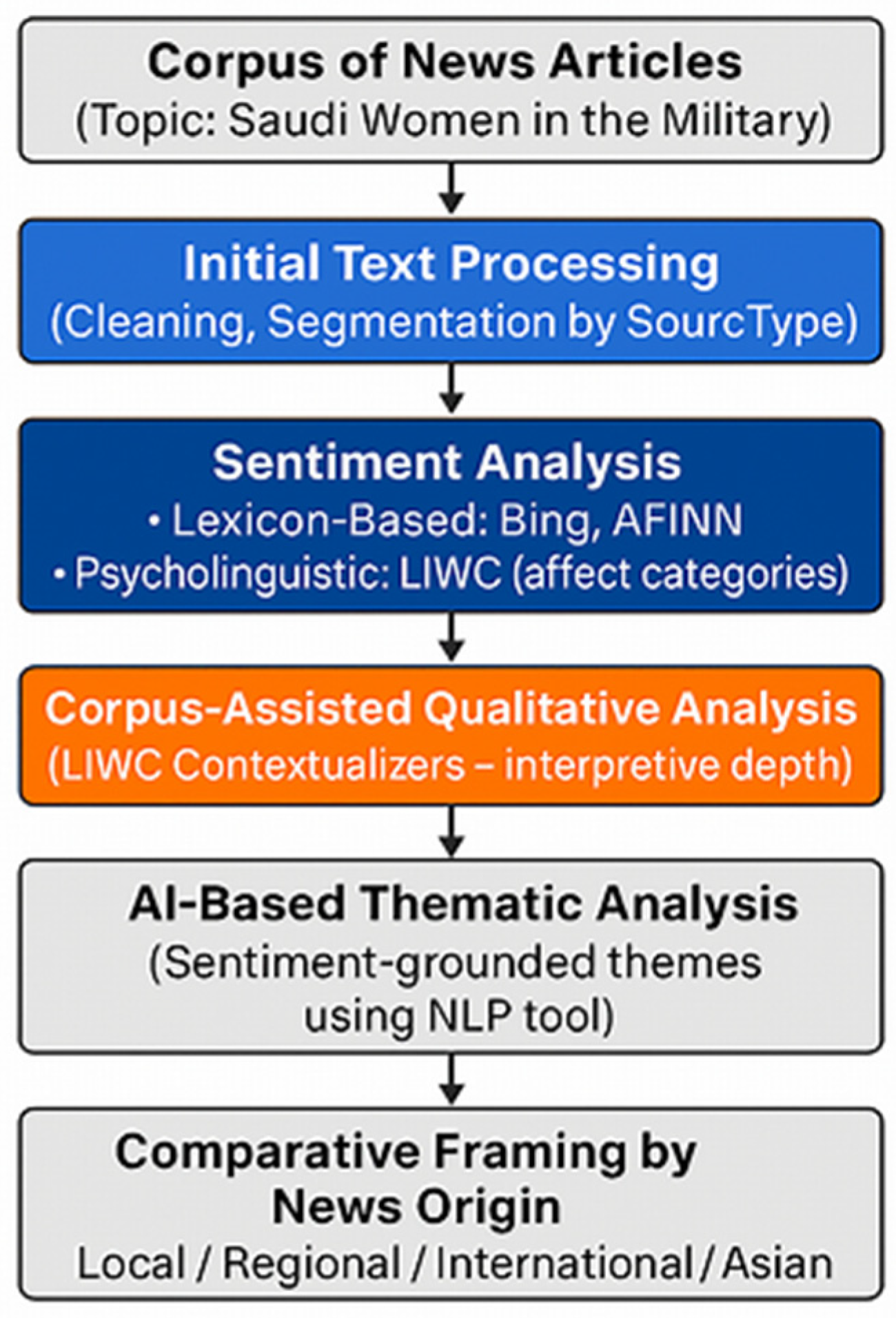
3.4. Research Stages
3.5. Data Collection
4. Data Analysis and Results
4.1. LIWC Sentiment Scores (LIWC-22 vs. Bing Lexicons)
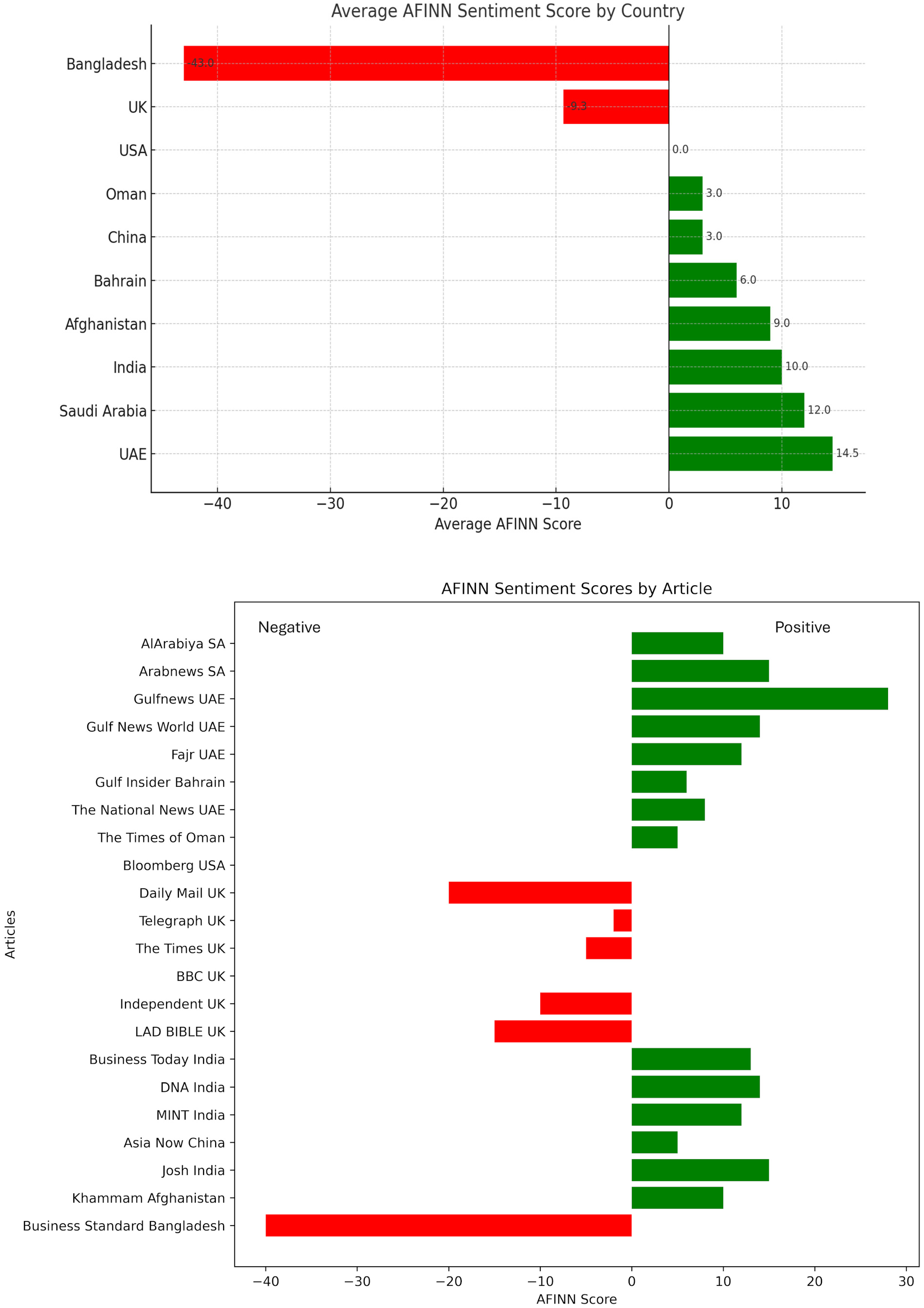
4.2. AFINN
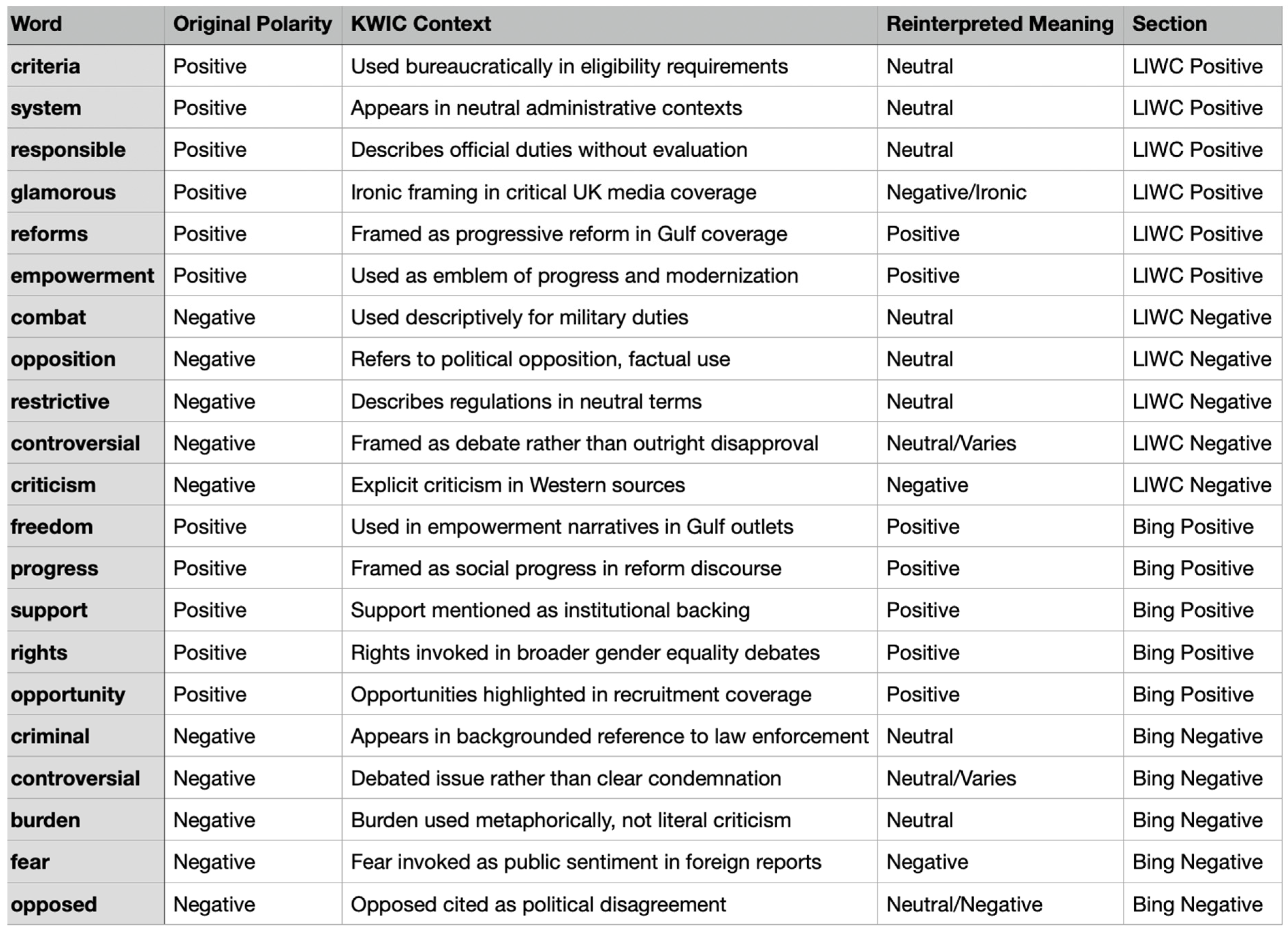
4.3. KWIC
4.4. AI Sentiment-Based Thematic Categorization
5. Discussion
6. Conclusions
Author Contributions
Funding
Institutional Review Board Statement
Informed Consent Statement
Data Availability Statement
Conflicts of Interest
Appendix A

| Region | Newspaper | No. of Articles | Date(s) of Publication | Headquarters |
|---|---|---|---|---|
| Saudi Arabia | Al Arabiya | 1 | 21.02.2021 | Riyadh |
| Arab News | 1 | 03.10.2019 | Jeddah | |
| Gulf (UAE, Oman, Bahrain) | The National News | 1 | 19.10.2018 | Abu Dhabi |
| Gulf News | 1 | 21.02.2021 | Dubai | |
| Falir | 1 | 23.02.2021 | UAE | |
| Gulf Insider | 1 | 21.02.2021 | Bahrain | |
| The Times of Oman | 1 | 28.02.2021 | Muscat | |
| United Kingdom | Daily Mail | 1 | 22.02.2021 | London |
| The Times | 1 | 23.02.2021 | London | |
| The Telegraph | 1 | 21.02.2021 | London | |
| Independent | 1 | 22.02.2018 | London | |
| LAD Bible | 1 | 22.02.2021 | London | |
| BBC | 1 | 26.02.2018 | London | |
| USA | Bloomberg | 2 | 21.02.2021/23.02.2021 | New York |
| Asia (India, Bangladesh, China, Afghanistan) | MINT | 1 | 16.02.2021 | India |
| Business Today | 1 | 22.02.2021 | India | |
| DNA | 1 | 22.02.2021 | India | |
| Jagran Josh | 1 | 23.02.2021 | India | |
| Business Standard | 1 | 23.02.2021 | Bangladesh | |
| Asia Now | 1 | 23.02.2021 | China | |
| Khamma | 1 | 23.02.2021 | Afghanistan |
Appendix B
| Region/Country | Newspaper/Article | Tone | Positive % | Negative % |
|---|---|---|---|---|
| Saudi Arabia | AlArabya.SA | 41.14 | 1.42 | 0.00 |
| Arabnews.SA | 63.66 | 3.26 | 0.50 | |
| United Arab Emirates | Glufnews UAE | 72.45 | 3.59 | 0.26 |
| Gulf News World UAE | 53.96 | 2.17 | 0.00 | |
| Falir UAE | 63.53 | 3.09 | 0.34 | |
| The National News | 50.59 | 2.26 | 0.28 | |
| Bahrain | Gulf Insider | 53.36 | 2.14 | 0.00 |
| Oman | The Times of Oman | 29.71 | 0.70 | 0.00 |
| USA | Bloomberg USA | 23.22 | 0.71 | 0.48 |
| United Kingdom | Daily Mail | 20.23 | 1.74 | 1.74 |
| Telegraph | 16.99 | 2.25 | 2.54 | |
| The Times | 6.78 | 1.03 | 2.56 | |
| BBC | 36.97 | 1.95 | 0.78 | |
| Independent | 23.46 | 1.28 | 1.02 | |
| LAD Bible | 20.23 | 1.73 | 1.73 | |
| India | Business Today | 44.11 | 1.60 | 0.00 |
| DNA India | 43.67 | 1.57 | 0.00 | |
| MINT India | 32.15 | 0.86 | 0.00 | |
| Jagran Josh India | 31.42 | 1.14 | 0.33 | |
| China | Asia Now | 35.11 | 1.26 | 0.21 |
| Afghanistan | Khamma | 60.79 | 2.90 | 0.32 |
| Bangladesh | Business Standard | 15.51 | 1.55 | 1.97 |
| Region/Country | Newspaper/Article | Positive % | Negative % |
|---|---|---|---|
| Saudi Arabia | AlArabya.SA | 1.01 | 0.41 |
| Arabnews.SA | 1.50 | 0.50 | |
| United Arab Emirates | Glufnews UAE | 3.33 | 0.00 |
| Gulf News World UAE | 1.09 | 0.36 | |
| Falir UAE | 1.37 | 1.37 | |
| The National News | 0.56 | 0.56 | |
| Bahrain | Gulf Insider | 1.07 | 0.00 |
| Oman | The Times of Oman | 1.40 | 0.00 |
| USA | Bloomberg USA | 0.71 | 1.66 |
| United Kingdom | Daily Mail | 2.46 | 2.46 |
| Telegraph | 4.51 | 2.82 | |
| The Times | 1.03 | 2.05 | |
| BBC | 1.56 | 1.56 | |
| Independent | 2.05 | 1.53 | |
| LAD Bible | 1.24 | 2.97 | |
| India | Business Today | 0.96 | 0.32 |
| DNA India | 0.59 | 0.39 | |
| MINT India | 0.00 | 0.00 | |
| Jagran Josh India | 1.79 | 0.49 | |
| China | Asia Now | 1.47 | 1.26 |
| Afghanistan | Khamma | 2.26 | 0.97 |
| Bangladesh | Business Standard | 2.11 | 2.67 |
Appendix C

| Left Context | Keyword | Right Context | Original Polarity | Reinterpreted Meaning |
|---|---|---|---|---|
| “Applicants must meet strict” | criteria | “before acceptance into the program.” | Positive | Neutral |
| “The new military” | system | “will oversee recruitment fairly.” | Positive | Neutral |
| “She was described as” | glamorous | “in a tone of irony by Western press.” | Positive | Negative/Ironic |
| Left Context | Keyword | Right Context | Original Polarity | Reinterpreted Meaning |
|---|---|---|---|---|
| “Training involves” | combat | “exercises but framed as routine.” | Negative | Neutral |
| “There was strong” | opposition | “but mainly political, not evaluative.” | Negative | Neutral |
| “Regulations were seen as” | restrictive | “yet framed neutrally as conditions.” | Negative |
| Left Context | Keyword | Right Context | Original Polarity | Reinterpreted Meaning |
|---|---|---|---|---|
| “The reforms are seen as a step toward greater” | freedom | “for Saudi women in the armed forces.” | Positive | Positive |
| “This was hailed internationally as” | progress | “in women’s empowerment.” | Positive | Positive |
| “Senior officials voiced their” | support | “for the inclusion of women.” | Positive | Positive |
| “Allowing women equal” | rights | “to serve was emphasized in the debate.” | Positive | Positive |
| “The policy opened new” | opportunity | “for female graduates to enlist.” | Positive | Positive |
| Left Context | Keyword | Right Context | Original Polarity | Reinterpreted Meaning |
|---|---|---|---|---|
| “Recruitment rules treat some offenses as” | criminal | “which automatically disqualifies applicants.” | Negative | Neutral (legalistic) |
| “The policy was described as” | controversial | “by critics in international outlets.” | Negative | Negative |
| “Some critics saw women as a” | burden | “on the military system, though rarely detailed.” | Negative | Neutral/Negative |
| “Opponents expressed” | fear | “of cultural change more than the policy itself.” | Negative | Negative |
| “The proposal was strongly” | opposed | “by conservative groups in parliament.” | Negative | Negative |
Appendix D
| Region | Article | Positive Themes (Count + Nature) | Negative Themes (Count + Nature) | Initial Verdict (Count-Based) | Final Verdict (Qualitative Override Applied) | Justification for Final Verdict |
|---|---|---|---|---|---|---|
| Regional | Gulf Insider Bahrain | 3–4 → Empowerment, modernization, opportunities; one procedural (weak positive) | 4 → Structural barriers, discrimination, inequality, societal resistance | Neutral → Negative leaning | Negative | Structural barriers and inequality outweigh relatively weak positives like process improvement |
| Regional | Gulf News UAE | 6 → Empowerment, modernization, leadership support, recognition, international standards | 4 → Social resistance, role restrictions, age restrictions | Positive | Positive | Strong, salient empowerment and leadership support themes dominate; negative themes minor |
| Regional | The National News UAE | 5 → Empowerment, career advancement, diverse roles, historic milestones, modernization | 5 → Age restrictions, resistance, cultural barriers, implementation, sustainability concerns | Neutral | Positive | Positive themes are strong and core to empowerment narrative; negatives are procedural or minor |
| International | LAD Bible UK | 5 → Empowerment, modernization, legal/social reform, international image, future prospects | 5 → Human rights concerns, activist repression, tokenism, guardianship limits, delayed reforms | Neutral | Negative | Strong human rights and tokenism framing outweighs equal count of positive reforms |
| International | Telegraph UK | 4 → Empowerment, modernization, education/professional advancement, international image | 4 → Human rights concerns, activist repression, tokenism (PR critique), selective reforms | Neutral | Negative | Salient negative themes (human rights abuses, repression, tokenism) dominate perceived polarity |
| International | Khamma Afghanistan | 5 → Empowerment, economic impact, diverse employment, legal/social reforms, modernization | 5 → Restrictions, gradual change, guardianship issues, educational limits, historical limitations | Neutral | Positive | Positive empowerment and modernization themes are much more salient; negatives are minor or backgrounded |
| International | Independent UK | 3 → Empowerment, progressive reforms, international attention | 5 → Human rights concerns, activist suppression, male guardianship, second-class citizenship, structural barriers | Negative | Negative | Strong systemic human rights critique and structural barriers dominate the framing |
| International | BBC UK | 4 → Empowerment, progress, inclusion, reform | 4 → Guardianship, symbolic change, limited roles, cultural restrictions | Neutral- Negative leaning | Negative | Negative themes (guardianship, symbolic gestures) are salient and undercut empowerment framing |
| International | Daily Mail UK | 5 → Modernization, opportunity, global image, support from global leaders, activist release | 5 → Human rights, repression, political motivations, conditional reforms, dissent crackdown | Neutral- Negative leaning | Negative | Strong focus on repression and political motives overshadows positive reforms |
| International | Bloomberg USA | 6 → Economic reform, legal visibility, workforce inclusion, empowerment, modernization, opportunity | 5 → Guardianship remains, dissent crackdown, past limits, cultural barriers, conditional access | Positive | Positive | While negatives exist, the empowerment framing and scale of reform dominate |
| International | Josh India | 6 → Empowerment, autonomy, opportunity, cultural shifts, reform, inclusion | 5 → Conditional progress, slow pace, residual restrictions, exclusion, historical barriers | Positive | Positive | Strong, clear empowerment trajectory outweighs critique of reform pace |
| International | MINT India | 6 → Inclusion, reform, cultural change, gender equality, workforce, empowerment | 5 → Resistance, symbolic change, slow implementation, eligibility restrictions, cultural conservatism | Positive | Positive | Emphasis on empowerment and modernizing norms is central to framing |
| International | DNA India | 5 → Empowerment, opportunity, autonomy, reform, inclusion | 4 → Requirements, cultural resistance, inequality in criteria, marital restrictions | Positive | Positive | Positive themes are stronger, concrete, and outweigh procedural negatives |
| International | Business India | 5 → Vision 2030, inclusion, empowerment, workforce equality, reform | 4 → Social resistance, criteria-based limits, scope of reform, conservative backlash | Positive | Positive | Dominant themes of progress and opportunity drive sentiment |
| International | Asia Now China | 6 → Inclusion, modernization, empowerment, employment, acceptance, unified process | 6 → Rank restrictions, cultural resistance, marital limits, reform limits, conservative context, backlash | Neutral- Positive leaning | Positive | Positive framing of empowerment and Vision 2030 progress dominates; negatives procedural |
| International | Business Standard BD | 4 → Reforms, modernization, activist release, autonomy | 4 → Repression, human rights, conditionality, political motives | Neutral- Negative leaning | Negative | Salient negative themes (repression, politically motivated reforms) outweigh positivity |
| International | The Times UK | 4 → Reform, modernization, inclusion, strategic overhaul | 4 → Yemen conflict, military abuse, accountability, perception concerns | Neutral | Neutral | Positive and negative themes are equally salient and balanced |
References
- Afzal, N., & Omar, A. (2021). The Saudi Vision 2030: Reproduction of women’s empowerment in the Saudi press: A corpus-based critical discourse analysis. Register Journal, 14(1), 121–138. [Google Scholar] [CrossRef] [Scilit]
- Agarwal, A., Sharma, V., Sikka, G., & Dhir, R. (2016). Opinion mining of news headlines using SentiWordNet. In Symposium on colossal data analysis and networking (CDAN) (pp. 1–5). IEEE. [Google Scholar] [CrossRef] [Scilit]
- Ahmed, S., & Matthes, J. (2016). Media representation of Muslims and Islam from 2000 to 2015: A meta-analysis. International Communication Gazette, 79(3), 219–244. [Google Scholar] [CrossRef] [Scilit]
- Alasmari, A., Farooqi, N., & Alotaibi, Y. (2024). Sentiment analysis of pilgrims using CNN-LSTM deep learning approach. PeerJ Computer Science, 10, e2584. [Google Scholar] [CrossRef] [Scilit]
- Al-Qahtani, A. (2025). Navigating modernity and tradition: A CDA of Saudi news articles on women’s rights. SAGE Open, 15(1), 21582440251365752. [Google Scholar] [CrossRef] [Scilit]
- AlQahtani, S. M., & Alghamdi, A. K. H. (2025). Unveiling progress: A visual exploration of Saudi women in the workforce. Humanities and Social Sciences Communications, 12, 1401. [Google Scholar] [CrossRef] [Scilit]
- AL-Sharuee, M. T., Liu, F., & Pratama, M. (2021). Sentiment analysis: Dynamic and temporal clustering of product reviews. Applied Intelligence, 51, 51–70. [Google Scholar] [CrossRef] [Scilit]
- Altohami, W. M. A., & Salama, A. H. (2019). The journalistic representations of Saudi women in the corpus of contemporary American English (COCA): A corpus critical discourse analysis. International Journal of English Linguistics, 9(6), 320–336. [Google Scholar] [CrossRef] [Scilit]
- Anctil Avoine, P., & Lida, A. (2016). “Deviant” women in English Arab media: Comparing representation in Iraq, Saudi Arabia, and Qatar. Reflexión Política, 18(36), 34–48. [Google Scholar] [CrossRef] [Scilit]
- Areshey, A., & Mathkour, H. (2024). Exploring transformer models for sentiment classification: A comparison of BERT, RoBERTa, ALBERT, DistilBERT, and XLNet. Expert Systems, 41, e13701. [Google Scholar] [CrossRef] [Scilit]
- Bajri, I. A., & Alqurayqiri, A. A. (2022). The rescue discourse: Representations of Saudi women in the Western media. World Journal of English Language, 12(8), 450–461. [Google Scholar] [CrossRef] [Scilit]
- Bashatah, N. (2017). Framing analysis of British newspaper representation of Saudi women from 2005–2013 [Doctoral dissertation, University of Salford]. [Google Scholar]
- Birjali, M., Kasri, M., & Beni-Hssane, A. (2021). A comprehensive survey on sentiment analysis: Approaches, challenges, and trends. Knowledge-Based Systems, 226, 107134. [Google Scholar] [CrossRef] [Scilit]
- Chandra, R., Zhu, B., Fang, Q., & Shinjikashvili, E. (2025). Large language models for newspaper sentiment analysis during COVID-19: The Guardian. Applied Soft Computing, 171, 112743. [Google Scholar] [CrossRef] [Scilit]
- Dastgeer, S., & Gade, P. J. (2016). Visual framing of Muslim women in the Arab Spring: Prominent, active, and visible. International Communication Gazette, 78(5), 432–450. [Google Scholar] [CrossRef] [Scilit]
- Edam, B. K., Aladdin, A., & Shaari, A. H. (2024). Discursive strategies unveiled: Exploring Arab and western media narratives on Arab women. GEMA Online® Journal of Language Studies, 24(4), 173–190. [Google Scholar] [CrossRef] [Scilit]
- Elyas, T., Al-Zhrani, K. A., Mujaddadi, A., & Almohammadi, A. (2021). The representation(s) of Saudi women pre-driving era in local newspapers and magazines: A critical discourse analysis. British Journal of Middle Eastern Studies, 48(5), 1033–1052. [Google Scholar] [CrossRef] [Scilit]
- Entman, R. M. (1993). Framing: Toward clarification of a fractured paradigm. Journal of Communication, 43(4), 51–58. [Google Scholar] [CrossRef] [Scilit]
- Essam, B. A., & Abdo, M. S. (2021). How do Arab tweeters perceive the COVID-19 pandemic? Journal of Psycholinguistic Research, 50, 507–521. [Google Scholar] [CrossRef] [Scilit] [PubMed]
- Ghobain, E., Al-Nofaie, H., & Saad, A. (2024). Press portrayals of Saudi women’s empowerment in the context of military enlistment. Humanities and Social Sciences Communications, 11, 218. [Google Scholar] [CrossRef] [Scilit]
- Gracia, J., Fäth, C., Hartung, M., Ionov, M., Bosque-Gil, J., Veríssimo, S., Chiarcos, C., & Orlikowski, M. (2020). Leveraging linguistic linked data for cross-lingual model transfer in the pharmaceutical domain. In J. Z. Pan, V. Tamma, C. d’Amato, K. Janowicz, B. Fu, A. Polleres, O. Seneviratne, & L. Kagal (Eds.), The semantic web—ISWC 2020 (Vol. 12507, pp. 488–504). Lecture Notes in Computer Science. Springer. [Google Scholar] [CrossRef] [Scilit]
- Hu, M., & Liu, B. (2004). Mining and summarizing customer reviews. In Proceedings of the tenth ACM SIGKDD international conference on knowledge discovery and data mining (pp. 168–177). ACM. [Google Scholar] [CrossRef] [Scilit]
- Islam, M. U., Ashraf, F. B., Abir, A. I., & Mottalib, M. A. (2017). Polarity detection of online news articles based on sentence structure and dynamic dictionary. In 2017 20th international conference of computer and information technology (ICCIT) (pp. 1–5). IEEE. [Google Scholar] [CrossRef] [Scilit]
- Jamil, S. T. (2020). Media representation of Muslims and Islam from 2011–2019: A meta-analysis. Journal of Cultural and Religious Studies, 8(1), 28–33. [Google Scholar] [CrossRef] [Scilit]
- Joshy, A., & Sundar, S. (2022). Analyzing the performance of sentiment analysis using BERT, DistilBERT, and RoBERTa. In 2022 IEEE international power and renewable energy conference (IPRECON) (pp. 1–6). IEEE. [Google Scholar] [CrossRef] [Scilit]
- Karolak, M., & Guta, H. (2020). Saudi women as decision makers: Analyzing the media portrayal of female political participation in Saudi Arabia. Hawwa, 18(1), 75–95. [Google Scholar] [CrossRef] [Scilit]
- Kaur, H., & Mohana, R. (2019). Temporal sentiment analysis based on meta-data in conjunction with linguistic context of words. International Journal of Information Technology, 11(4), 751–758. [Google Scholar]
- Khan, M. R., Mohamed Zin, Z. B., & Wan Fakhruddin, W. F. W. (2025). Media representations of Islam and Muslims in global contexts (2002–2022): A systematic literature review. Studies in Media and Communication, 13(1), 45–67. [Google Scholar] [CrossRef] [Scilit]
- Kiritchenko, S., & Mohammad, S. M. (2018). Examining gender and race bias in two hundred sentiment analysis systems. In Proceedings of the seventh joint conference on lexical and computational semantics (pp. 43–53). Association for Computational Linguistics. [Google Scholar] [CrossRef] [Scilit]
- Meyer, B., Bikdash, M., & Dai, X. (2017). Fine-grained financial news sentiment analysis. In SoutheastCon 2017. IEEE. [Google Scholar] [CrossRef] [Scilit]
- Mohammad, S. M. (2016). Sentiment analysis: Detecting valence, emotions, and other affectual states from text. In Emotion measurement (Vol. 8, pp. 201–237). Woodhead Publishing. [Google Scholar] [CrossRef] [Scilit]
- Moreo, A., Romero, M., Castro, J. L., & Zurita, J. M. (2012). Lexicon-based comments-oriented news sentiment analyzer system. Expert Systems with Applications, 39(10), 9166–9180. [Google Scholar] [CrossRef] [Scilit]
- Muhtaseb, A. (2020). US media darlings: Arab and Muslim women activists, exceptionalism and the “rescue narrative”. Arab Studies Quarterly, 42(1–2), 7–24. [Google Scholar] [CrossRef] [Scilit]
- Mustafa-Awad, Z., & Kirner-Ludwig, M. (2017). Arab women in news headlines during the Arab Spring: Image and perception in Germany. Discourse & Communication, 11(5), 515–538. [Google Scholar] [CrossRef] [Scilit]
- Park, S., Strover, S., Choi, J., & Schnell, M. (2021). Mind games: A temporal sentiment analysis of the political messages of the Internet Research Agency on Facebook and Twitter. New Media & Society, 25(3), 463–484. [Google Scholar] [CrossRef] [Scilit]
- Patil, M. K., Chaudhari, N., Pawar, B. V., & Bhavsar, R. (2023). Overcoming the challenges in multi-class context-based sentiment analysis. In A. Noor, K. Saroha, E. Pricop, A. Sen, & G. Trivedi (Eds.), Proceedings of third emerging trends and technologies on intelligent systems (ETTIS 2023) (Vol. 730). Lecture Notes in Networks and Systems. Springer. [Google Scholar] [CrossRef] [Scilit]
- Peters, K., Ryan, M. K., & Haslam, S. A. (2015). Marines, medics, and machismo: Lack of fit with masculine occupational stereotypes discourages men’s participation. British Journal of Psychology, 106, 635–655. [Google Scholar] [CrossRef] [Scilit] [PubMed]
- Reis, J., de Souza, F., Vaz de Melo, P., Prates, R., Kwak, H., & An, J. (2015). Breaking the news: First impressions matter on online news. Proceedings of the International AAAI Conference on Web and Social Media, 9(1), 357–366. [Google Scholar] [CrossRef] [Scilit]
- Rodríguez-Ibáñez, M., Casáñez-Ventura, A., Castejón-Mateos, F., & Cuenca-Jiménez, P. M. (2023). A review on sentiment analysis from social media platforms. Expert Systems with Applications, 223, 119862. [Google Scholar] [CrossRef] [Scilit]
- Smith, H. L., & Luedtke, C. J. (2005). Factors that limit the true integration of women at military academies. In G. Caforio, & G. Kümmel (Eds.), Military missions and their implications reconsidered: The aftermath of September 11th (pp. 369–389). Emerald Group Publishing Limited. [Google Scholar]
- Souma, W., Vodenska, I., & Aoyama, H. (2019). Enhanced news sentiment analysis using deep learning methods. Journal of Computational Social Science, 2(1), 33–46. [Google Scholar] [CrossRef] [Scilit]
- Tausczik, Y. R., & Pennebaker, J. W. (2009). The psychological meaning of words: LIWC and computerized text analysis methods. Journal of Language and Social Psychology, 29(1), 24–54. [Google Scholar] [CrossRef] [Scilit]
- Thompson, G., & Hunston, S. (Eds.). (2000). Evaluation in text: Authorial stance and the construction of discourse. Oxford University Press. [Google Scholar]
- Van Atteveldt, W., van der Velden, M. A. C. G., & Boukes, M. (2021). The validity of sentiment analysis: Comparing manual annotation, crowd-coding, dictionary approaches, and machine learning algorithms. Communication Methods and Measures, 15(2), 121–140. [Google Scholar] [CrossRef] [Scilit]
- Wankhade, M., Rao, A. C. S., & Kulkarni, C. A. (2022). A survey on sentiment analysis methods, applications, and challenges. Artificial Intelligence Review, 55(7), 5731–5780. [Google Scholar] [CrossRef] [Scilit]
- Wu, M. E., Nicol, A. A. M., & Ralph, S. C. (2023). Masculine conformity and social dominance’s relation with organizational culture change. Armed Forces & Society. Advance online publication. [Google Scholar] [CrossRef] [Scilit]

| Quantitative SA | Qualitative SA |
|---|---|
|
|
| Country | Article | LIWC Tone | LIWC Sentiment | Bing Positive % | Bing Negative % | Bing Sentiment |
|---|---|---|---|---|---|---|
| Saudi Arabia | AlArabya.SA | 41.14 | Neutral | 1.01 | 0.41 | Positive |
| Arabnews.SA | 63.66 | Positive | 1.50 | 0.50 | Positive | |
| UAE | Glufnews UAE | 72.45 | Positive | 3.33 | 0.00 | Positive |
| Gulf News World UAE | 53.96 | Positive | 1.09 | 0.36 | Positive | |
| Falir UAE | 63.53 | Positive | 1.37 | 1.37 | Neutral | |
| The National News UAE | 50.59 | Neutral | 0.56 | 0.56 | Neutral | |
| Bahrain | Gulf Insider Bahrain | 53.36 | Positive | 1.07 | 0.00 | Positive |
| Oman | The Times of Oman | 29.71 | Negative | 1.40 | 0.00 | Positive |
| USA | Bloomberg USA | 23.22 | Negative | 0.71 | 1.66 | Negative |
| UK | Daily Mail UK | 20.23 | Negative | 2.46 | 2.46 | Neutral |
| Telegraph UK | 16.99 | Negative | 4.51 | 2.82 | Positive | |
| The Times UK | 6.78 | Negative | 1.03 | 2.05 | Negative | |
| BBC UK | 36.97 | Negative | 1.56 | 1.56 | Neutral | |
| Independent UK | 23.46 | Negative | 2.05 | 1.53 | Positive | |
| LAD BIBLE UK | 20.23 | Negative | 1.24 | 2.97 | Negative | |
| India | Business Today India | 44.11 | Neutral | 0.96 | 0.32 | Positive |
| DNA India | 43.67 | Neutral | 0.59 | 0.39 | Positive | |
| MINT India | 32.15 | Negative | 0.00 | 0.00 | Neutral | |
| Jagran Josh India | 31.42 | Negative | 1.79 | 0.49 | Positive | |
| China | Asia Now China | 35.11 | Negative | 1.47 | 1.26 | Positive |
| Afghanistan | Khamma Afghanistan | 60.79 | Positive | 2.26 | 0.97 | Positive |
| Bangladesh | Business Standard Bangladesh | 15.51 | Negative | 2.11 | 2.67 | Negative |
| Country | Article | AFINN Score | AFINN Sentiment |
|---|---|---|---|
| Saudi Arabia | AlArabya.SA | +9 | Positive |
| Arabnews.SA | +15 | Positive | |
| UAE | Glufnews UAE | +27 | Positive |
| Gulf News World UAE | +11 | Positive | |
| Falir UAE | +13 | Positive | |
| The National News UAE | +7 | Positive | |
| Bahrain | Gulf Insider Bahrain | +6 | Positive |
| Oman | The Times of Oman | +3 | Positive |
| USA | Bloomberg USA | 0 | Neutral |
| UK | Daily Mail UK | −23 | Negative |
| Telegraph UK | −1 | Negative | |
| The Times UK | −5 | Negative | |
| BBC UK | 0 | Neutral | |
| Independent UK | −12 | Negative | |
| LAD BIBLE UK | −15 | Negative | |
| India | Business Today India | +11 | Positive |
| DNA India | +13 | Positive | |
| MINT India | +1 | Positive | |
| Josh India | +15 | Positive | |
| China | Asia Now China | +3 | Positive |
| Afghanistan | Khamma Afghanistan | +9 | Positive |
| Bangladesh | Business Standard Bangladesh | −43 | Negative |
Disclaimer/Publisher’s Note: The statements, opinions and data contained in all publications are solely those of the individual author(s) and contributor(s) and not of MDPI and/or the editor(s). MDPI and/or the editor(s) disclaim responsibility for any injury to people or property resulting from any ideas, methods, instructions or products referred to in the content. |
© 2026 by the authors. Licensee MDPI, Basel, Switzerland. This article is an open access article distributed under the terms and conditions of the Creative Commons Attribution (CC BY) license.
Share and Cite
Ghobain, E.; Al-Nofaie, H.; Alhazmi, F.; Bosli, R.; Shamakhi, M. A Triangulated Digital Approach to News Sentiment Analysis: Insights from Media Coverage of Saudi Women Enlistment in Military Forces. Journal. Media 2026, 7, 50. https://doi.org/10.3390/journalmedia7010050
Ghobain E, Al-Nofaie H, Alhazmi F, Bosli R, Shamakhi M. A Triangulated Digital Approach to News Sentiment Analysis: Insights from Media Coverage of Saudi Women Enlistment in Military Forces. Journalism and Media. 2026; 7(1):50. https://doi.org/10.3390/journalmedia7010050
Chicago/Turabian StyleGhobain, Elham, Haifa Al-Nofaie, Fatmah Alhazmi, Raneem Bosli, and Maha Shamakhi. 2026. "A Triangulated Digital Approach to News Sentiment Analysis: Insights from Media Coverage of Saudi Women Enlistment in Military Forces" Journalism and Media 7, no. 1: 50. https://doi.org/10.3390/journalmedia7010050
APA StyleGhobain, E., Al-Nofaie, H., Alhazmi, F., Bosli, R., & Shamakhi, M. (2026). A Triangulated Digital Approach to News Sentiment Analysis: Insights from Media Coverage of Saudi Women Enlistment in Military Forces. Journalism and Media, 7(1), 50. https://doi.org/10.3390/journalmedia7010050