Article

Responsible and Sustainable Transmediation Through Journalism and Film: A Teaching Experience

by
Sergio Albaladejo-Ortega
* and
Josefina Sánchez-Martínez
*
Department of Communication, Faculty of Social Sciences and Communication, Universidad Católica de Murcia (UCAM), Campus de los Jerónimos 135, 30107 Murcia, Spain
*
Authors to whom correspondence should be addressed.
Journal. Media 2026, 7(1), 47; https://doi.org/10.3390/journalmedia7010047
Submission received: 22 January 2026 / Revised: 13 February 2026 / Accepted: 21 February 2026 / Published: 26 February 2026

Abstract

UNESCO’s 2030 Agenda recognises education as a strategic pillar for sustainability, underlining the fundamental role that educational institutions need to play in equipping students with theoretical and practical skills geared towards developing best practices in today’s media ecosystem. However, recent technological transformations have not only failed to guarantee the responsible use of media but have also highlighted new challenges that need to be addressed from a media literacy perspective. This paper proposes a methodology that, applied in the fourth and final year of a journalism degree course, is based on relating the filmography of Luc and Jean-Pierre Dardenne to news content through transmedia strategies. This methodology, employing a tool called Transmedia Quest, aims to foster students’ application of critical reading of reality that leads to an awareness of threats in terms of inequality and the lack of guarantees for fundamental rights. Several conclusions can be drawn from the results, which not only help to understand the tool’s usefulness in this specific study, but also highlight the opportunities it offers for its use in future projects that incorporate similar content, approaches, and methods, in line with both transmedia strategies and the Sustainable Development Goals.

1. Introduction

The contemporary media ecosystem has undergone significant transformation in recent years as a result of the emergence of new technologies such as virtual reality and artificial intelligence, as well as the interconnection of platforms, content, and consumption patterns, leading to the current scenario being considered a kind of “media entanglement” (Lüthe, 2022). Strategies for the production, distribution, and consumption of content across multiple platforms have become a fundamental part of the here and now, supporting not only entertainment, as is the case with transmedia storytelling (Jenkins, 2006, 2022; Scolari, 2025), but also journalism or education, as with transmedia journalism (Chalikiopoulou & Veglis, 2024; Rampazzo Gambarato & Alzamora, 2018) and transmedia literacy (Scolari et al., 2018; Thomas et al., 2007). All of these are based on reading, writing and interaction through multiple platforms, giving audiences “an active role in gathering and processing the dispersed elements” (Jenkins, 2022, p. 13).
Transmedia narratives’ numerous applications allow one, particularly in the educational context, to reflect on the real world through representations of other possible worlds that, in many cases, may not be so very different from our own. The development of transmedia learning processes (Sánchez-Caballé & González-Martínez, 2023) based on narrative accounts allows for pedagogical principles to be put into practice in motivating proposals for students as they are relatable to their daily lives (Ordaz Guzmán et al., 2025), enabling them to imagine “their social existence, how they fit together with others, how things go on between them and their fellows, the expectations that are normally met, and the deeper normative notions and images that underlie this expectations” (Taylor, 2004, p. 23), resulting in a projection of possible or more desirable futures.
In response to these phenomena, this Innovative Teaching Project seeks to foster reflection on various social issues which, present in both films and news media, are aligned with the seventeen Sustainable Development Goals (SDGs) in UNESCO’s 2030 Agenda. It introduces transmedia strategies that connect, from a fictional perspective, the issues and situations represented in the filmography of Luc and Jean-Pierre Dardenne and, from a real-world perspective, the problems affecting the world we live in. Eleven feature films by the two Belgian filmmakers have been chosen for a fourth-year optional subject in the journalism degree, all of which “deal distinctively with subject matter recognisable to most of us—the lives of people living of the socio-economic margin” (Mosley, 2013, p. 10). Transmedia dynamics have been applied utilising a tool called Transmedia Quest (Albaladejo-Ortega, 2017; Albaladejo-Ortega & Sánchez-Martínez, 2024) that facilitates the connection of the selected films with the creation of news items that expand and reinterpret the original texts, aiding the acquisition of transmedia skills (Masanet & Scolari, 2024; Scolari et al., 2020).
As the media ecosystem has gone from being “media-centred”, finding its raison d’être in the media itself, to being “narrative-centred” (Scolari, 2008) or “narrative-oriented” (Kalogeras, 2017, 2025), prioritising the stories disseminated through said media, the traditional public has gone from being passive consumers of media content to actively interacting with it, thus becoming co-creators. Consequently, this transmedia configuration greatly influences literacy processes, calling for the training of students in a triple “critical–cultural–digital” dimension (Hoechsmann et al., 2021), as well as having to deal to no lesser degree with the challenge posed by sustainability in order to “guarantee competences, strategies and skills to citizens for the achievement of lifelong learning that will allow them to adapt to the challenges ahead” (Meyerhofer-Parra, 2025, p. 111).
Transmedia literacy or transliteracy enables unique connections between students, teachers, and material, helping to foster critical thinking in students, making them more participatory, and turning them into the protagonists of their own learning, thus allowing for them to “shape their ideas into well- structured narratives and complex storyworlds” (Teixeira Tárcia, 2018, p. 321). This last point is especially relevant because narrative engagement has great potential to influence audience loyalty and commitment to the SDGs (Chattoo & Feldman, 2017; Coles, 2024; Shata et al., 2025). That is why it is not simply a matter of introducing pre-existing narratives and transforming them into learning materials, but also of generating learning through the process of the students themselves becoming storytellers. In part, what drives these types of storytelling projects is a belief that having the opportunity to tell their own stories empowers individuals and communities, and that sustainable change occurs from within empowered communities. Nevertheless, stories do not exist in a vacuum and the purpose of many community storytelling or social research projects is to bring those stories into public discourse and into a dialogue between the storytellers and audience. (Hancox, 2018, p. 334)
Section 4 (‘Quality education’) of UNESCO’s 2030 Agenda for Sustainable Development establishes, as its seventh goal, one of the major challenges for the future, namely “to ensure that all learners acquire the knowledge and skills needed to promote sustainable development” (UNESCO, n.d.). This paper has the aim of contributing to this goal by presenting the results of an Innovative Teaching Project based on formal, non-formal, and informal teaching and learning dynamics. Teachers act in the project as a link between the educational institution and the media ecosystem with which students interact daily, seeking to promote transmedia learning aimed at fostering awareness of major topical issues. Therefore, working towards what Clough and Halley (2007) call “the affective turn”, the study is structured around a transmedia learning approach that focuses “not only on ‘how students learn’ but also ‘how students connect and build communities’ across platforms (as opposed to a focus on a single platform)” (Tombleson, 2024, p. 256).

2. Materials and Methods

The overall objective of this study is to apply the pre-existing transmediation tool Transmedia Quest to the Innovative Teaching Project called “Transmedia literacy for sustainable development through journalism and film”, during the 2024–2025 academic year in the fourth-year optional subject of the journalism degree called “Journalism and Film”, applying different literacy dynamics to the Belgian filmmakers Jean-Pierre and Luc Dardenne’s eleven films, which make up the object of study: Je pense à vous (1992), The Promise (La promesse, 1996), Rosetta (1999), The Son (Le fils, 2002), The Child (L’Enfant, 2005), Lorna’s Silence (Le silence de Lorna, 2008), The Kid with a Bike (Le gamin au Velo, 2011), Two Days, One Night (Deux jours, une nuit, 2014), The Unknown Girl (La Fille Inconnue, 2016), Young Ahmed (Le Jeune Ahmed, 2019) and Tori and Lokita (Tori et Lokita, 2022).
The following associated objectives were established:
  • O1. Foster transmedia literacy by connecting films with journalistic texts rooted in reality.
  • O2. Promote co-creation through the production of an original piece that expands upon the feature film being transmediated.
  • O3. Aid awareness of the Sustainable Development Goals by means of the relationship between these cinematic fictions and different examples of journalistic work.
These objectives give rise to three interrelated hypotheses: (H1) that the tool promotes students’ transmedia literacy through the creation of interconnected journalistic pieces; (H2) that the proposed activities enhance students’ autonomy and proactivity, enabling them to produce socially relevant news content; and (H3) that engagement with the underlying Sustainable Development Goals fosters awareness of contemporary issues and stimulates the development of potential solutions.
With these aims and premises in mind, the methodology to be employed consists of applying the aforementioned tool through the design of analysis tables intended to provide, firstly, instruction and guidance in the creative process, and, secondly, the collection and evaluation of the pieces generated by the students.

2.1. Reasons for the Innovative Project

The proposed Innovative Teaching Project, considering the issues addressed in the above sections, is based on the eleven feature films directed by the Dardenne brothers, since they reflect many of the Sustainable Development Goals set out in UNESCO’s 2030 Agenda, which reinforces the correspondence between what is shown in the brothers’ cinematic work and what happens in the real world of the spectators and witnesses. Issues such as immigration—Tori and Lokita (2022), Lorna’s Silence (2008), The Promise (1996); religion—Young Ahmed (2019); access to healthcare—The Unknown Girl (2016); unemployment—Two Days, One Night (2014), Rosetta (1999), The Son (2002), Je pense à vous (1992); and child vulnerability—The Kid with a Bike (2011), The Child (2005) occupy a central place in the Belgian filmmakers’ filmography. These aspects are so fundamental to their films that they have come to be defined with the term “responsible realists” (Mosley, 2013), perhaps because they are able to “elicit an audience’s empathy and belief, as if the film were taking place in our own world” (Mai, 2010, p. 53).
It is for these reasons, despite their linear and single-media nature, that these works are considered to offer so many opportunities for transmedia storytelling, both based on the strategies previously established and regarding news and issues influencing reality. This is especially true because “the transmedia communication experience raises awareness, sensitises, transforms, and, from this perspective, constitutes a strategy for democratic participation” (Alzate Gallego et al., 2023, p. 139). Although important drivers for the project were identified—such as the students’ knowledge of the genres and formats of journalism, their possession of a grounding in terms of audio-visual culture, and their familiarity with transmedia dynamics—it was also considered that barriers could arise which might hinder how it was put into practice; such barriers could be their lack of autonomy and proactivity, their reservations about participation and co-creation, or their shortcomings in digital competence.
Recognising those potential barriers, it was deemed appropriate to use an easily accessible and user-friendly tool such as Transmedia Quest, and to derive dynamics of reading, writing and interaction from it. Such dynamics, while calling for the students to work and be involved, did not require the application of digital, information, or transmedia skills that they had not acquired in their university education or could only acquire in the initial explanatory phase of the project. It was of great help that the project was based on two phenomena closely linked to the practices that digital natives carry out naturally every day: transmedia navigation (Jenkins et al., 2009), relating to the exploratory and multimodal practices they carry out in the media environment, and transmedia play (Herr-Stephenson et al., 2013), concerning their participation in gamified dynamics.

2.2. Design of the Study

The study, in terms of method, has been built employing the tool called Transmedia Quest, conceived as a pre-existing template for content transmediation, adapted to the project’s objectives, which allows for input—in this case, feature films—to be researched and enables students to generate content that leads them to reflect on the issues present in the works. It seeks to generate critical prosumption (Koc & Barut, 2016), insofar as the target audience are not passive consumers, but rather “can transmit their own beliefs, negotiate with the ideas of others, and consider the anticipated repercussions during the construction and participation in the media” (Ordaz Guzmán et al., 2025, p. 77).
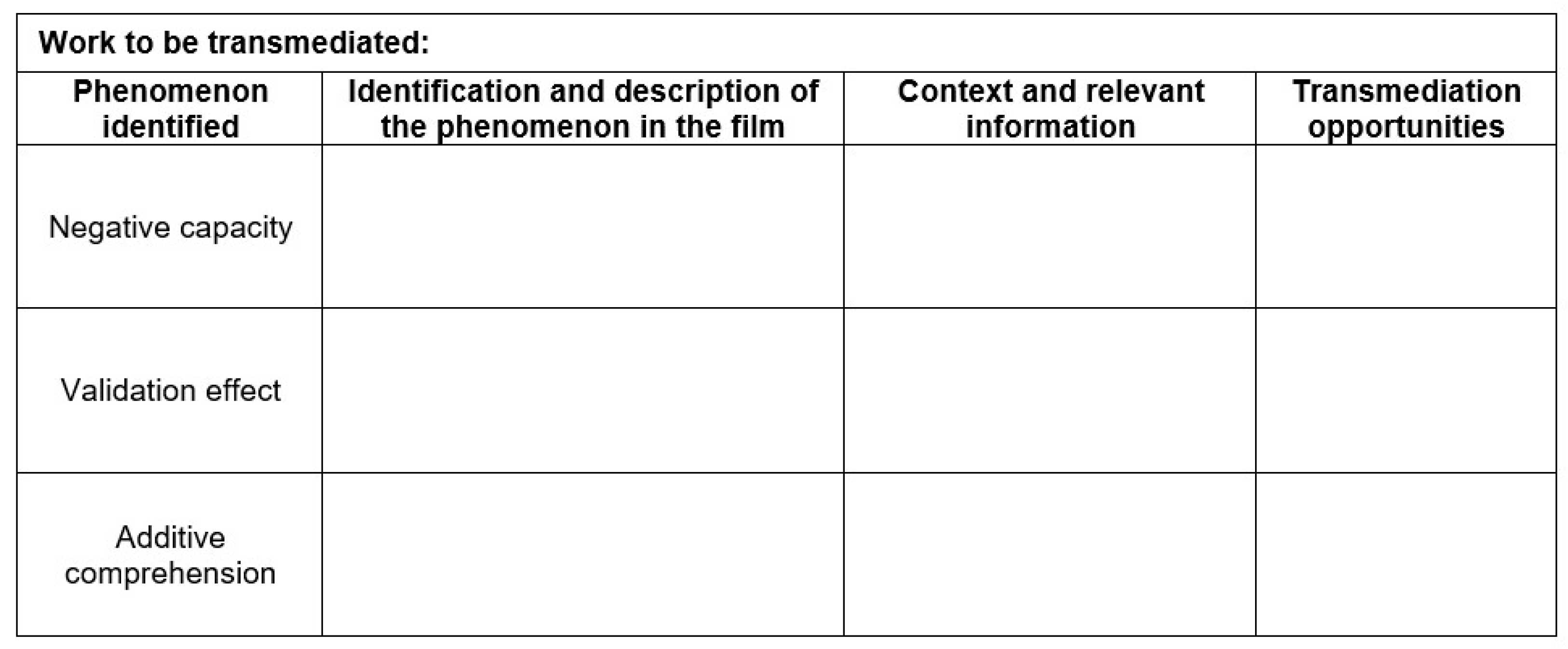
In line with this approach, three transmedia strategies have been utilised in this project employing Transmedia Quest. These aim both to foster a specific type of reading aligned with the objectives sought, and to assist in the creation of student-generated content. The strategies are “negative capability” (Long, 2007), which involves identifying gaps in texts that are appealing precisely because they need filling; the “validation effect” (Smith, 2009), which occurs when an assumption regarding some aspect that had not previously been admitted is finally confirmed; and “additive comprehension” (Long, 2007) which arises when information is expanded on or new data is provided regarding some aspect of the work, leading to a reinterpretation of what was previously known. These strategies affect both analogue and digital dynamics and content, enabling the hybridisation of both types of media to generate a more powerful and meaningful experience (Erta-Majó & Vaquero, 2023).
Three tables have been used to address the above points, each corresponding to the objectives of the research methodology. First, as illustrated in Figure 1, a table was designed to enable students to record the presence of the phenomena of negative capacity, validation effect, and additive comprehension in each of the films, describing how they occur, investigating the context of the fiction, and projecting possible opportunities for its transmediation.
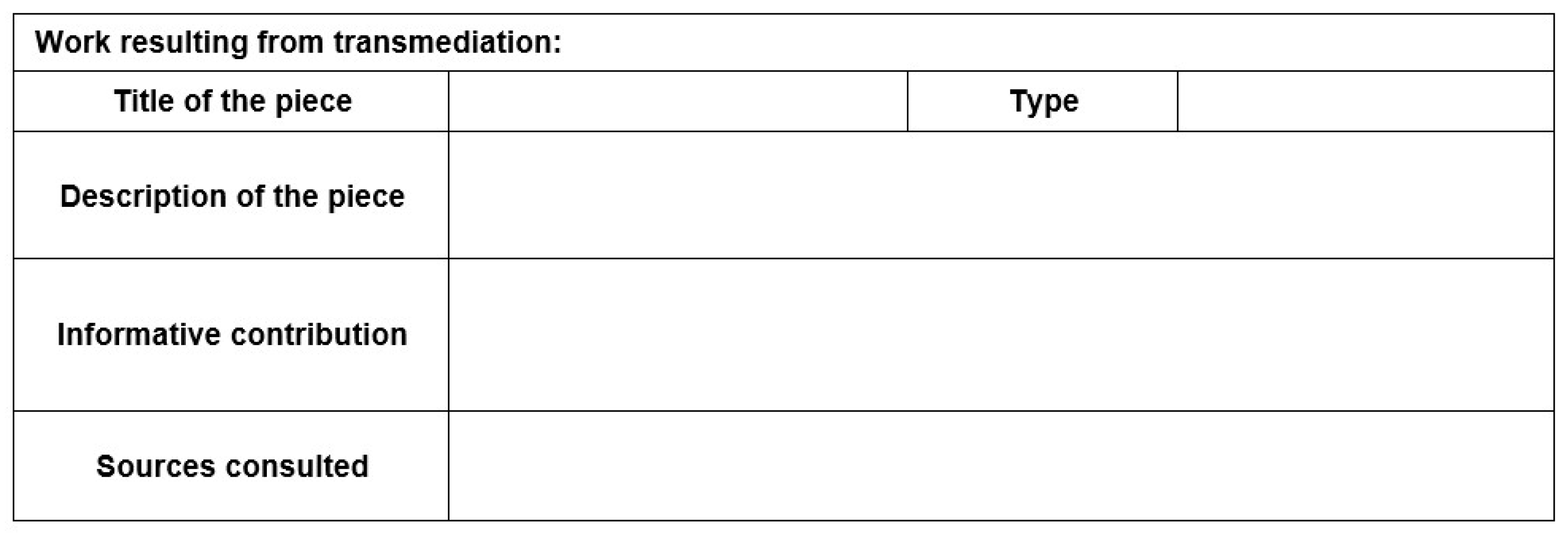
Secondly, as illustrated in Figure 2, another table is aimed at compiling the fundamental aspects that define the materialisation of the transmedia piece—audio-visual (documentary short film, fiction short film, video essay, reportage, etc.), written (interview, article, reportage, etc.), photographic, etc.—which, arising from the film and the rest of the pieces with which it was related, was carried out by each student and was finally been shared with the teaching staff and their peers.
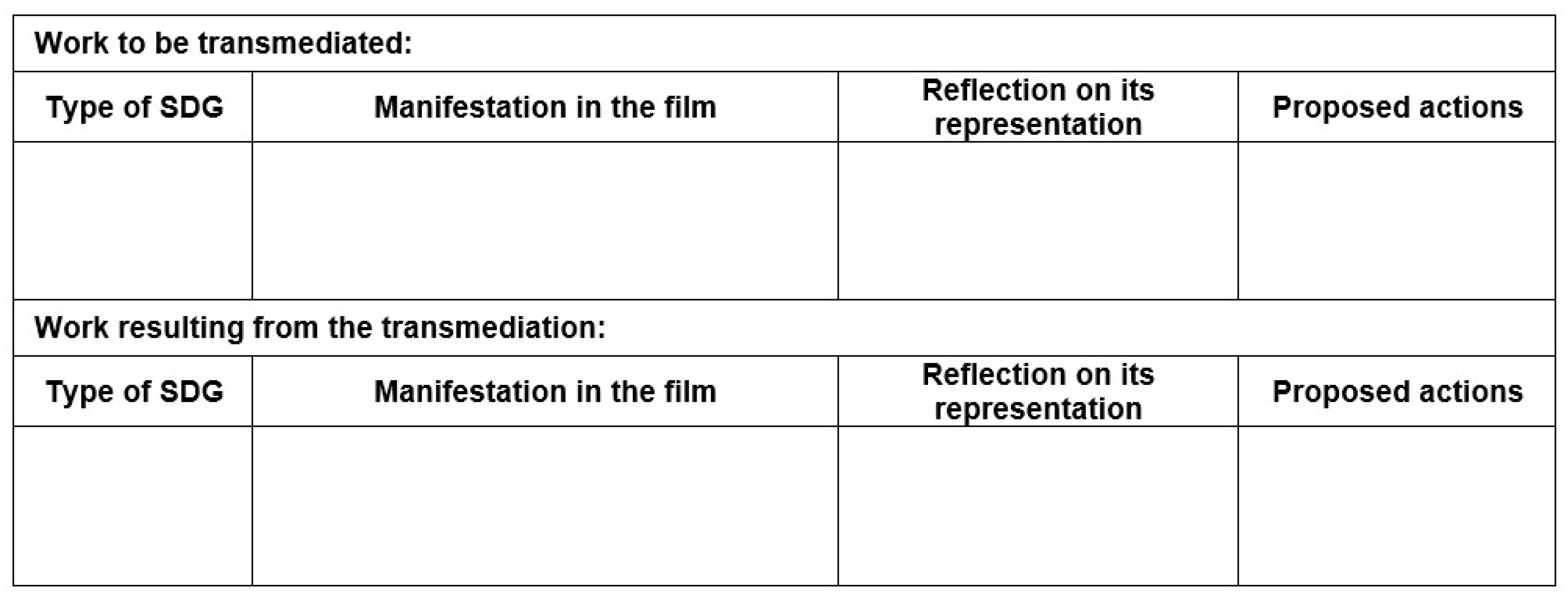
Finally, as illustrated in Figure 3, the connection is crucial between, on the one hand, the work to be transmediated and the piece resulting from the transmediation, and on the other, the Sustainable Development Goals defined by UNESCO, as these goals give meaning to this fundamental part of the project. This section is for the students, after identifying the goals in the films, to reflect on them and offer proposals for action to correct potential injustices or inequalities.

2.3. Participants in the Project

The project involved a group of eleven students, including an Erasmus student from Brazil and four exchange students from Burundi, all of whom were linked to Communication studies at their respective universities.
Regarding planning and sequencing, the project took place during the first semester, from September to December 2024, within the four-hour weekly block dedicated to the subject. The first two hours of this block were devoted to teaching the theoretical content related to approaching film from a journalistic perspective. The time was used not only to teach the knowledge and skills necessary for writing about film, but also to connect these different aspects to the perspectives upon which the innovation project is based. The following two hours were dedicated to practical exercises in which the students undertook the various tasks involved in creating transmedia content. This content, in the form of news items, extended the scope of the films and their connection to the Sustainable Development Goals.
The feature films studied followed the chronological order of their release, a schedule made known to the participants through the individual workbooks given to them. This enabled them to know which film would be shown in each session so they could preview it beforehand. They were able to use the workbook to follow the various instructions for creating their pieces, registering all the relevant aspects for design and production (Figure 1), and to later reflect on them (Figure 2 and Figure 3). They were also told that during the seventh and fifteenth weeks of the project, corresponding to the midpoint and conclusion, they would have to present one of the pieces they had completed in the first and second phases, respectively.
Regarding the researcher’s position during the study, it should be clarified that the Principal Investigator also served as the course instructor in which the project was implemented. He was responsible for designing the intervention and for providing formal guidelines for the different activities. However, during the phases involving creative production and reflective work, he deliberately adopted a non-interventionist stance in order to minimise potential bias and reduce undue influence on students’ performance.

3. Results

The results obtained are presented below, following the order in which the students addressed the different aspects: the origin, nature, and function of the pieces created; the application of transmedia strategies; the relationship with the information and nature of the sources consulted; and the representation of the SDGs. The data quantification allows for the fact that, in some cases, students’ responses concluded that the pieces simultaneously displayed several natures, characteristics, and functions.
Regarding the pieces chosen as the original work for creation in the first phase of the project, The Promise was chosen by four students out of the total of 11 involved in the project, followed by Rosetta, selected by three students. In the second phase, six out of 11 chose The Kid with a Bike, while The Unknown Girl was chosen by four students.
With respect to the nature and function of the pieces created in the first phase, printed materials (three out of 11) and social media content (three out of 11) stand out, with a clear predominance of the function of awareness-raising (10 out of 11), followed by informative (six out of 11) and educational (six out of 11) functions. Artistic (two out of 11) and entertainment (one out of 11) functions are less frequent. And the results concerning the nature and function of the pieces created in the second phase show a predominance of social media (four out of 11) and print media (three out of 11), while with respect to function, there is a preponderance, as in the first phase, of awareness-raising (11 out of 11), followed by the informative (eight out of 11) and educational (three out of 11) functions. In this case as well, artistic function is less frequent (one out of 11).
In relation to the transmediation strategies applied in the first phase, the validation effect stands to the fore, present on six occasions, with negative capacity and additive comprehension figuring to a lesser extent, appearing on three occasions each. A significant change is observed in the second phase: additive comprehension becomes clearly predominant, with nine occurrences, while negative capability is reduced to two and the validation effect disappears completely.
Concerning the nature of the sources consulted in the first phase, print news media and websites of organisations or institutions lead the way, each figuring eight times. These are followed by television news, mentioned five times, with radio, reports, and professional channels, all appearing on three occasions. Social media and activist sources appear less frequently (twice each), while statements by migrants, films and series, and scientific papers are registered only once each. Furthermore, the websites of organisations or institutions were still the commonest source in the second phase, appearing eight times. Next came social media, print media, and television, each making four appearances. Radio, professional channels, activist sources, and statements by migrants were less frequent, each earning two mentions. Finally, reports, films and series, and scientific papers were found once each.
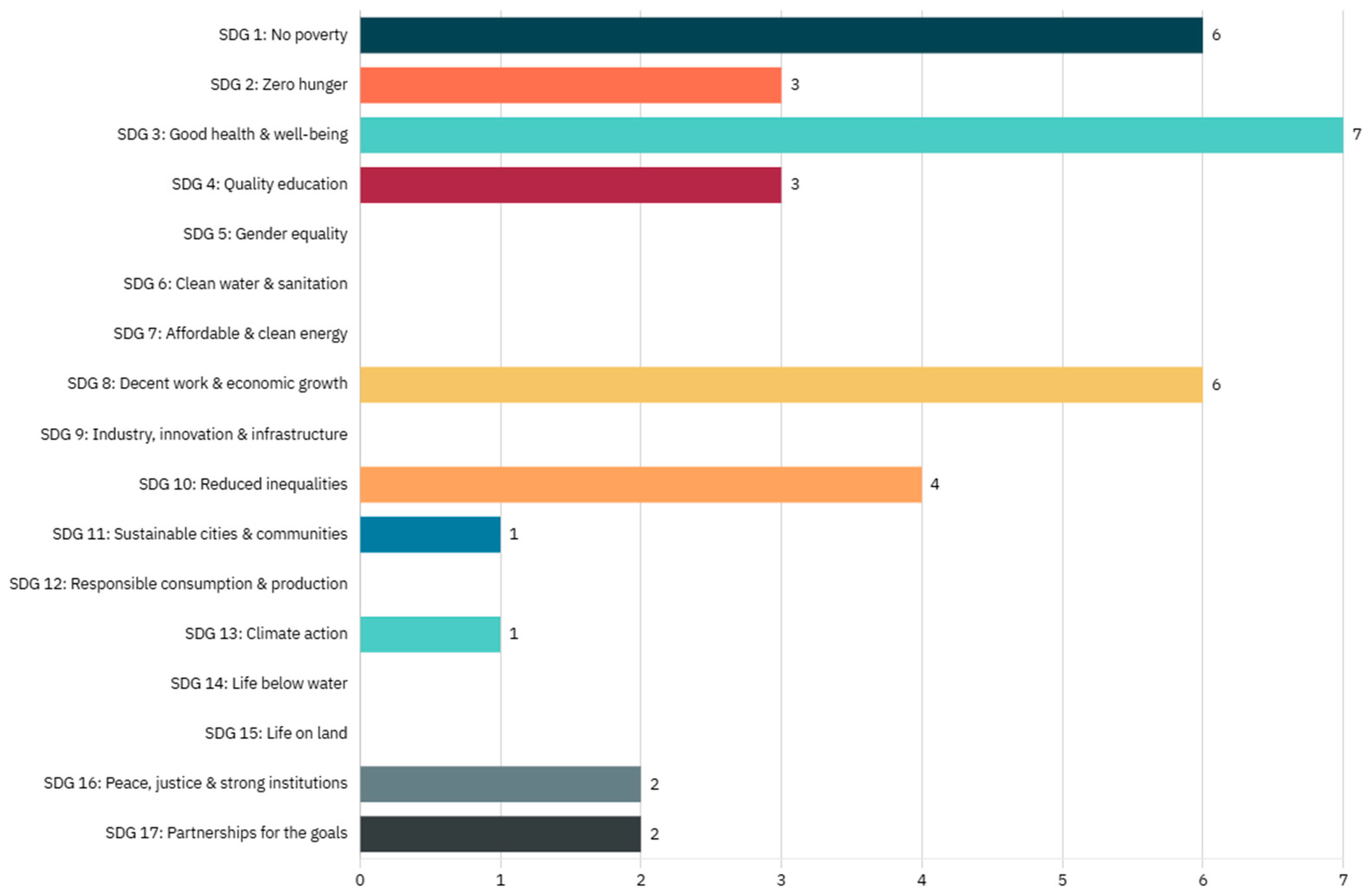
Lastly, turning to the representation of the SDGs, the most frequently mentioned in the pieces created in the first phase, as illustrated in Figure 4, are SDG 3: Good Health and Well-being, appearing seven times, SDG 1: No Poverty and SDG 8: Decent Work and Economic Growth, with six appearances each. These are followed by SDG 10: Reduced Inequalities, mentioned four times, while SDG 2: Zero Hunger and SDG 4: Quality Education appear three times each. Less frequently mentioned are SDG 16: Peace, Justice and Strong Institutions and SDG 17: Partnerships for the Goals, with two appearances each, and finally SDG 11: Sustainable Cities and Communities and SDG 13: Climate Action, figured only once each.
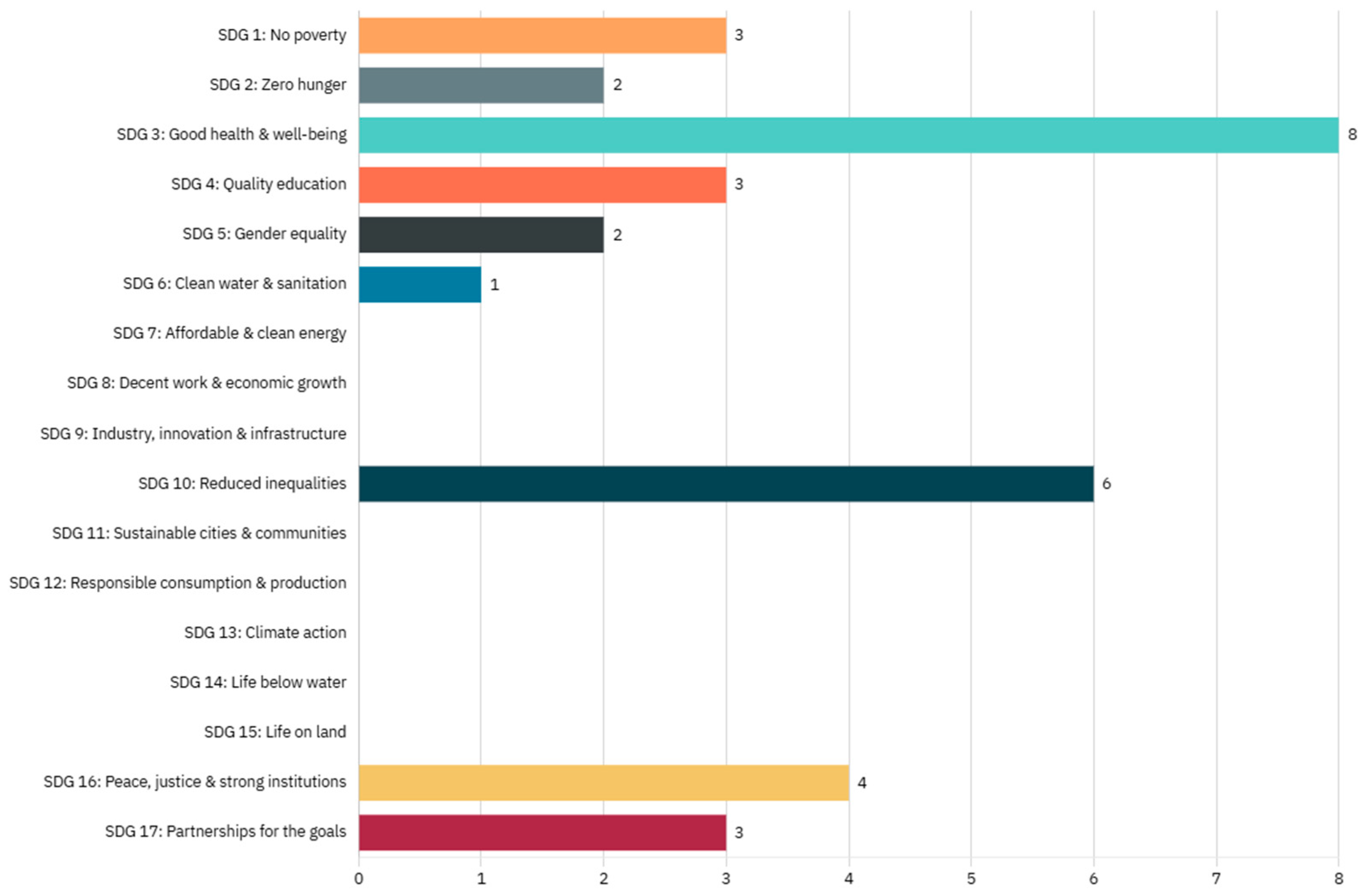
SDG 3: Good Health and Well-being, as illustrated in Figure 5, remains central in the second phase, being the most common with eight appearances, followed by SDG 10: Reduced Inequalities, with six. SDG 1: No Poverty, SDG 4: Quality Education, and SDG 17: Partnerships for the Goals are each represented three times, while SDG 16: Peace, Justice and Strong Institutions is mentioned four times. SDG 2: Zero Hunger and SDG 5: Gender Equality appear less frequently, with two entries each, and SDG 6: Clean Water and Sanitation makes a single appearance.

4. Discussion

4.1. Origin, Nature and Function of the Pieces

The choice of The Promise as the primary work for the creative process in the first phase, followed by Rosetta, is interesting as it reflects the exploitation of immigrants residing in Belgium as a consequence of structural flaws in the social system and its institutions. This is manifest in situations that are either explicitly shown or implied throughout the films, such as institutional racism and the invisibility of vulnerable groups. The students’ commonest choice in the second phase was The Kid with a Bike, followed by The Unknown Girl, which indicates their greater interest in more individual issues, focusing on the relationships between the protagonists and the emotional bonds they build in situations of abandonment and a need for help.
Regarding the pieces created by the students, their preference for printed materials in traditional formats such as reportage and interviews, as well as content for social media, seems to reflect their greater familiarity and competence with news products of that nature, acquired through other practical experience during their studies. As for the function these pieces serve, there is a clear predominance of those that aim to inform, educate, and, above all, raise awareness. In some cases, several of these functions are present simultaneously, demonstrating a clear intention to actively engage with the public.
Furthermore, a greater emphasis on the expressive and aesthetic component of the message is observed in the first phase pieces, arguably because the students were not yet fully immersed in and involved with the issues they would later grasp and internalise. In contrast, the second phase pieces demonstrate a greater focus on the message itself, thus highlighting the awareness-raising efforts and call to action. Consequently, while the pieces from the first phase primarily denounce the social problems generated by migration and its media portrayal, those from the second emphasise the individual’s responsibility and capacity for action.

4.2. Application of Transmedia Strategies

The three transmedia strategies appear prominently and deliberately, allowing not only for the provision of evidence that corroborates the discourses present in the feature films—validation effect—but also for the expansion of information and awareness of the issues addressed—additive comprehension—and for the resolution of information gaps and other ambiguous questions through novel contributions that provide continuity to these issues, fostering reflection and reinterpretation—negative capacity. It is revealing that it is validation effect which predominates in the first pieces. It seems to demonstrate a greater need to legitimise the grounding in reality in these early creations than in the later ones, where the knowledge acquired in the first phase allowed for greater certainty about what was being defended. In fact, none of these later pieces showed the validation effect, and most of them implemented additive comprehension.
The two presentations held at the midpoint and end of the project served to confirm that, as a subtext to the pieces, there was a desire to reveal the truth, using reality as raw material to support films that, despite being fictionalised, aim to reflect the true state of the world. While it is true that the original work in the transmedia process belonged to the realm of cinematic fiction, its special connection to reality made its message potentially extendable to the media sphere, thus facilitating its natural connection with current affairs and its easy redirection to news outlets where evidence of its presence and impact could be found.
Coupled with this desire to imbue the pieces with both verisimilitude and truthfulness, the creators’ ability and intentions were clearly perceptible. They strove to intervene through media that, by fostering participation and the dissemination of individual perspectives on shared realities, enabled dialogue and sharing across platforms. The application of transmedia strategies allowed the group to become involved in narratives that, by giving voice and name to the issues addressed, also enhanced their commitment to them, through the narration of universal principles and human situations.

4.3. Relationship with the Information and Nature of the Sources Consulted

The nature of the sources consulted—predominantly print media and websites of organisations or institutions in the first phase, followed by television news, and later, in the second phase, websites of organisations or institutions, followed by social media, print media, and television—reinforces the previously stated idea that the students needed to validate and legitimise what they were narrating in their creations. Similarly, the use of other sources, such as official reports, the professional channels of prominent media figures, scientific papers, and testimonies from migrants, demonstrates that, despite this need to base their pieces on certainties, they did seek out diverse sources that could provide what each case called for and analysed them critically and meticulously to obtain not only isolated data points, but also a broad and well-rounded perspective of the phenomena addressed.
The pieces produced in both phases of the project constitute personal perspectives on reality, constructed from fact-checked documentary sources. This demonstrates robust student engagement in the research and critical interpretation of the issues addressed, supporting the creation of content that engages with issues aligned with the Sustainable Development Goals. Thus, the resulting pieces do not seek to present absolute truths based on uncorroborated beliefs, but rather to open spaces for reflection, questioning, and dialogue based on narratives constructed from information disseminated in the media.

4.4. Representation of the SDGs

The presence of the Sustainable Development Goals throughout the work presented is not a superficial or merely formal application, but rather a central axis of the narrative. This integration, from an ethical perspective, reinforces its potential as a critical and transformative pedagogical tool, and transforms the production process into an exercise in active citizenship.
The majority representation of SDG 3 (Good Health and Well-being) in the pieces created, followed by SDG 10 (Reduced Inequalities), SDG 1 (No Poverty) and SDG 16 (Peace, Justice and Strong Institutions), reveals a clear orientation towards urgent structural social problems, indicating considerable sensitivity towards human suffering, dignified living conditions, and institutional justice.
Comparing their presence in the pieces from the first and second phases, it can be seen that the initial emphasis is on SDG 3 (Good Health and Well-being), SDG 8 (Decent Work and Economic Growth), and SDG 1 (No Poverty), reflecting a concern for employment, poverty, and health, and highlighting fundamental deficiencies. However, in the second phase, while SDG 3 (Good Health and Well-being) remains to the fore, SDG 10 (Reduced Inequalities) and SDG 16 (Peace, Justice and Strong Institutions) also gain prominence, indicating a shift towards issues related to equity, the protection of rights, and the underpinning of institutions.
The resulting pieces, through their representation of the SDGs, decry failures, challenge, and propose solutions, which, from a pedagogical perspective, reveals a superior level of media literacy, understood not only as mastery of technical language and tools, but also as the critical capacity to intervene responsibly in the public sphere. It is important to highlight here that the proposals emerging from their work range from awareness campaigns regarding legislative reforms, to the implementation of institutional and community mechanisms to address the issues raised.

4.5. Critical Reflection and Active Involvement

The students’ narrative and formal decision-making is consistent with the transformative purpose of the messages in the various pieces, demonstrating an internalisation of values such as justice, equity, and empathy, clearly revealing their social commitment. This is especially true because these values are not only implicit in their work but were also made explicit so as to reinforce their centrality to the project. That was achieved by the collective dynamic of reflection that emerged from the two presentation sessions, in which each student’s contributions helped to contextualise and refine the issues addressed.
Regarding their active involvement, it is worth noting that a particularly enriching component of the project was the participation of the international students, who brought a transnational and pluralistic perspective to the issues discussed. Among these voices, those of the students from Burundi proved particularly significant, as their lived experience provided direct testimony about the real challenges surrounding the achievement of the Sustainable Development Goals. Their connection to contexts where many of these rights are still far from being guaranteed for the majority of the population enriched the debate, giving it a lived and profoundly ethical dimension. Thanks to these contributions, the classroom became not only a hive of productivity, but also a space for listening, recognition, and shared learning, where cultural differences were transformed into catalysts for critical awareness and global empathy.
These various factors were undoubtedly aided by the very nature of the Dardenne brothers’ feature films, which, due to their documentary-like staging, enabled students to become immersed in the stories of their protagonists and, through them, to become aware of similar situations experienced by others. Thus, they managed to “eliminate this distance between audience and action, to destroy the screen as a picture frame, and to drag the audience through it into the reality of the scene” (Roemer, 1966) and, at the same time, into the authentic realities portrayed.

5. Conclusions

Analysis of the findings reveals a level of media literacy derived from content production that is satisfactory not so much from a technological perspective as from a critical one. Beyond technical learning, what is evident in the creations and reflections produced is a greater capacity to wrestle with ethical issues that, regardless of their connection to desirable competencies in higher education, contribute to the formation of critical citizenship in the truest sense of the term. The potential barriers identified during the project’s design stage did not come to being in practice, as all the participating students demonstrated autonomy and proactivity, making the most of their information, digital, and transmedia skills when creating their pieces.
Transmedia Quest is presented as a useful tool for instilling transmedia knowledge and skills that contribute to audience participation, fostering the practical application of search, interpretation, and validation processes for socially relevant news content. This ultimately supports the creation of original journalistic pieces focused on reflection and action regarding sustainability. It is worth noting that the tool not only enables students to develop transmedia skills but also allows teachers to be trained in its use so they can apply it to teaching–learning processes which, while addressing heterogeneous content and dynamics, can benefit from it due to their similar approach.
The project is not tied exclusively to the present, which would incur the risk of it becoming obsolete, but rather sets a course and offers major innovations that will undoubtedly contribute to the training of students in coming years. As a consequence, any results derived from its application will allow for adjustments to be made to improve the tool and the dynamics it supports, so that it can be applied in the future in other subjects related to the many areas of communication, and indeed in other disciplines.
In short, the project has demonstrated the potential to assist in the establishment of the aforementioned and necessary affective turn, increasing the emotional involvement and critical spirit of students through storytelling and transmediation. It has allowed for these strategies to generate empathy and projection not only towards the characters represented, but, above all, with respect to people with analogous situations, spurring interest and raising awareness regarding proposals of this nature in the 2030 Agenda.

Author Contributions

Conceptualization, S.A.-O. and J.S.-M.; Methodology, S.A.-O. and J.S.-M.; Validation, S.A.-O. and J.S.-M.; Formal analysis, S.A.-O.; Investigation, S.A.-O. and J.S.-M.; Resources, S.A.-O.; Data curation S.A.-O.; Writing—original draft, S.A.-O.; Writing—review & editing, S.A.-O. and J.S.-M.; Visualization, S.A.-O.; Supervision, J.S.-M.; Project administration, S.A.-O.; Funding acquisition, S.A.-O. and J.S.-M. All authors have read and agreed to the published version of the manuscript.

Funding

This article is part of the Teaching Innovation Project “Transmedia Literacy for Sustainable Development through Journalism and Cinema” (PID2024/0130), and has received funding from the Universidad Católica de Murcia (UCAM).

Institutional Review Board Statement

This study has received a favourable certification from the UCAM’s Ethics Committee (CE062409) on 28 June 2024.

Informed Consent Statement

Informed consent was obtained from all subjects involved in the study.

Data Availability Statement

The dataset is not publicly available because, given the nature of the topics covered and the reflections made on them by the students participating in the project, it contains information that compromises their privacy.

Conflicts of Interest

The authors declare no conflicts of interest.

Abbreviations

The following abbreviations are used in this manuscript:
SDGSustainable Development Goals
UNESCOUnited Nations Educational, Scientific and Cultural Organization

References

  1. Albaladejo-Ortega, S. (2017). Lego brick learning: Hacia un modelo de alfabetización transmediática a través de storytelling [Doctoral dissertation, Universidad Católica de Murcia]. RIUCAM. Available online: http://hdl.handle.net/10952/2403 (accessed on 3 November 2025).
  2. Albaladejo-Ortega, S., & Sánchez-Martínez, J. (2024). Transalfabetización para el consumo y la producción periodísticas: Propuesta de la herramienta transmedia quest. In E. Chiner, & I. Sánchez (Eds.), Nuevas tendencias interdisciplinares en educación y conocimiento (pp. 29–42). Tirant lo Blanch. [Google Scholar]
  3. Alzate Gallego, Y., Orozco Vallejo, M., & Zorrilla Abascal, M. L. (2023). Innovaciones transmedia en la educación: Miradas desde Colombia y México. Centro Editorial. [Google Scholar]
  4. Chalikiopoulou, E., & Veglis, A. (2024). Transfictionality, extensions and transmedia journalism: Expanding the storyworld of slavery of the 1619 project. Journalism and Media, 5(3), 892–914. [Google Scholar] [CrossRef]
  5. Chattoo, C. B., & Feldman, L. (2017). Storytelling for social change: Leveraging documentary and comedy for public engagement in global poverty. Journal of Communication, 67(5), 678–701. [Google Scholar] [CrossRef]
  6. Clough, P. T., & Halley, J. (2007). The affective turn. Theorizing the social. Duke University Press. [Google Scholar]
  7. Coles, J. N. (2024). Potential applications of transmedia storytelling for fostering SDG awareness and action. In I. Veiga Pereira, P. Botelho Pires, & J. Duarte Santos (Eds.), Effective digital marketing for improving society behavior toward DEI and SDGs (pp. 104–122). IGI Global. [Google Scholar]
  8. Erta-Majó, A., & Vaquero, E. (2023). Designing a transmedia educational process in non-formal education: Considerations from families, children, adolescents, and practitioners. Contemporary Educational Technology, 15(3), ep442. [Google Scholar] [CrossRef] [PubMed]
  9. Hancox, D. (2018). Transmedia for social change: Evolving approaches to activism and representation. In M. Freeman, & R. Rampazzo Gambarato (Eds.), The Routledge companion to transmedia studies (pp. 332–339). Routledge. [Google Scholar]
  10. Herr-Stephenson, B., Alper, M., Reilly, E., & Jenkins, H. (2013). T is for transmedia: Learning through transmedia play. USC Annenberg Innovation Lab. Available online: https://joanganzcooneycenter.org/wp-content/uploads/2013/03/t_is_for_transmedia.pdf (accessed on 17 October 2025).
  11. Hoechsmann, M., Thésée, G., & Carr, P. R. (2021). The struggle over meaning in a world in crisis. In M. Hoechsmann, G. Thésée, & P. R. Carr (Eds.), Education for democracy 2.0: Changing frames of media literacy (pp. 1–10). Brill|Sense. [Google Scholar]
  12. Jenkins, H. (2006). Convergence culture: Where old and new media collide. New York University Press. [Google Scholar]
  13. Jenkins, H. (2022). Transmedia, speculative world-building and the civic imagination. In G. Marci-Boehncke, M. Rath, M. Delere, & H. Höfer (Eds.), Medien–Demokratie–Bildung (pp. 13–24). Springer. [Google Scholar]
  14. Jenkins, H., Clinton, K., Purushotma, R., Robison, A. J., & Weigel, M. (2009). Confronting the challenges of participatory culture: Media education for the 21st century. The MIT Press. [Google Scholar]
  15. Kalogeras, S. (2017). Transmedia storytelling edutainment and the contemporary textbook in higher e-education. In L. Tomei (Ed.), Exploring the new era of technology-infused education (pp. 173–187). IGI Global. [Google Scholar]
  16. Kalogeras, S. (2025). A smart framework for making stories smarter through transmedia and real user interaction. Applied Innovations in Industrial Management, 5(2), 59–66. [Google Scholar] [CrossRef]
  17. Koc, M., & Barut, E. (2016). Development and validation of New Media Literacy Scale (NMLS) for university students. Computers in Human Behavior, 63, 834–843. [Google Scholar] [CrossRef]
  18. Long, G. (2007). Transmedia storytelling. Business, aesthetics and production at the Jim Henson Company [Doctoral dissertation, Massachusetts Institute of Technology]. DSpace@MIT. Available online: https://dspace.mit.edu/handle/1721.1/39152 (accessed on 22 May 2025).
  19. Lüthe, M. (2022). Telephonic conversations: The phone and transmedia competition in the culture of the progressive era. In C. Meyer, & M. Pietrzak-Franger (Eds.), Transmedia practices in the long nineteenth century (pp. 45–61). Routledge. [Google Scholar]
  20. Mai, J. (2010). Jean-Pierre and Luc Dardenne. University of Illinois Press. [Google Scholar]
  21. Masanet, M. J., & Scolari, C. A. (2024). How can we take advantage of students’ social media skills in the classroom? An international exploration. In M. M. Skoric, & N. Pang (Eds.), Research handbook on social media and society (pp. 287–302). Edward Elgar Publishing. [Google Scholar]
  22. Meyerhofer-Parra, R. (2025). A systematic review of transmedia literacy: Implications for lifelong learning. Journal of Media Literacy Education, 17(2), 110–124. [Google Scholar] [CrossRef]
  23. Mosley, P. (2013). The cinema of the Dardenne brothers: Responsible realism. Columbia University Press. [Google Scholar]
  24. Ordaz Guzmán, T., Meyerhofer-Parra, R., & González-Martínez, J. (2025). Las competencias transmediáticas del alumnado universitario: Un (posible) puente entre el aprendizaje informal y el formal. Edutec, Revista Electrónica de Tecnología Educativa, (92), 71–87. [Google Scholar] [CrossRef]
  25. Rampazzo Gambarato, R., & Alzamora, G. (Eds.). (2018). Exploring transmedia journalism in the digital age. IGI Global. [Google Scholar]
  26. Roemer, M. (1966). The surfaces of reality. In R. Dyer (Ed.), Film: A montage of theories (pp. 255–268). Dutton. [Google Scholar]
  27. Sánchez-Caballé, A., & González-Martínez, J. (2023). Transmedia learning: Fact or fiction? A systematic review. Culture and Education, 35(1), 1–32. [Google Scholar] [CrossRef]
  28. Scolari, C. A. (2008). Hipermediaciones. Elementos para una teoría de la comunicación digital interactiva. Gedisa. [Google Scholar]
  29. Scolari, C. A. (2025). Transmedia storytelling. Oxford Research Encyclopedia of Literature. [Google Scholar] [CrossRef]
  30. Scolari, C. A., Ardèvol, E., Pérez-Latorre, Ò., Masanet, M. J., & Lugo Rodríguez, N. (2020). What are teens doing with media? An ethnographic approach for identifying transmedia skills and informal learning strategies. Digital Education Review, 37, 269–287. [Google Scholar] [CrossRef]
  31. Scolari, C. A., Winocur, R., Pereira, S., & Barreneche, C. (2018). Alfabetismo transmedia. Una introducción. Comunicación y Sociedad, (33), 7–13. Available online: https://comunicacionysociedad.cucsh.udg.mx/index.php/comsoc/article/view/7227/5998 (accessed on 11 September 2025).
  32. Shata, A., Seelig, M., & Carcioppolo, N. (2025). Transmedia edutainment for sustainable advocacy: How narrative engagement and counterarguments influence generation Z’s response to sustainable development messages. International Journal of Communication, 19, 1468–1491. [Google Scholar]
  33. Smith, A. (2009). Transmedia storytelling in television 2.0. Strategies for developing narratives across media platforms [Doctoral dissertation, Middlebury College]. Middlebury Digital Collections. Available online: https://bpb-us-e2.wpmucdn.com/sites.middlebury.edu/dist/e/351/files/2009/06/Aaron_Smith_2009.pdf (accessed on 2 April 2025).
  34. Taylor, C. (2004). Modern social imaginaries. Duke University Press. [Google Scholar]
  35. Teixeira Tárcia, L. P. (2018). Transmedia education: Changing the learning landscape. In M. Freeman, & R. Rampazzo Gambarato (Eds.), The Routledge companion to transmedia studies (pp. 314–322). Routledge. [Google Scholar]
  36. Thomas, S., Joseph, C., Laccetti, J., Mason, B., Mills, S., Perril, S., & Pullinger, K. (2007). Transliteracy: Crossing divides. First Monday, 12(12). [Google Scholar] [CrossRef]
  37. Tombleson, B. (2024). Transmedia learning: A literature review. Technology, Pedagogy and Education, 33(2), 255–269. [Google Scholar] [CrossRef]
  38. UNESCO. (n.d.). Objetivos de desarrollo sostenible. Unesco. Available online: https://www.un.org/sustainabledevelopment/es/sustainable-development-goals/ (accessed on 18 February 2025).
Figure 1. Transmediation strategy collection table. Own production based on Long (2007), Smith (2009) and Albaladejo-Ortega (2017).
Journalmedia 07 00047 g001
Figure 2. Results of co-creation collection table. Own production.
Journalmedia 07 00047 g002
Figure 3. Representation of Sustainable Development Goals table. Own production.
Journalmedia 07 00047 g003
Figure 4. Representation of the SDGs in the first phase. Own production using Draxlr.
Journalmedia 07 00047 g004
Figure 5. Representation of the SDGs in the second phase. Own production using Draxlr.
Journalmedia 07 00047 g005
Disclaimer/Publisher’s Note: The statements, opinions and data contained in all publications are solely those of the individual author(s) and contributor(s) and not of MDPI and/or the editor(s). MDPI and/or the editor(s) disclaim responsibility for any injury to people or property resulting from any ideas, methods, instructions or products referred to in the content.