Review

Remote Sensing Applications for Land-Use and Land-Cover Change Research in South African Landscapes: A Review


by
Nzuzo Nxumalo
1,*,
Ntombifuthi Precious Nzimande
1 and
Sifiso Xulu
2
1
Discipline of Geography and Environmental Sciences, University of KwaZulu-Natal, Durban 4000, South Africa
2
Department of Geography, University of South Africa, Florida Campus, Private Bag X6, Roodepoort 1710, South Africa
*
Author to whom correspondence should be addressed.
Earth 2026, 7(2), 54; https://doi.org/10.3390/earth7020054
Submission received: 3 February 2026 / Revised: 6 March 2026 / Accepted: 16 March 2026 / Published: 21 March 2026

Abstract

In response to land-use and land-cover (LULC) changes in South Africa, which have varied effects on biodiversity, several studies have characterized LULC changes using remote sensing data due to its cost-effectiveness, repetitiveness, spatial coverage and flexibility. However, the geotemporal and methodological characteristics of these studies remain relatively unknown. In this regard, we review remote sensing-based studies conducted in South Africa using the Preferred Reporting Items for Systematic Reviews and Meta-Analyses (PRISMA). From the 343 articles retrieved from Web of Science, Google Scholar, and Scopus databases, 103 studies were eligible for analysis. The analysis showed that (a) various remote sensing datasets were increasingly and effectively used to characterize LULC in South Africa over the period 2001–2024, primarily Landsat data with integration of various advanced classification algorithms; (b) most studies were conducted in the eastern seaboard, particularly in the Maputaland–Pondoland–Albany hotspot and highveld to the north, and (c) much research dealt with issues pertaining to “pristine class” conversion to urban area and other human-induced activities, mainly in biodiversity-rich landscapes. Overall, LULC studies achieved consistently reliable accuracies, largely using publicly available geospatial datasets, thereby creating an accessible foundation for all researchers. LULC research is expected to increase as conservation efforts strengthen amid ongoing developments in South Africa.

1. Introduction

In recent decades, substantial alterations to the Earth’s land surface cover have occurred at an alarming rate. Where land-use and land-cover (LULC) changes are critical drivers of this global environmental change [1,2], and serve as an essential reference for mapping, understanding, and predicting environmental change [1]. Several studies worldwide provide clear evidence of profound transformation of the Earth due to diverse human activities at different scales and frequencies [2,3,4]. Information on LULC changes is incorporated into a variety of applications, such as impacts on biodiversity [5,6], climate change [7], land degradation [8], and water resources [4]. Globally, the main drivers of these land-use changes are often agricultural expansion and urbanization driven by rapid population growth, which is expected to reach 10 billion people globally by 2050 [5,6]. Some of these land conversions have destroyed many ecologically sensitive areas in developing countries, where resources and analytical capacity are insufficient to aid planning [7]. To better understand LULC patterns and the way landscapes change over time and space, remote sensing data are suitable, as they provide systematic data to accomplish this task [8]. Remote sensing has been widely used to characterize LULC changes, providing consistent, high-quality data on the location, nature, extent, and frequency of changes occurring on the Earth’s surface [9,10]. With advances in sensor technology and increased access to affordable datasets, remote sensing now offers a practical alternative and complementary method compared to traditional field surveys [11,12], which are often time-demanding [13] and laborious [14]. These properties make remote sensing particularly valuable for tracking and assessing LULC changes across diverse landscapes [15]. As more satellite data products become publicly available, the capacity to monitor biodiversity and address related conservation challenges has also expanded [16]. The use of remote sensing for LULC has become one, if not the most active area, in global change research [17]. Moreover, cloud-based platforms such as Google Earth Engine (GEE) have improved remote sensing by enabling large-scale LULC analyses without extensive computational requirements [18]. GEE enables detailed spatiotemporal assessments and uncovers trends such as urban expansion and agricultural intensification. For example, transition matrices and/or change detection effectively visualize changes among land-cover classes [19]. This reinforces the necessity of remote sensing-based LULC analyses as they can reflect the pattern of the human footprint while guiding strategies to improve decision-making and effectively protect biodiversity.
LULC change constitutes a leading cause of biodiversity loss worldwide [20], and this measure is essential for countries with high biodiversity, such as South Africa, which ranks third-highest in the world [21]. In southern Africa, studies such as Assede et al. [22] have shown complex socio-ecological interactions shaped by agriculture, conservation efforts, and climate variability. Unlike the widespread forest decline across much of Africa, certain areas have recorded forest gains of up to 46.9% between 1990 and 2018, largely due to regeneration and management initiatives [23]. However, grasslands and wetlands continue to decline, often being converted to croplands [24]. South Africa is home to three globally recognized biodiversity hotspots: the Cape Floristic Region (CFR), the Succulent Karoo (shared with Namibia), and the Maputaland–Pondoland–Albany Hotspot (shared with Mozambique and Eswatini), each playing a crucial role in global conservation efforts [25]. Despite their ecological importance, these hotspots face threats from urbanization, climate change, and invasive species [26,27]. For example, nearly 48% of wetland ecosystems in the country are severely threatened by human activities, with almost 50% of them already lost to urbanization and agriculture [28]. Against this background, severe landscape changes of various kinds have occurred in South Africa, and several studies have examined the impacts of LULC across different parts of the country. Examples of LULC research in South Africa include Wang et al. [29], who analyzed LULC changes in KwaZulu-Natal and Mpumalanga using Landsat-5 and Landsat-8 datasets from 1995 to 2020, identifying significant urban expansion, growth in plantations and increased mining activities with a decline in natural vegetation with an accuracy range of 62% to 91%. Similarly, Bailey et al. [30] used Landsat data to monitor land-cover changes within the Maputaland–Pondoland–Albany biodiversity hotspot and achieved an accuracy of 89%. More recently, Cloete et al. [31] used Sentinel-2 data to assess LULC changes in the Heuningnes catchment, achieving an overall accuracy of 75%. Furthermore, Gokool et al. [32] used UAV data to map LULC in the uMshwati Municipality, achieving 91% accuracy. While these studies highlight the potential of remote sensing in monitoring LULC changes, a deeper understanding of the spatiotemporal patterns and commonly used methods, particularly in biodiverse landscapes, remains to be explored. To bridge this gap, a synthesis that offers an in-depth reflection on existing research is essential, and the present study aims to fulfil this need. Importantly, this review does not assess biodiversity indicators directly, nor does it focus exclusively on biodiversity hotspots. Instead, it synthesizes remote sensing-based LULC research conducted across South Africa, while recognizing that biodiversity-rich regions are frequently represented in the literature due to their ecological sensitivity.
The aim of this study is to conduct a systematic review of the characteristics of LULC research in South Africa using remote sensing datasets. The contribution of this review lies in its systematic synthesis of the spatial, temporal, and methodological patterns of remote sensing-based LULC research conducted in South Africa between 2001 and 2024. Specifically, it provides insights into research progress from the first publication to the present, commonly used sensors, the most studied landscapes, and the patterns of LULC studies, including future directions.

2. Materials and Methods

2.1. Case Study: South Africa

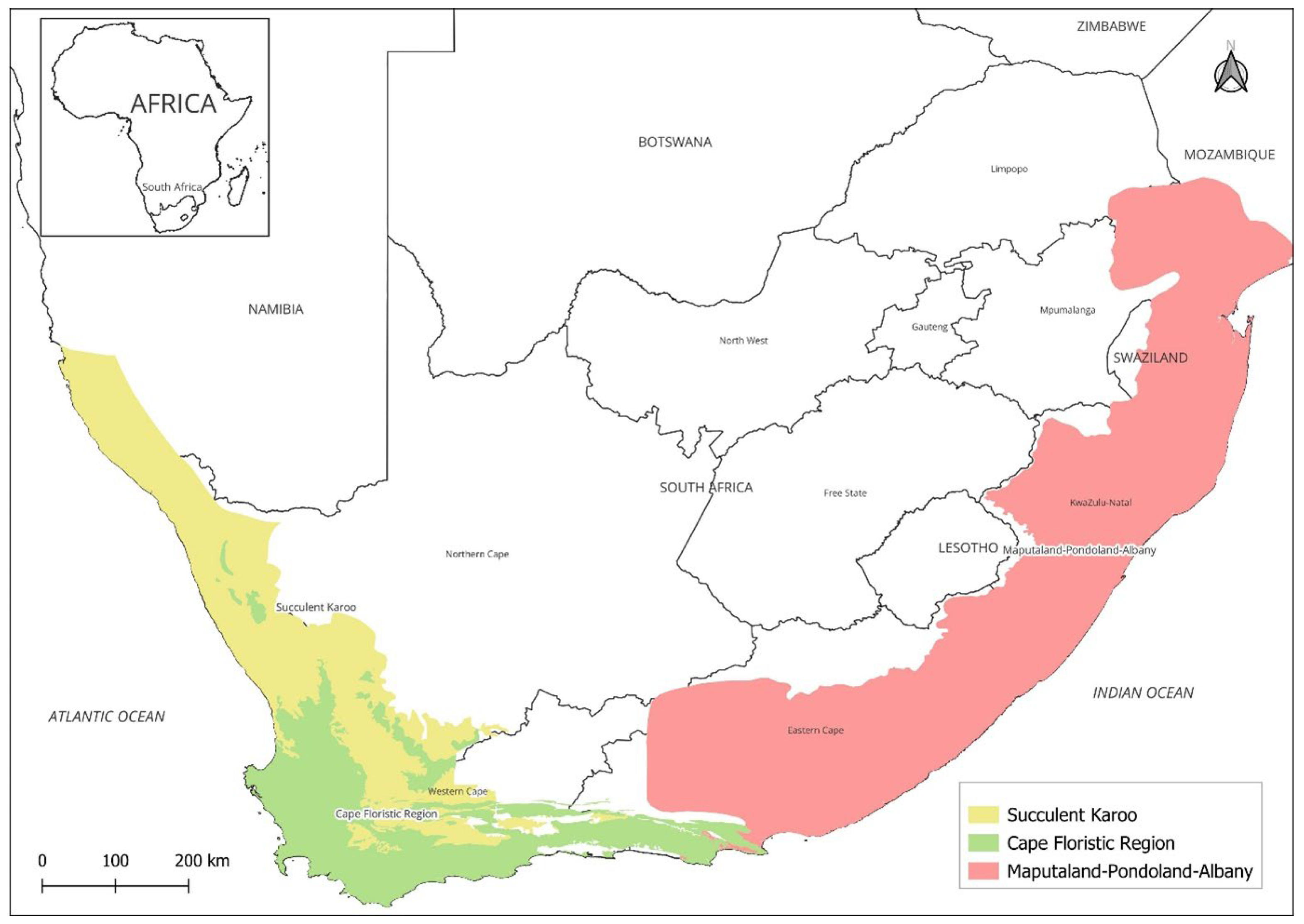
This review focuses on South Africa, located at the southern tip of Africa (Figure 1), between 30°33′34″ S and 22°56′15″ E, with almost 3000 km coastline along the South Atlantic and Indian oceans. This strategic positioning between two oceans supports diverse climates and ecosystems and enables vital global maritime trade, linking Africa with Europe, Asia, and the Americas.
The country’s terrain encompasses savannahs, grasslands, forests, and coastal areas, each contributing to its ecological richness. Despite covering only 2% of Earth’s land surface [33]. South Africa harbours nearly 10% of the planet’s plant species and 7% of its reptile, bird, and mammal species, marking the biodiversity hotspot located in South Africa, in urgent need of conservation [25]. For emphasis, urbanization significantly drives LULC change, leading to habitat loss and fragmentation, particularly in biodiversity hotspots [34]. Approximately 1.5% of the country’s land has been transformed due to urban expansion, threatening endemic species and amplifying conservation challenges [35,36]. It should be noted that land-use change dynamics highlight the need for spatially explicit monitoring systems that align with the UN’s Sustainable Development Goals (SDGs), particularly SDG 11 (Sustainable Cities and Communities), SDG 13 (Climate Action), and SDG 15 (Life on Land). In South Africa, as elsewhere in the world, reliable LULC information forms the foundation for assessing progress towards these goals by quantifying urban expansion, vegetation loss, and habitat conversion, as highlighted in this review.

2.2. Overview of Historical LULC Changes in South Africa

The history of LULC change mapping in South Africa has evolved alongside the country’s socio-political shifts, technological progress, and environmental challenges [37,38]. National maps have been documented, outlining changes attributed to urbanization, agriculture, and degradation. For example, urban land increased from 0.8% in 1994 to 2% by 2005 [39]. Early LULC mapping began with a 1990 National Land Cover (NLC) dataset derived from Landsat satellite imagery, achieving 79.4% accuracy, laying the groundwork for later improvements. The first major LULC map was developed in 1994/95 with Landsat 5 data, and it marked a pivotal step toward standardized LULC assessment [40]. Following this, the Council for Scientific and Industrial Research (CSIR) and the Agricultural Research Council (ARC) developed national guidelines for continuous land-cover monitoring, resulting in the NLC 2000 dataset derived from Landsat 7 imagery (30 m resolution). More recently, the South African National Land Cover (SANLC) 2018 product, based on Sentinel-2 imagery (10 m resolution), reflects the Department of Forestry, Fisheries, and Environment’s (DFFE) ongoing commitment to national-scale LULC monitoring [41]. Today, high-resolution satellite imagery and machine learning algorithms significantly enhance the accuracy of LULC mapping in South Africa. Complementary efforts by universities and research institutions have further advanced LULC mapping by integrating high-resolution satellite data and machine learning algorithms, thereby enhancing classification accuracy and spatial detail across diverse South African landscapes.

2.3. Selection of Studies

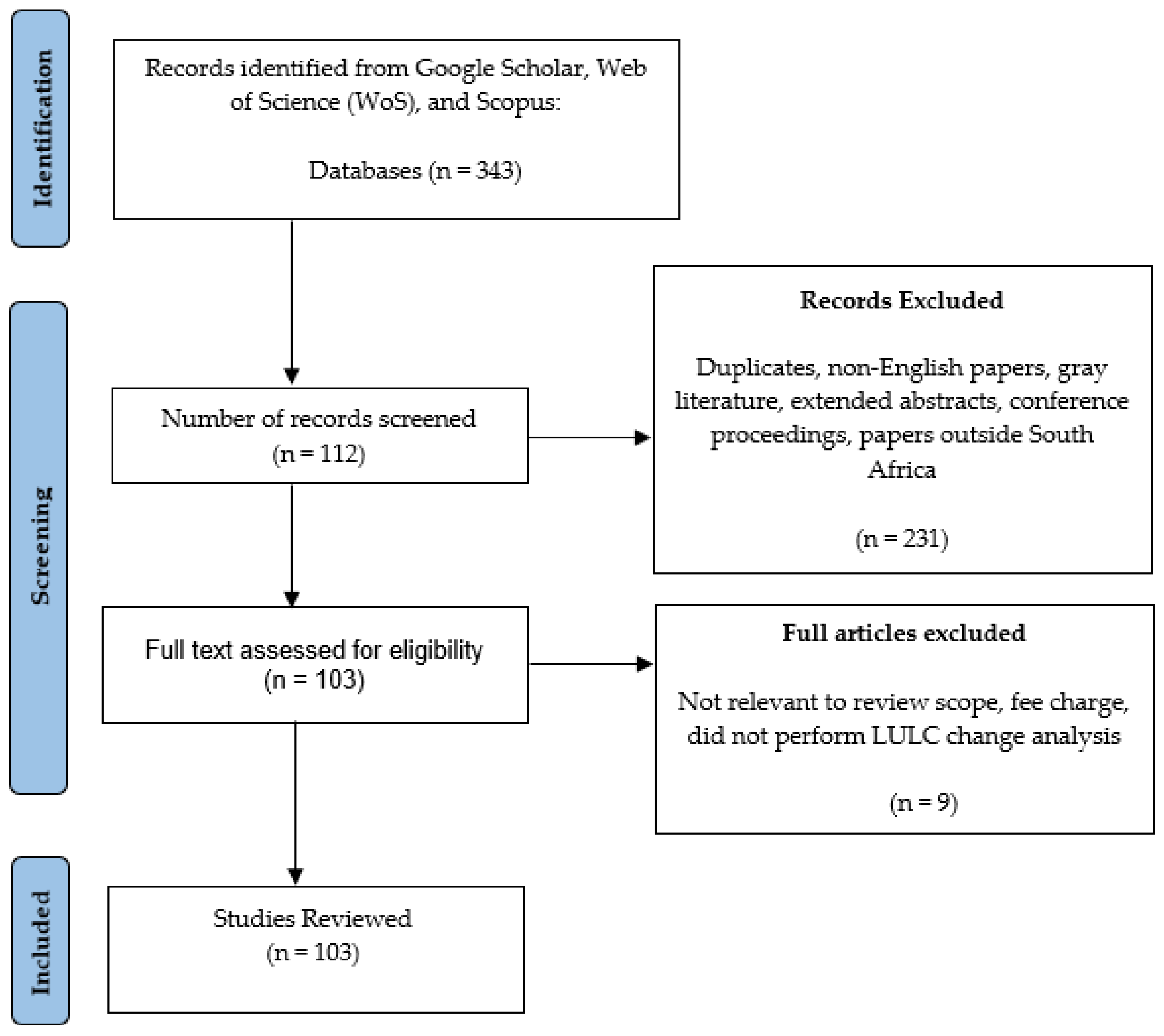
The primary data source for this review comprises peer-reviewed studies that investigated LULC change in South Africa using remote sensing platforms. The review encompasses literature published from the inception of such studies up to October 2024, which marks the commencement of the analytical phase of this work. In this context, we followed the Preferred Reporting Items for Systematic Reviews and Meta-Analyses (PRISMA) guidelines whereby articles were searched in databases such as Web of Science, Google Scholar and Scopus using the keywords (and their synonyms): “remote sensing” OR “satellite-based” OR “Earth observation” AND “land use” OR “land cover” OR “land use changes” OR “land cover changes” OR “land use monitoring” AND “South Africa”. Search results from all databases were exported and compiled in a Microsoft Excel file for screening. Duplicate records were identified through comparisons of title, author name, publication year, and DOI and subsequently removed prior to screening. The screening process was conducted in two stages. First, titles and abstracts were examined to assess relevance to remote sensing-based LULC studies conducted within South Africa. Second, full-text screening was performed to confirm eligibility. Studies were excluded if they: did not focus on South Africa, did not employ remote sensing data, did not address LULC classification or change detection, were grey literature (e.g., theses, reports, conference proceedings), were not published in peer-reviewed journals, or were not written in English. To enhance consistency and reduce selection bias, the screening process was conducted iteratively, with borderline cases re-evaluated to ensure alignment with the inclusion criteria. A total of 103 articles met all eligibility requirements and formed the final dataset for analysis (Figure 2).

2.4. Data Analysis Methods

The 103 eligible articles were systematically compiled in Microsoft Excel for structured data extraction. A coding framework was developed iteratively following an initial pilot review of 15 randomly selected studies to identify recurring analytical dimensions. Based on this exploratory assessment and the objectives of the review, the following categories were established: publication year, study location (province, town, and region), sensor platform, classification algorithm, investigated landscape type, LULC classes analysed, and reported classification accuracy. The coding scheme was refined progressively to ensure consistency in categorisation across studies. Where methodological descriptions were ambiguous, full-text articles were re-examined to confirm accurate classification. To enhance reliability, a subset of coded articles was revisited after the initial extraction phase to verify internal consistency and alignment with the predefined categories. Descriptive statistical analyses were then conducted to identify temporal trends, spatial distribution patterns, and methodological characteristics of remote sensing-based LULC research in South Africa. Visualisations were produced using ArcGIS Pro (v3.2–3.3), QGIS (v3.34 LTR), R (v4.3.x), and Python (v3.10–3.11) environments.

3. Results

Our analysis begins with an examination of historical research trends in LULC change mapping in South Africa. This is followed by a synthesis of the remote sensing sensors and classification models employed in LULC change studies. The review then outlines the geographical distribution of the studies, alongside an assessment of their thematic focus areas, methodological approaches, and application domains.

3.1. Historical Research Trends

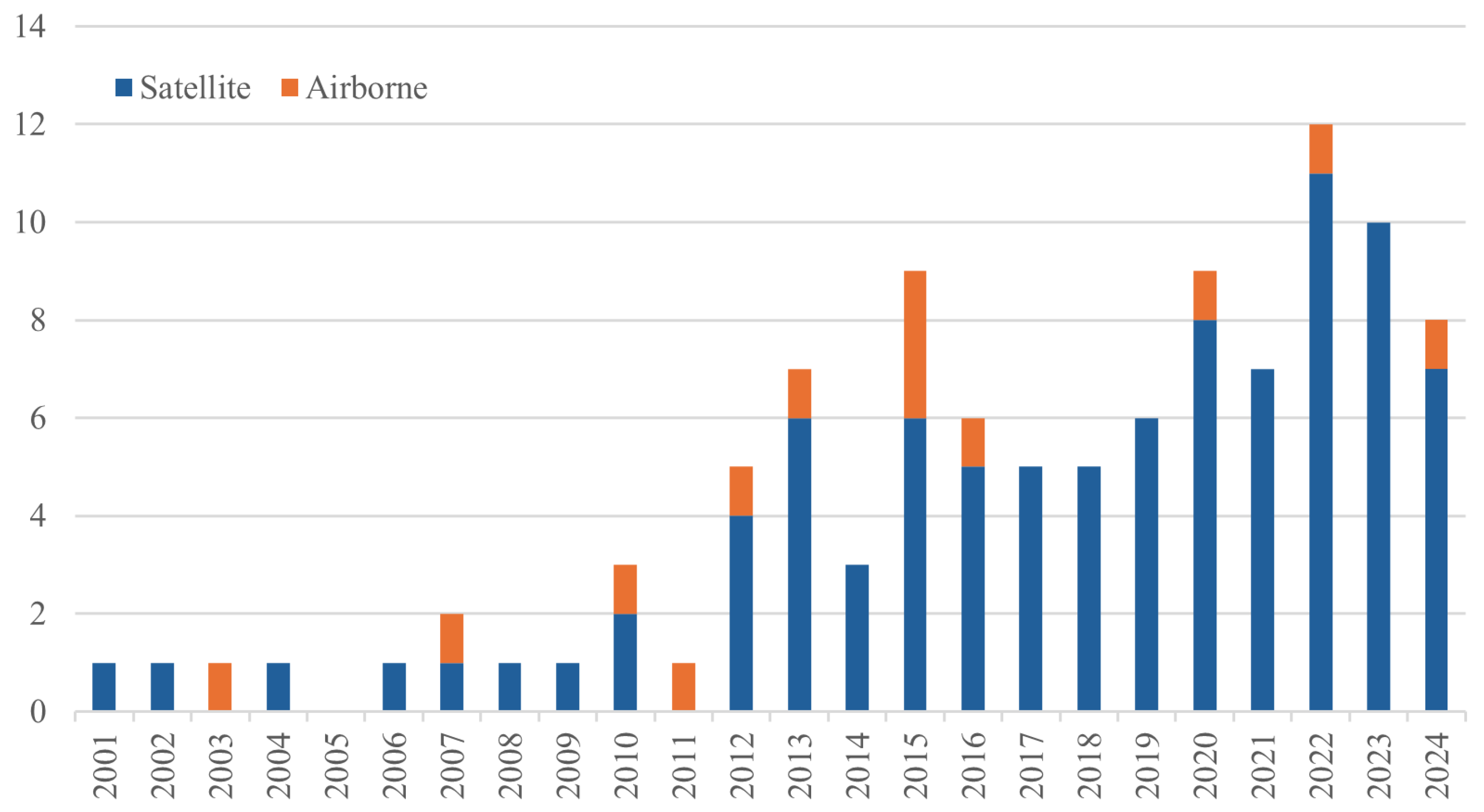
Over the past two decades, significant progress has been made in characterizing the nature and extent of LULC changes across various landscapes in South Africa using remote sensing, satellite, and airborne datasets. Results have shown that 89% of studies used satellites since 1990, while the remainder used airborne platforms (Figure 3). There has been a sharp rise in publications over this period, which may have been influenced by the open-access satellite data policies [42], peaking at nine articles in 2023. This has significantly enhanced access to high-quality satellite imagery for LULC monitoring. Moreover, satellite products appear to be more attractive to researchers because they are often consistent and affordable over small to broader areas [43], unlike costlier airborne data.
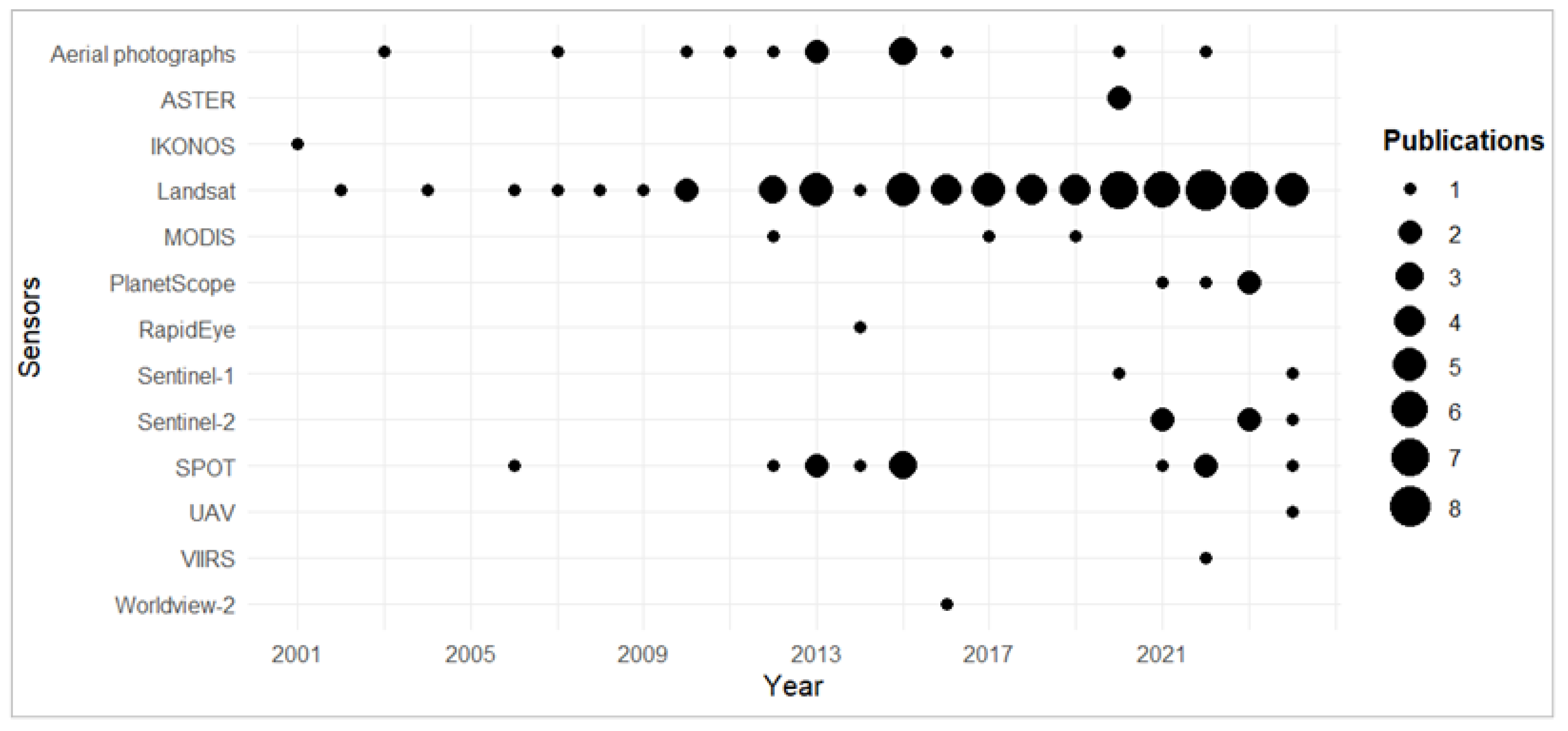
A variety of sensors contribute to monitoring land-use dynamics, each with unique spectral and temporal resolutions. Satellite sensors are arguably the most valuable remote sensing products for LULC change applications due to their resolution and affordability. In particular, Landsat (74 articles) is the most widely used dataset, allowing change evaluation over more than four decades due to its longevity (since 1972) (Figure 4), the comparatively minor adoption in the early 2000s, and the rapid increase likely due to the 2008 open-data policy [42]. The Satellite Pour l’Observation de la Terre (SPOT) programme has 12 publications, mainly sourced from the CSIR [44] and the South African National Space Agency (SANSA) [45], which has provided high-resolution imagery (up to 10 m), which is crucial for distinguishing among different land-cover classes.
Moreover, Sentinel-1 (2) and Sentinel-2 (5) datasets have also made essential contributions to LULC monitoring, where Sentinel-1 synthetic aperture radar (SAR) combines optical and radar data to enhance mapping in cloud-covered areas [46]. Sentinel-2’s high-resolution multispectral imagery offers frequent revisit times and superior data quality. However, its limited historical availability (since 2015) constrains long-term temporal analyses, which are often required to reveal trends emerging over extended timescales. MODIS, with a coarser spatial resolution of 500 m, has been extensively used for large-scale LULC studies [47]. Furthermore, commercial satellites such as PlanetScope, RapidEye, ASTER, and WorldView-2 are effective in LULC changes [32,48]. The integration of these multi-sensor datasets is therefore crucial for advancing spatial and temporal analyses of LULC dynamics in South Africa. Combining optical, radar, and high-resolution commercial imagery enhances the detection of subtle landscape transformations, particularly in cloud-prone and rapidly urbanizing regions. However, differences in spatial and temporal resolution across sensors highlight an ongoing challenge.
It should also be noted that the introduction of GEE in 2010, which hosts the complete Landsat and Sentinel archives from raw to analysis-ready with various indices, has marked a significant milestone in remote sensing, driving the increased use of these datasets [49].

3.2. LULC Classification Algorithms and Software

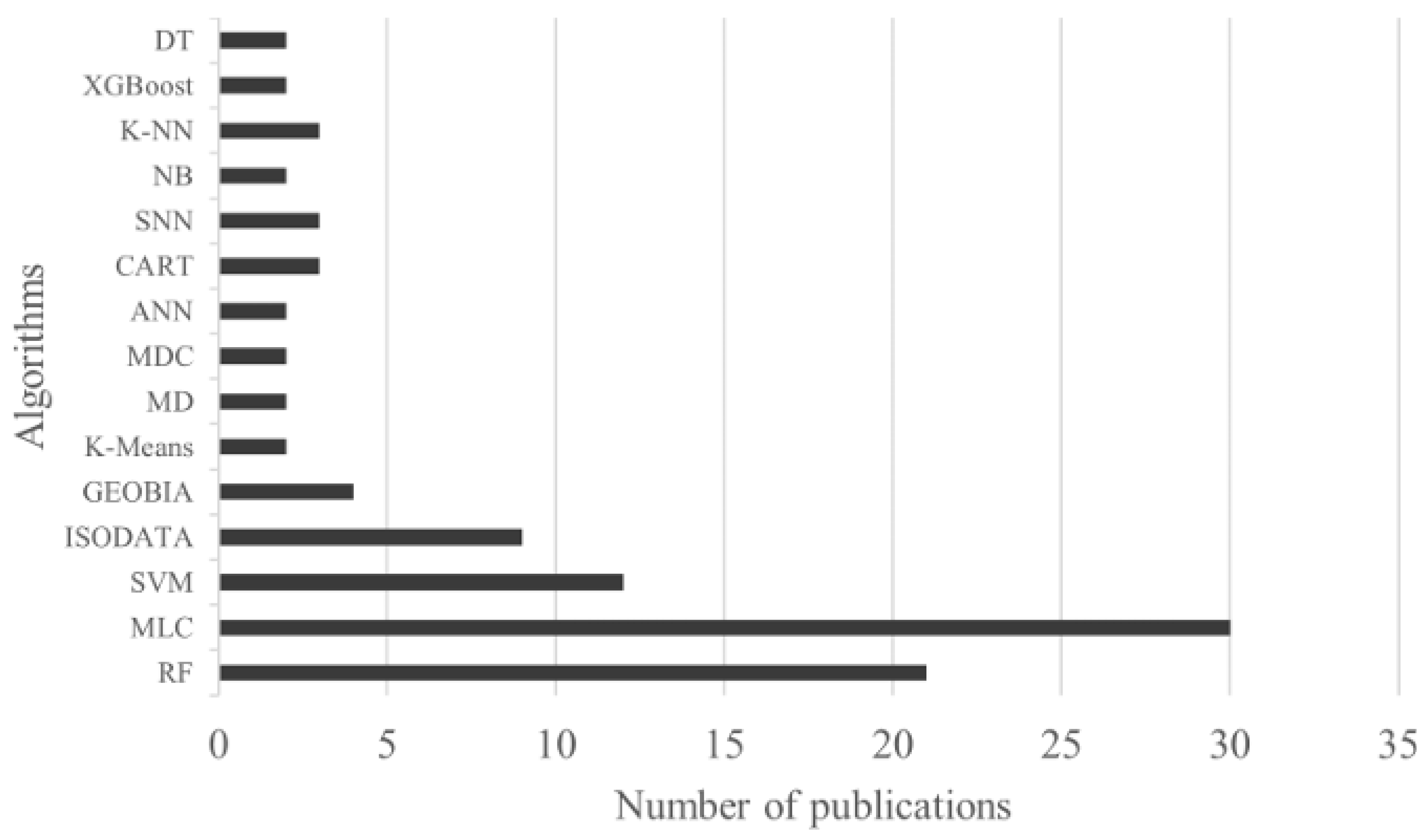
A core component of remote sensing analysis involves the application of classification algorithms to model and delineate LULC classes from satellite imagery. Techniques such as supervised and unsupervised classification, as well as object-based image analysis, are frequently employed. Unsupervised classification groups pixels into clusters based on statistical similarities using algorithms such as K-means or ISODATA [50]. In contrast, supervised classification requires selecting training samples for each LULC class, allowing classification based on spectral signatures but demanding significant training and expertise [51,52]. An increasing reliance on supervised classification approaches was observed, with a notable shift from traditional parametric methods to machine-learning–based algorithms. Where algorithms such as Maximum Likelihood Classifier (MLC; 30), Random Forests (RF; 21), Support Vector Machines (SVM; 12), Iterative Self-Organizing Data Analysis Technique (ISODATA; 9), and Geographic Object-Based Image Analysis (GEOBIA; 4), among others (Figure 5). Based on the findings, MLC has gained prominence due to its impressive properties, particularly its integration of the mean, variance, and covariance of each category across multiple spectral bands [53]. This approach significantly enhances its ability to effectively discriminate between land-cover classes. For example, a study by Ding et al. [54] generated a LULC change map from Landsat Thematic Mapper (TM) imagery using the MLC, achieving an overall classification accuracy of 88%. However, MLC also produces lower classification accuracy results when compared to machine learning algorithms such as ANN, SVM, and RF [55,56]. This is because MLC accounts for spectral variability within each class and explicitly considers class overlap; however, the method is computationally intensive, as it requires a large number of training samples to adequately characterise each LULC category [52]. Consequently, machine learning-based classifiers, such as Artificial Neural Networks (ANNs), SVM, and RF, are generally considered more robust and effective for LULC classification. However, these approaches are also associated with several limitations, including high data requirements, dependence on expert-driven training and parameter tuning, and substantial computational demands when generating an accurate LULC change map [57].
Beyond conventional machine learning approaches, recent studies have explored deep learning (DL) techniques for LULC classification. However, the adoption of DL methods in South African LULC studies remains limited, largely due to their substantial data requirements during the training phase and the high computational costs associated with model training and testing, particularly when handling large-scale datasets [52]. Despite these constraints, DL algorithms demonstrate strong potential for remote sensing applications, as they are capable of automatically learning hierarchical feature representations from large volumes of data [58]. Among these, Convolutional Neural Networks (CNNs) are widely used for analysing spatial data and have shown superior performance in capturing spatial features such as LULC change. Moreover, CNNs can effectively process both multispectral and hyperspectral imagery and automatically extract meaningful representations from image data, often resulting in high classification accuracy [52]. Furthermore, index-based classification, which uses spectral indices to extract classes, is standard in remote sensing [34,59]. The Normalized Difference Vegetation Index (NDVI; 3) was frequently employed, as it helps mitigate atmospheric effects and highlights features like vegetation health.
Accuracy assessment is a critical step for validating LULC classification maps generated from remote sensing data. Among the reviewed studies, results showed strong statistical consistency, with 2% rated as Poor (0–49), 5% as Fair (50–69), 34% as Good (70–84), 42% as Very Good (85–94), and 17% as Excellent (95–100). High accuracies were primarily achieved where high-resolution sensors and machine learning algorithms were integrated [32,60,61]. For robust applications, a "Good" level (70% and above) is recommended. In addition, the geospatial software platforms used in the studies include open-access and commercial tools, with notable differences in usage frequency. GEE is the most utilised among open-access platforms, appearing in 16 articles, followed by QGIS (11), with Python, RStudio and TerrSet IDRISI each cited in 3 studies. In the commercial category, ArcGIS leads with 25 studies, ENVI (11), ERDAS Imagine (13), ArcMap (5), and eCognition (4). This breakdown underscores the popularity of open-access tools like GEE and commercial options like ArcGIS for geospatial analysis.

3.3. Geographical Distribution of LULC Studies

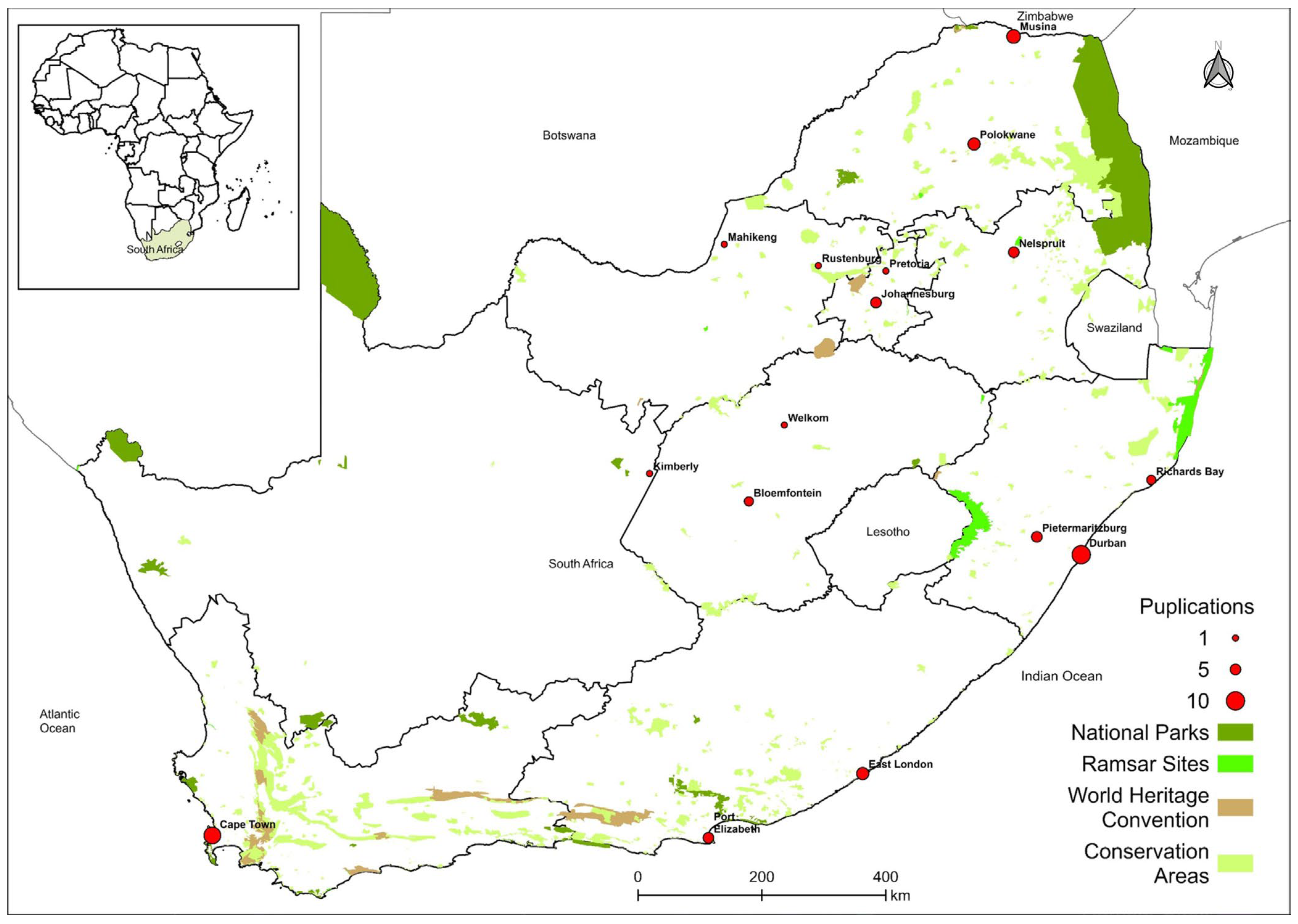
LULC change monitoring through remote sensing has rapidly expanded as a research field in South Africa. Spatially, 26% of studies focus on the KwaZulu-Natal province, particularly in coastal regions such as Durban (10 studies), Richards Bay (9), and Pietermaritzburg (5), with a strong emphasis on urban areas. The Eastern Cape province accounts for 22% of studies in areas such as Gqeberha (10), followed by the Limpopo Highveld (16%), Western Cape (11%), and Gauteng (8%), with other provinces making up the remainder (Figure 6). Notably, the Western Cape has the most conservation areas (459), followed by the Eastern Cape (408), Mpumalanga (136), and KwaZulu-Natal (106). While this pattern may partly reflect the ecological significance of biodiversity-rich landscapes within these regions, it may also be influenced by several additional factors. These include differences in population density and urbanisation intensity, the spatial distribution of academic and research institutions, accessibility of long-term remote sensing archives, and the presence of large-scale development pressures that necessitate monitoring. Meanwhile, the concentration of studies in KwaZulu-Natal and Limpopo may indicate heightened land-use pressures and environmental concerns in these regions.
Furthermore, the observed geographic concentration of LULC studies can be attributed to a combination of ecological significance, socio-economic dynamics, and data availability. Coastal and urban regions, particularly in KwaZulu-Natal and the Eastern Cape, are characterised by rapid urban expansion, informal settlement growth, and increasing pressure on coastal and peri-urban ecosystems, making them priority areas for LULC monitoring [62]. Similarly, provinces such as the Western and Eastern Cape may attract sustained research attention due to their high biodiversity value, extensive conservation networks, and sensitivity to climate variability, which necessitate continuous land- cover assessment to support ecosystem management and conservation planning. In contrast, provinces with fewer studies may reflect gaps in research capacity, limited access to high-resolution data, or lower prioritisation in national monitoring frameworks.
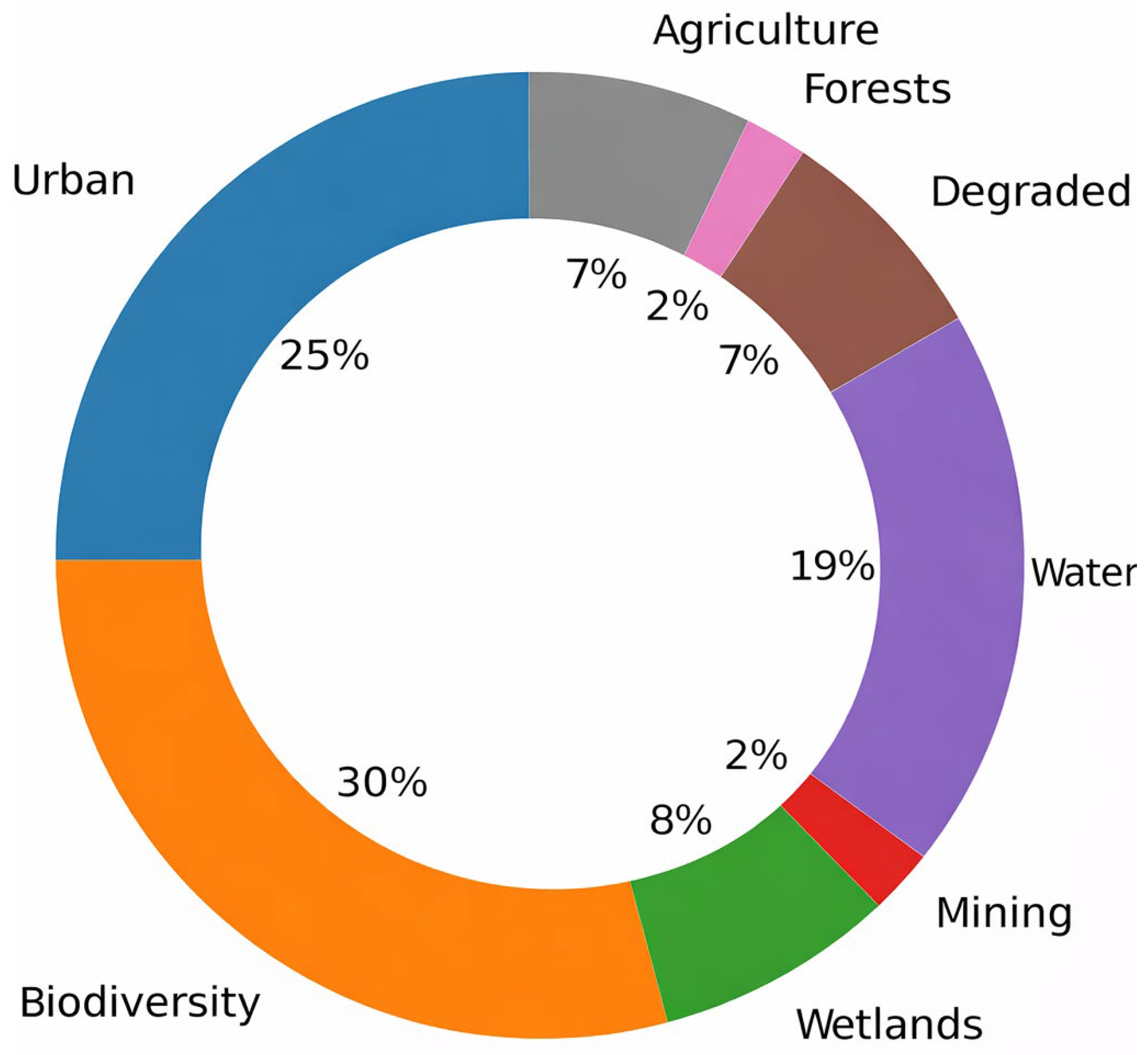
Our results indicate that most LULC remote sensing studies were conducted in biodiversity landscapes (30%) and urban areas (25%) (Figure 7). In contrast, other studies addressed water areas (19%), wetlands (8%), agriculture (7%), degraded landscapes (7%), and, to a lesser extent, mining and forest landscapes (2% each) (Figure 8). In biodiversity landscapes, studies often focus on coastal zones, vegetation, and ecosystem services. For example, Hyvärinen et al. [63] documented vegetation shifts, such as thicket expansion, over decades in the Asante Sana Game Reserve. Similarly, Coetzer-Hanack et al. [64] highlighted urban encroachment and vegetation degradation due to population pressures in the Kruger to Canyons Biosphere Reserve. In Mpumalanga Province, von Staden et al. [65] observed a 1.5% loss in natural cover from 2010 to 2020, mainly attributed to mining, agriculture, and settlements.
In water and urban landscapes, LULC studies utilize remote sensing and hydrological models to track changes in surface and underground water on catchments, river basins, and dams, using datasets such as Landsat and Sentinel-2 to assess water resources [66,67]. Moreover, Mashala et al. [49] showed that parametric machine learning algorithms frequently and effectively relate LULC changes to water quality metrics.
Urban studies, concentrated in ecologically sensitive coastal and urbanized regions, leverage commercial datasets and algorithms to map urban expansion. For instance, Jagarnath et al. [68] mapped Durban’s urban growth from 1994 to 2016, predicting an annual growth rate of 1.34%. Although agricultural and degraded landscapes are widely studied to monitor productivity loss and soil erosion, mining and forest areas remain challenging for remote sensing due to environmental complexities, highlighting the need for advanced techniques to improve mapping accuracy in these regions.
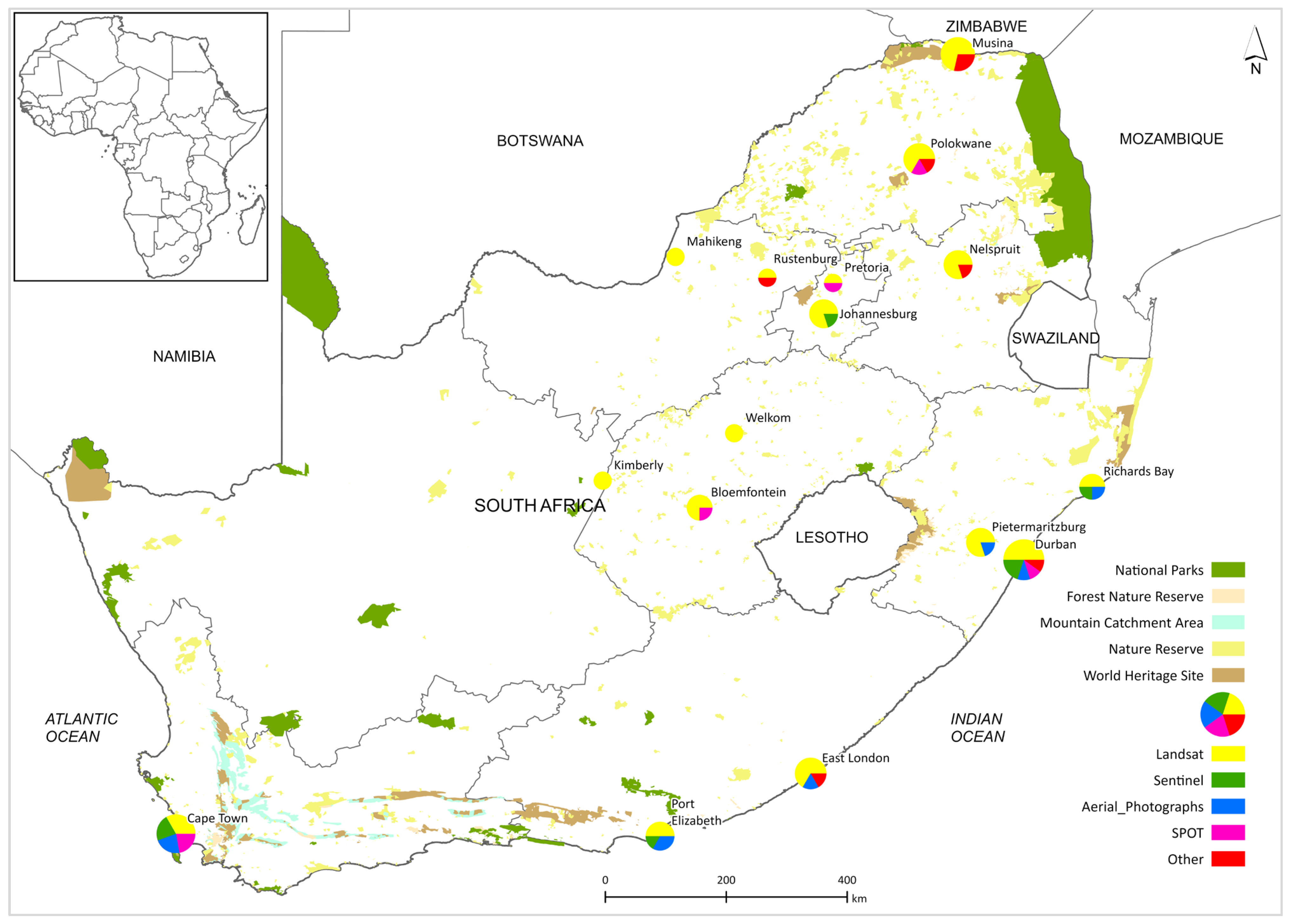
Figure 8 presents the spatial application of dominant remote sensing platforms across selected South African towns. While Figure 6 illustrated the geographical distribution and concentration of studies nationally, this figure emphasises the methodological dimension by mapping the relative use of sensors within each location. A comprehensive list of all remote sensing platforms identified in the review is provided in Figure 4; however, the focus here is on the most frequently applied sensors to demonstrate their spatial coverage. As shown in Figure 8, Landsat emerges as the only platform consistently used across all towns, underscoring its foundational role in LULC change research. This is followed by Sentinel-2, aerial photographs, and SPOT imagery, while the “Other” category represents additional platforms used less frequently and not individually displayed on the map. The proportional pie charts therefore provide a spatially explicit overview of sensor dominance, highlighting both the continuity of Landsat-based analyses nationwide and the growing integration of higher-resolution platforms in selected urban centres. To enhance clarity and comparability across study locations, only the four most frequently used remote sensing platforms were mapped, while less frequently used sensors were grouped under ‘Other’.”

3.4. Classification Framework for Remote Sensing in South Africa

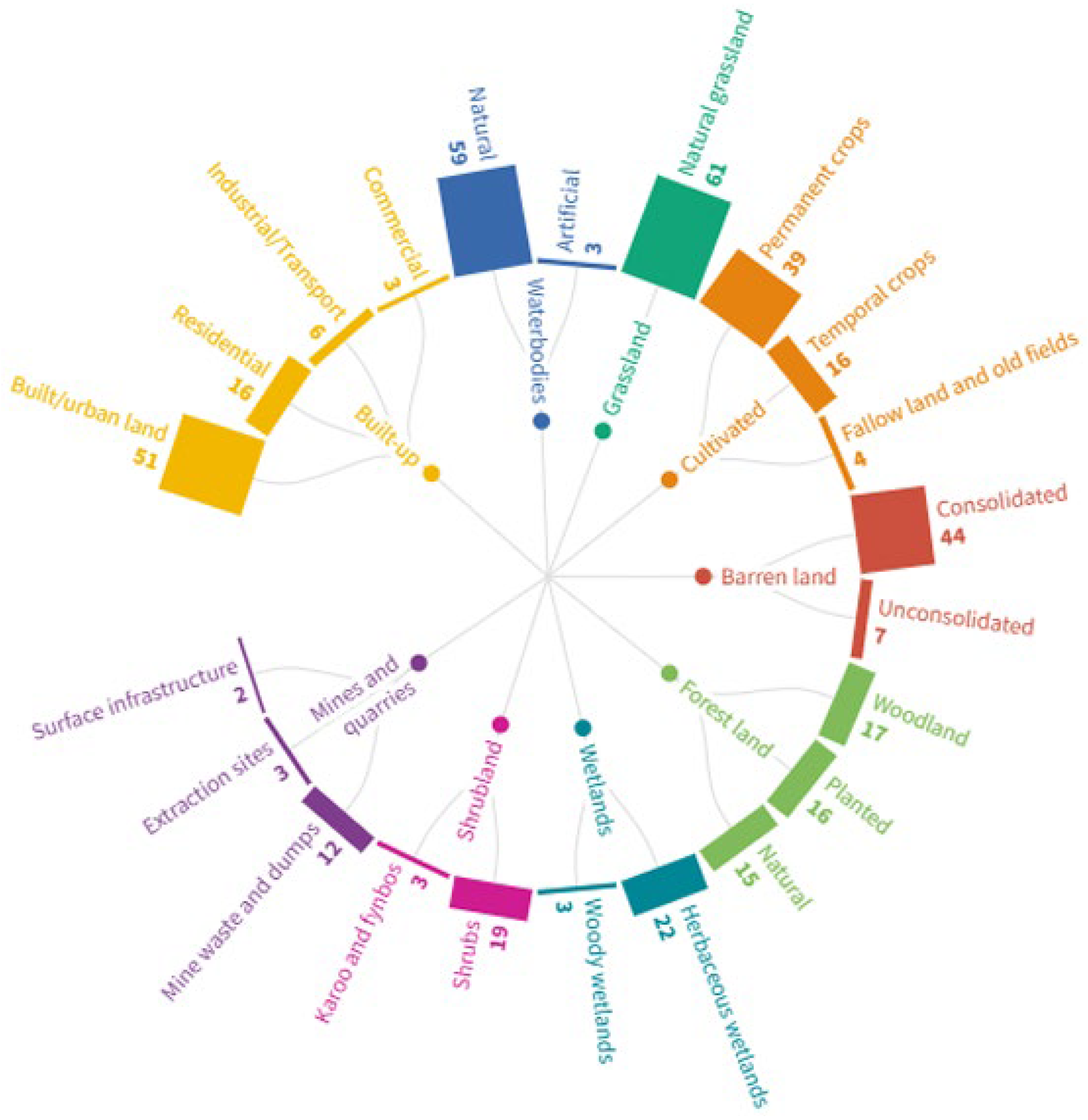
In this section, we quantify the frequency of specific classes in the South African LULC change research. We followed the latest South African Land Cover Classification (SALCC) scheme by the DFFE, showing broad classes (SALCC-1) and specific categories (SALCC-2) [69]. The results are shown in Figure 9. Built-up areas are the most frequent feature (79 articles), followed almost equally by the categories of waterbodies (62) and grassland (61), as well as cultivated land (59). Barren land is contained in 51 articles, followed by forest areas (48 articles) and wetland (25 articles), with the least covered categories being shrubland (22) and mining (17).
Table 1 summarises the LULC conversions, enabling a comparison of the outcomes reported across various articles over two decades. To synthesise reported LULC change patterns across studies, only articles that conducted multi-temporal change-detection analyses were included for this specific analysis, and only for the year 2005, as no data were available for that year. Studies based solely on single-date classification were excluded from this specific analysis. For each eligible study, the direction of reported change (gain, loss, or stable) for each LULC category was recorded based on the authors’ reported net change between analysed time periods. The most significant number of articles reported gains in hard classes with losses in pristine classes, confirming the results highlighted in Figure 9. These include urban/built-up areas, cultivated lands, mines, quarries, and barren lands, with net differences of 86%, 47%, 25%, and 28%, respectively. A substantial proportion of studies reported declines in waterbodies, grasslands, forests, wetlands, and shrublands, reflecting recurring patterns observed across different regions and time periods,, with a net of 24%, 53%, 69%, and 27%, respectively. For emphasis, built-up areas, as the main driver of the changes, showed an increase in 99 of 103 studies, with exceptions being Mogonong et al. [70]. These results indicate dominant reported trends within the reviewed literature, suggesting widespread urban expansion and conversion of natural land covers across multiple study contexts.
These trends may reflect the intensification of urbanization, agricultural expansion, and extractive activities across South Africa. The consistent gains in built-up areas and cultivated land, alongside increases in mining and barren landscapes, indicate a systematic conversion of natural and semi-natural land covers to anthropogenic uses. Consequently, the observed losses in waterbodies, grasslands, forests, wetlands, and shrublands underscore the growing pressure on ecologically sensitive systems. The near-universal increase in built-up areas across the reviewed studies further highlights urban expansion as a dominant driver of LULC change as indicated in numerous studies [59,71,72,73,74].

4. Discussion

4.1. Key Trends and Challenges in the Application of Remote Sensing for LULC Changes

The findings of this review indicate that the use of remote sensing to assess and map land-use and land-cover changes has been significant. Methodological advances in remote sensing, particularly the integration of machine learning (ML) and deep learning (DL) algorithms, have expanded analytical capabilities, offering greater opportunities to explore and accurately map environmental changes. Over the past two decades, studies have focused on the mapping and detection of LULC changes using remote sensing and geographic information systems (GIS) [37,38,62]. In contrast, earlier LULC mapping approaches relied primarily on aerial photography and field-based observations for land-cover interpretation and map production.
Recent advances in satellite sensors have cemented remote sensing as a critical and desired tool for accurately assessing LULC changes across diverse landscapes. Multispectral data from platforms such as Landsat, SPOT, MODIS, and Sentinel-2 have been widely applied to detect changes and differentiate between LULC classes [52]. For instance, the DFFE developed the South African National Land Cover (SANLC) in 2018, derived from 20 m multi-seasonal Sentinel-2 imagery with an accuracy exceeding 80% [75], providing a vital resource for national land management initiatives. Further exemplifying Sentinel-2’s applicability, studies such as Cloete, Shoko, Dube and Clarke [31] have demonstrated the effectiveness of Sentinel-2 for classifying seasonal LULC changes in the Heuningnes Catchment, achieving 75% classification accuracy.
A critical observation emerging from this review is the persistent dominance of Landsat datasets in LULC research across South Africa, despite the availability of Sentinel-2, which offers superior spatial (10–20 m) and temporal (5-day) resolution. This trend persists even though Landsat imagery provides moderate spatial resolution (30 m for multispectral bands, 15 m for panchromatic bands) and a coarse temporal resolution of 16 days [76]. Several factors explain this trend. First, the historical continuity of the Landsat program, providing an uninterrupted record since the 1970s, enables long-term change detection, trend analysis, and calibration with earlier datasets, which are essential for temporal consistency in LULC studies. Second, Landsat’s extensive global archive, well-documented metadata, and integration into widely used platforms such as Google Earth Engine (GEE) make it more accessible to researchers, particularly in developing countries where data infrastructure and computational capacity remain limited. Third, while Sentinel-2 offers higher resolution, its relatively recent launch (2015) constrains its utility for long-term analyses, and its large data volume increases processing requirements, posing challenges for institutions with limited bandwidth, storage, or technical expertise. Furthermore, studies have demonstrated the high efficacy of commercial datasets such as PlanetScope and RapidEye, which offer higher spatial resolution and are valuable for class differentiation [60]. Integrating airborne sensors with machine learning algorithms further promises to enhance the precision of LULC monitoring, particularly within heterogeneous biodiversity landscapes.
Numerous studies have reported high classification accuracies in LULC change analysis using satellite remote sensing and machine learning algorithms. Notable improvements in classification performance have been achieved using methods such as Random Forest (RF), Support Vector Machines (SVM), Maximum Likelihood Classifier (MLC), Artificial Neural Networks (ANN), Naïve Bayes (NB), and ISODATA, all of which have demonstrated strong discriminatory capability across diverse land-cover classes [77]. Among these approaches, RF has consistently outperformed alternative classifiers, with reported accuracies of up to 95% and 97% in studies by Lefulebe, Van der Walt and Xulu [60] and Bhungeni, Ramjatan and Gebreslasie [61], respectively. The emergence of cloud-based platforms, particularly GEE, has further streamlined remote sensing workflows by enabling efficient data access, processing, and management for large-scale LULC change monitoring. GEE is a semi-automated cloud computing platform that supports fundamental raster and vector operations and is capable of handling large volumes of remote sensing data directly on the cloud [78]. However, despite its advantages, GEE has limitations, notably the lack of native support for deep learning algorithms due to computational and platform constraints. As a result, users are typically required to extract data from GEE and implement deep learning models in external computing environments [52].
The review has also shown that the concentration of LULC change studies has been almost entirely confined to KwaZulu-Natal, particularly in urban and coastal areas such as Durban, Richards Bay, and Pietermaritzburg, within the broader Maputaland–Pondoland–Albany hotspot region. A strong focus on urbanized and coastal areas, particularly East London, Gheberha, and Cape Town, has been observed. The concentration of LULC studies in coastal and urban regions may be attributed to both environmental and socio-economic significance. These areas are centers of rapid urban expansion, population growth, industrialization, and infrastructure development, exerting substantial pressure on land and ecosystems. The reviewed studies have consistently highlighted increments in landscape changes, such as biodiversity [31], urban areas [79], cultivated lands [77], and mining activities [80]. Notably, other studies were dominant in aquatic landscapes to monitor water quality; for example, Che et al. [81] found a significant correlation between LULC changes and the distribution of physicochemical parameters and potentially toxic elements in the Crocodile River, revealing the environmental impact of human activities on water bodies. In agricultural landscapes, remote sensing has been used to monitor crop health, predict yields, and track the shift from agricultural to urban or industrial land use [32,72].
Over time, substantial advances in LULC classification techniques, coupled with improvements in satellite sensor capabilities, have significantly enhanced mapping accuracy. High-quality and reliable LULC maps are therefore essential for evidence-based decision-making, supporting effective planning, sustainable land resource management, and informed environmental policy development.

4.2. Limitations and Future Research

This review synthesized trends in the application of remote sensing products for mapping, monitoring, and analyzing LULC change across diverse geographic contexts in South Africa. Despite the observed methodological progress, several limitations remain that warrant consideration. Accurate LULC classification is strongly dependent on the spatial resolution of remotely sensed imagery, with higher spatial detail generally yielding improved classification performance. However, classification accuracy is also influenced by radiometric quality, atmospheric conditions, and sensor-specific characteristics, all of which can introduce uncertainty into LULC analyses. Radiometric and atmospheric correction procedures are therefore critical for mitigating these effects, yet their implementation remains complex due to the dynamic and spatially variable nature of atmospheric conditions [52]. Consequently, access to appropriate correction software and the careful selection of correction methods aligned with the study objectives are essential to ensure reliable, reproducible results.
High-precision LULC mapping often requires very high spatial resolution data, which can be provided by sensors such as PlanetScope and RapidEye (Planet Labs PBC, San Francisco, CA, USA), IKONOS, and WorldView-2 (Maxar Technologies, Westminster, CO, USA), and LiDAR among others. However, the application of these sensors in LULC studies remains limited, primarily due to their high acquisition costs, restricted temporal coverage, and limited accessibility for large-area or long-term analyses. As a result, freely available medium-resolution sensors, particularly Landsat, continue to dominate LULC research in South Africa, despite their relatively coarser spatial resolution. While these datasets enable long-term monitoring, their use may constrain the detection of fine-scale land-cover dynamics, especially in heterogeneous landscapes. Moreover, integrating imagery from multiple sensors introduces challenges related to differences in spatial resolution, spectral characteristics, acquisition timing, and environmental conditions. Ensuring consistency in acquisition parameters such as seasonality, sun angle, and spectral band configuration is therefore essential to minimize classification errors and maintain temporal comparability. These challenges are particularly pronounced in regions with persistent cloud cover, which limits the usability of optical multispectral datasets.
The increasing adoption of cloud-based platforms, particularly Google Earth Engine (GEE), has significantly improved access to large remote sensing archives and facilitated the processing of big geospatial datasets. Nevertheless, GEE presents notable limitations, including the absence of native support for deep learning algorithms due to computational constraints and platform design. As a result, deep learning workflows typically require data extraction from GEE and external processing, which may reduce analytical efficiency. Furthermore, the effective use of GEE depends on reliable internet connectivity, which poses challenges for researchers in data-limited or resource-constrained settings and may limit broader adoption [77]. Recent integration of GEE into desktop GIS environments, such as QGIS via plugin extensions, may partially alleviate technical barriers by enabling cloud-based processing within a familiar graphical interface, thereby reducing the need for coding expertise. However, this development does not fully resolve underlying constraints related to internet dependency and advanced algorithm implementation.
Validation remains a critical component of LULC mapping, with most studies relying on confusion matrices to assess classification performance using metrics such as overall accuracy, user’s accuracy, producer’s accuracy, and the Kappa coefficient. However, the Kappa statistic has been increasingly criticized for its limitations, particularly its inability to reliably translate sample-based confusion matrices into population-level accuracy estimates, which may affect the robustness of validation outcomes [82,83]. In addition, classification performance is influenced by multiple interacting factors, including sensor resolution, study scale, software availability, and the technical expertise of the analyst, underscoring the need for methodological transparency and context-specific model selection [15,76].
Despite these challenges, this review highlights important opportunities for future research. Greater adoption of deep learning approaches, particularly when combined with multi-temporal and high-spectral-resolution datasets such as Sentinel-2, has strong potential to improve classification accuracy and support predictive LULC modelling. The integration of machine learning methods, such as Random Forest, with deep learning models has further enhanced robustness in complex landscapes. While multispectral sensors such as Landsat and Sentinel-2 remain constrained by cloud contamination and moderate spatial resolution [84]. Data sources, such as unmanned aerial vehicle (UAV) imagery, offer promising alternatives. UAVs can provide near-real-time, high-resolution data, are less affected by cloud cover, and enable detailed mapping in inaccessible or heterogeneous areas [85]. As the Fourth Industrial Revolution advances, the increased incorporation of UAV data, alongside ensemble approaches that integrate multiple sensors and classifiers, is recommended to enhance the accuracy, scalability, and applicability of future LULC mapping and monitoring efforts.
While machine learning algorithms such as RF and SVM have demonstrated strong classification performance across many South African case studies, their application is not without limitations. RF models, although robust to noise and capable of handling high-dimensional data, may exhibit reduced interpretability and risk overfitting when training data are limited or spatially clustered. Similarly, SVM performance is sensitive to kernel selection and parameter tuning, which may affect reproducibility across different study contexts. Deep learning approaches, including CNNs, offer promising capabilities for extracting complex spatial patterns; however, their applicability within South Africa remains constrained by several practical factors. These include high computational demands, large training dataset requirements, and the need for advanced technical expertise. In data-scarce or resource-constrained environments, such requirements may limit cost-effectiveness and scalability.

5. Conclusions

We have conducted a systematic review to assess the progression of remote sensing applications in mapping and monitoring LULC changes. The reviewed literature highlights a growing reliance on remote sensing techniques, with multispectral Landsat imagery remaining the most widely used data source, despite the availability of alternative sensors with improved revisit frequency, spatial resolution, and radiometric performance, such as Sentinel-1 and Sentinel-2. While emerging data sources, including unmanned aerial vehicles (UAVs) and multi-source datasets integrating optical, radar, and LiDAR observations, have been explored in limited studies, their application remains context-specific and has not yet been systematically evaluated across the country. Furthermore, the adoption of advanced machine learning and deep learning algorithms has demonstrated considerable potential to improve classification performance. The continued integration of artificial intelligence-driven methods and cloud-based platforms, such as Google Earth Engine, is therefore essential for advancing large-scale and long-term LULC change assessments, ultimately supporting informed decision-making and sustainable environmental management.

Author Contributions

Conceptualization, N.N., N.P.N. and S.X.; methodology, N.N. and S.X.; software, N.N. and S.X.; validation, N.N., N.P.N. and S.X.; formal analysis, N.N. and S.X.; investigation, N.N., N.P.N. and S.X.; resources, N.N., N.P.N. and S.X.; data curation, N.N.; writing—original draft preparation, N.N., N.P.N. and S.X.; writing—review and editing, N.N., N.P.N. and S.X.; visualization, N.N., N.P.N. and S.X.; supervision, N.P.N. and S.X.; project administration, N.N., N.P.N. and S.X. All authors have read and agreed to the published version of the manuscript.

Funding

This research received no external funding.

Data Availability Statement

The data used to support the findings of this study are available from the corresponding author upon request.

Conflicts of Interest

The authors declare no conflicts of interest.

References

  1. Leta, M.K.; Demissie, T.A.; Tränckner, J. Modeling and prediction of land use land cover change dynamics based on land change modeler (Lcm) in nashe watershed, upper blue nile basin, Ethiopia. Sustainability 2021, 13, 3740. [Google Scholar] [CrossRef]
  2. Song, X.-P.; Hansen, M.C.; Stehman, S.V.; Potapov, P.V.; Tyukavina, A.; Vermote, E.F.; Townshend, J.R. Global land change from 1982 to 2016. Nature 2018, 560, 639–643. [Google Scholar] [CrossRef]
  3. Stephens, C.M.; Lall, U.; Johnson, F.; Marshall, L.A. Landscape changes and their hydrologic effects: Interactions and feedbacks across scales. Earth-Sci. Rev. 2021, 212, 103466. [Google Scholar] [CrossRef]
  4. Obaid, A.; Adam, E.; Ali, K.A. Land Use and Land Cover Change in the Vaal Dam Catchment, South Africa: A Study Based on Remote Sensing and Time Series Analysis. Geomatics 2023, 3, 205–220. [Google Scholar] [CrossRef]
  5. Cimatti, M.; Ranc, N.; Benítez-López, A.; Maiorano, L.; Boitani, L.; Cagnacci, F.; Čengić, M.; Ciucci, P.; Huijbregts, M.A.; Krofel, M. Large carnivore expansion in Europe is associated with human population density and land cover changes. Divers. Distrib. 2021, 27, 602–617. [Google Scholar] [CrossRef]
  6. Gu, D.; Andreev, K.; Dupre, M.E. Major trends in population growth around the world. China CDC Wkly. 2021, 3, 604. [Google Scholar] [CrossRef]
  7. Deng, G.; Jiang, H.; Zhu, S.; Wen, Y.; He, C.; Wang, X.; Sheng, L.; Guo, Y.; Cao, Y. Projecting the response of ecological risk to land use/land cover change in ecologically fragile regions. Sci. Total Environ. 2024, 914, 169908. [Google Scholar] [CrossRef] [PubMed]
  8. Wulder, M.A.; Loveland, T.R.; Roy, D.P.; Crawford, C.J.; Masek, J.G.; Woodcock, C.E.; Allen, R.G.; Anderson, M.C.; Belward, A.S.; Cohen, W.B. Current status of Landsat program, science, and applications. Remote Sens. Environ. 2019, 225, 127–147. [Google Scholar] [CrossRef]
  9. Hemati, M.; Hasanlou, M.; Mahdianpari, M.; Mohammadimanesh, F. A systematic review of landsat data for change detection applications: 50 years of monitoring the earth. Remote Sens. 2021, 13, 2869. [Google Scholar] [CrossRef]
  10. Pandey, P.C.; Koutsias, N.; Petropoulos, G.P.; Srivastava, P.K.; Ben Dor, E. Land use/land cover in view of earth observation: Data sources, input dimensions, and classifiers—A review of the state of the art. Geocarto Int. 2021, 36, 957–988. [Google Scholar] [CrossRef]
  11. Joshi, N.; Baumann, M.; Ehammer, A.; Fensholt, R.; Grogan, K.; Hostert, P.; Jepsen, M.R.; Kuemmerle, T.; Meyfroidt, P.; Mitchard, E.T. A review of the application of optical and radar remote sensing data fusion to land use mapping and monitoring. Remote Sens. 2016, 8, 70. [Google Scholar] [CrossRef]
  12. Kumar, P.; Debele, S.E.; Sahani, J.; Rawat, N.; Marti-Cardona, B.; Alfieri, S.M.; Basu, B.; Basu, A.S.; Bowyer, P.; Charizopoulos, N. An overview of monitoring methods for assessing the performance of nature-based solutions against natural hazards. Earth-Sci. Rev. 2021, 217, 103603. [Google Scholar] [CrossRef]
  13. Zhang, S.; Bogus, S.M.; Lippitt, C.D.; Kamat, V.; Lee, S. Implementing remote-sensing methodologies for construction research: An unoccupied airborne system perspective. J. Constr. Eng. Manag. 2022, 148, 03122005. [Google Scholar] [CrossRef]
  14. Opitz, R.; Herrmann, J. Recent trends and long-standing problems in archaeological remote sensing. J. Comput. Appl. Archaeol. 2018, 1, 19–41. [Google Scholar] [CrossRef]
  15. Li, J.; Pei, Y.; Zhao, S.; Xiao, R.; Sang, X.; Zhang, C. A review of remote sensing for environmental monitoring in China. Remote Sens. 2020, 12, 1130. [Google Scholar] [CrossRef]
  16. Stephenson, P. Technological advances in biodiversity monitoring: Applicability, opportunities and challenges. Curr. Opin. Environ. Sustain. 2020, 45, 36–41. [Google Scholar] [CrossRef]
  17. Chang, Y.; Hou, K.; Li, X.; Zhang, Y.; Chen, P. Review of land use and land cover change research progress. In Proceedings of the IOP Conference Series: Earth and Environmental Science, Kaohsiung City, Taiwan, 17–21 July 2018; IOP Publishing Ltd.: Bristol, UK, 2018; p. 012087. [Google Scholar]
  18. Tesfaye, W.; Elias, E.; Warkineh, B.; Tekalign, M.; Abebe, G. Modeling of land use and land cover changes using google earth engine and machine learning approach: Implications for landscape management. Environ. Syst. Res. 2024, 13, 31. [Google Scholar] [CrossRef]
  19. Aka, K.S.; Akpavi, S.; Dibi, N.D.H.; Kabo-Bah, A.T.; Gyilbag, A.; Boamah, E. Toward understanding land use land cover changes and their effects on land surface temperature in yam production area, Côte d’Ivoire, Gontougo Region, using remote sensing and machine learning tools (Google Earth Engine). Front. Remote Sens. 2023, 4, 1221757. [Google Scholar] [CrossRef]
  20. Paterson, J.E.; Bortolotti, L.E.; Kowal, P.D.; Pidwerbesky, A.J.; Devries, J.H. Predicting the effects of land cover change on biodiversity in Prairie Canada using species distribution models. Biol. Conserv. 2024, 298, 110754. [Google Scholar] [CrossRef]
  21. Griffiths, C.L.; Robinson, T.B.; Lange, L.; Mead, A. Marine biodiversity in South Africa: An evaluation of current states of knowledge. PLoS ONE 2010, 5, e12008. [Google Scholar] [CrossRef] [PubMed]
  22. Assede, E.S.; Orou, H.; Biaou, S.S.; Geldenhuys, C.J.; Ahononga, F.C.; Chirwa, P.W. Understanding drivers of land use and land cover change in Africa: A review. Curr. Landsc. Ecol. Rep. 2023, 8, 62–72. [Google Scholar] [CrossRef]
  23. Musetsho, K.D.; Chitakira, M.; Nel, W. Mapping land-use/land-cover change in a critical biodiversity area of South Africa. Int. J. Environ. Res. Public Health 2021, 18, 10164. [Google Scholar] [CrossRef]
  24. Dlamini, W.M. Analysis of deforestation patterns and drivers in Swaziland using efficient Bayesian multivariate classifiers. Model. Earth Syst. Environ. 2016, 2, 1–14. [Google Scholar] [CrossRef]
  25. Guo, D.; Arnolds, J.L. Biodiversity in South Africa. In Global Biodiversity; Pullaia, T., Ed.; Apple Academic Press: New York, NY, USA, 2018; pp. 247–272. [Google Scholar]
  26. Weyl, O.L.; Ellender, B.R.; Wassermann, R.J.; Truter, M.; Dalu, T.; Zengeya, T.A.; Smit, N.J. Alien freshwater fauna in South Africa. In Biological Invasions in South Africa; Springer International Publishing: Cham, Switzerland, 2020; pp. 153–183. [Google Scholar]
  27. Chapman, C.A.; Abernathy, K.; Chapman, L.J.; Downs, C.; Effiom, E.O.; Gogarten, J.F.; Golooba, M.; Kalbitzer, U.; Lawes, M.J.; Mekonnen, A. The future of sub-Saharan Africa’s biodiversity in the face of climate and societal change. Front. Ecol. Evol. 2022, 10, 790552. [Google Scholar] [CrossRef]
  28. von Staden, L. Planning for Improved Threatened Species Conservation. South African National Biodiversity Institute (SANBI) 2013. Available online: https://opus.sanbi.org/sanbiserver/api/core/bitstreams/5292d55c-2e2b-4de9-8699-e39b80105b7d/content (accessed on 12 December 2025).
  29. Wang, S.; He, S.; Wang, J.; Li, J.; Zhong, X.; Cole, J.; Kurbanov, E.; Sha, J. Analysis of land use/cover changes and driving forces in a typical subtropical region of South Africa. Remote Sens. 2023, 15, 4823. [Google Scholar] [CrossRef]
  30. Bailey, K.M.; McCleery, R.A.; Binford, M.W.; Zweig, C. Land-cover change within and around protected areas in a biodiversity hotspot. J. Land Use Sci. 2016, 11, 154–176. [Google Scholar] [CrossRef]
  31. Cloete, D.N.; Shoko, C.; Dube, T.; Clarke, S. Remote sensing-based land use land cover classification for the Heuningnes Catchment, Cape Agulhas, South Africa. Phys. Chem. Earth Parts A/B/C 2024, 134, 103559. [Google Scholar] [CrossRef]
  32. Gokool, S.; Mahomed, M.; Brewer, K.; Naiken, V.; Clulow, A.; Sibanda, M.; Mabhaudhi, T. Crop mapping in smallholder farms using unmanned aerial vehicle imagery and geospatial cloud computing infrastructure. Heliyon 2024, 10, e26913. [Google Scholar] [CrossRef] [PubMed]
  33. Driver, A.; Maze, K.; Rouget, M.; Lombard, A.; Nel, J.; Turpie, J.; Cowling, R.; Desmet, P.; Goodman, P.; Harris, J. National Spatial Biodiversity Assessment 2004: Priorities for Biodiversity Conservation in South Africa; South African National Biodiversity Institute: Pretoria, South Africa, 2005. [Google Scholar]
  34. Mazeka, B.; Phinzi, K.; Sutherland, C. Monitoring changing land use-land cover change to reflect the impact of urbanisation on environmental assets in Durban, South Africa. In Sustainable Urban Futures in Africa; Routledge: Oxfordshire, UK, 2021; pp. 132–158. [Google Scholar]
  35. Nkosi, M.; Mathivha, F.I.; Odiyo, J.O. Impact of land management on water resources, a South African context. Sustainability 2021, 13, 701. [Google Scholar] [CrossRef]
  36. De Vos, K.; Janssens, C.; Jacobs, L.; Campforts, B.; Boere, E.; Kozicka, M.; Leclère, D.; Havlík, P.; Hemerijckx, L.-M.; Van Rompaey, A. African food system and biodiversity mainly affected by urbanization via dietary shifts. Nat. Sustain. 2024, 7, 869–878. [Google Scholar] [CrossRef]
  37. Blair, D.; Shackleton, C.M.; Mograbi, P.J. Cropland abandonment in South African smallholder communal lands: Land cover change (1950–2010) and farmer perceptions of contributing factors. Land 2018, 7, 121. [Google Scholar] [CrossRef]
  38. Le Roux, A.; Augustijn, P. Quantifying the spatial implications of future land use policies in South Africa. S. Afr. Geogr. J. 2017, 99, 29–51. [Google Scholar] [CrossRef]
  39. Schoeman, F.; Newby, T.; Thompson, M.; Van den Berg, E.C. South African national land-cover change map. S. Afr. J. Geomat. 2013, 2, 94–105. [Google Scholar]
  40. Fairbanks, D.H.K.; Thompson, M.W.; Vink, D.E.; Newby, T.S.; Van den Berg, H.M.; Everard, D. The South African land-cover characteristics database: A synopsis of the landscape. S. Afr. J. Sci. 2000, 96, 69–82. [Google Scholar]
  41. Ramjeawon, M.; Demlie, M.; Toucher, M.L.; Janse van Rensburg, S. Analysis of three decades of land cover changes in the Maputaland Coastal Plain, South Africa. Koedoe Afr. Prot. Area Conserv. Sci. 2020, 62, a1642. [Google Scholar] [CrossRef]
  42. Woodcock, C.E.; Allen, R.; Anderson, M.; Belward, A.; Bindschadler, R.; Cohen, W.; Gao, F.; Goward, S.N.; Helder, D.; Helmer, E. Free access to Landsat imagery. Science 2008, 320, 1011. [Google Scholar] [CrossRef] [PubMed]
  43. Liang, S.; Wang, J. Advanced Remote Sensing: Terrestrial Information Extraction and Applications; Academic Press: Cambridge, MA, USA, 2019. [Google Scholar]
  44. Mhangara, P.; Kakembo, V. An object-based classification and fragmentation analysis of land use and cover change in the Keiskamma catchment, Eastern Cape, South Africa. World Appl. Sci. J. 2012, 19, 1018–1029. [Google Scholar]
  45. Ndude, M.A.; Gwena, K.R.; Hamandawana, H. The nature, causes and extent of land cover changes in Gamtoos River estuary, Eastern Cape province, South Africa: 1991–2017. Sustainability 2022, 14, 7859. [Google Scholar] [CrossRef]
  46. Martinis, S.; Plank, S.; Ćwik, K. The use of Sentinel-1 time-series data to improve flood monitoring in arid areas. Remote Sens. 2018, 10, 583. [Google Scholar] [CrossRef]
  47. Kleynhans, W.; Salmon, B.P.; Olivier, J.C.; Van den Bergh, F.; Wessels, K.J.; Grobler, T.L.; Steenkamp, K.C. Land cover change detection using autocorrelation analysis on MODIS time-series data: Detection of new human settlements in the Gauteng province of South Africa. IEEE J. Sel. Top. Appl. Earth Obs. Remote Sens. 2012, 5, 777–783. [Google Scholar] [CrossRef]
  48. Musakwa, W.; Van Niekerk, A. Monitoring sustainable urban development using built-up area indicators: A case study of Stellenbosch, South Africa. Environ. Dev. Sustain. 2015, 17, 547–566. [Google Scholar] [CrossRef]
  49. Mapuru, M.J.; Xulu, S.; Gebreslasie, M. Remote sensing applications in monitoring Poplars: A review. Forests 2023, 14, 2301. [Google Scholar] [CrossRef]
  50. Lemenkova, P. Evaluating land cover types from Landsat TM using SAGA GIS for vegetation mapping based on ISODATA and K-means clustering. Acta Agric. Serbica 2021, 26, 159–165. [Google Scholar] [CrossRef]
  51. Boori, M.S.; Paringer, R.A.; Choudhary, K.; Kupriyanov, A.V. Comparison of hyperspectral and multi-spectral imagery to building a spectral library and land cover classification performanc. Кoмпьютерная Oптика 2018, 42, 1035–1045. [Google Scholar]
  52. Mashala, M.J.; Dube, T.; Mudereri, B.T.; Ayisi, K.K.; Ramudzuli, M.R. A systematic review on advancements in remote sensing for assessing and monitoring land use and land cover changes impacts on surface water resources in semi-arid tropical environments. Remote Sens. 2023, 15, 3926. [Google Scholar] [CrossRef]
  53. Ahmad, A.; Quegan, S. Analysis of maximum likelihood classification technique on Landsat 5 TM satellite data of tropical land covers. In Proceedings of the 2012 IEEE International Conference on Control System, Computing and Engineering, Dubrovnik, Croatia, 3–5 October 2012; IEEE: New York, NY, USA, 2012; pp. 280–285. [Google Scholar]
  54. Ding, J.; Jiang, Y.; Fu, L.; Liu, Q.; Peng, Q.; Kang, M. Impacts of land use on surface water quality in a subtropical River Basin: A case study of the Dongjiang River Basin, Southeastern China. Water 2015, 7, 4427–4445. [Google Scholar] [CrossRef]
  55. Muavhi, N. Evaluation of effectiveness of supervised classification algorithms in land cover classification using ASTER images-A case study from the Mankweng (Turfloop) Area and its environs, Limpopo Province, South Africa. S. Afri. J. Geomat. 2020, 9, 61–74. [Google Scholar] [CrossRef]
  56. Otukei, J.R.; Blaschke, T. Land cover change assessment using decision trees, support vector machines and maximum likelihood classification algorithms. Int. J. Appl. Earth Obs. Geoinf. 2010, 12, S27–S31. [Google Scholar] [CrossRef]
  57. Yuan, H.; Yang, G.; Li, C.; Wang, Y.; Liu, J.; Yu, H.; Feng, H.; Xu, B.; Zhao, X.; Yang, X. Retrieving soybean leaf area index from unmanned aerial vehicle hyperspectral remote sensing: Analysis of RF, ANN, and SVM regression models. Remote Sens. 2017, 9, 309. [Google Scholar] [CrossRef]
  58. Vali, A.; Comai, S.; Matteucci, M. Deep learning for land use and land cover classification based on hyperspectral and multispectral earth observation data: A review. Remote Sens. 2020, 12, 2495. [Google Scholar] [CrossRef]
  59. Phinzi, K.; Ngetar, N.S. Land use/land cover dynamics and soil erosion in the Umzintlava catchment (T32E), Eastern Cape, South Africa. Trans. R. Soc. S. Afr. 2019, 74, 223–237. [Google Scholar] [CrossRef]
  60. Lefulebe, B.E.; Van der Walt, A.; Xulu, S. Fine-scale classification of urban land use and land cover with Planetscope imagery and machine learning strategies in the city of Cape Town, South Africa. Sustainability 2022, 14, 9139. [Google Scholar] [CrossRef]
  61. Bhungeni, O.; Ramjatan, A.; Gebreslasie, M. Evaluating machine-learning algorithms for mapping LULC of the uMngeni catchment area, KwaZulu-Natal. Remote Sens. 2024, 16, 2219. [Google Scholar] [CrossRef]
  62. Vetrimurugan, E.; Jonathan, M.; Shruti, V.; Rawlins, B. A view on South Africa’s KwaZulu-Natal coast: Stressors and coastal management. In Coastal Management; Elsevier: Amsterdam, The Netherlands, 2019; pp. 121–139. [Google Scholar]
  63. Hyvärinen, O.; Timm Hoffman, M.; Reynolds, C. Vegetation dynamics in the face of a major land-use change: A 30-year case study from semi-arid South Africa. Afr. J. Range Forage Sci. 2019, 36, 141–150. [Google Scholar] [CrossRef]
  64. Coetzer-Hanack, K.L.; Witkowski, E.; Erasmus, B.F. Thresholds of change in a multi-use conservation landscape of South Africa: Historical land-cover, future transformation and consequences for environmental decision-making. Environ. Conserv. 2016, 43, 253–262. [Google Scholar] [CrossRef]
  65. von Staden, L.; Lötter, M.C.; Holness, S.; Lombard, A.T. An evaluation of the effectiveness of critical biodiversity areas, identified through a systematic conservation planning process, to reduce biodiversity loss outside protected areas in South Africa. Land Use Pol. 2022, 115, 106044. [Google Scholar] [CrossRef]
  66. Du Plessis, A.; Harmse, T.; Ahmed, F. Quantifying and predicting the water quality associated with land cover change: A case study of the Blesbok Spruit Catchment, South Africa. Water 2014, 6, 2946–2968. [Google Scholar] [CrossRef]
  67. Namugize, J.N.; Jewitt, G.; Graham, M. Effects of land use and land cover changes on water quality in the uMngeni river catchment, South Africa. Phys. Chem. Earth Parts A/B/C 2018, 105, 247–264. [Google Scholar] [CrossRef]
  68. Jagarnath, M.; Thambiran, T.; Gebreslasie, M. Modelling urban land change processes and patterns for climate change planning in the Durban metropolitan area, South Africa. J. Land Use Sci. 2019, 14, 81–109. [Google Scholar] [CrossRef]
  69. Department of Forestry, Fisheries and the Environment (DFFE). The 2022 South African National Land Cover Data and Its Operational Use. 2024. Available online: https://www.dffe.gov.za/egis (accessed on 27 May 2024).
  70. Mogonong, B.P.; Twine, W.; Feig, G.T.; Van der Merwe, H.; Fisher, J.T. Influences of climate variability on land use and land cover change in rural South Africa. Remote Sens. 2024, 16, 1200. [Google Scholar] [CrossRef]
  71. Gyamfi, C.; Ndambuki, J.; Salim, R. Hydrological responses to land use/cover changes in the Olifants Basin, South Africa. Water 2016, 8, 588. [Google Scholar] [CrossRef]
  72. Timm Hoffman, M.; Skowno, A.; Bell, W.; Mashele, S. Long-term changes in land use, land cover and vegetation in the Karoo drylands of South Africa: Implications for degradation monitoring. Afr. J. Range Forage Sci. 2018, 35, 209–221. [Google Scholar] [CrossRef]
  73. Dlamini, M.; Adam, E.; Chirima, G.; Hamandawana, H. A remote sensing-based approach to investigate changes in land use and land cover in the lower uMfolozi floodplain system, South Africa. Trans. R. Soc. S. Afr. 2021, 76, 13–25. [Google Scholar] [CrossRef]
  74. Buthelezi, M.N.M.; Lottering, R.T.; Peerbhay, K.Y.; Mutanga, O. Predicting land use and land cover change dynamics in the eThekwini Municipality: A machine learning approach with Landsat imagery. J. Spat. Sci. 2024, 69, 1241–1263. [Google Scholar] [CrossRef]
  75. Huchzermeyer, N.; Powell, M. Carbon Quantification and Mapping of the Sout (Oos) River Catchment. Progress Report: High-Resolution Spatial Landcover Mapping. Nature’s Valley Trust. 2024. Available online: https://nvt.org.za/literature-publications/ (accessed on 20 December 2025).
  76. Chughtai, A.H.; Abbasi, H.; Karas, I.R. A review on change detection method and accuracy assessment for land use land cover. Remote Sens. Appl. Soc. Environ. 2021, 22, 100482. [Google Scholar] [CrossRef]
  77. Gxokwe, S.; Dube, T.; Mazvimavi, D. An assessment of long-term and large-scale wetlands change dynamics in the Limpopo transboundary river basin using cloud-based Earth observation data. Wetl. Ecol. Manag. 2024, 32, 89–108. [Google Scholar] [CrossRef]
  78. Gorelick, N.; Hancher, M.; Dixon, M.; Ilyushchenko, S.; Thau, D.; Moore, R. Google earth engine: Planetary-scale geospatial analysis for everyone. Remote Sens. Environ. 2017, 202, 18–27. [Google Scholar] [CrossRef]
  79. Buthelezi, M.N.M.; Lottering, R.; Peerbhay, K.; Mutanga, O. Assessing the extent of land degradation in the eThekwini municipality using land cover change and soil organic carbon. Int. J. Remote Sens. 2024, 45, 1339–1367. [Google Scholar] [CrossRef]
  80. Madasa, A.; Orimoloye, I.R.; Ololade, O.O. Application of geospatial indices for mapping land cover/use change detection in a mining area. J. Afr. Earth Sci. 2021, 175, 104108. [Google Scholar] [CrossRef]
  81. Che, N.S.; Bett, S.; Okpara, E.C.; Olagbaju, P.O.; Fayemi, O.E.; Mathuthu, M. An assessment of land use and land cover changes and its impact on the surface water quality of the crocodile river catchment, South Africa. In River Deltas Research-Recent Advances; IntechOpen: London, UK, 2021. [Google Scholar]
  82. Pontius, R.G., Jr.; Millones, M. Death to Kappa: Birth of quantity disagreement and allocation disagreement for accuracy assessment. Int. J. Remote Sens. 2011, 32, 4407–4429. [Google Scholar] [CrossRef]
  83. Pontius, G., Jr. Metrics That Make a Difference; Springer: Cham, Switzerland, 2022; ISBN 10:3030707644. [Google Scholar]
  84. Syifa, M.; Park, S.; Lee, C. Detection of the pine wilt disease tree candidates for drone remote sensing using artificial intelligence techniques. Engineering 2020, 6, 919–926. [Google Scholar] [CrossRef]
  85. Al-Najjar, H.A.; Kalantar, B.; Pradhan, B.; Saeidi, V.; Halin, A.A.; Ueda, N.; Mansor, S. Land cover classification from fused DSM and UAV images using convolutional neural networks. Remote Sens. 2019, 11, 1461. [Google Scholar] [CrossRef]
Figure 1. Biodiversity hotspots in South Africa.
Earth 07 00054 g001
Figure 2. Flowchart illustrating the literature search process from databases.
Earth 07 00054 g002
Figure 3. Progress of LULC remote sensing publications.
Earth 07 00054 g003
Figure 4. Remote sensing sensors employed in LULC studies from 2001 to 2024.
Earth 07 00054 g004
Figure 5. Frequently used algorithms for LULC assessment and monitoring in South Africa.
Earth 07 00054 g005
Figure 6. Spatial distribution of remote sensing studies on LULC in South Africa.
Earth 07 00054 g006
Figure 7. Investigated landscapes for LULC analysis in South Africa.
Earth 07 00054 g007
Figure 8. Sensor categories where LULC change studies were conducted.
Earth 07 00054 g008
Figure 9. LULC change categories identified in the articles reviewed for this study.
Earth 07 00054 g009
Table 1. Proportion of reviewed multi-temporal studies reporting net gain or loss in LULC classes (2001–2024).
LULC ClassYears/ArticlesTotal Gains (%)Total Losses (%)
2001–20052006–20102011–20152016–20202021–2024
Built-up areaGGGGG93.16.9
WaterbodyLLGLL37.862.1
GrasslandLLLLL23.476.5
Cultivated landGGGGG73.526.4
Forest landGGGLC50.050.0
WetlandLLLLL15.484.6
ShrublandLLGLL36.863.6
Mines & quarriesCGCGG62.537.5
Barren landGGGGG71.828.2
Key: “G” denotes LULC gain and “L” LULC loss, while C indicates a constant land-cover category.
Disclaimer/Publisher’s Note: The statements, opinions and data contained in all publications are solely those of the individual author(s) and contributor(s) and not of MDPI and/or the editor(s). MDPI and/or the editor(s) disclaim responsibility for any injury to people or property resulting from any ideas, methods, instructions or products referred to in the content.