Article

Multi-Criteria Decision-Making (MIVES) and Geographic Information Systems for Evaluating the Sustainability of Tourism Activities Around Costa Rica’s Protected Natural Areas

by
Juan Diego Araya
1,2,
Ana Hernando Gallego
1,
Francisco Hernando-Gallego
3 and
Javier Velázquez
4,*
1
Silvanet Research Group, E.T.S.I. Montes, Forestal y Medio Natural, Universidad Politécnica de Madrid, Ciudad Universitaria, 28040 Madrid, Spain
2
Sede Regional del Sur, Universidad de Costa Rica, Golfito 60701, Costa Rica
3
Department of Applied Mathematics, Escuela de Ingeniería Informática de Segovia, Universidad de Valladolid, 40005 Segovia, Spain
4
Faculty of Science and Arts, Catholic University of Avila, Calle de los Canteros, s/n, 05005 Avila, Spain
*
Author to whom correspondence should be addressed.
Earth 2026, 7(1), 28; https://doi.org/10.3390/earth7010028
Submission received: 29 December 2025 / Revised: 9 February 2026 / Accepted: 10 February 2026 / Published: 11 February 2026

Abstract

Multi-criteria methods are widely used in sustainability assessments because of their ability to handle large and complex datasets. The MIVES method (Integrated Value Model for Sustainability Assessment) has proven to be a versatile and adaptable tool that can be applied to both products and services across a variety of research fields. However, evidence of its integration with other analytical tools is still limited. This study combines the MIVES method with Geographic Information Systems (GIS) to evaluate the sustainability of tourism activities in seven destinations in southern Costa Rica, all located near national parks and nature reserves. First, a MIVES-based model was designed to compute sustainability indices across environmental, economic, and social dimensions, using thirteen normalized and weighted indicators. These calculations produced specific sustainability values for each destination analyzed. The results were then integrated into GIS using ArcGIS Pro 3.6, representing each requirement and indicator as a geographic layer with the corresponding sustainability value. This made it possible to create spatial maps that visually identify the destinations best positioned within the protected natural areas in terms of sustainability, as well as the indicators that most strongly influence each site’s performance—positively or negatively. The destinations that received the highest sustainability scores were Ojochal, La Palma, Puerto Jiménez, and Carate–Matapalo, with averages ranging from 60% to 61%, while Bahía Drake, Bahía Ballena, and Sierpe showed the lowest values, averaging between 58% and 59%. Of the three domains, the social dimension received the highest evaluation, followed by the environmental dimension and, finally, the economic dimension. Overall, all destinations achieved satisfactory sustainability levels, with an overall mean index of 0.60. The visual representation of results simplifies interpretation and serves as a valuable tool to support decision-making for sustainable tourism management.

1. Introduction

Tourism is the main economic activity of many countries [1] and has been one of the fastest-growing sectors in recent decades [2], generating substantial benefits for economic development [3]. Although the sector is highly sensitive to global crises [4] such as the COVID-19 pandemic [5], tourism has demonstrated remarkable resilience and recovery capacity [6] and continues to be a key driver of growth for developing economies. In the case of Costa Rica, this reality is clearly evident: tourism continues to stand as the country’s main source of income [7]. Despite the severe impact of the COVID-19 pandemic, the sector has steadily rebounded, reaching figures comparable to those of 2019 [8]. Costa Rica maintains its commitment to biodiversity and sustainability as the cornerstone of its strategy for protecting and conserving natural resources [9]. These principles have long supported the nation’s brand identity [10], positioning the country as one of the world’s leading destinations for nature-based tourism [11].
There are 169 protected areas in Costa Rica, with 25.5% of the national territory under some form of legal protection [12]. Of these 169 protected areas, 32 are national parks [13], most of which are open to tourism. The main visitor activities include ecotourism and adventure-based experiences [14], many of which take place within natural environments. In 2024, 99% of tourists visited at least one national park [15], underscoring the crucial role of protected areas in the country’s tourism development. Costa Rica has implemented several tools aimed at advancing sustainability policies, such as the Certificate for Sustainable Tourism (CST) [16], the Ecological Blue Flag Program [17], and carbon-neutral certifications [18]. While these initiatives focus primarily on individual achievements at the company or organizational level, there are gaps in the information regarding tourism sustainability in communities, an aspect that is especially important when the main attraction lies within a protected natural area.

Literature Review

A number of studies have evaluated the sustainability of tourism activities [19,20], often combining indicator-based systems with other analytical methods to approximate broader sustainability scenarios. It is essential to assess sustainability to monitor, analyze and identify potential impacts across its three foundational pillars—economic development, social equity, and environmental protection [21,22,23]. But this evaluation process can be complex [24] due to the large number of variables that affect its implementation [25]. There is extensive literature on sustainability, encompassing a wide range of methods and analytical approaches [26]. Two of the most frequently used are indicator-based systems and multi-criteria decision-making (MCDM) methods [27]. These methodologies have been used successfully in a variety of fields—from civil engineering [28], and construction processes [29] to Project selection [30], energy technology assessment [31] and service evaluation, including tourism [21].
Multi-criteria methodologies have been used frequently [32,33,34,35,36] because they make it possible to effectively manage large datasets, enabling a more structured and straightforward analysis than other methodologies [37] and allowing the selection of alternatives with more favorable scenarios [38]. The MIVES method has found to be particularly useful in the construction field [39], but has also been successfully applied to other types of assessments due to its flexibility and adaptability to different research domains [40]. By combining multi-criteria decision-making (MCDM) methods with Geographic Information Systems (GIS), geospatial data can be analyzed, managed, and visualized while at the same time improving the evaluation and selection of alternatives in decision-making processes. Numerous studies have used this integration—for example, in the optimal siting of wind farms [41], the assessment of wetland ecosystems [42], the design of ecological crossings along road networks [43], and the identification of suitable sites for ecotourism development [44]. GIS has also been combined with the Analytic Hierarchy Process (AHP) to outline environmental management zones within the Natura 2000 network [45]. Similarly, AHP integrated with fuzzy logic and GIS has been used to monitor natural World Heritage Sites, identifying the ones that are more or less vulnerable in terms of environmental conservation [46]. Other studies have assessed the suitability of land for citrus cultivation [47], the selection of solid urban waste landfill sites [48], the development of a climate vulnerability index for coastal cities using Delphi–AHP and GIS [49], the design of a composite indicator to measure efficient water use in Portugal [50], the quantification of sustainability in Cáceres, Spain, in terms of accessibility to public services [51] and the evaluation of urban sustainability at the neighborhood level using multi-criteria and spatial modeling approaches [52].
Sustainability assessment must be based on its three fundamental pillars—economic, environmental, and social [53]. The MIVES method integrates these three dimensions, making it possible to evaluate them with multi-criteria analysis and identify alternatives with better sustainability performance [30]. MIVES is a multi-attribute methodology designed to support decision-making in contexts characterized by a variety of options and, consequently, complex decision challenges. It is a flexible and adaptable tool [54] that can be applied across different fields of study [55] to assess both products and services [56].
Several studies have evaluated the sustainability of technologies used in the construction of schools in Catalonia, Spain [57], to analyze temporary housing units following disasters [58] and to assess the sustainability of construction processes in industrial buildings [59]. Other applications include the evaluation of façade layers in the rehabilitation of educational buildings [60], the assessment of urban infrastructure quality for resource allocation [61], the selection of more sustainable technologies in the manufacturing sector [39] and comparative studies of sustainability values across three industrialized housing construction methods [40].
Studies combining multi-criteria decision-making (MCDM) methods with Geographic Information Systems (GIS) have also been done in the fields of construction and planning. For example, optimal alternatives for temporary housing units were selected while simultaneously calculating sustainability indices and using GIS to enhance evaluation accuracy [62]. Other research explored the interaction between historic sites in Bilbao and heatwave exposure, incorporating economic, social, cultural, and physical dimensions [63].
As for the integration of MIVES with GIS, at the time of this study, there is virtually no evidence. Only the study presented by [62] applied MIVES with GIS for the optimal selection of sites for temporary housing units after disasters. Although the MIVES method has been applied primarily in civil engineering and construction, it has been found to be both versatile and adaptable across other areas of knowledge [55]. However, there is only one documented study in the field of tourism to date [21], which analyzed the sustainability of tourism activity and its relationship with ecosystem services.
This study presents a model that combines the MIVES multi-criteria decision-making method with Geographic Information Systems (GIS) to evaluate the sustainability of tourism activity across seven communities—Carate–Matapalo, Puerto Jiménez, La Palma, Bahía Drake, Sierpe, Bahía Ballena, and Ojochal—in southern Costa Rica. In each of these communities, tourism is closely tied to a nearby protected natural area.
The study has three main objectives: (1) to obtain an overall sustainability index for each community in relation to its associated protected area; (2) to use sustainability maps to identify the zones within each community that are more or less sustainable with respect to the protected area; and (3) to apply the MIVES method integrating GIS to the tourism domain to demonstrate the method’s versatility and adaptability across disciplines.
This work builds on a baseline study that evaluated tourism activity associated with ecosystem services in Puerto Jiménez and Golfito [21]. Thus far, no prior research that applies the MIVES methodology to the tourism sector or combines it with GIS has been reported. For this reason, this study aims to contribute new knowledge and application processes beyond the field of civil engineering, expanding the potential uses of the method and facilitating replication in other contexts.
This study is intended as a significant contribution to the field of scientific research on sustainability assessments, as it goes beyond simply obtaining sustainability values through the application of the proposed model. One of the distinguishing features of this work is the integration of Geographic Information Systems (GIS), which allows for a clearer and more accessible visualization of how tourism interacts in the buffer zones surrounding protected natural areas. Thanks to the use of GIS, the study not only reflects the current state of sustainability but also accurately identifies “where” the most critical points in terms of sustainability are located. This information is essential, as it enables better decision-making regarding the areas on which efforts should be focused in continuous improvement plans.
In this sense, the main contribution of this work is the validation of a methodological framework that integrates multi-criteria methods and GIS. This methodological combination, in addition to its flexibility, allows for its replicability in other spaces and contexts, thus facilitating the evaluation of tourism and its interaction with protected natural environments.

2. Materials and Methods

2.1. Study Area

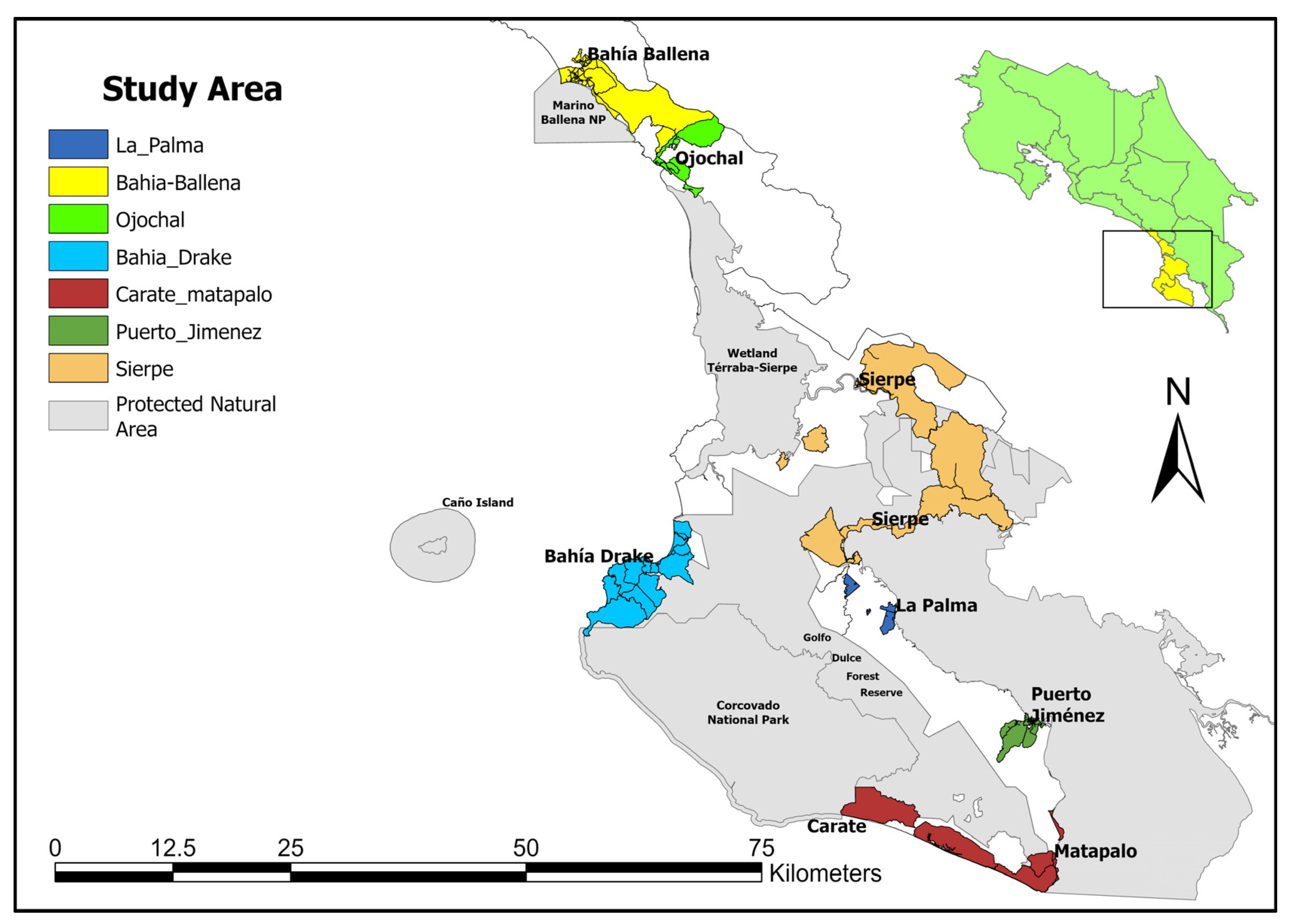
The study was conducted along the southern Pacific coast of Costa Rica, in the province of Puntarenas. It included the communities of Bahía Ballena, Ojochal, Sierpe, and Bahía Drake, in the municipality of Osa, as well as the sites of La Palma, Puerto Jiménez, Matapalo, and Carate, in the municipality of Puerto Jiménez. The selection was made considering that the sites function as centers for tourism distribution and development, within the framework of the South Pacific tourism planning unit, which serves as a base for visiting different primary attractions within their area of influence. They correspond to towns or small cities that offer support services for tourism and all the activities offered in the area. Additionally, each site corresponds geographically to its proximity to a protected natural area. For example, Bahía Ballena and Ojochal’s primary attraction is the Marino Ballena National Park, Sierpe with the Terraba-Sierpe National Wetland, Isla del Caño, and the Corcovado National Park. Finally, Bahía Drake, La Palma, Puerto Jiménez, and Carate-Matapalo’s main attraction corresponds to Corcovado National Park, Isla del Caño Biological Reserve, and Golfo Dulce. These geographical details can be seen in Figure 1.

2.2. Methodology

The methodology applied in this study builds on previous work by [21], which applied the MIVES method to the evaluation of tourism services for the first time. The MIVES approach is based on value analysis and transforms variables that may have different units of measurement into a single dimensionless value [64], providing a robust framework for sustainability assessments by allowing each alternative to be compared to the others.
The value function for each indicator is rated on a scale from 0 to 1, according to the desired maximum (value = 1) and minimum (value = 0) reference values of the indicators [65]. The closer a sustainability index is to 1, the more sustainable the alternative is; conversely, alternatives with values closer to 0 are regarded as less sustainable [66].
Each alternative undergoes the assessment process considering the three pillars of sustainability, which in the MIVES methodological framework are referred to as requirements, followed by criteria that support the evaluation, and indicators, which provide measurable data to obtain the sustainability values for each alternative [67]. This study aims to extend the MIVES method to other tourism destinations whose main attractions are one or more protected natural areas. In addition, Geographic Information Systems (GIS) tools were incorporated, specifically ArcGIS Pro, to complement and visualize the analysis. The proposed methodology consists of four ain phases (Table 1):
I.
Sample Calculation and Selection.
The study included tourism-related businesses operating in proximity to one or more of the previously mentioned protected natural areas. Databases provided by local governments were used to describe the active tourism companies in each site and the types of activities they offered. Based on this information, we applied a stratified probabilistic sampling approach [68].
A total of 471 establishments were identified in all of the study sites, grouped into seven categories of tourism activity, as shown in Table 2.
A stratified probabilistic sample was selected so that all individuals in the population had the same probability of being chosen for the study. This approach allows for comparison among business categories, which are considered as distinct strata or population groups. Stratification increases the precision of the sample by reducing the variance within each sampling unit.
A representative sample of 53% of a total of 471 tourism companies—251 establishments across all study sites—was obtained. Within this sample, businesses in each category were randomly selected for visits. When an owner refused to participate, another business was directly and conveniently selected as a replacement. The number of tourism companies selected for the study is shown in Table 3.
  • Direct data collection: Between December 2023 and January 2024, data was collected in the field through direct visits to each tourism company included in the sample. During these visits, participants filled out a structured questionnaire, divided into three components—environmental, economic, and social. Each component contained questions corresponding to the established indicators, which were later quantified using evaluation scales.
  • Direct observation and evidence gathering: During the visits, the reliability and accuracy of the information provided by each establishment was also verified, confirming on-site practices related to environmental management, economic performance, and social responsibility.
  • Official data sources: National institutions such as the National Geographic Institute of Costa Rica (IGN), the Costa Rican Tourism Institute (ICT), the National Institute of Statistics and Census (INEC), the National System of Conservation Areas (SINAC), and local governments collaborated. Each provided valuable data that complemented the field observations, offering official information on employment, seasonality of tourism activity, certifications, visitation to natural areas, and the registry of active tourism businesses.
  • Meta-search engines: Additional information was gathered through online meta-search platforms such as TripAdvisor, Google Reviews, Booking, and Kayak. These sources were used to obtain data for two specific indicators: the quality and price of tourism products and the level of visitor satisfaction.
II.
Integration of GIS and MIVES
To apply the MIVES method, the following sites were considered as alternatives: Bahía Ballena, Ojochal, Sierpe, Bahía Drake, La Palma, Puerto Jiménez, and Carate–Matapalo. Tourism activity in each of these locations revolves around one or more primary natural attractions, including Marino Ballena National Park, the Térraba–Sierpe Wetland, Caño Island Biological Reserve, Golfo Dulce, and Corcovado National Park.
The MIVES framework establishes a hierarchical structure with at least three levels: requirements (environmental, economic, and social), evaluation criteria, and indicators, which are applied consistently across all evaluated alternatives. The decision tree forms the foundation of the sustainability evaluation [69], comprising three requirements, seven criteria, and thirteen indicators (see Table 4 and Table A1).
Within this structure, the environmental requirement (R1) includes two criteria: (C1) Environmental performance of tourism companies and (C2) Biodiversity and land use, each of which contains two indicators.
The indicators used in this study were selected based on a comprehensive literature review and consultation with experts regarding their suitability, applicability, and representativeness in the context of the study. Additionally, key factors such as data availability and the measurability of indicators consistent with the study’s characteristics were taken into account. The description of the established criteria and the parameters they evaluate can be found in Appendix A.
The integration of GIS into the assessment is not intended to replace the assessment applied using the MIVES method. The basis of the GIS work comes from the data resulting from the application of the MIVES model, which can be expressed using geographic layers that show the sustainability of each study site.
The GIS application was implemented through the following steps:
  • Establishment of base geographic layers: each study site is duly georeferenced, consisting of polygons that make up the territorial area of the sites under analysis.
  • Georeferencing of tourism businesses: each participating business has been georeferenced, meaning that each tourism establishment will be located within the polygons of the different study sites.
  • Three types of maps have been generated: (1) a map that integrates the overall sustainability values for each study site, (2) maps with the values for each requirement (environmental, economic, and social), (3) maps of the thirteen indicators used for the assessment.
  • Grouping the layers created using ArcGIS Pro. Maps were generated showing the sustainability of each study community, considering economic, social, and environmental aspects. Each layer corresponds to an indicator that has been evaluated and contains a sustainability value that is expressed through the sustainability maps
  • Graded color scale: for better reading of the sustainability maps, a color scale was established to represent the degree of sustainability of each study site, as detailed below (Table 5):
Table 6 shows the different weights used for evaluation.
GIS was combined with the MIVES method through the following steps: (a) Indicators converted into layers: Each indicator used in the evaluation was transformed into a geographic layer containing the necessary information, including the sustainability value obtained for that indicator. (b) Integration of GIS data with the MIVES multi-criteria model: By grouping all the layers created in ArcGIS Pro, maps were generated to show the sustainability levels of each study community, considering the economic, social, and environmental dimensions. Each layer corresponds to a specific indicator that was evaluated and contains its sustainability value, which is visually represented on the sustainability
III.
Calculation of Indicators
Indicator (I1) Environmental Management was assessed based on five sub-indicators: environmental management plans and certifications, wastewater management, solid waste management, organic waste management, and used oil management. A weighted sum of these sub-indicators yielded the result for (I1) Environmental Management, showing variable outcomes across the study sites. To calculate the indicators, evaluation scales ranging from 1 to 5 were defined, where 1 represents the minimum satisfaction level and 5 represents the maximum. This scoring system was applied to indicators 1, 3, and 4 under the environmental requirement; indicators 5 and 6 under the economic requirement; and indicators 9, 11, 12, and 13 under the social requirement. For indicator (I2) CO2 Emissions, after estimating fuel consumption directly associated with tourist transport, emission factors provided by the Ministry of Environment and Energy (2024)—validated by the National Meteorological Institute of Costa Rica—were used as references. This data made it possible to calculate the monthly CO2 emissions (in tons) per vehicle through a mathematical operation.
Indicator (I7) differs from the previous ones because, although it also uses a scale from 1 to 5, in this case, the value 5 represents the minimum satisfaction level and 1 represents the maximum satisfaction level. This is due to the fact that a lower percentage of seasonality in tourism activity indicates higher satisfaction, while greater seasonality is associated with lower satisfaction. On the other hand, indicator (I8) uses an inverted percentage scale, where ranges between 0 and 20% are considered the most satisfactory and 81–100% the least satisfactory. This reflects the assumption that higher employment variability corresponds to lower satisfaction, whereas lower variability indicates greater stability and thus higher satisfaction. Finally, for indicator (I10), a direct percentage scale from 0 to 100% was adopted, where 0–20% represents the least satisfactory values and 81–100% represents the highest levels of satisfaction.
Table 6 shows the parameters used in the evaluation process, along with the value functions associated with each indicator that was analyzed.

3. Results

The results are presented in two scenarios. The first shows the outcomes obtained by applying the MIVES model, with the different sustainability values calculated for each alternative. The second scenario integrates GIS; ArcGIS Pro was used to generate sustainability maps to visualize and analyze the most and least sustainable areas within each site, according to the influence of tourism activities on the surrounding protected natural areas. The results indicate overall sustainability values above 50%, with Ojochal standing out as the most sustainable site compared to the others. Table 7 and Table 8 show the normalized values obtained from the indicators applied to each alternative (study site) after the model was executed.
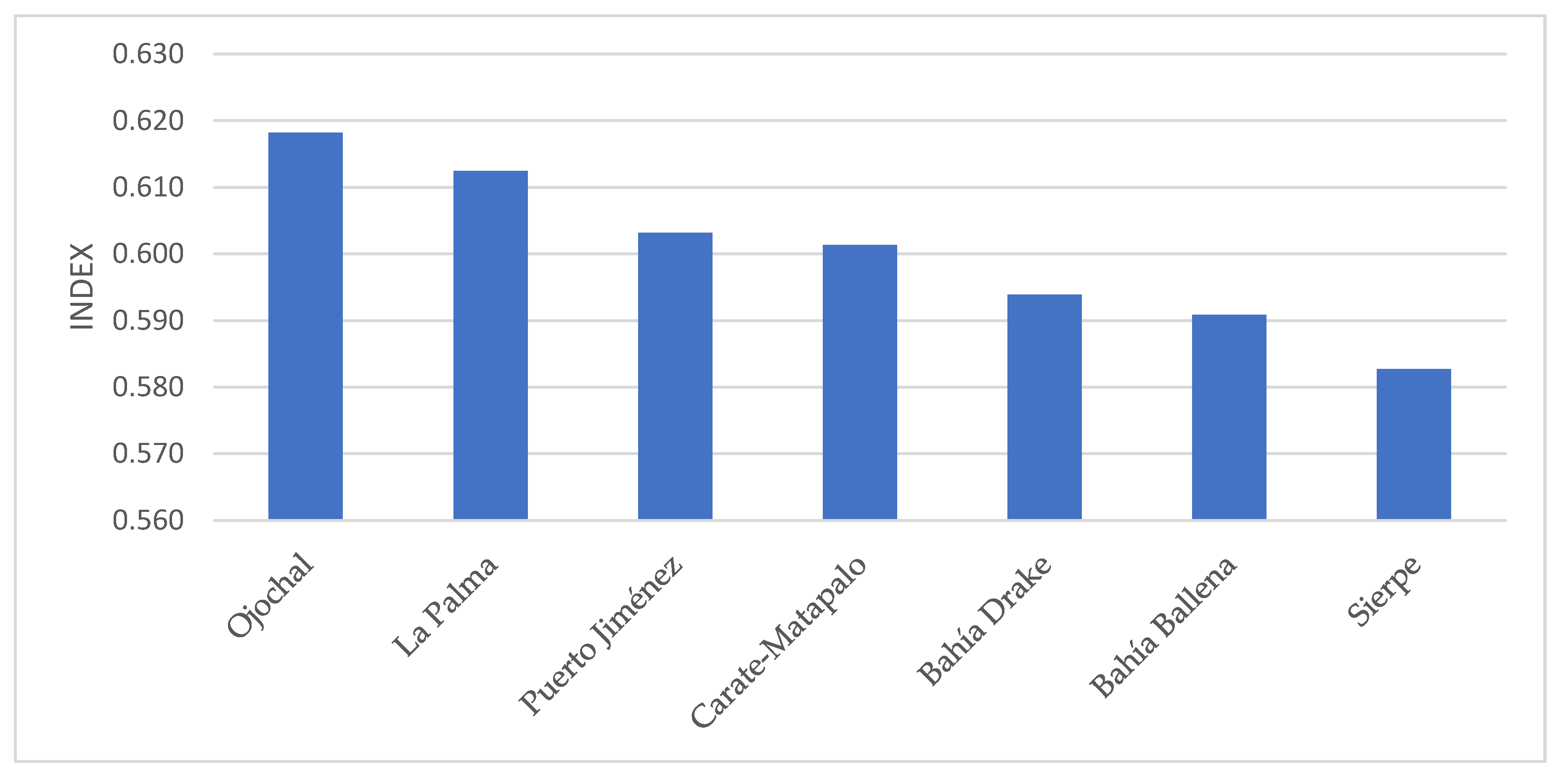
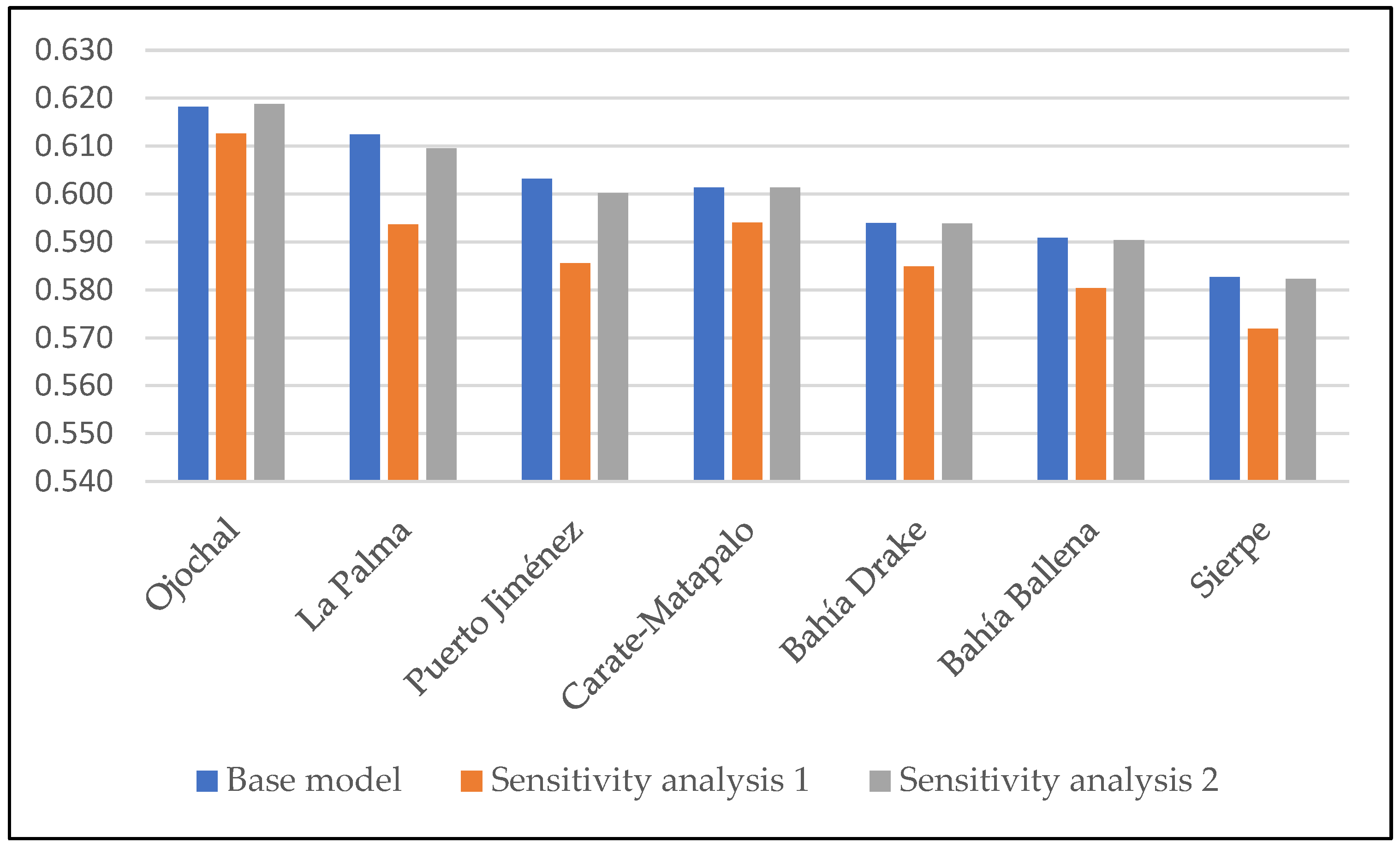
Figure 2 shows the overall sustainability values obtained for all study sites:
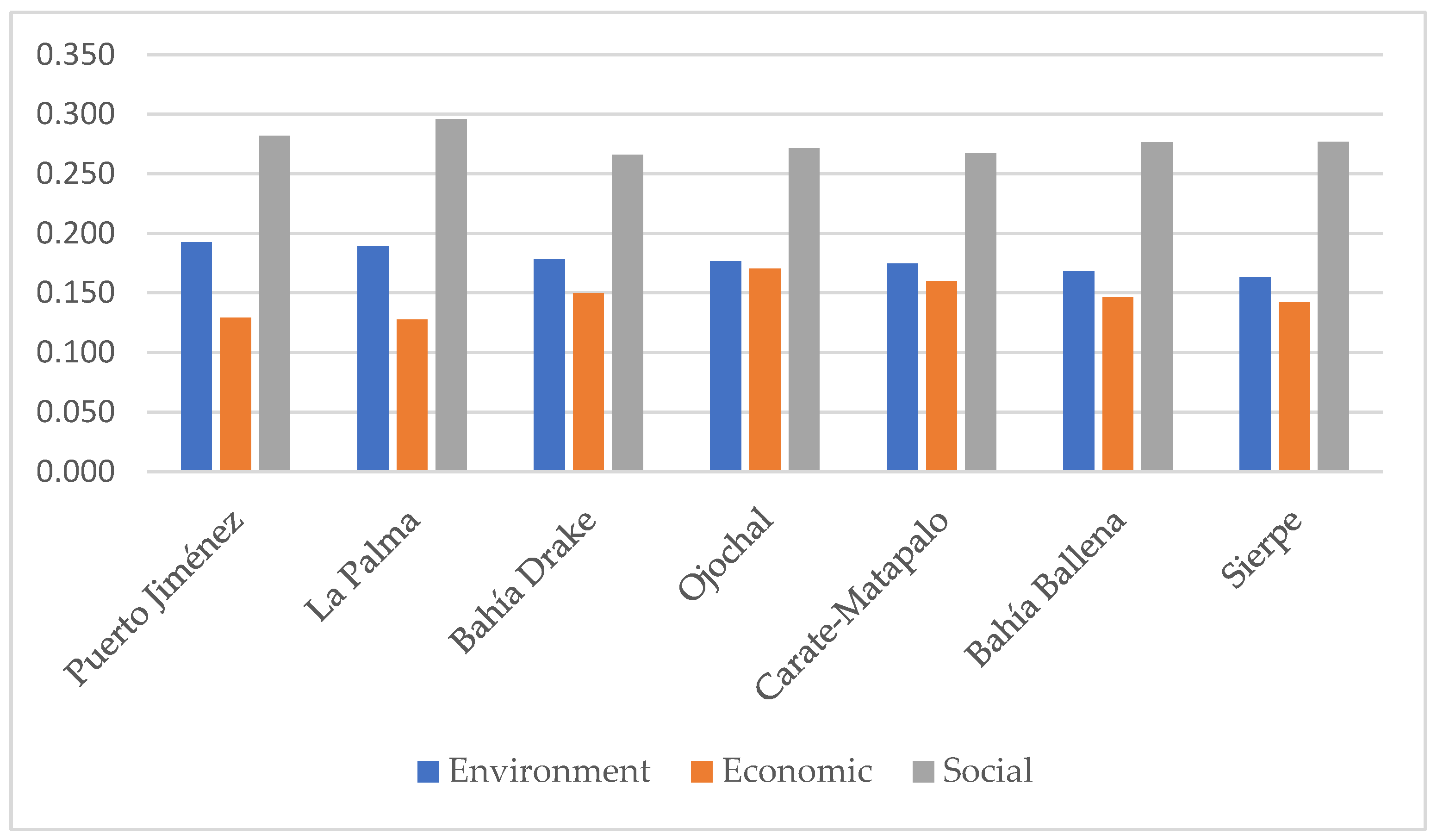
The most sustainable site is Ojochal, with a value of 0.618, followed by La Palma with an overall score of 0.612. The third most sustainable site is Puerto Jiménez, with a value of 0.603, followed by Carate-Matapalo at 0.601. In contrast, Bahía Drake, Bahía Ballena, and Sierpe are the lowest-rated alternatives, with values of 0.594, 0.591, and 0.583, respectively. At the level of individual requirements, Figure 3 shows the results obtained for the environmental, economic, and social dimensions.
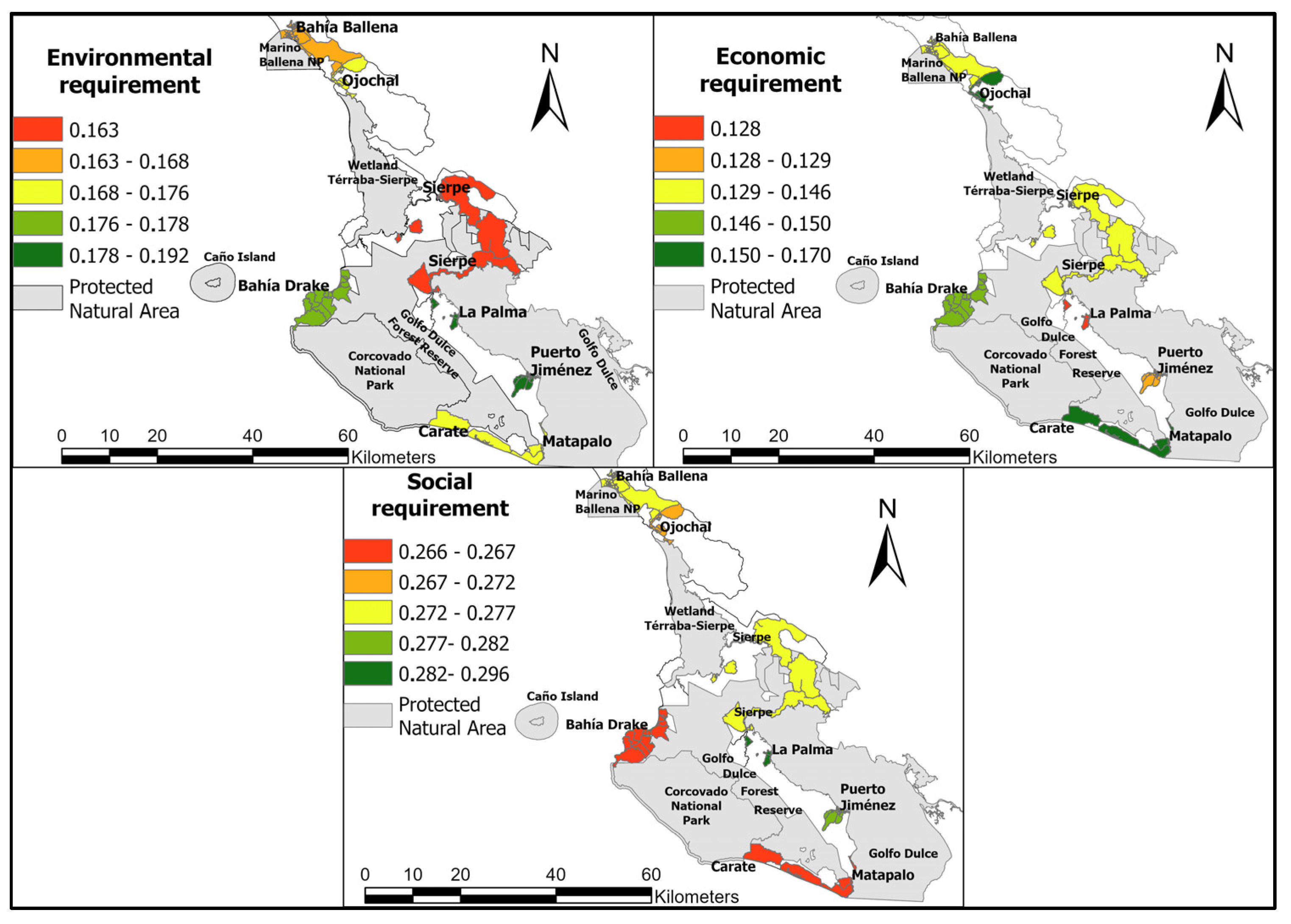
The social requirement shows the highest sustainability values across all of the alternatives. La Palma ranks the highest with a value of 0.296, followed by Puerto Jiménez with a final value of 0.282. The sites of Bahía Drake and Ojochal are the lowest rated, with values between 0.266 and 0.272. In contrast, the economic requirement shows an inverse trend: sites with higher sustainability scores in the social dimension tend to perform worse economically. As shown in the graph, the lowest economic scores correspond to La Palma (0.128), Puerto Jiménez (0.129), and Sierpe (0.142). The best-performing sites in this category are Ojochal, Carate-Matapalo, and Bahía Drake, with values between 0.150 and 0.170. Regarding the environmental dimension, the highest ratings were obtained by Puerto Jiménez (0.192) and La Palma (0.189), followed by Bahía Drake (0.178). The lowest-rated sites are Sierpe (0.163), Bahía Ballena (0.168), Carate-Matapalo (0.175), and Ojochal (0.176). Each value represents the sustainability level on a scale from 0 to 1, meaning that the closer the value is to 1, the more sustainable the site is; conversely, the farther it is from 1, the less sustainable it becomes. Figure 4 illustrates the indicator values obtained for each study site.
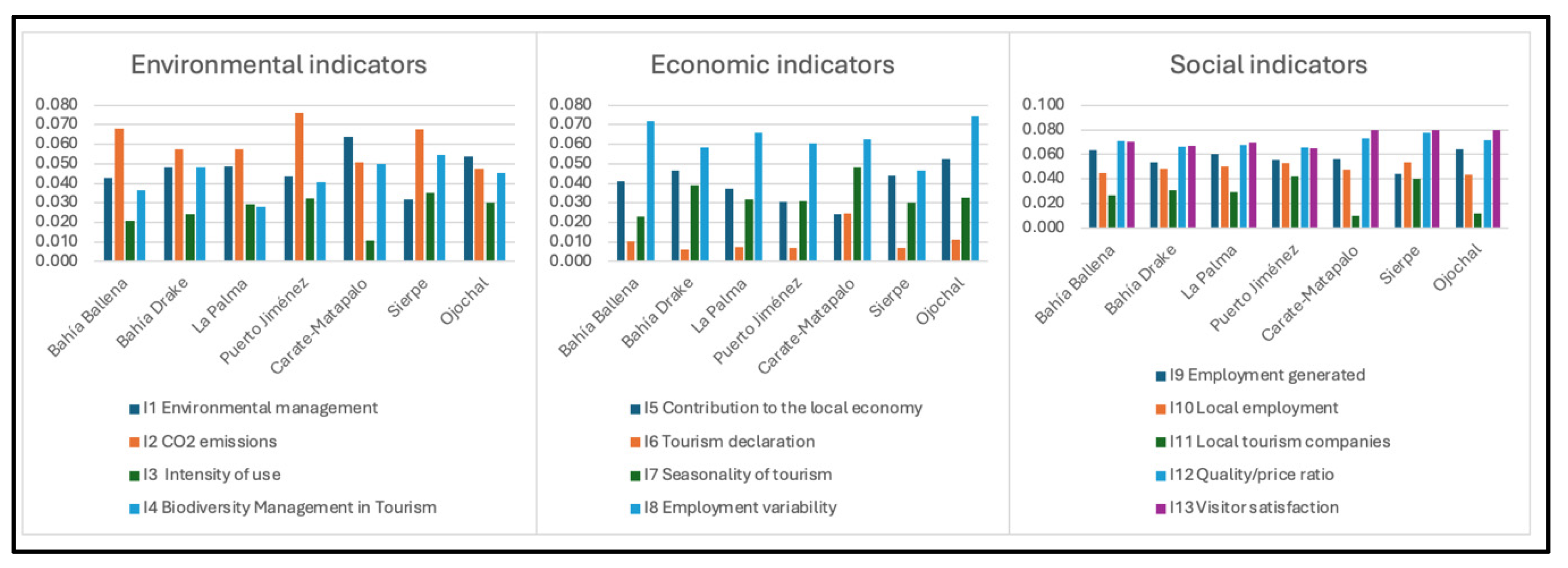
The figure above details the thirteen indicators implemented in the sustainability assessment model, considering each area (environmental, economic, social). It shows the normalized values resulting for each indicator once the model has been executed. Considering the range from 0 to 1, the behavior of each indicator can be observed for each study site; for all alternatives at the environmental level, the best-performing indicator is (I2) CO2 emissions, with an average value of 0.061. The sites of Puerto Jiménez (0.076), Bahía Ballena, and Sierpe (0.068) had the highest scores, while the lowest values were recorded in Ojochal (0.047), Carate-Matapalo (0.051), Bahía Drake (0.057), and La Palma (0.058), respectively.
The indicator (I3) intensity of use, with an average of 0.026, is the lowest rated among all environmental indicators. The sites of Carate-Matapalo, Bahía Ballena, and Bahía Drake show the lowest values (0.011, 0.021, and 0.024, respectively). Sierpe and Puerto Jiménez had the best scores, with values between 0.035 and 0.030. At the economic level, (I8) employment variability is the best-rated indicator, with an average of 0.063, where the sites of Ojochal (0.074), Bahía Ballena (0.072), and La Palma (0.066) show higher sustainability. Conversely, the sites of Sierpe, Bahía Drake, and Puerto Jiménez present the least favorable values, ranging between 0.046 and 0.060. The indicator (I6) tourism certification is the lowest rated, with an average of 0.010 across all alternatives, with Carate-Matapalo, Ojochal, and Bahía Ballena standing out as the most favorable, with values between 0.010 and 0.025. The sites with the lowest scores correspond to Bahía Drake, La Palma, Puerto Jiménez, and Sierpe, with values ranging between 0.006 and 0.007.
Lastly, at the social level, the highest-rated indicator was I13 (Visitor Satisfaction with the Tourism Product), which achieved an average value of 0.073 across all sites. The lowest-rated indicator was I11 (Local Tourism companies), with an average value of 0.027. Among these, Puerto Jiménez (0.040), Sierpe (0.040), and Bahía Drake (0.031) obtained the best scores, while Bahía Ballena (0.027), Ojochal (0.012), and Carate–Matapalo (0.010) recorded the lowest ratings. Overall, the results show highly satisfactory values for some indicators and very low values for others, suggesting that factors such as tourism structure, type of service offered, and proximity to protected areas can significantly influence the sustainability performance of each site.

3.1. Sensitivity Analysis

The sensitivity analysis assesses the consistency of the applied model, validating the results of the base model to ensure that outcomes are coherent and realistic in relation to the study’s objectives. As a general rule, at least two new scenarios are developed based on the initial model, varying the weights assigned to the environmental, economic, and social requirements. This makes it possible to see whether small changes in these weights can produce significant variations in the final evaluation value [39]. The decision tree weighting, as detailed in Table 6, was carried out in consultation with a panel of experts, who, in addition to providing the values assigned to the base model, also assigned the weights for the sensitivity analysis, as follows: in scenario 1, the environmental requirement was assigned a weight of 30%, the economic requirement 38%, and the social requirement 32%. In scenario 2, the environmental requirement was assigned a weight of 32%, the economic requirement 33%, and the social requirement 35%.
This analysis typically focuses on modifying the weights of the requirements, but indicators or criteria may also be analyzed. However, it has been demonstrated that these changes generally have minimal impact because their influence on the final outcome is not statistically significant [66]. Figure 5 compares the sensitivity analysis scenarios and the initial model. It should be noted that the values shown refer to the normalized sustainability value of each requirement within the decision tree.
As shown, the variations among the sensitivity scenarios relative to the initial model are minimal. In the base model, the Ojochal site stood out as the most sustainable, with values of 0.618. With the changes made to the evaluation weights, the variation is 0.613 for scenario 1 and 0.619 for scenario 2. In contrast, the worst-rated site in the base scenario is Sierpe, which, despite significant changes in the weighting of the assessment for scenarios 1 and 2, continues to show this trend with final values of 0.583 in the base scenario and 0.572 and 0.582 in scenarios 1 and 2. This same trend is evident for the other study sites. The variations in the weightings of the requirements in the different scenarios implemented do not influence the final evaluation of each site with respect to the baseline scenario, maintaining the same trend between the highest and lowest values. Therefore, and the overall trend of the resulting values for each study site remains consistent. Ojochal is still ranked as the most sustainable site, while Sierpe remains the least sustainable. Since the sustainability scenario values remain similar despite adjustments to the weighting of the requirements, it can be concluded that the model applied in this study is robust and reliable, and that the data obtained from the base model is valid and consistent for decision-making purposes.

3.2. Representation of Results

The MIVES method was applied first to obtain sustainability values and identify the sites and indicators with the best and worst performances. ArcGIS Pro was then used to generate sustainability maps based on the sustainability scores derived from the MIVES method, providing a clear and accessible visual presentation of the final results for each study site.
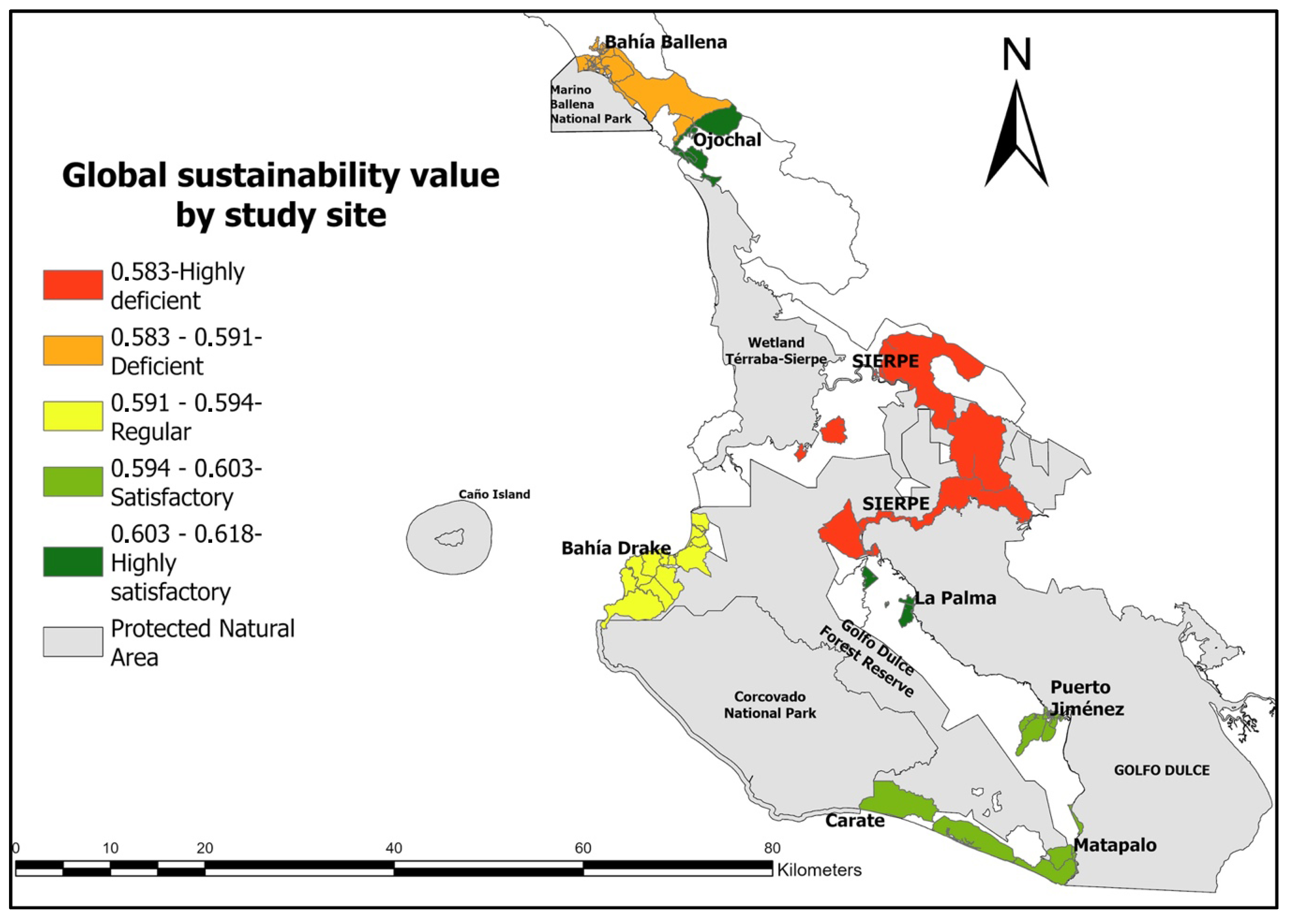
Figure 6 shows the degree of sustainability for each study site, represented by a color scale that visually differentiates the performance levels.
The figure shows the overall sustainability values for each alternative. Red and orange represent the least favorable results, yellow indicates moderate performance, and green highlights the most sustainable sites. The map also shows the protected natural areas where tourism activities take place for each study site. Sierpe had the lowest score, while Ojochal ranked as the best-performing site, followed by Carate–Matapalo, Puerto Jiménez, and La Palma. Bahía Ballena showed poor results (orange), and Bahía Drake was rated as moderate (yellow). Figure 7 presents a unified map that shows the sustainability values of each site and for each requirement—environmental, economic, and social.:
The map shows the overall sustainability values for each requirement evaluated according to the study site, in accordance with the color scale established in environmental terms. Puerto Jiménez and La Palma were found to be the most sustainable options, followed by Bahía Drake, which scored between 0.176 and 0.178. In contrast, Carate-Matapalo and Ojochal are presented as options of average quality, while Bahìa Ballena and Sierpe are the worst rated.
In contrast, the economic requirement was the dimension with the lowest scores overall. The sites with the best scores were Ojochal and Carate–Matapalo (highlighted in green), while Sierpe and Bahía Ballena showed average performance. Puerto Jiménez and La Palma had the poorest sustainability values within this requirement. The social requirement obtained the highest overall ratings, with La Palma and Puerto Jiménez scoring highest, and Carate–Matapalo and Bahía Drake with the lowest values.
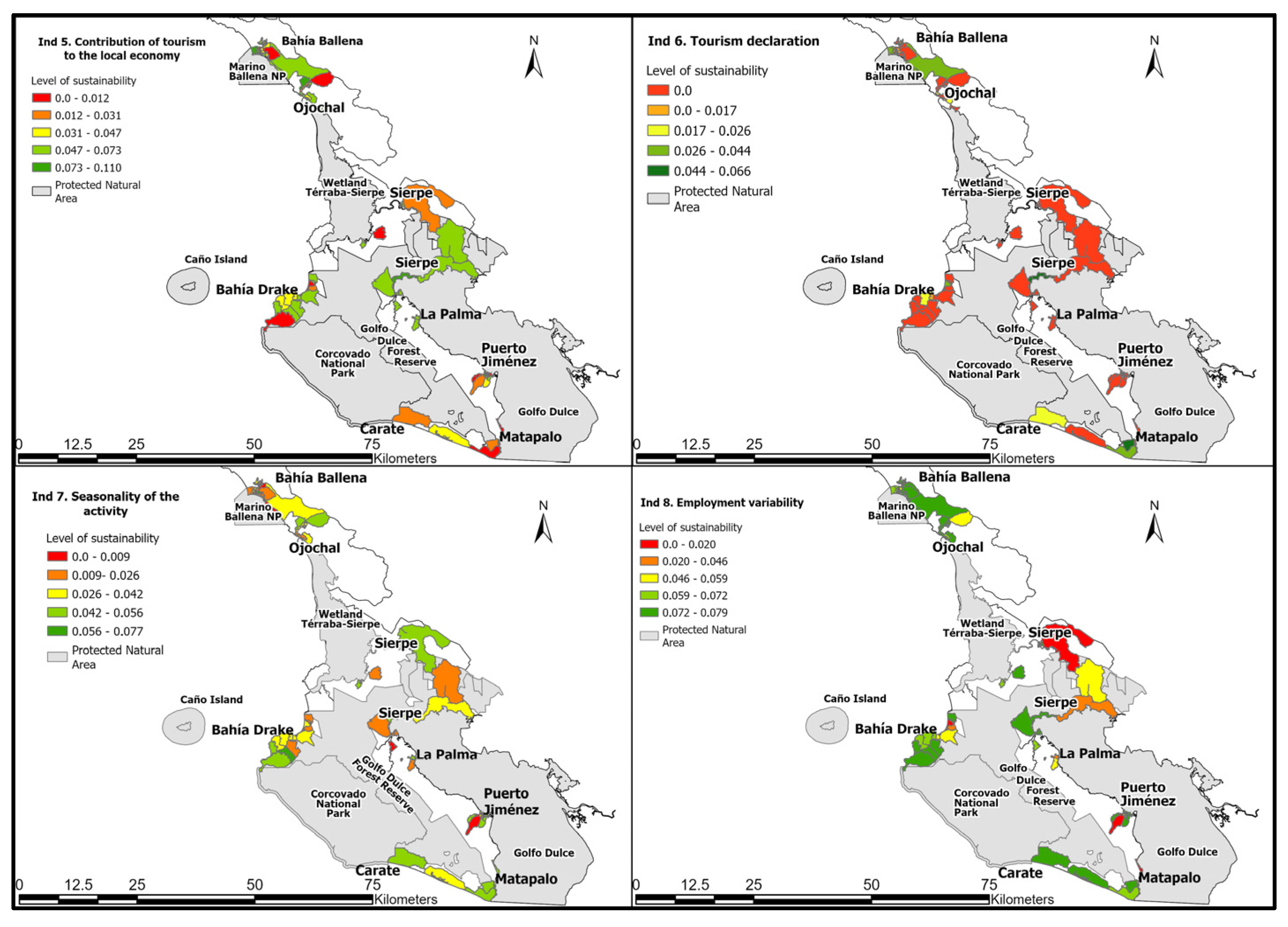
The relationships between the criteria and the study sites reveal that sustainability values are closely linked to tourism management dynamics and their interaction with protected natural areas. To illustrate these interconnections in greater detail, the following figures present the values obtained for each evaluated indicator (Figure 8).
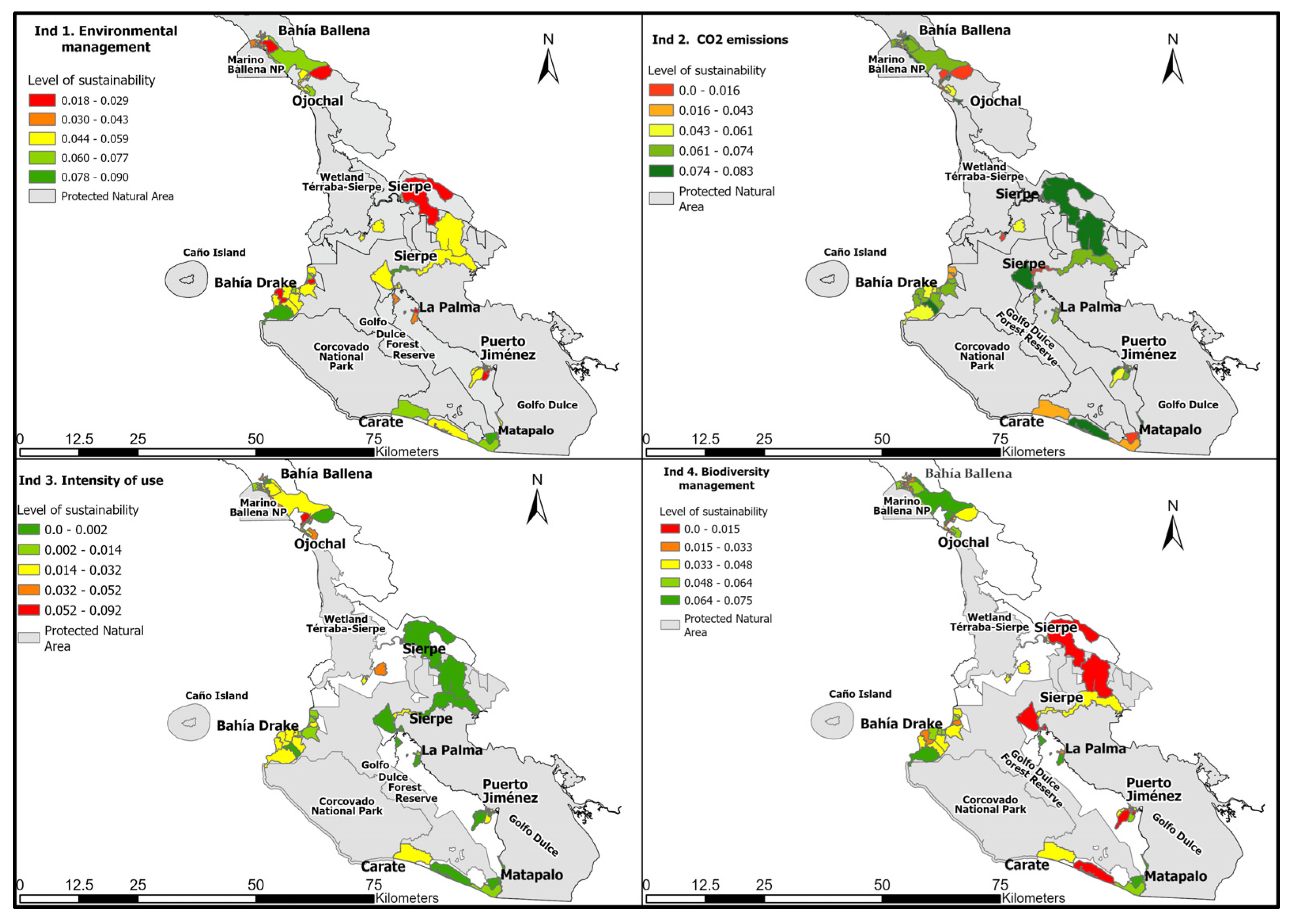
The sustainability values for each site are presented based on the four indicators that make up the environmental requirement: (I1) Environmental Management, (I2) CO2 Emissions, (I3) Land Use Intensity, and (I4) Biodiversity Management in Tourism.
The map shows a high degree of variability among indicators. CO2 Emissions (I2) was found to be the most sustainable indicator; however, this outcome is strongly influenced by the composition and structure of the tourism sector in each study site. Environmental Management (I1) ranked second, with Carate–Matapalo and Ojochal showing the most favorable results.
Land Use Intensity (I3) was the least favorable indicator, with Carate–Matapalo, Bahía Drake, and Bahía Ballena exhibiting higher levels of activity around nearby protected natural areas. Lastly, Biodiversity Management (I4) recorded an average value of less than 50%, with Sierpe and Carate–Matapalo rated highest and La Palma, lowest.
The following figure illustrates the performance of each site and the values obtained for the economic indicators (Figure 9).
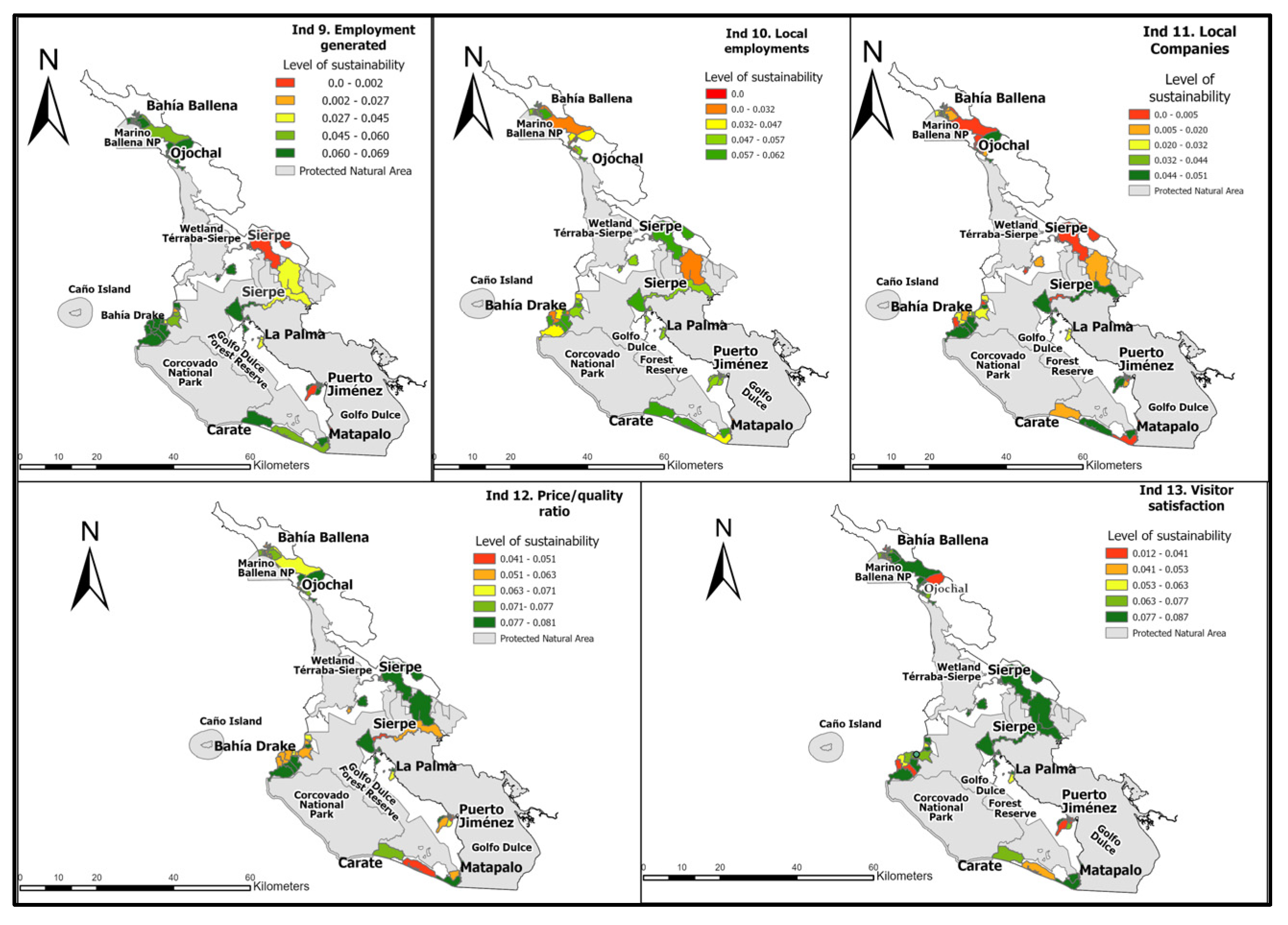
The indicator with the highest ratings was I8 (Employment Variability), with Bahía Ballena, Ojochal, and La Palma obtaining the best scores. In contrast, Sierpe, Puerto Jiménez, and Bahía Drake showed the least favorable results in the final evaluation. The second-best indicator was I5 (Tourism Contribution to the Local Economy), where Bahía Drake, Ojochal, and La Palma ranked as the top-performing sites, followed by Sierpe and Bahía Ballena, with moderate results. Carate–Matapalo and Puerto Jiménez recorded the lowest scores. Figure 10 shows the sustainability map for the indicators of the social requirement.
The social requirement indicators were the highest rated overall, surpassing the average compared to the other dimensions. As shown in the sustainability maps, the results varied by study site. For instance, the perception indicators of price–quality ratio and tourism product satisfaction criteria received the best scores, while Bahía Drake and Puerto Jiménez obtained the lowest ratings. These outcomes appear to be influenced by the structure of the tourism offerings in each location. Of the remaining indicators, I9 (Jobs Generated) showed the highest values in Bahía Ballena and Ojochal, followed by La Palma, whereas Sierpe and Bahía Drake received the lowest scores. For I10 (Local Employment), the best-performing sites were Puerto Jiménez, La Palma, and Sierpe, while Ojochal and Bahía Ballena recorded the lowest results.
Finally, for I11 (Local Entrepreneurship), the lowest values were found in Carate–Matapalo (highlighted in red on the map) and Ojochal, while Puerto Jiménez, La Palma, Sierpe, and Bahía Drake ranked as the top-rated sites.

4. Discussion

The overall sustainability index for all study sites is satisfactory. The value of 0.60 indicates that on a scale from 0 to 1, it is statistically close to the upper limit, which, according to the characteristics of the model, indicates a high level of sustainability. The sites that achieved the best sustainability scores were Ojochal and La Palma, followed by Puerto Jiménez and Carate–Matapalo, with average percentages of 61% and 60%, respectively. In contrast, Bahía Drake, Bahía Ballena, and Sierpe recorded the lowest average values—59% and 58%. Although there were some variations among the sites, the differences are not statistically significant, indicating that the overall sustainability level is relatively consistent across all locations analyzed.
The analysis of the requirements made it possible to identify sustainability values more precisely. The economic requirement received the lowest scores, primarily due to Indicator (I6) (Tourism Certification), which showed the weakest results: only 16.2% of all tourism companies hold an official tourism certification. This was largely influenced by the structure and composition of the tourism offerings in each study site. In Bahía Drake, La Palma, and Puerto Jiménez, the cabins category (see Table 2) accounts for a higher proportion of the total establishments compared to other categories. Although tourism certification is available for all business types, cabins account for only 2% of all certified companies [15]. Generally, those who obtain this certification are companies with greater financial capacity, which use the certification as a differentiating factor and a strategic business objective [16]. Consequently, a larger share of cabins—being the least likely to pursue certification—had a negative impact on the overall evaluation results.
This scenario is exemplified in Carate–Matapalo, where 68.8% of companies are lodge-type hotels, and in this group, 31.7% hold the official tourism certification.
Indicator (I7) (Tourism Seasonality) measures the variability of tourism demand during the year, identifying how pronounced the high and low seasons are in each study site and how these fluctuations may affect the flow of visitors to protected natural areas.
This indicator showed a medium sustainability value of 0.034, with Bahía Drake and Carate–Matapalo ranking as the best-performing sites. This suggests that seasonality in these locations is not particularly significant compared to the other study areas. This stability may also be related to the composition of their tourism structure.
For example, in Carate–Matapalo, 68% of companies are large hotels with considerable organizational and economic capacity, allowing them to maintain a broader range of activities year-round. Similarly, Bahía Drake hosts more than ten tour operator businesses that help mitigate seasonality during low-demand months by promoting activities such as whale and dolphin watching and snorkeling, which sustain tourism activity throughout the year.
Indicator (I5) (Tourism Contribution to the Local Economy) analyzes the contribution of tourism companies to the economic development of the communities in which they operate, considering two key elements: the acquisition of local products (such as food and cleaning supplies) and services (including transportation, guide services, and cleaning). These are essential factors to create productive connections within local economies.
Results for the acquisition of local products were generally positive; 84% of the 251 companies evaluated reported purchasing from local suppliers. The volume of local purchases per company was relatively low, falling within the deficient and very deficient levels.
The very satisfactory and satisfactory categories accounted for only 12.4% and 17.6% of the total, respectively, while the regular, deficient, and very deficient levels represented 22.5%, 31.8%, and 15.7%. These findings indicate that the acquisition of local products remains insufficient for most sites, likely due to factors such as the absence of continuous local supply chains and issues related to product quality and pricing.
Regarding the acquisition of local services, 62.6% of companies reported hiring local suppliers, which is considered satisfactory. However, similar to the case of local products, only 24% reached maximum satisfaction levels, and 32.2% were rated as deficient and 21.1% as very deficient. The acquisition of services is closely linked to the structure and composition of the companies. Larger companies tend to manage most aspects of their operations internally—often having their own transportation, tour guides, and cleaning departments—which reduces demand for external local services. Overall, when both local products and services are considered, the proportion of local acquisition was only an unsatisfactory 20%.
Indicator I8 (Employment Variability) shows highly positive results: 77.8% of participating companies maintain their workforce permanently, regardless of the tourism season, which reflects a very satisfactory rating. In some cases, rather than resorting to layoffs, companies reassign employees to different tasks, negotiate vacation periods, or apply reduced working hours depending on the nature of the position. The locations with the highest levels of employment variability are La Palma (26.3%), Bahía Drake (15.6%), Carate–Matapalo (12.5%), and Puerto Jiménez (15.2%).
Environmental Requirement—Indicator (I1) (Environmental Management): The results show that participating companies scored below 50% on the satisfaction scale, with a weighted average of 39.8% across all sites, indicating a generally deficient level of environmental management. These results could be influenced by the type and make-up of the businesses. Values tended to be higher in locations where lodges and tour operators are the dominant categories. As shown in Figure 8, Ojochal and Carate–Matapalo achieved the best scores, largely due to the greater presence of these companies, in which sustainability is a part of their organizational culture, and it is easier to integrate environmental management processes into operations. In contrast, smaller businesses—such as cabins, restaurants, hostels, and sodas—generally offer limited services. Environmental certifications are often not a priority for the owners of these establishments, and environmental management practices tend to be minimal. Since these types of companies make up the majority of the sample, they strongly influence the overall indicator value and lower the environmental management scores.
Indicator (I2) (CO2 Emissions) obtained the highest score among the environmental indicators. This result can be attributed to the fact that emissions measurements focused on the transportation used by tourism companies for their operations, including land and water transport, as well as the movement of goods within their supply chains.
Cabins, hostels, sodas, and restaurants showed a lower contribution to total emissions, primarily because they are small-scale businesses that do not operate their own vehicles. For instance, these categories account for 55.4% of all companies analyzed but produce only 35.8% of total CO2 emissions. In contrast, hotels, tour operators, and lodges account for 44.6% of the sample but generate 64.2% of total emissions.
Indicators I3 (Land Use Intensity) and I4 (Biodiversity Management) showed the lowest scores. The areas of Carate–Matapalo, Bahía Ballena, and Bahía Drake had the highest intensity of use within protected natural zones (see Figure 7). This pattern is in line with Indicator I7 (Tourism Seasonality), which also showed high values in these sites. Due to the low seasonality of these sites, they tend to attract visitors throughout the year, which leads to greater and more continuous use of protected natural areas compared to other locations.
The social requirement is analyzed using indicators related to the perception of the tourism product and the level of visitor satisfaction. Indicator I12 (Price–Quality Ratio) shows that 62% of establishments receive a very satisfactory rating and 30.4%, satisfactory. The highest percentages were recorded in Carate–Matapalo (68.7%), La Palma (84.2%), and Bahía Ballena (65.2%), while Bahía Drake (44.4%) and Sierpe (50%) had the lowest figures.
Indicator I13 (Visitor Satisfaction) obtained the highest average of the social indicators: 74.4% of visitors rated their experience as very satisfactory, 21.2% as satisfactory, and 4.4% as average. No poor or very poor evaluations were reported. The destinations with the highest satisfaction levels were Carate–Matapalo, La Palma, and Ojochal, with Bahía Drake, Puerto Jiménez, and Uvita showing lower values, between 58% and 69%. These findings are particularly relevant given the diversity of tourist profiles. On one hand, destinations such as Carate–Matapalo and Ojochal attract visitors—mostly foreigners—who are looking for exclusivity and high-quality standards, with lodge-type hotels in the greatest demand. Cabins, on the other hand, cater primarily to national or local tourists, who prioritize comfort at more affordable prices.
Indicator (I9) (Jobs Generated) ranked as the third highest in the social requirement and achieved a satisfactory score. Of the 251 companies in the sample, 73% of the jobs were permanent and full-time, with little variability between tourism seasons—indicating the sustained contribution of tourism companies to employment. The locations with the highest ratings were Bahía Ballena (85%), Ojochal (83.3%), and Sierpe (77.8%). In contrast, La Palma (52.6%) and Bahía Drake (68.8%) had the lowest evaluations. This indicator reaffirms Costa Rica’s commitment to tourism playing a leading role in job creation, within the framework of sustainable development goals for economic growth and the creation of permanent and stable jobs, thereby contributing to genuine socioeconomic growth in communities [70].
Indicator (I10) (Local Employment): approximately 66.2% of employees are local, which is considered satisfactory. However, none of the study sites achieved the maximum satisfaction values. The best-performing locations were La Palma and Puerto Jiménez, with 78% and 76% local employment, respectively. In contrast, Bahía Ballena and Ojochal recorded the lowest levels of local employment, at 57% and 55%, respectively. These results indicate that, on average, tourism companies must hire nearly half of their workforce from outside the local community.
Lastly, Indicator (I11) (Local Entrepreneurship) showed a moderate level of satisfaction: 51.4% of the establishments are owned by local entrepreneurs, 34% by foreign investors, and 14.1% represent mixed ownership—partnerships between local stakeholders and foreign capital. It is important to note that foreign investment contributes significantly because of the larger scale of the projects it supports. However, in general, smaller-scale and lower-category ventures are managed by national or local residents, while larger developments—such as lodges or conventional hotels—tend to be dominated by foreign capital.
The Carate–Matapalo area is one example, where 75% of companies are under foreign ownership. A similar pattern is observed in Ojochal, where 61% of the businesses are also controlled by foreign investors.
The model applied provides valuable data for sustainable tourism management. Although it does not focus specifically on protected natural areas, it does examine how tourism can have a positive or negative impact on a national park or protected natural area. In light of the results, the study presents scenarios similar to those applied in national parks, for example, the development by [71] in which they applied a model similar to the one proposed, integrating environmental, economic, and social indicators, allowing for the zoning of degrees of sustainability with the application of GIS. Other results are those reported by [72], which coincide with the results presented in this study in that the assessment of sustainability should not be a static value.

Analysis of Results Presented Using GIS

Although the GIS component has had a strong descriptive component, the objective has been to show the results obtained by applying the MIVES model in a simpler way. The maps reflect the sustainability values of each site, and the spatial analysis is based on the values resulting from the application of MIVES, making it possible to identify the most sustainable areas considering the different variables applied for their evaluation. As shown in Figure 6, the sites of Ojochal and Palma have the best values, followed by Puerto Jiménez and Carate-Matapalo. In this regard, the type of tourism, in situ variability, and nearby activities and attractions can significantly influence the results. Ojochal and La Palma are two contrasting sites in terms of tourism, yet they stand out with the best results in the assessment, which may be due to factors such as the number of businesses studied (representing only 7.2% and 7.6%), the categories analyzed, while in places such as Bahía Ballena and Bahía Drake, seven categories of businesses were evaluated (see Table 3), in the case of Ojochal, only five were evaluated due to the absence of this type of business in the area, and in La Palma, four categories of businesses were evaluated. The categories with the highest scores for Ojochal are lodge-type hotels and hostels, with values of 0.628 for lodge hotels and 0.610 for hostels.
The maps made it possible to identify “hot spots” in terms of tourist activity. According to the proximity of protected areas, there is evidence of greater pressure and, therefore, intensity of use of the space, as described in Figure 8 with the indicators of intensity of use and biodiversity management in tourism. This evidence contributes to decision-making by clearly identifying the most deficient areas that therefore require greater attention in terms of protection and conservation. For example, some correlational studies with the current one would be that developed by [73] where they combine Choreme-GIS for spatial representations in which they analyze tourism demand and supply, as well as the concentration of tourism resources and possible management gaps. Furthermore, with the use of tools such as those applied in the present study, decisions can be made regarding planning and better management of tourism so that tourist activity can be better distributed around the natural resources present in protected areas and thus reduce pressure on critical areas by analyzing different variables in the intrinsic relationship between buffer zones and protected areas, as well as being able to identify what type of tourism may be more sustainable with respect to the protected area [74].
The maps show the behavior of tourism companies within their area of operation in relation to the protected natural environment. For example, it is possible to identify the sites with the highest density of tourism activity. The trend is that the greater the capacity of the companies, the greater their operation within the protected areas, and the greater their capacity to receive tourists, which will also have an impact on the frequency of visits to the protected areas. Another aspect that marks a higher density or hot spots has to do with the category of company. For example, tour operators are the ones who mobilize tourists to national parks through the different tours they offer, while categories such as cabins focus their activity on providing a minimum service. In summary, the greater or lesser density shown on the maps will depend largely on the location and type of company.

5. Conclusions

The study assesses the sustainability of tourism activity in seven sites where tourism takes place within protected natural areas—such as national parks, wetlands, and marine reserves—by implementing a methodology that combines the MIVES method with Geographic Information Systems (GIS) using ArcGIS Pro.
The study pursued three main objectives: (1) to obtain an overall sustainability index for each community in relation to its associated protected area; (2) to use sustainability maps to identify the areas within each community that are more or less sustainable with respect to the protected area; (3) to apply the MIVES method within the tourism sector in combination with GIS to demonstrate the versatility and flexibility of the method across different disciplines.
The overall sustainability score was satisfactory (0.60) in all the sites studied. The social requirement obtained the highest score, with strong performance in perception-related indicators. However, in regard to social impact—particularly regarding local entrepreneurship—more than 34% of tourism companies are foreign-owned, compared with 51% with national or local owners. Although the results are generally positive, larger companies tend to be foreign-owned, whereas smaller establishments, such as cabins and hostels, are predominantly operated by Costa Rican owners.
The environmental requirement was the second-best performing category, with the CO2 emissions indicator achieving the highest score. However, as discussed in the following section, this result should not necessarily be interpreted as entirely positive; the outcomes may be influenced by the composition of the tourism structure in each study site, since companies with less favorable CO2 emission values often have better environmental management and biodiversity conservation practices.
The economic requirement obtained the lowest score across all of the analyzed sites, with an average weighted sum of 0.037 for the four indicators. Of these, Indicator I8 (Employment Variability) achieved the highest score, indicating generally stable employment levels. In contrast, Indicator I6 (Tourism Certification) recorded the lowest value. It is worth noting that companies in simpler categories—such as cabins, hostels, and restaurants—had a considerable impact on the final evaluation, since most of them lack official tourism certification. This negatively affected the results of the corresponding indicator.
The integration of GIS with MIVES is a valuable tool that facilitates the visualization of both numerical results and sustainability maps. This combination makes it possible to identify which zones or evaluated sites are more or less sustainable according to the applied indicators. It also generates multiple layers of information that give a more precise understanding of the areas that require more attention when making decisions, with the ultimate goal of ensuring the sustainability of tourism activity in protected natural areas.
This method validates the applicability results reported by Araya et al. (2023) [21]. When integrated with ArcGIS Pro, the approach spatially anchors the methodology, positioning it as a valuable tool for research in a variety of disciplines. It provides more precise and accessible information for decision-makers, particularly in improving the quality and effectiveness of sustainability assessments.
The integration of MIVES with GIS in the current exercise is a starting point not only for diagnosing the current state of tourism activity around protected natural areas, but also as a monitoring tool for assessing processes of improvement or deterioration in sustainability.
The capacity of MIVES-GIS to generate spatial representations and thematic maps facilitates the identification of areas that require greater attention, allowing decision-makers to implement management strategies tailored to the specific needs of each site. Through the analysis of the results obtained and their geospatial visualization, key indicators can be monitored in detail, which is essential for promoting the conservation and responsible use of natural resources in tourist destinations.

5.1. Policy Implications of the Research

  • The study and its results provide a valuable tool for decision-making by the competent authorities. The governance factor is therefore directly linked to related institutions such as local governments, tourism institutes, the National System of Conservation Areas, and tourism chambers.
  • It can also be used for adequate planning of public investment in the tourism development model and the management of protected areas.
  • Prioritization of management in sites with lower sustainability values or what could be considered critical points.
  • Possible reforms in land use regulatory plans about urban planning and its relationship with protected areas.

5.2. Limitations of the Research

  • Although the application of the MIVES model has been proven to be reliable and is a robust mathematical model, the weighting assigned by the expert seminar may be slightly subjective, which could well change the results of the evaluation.
  • Access to data in rural areas tends to be a limitation and a management challenge, as fieldwork may be more exhaustive than in other areas where large, constantly updated databases are available.
  • GIS is very valuable for showing the current picture in a sustainability assessment. However, the variables applied in the study may change significantly over time, so model integration must be a dynamic process.

5.3. Future Research Directions

  • Temporal monitoring: Run the model periodically so that the different indicators can be reviewed to see how they are evolving and identify whether the implementation of continuous improvement scenarios is leading to an improvement or deterioration in sustainability at the study sites.
  • Implementation of sensors: Connect GIS through real-time monitoring sensors to measure more complex variables such as entries and exits from protected areas, intensity of tourist use, and water management, allowing for a shift from static to dynamic maps.


Author Contributions

Conceptualization, J.D.A.; methodology, J.D.A.; software, J.D.A.; validation, A.H.G. and J.V.; formal analysis, J.D.A.; investigation, J.D.A.; resources, J.D.A.; data curation, J.D.A.; writing—original draft preparation, J.D.A.; writing—review and editing, A.H.G.; J.V. and F.H.-G.; visualization, A.H.G.; J.V. and F.H.-G.; supervision, A.H.G.; project administration, J.D.A.; funding acquisition, J.D.A. All authors have read and agreed to the published version of the manuscript.

Funding

This research has been financed by the teacher formation program of the University of Costa Rica through the granting of scholarships for study abroad. Scholarship Contract No. 17-2025.

Data Availability Statement

The data can be requested from the author. It is not published in open access because it contains sensitive information about the different tourism companies studied. In addition, at the time of conducting the fieldwork, a confidentiality agreement was established with each tourism company to protect the information provided.

Acknowledgments

We would like to acknowledge all the tourism companies in the South Pacific region of Costa Rica that contributed to the generation of data that was subsequently used in the study. We would also like to thank institutions such as the National System of Conservation Areas, the National Institute of Statistics and Censuses, and the Costa Rican Tourism Institute.

Conflicts of Interest

The authors declare no conflicts of interest.

Appendix A

Table A1. Description of the decision tree criteria.
Criterion 1 (C1):
I1 Environmental Management: this indicator evaluates the different environmental aspects related to each company, including the management of solid waste, wastewater, organic waste, and waste oils.
I2 CO2 Emissions: this indicator is based on an inventory of the number of vehicles owned by each tourism company—whether land or water transport—and quantifies the monthly fuel consumption required for their operations as part of their tourism activities…
Criterion 2 (C2):
I3 Intensity of Use: evaluates the frequency and intensity of use of protected areas by tourism companies in each study site, taking into account visitor levels according to the tourism season.
I4 Biodiversity Management in Tourism Activities: analyzes whether the company implements actions for environmental protection and conservation in the areas where it operates. The evaluation is based on a five-point scale, where 1 represents the least favorable condition and 5 the most satisfactory.
Criterion 3 (C3):
I5 Contribution of Tourism to the Local Economy: analyzes the level of economic contribution of tourism in relation to the protected area within the community, considering key elements such as the acquisition of local products and services and the percentage of local procurement.
I6 Tourism Certification: evaluates the number of companies that hold an official tourism certification that recognizes the quality of the products or services offered by the establishment.
Criterion 4 (C4):
I7 Tourism Seasonality: examines whether tourism companies experience seasonal variations in activity and how pronounced the difference is between high and low seasons. This indicator also considers the economic, labor, and environmental effects associated with seasonal intensity in the use of natural areas.
I8 Employment Variation: indicates how employment levels change within tourism companies between high and low seasons.
Criterion 5 (C5):
I9 Jobs Generated: measures the contribution of tourism companies to job creation, considering key aspects such as the stability of employment throughout the year, the hiring of local workers, and whether the jobs are full-time. An evaluation scale that will be described later was used for this indicator.
I10 Local Employment: indicates the percentage of positions offered by tourism companies that are filled by residents of the local community.
I11 Local Entrepreneurship: evaluates the percentage of locally owned tourism companies in each community, providing insight into the level of local entrepreneurship and whether the tourism structure is primarily managed by locals or foreign investors.
Criterion 6 (C6):
I12 Price–Quality Ratio of Tourism Services: analyzes tourist evaluations of the services received, considering factors such as facilities, service quality, staff, cleanliness, location, and comfort.
I13 Visitor Satisfaction: evaluates tourist satisfaction with their overall experience at the destination and with the services provided by the tourism establishment. The evaluation uses five categories: very satisfactory, satisfactory, average, poor, and very poor.

References

  1. Brida, J.; London, S.; Rojas, M. El turismo como fuente de crecimiento económico: Impacto de las preferencias interpertemporales de los agentes. Investig. Econ. 2014, 73, 59–77. Available online: https://www.elsevier.es/es-revista-investigacion-economica-122-pdf-S0185166715300035 (accessed on 10 July 2024).
  2. Nieto, J.L.; Román, I.; Bonillo, D.; Paulova, N. El Turismo a Nivel Mundial. Int. J. Sci. Manag. Tour. 2016, 2, 129–144. Available online: https://dialnet.unirioja.es/descarga/articulo/5665915.pdf (accessed on 10 July 2024).
  3. Jiménez, M.; Peña, A.; Ruiz, J. La demanda turística internacional: Recuperación de la crisis y turismo de lujo, una primera aproximación al caso español. Investig. Reg.-J. Reg. Res. 2017, 38, 47–66. Available online: https://ebuah.uah.es/dspace/handle/10017/3099 (accessed on 10 July 2024).
  4. Mendoza, F.; Zepeda, A.; Villafuerte, J. Turismo en tiempo de pandemias. COVID-19 en Latinoamérica. Tur. Soc. 2021, 29, 129–155. [Google Scholar] [CrossRef]
  5. Jouault, S.; Rivera, T.; de Fuentes, G.; Xool, M.; Montañez, A. Respuestas, resistencias y oportunidades del turismo comunitario en la península de Yucatán frente al COVID-19 y las crisis recurrentes. Investig. Geogr. 2021, 104, 1–16. [Google Scholar] [CrossRef]
  6. Nuevo, A.; Martínez, G.; Puig, M. Consecuencias y resiliencia del turismo ante el impacto de la pandemia desde una visión de la gestión a escala local para el caso de Málaga. Rev. Estud. Andal. 2023, 45, 167–189. [Google Scholar] [CrossRef]
  7. Arce, J.; Fernández, M. La evolución de la actividad turística en Costa Rica: Crecimiento antes de la pandemia y resiliencia a partir de la reapertura. Rev. Nac. Adm. 2022, 13, 133–152. [Google Scholar] [CrossRef]
  8. Instituto Costarricense de Turismo. Situación del Turismo en Costa Rica: Análisis de los Principales Indicadores Turísticos, Cierre 2023. San José, 2023. Available online: https://www.ict.go.cr/es/documentos-institucionales/estad%C3%ADsticas/informes-estad%C3%ADsticos/monitoreo-tur%C3%ADstico/2613-informe-cierre-2023/file.html (accessed on 10 July 2024).
  9. Gutiérrez, L.; Castro, E.; Largacha, C. Ecoturismo sostenible: Benchmarking del caso de Costa Rica para impulsar el turismo en Colombia. Tur. Soc. 2021, 29, 239–262. [Google Scholar] [CrossRef]
  10. Arce, D.; Ulloa, M. La marca país Esencial Costa Rica: Más allá del bienestar ambiental. Perspect. Estud. Soc. Educ. Cívica 2018, 17, 1–21. [Google Scholar] [CrossRef]
  11. Arenas, A.; Pérez, B. Naturaleza, Conservación e identidad verde en Costa Rica. Antropol. Exp. 2020, 19, 313–330. [Google Scholar] [CrossRef]
  12. Ministerio de Ambiente y Energía and Sistema Nacional de Áreas de Conservación. Plan Estratégico Institucional SINAC 2023–2030. San José, 2023. Available online: https://www.sinac.go.cr/ES/docu/Planificacion/Plan%20Estrat%C3%A9gico%20Institucional%20SINAC%202023-2030.pdf (accessed on 23 July 2024).
  13. Sistema Nacional de Áreas de Conservación (SINAC). Informe Anual Estadísticas SEMEC 2023 SINAC en Números. 2023. Available online: https://www.sinac.go.cr/ES/transprncia/Informe%20SEMEC/Informe%20SEMEC%202023.pdf (accessed on 23 July 2024).
  14. Instituto Costarricense de Turismo. Principales Actividades Realizadas por los Turistas. 2019. Available online: www.ict.go.cr (accessed on 23 July 2024).
  15. Instituto Costarricense de Turismo. Situación del Turismo en Costa Rica: Análisis de los Principales Indicadores Turísticos 2023. Sa José, 2023. Available online: https://www.ict.go.cr/es/estadisticas/cifras-economicas.html (accessed on 21 October 2025).
  16. Molina, S. Certificación turística sostenible y los impactos socioeconómicos percibidos por hoteles en Costa Rica. Rev. Tur. Patrim. Cult. 2019, 17, 363–372. [Google Scholar] [CrossRef]
  17. Mora, D.; Chavez, A. Aporte del Programa Bandera Azul Ecológica en la lucha contra el cambio climático en Costa Rica. Rev. Tecnol. Marcha 2019, 32, 158–168. [Google Scholar] [CrossRef]
  18. Gobierno de Costa Rica 2018–2022. Plan Nacional de Descarbonización de Costa Rica 2018–2050. 2018. Available online: https://cambioclimatico.go.cr/wp-content/uploads/2019/02/PLAN.pdf (accessed on 1 August 2024).
  19. Naranjo, A. Tourist carrying capacity as a sustainability management tool for coral reefs in Caño Island Biological Reserve, Costa Rica. Ocean Coast. Manag. 2021, 212, 105857. [Google Scholar] [CrossRef]
  20. Acuña, M.; Calvo, D.; Fontana, Y. Estado de situación del ocio y el turismo sostenible en Costa Rica. Trama Rev. Cienc. Soc. Humanidades 2021, 10, 84–131. [Google Scholar] [CrossRef]
  21. Araya, J.D.; Hernando, A.; Tejera, R.; Velázquez, J. Sustainable Tourism around Ecosystem Services: Application to a Case in Costa Rica Using Multi-Criteria Methods. Land 2023, 12, 628. [Google Scholar] [CrossRef]
  22. Calderón, J.F. Evaluación de la Sostenibilidad de las Actividades Turísticas Para el Desarrollo de Estrategias en la Comunidad de San Jerónimo, CR. Master’s Thesis, Universidad de Costa Rica, San José, CA, USA, 2023. Available online: https://www.kerwa.ucr.ac.cr/items/a3340716-8b90-4bdf-a8d5-5f42b79399f2 (accessed on 27 July 2024).
  23. Robert, M.; Echarri, M.; Acevedo, J. La evaluación de la sostenibilidad de los destinos turísticos en su relación con el enfoque a procesos. Explor. Digit. 2021, 5, 334–349. [Google Scholar] [CrossRef]
  24. Sala, S.; Ciuffo, B.; Nijkamp, P. A systemic framework for sustainability assessment. Ecol. Econ. 2015, 119, 314–325. [Google Scholar] [CrossRef]
  25. Aguado, A.; Gálvez, J.; Aguado-Renter, A.; Pujadas, P.; Fernández-Ordoñez, D. Evaluación de la sostenibilidad de carreteras. Carreteras 2017, 4, 8–19. Available online: http://hdl.handle.net/2117/108027 (accessed on 12 June 2021).
  26. Cinelli, M.; Coles, S.R.; Kirwan, K. Analysis of the potentials of multi criteria decision analysis methods to conduct sustainability assessment. Ecol. Indic. 2014, 46, 138–148. [Google Scholar] [CrossRef]
  27. López, F.; Torres, A.; Urgell, X.; Serrano, M. Gestión sostenible de destinos turísticos: La implementación de un sistema de indicadores de turismo en los destinos de la provincia de Barcelona. Bol. Asoc. Geogr. Esp. 2018, 2018, 428–461. [Google Scholar] [CrossRef]
  28. Pons, O.; del Mar Casanovas-Rubio, M.; Armengou, J.; de la Fuente, A. Approach for sustainability assessment for footbridge construction technologies: Application to the first world D-shape 3D-Printed fiber-reinforced mortar footbridge in Madrid. J. Clean. Prod. 2023, 394, 136369. [Google Scholar] [CrossRef]
  29. Maleki, B.; del Mar Casanovas-Rubio, M.; Tsavdaridis, K.D.; de la Fuente Antequera, A. Integrated Value Model for Sustainable Assessment of Modular Residential Towers: Case Study: Ten Degrees Croydon and Apex House in London. Sustainability 2024, 16, 497. [Google Scholar] [CrossRef]
  30. Pujadas, P.; Pardo, F.; Aguado-Renter, A.; Aguado, A. MIVES multi-criteria approach for the evaluation, prioritization, and selection of public investment projects. A case study in the city of Barcelona. Land Use Policy 2017, 64, 29–37. [Google Scholar] [CrossRef]
  31. Motlagh, S.H.B.; Hosseini, S.M.A.; Pons-Valladares, O. Integrated value model for sustainability assessment of residential solar energy systems towards minimizing urban air pollution in Tehran. Sol. Energy 2023, 249, 40–66. [Google Scholar] [CrossRef]
  32. Grajales, A.; Serrano, E.; Hahn, C. Los métodos y procesos multicriterio para la evaluación. Rev. Luna Azul 2013, 36, 285–306. Available online: http://www.scielo.org.co/pdf/luaz/n36/n36a14.pdf (accessed on 14 July 2021).
  33. Penadés, V. Aplicación de la Toma de Decisión Multicriterio al Diseño Sostenible de Puentes de Hormigón. Master’s Thesis, Universidad Politécnica de Valencia, Valencia, Spain, 2017. Available online: http://hdl.handle.net/10251/89181 (accessed on 15 June 2021).
  34. Falcón, E. Desarrollo de un Modelo de Planificación Energética Sostenible Usando Técnicas de Optimización Multicriterio: Una Aplicación a la Provincia de Cajamarca, Perú. Ph.D. Thesis, Universidad Politécnica de Madrid, Madrid, Spain, 2018. Available online: https://oa.upm.es/52109/1/EDER_JESUS_FALCON_ROQUE.pdf (accessed on 20 July 2024).
  35. Armengou, J.; de Cea, A.A. Metodología Multicriterio para toma de decisiones en gestión de proyectos: La integración de los agentes gestores como beneficio indirecto. Rev. Int. Sostenibilidad Tecnol. Humanismo 2012, 7, 45–68. Available online: http://hdl.handle.net/2099/13290 (accessed on 22 June 2023).
  36. Martín, S.; Gómez, A.; Martínez, E.; Pascual, C. Comparison of AHP and a utility-based theory method for selected vertical and horizontal forest structure indicators in the sustainability assessment of forest management in the sierra de Guadarrama National Park, Madrid Region. Sustainability 2018, 10, 2–16. [Google Scholar] [CrossRef]
  37. Diaz, L.; González, J.; Romero, C. Measuring systems sustainability with multi-criteria methods: A critical review. Eur. J. Oper. Res. 2017, 258, 607–616. [Google Scholar] [CrossRef]
  38. del Mar Casanovas-Rubio, M.; Armengou, J. Decision-making tool for the optimal selection of a domestic water-heating system considering economic, environmental and social criteria: Application to Barcelona (Spain). Renew. Sustain. Energy Rev. 2018, 91, 741–753. [Google Scholar] [CrossRef]
  39. Lizarralde, R.; Ganzarain, J.; Zubizarreta, M. Adaptation of the MIVES method for the strategic selection of new technologies at an R&D centre. Focus on the manufacturing sector. Technovation 2022, 115, 102462. [Google Scholar] [CrossRef]
  40. Medrán, F.; Enfedaque, A.; Alberti, M.G. A Sustainability Assessment of Industrialised Housing Construction Using the MIVES (Modelo Integrado de Valor para una Evaluación Sostenible)-Based Multicriteria Decision-Making Method. Buildings 2024, 14, 2712. [Google Scholar] [CrossRef]
  41. Szurek, M.; Blachowski, J.; Nowacka, A. GIS-Based method for wind farm location multi-criteria analysis. Min. Sci. 2014, 21, 65–81. [Google Scholar] [CrossRef]
  42. Malekmohammadi, B.; Blouchi, L.R. Ecological risk assessment of wetland ecosystems using Multi Criteria Decision Making and Geographic Information System. Ecol. Indic. 2014, 41, 133–144. [Google Scholar] [CrossRef]
  43. Gülci, S.; Akay, A.E. Assessment of ecological passages along road networks within the Mediterranean forest using GIS-based multi criteria evaluation approach. Environ. Monit. Assess. 2015, 187, 779. [Google Scholar] [CrossRef]
  44. Gigović, L.; Pamučar, D.; Lukić, D.; Marković, S. GIS-Fuzzy DEMATEL MCDA model for the evaluation of the sites for ecotourism development: A case study of ‘Dunavski ključ’ region, Serbia. Land Use Policy 2016, 58, 348–365. [Google Scholar] [CrossRef]
  45. Sánchez, J.M.; Bernal, J.A. Environmental management of Natura 2000 network areas through the combination of Geographic Information Systems (GIS) with Multi-Criteria Decision Making (MCDM) methods. Case study in south-eastern Spain. Land Use Policy 2017, 63, 86–97. [Google Scholar] [CrossRef]
  46. Du, X.; Wang, Z. Optimizing monitoring locations using a combination of GIS and fuzzy multi criteria decision analysis, a case study from the Tomur World Natural Heritage site. J. Nat. Conserv. 2018, 43, 67–74. [Google Scholar] [CrossRef]
  47. Zabihi, H.; Alizadeh, M.; Langat, P.K.; Karami, M.; Shahabi, H.; Ahmad, A.; Said, M.N.; Lee, S. GIS Multi-Criteria Analysis by Ordered Weighted Averaging (OWA): Toward an Integrated Citrus Management Strategy. Sustainability 2019, 11, 1009. [Google Scholar] [CrossRef]
  48. Bertsiou, M.M.; Theochari, A.P.; Baltas, E. Multi-criteria analysis and Geographic Information Systems methods for wind turbine siting in a North Aegean island. Energy Sci. Eng. 2021, 9, 4–18. [Google Scholar] [CrossRef]
  49. Bagheri, M.; Ibrahim, Z.Z.; Akhir, M.F.; Talaat, W.I.A.W.; Oryani, B.; Rezania, S.; Wolf, I.D.; Pour, A.B. Developing a Climate Change Vulnerability Index for Coastal City Sustainability, Mitigation, and Adaptation: A Case Study of Kuala Terengganu, Malaysia. Land 2021, 10, 1271. [Google Scholar] [CrossRef]
  50. de Belém Costa Freitas, M.; Xavier, A.; Fragoso, R.; Antunes, C. A composite indicator to measure sustainable water use in Portugal: A compromise programming approach. J. Environ. Manag. 2022, 311, 114791. [Google Scholar] [CrossRef]
  51. Spennemann, H.R.; Jiménez-Espada, M.; Cuartero, A.; Le Breton, M. Sustainability Assessment through Urban Accessibility Indicators and GIS in a Middle-Sized World Heritage City: The Case of Cáceres, Spain. Buildings 2022, 12, 813. [Google Scholar] [CrossRef]
  52. Khodakarami, L.; Pourmanafi, S.; Mokhtari, Z.; Soffianian, A.R.; Lotfi, A. Urban sustainability assessment at the neighborhood scale: Integrating spatial modellings and multi-criteria decision making approaches. Sustain. Cities Soc. 2023, 97, 104725. [Google Scholar] [CrossRef]
  53. Organización de las Naciones Unidas. Resolution Adopted by the General Assembly: The Future We Want. 2012. Available online: http://www.pnuma.org/sociedad_civil/documents/reunion2012/CIVIL%20SOCIETY%20PARTICIPATION/20120727%20Rio+20%20Outcome%20The%20Future%20We%20Want%20Eng.pdf (accessed on 4 August 2021).
  54. Tan, T.; Zheng, L.; Xue, F.; Bao, Z.; Fang, Z.; Liu, X. Mives multi-criteria framework to sustainability index of design for manufacture and assembly. J. Civ. Eng. Manag. 2024, 30, 234–247. [Google Scholar] [CrossRef]
  55. Boix, D.; Pardo, F.; Blanco, A.; Aguado, A.; Pujadas, P. A systematic review on MIVES: A sustainability-oriented multi-criteria decision-making method. Build. Environ. 2022, 223, 109515. [Google Scholar] [CrossRef]
  56. Josa, I.; Pons, O.; de la Fuente, A.; Aguado, A. Multi-criteria decision-making model to assess the sustainability of girders and trusses: Case study for roofs of sports halls. J. Clean. Prod. 2020, 249, 119312. [Google Scholar] [CrossRef]
  57. Pons, O.; Aguado, A. Integrated value model for sustainable assessment applied to technologies used to build schools in Catalonia, Spain. Build. Environ. 2012, 53, 49–58. [Google Scholar] [CrossRef]
  58. Hosseini, S.M.A.; De La Fuente, A.; Pons, O. Multi-criteria decision-making method for assessing the sustainability of post-disaster temporary housing units technologies: A case study in Bam, 2003. Sustain. Cities Soc. 2016, 20, 38–51. [Google Scholar] [CrossRef]
  59. Cuadrado, J.; Zubizarreta, M.; Roji, E.; Larrauri, M.; Alvarez, I. Sustainability assessment methodology for industrial buildings: Three case studies. Civ. Eng. Environ. Syst. 2016, 33, 106–124. [Google Scholar] [CrossRef]
  60. Alberti, M.G.; Gálvez, J.C.; Enfedaque, A.; Carmona, A.; Valverde, C.; Pardo, G. Use of steel and polyolefin fibres in the La Canda tunnels: Applying MIVES for assessing sustainability evaluation. Sustainability 2018, 10, 4765. [Google Scholar] [CrossRef]
  61. Habibi, S.; Valladares, O.P.; Peña, D. New sustainability assessment model for Intelligent Façade Layers when applied to refurbish school buildings skins. Sustain. Energy Technol. Assess. 2020, 42, 100839. [Google Scholar] [CrossRef]
  62. Hosseini, S.M.; Ghalambordezfooly, R.; De La Fuente, A. Sustainability Model to Select Optimal Site Location for Temporary Housing Units: Combining GIS and the MIVES-Knapsack Model. Sustainability 2022, 14, 4453. [Google Scholar] [CrossRef]
  63. Quesada, L.; Garmendia, L.; Alvarez, I.; Roji, E. Vulnerability assessment and categorization against heat waves for the Bilbao historic area. Sustain. Cities Soc. 2023, 98, 104805. [Google Scholar] [CrossRef]
  64. Aguado, A.; del Caño, A.; de la Cruz, M.P.; Gómez, D.; Josa, A. Sustainability Assessment of Concrete Structures within the Spanish Structural Concrete Code. J. Constr. Eng. Manag. 2012, 138, 268–276. [Google Scholar] [CrossRef]
  65. Biswal, D.; Joglekar, S.N.; Mandavgane, S.A. MIVES: A Multi-Attribute Value Function-Based Methodology for Sustainability Assessment; Springer: Singapore, 2022; Volume 407. [Google Scholar] [CrossRef]
  66. Viñolas, B.; Cortés, F.; Marques, A.; Josa, A.; Aguado, A. MIVES: Modelo Integrado de Valor para Evaluaciones Sostenible. In I Congreso Internacional de Medida y Modelización de la Sostenibilidad; Barcelona: New Braunfels, TX, USA, 2009; pp. 2–24. Available online: https://upcommons.upc.edu/bitstream/handle/2117/9704/3125829.pdf?sequence=1&isAllowed=y (accessed on 16 January 2022).
  67. Araya, J.D. Modelo Para la Toma de Decisiones en la Evaluación de Destinos Turísticos Basado en Criterios de Sostenibilidad: Estudio de Caso Situado en Costa Rica. Master’s Thesis, Universidad Politécnica de Cataluña, Barcelona, Spain, 2021. Available online: http://hdl.handle.net/2117/362386 (accessed on 10 October 2022).
  68. Hernández, R.; Fernández, C.; Baptista, L.P. Metodología de la Investigacion, 6a; McGraw-HILL: New York, NY, USA, 2014; pp. 175–181. [Google Scholar]
  69. Alarcon, B.; Aguado, A.; Manga, R.; Josa, A. A value function for assessing sustainability: Application to industrial buildings. Sustainability 2011, 3, 35–50. [Google Scholar] [CrossRef]
  70. Benavides, S.; Pinel, F.S. Una ruta hacia los servicios modernos, creativos e innovadores como aporte al desarrollo sostenible: El caso del turismo en Costa Rica. Rev. Geográfica América Cent. 2024, 2, 263–286. [Google Scholar] [CrossRef]
  71. MoÅŸ, A.; BrÃ, O. Apuseni Nature Park, a park for nature and people. J. Prot. Mt. Areas Res. Manag. 2024, 16, 16–24. [Google Scholar] [CrossRef]
  72. Mulero, A.; Rivera, M. Turismo de Naturaleza y espacios Naturales progegidos en España. Rev. Àbaco 2018, 4, 84–96. Available online: https://www.uco.es/teps/wp-content/uploads/2019/05/Articulo-Rvta-Abaco-Tur-y-EspNat-2018.pdf (accessed on 25 January 2026).
  73. Niță, A.; Drăguleasa, I.A. Choreme-Based Spatial Analysis and Tourism Assessment in the Oltenia de sub Munte Geopark, Romania. ISPRS Int. J. Geoinf. 2025, 14, 444. [Google Scholar] [CrossRef]
  74. Niță, A.; Drăguleasa, I.A.; Constantinescu, E.; Bonea, D. Geotourism: From Theoretical Definition to Practical Analysis in the Sohodol Gorges Protected Area, Romania. Geographies 2025, 5, 53. [Google Scholar] [CrossRef]
Figure 1. Study area. Bahía Ballena, Ojochal, Sierpe, and Bahía Drake belong to the municipality of Osa. Tourism activity in these locations is directly or indirectly linked to nearby protected natural areas, including Marino Ballena National Park, the Térraba–Sierpe National Wetland, Caño Island Biological Reserve, Golfo Dulce, and Corcovado National Park.
Earth 07 00028 g001
Figure 2. Global sustainability values for each alternative.
Earth 07 00028 g002
Figure 3. Sustainability values at the requirements level for all study sites.
Earth 07 00028 g003
Figure 4. Values obtained for each study site according to indicator.
Earth 07 00028 g004
Figure 5. Sensitivity analysis.
Earth 07 00028 g005
Figure 6. Sustainability map for study area.
Earth 07 00028 g006
Figure 7. Requirements map.
Earth 07 00028 g007
Figure 8. Environmental indicators.
Earth 07 00028 g008
Figure 9. Economic indicators.
Earth 07 00028 g009
Figure 10. Social indicators.
Earth 07 00028 g010
Table 1. Phased workflow methodology.
I.
Sample Calculation and Selection
II.
Integration of MIVES with GIS (ArgGIS Pro)
-
Alternatives/Decision Trees/Indicators
III.
Value functions
IV.
Weighting of the Decision Tree
Table 2. Categories of Tourism Companies Included in the Study.
CategoryDescription
HotelEstablishments offering lodging for visitors, often including additional amenities such as restaurants, swimming pools, and other facilities.
Hotel lodgeLodges generally refer to accommodations located away from urban areas and close to natural environments. They position themselves as eco-friendly and sustainable destinations, providing an integrated nature-based experience.
CabinsA typical form of lodging in Costa Rica that provides accommodation only. These are small units that may offer private or shared facilities and are generally more affordable than conventional hotels.
HostelA type of accommodation offering more limited services at lower prices compared to other categories. Facilities are usually shared, catering mainly to backpackers and adventure travelers seeking basic amenities and budget-friendly options.
RestaurantEstablishments serving a variety of national and international dishes and beverages, offering comfort and personalized attention aimed at enhancing the customer’s dining experience.
SodaSmall, locally owned eateries that serve traditional Costa Rican dishes at lower prices, providing visitors with an authentic and affordable culinary experience.
Tour operatorLocal travel agencies specializing in offering tourism packages that may include services such as local guides, transportation, and logistical arrangements for domestic travel.
Table 3. Number of Tourism companies by Category.
CategoryBahía BallenaBahía DrakePalmaPuerto JiménezCarate-MatapaloSierpeOjochal
Cabins1012912021
Hotels179122510
Hotel Lodge321031142
Hostels3404001
Restaurants2610411144
Soda4158110
Tour operator8606120
Total (251)71631946161818
Data Sources: Fieldwork.
Table 4. Decision Tree and Assigned Weights for the Evaluation.
RequirementsCriteriaIndicators
R1 Environmental (34%)C1. Environmental Performance of Companies (51%)I1 Environmental Management (52%)
I2 Emissions from Tourism Transportation (48%)
C2. Biodiversity and Land Use (49%)I3 Land Use Intensity (55%)
I4 Biodiversity Management in Tourism (45%)
R2 Economic (31%)C3. Economic Benefits and Certifications (53%)I5 Tourism Contribution to the Local Economy (60%)
I6 Tourism Certification Status (40%)
C4. Employment and Seasonality (47%)I7 Tourism Seasonality (46%)
I8 Employment Variability (54%)
R3 Social (35%)C5. Social Effects (52%)I9 Jobs Generated (38%)
I10 Local Employment (34%)
I11 Local Entrepreneurship (28%)
C6. Satisfaction with the Tourism Product (48%)I12 Price–Quality Relationship of Tourism Services (48%)
I13 Visitor Satisfaction (52%)
Table 5. Color scale for sustainability level.
ColorEvaluation
RedHighly deficient
OrangeDeficient
YellowRegular
Light greenSatisfactory
Dark greenHighly satisfactory
Table 6. Weight Assignments for the Evaluation.
RequirementInitial ModelSensitivity Analysis 1Sensitivity Analysis 2
Environmental34%30%32%
Economic31%38%33%
Social35%32%35%
Table 7. Evaluation Parameters. The table is interpreted as follows: C: abscissa approximation to the inflection point; K: ordinate approximation to the inflection point; P: defines the shape of the value function; CS: increasing S-shaped value function; DS: decreasing S-shaped value function; DL: decreasing linear value function; CL: increasing linear value function; BB: Bahía Ballena; BD: Bahía Drake; LP: La Palma; PJ: Puerto Jiménez; CM: Carate-Matapalo; S: Sierpe; O: Ojochal; Xmin: minimum satisfaction; Xmin minimum satisfaction, Xmax maximum satisfaction.
IndicatorsUnitsFunctionXminXmaxCKPBBBDLPPJCMSO
I1Environmental management PointsCS1530.534434444
I2CO2 EmissionsTnCO2DS876.1237.87456.990.53609.8876.1237.88124.21500.3235.547.4
I3Intensity of UsePointsCS1530.533322323
I4Biodiversity Management PointsCS1530.534444434
I5Tourism ContributionPointsCS1530.533433334
I6Tourism DeclarationPointsCS1530.532111312
I7Tourism Seasonality PointsDL514.60.0114333233
I8Employment Variability%DS81–100%0–20%500.538.926.140.523.221.715.86.7
I9Jobs GeneratedPointsCS1530.535444455
I10Local Employment%CL0–20%81–100%100.01171.977.286.884.877.180.670.5
I11Local EntrepreneurshipPointsCS1530.533444232
I12Quality/Price Ratio PointsCL151.40.0115454545
I13Visitor Satisfaction PointsCS1530.535555555
Table 8. Normalized values by study site.
IndicatorsBahía BallenaBahía DrakeLa PalmaPuerto JiménezCarate-MatapaloSierpeOjochal
I1Environmental management0.440.510.330.460.700.520.59
I2CO2 emissions0.110.000.990.940.280.810.98
I3Intensity of Use0.230.190.700.410.070.240.2
I4Biodiversity Management0.440.600.680.500.650.320.59
I5Tourism contribution0.280.370.300.180.170.300.43
I6Tourism Declaration0.010.000.000.000.090.000.01
I7Tourism Seasonality0.340.580.450.460.720.470.49
I8Employment Variability0.970.820.580.850.870.930.98
I9Jobs Generated0.920.730.570.770.760.860.93
I10Local Employment0.730.780.870.850.780.810.72
I11Local Entrepreneurship0.300.390.780.750.030.340.04
I12Quality/Price Ratio0.910.820.960.870.910.830.89
I13Visitor satisfaction0.800.730.900.750.880.730.89
IGGlobal sustainability index0.590.590.610.600.600.580.61
SA1Sensitivity analysis-Scenario 10.580.580.590.580.590.570.61
SA2Sensitivity analysis-Scenario 20.590.590.610.600.600.580.61
Disclaimer/Publisher’s Note: The statements, opinions and data contained in all publications are solely those of the individual author(s) and contributor(s) and not of MDPI and/or the editor(s). MDPI and/or the editor(s) disclaim responsibility for any injury to people or property resulting from any ideas, methods, instructions or products referred to in the content.