
Skip to Content

Materials Proceedings, Volume 6, Issue 1

2021 CMDWC 2021 - 35 articles

The 1st Corrosion and Materials Degradation Web Conference

Online | 17–19 May 2021

Volume Editors:
Raman Singh, Monash University, Australia
Digby Macdonald, University of Berkeley, USA
Rhys Jones, Monash University, Australia

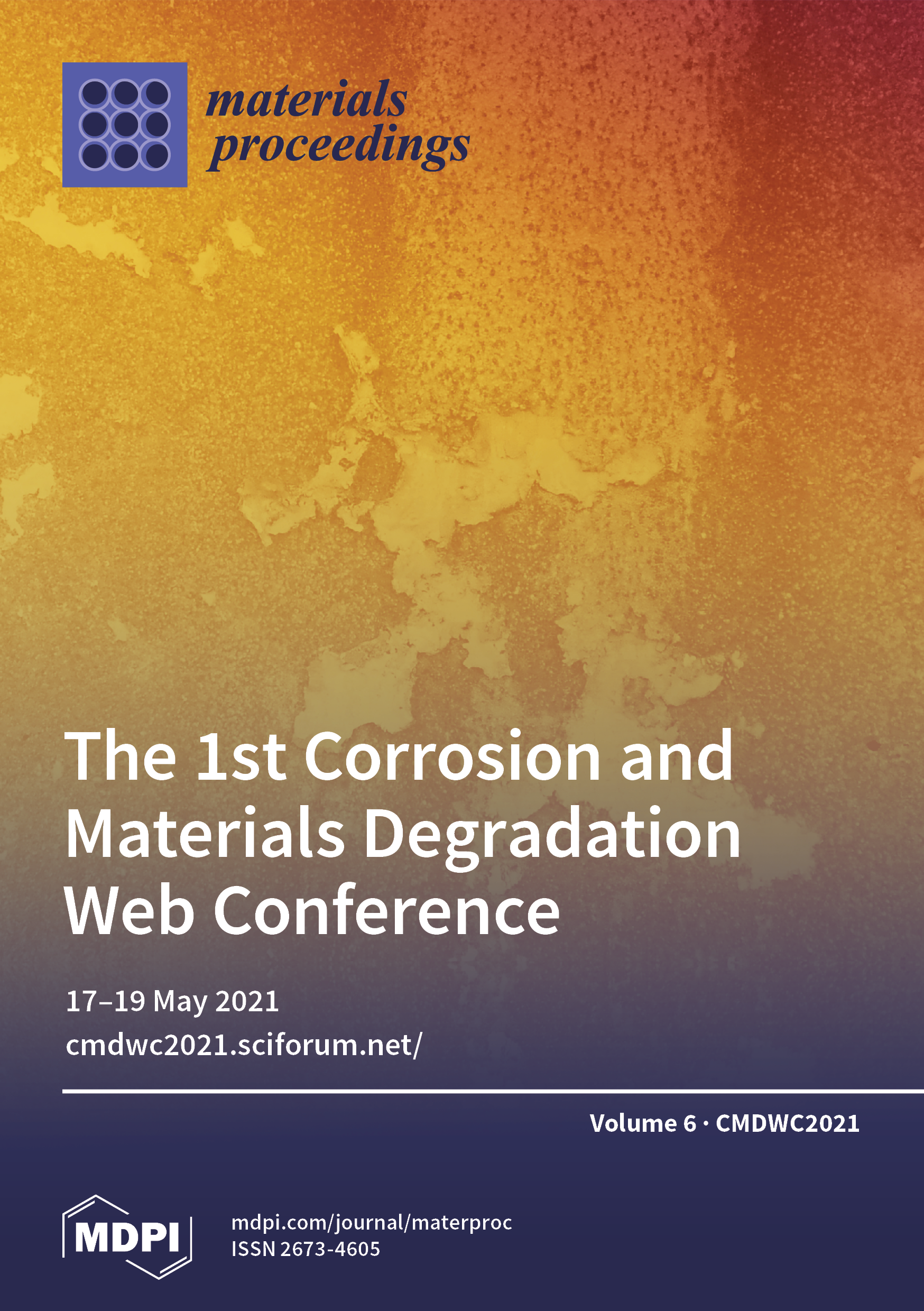
Cover Story: The 1st Corrosion and Materials Degradation Web Conference (CMDWC 2021), which is organized by the MDPI open access journals Corrosion and Materials Degradation (CMD) and Materials, was held online from 17 to 19 May 2021. Corrosion, along with the science and technology of its mitigation, is a long-lived and fascinating subject. It is among the most common forms of material degradation that poses enormous challenges to a variety of industries and can even impact our health. The vexing problem of corrosion continues to cost our society very dearly and has repercussions on the application of new and critical technologies. CMDWC 2021 presents disruptive and novel approaches to corrosion mitigation whose exploitation appears commercially attractive, while also promoting cutting-edge advancements in traditional approaches.
  • Issues are regarded as officially published after their release is announced to the table of contents alert mailing list .
  • You may sign up for email alerts to receive table of contents of newly released issues.
  • PDF is the official format for papers published in both, html and pdf forms. To view the papers in pdf format, click on the "PDF Full-text" link, and use the free Adobe Reader to open them.

Articles (35)

  • Abstract
  • Open Access
927 Views
1 Page

Corrosion Resistance of Electroless Nickel–Boron Coating in a Bath Exempt from Stabilizer

  • Muslum Yunacti,
  • Alexandre Megret,
  • Alex Montagne and
  • Véronique Vitry

Electroless nickel–boron (ENB) coatings from borohydride-reduced baths have received wide acceptance thanks to their excellent hardness and superior wear resistance. Therefore, they have been considered as an alternative to hard chrome. However...

  • Abstract
  • Open Access
980 Views
1 Page

Layered Double Hydroxide Coatings Loaded with Corrosion Inhibitors for Corrosion Protection of AZ31

  • Borja Pillado,
  • Marta Mohedano,
  • Rubén del Olmo,
  • Beatriz Mingo,
  • Endzhe Matykina and
  • Raúl Arrabal

Layered double hydroxide (LDHs) coatings were developed for the corrosion protection of AZ31 Mg alloy. AZ31 is widely used in the transport industry due to its low mass density and good mechanical properties. LDH coatings were fabricated under co-pre...

  • Abstract
  • Open Access
1 Citations
960 Views
1 Page

Corrosivity of Different Natural Groundwaters from Repository Sites

  • Mervi Somervuori,
  • Elisa Isotahdon,
  • Maija Nuppunen-Puputti,
  • Malin Bomberg,
  • Leena Carpén and
  • Pauliina Rajala

In Finland, the repositories for low- and intermediate-level waste (LLW and ILW) are situated in three different geographical locations in deep granite bedrock, where waste containers can be subjected to anoxic groundwater containing microbes. The co...

  • Abstract
  • Open Access
1,489 Views
2 Pages

Data Science Framework to Select Corrosion Inhibitors

  • Tiago L. P. Galvão,
  • Gerard Novell-Leruth,
  • Inês Ferreira,
  • Alena Kuznetsova,
  • José R. B. Gomes and
  • João Tedim

Organic corrosion inhibitors embedded in coatings play a crucial role in substituting for traditional anti-corrosion pigments, which can cause acute toxicity problems to human health and the environment [...]

  • Abstract
  • Open Access
1,119 Views
1 Page

Thermal energy storage (TES) is required when using energy sources that are intermittent in order to fill the gap between energy supply and energy demand. Latent heat storage systems are based on phase change materials (PCM) such as salt hydrates, wh...

  • Abstract
  • Open Access
1,248 Views
1 Page

Experimental Test on Flexural Performance of Prestressed Concrete Beams Damaged by Corrosion

  • Armando Benenato,
  • Barbara Ferracuti,
  • Stefania Imperatore,
  • Mahdi Kioumarsi and
  • Simone Spagnuolo

Prestressed reinforced concrete beams are widely used in industrial and commercial buildings, which are commonly exposed to aggressive environments and damaged by corrosion. This precast construction technique has also been used for the last 50 years...

  • Abstract
  • Open Access
3 Citations
1,324 Views
1 Page

Post-tensioned (PT) construction incorporating bonded tendons with cementitious grouts has been used for highway bridges. The tendon duct and the encapsulating grout materials provide barrier corrosion protection for the embedded high-strength steel...

  • Abstract
  • Open Access
1,299 Views
2 Pages

In contrast to other additive manufacturing methods such as Wire Arc Additive Manufacturing or Laser Metal Deposition, the cold spray system designed by SPEE3D allows for structures to be printed at much lower temperatures. As a result, structures pr...

  • Abstract
  • Open Access
1,092 Views
1 Page

Degradation Rate Control of MgxZnyCa Alloys by PEO Coatings

  • Lara Moreno,
  • Marta Mohedano,
  • Raúl Arrabal and
  • Endzhe Matykina

Magnesium alloys are actively researched for biodegradable implants in order to avoid an implant-removal surgery after the healing process. However, the high degradation rate of Mg leads to hydrogen evolution and may increase the pH of the environmen...

  • Abstract
  • Open Access
1,316 Views
1 Page

Recently, Fe-based amorphous coatings synthesized by different thermal spraying methods have been investigated as a potential candidate for long-term surface protection of various structures due to their outstanding wear and corrosion resistance. Def...

  • Abstract
  • Open Access
1 Citations
1,413 Views
1 Page

Experimental Tests on Bond Performance between Corroded Steel Reinforcements and Concrete

  • Armando Benenato,
  • Barbara Ferracuti,
  • Stefania Imperatore and
  • Mahdi Kioumarsi

The corrosion of steel bars in concrete is a dangerous and extremely costly problem that causes losses of serviceability and structural capacity in buildings and bridges. Once the depassivation occurs, because of concrete carbonation or chloride atta...

  • Abstract
  • Open Access
1 Citations
1,087 Views
1 Page

The corrosion of steel reinforcement is the most significant factor responsible for the premature deterioration of the durability and seismic resistance of reinforced concrete structures. As such, the main objective of the present study is the invest...

  • Abstract
  • Open Access
1,223 Views
2 Pages

Localized Corrosion Degradation of Bioresorbable Mg Alloys Promising for Medicine

  • Andrey S. Gnedenkov,
  • Sviatlana V. Lamaka,
  • Sergey L. Sinebryukhov,
  • Valeriia S. Filonina,
  • Mikhail L. Zheludkevich and
  • Sergey V. Gnedenkov

Magnesium is very light metal which possesses many useful properties, such as a high strength to weight ratio and good electrical and thermal conductivity. Magnesium and its alloys can be used in implant surgery as biodegradable materials. Taking int...

  • Abstract
  • Open Access
2 Citations
1,278 Views
2 Pages

According to currently enforced Eurocode 2 for the design of reinforced concrete structures, it is essential to protect steel reinforcements from corrosion and concrete from degradation under aggressive environmental conditions such as marine, urban,...

  • Abstract
  • Open Access
1,280 Views
1 Page

Metal fatigue management is generally well understood as reflected in the Aircraft Structural Integrity Management Plans, which, in some cases, consider environmental degradation prevention; however, limited provisions beyond find and fix exist for c...

  • Abstract
  • Open Access
1 Citations
1,930 Views
1 Page

Zinc phosphate coatings are commonly used to protect high-strength steel rods and improve the corrosion protection ability. The temperature and the pH of the phosphating bath are important parameters that affect to the film’s appearance, porosi...

  • Abstract
  • Open Access
1 Citations
1,111 Views
2 Pages

Electrochemical and Morphological Characterization of Fe-28Mn-6Si-5Cr Shape Memory Steel

  • Carmen Mariño-Martínez,
  • Antonio Collazo,
  • Xosé Ramón Nóvoa and
  • Carmen Pérez

In this paper, the Shape Memory Steel (SMS), a new kind of ferrous SMA of the Mn family and complemented with Cr additions, is introduced as a very interesting smart material, able to be used in fitting and reshaping applications, and with the potent...

  • Abstract
  • Open Access
1,142 Views
1 Page

Innovative 3D metal additive manufacturing (AM) techniques are revolutionizing the biomedical industry, since they enable the production of porous structures and patient-customized parts of biomedical-grade materials, such as Ti alloys. Surface treat...

  • Abstract
  • Open Access
999 Views
1 Page

Influence of Waste Glass Powder Addition in the Microstructure and Durability of Mortars in the Very Long Term

  • Rosa María Tremiño,
  • Teresa Real-Herraiz,
  • Viviana Letelier and
  • José Marcos Ortega

At present, the cement industry still constitutes an important pollutant in the industrial sector. As such, strategies to reduce its environmental impact are a popular research topic. One of these strategies consists of partially replacing clinker wi...

  • Abstract
  • Open Access
1 Citations
1,415 Views
1 Page

Traditional additive manufacturing (AM) technologies tend to focus on powder bed fusion (PBF) methods, such as SLM (selective laser melting) and EBM (electron beam melting), that are attractive for the rapid production of complex components. However,...

  • Proceeding Paper
  • Open Access
4 Citations
5,933 Views
10 Pages

Evaluation and Prevention of Hydrogen Embrittlement by NDT Methods: A Review

  • Sujeet Choudhary,
  • Manish Vishwakarma and
  • Sandeep Kumar Dwivedi

This paper comprises of hydrogen embrittlement phenomena in material, factors responsible for the hydrogen embrittlement and non-destructive methods to evaluate the internal defect in machines or components when working in hydrogen atmosphere. Hydrog...

  • Abstract
  • Open Access
1,191 Views
1 Page

Cerium salts in the form of ammonium cerium(IV) nitrate and cerium(III) nitrate hexahydrate are widely used as corrosion inhibitors due to their ability to provide active protection against corrosion. When incorporated into polymeric, ceramic or hybr...

  • Abstract
  • Open Access
1,296 Views
1 Page

Study of the Iron Behavior in Acid Rain Water Solution by Application of Two Green Corrosion Inhibitors

  • Meryem Zouarhi,
  • Said Abbout,
  • Hind Hammouch,
  • Mohamed Chellouli,
  • Hamid Erramli,
  • Hassane Said Omar Said,
  • Naima Bettach and
  • Najat Hajjaji

The corrosion of iron in an acidic medium similar to acid rainwater (pH = 3.6) at various rotation speeds was investigated. The investigation included the inhibiting effect of two new green formulations containing oils extracted from the seeds of Jat...

  • Abstract
  • Open Access
1,093 Views
1 Page

Effect of Temperature on Curing Time of Single-Lap Adhesive Joints in Marine Applications

  • Tiziana Alderucci,
  • Chiara Borsellino,
  • Guido Di Bella and
  • Federica Favaloro

In the industrial field, manufacturing time is one of the most important factors affecting production costs. Structural adhesives require long curing times (i.e., 3–4 weeks) before the joined components can be safely employed. The aim of the present...

  • Abstract
  • Open Access
2,679 Views
1 Page

Aluminum in Dental Implants: How to Reduce a Potential Risk to Patient’s Health?

  • Željka Petrović,
  • Ankica Šarić,
  • Ines Despotović,
  • Jozefina Katić and
  • Marin Petković

Some commercial dental implants contain aluminum, which represents a potential risk to health, since aluminum is associated with neurodegenerative diseases such as Alzheimer’s disease. Therefore, control of the chemical composition as well as t...

  • Abstract
  • Open Access
1,008 Views
1 Page

Modelling of Time-Dependent Behaviour of Corroded Reinforced Concrete Elements

  • Francesca Vecchi,
  • Lorenzo Franceschini and
  • Beatrice Belletti

Nowadays, the durability of reinforced concrete (RC) elements affected by corrosion has become a worldwide research topic, especially after some catastrophic failures that have involved corroded structures and infrastructures. One of the main purpose...

  • Abstract
  • Open Access
1,171 Views
1 Page

Hydrothermal Degradation of Biobased Poly(butylene succinate)/Nanofibrillated Cellulose Composites

  • Olesja Starkova,
  • Oskars Platnieks,
  • Alisa Sabalina and
  • Sergejs Gaidukovs

Biobased polymers and composites have gained increased global attention due to their abundance, renewability, and biodegradability. Natural fillers such as cellulose-based fillers improve the mechanical properties of biopolymers, extending their appl...

  • Abstract
  • Open Access
1,087 Views
1 Page

Corrosion Behavior of Al7Cu0.2Si0.2Zn0.2Mg0.1 Complex Concentrated Alloy, in 3wt% and 5wt% Na Cl Solution

  • Dumitru Mitrica,
  • Denisa Vonica,
  • Marian Burada,
  • Mihai Tudor Olaru,
  • Beatrice Adriana Serban,
  • Ioana Cristina Badea and
  • Ioana Anasiei

Complex concentrated alloys (CCAs) are new types of materials, where the equimolar rule proposed by high entropy alloys (HEAs) is modified in relation to the potential of the obtained structures. CCAs expend the compositional space of the conventiona...

  • Abstract
  • Open Access
1,047 Views
1 Page

Effect of Sandblasting on the Long-Term Corrosion Resistance of Ti G4 in Artificial Saliva

  • Patrycja Osak,
  • Maciej Zubko,
  • Julian Kubisztal,
  • Joanna Maszybrocka and
  • Bożena Łosiewicz

Titanium Grade 4 (G4) is the most commonly used material for dental implants due to its excellent biocompatibility and mechanical properties. However, titanium implants require a rough surface that can increase the biomechanical potential of implant–...

  • Abstract
  • Open Access
2 Citations
1,106 Views
1 Page

Corrosion Properties of Biodegradable AZ31 and ZK60 Magnesium Alloys: In Situ Study

  • Evgeniy Merson,
  • Vitaliy Poluyanov,
  • Dmitry Merson and
  • Pavel Myagkikh

Biodegradable magnesium alloys are promising materials for application in medicine. The corrosion rate and type of corrosion are among the most important properties for this kind of materials. The fine-grained biodegradable alloys AZ31 (hot-rolled) a...

  • Abstract
  • Open Access
1,202 Views
1 Page

Stainless steel is a material manufactured for its high corrosive resistance and is the first choice of material in a range of applications. Microbial-induced corrosion can cause significant damage to metals and is responsible for approximately 20% o...

  • Abstract
  • Open Access
1,077 Views
1 Page

Nano Topography Evaluation of NiTi Alloy Exposed to Artificial Saliva and Different Mouthwashes

  • Zoran Bobić,
  • Bojan Petrović,
  • Sanja Kojić,
  • Vladimir Terek,
  • Branko Škorić,
  • Lazar Kovačević and
  • Pal Terek

Evaluation of NiTi alloy corrosion behavior in conditions that exist in the oral cavity still remains a great characterization challenge. Such characterization is commonly simplified by avoiding the use of non-accelerated corrosion tests. Accordingly...

  • Abstract
  • Open Access
969 Views
1 Page

Restorative dental materials must be produced with special characteristics because they are operating in a medium environment with different humidity and temperature. These day-to-day factors play an important role in the lifetime of such dental rest...

  • Abstract
  • Open Access
1,349 Views
1 Page

The chloride-induced corrosion of steel reinforcement is one of the main causes of deterioration of reinforced concrete structures. Cathodic protection (CP) of steel in concrete is a widely accepted repair technique to reduce, or completely stop, rei...

  • Abstract
  • Open Access
3 Citations
1,330 Views
2 Pages

Fibre-reinforced composite materials are used in structural applications in marine, offshore, and oil and gas industries due to their light weight and excellent mechanical properties. However, the exposure of such materials to water leads to environm...

XFacebookLinkedIn
Mater. Proc. - ISSN 2673-4605