Abstract
Wireless Body Area Networks (WBANs) are a key application underpinned by advances in electronic textiles (e-textiles). Achieving higher throughput, data-rate, network capacity, and delivering wireless power to miniaturized devices requires WBANs to operate at millimeter-wave 5G+ frequencies. This, however, imposes significant challenges on the antenna design to cope with the additional losses introduced by textile substrates. In this paper, the performance of a novel, high-efficiency, textile-based millimeter-wave antenna is investigated for wireless links with a wearable device. Indoor “real-world” channel gain measurements are used to evaluate the antenna’s performance compared to anechoic gain measurements. Based on the measured channel gain between textile antennas, it is concluded that high-speed wireless links in the 24–30 GHz 5G+ spectrum could be realized with over one meter range using e-textile antennas.
1. Introduction
Wireless Body Area Networks (WBANs) are widely regarded as the most scalable and convenient method of connecting wearable devices. On-body WBANs, where wearables communicate between each other on the same body, as well as off-body WBANs, where the wearables communicate with a gateway away from the body, have attracted significant research interest [1].
Recently adopted for 5G communications, millimeter-wave (mmWave) bands are expected to enable high data-rate communications as well as energy-efficient networks based on wireless power transmission (WPT) [2]. Nevertheless, at mmWave frequencies, antennas are typically fabricated on low-loss, dielectric-stable substrates to achieve high gain and radiation efficiency. Recently, a range of textile-based antennas have been proposed for mmWave wearable applications [3,4]. A range of e-textile fabrication methods, including the laser ablation of copper films [3], photolithography on polyimide flexible circuit filaments [4], as well as screen printing combined with heat transfer [5], have been used to realize mmWave components such as antennas, transmission lines, and capacitors on textile substrates. While the radiation efficiency of textile-based mmWave antennas remains below their non-textile counterparts, the antennas’ gains, characterized through anechoic radiation pattern measurements, show the potential for high-speed communications and WPT. In most mmWave network architectures, directional antenna arrays with high gain are used [1]. Therefore, it is essential to experimentally characterize the link budget between e-textile, wearable mmWave antennas, where the highly dynamic and mobile body-centric environment may hinder effective communication between mmWave wearables.
In this paper, a state-of-the-art, textile-based mmWave microstrip antenna implemented on a woven polyester substrate is investigated for wearable applications in line of sight and non-line of sight cases. Through empirical channel gain measurements, it is shown that e-textile mmWave antennas are suitable for operation in this environment.
2. E-Textile mmWave Antenna Fabrication
The key requirements for maintaining a low conductor loss in mmWave bands are high conductivity and low roughness [3,5]. To explain, skin-depth-induced losses increase with frequency. Therefore, rough conductors are expected to introduce additional attenuation compared to those of smooth lines. This can be attributed to the low quality and homogeneity of the surface of the conductor, where most of the currents are confined in microwave and mmWave bands [5]. Therefore, to realize a high-efficiency antenna with minimal conductive losses, the photolithography of commercially available, flexible copper laminates is used to fabricate the antenna. The fabrication steps are summarized in Figure 1. The flexible copper laminates are based on a low-loss (mmWave dissipation factor < 0.01) polyimide film. The textile substrate used is woven polyester with a relative permittivity εr = 1.95 and dissipation factor tanδ = 0.026. Following the patterning of the copper sheets to create the antenna’s radiating top layer, the flexible polyimide antenna can be laminated onto different textile substrates, including rough fabrics unsuitable for direct printing [5], as shown in Figure 1e.
Figure 1.
Fabrication process of e-textile mmWave antennas for 5G+ applications based on etched polyimide copper laminates: (a) 25 μm-thick copper-clad Kapton; (b) photoresist deposition; (c) UV exposure through a film mask; (d) antenna traces following etching; (e) antenna traces adhered to fabric.
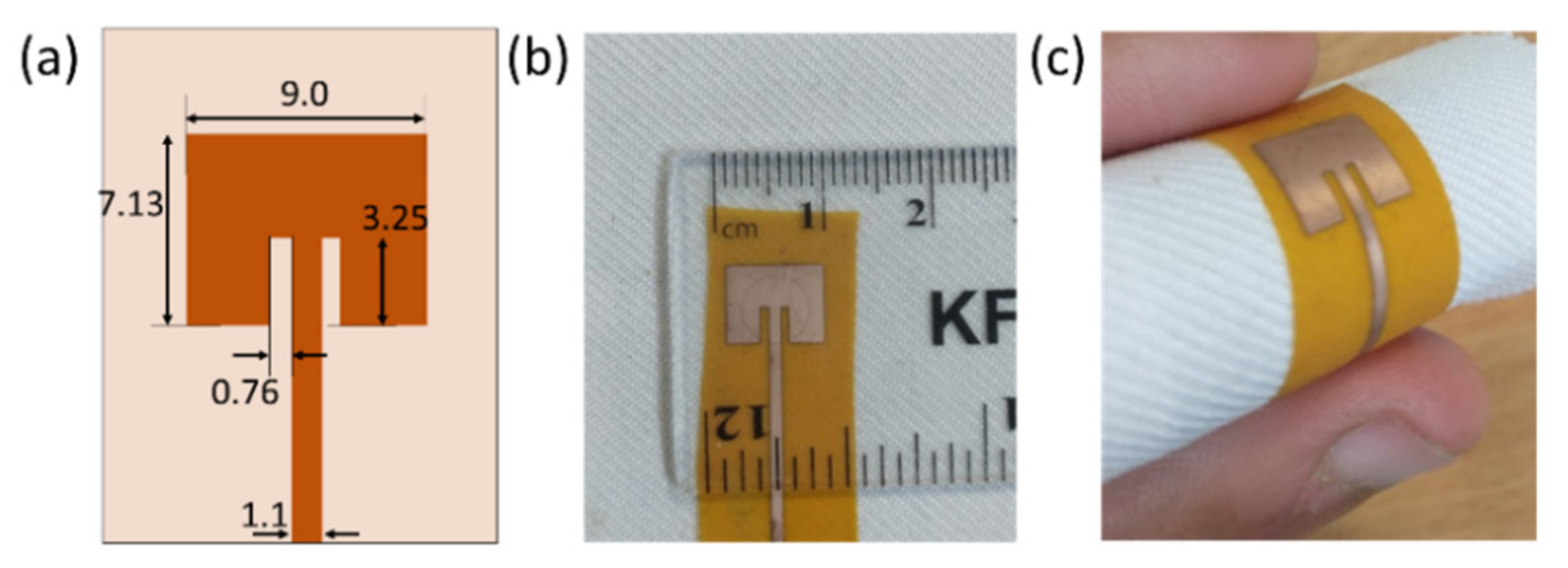
The antenna used in this work is based on a modified microstrip patch antenna with an inset feed, designed to maintain a matched input impedance over two resonant transverse magnetic (TM) second-order modes, to achieve a wider beamwidth than a conventional first-order mode microstrip antenna [6]. Figure 2a shows the layout and dimensions of the antenna, optimized for the woven polyester substrate. The bottom layer of the antenna is composed of a conductive ground plane, which can be realized using low-cost, breathable conductive fabrics [2] or a printed silver layer [3]. Figure 2b,c are photographs of the fabricated prototype, demonstrating its flexibility.
Figure 2.
The Kapton-on-woven polyester mmWave antenna (a) layout and dimensions (in mm); (b) the fabricated device; (c) applied to a surface with approximate bend radius of 5 mm.
3. mmWave E-Textile Antenna Characterization
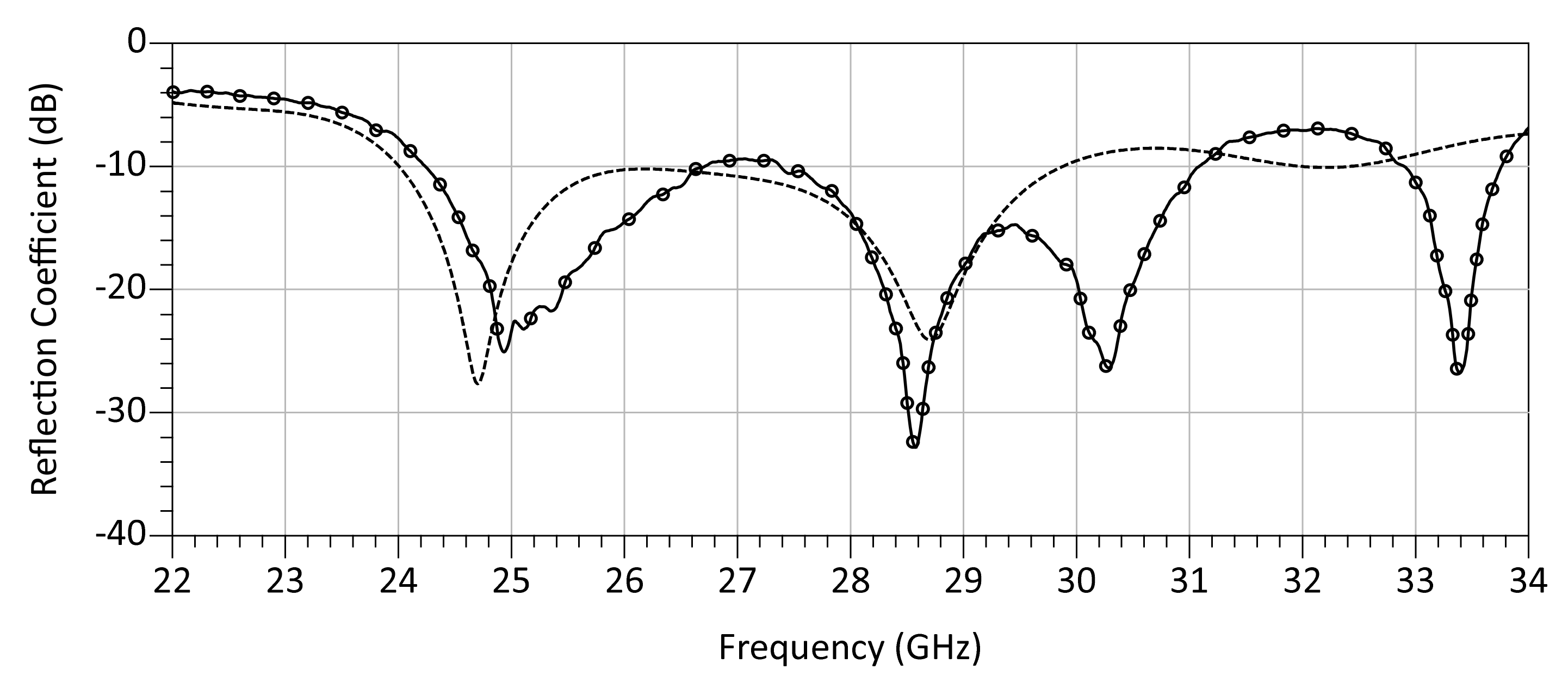
The fabricated prototype was characterized experimentally to evaluate its bandwidth and radiation properties. A key requirement of a mmWave antenna is the maintenance of a broad bandwidth [4]. To explain, a key advantage of operating at mmWave frequencies is the wider spectrum availability compared to sub-6 GHz bands [2]. For example, mmWave 5G uses the 26 and 28 GHz bands, with a combined bandwidth of over 4 GHz. To measure the antenna’s response, a solder-terminated 1.85 mm connector was added to the microstrip feed. The antenna’s reflection coefficient was measured using an Agilent E8361A PNA Vector Network Analyzer (VNA), calibrated using a standard electronic calibration kit. Figure 3 shows the measured reflection coefficient of the antenna as well as the simulated response, obtained through full-wave numerical electromagnetic simulation in CST Microwave Studio Suite.
Figure 3.
Simulated (no marker) and measured (solid with markers) reflection coefficient (S11) of the antenna, showing an S11 < −10 dB bandwidth from 24.2 to 31.1 GHz.
As observed in Figure 3, the antenna fulfills the bandwidth requirement of a 5G wearable antenna, where both the measured and simulated S11 responses indicate that over 90% of the power will be accepted by the antenna, demonstrating its suitability for integration in mmWave 24.2–30 GHz transceiver RF chains including amplifiers.
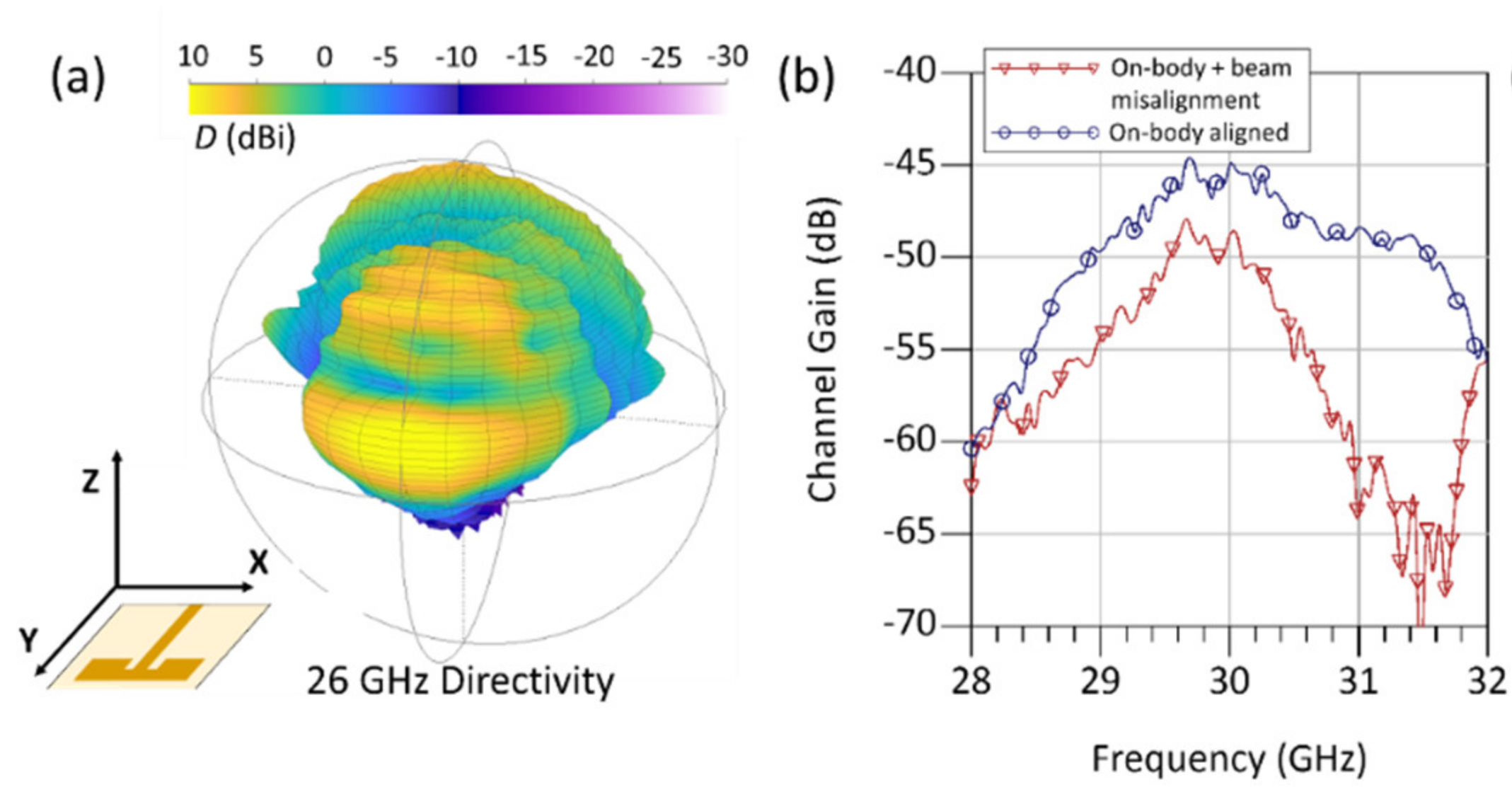
To evaluate the antenna’s far-field properties and subsequent performance in real-world, on-body mmWave links, the antenna’s radiation patterns were experimentally measured. The polarized radiation pattern measurements were performed relative to a standard 20 dBi gain waveguide horn antenna in an anechoic chamber. The total efficiency of the textile antenna (inclusive of impedance mismatch losses) was calculated relative to the horn antenna [4]. Figure 4a shows the measured 3D radiation patterns of the antenna, where it can be seen that the antenna maintains two main lobes, in line with a standard second-order mode microstrip patch antenna.
Figure 4.
The far-field performance of the e-textile mmWave antenna: (a) measured 3D spherical radiation patterns; (b) measured channel gain between symmetric antennas on-body, with and without main beam alignment at a 60 cm distance.
The total efficiency of the antenna, with respect to the reference horn, was found to be around 60% (±5%). The antenna was experimentally characterized through channel gain measurements to show its suitability for on-body mmWave communications. In Figure 4b, it can be seen that over −55 dB forward transmission can be maintained between two symmetric textile antennas along the body with and without main beam alignment. Such a link budget would enable this e-textile antenna to integrate with recently reported, short-range, high-data-rate mmWave transceivers, such as low-power, high-speed backscattering modulators printed on flexible substrates [7].
4. Conclusions
In this paper, the performance of a mmWave e-textile antenna was characterized, demonstrating its suitability for short-range, high-speed communication in 5G mmWave bands. It is anticipated that low-profile and high-efficiency mmWave textile-based antennas, such as the microstrip patch considered in this study, will enable future WBANs to leverage the mmWave spectrum to improve their throughput and end-to-end efficiency.
Author Contributions
Conceptualization, M.W.; methodology, M.W.; investigation, M.W. and G.S.H.; writing—original draft preparation, M.W.; writing—review and editing, M.W., A.S.W. and S.B.; funding acquisition, S.B. All authors have read and agreed to the published version of the manuscript.
Funding
This work was supported by the UK Engineering and Physical Sciences Research Council (EPSRC) under Grant EP/P010164/1. The work of Steve Beeby was supported by the Royal Academy of Engineering under the Chairs in Emerging Technologies Scheme. Data access: The datasets used in this work are available from doi:10.5258/SOTON/D1931.
Institutional Review Board Statement
Ethical approval has been obtained from the FEPS Faculty Ethics Committee, University of Southampton, SO17 1BJ, application number: 64814, approved: 26 August 2021.
Informed Consent Statement
Not applicable.
Data Availability Statement
Not applicable.
Conflicts of Interest
The authors declare no conflict of interest.
References
- Hall, P.; Hao, Y. Antennas and Propagation for Body-Centric Wireless Communications, 2nd ed.; Artech: Morristown, NJ, USA, 2012. [Google Scholar]
- Rappaport, T.S.; Sun, S.; Mayzus, R.; Zhao, H.; Azar, Y.; Wang, K.; Wong, G.N.; Schulz, J.K.; Samimi, M.; Gutierrez, F. Millimeter Wave Mobile Communications for 5G Cellular: It Will Work! IEEE Access 2013, 1, 335–349. [Google Scholar] [CrossRef]
- Chahat, N.; Zhadobov, M.; Muhammad, S.A.; le Coq, L.; Sauleau, R. 60-GHz Textile Antenna Array for Body-Centric Communications. IEEE Trans. Antennas Propag. 2013, 61, 1816–1824. [Google Scholar] [CrossRef]
- Wagih, M.; Hilton, G.S.; Weddell, A.S.; Beeby, S. Broadband Millimeter-Wave Textile-Based Flexible Rectenna for Wearable Energy Harvesting. IEEE Trans. Microw. Theory Tech. 2020, 68, 4960–4972. [Google Scholar] [CrossRef]
- Wagih, M.; Komolafe, A.; Hillier, N. Screen-Printable Flexible Textile-Based Ultra-Broadband Millimeter-Wave DC-Blocking Transmission Lines Based on Microstrip-Embedded Printed Capacitors. IEEE J. Microw. 2021, 2, 162–173. [Google Scholar] [CrossRef]
- Wagih, M.; Hilton, G.S.; Weddell, A.S.; Beeby, S. Millimeter Wave Power Transmission for Compact and Large-Area Wearable IoT Devices based on a Higher-Order Mode Wearable Antenna. IEEE Internet Things J. 2021. [Google Scholar] [CrossRef]
- Kimionis, J.; Georgiadis, A.; Daskalakis, S.N.; Tentzeris, M.M. A printed millimetre-wave modulator and antenna array for backscatter communications at gigabit data rates. Nat. Electron. 2021, 4, 439–446. [Google Scholar] [CrossRef]

Publisher’s Note: MDPI stays neutral with regard to jurisdictional claims in published maps and institutional affiliations. |
© 2022 by the authors. Licensee MDPI, Basel, Switzerland. This article is an open access article distributed under the terms and conditions of the Creative Commons Attribution (CC BY) license (https://creativecommons.org/licenses/by/4.0/).