1. Introduction
Grid resilience is the ability of power systems to withstand, conform to, and recover from disruptions like intense weather, equipment failures, human errors, and cyber-attacks [
1]. It is a key parameter that alters the quality and reliability of power supply and can foster economic growth. Globally and in Africa, the electricity grid is transitioning at all levels—generation, transmission, and distribution—thus affecting grid resilience [
2]. This transition is mainly seen due to increasing integration of variable renewable energy (VRE), energy storage, and emerging technologies such as smart grids and electric vehicles. African countries face challenges due to outdated and aging grid infrastructure, contributing to high electricity losses and suboptimal supply quality. To support the energy transition and achieve grid resilience, it is essential to enhance the planning, operation, and maintenance of these electricity grids. This effort should be complemented by substantial investments in modern technologies such as Machine Learning (ML) usage in electrical power systems, expansion of distribution and transmission networks, advanced energy storage systems, and other innovations that bolster system resilience—lower greenhouse gas emissions, reinforce national and regional power systems—and minimize both technical and commercial losses [
3].
In recent years, with greater emphasis on data-driven solutions, ML has emerged as an effective method for strengthening the resilience of general power systems. ML is a sub-field of Artificial Intelligence (AI), and it entails the process of enabling machines to learn from experience, adapt to new inputs, handle large volumes of data, and perform tasks like those done by humans. ML can learn from data with the least reliance on mathematical models of the physical systems, offering a potential solution to address technical challenges often experienced in power systems [
4].
Given the above capabilities, ML can be used for solving complex problems in power engineering. These include predictive maintenance, intelligent control, and data-driven planning. In power generation, ML supports production forecasting, renewable energy integration, predictive maintenance, operational efficiency control, fault detection, and diagnostics. Within transmission and distribution, it facilitates fault detection and predictive maintenance. Additionally, ML contributes to energy demand forecasting, distributed system planning, load balancing, renewable energy integration, and energy theft detection, thereby minimizing downtime [
4].
The long-term sustainability of Africa’s power systems requires consideration of future power networks and stakeholder needs, as well as the design of resilient systems capable of serving communities amid various challenges, including those related to climate change. This paper critically reviews ML applications and their potential benefits in strengthening African power grids across generation, transmission, and distribution. Papers were identified from Google Scholar, Elsevier, IEEE Xplore, MDPI, and the World Wide Web. To ensure a comprehensive methodology, publications from 2015 to 2025 were reviewed to reflect recent advancements in Machine Learning (ML), especially deep learning. Keywords included grid resilience, artificial intelligence, machine learning, deep learning, neural networks, power grids, and Africa. Peer-reviewed articles and conference papers on ML applications for grid resilience relevant to Africa were grouped by their specific ML use cases. The paper reviews ML use cases like predictive maintenance, demand forecasting, ML algorithms’ performance, grid stability, renewables integration, and cybersecurity, and suggests ways to integrate ML into Africa’s power grids.
2. Overview of Power Grids in Africa
2.1. Infrastructure Challenges
Energy infrastructure plays an essential role in supporting the modern economy. In Africa, several power system assets and infrastructure are considered outdated and may be prone to faults, with limited automation in detecting and alleviating the conditions. Policymakers must produce solutions to upgrade the power systems to meet increasing demand. At present, planning decisions related to resilience are largely made using established rules and rely significantly on human intervention [
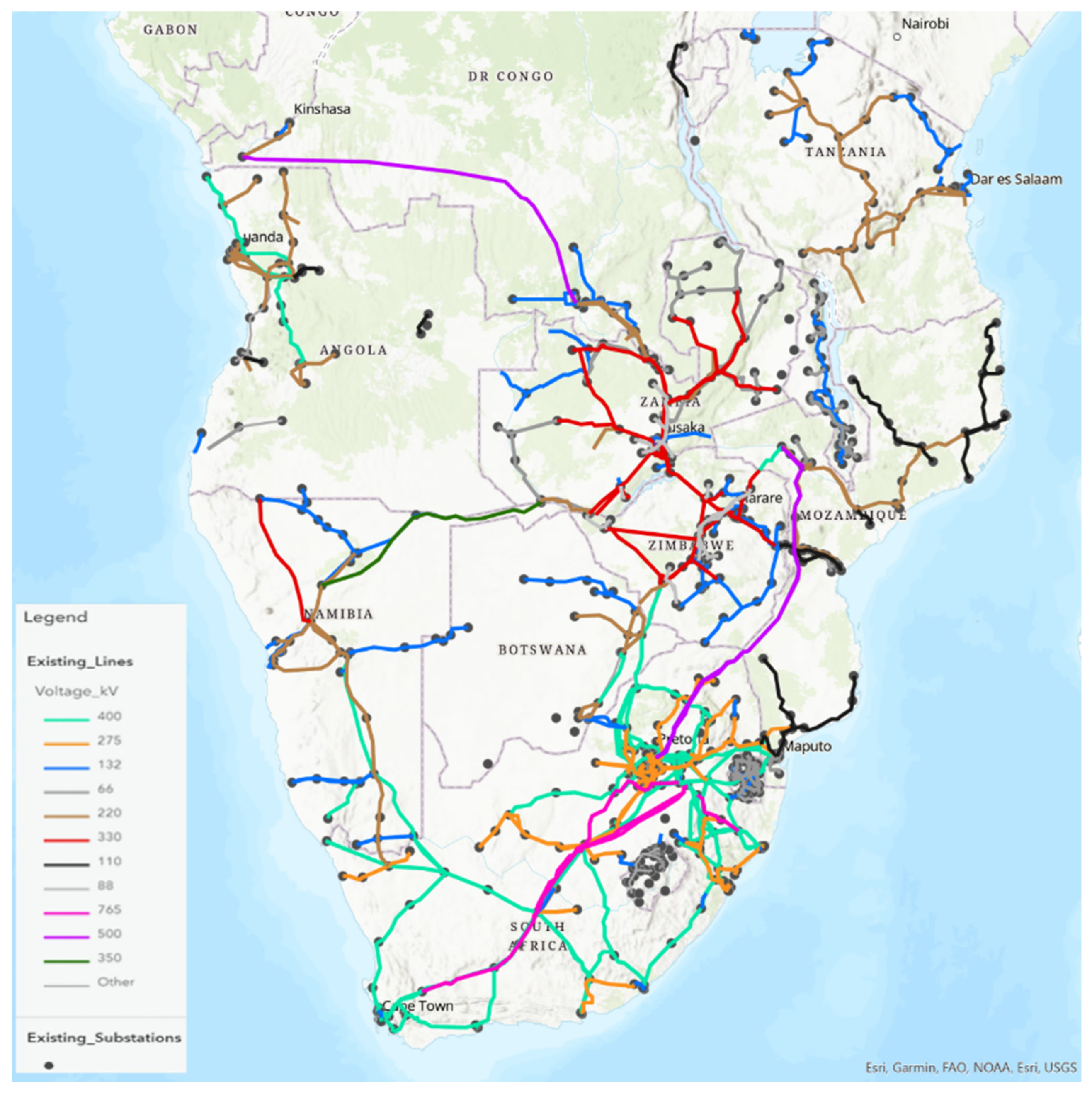
1]. Power grid interconnections have been utilized for exchanging electricity in regional power pools, namely the Southern African Power Pool (SAPP) in
Figure 1, which links the grids of several Southern African Development Community (SADC) countries. This has improved power and voltage stability while allowing power flows to load centers, where resilience and supply reliability are of major importance [
5]. In recent years, the SADC region has faced challenges in generating a daily average power output of approximately 76 GW, with South Africa accounting for around 59 GW. The application of ML techniques may be necessary for short-term forecasts of dispatchable power generation, swiftly rerouting it and determining the impact on the region’s economic growth. Reliable access to electricity extends productive hours and contributes to improvements in health, safety, and overall economic activity [
6].
2.2. Operational Challenges
Utilities in Africa experience overloading and turn to load shedding for energy management. This is often accompanied by issues of poor power quality. Data availability is restricted due to sparse sensor deployment and data quality.
This poses challenges for implementing data-driven solutions including ML. In some regions like West Africa, the grid consists of widely dispersed, low-density consumption points across large geographic areas, influenced by economic and technological factors. Various approaches, including the adoption of VRE such as solar, are being implemented to address energy access and improve grid resilience. However, increasing VRE integration introduces variability and intermittency which can affect power generation schedules. Energy storage is crucial to accommodate the VRE. However, in many countries, for example, Benin, Ghana and Zimbabwe, energy storage options—namely batteries and hydro storage—remain underdeveloped. ML can support by producing dependable generation forecasts for VRE power [
8].
3. Machine Learning Applications for Enhancing Grid Resilience
Across Africa, grid infrastructure frequently faces challenges such as limited visibility due to few phasor measurement units or advanced metering systems, data quality problems, maintenance delays, and financial limitations. In this context, ML may offer an affordable way to strengthen resilience with algorithms that can take preventive actions, attenuate major disruptions, automate generation, and load control with economic benefits. In recent years, advanced technologies have been adopted to enhance resiliency across generation, transmission, distribution, and renewable energy integration [
9]. This is highlighted in the literature as captured below.
3.1. Predictive Maintenance and Asset Management
The growing complexity of power systems in Africa necessitates proactive predictive maintenance and asset management plans to warrant steady operations. In this context, Ref. [
10] implemented multiple ML for predictive maintenance in transformers, with the goal of improving system integrity, efficiency, safety, and resilience. The study evaluated models comprising Logistic Regression, Support Vector Machine (SVM), K-Nearest Neighbors, Decision Tree, Random Forest, Extra Trees, AdaBoost, and XGBoost. Historical data consisting of oil levels, temperature, current, and voltage was analyzed. Advanced ML algorithms were utilized to forecast potential faults before they could escalate. The results demonstrated a high accuracy rate, with the ensemble methodology achieving 98.80%, while [
11] examined predictive maintenance of substation equipment with a multi-layered perceptron (MLP) to categorize the thermal conditions of substation components as either “failing” or “faultless.” The MLP achieved an initial accuracy of 79.78%. Accuracy increased to 84% when the MLP was combined with a graph cut approach.
Reference [
12] analyzed fatigue loads in wind farms using a Fatigue Reduction active power allocation algorithm based on convex reward reinforcement learning (RL). This approach combines Soft Actor-Critic (SAC) RL with Input Convex Neural Networks (ICNNs) to improve convergence and generalization, and to address the nonlinear dynamics found in wind farm operations. Analyses indicate that this method helps to reduce the equivalent fatigue load of the tower and main shaft in wind farms more effectively than traditional approaches; hence, maintenance works can be carried out before any major damages. In reference [
13], the Random Forest model for fault classification was examined. The research introduced the Autonomous Fault Explorer (AFE), which can independently identify and categorize faults. Results indicated that the AFE enables rapid and accurate fault detection in electrical grids.
3.2. Demand Forecasting and Load Management
In African contexts, power utilities are increasingly focused on monitoring energy consumption to enable effective demand response strategies. Load forecasting facilitates energy management and scheduling, playing a critical role in supporting supply stability by ensuring an optimal balance between demand and supply. The authors of [
14] presented an hourly energy prediction method through the implementation of a parallel deep learning framework, incorporating both Convolutional Neural Networks (CNNs) and Gated Recurrent Units (GRUs). The results illustrated that the proposed model delivers robust predictive performance, as evidenced by evaluation criteria—namely Mean Absolute Error (MAE), Mean Absolute Percentage Error (MAPE), and Root Mean Squared Error (RMSE). The researchers of [
11] applied deep learning (DL) to estimate electricity demand. The DL regression algorithm performed well with an R squared (R
2) of 0.93 and MAPE = 2.9%, while AdaBoost had the lowest results (R
2 = 0.75, MAPE = 5.7%).
The authors of [
15] used smart meter data to improve demand response by applying ensemble clustering (EC). Compared with K-Means++, fuzzy K-Means, and Spectral Clustering on 5567 households using metrics like Silhouette Score, Davies Bouldin Score, and Dunn Index, EC performed best, whilst a multi objective genetic algorithm, Covariance Matrix Adaptation Evolution Strategy (CMA-ES), was applied for precise energy forecasting and load optimization, enhancing grid efficiency in [
16]. Compared to RNNs and tree-based models, this method delivered superior precision and computational efficiency.
3.3. Grid Stability and Control
Stability assessment and prediction have become increasingly important in modern African grids, particularly owing to the integration of VRE sources, which can significantly impact grid stability. Traditional methods for evaluating and forecasting grid stability typically rely on modeling, simulations, and human expertise. These approaches are inadequate for managing the current grid complexity. ML techniques such as logistic regression (LR), random forest (RF), and support vector machines (SVMs) were applied in [
17] to assess, predict, and enhance grid stability. The results show that these methods adequately balance the grid and model complex scenarios. Another paper [
18] introduced an AI-driven approach for predicting a system’s stability margin based on its operating conditions. The stability rating technique was evaluated using dispatch scenarios, each derived and adapted from operational cases within the Western Electricity Coordinating Council (WECC) system model, which has over 20,000 buses. The findings indicate that the algorithm can forecast the stability boundary of such a large grid in under 0.2 milliseconds, utilizing an offline-trained agent.
Q-learning was used in [
19] for the power angle stability problem. The algorithm was evaluated on both an IEEE-39 node system and a real power grid. Results indicated that the method is capable of automatically adjusting and generating stability control strategies based on the system’s operating state and its response to faults. The approach demonstrated improved decision making and efficiency compared to previous methods. In a separate study [
20], a symmetric technique was used to improve the grid strength by incorporating ML and DL methods. Ensemble techniques—the voting and Dempster Shafer (DS) methods—were contrasted. The outcomes revealed that the application of the fusion distinct classifiers with voting theory reached an accuracy of 99.8% and surpassed other approaches inclusive of the DS method.
3.4. Renewable Energy Integration
As the proportion of VRE increases in power grids, grid resilience can be affected due to the variability and intermittency of these sources. DL and ensemble frameworks have been used in [
21] to enhance the precision of renewable energy forecasting. The results showed that this approach assists in managing the uncertainty associated with VRE generation and provides grid operators with accurate data for dynamic grid management. In [
22], the objective was to examine artificial neural network (ANN) models to predict VRE sources with an ensemble learning approach. The findings indicate that the ensemble learning (EL) exceeds long short-term memory (LSTM), light gradient boosting machine (LightGBM), and sequenced Gated Recurrent Units (GRUs) in forecasting wind power (MAE: 0.782, MAPE: 0.702, RMSE: 0.833) and solar power (MAE: 1.082, MAPE: 0.921, RMSE: 1.055). The methodology realized an R
2 value of 0.9821, demonstrating a better accuracy.
In [
23], the authors presented a power management system that uses ML algorithms to optimize energy distribution and storage, aiming to maintain resiliency and environmental sustainability. The system applied predictive models to estimate future energy yields and utilization patterns, allowing adjustments to balance supply and demand. The research reported improvements in energy efficiency and cost reduction, indicating the probable impact of applying ML in the energy sector. This study [
24] assessed to what degree ML enhances energy forecasting, grid management, and storage optimization for increased VRE reliability and efficiency. Using LSTM, RF, and SVMs to predict generation and demand patterns yielded a 15% boost in grid efficiency and a 10–20% gain in battery energy storage efficiency.
3.5. Cybersecurity and Threat Detection
Recent increases in cyber-attacks and extreme weather events affect power system operations. While several studies aim to improve resiliency, few management tools are available for operators. Ensuring high data quality is essential prior to applying the measurements for situational awareness and decision making. An ML-based anomaly reduction algorithm was used in [
25] that leveraged regression, clustering, and DL as detectors that feed reliable cyber data for system resiliency. They used synchronized grid data to help operators assess resiliency and maintain energy supply to strategic loads during cyber-attacks or natural failures. In [
26] an AI-powered Intrusion Detection System (IDS) for VRE grids, incorporating RF and Autoencoders to detect not only known and zero-day cyber threats in real time. Analysis with real world datasets shows the model attains 97.8% accuracy and lowers false positives versus traditional IDS.
A Restricted Boltzmann Machine-based inclined artificial root foraging optimization algorithm, classified as a metaheuristic algorithm, was applied in [
27] to recognize and categorize cyber-attacks by implementing deep learning algorithms and optimizing data attributes. The researchers utilized publicly available datasets, and the results revealed that the proposed algorithm attained higher accuracy, precision, and recall in contrast to other methods. In [
28], researchers trained Convolutional Neural Networks (CNNs), Transformers, and Long Short-Term Memory (LSTM) networks to rapidly detect cyber-attacks. Their analysis showed that CNNs achieved the highest accuracy at about 91%, while both LSTM and Transformer models reached approximately 90%.
3.6. Summary of Key Points and Drawbacks of Machine Learning
ML has shown viable implementation in areas related to power system resilience. In predictive maintenance, demand forecasting, stability control, renewable integration, and cybersecurity, ML algorithms offer data-driven solutions that are faster and more accurate than traditional approaches. Examples include the use of ensemble methods such as RF and XGBoost for fault prediction in assets like transformers, and for short-term load forecasting. However, some limitations remain, particularly in situations that are highly dynamic and have limited data. In these cases, interpretability, robustness, and adaptability continue to present challenges for implementing practical and dependable grid resilience solutions.
4. Case Studies
AI is transforming Africa’s energy systems and is demonstrating a significant influence on select energy grids across the continent as shown below.
4.1. South Africa
South African power utility, Eskom, has employed AI to monitor grid performance and enhance operational efficiency. AI has been implemented in predictive maintenance for grid infrastructure, where ML algorithms scrutinize sensor information and historical maintenance records to forecast equipment breakdowns. This allows for scheduled maintenance and helps reduce downtime. Eskom’s use of AI-based predictive maintenance has led to a reduction in unplanned outages. By detecting potential issues early, the utility has changed grid reliability and service disruption patterns, which affects the stability and resilience of the electricity supply. Stability means being able to keep parameters like voltage and frequency within acceptable limits [
29].
When maintenance shifts from reactive to predictive, it can contribute to a more stable grid. ML algorithms can detect patterns and anomalies in sensor data. Predicting failures enables the timely ordering and placement of required spare parts. While AI could offer clear benefits, several challenges remain. Reliable AI systems require high quality and consistent data, but Eskom’s aging infrastructure often lacks modern sensors, resulting in incomplete or inconsistent information. Additionally, there is a universal shortage of data scientists skilled in both AI and power systems engineering, creating resource and financial constraints.
4.2. Kenya
Kenya’s national utility, Kenya Power and Lighting Company (KPLC) has reduced energy losses by 30% through the application of ML to identify unauthorized power usage and optimize load management. Enel Green is also leveraging AI to facilitate the integration of solar and wind power into the grid. Algorithms analyze weather patterns to forecast energy generation, enabling optimized grid management. This minimizes reliance on fossil fuel plants and encourages a sustainable energy mix for Kenya [
30].
Mitigating losses resulting from theft and integrating VRE are essential for enhancing grid resilience. The implementation of AI to analyze consumption patterns enables more accurate predictions of power demand and potential surges. This proactive approach minimizes instances of network overload and equipment failure, thereby reducing the risk of blackouts. Furthermore, AI algorithms can identify anomalous consumption patterns indicative of unauthorized electrical connections. The primary challenges in implementation involve obtaining high quality data from smart meters and Phasor Measurement Units (PMUs). Additionally, capital investment requirements, the need for specialized technical expertise, and integration with legacy systems further complicate the process.
4.3. Uganda
The Uganda Electricity Distribution Company Limited (UEDCL) collaborated with OrxaGrid to deploy its AI platform for predicting voltage anomalies and mitigating grid blackouts. The voltage violation prediction algorithm notifies the distribution utility about potential future instances where voltage may exceed regulatory limits. This initiative is good for energy management and asset maintenance. Additional benefits include enhanced fault analysis and improved energy optimization [
31].
The challenges were like those encountered in other African grids. Issues included data, infrastructure, capital investments in grid systems, and a shortage of skills required to operate and manage the system during implementation.
5. Insights from the Reviewed Case Studies
Case studies from South Africa, Kenya, and Uganda show that, despite varied AI applications in Africa’s energy sector, the shared objectives are improving grid reliability, efficiency, and resilience. Eskom uses AI primarily to fix long-standing operational issues in its aging grid, with predictive maintenance aimed at reducing outages and load shedding. This improves grid reliability, but outdated infrastructure without modern sensors limits the effectiveness of AI solutions.
Kenya uses ML to cut power theft and to integrate solar and wind through AI-driven forecasting and load management. This approach strengthens grid resilience and reduces fossil fuel dependency. Challenges include smart meter data quality, legacy system integration, and resource constraints. Unlike South Africa, Kenya addresses both grid efficiency and sustainability with its AI adoption. In partnership with OrxaGrid, Uganda is addressing the technical challenge of predicting voltage anomalies, which helps prevent blackouts and maintain energy quality. The main benefits are improved asset health and regulatory compliance. Issues like data quality, funding, and skills show that Uganda is still early in its AI integration process compared to Kenya. The above is summarized below in
Table 1.
The key takeaway points from the three case studies are:
AI and ML deliver clear benefits: South Africa saw fewer outages, Kenya experienced less theft and better renewable integration, and Uganda improved voltage stability and blackouts prevention.
AI/ML adoption in Africa faces the same challenges of poor data quality, limited sensor coverage, a shortage of skilled professionals in AI applications for power systems, costly investments, and legacy systems that hinder integration.
The strategic directions for the three countries entail the modernization of infrastructure, deployment of advanced sensors in South Africa to optimize predictive maintenance, scaling of AI for distributed energy resources and smart grid development in Kenya, and an emphasis on scalable, cost-effective AI solutions for monitoring and anomaly detection in Uganda as a basis for wider adoption.
6. Challenges and Opportunities
Despite the implementation of advanced measurement and ML technologies to improve power grid resilience in particular cases, the risk of unstable African grids and blackouts persists; however, the case studies demonstrate the significant potential of AI within Africa’s energy sector. There remain challenges and limitations to AI adoption, including technical barriers, data availability, and social and cultural factors that influence implementation, as well as considerations regarding economic viability and return on investment.
As the integration of VRE sources increases, substantial research opportunities continue to emerge in the field of resiliency enhancement. Emerging AI technologies offer opportunities for cross-disciplinary research and collaboration. Supportive policy frameworks are needed, including standards, data privacy, and ethics in AI deployment. Partnerships among academia, industry, and government, as well as international cooperation and technology transfer, should be considered.
The three cases indicate that Africa’s research agenda may need to balance short-term operational efficiency with long-term grid modernization. For the continent, future research could involve developing AI solutions suited for environments with limited data and resources. Research may also include the creation and evaluation of educational frameworks, vocational training programs, and interdisciplinary curricula that integrate data science with electrical engineering within the African context. Addressing the human capital gap is a significant consideration for sustainable implementation.
7. Conclusions
ML supports resilience improvement for power systems using real time data. In Africa, many power systems are considered outdated and may be prone to faults, with limited automation; however, numerous countries are already looking to the implementation of AI in their power grids. The paper reviewed how ML can enhance power grid resilience in Africa, addressing issues like intermittent VRE, limited grid visibility, lack of data and infrastructure challenges. It analyses recent research, applications, and case studies to identify key ML techniques for generation forecasting and demand, fault detection, intelligent control, and energy management. The paper also discusses barriers to implementation and suggests a roadmap for ML-driven resilience strategies suited to Africa’s energy needs. Policymakers, utilities, and researchers in Africa should identify key opportunities for implementing AI in the power grid.
Author Contributions
Conceptualization, A.M.; methodology, A.M.; formal analysis, A.M.; investigation, A.M.; resources, S.C.; data curation, A.M.; writing—original draft preparation, A.M.; writing—review and editing, S.C.; supervision, S.C.; project administration, S.C.; funding acquisition, S.C. All authors have read and agreed to the published version of the manuscript.
Funding
This research was funded by National Research Foundation of South Africa (Grant Numbers: 150523).
Institutional Review Board Statement
Not applicable.
Informed Consent Statement
Not applicable.
Data Availability Statement
The raw data supporting the conclusions of this article will be made available by the authors on request.
Acknowledgments
The authors gratefully acknowledge Electrical Engineering Department, University of Cape Town, South Africa for providing the infrastructure for this research.
Conflicts of Interest
The authors declare no conflicts of interest. The funders had no role in the design of the study; in the collection, analyses, or interpretation of data; in the writing of the manuscript; or in the decision to publish the results.
Abbreviations
The following abbreviations are used in this manuscript:
| AI | Artificial Intelligence |
| AFE | Autonomous Fault Explorer |
| CMA-ES | Covariance Matrix Adaptation Evolution Strategy |
| CNNs | Convolutional Neural Networks |
| DL | Deep Learning |
| DS | Dempster Shafer |
| EC | Ensemble Clustering |
| GRUs | Gated Recurrent Units |
| IEEE | Institute of Electrical and Electronics Engineers |
| ICNNs | Input Convex Neural Networks |
| IDS | Intrusion Detection System |
| KLPC | Kenya Power and Lighting Company |
| LSTM | Long Short Term Memory |
| ML | Machine Learning |
| MAE | Mean Absolute Error |
| MAPE | Mean Absolute Percentage Error |
| MLP | Multi Layered Perceptron |
| PMU | Phasor Measurement Unit |
| RMSE | Root Mean Squared Error |
| SAC | Soft Actor-Critic |
| SADC | Southern African Development Community |
| SAPP | Southern African Power Pool |
| SVM | Support Vector Machine (SVM) |
| UEDCL | Uganda Electricity Distribution Company Limited |
| VRE | Variable Renewable Energy |
| WECC | Western Electricity Coordinating Council |
References
- Lin, Y.; Wang, J.; Yue, M. Equity-based grid resilience: How do we get there? Electr. J. 2022, 35, 107135. [Google Scholar] [CrossRef]
- Chetty, V.; Davidson, I.E. Modernization of the South African Power Grid. In Proceedings of the IEEE PES/IAS PowerAfrica 2024, Johannesburg, South Africa, 7–11 October 2024. [Google Scholar]
- The Renewable Energy Transition in Africa Powering Access, Resilience and Prosperity. Available online: https://www.giz.de/en/downloads/Study_Renewable%20Energy%20Transition%20Africa-EN.pdf (accessed on 10 November 2025).
- Mahar, U.; Raza, M.A.; Karim, A.; Azan, M.; Muhammad, K.; Soomro, S.A. Review on Artificial Intelligence Based Smart Electrical Power Systems. In Proceedings of the 2024 26th International Multi-Topic Conference (INMIC), Karachi, Pakistan, 30–31 December 2024. [Google Scholar]
- Ndlela, N.W.; Davidson, I.E.; Moloi, K. Power Planning for a Reliable Southern African Regional Grid. Energies 2023, 16, 1028. [Google Scholar] [CrossRef]
- Folorunso, O.; Sadiku, R.; Hamam, Y. Dispatchable generation analysis and prediction by using machine learning: A case study of South Africa. e-Prime—Adv. Electr. Eng. Electron. Energy 2024, 9, 100701. [Google Scholar] [CrossRef]
- SAPP SADC Grid Map|Southern African Power Pool. Available online: https://www.sapp.co.zw/sapp-sadc-grid-map (accessed on 20 October 2025).
- Kadri, S.M.; Bagre, A.O.; Camara, M.B.; Dakyo, B.; Coulibaly, Y. Electrical Power distribution status in West Africa: Assessment and Perspective Overview. In Proceedings of the 2019 8th International Conference on Renewable Energy Research and Applications (ICRERA), Brasov, Romania, 3–6 November 2019. [Google Scholar]
- Mishra, D.K.; Eskandari, M.; Abbasi, M.H.; Sanjeevikumar, P.; Zhang, J.; Li, L. A detailed review of power system resilience enhancement pillars. Electr. Power Syst. Res. 2024, 230, 110223. [Google Scholar] [CrossRef]
- Biradar, V.; Kakeri, D.; Agasti, A. Machine Learning based Predictive Maintenance in Distribution Transformers. In Proceedings of the 2024 8th International Conference on Computing, Communication, Control and Automation (ICCUBEA), Pune, India, 23–24 August 2024. [Google Scholar]
- Ibrahim, B.; Rabelo, L.; Gutierrez-Franco, E.; Clavijo-Buritica, N. Machine Learning for Short-Term Load Forecasting in Smart Grids. Energies 2022, 15, 8079. [Google Scholar] [CrossRef]
- Lou, Z.; Zhao, H.; Li, B.; Jiang, Y.; Meng, L.; Yu, Z. Fatigue-Reduction Active Power Allocation in Wind Farms Using Convex Reward Reinforcement Learning. In Proceedings of the 2025 9th International Conference on Green Energy and Applications (ICGEA), Singapore, 7–9 March 2025. [Google Scholar]
- Kanimozhi, S.; Enakshi; Chhabra, R.; Rai, S.S. AI-driven Solutions for Autonomous Maintenance and Fault Detection in Elec-trical Power Grids. In Proceedings of the 2024 4th Asian Conference on Innovation in Technology (ASIANCON), Pimari Chinchwad, India, 23–25 August 2024. [Google Scholar]
- Irankhah, A.; Saatlou, S.R.; Yaghmaee, M.H.; Ershadi-Nasab, S.; Alishahi, M. A parallel CNN-BiGRU network for short-term load forecasting in demand-side management. In Proceedings of the 2022 12th International Conference on Computer and Knowledge Engineering (ICCKE), Mashhad, Iran, 17–18 November 2022. [Google Scholar]
- Sarmas, E.; Fragkiadaki, A.; Marinakis, V. Explainable AI-Based Ensemble Clustering for Load Profiling and Demand Response. Energies 2024, 17, 5559. [Google Scholar] [CrossRef]
- Parvathareddy, S.; Yahya, A.; Amuhaya, L.; Samikannu, R.; Suglo, R.S. A hybrid machine learning and optimization frame-work for energy forecasting and management. Results Eng. 2025, 26, 105425. [Google Scholar] [CrossRef]
- Al-Ataby, A.; Attia, H. Deep Learning-Based Stability Prediction for Electrical Grids: A Data-Driven Approach. In Proceedings of the 2024 17th International Conference on Development in eSystem Engineering (DeSE), Khorfakkan, United Arab Emirates, 6–8 November 2024. [Google Scholar]
- Dong, J.; Mandich, M.; Zhao, Y.; Liu, Y.; You, S.; Liu, Y.; Zhang, H. AI-Based Faster-Than-Real-Time Stability Assessment of Large Power Systems with Applications on WECC System. Energies 2023, 16, 1401. [Google Scholar] [CrossRef]
- Jianxin, Z.; Qin, G.; Jian, Q.; Shangxue, X.; Guanghu, X.; He, H. Intelligent Generation Method of New Power System Security and Stability Control Strategy Based on Q-Learning. In Proceedings of the 2024 9th Asia Conference on Power and Electrical Engineering (ACPEE), Shanghai, China, 11–13 April 2024. [Google Scholar]
- Alaerjan, A.; Jabeur, R.; Ben Chikha, H.; Karray, M.; Ksantini, M. Improvement of Smart Grid Stability Based on Artificial Intelligence with Fusion Methods. Symmetry 2024, 16, 459. [Google Scholar] [CrossRef]
- Raj, V.H.; Kumar, P.L.; Pandey, K.; Prashant, K.; Kalyani, S.; Najm, R.; Nijhawan, G. Adaptive Machine Learning Models for Enhanced Renewable Energy Forecasting and Grid Stability. In Proceedings of the 2025 International Conference on Cognitive Computing in Engineering, Communications, Sciences and Bio-medical Health Informatics (IC3ECSBHI), Greater Noida, India, 16–18 January 2025. [Google Scholar]
- Abdul Baseer, M.; Almunif, A.; Alsaduni, I.; Tazeen, N. Electrical Power Generation Forecasting from Renewable Energy Systems Using Artificial Intelligence Techniques. Energies 2023, 16, 6414. [Google Scholar] [CrossRef]
- Kavya, B.M.; Mallikarjunaswamy, S.; Sharmila, N.; Shilpa, M.; Komala, M.; Shivaji, R.; Balachandra, P.; Sheela, S.; Pavithra, G.S. An Efficient Machine Learning-Based Power Management System for Smart Grids Using Renewable Energy Resources. In Proceedings of the 2024 Second International Conference on Networks, Multimedia and Information Technology (NMITCON), Bengaluru, India, 9–10 August 2024. [Google Scholar]
- Oladapo, B.I.; Olawumi, M.A.; Omigbodun, F.T. Machine Learning for Optimising Renewable Energy and Grid Efficiency. Atmosphere 2024, 15, 1250. [Google Scholar] [CrossRef]
- Anshuman, Z.N.; Sajan, K.S.; Srivastava, A.K. ML-based Data Anomaly Mitigation and Cyber-Power Transmission Resili-ency Analysis. In Proceedings of the 2020 IEEE International Conference on Communications, Control, and Computing Technologies for Smart Grids (SmartGridComm), Tempe, AZ, USA, 11–13 November 2020. [Google Scholar]
- Islam, U.; Ullah, H.; Khan, N.; Saleem, K.; Ahmad, I. AI-enhanced intrusion detection in smart renewable energy grids: A novel industry 4.0 cyber threat management approach. Int. J. Crit. Infrastruct. Prot. 2025, 50, 100769. [Google Scholar] [CrossRef]
- Diaba, S.Y.; Shafie-Khah, M.; Elmusrati, M. Cyber Security in Power Systems Using Meta-Heuristic and Deep Learning Al-gorithms. IEEE Access 2023, 11, 18660–18672. [Google Scholar] [CrossRef]
- Dayarathne, M.A.S.P.; Jayathilaka, M.S.M.; Bandara, R.M.V.A.; Logeeshan, V.; Kumarawadu, S.; Wanigasekara, C. Deep Learning-Based Cyber Attack Detection in Power Grids with Increasing Renewable Energy Penetration. In Proceedings of the 2024 IEEE World AI IoT Congress (AIIoT), Seattle, WA, USA, 29–31 May 2024. [Google Scholar]
- Whitehead, S. AI Powers Africa’s Push for Energy Access and Resilience. Available online: https://iafrica.com/ai-powers-africas-push-for-energy-access-and-resilience/ (accessed on 6 September 2025).
- Chekero, T.; Murray, N. Artificial Intelligence: A Game Changer for Just Energy Transition in Africa? Operationalising a Just Transition in Africa (OJTA). Available online: https://www.up.ac.za/centre-for-the-advancement-of-scholarship/article/3153442/operationalising-a-just-transition-in-africa-ojta (accessed on 6 September 2025).
- An Analytics Platform for Optimizing Energy. Available online: https://orxa.io/ (accessed on 6 September 2025).
| Disclaimer/Publisher’s Note: The statements, opinions and data contained in all publications are solely those of the individual author(s) and contributor(s) and not of MDPI and/or the editor(s). MDPI and/or the editor(s) disclaim responsibility for any injury to people or property resulting from any ideas, methods, instructions or products referred to in the content. |