Proceeding Paper

AI-Enhanced Strategies for Energy-Efficient Urban Environments †

by
Sk. Tanjim Jaman Supto
1,2,* and
Md. Nurjaman Ridoy
1
1
Department of Environmental Research, Nano Research Centre, Sylhet 3114, Bangladesh
2
Department of Geography and Environment, Shahjalal University of Science and Technology, Sylhet 3114, Bangladesh
*
Author to whom correspondence should be addressed.
Presented at the 1st International Online Conference on Designs, 9–10 February 2026; Available online: https://sciforum.net/event/Designs2026.
Eng. Proc. 2026, 138(1), 4; https://doi.org/10.3390/engproc2026138004
Published: 7 May 2026

Abstract

Artificial intelligence (AI) is rapidly redefining the management of urban energy systems by coupling predictive analytics with closed-loop control across buildings, power grids, and mobility networks, positioning cities as critical leverage points in global decarbonization efforts. Contemporary urban environments generate vast, heterogeneous datasets that enable advanced machine learning applications; however, limitations remain, including interpretability–fairness trade-offs, fragmented data governance, interoperability gaps, cybersecurity risks, and insufficient long-term validation across diverse climatic and socio-economic contexts. This review evaluates AI-driven strategies for energy-efficient urban systems and identifies the technical and governance conditions required for scalable impact. The evidence synthesized indicates that supervised and ensemble learning models achieve high predictive accuracy for electricity demand and chiller performance, with models such as Random Forest Regression achieving R2 values up to 0.9835 in electricity consumption forecasting, while unsupervised approaches detect latent inefficiencies in HVAC systems, delivering measurable savings typically around 6% under controlled benchmarking conditions. Deep learning architectures improve multi-building forecasting and real-time control, with hybrid CNN–LSTM models achieving prediction accuracies up to 97% and outperforming traditional statistical approaches in weekly energy demand forecasting achieving higher prediction accuracy and significant energy savings in complex urban subsystems with reported reductions of approximately 21–23% in residential and educational buildings and up to 37% in office HVAC systems. Hybrid and physics-informed AI models embed thermodynamic principles into data-driven frameworks, improving robustness, interpretability, and generalization. IoT sensor networks and edge-computing architectures support adaptive HVAC, demand–response, and smart-grid management, while integrated building–grid–mobility systems enhance load balancing, storage use, and carbon reduction. AI-enhanced strategies offer a credible pathway toward measurable reductions in urban energy use and emissions with deep reinforcement learning in digital twin environments reducing HVAC energy demand by 10–35% while maintaining thermal comfort within ±0.5 °C in line with ASHRAE standards, and overall energy savings reaching up to 44% in optimized systems when supported by interoperable infrastructures, secure digital-twin architectures, and standardized measurement and verification protocols.

1. Introduction

Artificial intelligence (AI) is rapidly redefining the management of urban energy systems by coupling predictive analytics with closed-loop control across buildings, power grids, mobility networks, and planning infrastructures, positioning cities as critical leverage points in global decarbonization efforts. Contemporary urban environments generate vast, heterogeneous datasets spanning energy consumption, environmental and climatic variables, and socio-behavioral dynamics, forming complex data ecosystems that enable advanced machine learning (ML) applications [1,2,3]. In parallel, AI is increasingly integrated with civil engineering materials to enhance urban energy efficiency by optimizing thermal insulation and building envelope performance. Energy-efficient building materials such as phase change materials (PCMs), aerogels, and advanced cement composites improve thermal insulation, reducing heating and cooling loads by up to 38% when combined with optimized material arrangements [4,5]. Supervised and ensemble learning models have demonstrated high predictive accuracy for electricity demand and chiller performance, with supervised techniques such as Random Forest Regression achieving R2 values up to 0.9835 for electricity consumption forecasting [5,6,7]. Unsupervised approaches reveal latent inefficiencies and operational faults in HVAC systems, delivering measurable savings in high-performance facilities [8,9]. Deep learning (DL) architectures, such as convolutional and recurrent neural networks, improve multi-building forecasting and real-time control, with hybrid CNN–LSTM models outperforming traditional methods in predicting weekly average energy consumption in residential and commercial buildings, achieving higher prediction accuracy and significant energy savings in complex urban subsystems [10]. Beyond purely data-driven paradigms, hybrid and physics-informed AI models integrate thermodynamic principles and simulation outputs into learning frameworks, improving robustness, interpretability, and generalization under data scarcity, with hybrid stacked models achieving R2 values up to 0.99 and mean absolute percentage errors as low as 2%, enabling optimization of energy use intensity and thermal comfort across diverse climates [11,12,13]. AI models, including machine learning and deep reinforcement learning, further predict material properties and optimize the deployment of advanced building materials across climates, achieving energy savings up to 45% while maintaining occupant comfort within narrow temperature ranges [14,15]. The interaction between material properties and AI optimization enables adaptive control of building envelopes, where physics-informed neural networks model multi-scale thermal conductivity to improve design robustness and energy performance [16]. This interdisciplinary integration bridges civil engineering, materials science, and AI through the combination of data-driven predictive analytics and thermodynamic principles [17]. At the infrastructure level, IoT sensor networks and edge-computing architectures provide real-time data for adaptive HVAC, demand–response, and smart-grid management, but adoption is constrained by interoperability gaps, cybersecurity risks, and limited technical capacity [6,18]. Integrated energy systems connecting buildings, electric vehicles, and distributed renewables highlight the need for dynamic coupling of mobility and grid models to optimize load balancing, storage use, and carbon reduction [3]. Despite these advances, critical limitations remain, including model uncertainty and epistemic bias [19], interpretability–fairness trade-offs in high-stakes decision contexts, fragmented data ownership regimes, and insufficient long-term validation across diverse climatic and socio-economic contexts. Against this backdrop, this review evaluates AI-driven strategies for energy-efficient urban systems and identifies the technical, governance, and ethical conditions required for scalable impact. It synthesizes urban data ecosystems, compares major AI methodologies, assesses IoT and digital-twin infrastructures, examines integrated building–grid–mobility applications with renewable coordination, and highlights performance metrics and key challenges related to transparency, scalability, and accountability.

2. Urban Data Ecosystems

Urban data ecosystems in smart cities integrate diverse sources and require coordinated governance for interoperability, with energy consumption data covering ambient conditions, occupancy, weather, and user preferences, enabling detailed analysis and anomaly detection to reduce energy waste [1,20]. Smart meter data from residential buildings can be clustered to identify consumption profiles shaped by season, housing type, and location, supporting energy demand simulation and load forecasting, while comprehensive datasets like JERICHO-E-usage integrate multiple sources to provide high-resolution sectoral energy patterns for system modeling and renewable integration [21,22]. Environmental and climate data are essential for managing natural resources and assessing climate change impacts, sourced from stations, remote sensing, and climate models [23]. High-resolution datasets offer hourly climate variables, temperature, humidity, solar irradiance, and wind speed for building simulations and resilience studies, while global and regional databases like HCLIM and Climate NA provide long-term historical and projected climate data for environmental and impact assessments [24,25]. Socio-behavioral datasets from surveys, sensors, and electronic health records (EHRs) capture behavioral factors affecting energy use, with EHR-derived indicators often requiring natural language processing to extract contextual determinants like housing [26]. Urban building energy models (UBEMs) are commonly evaluated using quantitative error metrics, including mean absolute percentage error (MAPE), percent error, and relative error, across a range of temporal (hourly to annual) and spatial (building to district or city) resolutions [27,28]. Reported performance varies substantially, with aggregate annual errors as low as approximately 1–10% at district or city scales, contrasted by significantly larger errors at the individual building level, particularly in the absence of model calibration. This variability underscores the importance of defining acceptable accuracy thresholds and explicitly linking them to the intended application of the model [28,29]. Formal validation against measured energy consumption or energy performance certificate datasets is essential for ensuring model credibility. Such validation is typically guided by standardized thresholds established by frameworks such as IPMVP, ASHRAE, and FEMP, or national certification protocols, often adopting acceptable error ranges on the order of ±15%. These benchmarks provide a critical reference for the development, training, and evaluation of reliable artificial intelligence-driven energy models [29,30]. In addition to model accuracy, the reliability of sensing infrastructure and data pipelines constitutes a fundamental component of urban AI systems. Key performance indicators include aggregate data accuracy (approximately 99%), fault and tamper detection rates (around 97%), mean time between failures, and the demonstrated stability or convergence of spatial data coverage. These metrics collectively define the integrity of the data quality layer underpinning UBEM applications [31]. To incorporate civil engineering-specific considerations, building material and structural data streams should be integrated alongside operational energy measurements. Lifecycle and embodied energy analyses indicate that construction materials including concrete, steel, timber, insulation, and finishing components as well as structural systems (for example, reinforced concrete, cross-laminated timber, and modular timber), can account for approximately 20–60% of total life-cycle energy consumption. Notably, timber-based structural systems have been shown to reduce embodied energy by approximately 28–47% relative to conventional concrete or steel alternatives [32,33,34].

3. AI-Based Optimization Techniques

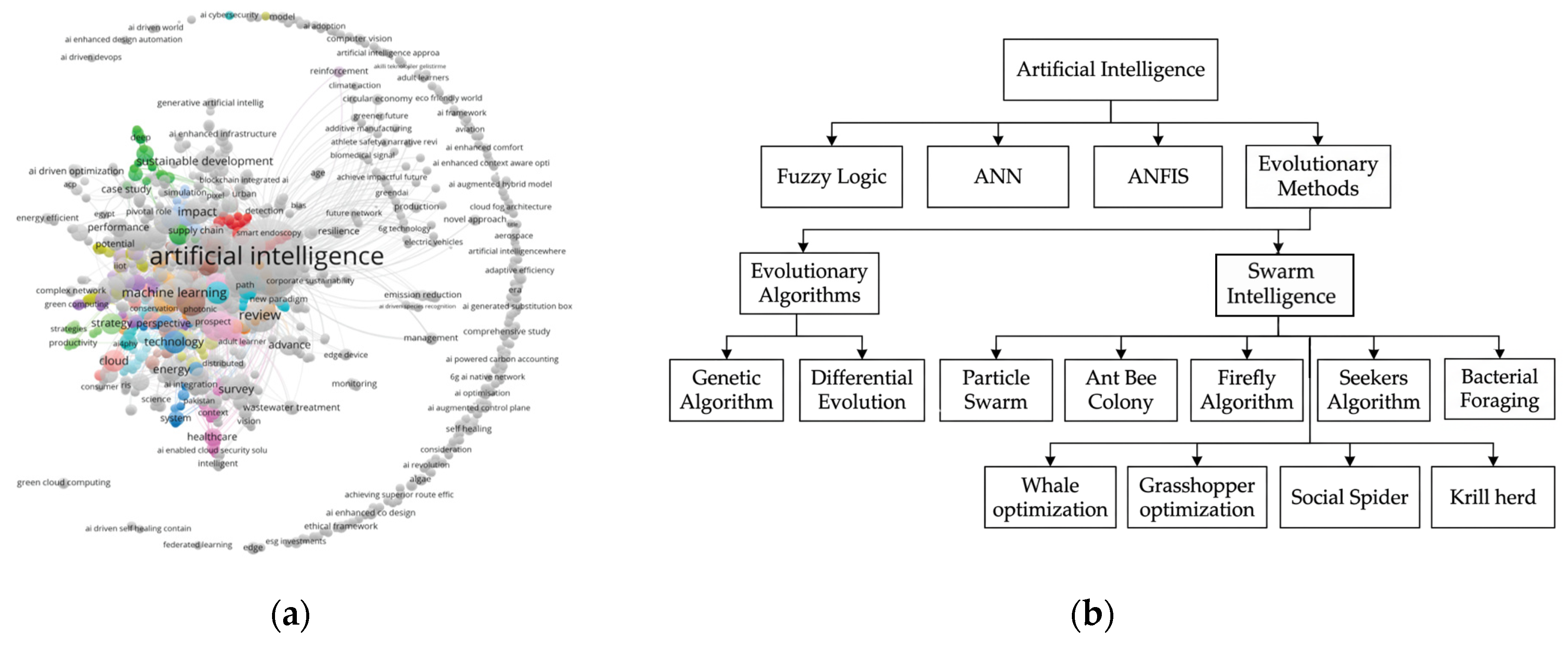
Advanced AI optimization enhances urban energy efficiency by integrating ML, DL, and multi-objective methods, with hybrid neural network and ensemble models accurately forecasting electricity use to support precise planning and reduce waste, as demonstrated in Tehran [35]. DL algorithms such as reinforcement learning (RL), CNNs, and RNNs optimize real-time energy demand prediction and power distribution in smart cities, although concerns remain about computational costs versus benefits [36]. Multi-objective ML frameworks support urban building retrofits by balancing energy savings, costs, and environmental impacts, while bio-inspired and genetic algorithms optimize indoor environmental quality and energy use, maintaining occupant comfort [3]. Figure 1 shows the network visualization and classification of AI.

3.1. Machine Learning Approaches

ML approaches play a crucial role in optimizing energy efficiency in urban environments by accurately predicting energy consumption and supporting sustainable planning. Implementing methods like Random Forest Regression and Gradient Boosting has shown high predictive accuracy for electricity demand by integrating environmental and fuel consumption data [35]. DL and RL algorithms optimize real-time energy management in smart buildings and cities by analyzing sensor data to balance load and reduce waste, although computational costs remain a consideration [37]. Hybrid frameworks that combine digital twins with ML model networks enable adaptive, real-time control of building energy use, enhancing both efficiency and occupant comfort [38].

3.1.1. Supervised Learning

Supervised learning optimizes building energy performance by predicting thermal comfort and consumption, with tree-based models such as regression ensembles, random forests, and gradient boosting, achieving over 95% accuracy in chiller and electricity demand forecasts [6]. Regression-based approaches remain effective in controlled scenarios, whereas neural networks better capture complex, non-linear interactions across varying climatic and operational conditions [39]. Hyperparameter optimization substantially improves model performance, and gradient boosting decision trees frequently outperform alternative supervised methods in urban building energy modeling [7].

3.1.2. Unsupervised Learning

Unsupervised learning enables urban energy systems to detect hidden inefficiencies without labeled data, with K-means clustering applied to HVAC time-series identifying operational faults and achieving up to 6% energy savings in high-performance buildings [8]. These approaches support energy performance assessment by grouping similar consumption patterns and revealing anomalies often overlooked by supervised models [9]. Unsupervised domain adaptation further addresses data scarcity and privacy constraints by transferring knowledge across buildings, reaching occupancy recognition up to 89% without direct source data access. The reported 6% energy saving is derived from time-series analysis combined with K-means clustering applied to one year of high-resolution HVAC power consumption data, collected at 1 min intervals from a LEED Platinum, Energy Star, and Net Zero-certified office building in Houston. The dataset includes subsystem-level measurements, encompassing HVAC, lighting, and plug loads, together with supporting variables such as outdoor temperature and occupancy estimates derived from access-card logs. The baseline scenario corresponds to the existing schedule-based HVAC operation, against which optimized performance is evaluated. Energy savings are identified through the detection of operational inefficiencies, particularly instances where elevated energy consumption occurs under conditions of low occupancy or reduced ambient temperature. The analytical framework follows a standard data-driven workflow, including data collection, preprocessing (for example, temporal resampling to hourly resolution), clustering using K-means, and comparative analysis of inefficient operating patterns relative to typical system behaviour. This approach enables systematic identification of performance gaps and supports the development of more adaptive and efficient HVAC control strategies [8].

3.1.3. Deep Learning Architectures

Deep learning is increasingly being applied to urban energy optimization through large-scale, data-driven forecasting and control frameworks. Transformer-based models have demonstrated substantial improvements in multi-building energy prediction, with reported accuracy gains of up to 23.7%. Convolutional neural networks (CNNs) further support real-time energy management and anomaly detection, achieving classification accuracies of approximately 88% [40]. RL approaches, particularly hierarchical deep Q-networks integrated with graph convolutional networks, have shown strong performance in complex energy systems, including urban 5G base stations, where energy savings exceeding 75% have been reported [10]. In parallel, deep neural networks applied to residential building datasets have achieved F1-scores above 99%, enabling highly accurate prediction and facilitating proactive energy efficiency strategies [41].

3.2. Hybrid and Physics-Informed AI Models

Hybrid and physics-informed AI models combine physical principles with data-driven learning to improve accuracy, reliability, and interpretability in urban energy systems, enhancing indoor temperature and building energy demand prediction through integrated physics-based and ML approaches [12]. Physics-informed ML embeds physical constraints directly into model structures or loss functions, reducing physically inconsistent outputs and addressing data scarcity in building energy modeling [13]. These frameworks have demonstrated strong performance in electricity demand forecasting when incorporating environmental drivers such as temperature and fuel use [35].

3.3. Internet of Things and Sensor Networks

Internet of Things (IoT) and sensor networks enhance urban energy efficiency through real-time monitoring and automated control of buildings and infrastructure, optimizing HVAC, lighting, and energy management, though adoption is limited by technical skill gaps in the built-environment sector [42]. Energy-efficient architectures that combine IoT with edge computing and LoRaWAN reduce transmission loads and dynamically manage node activity, reporting electricity demand reductions of up to 40% in sensor networks [43]. Wireless sensor networks enable smart transportation, environmental monitoring, and grid optimization with improved energy efficiency and network lifetime, while IoT-enabled smart grids enhance distribution and renewable integration but remain constrained by cost, interoperability, and cybersecurity challenges [18].

3.3.1. Sensor Layout and Network Configuration

In civil engineering, wireless sensor networks (WSNs) for structural health monitoring (SHM) require the optimized placement of sensing devices, including accelerometers, strain gauges, and displacement sensors, at critical structural locations such as mid-spans, supports, and key joints. Strategic sensor placement enables the accurate capture of modal responses and damage-sensitive features in large-scale infrastructure systems, including bridges and buildings [44]. Energy-aware configuration algorithms have been developed to jointly optimize the spatial distribution of sensor nodes, cluster heads, and base stations. These approaches aim to maximize information gain while minimizing power consumption, and have been successfully demonstrated on representative structural systems such as bridge models and space-truss configurations [45]. Full-scale implementations across bridges, buildings, and transport corridors have achieved data delivery rates exceeding 97% and network connectivity above 98% over extended operational periods of up to one year. These results highlight the robustness and reliability of optimized WSN configurations for long-term monitoring of large civil infrastructure assets [46].

3.3.2. Material Compatibility and Embedded Sensing

Recent developments in IoT-enabled wireless sensor networks (WSNs) have enabled the direct integration of sensing systems within structural materials. Battery-free LoRaWAN sensor nodes, for example, have been engineered for embedding within reinforced concrete, where they can be wirelessly powered and used to monitor key parameters such as temperature, humidity, strain, and electrical resistivity associated with corrosion processes [47]. In parallel, RFID-based and passive wireless strain sensors have been developed to bond directly to steel, concrete, and composite surfaces, facilitating long-term deformation monitoring without the need for complex wiring infrastructure. These systems provide a scalable and low-maintenance solution for continuous structural assessment [48]. Advances in materials and fabrication techniques have further enabled the development of flexible and free-form sensor housings and circuits, which can be manufactured on polymer substrates or directly integrated onto structural components. Such designs support deployment on irregular and complex civil surfaces, expanding the applicability of embedded sensing technologies across diverse infrastructure systems [49,50].

3.3.3. Environmental Adaptability and Harsh Conditions

Structural health monitoring (SHM) sensor networks for civil infrastructure are engineered to operate under harsh environmental conditions, including temperature fluctuations, moisture exposure, mechanical vibration, and electromagnetic interference. Long-range monitoring systems deployed on bridges have demonstrated reliable performance through the integration of energy-harvesting technologies, such as solar power, combined with adaptive duty-cycling strategies. These approaches extend network lifetime and enable tolerance to node failures of up to approximately 20%, thereby enhancing system resilience [51,52]. Advances in sensor materials and communication technologies have further expanded operational capabilities. Specialized radio-frequency components and high-temperature-resistant materials allow wireless sensing systems to function under extreme conditions, including elevated temperatures, high pressure, radiation exposure, and corrosive environments, thereby overcoming limitations associated with conventional silicon-based devices [52,53,54]. Comparative analyses of wired and wireless SHM systems highlight the importance of environmental robustness in sensor selection and deployment. In particular, fiber-optic sensing technologies and ruggedized wireless systems have emerged as preferred solutions for critical infrastructure applications, including bridges and high-rise buildings, due to their durability, reliability, and long-term performance in demanding environments [55]. Here, Table 1 shows the classification of urban data-driven approaches, detailing data types, methodological descriptions, application domains, and corresponding outcomes across smart city systems, telecommunications, energy management, civil engineering materials, and infrastructure monitoring, highlighting their roles in improving efficiency, sustainability, and data-informed urban decision-making.

4. Application Domains

4.1. Integrated Building, Grid, and Mobility Energy Systems

Integrated building, grid, and mobility energy systems focus on the interconnected management of energy flows among buildings, electric vehicles (EVs), and the power grid to enhance efficiency, reduce emissions, and support the integration of renewable energy. Energy interactions depend on building and vehicle types, renewable energy systems, and local climate, with advanced energy management and control strategies improving grid interaction, operational costs, and CO2 emissions [65]. Modeling integrated mobility-energy systems highlights the need for dynamic coupling of transportation demand and energy supply models to capture spatiotemporal variations and support alternative fuel adoption [66]. Vehicle-to-building and vehicle-to-home services further enable coordinated energy use between residences, workplaces, and EVs, reducing grid reliance and enhancing renewable energy utilization [67].

4.2. Renewable Energy Integration and Storage

Renewable energy integration faces challenges due to the intermittent and fluctuating nature of sources like solar and wind, which complicate grid stability and supply-demand matching. Energy storage systems (ESS) are critical for mitigating these issues by storing excess energy and releasing it when needed, thus enhancing grid reliability and power quality [68]. Various storage technologies, such as lithium-ion, pumped hydro, compressed air, redox flow, and thermal storage, offer distinct advantages in capacity, energy density, scalability, and applications, with hybrid ESS combining them to optimize performance [69]. Long-duration energy storage is especially important for addressing seasonal and large-scale renewable integration challenges [70]. AI is increasingly applied to optimize energy storage system design and control strategies, improving efficiency and economic feasibility in renewable integration [71].

5. AI-Driven Advances in Materials for Energy-Efficient Urban Systems

Recent research demonstrates that AI is increasingly being applied to link material selection and envelope design with long-term building energy performance. For example, random forest models trained on extensive datasets of simulated wall assemblies can accurately predict the energy implications of envelope parameters such as wall thickness, orientation, and thermal mass, achieving very low relative standard errors (<0.001). Such approaches enable rapid, early-stage screening of material configurations for energy-efficient envelope design [72]. Integrated AI-driven frameworks further extend this capability by combining building simulation, advanced machine learning models, and multi-objective optimization techniques. In particular, approaches incorporating gradient boosting (R2 ≈ 0.994) alongside optimization algorithms such as NSGA-II, DSE, and MOPSO have demonstrated the ability to generate envelope design solutions that simultaneously reduce energy consumption approximately 8.5% and cost over 7% in real-world case studies. These results highlight the capacity of AI to directly inform material–envelope trade-offs during the early design phase [73]. At the material scale, AI-assisted concrete design employs machine learning and multi-objective optimization to identify low-carbon, cost-effective mixtures that satisfy mechanical performance and durability requirements. Ensemble models and heterogeneous machine learning frameworks provide robust predictions of material properties and mixture performance, supporting the reduction in embodied energy and carbon emissions [74]. More broadly, recent developments in civil engineering indicate that AI-based computational methods now encompass both static and dynamic analyses of material and structural behaviour. This has enabled the emergence of end-to-end deep learning frameworks for structural analysis, creating opportunities to jointly optimize structural efficiency and material utilization for decarbonization objectives [75]. Complementary studies in AI-driven predictive modelling and sustainable construction further emphasize the integration of AI within life-cycle assessment (LCA) tools, AI-supported material selection processes, and the development of intelligent materials, such as self-healing and phase-change concretes. Collectively, these advances represent emerging pathways for reducing life-cycle energy consumption and emissions in the built environment [76,77].

6. Performance Evaluation and Metrics

Energy efficiency indicators often include measures such as energy intensity, energy savings, and sector-specific efficiencies, providing insights into how effectively energy inputs are converted into economic outputs [36]. Carbon and environmental metrics focus on greenhouse gas emissions, carbon intensity, and the environmental impact of energy use, with studies showing strong links between energy efficiency improvements and reductions in CO2 emissions [78]. Economic and operational metrics assess the cost-effectiveness, productivity, and economic growth associated with energy use, highlighting that energy efficiency can support GDP growth while reducing import dependency and emissions [79]. Data envelopment analysis and other quantitative methods are commonly used to evaluate the efficiency of energy use relative to economic and environmental outcomes, revealing variations across countries and sectors [57]. Life-cycle assessment studies indicate that embodied energy and carbon associated with construction materials including concrete, steel, timber, insulation, and finishing components can account for approximately 20–60% of a building’s total life-cycle impacts. Furthermore, transitioning from conventional concrete-based systems to timber structures can yield substantial reductions, with reported savings ranging from approximately 43–68% [33,34]. Different meta-analyses and review studies also provide benchmark values for embodied energy intensities at both building and material scales; for instance, residential buildings in Greece exhibit embodied energy intensities of approximately 3.2–7.1 GJ m−2, while timber-based structures typically range from 2.9 to 3.0 GJ m−2 compared to 4.0–5.6 GJ m−2 for concrete and steel systems. These values serve as important reference indicators for evaluating embodied performance within analytical frameworks [34,80,81]. To incorporate structural performance considerations, Section 5 should introduce metrics such as the building energy-saving rate (BESR) and envelope energy-saving contribution (ΔS). These indicators quantify the proportion of heating and cooling demand offset by passive envelope measures and structural configurations. Empirical studies suggest that building envelopes can contribute approximately 19% of total thermal comfort energy demand, with notable variations in BESR across different climatic conditions and building standards [82]. Additional structural energy performance indicators may include life-cycle embodied performance ratios that integrate embodied energy and carbon metrics, as well as life-cycle embodied energy reduction rates associated with design optimization strategies. Such approaches have demonstrated reductions of up to 61% through material selection and service life optimization. Moreover, façade and assembly-level design choices including variations in wall composition, plaster types, insulation thickness, and glazing systems can be quantitatively assessed through their impact on peak cooling load and CO2 emissions, with individual measures typically achieving reductions in the range of 8–18% [83,84].

7. Limitations, Challenges, Ethical Concerns, and Future Directions

7.1. Model Uncertainty, Interpretability, and Bias

Model uncertainty arises from incomplete knowledge about the true model structure and can lead to biased parameter estimates and overly narrow prediction intervals when ignored. It includes aleatoric uncertainty (inherent data noise) and epistemic uncertainty (model limitations), with epistemic uncertainty further decomposed into bias and variance components; failing to capture model bias can cause underestimation of epistemic uncertainty and overconfident predictions [85]. Interpretability can aid users in understanding predictions, but it does not necessarily improve decisions or error detection and may overwhelm users, while biased data and models risk unfair outcomes, making fairness evaluation essential alongside interpretability [19].

7.2. Transparency, Scalability, and Accountability

Transparency, scalability, and accountability are central to responsible AI deployment. While transparency seeks to make decision processes understandable, complex “black-box” models limit full interpretability, requiring complementary mechanisms such as observability and auditing frameworks to ensure accountability [86].

7.3. Data Ownership and Governance

Data ownership and governance are complex and evolving concepts that address who control data, how it is shared, and the ethical, legal, and social implications associated with it. Traditional notions of data ownership, such as private or public ownership, are often inadequate for resolving challenges related to individual-level data, especially in sensitive areas like health, where managed access processes like Data Access Committees (DACs) provide a more balanced governance approach [87].

7.4. Future Directions

Future research should advance the integration of AI with urban data ecosystems to improve prediction accuracy and real-time energy management. Emphasis is placed on hybrid and physics-informed models that combine data-driven learning with domain knowledge to optimize buildings, grids, and mobility systems, including renewable integration and storage [3]. Expanding IoT sensor networks and cloud-based infrastructures will support scalable, adaptive urban energy control [56]. Future research should address challenges related to model interpretability, transparency, scalability, and ethical concerns to ensure equitable and accountable AI deployment [58].

8. Conclusions

AI has emerged as a powerful enabler of energy-efficient urban transformation, but its impact depends less on algorithmic novelty and more on system-level integration, governance maturity, and verifiable performance outcomes. The evidence synthesized in this review indicates that supervised, unsupervised, DL, and reinforcement-learning models can significantly enhance forecasting accuracy, operational control, and adaptive optimization across buildings, grids, and mobility systems when supported by high-quality data and calibrated deployment frameworks. Hybrid and physics-informed AI approaches further strengthen robustness and generalizability by embedding physical constraints into data-driven models. To translate these capabilities into civil engineering practice, AI must be operationalized within BIM-based design workflows, where machine learning surrogate models such as ANN, RF, GB are coupled with multi-objective optimizers, for example, NSGA-II, MOPSO for building envelope and energy system design. Such frameworks have demonstrated 7–21% reductions in energy consumption and lifecycle cost in real-world case studies, using performance indicators such as annual heating or cooling load, primary energy demand, and lifecycle cost [88,89].
Furthermore, integration of AI within BIM environments requires standardized interoperability protocols, including IFC 4.3 compliance and API-based connectivity between BIM platforms (e.g., Revit) and machine learning frameworks (e.g., TensorFlow), enabling automated rule-checking, parametric optimization, and performance-driven design validation [90]. Interoperable IoT infrastructures, secure digital-twin architectures, and standardized measurement-and-verification protocols are essential to translate pilot successes into scalable urban outcomes.
At the construction stage, AI should be embedded within construction engineering management (CEM) systems integrated with BIM, where machine learning and computer vision support schedule optimization, risk prediction, and safety monitoring. For example, UAV-based and camera-based systems enable automated progress tracking and deviation detection between as-built conditions and BIM models, improving project control and reducing delays [91,92]. These workflows establish AI-enabled digital construction pipelines, where predictive analytics reduce planning uncertainty and improve resource allocation, representing emerging industry practice despite the absence of formalized standards.
Persistent challenges, including model uncertainty, bias, fragmented data governance, cybersecurity risks, and unequal access to digital infrastructure, highlight the necessity of embedding transparency, accountability, and fairness.
In the operational phase, AI deployment should prioritize BIM–IoT–digital twin integration, where real-time sensor data feeds predictive models for energy optimization, anomaly detection, and structural health monitoring (SHM). These systems enable condition-based maintenance and remaining-life prediction for infrastructure assets such as buildings and bridges, supporting lifecycle cost reduction and resilience [93,94]. AI-enabled lifecycle assessment (LCA) tools integrated into BIM further support ISO 14040-aligned carbon accounting, allowing engineers to evaluate embodied and operational impacts continuously across the building lifecycle [95].
From a policy perspective, cities should (1) establish open, secure urban data ecosystems with clear governance, (2) promote physics-guided and human-in-the-loop AI that incorporates comfort, safety, and equity, and (3) align AI deployment with retrofits, renewable integration, and long-duration storage to maximize carbon mitigation.
To strengthen industry applicability, these policy directions should be extended into engineering-grade requirements, including: mandating AI-integrated BIM workflows with embedded LCA modules aligned to ISO 14040 standards, requiring IFC 4.3 certification and standardized APIs for interoperability between BIM and AI systems, establishing validation protocols for AI-driven building performance models, including accuracy thresholds and benchmarking frameworks, and incorporating AI competencies into professional accreditation and engineering practice standards [96]. Additionally, performance-based metrics such as energy savings, lifecycle carbon reduction, and BIM–AI productivity gains should be adopted as key performance indicators (KPIs) for evaluating implementation success, although large-scale validation remains limited. In conclusion, AI-enhanced strategies offer a credible pathway toward measurable reductions in urban energy use and emissions, but only when embedded within coherent policy, institutional alignment, and rigorous performance validation.

Author Contributions

Conceptualization, S.T.J.S. and M.N.R.; methodology, S.T.J.S.; investigation, S.T.J.S. and M.N.R.; writing—original draft preparation, S.T.J.S. and M.N.R.; writing—review and editing, S.T.J.S. and M.N.R.; visualization, M.N.R.; supervision, S.T.J.S. All authors have read and agreed to the published version of the manuscript.

Funding

This research received no external funding.

Institutional Review Board Statement

Not applicable.

Informed Consent Statement

Not applicable.

Data Availability Statement

No new data were created or analyzed in this study.

Conflicts of Interest

The authors declare no conflicts of interest.

References

  1. Gupta, A.; Panagiotopoulos, P.; Bowen, F. An Orchestration Approach to Smart City Data Ecosystems. Technol. Forecast. Soc. Change 2020, 153, 119929. [Google Scholar] [CrossRef]
  2. Thorve, S.; Baek, Y.Y.; Swarup, S.; Mortveit, H.; Marathe, A.; Vullikanti, A.; Marathe, M. High Resolution Synthetic Residential Energy Use Profiles for the United States. Sci. Data 2023, 10, 76. [Google Scholar] [CrossRef]
  3. Shan, R.; Jia, X.; Su, X.; Xu, Q.; Ning, H.; Zhang, J. AI-Driven Multi-Objective Optimization and Decision-Making for Urban Building Energy Retrofit: Advances, Challenges, and Systematic Review. Appl. Sci. 2025, 15, 8944. [Google Scholar] [CrossRef]
  4. Qin, Z.; Li, M.; Flohn, J.; Hu, Y. Thermal Management Materials for Energy-Efficient and Sustainable Future Buildings. Chem. Commun. 2021, 57, 12236–12253. [Google Scholar] [CrossRef]
  5. Asghari, M.; Fereidoni, S.; Fereidooni, L.; Nabisi, M.; Kasaeian, A. Energy Efficiency Analysis of Applying Phase Change Materials and Thermal Insulation Layers in a Building. Energy Build. 2024, 312, 114211. [Google Scholar] [CrossRef]
  6. Benkhalfallah, M.S.; Kouah, S.; Harous, S. Predicting the Energy Consumption in Chillers: A Comparative Study of Supervised Machine Learning Regression Models. Energies 2025, 18, 3672. [Google Scholar] [CrossRef]
  7. Quan, S.J. Comparing Hyperparameter Tuning Methods in Machine Learning Based Urban Building Energy Modeling: A Study in Chicago. Energy Build. 2024, 317, 114353. [Google Scholar] [CrossRef]
  8. Talei, H.; Benhaddou, D.; Gamarra, C.; Benbrahim, H.; Essaaidi, M. Smart Building Energy Inefficiencies Detection through Time Series Analysis and Unsupervised Machine Learning. Energies 2021, 14, 6042. [Google Scholar] [CrossRef]
  9. Fan, C.; Xiao, F.; Li, Z.; Wang, J. Unsupervised Data Analytics in Mining Big Building Operational Data for Energy Efficiency Enhancement: A Review. Energy Build. 2018, 159, 296–308. [Google Scholar] [CrossRef]
  10. Xu, D.; Su, X.; Premsankar, G.; Wang, H.; Tarkoma, S.; Hui, P. Dynamic Hierarchical Reinforcement Learning Framework for Energy-Efficient 5G Base Stations in Urban Environments. IEEE Trans. Mob. Comput. 2025, 24, 8582–8599. [Google Scholar] [CrossRef]
  11. Mehraban, M.H.; Sepasgozar, S.M.; Ghomimoghadam, A.; Zafari, B. AI-Enhanced Automation of Building Energy Optimization Using a Hybrid Stacked Model and Genetic Algorithms: Experiments with Seven Machine Learning Techniques and a Deep Neural Network. Results Eng. 2025, 26, 104994. [Google Scholar] [CrossRef]
  12. Von Krannichfeldt, L.; Orehounig, K.; Fink, O. Combining Physics-Based and Data-Driven Modeling for Building Energy Systems. Appl. Energy 2025, 391, 125853. [Google Scholar] [CrossRef]
  13. Ma, Z.; Jiang, G.; Hu, Y.; Chen, J. A Review of Physics-Informed Machine Learning for Building Energy Modeling. Appl. Energy 2025, 381, 125169. [Google Scholar] [CrossRef]
  14. Kumar Patro, S.; Shelke, S.; Maitre, N.; Samptaro Salunkhe, S. Optimizing the Thermal Performance of Phase Change Materials in Building Applications Using Deep Reinforcement Learning and Bayesian Optimization. Therm. Sci. Eng. Prog. 2024, 55, 102867. [Google Scholar] [CrossRef]
  15. Baghoolizadeh, M.; Dehkordi, S.A.H.H.; Rostamzadeh-Renani, M.; Rostamzadeh-Renani, R.; Azarkhavarani, N.K.; Toghraie, D. Optimization of Annual Electricity Consumption Costs and the Costs of Insulation and Phase Change Materials in the Residential Building Using Artificial Neural Network and Genetic Algorithm Methods. J. Energy Storage 2023, 62, 106916. [Google Scholar] [CrossRef]
  16. Liu, B.; Wang, Y.; Rabczuk, T.; Olofsson, T.; Lu, W. Multi-Scale Modeling in Thermal Conductivity of Polyurethane Incorporated with Phase Change Materials Using Physics-Informed Neural Networks. Renew. Energy 2024, 220, 119565. [Google Scholar] [CrossRef]
  17. Stergiou, K.; Ntakolia, C.; Varytis, P.; Koumoulos, E.; Karlsson, P.; Moustakidis, S. Enhancing Property Prediction and Process Optimization in Building Materials through Machine Learning: A Review. Comput. Mater. Sci. 2023, 220, 112031. [Google Scholar] [CrossRef]
  18. Simionescu, M.; Strielkowski, W. The Role of the Internet of Things in Enhancing Sustainable Urban Energy Systems: A Review of Lessons Learned from the COVID-19 Pandemic. J. Urban Technol. 2025, 32, 103–132. [Google Scholar] [CrossRef]
  19. Poursabzi-Sangdeh, F.; Goldstein, D.G.; Hofman, J.M.; Wortman Vaughan, J.W.; Wallach, H. Manipulating and Measuring Model Interpretability. In Proceedings of the 2021 CHI Conference on Human Factors in Computing Systems; Association for Computing Machinery: New York, NY, USA, 2021; pp. 1–52. [Google Scholar]
  20. Himeur, Y.; Alsalemi, A.; Bensaali, F.; Amira, A. Building Power Consumption Datasets: Survey, Taxonomy and Future Directions. Energy Build. 2020, 227, 110404. [Google Scholar] [CrossRef]
  21. Priesmann, J.; Nolting, L.; Kockel, C.; Praktiknjo, A. Time Series of Useful Energy Consumption Patterns for Energy System Modeling. Sci. Data 2021, 8, 148. [Google Scholar] [CrossRef]
  22. Quesada, C.; Astigarraga, L.; Merveille, C.; Borges, C.E. An Electricity Smart Meter Dataset of Spanish Households: Insights into Consumption Patterns. Sci. Data 2024, 11, 59. [Google Scholar] [CrossRef]
  23. Gebrechorkos, S.H.; Hülsmann, S.; Bernhofer, C. Evaluation of Multiple Climate Data Sources for Managing Environmental Resources in East Africa. Hydrol. Earth Syst. Sci. 2018, 22, 4547–4564. [Google Scholar] [CrossRef]
  24. Lundstad, E.; Brugnara, Y.; Pappert, D.; Kopp, J.; Samakinwa, E.; Hürzeler, A.; Andersson, A.; Chimani, B.; Cornes, R.; Demarée, G.; et al. The Global Historical Climate Database HCLIM. Sci. Data 2023, 10, 44. [Google Scholar] [CrossRef]
  25. Machard, A.; Salvati, A.; Tootkaboni, M.P.; Gaur, A.; Zou, J.; Wang, L.L.; Baba, F.; Ge, H.; Bre, F.; Bozonnet, E.; et al. Typical and Extreme Weather Datasets for Studying the Resilience of Buildings to Climate Change and Heatwaves. Sci. Data 2024, 11, 531. [Google Scholar] [CrossRef]
  26. Sewell, M.N.; Soto, C.J.; Napolitano, C.M.; Yoon, H.J.; Roberts, B.W. Survey Data of Social, Emotional, and Behavioral Skills among Seven Independent Samples. Data Brief 2022, 40, 107792. [Google Scholar] [CrossRef]
  27. Oraiopoulos, A.; Howard, B. On the Accuracy of Urban Building Energy Modelling. Renew. Sustain. Energy Rev. 2022, 158, 111976. [Google Scholar] [CrossRef]
  28. Johari, F.; Shadram, F.; Widén, J. Urban Building Energy Modeling from Geo-Referenced Energy Performance Certificate Data: Development, Calibration, and Validation. Sustain. Cities Soc. 2023, 96, 104664. [Google Scholar] [CrossRef]
  29. Kong, D.; Cheshmehzangi, A.; Zhang, Z.; Ardakani, S.P.; Gu, T. Urban Building Energy Modeling (UBEM): A Systematic Review of Challenges and Opportunities. Energy Effic. 2023, 16, 69. [Google Scholar] [CrossRef]
  30. Saad, M.M.; Eicker, U. Investigating the Reliability of Building Energy Models: Comparative Analysis of the Impact of Data Pipelines and Model Complexities. J. Build. Eng. 2023, 71, 106511. [Google Scholar] [CrossRef]
  31. Teh, H.Y.; Kempa-Liehr, A.W.; Wang, K.I.-K. Sensor Data Quality: A Systematic Review. J. Big Data 2020, 7, 11. [Google Scholar] [CrossRef]
  32. Tettey, U.Y.A.; Dodoo, A.; Gustavsson, L. Effect of Different Frame Materials on the Primary Energy Use of a Multi Storey Residential Building in a Life Cycle Perspective. Energy Build. 2019, 185, 259–271. [Google Scholar] [CrossRef]
  33. Minunno, R.; O’Grady, T.; Morrison, G.M.; Gruner, R.L. Investigating the Embodied Energy and Carbon of Buildings: A Systematic Literature Review and Meta-Analysis of Life Cycle Assessments. Renew. Sustain. Energy Rev. 2021, 143, 110935. [Google Scholar] [CrossRef]
  34. Schenk, D.; Amiri, A. Life Cycle Energy Analysis of Residential Wooden Buildings versus Concrete and Steel Buildings: A Review. Front. Built Environ. 2022, 8, 975071. [Google Scholar] [CrossRef]
  35. Majnoon, A.; Saifoddin, A. AI-Driven Energy Optimization Enhancing Efficiency in Urban Environments with Hybrid Machine Learning Models. Clean. Eng. Technol. 2025, 28, 101072. [Google Scholar] [CrossRef]
  36. Rojek, I.; Mikołajewski, D.; Galas, K.; Piszcz, A. Advanced Deep Learning Algorithms for Energy Optimization of Smart Cities. Energies 2025, 18, 407. [Google Scholar] [CrossRef]
  37. Bereketeab, L.; Zekeria, A.; Aloqaily, M.; Guizani, M.; Debbah, M. Energy Optimization in Sustainable Smart Environments With Machine Learning and Advanced Communications. IEEE Sens. J. 2024, 24, 5704–5712. [Google Scholar] [CrossRef]
  38. Almadhor, A.; Alsubai, S.; Kryvinska, N.; Ghazouani, N.; Bouallegue, B.; Al Hejaili, A.; Sampedro, G.A. A Synergistic Approach Using Digital Twins and Statistical Machine Learning for Intelligent Residential Energy Modelling. Sci. Rep. 2025, 15, 26088. [Google Scholar] [CrossRef]
  39. Avcı, A.B. Supervised Machine Learning for Thermal Comfort and Energy Efficiency: An Evaluation for the Indoor Built Environment. Megaron 2025, 20, 418–432. [Google Scholar] [CrossRef]
  40. Alijoyo, F.A. AI-Powered Deep Learning for Sustainable Industry 4.0 and Internet of Things: Enhancing Energy Management in Smart Buildings. Alex. Eng. J. 2024, 104, 409–422. [Google Scholar] [CrossRef]
  41. Rani, U.; Dahiya, N.; Kundu, S.; Kanungo, S.; Kathuria, S.; Rakesh, S.K.; Sharma, A.; Singh, P. Deep Learning–Based Urban Energy Forecasting Model for Residential Building Energy Efficiency. Energy Explor. Exploit. 2024, 42, 1799–1828. [Google Scholar] [CrossRef]
  42. Marinakis, V.; Doukas, H. An Advanced IoT-Based System for Intelligent Energy Management in Buildings. Sensors 2018, 18, 610. [Google Scholar] [CrossRef]
  43. Madhumathi, C.S.; Ravi, R. Energy-Efficient IoT Sensor Networks Using LoRaWAN and Edge Intelligence. IIRJET 2025, 10, 12–21. [Google Scholar] [CrossRef]
  44. Yu, X.; Fu, Y.; Li, J.; Mao, J.; Hoang, T.; Wang, H. Recent Advances in Wireless Sensor Networks for Structural Health Monitoring of Civil Infrastructure. J. Infrastruct. Intell. Resil. 2024, 3, 100066. [Google Scholar] [CrossRef]
  45. Hao, X.-H.; Yuen, K.-V.; Kuok, S.-C. Energy-Aware Versatile Wireless Sensor Network Configuration for Structural Health Monitoring. Struct. Control. Health Monit. 2022, 29, e3083. [Google Scholar] [CrossRef]
  46. Wang, Z. Environmental Condition Monitoring of Infrastructure Projects Based on Wireless Sensor Networks. Front. Sci. Eng. 2025, 5, 142–160. [Google Scholar] [CrossRef]
  47. Loubet, G.; Sidibe, A.; Herail, P.; Takacs, A.; Dragomirescu, D. Autonomous Industrial IoT for Civil Engineering Structural Health Monitoring. IEEE Internet Things J. 2024, 11, 8921–8944. [Google Scholar] [CrossRef]
  48. Liu, G.; Wang, Q.-A.; Jiao, G.; Dang, P.; Nie, G.; Liu, Z.; Sun, J. Review of Wireless RFID Strain Sensing Technology in Structural Health Monitoring. Sensors 2023, 23, 6925. [Google Scholar] [CrossRef]
  49. Li, W.; Li, Y.; Xu, M.; Zhou, Y.; Miao, R.; Wang, K.; Cao, Y.; Song, Y.; Dang, S.; Zheng, L.; et al. Highly Customizable, Ultrawide-Temperature Free-Form Flexible Sensing Electronic Systems Based on Medium-Entropy Alloy Paintings. Nat. Commun. 2025, 16, 7351. [Google Scholar] [CrossRef]
  50. He, D.; Cui, Y.; Ming, F.; Wu, W. Advancements in Passive Wireless Sensors, Materials, Devices, and Applications. Sensors 2023, 23, 8200. [Google Scholar] [CrossRef]
  51. Buratti, C.; Conti, A.; Dardari, D.; Verdone, R. An Overview on Wireless Sensor Networks Technology and Evolution. Sensors 2009, 9, 6869–6896. [Google Scholar] [CrossRef] [PubMed]
  52. Yang, J.; Zhang, C.; Li, X.; Huang, Y.; Fu, S.; Acevedo, M.F. Integration of Wireless Sensor Networks in Environmental Monitoring Cyber Infrastructure. Wirel. Netw. 2010, 16, 1091–1108. [Google Scholar] [CrossRef]
  53. Meenal; Aghwariya, M.K.; Goel, T.; Patnaik, A. Advanced Materials for RF Sensors in Harsh Environments: A Comprehensive Review. IEEE Sens. Rev. 2025, 2, 324–338. [Google Scholar] [CrossRef]
  54. Huang, Q.-A.; Dong, L.; Wang, L.-F. LC Passive Wireless Sensors Toward a Wireless Sensing Platform: Status, Prospects, and Challenges. J. Microelectromechanical Syst. 2016, 25, 822–841. [Google Scholar] [CrossRef]
  55. Bhatta, S.; Dang, J. Use of IoT for Structural Health Monitoring of Civil Engineering Structures: A State-of-the-Art Review. Urban Lifeline 2024, 2, 17. [Google Scholar] [CrossRef]
  56. Jakkani, A.K. Enhancing Urban Sustainability through AI-Driven Energy Efficiency Strategies in Cloud-Enabled Smart Cities. J. Energy Eng. Thermodyn. 2024, 4, 1–13. [Google Scholar] [CrossRef]
  57. A Systematic Analysis of AI-Based Methods for Thermal Control and Energy-Efficiency in Sustainable Buildings|AIS—Architecture Image Studies. 2025. Available online: http://journals.wisethorough.com/index.php/AIS/article/view/1088 (accessed on 23 February 2026).
  58. Stecuła, K.; Wolniak, R.; Grebski, W.W. AI-Driven Urban Energy Solutions—From Individuals to Society: A Review. Energies 2023, 16, 7988. [Google Scholar] [CrossRef]
  59. Juan, A.A.; Ammouriova, M.; Tsertsvadze, V.; Osorio, C.; Fuster, N.; Ahsini, Y. Promoting Energy Efficiency and Emissions Reduction in Urban Areas with Key Performance Indicators and Data Analytics. Energies 2023, 16, 7195. [Google Scholar] [CrossRef]
  60. Chui, K.T.; Lytras, M.D.; Visvizi, A. Energy Sustainability in Smart Cities: Artificial Intelligence, Smart Monitoring, and Optimization of Energy Consumption. Energies 2018, 11, 2869. [Google Scholar] [CrossRef]
  61. Shao, L.; Chen, G.Q.; Chen, Z.M.; Guo, S.; Han, M.Y.; Zhang, B.; Hayat, T.; Alsaedi, A.; Ahmad, B. Systems Accounting for Energy Consumption and Carbon Emission by Building. Commun. Nonlinear Sci. Numer. Simul. 2014, 19, 1859–1873. [Google Scholar] [CrossRef]
  62. Aldersoni, A.A.; Ibrahim, A.O.; Aldamady, A.A.H.; Bashir, F.M.; Babatunde, O.E.; Dodo, Y.A.; Ibrahim, W. Investigating the Impact of Low-Carbon Building Materials on Energy Consumption and Carbon Emissions in Construction Projects. Int. J. Low-Carbon Technol. 2025, 20, 1581–1592. [Google Scholar] [CrossRef]
  63. Zhou, H.; Rezazadeh Azar, E. BIM-Based Energy Consumption Assessment of the on-Site Construction of Building Structural Systems. Built Environ. Proj. Asset Manag. 2018, 9, 2–14. [Google Scholar] [CrossRef]
  64. D’Amico, B.; Myers, R.J.; Sykes, J.; Voss, E.; Cousins-Jenvey, B.; Fawcett, W.; Richardson, S.; Kermani, A.; Pomponi, F. Machine Learning for Sustainable Structures: A Call for Data. Structures 2019, 19, 1–4. [Google Scholar] [CrossRef]
  65. Zhou, Y.; Cao, S.; Hensen, J.L.M.; Lund, P.D. Energy Integration and Interaction between Buildings and Vehicles: A State-of-the-Art Review. Renew. Sustain. Energy Rev. 2019, 114, 109337. [Google Scholar] [CrossRef]
  66. Muratori, M.; Jadun, P.; Bush, B.; Bielen, D.; Vimmerstedt, L.; Gonder, J.; Gearhart, C.; Arent, D. Future Integrated Mobility-Energy Systems: A Modeling Perspective. Renew. Sustain. Energy Rev. 2020, 119, 109541. [Google Scholar] [CrossRef]
  67. Bonfiglio, A.; Minetti, M.; Loggia, R.; Mascioli, L.F.; Golino, A.; Moscatiello, C.; Martirano, L. Integrated Vehicle-to-Building and Vehicle-to-Home Services for Residential and Worksite Microgrids. Smart Cities 2025, 8, 101. [Google Scholar] [CrossRef]
  68. Malik, F.H.; Hussain, G.A.; Alsmadi, Y.M.S.; Haider, Z.M.; Mansoor, W.; Lehtonen, M. Integrating Energy Storage Technologies with Renewable Energy Sources: A Pathway Toward Sustainable Power Grids. Sustainability 2025, 17, 4097. [Google Scholar] [CrossRef]
  69. Ergun, S.; Dik, A.; Boukhanouf, R.; Omer, S. Large-Scale Renewable Energy Integration: Tackling Technical Obstacles and Exploring Energy Storage Innovations. Sustainability 2025, 17, 1311. [Google Scholar] [CrossRef]
  70. Zeng, Y.; Zhou, T.; Wang, T.; Zhang, M.; Zhang, S.; Yang, H. Long-Duration Energy Storage: A Critical Enabler for Renewable Integration and Decarbonization. Energies 2025, 18, 466. [Google Scholar] [CrossRef]
  71. Abdalla, A.N.; Nazir, M.S.; Tao, H.; Cao, S.; Ji, R.; Jiang, M.; Yao, L. Integration of Energy Storage System and Renewable Energy Sources Based on Artificial Intelligence: An Overview. J. Energy Storage 2021, 40, 102811. [Google Scholar] [CrossRef]
  72. Hussien, A.; Khan, W.; Hussain, A.; Liatsis, P.; Al-Shamma’a, A.; Al-Jumeily, D. Predicting Energy Performances of Buildings’ Envelope Wall Materials via the Random Forest Algorithm. J. Build. Eng. 2023, 69, 106263. [Google Scholar] [CrossRef]
  73. Long, L.D. An AI-Driven Model for Predicting and Optimizing Energy-Efficient Building Envelopes. Alex. Eng. J. 2023, 79, 480–501. [Google Scholar] [CrossRef]
  74. Mahjoubi, S.; Barhemat, R.; Meng, W.; Bao, Y. Review of AI-Assisted Design of Low-Carbon Cost-Effective Concrete toward Carbon Neutrality. Artif. Intell. Rev. 2025, 58, 225. [Google Scholar] [CrossRef]
  75. Wang, C.; Song, L.; Yuan, Z.; Fan, J. State-of-the-Art AI-Based Computational Analysis in Civil Engineering. J. Ind. Inf. Integr. 2023, 33, 100470. [Google Scholar] [CrossRef]
  76. Nilimaa, J. Smart Materials and Technologies for Sustainable Concrete Construction. Dev. Built Environ. 2023, 15, 100177. [Google Scholar] [CrossRef]
  77. El-Abbasy, A.A.A. Artificial Intelligence-Driven Predictive Modeling in Civil Engineering: A Comprehensive Review. J. Umm Al-Qura Univ. Eng. Archit. 2025, 16, 1322–1345. [Google Scholar] [CrossRef]
  78. Pavel, T.; Polina, S.; Liubov, N. The Research of the Impact of Energy Efficiency on Mitigating Greenhouse Gas Emissions at the National Level. Energy Convers. Manag. 2024, 314, 118671. [Google Scholar] [CrossRef]
  79. Hai, N.T.; Duong, N.T. An Improved Environmental Management Model for Assuring Energy and Economic Prosperity. Acta Innov. 2024, 52, 9–18. [Google Scholar] [CrossRef]
  80. Dixit, M.K. Life Cycle Embodied Energy Analysis of Residential Buildings: A Review of Literature to Investigate Embodied Energy Parameters. Renew. Sustain. Energy Rev. 2017, 79, 390–413. [Google Scholar] [CrossRef]
  81. Dascalaki, E.G.; Argiropoulou, P.; Balaras, C.A.; Droutsa, K.G.; Kontoyiannidis, S. Analysis of the Embodied Energy of Construction Materials in the Life Cycle Assessment of Hellenic Residential Buildings. Energy Build. 2021, 232, 110651. [Google Scholar] [CrossRef]
  82. Liu, Y.; Yang, L.; Zheng, W.; Liu, T.; Zhang, X.; Liu, J. A Novel Building Energy Efficiency Evaluation Index: Establishment of Calculation Model and Application. Energy Convers. Manag. 2018, 166, 522–533. [Google Scholar] [CrossRef]
  83. Rauf, A. Reducing Life Cycle Embodied Energy of Residential Buildings: Importance of Building and Material Service Life. Buildings 2022, 12, 1821. [Google Scholar] [CrossRef]
  84. Hu, M. A Building Life-Cycle Embodied Performance Index—The Relationship between Embodied Energy, Embodied Carbon and Environmental Impact. Energies 2020, 13, 1905. [Google Scholar] [CrossRef]
  85. Jiménez, S.; Jürgens, M.; Waegeman, W. Why Machine Learning Models Fail to Fully Capture Epistemic Uncertainty. arXiv 2025, arXiv:2505.23506. [Google Scholar] [CrossRef]
  86. Meng, C.; Trinh, L.; Xu, N.; Enouen, J.; Liu, Y. Interpretability and Fairness Evaluation of Deep Learning Models on MIMIC-IV Dataset. Sci. Rep. 2022, 12, 7166. [Google Scholar] [CrossRef]
  87. Piasecki, J.; Cheah, P.Y. Ownership of Individual-Level Health Data, Data Sharing, and Data Governance. BMC Med. Ethics 2022, 23, 104. [Google Scholar] [CrossRef]
  88. Biswas, P.; Rashid, A.; Biswas, A.; Nasim, M.A.A.; Chakraborty, S.; Gupta, K.D.; George, R. AI-Driven Approaches for Optimizing Power Consumption: A Comprehensive Survey. Discov. Artif. Intell. 2024, 4, 116. [Google Scholar] [CrossRef]
  89. Elwy, I.; Hagishima, A. The Artificial Intelligence Reformation of Sustainable Building Design Approach: A Systematic Review on Building Design Optimization Methods Using Surrogate Models. Energy Build. 2024, 323, 114769. [Google Scholar] [CrossRef]
  90. Pan, Y.; Zhang, L. Integrating BIM and AI for Smart Construction Management: Current Status and Future Directions. Arch. Comput. Methods Eng. 2023, 30, 1081–1110. [Google Scholar] [CrossRef]
  91. Baduge, S.K.; Thilakarathna, S.; Perera, J.S.; Arashpour, M.; Sharafi, P.; Teodosio, B.; Shringi, A.; Mendis, P. Artificial Intelligence and Smart Vision for Building and Construction 4.0: Machine and Deep Learning Methods and Applications. Autom. Constr. 2022, 141, 104440. [Google Scholar] [CrossRef]
  92. Ivanova, S.; Kuznetsov, A.; Zverev, R.; Rada, A. Artificial Intelligence Methods for the Construction and Management of Buildings. Sensors 2023, 23, 8740. [Google Scholar] [CrossRef] [PubMed]
  93. Harle, S.M. Advancements and Challenges in the Application of Artificial Intelligence in Civil Engineering: A Comprehensive Review. Asian J. Civ. Eng. 2024, 25, 1061–1078. [Google Scholar] [CrossRef]
  94. Xu, G.; Guo, T. Advances in AI-Powered Civil Engineering throughout the Entire Lifecycle. Adv. Struct. Eng. 2025, 28, 1515–1541. [Google Scholar] [CrossRef]
  95. Attia, A.R. The Impact of Integrating Artificial Intelligence and Building Information Modeling (BIM) Systems on the Development of Construction Methodologies. J. Umm Al-Qura Univ. Eng. Archit. 2025, 16, 1537–1554. [Google Scholar] [CrossRef]
  96. Zima, K.; Cracow University of Technology, Poland. The use of Artificial Intelligence in Building Information Modelling: Document-based bibliographic analysis. BoZPE 2025, 14, 86–94. [Google Scholar] [CrossRef]
Figure 1. Illustrates: (a) Network visualization of the AI landscape based on keyword co-occurrence analysis; (b) Classification of Artificial Intelligence techniques.
Engproc 138 00004 g001
Table 1. Urban data approaches and resulting impacts.
CategoryData TypeDescriptionApplication DomainOutcomes
Smart City DataOpen data and
smart sensors
Coordinated urban data initiatives by
openness, diffusion, and a shared vision.
Urban governance and planningEnhanced collaboration city, improved data-driven decision-making [1].
RLDynamic
hierarchical RL
Operation of 5G in urban environmentsUrban
telecommunications
Reduced energy consumption while maintaining service quality [56].
Anomaly
Detection
Time series
analysis and ML
Detecting inefficiencies in building
energy usage
Smart building
operations
Early identification of energy waste leading to efficiency improvements [57].
IoT IntegrationIoT sensor
networks
Using IoT devices to monitor and
regulate urban energy usage
Sustainable urban
infrastructure
Real-time adaptive control reducing waste and supporting sustainability [58].
AI & ML for Energy NILM and smart meteringProvide high-frequency load profiles and appliance-level dataSmart buildings and smart gridsMore accurate load disaggregation improves targeting effectively [59,60].
Civil Engineering MaterialEmbodied energy & carbonMaterial and building-level embodied energy/carbon for concrete, steel, and timberStructural design, LCAIdentifies that materials contribute to structural energy/carbon [34,61].
Civil Engineering MaterialLow-carbon materials Use of low-carbon concrete, recycled steel, and sustainable timber with quantified life-cycle energy and GHG reductionsLow-carbon construction, retrofits, policy supportDemonstrates reductions in embodied energy cuts in life-cycle GHGs when shifting from conventional to low-carbon materials [34,62].
Structural & Infrastructure MonitoringBIM-based structural energy & carbon assessmentBIM-extracted element attributes linked to productivity and emission inventories to estimate construction-stage energy use and GHG emissions of structural systemsConstruction planning, structural system selectionAutomated comparison of structural alternatives supports selection of lower-energy, lower-carbon systems [63,64].
Disclaimer/Publisher’s Note: The statements, opinions and data contained in all publications are solely those of the individual author(s) and contributor(s) and not of MDPI and/or the editor(s). MDPI and/or the editor(s) disclaim responsibility for any injury to people or property resulting from any ideas, methods, instructions or products referred to in the content.