1. Introduction
The increasing reliance on global navigation satellite systems (GNSSs) for navigation and positioning has highlighted vulnerabilities in environments where GNSS signals are either denied or considered unreliable. This dependency is a threat both for civil operations and military missions [
1]. GNSS signals are indeed not always available because they can be blocked by nearby environment (e.g., mountains), they can be interfered with by non-cooperative actors (jamming or spoofing), or simply because GNSS infrastructure is not deployed (e.g., on the Moon or Mars). GPS spoofing is a form of electronic attack where a hostile actor transmits fake GPS signals to a GPS receiver, potentially resulting in unauthorized control of an aircraft or causing it to crash [
2]. For navigation on the Moon, while the use of direct Earth-GNSS [
3] or indirect Earth-GNSS through relay satellites [
4] is under study, an autonomous navigation system would be of utmost interest for future missions thanks to its full availability and resilience.
Aircraft navigation generally relies on an inertial navigation system (INS) which benefits from the measurements provided by an inertial measurement unit (IMU), navigation algorithms, and the use of external sensors. The sole use of the measurements from accelerometers and gyroscopes in an IMU does not allow accurate long-term navigation because of noises and biases of the inertial sensors which, at the navigation system level, turns into drifts and random walks. As shown in [
5], multi-sensory hybridization is a key enabler for continuous, accurate, and robust positioning, navigation, and timing (PNT) as it allows compensation for the aforementioned IMU drifts. Here is a non-exhaustive list of such external sensors in a GNSS-denied environment: other radio frequency signals (WLAN, UWB, etc.), magnetometry, visual odometry, velocity and air data sensors (barometer, angle of attack sensor, etc.), synthetic aperture radar (SAR), LiDAR, and astral sensors (star tracker, sun sensor, etc.).
Focusing on star trackers, this paper presents the development of a celestial navigation system (CNS) designed to provide autonomous navigation capabilities for Earth-based aircrafts and space rovers. The CNS benefits from the star tracker stability to compensate for the inertial sensor (IMU) drifts and offers a robust navigation solution in GNSS-denied environments. We will discuss the design of the star tracker, with a focus on daytime capabilities, and the hybridization strategy to integrate the celestial attitude into the CNS. Additionally, we will present two application cases currently under development at Sodern and evaluate the typical performance of the system in harsh environments.
2. Star Tracker Description
2.1. Star Tracker Measurement
A star tracker is an optical instrument designed to measure the position of stars and use this information to determine the orientation of a spacecraft or other vehicle relative to the celestial reference frame.
Celestial reference frame Rc: Star tracker outer reference frame; it follows the International Celestial Reference System defined by the IAU [
6]. Star reference coordinates are therefore expressed in the resulting International Celestial Reference Frame (ICRF) [
7].
Star tracker reference frame Rs: Star tracker inner reference frame on which this sensor attitude is based (along with Rc reference frame).
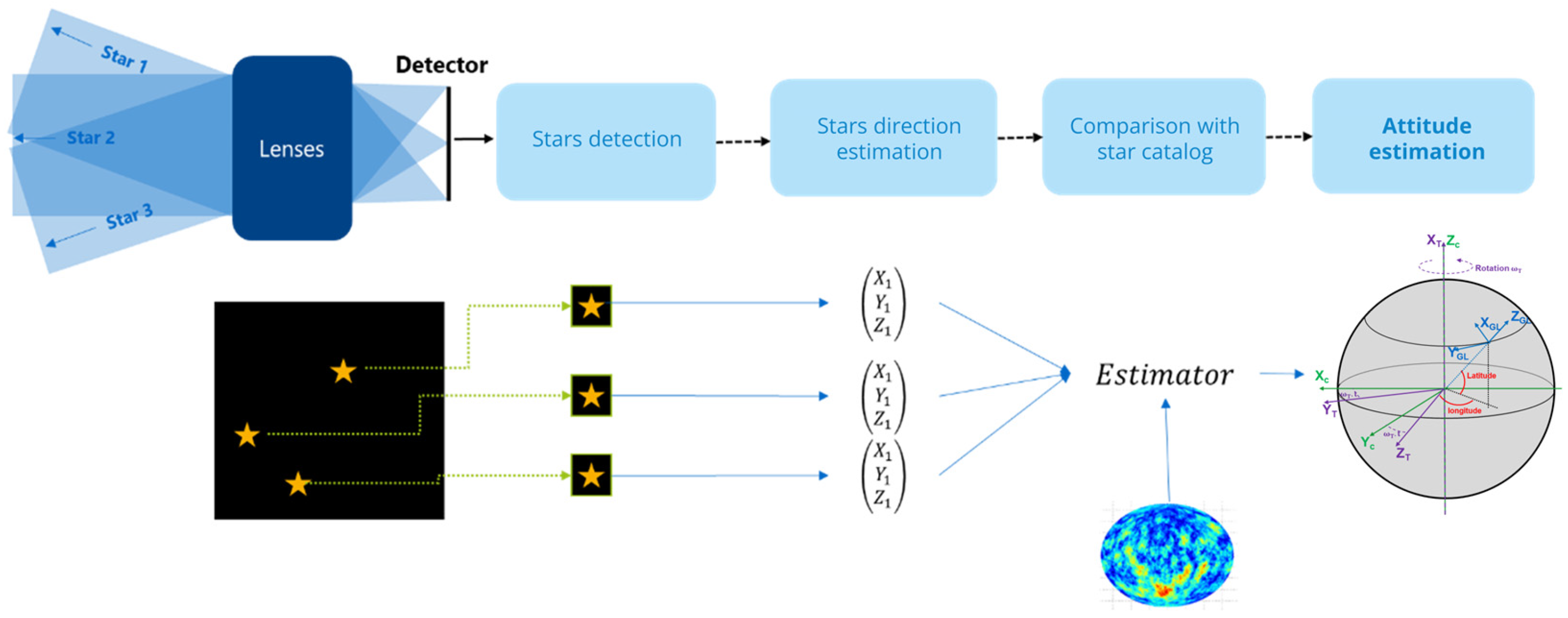
The typical star tracker used on satellites consists of a camera and a star identification algorithm. As shown in
Figure 1, the camera captures images of the star field, and the onboard software identifies and matches these stars with a preloaded star catalog. By comparing the observed positions of the stars with their known positions, the star tracker calculates the attitude of the platform.
This attitude information is very accurate (typically a few arcseconds), very stable over a long-term period, and can be updated at a relatively high frequency (typically 10 Hz and up to 30 Hz). Star trackers are thus a key sensor in attitude and orbit control systems (AOCSs). Depending on the needs of satellites, different grades of star trackers can be used. High-performance star trackers offer superior accuracy, robust filtering, and thermal stability, making them ideal for long-term, high-precision missions. This grade of sensor is thus able to track numerous stars even in harsh conditions such as high angular rate, large operating temperature range, and high particle fluxes. However, they come with higher costs, sizes, weights, and power (C-SWaP). On the other hand, low-cost star trackers are more cost-effective and compact, making them suitable for small satellite missions, and particularly for large constellations, but they may have lower accuracy and less robustness.
2.2. Daytime Star Tracker
The natural complementarity of the low frequency, absolute, and drift-free attitude measurement of a star tracker and the high-frequency gyroscope-based attitude is also of utmost interest for Earth-based applications (airborne or even ground-based carriers) for resilient and accurate positioning. However, unlike space-based applications, operating in such an environment requires the star tracker to detect the stars through the Earth’s atmosphere, ideally during both night and daytime to offer an accurate attitude measurement anytime and anywhere over the Earth.
Retrieving a star-based attitude during daytime requires, notably, filtering of the intense signal emitted by the Earth’s atmosphere. The resulting parasitic signal level in the star tracker field of view, several orders of magnitude higher that any straylight level considered in a space-based application, considerably limits the star detection capabilities, as caused by detector saturation, spatial noise amplifications, etc. Tackling these issues, Sodern has successfully developed a daytime star tracker. It combines a carefully designed optoelectronic system that optimizes the star signal to noise ratio (SNR), the use of inertial assistance to provide high robustness to kinematics, and electronics that support dedicated algorithms. Addressing the pressing interest of the airborne market, Sodern has defined ASTRADIA, a daytime star tracker tailored for airborne applications whose key performances are presented in
Table 1.
3. Hybridization of an Inertial Measurement Unit and a Star Tracker
3.1. Concept
As mentioned before, navigation in GNSS-denied environments typically relies on an inertial navigation system (INS). While these systems are accurate in the short term, the position accuracy degrades over time, a phenomenon known as inertial drift. The primary source of drift is the biases of the gyroscopes, which lead to attitude drift. Therefore, it is natural to hybridize the INS with a star tracker, as the latter measures the absolute attitude, not being subject to drift. This also allows for estimation of the drift of the gyroscopes when the star tracker is operating. Therefore, the inertial drift will be less severe during periods of star tracking inactivity (e.g., when the aircraft is under cloud cover).
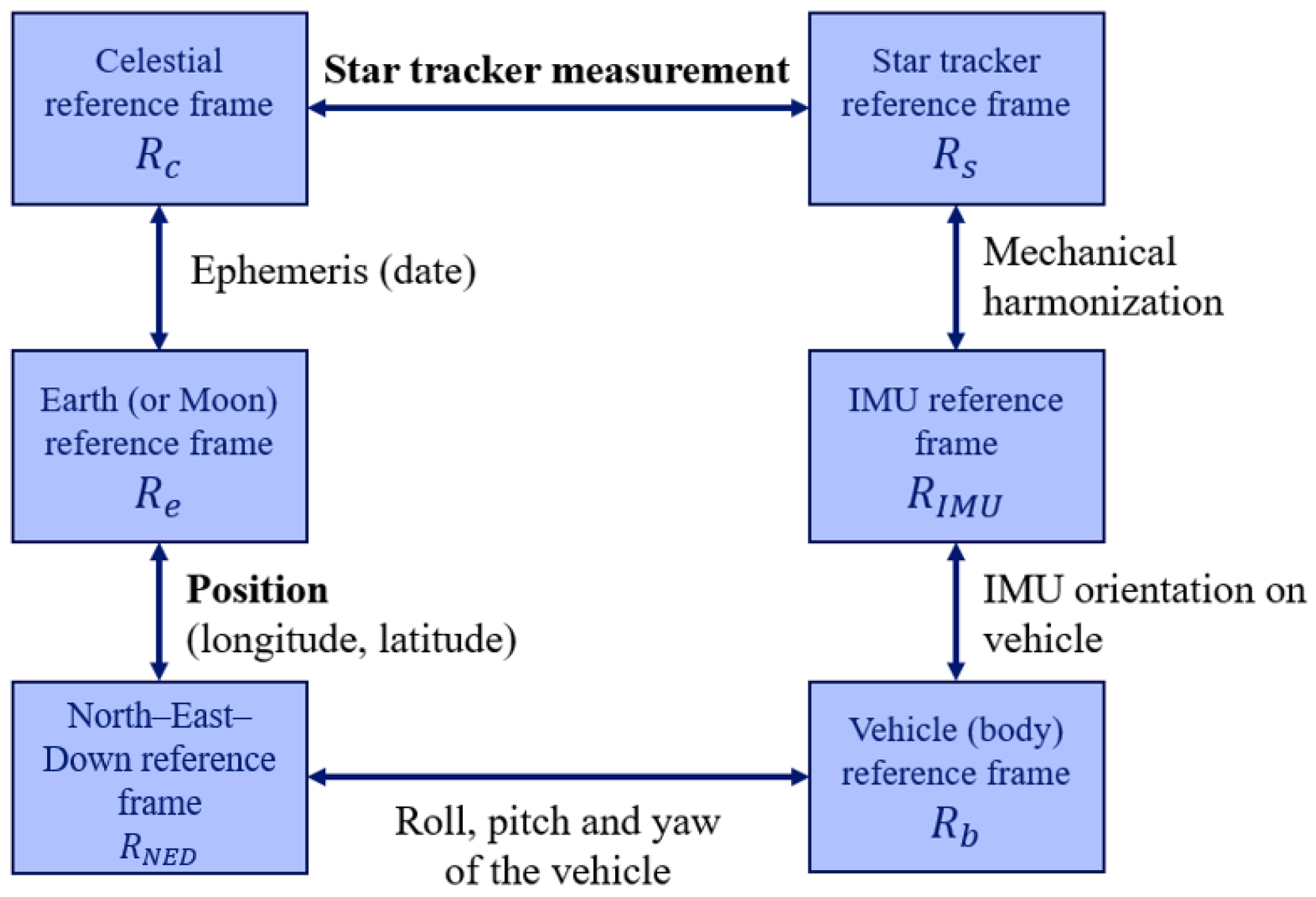
Figure 2 illustrates the reference frames involved in inertial navigation hybridized with a star tracker. In particular, it requires calculating with accuracy the Earth (or Moon) orientation relative to stars. It depends only on the date (e.g., UTC time) and may be computed from existing reference libraries such as Naval Observatory Vector Astrometry Subroutines (NOVAS), which have been validated by comparison with the IAU standard [
8]. It also requires a stable mechanical harmonization between the star tracker and the IMU. It is therefore recommended to rigidly mount the star tracker and the inertial measurement unit (IMU) to minimize relative movements between the two during the mission.
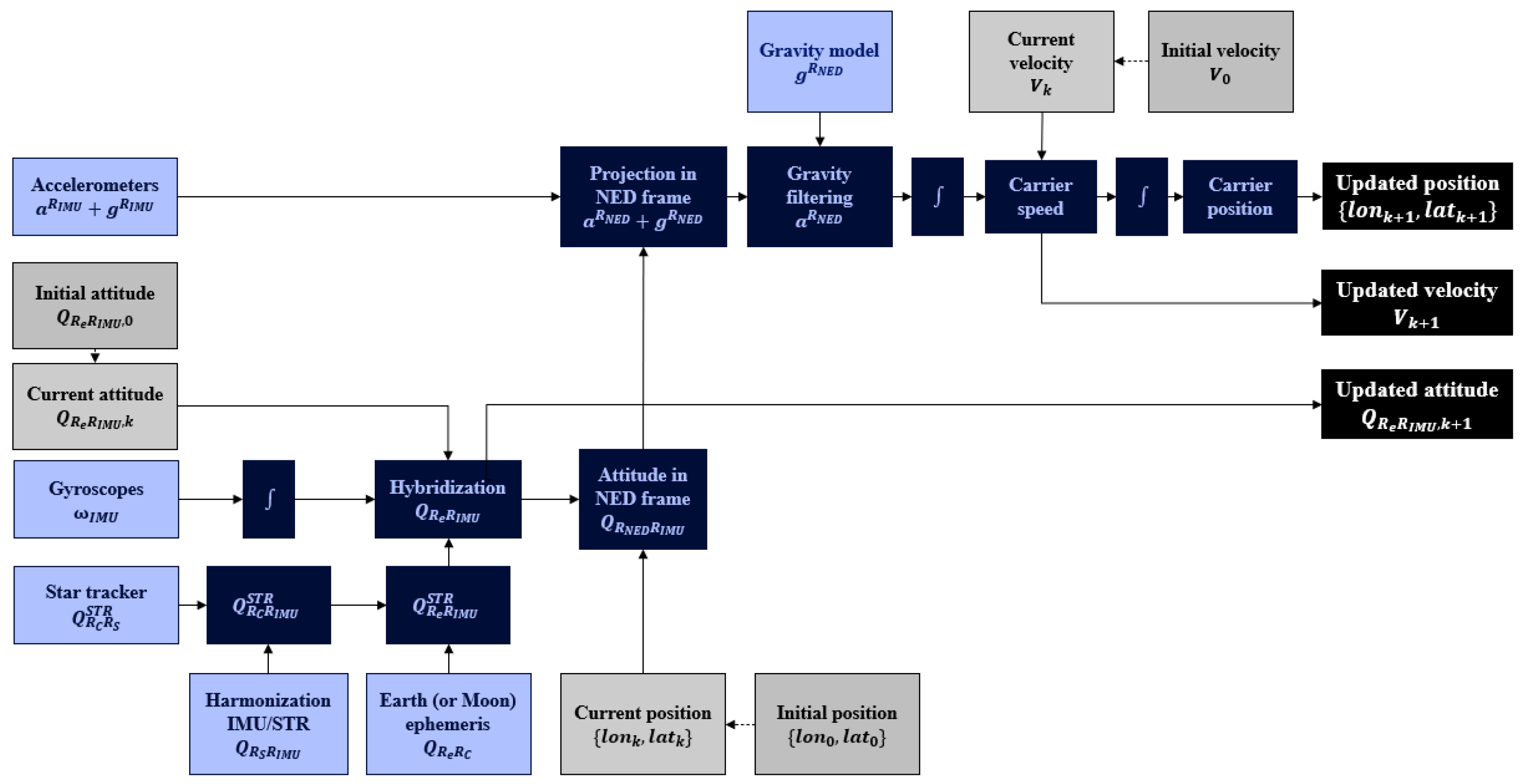
With these considerations in mind, it is possible to elaborate a navigation filter that incorporates star measurements.
Figure 3 schematically illustrates this process, showing that the star measurements are used to correct the attitude chain derived from the integration of gyroscope increments.
3.2. Error Model
Gyroscopes and accelerometers within an IMU are affected by various error sources that can impact navigation performances [
9]. In this paper, we choose the same approach as in [
10]: for both gyroscopes and accelerometers, we model the following errors:
Noise: For gyroscopes, we model it as a white noise on angular rate (ARW). For accelerometers, we model it as a white noise on measured acceleration (VRW).
Bias: For gyroscopes (resp. accelerometers), it is a bias on angular rate (resp. acceleration). We model this bias as an initially random value. To model bias instability, this initial value evolves as a random walk over time.
Scale and misalignment matrix (SAM): This is a 3 × 3 matrix that takes into account three scale factors, three non-orthogonality between axis, and three alignment angles. For each coefficient, we model this error as an initially random value. To model SAM instability, each coefficient evolves as a random walk over time.
The star tracker error model is defined as follows:
Noise: We model it as a white noise on attitude (known as noise equivalent angle).
Bias: We model this error as an initially random value. To model bias instability, this initial value evolves as a random walk over time. In this model, bias also incorporates the error on mechanical harmonization between the IMU and the star tracker.
4. Application Cases and Performance Evaluation
4.1. Aircraft Navigation
Astro-inertial navigation is well suited for both civil and military aircrafts. Despite the use of high-performance gyroscopes and accelerometers, the high dynamics of an aircraft with low constraints on degrees of freedom (movement along the three axes and rotation around the three axes, with the vehicle never being stationary) make inertial navigation less accurate in a long-term perspective if not hybridized with an external sensor. From the perspective of the star tracker, being at high altitude allows the aircraft to be above cloud cover and ease the star tracking process, as the sky luminance is lower at higher altitudes.
To demonstrate the relevance of astro-inertial navigation for airborne environments, we propose a simplified temporal covariance simulation. In this example, we assume that the aircraft is equipped with a typical civil aviation inertial navigation system (cf.
Table 2) at a 45° latitude. Additionally, we assume that the system undergoes a typical alignment when the aircraft is on the tarmac: 5 min of alignment when position and velocity are given to the Kalman filter. For the simulation case with a star tracker, we assume a daytime optical head with typical performance (cf.
Table 2) looking at the zenith. The star tracker and the inertial measurement unit (IMU) are rigidly coupled in a strapdown configuration. We assume that the mechanical alignment between the star tracker and the IMU is roughly known, with low drift over time (cf.
Table 2). We assume that the star tracker begins its first measurements after 30 min of flight (an upper limit of the time required to reach cruise altitude, above the clouds) and continues to operate continuously thereafter.
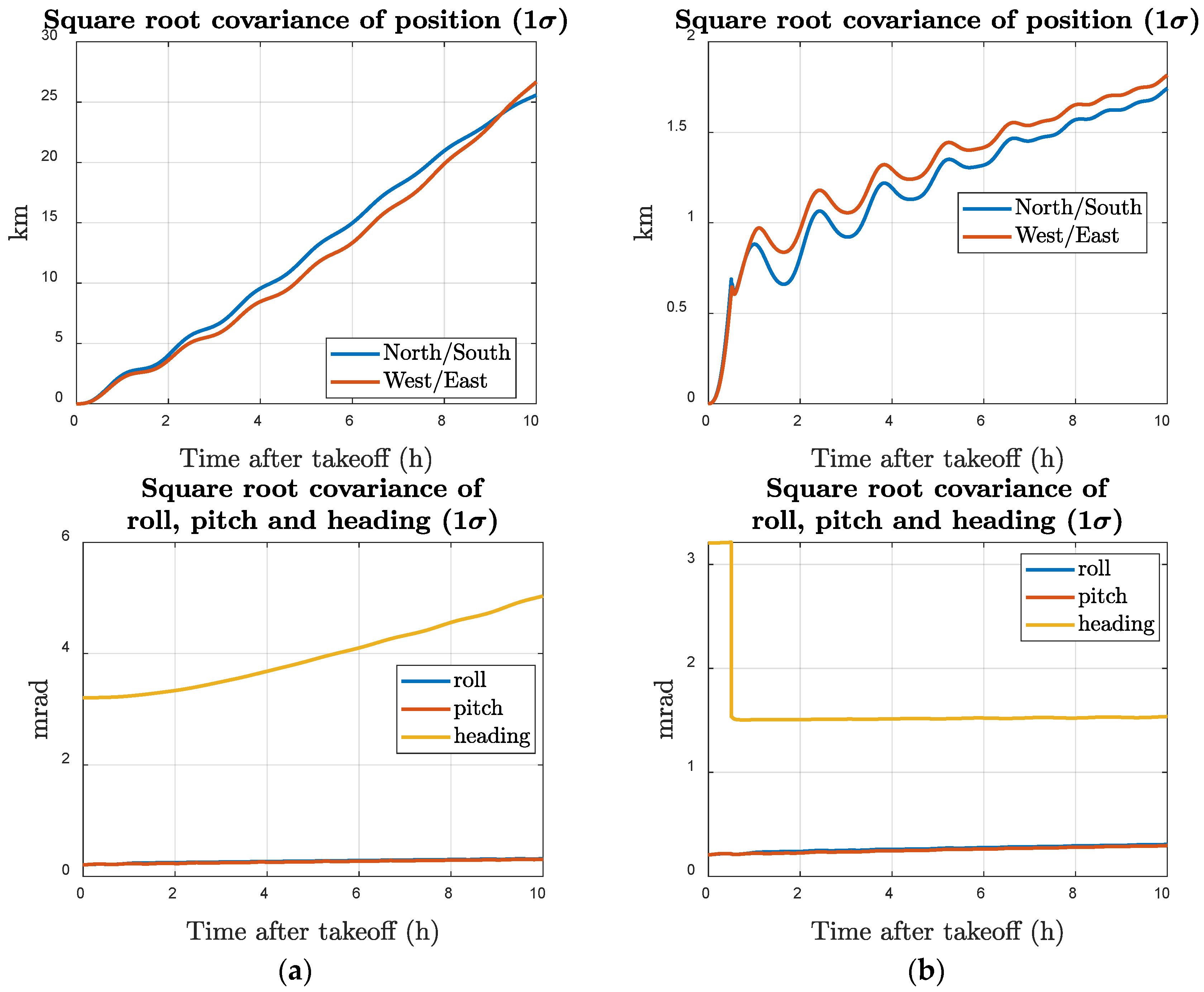
Figure 4 presents the results of the covariance simulator for both the case with the inertial navigation system (INS) alone and the case with the astro-inertial system.
The inertial-only case shows typical drift in position, characteristic of a civil aviation INS: approximately 3 Nm (95%) in one hour and 30 Nm (95%) after ten hours. The heading drift is also significant: although it is estimated to be 3.2 mrad (1σ) at the end of alignment, it reaches 5 mrad (1σ) after 10 h of flight without GNSS.
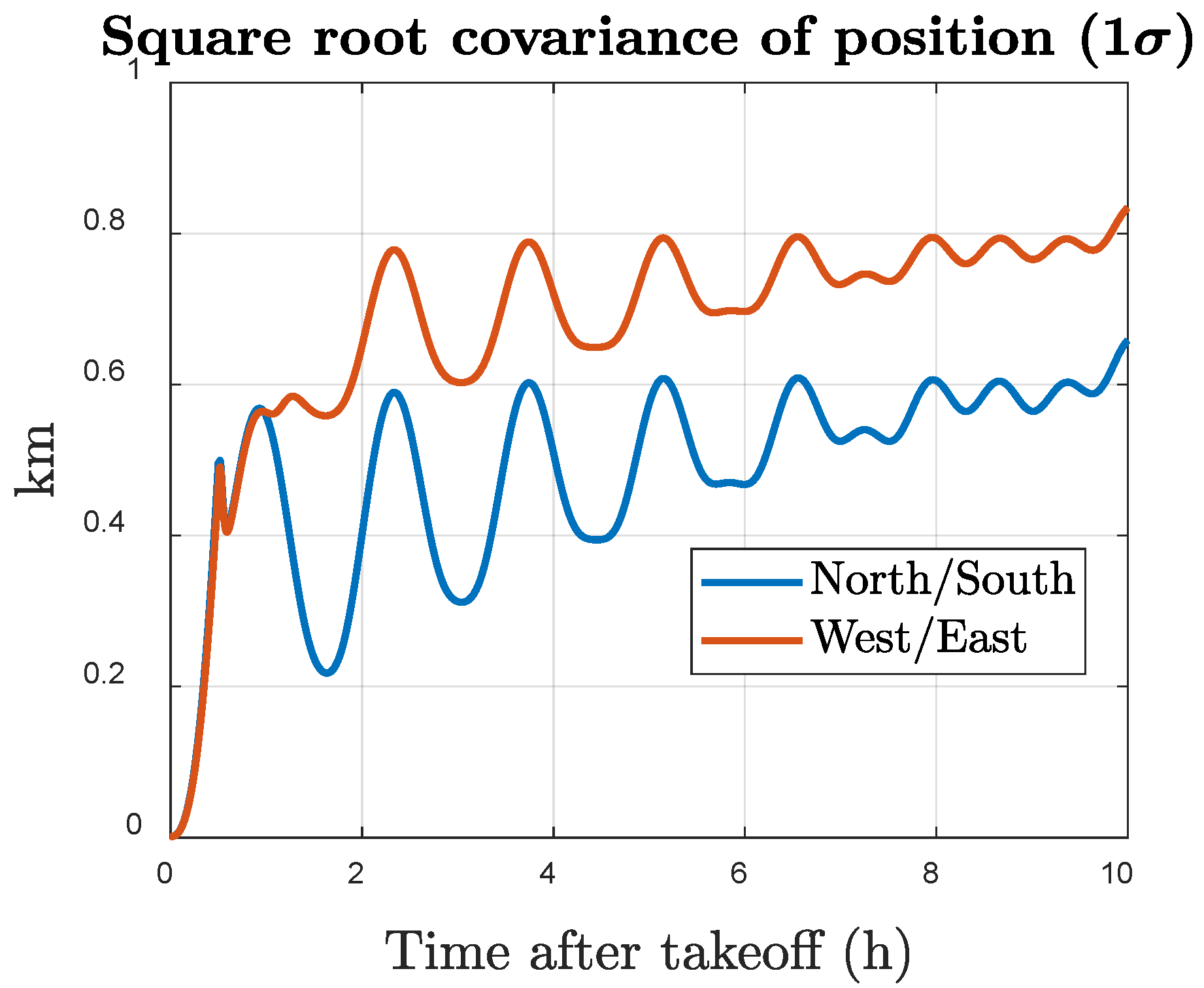
In contrast, the position calculated by the astro-inertial system is significantly more accurate and drifts much less over time: 1.2 Nm in 1 h (95%) and 2.4 Nm in 10 h (95%). Indeed, the inertial attitude is maintained through the absolute attitude measurements provided by the star tracker; there is no longer any inertial attitude drift due to gyroscope biases. Therefore, the position remains very accurate, even over the long term, despite the system being strapdown (as mentioned before, there is no mechanism to orient the star tracker). The major sources of error become the accelerometer biases and the star tracker-IMU alignment, whose uncertainty increases over time due to the instabilities modeled here. It is also worth noting that the heading of the system is well maintained, with the residual uncertainty corresponding to the uncertainty in the mechanical alignment. This advantage can be of significant interest for missions requiring precise orientation of equipment.
With particular attention to the stability of accelerometer biases and the alignment stability between the star tracker and the IMU during flight, it is possible to achieve performance with a 100 m class precision, even for flight durations of several hours without GNSS, as indicated in
Figure 5.
4.2. Lunar Navigation
Astro-inertial navigation is also well suited for missions on other celestial bodies, such as the Moon or Mars, where GNSS infrastructure is not yet available. Currently, it is of primary interest for the Moon, as numerous missions are planned for the coming decades [
11]. Additionally, the absence of atmosphere on the Moon makes star tracking easier than on Earth, with radiometric conditions similar to those in space, where star trackers have been used for decades. Two other arguments for astro-inertial navigation on the Moon are that an inertial-only alignment is nearly impossible (since the Moon rotates about 30 times slower than Earth, requiring gyroscopes that are 30 times better) and that the primary application is for rovers, which spend most of their time stationary. Thus, the system can be used like a sextant to calculate an absolute position.
The study we presented in [
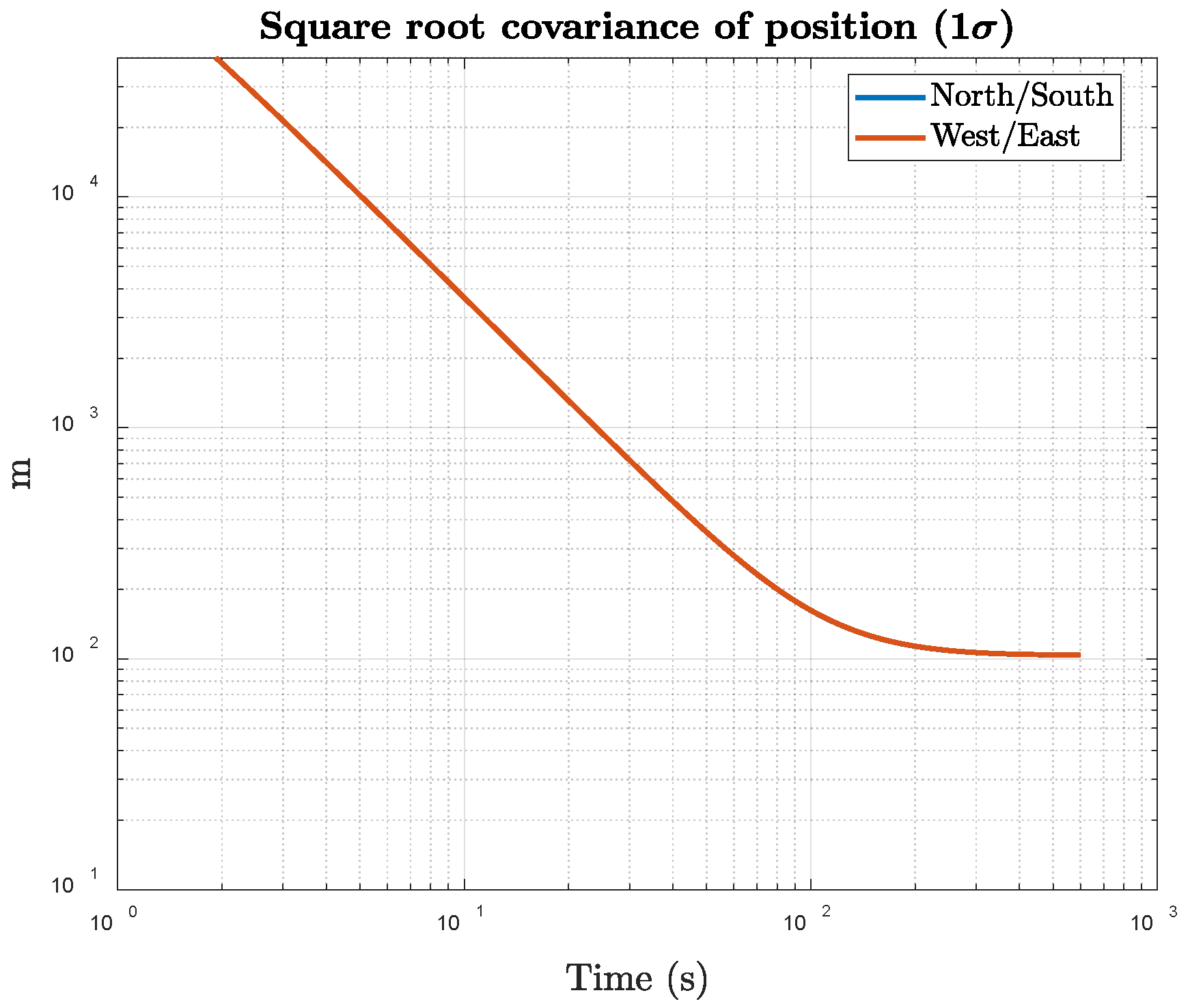
10] demonstrated that using a new space star tracker and a tactical IMU can achieve position performance on the order of hundreds of meters, provided that the IMU–star tracker alignment and the biases and scale factors of the accelerometers are well controlled, as shown in
Figure 6.
The use of astro-inertial systems on the Moon can thus enable numerous rovers and crewed missions to have precise knowledge of their position on the Moon in a fully autonomous manner, without the need for infrastructure on the lunar surface or in orbit around the Moon. The primary concerns are the robustness to the severe thermal environment and dust, as with any other lunar equipment, as well as the accurate consideration of lunar gravity, for which current models are sufficient to achieve precision on the order of 100 m [
10].
5. Conclusions and Perspectives
Astro-inertial navigation is a significant asset for missions where safety is critical, even in the absence of GNSS signals. Star trackers, with their high stability and ability to measure absolute attitude at the arcsecond level, can significantly limit the drift of inertial navigation systems, which is primarily caused by gyroscope biases.
Additionally, recent advancements in daytime star trackers now allow for precise attitude determination on Earth by observing stars even during the day, as verified by Sodern on recent developments and demonstrations. This is particularly important for the aviation domain. Indeed, aircraft navigation is one of the most challenging applications for inertial navigation due to the numerous degrees of freedom and high dynamics. Moreover, aircraft spend most of their flight above clouds, allowing for full availability of the daytime star tracker. The results presented in this paper show that it is possible to achieve position performance on the order of hundreds of meters even after several hours of flight without GNSS using a strapdown astro-inertial system without any gimbal mechanisms. For this, it is crucial to have stable accelerometers, a stable alignment between the star tracker and the IMU, and an accurate knowledge of absolute time to better than one second.
Astro-inertial navigation is also highly valuable for future lunar missions where GNSS infrastructure is currently unavailable. When the rover is stationary, such a system allows for fine alignment, heading knowledge, and the calculation of absolute position, even without prior information. These systems can also be considered for Mars, where the presence of an atmosphere would require a daytime star tracker rather than a traditional one.
Author Contributions
Conceptualization, M.L., B.P., F.G. and J.M.; methodology, L.E.; resources, D.P.; writing—original draft preparation, M.L.; writing—review and editing, M.L. and B.P. All authors have read and agreed to the published version of the manuscript.
Funding
This research has been partially funded by the Centre National d’Etudes Spatiales (CNES).
Institutional Review Board Statement
Not applicable.
Informed Consent Statement
Not applicable.
Data Availability Statement
No new data were created or analyzed in this study.
Conflicts of Interest
Authors Maxime Loil, Baptiste Paul, Frédéric Gorog and Laurent Eychenne were employed by the company Sodern. The remaining authors declare that the research was conducted in the absence of any commercial or financial relationships that could be construed as a potential conflict of interest.
Abbreviations
The following abbreviations are used in this manuscript:
| AOCSs | Attitude and orbit control systems |
| ARW | Angular random walk |
| CNS | Celestial navigation system |
| C-SWaP | Cost, size, weight, and power |
| ECSS | European Cooperation for Space Standardization |
| IAU | International Astronomical Union |
| ICRF | International Celestial Reference Frame |
| IMU | Inertial measurement unit |
| INS | Inertial navigation system |
| GNSS | Global navigation satellite system |
| GPS | Global positioning system |
| LiDAR | Light detection and ranging |
| NEA | Noise equivalent angle |
| PNT | Positioning, navigation, and timing |
| SAR | Synthetic aperture radar |
| SNR | Signal-to-noise ratio |
| UWB | Ultra-wideband |
| VRW | Velocity random walk |
| WLAN | Wireless local area network |
References
- Sabatini, R.; Moore, T.; Ramasamy, S. Global navigation satellite systems performance analysis and augmentation strategies in aviation. Prog. Aerosp. Sci. 2017, 95, 45–98. [Google Scholar] [CrossRef]
- Kerns, A.J.; Shepard, D.P.; Bhatti, J.A.; Humphreys, T.E. Unmanned Aicraft Capture and Control via GPS Spoofing. J. Field Robot. 2014, 31, 617–636. [Google Scholar] [CrossRef]
- Delépaut, A.; Giordano, P.; Ventura-Traveset, J.; Blonski, D.; Schönfeldt, M.; Schoonejans, P.; Aziz, S.; Walker, R. Use of GNSS for lunar missions and plans for lunar in-orbit development. Adv. Space Res. 2020, 66, 2739–2756. [Google Scholar] [CrossRef]
- Sirbu, G.; Leonardi, M.; Stallo, C.; Di Lauro, C.; Carosi, M. Evaluation of different satellite navigation methods for the Moon in the future exploration age. Acta Astronaut. 2023, 208, 205–218. [Google Scholar] [CrossRef]
- Grejner-Brzezinska, D.A.; Toth, C.K.; Moore, T.; Raquet, J.F.; Miller, M.M.; Kealy, A. Multisensor Navigation Systems: A Remedy for GNSS Vulnerabilities? Proc. IEEE 2016, 104, 1339–1353. [Google Scholar] [CrossRef]
- Luzum, B.; Petit, G. The IERS Conventions (2010): Reference systems and new models. Proc. Int. Astron. Union 2012, 10, 227–228. [Google Scholar] [CrossRef]
- Charlot, P.; Jacobs, C.S.; Gordon, D.; Lambert, S.; de Witt, A.; Böhm, J.; Fey, A.L.; Heinkelmann, R.; Skurikhina, E.; Titov, O.; et al. The third realization of the International Celestial Reference Frame by very long baseline interferometry. Astron. Astrophys. 2020, 644, A159. [Google Scholar] [CrossRef]
- Kaplan, G.H. The IAU Resolutions on Astronomical Reference Systems, Time Scales, and Earth Rotation Models. arXiv 2005, arXiv:astro-ph/0602086. [Google Scholar]
- Titterton, D.H. Strapdown Inertial Navigation Technology, 2nd ed.; Institution of Electrical Engineers: London, UK, 2004. [Google Scholar]
- Paul, B.; Loil, M.; Dauvergne, F.; Pascal, G.; Oddos-Marcel, L.; Montel, J.; Eychenne, L.; Ponceau, D. Stellar/inertial hybridized navigation system for lunar-based exploration missions. In Proceedings of the 47th Annual AAS Guidance, Navigation & Control Conference, Breckenridge, CO, USA, 31 January–5 February 2025. [Google Scholar]
- ESA Planned Future Missions. Available online: https://lunarexploration.esa.int/explore/esa/234 (accessed on 18 April 2025).
| Disclaimer/Publisher’s Note: The statements, opinions and data contained in all publications are solely those of the individual author(s) and contributor(s) and not of MDPI and/or the editor(s). MDPI and/or the editor(s) disclaim responsibility for any injury to people or property resulting from any ideas, methods, instructions or products referred to in the content. |