Proceeding Paper

Optimizing the Thickness Configuration of Bilayer Alumina-Aluminum Armors †
by
Tri Widodo Besar Riyadi
1,*,
Bagus Yulian Nugroho
1,
Akida Mulyaningtyas
2,
Haryanto
2 and
Desi Gustiani
3
1
Department of Mechanical Engineering, Faculty of Engineering, Universitas Muhammadiyah Surakarta, Surakarta 57102, Indonesia
2
Department of Chemical Engineering, Faculty of Engineering, Universitas Muhammadiyah Surakarta, Surakarta 57102, Indonesia
3
Department of Mechanical Engineering, Faculty of Technology, Sakarya University of Applied Sciences, Sakarya 54187, Türkiye
*
Author to whom correspondence should be addressed.
Presented at the 9th Mechanical Engineering, Science and Technology International Conference (MEST 2025), Samarinda, Indonesia, 11–12 December 2025.
Eng. Proc. 2026, 137(1), 11; https://doi.org/10.3390/engproc2026137011 (registering DOI)

Published: 21 May 2026

Abstract

The ballistic performance of the armor against the projectile impact is affected by the armor configuration. This work investigates the ballistic performance of alumina-aluminum armor impacted by a 20 mm armor-piercing projectile using simulation. A semi-analytical model was used to predict the residual projectile velocity and ballistic limit velocity for various panel configurations. The results show that increasing the alumina thickness in conjunction with decreasing the aluminum thickness can reduce the panel’s total thickness by 2.5–10% and areal density by 1.1–4.6%, without sacrificing the panel’s ballistic performance. This study assists engineers in determining ways to enhance the structural integrity of an armored vehicle.

1. Introduction

The military industry has traditionally concentrated on two competing objectives: advancing more powerful weapons to accomplish superior attack systems and more reliable and effective protection technology to support better defense strategies [1]. Consequently, the need for high mobility and protective capabilities is driving advancements in the design and application of new technologies in response to increasingly complex battlefield environments [2]. The development of armored panels parallels that of weapons technology, producing lightweight and protective armored panels [3].
Despite the development of advanced materials, steel is still the most prevalent material used for protection against the threat of projectiles or debris from explosions [4]. However, the use of steel in armored vehicles has been perceived as less effective due to its considerable weight. The material concern with armored vehicles is their excellent corrosion resistance, high impact resistance, and high strength-to-weight ratio. They are lightweight, so they can use fuel consumption to transport more soldiers and ammunition [5]. Using a bilayer panel made of metal on the back and ceramic on the front of the armor is one of the alternatives to the material constraint criterion for armored vehicles. Bilayer armor systems, which have a hard ceramic front face and an energy-absorbing metal backing layer, enable a lighter design than monolithic steel armor while providing the same ballistic protection from armor-piercing (AP) bullets. While the ceramic layer is responsible for blunting and decelerating the projectile, the backing layer holds the fractured ceramic and absorbs any remaining energy from the bullet [6].
The primary criterion for an armored vehicle’s performance is its capability to withstand ballistic impacts. The projectile entering the target without any remaining energy due to the impact velocity is called the ballistic limit velocity (Vbl). The projectile velocity that leaves the panel is the residual velocity (Vr) [7]. Many researchers have developed analytical, empirical, and numerical models to evaluate the residual velocity and ballistic limit velocity of an armor system. An analytical model simulates penetration by simplifying assumptions to reduce the governing equations to one- or two-dimensional ones. An empirical model is an algebraic equation produced by analyzing data from many experiments or simulations. A numerical simulation can provide much more data to support empirical models and decrease the number of tests that need to be conducted. To validate the numerical modeling approach, however, it is necessary to compare the simulation results with the experimental data that has been already published. The validated model can subsequently be used to explore different models of armor configurations [8].
Tepeduzu and Karakuzu [9] investigated the ballistic performance of ceramic/composite with different thicknesses using Ansys as a preprocessor and LS-DYNA as the solver. The tungsten projectile is modeled using the Johnson–Cook model, while the Johnson–Holmquist 2 (JH2) model is used for the alumina ceramic. The residual velocities of the model with and without considering the areal density of the armors were compared to a simulation work conducted by Feli and Asgari [10]. The validation results of the residual velocities between the two works are in good agreement. Feli and Asgari [10] simulated the ballistic performance of a ceramic/composite impacted by a tungsten projectile using the LS-DYNA code. The metal and ceramic damage models were also formulated using the Johnson–Cook and Johnson–Holmquist 2 (JH2) models, respectively. The result of the simulation work was validated using an analytical model developed by Chocron–Galvez [11] and simulation work by Shokrieh and Javadpour [12]. Since no experimental data are available, no comparison was made. Grujicic et al. [13] studied the ballistic performance of alumina/composite impacted by armor-piercing projectiles using analytical and numerical models. The result showed that in a hybrid armor, an optimal areal density of the armor is associated with a maximum ballistic armor performance against AP threats. The armor’s areal density helps to determine near-optimal armor configurations.
Referring to the previous works, it has been observed that the armor’s weight and thickness significantly affect the ballistic performance of an armor design. Since the differing layer configurations would result in diverse ballistic performance, it is necessary to investigate various layer thicknesses. The objective of the present work is to evaluate how different thickness configurations affect the ballistic limit velocity, residual velocity, and deformation of the panel and projectile during a ballistic test with a 20 mm Armor-Piercing Discard Sabot (APDS) projectile. A panel made of alumina 99.5% and aluminum 5083-H116 with different thicknesses was the target of several simulations using the Ansys/Explicit Dynamic software with solver Autodyn 2021 R1. The metal and ceramic material strength and fracture were established using the Johnson–Cook and the Johnson–Holmquist models, respectively. Designing an effective defense mechanism for an armored vehicle requires the ability to predict the behavior of the ceramic–metal panel during impact and penetration.

2. Materials and Methods

2.1. Part and Properties

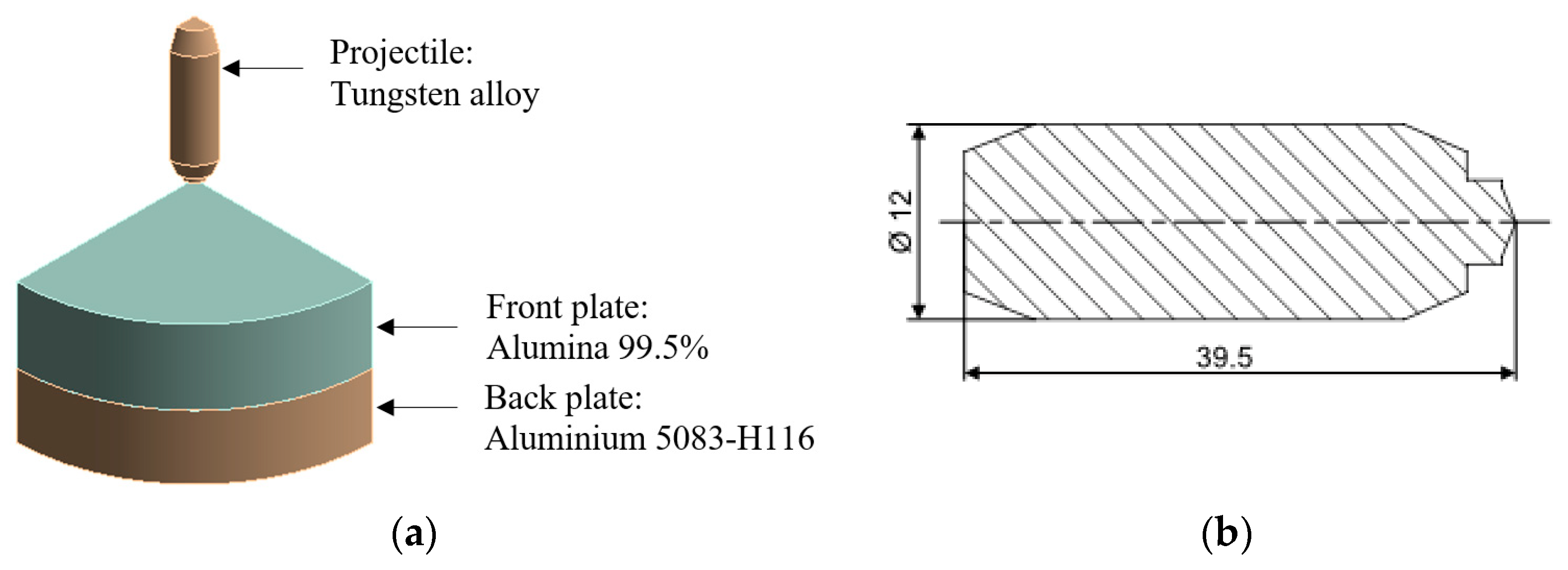
In this work, ballistic testing was performed utilizing a numerical simulation technique with the solver Ansys Autodyn 2021 R1 from Ansys Explicit Dynamic software. A similar software package, Ansys 2021 R1, was used to model the parts. Ansys SpaceClaim software, a modeling feature in the Ansys application, is used to create the APDS projectile parts [14]. The initial simulation was run to establish the model of a bilayer panel made of two different materials, as shown in Figure 1a. The front and back panels are made of 99.5% alumina and aluminum 5083-H116, respectively. For convenience of reading, the two letters followed by numbers were used as codes to represent the material and the thickness, respectively. For instance, the An20Al15 code means that the panel material is made of alumina with a thickness of 20 mm and aluminum with a thickness 15 mm. The model of the 20 mm APDS Tungsten Alloy projectile is shown in Figure 1b. The bullet and the panel are both cylindrical, so the modeling of both was refined into an axisymmetric 3D model. The part model was rendered by only one quarter to reduce the computation time [15]. The simulation was modeled in 3D-axisymmetric, with a panel size of 50 mm in diameter and 10 mm in thickness. At the same time, the APDS projectile is cylindrical, with a size of 39.5 mm in length and 20 mm in diameter. The initial velocity for the ballistic test is 1240 m/s.

2.2. Material Models and Boundary Conditions

In this work, the Johnson–Cook constitutive material model was used to model the behavior of metal in the tungsten alloy as the projectile’s core and aluminum as the panel’s back layer. In addition, the Johnson–Holmquist 2 was incorporated to model the strength of the alumina ceramic in the panel’s front layer. The metal and ceramic material properties are taken from Chi’s work [8]. The model’s boundary conditions are determined such that the contact condition between the projectile and the panel surfaces is assumed to be frictionless so the effect of friction between the projectile and the panel was considered negligible. This assumption is made by taking the coefficient of friction as 0.0, whereas the contact of the interface between the front and back panels is restrained or fixed. Similarly, the edge side of the panel is fixed to withstand the impact load. The mesh selection for the projectile and panel was selected using a body-fitted Cartesian mesh for the element type.

2.3. Mesh Convergence Studies

Mesh convergence is one of the most essential and frequently used methods for evaluating computational tools. According to the convergence criterion, the solution must approach a fixed value once the model is discretized [15]. Different element sizes, ranging from 0.3 to 1.75 mm, were employed in the convergence study, resulting in a total element number of 84,112 and 520,327 in the projectile and the panel, respectively. The simulation output for comparison purposes is the projectile’s residual velocity. The result demonstrates that the residual velocity converges at an element size of 1 mm. Consequently, the rest of the simulation applies an element size of 1 mm for all the models.

3. Results and Discussion

3.1. Model Validation

The present model was validated using experimental data reported by Gálvez and Paradela [1]. The projectile’s initial velocity is 1240 m/s, which is the same for all panels with variations in thickness. Table 1 shows the projectile residual velocity data obtained from the Galvez and Paradela experiment and the present simulation. The average difference between the projectile’s residual velocity observed in the simulation and the experiment of Galvez and Paradela is 4.9%. This result indicates that the model used in the current simulation correlates closely with the experimental results. Thus, the simulation model and material properties used in the current simulation are valid and acceptable for further studies using modified panel thicknesses.

3.2. Thickness Modifications

When the panel model had been validated using the experimental data, the verified model was then used to explore a new design of panel configuration. Four thickness configurations were studied in this work, modified from Chi’s panel [8]. Modifying the panel’s thickness was undertaken to increase the panel’s performance in parallel with the weight reduction. The areal density—the mass per unit area—is the best parameter for comparison in terms of panel weight. After several trials, it was proposed to increase the front plate thickness by 1 mm and reduce the back plate thickness by 2 mm with respect to Chi’s panel. Explicitly, the present simulation uses panel’s size of An6-Al3 to replace the Chi’s panel with size of An5-Al5. Likewise, An11-Al8, An16-Al13, and An21-Al18 proposed in the present work replaces the Chi’s panel with size of An10-Al0, An15-Al15, and An20-Al20, respectively. This consideration was taken to increase the front plate panel’s performance to destroy the projectile. Table 2 gives the total thickness and areal density observed by simulation in the current modified panels. The comparison to the Chi’s panel indicates that the total thickness and areal density of the present panel are smaller than those of Chi’s panel in the range of 2.5–10% and 1.1–4.6%, respectively. The finding in this work is therefore promising to renew the design of the predetermined armor.

3.3. Ballistic Performance

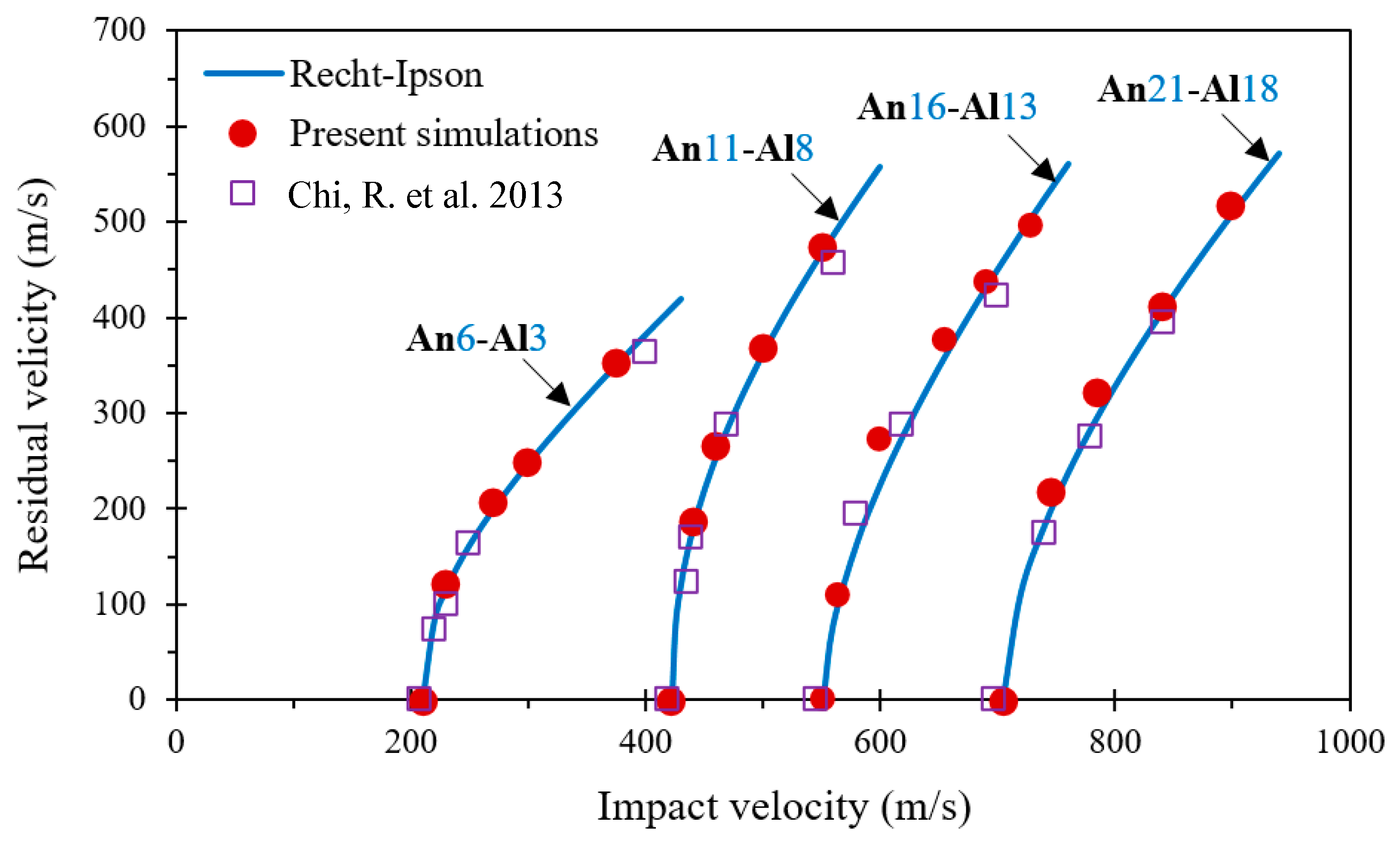
The ballistic performance of an armor structure can usually be analyzed using parameters of ballistic limit velocity and residual velocity [6]. A panel’s ballistic limit velocity (Vbl) reflects the projectile’s velocity limit so that the panel can withstand the projectile impact. The projectile’s velocity leaving the back panel is called the residual velocity. Figure 2 shows the relationship between the projectile’s impact velocity and the residual velocity for different panel configurations. The simulation result indicates that the residual velocity increases sharply with increased impact velocities above the Vbl. Subsequently, the increase in the residual velocity is more gradual. Lim et al. [16] reported that the reduction in the residual velocity at high impact velocity is related to the drop in the energy absorbed by the panel.
A semi-analytical model Recht–Ipson equation was proposed to predict the profile of the residual velocity obtained from the simulation data. The results show that the Vbl value obtained by simulation and the Recht–Ipson equation is reasonably close. This result indicates that the Recht–Ipson equation accurately predicts the projectile’s residual velocity, including the ballistic limit velocity.
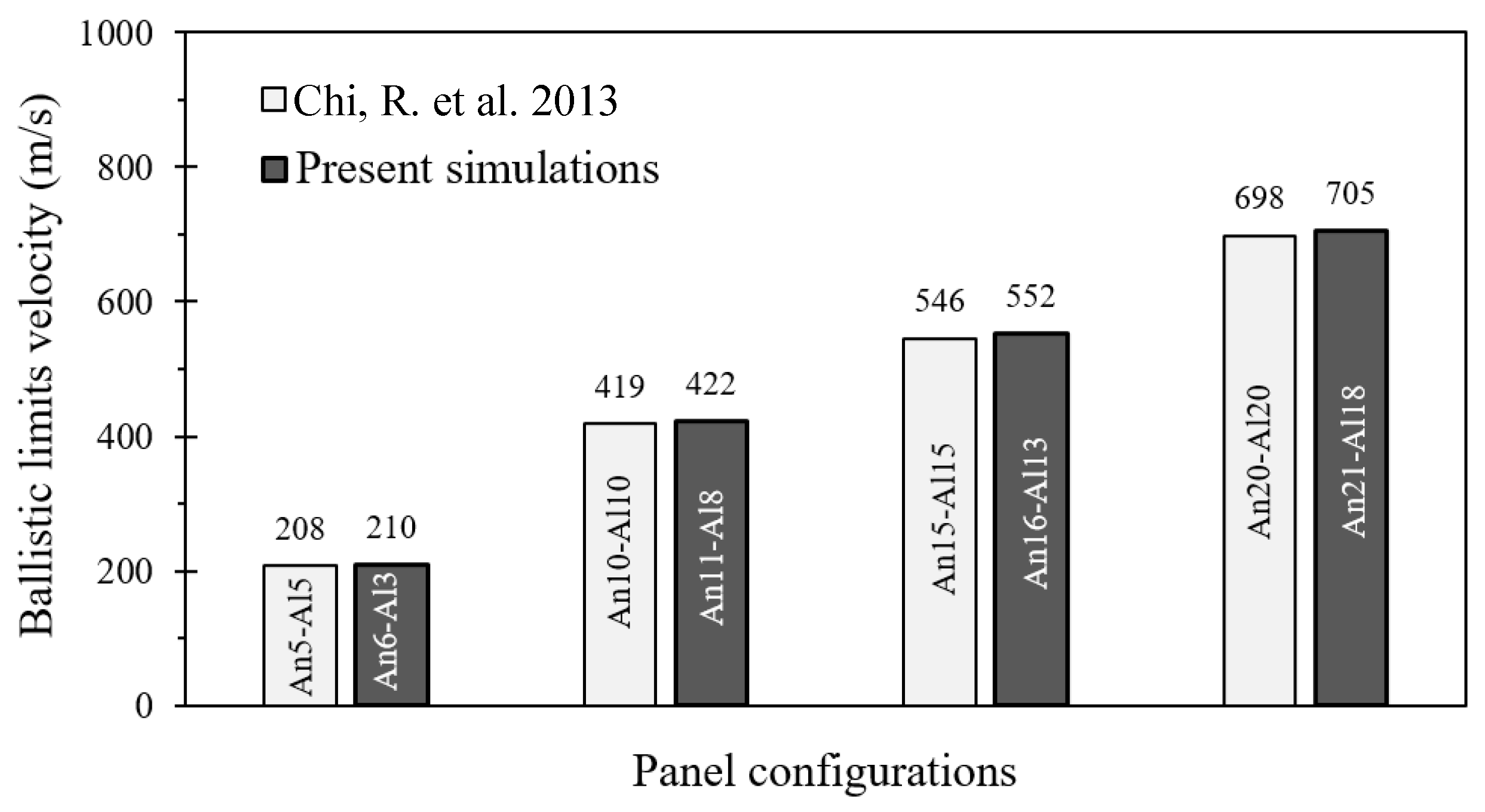
A comparison was made to determine the performance of the optimized panels and the study by Chi et al. [8], as shown in Figure 3. The result shows that the Vbl of the modified panels is higher than that of Chi’s panels. This finding demonstrates that the modified panels proposed in this study exhibit higher durability than Chi’s panel, although the panel thickness of the present configuration is smaller than that of the panels reported by Chi et al. [8].

3.4. Stress Distributions

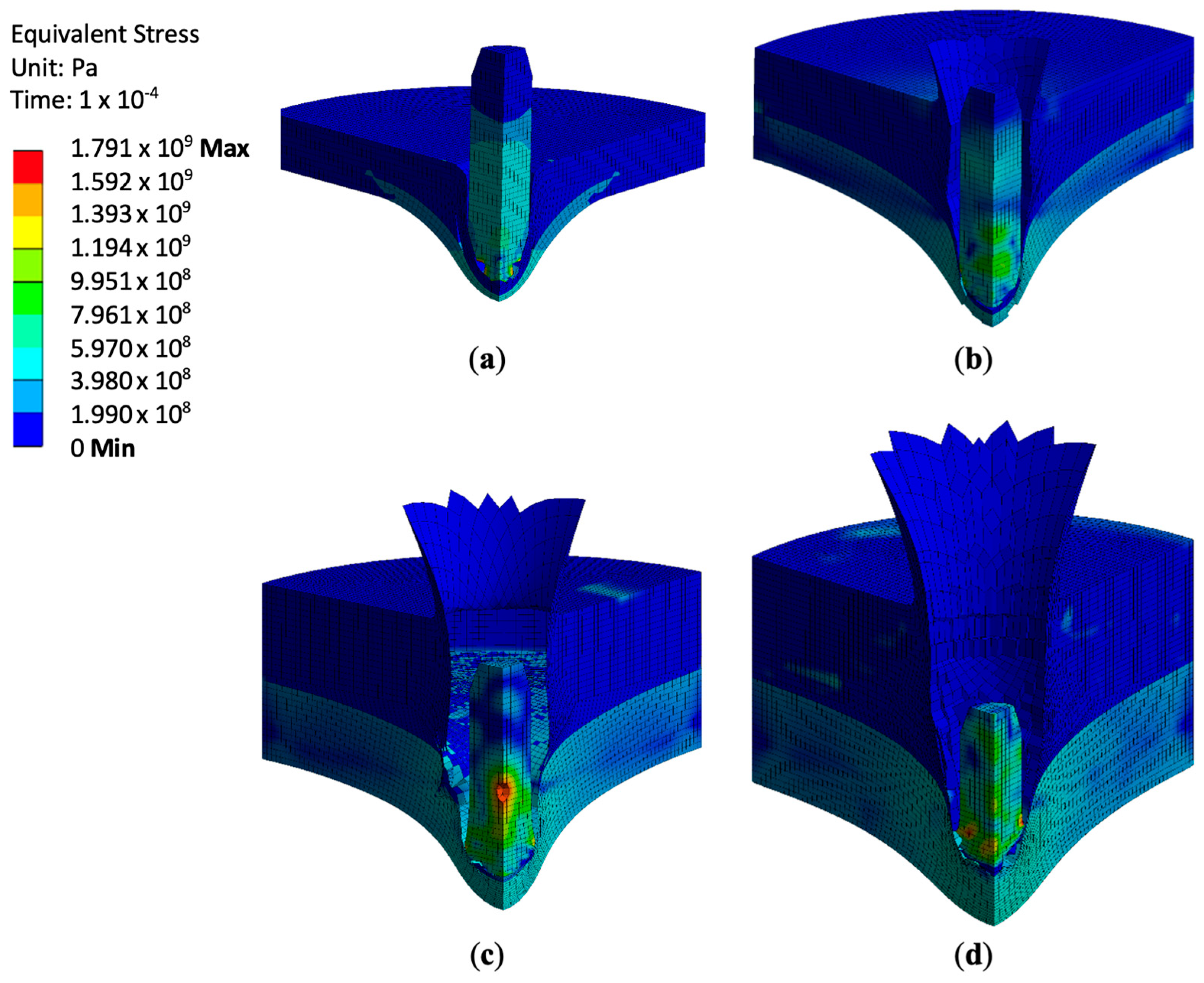
The stress distribution across the deformed parts during impact ballistics can be related to the cause of part failures [17]. Figure 4a–d shows the stress distributions captured at a time of 100 µs in the projectile penetrations with a ballistic limit velocity of 210 m/s, 422 m/s, 552 m/s, and 705 m/s on the panel code of An6-Al3, An11-Al8, An16-Al13, and An21-Al18, respectively. In their initial contacts, the projectile and the front side of the panel induce a high-stress wave. The stress wave may result in plastic deformation, fragmentation, and erosion of the projectile and the front and back panels, depending on the resistance of the materials [18]. The stress contours show that the stress experienced by the projectile is more intense than that in the panels with different configurations. The high stress in the projectile is attributed to the more rigid material of the projectile. Comparing the stress in the panels, the stress in the back panel is higher than in the front. The lower stress in the front panel indicates that the stress has been released after the crack formation. The projectile impact has caused the panel’s deformation, shaped like a petal flower. The An6-Al3 panel experiences petaling in the rearward. In contrast, the panels of An11-Al8, An16-Al13, and An21-Al18 suffer from petaling in the frontward. Backman and Goldsmith [19] explain that petaling is a type of deformation produced by high radial and circumferential tensile stresses on the panel plate due to the compressive stress wave that occurs near the edge of the projectile.
The aluminum plate on the panel’s back deflects under the applied load. As the interface between alumina and aluminum is modeled as a fixed bond, the aluminum deflection attracts some interface parts of the alumina plate, causing it to move following the aluminum deflection. No gap at the interface between the alumina and aluminum plates supports the fixed bond between the alumina and aluminum. The failure occurs in the back plate as its limits in absorbing the projectile’s kinetic energy are reached. Improving the deflection of aluminum in the back plate might be conducted by increasing its stiffness [20] using composite materials [21].

4. Conclusions

An armored panels’ design composed of alumina and aluminum was successfully optimized through a simulation using Ansys Explicit Dynamic software. Galvez-Shances’ experimental data were used to validate the present model. The model was used to investigate the different thicknesses of the front and back panels. The previous configuration panels proposed by Chi, composed of An5-Al5, An10-Al0, An15-Al15, and An20-Al20, were optimized in the present work by An6-Al3, An11-Al8, An16-Al13, and An21-Al18. The code of An21Al18 indicates that the panel is made of alumina with a thickness of 21 mm and aluminum with a thickness of 18 mm. The results show that the ballistic limit velocity increases with panel thickness. Similarly, the residual velocity increases with increased impact velocities, which is related to the drop in the energy absorbed by the panel. The role of the front plate in inhibiting projectile impact is more significant than that of the back plate. Reducing the metal thickness in the back panel still maintains the ballistic limit velocity. Increasing the alumina thickness in conjunction with decreasing the aluminum thickness can reduce the panel’s total thickness by 2.5–10% and areal density by 1.1–4.6%, without sacrificing the panel’s ballistic performance. The stress distribution on the projectile and the panels has indicated the causes of failure. The stress experienced by the projectile is more intense than that in the panels. The An6-Al3 panel experiences petaling in the rearward. In contrast, the panels of An11-Al8, An16-Al13, and An21-Al18 suffer from petaling in the frontward. The study’s findings reduce the weight of the armored panel without compromising its ability to withstand projectile impacts.

Author Contributions

Conceptualization, T.W.B.R.; methodology, B.Y.N.; software, B.Y.N.; validation, B.Y.N. and T.W.B.R.; formal analysis, B.Y.N.; investigation, B.Y.N.; resources, A.M. and H.; data curation, A.M. and H.; writing—original draft preparation, B.Y.N.; writing—review and editing, T.W.B.R. and A.M.; visualization, B.Y.N.; supervision, D.G.; project administration, D.G.; funding acquisition, T.W.B.R. All authors have read and agreed to the published version of the manuscript.

Funding

All authors acknowledge the research funding by the Universitas Muhammadiyah Surakarta through the scheme of “Higher Education of Integration Tridarma (HIT)” grants, with contract number 102/A.3-III/FT/III/2021.

Institutional Review Board Statement

Not applicable.

Informed Consent Statement

Not applicable.

Data Availability Statement

All supporting data are available by request.

Acknowledgments

During the preparation of this manuscript, the authors used Ansys software for the purposes of simulation. All authors have reviewed and edited the output and take full responsibility for the content of this publication. Special thanks are devoted to my student, Bagus Yulian Nugroho, who has worked day and night to model the parts and run the simulation.

Conflicts of Interest

The authors declare no conflicts of interest. The funders had no role in the design of the collection, analyses, and interpretation of data, including the writing of the manuscript and the decision to publish the results.

Abbreviations

The following abbreviations are used in this manuscript:
APArmor-piercing
APDSArmor-Piercing Discarding Sabot
AlAlumina (Al2O3) 99.5%
AnAluminum 5083-H116
JH2Johnson–Holmquist 2
VblBallistic limits velocity
VoInitial velocity
VrResidual velocity

References

  1. Gálvez, V.S.; Paradela, L.S. Analysis of failure of add-on armour for vehicle protection against ballistic impact. Eng. Fail. Anal. 2009, 16, 1837–1845. [Google Scholar] [CrossRef]
  2. Prasetyo, A.A.; Wijaya, A.P.; Gustiani, D.; Mulyaningtyas, A.; Riyadi, T.W.B. Ballistic performance of a composite armor reinforced by alumina balls with various matrix materials: A numerical study. Mech. Eng. Soc. Ind. 2025, 5, 276–285. [Google Scholar] [CrossRef]
  3. Rahman, N.A.; Abdullah, S.; Zamri, W.F.H.; Abdullah, M.F.; Omar, M.Z.; Sajuri, Z. Ballistic Limit of High-Strength Steel and Al7075-T6 Multi-Layered Plates Under 7.62-mm Armour Piercing Projectile Impact. Lat. Am. J. Solids Struct. 2016, 13, 1658–1676. [Google Scholar] [CrossRef]
  4. Yaakob, M.Y.; Saion, M.P.; Husin, M.A. Potency of natural and synthetic composites for ballistic resistance: A review. Appl. Res. Smart Technol. 2020, 1, 43–55. [Google Scholar] [CrossRef]
  5. Palta, E.; Gutowski, M.; Fang, H. A numerical study of steel and hybrid armor plates under ballistic impacts. Int. J. Solids Struct. 2018, 136-137, 279–294. [Google Scholar] [CrossRef]
  6. Rathod, S.; Tiwari, G.; Chougale, D. Ballistic performance of ceramic–metal composite structures. Mater. Today Proc. 2021, 41, 1125–1129. [Google Scholar] [CrossRef]
  7. Børvik, T.; Hopperstad, O.S.; Pedersen, K.O. Quasi-brittle fracture during structural impact of AA7075-T651 aluminium plates. Int. J. Impact Eng. 2010, 37, 537–551. [Google Scholar] [CrossRef]
  8. Chi, R.; Serjouei, A.; Sridhar, I.; Tan, G.E. Ballistic impact on bi-layer alumina/aluminium armor: A semi-analytical approach. Int. J. Impact Eng. 2013, 52, 37–46. [Google Scholar] [CrossRef]
  9. Tepeduzu, B.; Karakuzu, R. Ballistic performance of ceramic/composite structures. Ceram. Int. 2019, 45, 1651–1660. [Google Scholar] [CrossRef]
  10. Feli, S.; Asgari, M. Finite element simulation of ceramic/composite armor under ballistic impact. Compos. Part B Eng. 2011, 42, 771–780. [Google Scholar] [CrossRef]
  11. Benloulo, I.C.; Sánchez-Gálvez, V. A new analytical model to simulate impact onto ceramic/composite armors. Int. J. Impact Eng. 1998, 21, 461–471. [Google Scholar] [CrossRef]
  12. Shokrieh, M.; Javadpour, G. Penetration analysis of a projectile in ceramic composite armor. Compos. Struct. 2008, 82, 269–276. [Google Scholar] [CrossRef]
  13. Grujicic, M.; Pandurangan, B.; Zecevic, U.; Koudela, K.; Cheeseman, B. Ballistic Performance of Alumina/S-2 Glass-reinforced Polymer-matrix Composite Hybrid Lightweight Armor Against Armor Piercing (ap) and Non-AP Projectiles. Multidiscip. Model. Mater. Struct. 2007, 3, 287–312. [Google Scholar] [CrossRef]
  14. Pratiwi, D.A.; Riyadi, T.W.B.; Setiadhi, D.; Hariyanto, A. Ballistic Performance Anti-Projectile of Alumina And Weldox 460 E with Finite Element Method. Creat. Res. Eng. 2023, 3, 10–23. [Google Scholar] [CrossRef]
  15. Barrett, S.; Christiansen, R.V.L.R.; Othman, A. Ballistic Properties of Projectile Material. Master’s Thesis, Aalborg University, Aalborg, Denmark, 2016. [Google Scholar]
  16. Lim, C.; Shim, V.; Ng, Y. Finite-element modeling of the ballistic impact of fabric armor. Int. J. Impact Eng. 2003, 28, 13–31. [Google Scholar] [CrossRef]
  17. Dahlan, H. The effect of critical traction in cohesive zone model for fatigue crack growth retardation. Media Mesin Maj. Tek. Mesin 2016, 17, 44–54. [Google Scholar] [CrossRef]
  18. Mujiyono, M.; Nurhadiyanto, D.; Mukhammad, A.F.H.; Riyadi, T.W.B.; Wahyudi, K.; Kholis, N.; Wulandari, A.P.; bin Abu Hassan, S. Damage formations of ramie fiber composites multilayer armour system under high-velocity impacts. East.-Eur. J. Enterp. Technol. 2023, 1, 16–25. [Google Scholar] [CrossRef]
  19. Backman, M.E.; Goldsmith, W. The mechanics of penetration of projectiles into targets. Int. J. Eng. Sci. 1978, 16, 1–99. [Google Scholar] [CrossRef]
  20. Masyrukan, M.; Darmawan, A.S. Influence of Artificial Aging in Aluminum Silicon Alloy. Mater. Sci. Forum 2021, 1029, 9–14. [Google Scholar] [CrossRef]
  21. Riyadi, T.W.B. Structure and Properties of Ni-Al-Ti Systems Formed by Combustion Synthesis. Mater. Sci. Forum 2020, 991, 44–50. [Google Scholar] [CrossRef]
Figure 1. Part model of (a) panel and (b) projectile core.
Engproc 137 00011 g001
Figure 2. Residual velocity against impact velocity of the projectile for various panels [8].
Engproc 137 00011 g002
Figure 3. Comparison of the ballistic limit velocity [8].
Engproc 137 00011 g003
Figure 4. Stress distribution captured at 100 µs using Vbl impact on the projectile and panel code (a) An6-Al3, (b) An11-Al8, (c) An16-Al13, and (d) An21-Al18.
Engproc 137 00011 g004
Table 1. Residual velocity observed by present simulation.
An (mm)Al (mm)Vr (m/s)
20101033.8
2015982.2
2510947.1
2515896
Table 2. The thickness and areal density produced by present simulation.
Panel’s CodeTotal Thickness (mm)Areal Density (kg/m2)
An6-Al3931.44
An11-Al81964.39
An16-Al132997.34
An21-Al1839130.29
Disclaimer/Publisher’s Note: The statements, opinions and data contained in all publications are solely those of the individual author(s) and contributor(s) and not of MDPI and/or the editor(s). MDPI and/or the editor(s) disclaim responsibility for any injury to people or property resulting from any ideas, methods, instructions or products referred to in the content.