


Abstract
The Indonesian government should seriously consider the use of renewable energy, given the natural potential that can still be utilized as an environmentally friendly power source. The utilization of renewable energy can be achieved by harnessing available natural resources. Pico hydro power plants (PLTPHs) can serve as an alternative electricity generator for use in Indonesia due to the existing natural potential. The output from this power plant can be utilized directly or stored in batteries. Directly measuring the generator’s performance on-site is deemed less effective. Therefore, a monitoring system is introduced as a solution to allow remote monitoring and display parameters such as voltage, current, frequency, and power of the generator online. This system is designed to display the micro hydro generator’s output parameter data on the Blynk application. The display on the Blynk application can be monitored via a connected mobile phone. Testing of the monitoring system was carried out by comparing two sets of measurements: one through the PZEM-004T sensor system and the other through a kWh meter (Kilowatt-hour meter). For the AC output from the battery with a 12-watt lamp load (tested 4 times), the reading error values obtained were a voltage reading error of 0.2%, a current reading error of 19.4%, a frequency reading error of 0.67%, and a power reading error of 18.2%.
1. Introduction
As time progresses, one of the constant challenges faced is the various issues related to energy. The required energy consumption is vast, while the existing long-term energy sources are increasingly limited. The high demand for energy across various human sectors is inversely proportional to the amount of energy supply. The large-scale exploitation of fossil energy sources such as coal, petroleum, and natural gas will eventually deplete these reserves due to the immense demand.
Rivers serve as the source of life on Earth, containing water essential for all living creatures, especially humans. Indonesia possesses an abundance of rivers, ranging from small to large, spread across various regions. This condition presents a significant opportunity for the development of renewable electricity, particularly in areas not yet reached by the PLN (State Electricity Company) grid. Utilizing these water resources can be a solution for obtaining renewable energy [1]. Water is a plentiful natural resource that is easily found in the surroundings. Its function extends beyond meeting daily needs; it has become an alternative energy source replacing environmentally harmful generators.
The pico hydro power plant (PLTPH) utilizes water sources as the energy driver for turbines to generate electricity and is currently widely used by communities as an alternative renewable energy source. The core working principle of PLTPH involves harnessing the differential height (head) and the volume of water flow per second (debit) [2]. Pico hydro, a renewable energy generator, converts the potential energy from falling water or the kinetic energy from water flow into electrical energy. The relatively smaller size of PLTPHs compared to large hydroelectric power plants (PLTAs) allows its use in irrigation channels that do not require very large water flow [3].
While micro hydro typically exploits the potential energy (head) of falling water, difficult geographical factors where a natural waterfall cannot be found can be overcome by utilizing the rapid flow of water with an Archimedes screw-type water wheel, which is suitable for low-head conditions. Water is directed into a designed power plant, usually placed along riverbanks or irrigation channels, to drive the wheel. Electrical energy is obtained by converting mechanical energy into electrical energy from the rotation of the turbine shaft using a generator. The magnitude of the extractable energy is influenced by the density of water (ρ), the flow rate (Q), the falling height (h), gravity (g), and the total system efficiency (Et). The Archimedes screw turbine operates on the principle of converting the potential energy of water into power or energy. The flowing water pressure enters the turbine vanes, causing a pressure drop proportional to the decrease in water flow velocity, resulting in resistance on the turbine blades that drives the turbine. Water turbines are a type of turbine that uses water energy as its working medium. The development and utilization of renewable energy are increasing every year, and one example is the Micro-Hydro Power Plant (MHPP). Remote monitoring can be applied to these power plants to analyze the generated data. However, the relatively high cost of monitoring systems often hinders the implementation of remote monitoring systems [4]. Monitoring the current and voltage output of the generator via a web-based system allows the system to display the generator’s output parameter data on a webpage. The results obtained are displayed on the web and can be monitored in real-time or remotely [5]. Sensors function to monitor the generator’s performance and the output from the power plant. The sensors can read and display the generator’s results. The monitoring results are read via an Arduino and an Ethernet shield connected to a computer through a Wi-Fi connection [6]. The ESP32 microcontroller is used to read and process data from the PZEM-004T v3 sensor module, remotely control a solid-state relay (SSR), and implement software design such as the Internet of Things (IoT) [7]. The ESP32 microcontroller board features an integrated 2.4 GHz Wi-Fi chip and Bluetooth, designed with TSMC ultra-low-power technology. The advantages of the ESP32 microcontroller board include low power consumption, a dual-mode Bluetooth with low power usage, and an integrated Wi-Fi module. The board is compatible with Internet of Things (IoT) technology [8,9].
2. Research Method
2.1. Literature Review
The literature review involved several stages prior to conducting research, starting with searching for, studying, and gathering various references. These references were sourced from the internet, books, and journals (both national and international) that were relevant to the chosen research topic.
2.2. Research Flow Diagram
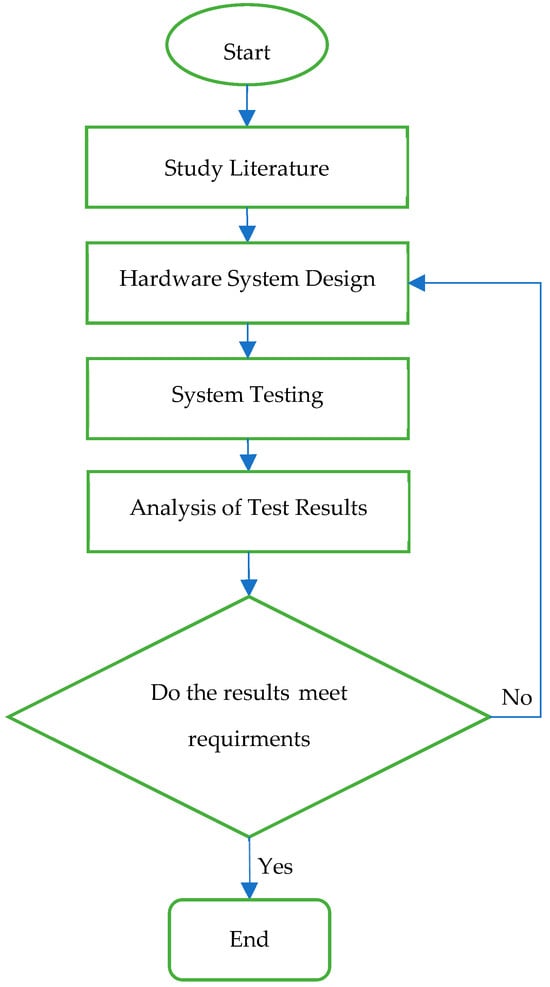
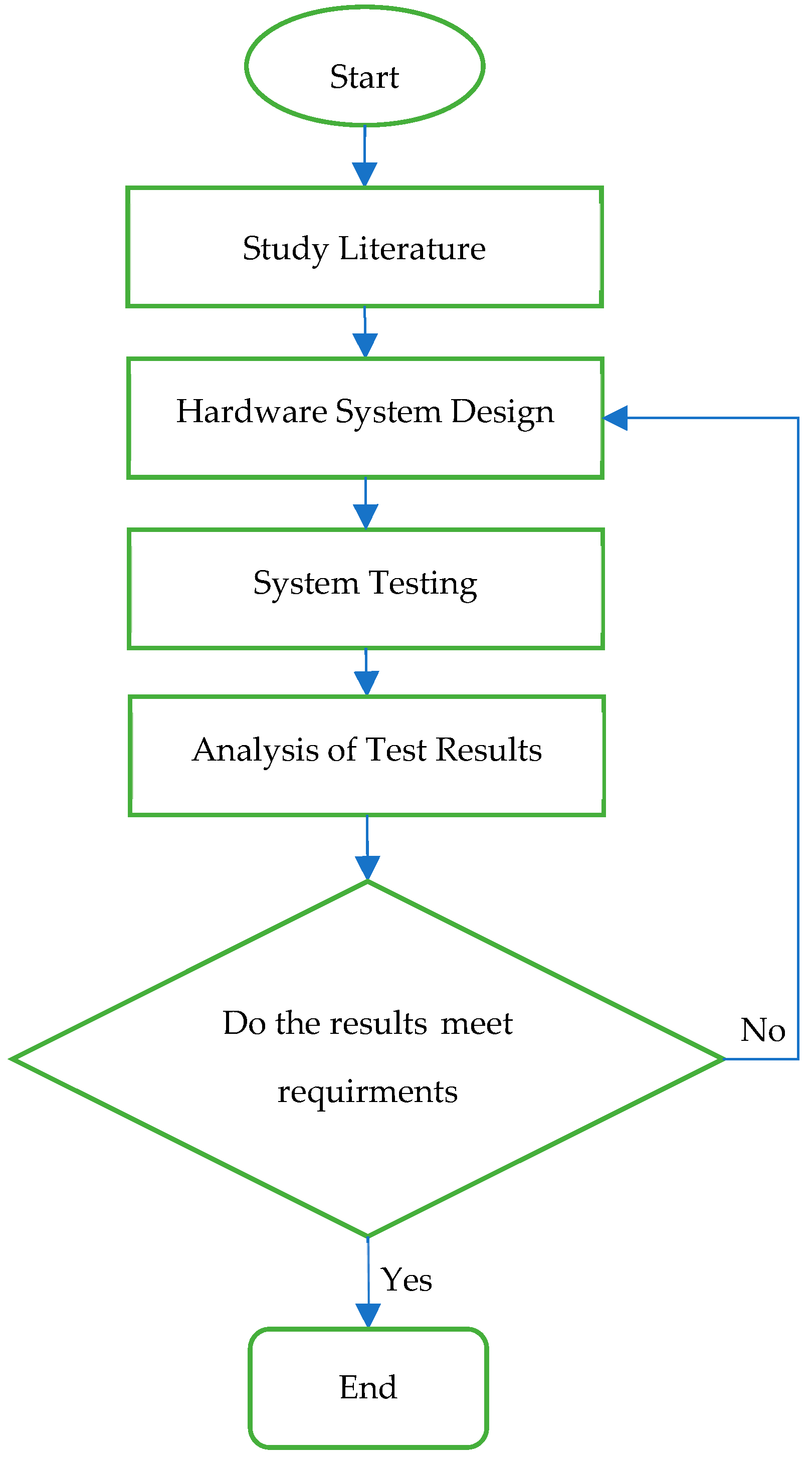
The research stages were executed systematically and meticulously planned to ensure maximum results as shown in Figure 1.
Figure 1.
Research method flow diagram.
2.3. Equipment Planning
a. PZEM-004T Sensor Module
The PZEM-004T module designed by Peacefair (Ningbo, China), is a sensor module designed to measure voltage, current, frequency, and power within an electrical circuit. The PZEM-004T module can be utilized for measurement projects on electrical networks, such as those in homes or buildings. This sensor module is capable of measuring a voltage range of 80–260 VAC with a measurement resolution of 0.1 VAC and a reading accuracy of 0.5%.
b. ESP32 Microcontroller Board
The ESP32 microcontroller board, developed by Espressif Systems (Shanghai, China), this board features an integrated 2.4 GHz Wi-Fi chip and Bluetooth capability. The key advantages of this board are its integrated Wi-Fi module, low power consumption, and the inclusion of dual-mode Bluetooth with low power usage. This board is fully equipped for Internet of Things (IoT) technology.
c. LM2596 step-down Module
The LM2596 step-down module, based on Texas Instruments (Dallas, TX, USA) design, this DC/DC converter is used to step down the voltage. It operates at a fixed-voltage, 150 kHz fixed-frequency (PWM step-down) and is capable of driving a 5 A load with high efficiency. This module is used to step down the voltage and resolve the voltage difference between the required input and the available supply.
d. Wiring and Hardware
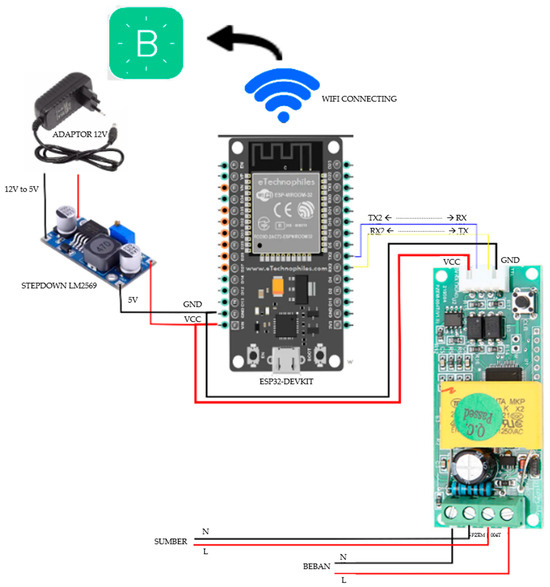
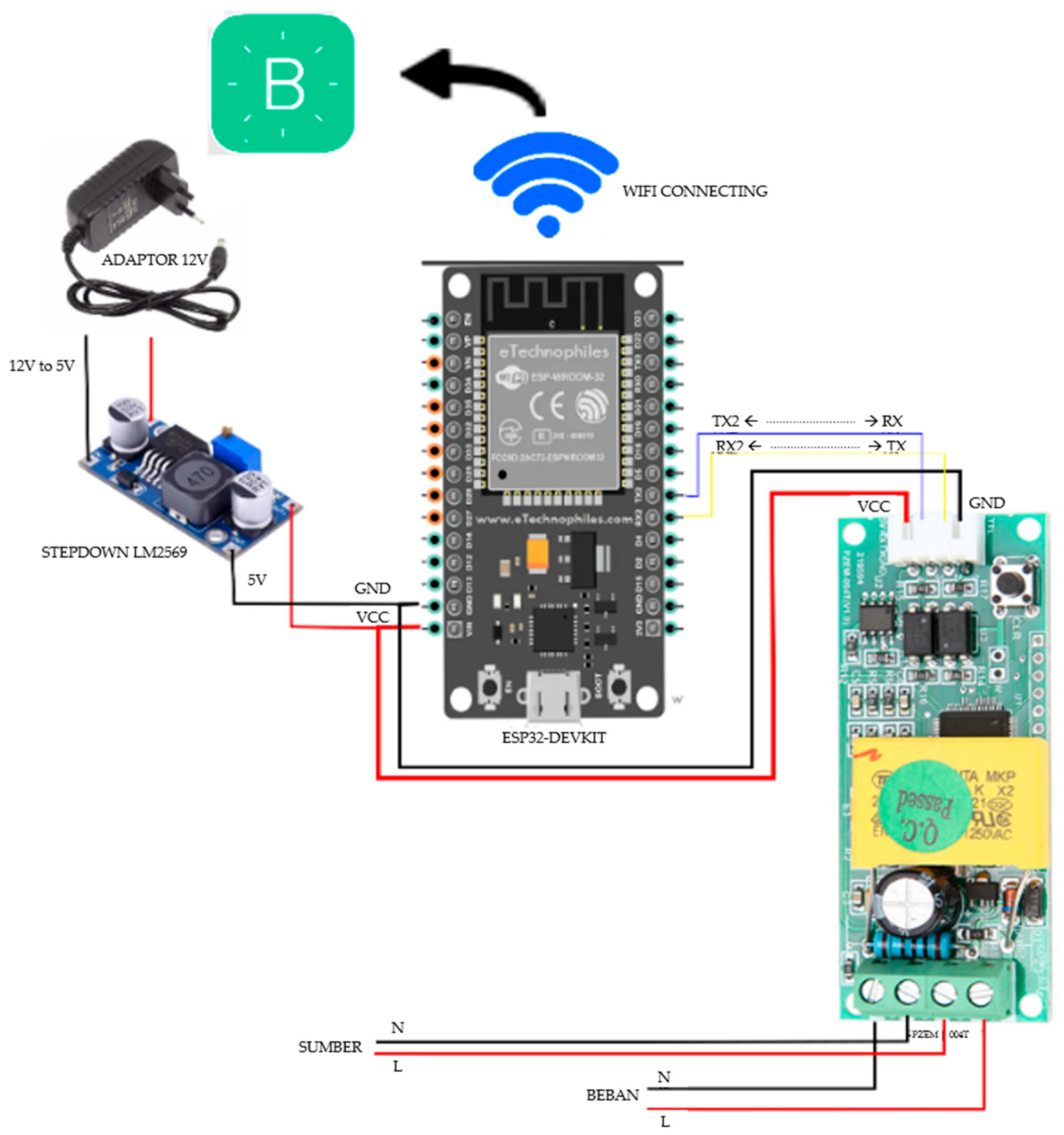
The experimental wiring arrangement for the proposed system is illustrated in Figure 2.
Figure 2.
Experimental wiring.
The AC output from the turbine is fed into a 12-volt adapter. This adapter rectifies the AC current into 12V DC. Subsequently, the 12V DC voltage is stepped down to 5V DC using an LM2596 Step-Down module. This 5V DC voltage is essential as the operating voltage for the microcontroller and the PZEM sensor. For the communication system, the PZEM sensor is connected to the ESP32 via two-way serial communication. The RX pin of the PZEM is connected to the TX pin of the ESP32, and the TX pin of the PZEM is connected to the RX pin of the ESP32. This bidirectional communication allows the ESP32 to read critical data from the PZEM, including voltage, current, power, energy, frequency, and power factor. IoT Monitoring System: This system incorporates the Internet of Things (IoT) to enable real-time monitoring of the PZEM data. The data acquired by the ESP32 is transmitted online via the internet network and displayed on the Blynk application. The parameters monitored and displayed on the Blynk application include voltage, current, power, energy, frequency, and power factor.
3. Results and Discussion
3.1. System Design and Testing Results
a. Design of the Power Plant Monitoring System
The monitoring system is connected to a pico hydro power plant located in Gumpang Village, Kartasura District, Sukoharjo Regency, Central Java. This power plant utilizes an Archimedes screw turbine installed in a dammed river with a relatively strong current. The power plant is equipped with a monitoring feature to facilitate the remote supervision of its operational results.
b. Device Testing
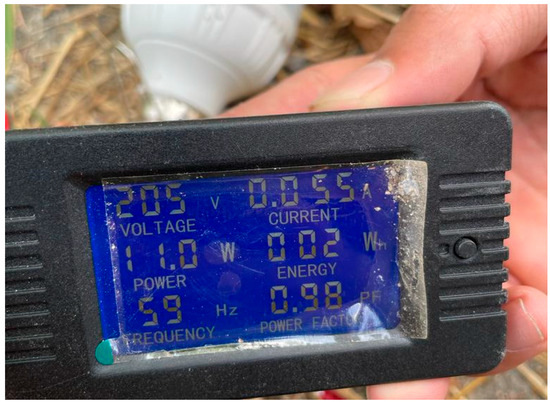
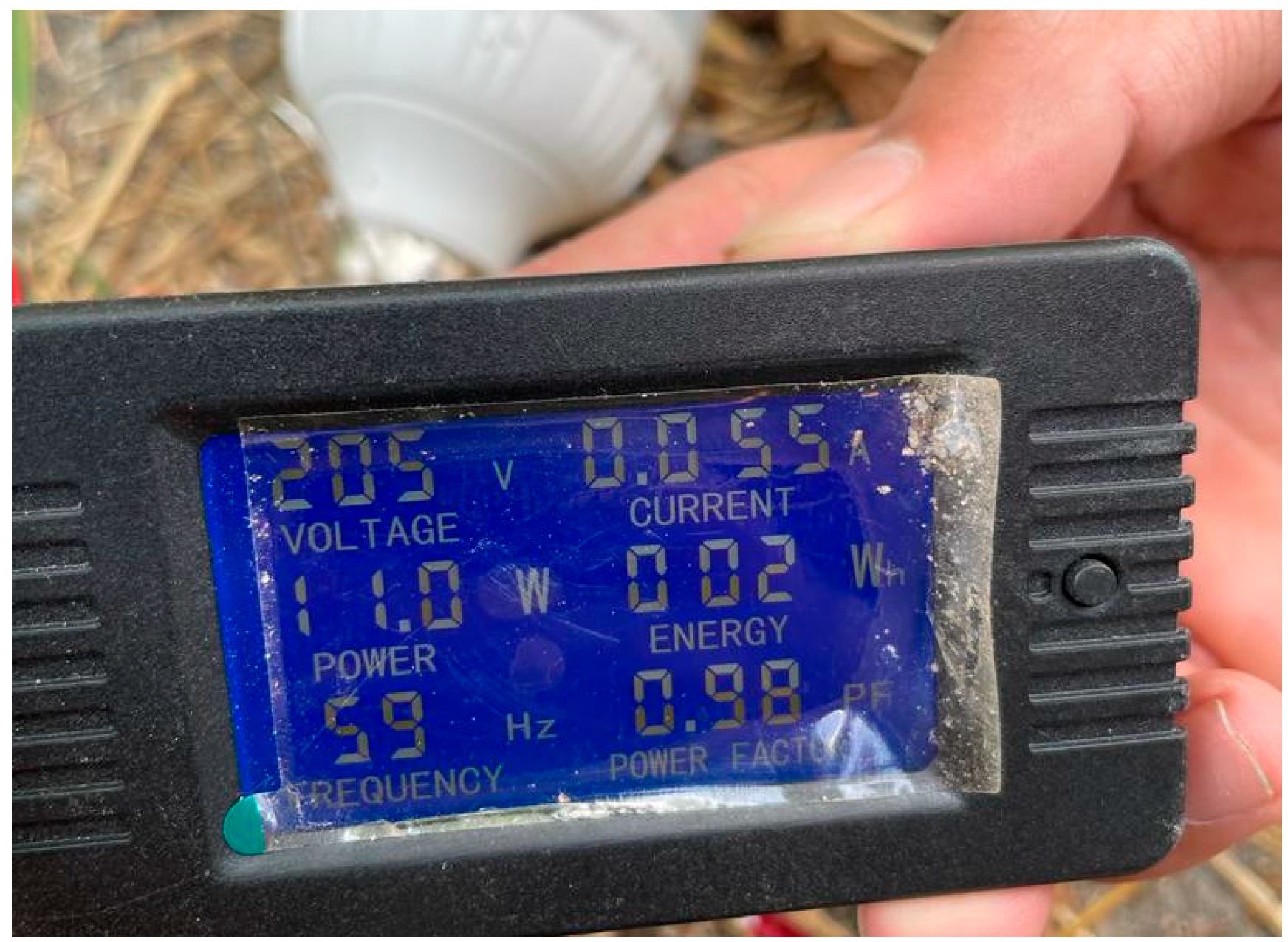
The equipment testing was conducted directly on the output of the pico hydro power plant. This testing utilized two distinct measurement methods: the first involved using a digital kWh meter, and the second employed the Blynk application-based monitoring system. The physical measurement result on the digital kWh meter is shown in Figure 3.
Figure 3.
Digital kWh meter measurement results.
3.2. Data Analysis of Test Results
This analysis focuses on the accuracy of the IoT monitoring system (Blynk application) compared to a reference instrument (digital kWh meter) across four parameters: voltage, current, frequency, and power. The data compares manual and IoT monitoring of a permanent magnet generator (PMG) pico hydro system. The pico hydro system utilizes a screw turbine coupled with a permanent magnet generator operating under a 12-Watt load.
Analysis of Voltage Readings (Table 1): The Blynk system demonstrates excellent accuracy in voltage measurement. The maximum difference is only 0.1 Volt. The average error is extremely low, at 0.02%. The accuracy in voltage measurement is exceptionally high (minimal error). This confirms that the voltage sensing and signal processing within the Blynk system are well-calibrated and the permanent magnet generator provides a stable voltage output around 205 V under this load condition. The voltage readings from the sensor integrated with the IoT system are reliable and consistent. This negligible error is well within acceptable tolerances for energy monitoring applications.
Table 1.
Results of voltage reading test.
Analysis of current readings (Table 2), there is a significant, systematic deviation between the current readings from the Blynk application and the digital kWh meter. The current difference is consistently around 0.011 Amperes. The average error is alarmingly high, reaching 19.4%. The Blynk application consistently provides a higher reading than the digital kWh meter (0.068 A vs. 0.057 A). In all test runs, the Blynk application consistently overestimates the current value compared to the reference meter. The current sensing component exhibits poor accuracy and requires immediate recalibration or replacement. An error approaching 20% renders the current data presented to the IoT user unreliable for accurate energy consumption or power calculation.
Table 2.
Results of current reading test.
Analysis of Frequency Readings (Table 3): The Blynk system shows fair results but exhibits a constant negative offset compared to the reference standard of 59 Hz. The digital kWh meter readings are stable at 59 Hz. The Blynk readings are consistently lower, resulting in a difference ranging from 0.3 Hz to 0.5 Hz. The average error is calculated at 0.67%. An average error below 1% is often acceptable for frequency monitoring. However, the consistent under-reporting suggests either inaccuracy in the microcontroller-based frequency measurement method or the pico hydro generator is operating slightly below the nominal RPM required to achieve the true reference frequency.
Table 3.
Frequency reading results.
Analysis of Power Readings (Table 4): The power readings exhibit a high error, which directly correlates with the issues observed in the current measurement. The difference in power ranges from 1.7 Watts to 2.3 Watts. The average error is high at 18.2%. Similar to the current data, the Blynk application consistently overestimates the power value.
Table 4.
Power reading results.
Technical Conclusion: Since power is calculated from voltage and current and power factor (P = V. I. PF), and the voltage readings (Table 1) are highly accurate, the significant error in power (18.2%) is almost entirely attributable to the poor accuracy of the current measurement. The system is failing to provide accurate data for energy generation or load analysis.
Generator Performance Analysis at Light Load: The pico hydro unit typically has a power capacity range around 100 W. The 12 W load used here represents an extremely low load. Voltage stability, due to the very light load, the voltage (Table 1) remained stable at approximately 205 V (with an error of only 0.02%). This is the expected behavior for a generator equipped with an adequate voltage control system or operating near a no-load condition. Frequency fluctuation: Despite the light load, the frequency showed an average error of 0.67% (Table 3). In a PMG (permanent magnet generator) pico hydro system, frequency is highly sensitive to the turbine rotation speed (RPM). This error suggests that the speed control system (governor) or the water flow rate is not sufficiently stable to maintain the very precise rotational speed required for a perfect 50 Hz or 60 Hz frequency, even under relatively small load conditions. Implications of Problematical Current/Power: If the current/power measurement error is already as high as 19% at a 12 W load, this error is likely to be significantly larger if the system were tested at higher loads. Accurate calibration across a wider load range is mandatory.
4. Conclusions
This research successfully demonstrates the following:
Reference Validation: The testing indirectly validates the accuracy of the digital kWh meter as a reference instrument, given that its voltage and current readings are highly consistent with the 12 W nominal power calculation.
Focus for Improvement: The biggest issue with the IoT monitoring system lies in the current data acquisition, which causes the significant error in power calculation.
Excellent Voltage Monitoring: The IoT system is highly effective for monitoring the voltage parameter.
Acceptable Frequency Monitoring: The frequency accuracy of 1% error is within a tolerable range.
Critical System Flaw: The high, consistent error in current 9.4% and power 18.2% readings render the energy consumption/generation data transmitted to the IoT platform invalid for critical energy efficiency analysis or metering purposes.
Author Contributions
Conceptualization, U. and H.A.; methodology, U.; software, R.R.A.; validation, U., H.A. and R.M.; formal analysis, U. and M.I.E.; investigation, R.R.A.; resources, U.; data curation, R.M.; writing—original draft preparation, U.; writing—review and editing, H.A.; visualization, R.R.A.; supervision, H.A.; project administration, U.; funding acquisition, H.A. All authors have read and agreed to the published version of the manuscript.
Funding
This research was funded by Universitas Muhammadiyah Surakarta through the HIT scheme, grant number 171/A.3-III/FT/III/2023. The APC was funded by Universitas Muhammadiyah Surakarta.
Institutional Review Board Statement
Not applicable.
Informed Consent Statement
Not applicable.
Data Availability Statement
The data presented in this study are available on request from the corresponding author.
Acknowledgments
The author expresses profound praise and gratitude to Allah SWT for His grace and blessings, which have enabled the completion of this research. May this work provide benefits for both the author and its readers. The author acknowledges the immense support, guidance, assistance, motivation, and all prayers received during the preparation of this research, which were instrumental in its successful completion. The researcher extends sincere thanks to Universitas Muhammadiyah Surakarta, and to all parties who have offered invaluable prayers and support, ensuring the smooth progress of this research.
Conflicts of Interest
The authors declare no conflict of interest.
References
- Dwiyanto, V.; Kusumastuti, D.I.; Tugiono, S. Analisis Pembangkit Listrik Tenaga Mikro Hidro (PLTMH) Studi Kasus: Sungai Air Anak (Hulu Sungai Way Besai). J. Rekayasa Sipil Dan Desain 2016, 4, 407–422. [Google Scholar] [CrossRef] [Scilit]
- Sari, N.R.; Sudarti; Yushardi. Analisis Pemanfaatan Pltmh Di Pondok Pesantren Nahdlatut Thalibin Kabupaten Probolinggo. JUPE J. Pendidik. Mandala 2022, 7, 443–449. (In Indonesian) [Google Scholar] [CrossRef] [Scilit]
- Citranath, I.G.N.A.; Jasa, L.; Suartika, I.M. Analisis Daya Output Generator Berdasarkan Variasi Debit Air Pada Prototype Pltmh Dengan Turbin Vortex. J. Spektrum 2022, 9, 35–43. (In Indonesian) [Google Scholar] [CrossRef] [Scilit]
- Sumiyarso, B.; Rochmatika, R.A.; Putri, F.T.; Prahara, T. Sistem Monitoring Pembangkit Listrik Tenaga Mikro Hidro Berbasis IoT. Pros. Semin. Has. Penelit. Dan Pengabdi. Masy. 2022, 4, 679–690. (In Indonesian) [Google Scholar]
- Ridlwan, H.M. Implementasi Perangkat Keras Sistem Monitoring Internet of Things (IoT) pada Pembangkit Listrik Tenaga Mikro Hidro. Power Elektron. J. Orang Elektr. 2022, 11, 57–62. (In Indonesian) [Google Scholar] [CrossRef] [Scilit]
- Gunawan, A.; Oktafeni, A.; Khabzli, W. Pemantauan Pembangkit Listrik Tenaga Mikrohidro (PLTMH). JRE 2013, 10, 202–206. (In Indonesian) [Google Scholar] [CrossRef] [Scilit]
- Ulinuha, A.; Febryan, F.M. Remote Monitoring System of Water Quality for Shrimp Fishery Pond Based on Microcontroller. In Proceedings of the 2024 International Conference on Smart Computing, IoT and Machine Learning (SIML); IEEE: Piscataway, NJ, USA, 2024; pp. 8–12. [Google Scholar] [CrossRef] [Scilit]
- Rusdi, M.F.; Hamdani, H.; Hamma, H. Rancang Bangun Monitoring Dan Controlling Pemakaian Daya Berbasis Internet of Things (Iot). Emit. J. Tek. Elektro 2022, 22, 148–154. [Google Scholar] [CrossRef] [Scilit]
- Supardi, A.; Abdulah, M.M. Development of an Arduino-Based Monitoring System for Pico-Hydro Power Plants. E3S Web Conf. 2024, 500, 03015. [Google Scholar] [CrossRef] [Scilit]

Disclaimer/Publisher’s Note: The statements, opinions and data contained in all publications are solely those of the individual author(s) and contributor(s) and not of MDPI and/or the editor(s). MDPI and/or the editor(s) disclaim responsibility for any injury to people or property resulting from any ideas, methods, instructions or products referred to in the content. |
© 2026 by the authors. Licensee MDPI, Basel, Switzerland. This article is an open access article distributed under the terms and conditions of the Creative Commons Attribution (CC BY) license.