1. Introduction
Urban hydrological models are widely applied for rainfall–runoff simulation and flood management, yet their accuracy strongly depends on parameter calibration and the choice of objective functions [
1]. Calibration is often challenged by equifinality, data limitations, and the need to balance multiple hydrological responses such as total runoff, peak discharge, and flow timing [
2]. The SWMM model, with its nonlinear reservoir approach, has become a common tool for event-based urban drainage studies [
3]. However, selecting suitable objective functions during optimization remains a critical issue, as different metrics emphasize different error characteristics and may bias parameter estimation [
4]. This paper addresses this gap by testing six objective functions for the calibration of an urban catchment model using SWMM. The contribution lies in demonstrating how event-based calibration with diverse objective functions affects runoff volume, peak flow rate and time to peak flow, offering practical insights for improving urban hydrological model identification.
2. Materials and Methods
The study was carried out in the Cascina Scala urban catchment (Pavia, Italy), a 12.7 ha residential area with ~62% impervious surfaces drained by a combined sewer system (~2 km length). The combined sewer network comprises 42 concrete pipes (~2 km total); upstream conduits are circular (Ø 400–600 mm) and downstream conduits are egg-shaped (600/900 × 700/1050 mm). Rainfall was monitored with two tipping-bucket gauges (0.2 mm resolution) and runoff at the outlet with a Venturi flume and bubbler system [
5]. From multi-year records, 20 rainfall–runoff events were selected based on quality criteria (rainfall ≥ 5 mm, peak intensity ≥ 0.1 mm min
−1, no data gaps). Ten events were used for calibration and ten for validation.
Event-based simulations were performed using SWMM with the nonlinear reservoir (N-LR) formulation. Surface runoff is generated once depression storage is exceeded and routed using Manning’s equation:
where
Q is discharge,
A is the cross-sectional area,
R is the hydraulic radius,
S is the slope, and
n is Manning’s coefficient.
Calibrated parameters included Manning’s roughness (roofs, streets, pervious areas, conduits), depression storage (pervious/impervious), Horton’s infiltration losses (maximum rate, minimum rate and decay coefficient), and a width coefficient. Parameter ranges followed literature and were applied uniformly to sub-catchments to reduce dimensionality.
A two-step workflow was adopted:
- (i)
Global sensitivity analysis using the Morris method (SAFE Toolbox) to identify influential parameters;
- (ii)
Calibration with a genetic algorithm (GA) linked to SWMM via Mat-SWMM. Unlike event-by-event calibration, an integrated strategy was applied, fitting parameters across all calibration events simultaneously to improve transferability [
6].
Six objective functions were tested, including Standard Deviation (SD) and Absolute Error (Abs), Nash–Sutcliffe Efficiency (NSE) and its square-root transformed version (NSE-sqrt), Peak and Volume multi-objective function (Q&P) and Index of Agreement (IoA). Model performance was assessed based on total runoff volume. The Absolute Relative Error (ARE) was used for quantitative comparison.
where
and
are the predicted and observed values.
3. Results
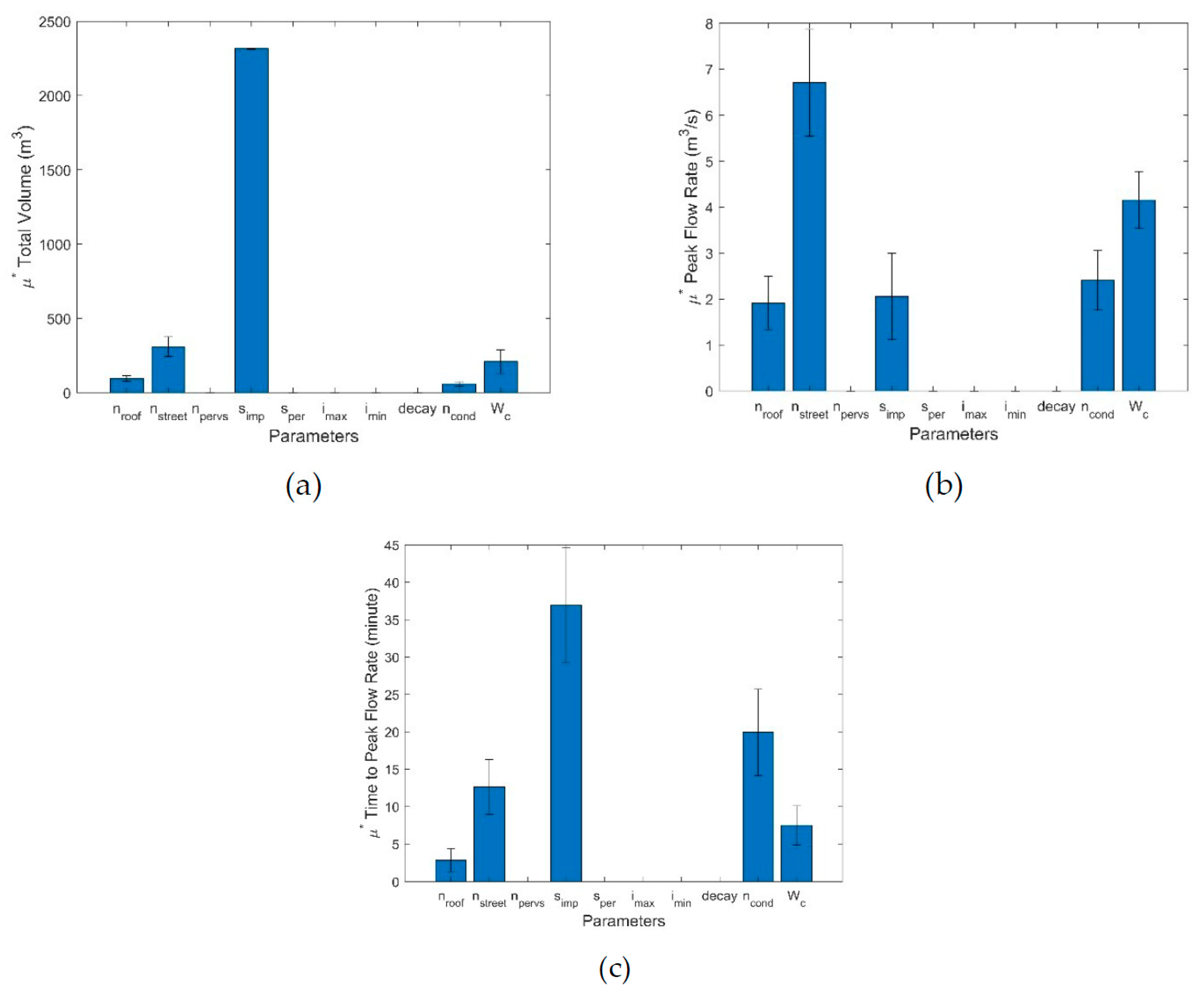
A sensitivity analysis of Event 22 (
Figure 1) showed contrasting controls on flow com-ponents. Total runoff volume was mainly affected by depression storage on impervious areas, while peak flow was governed by street roughness, conduit roughness, and flow width, emphasizing the role of hydraulic resistance in overland flow. Time to peak was most sensitive to impervious storage, with decay and conduit roughness also contributing, highlighting the influence of surface retention and drainage resistance. Infiltration-related parameters had negligible impact under the studied conditions. Consistently, across all 20 events, five parameters—S
imp, n
street, n
cond, W
c, and n
roof—emerged as the most influential in shaping runoff response.
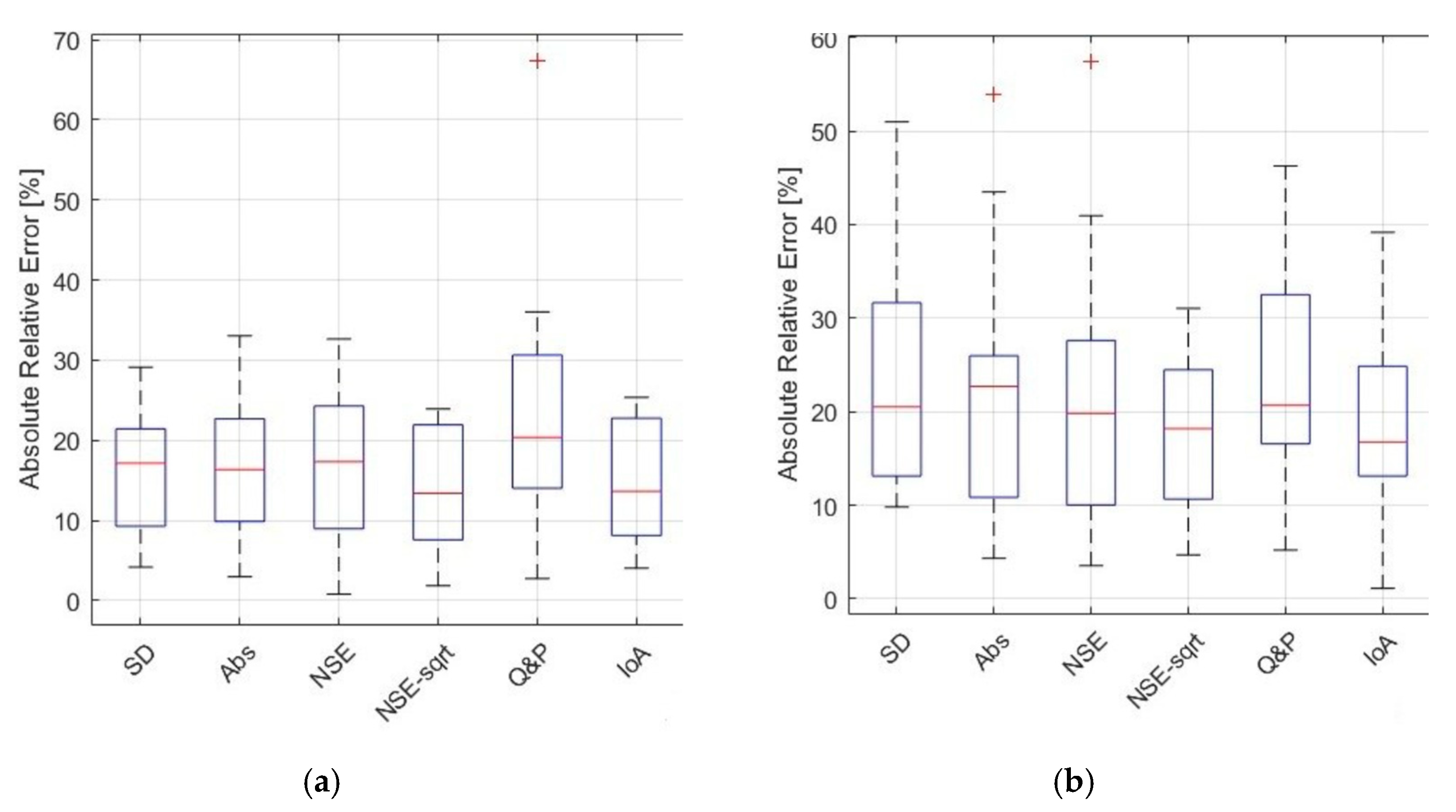
Across calibration events, objective functions showed median percentage errors for the total runoff volume between 13.4 and 20.4, with relatively contained interquartile ranges, indicating robust parameter estimation (
Figure 2). Validation results displayed slightly higher medians (16.8–22.7) and broader variability, reflecting the challenge of transferring calibration to independent events. Among the tested functions, the Index of Agreement and NSE-sqrt yielded the lowest medians, while multi-objective formulations (Q and P) provided balanced performance across calibration and validation. Overall, the choice of objective function had a clear impact on predictive accuracy, with weighted and combined metrics offering improved consistency.
Overall, the analysis showed that the Index of Agreement and NSE-sqrt provided the best performance, delivering lower errors and greater stability across calibration and validation. These results highlight their suitability for balancing accuracy in both runoff volume and peak flow reproduction.
4. Conclusions
The sensitivity analysis demonstrated that surface storage and hydraulic resistance parameters exert the strongest influence on runoff dynamics, whereas infiltration played only a marginal role under the studied events. This is consistent with findings from urban hydrology literature, where imperviousness and conveyance properties dominate storm response. The comparison of objective functions further highlighted that model performance is strongly dependent on the calibration metric employed. While traditional error-based measures tended to emphasize either peak flow or volume, the Index of Agreement and NSE-sqrt provided the most reliable balance across multiple performance indicators. This suggests that selecting objective functions that reduce sensitivity to extremes and normalize error distribution can substantially improve calibration robustness. The results confirm the value of testing diverse functions and support the adoption of metrics that integrate both peak and volume accuracy for urban drainage modeling.
Author Contributions
Conceptualization, M.N.A., S.M. and S.T.; methodology, M.N.A., S.M., L.T. and S.T.; Software, M.N.A. formal analysis, M.N.A.; investigation, M.N.A.; writing—original draft preparation, M.N.A.; writing—review and editing, S.M., L.T. and S.T.; supervision, S.M., L.T. and S.T.; funding acquisition, L.T. and S.T. All authors have read and agreed to the published version of the manuscript.
Funding
This research was funded by European Union—Next Generation EU grant No. P2022LXLYY.
Data Availability Statement
The data that support the findings of this study are available from the corresponding author upon reasonable request.
Acknowledgments
This research was supported by the Italian Ministry of University and Research (MUR) through the project “DORIAN of DICAr”—MUR Program “Dipartimento di Eccellenza 23-27”. L. Tamellini, S. Todeschini, S. Manenti, and M. N. Assaf were supported by the PRIN 2022 PNRR project “Uncertainty Quantification of coupled models for water flow and contaminant transport” (No. P2022LXLYY), financed by the European Union—Next Generation EU.
Conflicts of Interest
The authors declare no conflict of interest.
References
- Kim, S.M.; Benham, B.L.; Brannan, K.M.; Zeckoski, R.W.; Doherty, J. Comparison of hydrologic calibration of HSPF using automatic and manual methods. Water Resour. Res. 2007, 43, W01402. [Google Scholar] [CrossRef] [Scilit]
- Caviedes-Voullième, D.; Ahmadinia, E.; Hinz, C. Interactions of Microtopography, Slope and Infiltration Cause Complex Rainfall-Runoff Behavior at the Hillslope Scale for Single Rainfall Events. Water Resour. Res. 2021, 57, e2020WR028127. [Google Scholar] [CrossRef] [Scilit]
- Giudicianni, C.; Assaf, M.N.; Todeschini, S.; Creaco, E. Comparison of nonlinear reservoir and UH algorithms for the hydrological modeling of a real urban catchment with EPA-SWMM. Hydrology 2023, 10, 24. [Google Scholar] [CrossRef] [Scilit]
- Assaf, M.N.; Salis, N.; Manenti, S.; Tamellini, L.; Creaco, E.; Todeschini, S. Optimizing hydrological modelling on real urban catchment: Impact of calibration data selection and objective function. J. Hydrol. 2025, 662, 133821. [Google Scholar] [CrossRef] [Scilit]
- Todeschini, S.; Manenti, S.; Creaco, E. Testing an innovative first flush identification methodology against field data from an Italian catchment. J. Environ. Manag. 2019, 246, 418–425. [Google Scholar] [CrossRef] [Scilit] [PubMed]
- Assaf, M.N.; Manenti, S.; Creaco, E.; Giudicianni, C.; Tamellini, L.; Todeschini, S. New optimization strategies for SWMM modeling of stormwater quality applications in urban area. J. Environ. Manag. 2024, 361, 121244. [Google Scholar] [CrossRef] [Scilit] [PubMed]
| Disclaimer/Publisher’s Note: The statements, opinions and data contained in all publications are solely those of the individual author(s) and contributor(s) and not of MDPI and/or the editor(s). MDPI and/or the editor(s) disclaim responsibility for any injury to people or property resulting from any ideas, methods, instructions or products referred to in the content. |