Proceeding Paper

Thermal and Pressure Digital Twins from Online Process Control for Data-Based Optimization of Laser-Assisted In Situ Consolidation of High-Performance Composite Parts †
by
Beatriz Gomes
,
Sabela Sánchez
,
Mario Fernández-Pedrera
,
Prasad Shimpi
and
Pablo Romero-Rodríguez
*
AIMEN Technology Centre, Relva 27A-O Porriño, 36410 Pontevedra, Spain
*
Author to whom correspondence should be addressed.
Presented at the 15th EASN International Conference, Madrid, Spain, 14–17 October 2025.
Eng. Proc. 2026, 133(1), 73; https://doi.org/10.3390/engproc2026133073

Published: 6 May 2026

Abstract

Automated Fiber Placement (AFP) enables precise deposition of thermoplastic tapes on complex geometries, however variations in temperature, compaction pressure, deposition speed, and tooling conditions can affect the final laminate quality. This study presents an integrated real-time monitoring system and a systematic methodology for process/product data analysis linking process parameters to mechanical and microstructural performance. Mechanical testing evaluation by interlaminar shear strength (ILSS), thermal analysis, and microscopy studies identified both the consolidation and mold temperatures as the critical parameters for optimized mechanical properties. Results showed ILSS above 45 MPa, crystallinity up to 37.9%, and minimal porosity (~1%). Digital tools developed provided full traceability, early instability detection, and continuous optimization, enhancing reliability and repeatability in high-performance thermoplastic composite manufacturing, which paves the way towards zero-defect manufacturing.

1. Introduction

The increasing use of composite materials in sectors such as aerospace, automotive, and energy has driven the development of advanced manufacturing technologies capable of ensuring high precision, repeatability, and efficiency [1]. Among these, Automated Fiber Placement (AFP) stands out as one of the most promising, enabling controlled deposition of thermoplastic or thermoset tapes on complex geometries, with optimized fiber orientation in each layer [2,3].
Despite its advantages, AFP is highly sensitive to variations in operational parameters. Small fluctuations in temperature, compaction pressure, deposition speed, or tooling thermal conditions can compromise consolidation quality, leading to defects such as porosity, delamination, or variations in polymer matrix crystallinity [4,5,6]. Real-time monitoring is therefore essential to ensure process stability and traceability of results [7,8,9].
This work presents an integrated data acquisition and analysis system developed for AFP, capable of collecting, synchronizing, and visualizing critical variables during deposition. By combining thermal sensors, force feedback, and laser control, the system enables correlation of process parameters with the mechanical and microstructural performance of the laminates. The goal is to demonstrate how continuous monitoring and digital analysis support process optimization, early anomaly detection, and improved reliability in thermoplastic composite manufacturing.

2. Materials and Methods

The thermoplastic material selected for this study was Suprem™ T 55% C10243/PK10366, supplied by Suprem (Montagny-près-Yverdon, Switzerland) with a width of 12.7 mm and a thickness of 0.19 mm. The PEKK 60/40 matrix exhibits a low crystallization rate, which is advantageous for AFP in situ consolidation by reducing deformation and internal stress development typically observed in faster-crystallizing matrices such as PEKK. The properties of the tape are presented in Table 1.
Overall, the AFP system at AIMEN offers a technologically advanced environment that significantly enhances process traceability, repeatability, and scientific understanding of composite tape placement, making it particularly suited for studies focused on optimization of thermoplastic composite manufacturing. AFP deposition was performed using a single-tape CONBILITY AFP head mounted on a FANUC R 2000iC/165F robot (FANUC, Yamanashi, Japan), equipped with a pneumatic actuator (500 N) and a water-cooled silicone roller. An optional 2-axis external table provided 8-axis motion, and a pneumatic guillotine enabled tape cutting (minimum 100 mm). In situ heating was applied via a 6 kW diode laser (LASERLINE, Mülheim-Kärlich, Germany), controlled with a closed-loop using a pyrometer and infrared camera (FLIR A70, FLIR, Wilsonville, OR, USA). A hot-oil-circulated mold (AIMEN proprietary, Pontevedra, Spain) ensured stable thermal boundary conditions. Consolidation occurred at the nip-point, where the roller applied pressure to the heated tape, promoting interlayer bonding. Critical process parameters—nip-point temperature, compaction force, deposition speed, and mold temperature—were maintained within predefined ranges to assess their effect on laminate quality. An inline monitoring system developed in AIMEN, synchronized data from infrared thermography, laser power, roller load sensors, and speed encoders, storing it in a structured database that provided real-time visualization and corrective control, while SMARTVIEW v2.15 allowed offline analysis with 2D plots and 3D mapping. This integrated setup enabled traceability, repeatability, and adaptive process control, providing a robust framework for investigating consolidation mechanisms in thermoplastic composites.

3. Results

3.1. Process Optimization on Planar Cupons (SLS and ILSS)

The process window for in situ consolidation by AFP was established by correlating mechanical, thermal, and microstructural responses of specimens manufactured under controlled parameter variations. Interlaminar adhesion was selected as the primary indicator of consolidation quality and quantified using a simplified Single Lap Shear (SLS) test [10]. Specimens composed of [0°]4 UD tapes (12.7 mm width) and a Kapton separator created a defined shear zone, enabling rapid production of samples across a wide parameter space.
Four key parameters were investigated: nip-point temperature (350–450 °C), compaction force (250–500 N), layup speed (150–300 mm/s), and mold temperature (25–250 °C). A Central Composite Design (CCD) generated 20 test conditions, each producing six SLS specimens. Results showed that nip-point and mold temperatures were the dominant factors controlling adhesion strength, while layup speed had a comparatively minor effect. Higher processing and mold temperatures resulted in increased SLS strength and crystallinity, reflecting improved polymer chain mobility and enhanced interdiffusion during consolidation. Based on SLS trends, six representative conditions were selected for structural-scale validation via Interlaminar Shear Strength (ILSS) testing (ASTM D2344 [11]) using 22-ply laminates.
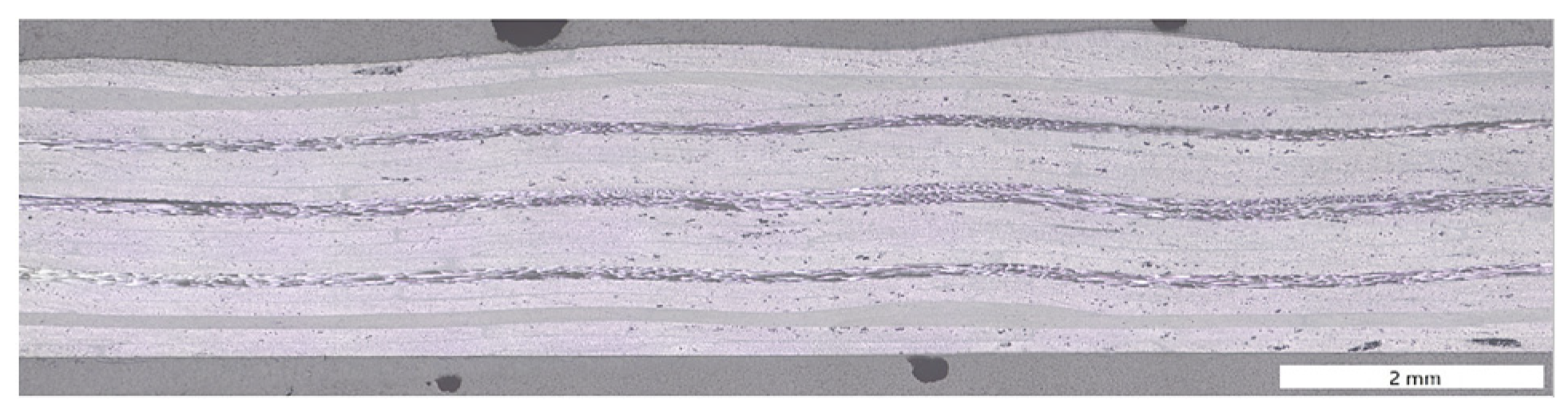
ILSS results (Table 2) confirmed the initial observations: the highest values (in the range of 45 MPa) were achieved under high nip-point temperature and high mold temperature. Thermal and microscopic (Table 2 and Figure 1) analyses further supported these findings, with optimal trials exhibiting up to 37.9% crystallinity and only 1% void content (Condition #3). Void content was evaluated by optical microscopy using an Olympus GX71 inverted reflected-light microscope where polished cross-sections were analyzed to identify and quantify voids based on their distribution within the laminate. The low void content observed in the optimal trials indicates effective melt flow and good interlaminar contact during in situ consolidation. Overall, the combined mechanical, thermal, and microstructural analyses confirmed that this material exhibits a wide and robust processing window for AFP in situ consolidation. Despite this broad range of acceptable conditions, Trial 3 emerged as the most favorable option, providing the best balance of interlaminar adhesion, ILSS performance, crystallinity, and void minimization, thereby defining the optimal processing parameters for thermoplastic composite consolidation.

3.2. Wing-Box Demonstrator Manufacturing and Temperature and Pressure Digital Twins

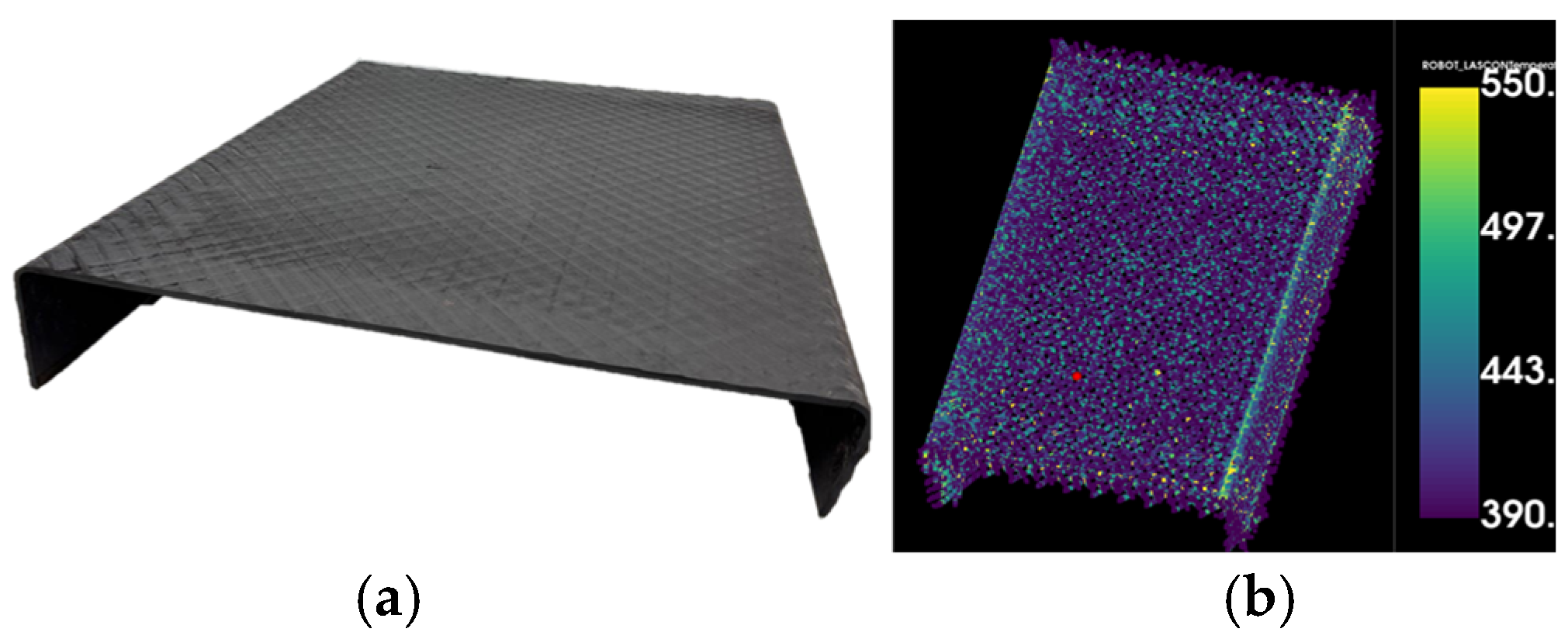
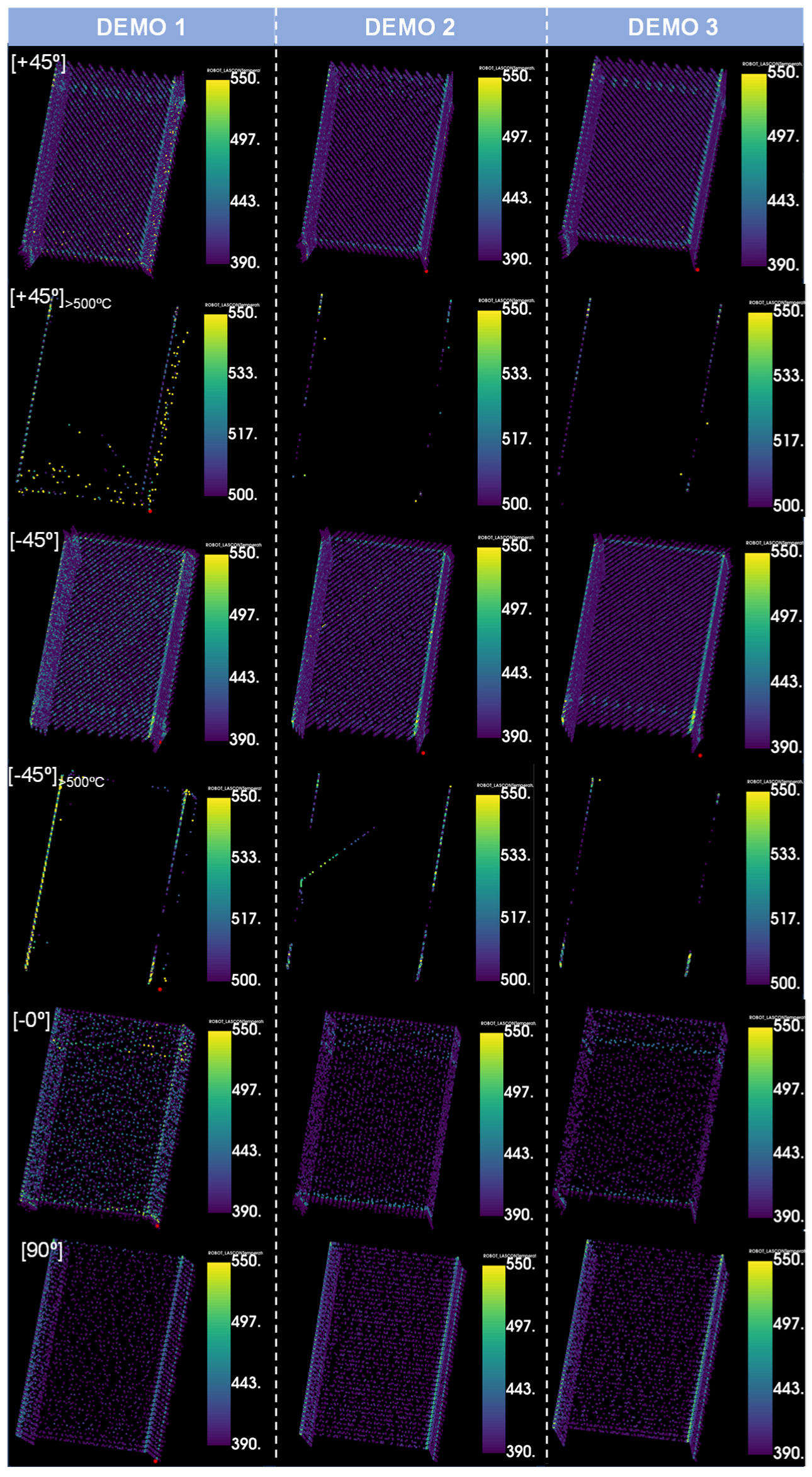
Three demonstrators were manufactured on three different days using the optimized conditions explained above, and with the same ply sequence (45/−45/0/−45/45/90/−45/45/45/−45/90/−45/45/45/−45/90/45/−45/0/−45/45). In Figure 2, it is shown both the demonstrator as manufactured and its thermal digital twin of the 21 plyes, showing temperature fluctuations between 390 °C and 550 °C. Figure 3 shows the temperature and compaction force digital twin per orientation, which gives a second level of data detail, which serves for further analysis as explained below.

3.3. Temperature and Pressure Analysis

The temperature distribution across layers and orientations reveals a behavior consistent with the inherent thermal limitations of AFP when processing U-shaped geometries. The most pronounced variations occur in tight-angle regions, where abrupt changes in surface normal alter the incidence angle and optical stand-off distance of the heating source.
These effects, combined with the kinematic modulation introduced by the 2-axis rotary table, generate fluctuations in local heat flux that exceed the instantaneous correction capability of the closed-loop control system. Partial shading on the inner walls and reduced lateral heat dissipation further amplify these oscillations, particularly in layers with ±45° orientations, where the thermal anisotropy imposed by tow alignment becomes more dominant.
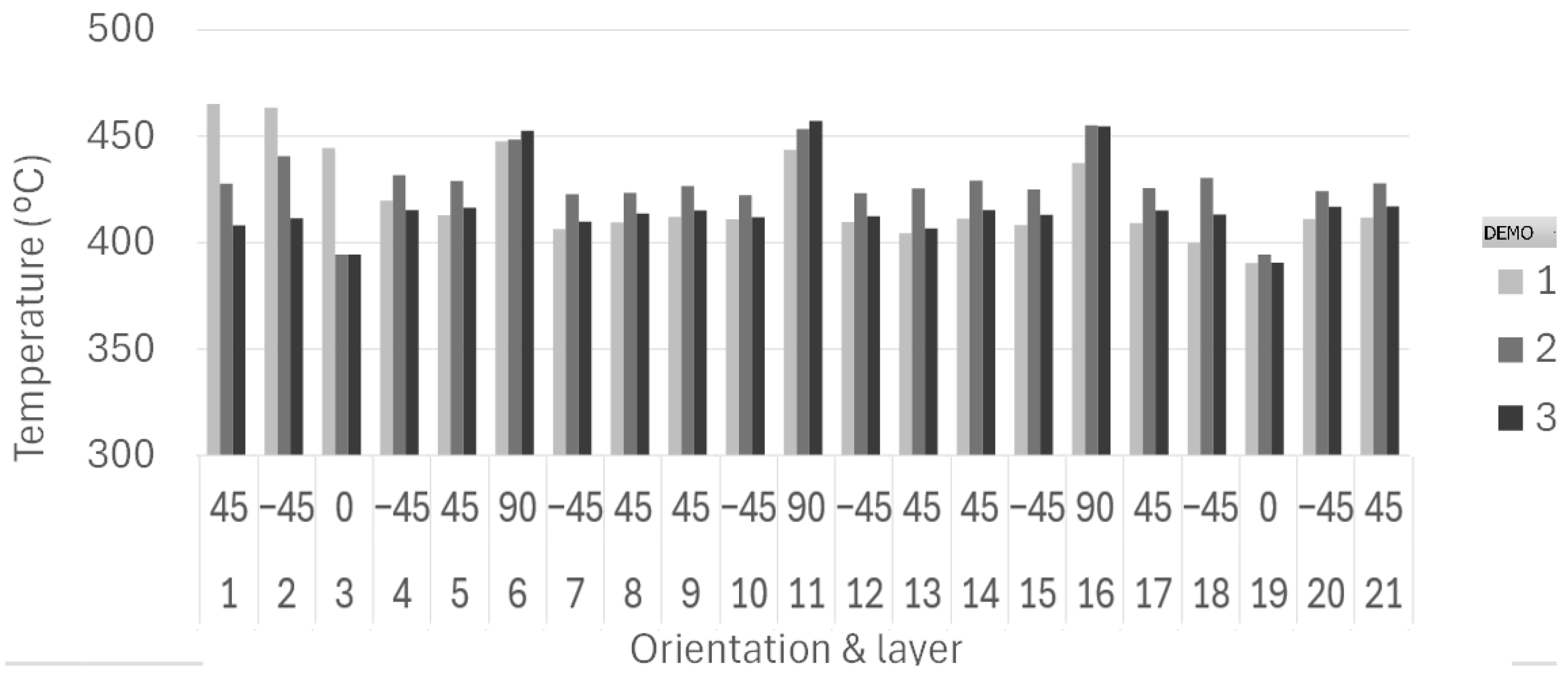
As shown in Figure 4, the first demonstrator shows a distinct drop in temperature from layer 4 onwards, directly reflecting the intentional reduction in the temperature set-point from 450 °C to 400 °C. Despite this adjustment, the temperature trends across DEMO 1, 2 and 3 continue to exhibit variability arising from geometric transitions and local curvature effects.
Layers deposited over regions with higher thermal accumulation, especially in internal curvature zones, tend to record higher temperatures, whereas lower values observed in DEMO 2 and DEMO 3 correspond to orientations or positions where heat dissipation is more effective or where partial loss of visibility of the heat source occurs.
These results confirm the sensitivity of the AFP process to local geometric and thermal disturbances while also demonstrating that the process retains a sufficiently wide thermal processing window. The optimization trials validated that adequate consolidation quality can be achieved at reduced temperatures, supporting the decision to lower the set-point to 400 °C to avoid potential thermal degradation in high-curvature areas. The observed thermal dispersion is therefore consistent with the expected process behavior and remains within the acceptable operational envelope.
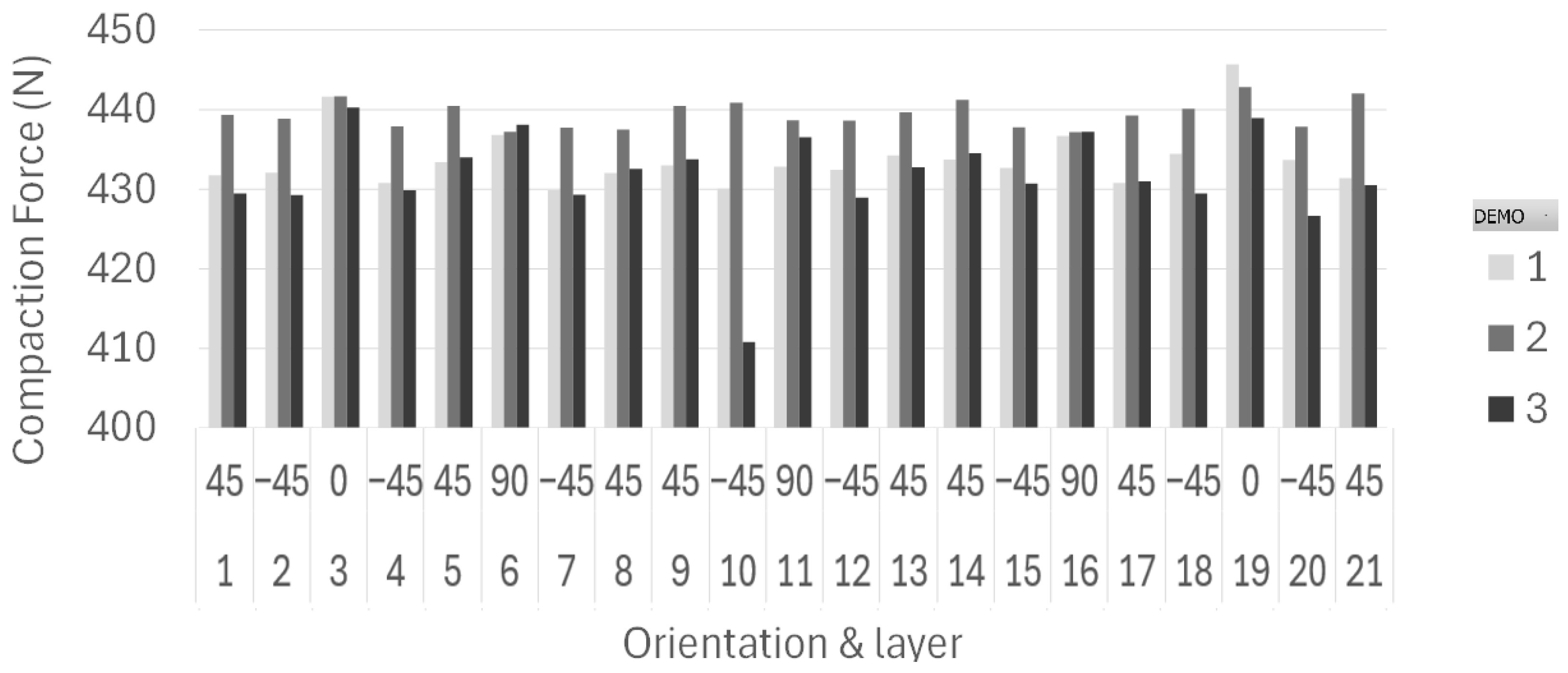
On the other hand, the dispersion observed in the compaction force among the three demonstrators manufactured by AFP essentially results from the interaction between thermal, kinematic, and material variability across the different layers and orientations (Figure 5). Although the nominal deposition parameters were kept constant, small differences in the actual tool-path trajectory and in the tangential speed introduce subtle changes in the contact time of the compaction roller, which affects the force effectively transmitted.
These deviations are amplified by local thermal fluctuations, since variations in substrate temperature modify the matrix viscosity and, consequently, the resistance offered to the roller. Additionally, the orientation transitions (45°, −45°, 0°, and 90°) change the local stiffness of the deposited surface, influencing the mechanical response of the laminate under the same nominal compaction load.
The dynamic response of the force-control system, with unavoidable delays and micro-corrections, further contributes to the variability observed between DEMO 1, 2, and 3. Therefore, the dispersion shown in the graph is consistent with the expected behavior of AFP components with multiple orientations and regions of geometric complexity, reflecting the inherent limitations of compaction stability in a process that is highly sensitive to thermal and kinematic disturbances.

3.4. Analysis of Areas Above Limit Processing Values

As presented in Figure 3, the visualization software Smartview enables a detailed analysis of areas surpassing the optimum manufacturing parameters which are close to degradation temperatures (above 500 °C in the case of the material studied) and with compaction forces below 10% of the optimal input (410 N), which represents an additional filtering functionality supporting indirect quality control, also enabling mechanical properties prediction based on the optimization campaign carried out by ILSS (Table 2).
Table 3 quantifies the % area surpassing the limit values per orientation, obtained by filtering the temperature above 500 °C and compaction force above 410 N. For DEMO 1, 0° orientation resulted in larger areas reaching 13% of its total area, this orientation being the higher probable to have defects among the three demos. This same situation happens to 90° orientation for both DEMO 2 (14%) and DEMO 3 (24%). Since only two layers are 0°, and 3 layers of 90°, we can conclude from this analysis that DEMO 1 resulted in larger areas with processing values surpassing the limit, based on the results of ±45°, most likely deriving in lower consolidation degree as compared to DEMO 2 and 3. On the contrary, the pressure signal below 410 N indicates that DEMO 3 resulted in larges limit areas (5 and 6% for ±45°), thus it is expected that lower consolidation degree was obtained in DEMO3.

4. Conclusions

This work demonstrated that real-time monitoring combined with advanced data analysis effectively supports the optimization of in situ consolidation by automated fiber placement of thermoplastic composites. Consolidation and mold temperatures were identified as the primary drivers of consolidation quality, enabling ILSS values above 45 MPa, crystallinity near 38%, and void contents around 1% at optimal conditions.
Regarding the AFP process stability, process monitoring and visualization digital tools enabled high-resolution traceability of thermal and pressure fields during planar trials and wing-box demonstrator manufacturing. It is found that thermal digital twins revealed predictable temperature gradients associated with geometric transitions, optical stand-off variations, and angular orientations, confirming the system’s sensitivity to local heat-flux disturbances. Pressure analysis likewise highlighted the intrinsic variability in compaction force caused by kinematic effects, substrate stiffness evolution, and thermal-dependent rheological changes in the PEKK matrix.
Moreover, temperature and pressure parameters fluctuations were successfully located across the demonstrators using data filtering functionalities, however despite this variability, all demonstrators remained within an acceptable processing envelope. In this regard, it is shown that 90° orientation resulted in larger thermal fluctuations, while the effect of layer orientation in compaction force is still not clear.
The quantification of over-limit temperature and pressure regions, which may lead to critical areas prone to under-consolidation, will be further assessed by mechanical testing in future work, so to conclude that this approach provides actionable information for defect prevention and adaptive control.
Overall, the methodology presented in this work validates that the combined use of controlled AFP deposition, real-time sensor fusion, and digital twins will significantly enhance process reliability, enable high-quality consolidation of thermoplastic composite structures and support advanced industrial implementation.

Author Contributions

Conceptualization, B.G., S.S., M.F.-P., P.S. and P.R.-R.; methodology, B.G., S.S., M.F.-P., P.S. and P.R.-R.; software, M.F.-P. and P.S.; validation, B.G. and M.F.-P.; formal analysis, B.G., S.S. and P.R.-R.; investigation, B.G., S.S., M.F.-P., P.S. and P.R.-F.; resources, B.G., S.S., M.F.-P., P.S. and P.R.-R.; data curation, B.G., S.S., M.F.-P. and P.R.-R.; writing—original draft preparation, B.G., S.S. and P.R.-R.; writing—review and editing, B.G. and S.S.; visualization, B.G., S.S., M.F.-P., P.S.; supervision, B.G., S.S. and P.R.-R.; project administration, B.G.; funding acquisition, P.R.-R. All authors have read and agreed to the published version of the manuscript.

Funding

This research was funded by HORIZON EUROPE project GENEX (Project ID 101056822).

Institutional Review Board Statement

Not applicable.

Informed Consent Statement

Not applicable.

Data Availability Statement

Data not available due to confidenciality.

Conflicts of Interest

The authors declare no conflicts of interest as well as the funders had no role in the design of the study; in the collection, analyses, or interpretation of data; in the writing of the manuscript; or in the decision to publish the results.

Abbreviations

The following abbreviations are used in this manuscript:
AFPAutomated Fiber Placement Layup
SLSSingle Lap Shear
ILSSInterlaminar Shear Strength
PEKKPoly-ether Ketone Ketone

References

  1. Kukwi, T.; Shan, C.; Liu, P.; Zhang, B.; Guo, L.; Wang, Z. Continuous Improvement in Composite Manufacturing: A Review of Automated Fiber Placement Process Evolution and Future Research Prospects. Appl. Compos. Mater. 2025, 32, 1267–1314. [Google Scholar] [CrossRef]
  2. Lukaszewicz, D.H.-J.A.; Ward, C.; Potter, K.D. The engineering aspects of automated prepreg layup: History, present and future. Compos. Part B Eng. 2012, 43, 997–1009. [Google Scholar] [CrossRef]
  3. Brasington, A.; Sacco, C.; Halbritter, J.; Wehbe, R.; Harik, R. Automated fiber placement: A review of history, current technologies, and future paths forward. Compos. Part C Open Access 2021, 6, 100182. [Google Scholar] [CrossRef]
  4. Sacco, C.; Radwan, A.B.; Harik, R.; Van Tooren, M. Automated Fiber Placement Defects: Automated Inspection and Characterization; NASA Technical Reports; NTRS: Chicago, IL, USA, 2019. [Google Scholar]
  5. Wen, L.; Li, S.; Dong, Z.; Shen, H.; Xu, E. Research on Automated Fiber Placement Surface Defect Detection Based on Improved YOLOv7. Appl. Sci. 2024, 14, 5657. [Google Scholar] [CrossRef]
  6. Ghamisi, A.; Charter, T.; Ji, L.; Rivard, M.; Lund, G.; Najjaran, H. Anomaly detection in automated fibre placement: Learning with data limitations. Front. Manuf. Technol. 2024, 4, 1277152. [Google Scholar] [CrossRef]
  7. Burke, G.; Nguyen, D.H.; Tretiak, I. Artificial Intelligence for Process Monitoring of Automated Fibre Placement: Real-Time Defect Detection and Classification; University of Bristol: Bristol, UK, 2023. [Google Scholar]
  8. Brysch, M.; Bahar, M.; Hohensee, H.C.; Sinapius, M. Single system for online monitoring and inspection of automated fiber placement with object segmentation by artificial neural networks. J. Intell. Manuf. 2022, 33, 2013–2025. [Google Scholar] [CrossRef]
  9. Yadav, N.; Schledjewski, R. Review of in-process defect monitoring for automated tape laying. Compos. Part A Appl. Sci. Manuf. 2023, 173, 107654. [Google Scholar] [CrossRef]
  10. Schiel, I.; Raps, L.; Chadwick, A.R.; Schmidt, I.; Simone, M.; Nowotny, S. An investigation of in-situ AFP process parameters using CF/LM-PAEK. Adv. Manuf. Polym. Compos. Sci. 2020, 6, 191–197. [Google Scholar] [CrossRef]
  11. ASTM D2344; Standard Test Method for Short-Beam Strength of Polymer Matrix Composite Materials and Their Laminates. ASTM: West Conshohocken, PA, USA, 2023.
Figure 1. Cross-sectional micrograph, specimen with 1% of void content (trial 3).
Engproc 133 00073 g001
Figure 2. (a) Demonstrator #1 manufactured by AFP and (b) thermal digital twin of the 21 plies.
Engproc 133 00073 g002
Figure 3. Thermal digital twins of the 3 demonstrators depicting temperature measurements per orientation [+45°, −45°, 0° and 90°], as well as their respective areas surpassing 500 °C. As expected, limit values of consolidation temperatures are identified in the edges. Limit values for 0° and 90° are omitted for the sake of clarity and space.
Engproc 133 00073 g003
Figure 4. Average consolidation temperatures per layer and orientation of the three demonstrators.
Engproc 133 00073 g004
Figure 5. Average compaction force per layer and orientation of the three demonstrators.
Engproc 133 00073 g005
Table 1. PEKK properties.
Fiber Weight Content (%wt.)Melt Temperature (°C)Glass Transition Temperature (°C)Crystallization Enthalpy Degradation Temperature
61.4%306 °C159 °C130 J/g519 °C
Table 2. Interlaminar shear strength, crystallinity and porosity results.
#Temperature (°C)Compaction Force (N)Speed (mm/s)Mold Temp. (°C)ILLS (MPa)Crystallinity
(%)
Porosity
(%)
14505001502528.79 ± 3.348.42.5
245050015025045.30 ± 1.1132.21
345050030025045.35 ±1.8837.91
437550022517533.51 ± 1.9526.23
540050022522531.90 ± 1.4531.,12.5
640050022517529.86 ± 0.6826.11.5
Table 3. Quantification of % of area in demonstrations surpassing the processing limiting values (T > 500 °C, P < 410 N).
OrientationDemo 1Demo 2Demo 3
45°4%, 2%2%, 2%4%, 5%
−45°7%, 2%5%, 3%4%, 6%
13%, 1%0%, 1%0%, 1%
90°4%, 1%14%, 2%24%, 2%
Disclaimer/Publisher’s Note: The statements, opinions and data contained in all publications are solely those of the individual author(s) and contributor(s) and not of MDPI and/or the editor(s). MDPI and/or the editor(s) disclaim responsibility for any injury to people or property resulting from any ideas, methods, instructions or products referred to in the content.