Proceeding Paper

A Fast Design and Performance Prediction Methodology and Tool for Centrifugal Compressors of Aircraft Environmental Control Systems †
1
Propulsion & Power, Faculty of Aerospace Engineering, Delft University of Technology, 2628 CD Delft, The Netherlands
2
Airbus Operations GmbH, Kreetslag 10, 21129 Hamburg, Germany
*
Author to whom correspondence should be addressed.
Presented at the 15th EASN International Conference, Madrid, Spain, 14–17 October 2025.
Eng. Proc. 2026, 133(1), 160; https://doi.org/10.3390/engproc2026133160 (registering DOI)
Published: 20 May 2026

Abstract

Within the framework of European Union-funded Clean Aviation and TheMa4HERA (Thermal Management for the Hybrid Electric Regional Aircraft) projects, a preliminary performance prediction and design tool for centrifugal compressors has been developed, targeting the turbomachinery components used in environmental control systems (ECS) in short/medium-range types of aircraft. This tool is an integral part of the objective to establish a complete optimization methodology for the performance assessment and sizing of air generation systems for next-generation aircraft. The methodology is based on mean-line analysis for the impeller, vaneless and vaned (including variable-vaned) diffusers, and volute, with a two-zone approach for the flow analysis in the vaned diffuser passage. The results of the model are validated against experimental data related to two different open-source compressor designs with both diffuser types. It is concluded from these cases that, for the purpose of the design tool, the model provides accurate results for the impeller and both diffuser types. Extreme conditions such as stall and choke remain difficult to accurately predict due to the complex three-dimensional nature of these phenomena. Future developments of the tool will include modeling capabilities for radial turbines and heat exchangers.

1. Introduction

In response to increasing global efforts to reduce greenhouse gas emissions, the aerospace industry is actively developing more efficient and environmentally sustainable systems. This push towards greener aviation is therefore also driving research into novel air systems technologies. The Research and Technology section of the Air Generation department at Airbus Operations GmbH is currently researching novel air generation systems for next-generation aircraft in the framework of the TheMa4HERA project. The ultimate objective is to establish a complete optimization methodology for the performance and sizing of these air generation systems. Consequently, the project first requires preliminary design and performance tools for the individual components. This study addresses the air-based centrifugal compressor and, therefore, represents an important first step toward the objective. The resulting program, implemented in Python 3.14, is named DACT-A (Design and Analysis of Centrifugal Turbomachinery for Airbus Air systems). The tool supports configurations with vaneless, vaned, and variable vaned diffusers.
Fast preliminary design and analysis tools are particularly valuable when a broad design space must be explored during early-stage development or when integration into a system analysis is required. Their low computational cost makes them well-suited for optimization frameworks, allowing rapid iteration without resorting to higher fidelity methods such as Computational Fluid Dynamics (CFD) simulations.
Centrifugal compressors have been extensively studied, and numerous methodologies for their design and performance prediction are available in the open literature. The current state of the literature shows that impeller loss modeling is well established, with widely used approaches described by Japikse [1] and Aungier [2], and refined through studies comparing large sets of loss model combinations [3,4,5]. For vaneless diffusers, the classical model of Stanitz [6] remains a common reference. However, in the case of vaned diffusers, many available models are semi-empirical or were originally developed for annular diffusers [7,8]. These developments highlight that, while impeller losses can be predicted with confidence, diffuser modeling continues to present challenges, particularly since empirical relations are less reliable when variable geometry is introduced.

2. Methods

The program incorporates both on-design and off-design procedures. The on-design procedure requires limited input data and determines the complete geometry together with the corresponding design point performance. The off-design procedure utilizes the full geometric specification to generate the performance maps.

2.1. On-Design

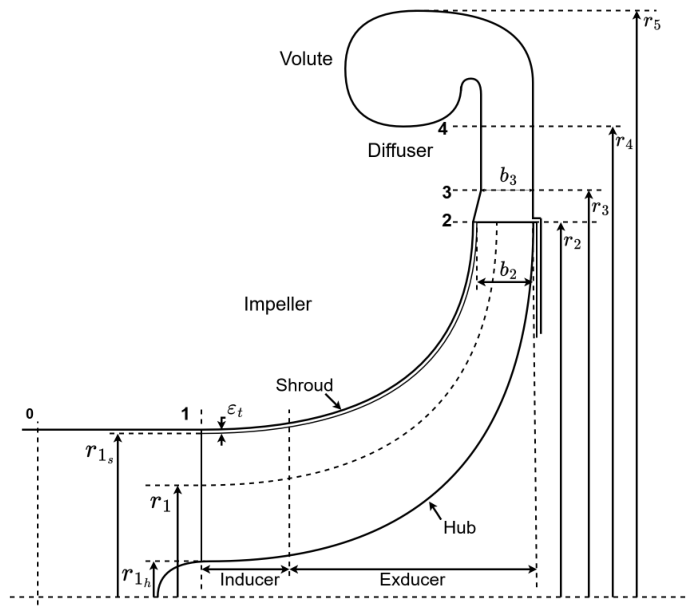
The compressor is divided into its three components, as shown in Figure 1: the impeller, the diffuser and the volute, and the mean-line stations are computed in sequence. The impeller consists of an inducer and an exducer part.
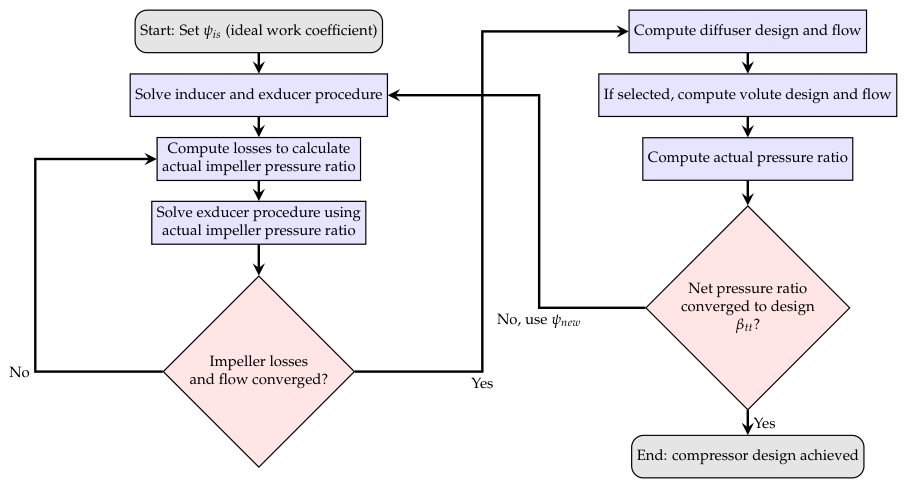
The computational workflow of the on-design procedure is shown in Figure 2. An iterative procedure is used to determine the thermodynamic state and height at the impeller exit (exducer), based on the loss calculations. A second iteration is applied at the compressor level to adjust the work coefficient until the net pressure ratio matches the design target. The complete list of required inputs is provided in the Supplementary Materials, Table S1.

2.2. Impeller

The impeller requires the input of blade number, blade thickness, rake angles, exit radius, and inlet shape factor. For the inducer, the combination of hub and shroud radii is found that corresponds to the lowest Mach number at the shroud in order to minimize compressibility effects. The free-vortex velocity triangle distribution and the thermodynamic state are computed accordingly, using the CoolProp open-source library and with density as the convergence parameter [9].
Given the user-defined pressure ratio, flow angle and density guess, the slip model [10] and Euler equation are used to compute the velocity triangle and the thermodynamic state at the impeller exit. The state is then corrected for internal losses, which yields a new density, and the process repeats until convergence. The total efficiency is subsequently determined by accounting for both the internal and external losses. Their semi-empirical models and sources are shown in Table 1.
The chosen models are mainly based on set 2 from Zhang et al., as it was found to be the most appropriate [4]. The leakage loss model by Oh et al. is accurate for compressors operating under low load. For higher pressure ratios, the Coppage model is preferable. For the mixing loss, the ’Two-Zone model’ method proposed by Zhang et al. [17] is used to numerically determine the wake width fraction, improving the prediction of the flow behavior at the diffuser inlet and the magnitude of the losses. This is particularly important for the vaned diffuser, where the choking condition is highly dependent on the impeller exit flow angle. As a result, the added complexity in modeling the mixing loss is justified.

2.3. Diffuser

The diffuser features two different configurations: the vaneless and the vaned. In the vaneless case, the geometry is user-defined, and the flow properties are obtained by solving the ordinary differential equations formulated by Stanitz [6]. For the vaned diffuser, the geometry is specified through the user-defined divergence angle, vane-leading edge thickness, and pitch height and radius. The pitch radius is fixed at the vane leading edge radius, and the upstream flow is computed using the vaneless procedure. To minimize incidence, the vane angle is set equal to the resulting flow angle. Finally, to ensure proper coupling between the impeller and diffuser, the throat area is calculated using the method of Casey and Rush, from which the required number of vanes follows naturally [18].
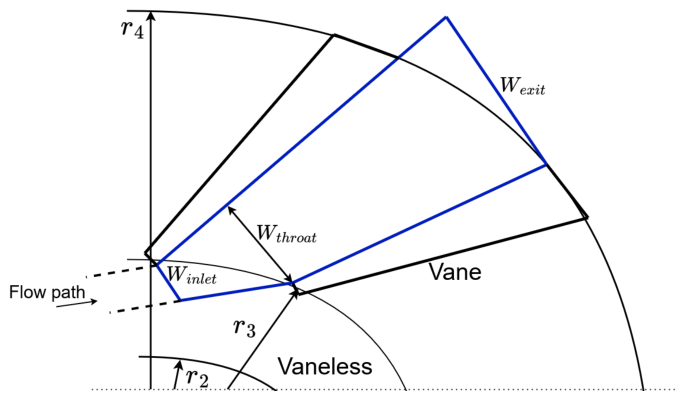
The flow in the vaned diffuser is considerably more complex than in the vaneless case. The presence of vanes in the flow path introduces turbulent boundary layers in an adverse pressure gradient, making the flow susceptible to separation. The analysis is conducted using a representative streamtube, illustrated in Figure 3. The objective is to accurately predict the static pressure recovery and losses in terms of total pressure. To this end, a coupled viscous–inviscid interaction method is adopted as the most suitable approach.
First, the channel flow equations for the Mach number and total pressure are derived from internal compressible flow principles, as shown in Equations (1) and (2), where the subscript ’e’ denotes the edge of the boundary layer [19]. These are expressed in terms of the dissipation coefficient C d , which represents the losses associated with the generation of total entropy and is not only governed by skin friction.
1 M 2 d M 2 d x = 1 + γ 1 2 M 2 1 M 2 2 A d A d x 2 p 0 d p 0 d x = 1 + γ 1 2 M 2 1 M 2 2 A d A d x 2 p 0 ρ e 2 m ˙ V e 3 C d
d p 0 d x = ρ e 2 m ˙ V e 3 C d , C d = T S i r r e v ρ V e 3
The boundary layer model provides the required relations for the momentum thickness θ and the displacement thickness δ * . To accurately represent the complex boundary layer behavior that develops in the diffuser passage, a suitable modeling approach must be selected. Based on reviews by Johnston and Japikse [1,20], the method of Childs and Ferziger is selected as the most appropriate choice [21].
They proposed a unified integral method tailored to channel diffusers, offering improved robustness against singularity issues that are common in integral methods. The method incorporates a lag-entrainment to represent the mass flux from the core flow into the boundary layer and requires the edge properties, which follow from the core equations.
The boundary layer formulation introduces three differential relations. The first governs the evolution of the shape parameter Λ , defined as the ratio of displacement thickness to boundary layer thickness. The second describes the development of the displacement thickness δ * . The third determines the entrainment parameter E, which represents the mass flux from the core flow to the boundary layer. Because these relations must be solved independently on the suction side and on the pressure side of the streamtube, the full system consists of eight coupled ordinary differential equations. The three boundary layer equations are provided in Equation (3) in their general form and apply to both sides. Auxiliary quantities such as E e q , δ , d δ / d x , θ , d θ / d x , H and d H / d x follow directly from the unified integral method of Childs and are therefore not repeated here.
d E d x = λ δ ( E e q E ) , d δ * d x = H d θ d x + θ d H d x , d Λ d x = d δ * d x δ δ * d δ d x δ 2
At the diffuser exit, the flow consists of a high-energy core flow and a low-momentum boundary layer. The thickness of the trailing edge of the vane further contributes to the low momentum part through its wake. Consequently, mixing between these two flows, from the vane trailing edge to downstream, leads to additional total pressure loss. This is assumed to occur instantaneously at the diffuser exit and is evaluated following the mass average method of Greitzer, Tan, and Graf [19].

2.4. Off-Design

Unlike the design case, where a target pressure ratio is prescribed, the off-design analysis relies on the known geometry, either user-defined or from the on-design output, to evaluate impeller performance. At each iteration, the impeller exit meridional velocity is computed from the continuity relation using the known area and a density guess. The relative flow angle is then obtained from the slip model, which enables the construction of the isentropic velocity triangle and the computation of the work coefficient through the Euler turbomachinery equation. The resulting thermodynamic state is corrected using the internal loss correlations and then used to update the density guess. The cycle is repeated until convergence, which yields the actual pressure ratio of the impeller.
To generate the performance map, the methodology of Giuffré is used [22], where the mass flow is first increased to find the choke point. Once found, the mass flow is decreased until an instability criterion is met. This procedure is then repeated for all required RPM settings. The impeller choke condition is determined from the velocity at the throat, found by using the static enthalpy at the impeller inlet and the conservation of rothalpy and mass. The diffuser choke condition depends on the presence of vanes. As the mass flow increases, the flow angle at the impeller exit decreases. Eventually, the effective inlet area of the streamtube exceeds the throat area, causing the passage to act as a convergent channel.
There are two criteria for identifying instability. First, instability occurs when the pressure ratio begins to decrease with decreasing mass flow, i.e., d β t t / d m ˙ > 0, following the linearized condition of Cumpsty [23]. Second, a rotating stall occurs for high flow angles at the impeller exit, and the critical value is determined by the semi-empirical relationships of Kobayashi and Senoo [24,25].

3. Results

The results focus on validating the model by comparing its predictions with experimental data from various open-source compressor designs. A total of six validation cases were analyzed. For brevity, only two representative compressors are discussed, one with a vaned diffuser configuration and the other with both configurations. The remaining cases show the same trends and lead to similar conclusions. The parameters defining the compressor designs are listed in Table S2 in the Supplementary Material [26,27].
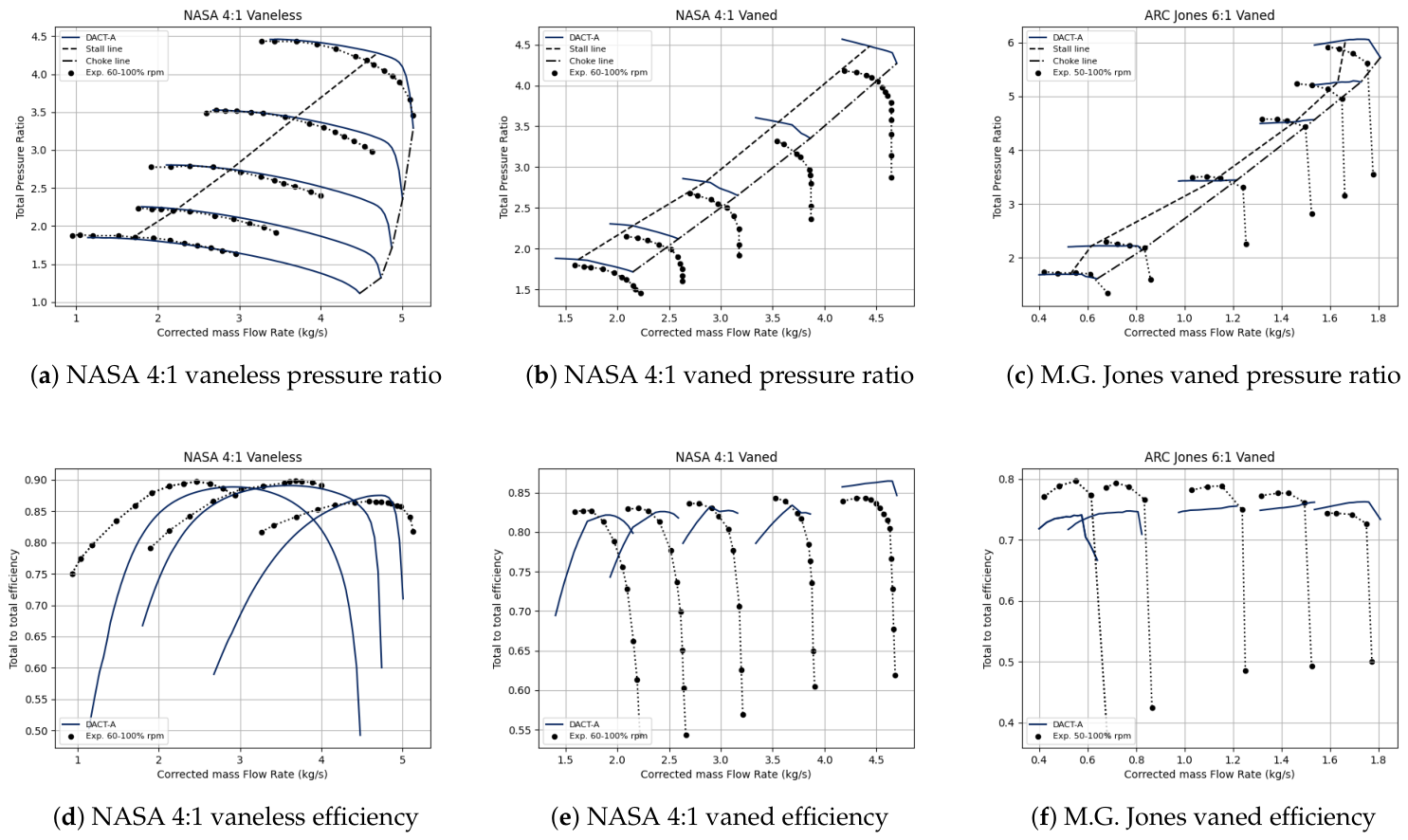
Skoch et al. performed laser anemometer measurements on the NASA 4:1 pressure ratio centrifugal compressor, and the results are compared to the results of DACT-A in Figure 4 for both vaneless (a,d) and vaned (b,e) diffuser configurations [28]. Efficiency lines of 60%, 80% and 100% are shown for the vaneless diffuser case for clarity, whereas for the vaned case, the lines for 70% and 90% rpm are included as well. The dots represent the experimental data points, while the solid lines indicate the prediction of the model. The dashed line marks the stall limit, and the dashed-dotted line marks the choke limit.
For the vaneless configuration, the onset of stall is for a higher mass flow compared to the data, showing a significant decrease in operating range. The pressure ratio and efficiency predictions show a good match, although the choking points exhibit a substantial deviation. In the vaned case, the stall and choke behavior agrees excellently with the experimental data. The efficiency trends and peak values are also well predicted. However, the pressure ratios are overestimated, and the efficiency lines would thus have a negative offset if the internal losses matched the experimental data better.
The second validation case is that of M.G. Jones of the Aeronautical Research Center in London, shown for the vaned diffuser configuration in Figure 4c,f [27]. This compressor is highly loaded, and that proves to be complex to adequately analyze. Consequently, the operating lines are more straight, and the solver is very sensitive to the condition d β t t / d m ˙ > 0 , resulting in a stall line as shown. In contrast, the choke line shows excellent agreement with the experimental data, while the pressure ratios remain accurate except at high rotational speed. The efficiency trends are also well captured, but with a systematic offset of roughly 3%.

4. Discussion

4.1. Choke and Stall

Choke and stall conditions for a centrifugal compressor remain difficult to predict accurately with low-order methods due to their strongly three-dimensional nature. This is most apparent in the vaneless diffuser configuration, where choking typically occurs in the impeller. In contrast, choke prediction in the vaned diffuser configuration is substantially more accurate, as choking occurs at the diffuser throat. This condition can be identified with relative ease from the angle and velocity of the flow at the impeller exit. Thus, although the flow entering the diffuser is highly non-uniform, its choking behavior is more predictable than in the impeller. The increased complexity of the two-zone model in accurately estimating the dominant mixing loss is validated by the enhanced prediction of the impeller outflow angle, thus more accurately determining the stall and choking conditions for the vaned configuration.
The prediction of stall remains more elusive and is based here on the equations of Senoo. In addition, the instability criterion is sensitive in compressors with characteristically flat performance maps. For a low-fidelity model, however, these approaches currently are the most suitable options available to the authors.

4.2. Validity

For the purpose of this program as a preliminary design and analysis tool for centrifugal compressors, the predictions are sufficiently accurate, generally within a 5% error margin for computed pressure ratio and efficiency. The accuracy of the vaned diffuser is slightly lower than that of the vaneless diffuser. The similar trend observed in the efficiency lines for both validation cases indicates inaccuracies in at least one of the external loss models. Because the pressure ratio predictions show considerably better agreement, the offset cannot be attributed to the internal loss models. Therefore, it is evident that external losses are overestimated at low mass flow rates and underestimated at higher mass flow rates. Investigation in external loss models that capture this behavior more effectively could substantially improve prediction accuracy.
The simulation time depends on the computer hardware and compressor characteristics and is typically 0.1 to 1.5 min and 2 to 4 min per operating line for vaneless and vaned configurations, respectively. Although direct incorporation into system models is still computationally costly, the tool can generate extensive datasets of compressor designs and their associated performance metrics that can be used directly in system simulations.

5. Conclusions

DACT-A meets the requirements of a fast and efficient design and analysis tool, serving as an important first step toward the development of a comprehensive optimization model for the sizing of air generation systems. The evaluation of the vaned diffuser configuration revealed that it provides a more precise representation of the operational range compared to the vaneless configuration. This increased accuracy is attributable to the more intricate three-dimensional dynamics of the choke phenomena within the impeller, in contrast to the choke behavior observed within the vaned diffuser passage, which is mainly influenced by the impeller outflow angle. However, the pressure ratio and efficiency predictions are more precise in the vaneless configuration, because of the complex loss mechanisms present in the vaned diffuser. The model can be extended in future research to include design and performance modules for the other components of the ECS.

Supplementary Materials

The following supporting information can be downloaded at: https://www.mdpi.com/article/10.3390/engproc2026133160/s1, Table S1: Required inputs for the program.; Table S2: Input parameters for two compressor cases.

Author Contributions

Conceptualization, T.B., G.Ç. and M.P.; methodology, software, validation, and formal analysis, T.B. and G.Ç.; writing, T.B., G.Ç., W.C. and M.P.; visualization and investigation, T.B.; supervision, G.Ç., W.C. and M.P.; project administration, G.Ç. All authors have read and agreed to the published version of the manuscript.

Funding

The project is supported by the Clean Aviation Joint Undertaking and its members under grant agreement No. 101102008.

Data Availability Statement

The original contributions presented in this study are included in the article. Further inquiries can be directed to the corresponding author.

Conflicts of Interest

Author Matteo Pini was employed by the Delft University of Technology. Authors Gülberg Celikel and Wilson Casas were employed by the company Airbus Operations GmbH. Author Toon Bloem was a master’s student at the Delft University of Technology and was employed by the company Airbus Operations GmbH.

References

  1. Japikse, D. Centrifugal Compressor Design and Performance; Concepts ETI: Wilder, VT, USA, 1996. [Google Scholar]
  2. Aungier, R. Centrifugal Compressors: A Strategy for Aerodynamic Design and Analysis; ASME: New York, NY, USA, 2000. [Google Scholar]
  3. Oh, H.; Yoon, E.; Chung, M. An optimum set of loss models for performance prediction of centrifugal compressors. IMA J. Power Energy 1997, 211, 331–338. [Google Scholar] [CrossRef]
  4. Zhang, C.; Dong, X.; Liu, X.; Sun, Z.; Wu, S.; Gao, Q.; Tan, C. A method to select loss correlations for centrifugal compressor performance prediction. Aerosp. Sci. Technol. 2019, 93, 105335. [Google Scholar] [CrossRef]
  5. Kovář, P.; Tater, A.; Mačák, P.; Vampola, T. Searching for the Most Suitable Loss Model Set for Subsonic Centrifugal Compressors Using an Improved Method for Off-Design Performance Prediction. Energies 2021, 14, 8545. [Google Scholar] [CrossRef]
  6. Stanitz, J.D. One-Dimensional Compressible Flow in Vaneless Diffusers of Radial- and Mixed-Flow Centrifugal Compressors, Including Effects of Friction, Heat Transfer and Area Change; NACA TN 2610; NASA: Cleveland, OH, USA, 1952.
  7. Vujicic, M.; Crnojevic, C. Calculation of Turbulent Flow in a Plane Diffuser by Using the Integral Method. FME Trans. 2003, 31. [Google Scholar]
  8. Hirschmann, A.; Casey, M.; Montgomery, M. A Zonal Calculation Method for Axial Gas Turbine Diffusers. In Proceedings of the ASME Turbo Expo 2013: Turbine Technical Conference and Exposition, San Antonio, TX, USA, 3–7 June 2013. GT2013-94117, V06BT37A002. [Google Scholar]
  9. Bell, I.H.; Wronski, J.; Quoilin, S.; Lemort, V. Pure and Pseudo-Pure Fluid Thermophysical Property Evaluation and the Open-Source Thermophysical Property Library CoolProp. Ind. Eng. Chem. Res. 2014, 53. [Google Scholar] [CrossRef] [PubMed]
  10. Wiesner, F. A Review of Slip Factors for Centrifugal Impellers. J. Eng. Power 1967, 89, 558–566. [Google Scholar] [CrossRef]
  11. Galvas, M.R. FORTRAN Program for Predicting Off-Design Performance of Centrifugal Compressors; TN D-7487; National Aeronautics and Space Administration: Washington, DC, USA, 1973.
  12. Coppage, J.; Eichenberger, H.; Hlavaka, G.; Knoernschild, E.; Le, N.V.; Dallenbach, F. Study of Supersonic Radial Compressors for Refrigeration and Pressurization Systems; WADC Technical Report 55-257; Wright-Patterson Air Force Base: Dayton, OH, USA, 1956. [Google Scholar]
  13. Jansen, W. A Method for Calculating the Flow in a Centrifugal Impeller When Entropy Gradients Are Present. In Proceedings of the Royal Society Conference on Internal Aerodynamics; IME: London, UK, 1967. [Google Scholar]
  14. Whitfield, A.; Baines, N.C. Design of Radial Turbomachines; Longman Scientific & Technical: Harlow, UK, 1990. [Google Scholar]
  15. Johnston, J.P.; Dean, R.C. Losses in Vaneless Diffusers of Centrifugal Compressors and Pumps. J. Eng. Power 1966, 88, 49–60. [Google Scholar] [CrossRef]
  16. Daily, J.W.; Nece, R.E. Chamber Dimension Effects on Induced Flow and Frictional Resistance of Enclosed Rotating Disks. J. Basic Eng. 1960, 82, 217–230. [Google Scholar] [CrossRef]
  17. Zhang, C.; Dong, X.; Liu, X.; Gao, Q.; Tan, C.q. An Improved Streamline Curvature Method for Centrifugal Compressor Performance; ASME: New York, NY, USA, 2017. [Google Scholar]
  18. Casey, M.; Rusch, D. The Matching of a Vaned Diffuser with a Radial Compressor Impeller and its Effect on the Stage Performance; ASME: New York, NY, USA, 2014. [Google Scholar]
  19. Greitzer, E.; Tan, C.; Graf, M. Internal Flow; Cambridge University Press: Cambridge, UK, 2017. [Google Scholar]
  20. Johnston, J. Review: Diffuser Design and Performance Analysis by a Unified Integral Method. J. Fluids Eng. 1998, 120, 6–18. [Google Scholar] [CrossRef]
  21. Childs, R.; Ferziger, J. A Computational Method for Subsonic Compressible Flow in Diffusers; AIAA: New York, NY, USA, 1983. [Google Scholar]
  22. Giuffré, A. Integrated Design Optimization of Electrically-Driven Vapor Compression Cycle Systems for Aircraft. Ph.D. Thesis, Delft University of Technology, Delft, The Netherlands, 2023. [Google Scholar]
  23. Cumpsty, N. Compressor Aerodynamics; Longman Scientific & Technical: Harlow, UK, 1989. [Google Scholar]
  24. Kobayashi, H.; Nishida, H.; Takagi, T.; Fukushima, Y. A Study on the Rotating Stall of Centrifugal Compressors: 2nd Report, Effect of Vaneless Diffuser Inlet Shape on Rotating Stall. Trans. Jpn. Soc. Mech. Eng. B. 1990, 56, 2646–2651. [Google Scholar] [CrossRef]
  25. Senoo, Y.; Kinoshita, Y. Limits of Rotating Stall and Stall in Vaneless Diffuser of Centrifugal Compressors; ASME: New York City, NY, USA, 1978. [Google Scholar]
  26. McKain, T.; Holbrook, G. Coordinates for a High Performance 4:1 Pressure Ratio Centrifugal Compressor; NASA CR 204134; NASA: Cleveland, OH, USA, 1997. [Google Scholar]
  27. Jones, M. The Performance of a 6.5 Pressure Ratio Centrifugal Compressor; ARC CP-1385; Her Majesty’s Stationery Office: London, UK, 1977. [Google Scholar]
  28. Skoch, G.J.; Prahst, P.S.; Wernet, M.P.; Wood, J.R.; Strazisar, A.J. Laser Anemometer Measurements of the Flow Field in a 4:1 Pressure Ratio Centrifugal Impeller; ASME: New York, NY, USA, 1997. [Google Scholar]
Figure 1. Schematic of the mean-line stages of the centrifugal compressor.
Engproc 133 00160 g001
Figure 2. Flow diagram of the iterative design procedure.
Engproc 133 00160 g002
Figure 3. Schematic of the streamtube control area, indicated by the blue lines.
Engproc 133 00160 g003
Figure 4. Comparison of DACT-A predictions with experimental data for the NASA 4:1 compressor and the M.G. Jones compressor.
Engproc 133 00160 g004
Table 1. The different loss mechanisms and models for the impeller.
Loss MechanismTypeSource
IncidenceInternalGalvas [11]
Blade loadingInternalCoppage [12]
Skin frictionInternalJansen [13]
ClearanceInternalJansen [13]
ChokeInternalAungier [2]
ShockInternalWhitfield & Baines [14]
MixingInternalJohnston & Dean [15]
Disc frictionExternalDailey & Nece [16]
RecirculationExternalOh ( β t t 3 ) [3], Coppage ( β t t > 3 ) [12]
LeakageExternalAungier [2]
Disclaimer/Publisher’s Note: The statements, opinions and data contained in all publications are solely those of the individual author(s) and contributor(s) and not of MDPI and/or the editor(s). MDPI and/or the editor(s) disclaim responsibility for any injury to people or property resulting from any ideas, methods, instructions or products referred to in the content.