Proceeding Paper

Application of an Event-Based Approach to Assess Bivariate Rainfall Models in Two Italian Climates †
by
Matteo Balistrocchi
*,
Hamzah Faquseh
and
Giovanna Grossi
Department of Civil, Environmental, Architectural Engineering and Mathematics (DICATAM), Università di Brescia, 25123 Brescia, Italy
*
Author to whom correspondence should be addressed.
Presented at II International Conference on Challenges and Perspectives in Urban Water Management Systems (CSDU-CSSI DAYS 25), Trieste, Italy, 18–19 November 2025.
Eng. Proc. 2026, 135(1), 24; https://doi.org/10.3390/engproc2026135024 (registering DOI)

Published: 20 May 2026

Abstract

The assessment of non-stationarity in the rainfall process is still a major research topic in the field of applied hydrology. The water cycle is affected by several characteristics of this process: rainfall volume, wet weather duration, their mutual association, and the annual number of events. The method used to sample rainfall variables from the time series may or may not suitably account for their variability. Herein, the rainfall process is analyzed using a bivariate event-based approach, with reference to two rainfall time series recorded at short time steps in different Italian climates. Trends are also estimated.

1. Introduction

The impact of climate change on the rainfall process has long been debated, and a vast body of research exists on this topic [1,2,3,4,5,6,7]. Nevertheless, non-stationarities are strongly dependent on the method used to sample the rainfall volumes from the continuous time series (total rainfall volumes referred to calendar intervals, annual maxima of rainfall volumes referred to a constant duration, inter event time definition used to separate rainfall events) and its parameterization. In Northern Italy, for instance, when total annual rainfall depths are analyzed, discordant and statistically non-significant trends are often estimated [6]. In contrast, when individual independent rainfall events are sampled by using an inter event time definition, the rainfall depth may show different trends, whose statistical significance depends on the season [7]. Furthermore, trend analyses often focus only on the non-stationarity in the rainfall depth. Several stochastic properties of the rainfall process, however, have a remarkable impact on the water cycle, such as (i) the variability of the wet weather duration, (ii) strength of the dependence structure relating the rainfall depth to the wet weather duration, and (iii) the number of events per year. Seasonality of all these items may play a crucial role as well. The event-based approach allows researchers to investigate the natural variability of multiple properties of the rainfall process at different time scales and their trends. In addition, the event-based approach makes it possible to develop analytical probabilistic models [8,9] or Monte Carlo simulation procedures [7], which can straightforwardly assess the impacts of multiple non-stationarities in the rainfall process on the runoff process. Nonetheless, few studies have used this approach until now. The event-based approach needs extended and high-quality rainfall time series recorded at a small time step, which are seldom available. In this work, two rainfall time series recorded in different Italian climates are analyzed by an event-based approach to assess the variability of multiple rainfall variables and their trends.

2. Materials and Methods

Main characteristics of the rain gauges and of the rainfall time series used in this study are listed in Table 1. Brescia ITAS is placed in Northern Italy at the transition between the Po Plain and the Alpine mountain range. The climate is humid with a mean annual rainfall of about 1000 mm. The rainfall regime is temperate, featuring two maxima (spring and autumn) and two minima (summer and winter). Messina is placed in Southern Italy along the eastern coast of the island of Sicily. The climate is dry with a mean annual rainfall of about 850 mm. The rainfall regime is Mediterranean, featuring a maximum in winter and a minimum in summer.
Individual independent rainfall events were sampled from the continuous time series using a minimum inter event dry period and a volume threshold, herein referred to as Inter Event Time Definition (IETD) and Initial Abstraction (IA), respectively (see details in [9,11]). Thus, each rainfall event can be characterized by multiple random variables, whose mutual associations can be investigated. In this study, the rainfall volume v, the wet weather duration d, and their association strength τ were analyzed. Events were aggregated according to calendar years to compute the annual mean values of v and d, the annual values of τ, by means of the Kendall rank correlation coefficient, and the total annual number of events μ. Linear trends were then assessed by using the Theil–Sen estimators for intercept and slope. These estimators have been demonstrated to be more robust than the traditional least squares regression when outliers exist [12]. To evaluate the trend significance, Theil tests for the slope of the regression line were conducted [12]. Stationarity, that is, a linear regression slope equal to zero, was assumed to be the null hypothesis.

3. Results and Discussion

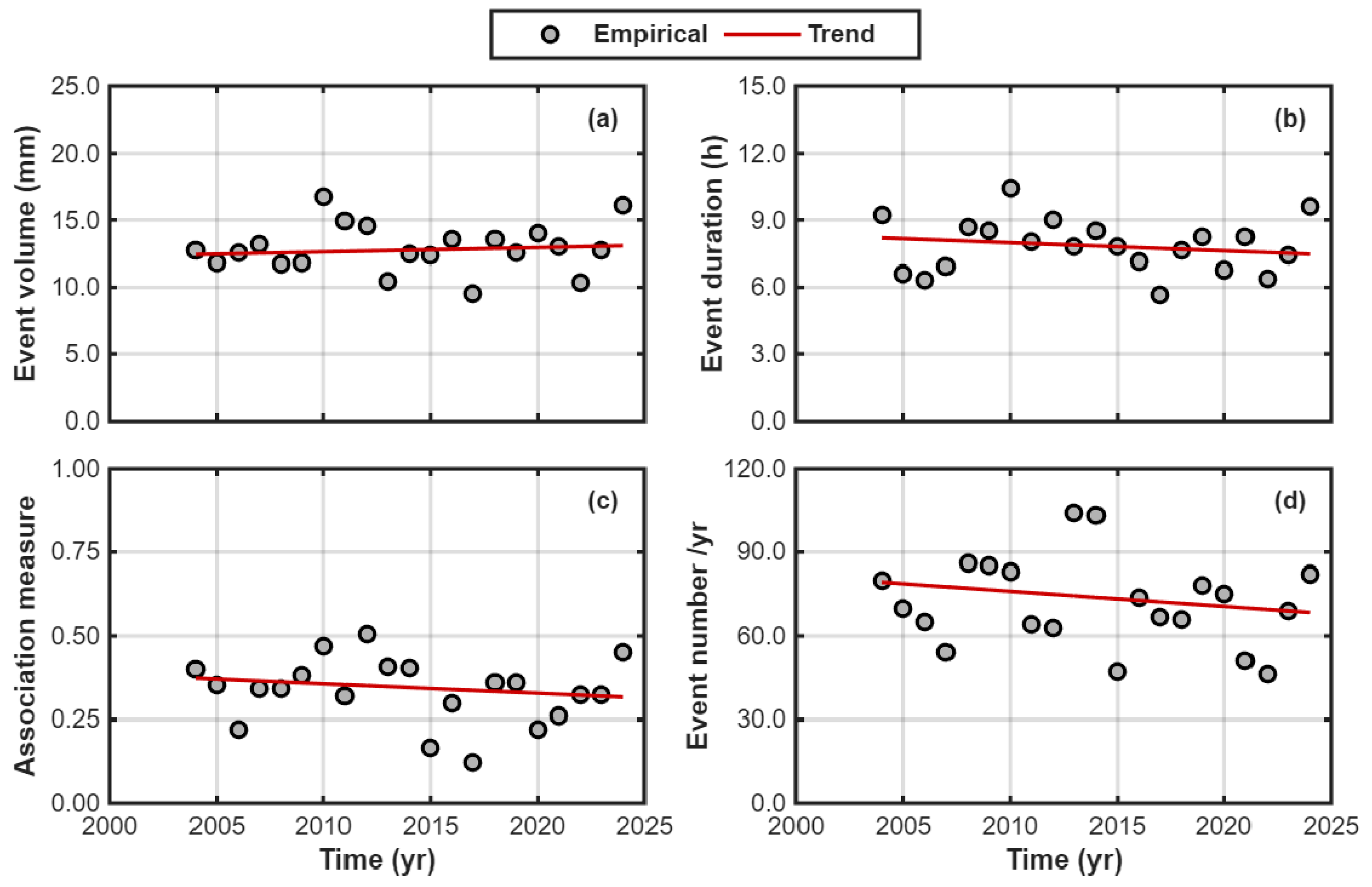
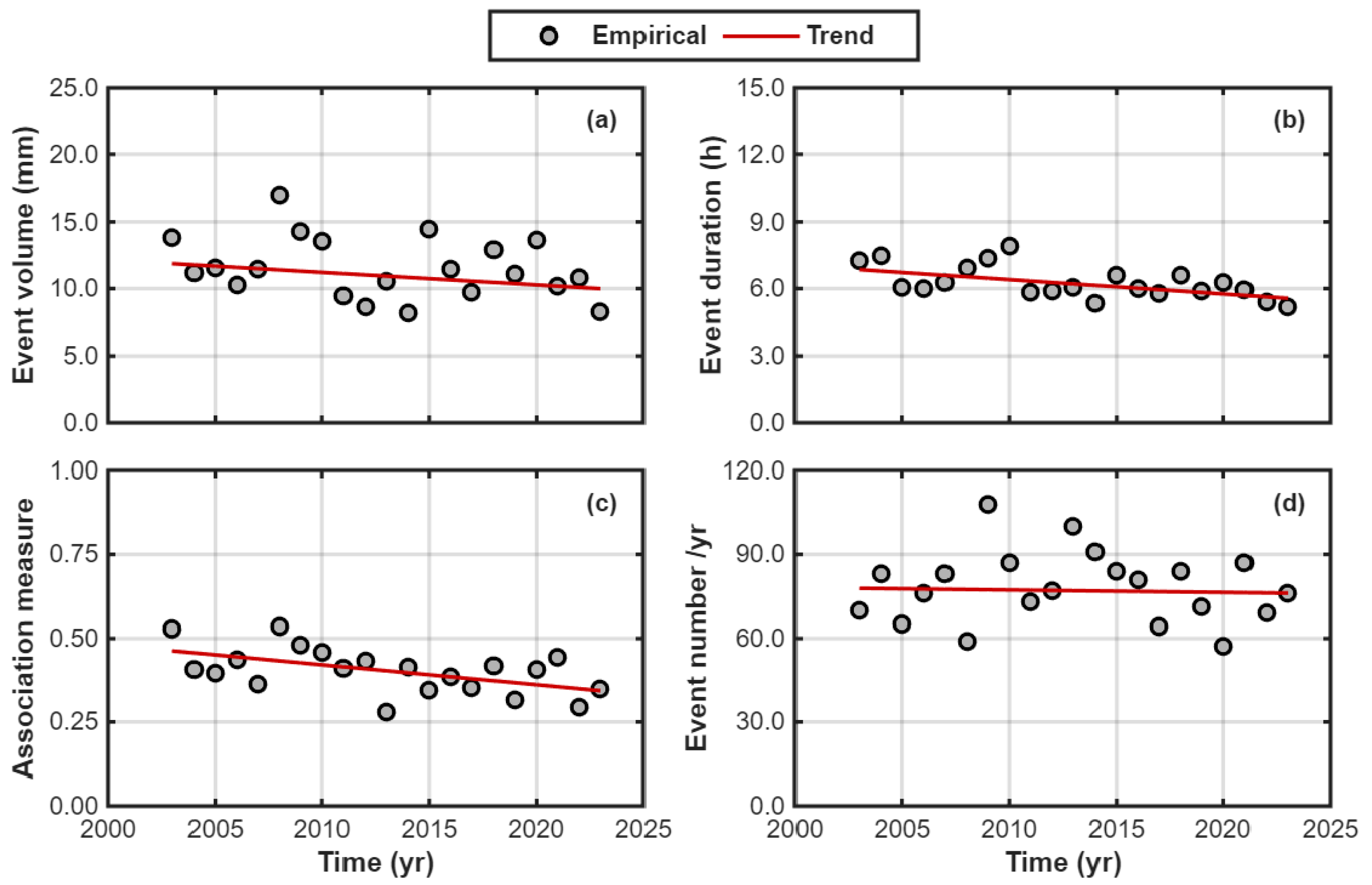
Aiming at spanning the full range of possible rainfalls, both series were analyzed using low values of the sampling parameters: IETD equal to 3 h and IA equal to 2 mm. As can be seen in Figure 1 and Figure 2, both time series surprisingly revealed similar results in terms of all analyzed variables, which span the same ranges in the two climates. For instance, the estimated mean annual rainfall volumes proved to be close, as for Brescia it was estimated in 972 mm (in agreement with historical data), whereas for Messina it was estimated in 970 mm (larger than expected). Trends were generally decreasing for all variables except for the annual mean of v in Brescia ITAS, as shown in Table 2. However, only those of d and τ in the Messina series appeared to be statistically significant (p-values less than 5%). It should be noted that decreasing trends in the association strength τ can have a remarkable impact on flood frequency, owing to the more frequent occurrence of events with large volume and short duration [7]. This impact may be further emphasized by the decrease in the wet weather duration d.

4. Conclusions

The event-based approach has demonstrated to be an effective strategy to investigate multiple aspects of the rainfall process, including potential trends and their significance. Most of the trends analyzed in this work were found to be statistically non-significant. However, further efforts must be taken to increase the series length in order to better investigate this issue. Seasonality is an additional direction that the research should addressed.

Author Contributions

Conceptualization, M.B. and G.G.; software, M.B.; validation, M.B., H.F. and G.G.; investigation, M.B., H.F. and G.G.; data curation, M.B. and G.G.; writing—original draft preparation, M.B. and G.G.; writing—review and editing, G.G.; visualization, M.B.; funding acquisition, G.G. All authors have read and agreed to the published version of the manuscript.

Funding

This research was supported by the Project “Multi-Risk sciEnce for resilient commUnities undeR a changiNg climate” (RETURN) funded under the National Recovery and Resilience Plan (NRRP), Mission 4 Component 2 Investment 1.3, through the Cascading Call Project SUNRISE (Sustainable Urban areas by Nature-based solutions implementation to mitigate climate impacts and achieve a Resilient, Innovative and Smart Environment).

Institutional Review Board Statement

Not applicable.

Informed Consent Statement

Not applicable.

Data Availability Statement

Time series can be freely downloaded at (Brescia ITAS) https://www.arpalombardia.it/temi-ambientali/meteo-e-clima/form-richiesta-dati last accessed on 25 September 2025, (Messina) http://www.sias.regione.sicilia.it/frameset_dati.htm last accessed on 17 September 2025.

Acknowledgments

The authors wish to thank Giuseppe T. Aronica and Giuseppina Brigandì of University of Messina for having provided the Messina rainfall data. The authors have reviewed and edited the output and take full responsibility for the content of this publication.

Conflicts of Interest

The authors declare no conflicts of interest.

References

  1. IPCC. Climate Change 2021: The Physical Science Basis. Contribution of Working Group I to the Sixth Assessment Report of the Intergovernmental Panel on Climate Change; Masson-Delmotte, V., Zhai, P., Pirani, A., Connors, S.L., Péan, C., Berger, S., Caud, N., Chen, Y., Goldfarb, L., Gomis, M.I., et al., Eds.; Cambridge University Press: Cambridge, UK; New York, NY, USA, 2021; pp. 1–2391. [Google Scholar] [CrossRef]
  2. Brunetti, M.; Maugeri, M.; Nanni, T.; Auer, I.; Böhm, R.; Schöner, W. Precipitation variability and changes in the greater alpine region over the 1800-2003 period. J. Geophys. Res. Atmos. 2006, 111, D11107. [Google Scholar] [CrossRef]
  3. Crespi, A.; Brunetti, M.; Ranzi, R.; Tomirotti, M.; Maugeri, M. A multi-century meteo-hydrological analysis for the Adda River basin (central Alps). Part I: Gridded monthly precipitation (1800–2016) records. Int. J. Climatol. 2021, 41, 162–180. [Google Scholar] [CrossRef]
  4. Villarini, G.; Smith, J.; Vecchi, G. Changing frequency of heavy rainfall over the central United States. J. Clim. 2013, 26, 351–357. [Google Scholar] [CrossRef]
  5. Zollo, A.L.; Rillo, V.; Bucchignani, E.; Montesarchio, M.; Mercogliano, P. Extreme temperature and precipitation events over Italy: Assessment of high-resolution simulations with COSMO-CLM and future scenarios. Int. J. Climatol. 2016, 36, 987–1004. [Google Scholar] [CrossRef]
  6. Balistrocchi, M.; Tomirotti, M.; Muraca, A.; Ranzi, R. Hydroclimatic variability and land cover transformations in the central Italian alps. Water 2021, 13, 963. [Google Scholar] [CrossRef]
  7. Balistrocchi, M.; Grossi, G. Predicting the impact of climate change on urban drainage systems in northwestern Italy by a copula-based approach. J. Hydrol. Reg. Stud. 2020, 28, 100670. [Google Scholar] [CrossRef]
  8. Bacchi, B.; Balistrocchi, M.; Grossi, G. Proposal of a semi-probabilistic approach for storage facility design. Urban Water J. 2008, 5, 195–208. [Google Scholar] [CrossRef]
  9. Balistrocchi, M.; Grossi, G.; Bacchi, B. An analytical probabilistic model of the quality efficiency of a sewer tank. Water Resour. Res. 2009, 45, 1633–1644. [Google Scholar] [CrossRef]
  10. Peel, M.C.; Finlayson, B.L.; McMahon, T.A. Updated world map of the Köppen-Geiger climate classification. Hydrol. Earth Syst. Sci. 2007, 11, 1633–1644. [Google Scholar] [CrossRef]
  11. Adams, B.J.; Papa, F. Urban Stormwater Management Planning with Analytical Probabilistic Models; Wiley & Sons: New York, NY, USA, 2000; p. 358. [Google Scholar]
  12. Hollander, M.; Wolfe, D.A.; Chicken, E. Regression problems. In Nonparametric Statistical Methods, 3rd ed.; Hollander, M., Wolfe, D.A., Chicken, E., Eds.; Wiley & Sons: New York, NY, USA, 2014; pp. 451–494. [Google Scholar]
Figure 1. Bivariate event-based analysis of the Brescia ITAS series (IETD = 3 h, IA = 2 mm): (a) rainfall volume v, (b) wet weather duration d, (c) association τ between rainfall volume and wet weather duration, and (d) number of individual independent events per year μ.
Engproc 135 00024 g001
Figure 2. Bivariate event-based analysis of the Messina series (IETD = 3 h, IA = 2 mm): (a) rainfall volume v, (b) wet weather duration d, (c) association τ between rainfall volume and wet weather duration, and (d) number of individual independent events per year μ.
Engproc 135 00024 g002
Table 1. Analyzed rainfall time series and characteristics of the rain gauges.
Rain GaugeClimate 1LatitudeLongitudeElevationConsistencyTime Step
Brescia ITASCfa45.5333°10.2194°150 MASL2004–202410 min
MessinaCsa38.2587°15.5614°421 MASL2003–202310 min
1 Updated Köppen–Geiger climate classification: Cfa = temperate, without dry season, hot summer; Csa = temperate, dry and hot summer [10].
Table 2. Trends of analyzed rainfall variables and statistical significance of the stationarity tests, expressed as percentage p-values reported in italics within brackets (IETD = 3 h, IA = 2 mm).
Rain Gaugev (mm 10−2 yr−1)d (h 10−2 yr−1)τ (10−2 yr−1)μ (10−2 yr−1)
Brescia ITAS3.2 (62.9%)−3.6 (50.7%)−0.3 (46.9%)−54.4 (39.8%)
Messina−9.4 (14.7%)−6.5 (0.9%)−0.6 (3.5%)−8.7 (80.9%)
Disclaimer/Publisher’s Note: The statements, opinions and data contained in all publications are solely those of the individual author(s) and contributor(s) and not of MDPI and/or the editor(s). MDPI and/or the editor(s) disclaim responsibility for any injury to people or property resulting from any ideas, methods, instructions or products referred to in the content.